Kernel Methods for Small Sample and
Asymptotic Tail Inference for Dependent,
Heterogeneous Data
[Running Title: Kernel Methods for Tail Inference]Jonathan B. Hill
¤Dept. of Economics
Florida International University, Miami, FL
March 17, 2007
Abstract
This paper considers tail shape inference techniques robust to sub-stantial degrees of serial dependence and heterogeneity. We detail a new kernel estimator of the asymptotic variance and the exact small sample mean-squared-error, and a simple representation of the bias of the B. Hill (1975) tail index estimator for dependent, heterogeneous data.
Under mild assumptions regarding the tail fractile sequence, mem-ory and heterogeneity, choosing the sample fractile by non-parametrically minimizing the mean-squared-error leads to a consistent and asymptoti-cally normal estimator.
A broad simulation study demonstrates the merits of the resulting minimum MSE estimator for autoregressive and GARCH data. We ana-lyze the distribution of a standardized Hill-estimator in order to asses the accuracy of the kernel estimator of the asymptotic variance, and the distri-bution of the minimum MSE estimator. Finally, we apply the estimators to a small study of the tail shape of equity markets returns.
1. INTRODUCTION The use of extreme value theory has reached into risk management in …nance, damage and catastrophe modeling in the en-gineering, actuarial and meteorological sciences, and the analysis of asset mar-ket contagion and hyper-in‡ation. See, e.g., Mandelbrot (1963), Fama (1965), McCulloch (1996), Embrechts, Klüppelberg, and Mikosch (1997), Finkenstadt
¤Dept. of Econom ics, Florida International University, Miami, FL; www.…u.edu/»hilljona ;
jonathan.hill@…u.edu. A MS classi…cation: 6 2G32.
Keywords: Hill estimato r; reg ular variation; extremal near epoch dependence; kernel estima-tor; mean-squa re-error.
and Rootzén (2003), Bradley and Taqqu (2003), Rachev (2003), and Beirlant, Goegebeur, Segers, Teugels, and De Waal (2004).
The general framework for analyzing extremes begins by assuming the dis-tribution tail is regularly varying at1: there exists some 0such that for all
¹
() :=() =¡()0whereis slowly varying. (1)
Distributions satisfying (1) include the domain of attraction of the stable laws with 2, coincide with the maximum domain of attraction of the extreme value distributionsexpf¡¡g, and characterize the tails of GARCH processes. See de Haan (1970), Leadbetter, Lindgren and Rootzén (1983), Bingham, Goldie and Teugels (1987), Resnick (1987), and Basrak, Davis, and Mikosch (2002).
Denote by ()0the order statistic of the sample path f1g:
(1)¸(2)¸, and let=fg2Ndenote a sequence of integers satisfying
! 1 as ! 1, and = (). B. Hill (1975) proposed the following
estimator of¡1: ^ ¡1 := 1 X =1ln()(+1)
The Hill-estimator has been widely used in the economics, …nance, and telecom-munications literatures, in particular on data for which substantial evidence suggests serial dependence and/or heterogeneity via volatility clustering. See Akgiray and Boothe (1988), Cheng and Rachev (1995), Resnick and Rootzén (2000) and Chan, Deng, Peng and Xia (2005) and Hill (2005b), to name a very few.
The question of selecting the tail fractile for dependent, heterogeneous
data, however, remains entirely ignored. Tail fractile selection is a long stand-ing problem in the extreme value theory literature because tail shape and tail dependence estimates may be highly sensitive to the chosen tail region. See Fig-ure 1 for plots of ^¡1 and^¡[1] foriid, AR(1) and IGARCH data with Stable or Pareto innovations. Positive serial dependence increases the likelihood that neighboring observations are close in value, diminishing observable tail thick-ness and rendering the Hill-estimator positively biased (e.g. Stable AR(1)); volatility clustering augments the detectable degree of tail thickness, leading to negatively biased estimates (e.g. Pareto IGARCH). Such plots are essentially non-formative for dependent or heterogeneous data.
INSERT FIGURE 1 HERE
Graphical "Hill-plot" methods for tail fractile selection for iiddata are con-sidered at length in Renick and St¼aric¼a (1997) and Drees, de Haan, and Resnick (2000). See, also, Beirlant, Vynckier and Teugels (1996) and Beirlant, Dierckx, and Guillou (2005). Bootstrap and adaptive selection methods for selecting
in theiid case are considered in Hall and Welsh (1985), Hall (1990), Drees and Kaufman (1997), and Draisma, de Haan, Peng and Periera (1997).
Mean-squared-error (MSE) and bias reduction methods for selecting
are developed in the seminal contributions of Hall (1982) and Hall and Welsh (1985), and recently in Beirlant,Vynckier and Teugels (1996), Resnick and St¼aric¼a (1997), Danielsson, de Haan, Peng, and de Vries (1998), Hall (1990), and Huisman Koedijk, Kool, and Palm (2001). Aniid assumption is universally im-posed in this literature, and several methods are suggested without theoretical riguer. Consider Beirlant,Vynckier and Teugels (1996) and Huisman, Koedijk, Kool, and Palm (2001).
It is a possible misconception that selecting the sequencefgby
minimiz-ing the MSE for eachleads to a inconsistent estimator ^. Hall (1982) and Hall and Welsh (1985) use the tail shape
() =¡(1 +(¡))0 (2)
and focus on sequences » 2(2+), 0. The MSE is easy to
char-acterize for iid data, and is parametrically minimized with respect to . The resulting estimator^is inconsistentdue simply to the chosen class of fractiles
2(2+). See Hall (1982: Theorem 2) and Hsing (1991: Theorems 2.4). See
also Huismanet al (2001).
In this paper we analyze non-parametric methods for selecting the tail frac-tilefor the B. Hill (1975) estimator for processes with substantial degrees
of dependence and heterogeneity restricted only to extremes. We do not im-pose any structure on non-extremes. For processes satisfying (1) we discuss a consistent kernel estimator of the exact MSE and asymptotic variance. We then characterize the small sample bias for tails satisfying (2), construct a bias-corrected MSE, and select fgby minimizing the MSE.
We only consider a class of sequences fg for which the Hill-estimator is
known to be consistent and asymptotically normal under general conditions, cf. Hill (2005a). The class (2) is not too restricted, and includes stochastic recur-rence equations, including the marginal distributions of Multivariate GARCH processes. See Basraket al (2002).
We focus on the Hill-estimator because a broad asymptotic theory already exists for dependent, heterogeneous data. The minimum MSE estimator is con-sistent and asymptotically normal for processes fg with extremes that are
Near-Epoch-Dependent on the mixing extremes of some shock processfg. This
covers at least nonlinear distributed lags, ARFIMA()and FIGARCH() processes with fractional di¤erence 2 [01), bilinear processes, and random coe¢cient and threshold autoregressions. Apparently this is the most general theory available for this or any other tail estimator (e.g. Pickands 1975; Smith 1987; Drees, Ferreira, and de Haan 2004), and for this or any other fractile se-lection method (e.g. Hall and Welsh 1985; Drees, de Haan, and Resnick 2000). In a large scale simulation study we analyze the merits of the kernel MSE estimator, say ^2
, for sample fractile selection. We also analyze ^
2
as an estimator of the asymptotic variance. We perform Cramer-von Mises tests of standard normality on standardized ratios´p(^¡1
¡¡
1)^
and …nd the range of over which ¼(01)at the 5%-10% levels nearly always includes the optimally selectedby minimizing the MSE.
Section 2 lays out extremal dependence de…nitions and properties of the Hill-estimator. In Sections 3 and 4 we characterize the mean-squared-error and bias of the Hill estimator for general data. Section 5 presents fractile selection methods and key asymptotic theory. Sections 6 and 7 contain a simulation study and an application to daily equity market returns. All …gures and tables are placed at the end of the paper.
2. TAIL SHAPE AND TAIL MEMORY We assumehas for each
a common marginal distribution tail (1) with support on [01), and-…eld
== (:·). In practice this setting applies to an absolute series=
jj, or tail preserving transforms=¡£(0)and=£ (
0).
Assume ¹()¹(¡) !1 such that there exists sequences f
g¸1 and
fg¸1, ! 1, satisfying
()()!1 (3) See Leadbetteret al(1983: Theorem 1.7.13). We must restrict the tail shape in order to expedite asymptotic normality. Cf. Goldie and Smith (1987: property SR1), Hsing (1991) and Hill (2005a).
Assumption A fgsatis…es (1)for some 0. For some positive measur-able :R+ !R+,
()()¡1 =(())as! 1 (4)
The function has bounded increase: there exists 0 0 1 and 0such that()()·some for ¸1and ¸0Speci…cally, fg¸1,fg¸1, and (¢) satisfy
p
()!0where ! 1,=(). (5) Remark 1: Tails satisfying Assumption A include ¹() = ¡(1 +
((ln)¡))and¹() =¡(1 +(¡)). See Haeusler and Teugels (1985).
Tails of the latter form have been widely exploited in the applied and theoretical statistics and econometrics literatures, and characterizes the tails of GARCH processes. See Hall (1982), Hall and Welsh (1985), Chan and Tran (1989), Caner (1998), Basrak et al (12002) and Hill (2005b) to name a new.
Remark 2: Property (5) restricts the rate at which! 1, and is key
to ensuring consistency and asymptotic normality for^ for general classes of data. See Hsing (1991) and Hill (2005a). If, for example, the tail satis…es (2) then (5) holds if
=(2(2+))
See Haeusler and Teugels (1985) for this and other examples. Property (5), therefore, does not include the sequence » 2(2+)exploited in Hall
(1982), Hall and Welsh (1985) and Huismanet al(2001). Such sequences render ^
an inconsistent estimator of . See Hall (1982) and Hsing (1991).
We require extremal versions of mixing and Near-Epoch-Dependence proper-ties developed in Hill (2005a). Consult that source for complete details, and see Hall and Heyde (1980) and Gallant and White (1988) for details on conventional mixing and NED processes.
Denote by=fga sequence of constant real thresholds,! 1as
! 1, and denote by´()a measurable extremal functional of
for 2 f1g, and = 0 for any other 2 f1g. Examples include
the extreme event(jj), exceedance(jj ¡)+, and valuejj £(
). De…ne
z
:=(() :··)
and de…ne the coe¢cients
´ sup 2z+2z+1+:2Z j(\+)¡()(+)j ´ sup 2z+2z+1+:2Z j(+j)¡(+)j wherefgis a sequence of positive integers satisfying1··,! 1as
! 1and=().
E-Mixing If !0as ! 1we say fgis Extremal-Strong Mixing with size 0. If ! 0as ! 1 we say fg is Extremal-uniform mixing with size 0.
2-E-NED fg is-Extremal-NED on some array of -…eldsfz1gwith
size 0,0,if for any 2R ° °(j=+ ¡)¡( jz+ ¡) ° ° ·()
where:R!R+is Lebesgue measurable onR+,sup() =(()1) for each 2R,and ()1¡1!0for some ¸.
Remark 1: fgis E-NED on fgif extremal information induced by
extremes of can be used to forecast the extreme eventwith an almost surely zero prediction error as ! 1. Memory restrictions are not imposed on the non-extremal support: ·! 1.
Remark 2: The E-NED property allows for a large degree of extremal
and non-extremal memory and heterogeneity, including ARFIMA() and FIGARCH() processes with 2 [01)bilinear processes, nonlinear
dis-tributed lags, random coe¢cient autoregressions, and extremal threshold au-toregressions. See Hill (2005a: Section 5). Thus, random walk and IGARCH processes have not been shown to have near epoch dependent extremes.
Assumption B fgis 2-E-NED with size 12on an E-Mixing processfg. The base fgis E-Uniform Mixing with size [2(¡ 1)]for some ¸
2, or E-Strong Mixing with size (¡2) for some 2. Under Assumptions A and B, Theorem 5 of Hill (2005a) delivers
p ¡ ^ ¡1¡¡1¢)(01) and p (^¡)~)(01) where 2 :=( p (^¡1¡ ¡1))2 and ~2 = 42
3. MEAN-SQUARED-ERROR KERNEL ESTIMATOR Note2
is identically the asymptotic variance and exact small sample MSE of^¡1. If the data areiidthen Hall (1982) shows2!¡2. In general when an analytic
expression for 2is not available Hill (2005a) proposes a kernel estimator
^ 2=¡1 X =1 X =1((¡)) ^ ^ where^:= [¡ln( +1) ¢ + ¡() ^¡ 1 ], and((¡)) denotes a standard kernel function with bandwidth1· ! 1 as!
1.
Assumption C Let 12 ! 1,! 1as! 1,= (¡12), and 1P=1j((¡ ))j = (12). Moreover, (¢) satis…es Assumption 1 of de Jong and Davidson (2000).
Under Assumptions A-C, Theorem 6 of Hill (2005a) delivers
j^2
¡
2
j !0
This includes Bartlett, Parzen, Quadratic Spectral and Tukey-Hanning kernels. The estimator ^2alone, provides an enormous improvement in theory
over existing MSE representations in which an iid assumption is universally imposed, leading to a potentially massive underestimate of the true MSE of ^
¡1for highly dependent and heterogeneous data. See Section 6 for evidence. Nevertheless, notice that^2incorporates the possibly biased ^
¡1
inf^g. In the next section we exploit a new characterization of the small sample bias to improve both^¡1 and the MSE for small samples.
4. SMALL SAMPLE BIAS The small sample bias is exactly
:=(
p
( ^¡1¡
¡1))
If»(2) such that ( ) = ¡(1 + ¡+ (¡)), and »
2(2+)then Hall (1982: Theorem 2) proves
!¡
+12(
+ ). Under Assumptions A and B, however, the Hill-estimator is asymptoti-cally unbiased.
THEOREM 1 Under Assumptions A and B
=p£¡1[(1 +((
)))
2¡1] +(1) =(1) (6)
Inspecting (6), a simple estimate of the bias can be achieved if the non-parametric term(())can be expressed analytically. For example, if the tail probability satis…es (2) then Haeusler and Teugels (1985) show
() =¡
and p() ! 0 if = (2(2+)) = 0. The -quantile can be easily estimated by thep-consistent(+1), where consistency is established for processes E-NED on an E-Mixing base in Hill (2005a: Theorem 5).
Hall and Welsh (1985) argue that tails (2) typically arise () as powers of smooth distributions;()from Type II extreme value distributionsexpf¡¡g;
or ()from stable distributions. They argue that case() typically involves
= or= 2; case()renders=; and case () implies = if1
and2·if12.
In most cases, therefore,== 2, or lies in a known range and in
most cases, they argue,¸. Hall (1990) and Huismanet al (2001) therefore
simply assume=.
COROLLARY 2 Suppose
¹
() =¡(1 +¡)0 (7)
and =(23)Under Assumptions A and B
=
p
¡1£5£¡+(1)
Remark 1: Under Assumption B tail shape (2) require=(2(2+))
=(23)when=.
Remark 2: For small samples and any process satisfying (2), or more
generally (1), ^
is at best a rough approximation of the true bias. Pareto random variables, for example, have(¡) = 0, hence^
over-estimates the bias.
The bias estimator ^
and bias-correct Hill-estimator^¡1( ^) simultane-ously solve ^ = p ^¡1( ^)£5£¡(^ +1)( ^) (8) =p^¡1 £5£ ¡1( ^¡ 1¡^ p) (+1) ¡^£5£¡1(^¡ 1¡^ p) (+1) ^ ¡1 ( ^) = ^ ¡1 ¡^ p
The solutionf^¡1
( ^)^gcan be computed numerically for each . How-ever, for large samples the mean-value-theorem implies the following result. LEMMA 3 Under the conditions of Corollary 2 and » ,0 23,
if ^ =( p )then ^ !0 and ¯ ¯ ¯ ¯ ¯¯^¡ p ^¡1£ ¡^ (+1) 2 + ^£ ¡^ (+1)£ ¡ ln(+1) ¢ +¡^ (+1) ¯ ¯ ¯ ¯ ¯¯!0 (9)
The argument used to prove Lemma 3 shows if ^
p
degenerates to
zero, then it must be the case that^
!0. In the sequel, therefore, we simply assert the following.
ASSUMPTION D Any solution f^¡1( ^)^gto (8) satis…es ^=(
p
) and ^¡1( ^) = ^
¡1
+(1) under Assumptions A-B.
Finally, a small sample bias-corrected MSE estimator^2( ^)uses^
¡1 ( ^): ^ 2( ^) :=¡1X =1 X =1((¡))£^( ^)£^( ^) ^ ( ^) := ¡ ln(+1) ¢ +¡()^ ¡1 ( ^)
5. Fractile Selection The simplest criteria for selecting the sample frac-tile is the minimization of the MSE over some set of appropriate sequences
fg. The trick for ensuring both asymptotic normality and consistency is to restrict attention to the set of proportional sequences under Assumption A:
= f=fg2N:! 1as! 1, (4)-(5) hold,
= 1 +(1),8g
The next result shows thatf^^
2
gis asymptotically equivalent tof^~^
2 ~
g for any pair~ 2 .
THEOREM 4 Let ~ 2 Under Assumptions A and B, ^ = ^~
+ (1p~)If additionally Assumption C holds, then ^2 = ^
2 ~
+
(1).
Now select that fractile¤that minimizes the mean-squared-error^2or the bias-corrected the mean-squared-error^2( ^)for each over some set of
feasible integers µ f1g. Each integer in must belong to a
sequencefgin.
Under (2) consider
For eacha candidate set of tail fractile integersis
= fg=1
= f[]¡
1[¡] +g=1, where =2[¡] + 1
and each2Ndoes not depend onabove a …xed threshold, set to ensure1
··for the minimalencountered.
For example, if= 5000and a rolling-window tail analysis involves windows of minimum width= 1000, the subset
=f[66]¡1£[65] +g
= 1, = 5£[65] + 1
is valid, where1000=f6547gand 5000 =f221544g.
The optimal fractile ¤
can be written as
¤= []¡[1¡] +¤, ¤2 f1g¤=()
The resulting sequence f¤g¸1 is itself an element of . By construction
each
¤= []¡[1¡] +¤2 f[]¡[1¡][] + (2¡1)[¡]g
hence for any 2
1á [ ]¡[ 1¡] +¤ [] + ( 2¡1)[¡] · ¤ · []¡[1¡] +¤ []¡[ 1¡] ! 1
THEOREM 5 Under Assumptions A-C for any subset µ and
¤2 ©arg min2^ 2 argmin2^ 2 () ª we havep¤(^¡1 ¤ ¡ ¡1)^ ¤ )(01)and p¤ ( ^¡1¤ ( ^)¡ ¡1)^ ¤ ( ^) )(01).
Remark: Theorem 5 has far more applications than a minimum MSE.
Any criterion that selects the fractile sequence from a set of proportional se-quences that satis…es Assumption B will not a¤ect consistency and asymptotic normality of^¤
, nor consistency of ^
2
¤
.
6. MONTE CARLO STUDY We draw random samples ofiid mean-zero innovations fgfrom either a symmetric Stable distribution with unit
scales, or a symmetric Paretian tail
(¡) = () =¡¡1+ 2¡¡1, ¸2
=1492704, 2[02]
By constructionR1
¡1()= 1In both cases= 17. Simulation results for
2and we want to access the accuracy of tests of …nite variance. The sample size is= 1000.
6.1 Step Up
We simulate AR(1) and Power-GARCH(1,1) processes usingfg. In the
AR(1) case
=¡1+2 f0269g
In the Power-GARCH(1,1) case
=¡1, =0+1j¡1j+2¡1= 15
We randomly select 2 [015] from a uniform distribution, retaining only
those1 +2 99.
We simulate3observations and retain the last. We generate10000series of each process and compute^for the absolute seriesjj. All reported values are averages over all simulated series.
6.2 Estimation
We estimate^with accompanying asymptotic 95% con…dence bands us-ing the kernel estimatorsb~2= ^4^2with a Bartlett kernel and bandwidth = [15]. Parzen and Tukey-Hanning kernels produce qualitatively similar
results. We compute the bias ^
according to formula (9), and estimate tail parameters for all2
=f10550g
See Figure 1, and see Tables 1 and 2 for con…dence band for selected2.
All reported values are averages over all repetitions. 6.3 Tail Index Estimates
We now return to the issues raised in the introduction. As the degree of positive serial dependence increases observations cluster with greater probability hence the observable tail thickness is large. More observations from the tail are required to obtain a sharp estimate offor persistent data. Consider Tables
1.1 and 2.1. For Stable or Paretian AR(1) processes with=9we require at least = 420tail observations in order not to incur a Type II error for
one-sided tests of¸2at the 5%-level, and as many as= 510tail observations
will render a 95% con…dence band that contains= 17. Using= 420(not
shown) the con…dence band for Stable random variables is168§24, and using
= 510(not shown) the band is151§19.
In general, for GARCH(1,1) data we require fewer tail observations to obtain a sharp index estimate that autoregressive data with positive serial dependence. This is fairly intuitive: positive serial dependence increases the likelihood of clustering such that more observations are required to discern the true tail shape (the Hill-estimator is positively biased for small). On the other hand, volatility clustering augments tail thickness. The use of fewer tail observations
in this case improves the likelihood that they will not be neighbors and hence not strongly heteroscedastically related (the Hill-estimator is negatively biased for large).
6.4 Kernel Asymptotic Variance Estimation
The asymptotic variance of ^ is2 for benchmarkiid random variables.
In this case the kernel variance estimator satis…esb~¼^for large¸350 for Stable processes, and even larger¸400for Paretian tailed processes. See
column one of Tables 1 and 2. As the degree of dependence and heterogeneity increases, however, the kernel variance increases well beyond 2. For Stable
AR(1) processes withiiderrors,=9, and= 400, the kernel estimate is
b
~
= 40817.
For exact Pareto tails, ( ) = ¡the performance of the
Hill-estimator signi…cantly improves, in particular foriid data. This is well known in the literature. In simulations not shown here the estimated kernel variance is between16and 18for any¸50.
Of course this may simply point out the inability of^2to approximate the variance of^2for dependent data. We perform a unique simulation study to assess the merits of^2by testing how well the standard normal distribution approximates the true distribution of
=p¡^¡1
¡
¡1¢^
In this case ^¡1
represents the tail index estimate of the
series, say
fg1000=1, and each series is generated independently of any other series. We
perform Cramer-von Mises tests of standard normality on sequencefg1000=1
for each simulated process.
In Figure 2 we plot Cramer-von Mises test statistics over 2 for iid, AR(1) with = 9 and GARCH(1,1). In general a large number of tail observations is required to ensure approximate standard normality at the 1% and 5% levels for dependent data, in particular for Stable random variables. A broad spectrum of fractile values can generate¼(01)at the 10%-level for GARCH(1,1) data.
6.5 Minimum MSE Estimates
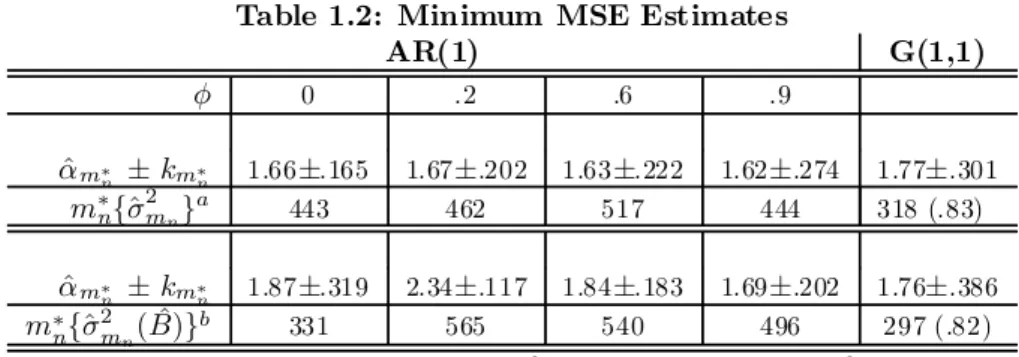
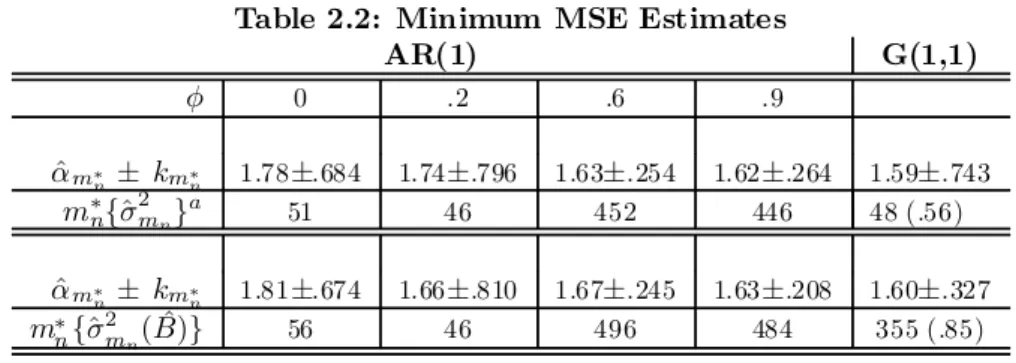
We select the optimal fractile¤by minimizing the MSE^2and the bias-corrected MSE^2( ^). In general each criterion generates sharp estimates, in particular for serially dependent data. The optimally selected fractile is nearly always within the fractile range over which the Hill-estimator is approximately normally distributed at the 5-10% level. See the last two rows of Tables 1 and 2.
The only challenging cases involve the minimum bias-corrected MSE esti-mator. The estimator tends to be positively biased foriid and low memory AR data. Nevertheless, the resulting estimator is exceptional for strongly dependent data (AR(1) with=9).
7. EMPIRICAL APPLICATION We now study daily log-returnsfg
to the NASDAQ and S&P500 composite indices over the period Jan. 1, 2001 to Dec. 31, 2005. Market closures are treated as missing values, and each series is …ltered through a standard 5 day dummy regression to remove daily e¤ects. After di¤erencing and removing missing values the sample size is1422.
See Figure 2 for plots of, and ^ based on the absolute series´ jj
The only distribution characteristics that matter regarding asymptotics for^ (assuming the tails are regularly varying) is dependence and heterogeneity in the extremes. In order to assess the degree of dependence in the extremes we estimate the …rst order tail dependence coe¢cient (1) de…ned as
(1) := () ((¡1 )¡()(¡1 )) A nonparametric estimator is simply
^ (1) = 1 X =1 ¡ ((+1))¡()¢ ¡((+1))¡()¢ .
See Hill (2006) for a literature review, asymptotic theory and a robust kernel variance estimator associated with^(1)under Assumptions A-C. Speci…cally, under Assumptions A-C
p
( ^(1)¡(1)) )(01) where 2
:= (
p
(^(1) ¡(1))2, and a kernel estimator, a la^
2 , satis…es^2 ¡ 2 ! 0.
Both equity returns series display signi…cant levels of positive …rst order extremal dependence. Unless we impose a parametric model and explicitly work out a parametric expression for the asymptotic variance of the Hill-estimator (if one exists analytically), the evidence supports the use of the kernel estimators. Minimum MSE [MMSE] estimates for either series are close to 2. Non-bias corrected MMSE estimates^§196b~
p
are171§ 204and202§
257 for the NASDAQ and SP500, respectively. The "bias-corrected" MMSE estimates are identical to the uncorrected MMSE estimates (up to four decimal places) because the estimated bias for each equity market is tiny (between¡01 and¡12) relative to the magnitude of the MSE itself (between5and80). See Figure 3 for plots of^¡1^
¡1
( ^)and^.
Appendix 1: Proofs of Main Results
Proof of Theorem 1. De…ne for any2R
fg:=©(ln)+¡[(ln)+] ª (10) © ¤ (p)ª:=n³p´¡h³ p´io
From Lemma A.1 in Appendix 2, Assumptions A and D imply p ¡ ^ ¡1¡¡1¢ = ¡12X =1 ¡ ¡¡1¤ ( p ) ¢ +p ³ 1 X =1(ln)+¡ ¡1´+ where [¡12P=1(¡ ¡1¤ (p))] = 0 by construction, =
(1)and[] =(1). Analogous to arguments in Hsing (1991), by properties
(1) and (3), dominated convergence and arguments in Smith (1982: eq. 2.2)
£p ¡ ^ ¡1¡¡1 ¢¤ =p ³ 1 X =1(ln)+¡¡ 1´+[ ] =p µ (ln)+¡¡1 ¶ +(1) =p µ Z 1 0 ()¡¡1 ¶ +(1) =p µ () Z 1 1 ¡1() () ¡¡1 ¶ +(1) =p µ (1 +(()))£ Z 1 1 ¡1¡(1 +(( )))¡¡ 1 ¶ +(1) =p¡1 ³ (1 +(())) 2 ¡1´+(1)
Proof of Corollary 2. Similar to the above argument, suppose ¹() =
¡(1 +¡£)for some 0Then
£p¡^¡1 ¡¡1 ¢¤ =p µ Z 1 1 ¡1( )¡¡ 1 ¶ +(1) =p µ Z 1 1 ¡1¡ ¡(1 +¡ ¡)¡¡1 ¶ +(1) =p µ ¡ ·Z 1 1 ¡1¡+¡ Z 1 1 ¡1¡( 1+) ¸ ¡¡1 ¶ +(1) =p µ ¡ £ ¡1+ (11 +))¡1¡ ¤¡¡1 ¶ +(1) =p¡1 ¡ (1 +(1p))£ £ 1 + (1 +)¡1¡ ¤¡1¢+(1) =p¡1(1 +)¡1¡ +(1) where = () (1 + (1 p
)) by Lemma A.2. Simply put= 1 to
Proof of Lemma 3. Step 1 (^ =( p )): Suppose ^ = ( p ). In order to prove ^
=(1)from (8) we need only show
p ¡ 1( ^¡ 1¡^ p) (+1) =(1) De…ne ^ := () ^ (+1) and write (11) ln µ ()¡1(^ ¡1 ¡^ p) (+1) ¶ =¡ ln ^ 1¡^£^p¡ ln() p £ " ^ £^ 1¡^£^p #
Under Assumptions A and B, Theorem 1 of Hill (2005b) states ^
!
and»with23implies
(ln)p= ³ ¡12ln´=(1) Thus,^ p !0,^ !and (11) imply ()¡1(^ ¡1 ¡^ p) (+1) ! ¡1 Use23! 0to conclude p ¡ 1( ^¡ 1¡^ p) (+1) =( p ()) =(1)
Step 2: By the mean-value-theorem there exists for each a random
variable¤2[0^]that satis…es
^ = p ^¡1£5£ ¡^ (+1) ¡5£p^¡1£ ¡ ln(+1) ¢ £ ¡1( ^¡ 1¡¤ p) (+1) p (^¡1¡¤ p )2 £^ ¡5£¡1(^ ¡1¡¤ p) (+1) £ ^ +5£ ¤ ¡ ln(+1) ¢ ¡1( ^ ¡1 ¡¤ p) (+1) p (^¡1¡¤ p )2 £ ^
Let ^
= (
p
) such that ¤ ! 0 by Step 1: ¤ 2 [0^] ! 0. Notice(ln(+1)) £ ¡1^¡1 (+1) ! 0. Therefore ¯ ¯ ¯ ¯ ¯ ¯ ^ ¡ p ^¡1£ ¡^ (+1) 2 + ^£ ¡^ (+1)£ ¡ ln(+1)¢+(¡^ +1) ¯ ¯ ¯ ¯ ¯ ¯!0 Proof of Theorem 4. Claim 1: Consider ©¤( p )
ª de…ned in (10). Lemma A.1
implies for any(,~) 2
¡12 X =1 ¡ ¡¡1¤( p )¢ ¡(~)12£~¡12 X =1 ³ ~¡¡1¤ ~ ( p ~ )´=(1)
where(~)12 = 1 +(1)by assumption, hence
¡12 X =1 ¡ ¡¡1¤( p ) ¢ ¡~¡12X =1 ³ ~¡¡ 1¤ ~ ( p ~ ) ´ =(1)
Lemma A.3 implies
p ¡^¡1¡¡ 1¢¡p ¡^¡1¡¡ 1¢ =¡12X =1 ¡ ¡¡ 1¤ ( p ) ¢ ¡~¡12 X =1 ³ ~¡¡ 1¤ ~ ( p ~ ) ´ =(1) Therefore p ¡^¡1¡¡1¢¡p~ ¡^¡~1¡¡ 1¢ =p¡^¡1¡¡ 1¢ ³1¡p~ p ´ +p~¡^¡1¡^ ¡1 ~ ¢ =(1)
By Theorem 5 of Hill (2005a) ^¡1 ¡ ¡
1 = (1p ), and by assumption 1¡ p~p=(1p). We deduce p( ^¡1 ¡^¡ 1 ) = (1), hence ^ ¡1= ^¡~1 =(1p~)as claimed. Claim 2: Clearly ¯ ¯^2¡^2~¯¯·¯¯^2¡2 ¯ ¯+¯¯^2~¡2 ~ ¯ ¯+¯¯2 ¡ 2 ~ ¯ ¯
By Theorem 6 of Hill (2005a)^2 ¡
2
= (1)for all2. Hence, it su¢ces to prove2
=
2 ~
+(1). This follows from Claim 1: ^
¡1 = ^¡ 1 ~ + (1 p ~ ) and ~= 1 +(1)8f,~g 2imply p ~ ¡^¡1 ~ ¡ ¡1¢ ¡ p ¡ ^ ¡1 ¡ ¡1¢ )0
in distribution, hence (e.g. Theorem 2.1 of Billingsley, 1999) 2¡2~=(p(^¡1¡ ¡1))2 ¡(p~( ^¡~1¡ ¡1))2 !0
Proof of Theorem 5. The claim follows from Theorem 4, asymptotic nor-malityp( ^¡1¡¡ 1) )(01)and consistency^ 2 ¡ 2 !0, cf. Theorems 5 and 6 of Hill (2005a).
Appendix 2: Supporting Lemmeta
LEMMA A.1 Under Assumptions A and B,
p ¡^¡1¡¡ 1¢ = ¡12 X =1 ¡ ¡¡1¤( p )¢ +p h ³¡1X =1(ln)+ ´ ¡¡1i+ = ¡12X =1 ¡ ¡¡ 1¤ ( p ) ¢ +(1) where =(1) and [] = (1), and is independent of scale.
LEMMA A.2 Under the conditions of Corollary 2,= ()(1 +(1
p
)).
LEMMA A.3 Under Assumptions A and B, 8fg 2
1p X =1¡1 p ~ X =1~=(1) 1pX =1 ¤ ( p )¡1 p ~ X =1 ¤ ~ ( p ~ ) =(1)
Proof of Lemma A.1. We can always write
p ¡^¡1¡¡ 1¢ =p ³ 1 X =1ln()(+ 1)¡¡ 1´ =p ³ 1 X =1ln()¡ ¡1´¡p ln(+1) =p ³ 1 X =1ln()¡ ³ 1 X =1(ln)+ ´´ ¡p¡ln(+ 1) ¢ +p h ³1 X =1(ln)+ ´ ¡¡1i
Using Assumption A and arguments in Hsing (1991: p. 1554),p[(¡1P= 1(ln)+)¡
¡1] = (1).
Moreover, Lemma 4 of Hill (2005a) and a Cramér-Wold device give
p ³ 1 X =1 ¡11 X =1 ¤ ( p ) ´ )(12)
where each»(02
),21.
Furthermore, Lemma 1 of Hill (2005a) statesjln([])¡ln()j !0for allin an arbitrary neighborhood of1. Therefore Theorem 2.2 of Hsing (1991: eq. 2.4-2.7) can be used to show
p ³ 1 X =1ln()¡ ³ 1 X =1(ln)+ ´´ )1 p ¡ln(+1) ¢ )2 hence p ¡^¡1¡¡ 1¢ = 1p X =1 ¡ ¡¡1¤( p )¢ +p h ³1 X = 1(ln)+ ´ ¡¡1i+ = 1p X =1 ¡ ¡¡1¤( p )¢+(1) where =³1pX =1ln()¡ ³ 1X =1(ln)+ ´´ ¡1X =1 +p¡ln(+ 1) ¢ ¡¡11p X =1 ¤ ( p ) =(1)
Finally [] ! 0 in probability by Fatou’s Lemma: limsup¸1[jj] ·
[limsup¸1jj] = 0, hencej[]j ·[jj]!0.
Proof of Lemma A.2. By the construction of the sequence fg¸1 and the distribution tail¹(
) =¡ (1 +¡ )we can write ()»(1 +¡ )) »() Use=(23)to conclude( ) »(1 + ¡ 1( )) = + () =+(¡12).
Proof of Lemma A.3. For simplicity let~·8. Write
112 X =1¡1~ 12 X =1 (12) = 112 X =1 ³ ¡(~)12 ~ ´ where ¡(~) 12 ~ = (ln)+¡(~)12(ln~)+ + (~)12(ln~)+¡(ln)+
Using Assumption A and (ln)+ ¸ 0, the expectations di¤erence is (12)because (~)12(ln~)+¡(ln)+ (13) = (~)12 Z 1 0 ¹ (~ )¡Z 1 0 ¹ ( ) = (~)12¹(~) Z 1 0 ¹ (~) ¹ (~) ¡¹() Z 1 0 ¹ () ¹ () »(~)12¹(~) Z 1 0 ¡¡¹() Z 1 0 ¡ =¡1£¹( ) "µ ~ ¶12 ¹ (~) ¹ () ¡1 # =¡1£()£(112) =(12)
where the last line follows from¹(
) =()by the construction of, and Lemma A.3.1 below.
It is easy to show ·~as ! 1follows from~· . Assume
is su¢ciently large such that ·~. De…ne
1=f:~¸g, ~2=f:¸~g.
Then (12) and (13) imply
(14) ¯ ¯ ¯¡12 X =1 ³ ¡(~)12~ ´¯¯ ¯ ·¯¯¯¡12X =1 ³ (ln)+¡(~) 12(ln ~)+´¯¯¯+(1) ·¡12 X 2 1 ln + ¯ ¯ ¯ ¯¡12 X 2 ~ 2 ³ ln¡(~)12ln~ ´¯¯¯ ¯+(1) ·¡12X 21 ln+ (ln~)£1~ 12 X =1(¸~) +(1) If we show each term on the right-hand-side of (14) is(1) then the claim
is proven by Chebyshev’s inequality. First, as! 1 ° ° ° °112 X 21 ln ° ° ° °1 · 12 ()£ Z l n ~ 0 () ()
= 12 ³ 1 +(¡12) ´ £ Z l n ~ 0 ¡ =12 ³ 1 +(¡12) ´ £¡1£¡1¡~ ¢ =12 ³ 1 +(¡12 ) ´ £¡1£(¡12 ) =(1)
The …rst equality follows from dominated convergence and Assumption A:
( )»¡()
= ()£(1 +(()))
= ()£(1 +(1p))
The third equality follows from Lemma A.3.1.
For the second term in (14), arguments similar to the above and Lemma A.3.1 give (ln~)£ ° ° °~¡12 X =1(¸~) ° ° ° 1 ·( ~¡12)£(~12)£(¸) =( ~¡12)£(~12)£ ³ 1 +(¡12) ´ =(1)
LEMMA A.3.1 Under the conditions of Lemma A.3, 82
µ ~ ¶12 ¹ (~) ¹ () = 1 + (¡12) and ~ = 1 + (¡12)
Proof. Properties (1)-(5) imply
() ¹() = ()¡ () = 1 +(()) = 1 +(¡ 12 ) hence µ ~ ¶¹( ~ ) ¹ () = (~) ¡ ~ ()¡ (~) () = 1 +( ~ ¡12 ) 1 +(¡12) = 1 +(¡12 )(15)
given~=(1). But this implies~!1, hence()(~)! 1. Moreover, for some, every¸, and any1
¯ ¯ ¯ ¯((~))¡1 ¯ ¯ ¯ ¯· ¯ ¯ ¯ ¯(()) ¡1 ¯ ¯ ¯ ¯=(()) =(¡ 12 ) (16)
From (15) we now deduce ()¡ (~)¡ ~ ³ 1 +(¡12) ´ = 1 +(¡12) hence ~ = 1 +( ¡12 ) (17) Together (15)-(17) imply¹( )¹() = 1 +(¡ 12 ), hence µ ~ ¶12¹( ~ ) ¹ () = 1 +(¡12)
References
[1] Akgiray, V. and G. Booth (1988). "The Stable Law Model of Stock Returns,"
Journal of Business and Economic Statistics 6, 51-57.
[2] Basrak, B., R.A. Davis, and T. Mikosch (2002). "Regular Variation of GARCH Processes,"Stochastic Processes and their Applications99, 95-115.
[3] Beirlant, J., P. Vynckier and J. Teugels (1996). "Tail Index Estimation, Pareto Quantile Plots, and Regression D iagnostics,"Journal of the American Statistical
As-sociation 91, 1659-67.
[4] Beirlant, J., D . Dierckx, and A. Guillou (2005). "Estimation of the Extreme Value Index and Generalized Plots,"Bernoulli11, 949-970.
[5] Beirlant, J. Y. Goegebeur, J. Segers, J. Teugels, D . De Waal (2004). "Statistics of Extremes: Theory and Applications," (John Wiley & Sons: New York).
[6] Bingham, N.H., C.M. Goldie and J. L. Teugels (1987). "Regular Variation," (Cam-bridge Univ. Press: Great Britain).
[7] Bradley, B.O., and M.S. Taqqu (2003). "Financial Risk and Heavy Tails. In Handbook of Heavy-Tailed Distributions in Finance," S. T. Rachev (ed.), Elsevier: Amsterdam.
[8] Brown, B. and R. W. Katz (1993). "Regional Analysis of Temperature Extremes: Spatial Analog for Climate Change?"Journal of Climate 8, 108–119.
[9] Caner, M. (1998). "Tests for Cointegration with In…nite Variance Errors,"Journal
of Econometrics 86, 155-175.
[10] Chan, N.H., and L.T. Tran (1989). "On the First Order Autoregressive Process with In…nite Variance,"Econometric Theory5, 354-362.
[11] Chan, N.H., S.D. Deng, L. Peng, and Z. Xia (2005). "Interval Estimation for the Conditional Value-at-Risk Based on GARCH with Heavy Tailed Innovations,"Journal
of Econometrics (forthcoming).
[12] Cheng, B.N. and S.T. Rachev (1995). "Multivariate Stable Futures Prices,"
Math-ematical Finance 5, 133-153.
[13] Cline, D. B. H. (1986). "Convolution Tails, Product Tails and Domains of Attrac-tion,"Probability Theory and Related Fields 72, 525-557.
Method to Choose the Sample Fraction in Tail Index Estimation," mimeo, Eramus University Rotterdam.
[15] de Haan, L. (1970). "On Regular Variation and Its Applications to the Weak Con-vergence of Sample Extremes,"MC Tract 32, Mathematisch Centrum, Amsterdam. [16] de Jong, R.M., and J. D avidson (2000). "Consistency of Kernel Estimators of Heteroscedastic and Autocorrelated Covariance Matrices,"Econometrica68, 407-423. [17] Draisma, G., L. de Haan, L. Peng, T.T. Periera (1997). "A Bootstrap-based Method to Achieve Optimality in Estimating the Extreme-value Index," Eramus Uni-versity, Econometric Institute Report EI 2000-18/A.
[18] Drees, H., de Haan, L. and Resnick, S. (2000). "How to Make a Hill Plot,"Annals
of Statistics28, 254-274.
[19] Drees, H., Ferreira A, and L. de Haan (2004). On Maximum Likelihood Estima-tion of the Extreme Value Index,Annals of Applied Probability 14, 1179-1201. [20] Drees, H., and E. Kaufman (1997). "Selecting the Optimal Sample Fraction in Univariate Extreme Value Estimation," Stochastic Processes and their Applications
75, 149-172.
[21] Dumouchel, W.H. (1983). "Estimating the Stable Index in order to Measure Tail Thickness,"Annals of Statistics 11 1019-1036.
[22] Embrechts, P. and C. M. Goldie (1980). "On Closure and Factorization Properties of Subexponential Distributions,"Journal of Aust. Math. Soc. Ser. A29, 243-256. [23] Embrechts, P. and C. M. Goldie (1982). "On Convolution Tails," Stochastic
Processes and their Applications 13, 263-278.
[24] Embrechts, P., C. Kluppelberg, and T. Mikosch (1997). "Modelling Extremal Events for Insurance and Finance," (Springer: New York).
[25] Fama, E. (1965). "Portfolio Analysis in a Stable Paretian Market,"Management
Science 11, 404-419.
[26] Finkenstadt, B., and H. Rootzén (2003). "Extreme Values in Finance, Telecom-munications and the Environment," (Chapman and Hall).
[27] Gallant, A. R. and H. White (1988). A Uni…ed Theory of Estimation and Infer-ence for Nonlinear Dynamic Models. Basil Blackwell: Oxford.
[28] Goldie, C.M., and R.L. Smith (1987). "Slow Variation with Remainder: Theory and Applications,"Quarterly Journal of Mathematics38, 45-71.
[29] Haeusler, E., and J. L. Teugels (1985). "On Asymptotic Normality of Hill’s Esti-mator for the Exponent of Regular Variation,"Annals of Statistics 13, 743-756. [30] Hall, P. (1982). "On Some Estimates of an Exponent of Regular Variation,"
Jour-nal of the Royal Statistical Society44, 37-42.
[31] Hall, P. (1990). "Using the Bootstrap to Estimate Mean Squared Error and Select Smoothing Parameter in Nonparametric Problems,"Journal of Multivariate Analysis
32, 177-203.
[32] Hall, P., and C. C. Heyde (1980). Martingale Limit Theory and Its Applications. Academic Press: New York.
[33] Hall, P., and A.H. Welsh (1985). "Adaptive Estimates of Parameters of Regular Variation,"Annals of Statistics 13, 331-341.
[34] Hill, B.M. (1975). "A Simple General Approach to Inference about the Tail of a Distribution,"Annals of Mathematical Statistics 3, 1163-1174.
[35] Hill, J.B. (2005a). "On Tail Index Estimation for Dependent, Heterogeneous Data," Dept. of Economics, Florida International University; available at http://www.…u.edu/»hill_het_dep.pdf,
[36] Hill, J.B. (2005b). "Gaussian Tests of ’Extremal White Noise’ for Dependent, Heterogeneous, Heavy Tailed Stochastic Processes with an Application", Conditionally accepted byJournal of Econometrics, available at www.…u.edu/»co-relation-test.pdf. [37] Hill, J.B. (2006). "Robust Tests of Extremal Volatility Spillover with an Applica-tion to Extremal Asset Market Contagion", Dept. of Economics, Florida InternaApplica-tional University.
[38] Hsing, T. (1991). "On Tail Index Estimation Using Dependent Data,"Annals of
Statistics 19, 1547-1569.
[39] Huisman R., K.G. Koedijk, C.J.M. Kool, and F. Palm (2001), "Tail-Index Esti-mates in Small Samples,"Journal of Business and Economic Statistics 19, 208-216. [40] Kearns, P. and A. Pagan (1997). "Estimating the Density Tail Index for Financial Time Series,"The Review of Economics and Statistics 79, 171-175.
[41] Leadbetter, M.R., G. Lindgren and H. Rootzén (1983). "Extremes and Related Properties of Random Sequences and Processes," (Springer-Verlag: New York). [42] Mandelbrot, B. (1963). "The Variation of Certain Speculative Prices,"Journal of
Business 36, 394-419.
[43] Manski, C. (1983). "Closest Empirical Distribution Estimation,"Econometrica
51, 304-319.
[44] McCulloch, J. H. (1996). "Financial Applications of Stable Distributions," in G.S. Maddala and C.R. Rao, eds.,Statistical Methods in Finance (Handbook of Statistics 14), 393-425, Elsevier Science: Amsterdam.
[45] Mikosch,T., and C. St¼aric¼a (2000). "Limit Theory for the Sample Autocorrela-tions and Extremes of a GARCH(1,1) Process,"Annals of Statistics 28, 1427-145. [46] Pickands, J. (1975). Statistical-Inference using Extreme Order Statistics,Annals
of Statistics3, 119-131.
[47] Poon, S., M. Rockinger and J.A. Tawn (2002). "Modelling Extreme-Value De-pendence in International Stock Markets," working paper, University of Strathclyde. [48] Rachev, S. T. (2003). "Handbook of Heavy Tailed Distributions in Finance," (Elsevier Science: New York).
[49] Resnick, S. (1987). "Extreme Values, Regular Variation and Point Processes," (Springer-Verlag: New York).
[50] Resnick, S. (1987). "Heavy Tail Modeling and Teletra¢c Data,"Annals of
Sta-tistics 25, 1805-1869.
[51] Resnick, S., and H. Rootzén (2000). "Self-Similar Communication Models and Very Heavy Tails,"Annals of Applied Probability10, 753–778.
[52] Resnick, S. and C. St¼aric¼a (1997). "Smoothing the Hill Estimator,"Advances in
Applied Probability29, 271-293.
[53] Smith, R.L. (1982). Uniform Rates of Convergence in Extreme-Value Theory, Advances in Applied Probability 14, 600-622.
[54] Smith, R.L. (1987). "Estimating Tails of Probability-Distributions," Annals of
Figure 1
Hill-Plots and Alt-Hill Plots for iid, AR(1) and IGARCH
Hill Plot: Stable,= 1.7
1.0 1.5 2.0 2.5 3.0 3.5 4.0 4.5 5.0 2 52 102 152 2 02 m
IID AR(1) IGARCH
Hill Plot: Pareto,= 1.7
0.0 0 .5 1.0 1.5 2.0 2 .5 3.0 3 .5 4.0 4 .5 5.0 2 52 102 152 2 02 m
IID AR(1) IGARCH
Alt Hill P lo t : St able,= 1 .7
1.0 1.5 2 .0 2 .5 3 .0 3 .5 4 .0 4 .5 5.0 .2 50 .3 50 .4 50 .550 .6 50 .750 .8 50 .9 50 IID A R ( 1) IG A R C H(1,1)
AltHill Plot: Pareto,= 1.7
0 1 2 3 4 5 6 7 .250 .350 .450 .550 .650 .750 .850 .950
IID AR(1) IGARCH(1,1)
Notes: The data are based on randomly generated symmetric Stable or Pareto innovations {} with unit scale and index= 17. In the AR(1) case
X=9X¡1+. In the IGARCH case X=¡1,=0+(1¡1)¡1+1¡1,
Figure 2
Cramér-von Mises Tests of Standard Normality on ^ C vM Te s ts of S tan dard Norm al i ty
on Ke rn e l Vari an ce S tan dardi z e d Hi l l -Es ti m ator P aret ian, IID AR(1) GARCH(1,1) 0 .0 0 0 .10 0 .2 0 0 .3 0 0 .4 0 0 .50 0 .6 0 0 .70 0 .8 0 0 .9 0 1.0 0 16 6 6 116 16 6 2 16 2 6 6 3 16 3 6 6 4 16 4 6 6 516 56 6 m IID AR (1): p hi =.9 G(1,1)
C vM Te sts o f S tan dard Norm al i ty on Ke rn e l Vari an ce S ta n dardi z e d Hi l l -Es ti m ato r
St able,= 1 .7 IID AR(1) GARCH(1 ,1) 0 .0 0 0 .10 0 .2 0 0 .3 0 0 .4 0 0 .50 0 .6 0 0 .70 0 .8 0 0 .9 0 1.0 0 16 6 6 116 16 6 2 16 2 6 6 3 16 3 6 6 4 16 4 6 6 516 56 6 m IID AR (1): p hi =.9 G(1,1)
Figure 3
NASDAQ and S&P500 Daily Log-Returns
NASDAQDailyReturns -0.10 -0.08 -0.06 -0.04 -0.02 0.00 0.02 0.04 0.06 0.08 0.10 0.12
Jan-01 May-01 Oct-01 Mar-02 Aug-02 Jan-03 May-03
SP500 DailyReturns -0.04 -0.03 -0.02 -0.01 0.00 0.01 0.02 0.03 0.04 0.05
Jan-01 May-01 Oct-01 Mar-02 Aug-02 Jan-03 May-03
NASDAQ
Hill-Estimator andRobust Confidence Bands
0 1 2 3 4 5 15 65 115 165 215 265 315 365 415 465 515 565 615 665 m a(m) a(m)-k a(m)+k
SP500
Hill-Estimator andRobust Confidence Bands
0 1 2 3 4 5 15 65 115 165 215 265 315 365 415 465 515 565 615 665 m a(m) a(m)-k a(m)+k
NASDAQ
Two-TailedTail Dependence Coefficient r(1) andRobust Confidence Band
-0.30 -0.25 -0.20 -0.15 -0.10 -0.05 0.00 0.05 0.10 0.15 0.20 0.25 0.30 0.01 0.06 0.11 0.16 0.21 0.26 0.31 0.36 0.41 0.46 0.51 0.56 0.61 0.66 m/nth quantile -k r(1,m) k SP500
Two-TailedTail Dependence Coefficient r(1) andRobust Confidence Band
-0.30 -0.25 -0.20 -0.15 -0.10 -0.05 0.00 0.05 0.10 0.15 0.20 0.25 0.30 15 65 115 165 215 265 315 365 415 465 515 565 615 665 m -k r(1,m) k
Notes: The median two-tailed tail dependence coe¢cients^(1)over all m are NASDAQ: .10§.07, and SP500: .17§.09. As long as each fractile m belongs to a sequence in S, the set of all proportional sequences, the median dependence coe¢cient is consistent and asymptotically normal under Assumptions A-C. See Hill (2006) for related theory and computation of the above plotted consistent kernel con…dence bands.
Figure 4
NAS DAQ In ve rte d H i l l -Esti m ator,
B i as C orre cte d In ve rte d H i l l -Esti m ator an d B i as
-0 .2 -0 .1 0 .0 0 .1 0 .2 0 .3 0 .4 0 .5 0 .6 0 .7 0 .8 18 6 8 118 16 8 2 18 2 6 8 3 18 3 6 8 4 18 4 6 8 m 0 10 2 0 3 0 4 0 50 6 0 70 8 0 9 0 10 0 1/ alp ha 1/ a lp ha (B ) B IAS M S E S P500
In ve rte d H i l l -Esti m ator,
B i as C orre cte d In ve rte d H i l l -Es ti m ator an d B i as
-0 .1 0 .0 0 .1 0 .2 0 .3 0 .4 0 .5 0 .6 18 6 8 118 16 8 2 18 2 6 8 3 18 3 6 8 4 18 4 6 8 m 0 10 0 2 0 0 3 0 0 4 0 0 50 0 6 0 0 70 0 8 0 0 9 0 0 10 0 0 1/ alp ha 1/ a lp ha (B ) B IAS M S E
Table 1.1: Stable, = 17= 1000 AR(1) G(1,1) 0 .2 .6 .9 m ^§ ^§ ^§ ^§ ^§ 20 2.36§2.3 2.32§2.5 1.38§1.3 5.14§4.4 2.17§2.4 50 2.73§2.1 2.38§1.4 1.42§.98 2.41§2.0 2.02§1.8 100 2.05§.73 2.41§1.3 1.55§.84 3.60§1.8 1.95§.83 150 2.32§.64 2.42§1.3 1.91§.80 3.21§1.3 2.03§.71 200 2.15§.39 2.19§.45 2.11§.66 2.88§.79 1.97§.42 300 1.89§.26 1.92§.31 1.89§.43 2.26§.48 1.81§.32 400 1.69§.16 1.71§.24 1.79§.30 1.72§.40 1.62§.23 500 1.47§.13 1.61§.15 1.48§.22 1.54§.20 1.41§.16 m ¯2 369 381 411 422 347 ¯ m 460 477 518 510 454 b ~ 400 1.80 2.41 3.09 4.04 2.35400 KS05 415-430 420-435 422-445 390-440 310-380 KS10 390-460 400-445 405-470 350-470 260-410 Notes: a. GARCH(1,1) b. Bandwidth= 1.96£b~/ 12
c. Minimum at which 2does not occur in the 90% interval. d. Maximumat which= 1.7 occurs in the 95% interval.
e. KS: Fractile range over which the Kolmogov-Smirnov test of normality
on12
(^-)/b~ is not rejected at the-level.
f. Excluding Paretian iid and GARCH data, in all cases the Cramér-von Mises statistic is bi-modal over the fractile range. We only display the upper range of fractile values at which we fail to reject normality. See Figure 2.
Table 1.2: Minimum MSE Estimates
AR(1) G(1,1) 0 .2 .6 .9 ^ ¤ §¤ 1.66§.165 1.67§.202 1.63§.222 1.62§.274 1.77§.301 ¤f^2g 443 462 517 444 318 (.83) ^ ¤ §¤ 1.87§.319 2.34§.117 1.84§.183 1.69§.202 1.76§.386 ¤ f^2( ^)g 331 565 540 496 297 (.82)
Notes: a. Non-"bias corrected"¤
f^2g=arg min2f^ 2 g. b. "Bias corrected"¤ f^2( ^)g=arg min2f^ 2 ( ^)g.
Table 2.1: Paretian,= 17,= 1000 AR(1) G(1,1) 0 .2 .6 .9 m ^§ ^§ ^§ ^§ ^§ 20 1.83§1.15 1.85§1.20 2.14§1.53 3.18§2.62 2.09§2.1 50 1.79§.703 1.87§.783 2.04§.962 2.81§.146 1.88§1.7 100 1.85§.509 1.90§.584 2.12§.799 2.59§1.11 1.61§.72 150 1.89§.421 1.95§.485 2.15§.662 2.46§.842 1.59§.57 200 1.94§.372 1.99§.428 2.17§.573 2.32§.670 1.58§.39 300 2.00§.308 2.08§.360 2.08§.427 2.05§.453 1.61§.32 400 2.06§.268 2.13§.311 1.87§.302 1.78§.317 1.64§.28 500 2.11§.239 2.14§.270 1.61§.208 1.52§.221 1.65§.25 550 2.13§.228 2.13§.254 1.47§.180 1.39§.206 1.69§.31 m ¯2 - - 448 423 180 ¯ m - - 536 510 575 b ~ 400 2.73 3.17 3.08 3.23 2.5950 KS05 15-48 15-50 430-485 400-450 15-85 KS10 15-110 15-95 430-500 360-480 15-575
Notes: The "Paretian Tail" is P(Xz) = z¡(1 + z¡).
Table 2.2: Minimum MSE Estimates
AR(1) G(1,1) 0 .2 .6 .9 ^ ¤ § ¤ 1.78§.684 1.74§.796 1.63§.254 1.62§.264 1.59§.743 ¤f^2g 51 46 452 446 48 (.56) ^ ¤ § ¤ 1.81§.674 1.66§.810 1.67§.245 1.63§.208 1.60§.327 ¤ f^2( ^)g 56 46 496 484 355 (.85)
Table 4. Equity Mininimum MSE Estimates
NASDAQ SP500 ^ ¤ §¤ 1.71§.204 2.02§.257 ¤(^2) =¤(^ 2 ( ^)) 466 473 Notes: Sample size = 1422.