Scott Schneider
Dissertation submitted to the Faculty of the Virginia Polytechnic Institute and State University in partial fulfillment of the requirements for the degree of
Doctor of Philosophy in
Computer Science
Dimitrios S. Nikolopoulos, Chair Henrique C. M. Andrade Godmar Back Kirk Cameron Calvin J. Ribbens December 10, 2010 Blacksburg, Virginia
Keywords: EMM, Cell BE, Programming Models, Parallel Programming, Parallel Hardware Architecture
Shared Memory Abstractions for
Heterogeneous Multicore Processors
Scott Schneider
We are now seeing diminishing returns from classic single-core processor designs, yet the num-ber of transistors available for a processor is still increasing. Processor architects are there-fore experimenting with a variety of multicore processor designs. Heterogeneous multicore processors with Explicitly Managed Memory (EMM) hierarchies are one such experimental design which has the potential for high performance, but at the cost of great programmer effort. EMM processors have cores that are divorced from the normal memory hierarchy, thus the onus is on the programmer to manage locality and parallelism. This dissertation presents the Cellgen source-to-source compiler which moves some of this complexity back into the compiler. Cellgen offers a directive-based programming model with semantics simi-lar to OpenMP for the Cell Broadband Engine, a general-purpose processor with EMM. The compiler implicitly handles locality and parallelism, schedules memory transfers for data par-allel regions of code, and provides performance predictions which can be leveraged to make scheduling decisions. We compare this approach to using a software cache, to a different programming model which is task based with explicit data transfers, and to programming the Cell directly using the native SDK. We also present a case study which uses the Cellgen compiler in a comparison across multiple kinds of multicore architectures: heterogeneous, homogeneous and radically data-parallel graphics processors.
This research is or was supported by grants from NSF (CCR-0346867, CCF-0715051, CNS-0521381, CNS-0720750, CNS-0720673), the U.S. Department of Energy (DE-FG02-06ER25751, DE-FG02-05ER25689), IBM, and Virginia Tech (VTF-874197).
1 Introduction: The Potential and Challenges of Heterogeneous Multicore
Processors 1
1.1 Parallel Programming Paradigms . . . 3
1.2 Implementing Shared Memory Abstractions on Heterogeneous Multicores . . 5
1.2.1 Cell Specifications . . . 5
1.2.2 Challenges Stemming from Heterogeneity . . . 6
1.2.3 Required Functionality . . . 8
1.3 Contributions . . . 9
2 Cellgen: Using Shared Memory Abstractions to Program a Heterogeneous Multicore Processor 12 2.1 Supported Computations . . . 13
2.2 The Basics . . . 14
2.3 Computations with Flat Arrays . . . 15
2.4 Reductions . . . 16
2.5 Multidimensional Arrays . . . 16
2.6 Matrix Multiplication . . . 18
2.7 Stencil Accesses . . . 19
2.8 Summary . . . 20
3 Code Transformation: Generating High Performance Code for Heteroge-neous Multicores 21 3.1 Reference Analysis . . . 21
3.2 Access Analysis . . . 23 3.3 Buffer Substitution . . . 23 3.4 Multibuffering . . . 25 3.5 Remainders . . . 27 3.6 Scheduling . . . 28 3.7 Stencil Analysis . . . 30
3.7.1 On-induction Stencil Access . . . 30
3.7.2 Off-induction Stencil Access . . . 31
3.8 Buffer Size . . . 33
3.9 Performance Prediction . . . 34
3.9.1 Data Transfer Model Derivation . . . 34
3.9.2 Computation Model Derivation . . . 36
3.10 Summary . . . 37
4 Experimental Evaluation: Measuring the Performance of Code Transfor-mations for Heterogeneous Multicores 38 4.1 Microbenchmarks . . . 39
4.2 Applications . . . 41
4.3 Dynamic Buffer Size Selection . . . 42
4.4 Application Performance . . . 43 4.5 Model Accuracy . . . 44 4.6 Stencil Benchmarks . . . 45 4.6.1 Transfer Savings . . . 45 4.6.2 Jacobi . . . 47 4.7 Summary . . . 49
5 Programming Models: An Evaluation of Different Programming Abstrac-tions for Heterogeneous Multicores with Explicitly Managed Memories 50 5.1 Cellgen . . . 50
5.2 Sequoia . . . 51
5.5 Quantitative Comparison . . . 55
5.5.1 CellStream . . . 55
5.5.2 Fixedgrid . . . 58
5.5.3 PBPI . . . 60
5.6 Summary . . . 64
6 Parallel Hardware Architectures: An Evaluation of Shared Memory Ab-stractions Across the Spectrum 65 6.1 Motivation . . . 66
6.2 Background . . . 68
6.2.1 Streaming Aggregation . . . 68
6.2.2 Parallel Streaming Aggregation . . . 69
6.2.3 Stock Market Distribution . . . 71
6.3 Case Study . . . 71 6.3.1 Parallel Hardware . . . 72 6.3.2 Implementations . . . 74 6.4 Results . . . 78 6.4.1 Intra-implementation Comparisons . . . 79 6.4.2 Inter-implementation Comparison . . . 82 6.5 Conclusions . . . 83 7 Related Work 85 7.1 Programming Models for Multicores . . . 85
7.1.1 OpenMP and Related Models for Cell . . . 85
7.1.2 General Multicore Programming Models . . . 88
7.2 Low-Level Compiler Optimizations . . . 91
7.3 Locality Optimizations . . . 91
7.4 Modeling . . . 92
8 Conclusions 94 A Compiler Design 108 A.1 Files . . . 108
A.2 Phases of Compilation . . . 109
A.3 Transformation Objects . . . 109
A.4 Augmented Parse Trees . . . 110
A.5 Example . . . 111
A.6 Runtime System . . . 114
1.1 Cell architecture . . . 6
3.1 On-induction stencil access . . . 30
3.2 On- and off-induction stencil access . . . 31
3.3 DMA latency vs. transfer size. . . 35
4.1 Microbenchmarks with XLC . . . 39
4.2 Buffer size evaluation. . . 42
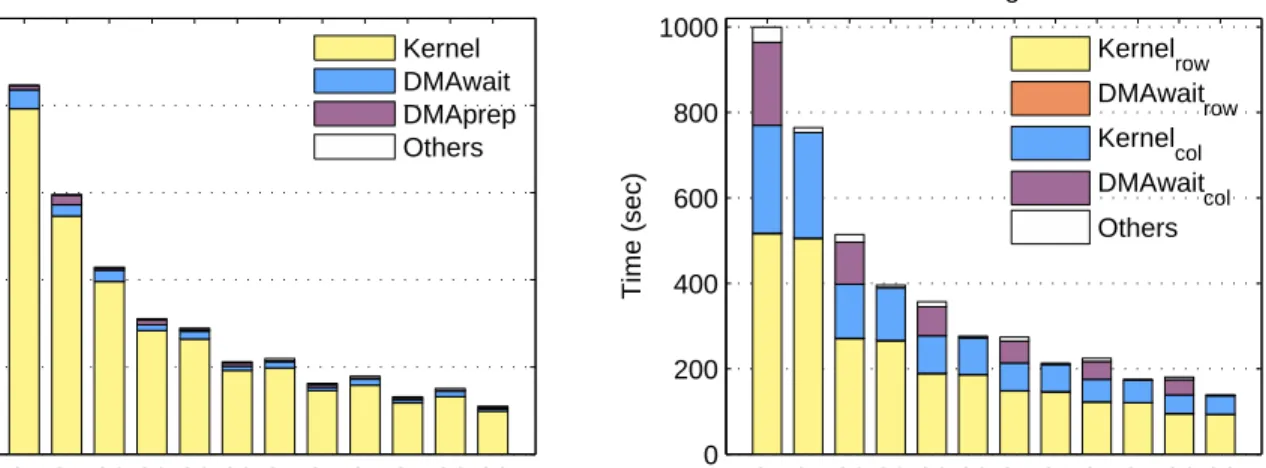
4.3 SPE timing breakdown. . . 43
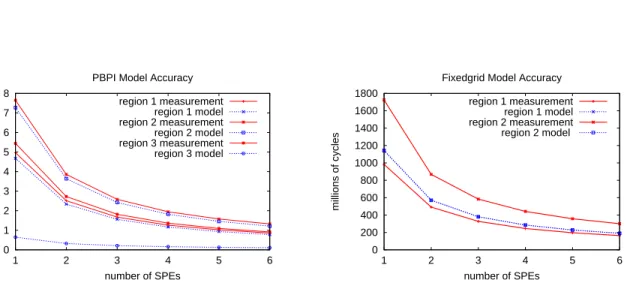
4.4 Model accuracy evaluation. . . 44
4.5 Transfer savings . . . 46
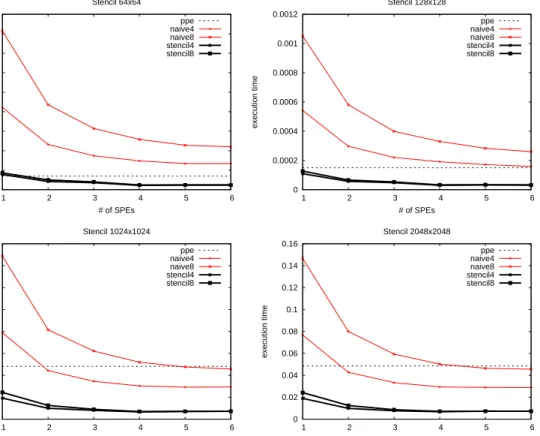
4.6 Jacobi performance comparison . . . 47
4.7 Stencil data division strategies . . . 48
5.1 CellStream bandwidth results . . . 56
5.2 Fixedgrid whole-application profile. . . 57
5.3 Fixedgrid SPE-kernel timing profile. . . 58
5.4 PBPI buffer sizes. . . 60
5.5 PBPI execution time detail. . . 61
5.6 PBPI buffer detail. . . 62
6.1 Stock symbol frequency distribution histograms. . . 69
6.2 Data structures used in partial aggregations. . . 70
6.3 Experimental setup . . . 73 vii
6.4 Bargain discovery application . . . 73 6.5 Parallel aggregation kernels . . . 75 6.6 Performance of two sequential implementations. . . 77 6.7 Performance of different number of threads used in the Intel Quad
implemen-tation. . . 79 6.8 Performance of different data transfer strategies for the GPU implementations. 80 6.9 Performance of different number of SPEs used for the Cell implementation. . 82 6.10 Performance comparison of all implementations. . . 83 A.1 Augmented parse tree. . . 112
3.1 Cycle counts. . . 36
5.1 Programming model exploration space. . . 50
6.1 Hardware used in our case study. . . 72
6.2 Data involved in each aggregation. . . 77 6.3 Ratio of data transfer time to total aggregation time for GPU and Cell. For
the GPU, timers on the host were used to track the time needed to transfer the data, and then the time needed for the computation itself. For the Cell, timers on each SPE kept track of how much time was spent waiting for a DMA to complete, and separate timers for how long each kernel took to complete. 78
Chapter 1
Introduction: The Potential and
Challenges of Heterogeneous
Multicore Processors
Processor designs are changing in fundamental ways. In the past, processor architects were able to improve performance by continuing to exploit instruction level parallelism (ILP) and adding to the cache hierarchy. While designers used different techniques to exploit ILP over the years—such as Very Long Instruction Words versus superscalar—the fundamental idea was to squeeze as much performance as possible from a single instruction stream.
These techniques have hit their limit. Long instruction pipelines are needed to keep many instructions in flight at once, using different functional units in parallel. As instruction pipelines grow, they incur several complications. The cost of mispredicted branches increases; it is more difficult to balance the cost of each stage; and they are more prone to stalls from cache misses. Even aggressive out-of-order processors are limited by the amount of ILP that exists in an instruction stream.
Meanwhile, the number of transistors available to processor architects continues to increase, consistent with Moore’s Law. Faced with a still increasing transistor budget and old designs based on exploiting ILP that no longer scale, architects are forced to explore new designs. These designs no longer rely solely on ILP, but instead provide hardware amenable to both thread and data level parallelism. These new designs are referred to as multicore processors
because there are at least two execution cores with distinct execution pipelines, functional units and usually one level of private cache.
Some multicore processors are homogeneous: each of the cores is the same. Such homo-geneous multicores typically have an architecture in which multiple sequential cores share a cache. Programming a homogeneous multicore is similar to programming a Symmetric Multiprocessor (SMP), where multiple sequential processors are connected to a single shared
main memory. Message passing paradigms are possible on such multicores, but they are per-haps most naturally programmed with shared memory, multithreaded techniques. In fact, multithreaded approaches that worked on SMPs will work on homogeneous multicores in the exact same manner since memory is shared among all cores in the same way that memory is shared among all processors on an SMP.
Heterogeneous multicore processors have at least one core that is different than the others. Heterogeneity introduces complexity because now either the programmer or a runtime system must determine why and how certain code should run on certain cores. Yet, heterogeneity is desirable for performance reasons. There are two arguments in support of the performance potential of heterogeneity, depending the kind of heterogeneous architecture.
Heterogeneity comes in two flavors: single instruction set architectures (single ISA) and multiple instruction set architectures (multiple ISA). Consider a multicore processor with many simple cores that are identical. Eventually, adding more cores of the same kind will manifest as diminishing performance returns at the application level. This observation is a result of Amdahl’s Law: more simple cores will speedup the parallel regions of the application, but the sequential regions of the application will have to run on the same simple cores. Eventually the sequential regions running on the simple cores will become the application’s bottleneck. At this point, a larger sequential core that would take up the die space of several simple cores could help overall performance [45]. This approach can also lead to more power efficient processors [63, 93]. This reasoning applies to both single ISA and multiple ISA heterogeneous processors. For single ISA processors, the larger core has the same functionality as the smaller cores, but it has better sequential performance.
Multiple ISA heterogeneous processors open up another opportunity for improved perfor-mance. A multiple ISA design can allocate one core to handle running the operating system and interfacing with external devices. The other cores are free to be specialized; if they do not need to run operating system code or interface with other devices, there are fewer constraints on their design. Such cores can be designed specifically for such tasks as dense floating point computations or branch-heavy integer codes. Specialized cores are also free to eschew a traditional memory hierarchy in favor of manual control which has the potential for higher performance.
Recent homogeneous multicore processors have focused on thread level parallelism, but an emerging set of heterogeneous multicores also relies on data parallelism. Architectures such as Larabee [92], the Cell Broadband Engine [23], Pangaea [99] and AMD Fusion [1] merge the CPU and GPU onto the same chip. These are heterogeneous multicore processors; some of the cores have classical designs similar to general purpose processors of the past, while the rest of the cores are specialized vector processors. In this set, the Cell is also a representative of an architecture with an explicitly managed memory hierarchy (EMM). The Cell’s vector cores require software management, as they are divorced from the normal memory hierarchy. By exposing multiple kinds of parallelism, these designs have the potential for high perfor-mance. However, the burden for extracting this performance is on programmers more than
3
before. For sequential processors, both the compiler and the processor itself were respon-sible for extracting ILP from sequential code. However, multicore processors require that programmers write code with significant thread or data level parallelism. Writing thread and data parallel code has been the domain of high-performance computing for decades. Processor architects have provided novel processor designs, and it falls on the systems and high-performance computing community to explore how to best program these processors. Currently, writing high performance applications for heterogeneous EMM processors requires an intimate understanding of the underlying hardware and familiarity with the provided API. The APIs for these processors (such as CUDA for GPUs and IBM’s Cell SDK) expose architectural details to the programmer. Programming in such environments is analogous to application development in assembly, writing multithreaded programs exclusively with Pthreads, or implementing distributed applications in MPI. All of these methods require knowledge of the underlying mechanisms to produce a working program. Optimizing the program requires extensive architectural knowledge.
Our approach to solve the programmability problem for heterogeneous multicores is to pro-vide a shared memory abstraction. This dissertation presents the design, implementation and performance evaluation of such an abstraction. But, before presenting a shared memory abstraction for heterogeneous multicores, we first discuss parallel programming models in general.
1.1
Parallel Programming Paradigms
There are two dominant parallel programming paradigms: shared memory and message passing. Shared memory parallel programming has a productivity advantage over message passing, although message passing programs have a greater potential for scalability. In this section we introduce these two paradigms in order to motivate why we chose a programming model based on shared memory to solve the productivity and performance challenge of heterogeneous multicores.
Shared memory parallel programming is usually accomplished with some form of multi-threading, where multiple threads on the same node share the same address space. Threads can effortlessly communicate because they operate in the same address space, so explicit syn-chronization must be used toprevent communication when it would lead to incorrect results. The dominant basic building block for multithreading on Unix based operating systems is the POSIX Threads (Pthreads) API [54]. Pthreads have various synchronization primitives for coordinating the progress of a computation and memory accesses: mutexes are used to indicate when a thread should have exclusive access to a region of code; condition variables are used for one thread to wait on a signal, and another thread to send that signal; and barriers for when no threads should proceed until all threads have reached the same point. The main strength of native multithreaded parallel programming—ease of communication
among threads—is also its main weakness. Multithreaded programs are notoriously difficult to code correctly because it is easy to accidentally read or write data without synchroniz-ing; the order and kind of synchronization required even for relatively simple problems can be non-obvious; and even the guarantees from the hardware and software stack are poorly understood by most programmers [8, 73]. While multithreading is powerful, the free-for-all approach of using Pthreads directly is low-level. There are many common tasks in multi-threaded programs: maintaining a pool of worker threads, dissembling a larger computation into smaller tasks, distributing these tasks to worker threads, load balancing the work across all worker threads, and synchronizing worker threads.
OpenMP [75, 87] handles all of these common tasks, relieving the programmer from having to contend with them. It is a directive-based extension to C, C++ and Fortran—languages commonly used in high performance computing. It was originally used to parallelize com-putational loops often seen in scientific applications with heavy use of matrices and vectors. Parallelizing such loops exploits data parallelism. OpenMP has also been extended to in-clude directives to manage task parallelism, which will be less regular than data parallel loops. The gain in productivity is that OpenMP programmers do not have to concern them-selves with such details as when or how to create new threads, how to distribute their data among these threads and how to synchronize and initiate the computation itself among the threads. OpenMP’s compiler and runtime do the work of mapping sequential code annotated with parallel directives to parallel execution.
Shared memory parallel programming models whose implementations depend on shared memory implemented at the hardware level have a fundamental limitation: they cannot use more than one compute node. They have a fundamental dependence on shared physical memory; there are no mechanisms to communicate with addresses spaces on separate nodes. Message passing paradigms do not have this limitation.
Message passing paradigms assume that the computing infrastructure is composed of mul-tiple nodes with distinct memory address spaces. That is, each compute node can only directly reference its own memory. Communication—of both data and intention—must oc-cur through discrete messages sent from process to process. The de facto standard for distributed computing is the Message Passing Interface (MPI) [82]. MPI abstracts inter-process communication, which may take place on the same compute node, or may take place between different compute nodes across a network. MPI is provided as a library for C, C++ and Fortran, while other languages have provided bindings that call into these standard def-initions. There are two main classes of communication types available to MPI programmers: point-to-point communication and collective communication. Point-to-point communication is used for sending or receiving data from one process to another. Collective communica-tions are used when one process communicates with the rest of the processes involved in the computation. Typically, the process initiating collective communication is the master pro-cess used to control the progression of the computation. Master propro-cesses perform collective operations such as broadcast (sending the same data to all processes), scatter (dispersing elements of a set to all processes), gather (receiving elements of a set from all processes) and
5
synchronization operations such as a barrier (preventing all processes from proceeding until they reach the same point in the computation).
While MPI does abstract how the inter-process communication occurs (such as over the net-work or normal inter-process communication on the same node), it does not provide a high-level abstraction for constructing parallel programs. Parallel programs based on message passing have enormous scaling potential—some message passing applications can scale to thousands of cores, with near linear speedup. In practice, however, achieving such speedups is difficult. Programmers must understand the runtime communication patterns of the vari-ous components of their application to determine the best communication schedule. Shared memory parallel programming has difficulty scaling to the same degree as message passing because it inherently depends on a single, shared address space. Despite this limitation, implementations of shared memory programming models, such as OpenMP, are popular for their productivity gains [37, 48]. Reasonable investments of programmer effort and time can yield applications that can at least scale with the number of cores on a single node that share an address space.
1.2
Implementing Shared Memory Abstractions on
Het-erogeneous Multicores
We propose using a shared memory parallel programming model to address the difficulties with programming heterogeneous multicores. However, implementing such an abstraction has many challenges. The processor we use as an example heterogeneous multicore processor is the Cell [23, 53]. The Cell’s heterogeneity and the fact that it is an EMM processor present considerable programming difficulties. We first present the salient architectural details of the Cell processor before enumerating the challenges associated with implementing a shared memory parallel programming model on such an architecture.
1.2.1
Cell Specifications
The architecture of the heterogeneous multicore Cell processor is shown in Figure 1.1. One of the cores, the Power Processing Element (PPE), is a 64-bit two-way SMT PowerPC. The other eight cores are 128-bit SIMD-RISC processors called Synergistic Processing Elements (SPEs) and they are typically used as accelerators for data-intensive computation. Each SPE has a 128-bit data path, 128 128-bit registers, and 256 KB of software-managed local store. SPEs can issue two instructions per cycle into two pipelines. One pipeline implements floating point instructions, whereas the other implements branches, load/stores and channel communication instructions.
SPU LS MFC SPU LS MFC SPU LS MFC SPU LS MFC SPU LS MFC SPU LS MFC SPU LS MFC SPU LS MFC Element Interconnect Bus
EIB L2 L1 PPU Memory Interface Controller MIC
off-chip to main memory
PPE
SPE
Figure 1.1: Cell architecture. The PPEis a typical PowerPC core with hardware managed caches. TheSPEs have a programmer-controlledLocal Storewhich communicates with theMemory Inter-face Controllerthrough theirMemory Flow Controller.
off-chip memory and with the local stores of other SPEs through Direct Memory Accesses (DMAs). DMAs are posted with channel commands to the Memory Flow Controller (MFC). Each MFC has a queue which can hold up to 16 outstanding DMA requests, each of which can send or receive up to 16 KB of contiguous data. The PPE, SPEs, MIC and I/O controller communicate via the Element Interconnect Bus (EIB), which has a maximum theoretical bandwidth of 204.8 GB/s [9].
1.2.2
Challenges Stemming from Heterogeneity
Implementing a parallel programming model that depends on shared memory is simple when the underlying hardware implements shared memory. On a heterogeneous multicore without such hardware support, a compiler and runtime system that supports shared memory must contend with the following challenges:
Local Memory Spaces Effective use of the Cell requires offloading as much computation as possible to the SPEs. The difficulty this situation presents is that the SPEs are divorced from the normal memory hierarchy. Each SPE has a local storage of 256 KB, and this is the only memory it can directly address. Data must be placed in the local storage explicitly by the programmer. Consequently, programmers must know
7
the memory access patterns in their application. SPEs can communicate directly with other SPEs, or with main memory through DMAs.
Small Local Storage The 256 KB local storage associated with each SPE contains both all of the code and all of the data the SPE uses. Due to the limited amount of data that can fit into the local storage, streaming data in such a way that communication and computation are overlapped is necessary for good performance. Programmers must be able to anticipate what data they will need for future computations, and initiate DMAs to prefetch this data while other data is in use for computation, or being written back to memory. Overlapping computation and communication can hide the latency associated with DMAs. The relatively large number of outstanding DMAs supported by the MFC further encourages the use of aggressive prefetching and multibuffering techniques for latency overlap.
Further, the small local storage limits the use of recursion. Since the local storage contains all code and all data, the stack frames depth for function calls is severely constrained.
Strided Access A single DMA transfers contiguous data; Cell has no architectural support for strided access to main memory. There are three options for accessing non-contiguous regions of memory:
1. Normal DMAs which transfer the entire contiguous region the strided data resides in. This technique transfers unnecessary data—in the case of large strides, it will transfer a large amount of unnecessary data.
2. Multiple DMAs issued in succession to the MFC. However, the MFC can only have 16 outstanding DMAs, so the 17th DMA will block.
3. Construct DMA lists, and issue a single DMA list instruction to the MFC. Each entry in a DMA list specifies a separate DMA, and it is the programmer’s re-sponsibility to ensure that memory addresses for all subsequent entries in the list adhere to the required stride.
In most cases, DMA lists are the most efficient method. Transferring large amounts of unnecessary memory is infeasible for large strides, and the chance of a large number of DMAs blocking is high for multiple DMAs. There is overhead—both in terms of programmer effort and execution time—to constructing the DMA lists. However, this overhead is usually outweighed by the inability of multiple DMAs to scale past 16, and the large amount of unnecessary data single DMAs must transfer.
Data Alignment All DMAs of less than 16 bytes must be naturally alignedin both main memory and in the SPE’s local storage. That is, transfers of 1, 2, 4 and 8 bytes must be aligned on a 1, 2, 4 or 8 byte boundary respectively. Transfers larger than or equal to 16 bytes must be aligned on a 16 byte boundary—but for best performance, data should be aligned on cache line boundaries (128 bytes).
Such an architecture presents many of the programming difficulties of both message pass-ing and shared memory parallel programmpass-ing. Uspass-ing DMAs to transfer data to and from the SPEs is similar to using messages to transfer data in distributed computations. This similarity means that programming the Cell processor shares programming difficulties with distributed computing. But, the DMAs among all of the SPEs are in the same address space. As a consequence of sharing the same address space, many of the same problems from shared memory multithreading are present, such as race conditions and accidentally changing values without the proper synchronization. The Cell presents a “worst of both worlds” scenario to programmers that develop natively for the architecture and system software that seeks to abstract it.
1.2.3
Required Functionality
The preceding challenges imply the functionality that an implementation of shared memory on a heterogeneous architecture must have. Task creation and scheduling exist as require-ments when implementing such programming models on shared memory architectures, but the preceding challenges make it more difficult on a heterogeneous platform. The remaining functionality are unique to such an architecture.
Task creation On Cell, the SPEs are independent vector cores with small local memories that execute independently of the main core, the PPE. We must transparently creates these tasks. Being able to execute arbitrary code on the SPEs requires infrastruc-ture that programmers would have to implement by hand for every offloaded region, and for each application. We must eliminate this concern by generating the needed infrastructure.
Parameter passing Transferring parameters to newly created tasks requires knowledge of PPE and SPE communication. We must handle passing parameters to the SPEs upon task creation.
Task scheduling We must determine how to divide user data for parallel execution, and how to distribute that data among the SPEs. We attempt to distribute data as evenly as possible among the SPEs while still adhering to Cell’s data alignment constraints. Buffer management We allocate, deallocate and determine the size of local data buffers
for each offloaded region. Local buffers are needed because of the small local storage on the SPEs—the common solution to the limited space is to stream data through the SPEs. By determining the size of the buffers and handling their resource usage, we alleviates programmers from having to consider the SPE’s small local storage.
Data communication We must automatically generate Direct Memory Accesses (DMAs) for all shared data. (A DMA is a transfer of data directly to or from main memory.)
9
We must also determine through static analyses which variables need DMAs from main memory to the SPEs, which need DMAs from the SPEs to main memory and which need both. Further, we need to determine if a series of variable references represent a contiguous or strided access to main memory. For strided accesses, we determine the size of the stride and generates code to handle a non-contiguous memory access. Results transmission For computations which reduce a computation to a single result, we
must handle collecting individuals results from the SPEs and aggregating them into a single result for use by subsequent code on the PPE.
Through automated task scheduling, buffer management and on-demand communication, we are able to provide the abstraction of a single address space among all SPEs. Program-mers provide sequential, data-parallel loops with directives indicating which variables will be shared among the SPEs, and our compiler and runtime system generates high performance code that handles all of the above issues. Our shared memory abstraction provides a solu-tion for how to program a heterogeneous multicore processor with reasonable effort while still realizing its performance potential.
1.3
Contributions
At the start of this work, there were many open questions and difficulties that we either aimed to solve, or had to contend with as part of our solutions. The following problems are directly addressed by this dissertation.
• What high-level code representation is suitable for expressing parallelism on a hetero-geneous multicore EMM processor?
• What kinds of computations can be expressed in such a programming model and still maintain high performance?
• What level of compiler and runtime support is necessary to enable such computations?
• In terms of performance, how does such compiler and runtime support compare to the usage of a software cache?
• How do programming models with implicit data transfers compare in terms of pro-grammability and performance to programming models with explicit data transfers when programming for heterogeneous multicore processors?
• Given that several kinds of multicore processors are now available, how do they compare to each other with regards to the kinds of computations that they readily support?
It is the job of the high performance computing community to assess the applicability of our current parallel programming techniques to the newly emerging multicore processors. Techniques which abstract the underlying hardware as much as possible are more likely to be adopted by the widest community. Therefore, we have to assess both the programma-bility of these techniques, and demonstrate their aprogramma-bility to achieve high performance. This dissertation makes the following contributions towards this goal.
• The first published (Schneider et al. [91]) shared memory abstraction for a heteroge-neous multicore processor that does not depend on a software cache.
– An empirical evaluation which demonstrates that with adequate compiler and runtime support, programs written using a high-level shared memory abstrac-tion that hides architectural details can still attain performance comparable to applications written by programmers optimizing specifically for that architecture. – Code transformation techniques for replacing references to shared variables with the corresponding references to a local buffer and the data transfers necessary to both implement the abstraction of a shared address space and maintain high performance.
– Scheduling dense computations at runtime for heterogeneous architectures with restrictive alignment constraints.
– Supporting stencil code accesses in a shared memory abstraction across hetero-geneous cores with separate memory spaces through access analysis at compile time, and a system of rotating buffers at runtime.
– A simple model for determining an appropriate buffer size for multibuffering that balances using a large buffer with ensuring there are enough transfers to overlap with computation.
– Performance prediction of computational loops expressed in a shared memory programming model based on a compile-time analysis of the computation’s in-structions and a runtime data transfer model.
• Empirical evaluation demonstrating the significant performance advantages in imple-menting a shared memory abstraction for heterogeneous multicores using direct multi-buffering instead of a software cache. (Presented in Chapter 4.)
• Quantitative and qualitative comparison of two different programming abstractions for heterogeneous multicores: task based with explicit data division and shared memory with implicit data transfers [91].
• A case study comparing streaming aggregation across three different parallel hardware architectures that represent the current spectrum of available multicores: a homoge-neous multicore, a heterogehomoge-neous multicore, and a graphics processor [90]. This case study presents the following findings:
11
– A GPU’s connection to main memory is ill-suited for data-movement bound al-gorithms that perform a single pass through memory.
– A GPU’s connection to main memory is also ill-suited for fine-grained memory transfers.
– Starting from similar shared-memory implementations, a compiler which can rec-ognize and generate explicit data transfers for regular memory access patterns can outperform a homogeneous processor that depends on a hardware controlled cache.
These findings point to the importance of future multicore architectures having a low-latency, high bandwidth connection to main memory in order to be able to exploit more kinds of parallelism.
Heterogeneity is likely to be important in the future of computing—high performance com-puting and even into mainstream programming. The work presented in this dissertation lays the groundwork for how to program such processors in such a way to maintain both productivity and performance.
Cellgen: Using Shared Memory
Abstractions to Program a
Heterogeneous Multicore Processor
Cellgen is a compiler that supports a shared memory abstraction on the Cell processor. It started as an attempt to allow PPE and SPE code to live in the same source file. Soon after Cellgen started supporting communication across the PPE-SPE boundary, it became clear the programming model we wanted to support was similar to OpenMP [75]. Offloading data-parallel sections of code to the SPEs naturally fit with the applications we had experience with on Cell.
This chapter provides a brief tutorial for how to program using Cellgen. Cellgen shares some semantics with OpenMP, but legal OpenMP code is not necessarily legal Cellgen code, and vice-versa. This distinction exists because the design approach in Cellgen was to only support memory access patterns that we knew how to generate high performance code for. Over time, Cellgen has been able to support increasingly more kinds of accesses, but it still does not support all access patterns that a full OpenMP implementation does. This chapter presents a brief tutorial of Cellgen, which serves to both provide the reader with an intuitive feel for the programming model and to highlight supported features.
Cellgen is a source-to-source compiler: it accepts C code and emits C code. The current workflow requires a programmer to call cellgen on a∗.cellgenfile, which will produce code for both the PPE and SPE. Currently, we rely on the sophisticated Make files provided by the IBM SDK [52] to produce executable code.
In all of these code examples, we assume the Cellgen blocks of code reside in a legal C program.
The full source code for Cellgen is available at http://www.cs.vt.edu/~scschnei/cellgen.
13
2.1
Supported Computations
The remainder of this chapter shows what kinds of computations Cellgen supports through example. In this section, however, we explicitly state what kinds of computations Cellgen supports.
Regarding syntax for denoting a Cell region, Cellgen requires the #pragma cell directive immediately followed by a set of opening and closing braces to enclose the computation that will execute on the SPEs. Directives for shared and private variables are not actually required. However, a Cell region that has no set of shared variables will not be able to perform any work that will be visible to the rest of the application. While both shared and
privatedirectives can be used to transfer data to the SPEs, only variables in asharedset can be used to transfer data out of an SPE. Hence, any interesting Cell region will have at least one variable listed in its shared set.
The majority of the programming model semantics is focused on the kinds of accesses that are legal to shared variables. There exists a fundamental distinction betweeninandoutaccesses. An in access appears on the right-hand side of an equals sign; it is part of a computation. An out access appears on the left-hand side of an equals sign; it is where a computation will be stored. Cellgen is more restrictive with allowable out accesses than with in accesses because every out access is implicitly a write to a location in main memory. Consequently,
outaccesses can only be simple combinations of induction variables. For a single dimensional shared variable named a with induction variable i, the only legal out access is a[i]. If a is instead a two-dimensional matrix with induction variables i and j, then the only two legal
out accesses are a[i][j] and a[j][i]. This pattern continues into the higher dimensions: there is no restriction on the order of accesses, but each individual use of an induction variable must be that induction variable itself. The result of this pattern is that for each iteration (including iterations in nested loops), we are guaranteed that only one iteration will write to one element in the shared variable.
All legal accesses for out variables are also legal accesses for in variables. The accesses that are legal for only in variables are both more interesting and less restrictive. We require that all out variable accesses are independent across iterations because of the potential for write-after-write data races. Forin variables, no such races will happen since we are strictly reading values; there is no harm in reading the same memory location across multiple SPEs. As a consequence, we can relax the independence requirement. This happens in two manners: stencil accesses and unrolled multi-dimensional accesses.
Stencil accesses involve an offset to the induction variable, such as a[i + c] or a[i −c] where
c is any constant known at compile time. Stencil accesses are allowed in all dimensions, and can even be used independently—such as a[i −2][j + 3], or just a[i + 4][j].
Cellgen also supports unrolled multi-dimensional accesses on single dimensional shared vari-ables. Such accesses are in the form of a[i ∗n + c] where n is a constant known at compile
time and c is less than n. While this access looks like a stencil access, it is semantically the same as a[i][c] assuming that n is the second dimension. The benefit of supporting this special case is that whennis relatively small, the data transfer strategy would transfer many buffers of sizen. It is more efficient to transfer buffers that are multiples of n.
All accesses that do not fall into the above categories are illegal. In particular, the set of illegal accesses includes using a function to index a shared variable, such asa[f(i)]or using the values of one shared variable to index another, such as a[b[i]]. The reason that these accesses are illegal is that they are irregular; the memory access pattern cannot be determined at compile time based on static code analysis. Cellgen does not support irregular accesses, although it is not impossible for it to do so. The work of Chen et al. [25] could be adapted to work with buffers instead of a software cache.
The final consideration for the legality of an access is scope. Nested loops are allowed in Cellgen (in fact, they are needed for multidimensional array accesses). Each loop must have its own, distinct induction variable. Further, each access to a shared variable must use all of the in-scope induction variables. For example, letabe a two-dimensional matrix, and further assume we have two nested loops with induction variables iandj. In the second nested loop, all of the above legal accesses are allowed. However, if we introduce a third nested loop, it is illegal to access a directly inside of it—assuming that a is a two-dimensional matrix and that valid accesses will involve only i and j. Of course, a can be used in the second-level scope, and its values can be stored in local variables and that local variable can be used in the third-level scope (see Section 2.6 for a concrete example). The reason for this restriction is that every shared variable access is implicitly a request for a data transfer at that level of scope. In the case of a, a value may be needed at the third-level scope, but it does not require a data transfer at that level. It requires the data transfers at the second-level of scope.
2.2
The Basics
All Cellgen code is preceded by a #pragmacell directive. Cellgen ignores all other lines of code until it reaches that pragma. The Cellgen code is also enclosed in braces. The simplest Cellgen code transfers no data in or out of the SPE:
#pragma cell {
printf("Hello world"); }
This code will print the string"Hello world"from each SPE. All code within a Cellgen region will be executed on the SPE, and all code outside will be executed on the PPE. In code:
15
printf("I will always execute on the PPE."); #pragma cell
{
printf("I will always execute on each SPE."); }
In the previous two examples, the SPEs all behaved the same. While the Cellgen model is to distribute the same code to each SPE, this model is only useful when each SPE operates on separate data. In the following example, each SPE executes different parts of the iteration space for a loop.
#pragma cell { inti; for(i = 0; i < 10; ++i) { printf("iteration %d\n", i); } }
In this case, each SPE executes a subset of the iteration space [0–10). We provide further explanation of how each SPE determines its starting and stopping conditions in Section 3.6.
2.3
Computations with Flat Arrays
None of the prior examples performed any interesting computations or even transferred any data beyond loop parameters. The following example multiplies each element of a single-dimensional array by a constant.
intvector[SIZE];
intfactor; // presumably set elsewhere
#pragma cellshared(int∗v = vector) private(intf = factor,intN = SIZE) { inti; for(i = 0; i < N; ++i) { v[i] = v[i] ∗ f; } }
This code sample introduces several new concepts. First, in order to pass data into a Cell region, we must specify if it is shared or private. Variables declared shared will have their data distributed among all SPEs, streamed in or out as needed. Cellgen performs reference analysis to determine how to stream the variables, which we explain fully in Section 3.1. In this example, the data forvectorwill be both streamed in and out of the SPEs; its result will be visible to code beyond the Cell region. Variables declared private will be transferred to each SPE once, and all SPEs will have their own local copy.
Each SPE will carry out its computation in parallel, and there is an implicit barrier at the end of the Cell region. Note that all of the iterations of the loop are independent. For variables whose data must be streamed out, it is the programmer’s responsibility to ensure that all accesses are independent across iterations. For variables whose data is only streamed in, we can relax this requirement, as shown in the Section 2.7. Cellgen enforces this constraint at compile time.
2.4
Reductions
The result from the previous example was an entire array. Cellgen can also handle reductions, where the computation relies on a large dataset, but the result is reduced to a single value.
intvector[SIZE];
intsum = 0;
#pragma cellshared(int∗v = vector) reduction(+:int s = sum)private(int N = SIZE) { inti; for(i = 0; i < N; ++i) { s += v[i]; } }
After all SPEs have finished, sum contains the summation of all elements of vector. Cellgen supports reductions for addition (+) and multiplication (∗).
2.5
Multidimensional Arrays
Dense matrices are usually implemented with multidimensional arrays in C. Cellgen can handle multidimensional arrays, but it requires more information than with flat arrays, and some programmer assistance is required with column accesses.
17
To start with, we shall consider row accesses. The following code multiplies each element of a 3-dimensional array by a constant factor:
intmatrix[N1][N2][N3];
intfactor;
#pragma cellshared(int∗m = matrix[N1][N2][N3])private(int f = factor) { inti, j, k; for(i = 0; i < N1; ++i) { for (j = 0; j < N2; ++j) { for (k = 0; k < N3; ++k) { m[i][j][k] = m[i][j][k]∗ f; } } } }
Cellgen needs to know the dimensions of the matrix, which are provided in the shared
directive. The dimensions can be either constants or variables only known at runtime. Cellgen requires the matrix dimensions so that it can compute addresses for the DMAs which will get and put values in main memory. All of the dimensions of the matrix are implicitly passed as private variables.
Column accesses currently require more work from the programmer. Row accesses access contiguous data in main memory. Data divisions for row accesses are made before the loop starts, and all subsequent accesses are made in contiguous chunks beyond that original divi-sion. This data division and access scheme ensures that row accesses are 16-byte aligned by guaranteeing that the original data divisions are 16-byte aligned. Column accesses, however, do not happen in contiguous chunks from a starting address. Rather, they access elements that are separated by a certain stride. For this reason, it is not possible to ensure ahead of time that all subsequent accesses will be correctly aligned. In order to ensure that the column accesses will be legal, Cellgen requires that programmers pad their data. The same computation as the previous example, but accessing columns:
typedef struct int16b_t { intnum;
char pad[12];
};
int16b_t matrix[N1][N2][N3];
#pragma cellshared(int16b_t∗ m = matrix[N1][N2][N3])private(int f = factor) { inti, j, k; for(i = 0; i < N2; ++i) { for (j = 0; j < N3; ++j) { for (k = 0; k < N1; ++k) { m[k][i][j].num = m[k][i][j].num∗ f; } } } }
All subsequent code examples that have accesses that end in.numimply that the programmer must pad that data in the same manner shown above.
2.6
Matrix Multiplication
Consider the simplest expression of a matrix multiplication:
inta[N][N] intb[N][N] intc[N][N] inti, j, k; for (i = 0; i < N; ++i) { for(j = 0; j < N; ++j) { for (k = 0; k < N; ++k) { c[i][j] += a[i][k]∗ b[k][j]; } } }
Augmenting this exact sequential code with a Cellgen directive violates one of Cellgen’s assumptions. The accessc[i][j] in the inner-most loop does not use the nearest loop induction variable,k, in its access. If Cellgen allowed such an access, it would generate incorrect DMA accesses for the matrix c because of its placement in the loop. Consequently, such an access is illegal, and Cellgen will flag it as an error. The correct way to express the computation in Cellgen is:
19 { inti, j, k; for(i = 0; i < N; ++i) { for (j = 0; j < N; ++j) { int sum = 0; for (k = 0; k < N; ++k) {
sum += a[i][k]∗ b[k][j].num;
}
c[i][j] = sum; }
} }
We moved the access c[i][j] outside of the inner-most loop so that it only resides in loops whose induction variables it uses. Because Cellgen is an implicit programming model, access placement matters—it uses access placement to infer programmer intentions. Putting a shared variable inside the inner-most loop indicates that how often that shared variable needs to send or receive data is a function of k. Instead, its accesses are only a function ofi
and j, so we lift it out of the inner-most loop.
2.7
Stencil Accesses
Shared variables that are streamed out—variables that appear on the left-hand side of an equals sign—must be accessed in such a way that each iteration’s access is independent. This restriction avoids race conditions.
Shared variables that are exclusively streamed in, however, do not have such race conditions; their values are only read, not written. Hence, we can relax the restriction that their accesses must be independent. Legal accesses are affine expressions involving the induction variable— expressions of the form ai +b where i is an induction variable. The following example demonstrates a Jacobi iteration in Cellgen:
#pragma cellshared(double16b_t∗ a = a[N][N], double16b_t∗ b = b[N][N]) {
inti, j;
for(i = 1; i < N−1; ++i) {
for (j = 1; j < N−1; ++j) {
a[i][j].num = (b[i−1][j].num + b[i+1][j].num + b[i][j−1].num + b[i][j+1].num) / 4.0;
} } }
Because b is only streamed in, we can relax our requirement that accesses to it must be independent across iterations. Also note that Cellgen supports stencil accesses in two di-mensions. This code requires padding because of the code transformations that Cellgen applies to support high performance stencil accesses.
2.8
Summary
Cellgen is an implementation of a shared memory abstraction for the Cell processor. Such an abstraction takes advantage of the fact that the vector cores’ DMAs all access the same address space, but protects the programmer from having to contend with the DMAs them-selves. However, any abstraction that hides complexities of the Cell’s heterogeneity must also preserve performance. If such an abstraction is unable to realize the performance potential of the underlying hardware, then there is no incentive to choose it over more conventional processors.
This chapter demonstrated the kinds of accesses that Cellgen supports: regular array ac-cesses, column accesses of multiple dimensions, and stencil accesses for read-only shared variables. Supporting all kinds of accesses—including irregular accesses—is a goal, but we will only support the kinds of accesses for which we can generate high performance code. In the next chapter, we present in detail the kinds of transformations that we apply to the code presented in this tutorial to achieve high performance on a heterogeneous multicore.
Chapter 3
Code Transformation: Generating
High Performance Code for
Heterogeneous Multicores
In this chapter we present the transformations which can take high-level code that assumes shared memory and produce code that can execute on a heterogeneous multicore where each of the cores has its own address space. This process requires analyzing how variables are used, classifying variables based on their usage patterns, and then using these classifications to infer the appropriate data transfer strategies. The first classification is analyzing assignments to determine which direction to transfer data. All accesses must also be classified based on how they access main memory: contiguously or with a known stride. Contiguous accesses and strided accesses require generating different kinds of data transfers. A process similar to strip-mining replaces all shared variable references to local buffer references along with the appropriate data transfers. Stencil accesses require special handling both in terms of buffer management and data transfers in order to maximize data reuse. Finally, runtime information is used to determine the best data distribution and buffer size.
Our compiler, Cellgen, targets the Cell processor. These transformations, however, will be necessary on any heterogeneous multicore processor with separate address spaces.
3.1
Reference Analysis
All values passed into accelerated sections are marked either private or shared, using the same semantics as OpenMP. For the remainder of the section, we trace the transformation of the following computation:
#pragma cellprivate(double factor = f) shared(double16b_t∗ mtx = m[N1][N2][N3]) { inti, j, k; for(i = 0; i < N1; i++) { for (j = 0; j < N3; j++) { for (k = 0; k < N2; k++) {
mtx[i][k][j].num = mtx[i][k][j].num∗ factor;
} } } }
Private variables are scalars or arrays that are accessed independent of the loop induction variable. Each SPE will see the same value, and will obtain its own local copy.
Shared variables are accessed using the loop induction variable, so their elements must be shared among all of the SPEs. In order to maintain high performance, this data must be streamed through the SPEs. How the variables are used in the accelerated region determines what kind of streaming occurs. During semantic analysis, each time Cellgen encounters a shared variable, it adds it to a set of in variables if it occurs on the right-hand side of an equals sign, and to a set of out variables if it occurs on the left-hand side of an equals sign. At each scope level (nested loop), Cellgen makes the determination for that scope of the direction of the shared variables used in that scope. If a variable is used exclusively on the right hand side of an assignment, it is transparently classified as an in variable by the compiler, which will use double buffering in the generated code to DMA data into the SPE. Cellgen determines the shared variables that appeared exclusively on the right-hand side of an equals sign by subtracting the intersection of the two sets from the in set. If a variable is used exclusively on the left hand side of assignment, then it is anoutvariable, and the compiler will use double buffering to DMA data out of the SPE back to main memory. Cellgen makes this determination by subtracting the intersection of the two sets from theout
set. Variables that appear on both sides of an assignment are classified as inout variables, which are triple buffered to DMA data in and out of the SPE. Cellgen knows which variables are inout because that is the intersection of the two sets.
The buffering principle is that a local buffer should exist for each state that a variable can be in. Invariables can be in two states: transferring data in, and computing. Outvariables can also be in two states: computing and transferring data out. Inout variables can be in three states: transferring data in, computing, and transferring data out. Maintaining variables in as many states as possible allows us to overlap computation and communication. This technique uses more memory in the SPEs local store, but it allows for significant performance gains by preventing computations from waiting on data from main memory.
In the prior example, Cellgen recognizes that mtx is used on both sides of an assignment, and classifies it as an inout variable.
23
3.2
Access Analysis
DMAs on the Cell can transfer only contiguous memory. Code on an SPE that needs to access noncontiguous regions of memory—such as the columns of a matrix stored in row-major format—must be handled differently than code that simply accesses contiguous regions.
Cellgen recognizes noncontiguous multidimensional accesses by comparing the order of the accesses with the most closely nested loop induction variable—the one changing the fastest. If the nearest induction variable and the right-most access match, then the access pattern is contiguous, and a single DMA can be used to transfer data. However, if the accesses and induction variable don’t match, then Cellgen generates code to transfer noncontiguous data. As explain in Section 1.2.2, noncontiguous data must be transferred with DMA lists on the Cell. The lists are a special data structure in the SPE’s local storage that contains a list of addresses and sizes that should be transferred. Cellgen will generate these lists and issue the DMA to the MFC for all column accesses that it encounters.
In the example we are following throughout this section, Cellgen recognizes that the closest induction variable to mtx’s access is k, which is the middle access. Since mtx is stored in row-major format, Cellgen recognizes this access as a column access and will generate DMA lists.
3.3
Buffer Substitution
During code generation for the SPE, all private and shared variables need their accesses replaced with a local buffer access. For private variables, this is trivial since, by definition, their value does not change during a loop. Shared variables require special handling.
The simplest technique for handling shared variables is to map the induction variable space to the buffer space, as shown in the following example:
1 doublt16b_t∗mtx_buf = malloc_align(sizeof(doublt16b_t) ∗buf_sz);
2 dma_list mtx_lst;
3 inti, j, k;
4 for (i = spe_start; i < spe_stop; i++) {
5 for(j = 0; j < N3; j++) {
6 for (k = 0; k < N2; k++) {
7 if(!(k % buf_sz)) {
8 void∗ adr = mtx_adr + ((i ∗N2 + k) ∗N3) + j;
9 intstride = N3 ∗sizeof(double16b_t);
11 dma_list_in(mtx_buf, mtx_lst, adr);
12 }
13
14 // actual computation
15 mtx_buf[k % buf_sz] = mtx_buf[k % buf_sz]∗ factor;
16
17 if(!((k+1) % buf_sz)) {
18 void∗ adr = mtx_adr + ((i∗ N2 + k + 1 −buf_sz)∗N3) + j;
19 intstride = N3 ∗sizeof(double16b_t);
20 mtx_lst = construct_dma_list(adr, buf_sz, stride);
21 dma_list_out(mtx_buf, mtx_lst, adr);
22 }
23 }
24 }
25 }
This code example does not use multibuffering to simplify its presentation. The presented code represents a technique which trivially handles variables with different buffer sizes. How-ever, the mapping from iteration space to buffer space requires a modulus operation for every shared variable access. The overhead from the modulus operation can be substantial. A better technique is similar to strip-mining 1, as shown in the following:
1 doublt16b_t∗mtx_buf = malloc_align(sizeof(doublt16b_t) ∗buf_sz);
2 dma_list mtx_lst;
3 inti, j, k;
4 for (i = spe_start; i < spe_stop; i++) {
5 for(j = 0; j < N3; j++) {
6 int stop = N2 −(N2 % buf_sz);
7 for (k = 0; k < stop; k += buf_sz) {
8 void∗adr = mtx_adr + ((i ∗ N2 + k)∗N3) + j;
9 int stride = N3∗ sizeof(double16b_t);
10 mtx_lst = construct_dma_list(adr, buf_sz, stride);
11 dma_list_in(mtx_buf, mtx_lst, adr);
12
13 int __k;
14 for (__k = 0; __k < buf_sz; __k++) {
15 mtx_buf[__k] = mtx_buf[__k]∗ factor;
16 }
17
18 adr = mtx_adr + ((i ∗N2 + k −buf_sz)∗ N3) + j;
1Strip-mining is a compiler optimization technique which splits one loop into two nested loops. The
nested loop iterates over a fixed size. Strip-mining itself is not actually an optimization, but it can enable other optimizations.
25
19 mtx_lst = construct_dma_list(adr, buf_sz, stride);
20 dma_list_out(mtx_buf, mtx_lst, adr);
21 }
22 }
23 }
The modulus operation is avoided by introducing an additional loop. Since the SPE does not have a dynamic branch predictor, it is usually best to avoid branches. However, the SPE does have instructions for software hints that can reduce the cost of a correctly hinted branch to a single cycle. Regular for loops such as the ones generated by Cellgen are amenable to such software hints. Consequently, the extra branches are significantly less expensive than the modulus operations.
An additional benefit is that the navie version also requires modulus operations and a branch to determine if data should be streamed in or out (lines 7–12 and 17–22 in the naive version). By adding an additional loop that consumes an entire buffer, we guarantee that when exe-cution reaches the top or the bottom of the original loop, data is ready to be sent or received (lines 8–11 and 18–20 in the strip-mined version). The benefit from this difference is not requiring an expensive modulus operation, and not having a branch inside the computation loop.
3.4
Multibuffering
The prior examples did not include multibuffering in order to highlight the overall buffer substitution strategy. Multibuffering, however, is the means by which Cellgen is able to overlap computation with communication. Hence, the technique is integral to achieving high performance.
In this example, mtx is an inout shared variable which means that at any given time, an SPE can be fetching data for it, performing computations on it, and sending results back to main memory. Cellgen maintains three buffers for each of these states. In the code below, the variables prev and mtx_nxt are used to keep track of buffer state:
1 #defineINOUT 3
2 doublt16b_t (∗mtx_buf)[buf_sz] = malloc_align(sizeof(doublt16b_t)∗ buf_sz∗ INOUT);
3 double16b_t∗ mtx; 4 dma_list mtx_lst[INOUT]; 5 intprev, mtx_nxt = 0; 6 void∗adr; 7 intstride; 8
9 inti, j, k;
10 for (i = spe_start; i < spe_stop; i++) {
11 for(j = 0; j < N3; j++) {
12 adr = mtx_adr + ((i ∗ N2)∗ N3 + j);
13 stride = N3 ∗sizeof(double16b_t);
14 mtx_lst[mtx_nxt] = construct_dma_list(adr, buf_sz, stride);
15 dma_list_in(&mtx_buf[mtx_nxt], mtx_lst[mtx_nxt], adr); 16 17 for (k = 0; k < N2; k += buf_sz) { 18 prev = mtx_nxt; 19 mtx_nxt = (mtx_nxt + 1) % INOUT; 20 21 dma_wait(mtx_nxt); 22
23 adr = mtx_adr + ((i ∗N2 + (k + buf_sz)) ∗ N3 + j);
24 mtx_lst[mtx_nxt] = construct_dma_list(adr, buf_sz, stride);
25 dma_list_in(&mtx_buf[mtx_nxt], mtx_lst[mtx_nxt], adr); 26 27 dma_wait(prev); 28 mtx = &mtx_buf[prev]; 29 30 unsigned int__k = 0; 31 for (__k = 0; __k < buf_sz; __k++) {
32 mtx[__k].num = mtx[__k].num∗ factor;
33 }
34
35 adr = mtx_adr + ((i ∗N2 + k) ∗N3 + j);
36 dma_list_out(mtx, mtx_lst[prev], adr);
37 }
38 }
39 }
Before the inner-most loop, lines 12–15 perform the first data fetch for the shared variable. This transfer cannot be overlapped with computation. Once inside the inner-most loop, we must first save the old buffer state value (line 18), then determine which buffer is next (line 19). The wait on line 21 ensures that before we continue, the last sending of results has completed. We must do this because lines 23–25 will overwrite those locations in the local store with data from main memory for the next iteration. The wait on line 27 ensures that all of the data for this iteration has finished transferring, and lines 30–33 perform this iteration’s computation. Finally, lines 35–36 write the results from this iteration’s computation back to main memory. Both of the calls to dma_wait() (lines 21 and 27) will block if the data transfer associated with that tag has not yet completed.
27
3.5
Remainders
All of the previously presented strip-mined examples have an implicit assumption: that the amount of data in the inner-most loop is a multiple of the buffer size. This assumption will not hold in the general case, so Cellgen must handle leftover data. The following code is a complete transformation of the original Cellgen example:
1 #defineINOUT 3
2 doublt16b_t (∗mtx_buf)[buf_sz] = malloc_align(sizeof(doublt16b_t)∗ buf_sz∗ INOUT);
3 double16b_t∗ mtx; 4 dma_list mtx_lst[INOUT]; 5 intprev, mtx_nxt = 0; 6 void∗adr; 7 intstride; 8 9 inti, j, k;
10 for (i = spe_start; i < spe_stop; i++) {
11 for(j = 0; j < N3; j++) {
12 adr = mtx_adr + ((i ∗ N2)∗ N3 + j);
13 stride = N3 ∗sizeof(double16b_t);
14 mtx_lst[mtx_nxt] = construct_dma_list(adr, buf_sz, stride);
15 dma_list_in(&mtx_buf[mtx_nxt], mtx_lst[mtx_nxt], adr);
16
17 int mtx_rem = N2 % buf_sz;
18 int mtx_ful = N2− mtx_rem;
19
20 for (k = 0; k < mtx_ful; k += buf_sz) {
21 prev = mtx_nxt;
22 mtx_nxt = (mtx_nxt + 1) % INOUT;
23
24 dma_wait(mtx_nxt);
25
26 adr = mtx_adr + ((i ∗N2 + (k + buf_sz)) ∗ N3 + j);
27 mtx_lst[mtx_nxt] = construct_dma_list(adr, buf_sz, stride);
28 dma_list_in(&mtx_buf[mtx_nxt], mtx_lst[mtx_nxt], adr); 29 30 dma_wait(prev); 31 mtx = &mtx_buf[prev]; 32 33 unsigned int__k = 0; 34 for (__k = 0; __k < buf_sz; __k++) {
35 mtx[__k].num = mtx[__k].num∗ factor;
37
38 adr = mtx_adr + ((i ∗N2 + k) ∗N3 + j);
39 dma_list_out(mtx, mtx_lst[prev], adr);
40 } 41 42 if (mtx_rem) { 43 dma_wait(mtx_nxt); 44 mtx = &mtx_buf[mtx_nxt]; 45 46 unsigned int__k = 0; 47 for (__k = 0; __k < mtx_rem; __k++) {
48 mtx[__k].num = mtx[__k].num∗ factor;
49 }
50
51 adr = mtx_adr + ((i ∗N2 + mtx_ful)∗ N3 + j);
52 dma_list_out(mtx, mtx_lst[mtx_nxt], adr); 53 54 dma_wait(mtx_nxt); 55 } 56 } 57 }
On lines 17 and 18, we use the original bounds of the inner-most loop and the buffer size to determine both how many full iterations there are, and how many elements, if any, are leftover. The stopping condition on line 20 uses the number of full iterations. The remainders are handled starting on line 42. First, we must wait for the last chunk of data to complete transferring, which is done on line 43. The final computation, over just the remaining data, occurs on lines 46–49. Finally, the remainder results are transferred back to main memory on lines 51 and 52.
3.6
Scheduling
Cellgen distributes the outermost loop iterations to the SPEs to run in parallel. Currently, we have implemented only static scheduling, which attempts to distribute the iterations to SPEs as evenly as possible to avoid imbalances. Each SPE callscompute_boundsto determine its place in the overall computation:
voidbounds_assign(int∗ start,int∗stop, const int cutoff_id,
const intbytes16, const intbase_chunks, const int leftover) {
29
if(spe_id > cutoff_id) {
∗start += bytes16∗ (spe_id−cutoff_id));
}
if(spe_id >= cutoff_id) {
∗stop =∗start + ((base_chunks + 1) ∗ bytes16 + leftover);
} else{
∗stop =∗start + (base_chunks ∗bytes16 + leftover);
} }
voidcompute_bounds(int∗start,int ∗stop, size_t element_sz)
{
const intbytes16 = 16 / element_sz;
const inttotal_chunks = (∗stop− ∗start) / bytes16; const intbase_chunks = total_chunks / spe_threads;
const intthread_bytes_rem = ((∗stop− ∗start) % (bytes16∗ spe_threads)); const intleftover = thread_bytes_rem % bytes16;
const intcutoff_id = spe_threads −(thread_bytes_rem / bytes16);
if(spe_id == spe_threads−1) {
bounds_assign(start, stop, cutoff_id, bytes16, base_chunks, leftover); }
else{
bounds_assign(start, stop, cutoff_id, bytes16, base_chunks, 0); }
}
Each SPE is sent the original starting and stopping conditions of the loop. That information, as well as the size of the smallest data type its accelerated region operates on, are passed
tocompute_bounds. First, it determines how many of the elements are contained in 16-bytes
(bytes16, line 20), and it uses that value to determine how many 16-byte chunks are contained
in the entire iteration space (thread_chunks, line 21). The total number of active SPEs is always kept inspe_threads, which is used to determine the base number of iterations each SPE should receive (base_chunks, line 22). Next, it needs to determine the remaining iterations that it could not evenly distribute among the SPEs, and must be added to the last SPE
(leftover, line 24). This adjustment causes a further adjustment to the starting condition of
other SPEs with an ID higher than cutoff_id.
This is perhaps a surprising amount of computations to perform a fundamentally simple task: evenly divide the iteration space. But these computations must be performed because an SPE with too many iterations will cause a work imbalance and lengthen the runtime of