C
a r d i f f U N I V E R S I T Y P R I F Y S G O LC
ae
RDY[§>
BINDING SERVICES Tel +44 (0)29 2087 4949 Fax+44 (0)29 20371921 e-mail [email protected]Sinusoidal Frequency Estimation
with Applications to Ultrasound
Thesis su b m itted to th e U niversity of Cardiff in c a n d id a tu re for th e degree of
D octor of Philosophy.
Zhuo Zhang
Ca r d i f f U N I V E R S I T Y P R I F Y S C O LCAERPY[tp
C entre of Digital Signal Processing
Cardiff University
UMI Number: U584763
All rights reserved
INFORMATION TO ALL USERS
The quality of this reproduction is dependent upon the quality of the copy submitted. In the unlikely event that the author did not send a complete manuscript and there are missing pages, these will be noted. Also, if material had to be removed,
a note will indicate the deletion.
Dissertation Publishing
UMI U584763
Published by ProQuest LLC 2013. Copyright in the Dissertation held by the Author. Microform Edition © ProQuest LLC.
All rights reserved. This work is protected against unauthorized copying under Title 17, United States Code.
ProQuest LLC
789 East Eisenhower Parkway P.O. Box 1346
DECLARATION
This work has not previously been accepted in substance for any degree and is not being
concurrently sub m itted in candidature for any degree.
4
4
&
S ig n e d ....J.A (candidate) D ate ..i.f../...L k ..^ ....T .^ /
STATEMENT 1
This thesis is the result of my own investigation, except w here otherw ise stated. O ther
sources are acknowledged by footnotes giving explicit reference. A bibliography is appended.
/
V'
/ 7 O , ,
S ig n e d ... ^ .. .. (candidate) D ate ^ ^ O
STATEMENT 2
I hereby give consent for my thesis, if accepted, to be available for photocopying and for
inter-library loan, and for the title and sum m ary to be made available to out side organiza
tions. , / [y
I ?
ABSTRACT
This thesis comprises two parts. The first p art deals w ith single carrier and m ultiplc-carrier
based frequency estim ation. T he second p art is concerned w ith th e application of ultrasound using the proposed estim ators and introduces a novel efficient im plem entation of a subspace tracking technique.
In the first p art, the problem of single frequency estim ation is initially examined, and a hybrid single tone estim ator is proposed, comprising both coarse and refined estim ates. The
coarse estim ate of the unknow n frequency is obtained using the unw eighted linear prediction
m ethod, and is used to remove th e frequency dependence of the signal-to-noise ratio (SNR) threshold. T he SNR threshold is then further reduced via a com bination of using an aver
aging filter and an outlier removal scheme. Finally, a refined frequency estim ate is formed
using a weighted phase average technique. The hybrid estim ator outperform s other recently developed estim ators and is found to be independent of the underlying frequency.
A second topic considered in th e first p art of this thesis is m ultiple-carrier based fre quency estim ation. Based on this idea, three novel velocity estim ato rs are proposed by
exploiting th e velocity dependence of the backscattered carriers; using synthetic data, all
three proposed estim ators are found to exhibit the capability of m itigating th e poor high velocity perform ance of the conventional correlation based techniques and thereby provide
A b s t ra c t iv
ods statistically, th e Cram er-Rao lower bound for the velocity estim ation is derived.
In the second p art, the fundam entals of ultrasound are briefly reviewed. An efficient subspace tracking technique is introduced as a way to im plem ent clu tter cigenfilters, greatly
reducing the com putation complexity as com pared to conventional eigenffiters which are based on the evaluation of th e block singular value decom position technique. Finally, the
hybrid estim ator and th e m ultiple-carrier based velocity estim ators proposed in th e first p art of the thesis are exam ined w ith realistic radio frequency d ata, illustrating the usefulness of these m ethods in solving practical problems.
ACKNOWLEDGEMENTS
I never thought th e day of subm itting my Ph.D. thesis would come so quickly although I
have been looking forward to it. Now it has. This thesis is th e culm ination of the academic experience I have acquired during my Ph.D . study. Inspiration, encouragem ent and support
have come from m any people, several institutions and organizations. They certainly all contributed to the developm ent of this thesis. It is a pleasure for me now to express my g ratitud e to them .
The experience of this Ph.D . study in signal processing sta rte d th ree years ago when my application was accepted by Prof. Jonathon A. Cham bers. I would like to th a n k Jonathon for
his expert knowledge, experience, suggestions and continuous encouragem ent which helped me so th a t all my efforts were certain to succeed. W ithout the su p p o rt from Jonathon, this
Ph.D . study would not have been possible from the very beginning to th e end.
In my life as a stu d en t in schools, I have been truly fo rtu n ate to have th e opportunity
to work under Dr. A ndreas Jakobsson. I am deeply indebted to A ndreas for acting as my
advisor. His co nstant and excellent guidance, helpful suggestions and inspiring ideas were decisive for the progress of my research. I am also grateful to A ndreas for his guidance with
the issues in DT^X, M atlab, w riting research papers and m any useful “tricks” . Under his tutorage, a long term dream and a goal for my professional life have been fulfilled.
Furtherm ore, I th an k Dr. Malcolm D. Macleod for the rew arding discussions about the
A c k n o w l e d g e m e n t s vi
single tone estim ation; I am also grateful to Prof. Peter N. T. Wells for interesting and stim ulating discussions abo ut ultrasound. I th an k both of them for acting as my faculty
opponents.
Reflecting on my international research visits, I th an k Prof. Jprgen A rendt Jensen
for inviting me twice to visit the Center fo r Fast Ultrasound Imaging (CFU) at Technical University of D enm ark and Dr Andreas Jakobsson for inviting me to visit the Center for
Control, Signals and System s (CCSS) at K alstad University, respectively. B oth the visits were fruitful and rew arding. T hanks also go to Dr. Svetoslav Nikolov, Dr. Malene Schlaikjer,
Mr. Jesper Udesen and Mr. Fredrik G ran at CFU for th e stim u lating discussions and their
help using the Field II toolbox. I also express my appreciations to Ms Elna Sprensen at CFU and Ms C arin Bergstrom -C arlsson at CCSS for th eir indispensable assistance helping me settle in in Copenhagen and K alstad, respectively.
I very gratefully acknowledge the financial support from UK U niversities, Cardiff Uni
versity, K ing’s College London, China-UK Trust and the W ing Yip B rothers for supporting me to com plete my Ph.D . study.
I also wish to th a n k all my research companions both a t K ing’s College London and
Cardiff University, p ast and present; Dr. Wenwu Wang, Dr. Yuhui Luo, Dr. M aria Jafari, Dr. Cenk Toker, Dr. Sajid Ahmed, Mr. Thom as Bowles, Mr. R ab Nawaz, Mr. Clive Cheong
Took, Mr. Yonggang Zhang, Mr. Qiang Yu, Mr. Cheng Shen, Mr. A ndrew Aubrey, Mr. Li Zhang, Ms Min Jing, Ms Yue Zheng and Ms Lay Teen, for their g reat com pany and support over the last three years.
Finally, I th an k my parents, sister and two brothers for their unconditional care, support and encouragement; I th a n k my girlfriend, Xia, for her un rem itting su pp ort. W ithout their love and support, I will not be where I am now.
CONTENTS
A B S T R A C T A C K N O W L E D G E M E N T S 111 Vll A C R O N Y M S xii L IST O F F I G U R E S x iv L IST O F T A B L E S x ix 1 I N T R O D U C T I O N 11.1 M otivation and Overview 1
1.2 Thesis O utline and C ontributions 5
1.2.1 E stim ation Using a Single C arrier Or M ultiple C arriers 5
1.2.2 A pplication: U ltrasound 7
ix
1 E stim a tio n U sin g a S ingle C arrier Or M u ltip le C arriers
10
2 E F F IC I E N T E S T IM A T IO N O F A S IN G L E T O N E 11
2.1 In trod uction 11
2.2 Single Tone E stim ators 14
2.2.1 M axim um Likelihood E stim ator 14
2.2.2 Unweighted Linear Predictor 15
2.2.3 K ay’s W eighted Phase Averager 17
2.2.4 T he Proposed H ybrid E stim ator 20
2.3 O ther Issues 25
2.3.1 Power D am ping 26
2.3.2 Frequency Spread 27
2.4 Numerical Exam ples 29
2.5 Conclusion 35
2.A D erivation of th e Noise Process in (2.2.26) 37
3 V E L O C IT Y E S T IM A T IO N U S IN G M U L T IP L E C A R R IE R S 39
3.1 Introduction 39
3.2 E stim ation Using M ultiple Carriers 42
3.2.1 Signal M odel 42
3.2.2 T he Subspacc-based Velocity E stim ator 43
3.2.3 T he D ata A daptive Velocity E stim ator 46
3.2.4 T he N onlinear Least Squares E stim ator 48
X
3.4 Conclusions 54
3.A D erivation of (3.2.11) 56
3.B P roof of (3.2.16) 57
3.C Proof of (3.2.21) 58
3.D Low R ank A pproxim ation 59
3.E Cram er-Row Lower Bound 60
II
A p p lication : U ltra so u n d
62
4 F U N D A M E N T A L S O F M E D IC A L U L T R A S O U N D 63
4.1 Wave P ro pag atio n and Interaction 63
4.2 Transducer, Beam form ing and Resolution 69
4.3 Pulsed Wave System 72
4.4 Conclusion 78
5 E F F IC I E N T IM P L E M E N T A T IO N O F C L U T T E R E I G E N F IL T E R S 79
5.1 C lu tter R ejection 79
5.1.1 Eigenvector Regression Filter 89
5.1.2 An Efficient C lu tter F ilter Im plem entation via Subspace Tracking 93
5.1.3 Sim ulation Results 100
5.2 Conclusion 103
5.A P aram eters for Sim ulating Blood Flow for C lu tter R ejection 105
xi
6.1 Blood Velocity E stim ation with Single Carrier
6.1.1 Exam ined w ith the Hybrid E stim ator
6.2 Blood Velocity E stim ation with M ultiple C arriers
6.2.1 T he Modified D ata A daptive Velocity E stim ato r
6.2.2 T he Modified Nonlinear Least Squares E stim ator
6.2.3 Sim ulation Results
6.3 Conclusion
6.A Param eters for Sim ulating Blood Flow w ith Single C arrier
6.B Param eters for Sim ulating Blood Flow w ith M ultiple C arriers
7 C O N C L U S IO N S A N D S U G G E S T IO N S F O R F U T U R E R E S E A R C H
7.1 Conclusions
7.2 Suggestions for F utu re Research
106 106 110 111 112 113 119 121 122 123 123 125 B I B L I O G R A P H Y 127
Acronyms
BSS Blind Source S eparation
CFI Colour Flow Im aging
CRLB Cram er-Rao Lower Bound
DAVE D ata A daptive Velocity E stim ator
DKLT Discrete K arhunen-Loeve Transform
EVD Eigenvalue D ecom position
FCFB Four C hannel Forward Backward
F F T Fast Fourier Transform
FIR F inite Im pulse Response
1CA Independent C om ponent Analysis
HR Infinite Im pulse Response
ILP Iterative Linear P rediction
A c r o n y m s xiii
KWPA K ay’s W eighted Phase Average
LOS Line of Sight
ML M axim um Likelihood
MSE M ean Square Error
NAT N itzpon et a Vs extended A utocorrelation Technique [NRB+95]
NLS Nonlinear Least Squares
ORE O utlier Removal E stim ato r
PGA Principal C om ponent Analysis
PW Pulsed Wave
R-SWASVD Revised Sliding W indow A daptive SVD
RF Radio Frequency
ROI Region of Interest
SNR Signal-to-Noise R atio
SVD Singular Value D ecom position
SVE Subspace-based Velocity E stim ator
SWASVD Sliding W indow A daptive SVD
UW LP Unweighted Linear P rediction
List of Figures
1.1 P rojection of a signal space (spanned by basis vectors Ui, u 2 and u 3) into a
clu tter subspace (spanned by basis vectors Ui and u 2). 4
2.1 The MSE of th e U W LP estim ator as a function of th e SNR, N = 24. 16
2.2 The MSE of the exam ined KW PA estim ator as a function of the SNR, N = 24. 20
2.3 The MSE of th e exam ined KW PA estim ator as a function of th e SNR, u = 0.757r. 21
2.4 T he MSE of th e exam ined UW PA estim ator as a function of th e SNR, N = 24. 22
2.5 Sum m ary of th e proposed hybrid estim ator. 23
2.6 T he MSE of th e H ybrid estim ator as a function of SNR w ith varying dam ping
factor a , for N — 24 and u — 0.757T. 26
2.7 The MSE of th e proposed hybrid estim ator as a function of th e SNR, with
varying <5 in each sub-figure, for u = 0 .757r. $n0 means no spread exists; Sni means spread exists w ith ^ = l e -3 ; 5n2 means spread exists w ith = l e ~3
and S2 = le ~ 2; Sn3 m eans spread exists w ith = le ~ 3, S2 = l e -2 and £3 = 0.1. 28
2.8 The MSE of th e proposed hybrid estim ator as a function of the SNR, with
varying K , for u j — 0.757T. 30
LIST O F F I G U R E S X V
2.9 T he MSE of the proposed hybrid estim ator as a function of the SNR, with varying P , for cu = 0 .757T.
2.10 T he MSE of th e proposed hybrid estim ator as a function of the SNR, w ith varying A, for ui — 0.757r.
2.11 The MSE of th e exam ined estim ators as a function of th e SNR.
2.12 T he MSE of th e exam ined estim ators as a function of the underlying frequency,
for SNR = 6 dB.
2.13 T he MSE of th e exam ined estim ators as a function of th e underlying frequency, for SNR = 4 dB.
3.1 The filter bank approach to velocity spectrum estim ation.
3.2 The velocity sp ectra using the proposed m ethods, w ith underlying tru e ve locity, v = 2vjs[yq, obtained from (a) S N R = —5 dB; (b) S N R = 0 dB; (c)
S N R = 10 dB; (d) S N R = 20 dB.
3.3 T he velocity sp ectra using the proposed m ethods, w ith S N R = 10 dB, ob
tained from (a) v = v ^ yq] (b) v = l . b v ^ yq] (c) v — 2 v ^ yq\ (d) v — 2.f>v^yq.
3.4 The MSE of th e discussed estim ators, NAT, SVE, DAVE and NLS, as a func tion of th e SNR, com pared to th e CRLB.
3.5 The MSE of th e discussed estim ators, KAT, NAT, SVE, DAVE and NLS, as
a function of th e velocity.
4.1 SonoSite p o rtab le ultrasou nd scanner (model: SonoSite 180plus). The total
weight of this device is 2.6 kg. (C ourtesy of SonoSite: www.sonosite.com).
4.2 Reflection and refraction of a sound wave.
31 32 33 34 35 46 51 52 53 54 64 67
LIST O F F I G U R E S x vi
4.3 (a) A linear array transducer used to scan a medium, (b) T he steering process
in a phased linear array transducer. 09
4.4 Beam form ing for reception in a phased array transducer, reproduced from
[NikOl]. 70
4.5 Com parison of a short pulse and a long pulse (top), together w ith their spectra
(bottom ), th e tru e normalized carrier frequency is 0.1. 71
4.6 (a) Continuous wave (CW ) system, Tx is the tra n sm itte r and R x is the re
ceiver, they use sep arated transducers; (b) Pulsed wave (PW ) system, Tx and
R x use the sam e transducer. 73
4.7 Block diagram of a P W ultrasound m easurem ent system , reproduced from [Jen96a]. T he wall filter in the figure is term ed clutter filter in this thesis. 74
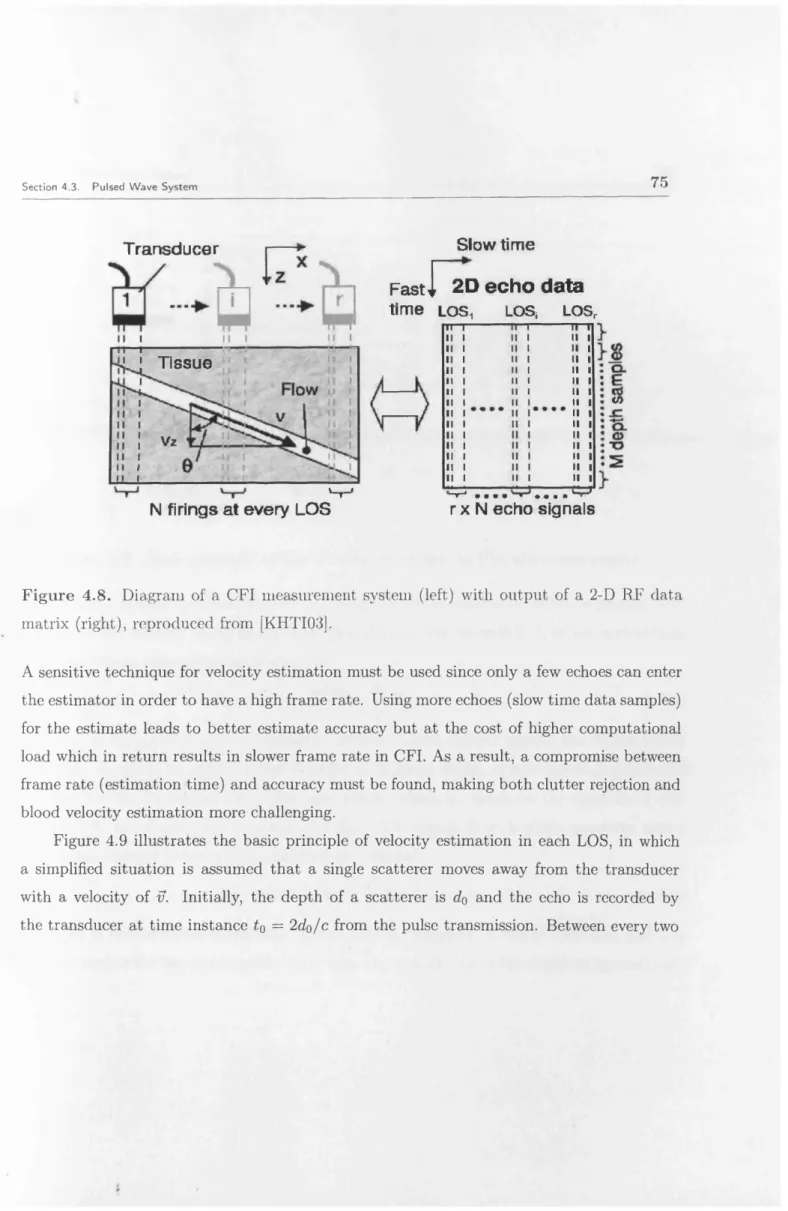
4.8 D iagram of a C FI m easurem ent system (left) w ith o u tp u t of a 2-D RF d ata
m atrix (right), reproduced from [KHTI03]. 75
4.9 Basic principle of th e velocity estim ation in P W ultrasonic system . 76
5.1 T he frequency sp ectra of clutter, blood and noise contained in dem odulated complex R F d ata, assum ing the Doppler shift is positive for m otion towards
probe. T he d o tted line represents an ideal high-pass filter, (a) w ith stationary
tissue; (b) w ith slow-moving tissue. 80
5.2 Classification of c lu tter filters. 82
5.3 Down-mixing m ethods, where fic( k ,n ) is the estim ated clu tter frequency. 86
5.4 Frequency responses w ith variable param eters: (a) A first-order E R F with
variable ensemble d a ta length N , fclutter = 0, C N R = 40 dB; (b) ER F with
LIST O F FI G U R E S X V I I
5.5 Cross section of a blood vessel buried in tissue. Each d a ta segm ent should be
selected w ith constant statistical properties of the clutter signal. 92
5.6 T he com putational gain of using the R-SWASVD algorithm as com pared to
the ordinary block-based SVD algorithm . 101
5.7 The com putational gain of using the R-SWASVD algorithm as com pared to
the sequential b i-iteration SVD algorithm . 102
5.8 E stim ated velocity profile with clutter filtering using the block-based SVD
m ethod and th e R-SWASVD algorithm . The d o tted curve represents the true
parabolic velocity profile. 103
6.1 The MSE of th e exam ined estim ators as a function of th e SNR, for v =
0.5 x v^yq, w ith fibre R F data. 107
6.2 The MSE of the exam ined estim ators as a function of th e SNR, for v =
0.5 x VNyq: w ith parabolic flow RF data. 108
6.3 The estim ated velocity profile using RF d a ta from sim ulated carotid artery. 109
6.4 T he velocity sp ectra using th e M-DAVE m ethod w ith R F d a ta obtained from
sim ulated fibre flow w ith S N R = 10 dB, for (a) v = 0 .5 x u a ^ ; (b) v = l x v Nyq;
(c) v = 1.5 x vNyq; (d) v = 2 x vNyq. 114
6.5 The velocity sp ectra using the M-NLS m ethod w ith R F d a ta obtained from
sim ulated fibre flow w ith S N R = 10 dB, for (a) v = O.bxvNyq] (b) v = l x v Nyq]
(c) v = 1.5 x vNyq] (d) v = 2 x vNyq. 115
6.6 The MSE of th e exam ined estim ators as a function of th e SNR, for v =
1.5 x vNyq, w ith fibre flow. 116
LIST O F F I G U R E S XV111
6.8 T he estim ated velocity profile of parabolic flow, with (a) S N R = 10 dB; (b)
S N R = 30 dB. 118
List of Tables
5.1 Sequential b i-iteratio n SVD algorithm 95
5.2 Revised Sliding W indow A daptive SVD algorithm (R-SWASVD) 99
Chapter 1
INTRODUCTION
“I hear, I forget; I see, I remember; I do, I understand. ”
A Chinese Saying.
The work com prising this Ph.D . study is prim arily concerned w ith single and multiple
frequency estim ation, together w ith efficient im plem entation of subspace tracking. Several approaches to these problem s are proposed in this thesis. To exam ine performance, the
m ethods are evaluated using both synthetic d a ta and realistic medical ultrasound data. The present chapter serves as an introduction and an overview of th e m ain topics covered in this thesis.
1.1 Motivation and Overview
P aram eter estim ation has been a classical problem for more th a n 200 years [Pro95] and is still an im portant research topic w ith a wide range of practical applications such as in biomedi
cine, com munications, rad ar and speech (see, e.g., [Pro89,Edd93, Jen96a,KP95,EM 00,SM 05]
S e c t i o n 1.1. M o t i v a t i o n an d O v e r v ie w 2
and the references therein). More specifically, in biomedicine, estim ation of various signal
characteristics from a patient, such as ultrasound-based radio frequency (RF) data, can, for instance, provide inform ation about Doppler shift which can be useful in colour flow imag
ing (CFI) for blood velocity estim ation [Jen96a, EMOO]. In com munications, one problem of current interest is the need to track the tim e-varying param eters in a cellular radio sys tem [Pro89]. In rad ar and sonar systems, an accurate estim ate can provide inform ation on
the location and m otion of targ ets situated in the field of view [Edd93, SM05]. In speech,
param eter estim ation of audio signals can be useful in b e tte r understanding the speech production process as well as for speech synthesis, coding and recognition [KP95]. A vast
number of other applications can easily be found.
An estim ate can be formed using either a param etric or a no np aram etric approach. Most m odern estim ation approaches in signal processing are m odel-based in the sense th a t they
rely on certain assum ptions m ade on the observed data. In particu lar, th e topic of sinusoidal param eter estim ation has received a huge interest in recent decades, w ith numerous books
w ritten on the topic (see, e.g., [Mar87,Kay88,QH01,SM05], and the references therein). One reason for this is due to th e wide applicability of such problems. A typical sinusoidal model
can be w ritten as a sum of complex-valued sinusoid(s) corrupted by a G aussian noise process typically not known, e.g,
d
ys (t) = x s(t) + e(t) ; x s(t) = ^ a k(t)el{uJkt+ipk) , ( 1-1.1) /c=l
where x s(t) denotes th e (complex-valued) noise-free sinusoidal signal; { a fc(t)}, {u;fc} and {tpk}
are its tim e-varying am plitudes (power), angular frequencies and initial phases, respectively;
and e(t) is an additive observation noise which is often assum ed to be zero mean complex valued circular w hite w ith G aussian distribution. Often, one is only interested in one or some of the param eters in (1.1.1), depending on th e specific application. Typically, estim ation of
S e c t i o n 1.1. M o t i v a t i o n an d O v e r v i e w 3
in the received d a ta sequence. In addition, in m any applications, it is the frequency contents of a signal th a t carry the inform ation about some desired property, e.g., Doppler shift and the
resulting blood velocity in CFI. Once the frequencies have been determ ined, the remaining param eters, nam ely am plitudes and phases, can then be com puted straightforw ardly [SM05].
It is notew orthy th a t for exponentially dam ped sinusoids, one also needs to determ ine the ex tra param eters of dam ping factors, which can be estim ated jointly w ith the frequencies
[ZH97], or separately using least-squares or forw ard-backward linear prediction (sec, e.g., [Sto93,ZH97, VSH+00,KK 01], and the references therein). In general, m any algorithm s are
tested on the basis of lim ited length synthetic sinusoidal d a ta samples, which is feasible if the sinusoidal d a ta m odel closely matches the practical data. However, in the real world,
many signals are non-stationary, have a frequency spread (broadband) a n d /o r exhibit a non- sinusoidal property w ith power dam ping, corrupting the d a ta m odel com monly causing the
estim ation procedure to fail. An example of an area where such problem s are encountered is in medical ultraso un d w here one tries to extract inform ation from a backscattered RF
signal, which will be discussed in later chapters. Given the great interest in good methods for frequency estim ation, vast numbers of approaches have been proposed over the years,
each w ith their own pros and cons. In this thesis, several frequency estim ators are proposed based on a simplified version of (1.1.1) as discussed later. Herein, th e proposed m ethods are
m otivated and associated w ith the application of ultrasound-based blood velocity estimation.
However, it is w orth em phasizing th a t these estim ators can be easily extended/applied to related problem s in rad ar and sonar and other possible applications.
A nother topic this thesis deals w ith is subspace estim ation and tracking in associa tion with the application of clu tter rejection in CFI. Subspace-based signal analysis consists
of splitting th e observations into a set of desired and a set of uninteresting components which can be viewed in term s of signal and noise subspaces. In CFI, the observed radio
S e c t i o n 1.1. M o t i v a t i o n a n d O v e r v ie w 4
Clutter Subspace
F ig u r e 1.1. P rojection of a signal space (spanned by basis vectors u 1} u 2 and u 3) into a clutter subspace (spanned by basis vectors Uj and u 2).
much stronger th a n th e echoes from blood scatters [Jen96a, EMOO]. To estim ate accurately blood velocities, th e c lu tter com ponent m ust be first suppressed; this step is term ed clutter
rejection. C lu tter rejection can be performed in m any different ways, which will be further discussed in C hap ter 5. One of the promising m ethods is the recently developed eigenfilter
technique which is based on estim ating the clu tter subspace using the eigenvalue decom
position (EVD) technique, or alternatively, using the singular value decomposition (SVD) technique (see, e.g., [BHR95,LBH97,EMOO,BTK02], and th e references therein). Once the clutter subspace is formed, the clu tter com ponent can be removed by projecting the observed
S e c t i o n 1.2. T h e s i s O u t l i n e a n d C o n t r i b u t i o n s 5
RF signal onto th e space orthogonal to the clutter subspace, as depicted in Figure 1.1, where
the clutter subspace is spanned by basis vectors Ui and u 2. However, th e com putational cost of evaluating the required SVD, or alternatively the estim ation of the correlation m atrix of
the examined R F signal and th e com putation of its EVD is often prohibitive, lim iting the practical applicability of th e eigenfilter in CFI. Therefore, there is a real need for th e com
putationally efficient im plem entation of this approach. In this thesis, we exploit the fact th a t the clu tter signal has a slowly time-varying n atu re b o th in the tem poral and spatial
direction, enabling an efficient evaluation of the consecutive SVDs using a subspace track ing technique refining th e sliding window adaptive SVD (SWASVD) algorithm proposed by Badeau et al. [BRD04].
1.2 Thesis Outline and Contributions
This thesis consists of two parts, estimation using a single carrier or multiple carriers and a focus application: ultrasound. This section presents the outline and contributions of this
thesis.
1.2.1 Estimation Using a Single Carrier Or Multiple Carriers
This p a rt of the thesis includes C hapter 2 and C hapter 3 which deal w ith general single tone estim ation as well as m ultiple-carrier based velocity estim ation. As some of this p art of
the thesis is associated w ith P a rt II, which mainly concerns w ith th e application of medical ultrasound, readers can also refer to C hapter 4 in P art II to obtain some fundam entals of ultrasound.
S e c tio n 1 .2 . T h e s is O u t lin e a n d C o n tr ib u tio n s 6
Chapter 2
This chapter discusses single frequency estim ation, particularly w ith phase-based techniques. The topic of com putationally efficient frequency estim ation of a single complex sinusoid cor
rupted by additive w hite G aussian noise has received significant atten tio n over th e last decades due to th e wide applicability of such estim ators in a variety of fields (see, e.g.,
[RB74, Kay89, CKQ94, H95, KNC96, FJ99, QH01, Fow02, Mac04, Kle05], and the references therein). In this chapter, a com putationally fast and statistically improved hybrid single tone estim ator is proposed. T he proposed approach outperform s other recently proposed
methods, lowering th e signal-to-noise ratio at which th e C ram er-R ao lower bound is reached.
The work of this chapter has been published in p art as:
• Z. Zhang, A. Jakobsson, M. D. Macleod, and J. A. Cham bers, Hybrid Phase-based Sin gle Frequency Estim ator, IE E E Signal Processing Letters, 12(9) :657-660, Sept. 2005.
• Z. Zhang, A. Jakobsson, M. D. Macleod, and J. A. Cham bers, Computationally Ef
ficient Estimation of a Single Tone, In IEEE 13th W orkshop on Statistical Signal Processing, B ordeaux, France, July 2005.
• Z. Zhang, A. Jakobsson, M. D. Macleod, and J. A. Cham bers, Statistically and Com
putationally Efficient Frequency Estimation of a Single Tone, Tech. Rep. EE-2005-02, Dept, of Electrical Engineering, K arlstad Univ., K arlstad, Sweden, February 2005.
Chapter 3
Typically, velocity estim ators based on th e estim ation of the Doppler shift will suffer from a
limited unam biguous velocity range. In this chapter, three novel m ultiple-carrier based ve locity estim ators extending the velocity range above the Nyquist velocity lim it are proposed.
S e c tio n 1 .2 . T h e s is O u t lin e a n d C o n tr ib u tio n s 7
Numerical sim ulations indicate th a t the proposed estim ators offer im proved estim ation per formance as com pared to other existing techniques.
The work of this chapter has been published in p a rt as:
• Z. Zhang, A. Jakobsson, S. Nikolov, and J. A. Cham bers. Extending the Unam biguous Velocity Range Using Multiple Carrier Frequencies, IEE Electronics Letters,
41 (22): 1206-1208, O ct. 2005.
• Z. Zhang, A. Jakobsson, and J. A. Cham bers, On Multicarrier-based Velocity Esti
mation, Tech. Rep. EE-2005-04, Dept, of Electrical Engineering, K arlstad Univ., K arlstad, Sweden, May 2005.
1.2.2 Application: U ltrasound
Following the first p a rt of the thesis, the second p art consists of C h ap ter 4, C hapter 5 and C hapter 6, which are m ainly concerned w ith the application of ultraso und . T he hybrid single tone estim ator and m ultiple-carrier based estim ators proposed in P a rt I will be examined in
this p art w ith realistic R F d a ta sim ulated w ith the Field II toolbox. T h e details on how to sim ulate R F d a ta w ith th e Field II toolbox can be found in [JenOl, Jen96b].
C hapter 4
Before exam ining th e proposed m ethods in the context of ultraso un d, it is preferable to
introduce some general th eory of ultrasound. In this chapter, some basic theory of acoustics and the fundam entals of m edical ultrasound are introduced.
S e c tio n 1 .2 . T h e s is O u t lin e a n d C o n tr ib u tio n s 8
Chapter 5
In colour flow imaging, efficient clu tter rejection is a key preprocessing step prior to blood
velocity estim ation. In this chapter, an efficient im plem entation of clu tter eigenfilters using a recent developed subspace tracking technique is introduced.
The work of this chap ter has been published in p a rt as:
• Z. Zhang, A. Jakobsson, J. A. Jensen, and J. A. Cham bers, On the Efficient Imple
mentation of Adaptive Clutter Filters fo r Ultrasound Color Flow Imaging, In Sixth
IMA International Conference on M athem atics in Signal Processing, pages 227-230, Cirencester, UK, 2004.
Chapter 6
This chapter is concerned w ith blood velocity estim ation using th e hybrid single tone esti m ator and the m ultiple-carrier based estim ators proposed in P a rt I.
T he work of this chapter has been published in p art as:
• Z. Zhang, A. Jakobsson, M. D. Macleod, and J. A. Cham bers, On the Efficient Esti mation of Blood Velocities, In Proceedings of the 2005 IE E E Engineering in Medicine
and Biology 27th A nnual Conference, Shanghai, China, Sept. 2005.
• Z. Zhang, A. Jakobsson, S. Nikolov, and J. A. Cham bers, Novel Velocity Estimator Using Multiple Frequency Carriers, In Medical Imaging 2004: U ltrasonic Imaging and Signal Processing, volume 5373, pages 281-289, San Diego, USA, Feb. 2004.
S e c tio n 1 .2 . T h e s is O u t lin e a n d C o n tr ib u tio n s 9
C hapter 7
This chapter will sum m arize th e work involved in this thesis and will suggest some related topics for future work.
Part I
E stim ation U sin g a Single Carrier Or
M u ltip le Carriers
Chapter 2
EFFICIENT ESTIMATION OF A
SINGLE TONE
The frequency estim ation of a single tone corrupted by additive w hite G aussian noise has received significant atten tio n over th e last decades due to its wide applicability in signal processing. In this chapter, a com putationally fast and statistically im proved hybrid single
tone estim ator is proposed, which outperform s other recently proposed approaches. Nu merical sim ulations indicate th a t, in contrast to many other techniques, th e performance
of the hybrid estim ato r is essentially independent of the underlying frequency component. Furtherm ore, it has also been exam ined for how power dam ping and frequency spread affect the perform ance of th e estim ator.
2.1 Introduction
Frequency estim ation is a topic widely occurring in signal processing and can be roughly classified into two m ain p aram eter estim ation problems:
• Single tone estim ation: where th e signal is a single, constant-frequency sinusoid, cor rupted by some noise.
• M ulti-carrier frequency estim ation: where there are several carriers of harmonically
S e c tio n 2 .1 . I n tr o d u c tio n 12
related or un related frequencies present as in the m ultiple-carrier based estim ators to
be discussed in C hapter 3.
In this chapter, discussion will be confined to single tone estim ation. The problem of es tim ating th e frequency of a sinusoid in noise has received much atten tion in the literature
as the problem arises in m any areas of applied signal processing, such as biomedicine, com m unications and ra d a r [Edd93, W ai02, Jen96a]. One often encounters a need to find a low
com putational com plexity estim ate of the frequency com ponent of d a ta which are assumed to consist of a single com plex sinusoid corrupted by additive w hite G aussian noise, and the topic
has, as a result, a ttra c te d significant interest over th e last decades (see, e.g., [LRP73,RB74, Tre85, Kay89, LM89, LW92, Cla92, CKQ94, H95, KNC96, FJ99, QuiOO, Fow02, Mac04, Kle05], and the references therein). T he problem can be briefly sta te d as follows; consider the d ata
sequence
y(t) = Pel^ t+es> -I- n(t), (2.1.1)
where (3 E R, u and 6 E [—7r, n) denote the determ inistic b u t unknow n am plitude, fre
quency, and initial phase, respectively, of a complex sinusoid. F u rther, n(t) is circular zero mean complex G aussian w hite noise w ith variance g\ . T hen, given th e sequence y(t), for
t = 0 , . . . , iV — 1, th e problem is simply to estim ate accurately u w ith the lowest possible
com putational complexity. In [RB74], Rife and Boorstyn derived th e m axim um likelihood (ML) estim ator of lj and proposed a statistically efficient approxim ate ML approach in
volving both a com bined coarse and fine search using the fast Fourier transform (FFT)
algorithm. However, zeropadding is often required to obtain sufficient resolution, requiring
0 ( N ' \ o g 2 N ') operations, where N ' is the size of th e desired frequency grid, w ith typically
N ' N . Furtherm ore, an iterative linear prediction (ILP) approach requiring G ( N log2 N )
operations was suggested in [BW02] showing similar perform ance to th a t of the ML estim a
tor. A variety of phase-based m ethods requiring only O ( N ) operations have been developed. In [Tre85], for exam ple, T re tte r proposed a phase-based approach simplifying the problem
S e c tio n 2 .1 . in t r o d u c t io n 13
to a linear regression on th e phase. The m ethod is based on a phase unw rapping algorithm , requiring a very high signal-to-noise ratio (SNR) (S N R 1), here defined as
R2
S N R = t L , (2.1.2)
to work well. Later, K ay proposed a modified version of T re tte r’s algorithm avoiding the use
of the phase unw rapping algorithm [Kay89]. The m ethod, here term ed K ay’s weighted phase average (KW PA) estim ator, was claimed to be unbiased and its variance attain s the Cramer-
Rao lower bound (CRLB) for sufficiently high SNR (a higher threshold th a n the ML method). Later, analysis showed th a t th e KW PA m ethod is in general biased, and th e SNR for which
the CRLB is achieved depends on th e underlying frequency [CKQ94,LW92,Qui00]. For much of the frequency range, th e K W PA m ethod can not handle the circular n atu re (rotation) of
frequency correctly. As a result, th e focus of recent contributions has m ainly been aimed at reducing the SNR threshold [KNC96], th e frequency dependency of th e threshold [Cla92], or both [FJ99,Mac04].
In this chapter, we propose a hybrid m ethod combining th e ideas in [KNC96, FJ99,
Mac04] to show perform ance close to th a t of ML or ILP, b u t only requiring O ( N ) operations. The hybrid estim ate is based on an initial coarse estim ate of th e unknow n frequency using th e unweighted linear prediction (UW LP) m ethod [LRP73, Kay89]; this estim ate is used
to remove the frequency dependence of the SNR threshold. T his SNR threshold is then
further reduced via a com bination of using an averaging filter, as suggested in [KNC96], and an outlier removal scheme as proposed in [Mac04]. Finally, a refined frequency estim ate is
formed along th e lines proposed in [KNC96, FJ99]. In Section 2.2, several basic estim ators are discussed, including th e ML estim ator in Section 2.2.1, th e U W LP in Section 2.2.2, the
KW PA in Section 2.2.3; then the proposed hybrid estim ator is given in Section 2.2.4. Section 2.4 contains numerical exam ples, w ith a conclusion in Section 2.5.
S e c tio n 2 .2 . S in g le T o n e E s tim a to r s 14
2.2 Single Tone Estim ators
In this section, an overview of recent single frequency estim ators is presented as well as the proposed hybrid estim ator. In this section, all th e results have been obtained using 103
M onte Carlo sim ulations.
2.2.1 M aximum Likelihood Estim ator
If the additive noise, n(t), in (2.1.1) is a zero mean w hite G aussian process, th e ML estim ator
of the frequency u> in (2.1.1) is the maximizer of the likelihood function (also called the joint probability density function) of the sequence {?/(£)}, given as
& M L E = arg m a x /
(y;£),
(2-2-1)U)
where ujmle is th e ML estim ate, w ith the likelihood function defined as
f te ’® = J ^
n exp(-^2
Y ,
(»(*) - /?ei<"‘+<’)) 2) . (2.2.2) where y = [2/(0), • - - , y ( N — 1)]T, o 2n = the noise variance and £ = [/?,<*;, 0]r , w ith [-]T denoting the transpose operation. Maximizing (2.2.1) is equivalent to minimizingN- 1
u m l e = argin in (y(t) - j3el{uJt+e)) 2 , (2.2.3)
t=o
which can be seen to be th e nonlinear least squares (NLS) estim ation problem . It can readily
be shown th a t th e NLS estim ate of the frequency of a single sine wave buried in white noise is given by th e peak of the periodogram of th e d a ta sequence [SM05], i.e.,
Um l e = arg m ax P (uj), (2.2.4)
S e c tio n 2 .2 . S in g le T o n e E s tim a to r s 15
where |x| denotes th e m odulus of the scalar x.
Rife &; B oorstyn [RB74] proposed a numerical m ethod similar to the ML estim ator,
which involves a coarse and a fine search. The coarse estim ate is obtained by choosing the frequency having th e greatest m agnitude in the periodogram , as discussed above. A finer estim ate is obtained using a m ethod such as the secant m ethod. Generally, zeropadding is
required to o btain sufficient resolution when using th e F F T , requiring 0 ( N ' log2 iV7) opera tions, where N ' is th e size of the desired frequency grid, w ith typically N ' N . Thus, the
estim ator is not com putationally efficient. However, it is statistically efficient with the low est SNR threshold am ong the variously proposed estim ators, exhibiting estim ation variance identical to the corresponding CRLB given by [RB74]
6
CRLB& = jV(jV2 _ 1) g j Vfl {r a d /s a m p le )2, (2.2.6)
where u denotes the estim ated frequency and the C R L B & is th e lowest variance which a statistically unbiased estim ato r may exhibit for a given SNR and N. Over the last decades,
the ML estim ato r’s high com putation cost has led to a search for altern ative m ethods th a t approach its statistical performance, bu t with less com putation.
2.2.2 Unw eighted Linear Predictor
As suggested in [Tre85], the d a ta model in (2.1.1) can be w ritten as
j/(t) = [1 + v(t)]/3eil-ult+e\ (2.2.7)
where
v(t) = (2.2.8)
is a complex w hite sequence. Let vr (t) and Vi(t) denote th e real and th e im aginary parts of
v(t), respectively. Then, for high SNR,
S e c t io n 2 .2 . S in g le T o n e E s t im a t o r s 16 -15 2.-25 -35 -45 -55 -65 -1 0 SNR (dB)
F ig u r e 2 .1 . T h e M SE of th e U W LP estim ato r as a function of th e SNR, N = 24.
allowing th e approxim ation
y(t)s r (2.2.10)
where
(j){t) = u t + 0 + Vi(t). (2.2.11)
Thus, th e additive noise has been converted into an equivalent phase noise Vi(t) w ith variance
[Kay89] ^
v a r M t ) ) = & = _ L _ . (2.2 .12)
M ost of th e recent phase-based approaches exploit th is approxim ation, allowing th e phase
S e c tio n 2 .2 . S in g le T o n e E s tim a to r s IT
Kay [Kay89], i.e.,
A<f>(t) = arg [y*(t)y(t + 1)] « u + Vi(t + 1) - u*(t), (2.2.13)
where (•)* denotes th e complex conjugate, suggesting the so-called unweighted linear predic
tor (U W LP) [LRP73,Kay89]
ujc — arg
t = 0
The UW LP m ethod is also term ed th e autocorrelation estim ator in ultrasound blood velocity
estim ation [KNK085], as discussed in th e later chapters. It is straightforw ard to show th a t the UW LP estim ator is unbiased, b u t statistically inefficient w ith variance [Kay89, CKQ94]
v a r (* ' ) = ( N - i y S N R ( 2 2 1 5 )
giving the ratio
variujr) N
= — . (2.2.16)
C R L Bqj 6 V j
Figure 2.1 shows th e m ean square error (MSE) of th e UW LP estim ator as a function of SNR,
w ith different frequencies denoted by different plots therein. As is clear from th e figure, the U W LP m ethod is statistically inefficient for all exam ined frequencies across the whole SNR
range, unable to reach the CRLB. However, given th e fact th a t th e U W LP is very simple w ith very low com putational cost, it can be adequate as a coarse estim ator, as will be used in our proposed hybrid estim ator discussed later.
(2.2.14)
2.2.3 Kay’s W eighted P h ase A verager
A nother basic co m pu tatio nally efficient estim ator discussed here is K ay’s weighted phase
average (KW PA) m ethod [Kay89]. Recall A i n (2.2.13), th e K W PA m ethod is expressed as
N- 2
& K W P A ~
E
w(t)A4>(t), (2.2.17) t= 0S e c tio n 2 .2 . S in g le T o n e E s tim a to r s 18
where C j k w p a denotes th e KW PA estim ate, and the parabolic window
<“ is»
The approxim ation in (2.2.13) will hold for a very high SNR (S N R 1) following the
approxim ation in (2.2.9) and (2.2.10). For this condition C j k w p a can be shown to be an
unbiased estim ator following th e derivation below
N- 2 E {ljKw p a} = ^>2 w ( t ) E { A ( f ) ( t ) } t=o N- 2 t=o N - 2
~ ^ 2 w (i )E{uj + Vi(t + 1) - Vi(t)}
=o N - 2 t= 0 N - 2 U t= 0 — UJ (2.2.19)
where the last equality follows from
N - 2
J 2 w (t ) = 1- (2.2.20)
t= 0
Similarly, as in (2.2.19), th e K W PA estim ator, for high SNR, can be shown to have the following variance [Kay89]
var(u,KIVPA) = n (n 2 _61 )s n r (2.2.21)
which is identical to th e CRLB in (2.2.6). As discussed earlier, th e KW PA m ethod is in general biased and (2.2.21) will only hold tru e for high SNR and very low frequency range [CKQ94, LW92, QuiOO].
S e c tio n 2 .2 . S in g le T o n e E s t im a t o r s 19
It has been shown th a t one of th e drawbacks of the KW PA m ethod is the unavoidable w rapping errors w hen th e phase uj approaches —7r /+7T, making the SNR threshold dependent on underlying frequency [FJ99]. This is because the cum ulative errors from noise component
Vi(t) will som etim es m ake th e estim ate lower th a n u and sometimes higher th an ui. If
A(f){t) exceeds —7r/ + 7r, th en it gets w rapped over the —7r / + n boundary and thus aliasing occurs resulting in higher variance as shown in Figure 2.2. A nother drawback of the KWPA
m ethod is th a t its perform ance highly depends on SNR [Kay89]. W hen th e SNR drops below a certain threshold as shown in Figure 2.2, the perform ance of th e KW PA m ethod falls off rapidly, exhibiting threshold behavior a t a higher SNR which is also confirmed in Figure
2.2. Also, unlike the ML m ethod, as th e d a ta length N increases, th e SNR threshold of the KWPA m ethod slowly increases [LM89], which is illustrated in Figure 2.3. As Kay pointed
out [Kay89], th e coefficients of th e parabolic window are responsible for ujkwpa attaining the CRLB. If we let w(t) = (2.2.22) then (2.2.17) becomes ^ N - 2 u u w p a = t=0 = W w - 1) - * ( 0)] = [v,(N - 1) - ^ ( 0)] (2.2.23)
which is term ed th e unw eighted phase average (UWPA) estim ator and is unbiased, b ut again
becomes inefficient statistically as shown in Figure 2.4. This is because th e UWPA estim ator in (2.2.23) discards useful inform ation by allowing common inform ation in adjacent term s
of the sum to cancel. T his is th e direct result of ignoring th e colouring in the noise term
S e c t io n 2 .2 . S in g le T o n e E s t im a t o r s 20 -15 -35 -45 -55 -65 -1 0 SNR (dB)
F ig u r e 2 .2 . T h e M SE of th e exam ined K W PA estim ato r as a function of th e SNR, N = 24.
2 .2 .4 T h e Proposed Hybrid Estim ator
Given th e lim itatio n s of th e K W PA estim ato r discussed above, various im proved and ex
tended m eth od s have been proposed for reducing th e SN R thresho ld and th e frequency
dependency of th e thresho ld (see, e.g., [KNC96, Cla92, FJ99, BW 02, Mac04], and th e refer
ences therein). In th is section, th e proposed hybrid m ethod com bines th e ideas in [KNC96,
FJ99,M ac04] to o b ta in th e perform ance close to th a t of ML or ILP, b u t only requiring 0 ( N )
operations.
As suggested in [Cla92,BW 02,M ac04], th e U W LP estim ate is used to form a dow nshifted
signal, yd(t), to remove th e frequency dependence of th e SNR threshold, i.e.,
S e c t io n 2 .2 . S in g le T o n e E s t im a t o r s 21 N = 12 N = 16 - - N = 20 - t - N = 24 •••• CRLB -1 5 2 .- 2 5 -35 -45 -55 -65 -1 0 -5 0 5 10 15 20 25 30 SNR (dB)
F ig u r e 2 .3 . T h e M SE of th e exam ined K W PA estim ato r as a fu nctio n of th e SNR, u —
0.75?r.
In [KNC96], Kim et a l proposed using a sim ple K-ta p m oving average filter to sm ooth
irregularities and rand om variations prior to th e frequency estim atio n as a way to reduce
th e SNR threshold. Such an averaging can be show n to lower th e SN R threshold up to
10 log10 K dB. However, as such an averaging will severely re stric t th e allowed frequency
range down to ( —T r /K ,ir /K \, th e m ethod in [KNC96] is lim ited to signals w ith frequencies
near zero. T his is because th e finite im pulse response (F IR ) averaging filter is essentially
a low pass filter. Herein, it is noted th a t th e frequency co n ten t of th e dow nshifted signal,
S e c t io n 2 .2 . S in g le T o n e E s t im a t o r s 2 2 -15 tj -2 5 -35 -45 -55 (0 = 0 co = 0.25ji — (D = 0.57i —t— CO = 0.75k CRLB -6 5 >--10 SNR (dB)
F ig u r e 2 .4 . T h e M SE of th e exam ined U W PA estim ato r as a function of th e SNR, N = 24.
signal as
1 K ~ l
» M - 5f 5 X * + *). (2.2.25)
fc=0
Sim ilar to (2.2.13), th e adjacent phase difference of (2.2.25) can be form ed as
A</)f (t) = arg [y}(t)yf (t + 1)] = u f + u c(t), (2.2.26)
where uc(t) is given by (2.A .9) for a general K (see A p pend ix 2.A for fu rth er details). It is
w orth noting th a t th e noise process u c(t) will now be coloured due to th e average filtering.
As shown in [LM89], th e SNR threshold behavior of th e phase-based frequency esti
m ators is affected by cum ulative ±27r phase errors resulting from th e effect of th e additive
S e c tio n 2 .2 . S in g le T o n e E s tim a to r s 23
/
I Begin j
X
Step 1: Coarse estimate using 'UWLP' 1
N - 2
\co
= arg'Step 2: Frequency downshift
^ - r E / t O X Z + l ) 1 r=0
r ...
[3;r f ( 0 = X 0 e
Step 3: Improve SNR using FIR ^
-ICQJ
£=0
Step 4: Form the phase difference
| A
<pf
(
t
) = arg [
y f
(t ) y f
(/ + !)]
Step 5: Outlier removal
I
|A M 0 =
Atpf ( t ) - s i g n ( f 3 , ) 2 x :
A M OStep 6: Fine estimate
N - K / K K- 1 _ |
s > /=
Z
r=l w =l I
Step 7: Final frequency estimate
S e c tio n 2 .2 . S in g le T o n e E s tim a to r s 24
effective scheme was proposed in [Mac04], where ± 2-7t outliers are detected if \(3t \ > \(3t±p\
and
IAI
> A (2.2.27) w ith p 0 t = A M t ~ P ) (2.2.28) P— — P,Pt£0where (3k = A4>f(k) — 0, for k 6 [—P, 1] and k E [N — K , N — K + P — 1]. Thus, the outliers
can be removed as follows
A4>f(t) — sign(/?t )27T if outlier detected
f 2.2.29)
A 4>f{t) otherwise
for t = 0 , . . . , N — K — 1. Here, A and P are user param eters, as discussed below. After the SNR threshold reduction using (2.2.25) and (2.2.29), further im provem ent can be achieved by-
taking into account th e colouration of the noise term in (2.2.26). T his can be achieved using the suggested Four C hannel Forward Backward (FCFB) m ethod in [FJ99, Fow02], whereby th e frequency correction term , a)/, can be found as
( N — K ) / K K -1
ujf = (2.2.30)
t = 1 m = 1
where
w ith t = 1, 2 , . . . , ( N — K ) / K . As mentioned in [Fow02], it is possible to develop a closed
form in (2.2.30) for any value of N , but they consider only the case when N is an integer m ultiple of K because it leads to an efficient structure for th e processing. Combined with the coarse estim ate, th e hybrid frequency estim ate is found as
S e c tio n 2 .3 . O th e r Issu e s 25
It is w orth noting th a t the FC FB applies a different set of weights th a n those used in the
KW PA approach.
In summary, the proposed hybrid estim ator is found by first forming the downshifted signal in (2.2.24) using th e U W LP estim ate in (2.2.14). Then, the phase difference of the filtered signal is formed using (2.2.26), followed by the outlier removal scheme in (2.2.29).
Finally, th e refined frequency estim ate is formed as (2.2.32), using (2.2.30). The hybrid estim ator is sum m arized in Figure 2.5. It is w orth stressing th a t the hybrid m ethod differs
from previously suggested approaches in th a t it combines all the above steps; the FCFB m ethod does not include th e outlier removal scheme in (2.2.29). Similarly, th e method proposed in [Mac04], hereafter term ed the outlier removal estim ator (O R E), does not include
the filtering in (2.2.25). In this chapter and C hapter 6, K = 6 , P = 1 and A = 4 will be used in th e sim ulations for th e hybrid estim ator, which is based on th e numerical analysis
of the estim ator given in Section 2.4.
2.3 O th er Issues
The estim ators discussed in th e previous section deal w ith one pure sinusoid corrupted by noise as in (2.1.1), w ith ou t taking into account power dam ping and frequency spread over
time. In this thesis, application to ultrasonics is a m ajor focus and th e sinusoidal-type signals encountered typically have non-zero bandw idth making it interesting to examine how robust
the proposed estim ator is to frequency spread and power dam ping, b o th of which are ways to approxim ate th e non-zero bandw idth of tones. In this section, discussion is given on how
the proposed hybrid estim ato r will be affected by these factors. All th e corresponding results displayed in this section have been obtained using 103 M onte Carlo simulations.
S e c t io n 2 .3 . O t h e r I s s u e s 26 a = 0.15 a = 0.125 - e - a = 0.075 - i - a = 0.05 — a = 0 CRLB - 1 0 -30 4 -40 -50 -60 -1 0 SNR (dB)
F ig u r e 2 .6 . T h e M SE of th e H ybrid estim ato r as a function of SN R w ith varying dam ping
factor a, for N = 24 an d uj = 0.757r.
2.3 .1 Power D am ping
Sim ilar to (2.1.1), th e observations are m odelled as
zd(t) = 0 ( t y < “t+V + n ( t ) , (2.3.1)
w hilst allowing for a decaying am p litu d e com ponent
Pit)
= (2.3.2)where z d{t) denotes th e observation sam ple for t = 0 , . . . , N — 1, and a th e dam ping factor
S e c tio n 2 .3 . O th e r I ss u e s 27
performance of th e estim ator, th e dam ping factor is allowed to vary as shown in Figure 2.6 where th e MSE results are obtained w ith th e hybrid estim ator. As is clear from the figure, th e dam ping factor does seriously affect th e perform ance of th e estim ator. More
perform ance degradation occurs as more dam ping exists. As th e hybrid estim ator and other estim ators discussed in Section 2.2 are based on the d a ta model in (2.1.1), it is expected th a t
other estim ators will also suffer similar perform ance degradation. It is w orth noting th a t the unknown dam ping could also be estim ated by, e.g., using least-squares or forward-backward
linear prediction (see, e.g., [Sto93, VSH+00,KK01], and the references therein).
2.3.2 Frequency Spread
A nother issue involved in th e topic of frequency estim ation is frequency spread, which implies th a t the carrier frequency in (2.1.1) is not perfectly narrow band. As a result, (2.3.1) can be
further modified as
K
Zd,(t) = m Y i ei(" i+'M) + n(t), (2.3.3)
k=0
where Zds(t) denotes th e observation sample taking into account dam ping factor denoted by P(t) and frequency spread denoted by 5k. B oth factors are assum ed to be positive. To
examine the im pact on th e perform ance of the hybrid estim ator as an example, we assume both dam ping factor and frequency spread existing in the d a ta samples as in (2.3.3) and the
corresponding M SE results are shown in Figure 2.7. As is clear from th e figure (clockwise from the top left), th e M SE of th e estim ator becomes larger when th e dam ping factor, a ,
increases; and th e perform ance of th e estim ator will get worse as the dam ping factor rises to some level, say a = 0.1 as shown in th e sub-figure on th e bo tto m left, no m atter if the
frequency spread exists or not. On the other hand, for any exam ined power dam ping factor, the MSE of th e estim ator will change when the frequency spread changes. It is interesting to note from the figure th a t the MSEs corresponding to th e frequency spreads denoted by 5ni
S e c t io n 2 .3 . O t h e r I ss u e s 2 8 a = 0 -60 ■--- ■ ---10 -5 0 5 10 15 20 SNR (dB) a = 0.075 a = 0.05 10* -* -* ^ ---6 0 1---10 -5 0 5 10 15 20 SNR (dB) a = 0.1 -1 0
S -20
-40 -50 -6 0 1 ---10 -5 0 5 SNR (dB)F ig u r e 2 .7 . T he M SE of th e proposed hybrid estim ato r as a function of th e SNR, w ith
varying 6 in each sub-figure, for u — 0.75n. Sn0 m eans no spread exists; Sni m eans spread
exists w ith Si = l e - 3 ; Sn2 m eans spread exists w ith = l e -3 and S2 = l e -2 ; Sn3 m eans
S e c tio n 2 .4 . N u m e r ic a l E x a m p le s 29
and Sn2, respectively, are lower th a n the one w ithout frequency spread (denoted by <Jn0). The reason is not clear. As th e current CRLB is derived based on th e pure single sinusoid d ata model in (2.1.1), one m ust bear in m ind th a t th e CRLB in (2.2.6) (represented by the dotted
line in Figure 2.7) can not be used to judge the estim ato r’s perform ance when dam ping or frequency spread exists. This is because either of the factors will make the real d ata
deviate from the assum ed pure sinusoid d ata model and th e CRLB needs to be re-derived based on a modified d a ta model which closely m atches th e observed data. This will also be discussed further in C h ap ter 5 when the hybrid estim ator is applied to ultrasound radio
frequency (RF) data. Based on th e results above, if th e R F d a ta have large frequency spread or power dam ping, one should expect th a t, w ithout further im provem ent of th e estimator, the estim ator will not work very well.
2.4 Numerical Examples
In this section, th e proposed estim ator is first exam ined w ith synthetic data. Initially, it is studied on how the perform ance of the hybrid estim ator is affected by th e length of the
averaging filter, K in (2.2.25), and the outlier removal threshold, A in (2.2.27). Figure 2.8 illustrates th e estim ated m ean square error (MSE) of th e hybrid m ethod as compared to the corresponding CRLB, given in (2.2.6), for varying K . Here, and below unless otherwise
stated, th e signal consists of N — 24 d a ta samples containing a single complex sinusoid with frequency u = 0.757T. As can be seen from the figure, th e estim ator improves to a point
with increasing K : showing its best performance for K = 6, for all th e examined values of A. Here P = 1 is chosen as in [Mac04]. Next, we examined th e MSE of th e hybrid estim ator
for varying P. Figure 2.9 dem onstrates the perform ance as com pared to th e corresponding CRLB. The results im ply th a t th e hybrid estim ator shows its best perform ance for P = 1.
M S E (d B ) M S E (d B ) S e c t io n 2 .4 . N u m e r ic a l E x a m p le s 30 P=1, Jt = 3 P = 1, Jt =3.5 K = 2 K = 4 -30 CRLB -35 -40 2 3 4 5
6
SNR (dB) P = 1 , X = 4 K = 2 K = 4 K = 6 -30 CRLB -35 -40 2 3 4 56
K = 2 K = 4 -30 -o CRLB -402
3 4 5 6 SNR (dB)P = J\ , \
=4.5 K = 2 K = 4 -30 CRLB cn
-35 -402
3 4 5 SNR (dB) SNR (dB)F ig u r e 2 .8 . T he M SE of th e proposed hyb rid estim ato r as a function of th e SNR, w ith
M S E (d B ) M S E (d B ) S e c t io n 2 .4 . N u m e r ic a l E x a m p le s 31 K = 6, X = 3 K = 6,X =3.5 CRLB 3 4 5 SNR (dB) K = 6,
A,
= 4 -30 P = 2 CRLB -35 -40 2 3 4 56
CRLBco -35
2 3 4 5 SNR (dB) K = 6,X
=4.5 -30 P = 2 P = 3 P = 4 CRLB co -35 -402
3 4 5 6 SNR (dB) SNR (dB)F ig u r e 2 .9 . T h e M SE of th e proposed hy brid e stim ato r as a function of the SNR, w ith
S e c t io n 2 .4 . N u m e r ic a l E x a m p le s 32
seen from th e figure, th e m ethod achieves sim ilar perform ance as soon as A > 3. Based on
these results, hereafter K = 6, P = 1 and A = 4 will be used.
K = 6, P = 1 Jt = 3 1 = 3.5 -3 0 CD T3 UJ CO 5 -3 5 -40 SNR (dB)
F ig u r e 2 .1 0 . T he M SE of th e proposed hybrid estim ato r as a function of th e SNR, w ith
varying A, for u = 0 .757r.
Next, th e proposed estim ato r will be exam ined and com pared to o th er recently proposed
algorithm s. Figure 2.11 illu strates th e M SE for th e proposed hybrid estim ato r, as com pared
to th e U W LP approach [LRP73], th e FC F B approach following [FJ99], th e O RE approach
[Mac04], th e ILP approach using th ree iteratio ns [BW02] and th e corresponding CRLB
as given in [RB74]. As is clear from th e figure, th e perform ance of th e proposed hybrid
estim ator is statistically im proved, closely following th e CRLB a t a lower SNR threshold