Air Force Institute of Technology
AFIT Scholar
Theses and Dissertations Student Graduate Works
3-22-2019
Machine Translation with Image Context from
Mandarin Chinese to English
Brooke E. Johnson
Follow this and additional works at:https://scholar.afit.edu/etd
Part of theOther Computer Engineering Commons, and theSystems and Communications Commons
This Thesis is brought to you for free and open access by the Student Graduate Works at AFIT Scholar. It has been accepted for inclusion in Theses and
Recommended Citation
Johnson, Brooke E., "Machine Translation with Image Context from Mandarin Chinese to English" (2019).Theses and Dissertations. 2265.
MACHINE TRANSLATION WITH IMAGE CONTEXT FROM MANDARIN CHINESE TO ENGLISH
THESIS
Brooke E. Johnson, Second Lieutenant, USAF AFIT-ENG-MS-19-M-035
DEPARTMENT OF THE AIR FORCE AIR UNIVERSITY
AIR FORCE INSTITUTE OF TECHNOLOGY
Wright-Patterson Air Force Base, Ohio DISTRIBUTION STATEMENT A.
The views expressed in this thesis are those of the author and do not reflect the official policy or position of the United States Air Force, Department of Defense, or the United States Government. This material is declared a work of the U.S. Government and is not subject to copyright protection in the United States.
AFIT-ENG-MS-19-M-035
MACHINE TRANSLATION WITH IMAGE CONTEXT FROM MANDARIN CHINESE TO ENGLISH
THESIS
Presented to the Faculty
Department of Electrical and Computer Engineering Graduate School of Engineering and Management
Air Force Institute of Technology Air University
Air Education and Training Command In Partial Fulfillment of the Requirements for the Degree of Master of Science in Electrical Engineering
Brooke E. Johnson, BS Second Lieutenant, USAF
March 2019
DISTRIBUTION STATEMENT A.
AFIT-ENG-MS-19-M-035
MACHINE TRANSLATION WITH IMAGE CONTEXT FROM MANDARIN CHINESE TO ENGLISH
Brooke E. Johnson, BS Second Lieutenant, USAF
Committee Membership:
Dr. Brett J. Borghetti Chair
Lieutenant Colonel Alan C. Lin Member
Captain Richard P. Uber Member
AFIT-ENG-MS-19-M-035
Abstract
Despite ongoing improvements in machine translation, machine translators still lack the capability of incorporating context from which source text may have been derived. Machine translators use text from a source language to translate it into a target language without observing any visual context. This work aims to produce a neural machine translation model that is capable of accepting both text and image context as a multimodal translator from Mandarin Chinese to English. The model was trained on a small multimodal dataset of 700 images and sentences, and compared to a translator trained only on the text associated with those images. The model was also trained on a larger text only corpus of 21,000 sentences with and without the addition of the small multimodal dataset. Notable differences were produced between the text only and the multimodal translators when trained on the small 700 sentence and image dataset, however no observable discrepancies were found between the translators trained on the larger text corpus. Further research with a larger multimodal dataset could provide more results clarifying the utility of multimodal machine translation.
Acknowledgments
I wish to express my gratitude my thesis committee for their active support in my research. To Dr. Borghetti for his research guidance, to Lt Col Lin for initial research support, hiring intern assistance, and his continued involvement despite the distance, and to Captain Uber for his support in language, working with me to hire another intern, and maintaining contact with my sponsor organization.
I would also like to extend my thanks to the two wonderful interns whose
assistance provided much help. To Ms. Leong for the creation of the multimodal dataset used in this research, and to Mr. Slater for his hard work and thorough programming.
Finally, I would like to thank my family for their care and encouragement, and my cat, Eugene for his company throughout my study at AFIT.
Table of Contents
Page
Abstract ... iv
Acknowledgments...v
List of Figures ... viii
List of Tables ... ix
I. Introduction ...1
1.1 Importance and Motivation ...1
1.2 Problem Statement ...2
1.3 Research Contributions ...2
1.4 Research Questions ...3
1.5 Methodology ...5
1.6 Assumptions and Limitations ...6
1.7 Organizational Preview ...8
II. Literature Review ...10
2.1 Chapter Purpose ...10
2.2 Natural Language Processing ...10
2.3 Machine Learning ...16
2.4 Current Research ...29
2.5 Research Gaps ...36
III. Methodology ...38
3.1 Chapter Overview ...38
3.2 Dataset and Preprocessing ...40
3.3 Translation Model Architecture ...43
3.5 Model Evaluation and Analysis ...50
IV. Analysis and Results ...53
4.1 Chapter Overview ...53
4.2 Text Only Versus Context-and-Text Models Small Dataset ...53
4.3 Text Only Compared to Context and Text with Addition of Large Dataset ...58
4.4 Discussion ...62
V. Conclusions and Recommendations ...64
5.1 Conclusions of Research ...64
5.2 Significance of Research ...65
5.3 Recommendations for Future Research ...66
5.4 Summary ...68
List of Figures
Page
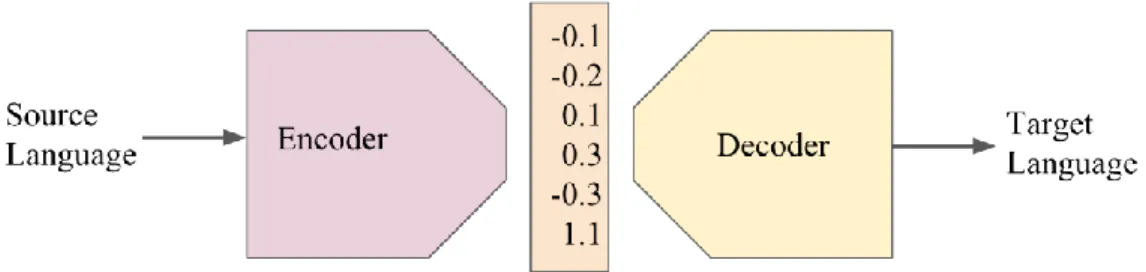
Figure 1: Basic Encoder-Decoder Architecture for Machine Translation ... 19
Figure 2: Flexibility of Recurrent Neural Networks ... 21
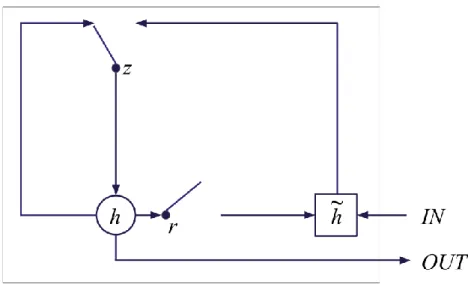
Figure 3: Gated Recurrent Unit... 23
Figure 4: Basic NMT encoder-decoder model ... 28
Figure 5: Multimodal Image Caption Translation Model by Caglayan et al. [2] ... 31
Figure 6: Calixto’s doubly-attentive decoder attends to image and language features independently [29] ... 33
Figure 7: Overall model using hierarchical attention by Helcl [33] ... 36
Figure 8: Multimodal Dataset Example ... 43
Figure 9: Top Level Conceptual Diagram of Multimodal Translator ... 44
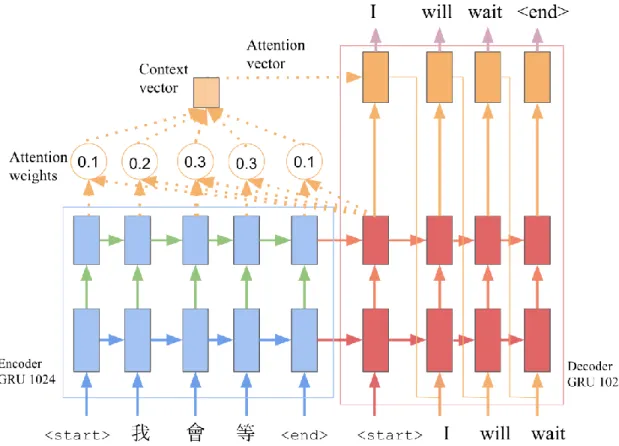
Figure 10: Neural Machine Translator with Attention Architecture ... 45
Figure 11: Incorporation of Image Classification Input to Translator ... 49
List of Tables
Page
Table 1: Depiction of written Chinese structure with English translations ... 12
Table 2: Unigram Precision Example ... 14
Table 3: Bigram Precision Example ... 15
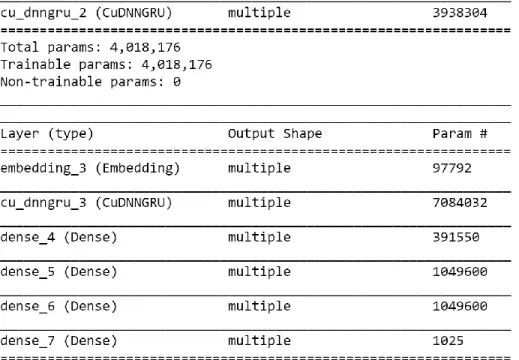
Table 4: Model Parameters ... 46
Table 5: Average BLEU-4 Score for Translation Model With and Without Image Context ... 54
Table 6: Average BLEU Scores of Best Performance vs. Google Translate ... 55
Table 7: Translation Examples at 20 Epochs ... 56
Table 8: Translation Results Regarding Chinese Homographs ... 58
Table 9: BLEU-4 Scores of Translation Models ... 59
NEURAL MACHINE TRANSLATION WITH IMAGE CONTEXT FROM MANDARIN CHINESE TO ENGLISH
I. Introduction
1.1 Importance and Motivation
Language translation is important for many facets of life. From personal travel and businesses, to government and military affairs, communication across language barriers happens everywhere. Because of this, research to develop machine translators has been conducted for decades [1]. However, due to the difficulty of natural language processing, many machine translators still perform worse than humans. This is especially true of Mandarin Chinese due to grammar differences, complexity of the writing system, cultural idioms, and textual context.
One of the main differences between human translation and machine translation in regards to is that current translation technology relies solely on text input during
translation. Humans, on the other hand, are capable of processing many other features. In any naturally occurring environment, humans have access to more modes than text, unlike a machine translator. Many polyglots consider visual context a very important modality when using a foreign language. In multimodal translation studies, human translation significantly drops in quality when lacking any image context [2]. Consider a situation in which homographs or unknown words have been used. With image or other situational context, despite the unknown words, humans are capable of understanding the information being conveyed. For example, in English a sentence using the homograph, “bank” could
cause confusion if incorrectly translated. (Is someone talking about the ground at the edge of a river or a financial institution?) This uncertainty in translation brings attention to a potential need for machine translation improvement.
1.2 Problem Statement
There are still many translations that are ambiguous or impossible to translate without situational context. This situational context can be input through an extra mode, while still including the available text [3]. Multimodal machine translation could provide the next improvement to machine translation quality, approaching human level parity.
While multimodality within machine translation has only been applied to bilingual image captioning, there is a significant lack of research regarding multimodal translation of naturally occurring scenes [4]. With the capabilities of deep learning combined with the advantages of situational context in translation, there is a need for true multimodal machine translation.
Consider a machine translator that is capable of more than a text modality. With access to the same context and information that a human might have, as well as training using this information, the performance of a machine translator ought to be improved to approach an improved level of translation quality. With better translation quality in machine translators, many currently ambiguous translations could be made certain or even corrected.
1.3 Research Contributions
This research produces a multimodal machine translation system from Mandarin Chinese to English. Currently, as there are no machine translators that make use of further
modes than text in natural settings, there is a large gap in regards to translation. This work provides a preliminary approach to fill the gap through the incorporation of image context modality into neural machine translation. This work produces and evaluates a multimodal translator model using neural machine learning methods.
Machine translation specifically fits into the domain of natural language
processing. By producing a machine translator that is more capable of translating from Chinese to English, this could save a significant number of man-hours required for hand translation of text. This work is of interest to the Air Force and the Department of Defense as due to the necessity of international communications. Not only is translation useful to the government, but research in this area in any language could also improve business and personal endeavors of people all over the world.
1.4 Research Questions
The goal of this research is to produce and evaluate the differences between neural machine translation models that can accept only text and a translator that can accept both text and image input. The comparison will be conducted with a nonbiased machine translation scoring mechanism. The score comparisons between each translation, as well as the multimodal architecture to be developed will provide insight to the uses and performance of machine translation using image context. To evaluate the success of this objective, the following research questions will be explored.
1) Does addition of image tags/labels improve translator performance, and if so, by how much?
Determining the answer to this question was conducted by comparing the performance of a multimodal translator to the text-only translator. A statistically significant translation improvement provides evidence suggesting the usefulness of image classification tags for translation.
2) Is there a repeated topic/structure/word composition with respect to sentences improved through multimodal translation?
This question is answerable through a by-hand analysis of the sentences translated from the multimodal translation model verses the baseline text-only translator. Checking what homographs have been improved through translation could provide evidence that an uncertain translation was corrected via image context. The number of improved
sentences, as well as the percentage of improvement provides proof that translations were corrected by the inclusion of image context. Sentences will be considered for grammar, word count, use of uncommon words, and inclusion of homographs.
3) Do certain image label topics/part of speech/repetition improve translation performance?
This question is answered through a by-hand analysis of the image label context used to derive the translated sentences in the test set. Translated sentences with and without variation between the test set without image labels and the test set with image labels will be considered for the possible effects of the image labels. Image tags associated with those
sentences will be considered for their effect on sentences for the length of tag words, accuracy, and use of identical words or synonyms to words used in a sentence translation.
1.5 Methodology
Machine translation is typically approached as a sequence to sequence problem. This thesis introduces a novel approach to machine translation through incorporation of image context within a sequence to sequence framework. The neural machine translation architecture is modeled after a widely accepted approach to neural machine translation with attention by Bahdanau et al. [5]. Bahdanau’s translation model is a common starting point for research in text translation, employing a sequence to sequence modeling
approach using recurrent neural networks with attention. A new translator model was produced by extending Bahdanau’s work by training with a text dataset that contains image tags or labels of items and events within an image. This multimodal dataset produced a resulting multimodal neural machine translation model that will be tested for its performance against a text-only translation model. The comparison between the models may provide evidence that neural machine translation is a good approach to improve Chinese-to-English translators. Translation evaluations have been conducted by
comparing the image translator to the text only translator, also comparing both to Google Translate as a baseline. The translation scoring was conducted using BLEU, (Bilingual Evaluation Understudy) [6].
As bilingual image data is fairly lacking, the visual input has been derived from the automatic image tagging system, Google Image Tagger API [7]; image tag generation is not part of this research. This work direction is not only novel in the field of machine
translation but could provide much-needed improvement in interpreting such a context rich language as Mandarin Chinese. The use of image tags in translation is novel in machine translation in general and could provide much needed clarifications specifically for Mandarin Chinese.
1.5.1 Datasets
Two datasets were used to train the multimodal translator. The first dataset was a standard text-only parallel corpus from Tatoeba Project containing 21,000
identical-meaning sentences translated in both Mandarin Chinese and English [8]. This dataset was used for the initial training of the translator model. A novel dataset was produced and then used to train the translator on image context: a collection of 700 images containing naturally occurring Chinese text or audio. The transcribed Chinese text
associated with each image was translated to English, producing a multimodal parallel corpus. Training for the text-only dataset was conducted on the majority of the 21,000 sentence pairs, with the exception of 200 sentences removed for a test set. The translation model for the image dataset was trained on the same text corpus plus the inclusion of 600 bilingual Chinese and English text associated images. The multimodal translation model was evaluated by a test set containing 100 images and their associated text.
1.6 Assumptions and Limitations
The relevance of this research rests upon the usability and translation quality of the datasets upon which the translation models were trained. The datasets contain Chinese and English text. The Chinese text is assumed to be naturally occurring Mandarin Chinese sentences and phrases produced by humans. Naturally occurring text is anything translated
from Chinese to English, that occurred during some real-world event rather than machine created text. It is also assumed that the English text is correctly translated from the source Chinese. A limitation of the translation is that even correctly translated text is ambiguous for any grammatically-incorrect text of Chinese origin. Consider translating a familiar or grammatically incorrect word or phrase, such as, “gonna” to another language. Should it first be converted into a proper English future tense “going to,” which could be translated into “travel to” or “headed towards” in the target language, or should it be translated to an idiomatically similar but grammatically incorrect verbal abbreviation suggesting a future state (“I’m gonna be mad”; “That’s gonna break”)? This type of translation is left to the discretion of human translators. Because the target use of the language often depends upon a known audience, humans who translate informal text or dialogue tend to be
consistent with each respective situational translation. The assumption must then be made that the machine translator will also perform consistently, with the limitation that the machine translator cannot direct any translations at a known target audience. While the machine translator may approach human translation quality, machine-learning-based translator performance is limited by the quality of the available datasets. Aside from the limitations of the correctness of the datasets, the image dataset is also a restrictive size for the machine learning task, because small datasets sometimes result in poor machine learning models, and larger datasets typically correlated with better performing models. The small dataset of images may limit the quality of the multimodal translation model.
1.6.1 Assumptions
2) The image dataset contains images with naturally occurring Chinese language. 3) Both the text and image dataset contain correctly translated English text.
1.6.2 Limitations
1) Translations of informal or grammatically incorrect Chinese text cannot be directed at a known target audience due to the deterministic nature of a machine translator. (As mentioned above, translation of informal speech is often directed at a target audience by a human translator, with respect to the regional specifics of the audience.)
2) The translation models are based on the correctness of the datasets.
3) The size of the image dataset is very restrictive for the machine learning task, as the quality of a translation model is based on the amount of available data.
1.7 Organizational Preview
This chapter motivated a current translation problem, presented several research questions, and described important terminology regarding natural language processing and Chinese writing. Background information on machine translation and various machine learning tools and techniques are found in Chapter 2. Following that is a description of the developed Chinese to English translation model, including text preprocessing steps and the multimodal machine learning model. The architecture of the
sequence-to-sequence model, as well as a description of each layer can be found in Chapter 3. In Chapter 4, results of translation performance evaluations using BLEU provide information regarding the usefulness of multimodal neural machine translation when translating from Chinese to English. Finally, conclusions and future work can be
found in Chapter 5, with detailed recommendations to future approaches on the problem of multimodal machine translation.
II. Literature Review
2.1 Chapter Purpose
While some research evaluates the performance of multilingual machine image captioning systems, almost no research has been executed in regards to translation with image context. Despite that, what multimodal research exists still provides understanding of natural language processing with deep learning. For better understanding of the experiment, the following subsections contain explanations of Chinese language terminology, as well as translation methods pertaining to neural machine learning. Selected works also detail the current capabilities of translation of image description captions, with the purpose of understanding how neural machine translation works in a multimodal setting.
2.2 Natural Language Processing
Natural language refers to language that has developed naturally as it is used by humans. Natural language appears in everyday conversations, books, street signs, or any other use of language by a human. Natural language processing aims to imitate, or
otherwise analyze language in areas of speech recognition, translation, and other language uses.
2.2.1 Chinese Specific and Translation Terminology
For understanding of natural language processing of Mandarin Chinese, Table 1 shows the composition of Chinese writing, and is included in addition to several terms pertaining Chinese and general language that are explained as follows:
Granularity
In machine translation, during encoding, granularity refers to the separation and tokenization of the text to be encoded. For most languages, the
granularity split is along each word. For Chinese (and other languages without spaces,) this can be split along a phrase, word, subword, or character [9].
Word
While the separation of words is very straightforward in English text, in Chinese, words are not separated, and are sometimes a combination of characters, or just a character itself.
Character
A Chinese character is a single logogram representing a word or a portion of a word. A full Chinese character can be made up of one or more radicals.
Radical
A radical is a combination of strokes, which in turn are used to make a full Chinese character. A large portion of radicals are a full character on their own.
Stroke
A stroke is a basic symbol used to form a Chinese radical. Many strokes do not make up a full radical or have represent any kind of meaning until combined into a radical; however, in some rare cases they can.
Stroke Radical Character Word
亅 子 Child 学 Learn 学生 Student
一 One 生 Part of: raw, health, unripe, crude, etc.
生 (Same as radical) 生的 Raw
Table 1: Depiction of written Chinese structure with English translations
2.2.2 Modeling and Evaluation of Natural Language
Some form of grading is necessary to evaluate the quality of machine translations. While this task used to be completed by hand, there are tools now that are capable of machine trading by comparison of a reference to a machine translated candidate sentence. One of such tools is BLEU (Bilingual Evaluation Understudy), an automatic and thus low cost method for evaluation of Machine Translation. BLEU uses a modified n-gram
precision metric for such measurements [10]. Both concepts can be seen in the following subsections.
2.2.2.1 N-Gram Model
In natural language processing, an n-gram is a contiguous subsequence of a sequence typically made up of words in a sentence. Each n-gram contains a set of n items of text [11]. The purpose of n-gram representation of text is to provide a model in which sentences can be systematically divided for mathematical applications such precision scoring [12]. The terminology for n-gram follows as: (n = 1), bigram (n = 2), trigram(n = 3), etc.
2.2.2.2 BLEU Scoring
BLEU is useful because it eliminates the need for human evaluation of translations by providing automatic translation scoring. It is used by comparing a candidate sentence to one or more reference sentences [6]. In the case of machine translation, the candidate sentence is the machine translated sentence to test, and the reference is a human translated comparison.
A portion of the scoring metric by BLEU is a modified n-gram precision computed over blocks of text [6]. The score evaluation is completed by comparing reference
sentences to candidate sentences over a corpus of text. N-gram precision is found by counting maximum number of n-gram matches in a single reference translation for each n -gram for each candidate sentence. (The denominator of the equation contains a tic-mark representing the counts only of the candidate sentence.) Then the total number of matches of a candidate n-gram is clipped for each n-gram for each candidate sentence by the maximum reference match. All clipped matches over all candidate sentences are added for each n-gram over all candidate sentences in the corpus. Finally, the total number of
unclipped candidate n-gram counts in the corpus are divided for each n-gram. [13]. The ranking system using n-gram precision has been shown to differentiate between human and machine translations with very strong differentiation on 4-gram precision [6]. The equation for this over an entire text corpus, as well as an example for unigram precision can be found below.
1
Table 2: Unigram Precision Example Candidate: the the the the the the the Reference: The dog is in the yard. Unigram precision: 7/7
Modified unigram precision: 2/7
The bigram precision in the reference sentence would be 0 because it does there are no two directly sequential words in the candidate sentence that matches the reference sentence. Table 3 contains a new example for bigram precision with an incorrect but better candidate sentence. Using 1, the n-gram precision can be found over a single example for the bigrams in the example below. Taking only part of the
summation, the number of bigram matches can be found. In this example the bigram match count is 5, but due to repetition the number of clipped bigrams is 4, because there are only four unrepeated word pairs that can be found in both the candidate sentence and reference sentence. This means that the modified bigram precision is then the clipped bigram count divided by the number of bigrams in the candidate, so the bigram precision is p2= 0.667. This equation can be used for each n-gram variation to find the modified n
Table 3: Bigram Precision Example Candidate: The dog the dog is the yard.
Reference: The dog is in the yard. Bigrams in candidate sentence:
the dog, dog the, the dog, dog is, is the, the yard Bigram matches:
the dog, the dog, dog is, the yard Clipped bigrams in candidate sentence: the dog, dog is, the yard
Bigram precision: 5/6
Modified bigram precision: 4/6
The overall translation score of a translated text corpus is from the geometric mean of the corpus’ modified precision scores, then multiplied by an exponential brevity penalty factor. First the geometric mean of the modified n-gram precisions, pnis found, using n
-grams with maximum length of N and the positive weights wn that sum to one. The
positive weights represent the graded preference of which n-grams to consider the most. Conventionally, BLEU-4 scores are found, using weights of ¼ for each n-gram up to a 4-gram. Then the length of the candidate translation c and the effective reference corpus length r are used to compute a brevity penalty BP as shown in 2. The brevity penalty is used as an adjustment factor to reduce translation scores for
sentences that are too short. If the machine translation candidate is longer than the reference sentence, then there is no penalty. The length of the translation is most often calculated using the word count for languages that use phonetic alphabets, however, character count can be used for languages with differing writing styles.
2 The total BLEU score is then found by multiplying the brevity penalty by the sum of the positive weights to N, by the log of the modified n-gram precisions as seen in
3. The overall BLEU score is always a number from 0 to 1, often represented as a percentage [6].
3 While BLEU scores provide an established ability to properly rank translation accuracy, note that few sentences receive a perfect translation score of 1 because few translations are entirely identical to their reference. With more reference sentences most translations receive improved scores due to the higher flexibility of word order or synonym use. On a test corpus containing nearly 500 sentences, a human translator received BLEU scores of 0.3468 against four references, but only 0.2571 against two references [6]. Note that this is not necessarily because the human translations were wrong, but caused by the variation in language for sentences that may carry the same meaning.
2.3 Machine Learning
Neural networks can be used to predict patterns based on training data. Deep neural networks are powerful machine learning models that can provide tremendous results on even difficult machine learning tasks. It can be applied to any problems that can be encoded into vectors with fixed or variable dimensionality [14]. There are many subtopics within machine learning. The following topics which pertain to translation using
machine learning will be discussed throughout this section of Chapter II: embeddings, encoder-decoder, sequence to sequence models, recurrent neural networks, gated recurrent units, teacher forcing, and attention.
2.3.1 Embeddings
Embeddings are used to represent data in a more efficient space than one hot encoding. One hot encoding which converts categorical values into integers, while simple can take up very high dimensional spaces using up memory and slowing down processes. Embeddings alleviate the problem of high dimensionality and space usage due to their low dimensionality and use of floating-point vectors over binary classification [15]. Word embeddings are learned from data and are meant to map human language into a geometric space. They are learned from starting with random word vectors and are then sorted through use of a neural network [16].
Embedding is a problem of optimizing the loss function between a pair of examples for each point 𝑥𝑖 to find an embedding 𝑓(𝑥𝑖). This is shown in the
4, where 𝐿 represents the loss function, 𝛼 represents learning parameters subject to a balancing constraint, 𝑊 represents weights as a matrix of similarity between examples 𝑥𝑖 and 𝑥𝑗. By minimizing this summation, the embedding vector 𝑓(𝑥𝑖) is found [16].
The loss function 𝐿 is found using multidimensional scaling in order to preserve distance between points and embeds them into a low dimensional space, as shown in
5.
5 Embedding vectors for learning neural networks are made by learning a model with layers of non-linear mappings with N layers of hidden units that give a C-dimensional output vector as shown in 6 [16]. In this equation, 𝑓𝑖(𝑥) represents the
embedding vector to be learned, 𝑥 represents an example, 𝑀 and 𝑈 are the total number of examples 𝑥𝑖.
6 Overall, embeddings can simply be thought of as a vector representation of some token. In the case of word embeddings, this is often done by segmentation of the text into words wherein each word is transformed into a vector. The embedding layer is then a dictionary that can map integer indices to dense vectors, saving dimensionality from the alternative approach of using one-hot vectors [15].
2.3.2 Encoder-Decoder
Neural machine translation models are built with an encoder to decoder
architecture. The purpose of an encoder is to extract a fixed-length representation from some input sequence of variable length. The fixed-length representation is often smaller than the initial input sequence. The fixed-length representation is then forwarded to the
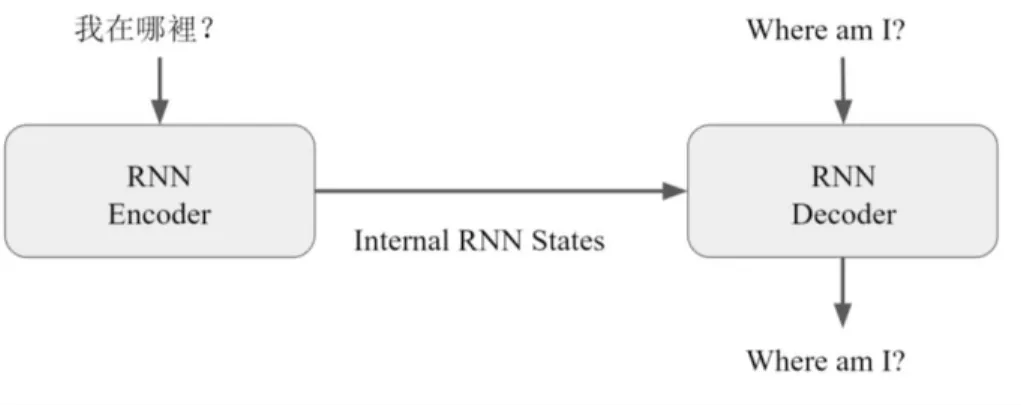
decoder network to generate its own sequence output. The decoder’s purpose is the generation of a variable length translation from this fixed-length representation [17]. This allows for the translation from one language to the other by input of a source language into the encoder, and then output from the decoder into the target language. A simple diagram of this applied to neural machine translation can be seen below in Figure 1: Basic Encoder-Decoder Architecture.
Figure 1: Basic Encoder-Decoder Architecture for Machine Translation
2.3.3 Sequence to Sequence
Sequence to sequence models are useful for many applications of problems in machine learning because they can be used on problems containing vectors with unknown dimensionality [14]. Sequence to sequence models typically have an encoder and a decoder part, that are separate neural network models combined for the purpose of one problem. At the core, sequence to sequence learning makes use of recurrent neural networks in order to map variable-length input sequences to variable length output
sequences. Typically, a recurrent neural network layer acts as an encoder, processing input and returning own internal state, and another recurrent neural network acts as the decoder, predicting next portion of target sequence. (Recurrent neural networks are described in
Section 202.3.4.) Sequence to sequence models are useful for machine translation, image captioning, constituency parsing, and other tasks [18].
The aim of sequence to sequence learning is to directly model the conditional probability of mapping an input sequence into an output sequence using an encoder-decoder framework [18]. From the input representation, the output sequence is generated one unit at a time by the decoder. The conditional probability is defined in
7, where y represents an output sequence, x represents an input sequence, and s represents the fixed-length encoder representation of an input sequence [18].
7
2.3.4 Recurrent Neural Networks
Recurrent neural networks (RNNs) are a type of neural network with the ability to process sequential data. The RNN is a generalization of a feedforward neural network to sequences [19]. RNNs can scale to much longer sequences than networks without flexible sequence-based specialization [20]. Many other neural networks are limited to accepting only fixed-sized vectors as input [21]. Recurrent neural networks can accept sequences of information as input, output, or both.
Figure 2: Flexibility of Recurrent Neural Networks
In Figure 2, the flexibility offered by RNNs can be seen. In this image, each rectangle represents a vector, and each arrow represents a function. Input vectors are shown in purple, output vectors are in blue, and internal states are represented by green arrows. An RNN combines the input vector with the state vector and a predetermined function to produce a new state vector [21]. RNNs are able to handle variable-length sequences through use of a recurrent hidden state, where the hidden state activation is dependent on the previous states. Given a sequence x = (x1, x2, …, xT), and a recurrent
hidden state ht, an RNN can compute a sequence of outputs y = (y1, y2, …, yT) through use
of the following equations [19]. In Equation 8 the function g is a smooth, bounded function, often a logistic sigmoid, or hyperbolic tangent function [22].
ℎ𝑡 = 𝑔(𝑊ℎ𝑥𝑥𝑡+ 𝑊ℎℎℎ𝑡−1) 8
𝑦𝑡= 𝑊𝑦ℎℎ𝑡 9
Without modification, simple RNNs are not able to solve problems effectively [22]. To counter this, generative models can be made. A generative RNN allows for the output of a probability distribution over the next element of the sequence, given the current state ht. The generative model is able to capture a distribution over variable length
sequences. This provides a sequence probability, which can be seen in 𝑝(𝑥𝑇|𝑥1, … , 𝑥𝑇−1)
10, where the last element represents an end-of-sequence value or token [22].
2.3.4.1 Gated Recurrent Units
A Gated Recurrent Unit (GRU) is a special type of generative recurrent neural network that is capable of adaptively capturing dependencies along different time scales. The GRU has gating units that allow for the flow of information to modulate. GRU models are capable of capturing long-term dependencies by alleviating problems with a vanishing or exploding gradient [22].
The GRU works using a linear interpolation at time t for the activation hjt between
the previous activation and the candidate activation as shown in
11. An update gate ztj determines the level of update of activation or content. This
is found as shown in 12. The candidate activation is shown in 13, where rt is a set of reset gates which is in turn computed using
14. A diagram of the GRU can be seen in Figure 3 [22].
11
12
13
Figure 3: Gated Recurrent Unit
2.3.5 Teacher Forcing
Teacher forcing is a useful technique that allows recurrent neural network models to use output from a prior time step as direct input. Through this technique, slow
convergence and instability in model training can be resolved. This is done through replacement during training of the actual output of a unit by something called a teacher signal [23]. (This is useful for language training because one word or character can be input for the next portion of the sequence, allowing the model to learn the sequence with the recursive output-as-input sequence.) Teacher forcing is incorporated into backward propagation through time through a backpropagation computation from later times being blocked at any unit in the network with an output set to a target value. Any unit with an external target value at a specific time step also should not be given error for that time step. This technique can also provide results where approximation is involved as well as training of continually operating networks. As information along the network moves, there is gradient information which can indicate the direction in which the network weights
must be changed. Upon reaching steady-state behavior, this information disappears. This usefulness of teacher forcing is because the network weights as well as initial conditions can determine the behavior of the network, however by using desired values that can partially reset the network state at the current time it helps control the initial conditions for better subsequent training [23].
2.3.6 Attention
Although recurrent neural networks using a GRU model with teacher forcing can ensure better performance, there is still a problem with the need to encode an entire sentence into a single fixed-length vector representation. This single fixed length vector is all that the decoder has access to when generating a translation. While encoding an entire sentence into a single vector is still possible, better results can be created when also implementing an attention mechanism in the translator. Attention is devised so that the decoder is able to access every hidden state generated by the encoder during all time steps [24]. This attention mechanism is implemented as a multi-layer perceptron. A single-layer feed-forward network can be used to compete an expected alignment between each hidden vector that represents a source word or character, as well as the target word at the current time step. This allows a normalized alignment matrix between each source hidden vector to be created with trained model parameters. 15 and
16 show the calculation of this, where h represents a hidden vector, d represents the decoder state, e represents the expected alignment, v is the fixed-length vector of the encoder embedding, and U and W are trained model parameters. The final calculation output a is the normalized alignment matrix [24].
𝑒𝑡,𝑖 = (𝒗𝑎)𝑇tanh (𝑼
𝑎𝒅𝑡−1+ 𝑾𝑎𝒉𝑖) 15
𝑎𝑡,𝑖 = exp (𝑒𝑡,𝑖)
∑𝑁𝑗=1exp (𝑒𝑡,𝑗)
16
A final calculation of a time-dependent source context vector is also computed. It is a weighted sum over the source hidden vectors, and each vector is weighted by the normalized alignment matrix attention weight. The context vector ct is computed for each
time step t of the decoder. It replaces the fixed-length vector v that was initially used in the encoder-decoder framework [24]. The equation for the context vector can be seen in
17.
𝒄𝑡 = ∑𝑇𝑥 𝑎𝑡,𝑖𝒉𝑖
𝑖=1 17
2.3.7 Multimodal Machine Learning
In a survey of multimodal machine learning by Baltrusaitis et al. several more important concepts and terminology were explained [25]. Representation of data is a fundamental problem in machine learning, and even more complex to manage when representing multimodal data while properly exploiting its complementarity and redundancy. Mapping from modality to modality is another challenge of multimodal machine learning, and is referred to as translation. Alignment is the challenge of identifying relations between elements of different modalities. Fusion is the joining of information from more than one modality to make a prediction; this is an important challenge for multimodal natural language processing using text and images. Finally, this paper described the challenge of co-learning, which manages the learning from one modality in order to train on another modality. Meaningful representation of data is an important part of machine learning, and is especially difficult when dealing with multiple
modalities. Recent work on most multimodal representations has often been a simple concatenation of unimodal data, however, new changes have involved joint and
coordinated representations. Joint representations combine unimodal signals into a single representation space, and are best suited for situations in which all modalities are present during inference. Coordinated representations enforce similarity constraints into what is called a coordinated space while processing unimodal signals separately, they exist in their own space but are coordinated through a structure constraint or similarity. Coordinated representations are most suited to applications in which only a single modality is present at test time [25].
Sequential representation through recurrent neural networks and their variants can be used to represent data of varying sequence length. The task of an RNN
encoder-decoder is representation of such a sequence, and is not limited to unimodal data. Currently a popular problem solved using multimodal machine learning is visual scene description such as image captioning. For this problem, when translating natural (human) languages, mapping from one modality to another is important. Within this problem there are two types of models, namely example-based and generative. A dictionary is used when translating (mapping) between modalities of example-based models, and they are
restricted by their training data. Generative models generate sequences of symbols and are more complicated than example-based models. A challenge with these multimodal methods is the difficulty of their evaluation. This is especially true of human language translation, as there are many translations deemed correct and the evaluation of the best translation is often subjective. This is why there are many methods for translation
evaluation including costly human evaluation, or various less accurate but more affordable machine evaluators [25].
Fusion of multimodal data integrates information from each modality in an attempt to predict an outcome. Fusion can provide robust predictions, complimentary information, and is operable even when a modality is missing. One of the modal-based approaches to fusion is the use of neural networks. Modern neural architectures described in this paper allow for end-to-end training of both the fusion and multimodal representation
components of a model. Despite the impressive performance of neural networks on multiple modalities, a drawback to them is the difficulty of interpreting which features predictions rely on. Along with fusion, co-learning can be used to allow a modality to influence the training of another modality, which allows for complementary information sharing. This task of co-learning is independent and can improve fusion, mapping, and alignment models [25].
2.3.8 Machine Translation
Machine translation has been significantly improved through the incorporation of deep machine learning. The leap from statistical machine translation to neural machine translation was a great breakthrough in the field of machine translation [5][26][27]. Neural machine translation is a sequence to sequence task completed with an encoder and decoder model using recurrent neural networks [17]. Training is done using a parallel corpus of source language text and correct translations of a target language text. This method of machine translation assigns a fixed length encoding to a variable length sequence of input text in a source language using what is called the encoder. From there,
the fixed length encoding vector can be decoded into the target language as a variable length text sequence. The translation model contains recurrent neural networks which are effectively used to learn a distribution over the variable length source and target language texts [17]. A general diagram for this model can be seen in Figure 4: Basic NMT encoder-decoder model.
Figure 4: Basic NMT encoder-decoder model
More recent methods of this sometimes include an attention network as a
feedforward neural network that is jointly trained with the rest of the translation system. This attention mechanism is used to compute a soft alignment, allowing for
backpropagation of the cost function [5]. Local attention networks have been shown to provide better results when translating longer text sequences compared to systems without attention or that only contain global attention [26]. Attention is used in general for
translation as it typically provides significant score increases from translators without attention [5][26][28].
2.4 Current Research
2.4.1 Chinese Text Granularity in Neural Machine Translation
Many current NMT systems are limited to a moderate vocabulary size, and are rarely capable of translating rare words due to lack of proper training in Chinese. To improve the modelling of words, the varying granularity methods of separating Chinese words has been assessed for performance. NMT allows for the freedom of choice with regards to token units and sentence segmentation [9]. Four granularities commonly discussed are character level separation, hybrid separation of word-characters, and two forms of subword level separation.
The first granularity discussed was Character Level separation, in which a sentence is split into a sequence of characters. For Chinese, this means that each Chinese character is separated (even if some characters in Chinese represent a whole word.) The character model for English is somewhat challenging as a sentence in English contains 300-1000 characters typically, making the state space very large. Taking that into account, this work only separated Chinese sentences by character split.
The second granularity discussed was a hybrid separation of word-characters. In this split method each character in a word has its location designated as beginning, middle, or end.
The third granularity method is a method of subword level separation called byte pair encoding. This is a compression method that iteratively replaces most frequently used pairs of bytes in a sequence with an unused byte. This means that characters and character sequences merge.
The last granularity in the paper was another subword level separation with a different approach. This granularity, called wordpiece model is a deterministic data-driven segmentation method for any sequence of characters. Through this model, a special
symbol is prepended to the beginning of words and the rest of the word is split into subword components by character [9].
2.4.2 Multilingual Image Captioning
A significant amount of multimodal machine translation research falls into the category of multilingual automatic image captioning. These image captioning systems take an image and its source language caption, and then generate a caption in the target language, while using both the source language text and image as input. While this is a different problem from translation using image context, there is still valuable insight to be gained from said research for multimodal translation. Several approaches in recent
literature shall be described in this subsection.
2.4.2.1 Multimodal Image Caption Translation Compared to Statistical Machine Translation
The primary translation task completed in a paper written by Caglayan et al. was to multimodally translate English image descriptions into German [2]. The baseline system that was used for this task was built using a statistical translation system called Moses. The Moses pipeline was trained using minimum error training rate (MERT). The task described in this paper was also completed through use of continuous space language model with auxiliary features support, which allowed the use of sentence-level features. The auxiliary features used for training were image features extracted from a layer of the
image network using the FC7 layer of the VGG-19 network [29] and sentence text representation vectors. In order to test against the statistical phrase-based machine translation system, a neural MT system was also built. The model built was an attention-based encoder-decoder with GRU for a recurrent decoder shown in Figure 5. One
attention mechanism was implemented for a fully-connected feed-forward neural network, that determined the decoder’s initial hidden state by receiving the mean annotation vector. The dataset on which both of the systems were trained is the multilingual Flickr30k provided by WMT. The visual data of the images was trained through convolutional neural networks based off previous research using ResNet-50 features [2].
Figure 5: Multimodal Image Caption Translation Model by Caglayan et al. [2] The multimodal translation model was the combination of the translation and image evaluation systems using two GRU layers and an attention mechanism. A shared attention layer consisting of a fully-connected feed-forward network was used for computation of a set of attention coefficients along each timestep. The second GRU generated hidden states from intermediate representations of them along with the context vector. The results of the multimodal system vs the monomodal system were reported with
the monomodal system performing better than the multimodal system for both BLEU and another language scoring metric reported scores. This was explained by noting that either their image and text representations were not integrated well in their system, or the images contained too much irrelevant information [2].
2.4.2.2 Multimodal Neural Machine Translation of Image Captions using a Doubly-Attentive Decoder
A notable paper by Calixto, Liu, and Campbell described their novel approach to multimodal neural machine translation on image descriptions [30]. Detailed in this paper is a machine translation model built to incorporate spatial visual features of images to aid in translation of image captions. (The captions to the images are descriptions of the image content.) This paper’s contributions to the field of multi-modal neural machine translation include use of attention-based models to incorporate the image information, as well as the proof that images provide useful information to a neural machine translation model for the application of translating the datasets provided by the Conference of Machine Translation.
Figure 6: Calixto’s doubly-attentive decoder attends to image and language features independently [30]
The translation model described in this paper is a doubly attentive model based off prior researchers’ work. The paper describes the previous work as having an encoder and decoder as two recurrent neural networks with one attention mechanism implemented by a multilayer perceptron. The encoder is descried as a bidirectional recurrent neural network with gated recurrent unit, while the decoder has a conditional gated recurrent unit. The overall diagram of the model created by Calixto et al. can be seen in Figure 6. Their use of the previous translator work was extended in this research through the incorporation of multimodal attention based neural machine translation using spatial visual features as well
as text. The spatial visual features were extracted using the 50-layer Residual network [31]. To generate translations, the doubly-attentive decoder independently attends to the image features and the source-language words. To start training the translator, a text only phrase-based system was built, and then used along with a pretrained image processing system. A notable limitation of the model is that it was only trained to translate sentences up to a certain length as anything in the dataset exceeding the length limit was removed. The dataset used for this research is a multi-lingual version of the Flickr30k dataset [31][32]. (The Flickr30k dataset contains thirty thousand images with five human
generated captions per image written in English. The variation of this dataset used for the multimodal project was the M30k, which contains each image with one of the five English translations having been human translated to German [32].)
The performance of the model described in this paper exceeded other comparable models that were trained on the same dataset. Notably, it purportedly outperforms the other models with an improvement of +1.4 BLEU. The doubly-attentive model is noted as having improvements in recall and precision-oriented metrics due to the incorporation of images in the model. Performance of the model when pre-trained on different datasets is also noted in the paper [30].
In a later publication about multimodal translation by Calixto et al. a similar multimodal translator from English to German using neural machine translation with convolutional neural networks was created [33]. The extracted image features used in translation by Calixto et al. were incorporated on several levels, including in the source sentence, in the encoder, and also in the decoder. Their work evaluated differences
stating that using image features directly in the decoder caused model overfitting [33]. This overfitting was later described in another publication by Calixto et al. as being avoidable by incorporating visual features to ground translations rather than use image features directly along each time step in the decoder thus improving translation quality [24].
2.4.2.3 Multimodal Image Caption Translation using Image Region Bounding A different approach to use of image context in image caption translation has been proposed by Huang et al. to translate English image captions into German. Their method used a neural machine translation framework including extensive research into bounding image regions into separate feature fields [34]. The structure of their method allowed association between text and image features. Their incorporation of image context was shown to outperform translations using text only [34].
Research has also been done to translate image captions from English to Czech multimodally using neural machine translation by Helcl [35]. The research covered more modes than just including image input.
Figure 7: Overall model using hierarchical attention by Helcl [35]
To translate an image description from one language to the other, Helcl used a neural translation model including a convolutional neural network encoder for the image with two textual encoders for the image text and translation. (Note that while the main research was to improve Czech translation, the research for image caption translation used German as the target language) [35].
2.5 Research Gaps
As noted before, nearly all of the multimodal machine translation research applies only to image caption translation, there is an entire field of translation research yet to be explored. Compounded with the fact that it is all to and from German and English, research in any other language pair would provide new insight to the problem of multimodal translation.
In an earlier publication by Calixto using image context for statistical machine translation was surveyed, including a report on the usefulness of images [36]. That survey aimed to evaluate if visual information could alleviate text ambiguity of unknown words
in translation, and looked to determine what ways image clues could be used in statistical machine translation systems, wherein Calixto et al. used similar images and their
predetermined textual information. This short publication did not approach an
identification of methods answering how to use image information as it only evaluated potential use of images in translation [36]. That research asked questions about using image context in translation; however, it did not provide insight or architecture for the incorporation of visual context.
An important area of research which lacks current solutions is incorporation of image context into machine translation. Research that would open up this unexplored avenue of machine translation could provide meaningful input to the topic area of machine translation. This work aims to do so, while using a state-of-the-art neural machine
translation model with attention and incorporating image context in the form of image tags into that model.
III. Methodology
3.1 Chapter Overview
This section describes the both the implementation of an NMT with attention built from the architecture provided by Bahdanau et al [5], and an image context incorporation to the text translator. There were several datasets used containing an extensive parallel text corpus of human translated Chinese and English sentences as well as a parallel corpus of images and associated text in Chinese and English. Performance of the translator was evaluated using the machine translation scorer, Bilingual Evaluation Understudy. The architecture and implementation of the machine learning model for text translation and multimodal translation are presented throughout the following sections.
The goal of this research is to provide answers to questions regarding the
differences between neural machine translation models that can accept text only against a translator with both text and image label input, comparing the two by using a nonbiased machine translation scoring mechanism. The score comparisons between each translation, as well as the multimodal architecture to be developed will provide insight to the uses and performance of machine translation using image context. To evaluate the completion of this objective, the following research questions will be evaluated.
1) Does addition of image tags/labels improve translator performance, and if so, by how much?
Determining the answer to this question was conducted by evaluating the level of improvement the multimodal translator had over the text-only translator. Any statistically significant number of improved translations provides evidence for a positive answer to
this research question. This question is answerable through measuring whether translation evaluation scores for the multimodal translation model are improved from the baseline text-only translator.
2) Is there a repeated topic/structure/word composition with respect to sentences improved through multimodal translation?
This question is answered through a by-hand analysis of the translated sentences in the test set. Sentences have been considered for grammar, word count, use of uncommon words, and inclusion of homographs. Checking what homographs have been improved through translation provides evidence that an uncertain translation was corrected via image context. The number of improved sentences, as well as the percentage of improvement provides proof that translations were corrected by the inclusion of image context.
3) Do certain image label topics/part of speech/repetition improve translation performance?
This can be answered through a comparison of attention weights for tags. The visualization of attention plots provides insight to the features the translator viewed as most important. A by-hand assessment of length and use of image tags has been considered to find a pattern in what kind of image tags were most important. Patterns being considered include part of speech, nouns referring to objects or people, and homographs clarified by an image label.
This chapter describes the datasets used to train text only and multimodal
is a description of the translator model architecture and how it is applied for text only and a multimodal translation. Model fitting is described for each translation model, followed by evaluation and analysis methods for measuring the performance of each trained translator.
3.2 Dataset and Preprocessing
Two datasets were used for training each translator model, a text dataset, and a dataset containing both text and images. Before training the model, the text required reformatting. To avoid out of memory problems, any sentence exceeding a maximum character count of 100 characters was removed from the datasets for either Chinese or Roman alphabetic characters. Separation and tokenization of the sentences in each language was also conducted. The English granularity within the model was separated by word; this is a very simple but effective approach to granularity and works well for the majority of languages containing spaces between each word. Its high effectiveness and simplicity makes it common to work at the word level for many text sequence problems [9][15]. The Chinese granularity for this translation model was separated by character. This is because separation by character is more intuitive, and produces acceptable results. (To understand why separation between words is impractical for Chinese, refer to Section 2.2.1, where it is described that characters and radicals may represent words or only portions of words depending on the other surrounding characters.) A word index and reverse word index was created for the purpose of mapping from word to index and back. The parallel corpora of sentence pairs provided the necessary data to conduct sequence to sequence machine
learning. While sentences do not contain specific features that vary in translational relevance, it is expected that more training information will produce better results.
3.2.1 Text Dataset
The dataset containing only text consists of over 21,000 sentences written in English and in Mandarin Chinese. Within the thousands of sentences/observations, there is a variable count of words/features. The parallel sentence corpus was written and translated by humans. Note that human translation, despite variability, is the best way to conduct language translation. The list of sentences was freely available under a Creative Commons license by the Tatoeba Project, and also includes select sentences from various Chinese literature, as well as a dictionary of Chinese characters. The character dictionary was included to allow for training on rare words.
The following sections provide detailed explanation of the datasets used to train the models, as well as the translation model architecture. Model architecture is described for both text translator and the image context input, starting with the training and
execution of the text translator. Finally, evaluation of the translators is discussed, along with methods used to answer the research questions.
3.2.2 Image Dataset
The dataset for use with the image translator is composed of 700 images with an associated sentence drawn from Chinese media. Each Chinese sentence has been
translated into English by a human experienced with Chinese-to-English translation. The images were pulled from several sources that included several types of textual formats.
One of the use cases is ‘natural text in the wild,’ which includes text on storefronts, billboards, and other real-world writing. Another portion of the dataset is made from screen caps of subtitled videos. An example of one of these images, and its associated
information can be seen in Figure 8. The videos used
are from Weibo Videos [37], a Chinese video streaming site similar to YouTube that is very popular in China, as well as YouTube [38] itself, BBC News [39], and other similar sources [40][41][42]. (Because the database does not involve ordinary reading or viewing of the processed works, the use is non-consumptive and is therefore considered fair use.) This video source was chosen because it contains a wide variety of videos all commonly watched and understood by speakers of Mandarin Chinese, which makes it a good general representative of Chinese language used in videos. Due to the plethora of dialects in China, videos almost always contain subtitles. (The subtitles are technically in Mandarin Chinese, but due to the logographic nature of the language, each word is written with the same character in every Chinese dialect and can be understood by any literate Chinese
image data were translated to English. The English translations were completed by native speakers of Mandarin Chinese and English. The preprocessing required for the image dataset includes the same granularity separation of Chinese text as described in Chapter 2, as well as the retrieval of image tags. The image tags will be used to provide visual
context rather than developing an image interpretation model.
Figure 8: Multimodal Dataset Example
3.3 Translation Model Architecture
The overall approach to multimodal translation is to combine previous research of image classification with text translation. The input to the multimodal translator contains text input like any standard translator, as well as image input in the form of image
Chinese Text 它很可爱 English Text It's so cute Image
Labels/Tags
dog breed, dog, grass, snout, companion dog, beagle, dog like mammal, plummer terrier, hound
classification tags. The goal of this multimodal translator is to produce a translator that can incorporate extra contextual information into a translation, thus producing more accurate results even on sentences lacking verbal context clues. The conceptual level design of the overall multimodal translator can be seen in
Figure 9.
Figure 9: Top Level Conceptual Diagram of Multimodal Translator
Language translation is a sequence to sequence problem. Before a multimodal translator can be completed, it is important to have an established text translation model. To
accomplish translation from Chinese to English. This architecture provides support for the multimodal translation model. The input sentence is put through an encoder model that in turn gives the encoder output and the encoder hidden state. Both encoder and decoder models are composed of a gated recurrent unit (GRU) recurrent neural network (RNN).
Figure 10: Neural Machine Translator with Attention Architecture The encoder consists of an embedding layer with an output dimension of 256 followed by three GRU layers with 1024 units and a batch size of 64. The GRU layers output a sequence and a state, with embedded source language text Chinese sent in with start and end tokens. The decoder also has an embedding layer and three GRU layers containing 1024 units and a batch size of 64, as well as two fully connected layers, and six fully connected layers for attention. The sequence and state are passed to the fully
connected layers. The attention weights are calculated through application of a softmax activation function to the output of the fully connected layers. Once the attention weights are calculated, the context vector is found by calculating the dot product of the attention weights with the encoder output. The training of the model is competed using a sparse softmax cross entropy with logits loss function, which computes the cross entropy between the log probabilities and labels providing the softmax cross entropy loss [43]. During training, prior time steps are used as input to the model as teacher forcing.
The model parameterizations and structure were based off of Bahdanau’s model architecture [5], while the code implemented contains hyperparameters that were pre-tuned by the TensorFlow authors [44]. The parameters of the model can be seen in Table 4. (Output shape is multiple because each layer returns multiple items, an output as well as a state.)

![Figure 5: Multimodal Image Caption Translation Model by Caglayan et al. [2]](https://thumb-us.123doks.com/thumbv2/123dok_us/10116952.2912252/42.918.136.786.494.734/figure-multimodal-image-caption-translation-model-by-caglayan.webp)
![Figure 6: Calixto’s doubly-attentive decoder attends to image and language features independently [30]](https://thumb-us.123doks.com/thumbv2/123dok_us/10116952.2912252/44.918.323.591.118.612/figure-calixto-attentive-decoder-attends-language-features-independently.webp)
![Figure 7: Overall model using hierarchical attention by Helcl [35]](https://thumb-us.123doks.com/thumbv2/123dok_us/10116952.2912252/47.918.171.743.111.380/figure-overall-model-using-hierarchical-attention-helcl.webp)