Principles and Principals: Does Self-Concept Compete or
Complement Brand Experience When Shaping Consumer Brand
Relationship, Brand Preference and Customer Satisfaction?
Rukhsana Gul Gilal1*, Sun Xixiang1, Faheem Gul Gilal2, Rehman Gul Gilal3 , Naeem Gul Gilal41. School of Management, Wuhan University of Technology, Wuhan, Hubei, 430070, P.R. China
2. Donlinks School of Economics and Management, University of Science and Technology Beijing, No.
30, Xueyuan Road, Haidian District, Beijing, 100083, P.R. China
3. Department of Business Administration, Shah Abdul Latif University Khairpur, Old National Highway Khairpur Mir’s, 66020 Sindh, Pakistan
4. School of Management, Huazhong University of Science and Technology, Wuhan, Hubei, 430074,
P.R. China
*Email address of corresponding author: [email protected]
Abstracts
This study aims to investigate the direct and indirect effect of brand experience on consumer brand relationship, brand preference and customer satisfaction through self-concept. Non probability sampling technique was applied. The primary data were collected from 297 (n = 297) Pakistani customers. The proposed theoretical model was tested using structural equation modeling in PLS Smart. Results showed that brand experience has strongest direct effect on consumer brand relationship, followed by brand preference, and then customer satisfaction. The results of indirect effect revealed that the self-concept emerged as a stronger driver for brand experience and consumer brand relationship, then for brand preference and customer satisfaction. Additionally, the implications for academicians and practitioners are discussed.
Keywords: Brand experience, consumer brand relationship, brand preference, customer satisfaction, self-concept.
1.
Introduction
Marketing and consumer behavior researchers traditionally focused on product quality, availability and price as main strategies to capture the market shares (Leventhal et al., 2006). However, previous research has implied that in order to survive in the long run, marketers have to continuously craft innovative strategies to achieve superiority in the products and services. This shift in the marketing concept includes relationship management (Berry, 1983), value creation (Ravald & Grönroos, 1996), and brand experience (Brakus, Schmitt, & Zarantonello, 2009).Whereas, consumer brand relationship has got considerable attention in the marketing and consumer behavior literature (Ashworth et al., 2009). Relationship concept is particularly important for marketing managers because of economic gain that an organization may achieve as a result of strong consumer brand relationship. These advantages do not only include less marketing cost associated with attracting new customers, advertising and promotion but also it leads toward customer retention, generation of brand equity which in turns further generate more revenue and profit (Dowling, 2002; Winer, 2001). Moreover, research has implied that consumer relationship has the potency to enhance the financial position of the organization by improving cash flows, market shares and establishing entry barriers (Ashworth et al., 2009). Despite the massive importance of the consumer brand relationship, little attention has been paid to measure and strengthen this concept (Ashworth et al., 2009). Therefore, what marketers need to establish is the long term relationship and to achieve competitive advantage through brand experience (Rukhsana et al., 2015).The significance of experiential consumption was put forward against the hegemony of benefits and features based marketing. Consumption was then begun to view as a feelings, fantasies and fun (Morris & Elizabeth, 1982). Whereas, brand experience has highlighted the importance to capture the senses of consumers, touch their hearts and minds through enticing rich brand experiences (Schmitt, Brakus, & Zarantonello, 2014).
According to Pine & Gilmore (1999) economy has proceeded through series of stages and market has now entered into the fourth stage, where highest economic offerings are no more products or services, rather the
holistic experiences which are based on entertainment and education in nature. Information technology has dominated every sector of economy. Almost everything is digitalized. Most of the online brands are entertainment and education in nature, such as YouTube, Google and Wikipedia. People are connected with each other through social media and consumers would have functions and features as taken by granted. What customers really want are the compelling brand experiences (Schmitt et al., 2014).
Furthermore, extant research suggests that consumer brand relationship can play prominent role to trigger consumer behavioral outcomes, such as repeat purchase, word of mouth and willingness to pay (Ashworth et al., 2009). The extant literature of brand experience and consumer brand relationship show great potent to link brand experience with consumer brand relationship and other consumer behavior outcomes, such as brand preference. For instance, Brakus et al., (2009) determined the impact of brand experience on loyalty though direct and indirect effect of personality (Brakus et al., 2009). Another research explored the role of brand experience on brand loyalty through direct means and indirectly by mediating role of brand relationship and brand personality (Ramaseshan & Stein, 2014). Researchers further investigated the role of brand experience on loyalty through mediating role of consumer brand relationship quality (Francisco-Maffezzolli et al., 2014). Researchers have also examined how brand experience and personality impact the consumer brand relationship (Chang & Chieng, 2006).
As presently developed, this study aims to contribute to this growing area of research by proposing a conceptual model to investigate the relationship between brand experience and consumer brand relation, brand preference and customer satisfaction. Moreover, the mediating role of self-concept between brand experience and other consumer behavior outcomes are proposed.
2.
Theoretical Framework
2.1.Brand Experience
Brand experience is conceptualized as subjective internal consumer responses (sensations, feelings and cognitions) as well as behavioral responses evoked by brand-related stimuli that are part of a brand design, identity, packaging, communications and environments (Brakus et al., 2009). Hirschman & Holbrook (1982) are among the earlier researchers who first promoted the “experiential view”, they strongly emphasized to complement the consumption as information processing view as well as experiential view. The Information processing model, view consumers as rational decision makers, who engage in information search and problem solving to make rational purchase decisions. Brands were regarded as bundle of attributes. Indeed this model mainly focuses on single sided approach and overlooking very important experiential aspects of consumption. The Informational processing model was then begun to challenge in view that it neglects certain important consumption phenomena that includes various playful leisure activities, aesthetic enjoyment, sensory pleasures and other emotional responses. Traditional marketing only focuses on utilitarian or benefits of products, whereas consumers demand more than benefits offered by brands. Thus, researchers begun to think about experiential perspective that focuses on subjective characteristics and consumption has begun to see as experiential view, which focuses on feelings, fantasies and fun (Holbrook, 1978).
2.2.Brand Experience and Self-concept
Self-concept is an individual’s perception of one’s own capabilities, characteristics, personality, restrictions and appearance. Self-concept can be regarded as the sum of the individual’s ideas, views and feelings about themselves relative to other objects in a socially determined frame of reference (Wohlfeil & Whelan, 2006). A person’s self-concept is developed over the period of time and it is comprised of how individual think of themselves as well as how other people view them. Therefore, self-concept can be viewed as set of knowledge and beliefs detained in consumer’s memory that influence purchase decision and consumption of brands. Based on literature, Authors propose the following the relationship.
Hypothesis 1
:
Brand experience is positively related to self-concept.2.3.Brand Experience and Consumer Brand Relationship
The concept of consumer brand relationship was first introduced by Fournier (1988) who suggested that consumer can form relationship with brands as they can develop with humans. Consumer brand relationship refers to the nature of relationship the consumers have with the brand and level of synch with the brand. It focuses on the level of psychological bond the customers have with brand (Keller, 2001). Consumer brand relationship quality has been viewed as the central concept in building long term relationship with the brand, as the customers interact with brands they get experiences on cognitive utilitarian dimension as well as affective dimension of the brand (Belk, 1985). Therefore, consumer brand relationship seems to be evolved from personal relationship theories, as evidenced the consumers gain experience with the brands. Furthermore, since 1980, the concept of experience has received the attention of brand management researchers to explore its role in marketing. Moreover, recent study by Francisco (2014) cited that the necessary condition for brand to remain in market for long time depends mainly on how effectively market manages customers experiences (Francisco-Maffezzolli et al., 2014). Consumer’s experience with brand starts when customers search for the brand, purchase and consume it. Brand related stimuli triggers consumer’s senses and effect visual, taste, smell, hearing and sighting which in turn effect consumers happiness and satisfaction (Arnould & Price, 1993; Schmitt, 1999). Moreover, research implied that capturing consumer’s senses through brand experience can also have impact on consumer brand relationship which will in turn effect customer loyalty (Francisco-Maffezzolli et al., 2014; Ramaseshan & Stein, 2014). Thus, we propose the following the relationship
Hypothesis 2:Brand experience is positively related to consumer brand relationship.
2.4. Brand Experience, Brand Preference and Customers Satisfaction
Research in consumer behavior has implied that brand experience can directly and indirectly lead to create the brand preferences (Kerin, Jain, & Howard, 1992). Brand experience is key source of preference learning (Simonson, 2007). Customers tend to rely on their personal experience, as it leads for the accumulation of information which serves as milestone for preference development (Hoeffler & Ariely, 1999). Even the brand experience can change the level of preferences (Zajonc & Markus, 1982). Moreover, research further implied that the customers develop preferences with certain level of experiences. Three level of experiences are particularly important in preference formation. The first type of experience is formed when consumers get negative experience and reject the brand. Second when consumers get neutral experiences and accept the brand. Third when consumers get positive brand experiences and develop preferences toward the brand (Carbone & Haeckel, 1994). The research further analyzed the different level of experience on preference formation. When consumer repeatedly purchase and use the brand, it will cause the accumulation of experiences which ultimately lead towards preference formation (Heilman, Bowman, & Wright, 2000).
Research has implied that brand experience can positively impact consumer behavior outcomes, such as satisfaction through direct and indirect route. For example, when the brand effectively triggers experiences, it could lead toward development of customer satisfaction (Brakus et al., 2009). Give this, we propose the following the relationships.
Hypothesis 3: Brand experience is positively related to brand preference. Hypothesis 4: Brand experience is positively related to customer satisfaction.
2.5. Self-concept and Consumer Brand Relationship
People use numerous ways to define themselves and one of the ways is to form relationship with certain brands. Relationship plays an important role in developing one’s self-concept. The relationship that consumers form with brands are often developed when customers get experiences with the brands. Therefore, research implied that customers purchase certain brands because of value they get from meaning that a brand adds to their identity
(Fournier, 1998). Moreover, consumers develop their self-identity and present themselves to others by their brand unique choices or adoptions based on the congruency between brand-user associations and self-image associations (Escalas & Bettman, 2005). Self-concept connection is viewed as facet of consumer brand relationship, which specify the role that brand plays in developing one’s identity, values and goals. A high self-connection can reflect or symbolize one’s self identity. Thus, we propose the following the relationship
Hypothesis 5: Self-concept mediates the relationship between brand experience and consumer brand relationship.
2.6 Self-concept, Brand Preference, and Customer Satisfaction
Extant research has well explained that consumers do not only buy because of utilitarian benefits offered by the brand but also due to symbolic images that brand can demonstrate about them (Elliott, 1997). Moreover, consumption cannot be regarded as bundle of attributes rather brands can portray the symbolic meaning that consumer’s assume to be associated with it (Holt, 1995). Research has confirmed that brands contain functional as well as symbolic significance. The symbolic meaning of a brand is conveyed through consumption, therefore, customers prefer the brand that well explained their self-concept (McCracken, 1986).
Further, self-concept is especially important for marketers to consider the fact that consumer buying decision can be influenced by the image the consumers have about themselves (Zinkhan & Hong, 1991). Consumer tends to define, maintain and enhance their self-concept through their consumption pattern (Zinkhan & Hong, 1991). Self-image congruity is dominantly effect the consumer brand preferences and purchase intentions (Mehta, 1999). Moreover, research has also proved that there is strong relationship between self-image congruence and satisfaction and self-image congruity can be considered as strong predictor of the customer satisfaction. Customers who have strong self-imagecongruence with specific brand are more likely to prefer the brand and enjoy more satisfaction (Jamal & Goode, 2001). Thus, we propose the following the relationships
Hypothesis 6: Self-concept mediates the relationship between brand experience and brand preference.
Hypothesis 7: Self-concept mediates the relationship between brand experience and customer satisfaction.
FIGURE 1
FIGURE 2
Estimated Theoretical Model
Research Methodology
The questionnaire for this study consisted of two parts. The first part comprised of five variables including brand experience, self-concept, consumer brand relationship, brand preference and customer satisfaction. Second part of the questionnaire measured the demographic information of participants. Brand experience instrument was taken from the study of Brakus (2009), which contained four sub-constructs, such as sensory, behavioral, affective and intellectual. Self-concept instrument was taken from Escalas & Bettman’s (2005) study. Consumer brand relationship instrument was taken from the study of Fournier (1998), which is considered as a pioneer study in consumer brand relationship. Brand preference scale was taken from the study of Ebrahim (2013). Finally, the customer satisfaction scale was adopted from the study of Brakus (2009). All the responses were measured on 5-point scale ranging from 1 = “strongly disagree” to 5 = “strongly agree”. The participants were asked to define the extent to which they agree or disagree with the statements. On the basis of focus group, the brands such as Apple, Samsung, Nokia, Motorola, andSony Ericson were selected from consumer electronics product category. Similarly, McDonalds and KFC were chosen from fast food industry. Finally, Coco-cola brand was selected from beverage industry.
The survey was personally administrated in big metropolitan cities of Pakistan. Respondents were approached in universities and shopping malls. Total 320 shoppers of above mentioned brands were approached for survey. The 23 questionnaires found to be incomplete, therefore excluded from the final data set. The total sample size was 297 (n = 297). Finally, the data were analyzed in PLS Smart and structural equation modeling technique was performed to validate the proposed research model and to test the proposed hypotheses.
3.
Results
Based on the thorough literature review, our model is classified as reflective formative high order construct. As the first order constructs are reflectively measured constructs that do not share a common cause but fully mediate its influence on subsequent endogenous variables (Chin, 2003). Whereas to estimate the hierarchical latent variable model repeated indicator approach was applied. Centroid inner weighting scheme was used for algorithm. This study adopted the Anderson & Gerbing’s (1998) approach (measurement model and structural model) to test the hypothesized model depicted in Figure 1. In the first step the model was tested and confirmed
through confirmatory factor analysis (CFA), subsequently structural equation modeling was performed on the measurement model to estimate the interrelationship between brand experience, self-concept, consumers brand relationship, brand preference and customer satisfaction in PLS Smart. The proposed structure equation model
depicted in the Figure 1 has total five constructs: (1) brand experience (2) self-concept, (3) consumer brand relationship, (5) brand preferences and (5) customer satisfaction.
The present research model contains two hierarchical constructs. Therefore, appropriateness of research model was tested by initially validating the first order constructs subsequently second order construct (Becker, Klein, & Wetzels, 2012). Several criterion were kept into consideration for reflective constructs, indicator’s loadings, average variance extracted (AVE), composite reliability and discriminant validity were analyzed. Whereas for formative constructs indicator’s weight, multi collinearity of indicators and significance of weights were kept into consideration for analysis (Becker et al., 2012; Hair et al., 2013).
First, the internal consistencyand reliability of the model was tested by Cronbach alpha (see Table 2). Results showed that Cronbach alpha value for brand experience dimension accounted about sensory = 0.616, behavioral = 0.673, affective = 0.730 intellectual = 0.831. The consumer brand relationship dimension showed Cronbach alpha value attachment = 0.804,commitment = 0.767, brand love = 0.688, brand trust = 0.754. Remaining constructs, such as self-concept, brand preference and customer satisfaction accounted for 0.707, 0.821, and 0.530 respectively. The results suggested that all the constructs are equally reliable. Another criterion for internal consistency reliability is composite reliability; the index showed that all constructs have good composite reliability and constructs have above threshold level of 0.7. Results showed that the composite reliability of brand experience dimensions, such as CR Sensory = 0.838,CR Behavioral = 0.804, CR Affective = 0.766, and CR Intellectual
= 0.734.
Similarly, the composite reliability for consumer brand relationship dimensions were above threshold level of 0.7 (CR Attachment = 0.871, CR Commitment = 0.866, CR Brand Love = 0.803, CR Trust = 0.843). Moreover, composite
reliability for self-concept, brand preference and customer satisfaction were also above threshold level of 0.7 (CR Self-Concept = 0.819, CR Brand Preference = 0.881, and CR Customer Satisfaction = 0.811. Second, the convergent validity
for formative constructs was analyzed in order to measure correlation among the items of constructs.The rule of thumb is that latent variable should define at least 50% of the variance of individual indicator. Results revealed the satisfactory AVE of the each measure (AVE Sensory = 0.721, AVE Behavioral = 0.673, AVE Affective = 0.621, AVE Intellectual = 0.581, AVE Attachment = 0.631, AVE Commitment = 0.684, AVE Brand Love = 0.579, AVE Trust = 0.575, AVE Self-Concept = 0.532, Brand Preference = 0.650 and AVE Customer Satisfaction = 0.683). Third discriminant validity of each
construct was also suggested the satisfactory results as per criterion given by Fornell Larcker (1981). Such as the square root of AVE should be greater than the Inter-correlation of all construct under consideration. The square root value of SR Sensory = 0.730, SR Behavioral = 0.820, SR Affective = 0.788, SR Intellectual = 0.762, SR Attachment =
0.794,SR Commitment = 0.826, SR Brand Love = 0.760, and SR Brand Trust = 0.850, SR Self-Concept = 0.826, SR Brand Preference =
0.641 and SR Customers Satisfaction = 0.826. The Inter-correlation values of all constructs were lower than square root
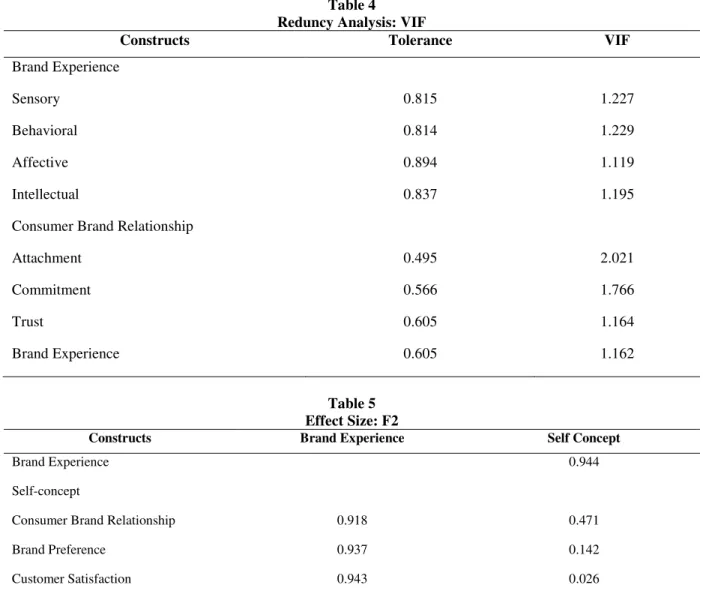
of average variance extracted (AVE). Thus, meeting the criterion given by Fornell Larcker (1981) for discriminant validity (see Table 3). Fourth, present research also used two high order constructs, such as brand experience and consumer brand relationship. Therefore, in order to validate these formative constructs, multi co-linearity of indicators and indicators weight as well as their significance were analyzed and found satisfactory as per rule of thumb. Such as a tolerance value of 0.20 and lower and VIF value of 5 and greater represent co-linearity issue. Our results also meet this criterion (see Table 4). Sixth, results of F Square value showed that brand experience has larger impact on all exogenous constructs, such as brand experience defined self-concept 0.944, consumer brand relationship = 0.918, brand preference = 0.937, customers satisfaction = 0.944. All values represent larger impact of brand experience on all constructs. Similarly, self-concept accounted for larger effect on consumer brand relationship 0.471, medium effect on brand preference 0.142, and smaller effect on customers satisfaction 0.026 (see Table 5).
Table 1
Assessment of Constructs as Formative Model: Theoretical Consideration
Items Selected Model Rationale
• This brand makes a strong impression on my visual sense or other senses.
• I find this brand interesting in a sensory way.
• This brand does not appeal to my senses.
• This brand induces feelings and sentiments.
• This brand is an emotional brand.
• I engage in physical actions and behaviors when I use this brand.
• This brand results in bodily experiences.
• This brand is not action oriented.
• I engage in a lot of thinking when I encounter this brand.
• This brand does not make me think.
• This brand stimulates my curiosity and problem solving.
High order construct. As
first order constructs is
reflective in nature where
second order construct is
formative.
• When the constructs involve two layers of constructs is defined as high order construct (Hair
Jr, Hult, Ringle, & Sarstedt, 2013).
• The construct brand experience consists of four dimensions, such as sensory, behavioral, affective
and intellectual.
• Another key requirement for operationalizing high order construct is that it must be derived from
theory and theory determine the number of
dimensions of construct (Johnson, Rosen,
Djurdjevic, & Taing, 2012).
Consumer Brand Relationship
• I really love this brand.
• I am addicted to this brand in some way.
• I have feeling for this brand.
• Even if this brand was more difficult to reach, I would still keep buying this brand.
• I am willing to go extra miles to remain customer of this brand.
• I feel very loyal to this brand.
• The brand is part of me and who I am.
• I feel personally connected to the brand.
• I feel missing if I don’t use this brand for a while.
• My thoughts and feelings towards the brand often automatic.
• I trust this brand.
• I rely on this brand.
• This is an honest brand.
• This brand is safe.
High order formative
reflective construct.
• When the constructs involve two layers of constructs is defined as high order construct (Hair Jr
et al., 2013).
• The construct brand experience consists of four dimensions, such as brand attachment, commitment,
brand love and brand trust.
• Another key requirement for operationalizing high order construct is that it must be derived from
theory and theory determine the number of
dimensions of construct (Johnson et al., 2012).
Brand Preferences
• I like this brand more than any other brand.
• This brand is my preferred brand over any other brands.
• I would use this brand more than any other brand.
• This brand meets my requirements better than other brands.
• I am interested in trying other products from other bran
Reflective Model
• Causal relationship is from construct to traits(Bollen & Lennox, 1991).
• All the items have common theme(Jarvis, MacKenzie, & Podsakoff, 2003; Rossiter, 2002)like
measuring the Brand preference.
• Variation in construct causes changes in items (Jarvis et al., 2003)..
Self-Concept
• I feel this Brand reflects who I am.
• I can be identifying with this Brand.
• I feel a personal connection to this Brand.
• I use/would use Brand to communicate who I am to other people
Reflective Model
• Causal relationship is from construct to traits(Bollen & Lennox, 1991).
• All the items have common theme (Jarvis et al., 2003; Rossiter, 2002) like measuring self-concept.
4.1 Results: Direct Effect
The results of proposed research model are presented in the Table 7. All the direct effect hypotheses are statistically significant at p < 0.001 Level. Hypothesis 1 which says that brand experience is positively related to self-concept. Our results supported this view (β = .402, t (7.83), p < 0.000). Thus, Hypothesis 1 was accepted. Hypothesis 2, which proposes that brand experience is positively related to consumer brand relationship was also proved to be significant (β = 0.493, t (11.14), p < 0.000). Hypothesis 3 argues that brand experience is positively related to brand preference. The results supported our view (β = 0.481 t (8.90), p < 0.000). Finally, Hypothesis 4, which proposes that brand experience is positively related to customer satisfaction was also supported (β = 0.402, t (9.14), p < 0.000).
Regarding the standardized direct effects of brand experience on three outcome variables, the effect of the brand experience on consumer brand preference (.493) was greater than the direct effect on the brand preference (.481), and customer satisfaction (.402). This effect has important implications for practitioners in several ways. First, this effect might be due to consumers' strong will to engage and build relationship with those brands which are not only satisfying needs and wants but also which are full of rich, unique and memorable experiences. Second, practitioners may develop consumer brand relationship on the basis of aesthetic or hedonic aspects, such as sensory pleasure instead of intellectual or cognitive aspects.
Table 7
Structural Equation Modeling Results for Direct Effect of Brand Experience on Outcome Variables
H Effects between Constructs Standardized
β
Conclusion
H1 Brand Experience Self Concept 0.402 (p < .000) Accepted
H2 Brand Experience Consumer Brand Relationship 0.493 (p < .000) Accepted
H3 Brand Experience Brand Preference 0.481 (p < .000) Accepted
H4 Brand Experience Customer Satisfaction 0.402 (p < .000) Accepted
4.2 Indirect and Total Effects
Aside from direct effect, the brand experience also had an effect on consumer self-concept, which in turn had positive effect on the consumer brand relationship, brand preference and customer satisfaction. This effect is called an indirect effect, and self-concept is called a mediator. A mediator is a third variable that represents the generative mechanism through which the focal independent variable is able to influence the dependent variable of interest (Baron & Kenny, 1986). Given this, our Hypothesis 5 which states that self-concept mediates the relationship between brand experience and consumer brand relationship. In order to examine whether self-concept fully or partially mediates the relationship between brand experience and consumer brand relationship, the conditions/rules suggested by Baron & Kenny (1986) were adopted to establish mediation. First, the effect of independent variable on mediating variable must be statistically significant. Second, the effect of mediator variable on dependent variable must be significant. Third, the direct effect of independent variable on dependent variable must be significant or insignificant. If the indirect effect is significant only, we then assumed full mediation occurs. If both the indirect and direct effects are significant, then partial mediation occurs (Zhang, Wedel, & Pieters, 2009).
As shown in the Table 8 brand experience was significantly related to self-concept (β = 0.402; p < 0.05). Thus, Condition 1 was supported. The effect of self-concept (mediating variable) on consumer brand relationship was also statistically significant (β = 0.472; p < 0.05). Thus, Condition 2 was supported. The direct effect of brand experience on consumer brand relationship was also significant (β = 0.303; p < 0.05), which suggests partial mediation. Given this, the Hypothesis 5 was supported which argued that self-concept mediates the relationship between brand experience and consumer brand relationship.
Table 8
Overall Structural Equation Results
Sno
Effects between Constructs
β
SE
T
-value
P
-value
1
Brand Experience
Self Concept
.402
.049
8.14
.000
2
Brand Experience
Consumer Brand Relationship
.303
.043
7.03
.000
3
Brand Experience
Brand Preference
.400
.062
6.42
.000
4
Brand Experience
Customer Satisfaction
.325
.052
6.21
.000
5
Self concept
Consumer Brand Relationship
.472
.054
8.73
.000
6
Self Concept
Brand Preference
.202
.058
3.47
.000
7
Self concept
Customer Satisfaction
.191
.064
2.98
.000
Similarly, Hypothesis 6 which says that self-concept mediates the relationship between brand experience and brand preference. Condition 1 was supported by our results for Hypothesis 5, in which brand experience was significantly related to self-concept (β = 0.402; p < 0.05). Second, the effect of self-concept (mediating variable) on brand preference was statistically significant (β = 0.202; p < 0.05). Thus, Condition 2 was supported. Finally, the direct effect of brand experience on brand preference was also significant (β = 0.400; p < 0.05), which suggests partial mediation. Given this, Hypothesis 6 was also supported which proposed that self-concept mediates the relationship between brand experience and brand preference.
Table 9
Structural Equation Results for Mediation of Self Concept
H
Effects between Constructs
Standardized
β
Conclusion
H5
Brand Experience
Self Concept
CBR
0.190 (
p
= .05)
Accepted
H6
Brand Experience
Self concept
Brand Preference
0.081 (
p
=.05)
Accepted
H7
Brand Experience
Self Concept
Satisfaction
0.077 (
p
= .05)
Accepted
Finally, Hypothesis 7 which proposes that self-concept mediates the relationship between brand experience and customer satisfaction. Condition 1 was supported by our results for Hypothesis 5, in which brand experience was significantly related to self-concept (β = 0.402; p < 0.05). Second, the effect of self-concept (mediating variable) on customer satisfaction was statistically significant (β = 0.191; p < 0.05). Thus, Condition 2 was supported. Finally, the direct effect of brand experience on customer satisfaction was also significant (β = 0.325; p < 0.05), which suggests partial mediation . Given this, the Hypothesis 7 was supported which stated that self-concept mediates the relationship between brand experience and customer satisfaction (see Table 8 & 9).
All mediation effects are positive and statistically significant for our three dependent variables in the model at p
< .05 level. Particularly, Sobel Test results for significance indirect effect of brand experience through self-concept on three outcome variables were found statistically significant at p < .05 level (see Table 10). Regarding the significant indirect effects, we can say that self-concept partially mediates for three dependent variables in the model. However, the brand experience constitutes the strongest driver of consumer brand relationship, followed by brand preference, and then customer satisfaction. This effect might be due to consumers' strong will to not only engage themselves with fascinating, gratifying and pleasurable brand experiences but also they want
to express themselves with the help of those highly experiential brands. The indirect effect of brand experience through self-concept on customer satisfaction was the smallest indirect effect. However, indirect paths of brand experience through self-concept increase the total effect sizes of the customer satisfaction. This might indicate the consumers’ feeling of being connected and identified with brand, effects their satisfaction.
Finally, adding the indirect and direct effects together leads to the total effects. The standardized total effect of brand experience on three outcomes variables are: consumer brand relationship (.493), brand preference (.481) and customer satisfaction (.402) respectively. Thus, brand experience positively influences the three dependent variables of our model.
Table 10
Direct, Indirect, and Total Effects of Brand Experience on Outcome Variables
Direct Effect
β
Indirect Effect
β
Total Effect
β
Sobel Test
Statistic
Significance
Level
.303
.190
.493
5.95
.000
.400
.081
.481
3.194
.001
.325
.077
.402
0.803
.005
4.
Discussion
This study has contributed to the existing body of knowledge in several distinct ways. Our overall contribution is that, we have built and tested a conceptual model that integrates brand experience with consumer brand relationship, brand preference and customer satisfaction. In addition, the mediating effect of self-concept on consumer brand relationship, brand preference and customer satisfaction was also examined.
First, we found support for our Hypothesis 1, which proposed that brand experience has significant positive effect on self-concept. This indeed can be true as hedonic or experiential aspects of brands lead consumers to feel personally connected with the brand. Consumers prefer the brand which better reflect their personality and represent who they are. Second, we found support for our Hypothesis 2 which purported to examine the relationship between brand experience and consumer brand relationship, was also supported by our results. Our research empirically demonstrated that consumer brand relationship can also be formed on the basis of aesthetic or hedonic aspects of brand, such as sensory pleasure and by stimulating behavioral, affective and intellectual dimensions in the brand. More importantly, this finding is especially significant which highlighted the importance of creating consumers favorable responses, such as brand attachment, commitment, brand love and trust. Our these results are in line with the recent study conducted by Ramaseshan & Stein, (2014). Third, we found support for our Hypothesis 3, which demonstrated the significant impact of brand experience on brand preference. This important finding constituted that when consumers have favorable brand experience, it will lead to create consumer brand preferences. Fourth, we found support for our Hypothesis 4, which proposed that brand experience has significant positive effect on customer satisfaction, was also proved statistically significant. Our research confirmed previous study’s findings of Brakus et al., (2009). Fifth, we found support for our Hypothesis 5 for indirect effect of brand experience through self-concept on consumer brand relationship which constituted the strongest indirect effect (.19). This effect might be due to consumers strong will to not only expecting fascinating, gratifying and pleasurable brand experiences but also they want to express themselves with the help of those highly experiential brands. Sixth, we found support for our Hypothesis 6 which argued thatself-concept mediates the relationship between brand experience and brand preference. The results suggested that self-concept is a stronger mediator of brand experience and consumer brand preference. This can be an important finding for marketers as this is the indication that consumers prefer the brands which are not only providing unique memorable experiences but also which are compatible with their self-image (Jamal & Goode, 2001; Zinkhan & Hong, 1991).
Finally, we found support for our Hypothesis 7. Although the indirect effect of brand experience through self-concept on customer satisfaction was the smallest indirect effect (.077). indirect paths of brand experience through self-concept increase the total effect sizes of the customer satisfaction (.402). This indicates that the consumers feeling of being connected and identified with brand, effects their satisfaction.This finding confirmed the previous study by (Hwang & Kandampully, 2012).
5.
Managerial Implications
Research on consumer behavior has clearly demonstrated that consumption pattern do not solely depends on utilitarian aspects of brands. As regarded in traditional marketing where the price, quality and availability were main considerations for marketing managers. In highly competitive market, consumption pattern goes beyond bundle of attributes of brands (Holt, 1995). Our research has made great contribution for practitioners to create exciting brand experiences in order to build long-term relationship with customers, strong brand preferences and endless customer satisfaction. Particularly, our research reported the stronger direct effect of brand experience on consumer brand relation, which might be an important sign for practitioners to engage customers with brands which not only satisfying the needs and wants but also create/build brands which provide exceedingly rich, unique and memorable experiences during selecting, buying, using and disposing of products and services. Second, practitioners may develop consumer brand relationship by building aesthetic or hedonic features in the brand. Third, our research reported the stronger indirect effect of self-concept between brand experience and consumer brand relation, which has invaluable implications for practitioners, as customers prefer the brands which are not only providing unique and memorable experiences but also which are compatible with their personality and self-image. This might be because of consumers strong will to not only expecting fascinating, gratifying and pleasurable brand experiences but also they want to express themselves with the help of those highly experiential brands. Thus, marketers should utilize the findings of our research to reconsider and rebuild their future brands (1) which not only provide exceedingly rich and memorable brand experiences (2) but also through which end users express their personality, inner hidden self and reflection.
6.
Limitation and Future Research
Although our study has added greatly in the present body of knowledge about the role of brand experience to build long-term relationships with customers. Certainly our study is not without limitations. First, this study has taken only consumer brand categories for analysis, other wide range of categories, such as B2B, service categories as well as other consumer brand categories can be taken into account to analyze and generalize the results. Second, comparative analysis of different brands would give a significant understanding of how brand experience works in different product categories instead of only selecting the experiential brands. Third, further study can be undertaken to investigate how sensory, behavioral, affective and intellectual dimension of the brand experience impact consumer brand relationship dimensions, such as attachment, commitment, brand love and trust separately. Fourth, this study did not take into account the process of how brand experience, consumer brand relationship and brand preferenceare established. It will be more interesting to know, which brand experience stimuli triggers to which dimension of the brand relations and preferences. Fifth, other important marketing constructs would add to model, such as customer life time value and share wallet to examine whether or not brand experience impact customer life time value.
References
Arnould, E. J., & Price, L. L. (1993). River magic: Extraordinary experience and the extended service encounter.
Journal of Consumer Research, 24-45.
Ashworth, L., Dacin, P., Thomson, M., MacInnis, D., Park, W., & Priester, J. (2009). Why on earth do consumers have relationships with marketers. Handbook of brand relationships, 82-106.
Baron, Reuben M. and David A. Kenny (1986), “The Moderator-Mediator Variable Distinction in Social Psychological Research: Conceptual, Strategic, and Statistical Considerations,” Journalof Personality and Social Psychology, 51 (6), 1173-82.
Becker, J.-M., Klein, K., & Wetzels, M. (2012). Hierarchical latent variable models in PLS-SEM: guidelines for using reflective-formative type models. Long Range Planning, 45(5), 359-394.
Belk, R. W. (1985). Materialism: Trait aspects of living in the material world. Journal of Consumer Research, 265-280.
Berry, L. L. (1983). Relationship marketing.
Bollen, K., & Lennox, R. (1991). Conventional wisdom on measurement: A structural equation perspective.
Psychological bulletin, 110(2), 305.
Brakus, J. J., Schmitt, B. H., & Zarantonello, L. (2009). Brand experience: what is it? How is it measured? Does it affect loyalty? Journal of marketing, 73(3), 52-68.
Carbone, L. P., & Haeckel, S. H. (1994). Engineering customer experiences. Marketing management, 3(3), 8. Chang, P. L., & Chieng, M. H. (2006). Building consumer–brand relationship: A cross‐cultural experiential
view. Psychology & Marketing, 23(11), 927-959.
Chin, W. W. (2003). Issues and opinions on structural equation modeling.
Dowling, G. (2002). Customer relationship management: in B2C markets, often less is more. California management review, 44(3), 87-104.
Ebrahim, R. S. (2013). A study of brand preference: An experiential view. Brunel University Brunel Business School PhD Theses.
Elliott, R. (1997). Existential consumption and irrational desire. European Journal of Marketing, 31(3/4), 285-296.
Escalas, J. E., & Bettman, J. R. (2005). Self‐construal, reference groups, and brand meaning. Journal of Consumer Research, 32(3), 378-389.
Fournier, S. (1998). Consumers and their brands: Developing relationship theory in consumer research. Journal of Consumer Research, 24(4), 343-353.
Francisco-Maffezzolli, E. C., Semprebon, E., & Prado, P. H. M. (2014). Construing loyalty through brand experience: The mediating role of brand relationship quality. Journal of Brand Management, 21(5), 446-458.
Hair Jr, J. F., Hult, G. T. M., Ringle, C., & Sarstedt, M. (2013). A primer on partial least squares structural equation modeling (PLS-SEM): Sage Publications.
Heilman, C. M., Bowman, D., & Wright, G. P. (2000). The evolution of brand preferences and choice behaviors of consumers new to a market. Journal of marketing research, 37(2), 139-155.
Hoeffler, S., & Ariely, D. (1999). Constructing stable preferences: A look into dimensions of experience and their impact on preference stability. Journal of Consumer Psychology, 8(2), 113-139.
Holbrook, M. B. (1978). Beyond attitude structure: Toward the informational determinants of attitude. Journal of marketing research, 545-556.
Holt, D. B. (1995). How consumers consume: A typology of consumption practices. Journal of Consumer Research, 22(1), 1-16.
Hwang, J., & Kandampully, J. (2012). The role of emotional aspects in younger consumer-brand relationships.
Journal of Product & Brand Management, 21(2), 98-108.
Jamal, A., & Goode, M. M. (2001). Consumers and brands: a study of the impact of self-image congruence on brand preference and satisfaction. Marketing Intelligence & Planning, 19(7), 482-492.
Jarvis, C. B., MacKenzie, S. B., & Podsakoff, P. M. (2003). A critical review of construct indicators and measurement model misspecification in marketing and consumer research. Journal of Consumer Research, 30(2), 199-218.
Johnson, R. E., Rosen, C. C., Djurdjevic, E., & Taing, M. U. (2012). Recommendations for improving the construct clarity of higher-order multidimensional constructs. Human Resource Management Review, 22(2), 62-72.
Keller, K. L. (2001). Building customer-based brand equity. Marketing management, 10(2), 14-21.
Kerin, R. A., Jain, A., & Howard, D. J. (1992). Store shopping experience and consumer price-quality-value perceptions. Journal of Retailing, 68(4), 376.
Leventhal, R. C., Mascarenhas, O. A., Kesavan, R., & Bernacchi, M. (2006). Lasting customer loyalty: a total customer experience approach. Journal of Consumer Marketing, 23(7), 397-405.
McCracken, G. (1986). Culture and consumption: A theoretical account of the structure and movement of the cultural meaning of consumer goods. Journal of Consumer Research, 71-84.
Mehta, A. (1999). Using self-concept to assess advertising effectiveness. Journal of Advertising Research, 39(1), 81-81.
Morris, B. H., & Elizabeth, C. H. (1982). The experiential aspects of consumption: consumer fantasies, feelings, and fun. Journal of Consumer Research, 9(2), 132-140.
Pine, B. J., & Gilmore, J. H. (1999). The experience economy: work is theatre & every business a stage: Harvard Business Press.
Ramaseshan, B., & Stein, A. (2014). Connecting the dots between brand experience and brand loyalty: The mediating role of brand personality and brand relationships. The Journal of Brand Management, 21 (7-8), 664-683.
Ravald, A., & Grönroos, C. (1996). The value concept and relationship marketing. European Journal of Marketing, 30(2), 19-30.
Rossiter, J. R. (2002). The C-OAR-SE procedure for scale development in marketing. International Journal of Research in Marketing, 19(4), 305-335.
Rukhsana G, Xixiang S, Gilal, F. G (2015). The Role of Brand Experience to Categorize Consumer Behaviour: A New Paradigm to Consumer Psychology, At 12th International Conference on Innovation and Management, Wuhan, P.R. China.
Schmitt, B. (1999). Experiential marketing. Journal of Marketing Management, 15(1-3), 53-67.
Schmitt, B. H., Brakus, J., & Zarantonello, L. (2014). The current state and future of brand experience. Journal of Brand Management, 21(9), 727-733.
Simonson, I. (2007). Will I like a'medium'pillow? another look at constructed and inherent preferences. Journal of Consumer Psychology, Forthcoming.
Winer, R. S. (2001). A framework for customer relationship management. California management review, 43(4), 89-105.
Wohlfeil, M., & Whelan, S. (2006). Consumer motivations to participate in event-marketing strategies. Journal of Marketing Management, 22(5-6), 643-669.
Zajonc, R. B., & Markus, H. (1982). Affective and cognitive factors in preferences. Journal of Consumer Research, 123-131.
Zhang, Jie, Michel Wedel, and Rik Pieters (2009), “Sales Effects of Attention to Feature Advertisements: A Bayesian Mediation Analysis,” Journal of Marketing Research, 46 (October), 669-81.
Zinkhan, G. M., & Hong, J. W. (1991). Self Concept and Advertising Effectiveness: A Conceptual Model of Congruency, Conspicuousness, and Response Mode. Advances in consumer research, 18(1).
Appendix
Table 2Results of Measurement Model Evaluation of first order construct
Constructs
R Square
Composite
Reliability
Cronbach
Alpha
AVE
Sensory
0.953
0.838
0.616
0.721
Behavioral
0.804
0.520
0.673
Affective
0.766
0.730
0.621
Intellectual
0.734
0.831
0.581
Self-concept
0.161
0.819
0.705
0.532
Brand Experience
1.000
0.881
0.821
0.650
Attachment
0.871
0.804
0.631
Commitment
0.866
0.767
0.684
Brand Love
0.803
0.688
0.579
Brand Trust
0.843
0.754
0.575
Consumer Brand Relationship
1.000
0.905
0.730
0.411
Brand Preferences
0.266
0.881
0.821
0.650
Table 3
Discriminant Validity: FornellLacker Criterion Construct s Affecti ve Attachm ent Brand Preferen ce Behavio ral Commitm ent Intellect ual Bran d Love Satisfacti on Self-Conce pt Senso ry Bran d Trus t Affective 0.788 Attachme nt 0.225 0.794 Brand Preference 0.233 0.424 0.641 Behaviora l 0.239 0.293 0.234 0.820 Commitm ent 0.249 0.609 0.575 0.279 0.826 Intellectua l 0.193 0.252 0.304 0.319 0.262 0.762 Brand Love 0.219 0.602 0.489 0.236 0.607 0.250 0.76 0 Satisfactio n 0.121 0.385 0.461 0.225 0.403 0.317 0.32 1 0.826 Self Concept 0.242 0.577 0.363 0.259 0.474 0.345 0.47 2 0.310 0.826 Sensory 0.189 0.257 0.451 0.251 0.329 0.250 0.27 6 0.306 0.221 0.730 Brand Trust 0.149 0.580 0.437 0.180 0.490 0.209 0.24 1 0.536 0.395 0.340 0.85 0
Table 4 Reduncy Analysis: VIF
Constructs Tolerance VIF
Brand Experience
Sensory 0.815 1.227
Behavioral 0.814 1.229
Affective 0.894 1.119
Intellectual 0.837 1.195
Consumer Brand Relationship
Attachment 0.495 2.021 Commitment 0.566 1.766 Trust 0.605 1.164 Brand Experience 0.605 1.162 Table 5 Effect Size: F2
Constructs Brand Experience Self Concept
Brand Experience 0.944
Self-concept
Consumer Brand Relationship 0.918 0.471
Brand Preference 0.937 0.142
Table 6
Inner and Outer Regression Weights for the Path Model
Constructs Standardized Regression Loadings
Sen1 0.875** Sen2 0.823** Afe1 0.817** Afe3 0.759** Bhr1 0.868** Bhr2 0.770** Int1 0.715** Int3 0.807** Slfimg1 0.702** Slfimg2 0.782** Slfimg3 0.775** Slfimg4 0.652** Atch1 0.839** Atch2 0.854** Atch3 0.773** Atch4 0.704** Com1 0.809** Com2 0.870** Com3 0.799** Lov1 0.681** Lov2 0.785** Lov3 0.811** BTrust1 0.756** Btrust2 0.771** BTrust3 0.821** Btrust4 0.680** Sat1 0.833** Sat2 0.820** Btrust5 0.803** Brprf1 0.771** Brprf2 0.852** Brprf3 0.808** Brprf4 0.794** Notes: *p, 0.1; **p, 0.01