NATURE|VOL 417|16 MAY 2002|www.nature.com 351
T
he study of birdsong exemplifies aneuroethological approach to understanding brain function, in which a detailed knowledge of naturally occurring behaviours can inform and guide the search for underlying neural mechanisms. Songbirds also illustrate the neuroethological tenet that ‘specialist’ animals can provide revealing examples of basic processes shared by less specialized animals. For example, songbirds display complex perceptual learning, in which experience interacts with inborn predispositions to learn. They engage in sophisticated motor skill learning, guided by performance-based feedback. Their capacity for song learning is restricted to a sensitive period in development, the timing of which depends on experience as well as hormones, and varies between species. To subserve vocal learning, songbirds have evolved a discrete set of brain structures, which include specializations of widely conserved vertebrate circuitry, such as basal ganglia networks. The structures involved in song learning and production have also revealed some of the most compelling examples of adult neurogenesis and its regulation. Finally, the properties of song learning make it a model not only for general sensory and motor learning, but also for human speech learning, providing one of the few model systems for the human capacity to acquire vocal behaviour.
In this highly selective review of birdsong learning, we begin by outlin-ing some behavioural observations. We then describe what can be inferred about nervous system function from these observations, as well as what has been learned about how the brain solves these behaviourally defined tasks. In some cases, inroads have been made into understanding how the nervous system carries out compo-nents of the behavioural repertoire; in most, however, our understanding remains incomplete. Nevertheless, songbirds provide a system where observation of naturally occurring
behaviours has delineated a series of questions of general relevance to learning, in a context where it is highly tractable to elucidate neural mechanisms.
Behavioural basis of vocal learning
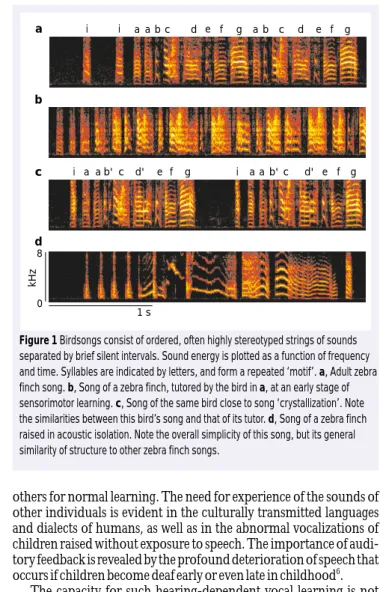
The importance of hearingThe scientific study of birdsong began in the late 1950s, with Thorpe1and Marler2. They showed that birds, taken from the wild as eggs or nestlings and tutored with songs of unrelated adults of the same species (conspecifics), ultimately produce songs that resemble the tutor songs (Fig. 1a–c). In contrast, birds raised in acoustic isolation from conspecific males produce very abnormal ‘isolate’ songs (Fig. 1d). Moreover, some songbirds, like humans, have learned, geographically restricted ‘dialects’2. These results illustrate that hearing the sounds of others during an early ‘sensory learning’ period (Fig. 2) is essential to normal learning.
Songbirds must also be able to hear themselves in order to learn to vocalize normally. If birds are deafened after exposure to the songs of others, but before they begin prac-tising their vocalizations during ‘sensorimotor learning’ (Fig. 2), they develop highly abnormal songs that show no evidence of learning3. However, the tutor no longer needs to be heard during this rehearsal phase. These behavioural results suggest that during the sensory phase of learning, young birds form an internal representation of song to which they are exposed — a song ‘tem-plate’. Later, during the sensorimotor phase, birds use auditory feedback to compare their developing vocaliza-tions with the template, and guide their song modification using this comparison3,4.
Birdsong and human speech
Speech and song are both complex acoustical signals (Fig. 1), and numer-ous features of song learning show striking parallels to human speech development5. Most important, humans, like songbirds, depend criti-cally on hearing both themselves and
What songbirds teach us
about learning
Michael S. Brainard & Allison J. Doupe
W. M. Keck Center for Integrative Neuroscience and Departments of Physiology and Psychiatry, University of California, San Francisco, California 94143, USA (e-mail: [email protected])
Bird fanciers have known for centuries that songbirds learn their songs. This learning has striking parallels to
speech acquisition: like humans, birds must hear the sounds of adults during a sensitive period, and must
hear their own voice while learning to vocalize. With the discovery and investigation of discrete brain
structures required for singing, songbirds are now providing insights into neural mechanisms of learning.
Aided by a wealth of behavioural observations and species diversity, studies in songbirds are addressing such
basic issues in neuroscience as perceptual and sensorimotor learning, developmental regulation of plasticity,
and the control and function of adult neurogenesis.
352 NATURE|VOL 417|16 MAY 2002|www.nature.com others for normal learning. The need for experience of the sounds of
other individuals is evident in the culturally transmitted languages and dialects of humans, as well as in the abnormal vocalizations of children raised without exposure to speech. The importance of audi-tory feedback is revealed by the profound deterioration of speech that occurs if children become deaf early or even late in childhood6.
The capacity for such hearing-dependent vocal learning is not widespread5. Apart from humans, no primates have been shown to learn their complex vocalizations. Among the rest of the mammals, only cetaceans (whales and dolphins) and some bats show evidence of vocal learning. In contrast, the vocal behaviour of the many thou-sands of songbird species, as well as of parrots and hummingbirds, provides a rich source of possible models for human speech learning. Some aspects of birdsong are clearly not analogous to human speech. Although birdsong is used for communication, it does not seem to be ‘language’ in the sense of conveying complex meaning. What it shares with speech is the learned sensorimotor control of an elaborate vocal system. The strikingly similar requirements for this vocal learning in songbirds and humans suggest that there may be related neural mechanisms, even in brain areas that are not homologous.
Neural substrates for vocal behaviour
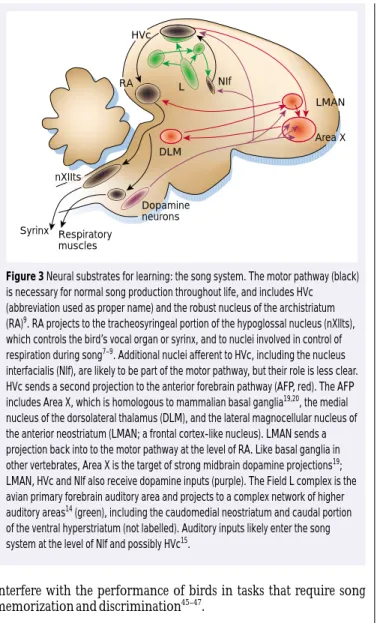
The behavioural studies of vocal learning indicate that there must be neural circuitry for a variety of processes, in particular (1) producing the motor commands that give rise to the complex sounds of song; (2) perceptual learning of sounds, including the memorization of the tutor song; and (3) evaluating auditory feedback relative to the internal template, and generating signals that can guide consequent modification of vocal motor output. The likely locations for these processes are a set of brain structures known as the ‘song system’ (Fig. 3), outlined below.
The motor pathway
Song, like speech, requires the coordinated control of vocal and res-piratory musculature7,8. Evidence suggests that the ‘motor pathway’
breathing and vocal muscle activity necessary for song production. Lesions of either of the two main nuclei of this pathway, the HVc (abbreviation used as proper name) and the robust nucleus of the archistriatum (RA), result in abnormal songs or muteness9, and neurophysiological activity in HVc and RA is correlated with song production10,11. There is evidence for a motor hierarchy: HVc encodes higher-level song structure than does RA12, and microstimu-lation in HVc causes interruption of singing and restarting of the song, whereas the same stimulation in RA disrupts only the structure of syllables without altering song patterning13.
Auditory areas and mechanisms
A network of forebrain auditory areas (Fig. 3) radiating from Field L, which is analogous to primary auditory cortex of mammals, is the likely source of auditory inputs to the song system14,15. These high-level auditory regions may also be sites of some of the specialized operations critical to song learning. In addition, the song system itself contains some of the most complex sensory neurons known, which respond selectively to the sound of the bird’s own song16–18(see below). The anterior forebrain pathway and basal ganglia function
The anterior forebrain pathway (AFP) indirectly connects the motor nuclei HVc and RA9,19,20 (Fig. 3). Anatomical, physiological and behavioural evidence supports the identification of this pathway as a specialized basal ganglia thalamo-‘cortical’ loop19,20. In contrast to the song motor pathway, the AFP seems to contribute minimally to the production of stable adult song9,21. However, lesions of the AFP during song learning prevent birds from developing normal adult songs21–23, consistent with a function in sensory or sensorimotor learning (see below). The combination of a specialized basal ganglia circuit and a stereotyped motor output may make the AFP a particularly tractable system for revealing principles of basal ganglia function in motor learning.
Sensory learning
Nature versus nurtureThe brain of a young songbird is not a clean slate. Without previous song exposure, young birds show greater changes in heart rate and more begging calls in response to conspecific songs than to songs of other species (heterospecific songs)24,25. Moreover, although young birds are capable of copying heterospecific song, especially if it is the only model available, they will preferentially learn conspecific songs when given a choice26. Finally, although birds raised in acoustic isolation sing much less complex songs than tutored birds, their songs contain some species-specific structure2,4(Fig. 1d). Because most of this structure is absent in birds deafened before sensorimotor learning3,4, isolate songs seem not to be pre-specified motor pro-grams, but rather involve some sensory recognition, perhaps with respect to an ‘innate template’. These behavioural studies indicate that there must be genetically determined circuitry for innate species-specific song recognition and learning.
Sensitive periods for sensory learning of song
Numerous forms of learning are subject to ‘sensitive’ or ‘critical’ periods during which experience is crucial in shaping nervous system function. One well known sensitive period is that for human speech; after early adolescence, it is difficult to learn to produce the sounds of a new language with the competence of a native speaker5. Many songbird species have a similar sensitive period (Fig. 2). For instance, recorded tutor songs presented to a white-crowned sparrow after 100 days of age do not appear in the bird’s adult song. Similarly, white-crowned sparrows raised in isolation to 100 days of age and subsequently exposed to taped tutors still produce abnormal isolate songs as adults2,4. For songbirds (and perhaps for humans as well), it seems that it is the capacity for sensory learning that declines with age (see ref. 5 for a review).
1 s 0 8 i i a a b c d e f g a b c d e f g i a a b' c d' e f g i a a b' c d' e f g kHz a b c d
Figure 1Birdsongs consist of ordered, often highly stereotyped strings of sounds separated by brief silent intervals. Sound energy is plotted as a function of frequency
and time. Syllables are indicated by letters, and form a repeated ‘motif’. a, Adult zebra
finch song. b, Song of a zebra finch, tutored by the bird in a, at an early stage of
sensorimotor learning. c, Song of the same bird close to song ‘crystallization’. Note
the similarities between this bird’s song and that of its tutor. d, Song of a zebra finch
raised in acoustic isolation. Note the overall simplicity of this song, but its general similarity of structure to other zebra finch songs.
NATURE|VOL 417|16 MAY 2002|www.nature.com 353 The sensory exposure required for tutor song memorization can
be surprisingly short. Nightingales can almost fully reproduce tapes of 60 songs that they have heard only once a day for 20 days27, and zebra finches can learn well with less than a minute of tutor song exposure per day28. In this respect, sensory learning of song resembles ‘imprinting’, in which animals very rapidly and irreversibly learn to recognize an animal or object of critical behavioural relevance. Closure of the sensitive period is affected by experience
The sensitive period for song learning does not have a strict age limit. Rather, experience itself is centrally involved in closing the sensitive period. For instance, songbirds tutored with only heterospecific songs can incorporate new songs from their own species at a time when birds raised with conspecifics will no longer learn1,29. For some species, even more deprivation, such as raising birds in complete isolation, can result in adults that will still incorporate new song elements29,30. Thus, a lack of normal experience leaves the brain open to be shaped by the appropriate input for longer than usual. In most cases, however, plasticity seems not to last indefinitely, even in the absence of experience. Presumably, circuits poised to be shaped by activity-dependent events ultimately stabilize in some state, even if driven only by spontaneous activity.
Attentional or motivational factors also influence the timing of the sensitive period. Birds will learn from live, countersinging tutors for longer than they learn from taped tutors31,32. Hormonal factors may be important as well, as manipulations that delay the onset of singing and decrease testosterone levels seem to extend the sensitive period1,33.
Auditory neurons shaped by song experience
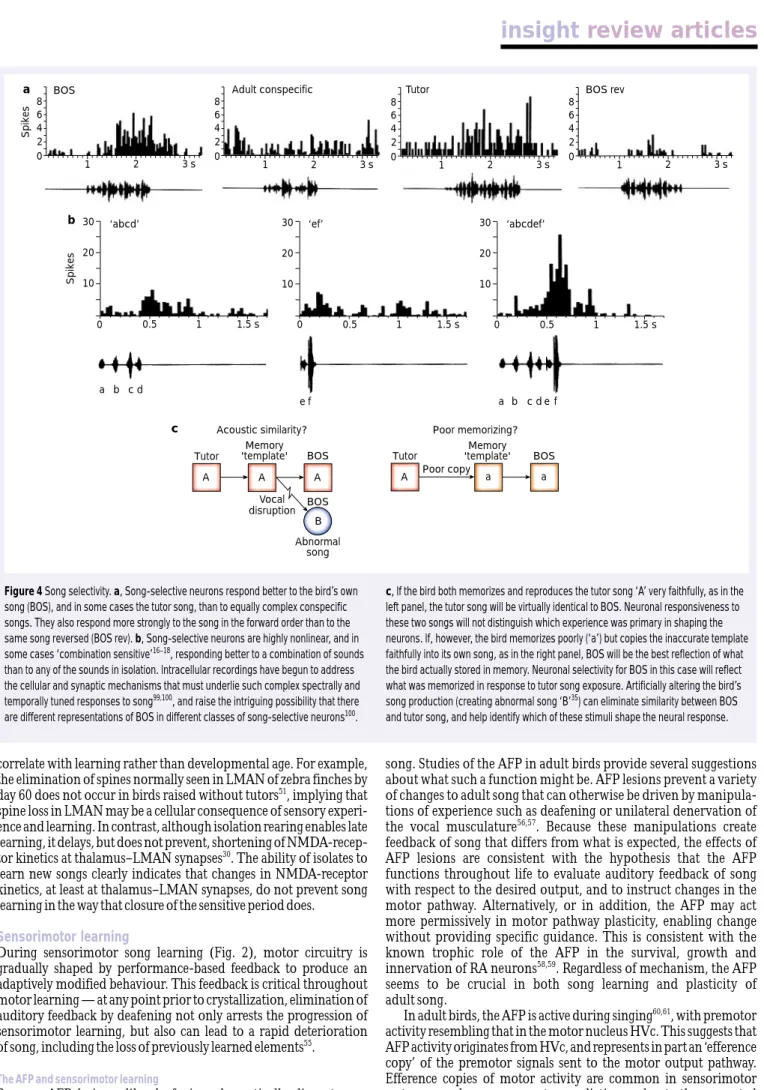
We do not yet know where and how in the brain the memory of the tutor song is stored during the process of sensory learning, nor how this memory is accessed during the evaluation of auditory feedback that guides vocal practice. However, the use of behaviourally relevant auditory stimuli has revealed neurons that clearly have been shaped by the individual bird’s unique auditory experience during song learning. These ‘song-selective’ neurons, which are found through-out the adult male song system, respond more strongly to the sound of the bird’s own song (BOS), and in some cases to the tutor song, than to other equally complex auditory stimuli, such as conspecific songs or BOS played in reverse or out of order16–18(Fig. 4).
Although song-selective neurons reflect the individual bird’s experience, it is not clear which aspects of that experience are
responsible for generating selectivity. In principle, these neurons might be shaped by the tutor song during sensory learning and/or by feedback of BOS during sensorimotor learning. The former possibil-ity is especially intriguing; if tutor song selectivpossibil-ity arises during sensory learning, then this selectivity itself may be a manifestation of the tutor song memory. Moreover, such tutor-tuned neurons could participate directly in the subsequent evaluation of auditory feedback during sensorimotor learning: as a bird practises his song, auditory feedback from those variants that more closely resemble the tutor’s song would be differentially effective in activating tutor-selective neurons. Hence, the degree of activation of these neurons during vocal practice could signal the degree of success in the young bird’s attempts to mimic the tutor song.
This simple scenario, in which sensory learning generates tutor-selective neurons that can then guide feedback evaluation, faces a serious challenge. Developmental studies suggest that robust song selectivity does not emerge during sensory learning, but instead aris-es in parallel with the bird’s own motor production. Moreover, the emerging song selectivity is characterized by greater response to BOS than to the tutor song, or by similarly strong responses to both these songs18,34,35. These observations are consistent with the possibility that the critical experience that shapes song selectivity is exposure to feedback of BOS. The tutor song responses observed could arise simply because of similarity between the bird’s learned song and the tutor song to which it was exposed; neurons tuned to BOS would tend to respond well to the acoustically similar tutor song (Fig. 4c).
Because of this problem of acoustic similarity, and because the tutor song is only an indirect representation of what the bird has actu-ally memorized, the relative strength of neural responses to BOS and tutor song in normal adults cannot unambiguously reveal which experiences have shaped song selectivity35(Fig. 4c). This problem has been partly addressed by studying birds that were prevented from producing a good copy of the tutor song by denervating the vocal apparatus. These birds produce very abnormal songs, without the usual acoustic similarity to tutor song. Song-selective neurons in these birds, at least in the AFP, develop sensitivity to the sound of the abnormal songs produced by the bird35. This indicates that BOS shapes song-selective neurons during sensorimotor learning.
But some AFP neurons in birds with deafferented vocal organs are strongly responsive to the tutor song as well as to BOS, despite the acoustic differences between the two35. Thus, some song-selective neurons seem to reflect independently both sensory and sensorimo-tor learning. Such joint selectivity for BOS and tusensorimo-tor song could be a
Figure 2Timelines for song
learning. a, In many seasonal
species, such as the white-crowned sparrow, the sensory and sensorimotor phases of learning can be separated in time. The initial vocalizations, or ‘subsong’, produced by young birds are variable and generic across individuals, akin to the babbling of human infants. Subsong gradually evolves into ‘plastic song’, which remains highly variable from one rendition to the next, but also begins to incorporate some recognizable elements of tutor songs. Plastic song is progressively refined until the bird ‘crystallizes’ its stable adult
song. b, Zebra finches develop
rapidly, and their two phases of
learning overlap extensively. c, ‘Open learners’, such as canaries, can continue or recapitulate the initial learning process as adults.
Hatch
Sensory Sensorimotor
Spring Autumn Spring
Crystallized Sensitive period ends Subsong Plastic song
Hatch Sensorimotor Sensorimotor Sensorimotor Sensory Sensory Sensory? Crystallized Crystallized Crystallized 25 60 Day 90
Hatch Spring Autumn Spring Autumn Spring Plastic
Sparrows
Zebra finches
interfere with the performance of birds in tasks that require song memorization and discrimination45–47.
Cellular and synaptic changes correlated with sensory learning
Tutor song memorization could be distributed across a number of brain areas, but because disruptions of the AFP affect learning, many studies have focused on this circuit in the search for neural mechanisms underlying the sensitive period for sensory learning48. In zebra finches, the AFP and its connection to RA undergo numerous regressive changes by 60 days of age, when the sensitive period closes in this species. The synapses from LMAN to the motor pathway decrease in number when HVc innervates RA49, and the ini-tially coarse topographic projection from LMAN to RA undergoes refinement50. Elimination of connections is also prominent within the AFP itself: LMAN neuron spine density decreases between 25 and 60 days of age51, and thalamic arbors in LMAN are pruned52. This is accompanied by decreased N-methyl-D-aspartate (NMDA) recep-tors in LMAN53, faster NMDA currents at synapses from thalamus to LMAN30, and loss of activity-dependent synaptic potentiation and depression at synapses within LMAN54.
These regressive changes could potentially underlie an experi-ence-dependent narrowing of song responsiveness as birds encode a particular tutor song memory. But in zebra finches, the period of sensory learning also overlaps with the onset of vigorous singing, sensorimotor rehearsal and refinement of auditory selectivity for BOS (Fig. 2), making it difficult to specifically attribute any changes to sensory learning. In addition, the song system is still developing during this time, such that many of the observed changes could reflect developmental events that are independent of learning. So far, only a small number of observations have been tested and found to
354 NATURE|VOL 417|16 MAY 2002|www.nature.com
two stimuli. There is as yet little evidence in the song system for the simpler idea of auditory neurons with strong suprathreshold selectivity to tutor song alone.
Neurons with responses to BOS playback in anaesthetized or sleeping animals do not always show these responses when birds are awake, indicating that the strength, and perhaps the nature, of audi-tory responses to sounds are ‘gated’ by the behavioural state of the bird36,37. In other sensorimotor systems, for instance locomotion in mammals or flying in insects, sensory responses related to a behav-iour are ‘gated’ by the motor activity that generates the behavbehav-iour38. That is, responses are diminished unless the animal is also engaged in the behaviour. Similarly, for songbirds as for humans, auditory feedback of self is available only when the animal is actually vocaliz-ing. Thus, anaesthesia or sleep may artificially open a gate that is normally operated by the act of singing. Ultimately, an understand-ing of the neural mechanisms for evaluation of auditory feedback of BOS is likely to require recording neural activity when that feedback is produced — that is, during singing.
Forebrain auditory areas and sensory responses
Complex stimulus selectivity is also found in some auditory forebrain regions that provide input to the song system15,39–41. In particular, the high-level auditory areas (Fig. 3) known as the caudo-medial neostriatum (NCM) and the caudal portion of the ventral hyperstriatum contain neurons that show more immediate early gene induction or neurophysiological activity in response to conspecific songs than to heterospecific songs39,40. For the most part, responses within these regions, unlike those within the song system, do not seem to be restricted specifically to BOS or tutor song stimuli. Hence, these forebrain regions may contribute to a general process-ing of conspecific sounds. However, one recent study found that, within NCM, some auditory responses seem to reflect the individual bird’s song-learning experience42,43. It therefore remains possible that some of the sensory learning of song occurs within this network of auditory forebrain areas.
This conclusion seems especially plausible as many animals that are not vocal learners, including some birds, are nevertheless capable of perceptual learning. Perceptual learning, including that of tutor song, may rely on sensory processing pathways that are phy-logenetically widespread. In contrast, the sensorimotor component of vocal learning, which has appeared only rarely, may have required the evolution of specialized vocal areas such as the song system. Assessing the functional role of brain regions in sensory learning
Lesion studies are problematic for identifying brain regions that are specifically involved in the sensory phase of song learning. This is because the main assay for what a bird has memorized is the song that the bird ultimately produces; any song abnormalities arising from lesions are therefore difficult to attribute specifically to disrup-tion of sensory learning, as opposed to disrupdisrup-tion of subsequent sensorimotor learning or song production. One attempt to circum-vent this problem in investigating the role of the AFP has been to reversibly inactivate the AFP nucleus LMAN (lateral magnocellular nucleus of the anterior neostriatum) during tutoring sessions, but not during song rehearsal44. Song learning in these experimental birds is reduced relative to controls. However, the decrease is small, and the songs of treated birds are not isolate-like, as might be expect-ed if song memorization were completely preventexpect-ed. Nonetheless, this experiment provides perhaps the most direct evidence of involvement of a brain area in song memorization, and could be extended usefully to testing the role of other brain areas.
Another approach is to study the effects of lesions in purely per-ceptual tasks, where aspects of sensory learning can be measured independently of song production. Although such studies have not addressed the issue of memorization of tutor song, they have found that lesions of song nuclei, including HVc and LMAN,
RA DLM Syrinx HVc Area X LMAN L nXIIts Respiratory muscles NIf Dopamine neurons
Figure 3Neural substrates for learning: the song system. The motor pathway (black) is necessary for normal song production throughout life, and includes HVc (abbreviation used as proper name) and the robust nucleus of the archistriatum
(RA)9
. RA projects to the tracheosyringeal portion of the hypoglossal nucleus (nXIIts), which controls the bird’s vocal organ or syrinx, and to nuclei involved in control of
respiration during song7–9
. Additional nuclei afferent to HVc, including the nucleus interfacialis (NIf), are likely to be part of the motor pathway, but their role is less clear. HVc sends a second projection to the anterior forebrain pathway (AFP, red). The AFP
includes Area X, which is homologous to mammalian basal ganglia19,20, the medial
nucleus of the dorsolateral thalamus (DLM), and the lateral magnocellular nucleus of the anterior neostriatum (LMAN; a frontal cortex-like nucleus). LMAN sends a projection back into to the motor pathway at the level of RA. Like basal ganglia in
other vertebrates, Area X is the target of strong midbrain dopamine projections19;
LMAN, HVc and NIf also receive dopamine inputs (purple). The Field L complex is the avian primary forebrain auditory area and projects to a complex network of higher
auditory areas14
(green), including the caudomedial neostriatum and caudal portion of the ventral hyperstriatum (not labelled). Auditory inputs likely enter the song
system at the level of NIf and possibly HVc15
NATURE|VOL 417|16 MAY 2002|www.nature.com 355 correlate with learning rather than developmental age. For example,
the elimination of spines normally seen in LMAN of zebra finches by day 60 does not occur in birds raised without tutors51, implying that spine loss in LMAN may be a cellular consequence of sensory experi-ence and learning. In contrast, although isolation rearing enables late learning, it delays, but does not prevent, shortening of NMDA-recep-tor kinetics at thalamus–LMAN synapses30. The ability of isolates to learn new songs clearly indicates that changes in NMDA-receptor kinetics, at least at thalamus–LMAN synapses, do not prevent song learning in the way that closure of the sensitive period does.
Sensorimotor learning
During sensorimotor song learning (Fig. 2), motor circuitry is gradually shaped by performance-based feedback to produce an adaptively modified behaviour. This feedback is critical throughout motor learning — at any point prior to crystallization, elimination of auditory feedback by deafening not only arrests the progression of sensorimotor learning, but also can lead to a rapid deterioration of song, including the loss of previously learned elements55.
The AFP and sensorimotor learning
Because AFP lesions, like deafening, dramatically disrupt song development, this circuit may function in sensorimotor learning of
song. Studies of the AFP in adult birds provide several suggestions about what such a function might be. AFP lesions prevent a variety of changes to adult song that can otherwise be driven by manipula-tions of experience such as deafening or unilateral denervation of the vocal musculature56,57. Because these manipulations create feedback of song that differs from what is expected, the effects of AFP lesions are consistent with the hypothesis that the AFP functions throughout life to evaluate auditory feedback of song with respect to the desired output, and to instruct changes in the motor pathway. Alternatively, or in addition, the AFP may act more permissively in motor pathway plasticity, enabling change without providing specific guidance. This is consistent with the known trophic role of the AFP in the survival, growth and innervation of RA neurons58,59. Regardless of mechanism, the AFP seems to be crucial in both song learning and plasticity of adult song.
In adult birds, the AFP is active during singing60,61, with premotor activity resembling that in the motor nucleus HVc. This suggests that AFP activity originates from HVc, and represents in part an ‘efference copy’ of the premotor signals sent to the motor output pathway. Efference copies of motor activity are common in sensorimotor systems, and may generate predictions about the expected sensory consequences of motor commands. Such an efference copy
a b c d e f a b c d e f A A A B A a a Acoustic similarity? Tutor Memory
'template' BOS Tutor
Memory 'template' BOS BOS Abnormal song Poor memorizing? a b c Poor copy 8 6 4 2 0 1 2 3 s Spikes 8 6 4 2 0 1 2 3 s 8 6 4 2 0 1 2 3 s 8 6 4 2 0 1 2 3 s 30 20 10 30 20 10 30 20 10 0 0.5 1 1.5 s 0 0.5 1 1.5 s 0 0.5 1 1.5 s Spikes
BOS Adult conspecific Tutor BOS rev
‘abcd’ ‘ef’ ‘abcdef’
Vocal disruption
Figure 4Song selectivity. a, Song-selective neurons respond better to the bird’s own song (BOS), and in some cases the tutor song, than to equally complex conspecific songs. They also respond more strongly to the song in the forward order than to the
same song reversed (BOS rev). b, Song-selective neurons are highly nonlinear, and in
some cases ‘combination sensitive’16–18, responding better to a combination of sounds
than to any of the sounds in isolation. Intracellular recordings have begun to address the cellular and synaptic mechanisms that must underlie such complex spectrally and
temporally tuned responses to song99,100
, and raise the intriguing possibility that there
are different representations of BOS in different classes of song-selective neurons100.
c, If the bird both memorizes and reproduces the tutor song ‘A’ very faithfully, as in the
left panel, the tutor song will be virtually identical to BOS. Neuronal responsiveness to these two songs will not distinguish which experience was primary in shaping the neurons. If, however, the bird memorizes poorly (‘a’) but copies the inaccurate template faithfully into its own song, as in the right panel, BOS will be the best reflection of what the bird actually stored in memory. Neuronal selectivity for BOS in this case will reflect what was memorized in response to tutor song exposure. Artificially altering the bird’s
song production (creating abnormal song ‘B’35
) can eliminate similarity between BOS and tutor song, and help identify which of these stimuli shape the neural response.
reflect alterations in the central motor pathway of adults.
It is not certain whether these disruptions of motor production are caused by damage to the motor periphery per se, or by the result-ing abnormal auditory feedback (see ref. 71 for full discussion). Manipulations of auditory feedback that can be imposed without interfering with motor production, such as deafening or reversible disruption of auditory feedback, can also lead to deterioration of adult song55,72–75. This indicates that there is not a complete loss of plasticity in the motor pathway even in response to a primarily senso-ry manipulation, and suggests that auditosenso-ry feedback continues to exert an important influence on adult song.
The degree of song deterioration after hearing loss is much less severe in adulthood than in juveniles55,72, and the effects of deafening continue to wane even after the apparent crystallization of adult song. For zebra finches, the consequences of deafening for adult song are much greater shortly after song crystallization than when birds are deafened progressively later over the ensuing months76,77. Humans show a similar dependence on auditory feedback. In adults, speech gradually deteriorates after hearing loss, but exhibits progres-sively less deterioration as hearing loss occurs later over the second, third and fourth decades of life6. These findings suggest that for both birds and humans, even after sensorimotor learning seems to be complete, there is nevertheless a continuing, covert stabilization of adult vocalizations.
Sleep may be important in such consolidation of song, or in song learning more generally. During sleep, some of the spontaneous bursting of adult RA neurons is similar in its pattern to the activity of the same neurons during singing, and thus perhaps reflects ‘replay’ of activity that occurred during the day63. Such replay could be involved in ‘off-line’ alteration or strengthening of connections in the neural network for song; this would be consistent with reports hypothesiz-ing a role for sleep in learnhypothesiz-ing and consolidation of memory78. Hormones and sensorimotor plasticity
Songbirds vary widely in the degree to which they can modify their song in adulthood. ‘Closed-learners’ like the zebra finch or white-crowned sparrow pass through a single period of song learning and then normally retain an essentially unchanging song throughout life. In contrast, ‘open-learners’, like canaries or starlings, initially pass through sensory and sensorimotor learning resulting in stable adult song, but then can continue to learn79,80(Fig. 2). In canaries this occurs seasonally; after a winter period of song variability, they produce a stable song each spring into which new elements have been incorporated79. Comparisons across species that have different capacities for learning, and within species at times when learning is differentially enabled, have the potential to reveal what factors regulate nervous system plasticity.
Steroid hormones may be one such factor. Sex steroids are well known to shape the development of the sexually dimorphic song system4,81,82, but they also seem to influence learning more directly19. Testosterone levels rise during sensorimotor learning, in parallel with song crystallization; they are high in springtime, when song is stable, and low in late summer and autumn79. Testosterone treatment can precipitate premature crystallization of abnormally simple song83,84. Conversely, depletion of testosterone can delay or prevent crystalliza-tion of song85,86. Testosterone causes numerous structural and electrophysiological changes in song system neurons19,87, which could influence plasticity. Because steroid hormone receptors are particular-ly enriched in the song motor pathway and LMAN19,87, testosterone could be acting directly at these sites. Alternatively, because androgens increase singing, the effects of testosterone on the song system could reflect the indirect consequences of increased motor performance88.
New neurons in adult brains
The song system has contributed greatly to our understanding of neuron generation in adulthood, again aided both by behavioural
356 NATURE|VOL 417|16 MAY 2002|www.nature.com
during sensorimotor learning62,63. Song-selective neurons as motor neurons
Song-selective neurons not only respond to complex sensory signals, but also can be active during motor production61,63. For instance, the same RA neurons that exhibit song-selective responses in sleeping birds are active during singing63. There is a remarkable correspon-dence between these neurons’ auditory responses to song and their premotor activity — playback of one set of syllables triggers an auditory response that resembles the premotor activity for the next syllable in the song. Thus the auditory response can be considered a prediction of the motor command for the following syllable. These results raise the possibility that song-selective neurons in both the motor pathway and the AFP are critically involved in linking sensory and motor representations in the song system62,63.
Crystallization and selection of song
Studies of developing or ‘plastic’ song reveal that some bird species sing more sounds as juveniles than are ultimately preserved in their adult song. For example, birds exposed to multiple tutor songs may sing plastic songs that include virtually complete renditions of each tutor song, even though they will eventually sing only one of these64. During sensorimotor learning, birds are thus not only learning how to produce previously memorized sounds, but are also selecting which of these acquired skills will ultimately be expressed. It is clear that external stim-uli, including social interactions, are important in this process. For example, white-crowned sparrows singing multiple juvenile songs in the field crystallize the one that is most similar to songs of other birds in the vicinity, and this selection can be reproduced in the laboratory using song playback64. Social influences on song crystallization are not only acoustic; male cowbirds will preferentially retain songs that prove effective in eliciting courtship displays from females65.
How messages about song quality are conveyed to the song motor pathway is unknown. However, in adult birds, social context strongly modulates the level of activity within the AFP of the song system during song production66,67. Similar modulation during the final stages of sensorimotor learning might have a role in song selection. Because reinforcement signals provided by social interactions can be non-acoustic, ascending dopaminergic projections from the midbrain ventral tegmental area could be involved (these are thought to have a highly conserved role in mediating effects of reward and reinforcement). In songbirds, dopaminergic pathways send a partic-ularly dense projection to nuclei of the song system, especially Area X of the AFP19,20, and are thus well situated to modulate song learning. Regulation of sensorimotor plasticity
Although there is strong evidence for sensitive periods for the sensory phase of song learning, it is less straightforward to determine whether there is similar regulation of sensorimotor learning. The stability of adult song in many species raises the possibility that motor circuitry becomes ‘crystallized’ and unchangeable, although this could also reflect continued matching of song output to an unchanging sensory template. Pytte and Suthers68 showed that transiently disrupting motor production with botulinum toxin in very young or adult birds has no lasting effects on song. However, if birds are prevented from vocalizing normally during the later stages of sensorimotor learning, just before or during song crystallization, song becomes permanently distorted68. This pre-crystallization period may thus represent a motor sensitive period during which it is crucial that birds have normal opportunity for rehearsal.
More pronounced perturbations of the motor periphery make it clear that adult song production does not become completely refrac-tory to the influence of experience. Crushing the nerve that innervates the syrinx69, or interfering (reversibly) with the mechanics of syringeal movement70not only acutely disrupts song, but, unlike botulinum toxin, eventually leads to permanent elimination of song elements
NATURE|VOL 417|16 MAY 2002|www.nature.com 357 knowledge and by the discrete circuit underlying song. The initial
suggestion that new neurons were born in the adult mammalian brain89met with resistance. But in the early 1980s, while searching for possible mechanisms underlying seasonal changes in song and in the volume of the song control nucleus HVc, Goldman and Nottebohm90 discovered striking amounts of adult neurogenesis in the songbird forebrain, including HVc. Because many new neurons were added to a well-defined circuit, Nottebohm and colleagues were able to pro-vide compelling epro-vidence for neurogenesis, including electron microscopy, retrograde neuronal labelling, and neurophysiological recordings from newly generated neurons91,92. Only recently has it become more generally accepted that adult neurogenesis also occurs in mammalian brains93.
Neurogenesis is regulated in adult songbirds (as it seems to be in mammals): not all brain areas receive new neurons, and not all neuronal types are readily generated anew in adulthood92. Although neurogenesis occurs in non-song learners and in many areas of the avian forebrain, including the hippocampus, studies within the well-delineated song system have facilitated recognition of the regulation of neurogenesis. For instance, HVc has two intermingled popula-tions of long-range projection neurons, one projecting to the motor nucleus RA, and the other targeting the basal ganglia nucleus Area X (Fig.3). Only RA-projecting neurons are born in adulthood92, and selective killing of these neurons in adult birds results in a peak of increased insertion of new neurons into HVc94. In contrast, killing adult Area X-projecting neurons does not result in more neurogene-sis. Newly generated neurons are produced when Area X-projecting neurons are killed in young birds, but the new neurons are all RA-projecting94. Thus the birth or recruitment of neurons is sensitive to injury or vacancy signals from the brain, but not all neuron types can be generated with equal ease.
Many more neurons are born in adulthood than ultimately survive. However, studies in adult songbirds have also led to some of the best evidence for prolonged survival of new neurons, with newly generated RA-projecting neurons in HVc living for at least 8 months91. In addition, these neurons send long-range projections to their appropriate targets within pre-existing, myelinated adult circuits91. Understanding the molecular signals that allow this growth and targeting should inform the search for factors important for the migration and connection of neurons in adult mammalian brain and spinal cord.
In songbirds, the evidence that neurogenesis and neuronal recruitment is sensitive to experience and environmental cues is multifaceted and compelling. Recruitment of new neurons is clearly seasonally and hormonally regulated. There are large differences in the number of new neurons observed after injection of [3 H]thymi-dine in the autumn compared with the spring, and treatment of birds with testosterone dramatically increases the insertion and/or survival of new neurons in HVc, without affecting the rate of neuro-genesis in the ventricular zone95,96. Eliminating auditory input by deafening animals also alters the number of new neurons in HVc97, as does the act of singing88.
Perhaps the most intriguing question regarding adult neurogene-sis is whether newly generated neurons have an important function, especially in learning. In songbirds, the strong association between a stereotyped learned vocal behaviour and discrete brain areas should make it feasible to test whether there is a causal link between new neurons and song plasticity. Interestingly, there are peaks of neuron loss and replacement in canary HVc that correlate with seasonal periods of song instability and restabilization, respectively92. However, new neurons are also inserted in other seasonal species that do not change their songs98. Thus, critical experiments remain to be done, to see whether eliminating neurogenesis prevents song learning or modification.
The observation that many birds that incorporate new neurons nonetheless have an unchanging adult song is of interest in its own right. Even the disruption of adult zebra finch song that is triggered
by ablation of RA-projecting neurons (and is followed by increased neuronal recruitment) is succeeded by gradual recovery of song to its pre-ablation state94. Songbirds thus provide an example of a system where learned capacities and memories persist despite neural turnover. The mechanisms underlying such resilience to cell loss and replacement may be particularly relevant in the future as we attempt to repair the adult brain by inserting new neurons.
Future directions
This review highlights the richness of song learning behaviour, and the many questions of general relevance to learning and memory posed by behavioural studies. Much about the neural foundations of this behaviour remains unexplored, and we hope to have conveyed here the potential waiting to be tapped.
Songbirds have many experimental advantages, including their small size, relatively rapid development, and the ease both of altering their experience and of recording brain activity during behaviour. These features, together with the specialized brain areas for song, give this system the potential to elucidate neural mechanisms of learning from the systems down to the cellular and molecular levels.
It is a disadvantage, for molecular studies in particular, that birds do not possess the genetic tractability of animals such as mice and flies. However, the naturally occurring differences in learning between species effectively provide opportunities to study mechanisms of phenotypic variation. Moreover, new tools for ‘non-genetic’ animals are under development, and songbirds may prove to be relatively easy vertebrates to manipulate. Indeed, as additional organisms are selected for genome sequencing, we would be well served by targeting animals such as songbirds. Ultimately, if we are to address questions of complex natural behaviour including our own, we must tackle, at all levels of analysis, systems where evolution has resulted in elaborate, learned behavioural capacities and the
corresponding neural mechanisms. ■■
1. Thorpe, W. H. Bird-Song (Cambridge Univ. Press, Cambridge, 1961).
2. Marler, P. A comparative approach to vocal learning: song development in white-crowned sparrows.
J. Comp. Physiol. Psychol. 71, 1–25 (1970).
3. Konishi, M. The role of auditory feedback in the control of vocalization in the white-crowned sparrow. Z. Tierpsychol. 22, 770–783 (1965).
4. Konishi, M. Birdsong: from behavior to neuron. Annu. Rev. Neurosci. 8, 125–170 (1985). 5. Doupe, A. J. & Kuhl, P. K. Birdsong and human speech: common themes and mechanisms. Annu. Rev.
Neurosci. 22, 567–631 (1999).
6. Cowie, R. & Douglas-Cowie, E. Postlingually Acquired Deafness: Speech Deterioration and the Wider
Consequences (Mouton de Gruyter, Berlin, 1992).
7. Wild, J. M. Neural pathways for the control of birdsong production. J. Neurobiol. 33, 653–670 (1997).
8. Suthers, R. A., Goller, F. & Pytte, C. The neuromuscular control of birdsong. Phil. Trans. R. Soc. Lond.
B 354, 927–939 (1999).
9. Nottebohm, F., Stokes, T. M. & Leonard, C. M. Central control of song in the canary, Serinus canarius.
J. Comp. Neurol. 165, 457–486 (1976).
10. McCasland, J. S. Neuronal control of bird song production. J. Neurosci. 7, 23–39 (1987). 11. Chi, Z. & Margoliash, D. Temporal precision and temporal drift in brain and behavior of zebra finch
song. Neuron 32, 899–910 (2001).
12.Yu, A. C. & Margoliash, D. Temporal hierarchical control of singing in birds. Science 273, 1871–1875 (1996).
13. Vu, E. T., Mazurek, M. E. & Kuo, Y. C. Identification of a forebrain motor programming network for the learned song of zebra finches. J. Neurosci. 14, 6924–6934 (1994).
14. Vates, G. E., Broome, B. M., Mello, C. V. & Nottebohm, F. Auditory pathways of caudal telencephalon and their relation to the song system of adult male zebra finches (Taeniopygia guttata). J. Comp.
Neurol. 366, 613–642 (1996).
15. Janata, P. & Margoliash, D. Gradual emergence of song selectivity in sensorimotor structures of the male zebra finch song system. J. Neurosci. 19, 5108–5118 (1999).
16. Margoliash, D. Acoustic parameters underlying the responses of song-specific neurons in the white-crowned sparrow. J. Neurosci. 3, 1039–1057 (1983).
17. Margoliash, D. & Fortune, E. S. Temporal and harmonic combination-sensitive neurons in the zebra finch’s HVc. J. Neurosci. 12, 4309–4326 (1992).
18. Doupe, A. J. Song- and order-selective neurons in the songbird anterior forebrain and their emergence during vocal development. J. Neurosci. 17, 1147–1167 (1997).
19. Bottjer, S. W. & Johnson, F. Circuits, hormones, and learning: vocal behavior in songbirds. J.
Neurobiol. 33, 602–618 (1997).
20. Luo, M., Ding, L. & Perkel, D. J. An avian basal ganglia pathway essential for vocal learning forms a closed topographic loop. J. Neurosci. 21, 6836–6845 (2001).
21. Bottjer, S. W., Miesner, E. A. & Arnold, A. P. Forebrain lesions disrupt development but not maintenance of song in passerine birds. Science 224, 901–903 (1984).
22. Sohrabji, F., Nordeen, E. J. & Nordeen, K. W. Selective impairment of song learning following lesions of a forebrain nucleus in the juvenile zebra finch. Behav. Neural Biol. 53, 51–63 (1990). 23. Scharff, C. & Nottebohm, F. A comparative study of the behavioral deficits following lesions of
and the learning of song syllables. J. Neurophysiol. 84, 1204–1223 (2000).
63. Dave, A. S. & Margoliash, D. Song replay during sleep and computational rules for sensorimotor vocal learning. Science 290, 812–816 (2000).
64. Nelson, D. A. & Marler, P. Selection-based learning in bird song development. Proc. Natl Acad. Sci
USA 91, 10498–10501 (1994).
65. West, M. J. & King, A. P. Female visual displays affect the development of male song in the cowbird.
Nature 334, 244–246 (1988).
66. Jarvis, E. D., Scharff, C., Grossman, M. R., Ramos, J. A. & Nottebohm, F. For whom the bird sings: context-dependent gene expression. Neuron 21, 775–788 (1998).
67. Hessler, N. A. & Doupe, A. J. Social context modulates singing-related neural activity in the songbird forebrain. Nature Neurosci. 2, 209–211 (1999).
68. Pytte, C. L. & Suthers, R. A. Sensitive period for sensorimotor integration during vocal motor learning. J. Neurobiol. 42, 172–189 (2000).
69. Williams, H. & McKibben, J. R. Changes in stereotyped central motor patterns controlling vocalization are induced by peripheral nerve injury. Behav. Neural Biol. 57, 67–78 (1992). 70. Hough, G. & Volman, S. Short-term and long-term effects of vocal distortion on song maintenance in
zebra finches. J. Neurosci. 22, 1177–1186 (2002).
71. Brainard, M. S. & Doupe, A. J. Auditory feedback in learning and maintenance of vocal behavior.
Nature Rev. Neurosci. 1, 31–40 (2000).
72. Nordeen, K. W. & Nordeen, E. J. Auditory feedback is necessary for the maintenance of stereotyped song in adult zebra finches. Behav. Neural Biol. 57, 58–66 (1992).
73. Leonardo, A. & Konishi, M. Decrystallization of adult birdsong by perturbation of auditory feedback.
Nature 399, 466–470 (1999).
74. Okanoya, K. & Yamaguchi, A. Adult Bengalese finches (Lonchura striata var. domestica) require real-time auditory feedback to produce normal song syntax. J. Neurobiol. 33, 343–356 (1997). 75. Woolley, S. M. & Rubel, E. W. Bengalese finches Lonchura Striata domestica depend upon auditory
feedback for the maintenance of adult song. J. Neurosci. 17, 6380–6390 (1997).
76. Lombardino, A. J. & Nottebohm, F. Age at deafening affects the stability of learned song in adult male zebra finches. J. Neurosci. 20, 5054–5064 (2000).
77. Brainard, M. S. & Doupe, A. J. Post-learning consolidation of the motor program for birdsong: stabilizing effects of age and anterior forebrain lesions. J. Neurosci. 21, 2501–2517 (2001). 78. Stickgold, R., Hobson, J. A., Fosse, R. & Fosse, M. Sleep, learning, and dreams: off-line memory
reprocessing. Science 294, 1052–1057 (2001).
79. Nottebohm, F., Nottebohm, M. E., Crane, L. & Wingfield, J. C. Seasonal change in gonadal hormone levels of adult male canaries and their relation to song. Behav. Neural Biol. 47, 197–211 (1987). 80. Bohner, J., Chaiken, M. L., Ball, G. F. & Marler, P. Song acquisition in photosensitive and
photorefractory male European starlings. Horm. Behav. 24, 582–594 (1990).
81. Arnold, A. P., Bottjer, S. W., Brenowitz, E. A., Nordeen, E. J. & Nordeen, K. W. Sexual dimorphisms in the neural vocal control system in song birds: ontogeny and phylogeny. Brain Behav. Evol. 28, 22–31 (1986). 82. Holloway, C. C. & Clayton, D. F. Estrogen synthesis in the male brain triggers development of the
avian song control pathway in vitro. Nature Neurosci. 4, 170–175 (2001).
83. Korsia, S. & Bottjer, S. W. Chronic testosterone treatment impairs vocal learning in male zebra finches during a restricted period of development. J. Neurosci. 11, 2362–2371 (1991).
84. Whaling, C. S., Nelson, D. A. & Marler, P. Testosterone-induced shortening of the storage phase of song development in birds interferes with vocal learning. Dev. Psychobiol. 28, 367–376 (1995). 85. Marler, P., Peters, S., Ball, G. F., Dufty, A. M. Jr & Wingfield, J. C. The role of sex steroids in the
acquisition and production of birdsong. Nature 336, 770–772 (1988).
86. Bottjer, S. W. & Hewer, S. J. Castration and antisteroid treatment impair vocal learning in male zebra finches. J. Neurobiol. 23, 337–353 (1992).
87. Ball, G. F. in The Design of Animal Communication (eds Hauser, M.D. & Konishi, M.) 215–253 (MIT Press, Cambridge, MA, 1999).
88. Li, X.-C., Jarvis, E. D., Alvarez-Borda, B., Lim, D. A. & Nottebohm, F. A relationship between behavior, neurotrophin expression, and new neuron survival. Proc. Natl Acad. Sci. USA 97, 8584–8589 (2000). 89. Altman, J. & Das, G. D. Autoradiographic and histological evidence of postnatal hippocampal
neurogenesis in rats. J. Comp. Neurol. 124, 319–336 (1965).
90. Goldman, S. A. & Nottebohm, F. Neuronal production, migration, and differentiation in a vocal control nucleus in the adult female canary brain. Proc. Natl Acad. Sci. USA 80, 2390–2394 (1983). 91. Kirn, J. R., Alvarez-Buylla, A. & Nottebohm, F. Production and survival of projection neurons in a
forebrain vocal center of adult male canaries. J. Neurosci. 11, 1756–1762 (1991).
92. Alvarez-Buylla, A. & Kirn, J. R. Birth, migration, incorporation, and death of vocal control neurons in adult songbirds. J. Neurobiol. 33, 585–601 (1997).
93. Gould, E. & Gross, C. G. Neurogenesis in adult mammals: some progress and problems. J. Neurosci. 22, 619–623 (2002).
94. Scharff, C., Kirn, J. R., Grossman, M., Macklis, J. D. & Nottebohm, F. Targeted neuronal death affects neuronal replacement and vocal behavior in adult songbirds. Neuron 25, 481–492 (2000). 95. Rasika, S., Alvarez-Buylla, A. & Nottebohm, F. BDNF mediates the effects of testosterone on the
survival of new neurons in an adult brain. Neuron 22, 53–62 (1999).
96. Brown, S. D., Johnson, F. & Bottjer, S. W. Neurogenesis in adult canary telencephalon is independent of gonadal hormone levels. J. Neurosci. 13, 2024–2032 (1993).
97. Wang, N., Aviram, R. & Kirn, J. R. Deafening alters neuron turnover within the telencephalic motor pathway for song control in adult zebra finches. J. Neurosci. 19, 10554–10561 (1999).
98. Tramontin, A. D. & Brenowitz, E. A. A field study of seasonal neuronal incorporation into the song control system of a songbird that lacks adult song learning. J. Neurobiol. 40, 316–326 (1999). 99. Lewicki, M. & Konishi, M. Mechanisms underlying the sensitivity of songbird forebrain neurons to
temporal order. Proc. Natl Acad. Sci. USA 92, 5582–5586 (1995).
100.Mooney, R. Different subthreshold mechanisms underlie song selectivity in identified HVc neurons of the zebra finch. J. Neurosci. 20, 5420–5436 (2000).
Acknowledgements
We are grateful to M. Kao for thoughtful comments on the manuscript and help with figures. Work in the authors’ laboratories is supported by the NIH, the Sandler Family Supporting Foundation, NARSAD and the Grable Foundation, and the Kirsch Foundation.
358 NATURE|VOL 417|16 MAY 2002|www.nature.com
2896–2913 (1991).
24. Dooling, R. & Searcy, M. Early perceptual selectivity in the swamp sparrow. Dev. Psychobiol. 13, 499–506 (1980).
25. Nelson, D. A. & Marler, P. Innate recognition of song in white-crowned sparrows: a role in selective vocal learning? Anim. Behav. 46, 806–808 (1993).
26. Marler, P. & Peters, S. The role of song phonology and syntax in vocal learning preferences in the song sparrow, Melospiza melodia. Ethology 77, 125–149 (1988).
27. Hultsch, H. & Todt, D. Song acquisition and acquisition constraints in the nightingale, Luscinia
megarhynchos. Naturwissenschaften 76, 83–85 (1989).
28. Tchernichovski, O., Lints, T., Mitra, P. P. & Nottebohm, F. Vocal imitation in zebra finches is inversely related to model abundance. Proc. Natl Acad. Sci. USA 96, 12901–12904 (1999).
29. Slater, P. J. B., Eales, L. A. & Clayton, N. S. Song learning in zebra finches (Taeniopygia guttata): progress and prospects. Adv. Study Behav. 18, 1–34 (1988).
30. Livingston, F. S., White, S. A. & Mooney, R. Slow NMDA-EPSCs at synapses critical for song development are not required for song learning in zebra finches. Nature Neurosci. 3, 482–488 (2000). 31. Baptista, L. F. & Petrinovich, L. Song development in the white-crowned sparrow: social factors and
sex differences. Anim. Behav. 34, 1359–1371 (1986).
32. Nordby, J. C., Campbell, S. E., Burt, J. M. & Beecher, M. D. Social influences during song development in the song sparrow: a laboratory experiment simulating field conditions. Anim. Behav. 59, 1187–1197 (2000).
33. Whaling, C. S., Soha, J. A., Nelson, D. A., Lasley, B. & Marler, P. Photoperiod and tutor access affect the process of vocal learning. Anim. Behav. 56, 1075–1082 (1998).
34. Volman, S. F. Development of neural selectivity for birdsong during vocal learning. J. Neurosci. 13, 4737–4747 (1993).
35. Solis, M. M. & Doupe, A. J. Contributions of tutor and bird’s own song experience to neural selectivity in the songbird anterior forebrain. J. Neurosci. 19, 4559–4584 (1999).
36. Schmidt, M. F. & Konishi, M. Gating of auditory responses in the vocal control system of awake songbirds. Nature Neurosci. 1, 513–518 (1998).
37. Dave, A. S., Yu, A. C. & Margoliash, D. Behavioral state modulation of auditory activity in a vocal motor system. Science 282, 2250–2254 (1998).
38. Pearson, K. G. Common principles of motor control in vertebrates and invertebrates. Annu. Rev.
Neurosci. 16, 265–297 (1993).
39. Mello, C. V. & Clayton, D. F. Song-induced ZENK gene expression in auditory pathways of songbird brain and its relation to the song control system. J. Neurosci. 14, 6652–6666 (1994).
40. Stripling, R., Kruse, A. A. & Clayton, D. F. Development of song responses in the zebra finch caudomedial neostriatum: role of genomic and electrophysiological activities. J. Neurobiol. 48, 163–180 (2001).
41. Theunissen, F. E., Sen, K. & Doupe, A. J. Spectral-temporal receptive fields of nonlinear auditory neurons obtained using natural sounds. J. Neurosci. 20, 2315–2331 (2000).
42. Bolhuis, J. J., Zijlstra, G. G., den Boer-Visser, A. M. & Van Der Zee, E. A. Localized neuronal activation in the zebra finch brain is related to the strength of song learning. Proc. Natl Acad. Sci. USA 97, 2282–2285 (2000).
43. Marler, P. & Doupe, A. J. Singing in the brain. Proc. Natl Acad. Sci. USA 97, 2965–2967 (2000). 44. Basham, M. E., Nordeen, E. J. & Nordeen, K. W. Blockade of NMDA receptors in the anterior forebrain impairs sensory acquisition in the zebra finch. Neurobiol. Learn. Mem. 66, 295–304 (1996).
45. Scharff, C., Nottebohm, F. & Cynx, J. Conspecific and heterospecific song discrimination in male zebra finches with lesions in the anterior forebrain pathway. J. Neurobiol. 36, 81–90 (1998). 46. Burt, J. M., Lent, K. L., Beecher, M. D. & Brenowitz, E. A. Lesions of the anterior forebrain song control
pathway in female canaries affect song perception in an operant task. J. Neurobiol. 42, 1–13 (2000). 47. Gentner, T. Q., Hulse, S. H., Bentley, G. E. & Ball, G. F. Individual vocal recognition and the effect of
partial lesions to HVc on discrimination, learning, and categorization of conspecific song in adult songbirds. J. Neurobiol. 42, 117–133 (2000).
48. Nordeen, K. W. & Nordeen, E. J. Anatomical and synaptic substrates for avian song learning. J.
Neurobiol. 33, 532–548 (1997).
49. Herrmann, K. & Arnold, A. P. The development of afferent projections to the robust archistriatal nucleus in male zebra finches: a quantitative electron microscopic study. J. Neurosci. 11, 2063–2074 (1991). 50. Iyengar, S., Viswanathan, S. S. & Bottjer, S. W. Development of topography within song control circuitry
of zebra finches during the sensitive period for song learning. J. Neurosci. 19, 6037–6057 (1999). 51. Wallhausser-Franke, E., Nixdorf-Bergweiler, B. E. & DeVoogd, T. J. Song isolation is associated with
maintaining high spine frequencies on zebra finch LMAN neurons. Neurobiol. Learn. Mem. 64, 25–35 (1995).
52. Iyengar, S. & Bottjer, S. Development of individual axon arbors in a thalamocortical circuit necessary for song learning in zebra finches. J. Neurosci. 22, 901–911 (2002).
53. Aamodt, S. M., Kozlowski, M. R., Nordeen, E. J. & Nordeen, K. W. Distribution and developmental change in [3H]MK-801 binding within zebra finch song nuclei. J. Neurobiol. 23, 997–1005 (1992). 54. Boettiger, C. A. & Doupe, A. J. Developmentally restricted synaptic plasticity in a songbird nucleus
required for song learning. Neuron 31, 809–818 (2001).
55. Price, P. H. Developmental determinants of structure in zebra finch song. J. Comp. Physiol. Psychol. 93, 268–277 (1979).
56. Williams, H. & Mehta, N. Changes in adult zebra finch song require a forebrain nucleus that is not necessary for song production. J. Neurobiol. 39, 14–28 (1999).
57. Brainard, M. S. & Doupe, A. J. Interruption of a basal ganglia-forebrain circuit prevents plasticity of learned vocalizations. Nature 404, 762–766 (2000).
58. Akutagawa, E. & Konishi, M. Two separate areas of the brain differentially guide the development of a song control nucleus in the zebra finch. Proc. Natl Acad. Sci. USA 91, 12413–12417 (1994). 59. Kittelberger, J. M. & Mooney, R. Lesions of an avian forebrain nucleus that disrupt song development
alter synaptic connectivity and transmission in the vocal premotor pathway. J. Neurosci. 19, 9385–9398 (1999).
60. Jarvis, E. D. & Nottebohm, F. Motor-driven gene expression. Proc. Natl Acad. Sci. USA 94, 4097–4102 (1997).
61. Hessler, N. A. & Doupe, A. J. Singing-related neural activity in a dorsal forebrain-basal ganglia circuit of adult zebra finches. J. Neurosci. 19, 10461–10481 (1999).