DBMSs
Kanda Runapongsa and Jignesh M. Patel
University of Michigan, Ann Arbor MI 48109, USA
{krunapon, jignesh}@eecs.umich.edu
Abstract. As the popularity of eXtensible Markup Language (XML) continues to
increase at an astonishing pace, data management systems for storing and querying large repositories of XML data are urgently needed. In this paper, we investigate an Object-Relational DBMS (ORDBMS) for storing and querying XML data. We present an algorithm, called XORator, for mapping XML documents to tables in an ORDBMS. An important part of this mapping is assigning a fragment of an XML document to a new XML data type. We demonstrate that using the XO-Rator algorithm, an ORDBMS is usually more efficient than a Relational DBMS (RDBMS). Based on an actual implementation in DB2 V.7.2, we compare the performance of the XORator algorithm with a well-known algorithm for mapping XML data to an RDBMS. Our experiments show that the XORator algorithm re-quires less storage space, has much faster loading times, and in most cases can evaluate queries faster. The primary reason for this performance improvement is that the XORator algorithm results in a database that is smaller in size, and queries that usually have fewer number of joins.
1
Introduction
As the popularity of XML (eXtensible Markup Language) [5] for representing easily sharable data continues to grow, large repositories of XML data are likely to emerge. Data management systems for storing and querying these large repositories are urgently needed. Currently, there are two dominating approaches for managing XML reposito-ries [14]. The first approach is to use a native XML database engine for storing and querying XML data sets [20, 1]. This approach has the advantage that it can provide a more natural data model and query language for XML data, which is typically viewed using a hierarchical or graph representation. The second approach is to map the XML data and queries to constructs provided by a Relational DBMS (RDBMS) [12,15,25,26]. XML data is mapped to relations, and queries on the XML data are converted into SQL queries. The results of the SQL queries are then converted to XML documents before returning the answer to the user. If the mapping of the XML data and queries to relational constructs is automatic, then the user does not need to be involved in the complexity of mapping. One can leverage many decades of research and commercialization efforts by exploiting existing features in an RDBMS. An additional advantage of an RDBMS is that This work was supported in part by the National Science Foundation under NSF grant
IIS-0208852, by an IBM CAS Fellowship, and by gift donations from IBM and NCR. A.B. Chaudhri et al. (Eds.): EDBT 2002 Workshops, LNCS 2490, pp. 266–285, 2002.
c
it can be used for querying both XML data and data that exists in the relational systems. The disadvantage of using an RDBMS is that it can lower performance since a map-ping from XML data to the relational data may produce a database schema with many relations. Queries on the XML data when translated into SQL queries may potentially have many joins, which would make the queries expensive to evaluate. In this paper, we investigate a third approach, namely using an Object-Relational DBMS (ORDBMS) for managing XML data sets. Our motivations for using an ORDBMS are threefold: first, most database vendors today offer universal database products that combine their relational DBMS and ORDBMS offerings into a single product. This implies that the ORDBMS products have all the advantages of an RDBMS. Second, an ORDBMS has a more expressive type system than an RDBMS, and as we will show, can be used to produce a more efficient mapping from an XML data model to constructs in the OR-DBMS type system. Third, an OROR-DBMS is better suited for storing and querying XML documents that may use a richer set of data types.
We present an algorithm, called XORator (XML to OR Translator), that uses Doc-ument Type Definitions (DTDs) to map XML docDoc-uments to tables in an ORDBMS. An important part of this mapping is the assignment of a fragment of an XML document to a new XML data type, called XADT(XML Abstract Data Type). Among several recently proposed XML schema languages, in this paper, we use DTDs since real XML documents that conform to DTDs are readily available today. Although we focus on using DTD, the XORator algorithm is applicable to any XML schema language that allows defining elements composed of attributes and other nested subelements. In this paper, we also explore alternative storage organizations for theXADT. Storing a large XML fragment as a tagged string can be inefficient as repeated tags can occupy a large amount of space. To reduce this space overhead, we also explore the use of an alternative compressed storage technique for theXADT.
We have implemented the XORator algorithm and theXADTin DB2 UDB V.7.2, and used real and synthetic data sets to demonstrate the effectiveness of the proposed algorithm. In the experiments, we compare the XORator algorithm with the well-known Hybrid algorithm for mapping XML data to relational databases [25]. Our experiments demonstrate that compared to the Hybrid algorithm, the XORator algorithm requires less storage space, has much faster loading times, and in most cases can evaluate queries faster. In many cases, query evaluation using the XORator algorithm is faster by an order of magnitude, primarily because the XORator algorithm produces a database that is smaller in size, and results in queries that usually have fewer number of joins.
The remainder of this paper is organized as follows. We first discuss related work in Section 2. Section 3 describes the XORator algorithm for mapping XML documents to relations in an ORDBMS using a DTD. We then compare the effectiveness of the XORator algorithm with the Hybrid algorithm in Section 4. Finally, we present our conclusions and discuss future work in Section 5.
2
Related Work
In this section we discuss and compare previous work on mapping XML data to rela-tional data. Several commercial DBMSs offer some support for storing and querying
XML documents [23, 11, 10]. However, these engines do not provide automatic map-pings from XML data to relational data, thus the user needs to design an appropriate storage mapping. A number of previous works have been proposed for automatic map-ping from XML documents to relations [12, 15, 17, 24, 25, 26]. Deutsch, Fernandez, and Suciu [12] proposed the STORED system for mapping between the semistructured data model and the relational data model. They adapted a data mining algorithm to identify highly supported patterns for storage in relations. Along the lines of mapping XML data sets to relations, Florescu and Kossmann [15] proposed and evaluated a number of alter-native mapping techniques. From their experimental results, the best overall approach is an approach based on separate Attribute tables for every attribute name, and inlining values into these Attribute tables. While these approaches require only an instance of XML data in the transformation process, Shanmugasundaram et al. [25] used the DTD to find a “good" storage mapping. They proposed three strategies to map DTDs into relational schemas and identified the Hybrid inlining algorithm as being superior to the other ones (in most cases). Most recently, Bohannon et al. [2] introduced a cost-based framework for XML-to-relational storage mapping that automatically finds the best map-ping for a given configuration of an XML Schema, XML data statistics, and an XML query workload. Like [25, 2], we also use the schema of XML documents to derive a relational schema. However, unlike these previously discussed algorithms, we leverage the data type extensibility feature of ORDBMSs to provide a more efficient mapping. We compare the effectiveness of the XORator algorithm (using an ORDBMS) with the Hybrid algorithm (using an RDBMS) , and show that the XORator algorithm generally performs significantly better.
Shimura et al. [26] proposed the method that decomposed XML documents into the nodes, and stored them in relational tables according to the node types. They defined a user data type to store a region of each node within a document. This data type keeps positions of nodes, and the methods (associated with the data type) determine ancestor-descendant and element order relationships. Schimdt et al. [24] proposed the Monet XML data model, which is based on the notion of binary associations, and showed that their approach had better performance than the approach proposed by Shimura et al. [26]. Since the Monet approach uses a mapping scheme that converts each distinct edge in DTD to a table, their mapping scheme produces a large number of tables. The Shakespeare DTD maps to four tables using the XORator algorithm, while it maps to ninety-five tables using the algorithm proposed in [24].
Techniques for resolving the data model and schema heterogeneity difference be-tween the relational and XML data models have been examined [16]. The problem of preserving the semantics of the XML data model in the mapping process has also been addressed [18]. These techniques are complementary to the XORator algorithm of mapping based on the structural information of the XML data.
Our work is closest to the work proposed by Klettke and Meyer [17]. While their mapping scheme uses a combination of DTD, the statistics of sample XML documents, and the query workload to map XML data to ORDBMS data, the XORator algorithm only examines the DTD. Whereas there is no implementation or experimental evaluation presented in [17], we implement the XORator algorithm and compare it with the Hy-brid algorithm. Furthermore, their mapping assumes the existence of the following type
constructors: set-of, and list-of in ORDBMSs (which are not available in current com-mercial products), and requires that the user set a threshold specifying which attributes should be assigned to an XML data type. However, there are no guidelines provided in choosing a threshold. On the other hand, the XORator algorithm requires neither user input nor query workload. The XORator algorithm is a practical demonstration of the use of an XML data type and the advantage of using an ORDBMS over an RDBMS.
3
Storing XML Documents in an ORDBMS
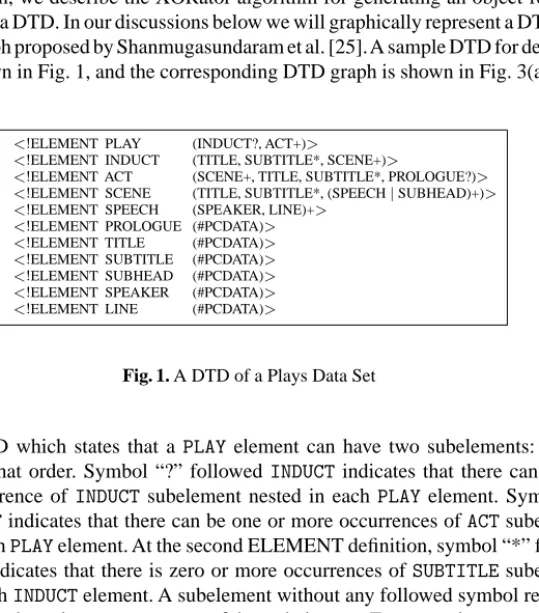
In this section, we describe the XORator algorithm for generating an object-relational schema from a DTD. In our discussions below we will graphically represent a DTD using the DTD graph proposed by Shanmugasundaram et al. [25]. A sample DTD for describing Plays is shown in Fig. 1, and the corresponding DTD graph is shown in Fig. 3(a). Fig. 1
<!ELEMENT PLAY (INDUCT?, ACT+)>
<!ELEMENT INDUCT (TITLE, SUBTITLE*, SCENE+)>
<!ELEMENT ACT (SCENE+, TITLE, SUBTITLE*, PROLOGUE?)>
<!ELEMENT SCENE (TITLE, SUBTITLE*, (SPEECH|SUBHEAD)+)>
<!ELEMENT SPEECH (SPEAKER, LINE)+>
<!ELEMENT PROLOGUE (#PCDATA)>
<!ELEMENT TITLE (#PCDATA)>
<!ELEMENT SUBTITLE (#PCDATA)>
<!ELEMENT SUBHEAD (#PCDATA)>
<!ELEMENT SPEAKER (#PCDATA)>
<!ELEMENT LINE (#PCDATA)>
Fig. 1. A DTD of a Plays Data Set
shows a DTD which states that a PLAYelement can have two subelements: INDUCT andACTin that order. Symbol “?” followedINDUCTindicates that there can be zero or one occurrence ofINDUCT subelement nested in eachPLAY element. Symbol “+” followedACTindicates that there can be one or more occurrences ofACTsubelements nested in eachPLAYelement. At the second ELEMENT definition, symbol “*” followed
SUBTITLEindicates that there is zero or more occurrences ofSUBTITLEsubelements nested in eachINDUCTelement. A subelement without any followed symbol represents that there must be only one occurrence of that subelement. For example, anACTelement must contain one and only oneTITLEsubelement. For more details about DTD, please refer to [4].
3.1 Reducing DTD Complexity
The first step in the mapping process is to simplify the DTD information to a form that makes the mapping process easier. We start by applying the set of rules proposed in [25] to simplify the complexity of DTD element specifications. These transformations reduce the number of nested expressions and the number of element items. Examples of these transformations are as follow:
– Flattening (to convert a nested definition into a flat representation):(e1, e2)∗ →
e∗
1, e∗2
– Simplification (to reduce multiple unary operators into a single unary operator) :
e∗∗
1 →e∗1
– Grouping (to group subelements that have the same name): e0, e∗1, e∗1, e2 →
e0, e∗1, e2
In addition,e+is transformed toe∗.
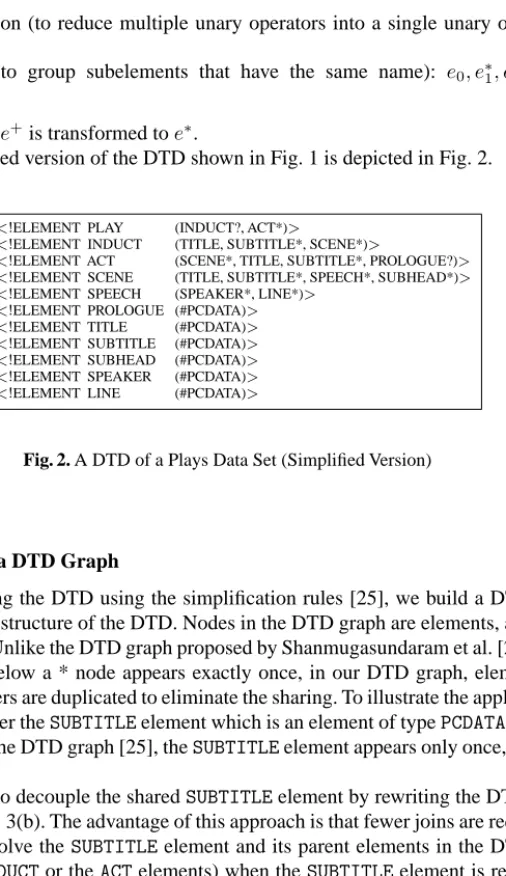
The simplified version of the DTD shown in Fig. 1 is depicted in Fig. 2.
<!ELEMENT PLAY (INDUCT?, ACT*)>
<!ELEMENT INDUCT (TITLE, SUBTITLE*, SCENE*)>
<!ELEMENT ACT (SCENE*, TITLE, SUBTITLE*, PROLOGUE?)>
<!ELEMENT SCENE (TITLE, SUBTITLE*, SPEECH*, SUBHEAD*)>
<!ELEMENT SPEECH (SPEAKER*, LINE*)>
<!ELEMENT PROLOGUE (#PCDATA)>
<!ELEMENT TITLE (#PCDATA)>
<!ELEMENT SUBTITLE (#PCDATA)>
<!ELEMENT SUBHEAD (#PCDATA)>
<!ELEMENT SPEAKER (#PCDATA)>
<!ELEMENT LINE (#PCDATA)>
Fig. 2. A DTD of a Plays Data Set (Simplified Version)
3.2 Building a DTD Graph
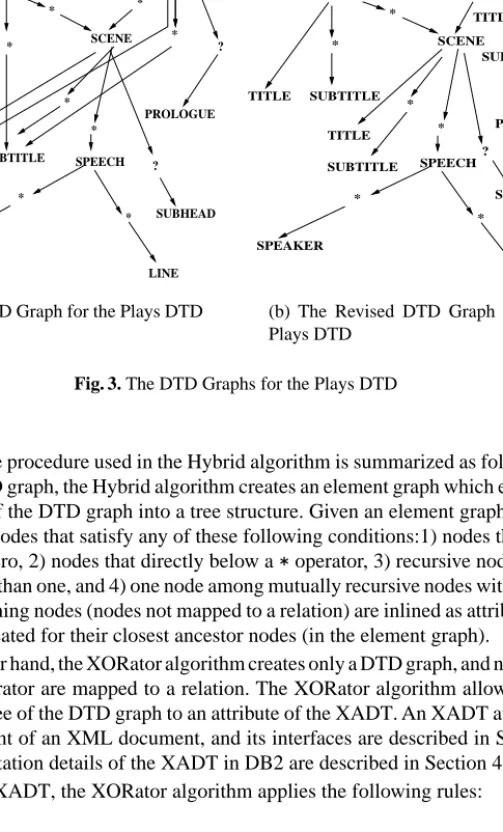
After simplifying the DTD using the simplification rules [25], we build a DTD graph to represent the structure of the DTD. Nodes in the DTD graph are elements, attributes, and operators. Unlike the DTD graph proposed by Shanmugasundaram et al. [25] where each element below a * node appears exactly once, in our DTD graph, elements that contain characters are duplicated to eliminate the sharing. To illustrate the application of this rule, consider theSUBTITLEelement which is an element of typePCDATA(contains characters). In the DTD graph [25], theSUBTITLEelement appears only once, as shown in Fig. 3(a).
We choose to decouple the sharedSUBTITLEelement by rewriting the DTD graph, as shown in Fig. 3(b). The advantage of this approach is that fewer joins are required for queries that involve theSUBTITLEelement and its parent elements in the DTD graph (such as theINDUCTor theACTelements) when theSUBTITLEelement is represented directly in the table corresponding to the parent attribute. The disadvantage of this approach is that queries on the SUBTITLEelements must now query all tables that contain data corresponding to theSUBTITLEelement. In the future, we plan to take the query workload (if it is available) into account during the transformation.
3.3 XORator: Mapping DTD to an ORDBMS Schema
The next step is to map this DTD graph to constructs in an ORDBMS schema. For this purpose, the XORator algorithm builds on the procedure used in the Hybrid
algo-? INDUCT ACT * TITLE SUBTITLE * SCENE * ? * * * * * SPEECH PLAY LINE SPEAKER ? SUBHEAD PROLOGUE *
(a) The DTD Graph for the Plays DTD
PLAY ? INDUCT TITLE SUBTITLE * * * ACT SUBTITLE * * SCENE * * * SPEECH LINE SPEAKER * TITLE SUBTITLE TITLE ? SUBHEAD PROLOGUE ?
(b) The Revised DTD Graph for the Plays DTD
Fig. 3. The DTD Graphs for the Plays DTD
rithm [25]. The procedure used in the Hybrid algorithm is summarized as follows. After creating a DTD graph, the Hybrid algorithm creates an element graph which expands the relevant part of the DTD graph into a tree structure. Given an element graph, a relation is created for nodes that satisfy any of these following conditions:1) nodes that have an in-degree of zero, 2) nodes that directly below a*operator, 3) recursive nodes with in-degree greater than one, and 4) one node among mutually recursive nodes with in-in-degree one. All remaining nodes (nodes not mapped to a relation) are inlined as attributes under the relation created for their closest ancestor nodes (in the element graph).
On the other hand, the XORator algorithm creates only a DTD graph, and not all nodes below a*operator are mapped to a relation. The XORator algorithm allows mapping an entire subtree of the DTD graph to an attribute of theXADT. AnXADTattribute can store a fragment of an XML document, and its interfaces are described in Section 3.4. The implementation details of theXADTin DB2 are described in Section 4.1.
Using theXADT, the XORator algorithm applies the following rules:
1. If a non-leaf nodeNin the DTD graph has exactly one parent, and if there are no links incident on any of the descendants of this node, then nodeN is assigned to an
XADTattribute. If nodeNis assigned to a relation, then queries on this node and its parent require a join. This rules identifies maximal subgraphs that are connected to the remaining nodes in the graph by a single node. Each subgraph is mapped to anXADTattribute.
2. If a non-leaf node below a*node is accessed by multiple nodes, then it is assigned to a relation. For nodes that are mapped to relations, the ancestors of these nodes must also be assigned as relations.
3. If a leaf node is below a*node, then it is assigned as an attribute of the XADT. Otherwise, it is assigned as an attribute of string type.
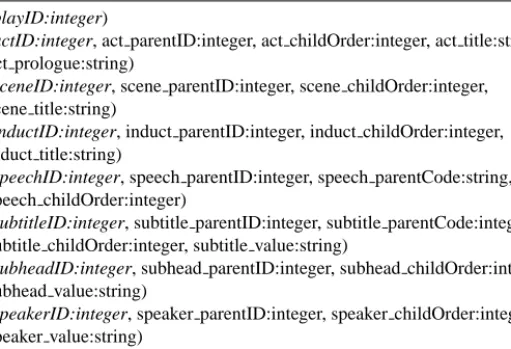
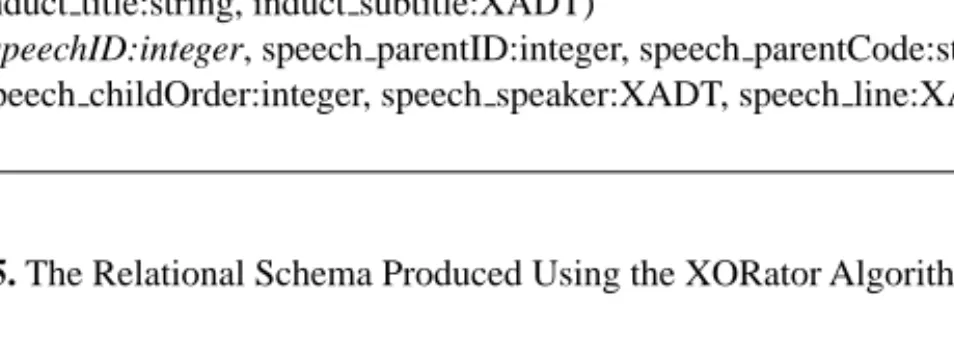
The schemas of the relations produced by the two algorithms are shown in Fig. 4 and Fig. 5 respectively.
play (playID:integer)
act (actID:integer, act parentID:integer, act childOrder:integer, act title:string, act prologue:string)
scene (sceneID:integer, scene parentID:integer, scene childOrder:integer, scene title:string)
induct (inductID:integer, induct parentID:integer, induct childOrder:integer, induct title:string)
speech (speechID:integer, speech parentID:integer, speech parentCode:string, speech childOrder:integer)
subtitle (subtitleID:integer, subtitle parentID:integer, subtitle parentCode:integer, subtitle childOrder:integer, subtitle value:string)
subhead (subheadID:integer, subhead parentID:integer, subhead childOrder:integer,
subhead value:string)
speaker (speakerID:integer, speaker parentID:integer, speaker childOrder:integer, speaker value:string)
line (lineID:integer, line parentID:integer, line childOrder:integer, line value:string)
Fig. 4. The Relational Schema Produced Using the Hybrid Algorithm
Fields shown in italic are primary keys. As proposed in [25], each relation has an
IDfield to serve as the primary key for that relation, and all relations corresponding to element nodes having a parent also have aparentIDfield to serve as a foreign key to the parent tuple. Moreover, all relations corresponding to element nodes that have multiple parents have aparentCODEfield to identify the corresponding parent tables. In this paper, we also add achildOrderfield to serve as the order number of the element among its siblings.
3.4 Defining an XML Data Type (XADT)
There are two aspects in designing theXADT: choosing a storage format for the data type, and defining appropriate methods on the data type. We discuss each of these aspects in turn.
Storage Alternatives for theXADT
play (playID:integer)
act (actID:integer, act parentID:integer, act childOrder:integer, act title:string, act subtitle:XADT, act prologue:string)
scene (sceneID:integer, scene parentID:integer, scene childOrder:integer, scene title:string, scene subtitle:XADT, scene subhead:XADT)
induct (inductID:integer, induct parentID:integer, induct childOrder:integer, induct title:string, induct subtitle:XADT)
speech (speechID:integer, speech parentID:integer, speech parentCode:string, speech childOrder:integer, speech speaker:XADT, speech line:XADT)
Fig. 5. The Relational Schema Produced Using the XORator Algorithm
fragment of the XML document. Since a string may have many repeated element tag names, this storage format may be inefficient. An alternative storage representation is to use a compressed representation for the XML fragment. The approach that we adopt in this paper is to use a compression technique inspired by the XMill compressor [19]. The element tags are mapped to integer codes, and element tags are replaced by these integer codes. A small dictionary is stored along with the XML fragment to record the mapping between the integer codes and the actual element tag names.
In some cases where there are few repeated tags in the XADT attribute, the compression increases the storage size because of the dictionary space. Consequently, we have two implementations of theXADT: one that uses compression, and the other one that does not. The decision to use the “correct” implementation of theXADT is made during the document transformation process by monitoring the effectiveness of the compression technique. This is achieved by randomly parsing a few sample documents to obtain the storage space sizes in both uncompressed and compressed ver-sions. Compression is used only if the space efficiency is above a certain threshold value.
Methods on theXADT
In addition to defining the required methods for input and output on theXADT, we also define the following methods:
1. XADT getElm(XADT inXML, VARCHAR rootElm, VARCHAR searchElm, VAR-CHAR searchKey, INTEGER level):
This method examines the XML fragment stored in inXML, and returns all rootElm elements that have searchElm within a depth of level from the rootElm. A default value for level indicates that the level information is to be ignored. If searchKey and searchElm are specified, this method only considers the searchElm that contains the searchKey keyword. If only searchKey is an empty string, then it returns all rootElm elements that have searchElm as subelements. If only searchElm is an empty string, then it returns all rootElm elements. If both searchElm and searchKey are empty strings, this method returns all rootElm elements in the inXML fragment.
The above function answers a simple path query with two element tag names, but more complex path queries can be answered by a composition of
multi-ple calls to this function. This function takes an XADT attribute as input and produces anXADToutput which can then be an input to another call of this function. 2. INTEGER findKeyInElm(XADT inXML, VARCHAR searchElm,
VARCHAR searchKey):
This method examines all elements with the tag name searchElm in inXML, and searches for all searchElm elements with content that matches the searchKey key-word. As soon as the first searchElm element that contains searchKey is found, the function returns a value of 1 (true). Otherwise, the function returns a value of 0 (false). If only searchKey is an empty string, this method simply checks whether inXML contains any searchElm elements. If only searchElm is an empty string, this method simply checks whether searchKey is part of the content of any element in inXML. Both searchElm and searchKey cannot be empty strings at the same time. This function is a special case of the getElm method defined above, and is implemented for efficiency purposes only.
3. XADT getElmIndex(XADT inXML, VARCHAR parentElm, VARCHAR childElm, INTEGER startPos, INTEGER endPos):
This method returns all childElm elements that are children of the parentElm ele-ments and with the sibling order from startPos to endPos positions. If only parentElm is an empty string, then childElm is treated as the root element in theXADT. Note that childElm cannot be an empty string.
In this paper, we only use the three methods described above, however, more spe-cialized methods can be implemented to improve the performance using theXADTeven further.
Sample queries in both algorithms posed on a data set describing Shakespeare Play are depicted in Fig. 6 and Fig. 7. The DTD for this data set is shown in Fig. 9.
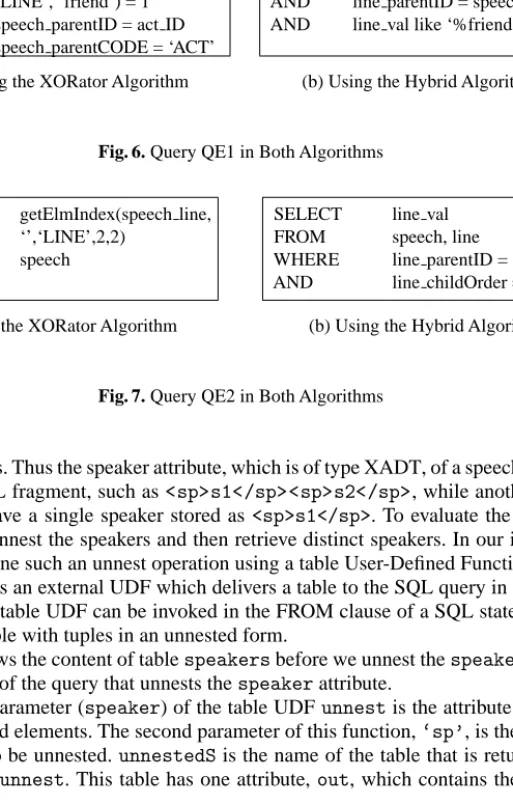
Fig. 6 shows query QE1, which retrieves lines that are spoken in acts by the speaker HAMLET and have the keyword ‘friend’ in the line. Fig. 6(a) demonstrates the use of theXADTmethods:getElmandfindKeyInElm, and Fig. 6(b) demonstrates the query QE1 executed over the database produced by the Hybrid algorithm.
Fig. 7 shows query QE2, which returns the second line in each speech. Fig. 7(a) demonstrates the use of theXADTmethod:getElmIndex, and Fig. 7(b) demonstrates the query QE2 executed over the database produced by the Hybrid algorithm.
3.5 Unnest Operator
In addition to the functionality provided by the methods described above, to answer queries posed on the XML data we also need an unnest operator. As described in Sec-tion 3.3, using the XORator algorithm, it is possible to map an entire subtree of a DTD graph below a*node to anXADTattribute. One can then view theXADTattribute as a set of XML fragment trees. When a query needs to examine individual elements in the set, an unnest operator is required. For example, for the Plays DTD (of Fig. 1), consider the query that requests a distinct list of all speakers who speak in at least one play. In our approach, speakers are stored as anXADTattribute. It is possible that one speech has
SELECT getElm(speech line, ‘LINE’, ‘LINE’, ‘friend’)
FROM speech, act
WHERE findKeyInElm(speech speaker, ‘SPEAKER’, ‘HAMLET’) = 1 AND findKeyInElm(speech line,
‘LINE’, ‘friend’) = 1 AND speech parentID = act ID AND speech parentCODE = ‘ACT’
(a) Using the XORator Algorithm
SELECT line val
FROM speech, act, speaker, line WHERE speech parentID = act ID AND speech parentCODE = ‘ACT’ AND speaker parentID = speech ID AND speaker val = ‘HAMLET’ AND line parentID = speech ID AND line val like ‘%friend%’
(b) Using the Hybrid Algorithm
Fig. 6. Query QE1 in Both Algorithms
SELECT getElmIndex(speech line, ‘’,‘LINE’,2,2)
FROM speech
(a) Using the XORator Algorithm
SELECT line val FROM speech, line
WHERE line parentID = speech ID AND line childOrder = 2
(b) Using the Hybrid Algorithm
Fig. 7. Query QE2 in Both Algorithms
many speakers. Thus the speaker attribute, which is of typeXADT, of a speech tuple can store the XML fragment, such as<sp>s1</sp><sp>s2</sp>, while another speech tuple could have a single speaker stored as<sp>s1</sp>. To evaluate the query, we need to first unnest the speakers and then retrieve distinct speakers. In our implemen-tation, we define such an unnest operation using a table User-Defined Function (UDF). A table UDF is an external UDF which delivers a table to the SQL query in which it is referenced. A table UDF can be invoked in the FROM clause of a SQL statement, and produces a table with tuples in an unnested form.
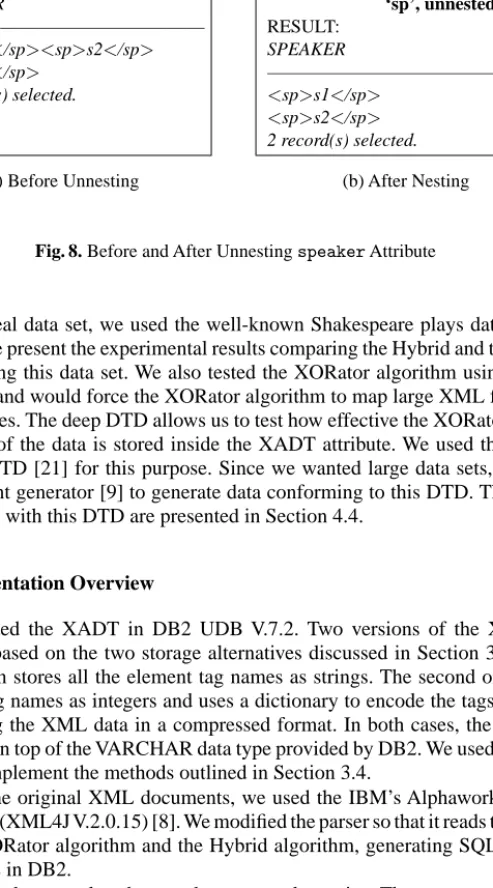
Fig. 8 shows the content of tablespeakersbefore we unnest thespeakerattribute and the result of the query that unnests thespeakerattribute.
The first parameter (speaker) of the table UDFunnestis the attribute name that contains nested elements. The second parameter of this function,‘sp’, is the tag name of elements to be unnested.unnestedSis the name of the table that is returned from this function,unnest. This table has one attribute,out, which contains the unnested elements.
4
Performance Evaluation
In this section, we present the results of implementing the XORator algorithm (along with theXADT), and the results comparing its effectiveness with the Hybrid algorithm [25]. We evaluated the effectiveness of the two algorithms using both real and synthetic data
QUERY: SELECT speaker FROM speakers RESULT: SPEAKER ——————————————— <sp>s1</sp><sp>s2</sp> <sp>s1</sp> 2 record(s) selected.
(a) Before Unnesting
QUERY: SELECT unnestedS.out as SPEAKER FROM speakers, table(unnest(speaker, ‘sp’, unnestedS)) RESULT: SPEAKER —————————————– <sp>s1</sp> <sp>s2</sp> 2 record(s) selected. (b) After Nesting
Fig. 8. Before and After UnnestingspeakerAttribute
sets. For the real data set, we used the well-known Shakespeare plays data set [3]. In Section 4.3, we present the experimental results comparing the Hybrid and the XORator algorithms using this data set. We also tested the XORator algorithm using a data set that is “deep” and would force the XORator algorithm to map large XML fragments to
XADTattributes. The deep DTD allows us to test how effective the XORator algorithm is when most of the data is stored inside the XADT attribute. We used the SIGMOD Proceedings DTD [21] for this purpose. Since we wanted large data sets, we used an XML document generator [9] to generate data conforming to this DTD. The results of the experiment with this DTD are presented in Section 4.4.
4.1 Implementation Overview
We implemented the XADT in DB2 UDB V.7.2. Two versions of theXADT were implemented based on the two storage alternatives discussed in Section 3.4. The first implementation stores all the element tag names as strings. The second one stores all the element tag names as integers and uses a dictionary to encode the tags as integers, thereby storing the XML data in a compressed format. In both cases, theXADTwas implemented on top of the VARCHAR data type provided by DB2. We used the C string functions to implement the methods outlined in Section 3.4.
To parse the original XML documents, we used the IBM’s Alphawork Java XML Parser Release (XML4J V.2.0.15) [8]. We modified the parser so that it reads the DTD and applies the XORator algorithm and the Hybrid algorithm, generating SQL commands to create tables in DB2.
The modified parser also chooses the storage alternative. The compressed format is chosen only if it reduces the storage space by at least 20%. In our current implementation all tuples in a table with an attribute of theXADTuse the same storage representation. To decide which storage alternative to use, we randomly parse a few sample documents to obtain the storage space sizes in both uncompressed and compressed cases.
4.2 Experimental Platform and Methodology
We performed all experiments on a single-processor 550 MHz Pentium III machine running Windows 2000 V.5.0 with 256 MB of main memory. We used the IBM DB2 V.7.2 as the database system. All the UDFs on theXADTare run in a NOT FENCED mode in DB2. We chose to run in the NOT FENCED mode because the FENCED option causes the UDF run in an address space that is separated from the database address space, and this causes a significant performance penalty [7]. DB2 was configured to use a page size of 8MB, and the use of hash joins was enabled.
Before executing queries in both algorithms, we created indexes as suggested by the DB2 Index Wizard, and collected statistics. The execution times reported in this section are cold numbers. Each query was run five times, and we report the average of the middle three execution times.
4.3 Experiments Using the Shakespeare Plays Data Set
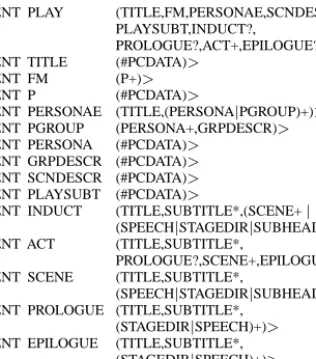
In this experiment, we loaded 37 XML Shakespeare play documents (size 7.5 MB) into DB2 using the two mapping algorithms. The DTD corresponding to the Shakespeare Plays data set [3] is shown in Fig. 9. For this data set, the XORator algorithm chooses not
<!ELEMENT PLAY (TITLE,FM,PERSONAE,SCNDESCR,
PLAYSUBT,INDUCT?,
PROLOGUE?,ACT+,EPILOGUE?)>
<!ELEMENT TITLE (#PCDATA)>
<!ELEMENT FM (P+)>
<!ELEMENT P (#PCDATA)>
<!ELEMENT PERSONAE (TITLE,(PERSONA|PGROUP)+)>
<!ELEMENT PGROUP (PERSONA+,GRPDESCR)>
<!ELEMENT PERSONA (#PCDATA)>
<!ELEMENT GRPDESCR (#PCDATA)>
<!ELEMENT SCNDESCR (#PCDATA)>
<!ELEMENT PLAYSUBT (#PCDATA)>
<!ELEMENT INDUCT (TITLE,SUBTITLE*,(SCENE+|
(SPEECH|STAGEDIR|SUBHEAD)+))>
<!ELEMENT ACT (TITLE,SUBTITLE*,
PROLOGUE?,SCENE+,EPILOGUE?)>
<!ELEMENT SCENE (TITLE,SUBTITLE*,
(SPEECH|STAGEDIR|SUBHEAD)+)>
<!ELEMENT PROLOGUE (TITLE,SUBTITLE*,
(STAGEDIR|SPEECH)+)>
<!ELEMENT EPILOGUE (TITLE,SUBTITLE*,
(STAGEDIR|SPEECH)+)>
<!ELEMENT SPEECH (SPEAKER+,
(LINE|STAGEDIR|SUBHEAD)+)>
<!ELEMENT SPEAKER (#PCDATA)>
<!ELEMENT LINE (#PCDATA|STAGEDIR)*>
<!ELEMENT STAGEDIR (#PCDATA)>
Fig. 9. The DTD of Shakespeare Data Set
to use the compressed storage alternative since the compressed representation actually increases the storage size. The schemas for these relations are presented in the extended
version of this paper [22]. Table 1 shows the comparisons of the number of tables, database sizes, and index size between the two algorithms. The sizes of the database produced by the XORator algorithm is about 60% of the size of the database produced by the Hybrid algorithm.
Table 1. Database Sizes When Using the Shakespeare Data Set Hybrid XORator
Number of tables 17 7 Database size (MB) 15 9 Index size (MB) 30 3
To produce data sets that are larger than the base data set (size 7.5 MB), we took the original Shakespeare data set and loaded it multiple times, producing data sets that were two, four and eight times the original database size. We call these configurations DSx2, DSx4, and DSx8 respectively. We call the original configuration DSx1.
The query set in this experiment is described below:
QS1: Flattening List speakers and the lines that they speak.
QS2: Full path expression Retrieve all lines that have stage directions associated with
the lines.
QS3: Selection Retrieve the lines that have the keyword “Rising” in the text of the stage
direction.
QS4: Multiple selections Retrieve the speeches spoken by the speaker “Romeo” in the
play “Romeo and Juliet.”
QS5: Twig with selection Retrieve the speeches in the play “Romeo and Juliet” spoken
by the speaker “Romeo”, and the lines in the speech that contain the keyword “love.”
QS6: Order access Retrieve the second line in all speeches that are in prologues.
We chose this simple set of queries because it allows us to study the core performance issues and is an indicator of performance for more complex queries. In this paper, we do not focus on automatically rewriting XML queries into equivalent SQL queries. We refer the reader to proposed query rewriting algorithms from XML query languages to SQL [26, 6, 13]. The SQL statements corresponding to the above queries for both algorithms are presented in the extended version of this paper [22].
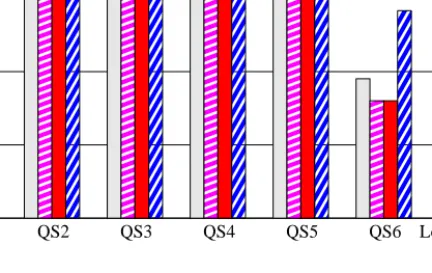
The data loading times and the result of executing queries QS1 through QS6 for the various data sets are shown in Fig. 10. In this figure, we plot the ratios of the execution times using the Hybrid and the XORator algorithms on a log scale. Since the size of the database produced using the XORator algorithm is about 60% of the size of the database produced using the Hybrid algorithm, the XORator algorithm results in much less loading times than the Hybrid algorithm. The XORator algorithm also results in significantly better execution times for all queries, except query QS6. In most queries,
the XORator algorithm is an order of magnitude faster than the Hybrid algorithm.
This is because all queries using the XORator algorithm requested at least one fewer join than the corresponding query (on the database produced) using the Hybrid algorithm. In the case of query QS6, the response times of the XORator algorithm are more than
QS1 QS2 QS3 QS4 QS5 QS6 Loading time 0.1 0.01 0.001 1 10 100
Hybrid/XORator Performance ratios (log scale)
DSx1 DSx2 DSx4 DSx8
Fig. 10. Hybrid/XORator Performance Ratios for DSx1, DSx2, DSx4, and DSx8
those of the Hybrid algorithm. This is because the database needs to scan theXADT
attribute to extract elements in the specified order when using the XORator algorithm, while the database needs to only extract the value of the element order attribute when using the Hybrid algorithm.
As shown in Fig. 10, the ratios of the response times of some queries, such as query QS3, do not always increase as the data size increases. This is because the optimizer chooses different plans for different data set sizes. Note that the query optimizer has the most up-to-date statistics since we always ran the “runstats” command and created indexes as suggested by the DB2 Index Wizard before executing the queries.
4.4 Experiments Using the Synthetic Data Set
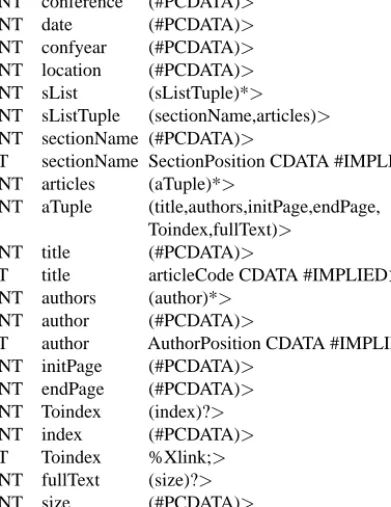
This section presents the experimental results from using the SIGMOD Proceedings data set. The DTD of this data set is an example of a deep DTD. With such a DTD, the XORator technique maps large fragments of XML data to theXADTattributes. So this DTD is representative of the worst-case scenario for the XORator algorithm. The DTD corresponding to the SIGMOD Proceedings data set has seven levels. Elements, such as “author”, that are likely to be queried often, are at the bottom-most level. The DTD is shown in Fig. 11
In this experiment, we loaded the 3000 documents (size 12 MB) into DB2. For this data set, the XORator algorithm chooses to use the compressed storage alternative since the compressed representation reduces database size by about 38%. Table 2 shows the comparisons of the number of tables, database sizes, and index size between the two algorithms. The sizes of the database produced by the XORator algorithm is about 65% of the size of the database produced by the Hybrid algorithm. Please refer to the extended version of this paper [22] for the schemas of these relations.
<!ELEMENT PP (volume,number,month,year,conference, date,confyear,location,sList)>
<!ELEMENT volume (#PCDATA)>
<!ELEMENT number (#PCDATA)>
<!ELEMENT month (#PCDATA)>
<!ELEMENT year (#PCDATA)>
<!ELEMENT conference (#PCDATA)>
<!ELEMENT date (#PCDATA)>
<!ELEMENT confyear (#PCDATA)>
<!ELEMENT location (#PCDATA)>
<!ELEMENT sList (sListTuple)*>
<!ELEMENT sListTuple (sectionName,articles)>
<!ELEMENT sectionName (#PCDATA)>
<!ATTLIST sectionName SectionPosition CDATA #IMPLIED>
<!ELEMENT articles (aTuple)*>
<!ELEMENT aTuple (title,authors,initPage,endPage, Toindex,fullText)>
<!ELEMENT title (#PCDATA)>
<!ATTLIST title articleCode CDATA #IMPLIED>
<!ELEMENT authors (author)*>
<!ELEMENT author (#PCDATA)>
<!ATTLIST author AuthorPosition CDATA #IMPLIED>
<!ELEMENT initPage (#PCDATA)>
<!ELEMENT endPage (#PCDATA)>
<!ELEMENT Toindex (index)?>
<!ELEMENT index (#PCDATA)>
<!ATTLIST Toindex %Xlink;>
<!ELEMENT fullText (size)?>
<!ELEMENT size (#PCDATA)>
<!ATTLIST fullText %Xlink;>
Fig. 11. The DTD of the SIGMOD Proceedings Data Set
Table 2. Database Sizes When Using the SIGMOD Proceedings Dataset Hybrid XORator
Number of tables 7 1 Database size (MB) 23 15
Index size (MB) 34 2
To produce data sets that are larger than the base data set (size 12 MB), we took the original SIGMOD Proceedings data set and loaded it multiple times, producing data sets that were two, four and eight times the original database size. We call these configurations DPx2, DPx4, and DPx8 respectively. We call the original configuration DPx1.
QG1: Selection and extraction Retrieve the authors of the papers with the keyword
“Join” in the paper title.
QG2: Flattening List all authors and the names of the proceeding sections in which
their papers appear.
QG3: Flattening with selection Retrieve the proceeding section names that have the
papers published by authors whose names have the keyword “Worthy.”
QG4: Aggregation For each author, count the number of proceeding sections in which
the author has a paper.
QG5: Aggregation with selection Count the number of proceeding sections that have
papers published by authors whose names have the keyword “Bird.”
QG6: Order access with selection Retrieve the second author of the papers with the
keyword “Join” in the paper title.
The SQL statements corresponding to the above queries for both algorithms are presented in the extended version of this paper [22].
QG1 QG2 QG3 QG4 QG5 QG6 Loading time 0.1 0.01 1 10 100
Hybrid/XORator Performance ratios (log scale)
DPx1 DPx2 DPx4 DPx8
Fig. 12. Hybrid/XORator Performance Ratios for DPx1, DPx2, DPx4, and DPx8
The performance comparison between the Hybrid technique and the XORator tech-nique (with theXADTimplemented in compressed version) for the various data sets is shown in Fig. 12. Since the size of the database produced using the XORator algorithm is about 65% of the size of the database produced using the Hybrid algorithm, the XORator approach results in much smaller loading times. Two observations can be made based on Fig. 12: a) when the size of data is small (DPx1 and DPx2), the XORator algorithm performs worse than the Hybrid algorithm; and b) when the size of data becomes large (DPx4 and DPx8), the XORator algorithm outperforms the Hybrid algorithm.
When the amount of data is small, the XORator algorithm results in worse execution times for all queries. With the SIGMOD Proceedings data set, all data is mapped to a single table. Consequently, there is no table join in the query, but each query has four to
eight calls of UDFs to extract subelements or to join elements inside theXADTattribute. The cost of invoking UDFs is a significant component of the query evaluation of the XORator algorithm. To investigate if a UDF incurs a higher performance penalty than an equivalent built-in function, we conduct the following experiment. We implemented two string functions, namely “return length" and “return substring", using built-in string functions and using UDFs. The experiment consists of two queries:
QT1: Return the length of string in the SPEAKER attribute.
QT2: Return a substring of string in the SPEAKER attribute from the fifth position to
the last position.
Both queries were run on the Shakespeare data set and returned 31,028 tuples. In the built-in function case, we used the SQLlengthandsubstrfunctions in queries QT1 and QT2 respectively. In the UDF case, we used UDFs that called the C functionsstrlen andstrncpyin queries QT1 and QT2 respectively. The results of these experiments are shown in Fig. 13 (the exact time taken to run this query is deliberately not shown in this figure). Compared to using a built-in function, using the equivalent UDF is approximately 40% more expensive. QT1 QT2 Queries 0 Response Time Built-in UDFs
Fig. 13. Overhead in Invoking UDFs
Invoking UDFs are expensive for two reasons. First, our implementation of the methods on theXADTuses string compare and copy functions on the VARCHAR. This sometimes requires scanning a large amount of data. Perhaps, if we have the metadata associated with eachXADTattribute to help us quickly access the starting position of each element stored inside theXADTdata, the performance may be improved. We plan on investigating this issue further in the future.
Second, the cost of evaluating a UDF is actually higher compared to the cost of evaluating an equivalent built-in function, as shown in Fig. 13. If theXADTwere imple-mented as a native data type (by the database vendors), we would expect the overhead in invoking the methods associated with theXADTwould be reduced significantly, making the XORator technique more competitive.
Regarding the second observation in Fig. 12, as the data size increases, the ratios of the response times between the Hybrid and the XORator algorithms become more than one (i.e., the XORator technique starts to outperform the Hybrid technique). The reason is that queries using the XORator algorithm typically have no join and thus the response times grow atO(n)rate (scan cost). However, the queries using the Hybrid algorithm, which typically have many joins, grow at eitherO(nlogn)rate (merge sort join cost), orO(n2)rate (nested loop join cost), wherenis the number of tuples. cost), wherenis the number of tuples.
5
Conclusion and Future Work
We have proposed and evaluated XORator, an algorithm for mapping XML document with DTDs to relations in an Object-Relational DBMS. Using the type-extensibility mechanisms provided by an ORDBMS, we added a new data type calledXADTthat can store and query arbitrary fragments of an XML document. The XORator algorithm maps a DTD to an object-relational schema that may have attributes of typeXADT. Using an implementation in DB2, we show that the XORator algorithm generally outperforms the well-known Hybrid algorithm that is used for mapping XML documents to relations in an RDBMS. The primary reason for this superior performance is that queries in the database produced using XORator usually execute fewer number of joins. We also show that it is important to pay close attention to the implementation and evaluation of the UDF. Perhaps, if the database vendors implemented theXADTas a native data type, the overhead in invoking the methods associated with theXADTbe reduced, making the XORator algorithm more effective. For future work, we will expand the mapping rules to accommodate additional factors, such as the query workload, and the statistics of XML data, including the number of levels and the size of the data that is in an XML fragment. We will also investigate storing of metadata with theXADTattribute and indexing on theXADTattribute to improve the performance of the methods on theXADT.
Acknowledgements. We would like to thank H.V. Jagadish and Atul Prakash for
pro-viding insightful comments. We also would like to thank Kelly Lyons and Chun Zhang for providing information about UDFs. Finally, we would like to thank Hamid Pirahesh and Berthold Reinwald for allowing Kanda Runapongsa to work on this paper during her summer internship at IBM Almaden Research Center.
References
1. Software AG. Tamino - The Information Server for Electronic Business, 2000.
http://www.softwareag.com/tamino/.
2. P. Bohannon, J. Freire, P. Roy, and J. Sime´on. From XML Schema to Relations: A Cost-Based Approach to XML Storage. In Proceedings IEEE International on Data Engineering, San Jose, California, February 2002.
3. J. Bosak. The Plays of Shakespeare in XML, July 1999.
http://metalab.unc.edu/xml/examples/shakespeare/.
4. J. Bosak, T. Bray, D. Connolly, E. Maler, G. Nicol, C.M. Sperberg-McQueen, L. Wood, and J. Clark. W3C XML Specification DTD, June 1998.
5. T. Bray, J. Paoli, C.M. Sperberg-McQueen, and E. Maler. Extensible Markup Language (XML), October 2000.http://www.w3.org/TR/REC-xml.
6. M.J. Carey, J. Kiernan, J. Shanmugasundaram, E.J. Shekita, and S.N. Subramanian. XPERANTO: A Middleware for Publishing Object-Relational Data as XML Documents. In Proceedings International Conference Very Large Data Bases, pages 646–648, Cairo, Egypt, September 2000.
7. D. Chamberlin. Using The New DB2: IBM’s Object-Relational Database System. Morgan Kaufmann Publishers, Inc., San Francisco, California, 1996.
8. IBM Corporation. XML Parser for Java., February 1998.
http://www.alphaworks.ibm.com/tech/xml4j. 9. IBM Corporation. IBM XML Generator, September 1999.
http://www.alphaworks.ibm.com/tech/xmlgenerator.
10. IBM Corporation. IBM DB2 UDB XML Extender Adminstration and Programming, March 2000. http://www-4.ibm.com/software/data/db2/extenders/xmlext/docs/
v71wrk/dxx%awmst.pdf.
11. Oracle Corporation. Oracle XML SQL Utility.
http://otn.oracle.com/tech/xml/oracle_xsu/content.html.
12. A. Deutsch, M. F. Fernandez, and D. Suciu. Storing Semistructured Data with STORED. In Proceedings of the ACM SIGMOD International Conference on Management of Data, pages 431–442. ACM Press, 1999.
13. M. F. Fernandez, Dan Suciu, and Wang-Chiew Tan. SilkRoute: Trading between Relations and XML. In Proceedings of Ninth International World Wide Web Conference, 2000. 14. D. Florescu, G. Graefe, G. Moerkotte, H. Pirahesh, and H. Sch¨oning. Panel: XML Data
Management: Go Native or Spruce up Relational Systems? In Proceedings of the ACM SIGMOD International Conference on Management of Data, Santa Barbara, California, May 2001. (Panel Chair: Per-Ake Larson).
15. D. Florescu and D. Kossmann. Storing and Querying XML Data using an RDBMS. Bulletin of the Technical Committee on Data Engineering, 22(3):27–34, 1999.
16. G. Kappel, E. Kapsammer, S. Raush-Schott, and W. Retschzegger. X-Ray - Towards Inte-grating XML and Relational Database Systems. In International Conference on Conceptual Modeling (ER), pages 339–353, Utah, USA, October 2000.
17. M. Klettke and H. Meyer. XML and Object-Relational Database Systems - Enhancing Struc-tural Mappings Based on Statistics. In International Workshop on the Web and Databases, Dallas, Texas, May 2000.
18. D. Lee and W. W. Chu. Constraints-Preserving Transformation from XML Document Type Definition to Relational Schema. In International Conference on Conceptual Modeling (ER), October 2000.
19. H. Liefke and D. Suciu. XMill: an Efficient Compressor for XML Data. In Proceedings of the ACM SIGMOD International Conference on Management of Data, pages 153–164, Dallas, Texas, May 2000.
20. J. McHugh, S. Abiteboul, R. Goldman, D. Quass, and J. Widom. Lore: A Database Manage-ment System for Semistructured Data. SIGMOD Record, 26(3):54–66, September 1997. 21. Sigmod Record. Sigmod Record: XML Edition.
http://www.dia.uniroma3.it/Araneus/Sigmod/Record/DTD/.
22. K. Runapongsa and J. M. Patel. Storing and Querying XML Data in ORDBMSs. University of Michigan, Technical Report, 2002.
23. M. Rys. State-of-the-art Support in RDBMS:Microsoft SQL Server’s XML Features. Bulletin of the Technical Committee on Data Engineering, 24(2):3–11, June 2001.
24. A.R. Schmidt, M.L. Kersten, M. Windhouwer, and F. Waas. Efficient Relational Storage and Retrieval of XML Documents. In WebDB’2000 Third International Workshop on the Web and Databases, Dallas, Texas, May 2000.
25. J. Shanmugasundaram, K. Tufte, G. He, C. Zhang, D.DeWitt, and J.Naughton. Relational Databases for Querying XML Documents: Limitations and Opportunities. In Proceedings In-ternational Conference Very Large Data Bases, pages 302–314, Edinburgh, Scotland, Septem-ber 1999.
26. T. Shimura, M. Yoshikawa, and S. Uemura. Storage and Retrieval of XML Documents Using Object-Relational Databases. In International Conference on Database and Expert Systems Applications, pages 206–217, Florence, Italy, September 1999.