Software Architecture and the Creative
Process in Game Development
Njål Nordmark
Master of Science in Computer Science Supervisor: Alf Inge Wang, IDI
Department of Computer and Information Science Submission date: June 2012
Problem Description
The goal of this master thesis is to investigate the relationship between software architecture, the creative team, and the development processes, providing insight into how these relationships are today.
Primarily the thesis will look at how the different game companies use software architecture to facilitate the creative team’s work. The thesis will also investigate the effect the different development processes have on the creative team. In addition, the thesis will look at to what extent the team is given the opportunity to contribute in these processes.
Assignment given: January 16th, 2012 Supervisor: Professor Alf Inge Wang, IDI
Abstract
The goal of this thesis has been to perform research on the relationship between the creative team, software architecture, and game development processes.
Researching this relationship was done in three stages. The first stage was a literature review into software architecture and game development. In the second stage a questionnaire was designed based on the literature review, and this questionnaire was then distributed to several game developers. In addition to querying the game developers on their knowledge on the field, they were also asked whether or not they would be willing to answer a set of follow-up questions later.
The responses to the questionnaire provided a lot of answers, but also gave rise to new questions. In the third stage these new questions were incor-porated into a follow-up survey which was distributed to those respondents whom had previously answered that they were willing to answer follow-up questions.
The problem definition has been divided into five research questions ac-cording to the Goal Question Metric approach. Supported by the literature review and the responses to both the questionnaire and the survey, these five research questions have been answered in detail in Chapter 11: “Research Conclusions”.
The results from this thesis is not generalizable to all game developers, but provides a very interesting glimpse into how the creative team is affected by, and is allowed to affect, the software architecture and tools used, as well as the game development process.
Samandrag
M˚alet med denne masteroppg˚ava har vore ˚a forska p˚a forholda mellom dei som jobbar med dei kreative aspekta av spel, programvarearkitekturen som vert brukt og prosessane rundt spelutvikling.
Denne forskinga vart gjennomført i tre stadium. Det fyrste stadiet var eit litteraturstudium som fokuserte p˚a programvarearkitektur og spelutvikling. I det andre stadiet av forskinga vart det utforma ei spørjeundersøking som var basert p˚a litteraturstudiet. Denne spørjeundersøkinga vart s˚a send ut til mange forskjellege spelutviklarar. I tillegg til ˚a stilla spørsm˚al til spe-lutviklarane om spelutvikling og dei kreative prosessane, vart dei og spurde om dei kunne svara p˚a nokre oppfølgingsspørsm˚al.
Svara p˚a spørjeundersøkinga var til stor hjelp n˚ar konklusjonen p˚a forsk-ingsspørm˚ala skulle utformast, men gav og grunnlag for ein del nye spørsm˚al. I det tredje stadiet av forskinga vart desse nye spørsm˚ala tatt med i ei oppfølgingsundersøking. Denne undersøkinga vart s˚a sendt ut til dei som gjennom spørjeundersøkinga hadde sagt at dei var viljuge til ˚a svara p˚a oppfølgingsspørsm˚al.
Problemdefinisjonen har vorte delt opp i fem separate forskingsspørsm˚al ved bruk av Goal Question Metric-tilnærminga. Understøtta av litteratur -studiet og svara p˚a b˚ade spørjeundersøkinga og oppfølgingsundersøkinga vert desse forskingsspørsm˚ala gjord greie for i detalj i Kapittel 11: “Research Conclusions”.
Resultata fr˚a denne forskinga kan ikkje generaliserast p˚a ein slik m˚ate at dei vert gjeldande for alle spelutviklarar. Trass i dette gjev resultata eit godt innblikk i korleis dei kreative aspekta ved spelutvikling b˚ade p˚averkar og vert p˚averka av programvarearkitekturen og verktya som vert brukte, samt spelutviklingsprosessen.
Preface
This report is the master thesis delivered in the courseTDT4900 - Computer and Information Science, Master Thesis, marking the end of a five year master’s program at the Department of Computer and Information Science under the Faculty of Information Technology, Mathematics and Electrical Engineering at the Norwegian University of Science and Technology.
The researcher would like to thank professor Alf Inge Wang for his con-tinuous support and enduring enthusiasm during the process of working with this thesis, providing the researcher with the opportunity to study the field of software architecture and games.
The researcher would also like to thank all of those who have given their comments on the thesis, in addition to those who have proofread the questionnaire, the survey and the thesis itself.
Trondheim, June 5th, 2012
Nj˚al Nordmark
Contents
I Introduction 1 1 Project Introduction 3 1.1 Project Context . . . 3 1.2 Project Motivation . . . 3 1.3 Problem Definition . . . 41.3.1 Creative Team versus Technical Team . . . 4
1.4 Research Questions . . . 4
1.5 Structure . . . 5
1.6 Related Work . . . 5
2 Research Method 7 2.1 The Scientific Method for Software Engineering . . . 7
2.2 Goal Question Metric . . . 8
2.3 Research Paradigms . . . 9 2.4 Empirical Strategies . . . 9 2.4.1 Survey . . . 10 2.4.2 Case Study . . . 10 2.4.3 Experiments . . . 11 2.5 Literature Review . . . 11
2.6 Measurements in Software Engineering . . . 11
2.6.1 Objective and Subjective Measure . . . 12
2.6.2 Direct or Indirect Measure . . . 12
2.7 Validation of Results . . . 12
2.8 Application of Research Methods . . . 13
2.8.1 Research Method and Paradigm . . . 13
2.8.2 Problem Definition . . . 13
2.8.3 Empirical Strategies and Measurements . . . 13
II Pre-Study 15 3 Software Architecture 17 3.1 What is Software Architecture? . . . 17
x CONTENTS
3.1.1 The chosen Definition of Software Architecture . . . . 18
3.1.2 Implications of this Definition . . . 19
3.1.3 Views of Software Architecture . . . 19
3.2 Goals of a Software Architecture . . . 21
3.3 Designing a Software Architecture . . . 21
3.3.1 Domain-Driven Design . . . 21
3.3.2 Responsibility-Driven Design . . . 22
4 Software Architecture in Games 25 4.1 Does Games need a Software Architecture . . . 25
4.2 Game Engine Architecture . . . 28
4.2.1 What is a Game Engine . . . 28
4.2.2 Modules . . . 29
4.2.3 Develop or Buy . . . 30
4.3 Middleware . . . 31
4.4 Supporting the Creative Team . . . 32
5 Game Development 35 5.1 History of Game Development . . . 35
5.2 Requirements Engineering . . . 36
5.3 Evolution of Game Development . . . 37
5.3.1 Research Quality . . . 37
5.3.2 The use of External Game Engines . . . 38
5.3.3 Increased use of Middleware . . . 39
5.3.4 Tools . . . 39
6 Web Surveys 41 6.1 Challenges with Questionnaire Design . . . 41
6.1.1 Limitations of Web Surveys . . . 41
6.1.2 Types of Nonresponse . . . 42
6.1.3 Survey Characteristics that Affect Nonresponse . . . . 42
6.2 SurveyMonkey . . . 45
6.2.1 Designing Web Questionnaires . . . 46
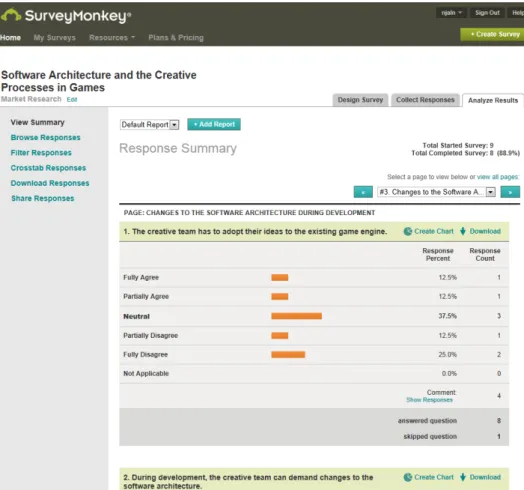
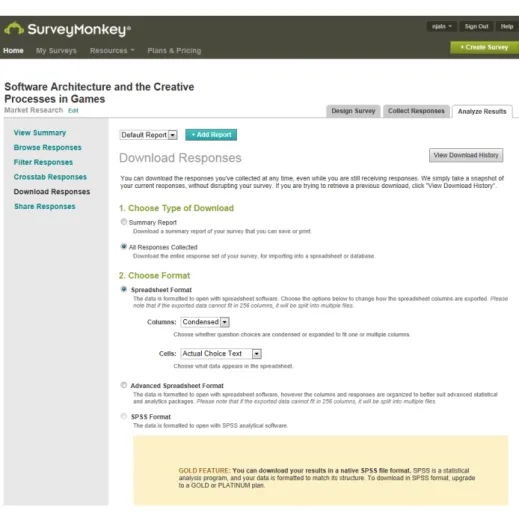
6.2.2 Analyzing the Results . . . 46
III Research 49 7 Questionnaire 51 7.1 Design of the Web Questionnaire . . . 51
7.1.1 Limitations of Web Surveys . . . 51
7.1.2 General Structure . . . 52
7.1.3 Length . . . 52
CONTENTS xi
7.1.5 Visual Presentation . . . 52
7.1.6 Interactivity . . . 53
7.1.7 Question and Response Format . . . 53
7.2 Design of the Paper Questionnaire . . . 53
7.3 Analysis . . . 54
7.3.1 Question Numbering . . . 54
7.3.2 Presentation . . . 57
7.4 Questionnaire Results and Analysis . . . 57
7.4.1 Design of Software Architecture . . . 58
7.4.2 Changes to the Software Architecture during Devel-opment . . . 64
7.4.3 Supporting the Creative Processes . . . 70
7.4.4 Changes over Time . . . 74
8 Survey 79 8.1 Survey Design . . . 79
8.1.1 Introduction . . . 79
8.1.2 Game Engine . . . 80
8.1.3 Software Architecture and the Creative Team . . . 80
8.1.4 Implementing Changes . . . 81
8.1.5 Relation between the Survey and the RQs . . . 82
8.2 Analysis of Responses . . . 82
8.2.1 Game Engine . . . 83
8.2.2 Software Architecture and the Creative Team . . . 85
8.2.3 Implementing Changes . . . 86
9 Experiences 89 9.1 Previous Experience with Game Developers . . . 89
9.2 Questionnaire Experiences . . . 89 9.2.1 Design . . . 89 9.2.2 Distribution . . . 90 9.2.3 Collection . . . 90 9.3 Survey . . . 90 9.3.1 Design . . . 90 9.3.2 Feedback . . . 91 9.3.3 Collection . . . 91 9.4 Summary . . . 91 10 Evaluation 93 10.1 Research Method . . . 93 10.2 Research Performed . . . 93
xii CONTENTS IV Conclusions 95 11 Research Conclusions 97 11.1 Validity of Results . . . 97 11.2 Research Question 1 . . . 97 11.3 Research Question 2 . . . 99 11.4 Research Question 3 . . . 100 11.5 Research Question 4 . . . 101 11.6 Research Question 5 . . . 102 12 Future Studies 105 12.1 High-Level Third Party Game Engines . . . 105
12.2 Cost-Benefit Trade-Off . . . 105
12.3 Feature Availability in Game Engines . . . 105
12.4 Reference Architectures . . . 106
Bibliography 107 Appendices A Questionnaire 111 A.1 Paper Questionnaire . . . 111
A.2 E-Mail sent to Game Developers . . . 114
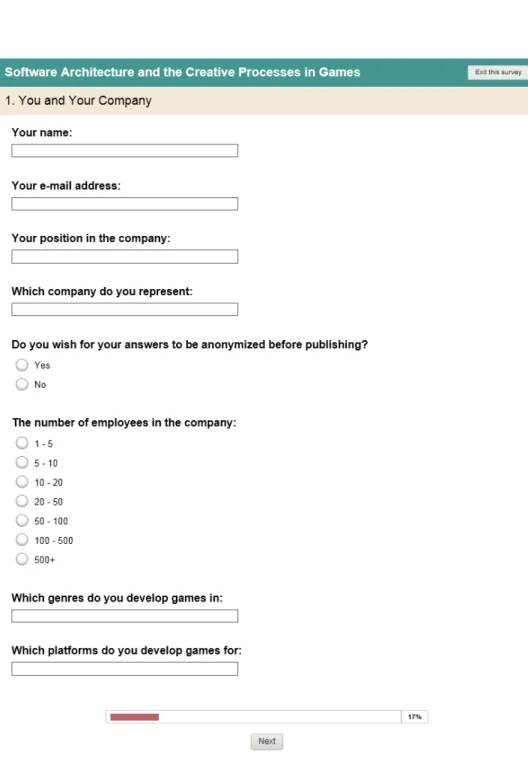
A.3 Web Questionnaire . . . 115
B Questionnaire Results 125 B.1 Company A’s Questionnaire Response . . . 125
B.2 Company B’s Questionnaire Response . . . 128
B.3 Company C’s Questionnaire Response . . . 132
B.4 Company D’s Questionnaire Response . . . 134
B.5 Company E’s Questionnaire Response . . . 137
B.6 Company F’s Questionnaire Response . . . 140
B.7 Company G’s Questionnaire Response . . . 142
B.8 Company H’s Questionnaire Response . . . 144
B.9 Company I’s Questionnaire Response . . . 147
B.10 Company J’s Questionnaire Response . . . 149
B.11 Company K’s Questionnaire Response . . . 151
B.12 Company L’s Questionnaire Response . . . 153
B.13 Company M’s Questionnaire Response . . . 155
C Survey 157 C.1 E-Mail sent to Game Developers . . . 157
CONTENTS xiii D Survey Results 163 D.1 Company B . . . 163 D.2 Company D . . . 168 D.3 Company E . . . 169 D.4 Company H . . . 171 D.5 Company M . . . 174 D.6 Company Z . . . 176
List of Figures
3.1 The “4+1” View Model of Software Architecture . . . 20
4.1 2D game circa 1994 . . . 26
4.2 3D game circa 1996 . . . 26
4.3 3D game circa 2004 . . . 27
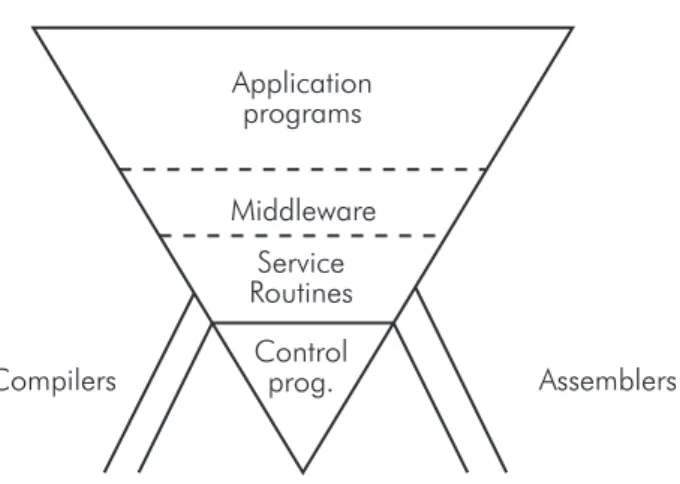
4.4 d‘Agapeyeff’s Inverted Pyramid . . . 32
6.1 SurveyMonkey survey designer . . . 46
6.2 SurveyMonkey response summary . . . 47
6.3 SurveyMonkey report downloading . . . 48
7.1 Questionnaire questions related to the research questions. . . 56
8.1 Survey questions related to the research questions. . . 82
A.1 You and Your Company . . . 116
A.2 Design of Software Architecture, Part One . . . 117
A.3 Design of Software Architecture, Part Two . . . 118
A.4 Changes to the Software Architecture during Development, Part One . . . 119
A.5 Changes to the Software Architecture during Development, Part Two . . . 120
A.6 Supporting the Creative Processes . . . 121
A.7 Changes over Time . . . 122
A.8 Closing Remarks . . . 123
C.1 Survey: Introduction . . . 158
C.2 Survey: Game Engine . . . 159
C.3 Survey: Software Architecture and the Creative Team . . . . 160
C.4 Survey: Implementing Changes . . . 161
List of Tables
7.1 Answers to question 1 . . . 58 7.2 Answers to question 2 . . . 59 7.3 Answers to question 3 . . . 60 7.4 Answers to question 4 . . . 61 7.5 Answers to question 5 . . . 62 7.6 Answers to question 6 . . . 63 7.7 Answers to question 7 . . . 64 7.8 Answers to question 8 . . . 65 7.9 Answers to question 9 . . . 66 7.10 Answers to question 10 . . . 67 7.11 Answers to question 11 . . . 68 7.12 Answers to question 12 . . . 69 7.13 Answers to question 13 . . . 70 7.14 Answers to question 14 . . . 71 7.15 Answers to question 15 . . . 72 7.16 Answers to question 16 . . . 73 7.17 Answers to question 17 . . . 74 7.18 Answers to question 18 . . . 75 7.19 Answers to question 19 . . . 76 7.20 Answers to question 20 . . . 77B.1 Company A’s Questionnaire Results . . . 125
B.2 Company B’s Questionnaire Results . . . 128
B.3 Company C’s Questionnaire Results . . . 132
B.4 Company D’s Questionnaire Results . . . 134
B.5 Company E’s Questionnaire Results . . . 137
B.6 Company F’s Questionnaire Results . . . 140
B.7 Company G’s Questionnaire Results . . . 142
B.8 Company H’s Questionnaire Results . . . 144
B.9 Company I’s Questionnaire Results . . . 147
B.10 Company J’s Questionnaire Results . . . 149
B.11 Company K’s Questionnaire Results . . . 151
B.12 Company L’s Questionnaire Results . . . 153
xviii LIST OF TABLES
B.13 Company M’s Questionnaire Results . . . 155
D.1 Company B’s Questionnaire Results . . . 163
D.2 Company D’s Questionnaire Results . . . 168
D.3 Company E’s Questionnaire Results . . . 169
D.4 Company H’s Questionnaire Results . . . 171
D.5 Company M’s Questionnaire Results . . . 174
Acronyms
AI Artificial Intelligence
FPS First-Person Shooter
GQM Goal Question Metric
IDI Department of Computer and Information Science
IME Faculty of Information Technology, Mathematics and Electrical Engi-neering
MMOG Massive Multiplayer Online Game
NFR Non-Functional Requirement
NPC Non-Player Character
NTNU Norwegian University of Science and Technology
OS Operating System
RQ Research Question
XML Extensible Markup Language
Part I
Introduction
Chapter 1
Project Introduction
In this chapter a short introduction to the motivation behind the project and the project itself is given.
1.1
Project Context
This project is articulated by professor Alf Inge Wang at Norwegian Univer-sity of Science and Technology (NTNU). It is a master thesis in the game research program at Department of Computer and Information Science (IDI) under the Faculty of Information Technology, Mathematics and Electrical Engineering (IME).
It is a research spurred from a project performed in the fall of 2011 (Nordmark [18]), and will look further into the roles of a developing or-ganization and how these affect the software architecture of a game. The problem definition is presented in Section 1.3.
1.2
Project Motivation
The video game industry is today a major part of the software development industry as well as the entertainment industry. It has been an area of intense growth since the beginning in the 1970s [29], and is in many ways just beginning to mature into the engineering-aspect of software engineering.
In other areas of software engineering, the developers and companies are starting to look towards how to enable simple maintenance, reuse, and further development through best-practices both in terms of processes as well as the technical aspects, such as software architecture. As presented in the book by Rollings and Morris [21], the authors are also worried that the video game industry is lagging behind the rest of the software industry.
In the research Nordmark [18] it is discovered that the game develop-ers have a concious relationship to software architecture, but that they are
4 CHAPTER 1. PROJECT INTRODUCTION
lacking in other areas. These findings suggested new areas of interest, par-ticularly how the creative team1 affects, and are affected by, the software architecture in the underlying game or game engine.
1.3
Problem Definition
The main goal of this research entitled “Software Architecture and the Cre-ative Process in Game Development” is to perform research into software architecture in the field of game development. The study will look at three different aspects of this; (1) how are game developers today using software architecture to facilitate the creative processes in game development, (2) which methods and practices do they use to make the creative team’s job easier, and (3) are there ideas from other areas of software engineering which can be used to promote the creative work in game development.
1.3.1 Creative Team versus Technical Team
In the text above, a distinction betweenthe creative team and the technical team is introduced. However, the researcher recognizes that most people involved in game development perform creative work in their day-to-day tasks. By using this distinction, it is possible to make the language of the text both more precise and easier to read. By the creative team the researcher includes those who work with tasks concerned with game design, artistry, generating content, level design, story, etc. Similarly, the technical team includes those who work with implementing the game, game engine, and supporting tools and systems in source code.
Note that these two groups are not necessarily mutually exclusive. Mem-bers of the technical team can very well be adept artist, and vice versa.
1.4
Research Questions
Based on the problem definition given in Section 1.3, the following research questions have been identified:
RQ1: What are the primary ways in which the creative team can affect the software architecture in a game?
RQ2: Are there any particular architectural approaches that facilitate the creative processes in game development?
RQ3: Are there any particular development methods or processes which help the creative team do their job?
1
See Section 1.3.1 for a discussion of the distinction betweenthe creative teamandthe technical team.
1.5. STRUCTURE 5
RQ4: Do the organizations prioritize the needs and wants of the creative team?
RQ5: How has game development evolved over the years as an engineering discipline?
1.5
Structure
This thesis is divided into four main parts. Part I introduces the background for the project, the research method used, and the overall goal of the project. Part II investigates different areas of software architecture and research, laying the foundation for the research. In Part III the actual research of this thesis is presented. The results for on the different questions (metrics in Goal Question Metric (GQM)) is analyzed to enable drawing conclusions. In addition to this a short evaluation of the research as well as future areas of interest is presented. In Part IV conclusions regarding the research questions (see Section 1.4) are presented. The thesis is then concluded with some suggestions for future studies.
1.6
Related Work
Apocalypse Engine
In 2009, Guldbrandsen and Storstein performed a research into software architecture and game engines [13]. This research was done as a preparation for their master thesis at NTNU.
Software Architecture in Games
In 2011, Nordmark performed a research into software architecture in games and how the different roles of the employees in a developing organization can affect the software architecture in the final game [18]. This research was done immediately preceding this master thesis.
Requirements Engineering and the Creative Processes in the Video Game Industry
Callele, Neufeld, and Schneider perform a review of practices of requirements engineering in games, and how these practices affect the development cycle [6]. In particular, Callele et al. address issues related to Non-Functional Requirements (NFRs), and how these requirements should be presented in a requirement document for the technical team.
6 CHAPTER 1. PROJECT INTRODUCTION
Postmortem Analysis of Video Games
Kvasbø presents a thorough review of most of the postmortems inGame De-veloper Magazine [24] from 1994 through 2006, with particular focus on the evolution of game development [16]. This research was done as a preparation for his master thesis at NTNU.
Chapter 2
Research Method
In this chapter several key points of performing research will be introduced, including how goals are defined, different strategies for researching those goals, and how to validate the conclusion.
2.1
The Scientific Method for Software
Engineer-ing
To perform any kind of research, one needs to follow a scientific method. In the article “The Experimental Paradigm in Software Engineering” [1], Basili discusses two main approaches to researching software architecture; (1) the scientific method and (2) the mathematical method.
Basili defines them as follows:
The Scientific Method: Observe the world, propose a model or a theory of behavior, measure and analyze, validate hypotheses of the model or theory, and if possible repeat the procedure.
The Mathematical Method: Propose a formal theory or set of axioms, develop a theory, derive results and if possible compare with empirical observations.
The mathematical method is better suited for a formalization of an exist-ing procedure which does not necessarily require too much human thought. However, it is difficult to use it to research the creative sides of software engineering. During software development, there is a great deal of creative-ness from each software developer, and thus, the scientific method is better aligned with research into software architecture and the processes surround-ing it.
Basili subdivides the scientific method into two more specific methods; (1) the engineering method and (2) the empirical method.
8 CHAPTER 2. RESEARCH METHOD
The Engineering Method: observe existing solutions, propose better so-lutions, build/develop, measure and analyze, and repeat the process until no more improvements appear possible.
The engineering method is an evolutionary research method. This is important as it usually cannot result in radical changes, but only improve the different objects under study.
The researcher looks at an object of interest (e.g., a process or a tool), and tries to find ways to improve this. This improvement is then imple-mented and tried out, e.g., using a case study (see Section 2.4.2). Identifying new objects of interest can be done in many ways. One natural way is that the researcher knows the system because she has used it. Another way can be by performing a explorative pre-study, e.g., by using surveys (see Section 2.4.1).
The Empirical Method: propose a model, develop statistical/qualitative methods, apply to case studies, measure and analyze, validate the model and repeat the procedure.
The empirical method is a more revolutionary approach than the engi-neering method. A researcher proposes a (possibly) new set of ideas (e.g., a set of tools or processes). The researcher then develops measures for this new model, and applies them to a suitable situation, e.g., by using a case study (see Section 2.4.2). If the results are promising, this can be done several times to further improve the new model.
2.2
Goal Question Metric
Regardless of the chosen research method, it is important to have a clearly defined goal of the research, as well as an understanding of how one should fulfill this goal. Basili, Caldiera, and Rombach [2] argue that any measure-ment of any part of software engineering needs to be defined in a top down fashion. Following this, they identify that for a measurement to be effective, it needs to be:
1. Focused on specific goals
2. Applied to all life-cycle products, processes, and resources
3. Interpreted based on characterization and understanding of the orga-nizational context, environment, and goal
Basili et al. then go on to propose an approach to help create these measurements, an approach called Goal Question Metric (GQM). The GQM approach is divided into three levels, defined as follows:
2.3. RESEARCH PARADIGMS 9
Conceptual level (GOAL): A goal is defined for an object, for a variety of reasons, with respect to various models of quality, from various points of view, relative to a particular environment.
Operational level (QUESTION): A set of questions is used to charac-terize the way the assessment/achievement of a specific goal is going to be performed based on some characterizing model. Questions try to characterize the object of measurement (product, process, resource) with respect to a selected quality issue and to determine its quality from the selected viewpoint.
Quantitative level (METRIC): A set of data is associated with every question in order to answer it in a quantitative way. The data can be [objective or subjective]1.
This approach lends itself very well to creating questionnaires. Here one defines the goal, which leads to the research questions, which again leads to questions one can use on a questionnaire.
2.3
Research Paradigms
In the book “Experimentation in Software Engineering: An Introduction” [31] the authors Wohlin et al. present the two main research paradigms in empirical research; qualitative and quantitative research.
Qualitative: A qualitative research is performed on the object of interest in it’s natural setting. This is done by gathering descriptions of the object of interest from different sources and then generalizing the descriptions into a conclusion or hypothesis.
Quantitative: A quantitative research is a research in which one tries to identify a relationship between to objects or group of objects. This research is usually performed in a controlled or semi-controlled set-ting in which the researcher can modify certain values or setset-tings and measure the effect on the object of interest. The relationship can be precise, e.g., a correlation factor, or it can be a more general ordering, e.g., method A is better than method B.
2.4
Empirical Strategies
Wohlin et al. [31] identify three main approaches, or strategies, for collecting data for a research; surveys, case studies, and experiments.
1
10 CHAPTER 2. RESEARCH METHOD
2.4.1 Survey
A survey is an activity in which one tries to make a snapshot of the current situation. It asks a subset of a population a set of questions regarding their perception and understanding of the object of interest. These answers are then analyzed, generalizing the information relating to the object, enabling assertions or conclusions to be drawn. Surveys are often used in market research and other polls, as they are suitable to perform exploratory research, e.g., by charting new opinions or conceptions.
Wohlin et al. [31] identify three main objectives for conducting a survey:
Descriptive surveys are used to enable assertions regarding a population without considering the reasons for this assertion
Explanatory surveys are used to explain certain phenomenon in a pop-ulation
Exploratory surveys are often used as a pre-study for another research, allowing the researcher to verify that no key point is missed
2.4.2 Case Study
A case study is an activity in which one tries to measure a single object or phenomenon at a particular time. A strong point of the case study is that it is performed in a semi-controlled setting. In this setting, the researchers are able to control at least parts of the situation, but still allow the participants to act as if everything is normal.
For instance, a case study is a good way to compare a new method or principle with a baseline. If a large company is considering changing it’s software development methodology, it may be a good idea to allow one or a few teams to try it out first. If the teams and projects are chosen carefully, making sure that they are comparable to other teams and projects in the organization, the researcher has a good starting point. The team can then use the new methods, and the researcher can record the necessary metrics to compare this new method to the old one.
There are two major limitations to case studies; they cannot be repli-cated, and they have limited validity. Since a case study is a measure taken at a specific time in a specific situation, there is no way to reconstruct this exact situation at a later time. Because of this, it is difficult to generalize the results of such a case study, since there is no viable, scientific way to validate the conclusions. This again limits the validity of the results. Often the results of a case study can only be used by the group or organization which performed the research, and then again, only for a relatively short period after it was performed.
2.5. LITERATURE REVIEW 11
2.4.3 Experiments
An experiment is a research activity in which the researcher controls every aspect of the situation in which the test subjects are placed. Since the researcher then can vary every single aspect of the situation randomly, it is well suited to confirming theories or conventional knowledge.
As an example, a researcher wishes to test the calculation speed of a cer-tain mathematical operation in different programming languages. She then has control over which developer writes the program, which programming language she uses, which compiler is used, which computer/architecture is used, etc. By varying these variables, the researcher can identify the rela-tionships among them and draw a conclusions.
A great strength of an experiment is that the results are valid far beyond the organization which performed it. Anyone can redo the experiment and check it’s validity, and thus it allows for general theories or concepts to be proven.
2.5
Literature Review
As a part of this research, literature review will be used to answers parts of the research questions. A literature review is a process wherein one goes through existing literature on the subject. This is done to give the researcher a thorough understanding of the subject matter, as well as helping to identify gaps in the current knowledge where further research is appropriate [5].
2.6
Measurements in Software Engineering
In Wohlin et al. [31] an overview of scientific measurement focused on mea-surement of software and software engineering is presented.
First and foremost, Wohlin et al. argue that any scientific measure must be a valid measure. By valid, they mean a measure that does not violate any necessary properties of the object, and that the measure correctly character-ize the object mathematically. Furthermore, any statements made regarding this measurement (conclusions or generalizations) must be what they term “meaningful”. A meaningful statement is not invalidated by a change of
measurement scale (e.g., a change from Celsius to Fahrenheit).
The authors also discuss different types of measurement scales, and iden-tify the following four different scales:
Nominal Scale: A nominal scale is a one-to-one mapping form the measure to the scale. This makes it difficult to conclude regarding internal ordering within the measurement.
12 CHAPTER 2. RESEARCH METHOD
Ordinal Scale: A ordinal scale is used when the measurements can be sorted by an ordering criterion. This scale also includes the relative distance between the measurements.
Interval Scale: An interval scale is used when the value distance between two measurements are useful, but not the value in itself.
Ratio Scale: A ratio scale is used when there is a meaningful zero value of the scale, and the ratio between two measurements can have a mean-ing.
Chiefly, the nominal and ordinal scale are used when doing qualitative research, and the interval and ratio scale are used when doing quantitative research.
Furthermore, the authors discuss two other aspects of a measure; objec-tive versus subjecobjec-tive and direct versus indirect.
2.6.1 Objective and Subjective Measure
A measure is either objective or subjective. An objective measure is a mea-sure which is only dependent upon the object under meamea-surement. A sub-jective measure is a measure wherein the person measuring the object uses judgement when measuring.
2.6.2 Direct or Indirect Measure
A direct measure is when one can measure the value directly from the object. An indirect measure is calculated using other measures.
2.7
Validation of Results
As an important part of any research, the results will need to be validated. Wohlin et al. [31] state that “adequate validity refers to that the results should be valid for the population of interest”.
This implies two things; (1) the researcher needs to consider which pop-ulation she would like to make a generalization about and (2) the researcher needs to modify the research in a way which allows this generalization to happen.
First and foremost the researcher should decide which population she wants the results to apply to. Based on this, the researcher can choose a suitable subset on which the research is to be performed. When the subset is decided, the researcher needs to consider if this is a representable selec-tion, and if the results from this group can actually be valid for the entire population of interest.
2.8. APPLICATION OF RESEARCH METHODS 13
After the researcher has found a subset and concluded on which popu-lation the research can be applied to, she can make the research specific for this group. If the research is a survey or questionnaire, the questions can be adapted to the selected population, making the results as applicable as desired.
2.8
Application of Research Methods
In this section, the application of the different research methods to this research, as well as the rationale for choosing them, will be presented.
2.8.1 Research Method and Paradigm
The research is tasked with proposing models for how software architecture can be used to facilitate the creative processes in game development. From this model, a subset of game developers will be studied to validate the model. This research is a qualitative one, and suites the empirical method de-scribed by Basili [1].
2.8.2 Problem Definition
The presented GQM approach will be used to define the problem at all the necessary levels.
Firstly, the overarching research goal will be defined (as the conceptual level in GQM). This goal is presented in Section 1.3. Then, the Research Questions (RQs) will be defined to support a conclusion to the research goal (the operational level). These are presented in Section 1.4. Lastly, the specific questions for the questionnaire and survey will be defined, allow-ing conclusions to be drawn regardallow-ing the RQs (quantitative level). The questionnaire is presented in Chapter 7, and the survey in Chapter 8.
2.8.3 Empirical Strategies and Measurements
During this research, there are two main phases; (1) a pre-study on technical solutions and processes geared at helping the creative team in the game company, and (2) the main study where real-world data is gathered and analyzed, comparing this data to the results of the pre-study.
During the research, a questionnaire will be sent out to game developers. The rationale for using a questionnaire instead of a full-fledge survey, is that it reduces the effort needed for answering. This will provide an interesting glimpse into how different game developers are doing their work today.
After the questionnaire has been completed, a normal survey will be sent out to a subset of game developers. This survey will be adapted to the
14 CHAPTER 2. RESEARCH METHOD
responses to the original questionnaire, enabling the researcher to conclude on the five RQs.
Given the large discrepancy between different game developers, combined with the pure qualitative research being performed, the results will map to a nominal scale.
The measures will also be subjective measures, as the replies to both the questionnaire and the survey will be subject to the researcher’s interpreta-tion.
Part II
Pre-Study
Chapter 3
Software Architecture
In this chapter an introduction to software architecture will be given. First, an understanding of what software architecture is is given. This is followed by a short discussion of the goals a software architecture can have. Lastly, two different methods for designing software architecture is presented.
As a complete overview is beyond the scope of this thesis, this introduc-tion will be necessarily brief.
3.1
What is Software Architecture?
Before this research can be performed, a thorough understanding of what the term “software architecture” means is needed.
A good starting point for anyone studying software architecture, is the article “Foundations for the Study of Software Architecture” [19] by Perry and Wolf. This article presents some history of the field, as well as an intuitive understanding of software architecture.
The starting point for most major fields of study is a need of solutions to existing problems. In the 1960s developers encountered new problems in the computer science field, where they were to develop large-scale software systems. This had not been done before, and spurred the study of “software design”. This in turn became more abstract over the years, up to the point where one can identify it as the study of software architecture.
But what is software architecture?
There are many definitions available today which all propose to be the one definition of software architecture. Perry and Wolf [19] present the following model:
Software Architecture ={Elements,Form,Rational}.
This model is further discussed in their article [19], but there are a few points one should take note of:
18 CHAPTER 3. SOFTWARE ARCHITECTURE
Elements: These are the actual pieces that the software architecture con-sists of. Perry and Wolf divides the elements into (1) processing ele-ments, (2) data eleele-ments, and (3) connecting elements.
Form: The form of a software architecture is the constraints imposed on the implementation. This can relate to properties of particular ele-ments (e.g., this element should output its data in XML-format) or the relationships among them (e.g., element A should be a customer of element B).
Rationale: The last, and perhaps most important, part of the software architecture is the rationale which is used to choose between different elements and forms. This is what lends the software architecture its credibility in the early stages of design and development.
Whilst this model provides some insight, it is in and of itself limited.
3.1.1 The chosen Definition of Software Architecture
However, as a complete definition and description of software architecture is beyond the scope of this thesis, the tested and tried version found in the book “Software Architecture in Practice” [3] will be used. The definition is as follows:
“The software architecture of a program or computing sys-tem is the structure or structures of the syssys-tem, which comprise software elements, the externally visible properties of those ele-ments, and the relationships among them.”
A thorough introduction to this definition is given in Bass et al. [3], but a few points should be introduced here:
1. “the structure or structures of the system [. . . ]”:
This implies that a program chiefly consists of several elements, and that the ordering between them are of importance. It also implies that this ordering can be changed as a response to different conditions.
2. “which comprise software elements [. . . ]”:
This implies that the actual elements chosen to do the job is part of the software architecture. This again implies that although pieces possibly are exchangeable, choosing one rather than the other is an architectural decision.
3. “the externally visible properties of those elements [. . . ]”:
At the same time as one includes every last bit of code into the software architecture, one also abstracts to a sufficient level, looking at the observable effects the different elements of the software architecture have. This allows us to introduce constraints on the different elements, both in terms of interfaces and inter-element relations.
3.1. WHAT IS SOFTWARE ARCHITECTURE? 19
4. “and the relationships among them”:
Lastly we return to the relationships among the elements. This definition clearly states that the form of the final product is important, and that the different roles elements assume, and the relationships amongst them, are also part of the software architecture.
3.1.2 Implications of this Definition
When looking at the definition used in Bass et al. [3], some might disagree with their notion of what software architecture is. The fact that the actual elements chosen are part of the software architecture might disagree with notions of a good software architecture. However, although enabling the ex-change of modules most likely is a good architectural decision, the module which is chosen is scrutinized, looking for the best match within the con-straints given. These concon-straints can be cost, licensing, performance, etc., but they all imply something regarding the software architecture.
However, only the public parts of the elements are of concern. This implies that the use of pointers most likely touches upon software archi-tecture. The reason for this is that modifications made using this pointer generally are observable. In contrast, temporary instance variables are not architectural since they are not observable
Nonetheless, the complete architecture still comprises most of the in-formation concerning a system, and quickly become too comprehensive to document in full. Thus one needs another approach to documenting the soft-ware architecture, an approach that can be found by using various views.
3.1.3 Views of Software Architecture
As the software architecture itself is too comprehensive to document prop-erly, it has been suggested that it should be represented using different views which focus on certain areas of the architecture in isolation. This is much the same as is done in building architecture, where one represents different views of the building for different uses. Plumbers and electricians need a set of drawings telling them where which elements goes (e.g., pipes, power intake, etc.), whilst the seller of the house would need another set.
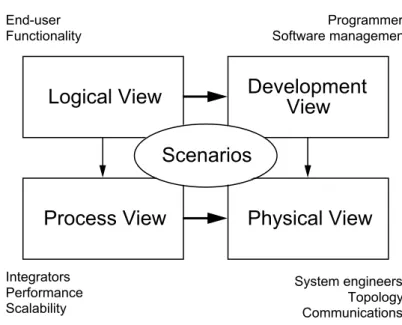
Examples of views in software architecture are the physical deployment view which illustrates where the software will be running (i.e., on which machines) and the logical view which illustrates the different classes and modules, and certain connections between them.
The “4+1” View Model of Software Architecture
A great example of how software architecture can be documented and pre-sented is introduced in Kruchten [15], and is calledThe “4+1” View Model of Software Architecture.
20 CHAPTER 3. SOFTWARE ARCHITECTURE
2
• the development view, which describes the static organization of the software in its development environment.
The description of an architecture—the decisions made—can be organized around these four views, and then illustrated by a few selected use cases, or scenarios which become a fifth view. The architecture is in fact partially evolved from these scenarios as we will see later.
Logical View
Development
View
Process View
Physical View
Scenarios
Programmers Software management System engineers Topology Communications Integrators Performance Scalability End-user FunctionalityFigure 1 — The “4+1” view model
We apply Perry & Wolf’s equation independently on each view, i.e., for each view we define the set of elements to use (components, containers, and connectors) , we capture the forms and patterns that work, and we capture the rationale and constraints, connecting the architecture to some of the requirements.
Each view is described by a blueprint using its own particular notation. For each view also, the architects can pick a certain architectural style, hence allowing the coexistence of multiple styles in one system. We will now look in turn at each of the five views, giving for each its purpose: which concerns is addresses, a notation for the corresponding architectural blueprint, the tools we have used to describe and manage it. Small examples are drawn from the design of a PABX, derived from our work at Alcatel Business System and an Air Traffic Control system3, but in very simplified form—the intent here is just to give a flavor of the views and their notation and not to define the architecture of those systems.
The “4+1” view model is rather “generic”: other notations and tools can be used, other design methods can be used, especially for the and the logical and process decompositions, but we have indicated the ones we have used with success.
Figure 3.1: An illustration of the five views used in The “4+1” View Model of Software Architecture. Image taken from Kruchten [15].
In this model, the idea is that a software architecture can be represented by five views which serve very different purposes.
Four of the five views are related to how the system is implemented and how it looks during runtime. These four views are:
1. The Logical View 2. The Process View 3. The Physical View 4. The Development View
The fifth view is used to illustrate how the four other views are connected and highlight how the architecture as a whole fulfills the needs which are placed on it. For completeness, the last view is:
5. Scenarios/Use Cases
A thorough introduction to how these views interrelate and are used is given in Kruchten [15], but they can be summarized as illustrated in Figure 3.1.
The strength of this model is that all the four “main” views are treated as a complete and distinctive representation of the software architecture. It includes everything which it can based on the constraints of the representa-tion for the respective view, and should therefore also include a rarepresenta-tionale as
3.2. GOALS OF A SOFTWARE ARCHITECTURE 21
to why this specific set of choices were made. By doing this, the software ar-chitects can be confident that their design fulfills all which is required by the system as a whole, but without having to consider every all the information at the same time.
3.2
Goals of a Software Architecture
The primary reason for studying and using software architecture is to achieve certain goals. These can be tied directly into the requirements given by the customer (e.g., “the system shall have an uptime of 99,99%”) or can be desired attributes given by the developing organization (e.g., “it must be simple to add support for a new printer”).
In Bass et al. [3] they discuss what they call “quality attributes”. These attributes are certain characteristics that the final software should possess to some extent (as given in the requirements). Bass et al. present six of the most common qualities; availability, modifiability, performance, security, testability, and usability.
If a traditional First-Person Shooter (FPS) game is used as an exam-ple, these quality attributes can be ordered according to importance. One such ordering might be (1) usability, (2) performance, (3) modifiability, (4) availability, (5) testability, and (6) security. Based on such an ordering, the developing organization can prioritize effort and other resources to achieve the results they wish.
When such orderings, or other constraints, are in place, the software architects can begin designing the software architecture. Accordingly, all the choices the software architects make can be argued for in the rationale using the desired qualities as a guideline.
3.3
Designing a Software Architecture
Designing a successful software architecture is a difficult job. There are many ways of doing this, each with their own strengths and weaknesses. Here we will briefly introduce two approaches; domain-driven design and responsibility-driven design.
3.3.1 Domain-Driven Design
In his excellent book “Domain-Driven Design: Tackling Complexity in the Heart of Software” [10], Evans introduce domain-driven design. Domain-driven design is the process where software is designed by understanding the high-level concepts of the domain you are trying to create a program for. If you are developing an accounting application, the developers should get a basic understanding of how the domain works by discussing it with subject
22 CHAPTER 3. SOFTWARE ARCHITECTURE
matter experts (e.g., accountants). Together, they articulate a common and explicit model of the domain, and implement the software according to this model.
In addition to presenting domain-driven design, Evans suggests several ways of keeping the model up to date, keeping it a useful part of the devel-opment team’s knowledge. Of particular interest are the “Conformist” and “Anticorruption Layer” techniques suggested.
Conformist The conformist technique consists of allowing the soft-ware architecture of the program you produce to be dictated fully by the supporting technology in use. If, for example, a third party game engine is used, the conformist approach would likely be the best way to produce cor-rect and working software. It implies that you get a thorough understanding of the existing application (i.e., the game engine), and that all the code you produce follow the model and structure in it.
Anticorruption Layer The anticorruption layer approach is an ex-treme approach. It implies that you do not wish any influence from any third-party software on your own system. This is achieved by inserting a layer between the third-party software and your own application. On the inside, this layer conforms to the application’s structure, and on the outside, this layer conforms to the third-party software’s structure. In many ways this is a safe approach which allows third-party software to be integrated into the application without affecting the existing structure. On the other hand, if the layer becomes too complicated or slow, it might not be worth the effort.
In any case, the developing organization should at all times be concious of how they integrate third-party software into their own games. The two presented approaches present the extremes, and for most real-life applica-tions, something in between will be the best solution.
3.3.2 Responsibility-Driven Design
In the article “Object-Oriented Design: A Responsibility-Driven Approach” [30] the authors Wirfs-Brock and Wilkerson present a design method which focuses on the responsibilities of the different entities of a system. They start out by addressing some of the problems with the data-driven design method, most importantly including that it can lead to a violation of encapsulation, since the structure of an object becomes part of it’s definition.
They then go on to describe the responsibility-driven approach. In responsibility-driven design, the designers inspect the relationships between the different modules as a client-server relationship. A server is an object that can perform a service (e.g., provides data) and a client is an object that requests services (e.g., requests data).
By designing modules in this way, you do not tie down the actual struc-ture of the different modules or classes in the definition, but instead produce
3.3. DESIGNING A SOFTWARE ARCHITECTURE 23
objects which have clearly defined services which they can perform. If we look at a game engine, each main module can be viewed as a server. The rendering engine, for example, provides the service of generating an image that can be viewed by the end user. The physics engine can calculate object interactions, and the sound engine can output sound.
All these are great examples of object-oriented design, as they provide an encapsulated service, and can, in theory, be exchanged by another module which performs the same services (e.g., by adding a wrapper to the new module).
Chapter 4
Software Architecture in
Games
First In this chapter a rationale for the need for software architecture in games will be given. This is then followed by a short introduction to game engines, and the chapter is concluded by a discussion of middleware and the middleware’s effect on game development.
4.1
Does Games need a Software Architecture
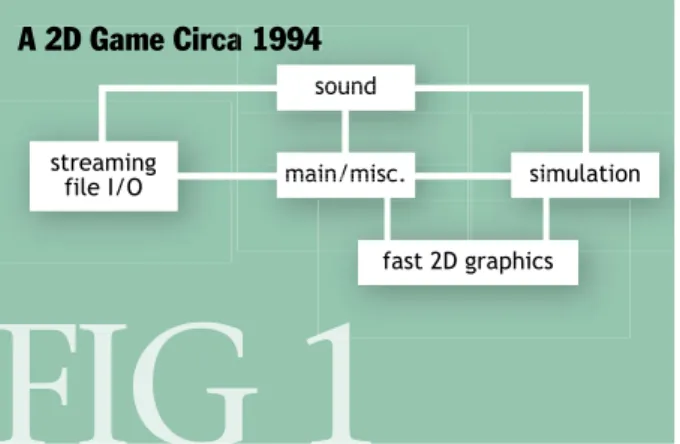
In Blow [4] a short, but compelling, introduction to the evolution of size and complexity of games is given. As can be seen in Figure 4.1, games started out as rather small and limited pieces of software. However, it can be seen from the figure that there were certain architectural decisions taken, either consciously or sub-consciously, to identify and develop sub-modules, which had their own responsibility.Then, a couple years later, 3D graphics became a more important part of gaming. Following this, the complexity of the source code increased (Figure 4.2). Now the modules are really starting to stand out. However, it is conceivable that a company still would manage to produce a game without needing a software architecture designed up-front.
Finally, when looking at a 3D game from 2004 (Figure 4.3), one can see that there is no way in which a company can produce such a piece of software without considering software architecture. When also considering that each module consist of between 6 and 40 thousand lines of code [4], the engineering challenge of games become intimidating.
26 CHAPTER 4. SOFTWARE ARCHITECTURE IN GAMES
30 February 2004 QUEUE rants: [email protected] more queue: www.acmqueue.com QUEUE February 2004 31
categories is a bit artificial; we will come full-circle at the end, seeing that there are fundamental domain-specific reasons (problems due to highly domain-specific require-ments) why we should expect that games are among the most complicated kinds of software we should expect to see (problems due to overall project size), and why we should not expect this to change for the foreseeable future.
PROJECT SIZE AND COMPLEXITY
To illustrate the growth of games over the past decade, I’ve chosen four examples of games and drawn graphs of them. Each node in a graph represents a major area of functionality, and the arcs represent knowledge couplings
between modules. Two nodes with an arc between them need to communicate heavily, so design decisions made in one node will propagate through its neighbors.
Figure 1 depicts a 2D game from the early 1990s, per-haps a side-scrolling action game for a home console, like Super Metroid. Other genres of game would have slightly different diagrams, for example, a turn-based strategy game like Civilization would gain a node for computer-opponent AI (artificial intelligence), but would lose the node for fast graphics. Certainly Super Metroid itself also has computer opponents, but their behavior is simple enough that it doesn’t warrant an extra node; instead the enemy control code is lumped in with “main/misc.”
By 1996, 3D games had become a large portion of the game industry’s output. Figure 2 shows an early 3D game, for example, Mechwarrior 2. Contrast this with figure 3, a modern single-player game.
The largest endeavor we currently attempt is the 3D massively multiplayer game (MMG), illustrated in figure 4. Everquest is the canonical first example of a 3D MMG, though a more up-to-date example would be The Matrix Online (expected release in 2004).
Contrasting figure 4 to figure 1 should give you a gen-eral sense of how the situation has changed. The arcs in these figures assume that code has been ideally factored, but since this is never the case, real-life situations will be more tangled. Keep in mind that each node in these graphs is itself a complex system of many algorithms working together, and that each of these nodes represents somewhere between six thousand and 40 thousand lines of source code.
There’s another category of game, the non-massively multiplayer client/server game, which tends to house a smaller number of players at once (perhaps 50) and does not maintain a persistent world. The diagram for one of those would be somewhere between figure 3 and figure 4.
Tools. To tackle such com-plexity, it helps to have excellent development tools. Sadly, we do not have excellent develop-ment tools.
For programming on PCs, we use a compiler development environ-ment like Microsoft Visual Studio, which is basically a wrapper around their C++ compiler; most games now are written primarily
Game Development
FOCUS
Game
Harder Than You Think
Development
A 2D Game Circa sound sound main/misc. main/misc./ streamingafile I/O simulationsim
fast 2D graphics
FIG 1
A 3D Game Circa 19 sound main/misc. main/misc./ streamingafile I/O simulationsimulationla detectiondcollision fast 2D graphics 3D rendering
FIG 2
Figure 4.1: An illustration of a typical 2D game from around 1994. Image taken from Blow [4].
30 February 2004 QUEUE rants: [email protected] more queue: www.acmqueue.com QUEUE February 2004 31
categories is a bit artificial; we will come full-circle at the end, seeing that there are fundamental domain-specific reasons (problems due to highly domain-specific require-ments) why we should expect that games are among the most complicated kinds of software we should expect to see (problems due to overall project size), and why we should not expect this to change for the foreseeable future.
PROJECT SIZE AND COMPLEXITY
To illustrate the growth of games over the past decade, I’ve chosen four examples of games and drawn graphs of them. Each node in a graph represents a major area of functionality, and the arcs represent knowledge couplings
between modules. Two nodes with an arc between them need to communicate heavily, so design decisions made in one node will propagate through its neighbors.
Figure 1 depicts a 2D game from the early 1990s, per-haps a side-scrolling action game for a home console, like Super Metroid. Other genres of game would have slightly different diagrams, for example, a turn-based strategy game like Civilization would gain a node for computer-opponent AI (artificial intelligence), but would lose the node for fast graphics. Certainly Super Metroid itself also has computer opponents, but their behavior is simple enough that it doesn’t warrant an extra node; instead the enemy control code is lumped in with “main/misc.”
By 1996, 3D games had become a large portion of the game industry’s output. Figure 2 shows an early 3D game, for example, Mechwarrior 2. Contrast this with figure 3, a modern single-player game.
The largest endeavor we currently attempt is the 3D massively multiplayer game (MMG), illustrated in figure 4. Everquest is the canonical first example of a 3D MMG, though a more up-to-date example would be The Matrix Online (expected release in 2004).
Contrasting figure 4 to figure 1 should give you a gen-eral sense of how the situation has changed. The arcs in these figures assume that code has been ideally factored, but since this is never the case, real-life situations will be more tangled. Keep in mind that each node in these graphs is itself a complex system of many algorithms working together, and that each of these nodes represents somewhere between six thousand and 40 thousand lines of source code.
There’s another category of game, the non-massively multiplayer client/server game, which tends to house a smaller number of players at once (perhaps 50) and does not maintain a persistent world. The diagram for one of those would be somewhere between figure 3 and figure 4.
Tools. To tackle such com-plexity, it helps to have excellent development tools. Sadly, we do not have excellent develop-ment tools.
For programming on PCs, we use a compiler development environ-ment like Microsoft Visual Studio, which is basically a wrapper around their C++ compiler; most games now are written primarily
Game Development
FOCUS
Game
Harder Than You Think
Development
A 2D Game Circa sound sound main/misc. main/misc./ streamingafile I/O simulationsim
fast 2D graphics
FIG 1
A 3D Game Circa 19 sound main/misc. main/misc./ streamingafile I/O simulationsimulationla detectiondcollision fast 2D graphics 3D rendering
FIG 2
Figure 4.2: An illustration of a typical 3D game from around 1996. Image taken from Blow [4].
4.1. DOES GAMES NEED A SOFTWARE ARCHITECTURE 27
32 February 2004 QUEUE rants: [email protected] more queue: www.acmqueue.com QUEUE February 2004 33
and forth, we can’t just convert the data between formats at function call time as that would be too slow). And since games are so CPU-intensive, it will often happen that the third-party component presents a significant performance bottleneck for some input scenarios—and the programmer must fix these situations or work around them.
Often when third-party code fails, it’s because the problem it solves is insufficiently large; for the amount of work the development team spends to make the code
succeed, they might as well have written the module from scratch—something you certainly don’t want to find out after failing with the licensed code. The decision to license third-party code should always be preceded by a careful cost/benefit analysis as there’s no guarantee that the product will actually hasten your development.
Full-Figure Option. Instead of licensing components, we can license an entire game engine from a company that has successfully built a solid one (see my discussion of highly domain-specific requirements in this article).
A 3D Single-Player Game Circa 2004
sound, low-levelo sound,un management main/misc. connects to nearly everything
(arcs not shown)
streaming file I/Og
scripting evaluatore t collision c isision detection/c physicsys spatial s at partitioning p and searchn AI A rendering: scene management scripted events/ sc gameplay code/ entity layer geometry ande animation a exporterso Tools (often not distributed
o players) world constructionon
and layoutd l t scripted eventcreationppt ti audio/animationphysically-basedud ca -// eo arrangementn a rendering:e low-level 3D animationnD
FIG 3
Figure 4.3: An illustration of a typical 3D game from around 2004. Image taken from Blow [4].
28 CHAPTER 4. SOFTWARE ARCHITECTURE IN GAMES
Furthermore, when discussing long build times, Blow states that “the best way to avoid long build times is to architect the entire code base to minimize dependencies”. Based on this and the increasing complexity of games in software engineering terms, one can conclude that a suitable and well planned software architecture is integral to a successful game1.
Thus, it has been established that games need to have a concious rela-tionship to software architecture.
A survey performed in Nordmark [18] looks into the relationship that game developers have to software architecture. In the conclusions on this part of the survey, Nordmark state the following:
“Through this research we have shown that game developers today have a concious relationship to software architecture, and the benefits they reap from using it actively to promote certain characteristics of their software. One of the main findings in the survey is that game developers now rate software architecture as an important part of their game, and that they strive to achieve a software architecture which enables reuse, porting, extension, etc. This hints towards a level of maturity in the game develop-ment industry which has been reported and assumed lacking.”
4.2
Game Engine Architecture
If one looks at the Figures 4.1, 4.2, and 4.3, one can see that many of the nodes represent general purpose jobs. Examples include sound management, collision detection, and 3D animation. If we take the architecture of a game one step further, these modules can be generalized to such an extent that they can be used in a game engine. This generalization will be discussed in the following sections.
4.2.1 What is a Game Engine
In Gregory [12], the difference between a game and a game engine is defined as follows:
“Arguably a data-driven architecture is what differentiates a game engine from a piece of software that is a game but not
an engine. When a game contains hard-coded logic or game
rules, or employs special-case code to render specific types of game objects, it becomes difficult or impossible to reuse that software to make a different game. We should probably reserve 1
The researcher recognizes that smaller (e.g., indie) games can be made in a simpler fashion. However, these developers would most likely also reap the benefits of a proper software architecture.
4.2. GAME ENGINE ARCHITECTURE 29
the term ‘game engine’ for software that is extensible and can be used as the foundation for many different games without major modification.”
Here certain desirable architectural traits already surface. Gregory has identified a need for the game engine to be data-driven, and that most, if not all, of the game-specific elements should be left out of the game engine. Being data-driven, the game engine should accept new data containing information about the levels, the characters in it, and the possible interactions, and render this to the user in a correct manner. This, in turn, implies that if one uses a complete game engine to create a game, you should only have to focus on the content, not the mechanics allowing you to create a game.
Furthermore, a game engine is usually structured around different mod-ules. These modules each have their own responsibility (e.g., rendering, physics, and lighting), and thus the engine itself is also a responsibility-driven architecture.
4.2.2 Modules used in Today’s Game Engines
Guldbrandsen and Storstein [13] performed a study on state-of-the-art game engines, wherein they looked at which modules and middleware were present in the different game engines.
Guldbrandsen and Storstein identify two classes of modules and the mod-ules which are present on virtually all game engines; core modmod-ules and game-play modules.
Below is a short summary of their findings.
Core Modules versus Gameplay Modules
The research Guldbrandsen and Storstein present indicates that the game engines have two main module types; core modules and gameplay modules. Furthermore they confirm this distinction and present the following state-ment:
“One should strive to define what is core functionality, and what is more linked to gameplay. The core should be efficient and stable, and ideally not something a game programmer would need to touch. The gameplay layer should ideally have loose coupling and be extensible for game programmers to incorporate game-specific functionality.”
Core Modules
Core modules are characterized by performing a general purpose task like rendering, physics, collision detection, particle system, etc., and are heavy-duty modules which certainly need to be as optimized as possible.
30 CHAPTER 4. SOFTWARE ARCHITECTURE IN GAMES
As these modules are developed with performance in mind, making them architecturally pretty is not the main focus.
Gameplay Modules
Gameplay modules are focused on the parts which game developers need to modify to make the specific game they are working on. These consist of entity management, scripting, message passing, etc., and are generally not the most performance intensive modules. Since they are directed at the game developers and designers they are often more “user friendly”, i.e., they are developed using functional interfaces, use known architectural patterns, etc.
Below follows a short highlight of two different modules which are typ-ically present in modern games. These are chosen since they affect the job of the creative team. A more thorough introduction to these, and other modules typically present in current game engines, is given in Guldbrandsen and Storstein [13].
Scripted Events
Scripted events are integral to making and fine-tuning the level to match the designers original ideas. Scripts can be used to portray the story, and trigger important events either based on actions, locations, or other indicators.
Most large game engines ship with a scripting language/system like Un-real Engine’s UnUn-realScript [9].
Additional Tools
Most large-scale game engines ship with an assorted set of tools which aid the development of the game. These tools can be everything from level designers, scripting applications, debuggers, etc.
4.2.3 Develop or Buy
Today there are several game engines which can be bought/licensed at a fair price, and they often are considered “mostly-ready game engines” [27]. Examples include UnrealEngine [8], Unity[25], and CryENGINE [7]. And whilst these all show great promise, and can be the correct choice in many situations, a decision to buy a game engine should be carefully considered.
One great benefit is that if the game company decides to buy an existing game engine, they are given a product which is guaranteed to be working, can support bleeding-edge graphics and physics, and allows the company to focus on what makes their game unique, i.e., the content, instead of developing a game engine.
A disadvantage is that the company is limited to what the game engine is capable of doing. Of course, the organization can modify and extend
![Figure 4.3: An illustration of a typical 3D game from around 2004. Image taken from Blow [4].](https://thumb-us.123doks.com/thumbv2/123dok_us/10765571.2964683/49.892.141.678.328.876/figure-illustration-typical-d-game-image-taken-blow.webp)