At first glance, the lawsuits appear solid. Although the debate over the level of the risks associated with environmen-tal tobacco smoke continues, the risks that cigarettes pose to the smokers themselves are much more established. Few deny that smoking is risky to one’s health. Indeed, scientific evi-dence suggests that, by almost any standard, smoking is among the highest risks that individuals can assume when judged on a lifetime basis.
Estimating the health costs of smoking is also feasible. Although cigarette smoking does not lead to signature diseases that are specifically earmarked to one’s smoking habit, on a sta-tistical basis, smoking has health effects and insurance conse-quences that researchers can assess. State suits are attempting to recoup the portion of those health care costs that are paid by the state through various programs, principally Medicaid.
The financial cost arguments advanced by the states do not, however, withstand close scrutiny. Even if one’s sole concern is the financial cost to the state, not the welfare of the smokers themselves, the financial calculations are more complex than the states have indicated. Put quite simply, the states only want to count the negative side of the cost ledger and ignore the cost savings. Some financial implications of smoking increase the costs to the states; other insurance effects decrease state bud-getary costs. What matters is whether those net insurance con-sequences are positive or negative. Moreover, cigarette smokers also pay the states in advance for at least some of those costs through the excise taxes that states levy on cigarettes. Do cigarettes cost the states money after the various offsets are considered?
The shaky ground on which the state suits are based is reflected in the series of economics studies indicating that, on a national basis, cigarettes are self-financing. From the stand-point of the entire country, cigarettes generate a net financial gain rather than a cost. The same self-financing result holds for every state, though the extent to which cigarettes pay for themselves is less pronounced for the states than it is for the federal government. The bottom line is that cigarettes save the states money in every state. The suits are without merit. WHICH COSTS COUNT?
Any legal proceeding seeking to assess costs should ask the TH E 1990S H A V E W I T N E S S E D A B L I Z Z A R D of
anti-smoking efforts. Hillary Clinton and a variety of supporters of the Clinton health care plan urged dramatically higher cigarette taxes to pay for expanded health insurance efforts. And many state and local governments have imposed smoking restrictions or have undertaken antismoking ad campaigns.
Those anti-smoking efforts recently culminated with a pro-posed $368.5 billion settlement to address many liability and regulatory issues. The focal point of the bargain was the settle-ment of a series of lawsuits filed by the states against cigarette companies to recoup smoking-related Medicaid costs. Several state attorneys general composed the principal antismoking bargainers. Chief among them is Michael Moore, the Mississippi Attorney General who filed the first suit. The states argue that they must pay huge amounts of money to cover the higher health care costs of smoking.
Cigarette company investors have reacted fervently to the proposed deal, not yet approved by Congress. The financial stakes are enormous, even for major corporations. Whether the payoff is a realistic possibility hinges on the merits of the liti-gation that is, in effect, being settled out of court. Detailed examination of the economic underpinnings of the suits sug-gests that it is a bad deal for the companies and a money grab. Cigarette companies will buy out of the lawsuits if they fear that the court system will not function sensibly.
THE STATES’ CASE
Much of the antismoking initiative leading to the proposed set-tlement took place largely beyond public view. To date, forty-one states have filed lawsuits against the cigarette industry. The lawsuits seek to obtain reimbursement for smoking-related health care costs paid by the state. Some states, such as Minnesota, may continue with their suits even if the settlement is approved, unless Congress prohibits them. Without a settlement deal, the litigation could escalate. If any state wins their suit, one would expect other states to follow suit, not wishing to pass up a chance to obtain out-of-state funds for their state treasuries. The effort has garnered notoriety from the much publicized decision by the Liggett Group to pay a portion of its profits to fund the litigation in return for being exempted from it.
F
ROM
C
ASH
C
ROP
T
O
C
ASH
C
OW
HOW TOBACCO PROFITS STATE GOVERNMENTS
b y W . K i p V i s c u s i
W. Kip Viscusi is Cogan Professor of Law and Economics and Director of the Program on Empirical Legal Studies, Harvard Law School.
costs specifically attributable to cigarettes. That influence will not be emphasized in the assessment of whether smoking on balance costs or saves state money, but it is useful to recog-nize that statistical studies may overstate smoking costs for that reason.
Accepting the assumption that smoking poses health risks, it follows that all of the insurance consequences linkage should be assessed. The states have focused simply on those effects that raise health care costs. But a complete cost assessment is needed. Because of their shorter expected life spans, cigarette smokers will incur fewer medical costs and pension-related expenses in old age, such as nursing home expenditures and
social security payments. The other significant compo-nent in the calculations is the social security payroll taxes or contributions to state pension plans that smokers fail to make because of their premature mortal-ity. If the pension benefits not collected by smokers are count-ed as a financial savings for the state, it is also appropriate to count the tax payments that the smokers fail to pay into the system because of the health risks associated with smoking. Those various cost effects occur at different points in time. Health care costs tend to be more immediate, whereas finan-cial offsets such as lower nursing home costs are deferred. To put it in comparable terms, it is appropriate to assess the pre-sent value of the costs, weighing the cost numbers to reflect the fact that cost effects in the immediate future should receive a greater weight than deferred cost effects.
A final financial consideration is the excise taxes that are levied specifically on cigarettes. Cigarettes are one of the most heavily taxed consumer commodities, with an average tax per pack of $0.53. The tax is divided between the $0.24 per pack tax paid to the Federal government and an average tax rate of $0.29 per pack paid to state and local governments. By paying that tax, smokers in effect pay in advance for costs that they might impose on the state or the Federal government. Suppose that a state learned that cigarettes on average cost the state $0.25 per pack in insurance costs. It could recoup costs after the fact by seeking reimbursement for those costs, or it could impose a charge up front of $0.25 per pack in excise taxes to cover the financial costs it incurs. Those measures are equiva-lent from a financial standpoint except that the state can avoid the litigation costs through the excise tax mechanism. Moreover, since excise taxes are subject to control by the states, unlike an award that is set by the courts for insurance costs, that mechanism is better suited for recouping any costs that might exist.
Many well-known health-related effects do not enter the calculations at all. For example, to the extent that smoking adversely affects one’s health and longevity, the lifetime earn-ings of smokers will be reduced as well. That effect is, howev-er, a private cost rather than a social cost to the states. There has been no effort by the states to recoup the value of those following question: But for the activity attributable to the
alleged misconduct, what would the costs to the injured party have been? Posing the question in that manner makes clear that the net financial implications are of consequence. Moreover, one must isolate any such net costs to the specific period in question and the effect of the misconduct during that period. If the conduct of cigarette companies is not in question before some initial point in time—possibly because of lack of knowledge of the risks—or after a certain ending date-possi-bly because of legislative exemptions and mandated warnings-then one should only consider the costs of cigarettes during the period in which the companies’ conduct is in question. Moreover, if the misconduct of
the companies increased smoking rates by, for example, 50 percent, then only half of those costs are pertinent.
Assessment of the financial costs to the states is an elaborate
accounting exercise that involves two issues, which costs to count and how to count them. The exercise is not a compre-hensive tally of the social desirability of smoking. Nor is it a measure of whether smoking is beneficial to the smokers themselves. The benefits and costs to the smokers are not con-sidered. The task is to assess the financial costs imposed on others. The cost tally addresses the narrower issue that is the focus of the lawsuits; whether the states lose money because of cigarette smoking.
The underlying impetus for the lawsuits is that scientists agree that smoking is risky. Substantial medical literature summarized in annual reports by the U.S. Surgeon General indicates that smoking may pose a variety of health hazards. Smokers have an 18 percent to 36 percent chance of dying ear-lier than they would if they did not smoke. The extent of life lost is, however, shorter than for acute accidents. The life years lost due to smoking generally are deferred, often leading to shortening of one’s retirement years. That temporal inci-dence of smoking-related mortality will prove to be important for assessing the financial consequences of smoking.
Because cigarette smoking is expected to lead to premature mortality and other adverse health effects, one would expect smokers to have higher levels of health expenditures in the near term but perhaps fewer expenditures in the very distant future. Any comprehensive tally of smoking costs consequent-ly must consider the stream of costs over the smoker’s lifetime.
Available statistical techniques make possible estimation of the additional expected medical care costs and life insurance costs due to smoking. Those analyses are straightforward, but involve some error. More importantly, they do not isolate the costs specifically due to smoking but rather the health care costs that are correlated with being a smoker. Smokers are more willing to engage in other risky pursuits, for example, they are more likely to work on hazardous jobs and to be injured on such jobs. Statistical estimates of the increased medical costs due to smoking consequently may overstate the
BECAUSE OF THEIR SHORTER EXPECTED LIFE SPANS, CIGA -RETTE SMOKERS WILL INCUR FEWER MEDICAL COSTS AND PENSION-RELATED EXPENSES IN OLD AGE, SUCH AS NURSING
29
elements that could be considered in calculating the costs of smoking. Examining the national evidence can show the rea-son for the concern over what counts and what does not count. Although the estimates described below are based on my own published estimates for 1993, every major published economic study of the social security consequences or national economic effects of smoking has also indicated that cigarette smoking pays for itself.
The only critical technical assumption worth noting is that the various cost figures have been brought to present value assuming a real interest rate (i.e., the rate of interest net of inflation) of 3 per-cent. Lower interest rates increase the weight placed on the cost
offsets from smoking, and higher interest rates place a greater weight on the more immediate health care costs.
The results of those tallies indicate why the states are par-ticularly eager to focus on only the medical care cost component. On a national basis, even if one ignores the excise taxes paid by smokers, cigarette smoking is currently self-financing. Indeed, the net cost savings is substantial, on the order of $0.32 per pack.
In a complete consideration of net smoking costs, some components reflect both costs and savings. For example, the medical cost component consists primarily of the higher costs associated with Medicare and Medicaid. However, there are other costs as well, such as other government subsidies given to hospitals. The estimates suggest that cigarette smoking leads to increased health care costs of $0.33 per pack before age 65 and of $0.17 per pack after age 65, for a total medical cost effect of an additional $0.50 per pack.
It is also appropriate to take into account nursing home care expenditures. Those expenditures, which are divided primarily between the Federal and state governments, generate a cost savings of $0.22 per pack. That is because smokers die at younger ages and thus do not utilize nursing services as much as do longer living nonsmokers. Consequently, even if one looks at medical care and nursing home care as a medical-related package, cigarettes are not self-financing. From a national standpoint their net cost is $0.28 per pack ($0.50 per pack for medical costs minus $0.22 per pack savings in nurs-ing home care). The state share of those costs is, however, not necessarily positive even though the national total is positive.
By far the biggest entry in cigarette cost accounting is the effect of cigarettes on pension and social security costs. It is the retirement-related cost component that is most affected by smok-ing-related mortality. Those cost savings are tremendous because of the timing of the early expected mortality of smokers, which tends to be after most retirement contributions have been made but before most benefits have been collected. The cost savings for retirement programs total $1.10 per pack. That retirement program effect represents a tremendous cost offset for any cost that smokers might impose. Smokers save society about $25 bil-consequences of smoking.
Similarly, the income taxes that smokers fail to pay because of health effects reduce state and Federal revenues, but the losses do not enter the debate either. The rationale is that since smokers die before they are able to reap the benefits of the government programs, it is not appropriate to charge them taxes that they would have paid had they remained alive. There seems to be no disagreement over that cost counting issue in the economics literature.
From an economic standpoint then, the appropriate issue to be addressed by the litigation is whether the net financial costs of cigarettes to the states are adverse. The menu of cost conse-quences, both positive or
nega-tive, includes medical costs, life insurance costs, nursing home care costs, pension-relat-ed effects, taxes relatpension-relat-ed to retirement programs, as well as minor cost components, such as sick leave and fires.
HOW THE STATES COUNT COSTS
In their lawsuits, state officials typically calculate only on one component—the increased medical costs due to smoking. By eliminating all potential negative cost effects from considera-tion, they can maximize their take from the litigation lottery. State officials feign moral outrage when analysts cite that fact. For example, the state of Mississippi refers to that reasoning and the analysts espousing it as “ghoulish,” “offensive to human decency,” and “unquestionably contrary to public policy.”
However,the lawsuits are not about whether smoking is good or bad for society or about whether the health and wel-fare of smokers are best promoted through their current smok-ing decisions. Unfortunately, state officials often describe the smoking as a lifestyle choice to avoid discussing the real issue; whether smokers actually cost states on net through higher medical bills and other costs.
The states have also resisted the lifetime cigarette cost logic. They prefer instead to focus on costs at only one point in time. The states’ approach consequently ignores the shorter life expectancy of smokers and the fact that there are no med-ical costs generated by smokers after they are dead.
The states dismiss the excise taxes that smokers pay by equating those taxes with general sales taxes paid on all com-modities. But unlike commodity-specific excise taxes on ciga-rettes, general sales taxes are paid on all products and do not specifically discourage individuals from buying particular products. Smokers pay the states an additional amount specifi-cally because they have purchased cigarettes. Through excise tax payments, smokers in effect pay in advance for the costs they generate. The question is whether they are paying enough to cover their smoking-related costs.
EVIDENCE ON THE COSTS OF SMOKING
Any state wishing to succeed in its litigation had to restrict the
IN THEIR LAWSUITS, STATE OFFICIALS TYPICALLY CALCU -LATE ONLY ON ONE COMPONENT-THE INCREASED MEDICAL COSTS DUE TO SMOKING. BY ELIMINATING ALL POTENTIAL NEGATIVE COST EFFECTS FROM CONSIDERATION, THEY CAN
of the cost offset reaped by the Federal government will be proportionally greater than that for the states. As a conse-quence, the calculation of the financial implications of ciga-rettes for the states will be much closer to a break-even point than it is for the Federal government or for society as a whole. SECOND HAND SMOKE
There are societal consequences that go beyond the cost calcu-lations discussed above. Chief among them is environmental tobacco smoke. Recent efforts to restrict public smoking have been stimulated in part by the widespread publicity given to the potential hazards of environmental tobacco smoke. How does recognition of those consequences affect the tally of the social implications of cigarettes?
To make those calculations, one can use the estimates for adverse health effects of environmental tobacco smoke pre-pared by OSHA and the EPA. The linkage between cigarette smoking and heart disease and lung cancer is much debated due to the low levels of exposure associated with environmen-tal tobacco smoke. Because of the greater weight that the gov-ernment studies place on worst-case scenarios, existing esti-mates of the risks may be too high. Nevertheless, even if one takes the government assessments at face value, the costs associated with environmental tobacco smoke are not suffi-cient to tip the accounting scales against cigarettes. Valuing the lives potentially lost due to environmental tobacco smoke exposures at $5 million per life may eliminate much of the financial cost savings associated with smoking. However, after recognizing the role played by excise taxes, cigarettes still remain a self-financing proposition.
Inclusion of environmental tobacco smoke is appropriate if one is thinking about the broad national consequences of ciga-rette smoking. However, the focus of the state lawsuits is not on the total economic consequences to all citizens, but rather on the financial costs imposed on the state. The insurance effects on the states of environmental tobacco smoke are less than a penny per pack. As a result, it is not necessary to include the effects of environmental tobacco smoke, which are not financial in nature but instead represent a valuation of the health care consequences for individuals exposed to smoking. SELF-FINANCING CIGARETTES IN THE STATES The cost estimates for the states do not represent simply a scaled-down version of the national estimates. The mix of pro-grams administered by the states differs from the mix run by the Federal government. States operate pension plans for their workers, but most workers in a state are covered by the Federal program administered through social security.
Estimates for each state will also differ for a variety of state-specific reasons. The sharing formula for Medicaid depends on the state income level, which will require higher levels of cost sharing for more affluent states. The number of state employees covered by pension plans and the level of their benefits will also differ widely. As a result, an assessment of state effects requires that one take into account a series of state-spe-lion in pension costs and almost $30 bilstate-spe-lion in pension and
nurs-ing home care costs annually. Although the Federal government enjoys much of the saving, the states benefit as well.
The final major component consists of the taxes that smok-ers do not pay into the various retirement programs once they are deceased. It does not appear to be appropriate to count income taxes not paid by smokers since they are not alive to receive the broadly provided public benefits that income taxes make possible. However, in the case of payroll taxes and pen-sion contributions, payments are linked to the subsequent ben-efits for which cost savings due to cigarettes are counted. For symmetry, one must also count those taxes not paid. The esti-mate of the tax losses due to smoking is about $0.35 per pack. Thus, that cost is comparable in size to the net medical care and nursing home costs, but one-third the size of the retire-ment benefit cost savings.
There are, of course, other financial consequences of smok-ing. Smokers are more likely to claim sick leave benefits, which leads to a cost of one penny per pack. Smokers are also more likely to be involved in fires, which has financial costs for society of $0.02 per pack. Group life insurance cost effects are more substantial, costing about $0.13 per pack. Various minor components such as those are included in the total cal-culation below, but will not be the focus of the discussion.
On balance, counting all those effects, smokers save society $0.32 per pack. Those cost savings exclude the excise tax that smokers pay, which contributes an additional $0.53 per pack. Consequently, the national calculation is overwhelming. From a financial standpoint, cigarettes subsidize the country $0.85 per pack.
The distribution of that cost effect is also important. The Federal government is the major beneficiary of the lower costs associated with Medicare and social security. Thus, the extent
Those cost savings only represent the insurance cost effects. But one can view the financial consequences of smoking from three different reference points, each of which indicates that cigarettes are self-financing. First, the cigarette excise tax of $0.18 per pack in Mississippi is over ten times as great as the higher medical care costs. Once excise taxes are taken into account, the net cost of cigarettes is a plus for the state. Second, even the medical cost component is not adverse con-sidering the nursing home cost reductions. For Mississippi, nursing home cost savings ($0.025 per pack) exceed the med-ical cost increase ($0.017 per pack), whereas that is not the case for the nation as a whole. Third, recognition of the net savings to state-financed pensions ($0.043 per pack) minus taxes not paid by smokers ($0.014 per pack) also exceeds the burden of any higher medical care costs.
Based on that analysis, the only way the state of Mississippi could have a claim for a cost increase would be if the court were to exclude all three possible offset components—nursing home care cost savings, pension cost savings, and excise taxes. Recognition of any one of those cost offsets is sufficient to swamp the increased medical care cost increase. If one properly accounts for all excise tax and cost effects, cific economic factors that drive the financial consequences.
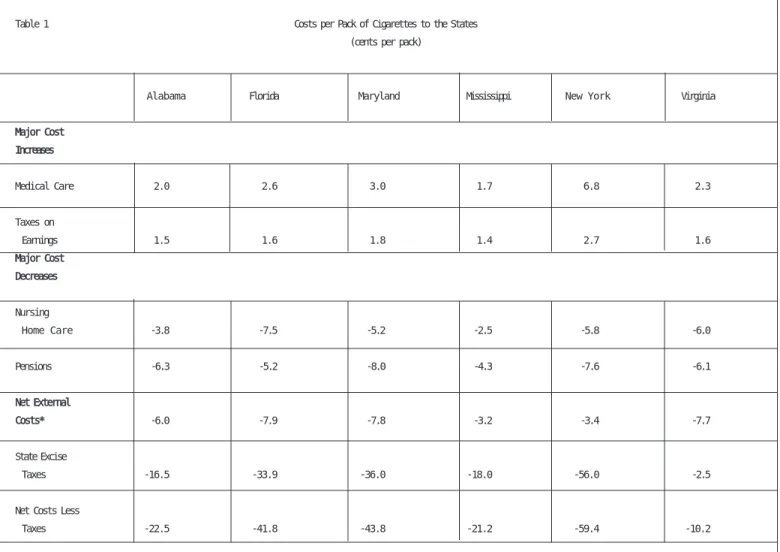
The results of that calculation indicate that the states have no financial basis for the lawsuits. Table 1 summarizes the perti-nent statistics for six states. Consider the results for the state of Mississippi, the leader in tobacco litigation. Mississippi is relatively poor so that many of the cost consequences will be less pronounced than for more affluent states that provide a higher level of benefits. In the case of Mississippi, cigarette smoking leads to higher health care costs of under $0.02 per pack. However, the costs are offset by the almost $0.03 pack reduction in nursing home costs. Thus, when the medical care and nursing home effects are viewed as a health-related pack-age, there is no net cost to the state of Mississippi. In contrast, for the nation as a whole, there was not a complete offset when those components are combined.
Because of their early expected mortality, smokers fail to pay $0.01 per pack in taxes on earnings, but they collect fewer pension benefits. That leads to a cost savings of $0.04 per pack. Adding all those financial effects as well as other conse-quences, such as life insurance and sick leave, Mississippi actually saves on average $0.03 per pack in terms of the vari-ous financial costs generated by cigarettes.
Table 1 Costs per Pack of Cigarettes to the States (cents per pack)
Alabama Florida Maryland Mississippi New York Virginia
M Maajjoorr CCoosstt I Innccrreeaasseess Medical Care 2.0 2.6 3.0 1.7 6.8 2.3 Taxes on Earnings 1.5 1.6 1.8 1.4 2.7 1.6 M Maajjoorr CCoosstt D Deeccrreeaasseess Nursing Home Care -3.8 -7.5 -5.2 -2.5 -5.8 -6.0 Pensions -6.3 -5.2 -8.0 -4.3 -7.6 -6.1 N Neett EExxtteerrnnaall C Coossttss** -6.0 -7.9 -7.8 -3.2 -3.4 -7.7 State Excise Taxes -16.5 -33.9 -36.0 -18.0 -56.0 -2.5
Net Costs Less
Taxes -22.5 -41.8 -43.8 -21.2 -59.4 -10.2
*
THE ANTISMOKING MOVEMENT’S DILEMMA The principal defense against the comprehensive accounting framework is that recognition of cost savings is morally offen-sive, whereas recognition of cost increases is not. There is no rational basis for asymmetry based on an alleged moral superi-ority of recognizing some cost components but not others. Those concerns may suggest that state lawsuits are not framing smoking issues in a meaningful way. The elaborate bean-count-ing exercise initiated by the states is little more than a profit-making venture; a gamble that the courts will fail to take a com-prehensive cost perspective. The latest cigarette battles do little to help individuals make sensible smoking decisions.
The substance of the issues seems to matter little. The ciga-rette companies offered to settle the suits for a financial pack-age of unprecedented size. Some components of the settlement offer real benefits to the two parties. A prohibition of punitive damages would benefit the firms, and antismoking forces obtained a variety of measures that should reduce smoking rates. However, the heart of the agreement is the buyout of the lawsuits by the states, and this is entirely without economic merit. Surprisingly, the misgivings expressed about the suits thus far have largely been from the public health constituency. There has been little concern on the part of investors in ciga-rette companies that the litigation has no sound basis.
There is, of course, no guarantee that the courts would address cost issues rationally. Juries are unpredictable, particu-larly given the current antismoking fervor. Will net costs be considered, or only selective cost increases? Will excise taxes be recognized appropriately as a cost contribution to the states that would not have occurred “but for” cigarette smoking? Legal uncertainties regarding the rationality of the court sys-tem seem to have provided the primary impetus for the settle-ment agreesettle-ment. The economically groundless basis of the attorney generals’ claims seems to be of little concern. The fact that the stock market has responded favorably to the reduction in legal uncertainty appears to be a sufficient reward to those who will profit from the continued good health of the cigarette industry.
Mississippi now reaps a profit of $0.21 per pack from ciga-rettes.
Does that result hold for other states? What about potential outliers such as states with very large contributions to medical care? The highest cigarette-related medical care cost increase in any state is for New York, where the medical care cost increase associated with smoking is just under $0.07 per pack. In that state, the nursing home cost savings of $0.06 per pack is just short of the amount needed to exceed the medical care cost increase. However, the other financial consequences of smoking easily outweigh the medical care cost rise. The net pension less taxes-not-paid effect of cigarettes is a cost sav-ings of $0.049 per pack. And the total net cost savsav-ings to the state is $0.034 per pack. New York State also has an extreme-ly high excise tax rate of $0.56 per pack, which is almost an order of magnitude larger than any medical care cost increase and leads to a total beneficial cost effect of $0.59 per pack. Clearly, cigarette smoking is not a losing financial proposition for the state of New York.
Other states with high excise tax rates, such as Maryland, gain similarly. Maryland’s smoking-related medical cost bill is $0.03 per pack. However, on balance the state is a clear-cut financial beneficiary. Excluding the role of excise taxes, Maryland on balance gains $0.078 per pack. The state’s addi-tional excise tax amount of $0.36 per pack makes the state’s net profit $0.438 per pack.
As a final example, it is worthwhile to consider the state with the lowest tax per pack of cigarettes, the tobacco-produc-ing state of Virginia. There the excise tax is only $0.025 per pack. However, even in Virginia that tax amount is sufficient to exceed the increased medical care costs of $0.02 per pack. Moreover, the nursing home cost saving at $0.06 per pack is almost triple the medical care cost increase. Recognition of the pension cost savings net of taxes of over $0.04 per pack also exceed the increase in medical costs. The total net financial impact is a cost savings of $0.077 per pack in insurance costs in addition to the $0.025 per pack in excise taxes.
Those states are representative and not best case scenarios for cigarette cost accounting. In every state, cigarette smoking is a self-financing proposition. Moreover, in almost every instance, self-financing can be achieved in any one of three ways: by recognition of excise taxes, by including the cost reductions for nursing home care, or by incorporating the pen-sion cost savings. Even if one excludes excise taxes, there are always net cost savings of cigarettes to the states, with a range of around $0.03 per pack for Mississippi to a high value of $0.16 for California. Mississippi’s lead role in the litigation is not surprising since that state profits the least from the insur-ance effects of smoking. However, Mississippi officials are still being highly selective, narrowing their focus on the med-ical care costs alone in their efforts to find a positive cost effect of consequence.
SELECTED READINGS
W. Kip Viscusi. “Cigarette Taxation and the Social Consequences of Smoking,” in Tax Policy and the
Economy, 9:51-101, edited by James Poterba.
Washington, DC: National Bureau of Economic Research (1995).
W. Kip Viscusi. Smoking: Making the Risky Decision. New York: Oxford University. Press (1992). Jane Gravelle and D. Zimmerman. Cigarette Taxes to
Fund Health Care Reform: An Economic Analysis.
Washington, D.C.: Congressional Research Center (1994).