University of Huddersfield Repository
Formosa Pace, Janice Intergenerational Continuity in Offending: An Approach to the Phenomenon in the Maltese Islands Original Citation Formosa Pace, Janice (2014) Intergenerational Continuity in Offending: An Approach to the Phenomenon in the Maltese Islands. Doctoral thesis, University of Huddersfield. This version is available at http://eprints.hud.ac.uk/id/eprint/25015/ The University Repository is a digital collection of the research output of the University, available on Open Access. Copyright and Moral Rights for the items on this site are retained by the individual author and/or other copyright owners. Users may access full items free of charge; copies of full text items generally can be reproduced, displayed or performed and given to third parties in any format or medium for personal research or study, educational or notforprofit purposes without prior permission or charge, provided: • The authors, title and full bibliographic details is credited in any copy; • A hyperlink and/or URL is included for the original metadata page; and • The content is not changed in any way. For more information, including our policy and submission procedure, please contact the Repository Team at: [email protected]. http://eprints.hud.ac.uk/Intergenerational Continuity in Offending: An Approach to the
Phenomenon in the Maltese Islands
Janice Formosa Pace
A thesis submitted to the University of Huddersfield in partial fulfilment of the requirements for
the degree of Doctor of Philosophy
Abstract
This study explores the concentration of convictions in Maltese families through a study of all inmates interned at the prison setting, Corradino Correctional Facility (CCF), between 1950 and 2010. The main aim of this study is to explore patterns of intergenerational crime for the first time in the Maltese islands, to understand how and why convictions run in Maltese families. In other words, the focus here is on the potential role of the family in crime continuity, the familial relationships between incarcerated inmates and the influence of these relationships on emerging crime trends. Quantitative methods are used to examine intergenerational presence and the evolvement of crime covering at least two to three generations of families. This is achieved through employing a risk factor approach to explore potential “crime promoters” that could act as transmission proxies in crime continuity. One in every three inmates registered at CCF belongs to the intergenerational cohort. Moreover, the findings from this study identify that having a sibling, a parent and/or a spouse convicted of a crime is a risk/mediating factor for crime continuity, and the risk is further augmented by the increased presence of criminal relatives. This is compounded by exposure to crime through co-offending, social networks between related inmates within the walls of CCF and also the time a person spends in their neighbourhood. The intergenerational cohort is more crime prolific as attested by intense conviction patterns and recidivism trends and is also inclined towards committing serious crimes and crimes that require more planning and organisation. The processes required for this may be accommodated by the family providing one with entrusted accomplices. The relatively larger crime families (5-node to 10+ node structures) together represent one quarter of the intergenerational cohort. As crime families increase in size, a blend of restricted and extended relationships features
evidently attesting the concentration and continuity of offending. The `orma (a large
group of people/children), hosting 54 related inmates symbolises the fusion of five crime
families through assortative partnering; representing crime continuity across two to five generations. The occurrence of multiple risk factors for intergenerational offending in Malta that were simultaneously identified in this study include: economic inactivity; residing in neighbourhoods laden with crime families; poverty pockets and offender-residence hotspots. These combined individual and ecological risk factors help to explain the concentration of convictions in a relatively small number of crime families.
Disclaimer
The results presented in this thesis are based on my own research in the Department of Criminology, University of Huddersfield. All assistance received from other individuals and organisations has been acknowledged and full reference is made to all published and unpublished sources used.
This thesis has not been submitted previously for a degree at any Institution.
Signed:
_________________________________ Janice Formosa Pace
Copyright Statement
i. The author of this thesis (including appendices) owns any copyright in it and she
has given the University of Huddersfield the right to use such Copyright for any administrative, promotional, educational and/or teaching purposes.
ii. Copies of this thesis, either in full or in extracts, may be made only in accordance
with the regulations of the University Library. Details of these regulations may be obtained from the Librarian. This Page must form part of any such copies made.
iii. The ownership of any patents, designs, trademarks and any all other intellectual
property rights except for the Copyright and any reproduction of copyright works, for examples graphs and tables, which may be described in this thesis, may not be owned by the author and may be owned by third parties. Such Intellectual Property Rights and Reproductions cannot and must not be made available for use without the prior written permission of the owner(s) of the relevant Intellectual Property Rights and/or Reproductions.
Statement of Assistance
The author expresses acknowledgement of assistance acquired from Dr Saviour Formosa from the University of Malta who was instrumental in the spatial analysis process.
Acknowledgements
Acknowledgements are due to a number of persons without whom the thesis would have been very difficult to accomplish.
Dr Jacqueline Azzopardi Head of Department of Criminology, Faculty of Social
Wellbeing, for ongoing support and encouragement as well as expertise on crime
Professor Angela Abela For providing me with the opportunity to present my
research to colleagues at the University of Malta during a seminar held in 2013
Ms Carmen Borg Care and Reintegration Manager who helped in facilitating
interviews held within the prison
Professor Lino Briguglio For encouraging me and supporting me throughout my
research journey
Mr Simon Buttigieg Head of Operations at Corradino Correctional Facility,
member of the Prison Leave Advisory Board
Mr Vincent Vassallo Senior Correctional Officer in charge of the Registry at
Corradino Correctional Facility
Mr Abraham Zammit Former Director of Prisons, who granted access to Corradino
Correctional Facility and feedback on the data gathering exercise
Mr Ray Zammit Former Acting Commissioner of Police and Director of
Prisons who approved access to interviewing inmates
Special thanks go to the supervisory team composed of Dr Andrew Newton, Professor Alexander Hirschfield and Dr Grainne McMahon for their continuous support and feedback over the last four years. This thesis could not have been completed without Professor Alexander Hirschfield’s help as main supervisor between 2010 and 2014 and Dr Andrew Newton as main supervisor in 2014. Their feedback and guidance throughout my research journey is difficult to find elsewhere and it’s even harder to explain in just a few words. Each phase of my research paved way to different challenges and without their expertise and direction this study would not have been completed.
I cannot forget mentioning my colleagues at work particularly the staff who has worked closely with me in supporting students with social and emotional behavioural disorders; the Heads of the respective schools where I teach Mr Paul Debono (St. Clare College Gzira
Boys Secondary) and Ms Mary Rose Leone (St. Clare College Pembroke Secondary). Thanks go to my parents for their continuous encouragement and help, without which balancing between studying and parenting would have been an impossible task. To my family and in-laws who supported me to keep up with the pressure to finish off this Thesis. Finally, to the most important people in my life: my son Ryan and my husband Saviour. Ryan at the age of 12 and after living through two PhDs, undoubtedly dreams of a different lifestyle.
Glossary
Branches The number of relationships within family trees.
CCF Corradino Correctional Facility; the only Prisons on the
islands hosting male and female offenders in separate divisions.
Co-offender A criminal act involving the concurrent presence of at least
two offenders as partners in crime.
Crime family A group of individuals with identified restricted and/or
extended familial relationships with other inmates at CCF.
Extended relationships Relationships with family members outside the nuclear
family.
Family tree The structure or model used to graphically depict the
individuals (inmates) and the nature of their familial relationships with other inmates. Each tree is assigned an ig_no.
Horizontal relationships Offending within a family likely to involve one generation
of individuals such as siblings, spouses, cousins and in-laws.
Intergenerational cohort Those individuals whom have identified restricted or
extended familial relationships with other inmates; a sub-set of the general prison population.
Intergenerational research The study of transmission of anti-social tendencies across
generations of families; the focus is to highlight across individual differences and to what extent lives are linked.
Intragenerational research A genre of research focusing on individual trajectories
mainly dominated by criminal career research as part of developmental and life course criminology.
ISCO International Standard Classification of Occupations
(ISCO); an international classification issued by the International Labour Organisation.
NNH The NNH (hierarchical nearest neighbour) clustering is a
constant-distance clustering routine that groups points together on the basis of spatial proximity.
Nodes The number of persons belonging to a family tree.
Non-family Component Individuals (inmates) with no identified familial links with
NUTS level Nomenclature of terrestrial units for statistics (EUROSTAT): NUTS5 represents the Local Council level
Parameter All inmates at CCF between 1950 and 2010 referred to as the
general prison population.
Prospective approach Method that explores human behaviour through the
following of a cohort’s individuals over time aimed at studying outcomes.
Recidivists Those inmates who have served more than one conviction
ticket at CCF are considered recidivists.
Restricted relationships Relationships between individuals belonging to a particular
nuclear family.
Retrospective approach A cohort of individuals is studied back in time and the focus
is likely to include risk and protective factors in relation to an outcome/phenomena identified in the beginning of the study.
Vertical relationships Offending involving at least two generations of individuals
from the same family such as father-son.
Contents Abstract ... 2 Disclaimer ... 3 Copyright Statement ... 4 Statement of Assistance ... 5 Acknowledgements ... 6 Glossary ... 8 Contents ... 10 List of Tables ... 13 List of Figures ... 15 Chapter 1: Introduction ... 17
1.1 Aim of the Research ... 17
1.2 Introduction to the topic ... 18
1.3 Chapter Structure ... 21
Chapter 2: Literature Review ... 25
2.1 Introduction ... 25
2.2 Criminal career research sets the foundations to intergenerational crimeresearch .. 25
2.3 The methodologies of Intergenerational research ... 28
2.4 The intergenerational transmission of crime ... 35
2.5 An overview of the main themes identified in intergenerational studies ... 37
2.6 Intergenerational mechanisms ... 55
2.7 Using theory to understand the intergenerational transmission of crime ... 59
2.8 Summary of findings ... 63
2.9 Conclusion ... 64
Chapter 3: Malta - An Overview... 67
3.1 Introduction ... 67
3.2 Demographic characteristics ... 67
3.3 The Family ... 69
3.4 Poverty ... 74
3.5 Reported crimes in the Maltese Islands ... 78
3.6 Exploring intergenerational continuity in offending in Malta ... 82
3.7 Conclusion ... 84
Chapter 4: The Research Questions and Research Framework ... 86
4.1 Introduction ... 86
4.3 Aims ... 89 4.4 Research Objectives ... 90 4.5 Research Questions ... 93 4.6 Conclusion ... 97 Chapter 5: Methodology ... 99 5.1 Introduction ... 99
5.2 Introduction to the Research Design ... 100
5.3 The Methodological Approach ... 102
5.4 Data collection and sampling ... 120
5.5 Data sets ... 123
5.6 Analysis of the data ... 134
5.7 Ethical Issues... 145
5.8 Conclusion ... 145
Chapter 6: Profile of Intergenerational Offending in Malta ... 147
6.1 Introduction ... 147
6.2 Research Question 1: Part 1 ... 151
6.3 Research Question 1: Part 2 ... 154
6.4 The Prison population: an analysis by cohort affiliation ... 161
6.5 Conclusion ... 174
Chapter 7: Familial relationships amongst Maltese offenders and their effect on crime patterns ... 176
7.1 Introduction ... 176
7.2 Familial relationships among Maltese offenders: Research Question 2 ... 177
7.3 Relationship type... 180
7.4 Research Question 3 ... 200
7.5 The 2-node and the 10+ node structures ... 203
7.6 Exposure to crime through Co-offending ... 206
7.7 Conclusion ... 215
Chapter 8: Transmission risks of intergenerational offending ... 218
8.1 Introduction ... 218
8.2 Residential location: an analysis by family tree size ... 220
8.3 Analysing the proportionality of Family presence based on a national rate calculation ... 222
8.4 Summary: the residential location of crime families ... 227
8.5 Understanding community influence from a presence perspective ... 228
8.6 Exposure to convicted relatives: a spatial analysis ... 231
8.8 Summary: Research Question 4 ... 241
8.9 Literacy ... 244
8.10 Employment ... 247
8.11 Summary: Research Question 5 ... 251
8.12 Conclusion ... 252
Chapter 9: Conclusion ... 255
9.1 Introduction ... 255
9.2 Research findings ... 256
9.3 Limitations of the study ... 265
9.4 Policy Implications ... 268
9.5 Recommendations for future research ... 271
9.6 Conclusion ... 272
References ... 274
Appendices ... 301
Appendix 1 Studies and Findings by country ... 302
Appendix 2 Crime Categories based on PIRS and Formosa (2007) ... 308
Appendix 3 Offence Categorisations ... 312
Appendix 4 Relationship type by family tree size ... 319
Appendix 5 League Table of Residential presence of Intergenerational, Non-Family and the PopGen cohorts ... 325
Appendix 6 Poverty and offender hotspots ... 328
List of Tables
Table 2.1: Reviewed intergenerational research: Methodological characteristics and theoretical framework
30 Table 2.2 Risk factor mechanisms that help one to understand why crime runs in
families
56
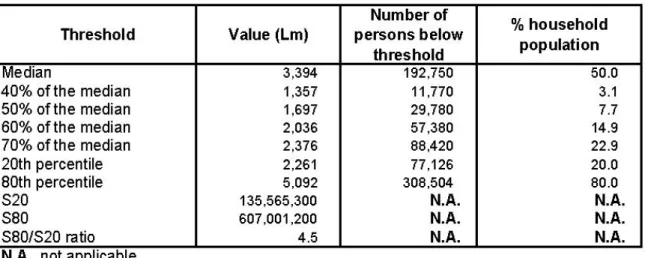
Table 3.1: Poverty Indicators 75
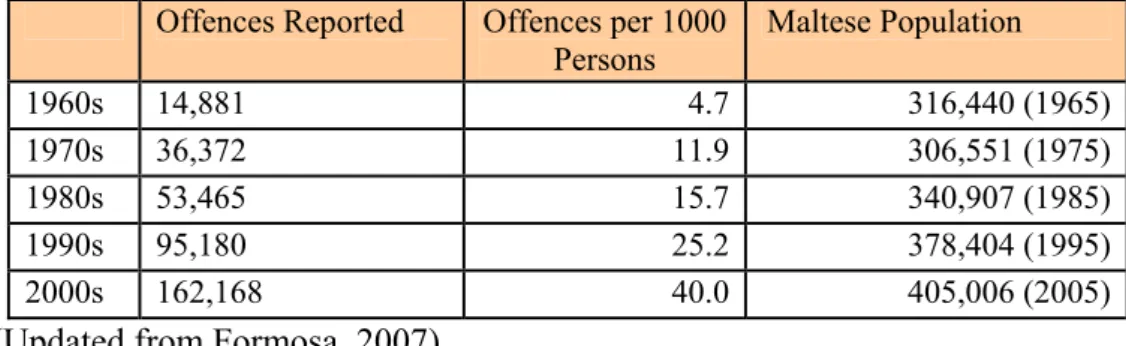
Table 3.2: Offences per 1000 persons – Decades 1960s-2000s 78
Table 5.1: Documentation review 105
Table 5.2: Intergenerational database structure 109
Table 5.3: Attributes relevant to the study 124
Table 5.4: List of Variables used for analysis 132
Table 6.1: Convictions for the general prison population by decade 149
Table 6.2: Number of individual inmates by decade 149
Table 6.3: Crimes by Type using Main Categories of the General Prison Population
150
Table 6.4: Number of individuals (counts) by decade 152
Table 6.5: Co-offending Occurrences for the General Prison Population 158
Table 6.6: Offences of the Intergenerational, Non-Family and General Prison Population
165
Table 6.7: Comparison of Gs by percentage of offences 169
Table 6.8: Number of Gs by Offence counts across decades 169
Table 6.9: Number of Crimes by Family Size 170
Table 7.1: Number of families and individuals in prison vis-a-vis number of
incarcerations per family structure: 1950 – 2010 179
Table 7.2: Number of families and individuals in the 10+ 179
Table 7.3: Seriousness Conjunctivity for relationships: siblings, parental and spouses
202 Table 8.1: Analysing the proportionality of Family presence based on a national
rate calculation
223
Table 8.2: Rate Calculator 224
Table 8.3: League Table of Residential presence of Intergenerational,
Non-Family and the PopGen cohorts 226
Table 8.4: Percentage Lifetime spent in Prison for Intergenerational Cohort 230
Table 8.5: Employment by population cohort using ISCO codes 248
Appendix 2
Appendix 3
Table 1: Relationship vs Offences Main - Category – All Offences 313
Appendix 4
Table 1: Relationship Type: 2 Node Structures 319
Table 2: Relationship Type: 3 Node Structures 320
Table 3: Relationship Type: 4 Node Structures 321
Table 4: Relationship Type: 5 Node Structures 322
Table 5: Relationship Type: 6-9 Node Structures 323
Table 6: Relationship Type: 10+ Node Structures 324
Appendix 5
Table 1: League Table of Residential presence of Intergenerational, Non-Family
List of Figures
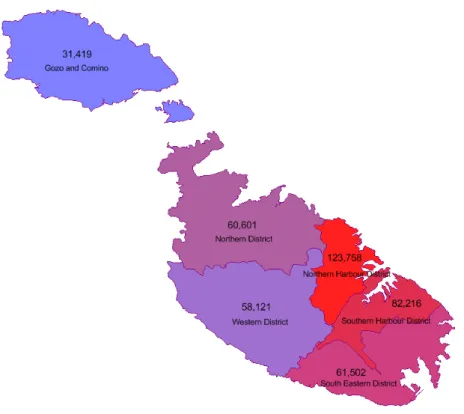
Figure 3.1: The Population of the Maltese Islands (NUTS4) 68
Figure 3.2: Crime trends across the decades from 1960s to 2000s 80
Figure 5.1: Yellow files 102
Figure 5.2: Storage at CCF 104
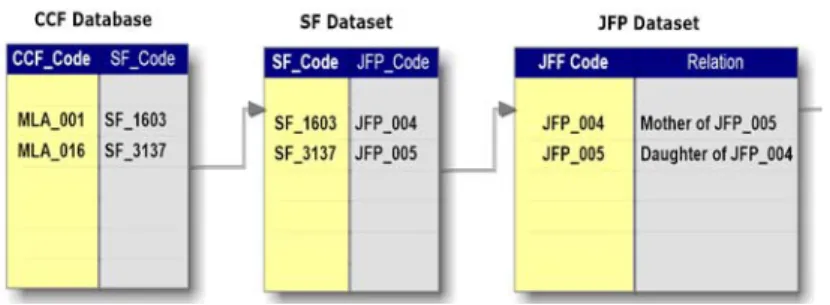
Figure 5.3: The three databases linkages employed in the fieldwork process 107
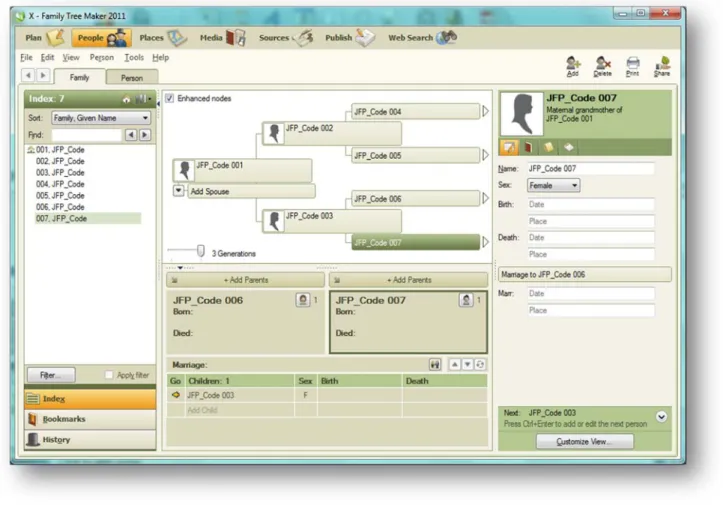
Figure 5.4: Family Tree Maker Input Interface 114
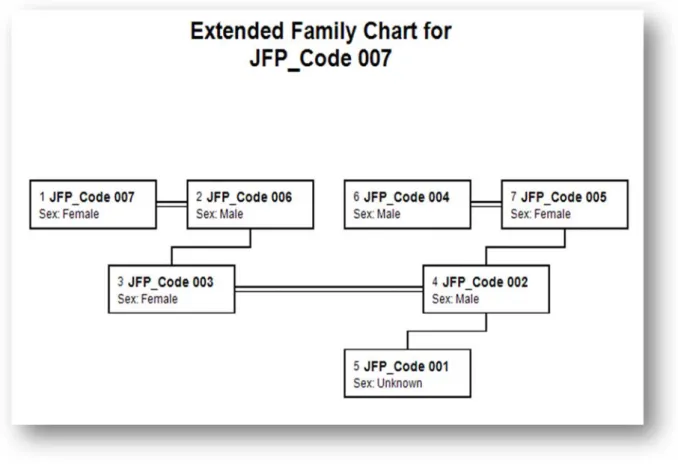
Figure 5.5: Family Tree Maker Output Tree 115
Figure 5.6: The full model 116
Figure 5.7: Registration Questionnaire 121
Figure 5.8: CCF aerial imagery 123
Figure 5.9: Physical Ledgers 124
Figure 5.10: Main CCF Datasets 126
Figure 5.11: Main CCF Ledger Attributes 127
Figure 5.12: Census Enumeration Areas Map 128
Figure 5.13: The different types of trees 138
Figure 5.14a: The Vertical structures: Initial levels 140
Figure 5.14b: The Horizontal Structure: Initial levels 141
Figure 5.14c: The Multi-Dimension Vertical-Horizontal Structure: Initial levels
142
Figure 6.1: Individuals (frequency) by decade 153
Figure 6.2: Recidivism by Cohort 156
Figure 6.3: Recidivism times by cohort 157
Figure 6.4: Co-offending by cohort 159
Figure 6.5: Age distribution by cohort 162
Figure 6.6: Offence Categories – Percentages 163
Figure 6.7: Sentence Length (percentage) by cohort 167
Figure 6.8: Crimes per Offender by Family Size and Trend-line 171
Figure 6.9: Crimes per Offender by Family Size and Trend-line less the two-largest families
171
Figure 7.1: Most Dominant relationship: 2-Node Structure 185
Figure 7.2: Most Dominant relationship: 3-Node Structure 189
Figure 7.3: Most Dominant relationship: 4-Node Structure 191
Figure 7.4: The ¬orma 193
Figure 7.5: Co-offending by main offence category and relationship 207
Figure 7.6: Time interval precedence 210
Figure 7.7: Time interval for parents preceding offspring 211
Figure 7.8: Siblings at CCF at the same time 212
Figure 8.1: Percentage lifetime spent at CCF 230
Figure 8.2: Offenders’ Residence 2000s – Intergenerational cohort 235
Figure 8.3: Map of Intergenerational Individual Offenders residing in Poverty hotspots.
236 Figure 8.4: Families residing in Poverty hotspots by Locality in the 2000s–
NUTS5 237
Figure 8.5: Map of Intergenerational Individual Offenders residing in offender Residence hotspots
239
Figure 8.6: Individuals in Offender Hotpots by Locality in the 2000s 239
Figure 8.7a: Map of individuals residing in Offender Residence hotspots and poverty hotspots in the 2000s
240 Figure 8.7b: Map of individuals residing in offender residence hotspots and
poverty hotspots: detail of the Grand Harbour Area 241
Figure 8.8: Literacy by Population Cohort 245
Figure 8.9: Employment by population cohort 249
Appendix 1
Figure Key 302
Figure 1: British Studies Consolidation 303
Figure 2: American Studies Consolidation 304
Figure 3: Scandinavian Studies Consolidation 305
Figure 4: Netherlands Studies Consolidation 306
Figure 5: British-Netherlands Comparative Consolidation 307
Appendix 3
Figure 1: Highest 15 categories of offence types by decade 312
Appendix 6
Figure 1: Map of Poverty Hotspots (NNH1 – Nearest Neighbour Hierarchical Clustering)
328
Figure 2: Map of Offender Residence hotspots and Poverty hotspots 328
Chapter 1: Introduction
1.1 Aim of the Research
Functionalists depict the family as a positive, universal social institution which addresses the needs of its members by fulfilling four key societal functions; sex, reproduction, education and economic factors (Murdock, 1949; Parsons, 1951). Within this close-knit structure, children experience primary socialisation, a process through which they acquire the societal norms and values that set the building blocks for an individual’s life and the “stabilisation of personalities” as adults (Gillin, 1954). Critics argue that this is in tune with an ideological stance deeply rooted in a conservative framework that underestimates and ignores the negative aspects of the family such as domestic violence, aggression, delinquency and crime (Simons, Simons & Wallace, 2004).
All countries embrace different family types as fundamental units shaped and moulded by society. Thus, the family as a fundamental unit serves as a source of identity to its members. The family as a social institution has experienced a significant amount of changes in view of increased separation and divorce rates, the increase of one-parent households, and reconstituted families. In addition, there are further pressures that emanate from constraints rooted in socio-economic inequalities (Collishaw, Goodman, Pickles & Maughan, 2007), and the increasing urges that feature in a materialistic contemporary era (Eckersely, 2006). Changes are socio-economic and socio-cultural in nature and represent different realties across space and time, and, are heavily influenced by the context of the society in which they occur. This said, however, there is no doubt that crime is inevitable (Durkheim, 1895) and is integral to the social context where the concept of a crime-free society represents more of a “utopia”.
It is noted that imprisonment rates have increased in Europe and in America between the end of 2008 and May 2011 (Walmsley, 2009) resulting in a significant number of children having parents in prison (Campbell Systematic Reviews, 2009; Murray & Farrington, 2008). In the Lappi-Seppälä (2011) comparative study of imprisonment rates (1992/1995 and 2009/2010) in Europe, all countries except four (Estonia, Lithuania, Romania, Finland) experienced an increase in imprisonment rates. Interestingly, the “small states of Croatia, followed by Malta and Cyprus” attested the highest increases (Lappi-Seppälä, 2011, p.304). This phenomenon
led to an increase in empirical interest in the relationship between the family as a fundamental social institution and the occurrence of crime in view of the harm done to the social fabric through the erosion of social cohesion and in turn social capital (Siegel, 2009).
Focusing on a specific country, the main aim of this study is to develop an understanding of the concentration of incarcerations in Maltese families and to analyse the evolvement of crimes across the generations. The study analyses whether the family has a role to play in crime particularly in the Maltese islands. As imprisonment rates have increased in Malta, it is expected that an increasing number of children will have parents imprisoned. Malta as an island state, is built on families rooted in social solidarity and support networks (Formosa, 2007), which may impact upon the likelihood of crime occurring within families. This research
involves an analysis of all incarcerated persons1 in the Maltese Islands from 1950 to 2010. This
60-year span covers at least two to three generations of Maltese families. The study is pioneering in that it builds a comprehensive lineage structure of related incarcerated offenders across time and space.
1.2 Introduction to the topic
1.2.1 Synopsis: Theoretical Background
Intergenerational crime research focuses on studying the crime patterns of generations of families across decades. Thornberry, Freeman-Gallant, Lizotte, Krohn and Smith (2003), in their study on intergenerational antisocial tendencies as a series of behavioural patterns, claimed that such tendencies, inclusive of crime, are transmitted across generations of families. This was further strengthened by Thornberry (2009) and Johnston (2006) that parents and children, not only manifest genetic similarities such as eye and hair colour, but also, exhibit similar forms of anti-social and criminal behaviour. The criminal activities of fathers and their sons are widely researched and an increasing body of research has explored the concentration of convictions amongst siblings. Intergenerational offending research is an implicit theme within Developmental and Life Course Criminology (DLC) and within the DLC umbrella the
notion of the criminal career2 theoretical framework is highly relevant. The main exponents of studies intended to explore crime continuity across generations of families employ, primarily, the use of longitudinal designs through a blend of prospective and retrospective techniques. However, irrespective of the methodological design employed, this type of research points towards a scenario in which lives are linked (Thornberry et al., 2003), where parents and children tend to show similar anti-social patterns, (Thornberry, 2009) and the correlation between parents’ and children’s crime is strong (Johnston, 2006). Having a parent and/ or a sibling involved in crime is considered as a risk/mediating factor in the cycle of crime. Also, this scenario could be stimulated by other crime-related constructs that simultaneously interact with family risk factors (Bijleveld & Wijkman, 2009) sustaining crime continuity across generations of related individuals. However, it is not expected that all criminal parents bear criminal children and neither do all anti-social children grow into anti-social adults (Robins, 1978). In fact, some of these children become resilient young adults (Hoffmann & Cerborne, 1999). On the other hand, it is also likely that siblings, particularly those sharing similar backgrounds, influence each other’s behaviour irrespective of their parents’ criminal or law-abiding tendencies. The focus of intergenerational research is to study similarities and differences across individuals, so as to understand to what extent lives are linked and to what extent behavioural models persist across generations of families. Nonetheless, research in the field falls short of studying the underlying mechanisms (Bijlevald & Farrington, 2009; Putkonen, Ryynänen, Eronen & Tiihonen, 2002; Thornberry et al., 2003 ) and related risk and mediating factors which may identify how and why crime runs in families.
Social scientific research is interested primarily in understanding human development and behaviour. As researched since the early days of the fathers of sociological thought, this is essentially aimed at comprehending both conventional as well as deviant behaviours of societal members (Comte, Durkheim, Dahrendorff, Weber, Marx, and Merton). Theories that are most relevant to intergenerational offending research include the general theory of crime (Gottfredon & Hirschi, 1990); social control theory (Hirschi, 1969); morality (Wikström, 2004, 2006, 2008); rational choice theory (Clark & Cornish, 1985); social interactionists’ perspective (Glaeser, Sacerdote & Schienkman, 1996); differential association theory (Sutherland, 1947); social disorganisation framework (Park & Burgess, 1924; Shaw & McKay, 1942) and the
2 Criminal career research adopts the intragenerational genre of research; the study of criminal careers and
classic class-crime debate (e.g. Ferguson, Swain-Campbell & Horwood, 2004). The general
theory of crime is the most cited theory in intergenerational research as low self-control3 is
indicative of the emergence of conduct problems.
However, other research highlights that social control4 and the provision of moral constraints
regulate conduct behaviour. Wikström’s situational action theory (SAT) combines routine activity theory, as rooted in environmental criminology, self-control theory and rational choice theory in order to focus on morality as a construct in explaining and understanding crime. SAT
highlights the role of the setting5 and the nature of criminogenic exposure that individuals are
subjected to. One such exposure, marriage, has been defined as a turning point for desistance as identified by Glueck’s 1950 study; however intimate relationships with partners involved in crime posits an imminent risk and could serve as a fertile ground for intergenerational transmission. Also, crime committed by parents could indicate poor social control and poor transmission of moral standards. Social interactionist (Glaeser et al., 1996) claim that people’s behaviour is shaped by the actions of others and it is anticipated that one is more crime prolific in a “bad environment”. This directs one’s attention to the observation that people of similar characteristics opt to live in similar neighbourhoods. The correlation between inequality, socio-economic deprivation and crime can be explained using a social disorganisation framework highlighting the clustering of families in neighbourhoods laden with socio-economic strain and where social exclusion is reinforced.
In terms of the local context, most sociological research in the Maltese Islands has focused primarily on the functional role of the family as a positive social institution disregarding the fact that the family, per se, could be responsible in generating and maintaining a cycle of disadvantages across generations (Simons et al., 2004). Nonetheless, crime research in Malta shows that the typical incarcerated offender is a young unmarried male displaying drug-related tendency (Malta Probation Service, 2007 cited in Azzopardi & Scicluna, 2009, p.160). Male and female inmates alike tend to belong to the younger cohort; mostly between 20-24 years of age (Formosa, 2007). The prison population at times in 2014 stood at 630 as compared to a population of 420,000. This could be attributed to various scenarios; harsher and longer
3 An internal means of control 4 An external means of control 5 Family and society
incarceration sentences, increased conversions of unpaid fines to prison terms and an increase in the number of white collar offenders, amongst others.
It is essential that intergenerational crime research is carried out in the Maltese islands since this topic is innovative. Detailed research here has not previously been conducted due to a dearth of data, and therefore the family unit has not been studied in relation to crime. Additionally, the intergenerational genre has not featured in countries where the geographical and cultural factors influencing family life are so strong as to render it difficult for individuals to detach from their “roots”, leading to the propagation of crime across the generations and, in turn, act directly or indirectly as potential “crime promoters” or alternatively as “crime preventers” (Ekblom, 2010).
1.3 Chapter Structure
This thesis is structured as follows:
1.3.1 Chapter 2: Literature Review
Chapter 2 provides the reader with an overview of the main exponents of intergenerational research carried out in different countries. This is aimed at setting the foundations for understanding the empirical rationale of research focusing on studying the “persistence” of behaviours across individuals and subsequently across generations of families. A discussion of the major themes that stem from the reviewed studies follows where each theme is presented as a risk and/or mediating factor in the cycle of crime continuity. The themes include the: i) role of the family as a social institution ii) key figures in crime transmission; iii) gender related issues and partner choice; iv) exposure to crime; and v) other risk factors linked to intergenerational continuity of offending. A discussion on the mechanisms that attempt to explain how and why crime runs in families is given. This is, in turn, backed up by a review of theories that are often employed to understand crime continuity whilst also highlighting the gaps identified in the reviewed literature.
1.3.2 Chapter 3: Malta - An Overview
The main emphasis of chapter 3 is to provide a discussion on the cultural, demographic, family, socio-economic factors and crime constructs that feature in Malta. It sets the context for understanding the setting (country) in which the study is carried out, focussed on Maltese nationals interned at Corradino Correctional Facility (CCF) and their respective families. The chapter aims to identify the aspects of family life in Malta that could influence crime continuity, particularly in view of the issues and gaps identified in the international literature.
1.3.3 Chapter 4: The Research Questions and Research Framework
Chapter 4 outlines the research framework for this thesis. This serves as a launching pad to discuss the aims of the study. Following this is an overview of the three research objectives emanating from the research aim. Objective 1 explores conviction patterns of crime families whilst objective 2 examines the potential influence of familial relationships on crime patterns. The third objective outlines potential risk factors which could be linked to the intergenerational continuity in offending. This, in turn, is supported by a discussion that outlines the five research questions resultant from the objectives for this Malta study outlined in Section 4.5. The reader is provided with an in-depth overview of the empirical rationale derived from the gaps identified in the international literature (Chapter 2) and the cultural aspects that could influence the intergenerational continuity of offending in Malta (Chapter 3). In addition, the discussion presented in Chapter 4 highlights those criminogenic aspects that were beyond the remit of this research.
1.3.4 Chapter 5: Methodology
This methodological chapter provides a summary of the research design employed in the study of intergenerational offending in this thesis. An overview of the methodological approach follows outlining the three phases of this study and the research objectives within them. A discussion on the collection of data and sampling techniques used is offered through a synopsis of the data sets used in this study; data availability; and the reliability of the data. The limitations of the research design and the ethical issues pertaining to the study are also outlined. This is also supported by a discussion focusing on the analysis of data and an explanation of
the methodological tools employed in the process of data analysis. A description of the attributes used for the statistical and spatial analysis of data is also provided.
1.3.5 Chapter 6: Profile of Intergenerational Offending in Malta
Chapter 6 presents the findings emanating from the first research objective focusing on the creation of a profile of intergenerational continuity in offending in Maltese families. An overview of the general prison population is presented. Here the reader is provided with a description of the population sub-sets; the intergenerational cohort and the non-family component. The next two sections then present the analysis of findings related to the first research question, focusing on the absence or presence of intergenerational continuity in offending in Malta. The first section aims to highlight whether or not the phenomenon of intergenerational offending exists in Malta. A comparative cohort analysis taken up in the second part of Chapter 6 aims to identify potential crime patterns specific to the intergenerational cohort through the examination of crime types, recidivism trends and co-offending. This, in turn, is supported by an in-depth analysis of crime types and length of sentences served at CCF. This leads to a discussion on the number of generations attesting an association of convictions between related inmates together with an investigation on crime prevalence through the analysis of crime family size.
1.3.6 Chapter 7: Familial Relationships amongst Maltese Offenders and their effect on crime patterns
Chapter 7 presents the findings from the second research objective; concerned with the influence of relationships on emerging crime patterns tackling two research questions. A discussion linked to the second research question summarises the type of relationships between related individual inmates interned at CCF. This is complemented by an overview of the mapping exercise which was carried out to compile “trees” representing crime families who constitute the entire intergenerational cohort. The focus here is on exploring the size of crime family and the nature of relationships that feature in the respective structure. Vignettes are employed to provide a biographical description of relationships and “criminal careers” within a specific crime family. The analysis emanating from the second research question sets the foundation for the third research question. The focus here is on analysing the potential
influence of relationships identified in the mapping of crime families on emerging crime patterns focusing primarily on seriousness of offending and recidivism. The discussion is aimed at studying the impact of exposure to crime on crime continuity.
1.3.7 Chapter 8: Transmission risks of intergenerational offending
Chapter 8 outlines other risk and/or mediating factors which could directly or indirectly influence the transmission of crime across generations. The discussion focuses on the third research objective exploring the potential transmission risks in intergenerational continuity of offending, from which two research questions arise. The findings from the spatial and statistical analysis are presented into two sections. The first section outlines the spatial factors, which could act as potential “crime promoters” in view of offender residence and poverty hotspots identified in another study carried out in Malta (Formosa, 2007). This is aimed at identifying potential concentrations of crime families in “areas” that could promote crime continuity. The analysis presented in the second part of the chapter focuses on the presence of individual (literacy and school type) and social (employment; activity vs. non-activity) risk factors as potential transmission proxies.
1.3.8 Chapter 9: Conclusion
Chapter 9 brings together the results elicited in the findings chapters (Chapters 6 to 8) and highlights the major issues pertaining to Maltese culture and its potential relationship to social constructs and crime issues. The discussion reviews the results in line within the research framework outlined in Chapter 4. The chapter concludes through the setting out of recommendations for policy review and highlights the areas/gaps that could be taken up for further research.
Chapter 2: Literature Review
2.1Introduction
The aim of this chapter is to review and understand literature pertaining to the study of intergenerational transmission of crime. The focus is to explore offences and their association with the family as a social institution, in order to comprehend the potential role of family in the cycle of crime continuity. This chapter reviews the development of intergenerational crime research, and provides the reader with an overview of the main exponents and landmarks in this genre of research. This is followed by an outline of the methodological approaches employed to study whether or not lives within families are linked through crime.
Findings from the reviewed studies are grouped into key criminological concepts, which are presented as risk factors and “promoters” of potential incarcerations of different family members. This is corroborated by a review of the mechanisms that could explain how and why crime runs through families, followed by an overview of the various theoretical frameworks relevant to the study of the intergenerational transmission of crime. This chapter concludes with a synopsis of the main findings, outlines gaps in existing knowledge, and sets the context for justifying Malta as a case study in intergenerational crime research.
2.2 Criminal career research sets the foundations to intergenerational crime
research
Criminal career studies have predominantly concentrated on the analyses of onset and development of the criminal trajectory, thus exploring offending across the life course for individual offenders. The main focus of this type of research, which adopts an intragenerational approach, is to focus on the development of offending careers at the individual level, prevalence of offending, persistence, and, to a lesser extent, desistance from crime (Bottoms, 2006). This genre of research is central to the Developmental and Life Course
Criminology (DLC) (Farrington, 2008). Intergenerational crime research explores the crime
patterns of generations of families across decades. Thus, intergenerational research investigates the similarities and differences between individual offenders who are related to
one another by familial ties. The focus is primarily on fathers and sons, and to some extent siblings covering at least two to three generations.
Intergenerational research was launched through DLC, and became renowned in the 1980s through Blumstein’s study yielding information on criminal careers and offending patterns (Blumstein, Cohen, Roth & Visher, 1986) and gained more publicity through subsequent longitudinal studies (Kyvsgarrd, 2003; Liberman, 2010; Piquero, Farrington & Blumstein, 2007). DLC incorporates under its umbrella the criminal career and risk factor prevention paradigms, as well as life course criminology. The study of criminal careers is fundamental to
this theoretical framework (Farrington, 2008). Also, criminal career research6 focusing
prominently on studying individual life course trajectories is described by Van De Rakt, Nieuwbeerta and De Graaf (2008) to be rooted in the “intragenerational” developmental framework of crime. Intergenerational crime research is less popular than individual criminal career research as it is time consuming, covers at least two family generations thus capturing data on parents and children, and requires the identification and use of a control group (Van de Rakt et al., 2008).
The Cambridge Study (West & Farrington, 1977) is the most frequently cited intergenerational empirical evidence and is regarded as a “landmark” in criminal career research (Van De Rakt et al., 2008). Farrington, one of the most prominent figures in criminal career research in the past decades, has set the building blocks for intergenerational crime research in the United Kingdom (UK) by conducting the Cambridge Study. This survey studied crime and delinquency of 411 males, mostly aged 8 and 9, in 1961-2 living in a working class area in London (Farrington & Hawkins, 1991). The study identified four factors as important predictors of offending including: economic deprivation, crime in the family, lack of parental skills and school failure (Farrington & West, 1990). The Cambridge Study originally aimed at understanding and explaining the development of delinquency and crime of inner-city males sets the groundwork for intergenerational research by identifying that convicted parents and delinquent siblings are important predictors of offending (Farrington & West, 1990). The study findings also consolidate the concept of continuity in offending across generations, as crime is part of a cycle of antisocial tendencies (Farrington, Jolliffe, Loeber, Stouthamer-Loeber & Kalb, 2001). Problem children tend to grow into problem adults who, in turn, bear problem
6 Examples: Blockland and Nieuwbeerta (2005); Blumstein et al. (1986); Bushway, Brame and Paternoster (1999);
Farrington and West (1990); Farrington and Wikström (1994); Laub and Sampson (2003); Piquero, Farrington and Blumstein, (2003); Stouthamer-Loeber, Wei, Loeber and Master (2004).
children (Farrington & West, 1990), within the family unit which is the social institution responsible for child rearing (Farrington, 2005).
Another noteworthy longitudinal study within the criminal career framework is the Pittsburgh Youth study (Loeber, Farrington, Stouthamer-Loeber, Moffitt & Caspi 1998a). This study analysed a sample of 1,517 inner-city boys attending public schools and representing different age groups. The research primarily aimed at studying the developmental delinquency pathways from childhood to early adulthood, inclusive of dependence of substances (Loeber, Wei, Stouthamer-Loeber, Huizinga & Thornberry, 1999). Like the Cambridge study, this research focused on the intergenerational aspects of crime. Using arrest data, a series of family members ranging from parents, to siblings, to grandparents and uncles were identified as predictors of delinquency, with the father being the most significant and influential crime predictor (Farrington et al., 2001). The Pittsburgh Youth study confirmed clustering of offending in families, with 12% of the siblings studied generating 59% of the delinquent acts (Van de Rakt, Nieuwbeerta & Apel, 2009) corroborating with previous findings by Haynie and McHugh (2003) and Rowe and Gulley (1992).
Criminal career research has served as the foundation for theory and methods to intergenerational crime research, since life-course and intergenerational frameworks of offending merge well (Van de Rakt et al., 2008) and, to a certain extent, overlap. Criminal career research primarily focuses on the prevalence and interconnectedness of factors (Farrington & Maughan, 1999), related to onset, duration and desistance, as sequential stages of the criminal career (Farrington, 1995). This research identifies parenting styles (Jang & Smith, 1997) and poor self-control (Hirschi, 1969) as having repercussions for subsequent intergenerational impacts and the continuity of offending (Thornberry et al., 2003). Criminal career research also identifies factors such as stable employment (Blockland & Nieuwbeerta, 2006; Laub & Sampson, 2003) and marriage as signposts to desistance and transition to conventional trajectories (Blockland & Nieuwbeerta, 2006; Farrington & West, 1995; King, MacMillan & Massoglia, 2007; Laub & Samspon, 2003; Laub, Nagin & Sampson, 1998; Sampson & Laub, 1993; Sampson, Laub & Wimer, 2006; Theobald & Farrington, 2009). This partly explains why not all criminal parents bear criminal children as “detours and unpredictable outcomes” account for within individual and between individual differences in the life-course (Le Blanc, 2008).
However, as Bottoms (2006) points out, when Laub and Sampson (2003) refer to stable employment and marriage as “turning points”, they fail to explain the choice process involved in responding to such detours. Human beings as “actors” constantly restructure their past experiences so as to organise and mould their future responses with a visualisation of setting foot in a new life period (Emirbayer & Mische, 1998). It is amply clear that not all antisocial children grow to become antisocial adults (Robins, 1978). In addition, reduced family hardships positively affects conduct problems (Barker & Maughan, 2009) and thus somewhat account for a modest intergenerational transmission of anti-social behaviours. This is seen in the Thornberry et al. (2003) study, attesting that such transmission is mediated by economic problems and parenting conduct behaviours, with effects fluctuating according to second generation gender.
2.3 The methodologies of Intergenerational research
A series of behavioural patterns including crime have been assumed and claimed by various authors (Blazei, Iacono & Krueger, 2006; Herdon & Lacono, 2005; Johnston, 2006; Lussier, Farrington & Moffitt, 2009; Moffitt, 1993; Rowe, Rodgers & Meseck-Bushey, 1992; Thornberry, 2009), to be transmitted across family generations, thus highlighting that lives are linked (Thornberry et al., 2003). Furthermore Jacobson, Prescott, Neale and Kendler (2000) also state that the prevalence of anti-social tendencies increases across succeeding generations, as explained by Moffit (1993) and Lussier et al. (2009). These tendencies are carried from one stage to the other in the life-course as such tendencies are shared between parents and their children (Herdon & Iacono, 2005) whilst siblings living within the same family unit tend to manifest similar tendencies (Rowe et al., 1992). Early engagement in such tendencies limits one’s opportunities for change (Moffitt, 1993) since one’s engagement in pro-social activities such as stable employments are reduced. Robins (1978) and Hoffmann and Cerborne (1999) appear to disagree with the above mentioned authors however, stating that not all criminal parents bear criminal children and not all anti-social children grow into anti-social adults since they become resilient young adults and thus learn to cope with “strains” (Agnew, 1997).
Various anti-social behaviours and criminal behaviours have been investigated in the study of
intergenerational crime including aggressive behaviour (Delsol & Margolin, 20047; Shaw,
2003); domestic violence (Wareham, Paquette Boots & Chavez, 20098); intimate partner
violence (Lussier et al., 2009); alcohol abuse (Fuller et al., 20039); drug abuse (Hjalmarrson &
Lindquist, 2009; Thornberry, 2009); child abuse (Egeland & Susman-Stillman, 1986; Widom,
1989) and crime more generally (Bijlevald & Wijkman, 200910; Putkonen, Ryynänen, Eronen
& Tiihonen, 2007; Rowe & Farrington, 1997). These behaviours have been empirically claimed to persist to some extent across decades representing generations of families.
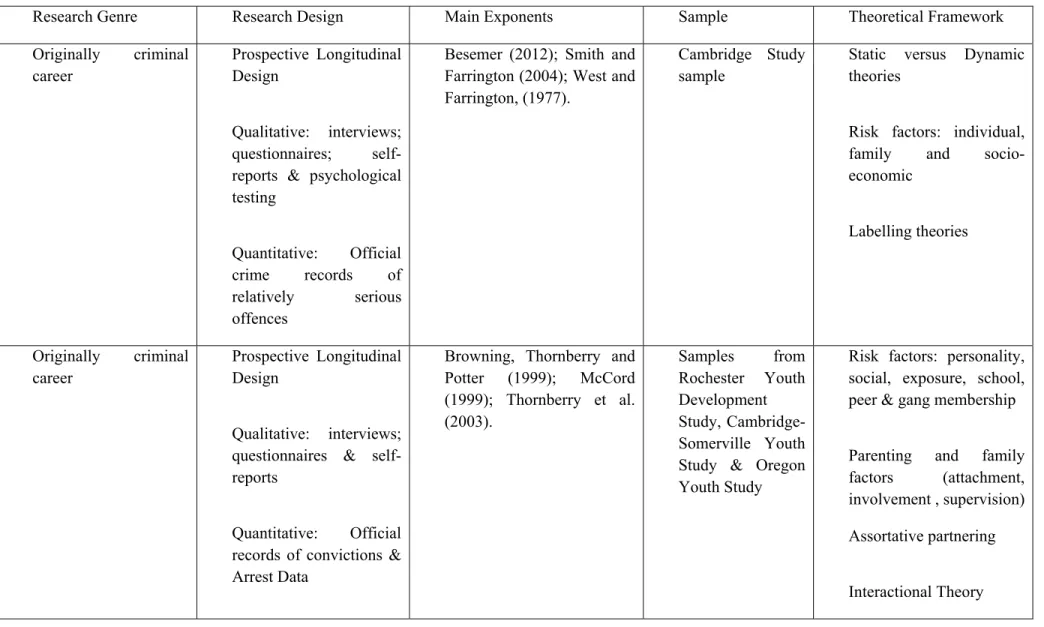
Intergenerational research is a slow growing body of research because it is time consuming, costly, frequently adopts retrospective methodologies, and typically relies on very few informants (if any). There are various approaches to study continuities in crime. These include: criminal career research as discussed above; the intergenerational design; experimental methods; case studies, and the most recent design referred to as the life-course trajectory. Table 2.1 summarises the methodological characteristics of the approaches outlined above, the theoretical premise/s, and the examples of research that fall within each group. The main exponents of research in the field are categorised by the similarities of the methodological design that are shared between the individual examples of research, which groupings have shared features that make them distinctive. Nonetheless, the main thrust of the approaches, irrespective of the design employed, is the study of crime across family generations.
7 Other studies include Bandura (1973); Doumas, Margolin and John (1994); Fuller et al., (2003); Huesemann,
Eron, Lefkowitz and Walder (1984); Mihalic and Elliott (1997); Osborn and West (1979). 8 Other studies include Egeland, Jacobvitz and Sroufe (1988); Fagan, Hansen and Stewart (1983). 9 Other studies include Jacob (1986); McCord (1999); Velleman (1992).
10 Other studies include Bijlevald and Farrington (2009); Farrington, Coid and Murray (2009); Farrington,
Lambert and West (1998); Farrington et al. (2001); Ferguson (1952); Glueck and Glueck (1950); Kim, Capaldi, Pears, Kerr and Owen (2009); McCord, 1999; Thornberry et al. (2003); Van de Rakt et al. (2008), Van de Rakt et al. (2009); Van de Rakt, Ruiter, De Graff and Niuewbeerta (2010).
Table 2.1: Reviewed intergenerational research: Methodological characteristics and theoretical framework
Research Genre Research Design Main Exponents Sample Theoretical Framework
Originally criminal career Prospective Longitudinal Design Qualitative: interviews; questionnaires; self-reports & psychological testing
Quantitative: Official
crime records of
relatively serious
offences
Besemer (2012); Smith and Farrington (2004); West and Farrington, (1977).
Cambridge Study sample
Static versus Dynamic theories
Risk factors: individual,
family and
socio-economic Labelling theories Originally criminal career Prospective Longitudinal Design Qualitative: interviews; questionnaires & self-reports
Quantitative: Official records of convictions & Arrest Data
Browning, Thornberry and
Potter (1999); McCord (1999); Thornberry et al. (2003). Samples from Rochester Youth Development Study, Cambridge-Somerville Youth Study & Oregon Youth Study
Risk factors: personality, social, exposure, school, peer & gang membership
Parenting and family
factors (attachment,
involvement , supervision) Assortative partnering Interactional Theory
Research Genre Research Design Main Exponents Sample Theoretical Framework Originally criminal career Prospective & Retrospective designs Municipal records; Population Registration data & Crime records of convictions
Nijhof, de Kemp and Engels (2009); Van De Rakt et al. (2008); Van De Rakt et al. (2009); Van De Rakt et al. (2010).
Dutch Criminal
Career & Life Course Study
Static and Dynamic
Theories
The General Theory of Crime
Risk factors:
socio-economic, learning by imitation, socialising with
similar peers,
neighbourhoods laden
with social constraints and parenting styles
Social Learning Theory Nature vs. Nurture Labelling
Experimental & Case Study Approach
Quantitative: Official crime record;
Socio-economic data &
residence
Hjalmarrson and Lindquist (2009); Putkonen et al. (2007).
Adoption & Twin Studies
Social background, socio-economic constraints and exposure to individuals (parent/s) in crime
Research Genre Research Design Main Exponents Sample Theoretical Framework Small sample of homicide recidivists Nature vs. Nurture Timing of fathers’ convictions Parenting: quality of relationships Life-course trajectory: new approach Retrospective techniques Matched control group
Besemer and Farrington (2012); Van de Rakt et al. (2008).
Originally Dutch Criminal Career & Life Course Study and the Cambridge
Study Sample respectively Semi-parametric group-based analysis Differential Association Theory Biological factors Self-control Theory Socio-economic factors and environmental constructs
Timing and Intensity of Crime
Most studies carried out to date particularly in the UK, United States (US) and the Netherlands, have primarily been designed to generate data necessary for criminal career research. Typically, such data have been used for intergenerational crime research covering two to three
and even five successive family generations. Five British11, four American12, two Nordic13,
five Dutch14 and one British-Netherlands15 comparative studies were reviewed for the purpose
of this thesis and the main findings are presented in section 2.4 (See Figures 1 to 5 in Appendix 1 which depict the research aims, methodological rationale, and findings and limitations distinguishing studies by country). These studies are the main exponents of research investigating the continuity of crime across generations of families.
All British studies examined here have used the sample of people researched in the Cambridge Study discussed above. All of these studies adopted a predominantly prospective longitudinal
design16 which amalgamates qualitative techniques and quantitative methodological tools17
using official crime records. The original Cambridge study sample of 411 South-London males represent the second generation referred to as G2. Their parents were traced retrospectively; referred to as G1 (first generation). The third generation (studied prospectively) known as G3, represents the children of G2 and the grandchildren of G1. The coding system adopted here, which represents the different generations of individuals studied in intergenerational research, is employed in most research exploring crime continuity. The focus is on individual risk factors such as conduct behaviour at school and attitudes, family and social risk factors particularly employment, socio-economic issues, atmosphere at home, parental supervision, and history of
mental health (Farrington et al., 2009).
Similarly, the US studies (Browning et al., 1999; Kim et al., 2009; McCord, 1999; Thornberry et al., 2003) also took on board the prospective longitudinal genre using samples from a series of studies such as the Rochester Youth Development Study, the Cambridge-Somerville Youth Study and the Oregon Youth Study. In turn, qualitative techniques incorporating interviews
11 Besemer (2012); Besemer and Farrington (2012); Farrington, et al. (2009); Smith and Farrington (2004); West
and Farrington (1977).
12 Browning et al. (1999); Kim et al. (2009); McCord (1999); Thornberry et al. (2003). 13 Hjalmarrson and Lindquist (2009); Putkonen et al. (2007).
14 Bijlevald and Wijkman (2009); Nihjof et al. (2009); Van de Rakt et al. (2008); Van de Rakt et al. (2009),Van
de Rakt et al. (2010).
15 Besemer, Van der Geest, Murray, Bijlevald and Farrington (2011).
16Prospective longitudinal research incorporates repeated observations of identified variables over decades. A
selected time period is identified and participants are studied over the years. 17 Tools refer to statistical software and measurement scales.
and self-reports together with quantitative analysis of data from official records18, convictions and arrest data were used to unveil the complexity of crime in addition to the psycho-social
component. As with the British studies, retrospective19 methods are used in the US to trace
back G1, the parents of the targeted G2 sample from the original respective studies.
Most research in this field undertaken in the Netherlands (Bijleveld & Wijkman, 2009; Nijhof et al., 2009; Van De Rakt et al., 2008, 2009, 2010) mirrors the British methodological approach in various aspects such as the use of a criminal career database to identify the sample. Other similarities include the use of retrospective techniques to trace back previous generations of the targeted G2 sample, and the amalgamated use of qualitative and quantitative methods in data analysis. A distinctive feature in the Dutch studies is the analysis of demographic realities by focusing on a series of neighbourhoods. These were made possible through the use of official records such as municipal records, population registration data as acquired from the neighbourhoods from which families in crime originate, and crime records such as convictions data. The Bijleveld and Wijkman (2009) study distinguishes itself through its coverage of five generations targeting an identified high risk sample of males focusing on convictions. This study used a prospective and retrospective approach. Dutch criminologists tackled the phenomenon of intergenerational crime research through the application of different research tools using different datasets whilst amalgamating such databases to analyse intergenerational transmission across families.
The methodological strategies adopted by two Scandinavian studies (Hjalmarrson & Lindquist, 2009; Putkonen et al., 2007) are to some extent different from the previously reviewed studies. The Hjalmarrson and Lindquist’s (2009) research was conducted over four phases including: analysis of correlations of fathers’ and children’s convictions; exploring the underlying mechanisms: social and household background; undertaking various experiments such as twin studies to study siblings' behaviour and studying the effects of paternal incarceration on children. Another distinctive feature involved the inclusion of family data with particular focus on socio-economic status and residence. The Putkonen et al. (2007) study adopted the case study approach focusing solely on a relatively small sample of homicide recidivists. Both
18 Sources used comprise: Police, schools, social services and income data.
19 A retrospective study is a longitudinal study that goes back in time by exploring records of previous
studies used quantitative designs to analyse official data of crime records. It must be noted that the use of official crime records ignores unreported crimes.
Another relatively recent methodological technique used in the Netherlands study of Van de Rakt et al. (2008) and the British, Besemer and Farrington (2012) study concerns the semi-parametric group-based trajectory. This focuses on the identification of groups manifesting similar behavioural patterns across life-course trajectories, which in turn caters for group-based analysis (Nagin, 2005). The study employed the “semi-parametric group trajectory methodology”, which is a model that facilitates the design of diverse “age- crime” curves and also caters for the identification of groups of people who share similar behavioural trajectories. This in turn allows for studying criminal propensity at the individual level employing the study of developmental crime trajectories such as in the Van de Rakt et al. (2008) study. This technique represents a retrospective method enabling one to test the similarities and differences between successive generations of families in crime. On the other hand, Van de Rakt et al.
(2008) included a matched control group20 since the criminal career database21 that they used
for their study lacked a control group; children of fathers who had never received convictions.
2.4The intergenerational transmission of crime
Studies in family research show that crime runs and concentrates in families (Bijleveld & Farrington, 2009; Dugdale, 1887; Farrington & Welsh, 2007; Farrington, Barnes & Lambert, 1996; Farrington et al., 1998; Hjalmarrson & Lindquist, 2009; McCord 1991, 1999; Rowe & Farrington, 1997; Van de Rakt et al., 2008, 2009, 2010) as do convictions (Farrington et al., 1996, 2009; Rowe & Farrington, 1997) resulting in situations where criminal children are more likely to have criminal parents. Indeed, when adopting a risk factor approach, parental criminality seems to be the strongest family predictor (Farrington, 2011; Thornberry, 2009). In line with this, studies have addressed the similarities and differences in the crime patterns of parents and their children retrospectively (Rowe & Farrington, 1997; Sampson & Laub, 1993) and prospectively (Farrington et al., 1996; Smith & Farrington, 2004; Thornberry, 2005; Thornberry et al., 2003; Van de Rakt et al., 2008) mostly across two generations of families, adopting an intragenerational developmental framework of crime (Van de Rakt et al., 2008).
20 The matched control group from military record files consisted of 717 males chosen according to birth date so
as to match with research subjects.
Most studies focusing on intergenerational transmission adopt the comparative “any lifetime offending” to link the criminal behaviour of parents and their children without focusing on the timing of parental criminality and the intensity of parental criminality (Besemer, 2012; Besemer & Farrington, 2012). Thus, not accounting for the duration and timing of incarcerations amounts to a failure to challenge the direct examination of the nature of exposure to a criminal family member; learning by imitation/exposure; and the benefits emanating from losing contact with a criminal relative.
On the other hand, most studies that have focused on comparing convictions fail to distinguish between convictions and imprisonment as not all convictions are followed by imprisonment sentences. Moreover, the reliance on official reports conceals the dark figure of crime. This is particularly problematic when studying offending within families because family members tend to protect their relatives and could be also willing to provide alibis to police authorities. Other limitations also exist such as sample size and selection. For example the exclusion and/or limited inclusion of females hinders the study of potential gender related-issues in the continuity and discontinuity of offending. Furthermore, studying the concentration of offending in families proves to be a difficult task due to the constant changes in family units (Farrington et al., 2001).
Besides parental criminality, other risk factors (Refer to 2.4.4) have also been linked to the continuity of offending across generations. Nonetheless, the inclusion of some risk factors and the exclusion of others examined in relation to crime continuity are worth further discussion. An example includes failing to test straightforwardly biological constructs in the intergenerational transmission of crime such as in the Caspi et al. (2002) study of the cycle of
violence in maltreated children, claiming that higher levels of MAOA22 serve as a moderator to
the exposure to maltreatment. Socialising with other delinquent peers is another well documented crime risk factor (Laub & Sampson, 2003; Moffitt, 1993). Delinquent youths hang around with delinquent peers since they share similar characteristics (Scaramella, Conger, Spoth & Simons, 2002). However, the examination of peer influences, peers’ convictions and peers as co-offenders has to a great extent been ignored in intergenerational research.
Ecological approaches in empirical studies of offending emphasise the importance of neighbourhood influences and structural factors such as socio-economic disadvantage, poverty
22 The neurotransmitter-metabolising enzyme monoamine oxidase; the MAOA gene is located in the X