2007 - 2011
Final Report
Road Sector Strategy 2007 - 2011
Final Report
Preface
The Road Sector Strategy 2007 – 2011 (RSS) was prepared for the Government of Mozambique by the Administração Nacional de Estradas (ANE), with the assistance of the Road Fund and Ministry of Public Works and Housing.
The RSS is based upon the Draft Final Report of the Review of Road Sector Strategy and Phase 2 Planning, prepared for ANE by Stewart Scott International (SSI) in Association with Sociedade de Engenharia e Desenvolvimento (SEED). The RSS also draws from drafts of the Paved Road Works Program and Unpaved Road Works Program, both of which were also prepared by SSI and SEED.
The present volume (and Map Supplement) summarizes and revises Volume I of the Draft Final Report, The Revised Road Sector Strategy, containing the essential features of the Strategy. Volume II: Strategic Analysis, is intended for readers who want to delve further into the analysis behind the Strategy. In addition to an analytical review of the original Integrated Road Sector Strategy and detailed explanation of the proposed changes, it contains the full versions of the Strategic Maintenance Plan and the Preliminary Investment Plan and Project Prioritization. Volume III: Stakeholder Consultation includes much of the basic input that went into the revision of the Strategy, in addition to a report on the seminar that was held to discuss the initial findings of the Review. Volume IV: Candidate Projects is a compendium of the candidate projects and the details on their technical aspects and justifications. Volume V: Maps, contains all of the maps used in the report and is a useful companion to all of the Volumes.
Summary Table of Contents of the Review of Road Sector Strategy and Phase 2 Planning Volume I: Revised Road Sector Strategy
• Executive Summary: • Chapter 1: Introduction
• Chapter 2: Principles of the Road Sector Strategy • Chapter 3: Summary Strategic Maintenance Plan • Chapter 4: Project Prioritization and Investment Plan • Chapter 5: Financial Plan
Volume II: Strategic Analysis • Executive Summary • Chapter 1: Introduction
• Chapter 2: Summary of Main Elements of the Integrated Road Sector Strategy • Chapter 3: Review of RBMMP Implementation
• Chapter 4: Proposed Modifications to the Road Sector Strategy • Chapter 5: Strategic Maintenance Plan:
• Chapter 6: Project Prioritization and Investment Plan: Volume III: Stakeholder Consultations
• Chapter 1: Survey of Road Sector Professionals • Chapter 2: Provincial Consultations
• Chapter 3: Focus Group Consultations
• Chapter 4: Seminar on the Review of the Road Sector Strategy • Annexes
Volume IV: Candidate Projects
• Chapter 1: National Roads Projects • Chapter 2: Provincial Roads Projects • Chapter 3: Bridge Projects
Road Sector Strategy 2007 - 2011
Final Report
Table of Contents
Table of Contents ... ii
List of Tables... iii
List of Figures ... iii
Abbreviations ...iv
1 Introduction ...1
1.1 General ...1
1.2 Thematic Overview...2
1.3 Structure of the Report ...4
2 Principles of the Road Sector Strategy 2007 - 2011...5
2.1 Reinforcing the Strategic Principles and Vision ...5
2.2 The Road Sector and National Objectives ...5
2.3 Road Sector Strategy and the PARPA ...6
2.4 Fundamental Principles...6
2.5 Network Vision and Planning ...9
2.6 Paved Road Management Program ...14
2.7 Regional Roads Investment Program ...15
3 Strategic Plan...17
3.1 Strategic Maintenance Plan...17
3.2 Strategic Investment Plan and Project Prioritization...21
3.3 Strategic Financial Plan...27
4 Strengthening Sector Management...32
4.1 Building an Effective Road Sector Organization ...32
4.2 Completing Institutional Reforms and Improving Management...33
4.3 Reviving Network Maintenance Planning and Monitoring...33
4.4 Streamlining Procurement...35
4.5 Professionalizing the Management of Services...36
4.6 Creating Effective Local Capacity ...37
4.7 Revitalizing Sector Dialogue ...39
4.8 Ensuring the Attainment of Broad Social Objectives...40
5 Fine-Tuning Road Sector Finance ...41
5.1 Fundamental Principles of Road Sector Financing ...41
5.2 New Financing Mechanisms ...42
6 Value for Money Through Better Engineering...44
6.1 Realistic Approaches to Maintenance ...44
6.2 Maintenance Contracting and Management...45
6.3 Rationalizing Design Standards and Practices ...45
6.4 Materials and Research ...47
6.5 Protecting Pavements: Effective Axle Load Controls...48
Road Sector Strategy 2007 - 2011: Summary Volume p. iii Table of Contents
List of Tables
Table 1: Summary Road Conditions ... 3
Table 2: Summary Road Usage by Condition... 4
Table 3: Main Corridors and Trunk Roads ... 11
Table 4: Unit Maintenance Costs Rates and Return Periods... 19
Table 5: Base Classified and Urban Road Networks (kilometers)... 19
Table 6: Maintenance Category by Class and Surface... 20
Table 7: Road Network by Maintenance Category, Class and Surface... 20
Table 8: Projected Annual Maintenance ... 21
Table 9: National Roads Investment Projects ... 23
Table 10: Additional National Road Candidate Projects ... 24
Table 11: National Roads Capital Repair and Periodic Maintenance Projects ... 26
Table 12: GOM Priority Bridge Rehabilitation and Repair Program... 27
Table 13: Strategic Financial Plan (2007-2011) US$ mn ... 29
Table 14: Projected Road Fund Revenues ... 30
Table 15: Sources and Uses Financial Plan (2007-2009) US$ mn... 31
List of Figures
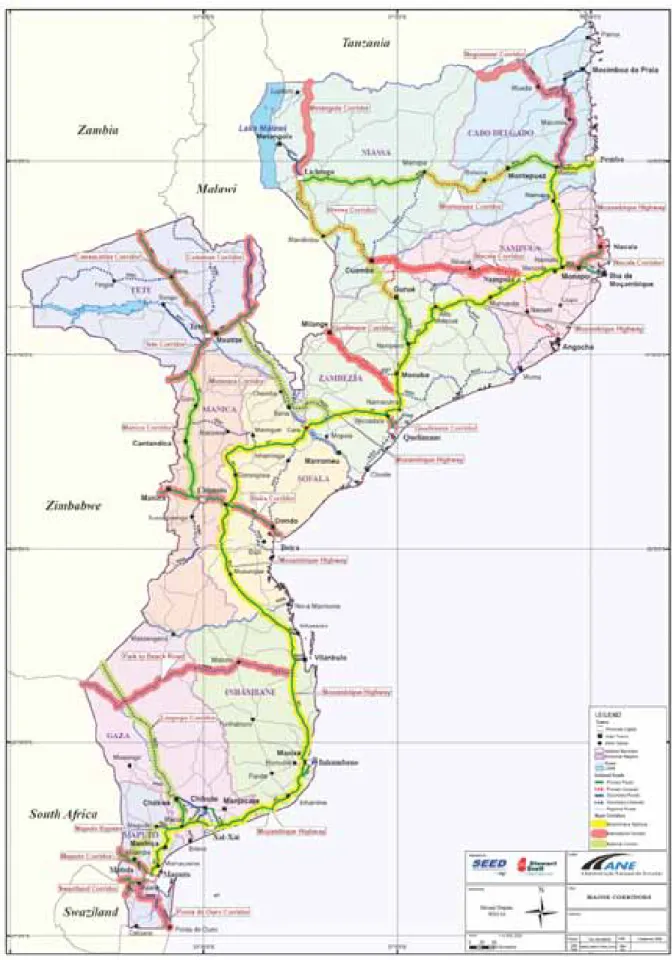
Figure 1: Map of Main Corridors... 13Abbreviations
AADT ... Average Annual Daily TrafficADB ... African Development Bank ANE ... National Roads Administration
DEP ... Provincial Department of Roads and Bridges EIRR ... Economic Internal Rate of Return
EOI... Expression of Interest ETB ... Emulsion Treated Base EU ... European Union
GIS ... Geographical Information System GOM ... Government of Mozambique
HDM ... Highway Design and Maintenance Standards Model HNMS ... Highway Network Management System
IDA ... International Development Association IDB... Islamic Development Bank
INAV ... National Institute of Road Traffic IRMS... Integrated Road Management System IRSS ... Integrated Road Sector Strategy
JBIC ... Japan Bank for International Cooperation LEM ... Engineering Laboratory of Mozambique MCA ... Multi-Criteria Analysis
MER... Monitoring, Evaluation and Reporting MOPH ... Ministry of Public Works and Housing NGO... Non-Governmental Organization N/C... Unclassified Roads
PAF ... Planning and Assessment Framework PARPA... Programme for Poverty Reduction (PRSP) PIP... Project Implementation Plan
PPP... Public Private Partnerships
PRMC ... Provincial Road Management Consultants PRMP... Paved Road Management Program PRMU ... Paved Road Management Unit PRWP... Paved Road Works Program
RBMMP... Roads and Bridges Management and Maintenance Programme (Roads 3) RRIP... Regional Roads Investment Program
RRIF... Regional Roads Investment Fund RSS ... Road Sector Strategy 2007 2011
SADC... Southern Africa Development Community
SATCC... Southern Africa Transport and Communication Commission SFP... Strategic Financial Plan
SIP... Strategic Investment Plan SMP ... Strategic Maintenance Plan SWAP ... Sector Wide Approach TI... Targeted Intervention TM ... Transitability Maintenance TOR ... Terms of Reference
VAT ...Value Added Tax
Road Sector Strategy 2007 - 2011: Summary Volume p. 1 Chapter 1: Introduction
Road Sector Strategy 2007 - 2011
Final Report
1
I
NTRODUCTION
1.1
General
The Road Sector Strategy 2007 - 2011 (RSS) presents the main elements of the Government of Mozambique’s (GOM’s) strategy for developing and managing the country’s classified roads. The RSS is based upon the GOM’s Road Sector Policy which establishes the broad goals and priorities for the sector in the context of national policy.
RSS has been formulated following a consultative process that included a review of the Integrated Road Sector Strategy (IRRS, 2001), stakeholder consultations, formulation of strategic plans for investment, maintenance and finance, and presentation to a broad audience of GOM officials, road sector professionals, the donor community, and other stakeholders. The analytical background and further detail for RSS can be found in the 5-volume “Revised Road Sector Strategy”.
The RSS takes a medium- long-term perspective of the development and management of the classified road network of Mozambique.1 RSS adds a level of detail to the GOM’s Road Sector Policy to establish the main principles, approaches, and activities that will be undertaken through the end of Roads-3, GOM’s 10-year road’s program. The strategic plans for investment, maintenance and finance included in RSS are prepared for a 5-year horizon, 2007 – 2011. Both RSS and the 5-year strategic plans should be reviewed and revised in 3 year’s time in preparation for Phase 3 of Roads-3. The figures, projects descriptions and plans presented in this report are current through May 2006; subsequent developments will be reported in the Project Implementation Plan.
A detailed set of plans for the period 2007 – 2009 are being prepared for inclusion in a separate document, the Roads-3 Phase 2 Project Implementation Plan (PIP 2007 - 2009). PIP 2007 - 2009 includes detailed programs of works (paved and unpaved, investment and maintenance, national and provincial) and sector support activities (road sector planning and management, capacity building, road safety, and axle load control). Procurement, implementation and disbursement schedules are also included in PIP 2007 - 2009, as are the performance indicators that will be used to measure accomplishments and performance. PIP 2007 - 2009 will be reviewed and adjusted annually to take into account changes in needs and resource availability. Toward the end of Roads-3 Phase 2, the program for Phase 3 (PIP 3) will be prepared based upon a revised Strategy and rolling 5-year plan.
The purpose of this Volume is to present a clear and concise description of RSS which will guide road sector planning, programs, and implementation during the Phase 2 of Roads-3. Most of the major principles and elements of the original IRSS remain valid. Those aspects of RSS that have been modified or added are explained in more detail.
1
Although the urban and unclassified road networks are not addressed in detail, RSS recognizes the need for strategic and detailed planning for these sub-sectors. An important part of the Road Sector Strategy is to
1.2
Thematic Overview
RSS is a guide to road sector planning, programs, and implementation during Phase 2 of Roads-3. The overall theme relates to Consolidation and Strengthening of the improvements that have been achieved to date.
The main new themes of RSS are asset preservation, enhanced transitability, and
maintainability. These complement the main principles elaborated in the original IRSS: sustainability, connectivity, and accessibility. These objectives will be achieved through sound sector planning, management and implementation. The key elements of RSS include:
Sustainability: by prioritizing maintenance and ensuring that adequate funds are allocated
and effectively used to provide quality and appropriate maintenance on both paved and unpaved roads. A key principle guiding all investment and resource allocation in RSS is to ensure that what is upgraded and rehabilitated is then maintained. Resources will be allocated to maintenance activities so as to ensure the preservation of road sector assets, even at the expense of deferring desirable and worthy investments. Donors will participate in financing some of the maintenance requirements, predominantly in supporting timely periodic maintenance on the paved road network.
Asset preservation: to ensure that what has been rehabilitated and can be sustained through
standard maintenance, actually receives that maintenance as a matter of highest priority. This principle applies most especially to the paved road network, and RSS includes a Paved Road Management Program with the stated goal of preserving this valuable investment while ensuring a good level of service on the country’s paved road network.
Transitability: to provide at least minimal access to those communities and districts to which
existing access roads have deteriorated to the extent that they are cut off from the main trunk network, through investments (targeted interventions and spot improvements) and through the implementation of transitability maintenance which ensures that roads are passable almost all year. Annual targets will be established to increase the share of the network that is transitable with the goal of 95% transitability by the end of 2011.
Selective rehabilitation and upgrade: Selected rehabilitation and upgrade of priority
segments of the main road network are also components of RSS. Priority is given to upgrading the entire primary road network to paved standard by the end of Roads-3. Rehabilitation and construction of bridges is a key element of RSS, especially in light of their importance for ensuring transitability.
Balanced investment: by explicitly providing resources for the rehabilitation and opening of
vital rural links in the regional roads network. Selected upgrade and rehabilitation of the secondary network and regional roads networks (tertiary and vicinal roads) will be prioritized, planned and programmed on a provincial basis so as to ensure balanced and sustainable development of the network. To this end RSS includes the creation of a Regional Roads Investment Program and Fund.
Rational allocation of investment resources: proposed projects will be systematically
evaluated and prioritized using the fundamental principles of connectivity and accessibility, justified on social-economic grounds, designed to provide the minimum level of service required consistent with minimum life-cycle costs, and capable of being maintained properly. Project designs will take into account the limitations of financial and implementation capacity, applying minimum maintenance-friendly standards with the objective of achieving the optimal network performance.
Road Sector Strategy 2007 - 2011: Summary Volume p. 3 Chapter 1: Introduction
Improving road-sectormanagement: good sector management and timely decision-making
in terms of planning, procurement, and contract management is the simplest and cheapest way to make scarce sector resources go farther. The role of planning will be enhanced, and monitoring and evaluation will be incorporated into road sector management, including bi-annual reviews of performance and achievement of targets.
Develop true capacity: the desired development of local capacities in the public sector as
well as in the private sector will only come about with experience gained from performing the required tasks. This will require a complete rethinking of the approaches to human resources management, training, and technical assistance, with accountability and on-the-job training as the essential elements.
Rationalizing sector finance: moving to a Sector Wide Approach to planning, finance and
assessment will enhance efficient resource allocation and control. A sector budget approach to financing maintenance and investments (the so-called single channel or sector budget support) will facilitate a cohesive implementation of RSS, avoid fragmentation and duplication of efforts, and promote harmonization of procedures among the various funding partners.
Innovate, experiment, but most importantly, implement change: RSS contains numerous
initiatives to improve sector performance. These range from promoting technical solutions such as emulsion treated bases (ETB) designs to planning rolling works plans and programs to alternative contracting methods such as multi-year level-of-service maintenance contracts. Road sector management will evaluate the impact of the various initiatives and strive to expand the implementation of those approaches which prove most successful.
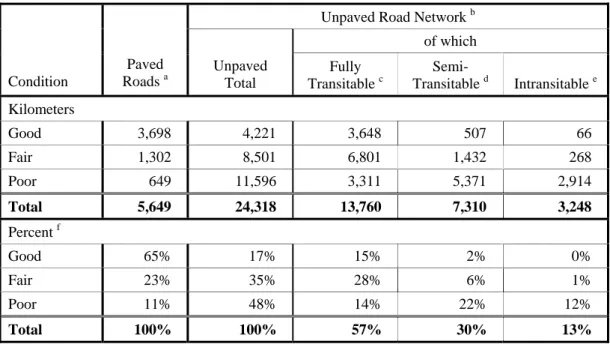
Table 1: Summary Road Conditions
Unpaved Road Network b of which Condition Paved Roads a Unpaved Total Fully Transitable c Semi-Transitable d Intransitable e Kilometers Good 3,698 4,221 3,648 507 66 Fair 1,302 8,501 6,801 1,432 268 Poor 649 11,596 3,311 5,371 2,914 Total 5,649 24,318 13,760 7,310 3,248 Percent f Good 65% 17% 15% 2% 0% Fair 23% 35% 28% 6% 1% Poor 11% 48% 14% 22% 12% Total 100% 100% 57% 30% 13%
a. Data from paved road visual assessment, March – April 2006. Conditions are projected for roads currently under works and therefore overstate share of roads in good condition.
b. Data from interviews with provincial roads personnel, April 2006. c. Fully transitable: road is open to “normal” traffic all year without closure.
d. Semi-transitable: road is closed to “normal” traffic intermittently during rainy season. e. Intransitable: road is closed to “normal” traffic during most of the year.
Current Road Conditions Usage: Mozambique’s classified road network consists of almost 30,000 kilometers of roads, of which less than 20% (5,649 kilometers) are paved. In general, the condition of the paved road network is better than the unpaved network (see Table 1). Almost half of the unpaved roads are in poor condition, and only 57% are fully transitable by normal (non four-wheel drive) traffic.
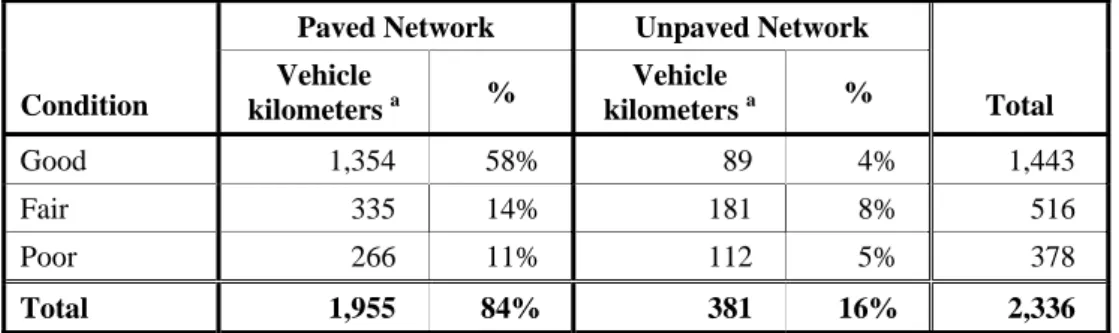
In terms of road usage it can be seen that the paved road network carries the largest share of traffic in terms of estimated vehicle-kilometers, almost 85% (see Table 2). The analysis of road usage indicates that while the unpaved road network is important for accessibility goals, the greatest economic impact of poor road condition is concentrated on the more heavily trafficked paved roads.
Table 2: Summary Road Usage by Condition
Paved Network Unpaved Network Condition Vehicle kilometers a % Vehicle kilometers a % Total Good 1,354 58% 89 4% 1,443 Fair 335 14% 181 8% 516 Poor 266 11% 112 5% 378 Total 1,955 84% 381 16% 2,336
a. Based on databases for paved and unpaved roads described above.
b. Million vehicle kilometers estimated from ANE traffic count and survey data.
1.3
Structure of the Report
The main elements of RSS are presented in five chapters following this Introduction:
Chapter 2: Principles of the Road Sector Strategy 2007 - 2011 is a summary of the main
principles and plans of RSS. It begins with an overview of the vision of road sector management and a brief description of the role of the road sector in promoting national and PARPA objectives. It then presents the six fundamental principles guiding RSS and concludes with sections on long-term network vision and planning and description of the Paved Road Management and Regional Roads Investment Programs.
Chapter 3: Strategic Plan presents the framework for the three plans that make up
PIP 2007 - 2009: the Strategic Maintenance Plan, the Strategic Investment Plan; and the Strategic Financial Plan
Chapter 4: Strengthening Sector Management addresses those actions which will be taken
to improve overall management of the road sector, and the institutional and management changes that are planned in RSS.
Chapter 5: Fine-Tuning Road Sector Finance deals with the measures required to ensure
adequate financial performance of the road sector. These include a statement of the principles of road sector financing under RSS and specific actions which are planned in order to enhance revenues and improve road services.
Chapter 6: Value for Money Through Better Engineering addresses the crucial technical
matters that lie at the heart of providing road users with good roads. These include the maintenance approaches to be utilized in RSS, maintenance management issues, development and application of appropriate standards, and road safety and axle-load controls.
Road Sector Strategy 2007 - 2011: Summary Volume p. 5 Chapter 2: Principles of RSS 2007 -2011
2
P
RINCIPLES OF THE
R
OAD
S
ECTOR
S
TRATEGY
2007
-
2011
2.1
Reinforcing the Strategic Principles and Vision
The Road Sector Strategy 2007 – 2011 is premised on the view that the harmonious development of the country’s economy depends upon the compatibility of national and road-sector development plans and policies. The ultimate goal of RSS is to substantially contribute to the GOM’s objectives for economic growth and poverty alleviation, especially in rural areas. The commercial orientation of RSS is in keeping with the Government’s sectoral policies of maximizing the economic profitability of investments made in the road network while minimizing total road-sector transport costs.
The overall thrust of RSS is to create an efficient, dynamic, independent, and responsive system of roads management that is capable of implementing national and provincial policies and effectively delivering road services desired by road users.
RSS is formulated to achieve these objectives in a sustainable manner by prioritizing maintenance and by ensuring the required funding for maintenance of rehabilitated roads through road-user charges. Priority is given to asset preservation by maintaining roads that are already in transitable condition and by expanding transitability to the entire classified network. Revenues are to be collected from road users in a manner that ensures a sufficient flow of funds to cover all maintenance needs.
This vision presented in RSS reflects a Sector Wide Approach, encompassing a unified, coherent and coordinated program of investment, maintenance, management, finance, institutional development and capacity building. All stakeholders and partners shall act in coordinated fashion, with RSS as the guiding instrument for planning and implementing sector activities, under the leadership of the Ministry of Public Works and Housing (MOPH) and its main implementing agencies, ANE and the Road Fund. To the extent possible, all plans and procedures shall be harmonized so as to ensure consistency and compatibility.
2.2
The Road Sector and National Objectives
Sector policy and RSS recognize the dual roles of the road network: (a) ensuring the social
and economic mobility necessary for promoting growth; and (b) fostering regional
development by providing secure links to all areas of the country. The specific rationales for improving the road network are:
• National Integration: Better roads contribute to the reduction of regional differences and to the building of national unity through integration resulting from enhanced transportation services.
• Economic Growth: Better roads stimulate economic growth by reducing transportation costs and providing access to markets. They facilitate marketing of agricultural commodities by ensuring reliable delivery of inputs and timely marketing of production at reasonable cost.
• Strategic Asset: Better roads bolster Mozambique’s strategic geographical position as an essential transit corridor for its landlocked neighbors, facilitating their access to international markets.
2.3
Road Sector Strategy and the PARPA
The Goals and objectives of RSS are consistent with the Programa do Governo para a Redução da Pobreza Absoluta, or PARPA, the Government’s program for poverty reduction. The PARPA establishes five major goals for the road sector:
• Supporting Markets: To contribute to the expansion of markets, in particular in the agricultural sector;
• District Access: To ensure access to districts with the greatest economic potential, focusing on provinces with high population densities and high concentrations of poverty; • Connectivity: To establish connectivity between the major regions of the country and to
develop the main corridors;
• Decentralization: To improve the capacity at the provincial and local level for the management and prioritization of roads civil works; and
• Quality of Works: To improve the quality of the roads civil works, including construction, rehabilitation and maintenance.
The specific targets established in the PARPA are incorporated in the PIP 2007 - 2009 performance indicators. RSS includes systematic monitoring of progress toward achievement of the PARPA goals.
• All planning activities and resulting documents shall explain how the proposed actions contribute to the PARPA goals.
• ANE and the Road Fund shall hold an annual review of the PARPA’s transportation objectives in light of institutional priorities.
• The Planning and Assessment Framework for the road sector shall include an annual report on achievement of the PARPA goals for the road sector.
2.4
Fundamental Principles
Six fundamental principles underlie the Revised Road Sector Strategy and are incorporated in the Plan for Phase 2. These include Sustainability, Connectivity, Accessibility, Transitability, Asset Preservation, and Maintainability. While interrelated, each of these principles identifies a separate aspect of the management of roads that when combined with the others, serves to achieve the Government’s overall sectoral objectives. The first, sustainability, addresses an overall approach to sector management. Connectivity and accessibility focus on priorities for the development of the Mozambican road network. The last three, transitability, asset preservation, and maintainability underlie the approach towards maintenance interventions.
Sustainability
The most fundamental principle of RSS is to assure the sustainability of the road network and to ensure that resources invested in the sector yield long-term benefits to the economy. This requires three separate conditions:
Sustainability of maintenance: Ensuring that civil works are planned and implemented so as
to preserve the investments and reduce total life-cycle costs of rehabilitation, maintenance and operation of the infrastructure. Under RSS:
• Maintenance is prioritized ahead of new investment activities; • the highest priority is given to effective routine maintenance;
• periodic maintenance will be programmed, budgeted and implemented so that roads don’t fail before their design life;
Road Sector Strategy 2007 - 2011: Summary Volume p. 7 Chapter 2: Principles of RSS 2007 -2011
• rehabilitation of roads that are not maintainable using standard methods will be undertaken only when maintenance can be assured.
Financial sustainability: Ensuring that financial resources are sufficiently and timeously
available to finance programmed civil works. Delayed maintenance leads to accelerated degradation of roads conditions and disproportionately higher costs for restoring roads to acceptable conditions. Under RSS:
• flows of maintenance funding will be sufficient and stable;
• maintenance budgets will be timely and funding will flow without delays; • road user charges will increasingly finance maintenance needs;
• maintenance funding gaps will be given priority over new investment.
Sustainability of capacity: Ensuring that the capacity exists to implement the programmed
civil works, including capabilities on both the road management side and on the works execution side. Under RSS:
• data collection, information management and network maintenance planning systems and tools to program required maintenance will be implemented;
• procurement of consulting services and civil works will be responsive and rapid so that interventions are executed on time;
• effective contract management will ensure that quality services are delivered as specified and within budget;
• programs will be implemented to develop local consultant and contractor capabilities and capacities (technical, financial, and access to equipment) to satisfactorily execute the quantity and quality of maintenance services.
Connectivity
Connectivity is directly related to the goal of national integration and mainly refers to the role of the primary, and to a lesser extent, the secondary road networks in connecting the nation’s provinces, provincial capitals, and main international corridors. It also contributes to national economic development by connecting national and international markets to zones of production and consumption.
The principle of connectivity mainly applies to the prioritized approach to the rehabilitation and upgrading of the main trunk network of roads. The main principles under RSS include:
• achieving and sustaining a good level of service on the N1 from Maputo to Pemba, including the Zambezi River Bridge;
• ensuring secure and continuous connectivity to the network for all provincial capitals; • giving priority to the main international corridors that provide access to Mozambican
ports and to international border crossings;
• achieving regional balance in development of national corridors to connect major regional social, political and commercial centers.
Accessibility
The concept of accessibility refers to the role of secondary roads to provide access to high-priority economic poles and to the role of tertiary and vicinal roads to improve and expand rural accessibility, especially in densely populated and economically productive regions. Accessibility is closely related to the concept of transitability.
The main goal for the secondary network is to serve priority economic areas that contribute to economic growth—agricultural areas, tourist sites, areas of industrial or natural-resource development, and access to ports, rail lines, and border crossings. Both secondary and tertiary roads are also important for connecting cities, district capitals and other important towns to the national road network.
Improving the tertiary and vicinal road network is intended to extend access and economic opportunities to rural populations, especially those populations effectively cut off from the transportation network and thereby without access to markets and basic social services. These tend to be very low-volume roads, requiring the use of low-cost labor-intensive construction and maintenance methods. Under RSS accessibility will be extended to a greater portion of the road network by focusing on transitability interventions rather than more expensive standard rehabilitation and maintenance approaches which at this point are not sustainable.
Transitability
Closely related to the network development goal of accessibility is the principle of transitability. The goal of transitability is to keep roads open almost all year, in almost all weather, especially for those roads that are the only source of accessibility for otherwise isolated rural populations and districts.
The principle of transitability will significantly extend accessibility to a larger share of users of the road network. A road is deemed to be transitable if it is open to normal vehicular traffic during the entire year, with few exceptions.2 This concept allows for situations where different sections of a road deliver varying levels of service, and even accepts that certain sections may be poor (high roughness, low travel speeds) if they are at least passable.
When applied to maintenance planning and investment prioritization, transitability requires flexibility in addressing designs. Interventions may not be uniform over the length of the road. Interventions should be first targeted to address those parts of the road that are prone to becoming impassable, especially during the rainy season. This approach to road maintenance and investment is termed transitability maintenance and targeted intervention.3 Transitability maintenance interventions may call for localized repairs and spot improvements such as the construction of culverts or other drainage structures. In the case of targeted intervention, limited sections of road may be upgraded to paved standards while the balance of the road remains unpaved.
Asset Preservation
The asset preservation principle is to minimize the long-term life-cycle costs of maintaining the road network. In particular, it strives to prevent the high costs of neglected maintenance, especially on those roads which represent the largest investment in the sector, paved roads. Insufficient maintenance on all roads, but especially on paved roads, results in disproportionately high costs of future maintenance, shortens pavement life and maintenance return periods for periodic maintenance and rehabilitation, and results in rapidly escalating
2
Normal vehicular traffic may vary from road to road, but should generally include passage by taxis (mini buses or modified pickups) and light trucks.
3
The concepts of transitability maintenance, spot improvement, and targeted intervention address the goals of providing transitability by improving or upgrading of problem sections of a road. Transitability maintenance applies to interventions on an unimproved track to provide year-round transitability. Targeted intervention is more generally applied to problem sections of already improved roads.
Road Sector Strategy 2007 - 2011: Summary Volume p. 9 Chapter 2: Principles of RSS 2007 -2011
user costs. The asset preservation approach attempts to save on long-term maintenance costs by ensuring that technically required maintenance is carried out in a timely fashion.
RSS applies the asset preservation principle, prioritizing maintenance of all types especially for those roads where the costs of not doing maintenance are deemed to be high. RSS views maintenance as a preventative action, not a response to already observed problems. Maintenance will be planned proactively. Roads will be inspected carefully and regularly and required interventions will be executed promptly.
The principle of asset preservation underlies the Paved Road Management Program described later. But asset preservation also applies to unpaved roads where the benefits of rehabilitation are quickly eroded if appropriate maintenance practices are not followed.
Maintainability
The final fundamental principle of road network management under RSS is maintainability. Maintainability entails the design and construction of roads keeping in mind the limited capacities for maintenance. It does not mean using expensive low-maintenance options, but rather focusing on realistic life-cycle costs of keeping roads in good or at least transitable condition. It also means considering and employing, where suitable, maintenance-friendly solutions. This could be, for example, the use of emulsion treated bases (ETB) and sand seal surfacing where they are suitable.
One particular technical aspect of maintainability addressed in RSS is drainage. Both with respect to road design and maintenance interventions, attention to proper drainage, both in terms of structures and appropriate road cross sections is particularly important.
2.5
Network Vision and Planning
The intermediate term network vision is guided by the network principles of connectivity and accessibility. In the long term, RSS calls for a far-sighted vision of the Mozambican road network, using a Master Planning approach. Both of these will be supported by the road classification system which will be revised to more accurately reflect the function and administrative attributes of the roads.
Long-Term Network Vision and Master Planning
ANE and provincial roads authorities have naturally tended to focus on managing the road network in terms of maintenance and on individual projects, having little time and resources to devote to long-term network vision. One way to address this is to separate network planning from maintenance planning.
Under RSS, long-term network planning will be separated from maintenance planning. A national Highway Master Plan will be prepared by consultants to guide the long-term investment plan for roads. The Master Plan will formalize the long-term goals for the road network and provide a guide to future investments. The Master Plan will determine the need for roads as a function of development plans for the various sectors, both public and private. It will be based on forecasts of population, land uses and economic activity, generating forecasts of traffic demand for the various modes of transportation.
The Master Plan will be implemented through a consultancy to the MOPH and will include the establishment of a National Highway Master Plan office, to solicit, manage, evaluate and
coordinate feasibility studies and proposals for the development of the road network. This will include developing methods for generating and evaluating public private partnerships (PPPs) and concession schemes for the development of roads that fit into the long-term network vision as expressed in the Master Plan.
The Master Plan consultancy will also be tasked with assisting in the formulation of Provincial Master Plans that set out priorities for road upgrading, rehabilitation and opening, including indications of internal and external funding needs necessary for the development of provincial road networks. A Strategy for urban roads and individual Urban Road Master Plans for the main municipalities (most especially for the Maputo-Matola metropolitan area) will be prepared early in Phase 2. Finally, a National Transport Master Plan should be discussed with the other transport subsectors; this will be useful to ensure consistency between investments in the various transport modes.
Classification and Mapping of the Mozambican Road Network
Under RSS, the classification of the classified road network will be reviewed and revised to better reflect the function of the roads. This process will involve detailed input from provincial roads professionals. The revised classification will be put into practice and road classification will become an integral part of road network management. In addition, clear, detailed and accurate maps of the road network will produced and made available to road sector professionals and to road users. To this end, the following steps will be undertaken:
• Conduct an additional round of provincial consultations regarding the final classification, aimed at correcting errors, proposing limited amendments, and winning public support for the reclassification;
• Addition of select key alignments to the classified network, including the alignment to the Unity Bridge, the road from Cuamba to Gurué, and the proposed Maputo Bypass road; • Addition of a select number of key urban roads that logically comprise part of the
national classified network in order to create a more unified and continuous network and shift management responsibility to ANE;
• A GIS/mapping facility will be established within ANE (initially to be contracted out) with responsibility for producing accurate maps and databases of roads and road characteristics;
• Detailed maps will be made available to provincial authorities and all road sector professionals, both in printed and in electronic versions;
• A program to update and replace roads signs to reflect the new classification system will be budgeted and implemented. All signs will be replaced or corrected within one year; • Desirable geometric design and maintenance standards for each class of road in the
network will be established.
Medium-Term Priorities and Main Corridors
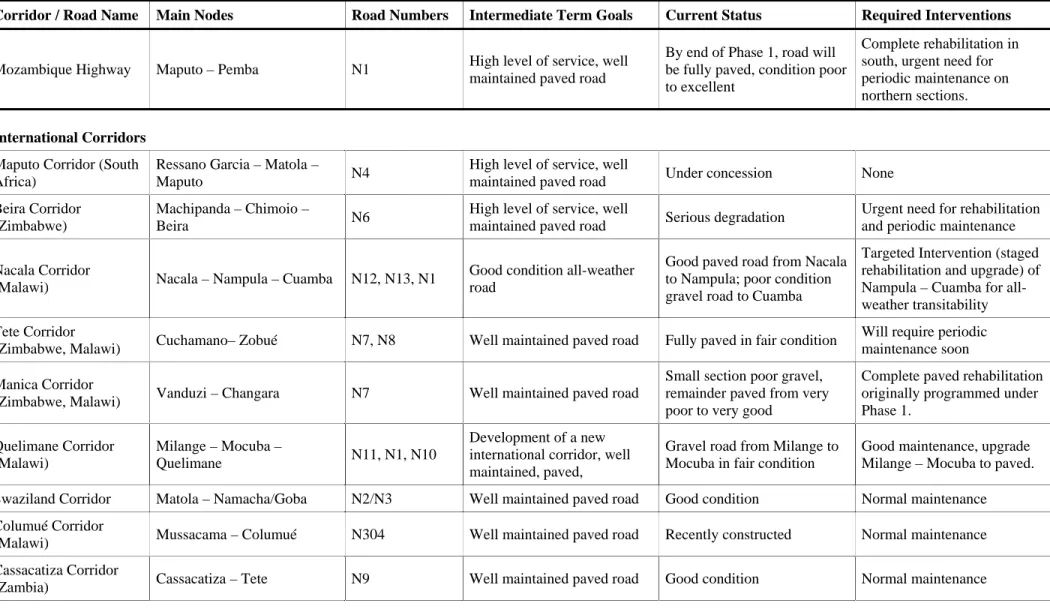
The main elements of the national grid that is currently envisioned for the national road network follow from the main principles of connectivity and accessibility noted above. These give rise to the main corridors and trunk roads shown in Table 3 and in Map 1. For each, a very brief description is provided of the intermediate term goals (i.e., to be completed under Roads-3), the current status of the road and the anticipated interventions. This list helped to guide the prioritization of projects for Phase 2 described later.4
4
In general the names given to the major corridors and roads in the table follow the conventions adopted in earlier documents.
Road Sector Strategy 2007 - 2011: Summary Volume p. 11 Chapter 2: Principles of RSS 2007 -2011
Table 3: Main Corridors and Trunk Roads
Corridor / Road Name Main Nodes Road Numbers Intermediate Term Goals Current Status Required Interventions
Mozambique Highway Maputo – Pemba N1 High level of service, well maintained paved road
By end of Phase 1, road will be fully paved, condition poor to excellent
Complete rehabilitation in south, urgent need for periodic maintenance on northern sections.
International Corridors
Maputo Corridor (South Africa)
Ressano Garcia – Matola –
Maputo N4
High level of service, well
maintained paved road Under concession None Beira Corridor
(Zimbabwe)
Machipanda – Chimoio –
Beira N6
High level of service, well
maintained paved road Serious degradation
Urgent need for rehabilitation and periodic maintenance Nacala Corridor
(Malawi) Nacala – Nampula – Cuamba N12, N13, N1
Good condition all-weather road
Good paved road from Nacala to Nampula; poor condition gravel road to Cuamba
Targeted Intervention (staged rehabilitation and upgrade) of Nampula – Cuamba for all-weather transitability Tete Corridor
(Zimbabwe, Malawi) Cuchamano– Zobué N7, N8 Well maintained paved road Fully paved in fair condition
Will require periodic maintenance soon Manica Corridor
(Zimbabwe, Malawi) Vanduzi – Changara N7 Well maintained paved road
Small section poor gravel, remainder paved from very poor to very good
Complete paved rehabilitation originally programmed under Phase 1. Quelimane Corridor (Malawi) Milange – Mocuba – Quelimane N11, N1, N10 Development of a new international corridor, well maintained, paved,
Gravel road from Milange to Mocuba in fair condition
Good maintenance, upgrade Milange – Mocuba to paved. Swaziland Corridor Matola – Namacha/Goba N2/N3 Well maintained paved road Good condition Normal maintenance Columué Corridor
(Malawi) Mussacama – Columué N304 Well maintained paved road Recently constructed Normal maintenance Cassacatiza Corridor
Corridor / Road Name Main Nodes Road Numbers Intermediate Term Goals Current Status Required Interventions
Ponta do Ouro Corridor
(South Africa) Boane – Ponta do Ouro N200
Well maintained gravel road; consider alternative alignment and concession as BOM.
Fair gravel road to Bela Vista, fair paved road to Salamanga, poor sand road to Ponta do Ouro
Targeted Intervention, staged upgrade, for all-weather transitability
Park to Beach Road
(South Africa) Parfuri – Mapinhane (N1) N222
Create all-weather transitable gravel road
Poor condition unsurfaced road, seasonally intransitable
Targeted Intervention for all-weather transitability Negomane Corridor
(Tanzania)
Sunate – Oasse – Mueda – Negomane (Unity Bridge)
N380, N381, to be designated
Good condition all-weather road
Mostly surfaced from Sunate to Mueda; poor sand road to Negomane
Surface Macomia – Oasse; Targeted Intervention for Mueda – Negomane for all-weather transitability. Metangula Corridor
(Tanzania)
Lichinga – Metangula and Lichinga – Macaloje – Matchedje
N361, R733, R1215
Well maintained paved road to Metangula, good condition all-weather road to Matchedje
Paved road to Maniamba; poor unsurfaced road to Matchedje
Upgrade road to Metangula; Targeted Intervention for all-weather transitability to Matchedje
National Corridors
Montepuez Corridor Lichinga – Marrupa –
Montepuez – Pemba N14 Well maintained paved road
Unpaved from Marrupa to Montepuez, narrow width Lichinga to Litunde
Improve Marrupa to
Montepuez, widen, Lichinga to Litunde, bridge works Niassa Corridor Lichinga – Cuamba – Gurué –
Nampevo N13, N103
Good condition all-weather road
Poor condition gravel to Gurué, paved to Nampevo
Rehabilitate or upgrade gravel, bridge over Rio Lurio
Limpopo Corridor Macia – Chokwé / Guijá –
Macarretane – Chicualacuala N101, N221,
Well maintained paved road to Macarretane, good condition all-weather road to Chicualacuala
Poor condition pavement from Macia to Chokwé, poor condition unsurfaced road to Chicualacuala
Urgent need for maintenance on Macia – Chokwé; Targeted Intervention for all-weather transitability to Chicualacuala Mutarara Corridor Kambulatsisi (Tete) –
Morrumbala (Zambezia) N322 Well maintained gravel road
Poor gravel, seasonally intransitable
Targeted Intervention for all-weather transitability, rehabilitate
Maputo Bypass Moamba – Magude – Xinavane
R 811 or R402 (to be
redesignated)
Provide all-weather road for northbound traffic to relieve congestion in Maputo
Poor condition unsurfaced road
Targeted Intervention, staged upgrade, for all-weather transitability
Road Sector Strategy 2007 - 2011: Summary Volume p. 13 Chapter 2: Principles of RSS 2006
Priority Corridors for Phase 2 Interventions: The following is a brief summary of the highest corridor priorities for Phase 2:
• Mozambique Highway (N1): rehabilitation of several sections south of the Zambezi are
included in the Investment Plan; rehabilitation and periodic maintenance of four northern sections are included in the Paved Road Works Program (PRWP)
• Beira Corridor (N6): Substantial rehabilitation and periodic maintenance of this
strategic corridor is required and planned in Phase 2.
• Nacala Corridor (N13): upgrade of the Cuamba – Nampula to a paved standard is
planned to begin in Phase 2, with intensive maintenance of unpaved sections applied to ensure a reasonable level of service.
• Tete Corridor (N7): periodic and backlog maintenance is scheduled under the PRWP.
• Manica Corridor (N7): completion of the Vanduzi – Changara road rehabilitation is
included in the Phase 2 investment plan.
• Quelimane Corridor (N11): Upgrade of the Mocuba – Milange road will begin in
Phase 2; periodic and backlog maintenance on the Namacurra – Quelimane road is scheduled under the PRWP.
• Negomane Corridor: improvement of the road linking Mueda with the Unity Bridge will
coincide with the opening of the bridge; periodic maintenance and completion of the upgrade of the remainder of the road to Sunate (N381, N380) is planned under the PRWP.
• Montepuez Corridor (N14): completion of the upgrade of the road from Montepuez to
Ruaça, Marrupa to Ruaça, and Lichinga to Litunde, as well as the construction of bridgeworks is scheduled for Phase 2.
• Niassa Corridor (N13, N103): Extension of the paved portion of the N103 from Gurué
to Magige is planned during Phase 2; Upgrade of the Lichinga – Cuamba road should begin in Phase 2 but is not funded; final alignment of the N103 to Cuamba must be determined and funding found for construction.
• Mutarara Corridor (N322): the priority is to bring this road to full serviceability as an
all-year all-weather road through the construction of bridges targeted intervention.
2.6
Paved Road Management Program
A key new element of RSS and of the Strategic Maintenance Plan (SMP) is the introduction of the Paved Road Management Program (PRMP). Following the principle of asset preservation, the program is designed to ensure the appropriate safeguarding of the capital asset represented by the paved road network. The objective of the PRMP is to manage and finance the paved road network such that roads entering the program will be maintained according to principles of optimal maintenance interventions based upon sound engineering and economic principles.
The PRMP for Phase 2 is fully described in the Paved Road Works Program, is included in PIP 2007 - 2009 and is shown separately in the Strategic Financial Plan (SFP). The PRMP consists of two components:
Paved Roads Management: Paved road management will be concentrated in a Paved Road
Management Unit (PRMU), separate from management of the rest of the network. The program will be led by an experienced and highly competent paved roads maintenance specialist, assisted by a team of engineers with experience in maintenance. The PRMP team will be responsible for the overall management of the program with the following tasks:
Road Sector Strategy 2007 - 2011: Summary Volume p. 15 Chapter 2: Principles of RSS 2006
• Selection of paved roads that qualify for the program;
• Review of designs for paved road construction and upgrades to ensure the appropriateness and sustainability of the works;5
• Regular and careful inspection of the paved road network;
• Development of local expertise in paved road maintenance management; • Utilization of the IRMS (Integrated Road Management System, the successor
computerized management system to HNMS) for paved roads (i.e., the Pavement Management System function of the system);
• Preparation of annual and multi-annual works programs and budgets; • Establishing the standards and practices for paved road maintenance; • Use of innovative forms of maintenance contracts including concessions.
Paved Roads Maintenance Finance: Funding for paved road maintenance will be channeled
entirely through the Road Fund. Multi-annual budget planning (connected to the SMP) will provide the indicated levels of funding necessary. Financial principles include:
• Funding of all paved road routine maintenance by the Road Fund;
• Periodic maintenance funding is shared by the Road Fund and donors, with a target of increasing the Road Fund share over time;
• Until such time as full sector budget support is implemented, donors will initially contribute to a ring-fenced revolving fund to be used for paved road periodic maintenance. Donors will not fund individual projects;
• Harmonized procurement and contracting procedures for all projects; • Promotion of alternative financing for paved road maintenance such as tolls.
2.7
Regional Roads Investment Program
Investment in regional roads (tertiary and vicinal roads) features prominently in RSS. Regional roads serving rural areas are a vehicle for social development as they provide accessibility to large segments of the less advantaged population. They provide important connections between agricultural production zones and markets and are very often the only links between Districts and from Districts to provincial capitals and the trunk road network. Despite these principles, regional roads have been at a disadvantage in terms of claims on available resources. Because funding for regional roads investment has generally been weak and not uniformly distributed, rehabilitation and upgrade of priority regional roads tends to be deferred. Provincial roads authorities contend with this by applying routine maintenance funds to inadequately scoped rehabilitation projects on roads that would otherwise be considered unmaintainable. The interventions rarely solve the critical problems on the road, with the works often being “washed away” during the next rainy season.
The negative repercussions also extend to the rest of the network, as the diversion of maintenance funds results in more rapid deterioration and subsequent greater needs for more intensive interventions. Further, the situation creates a serious issue of inequity and imbalance between those provinces fortunate enough to benefit from targeted support from donors and those without such external funding.
5
To address these problems, RSS calls for the implementation of a Regional Roads Investment Program (RRIP) and creation of a Regional Roads Investment Fund (RRIF). The fund will be operated by the Road Fund, using donor funds specifically earmarked for this purpose. Since the objective is rehabilitation, the GOM will make available counterpart funds from the Ministry of Finance equal to approximately 10% of the cost of the RRIF.
Wherever possible, labor-based intervention methods will be utilized. Further, the program will promote the use of output- and performance-based contracts that include both a rehabilitation and a maintenance component. Such contracts (sometimes called multi-year level of service) are actually a form of concessioning. The program will promote this promising approach by implementing pilot programs under the guidance of a specialist with experience in these forms of contracting.
The RRIP address the objective of transitability for regional roads. Rehabilitation and construction of bridges and major drainage structures, and use of the Targeted Intervention approach will help to maximize accessibility while minimizing investment costs and future maintenance burdens. Upgrade proposals will be considered in those cases where it can be demonstrated that life-cycle maintenance costs will be dramatically reduced.
The RRIP will be a participatory bottom-up program. Proposals for project funding will originate in the Provinces and District involvement in planning and prioritization will be encouraged. The allocation of budgets will include provincial balance criteria and the requirement for systematic prioritization based on network, economic, and other criteria. The financial aspects of the program include the following:
• All funding for regional roads investments will be channeled through the RRIP.
• RRIP will be financed through a revolving managed by the Road Fund. Donors will not fund specific projects, but rather a fixed portion of the program.
Road Sector Strategy 2007 - 2011: Summary Volume p. 17 Chapter 3: Strategic Plans
3
S
TRATEGIC
P
LAN
The RSS includes strategic plans for maintenance, investment and finance. These plans are all guided by the principles set forth above and are formulated for a 5-year period. The strategic plans establish the framework for the preparation of the detailed Work Plans that are included in PIP 2007 - 2009. This chapter also includes descriptions of two specialized programs, the Paved Road Management Program and the Regional Roads Investment Program.
3.1
Strategic Maintenance Plan
The SMP is a multi-annual rolling plan conceived at the strategic level that indicates the level and types of maintenance activities necessary to achieve sustainability of the road network over the medium term. The SMP prepared as part of RSS provides a general guide for maintenance resource allocation and for the Strategic Financial Plan; a more detailed set of work plans for maintenance are included as part of PIP 2007 - 2009. The SMP will be updated annually in parallel with the detailed work plans to be formulated annually.
Maintenance Approaches and Definitions 6
Under RSS and the SMP, maintenance is divided into standard maintenance and transitability maintenance. The term “standard maintenance” is used to mean maintenance activities applied on roads which are normally transitable and which can be maintained to a level of service with regular interventions: annual routine maintenance, regular and timely periodic maintenance, and return-period rehabilitation at the end of a road’s design life.7 The categories used here do not define the interventions narrowly. The specific interventions for each road and road section will differ and must be programmed locally. However, the average interventions required are predictable.
In contrast, “transitability maintenance” refers to the interventions required on roads that are not currently “maintainable” and for which the objective is simply to keep the road transitable, even if in poor condition. Transitability maintenance is no substitute for investments that are required to construct bridges (the most common reason for intransitability) or to rehabilitate or upgrade a road that is currently intransitable. Rather, it will be used as a maintenance approach, combined with targeted interventions (investment), that strives to maximize the extent of the network that is transitable most of the year with the limited maintenance resources available.
The SMP also includes two additional categories of works. Backlog periodic maintenance is defined for paved roads where the level of repairs required to bring the road back to its design standard exceeds the definition of periodic maintenance, i.e., resealing and minimal repairs to the structure. The requirements for backlog maintenance were derived from the project prioritization analysis and are included in the Paved Road Works Program that comprises part of PIP 2007 - 2009.
Emergency works are also an essential part of a maintenance program. They are defined as any repair or reinstatement of a section or sections of an existing route (including structures)
6
Full maintenance definitions for paved and unpaved roads are found in the Draft Final Report, Volume II, Chapter 4, and included in the Paved Road Works Program and Unpaved Road Works Program Reports. 7
where the circulation of traffic has been interrupted due to unforeseen circumstances, usually due to a natural event. The goal of the emergency works is to restore the integrity of the link so that the reinstated sections or structures will be structurally and functionally adequate and will be maintainable by normal recurrent maintenance until the next major intervention.
Maintenance Strategy
In principle, standard maintenance will be applied so as to preserve as much of the network in good and fair condition as possible, while transitability maintenance funds will be allocated so as to maximize the transitability of the network, or alternatively, to minimize the number of days that roads are closed.
The distinction between maintenance interventions and investments is important, both for standard maintenance and transitability maintenance. Investments intended to improve the condition of roads in the form of rehabilitation, reconstruction, and upgrade, and investments intended to increase transitability in the form of bridge construction and targeted interventions, are one-off interventions, are considerably more costly than maintenance, and will be included in the Investment Plan (Section 3.2).8
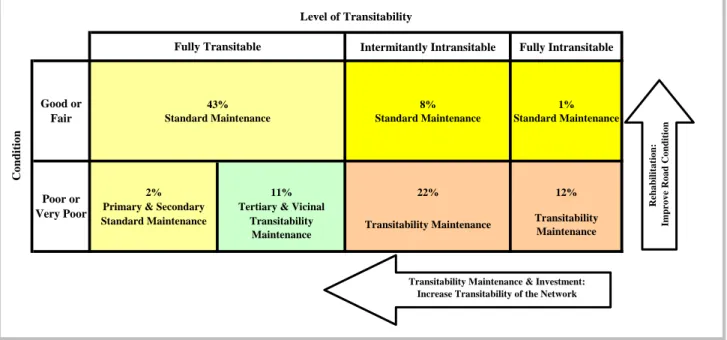
The unpaved road maintenance strategy is shown visually in Figure 2. The figure depicts the current state of the network in terms of condition and transitability (as percent of the unpaved road network), and the prescribed maintenance to be applied. The two arrows indicate dual objectives of improving both condition (through investment/rehabilitation) and transitability (through transitability maintenance and through investment).9
Figure 2: Maintenance Strategy
Level of Transitability
Intermitantly Intransitable Fully Intransitable
8% 1%
Standard Maintenance Standard Maintenance
2% 11% 22% 12%
Primary & Secondary Tertiary & Vicinal
Standard Maintenance Transitability
Maintenance Transitability Maintenance
Transitability Maintenance Condi tion Standard Maintenance Fully Transitable 43% Good or Fair Poor or Very Poor
Transitability Maintenance & Investment: Increase Transitability of the Network
Reha bi lit at ion: Im pro v e Ro ad Co ndi ti on
8
The distinction between intensive standard maintenance and rehabilitation, or between spot improvements as part of transitability maintenance and targeted intervention as a partial upgrade to a road, may, at times, be matters of judgment, which local engineers must carefully consider.
9
A fully description of the unpaved road maintenance strategy is contained in the Unpaved Road Works Program.
Road Sector Strategy 2007 - 2011: Summary Volume p. 19 Chapter 3: Strategic Plans
Unit Costs
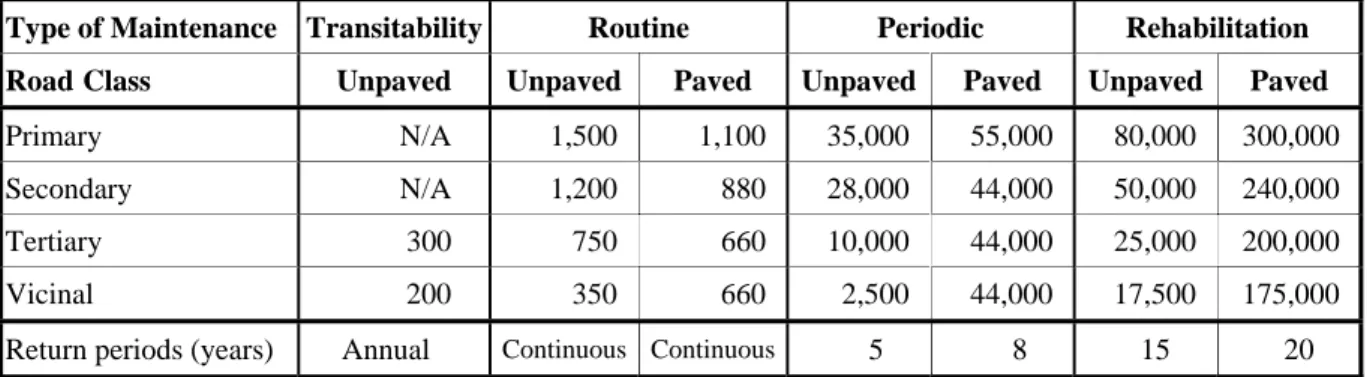
The projected average maintenance costs by class of road and type of intervention are shown in Table 4. These costs are projected averages which have been used to project annual maintenance budgets; the costs of each intervention will vary by the specific requirements of the road, local costs, and other factors. Unit costs will be monitored and average costs in updates of the Strategic Maintenance Plan will be modified as required.
Table 4: Unit Maintenance Costs Rates and Return Periods
(US$ per km, per year for Transitability and Routine)
Type of Maintenance Transitability Routine Periodic Rehabilitation
RoadClass Unpaved Unpaved Paved Unpaved Paved Unpaved Paved
Primary N/A 1,500 1,100 35,000 55,000 80,000 300,000
Secondary N/A 1,200 880 28,000 44,000 50,000 240,000
Tertiary 300 750 660 10,000 44,000 25,000 200,000
Vicinal 200 350 660 2,500 44,000 17,500 175,000
Return periods (years) Annual Continuous Continuous 5 8 15 20
Road Network
The SMP is formulated for the classified and urban road networks. The base network is shown in Table 5. The total classified network included in the SMP is just under 30,000 kilometers with an additional 3,000 kilometers of urban roads.
Table 5: Base Classified and Urban Road Networks (kilometers)
Class Unpaved Paved Total
Primary 1,407 4,459 5,866 Secondary 3,983 809 4,792 Tertiary 11,645 516 12,161 Vicinal 6,500 30 6,530 Subtotal Classified 23,535 5,814 29,348 Urban 2,500 500 3,000 Grand total 26,035 6,314 32,348
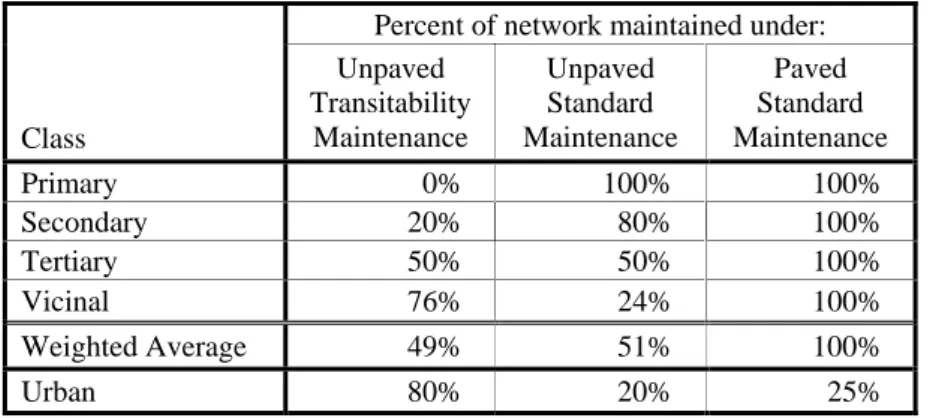
This network has been divided into roads that are forecast to be maintainable by standard maintenance interventions and the balance of the network which will be maintained by transitability maintenance. The shares of the network in each maintenance category by class and surface are shown in Table 6. These shares will be refined as more detailed maintenance needs are defined. The working assumption of the SMP is that 100% of classified paved roads and approximately 50% of classified unpaved roads receive standard maintenance. For urban roads, given the current degraded conditions, only 20% of unpaved roads and 25% of paved roads are assumed to receive standard maintenance interventions.
Table 6: Maintenance Category by Class and Surface
Percent of network maintained under:
Class Unpaved Transitability Maintenance Unpaved Standard Maintenance Paved Standard Maintenance Primary 0% 100% 100% Secondary 20% 80% 100% Tertiary 50% 50% 100% Vicinal 76% 24% 100% Weighted Average 49% 51% 100% Urban 80% 20% 25%
The extent of the network then maintained under each category is shown in Table 7. The SMP divides the classified road network into a “target” network of 17,800 kilometers on which standard maintenance can be applied, and a “transitability” network of about 12,800 kilometers on which transitability maintenance will be applied. Note that not all urban roads are assumed to receive maintenance. Specific maintenance interventions will be determined for each road as part of the annual planning exercise.
Table 7: Road Network by Maintenance Category, Class and Surface
Kilometers maintained under: Class Unpaved Transitability Maintenance Unpaved Standard Maintenance Paved Standard Maintenance Total Primary 0 1,407 4,459 5,866 Secondary 797 3,187 809 4,792 Tertiary 5,822 5,822 516 12,161 Vicinal 4,929 1,570 30 6,530 Subtotal 11,548 11,986 5,814 29,348 Urban 2,000 500 125 2,625 Grand total 13,548 12,486 5,939 31,973
Projected Annual Maintenance
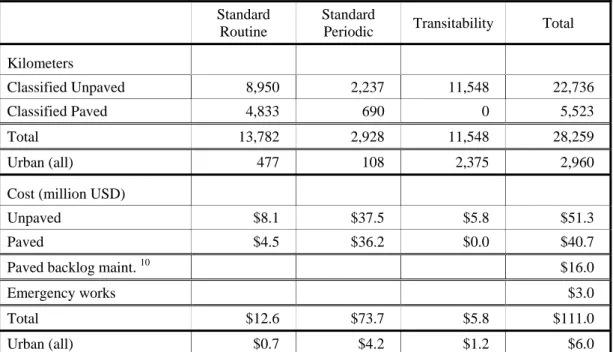
Based on the assignment of maintenance categories, unit rates, and return periods, summary total annual maintenance by kilometers and costs are shown in Table 8. These projections do not take into account “return-rehabilitation”, i.e., rehabilitation that would be projected based on normal pavement design life. The projections shown here were used to establish the Strategic Financial Plan framework. Detailed annual planning of maintenance can be found in PIP 2007 - 2009.
In addition to standard and transitability maintenance, US$ 48 million in backlog maintenance for paved roads has been projected for Phase 2. This backlog maintenance is the minimum amount estimated to prevent critical roads from deteriorating to the point of requiring more expensive rehabilitation in the near term. The specific program of backlog maintenance is included in the Paved Road Works Program included in PIP 2007 - 2009.
Urban road maintenance is limited to US$ 6 million annually in the Strategic Maintenance Plan, an amount approximately equal to the statutory contribution required of the Road Fund. This is far below the amount of maintenance required to bring urban road networks up to
Road Sector Strategy 2007 - 2011: Summary Volume p. 21 Chapter 3: Strategic Plans
reasonable standards. The amount of necessary rehabilitation works cannot be estimated without additional detailed data. These data will be collected and evaluated urgently in Phase 2 and a plan for the rehabilitation and maintenance of urban roads will be prepared and implemented.
Finally, an allowance of US$ 3 million annually has been included for emergency works. The needs for properly defined emergency works will be monitored and the budget adjusted accordingly.
Table 8: Projected Annual Maintenance
Standard Routine
Standard
Periodic Transitability Total Kilometers
Classified Unpaved 8,950 2,237 11,548 22,736
Classified Paved 4,833 690 0 5,523
Total 13,782 2,928 11,548 28,259
Urban (all) 477 108 2,375 2,960
Cost (million USD)
Unpaved $8.1 $37.5 $5.8 $51.3
Paved $4.5 $36.2 $0.0 $40.7
Paved backlog maint. 10 $16.0
Emergency works $3.0
Total $12.6 $73.7 $5.8 $111.0
Urban (all) $0.7 $4.2 $1.2 $6.0
3.2
Strategic Investment Plan and Project Prioritization
The full Investment Plan for Phase 2 is presented in PIP 2007 - 2009, and detailed analysis of Project Prioritization is found in Volume II of the full RSS report. The principle of sustainability dictates that new investments (rehabilitation, upgrading, and new construction) will only be undertaken where there is a demonstrated capacity to maintain those investments. At the same time, RSS establishes a priority for upgrading, rehabilitating, and maintaining the entire core primary road network to good paved condition. Further, the goal of accessibility points to the importance of allocating investment resources toward regional roads. These three factors point to the importance of a balanced approach to investment decision.
The investment plan followed a process of identification and evaluation of candidate projects. For the purposes of the prioritization exercise, projects were divided into three categories:11
• National roads projects (primary and secondary roads), including upgrade,
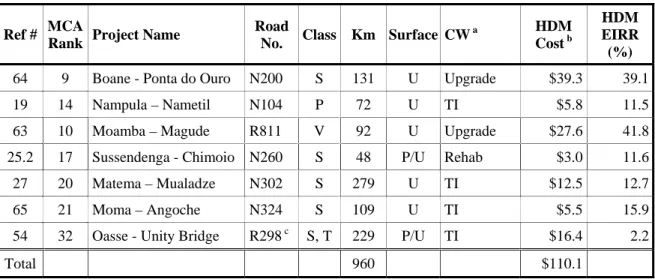
rehabilitation and periodic maintenance of paved roads.12 The full list of National Roads candidate projects was discussed with stakeholders and following revisions, a total of 59 were included in the prioritization exercise. These projects were prioritized using
10
Backlog maintenance for paved roads is estimated for only three years. 11
As noted above, investment (rehabilitation) in urban roads has not been included in RSS. Programs for urban roads and the unclassified rural network will be prepared separately.
economic analysis using HDM and then applying multi-criteria analysis (MCA) to incorporate less easily quantified network, social and economic factors.
• Regional roads projects (tertiary and vicinal roads): A total of 69 provincial roads were
initially identified. These projects were not prioritized as regional roads rehabilitation priorities will be established in cooperation with the Provinces. An expanded list of regional roads candidate projects and preliminary evaluations and prioritizations are included in PIP 2007 - 2009.
• Bridge projects: A total of 32 Bridge candidate projects were identified. The GOM has
established a priority program of 13 bridges for rehabilitation and construction in Phase 2.
National Roads Investment Projects
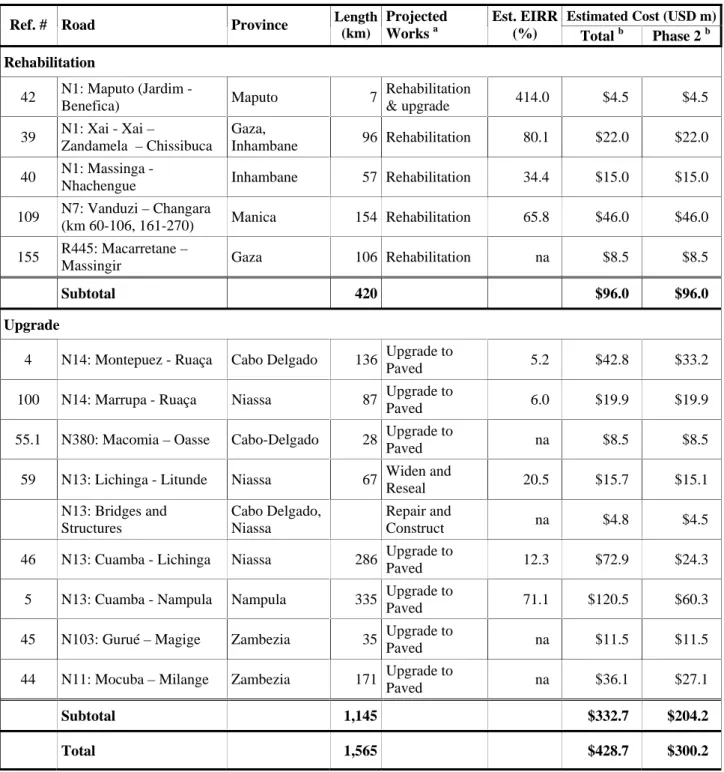
Forty national roads candidate projects were prioritized for rehabilitation and upgrade. These projects represent 5,591 kilometers of roads at an estimated cost of US$ 786 million. Thirteen projects were finally selected for inclusion in the Phase 2 Investment Plan, comprising 1,565 kilometers and with a total estimated cost of US$ 429 million (Table 9). Some of the projects will extend beyond Phase 2 (2007 – 2009) with the estimated Phase 2 investment cost being US$ 300 million. All selected roads are primary roads with the exception of the Macarretane – Massingir and Macomia – Oasse roads. The estimated costs for each project are based on the engineering estimate for projects for which there are designs prepared and on pre-design estimates in other cases. In all cases, designs will be reviewed to ensure that projects are in accordance with RSS design and network optimization principles. Each project is described briefly.
Rehabilitation Projects
• Southern N1 Sections: three projects are sections of the N1 south of the Zambezi River,
all of them deferred from Phase 1 due to costs. All are due to be financed by IDA and already have detailed designs (which must be reviewed). They include:
¾ Maputo: Jardim – Benfica
¾ Xai - Xai – Zandamela – Chissibuca
¾ Massinga - Nhachengue
• N7: Vanduzi – Changara: originally consisting of two lots, this project was originally
supposed to have been completed under Phase 1 under ADB financing. The project is highly ranked and important, especially given the degradation of the pavement on the northern part of the road. Financing arrangements to complement the ADB commitment remains to be finalized.
• R445: Macarretane – Massingir: although not a national road, this project was included
originally as a periodic maintenance/capital repair project. Timed to follow the completion of the Massingir dam construction works, this project will be funded by the OPEC Fund.
Upgrade Projects
• N14: Montepuez Corridor Projects: Three sections of the Montepuez Corridor remain
to be upgraded: Ruaça – Montepuez in Cabo-Delgado, and Marrupa – Ruaça and Lichinga – Litunde in Niassa Province. All three are part of a joint financing agreement for the N14 including participation of ADB, ASDI, JBIC and the GOM. These projects will likely commence in 2008 and largely be completed during Phase 2. When completed, these projects will provide for an all-weather paved trunk road from Lichinga to Pemba, serving the economic development of the two provinces.