WATKINS, KELLEE DILLARD, Ph.D. Expectations for Implementing Common Core State Standards and New Programs for Reading in a Title I School: Case Studies of the Role of Teachers’ Knowledge and Beliefs. (2016)
Directed by Dr. Barbara B. Levin. 314 pp.
The purpose of this qualitative case study was to investigate the role of six
elementary teachers’ knowledge and beliefs when implementing the Common Core State Standards (CCSS) for reading in their school context. The source(s) of any change(s) in teachers’ knowledge and beliefs while learning about and implementing the CCSS was also investigated.
Six focal teachers were selected to participate in this study based on purposeful sampling at a Title I school in the southeastern United States. Data were collected about these teachers’ knowledge and beliefs about reading through observations, interviews, and the Literacy Orientation Survey (Lenski, 1998) to craft case studies of each teacher. Three District and school leaders were also interviewed to provide additional
perspectives on the context of this study.
A cross-case analysis highlighted several key findings. First, the teachers did not have solid knowledge of reading or the CCSS for reading. Second, their prior beliefs, including their beliefs about their students’ abilities and motivation, informed their instructional decision-making. Third, although the teachers viewed themselves as constructivists, their traditional application of reading practices followed District and school expectations for instruction. Fourth, changes in teachers’ knowledge, beliefs, and practices were attributed to those expectations. Finally, teachers in the study made
choices about how to implement the CCSS based on District and school expectations, their students, state assessments, and online resources.
This study yielded several recommendations related to implementing new instructional programs and structures for teaching reading when teachers are also
expected to use standards-based instruction. Recommendations for district leaders include collaborating with teachers, administrators, and curriculum leaders to create a common vision, common vocabulary, and aligned goals for implementing new programs and standards. District leaders should also create a timeline for preparing and supporting school-based professionals implementing new programs and standards, allocating
resources, and providing on-going professional development. School administrators must ensure that school visions and timelines are aligned with District expectations and
support the needs of the school. School-based teachers, teacher leaders, curriculum coaches, and administrators need opportunities to collaborate in order to create a shared commitment to learning when implementing new programs and standards.
EXPECTATIONS FOR IMPLEMENTING COMMON CORE STATE STANDARDS AND NEW PROGRAMS FOR READING IN A TITLE I SCHOOL:
CASE STUDIES OF THE ROLE OF TEACHERS’ KNOWLEDGE AND BELIEFS
by
Kellee Dillard Watkins
A Dissertation Submitted to the Faculty of The Graduate School at The University of North Carolina at Greensboro
in Partial Fulfillment of the Requirements for the Degree
Doctor of Philosophy Greensboro 2016 Approved by _______________________ Committee Chair
ii
To my husband, Trent, and my babies, Sanaa, Wade, and Jaeden for continuous support, understanding, and love.
iii
APPROVAL PAGE
This dissertation written by KELLEE DILLARD WATKINS has been approved by the following committee of the Faculty of The Graduate School at The University of North Carolina at Greensboro.
Committee Chair _______________________ Barbara B. Levin Committee Members _______________________ Jewell E. Cooper _______________________ Karen K. Wixson ______________________ Melody P. Zoch ____________________________ Date of Acceptance by Committee _________________________ Date of Final Oral Examination
iv
ACKNOWLEDGEMENTS
This dissertation represents commitment and dedication to professional growth. My dissertation chair and advisor, Dr. Barbara Levin, pushed me to grow and to see myself as a scholar and researcher. Dr. Levin, thank you for your emails, discussions, and comments. Thank you for pushing me to think deeper, reflect on my practices, and to see myself as a researcher. Your guidance taught me how to support others in the process of growing professionally.
I would also like to thank my committee. Thank you for your patience, support, and guidance through this long journey. Dr. Cooper, thank you for the extra nudges and willingness to push me to see myself as worthy of earning an advance degree. Dr. Zoch and Dr. Wixson, thank you for your feedback. I am fortunate to have leaders in my field on my committee to provide me with feedback that not only helped me through the process, but that will help me in my future and to support others.
Thank you to the teachers, administrators, school and district leaders who allowed me to conduct the study in your school setting. Thank you for allowing me to interview and observe you. The information that you provided not only helped with this
dissertation, the information helped me grow professionally and as a researcher. For this, I thank you.
Thank you to the principal and the teachers at my current school. Thank you for understanding my split attention to our school and my dissertation. Most importantly, thank you for encouraging words and constant questions about when I would be finished.
v
Thank you to my best friends. Kesha, Catina, and Yolanda, thank you for
believing in me and seeing in me what I do not always see in myself. LaKesha, thank you for calling me and asking me how my process was going. Thank you for helping me see that there was a light at the end of the seemingly dark tunnel. Thank all of you for loving me.
Thank you to my family for your continuous support. Your quiet and subtle ways of pushing me did not go unnoticed and kept me moving forward. Your willingness to keep the babies so that I could write and so that Trent could take needed breaks is appreciated. Pop, thank you for reminding me that you were waiting patiently to pitch a tent outside of the graduation ceremony the night before so that you would not miss it. Ma, thank you for putting it in my head early in life that I would go to college and for changing that goal with each degree I earned. Rupa, thank you for always having your home open to me and my babies so that I could write. The big breakfasts were great too. Grandma Clair, thank you for your encouraging words and for taking the kids in on long weekends. Sam and Debika, thank you for your continuous votes of confidence and taking the kids to their special events when I could not. Mike, thank you for making Mikayla available to baby sit and for taking my babies to track practice. All of you had a role in my dissertation.
Thank you to my husband, Trent, and my three babies, Sanaa, Wade, and Jaeden. Trent, you felt every pain that I felt, you lost every free minute that I lost, you missed out on every family moment that I missed, and I thank you for your willingness to experience these things with me. You are loved and appreciated for taking an active role in my
vi
dissertation. Jaeden, you asked me about the progress of my dissertation and the chapter that I was on every day, thank you. Wade, you asked me when I would be able to go to the beach, movies, and church with you guys, thank you. Sanaa, you asked me when I would finish so that we could play with your Barbies, thank you for keeping me focused on the fun to come. I pray that I showed you all what it means to be committed to growth. I pray that you will seek higher education. Most importantly, I pray that I showed you how not to give up.
vii
TABLE OF CONTENTS
Page
LIST OF TABLES ... xi
LIST OF FIGURES ... xii
CHAPTER I. INTRODUCTION ...1 Purpose ...5 Research Questions ...6 Definition of Terms...7 Summary ...10
II. REVIEW OF THE LITERATURE ...12
Conceptual Framework for this Study ...15
Brief Introduction to the Historical Context of Standards ...18
Common Core State Standards for Reading ...21
Changes in Reading Instruction: From 1830 to the CCSS ...24
Reading Practices and Programs 1970’s – 1990’s ...25
Reading Practices and Programs 1990’s – 2010’s ...26
The Great Debate ...27
National Reading Panel...28
The Importance of Teacher Knowledge ...30
The Big Five ...31
Research on Teacher Theoretical Knowledge ...40
Summary ...43
Teacher Beliefs ...44
Traditional vs. Constructivist Beliefs ...45
Beliefs about Learners ...49
Beliefs about the Role of Teachers ...50
Teachers’ Literacy Beliefs ...52
Changes in Teacher Beliefs and Practices ...54
Types of Research on Teacher Beliefs...55
Reading Professional Development ...56
Common Core State Standards ...58
History of the Common Core State Standards ...60
Knowledge Expectations in the Common Core State Standards ...65
viii
Teacher Knowledge for Common Core State
Standards ...67
Summary ...75
Teacher Pedagogy for Common Core State Standards ...76
Collaborative and Cooperative Learning ...80
Materials and Resources ...83
Summary ...87 Research on CCSS Literacy ...89 Summary ...93 III. METHODOLOGY ...96 Research Questions ...98 Research Setting...98
Choosing Fairmont Elementary ...100
Participants ...103
Data Collection Procedures ...105
Survey ...105
Interviews ...107
Observations ...110
Data Analysis Procedures ...113
Analysis of Survey Data ...113
Analysis of Interview Data ...114
Analysis of Observation Data ...114
Case Study Analysis ...115
Cross-Case Analysis ...117
Researcher Positionality...120
Validity ...121
Multiple Data Sources...122
Member Checks ...122
Thick Descriptions ...123
Direct Quotes ...123
Generalizability ...124
Researcher as Primary Instrument ...124
Summary ...125
IV. FINDINGS ...128
Fairmont Elementary ...128
School and District Initiatives ...131
Literacy Framework ...131
Blended Learning ...133
ix
District and School Leaders ...135
Ms. Marsh ...135
Mr. Caldwell ...140
Ms. Charles ...144
Participant LOS Data ...152
Participant Profiles ...153 Ms. Denver ...153 Ms. Emerald ...171 Ms. Hamilton ...185 Ms. McRae ...202 Ms. Monroe ...215 Ms. Senter ...230 Cross-Case Analysis ...242
Research Question #1: What Do Teachers Reveal about Their Knowledge and Beliefs about Reading and How They Implement the CCSS because of Their Knowledge and Beliefs? ...243
Research Question #2: What, If Any, Shifts or Changes Do Teachers Describe or Report in Their Knowledge and Beliefs about Reading during Their Implementation of the CCSS? ...246
Research Question #3: What Do Teachers Say about Why They Implement the CCSS the Way that They Have Chosen to Implement the CCSS? ...248
Summary ...251
Chapter 4 Summary ...251
V. DISCUSSION AND IMPLICATIONS ...253
Discussion of Findings ...254
Teachers Do Not Have Solid Knowledge of Reading or CCSS ...255
Teachers Experienced Shifts in Knowledge, Beliefs, and Practices ...258
Context Makes a Difference in Instructional Decisions ...260
Assertions ...261
Strong Focus and Expectations for Blended Learning ...262
Limited Focus and Preparation for Reading and CCSS...264
Recommendations ...267
District Leaders ...267
School Administrators ...269
School-Based Curriculum Coaches and Lead Teachers ...271
x
Limitations ...273
Sample Size ...274
One School District and One School ...274
Sample Selection ...275
Limited Interviews and Observations ...275
My Role as a Researcher...276
Future Research ...276
Alignment Between Initiatives and Standards ...277
Multiple Case Studies in Varied Settings ...277
On-going Professional Development: Student-Centered and Standards Focused ...277
Content and Pedagogical Knowledge of School Leaders ...278
Phenomenological Research ...278
Conclusion ...279
REFERENCES ...281
APPENDIX A. LITERACY ORIENTATION SURVEY (LOS) ...300
APPENDIX B. INTERPRETING YOUR LOS SCORE ...305
APPENDIX C. TEACHER INTERVIEW PROTOCOL ...307
APPENDIX D. PRINCIPAL/DISTRICT LEADER INTERVIEW PROTOCOL ...308
APPENDIX E. OBSERVATION PROTOCOL ...309
APPENDIX F. RESEARCH DESIGN DIAGRAM: IMPLEMENTING COMMON CORE STATE STANDARDS ...312
APPENDIX G. INTERVIEW MARTRIX: TEACHER KNOWLEDGE AND BELIEFS THROUGH THE CCSS ...313
APPENDIX H. OBSERVATION MATRIX: IMPLEMENTATION OF THE CCSS ...314
xi
LIST OF TABLES
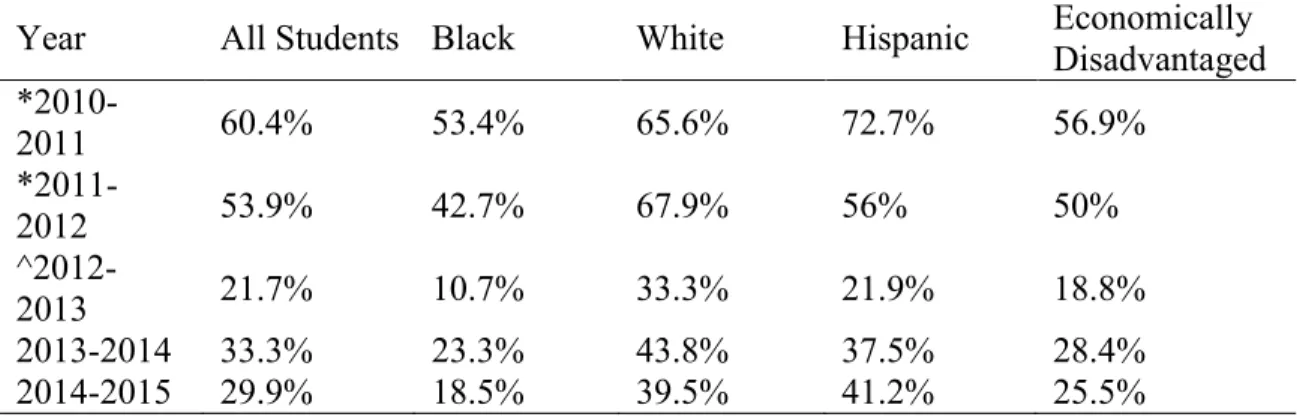
Page Table 3.1. Fairmont End of Grade Test Data: Percent of Students
Grade Level Proficient ...102
Table 3.2. Fairmont End of Grade Test Data: Percent of Students College and Career Ready ...102
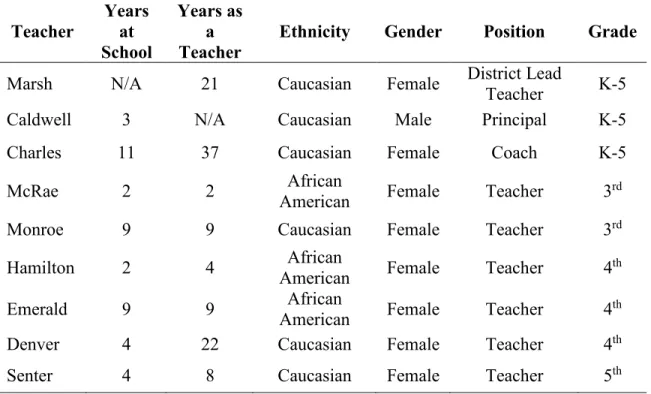
Table 3.3. Participant Overview ...103
Table 3.4. Probing Questions ...109
Table 4.1. Participant LOS Survey Data ...153
xii
LIST OF FIGURES
Page Figure 1. Conceptual Framework: Common Core State Standards
for Reading and the Role of Teacher Knowledge, Beliefs,
Context, and Mandates...16 Figure 2. Common Core State Standards for Reading ...22
1 CHAPTER I INTRODUCTION
The adoption of the Common Core State Standards (CCSS) in 2010 created a wave of changes in policies, procedures, and instructional expectations that made it possible for 47 participating states to have the same standards for Mathematics and English Language Arts. Implementing these new standards forced teachers, schools, and systems to evaluate current and past knowledge for teaching reading with the goal of students mastering the 21st Century College and Career-Ready standards set forth in the CCSS.
The need for standards-based change was a result of the United States’ desire to become globally competitive (Barton, 2009). In 2008, the National Governors
Association (NGA) revealed gaps between the United States and other countries in reading and mathematics as well as between and within socioeconomic groups and racial groups within the United States. According to the NGA, the Council of Chief State School Officers (CCSSO) and Achieve (www.achieve.org), the reading scores of fourth graders in the United States had become stagnant while other countries made substantial gains. Achieve, like the NGA and CCSSO, is focused on reform in education by raising academic standards, graduation requirements, and accountability standards that will lead to gains in the United States (www.achieve.org). This is important because gains in other countries are attributed to their reform movements (NGA, 2008). Concern about gaps and
2
the need for all students in the United States to be globally competitive in the 21st century led to a change in how we view educating the students of the United States, which in turn led to the research that was used to create the Common Core State Standards Through “international benchmarking” the United States sought to identify what top performing countries did to create their world-class education systems (NGA, 2008). Benchmarking, in this sense, required a willingness to make necessary changes in academic standards to allow the United States to perform at or above the level of the countries that were
benchmarked (NGA, 2008). It was noted that there were wide variations in the quality of content standards, and alignment of instruction and assessments across the states, and yet states were sanctioned according to the same federal law (Barton, 2009). Benchmarking allowed Achieve, National Governors Association, and the Council of Chief State School Officers to help states set standards, including common standards (Barton, 2009). The creation of common standards not only created a common set of goals for students within the United States, common standards created the possibility of an assessment system that aligns with the standards. Though the curriculum may not be common across the states, the creation of common standards created a space for curriculum and instruction to be more aligned with both the standards and the assessment system.
In 2010, the CCSS was published and became the impetus for change in teacher education and professional development to ensure that teachers were equipped to implement the standards as intended by the researchers and writers of the standards. However, it was clear during the original presentation of the standards that curriculum leaders and developers in states and school systems should be the ones to determine how
3
instruction would be delivered and the materials that would be used to deliver the instruction. Then, in 2012, two lead writers of the CCSS published the Revised
Publishers’ Criteria for the Common Core State Standards in English Language Arts and Literacy (CCCSS). This publication, among others, was created to help teachers, schools, and school systems with the selection of materials and instructional practices to support the implementation of the CCSS. Nevertheless, in the ensuing years there has been concern about how to implement the standards, and there were and still are concerns within schools about whether the standards will produce students who are college and career ready.
Although there are some teachers and principals who say they are confident about their knowledge for implementing the CCSS, they are less confident that the CCSS will improve student achievement (MetLife, 2013). Some teachers and principals are even less confident that the CCSS will actually prepare students for college or careers after high school (MetLife, 2013). Based on my understanding of the MetLife surveys and my experience as a literacy facilitator whose job it is to help teachers enact the CCSS, there are several assumptions that can be made. First, although teachers say they are confident in their knowledge of the standards and their ability to implement them, this confidence may be based on misinterpretations and misunderstandings of the intentions of the standards. Misinterpretations can cause implementing the standards in a way that does not remain true to the standards and fails to provide students with the rigor needed for success beyond high school. Second, although teachers may believe in the standards, they may not believe that the rigorous nature of the standards is beneficial for all students. In
4
this case, there may be students whose teachers believe are incapable of performing to the expectations of the standards. Third, mandates from leadership in schools and school systems about the implementation of the CCSS may conflict with instructional beliefs and knowledge about reading of some teachers. These conflicts may result in an
unwillingness of some teachers to be open to change and meaningful conversations about the standards, even in situations where students have not benefited from prior instruction.
In addition, the context of a school community is related closely to the implementation of the CCSS, especially in Title I schools where teachers are seeking ways to close the achievement gaps between their students and students in more affluent schools. In fact, in my pilot study for this dissertation, I found that teachers in Title I schools face the challenge of navigating standards-based curriculum changes in environments where some may not believe the standards are appropriate for their
population of students. Nevertheless, implementation of the CCSS has forced schools that have traditionally done poorly with reading proficiency, compared to other schools, to reevaluate how instruction is delivered to help the students meet the goal of being college and career ready. According to the standards, all students should be college and career ready by the end of the twelfth grade. Arguably, teachers’ beliefs about how students in Title I schools learn impacts the delivery of the CCSS, and teacher knowledge and context also appear to be important factors in how the CCSS are implemented. However, there is limited empirical evidence available to evaluate this assumption.
Fives and Buehl (2012) believe that “beliefs are precursors to action” (p.481) and changes in beliefs are the key for effective change in teacher practices. Although the
5
CCSS do not endorse particular materials or methods that should be used for teaching, it is clear from my experience that changes in materials and methods are needed to reach the rigor and coherence required by the standards. It is also clear that if instruction and materials for instruction remain the same, the results and gaps will remain the same. Other countries have made extensive changes in their standards, and seemingly in their instruction, that have produced positive changes in student performance. The CCSS are an attempt to guide school systems in the United States to make the same type of changes seen in countries where socioeconomic status does not impact student learning (NGA, 2008). Therefore, asking teachers to evaluate their knowledge and beliefs as a way to identify starting points for professional growth and development is important to the successful implementation of the standards. However, little empirical research is available to help on this front.
Purpose
This was a study of the "lived" experiences of teachers implementing the Common Core State Standards (CCSS) filtered through their knowledge and beliefs about reading instruction. The purpose of this study was to examine the role of teachers’ knowledge and beliefs when implementing the CCSS for reading within the context in which they taught. I was also interested in understanding how the CCSS reciprocally influenced teachers’ knowledge and beliefs. Knowing that the CCSS were created to eliminate international and national gaps in literacy, I was seeking to understand how teachers viewed and implemented the CCSS for reading in a Title I setting. In sum, this
6
study focused on how the standards-based changes in a Title I school influenced teacher knowledge, beliefs, and implementation of reading instruction, and vice versa.
To achieve the purposes of this study, I used case study methodology to capture the detailed account of six teachers at a Title I school who were implementing the CCSS in reading. In-depth interviews and observations were undertaken to provide rich
descriptions of the prior knowledge and beliefs of six teachers, how these teachers negotiated the standards, and the context in which they taught. Not only did this study reveal how the standards were filtered through the teachers’ prior knowledge and beliefs about reading instruction, it also revealed how the standards shifted in teachers’
knowledge and beliefs that then impacted their implementation of the standards. Research Questions
The research questions were based on the following propositions that underlie this study. First, I wanted to know more about how teachers’ understanding and use of the CCSS were filtered through their theoretical knowledge, beliefs, and the context in which they taught. Second, I wanted to reveal possible shifts or changes that occurred when teachers’ beliefs and knowledge did not align with the expectations or mandates for implementing the CCSS. Third, I wanted to know if such shifts or changes, if
experienced, led to changes in teacher knowledge and beliefs or in how the CCSS were implemented. The following research questions were the focus while gathering teachers’ accounts about how they implemented the CCSS and how implementing the CCSS may have caused shifts in their practice, knowledge, and beliefs. The following questions guided this study:
7
What do teachers reveal about their knowledge and beliefs about reading and how they implement the CCSS because of their knowledge and beliefs?
What, if any, shifts or changes do teachers describe or report in their knowledge and beliefs about reading during their implementation of the CCSS?
What do teachers say about why they implement the CCSS the way that they have chosen to implement the CCSS?
Definition of Terms
The following definitions provide an understanding of key terms related to my study. It is not intended that these definitions are all encompassing. Rather, I am providing the definitions of the key terms that supported my path, my lens, and my framework throughout my study.
Achievement Gap. According to Au (1998), the literacy achievement gap can be
explained through a social constructivist perspective. The “gap” represents the lack of success of students with linguistic differences, cultural differences, and socio-economic differences as compared to students who have characteristics generally needed for
reading success. “Students have difficulty learning in school because instruction does not follow their community’s cultural values and standards for behavior” (Au 1998, p. 302).
Common Core State Standards (CCSS). Created in 2010, the CCSS are a
sequence of standards from K-12 that are intended to ensure that all students are college and career ready (CCSS, 2010). The National Governors Association (NGA) and the Council of Chief State School Officers (CCSSO) collaborated on the creation of the internationally benchmarked standards to provide rigorous instruction in K-12 schools in
8
the United States (CCSS, 2010). They are considered high-quality academic standards that outline what students should know and be able to do in mathematics and English language arts at the end of each grade (CCSS, 2010).
Common Core State Standards for English Language Arts & Literacy in
History/Social Studies, Science, and Technical Subjects. The CCSS for ELA are
grade-specific standards for reading, writing, listening, and speaking that students will need to be college and career ready in the 21st century. These literacy standards reach beyond the traditional ELA classroom into teaching literacy in the content areas including social studies, science, and the technical subjects. They represent the literacy skills that college and career ready students must master to read print and digital text closely and critically (CCSS, 2010). Although the standards for literacy and content areas are written as one set of standards for elementary, the standards are written in two sets (Literacy and
History/Social Studies, Science & Technical Subjects) for 6th -12th grades.
Change. Change in this study was related to teachers modifying or refining their
beliefs, knowledge, and instructional practices. Change can be caused by outside sources including school and system mandates, professional development, professional teacher training, or change in location. Change may also be the result of shifts in personal beliefs, theoretical and practical knowledge, and experiences with teaching children to read.
Context (classroom and school). Context was two-fold for this study. First, there
was the context of the school or school system that has power over teachers’ ability or inability to enact their own beliefs. Context, from this perspective, involved schools and school systems setting mandates that introduced or eliminated certain curriculum
9
materials, controlled instructional time and delivery, and valued specific theoretical understandings. Second, there was context within the school and classroom that impacted how the teacher communicated and provided instruction to students. This type of context was filtered through teachers’ preconceived notions about the populations of students that the school served, and the teacher’s professional knowledge base.
Filters. A teacher’s professional knowledge base and theoretical beliefs about
literacy instruction, including how both teachers and pre-service teachers approach learning to teach reading, filters which elements are used and will become a part of the teacher’s classroom practice (Tillema, 1994). Individual understandings of reality are revealed through existing beliefs, which influence, screen, or filter how new information and experiences shape both what is learned from new information and how new
information is used (Fives & Beuhl, 2012).
Implementation. Implementation is the purposeful application of a specific set of
activities to put into practice a specified activity, program, or in this case a set of
standards (Fixsen, Naoom, Blase, Friedman, & Wallace, 2005). For the purposes of this study, implementation was based on policy and contextual changes within schools and school systems. As a result, teachers made changes in how they implemented, created, and applied activities to meet the expectations of the adopted policies and requirements.
Mandates. Mandates bring with them the requirement to make changes in
instructional materials and methods based upon what the leaders find most beneficial for the organization or the people serviced by the organization. Mandates are requirements placed upon teachers, but mandates often disregard a teacher’s knowledge and beliefs.
10
Teacher Beliefs. Teacher beliefs serve as filters that allow teachers to interpret events and the relevance of content. Beliefs also serve as frames that define problems or tasks, and they are guides that affect teachers’ immediate actions (Fives & Beuhl, 2012). They influence how teachers approach learning to teach and the knowledge that is constructed during the experience (Fives & Beuhl, 2008). Teacher beliefs for this study revealed both their implicit and explicit nature, stability over time, situated or generalized nature, relation to knowledge, and existence as individual propositions or larger systems (Fives & Beuhl, 2012). Another way of defining and describing teacher beliefs in this study was through teachers’ theoretical orientations for reading including traditional, constructivist, or eclectic orientations (Lenski, 1998).
Teacher Knowledge. For the purpose of this study, teacher knowledge included
knowledge about reading content and pedagogy that was valued and retained as a part of teachers’ development of beliefs during undergraduate education and in-service
professional development. It includes knowledge about the reading content, pedagogy, and pedagogical content knowledge. For this study, it also includes knowledge about reading instruction for students who attended Title I schools. Knowledge should not be confused with beliefs, although the two are closely connected (Pajares, 1992; Richardson, 1995).
Summary
The Common Core State Standards (CCSS) were created with the goal of closing the academic performance gap between the United States and other countries. This study was designed to capture the lived experiences of teachers implementing the CCSS who
11
teach in Title I schools that have as their goal to close performance gaps. This study was designed to document how these teachers navigate their own knowledge and beliefs with the expectations placed upon them at school and district levels and what teachers thought about how to accomplish the goal of closing reading performance gaps while enacting a standards-based reading curriculum. This study also looked at possible changes in
practices and beliefs related to changes in standards and curriculum based on mandates or expectations.
In chapter 2, I present the review of literature in teacher knowledge and beliefs, the history of reading knowledge, and the national and North Carolina history of the CCSS implementation. This review provided the background for this study and provided the starting point for interviews and observation, which were the plans for data collection described in Chapter 3. Chapter 3 describes the research methods, including the purpose and the process for the interviews, the observations and the Literacy Orientation Survey (LOS). Chapter 4 will begin with an overview of school and district initiatives to increase student achievement and to close achievement gaps in reading. The overview will also include data collected from district and school leaders that influenced how teachers learn, interpret, and implement required standards and practices. The majority of Chapter 4 will focus on the findings of the study, including my analysis and interpretation of the data collected from six teachers to answer my three research questions. Finally, Chapter 5 will discuss the findings, assertions, recommendations, limitations, and future research.
12 CHAPTER II
REVIEW OF THE LITERATURE
Throughout history, there have been many reforms in education with the goal of ensuring that all students receive the education that is needed to become productive citizens. In this literature review, I present research that addresses teachers’ theoretical knowledge, teacher beliefs, and the Common Core State Standards (CCSS). I also address the history, political climate, and reform movements that influenced the knowledge base for teaching reading, and how knowledge is enacted in the classroom. This focus will help better understand how the CCSS has impacted teacher knowledge, beliefs, and instruction, which are key components of my research. My goal in this study was to understand how teachers’ knowledge and beliefs about reading instruction and the CCSS were changed, or not, during the implementation of standards-based reforms and mandates.
As described in Chapter 1, the need for the adoption of the CCSS, was a result of the United States’ desire to become globally competitive after years of lagging behind other countries in reading, math, and science. In 2008, the National Governors
Association (NGA) revealed gaps between the United States and other countries, and gaps in reading and mathematics between socioeconomic groups and between racial groups within the United States (Barton, 2009; U.S. Department of Education). For example, according to the National Governors Association (NGA), Council of Chief
13
State School Officers (CCSSO), and Achieve (http://achieve.org/history-achieve), the reading scores of fourth graders in the United States were stagnant while other countries were making substantial gains. Even after previous standards-based changes and
educational reforms, the gaps that led to the adoption of the CCSS remained consistent between the United States and other countries and between sub-groups within the United States, including socioeconomic and racial groups. The goal of ensuring that all students, regardless of income, race, ethnicity, language, or disability graduated from high school ready for college and careers, meant that standards needed to be raised for all students (United States Department of Education, 2010; Conley, 2014).
To reiterate, the purpose of this study was to examine the role of teachers’ knowledge and beliefs when implementing the CCSS for reading. Knowing that the CCSS were created to eliminate international and national gaps, I was seeking to understand how teachers’ beliefs and knowledge influenced how the standards were implemented with populations of students who traditionally score on the bottom half of the literacy achievement gap. I was also interested in understanding how implementing the CCSS may have created change in teachers’ knowledge and beliefs. Therefore, this study focused on teacher knowledge and beliefs during standards-based change and the contextual factors that standards-based change had on teacher knowledge, beliefs, and implementation of reading instruction for students in Title I schools. I also focused on the context and influences that states, school systems, and schools had on how the
14
I created the conceptual framework (see Figure 1) for this study. This framework was designed to outline key elements of my study and areas of focus for the literature review. Followed by the explanation of the conceptual framework, a brief overview of the CCSS for reading is provided (see Figure 2) because they are foundational to this study. Next, a historical overview of teacher knowledge about reading and reading instruction from the 1800s to the adoption of the CCSS is provided. This historical overview focuses on legislation, policies, and trends in reading instruction that impacted the knowledge and beliefs of teachers and how reading instruction has been implemented throughout history. This history also includes research that was used to support various movements in reading instruction, and the reasoning behind the decisions that were made regarding reading instruction at various points in time. The remaining sections of this literature review focus on teacher knowledge and beliefs, including both general and specific beliefs about how reading should be taught. The beliefs section includes literacy beliefs related to various theoretical orientations and the types of research that have been used to capture teachers’ theoretical orientations and teachers’ beliefs.
The final section of this literature review returns to the key ideas in the conceptual framework and provides an in-depth view of the Common Core State Standards for English Language Arts. This section includes how the CCSS came about, how the standards were intended to be implemented, the goals of the standards, teachers’ beliefs related to the standards, and additional aspects in my conceptual framework including the role context and competing mandates that were revealed in the pilot study for this
15
dissertation. I concluded this literature review with a synthesis of recent research studies focused on the CCSS for reading to show how my research filled a gap in that research.
Conceptual Framework for this Study
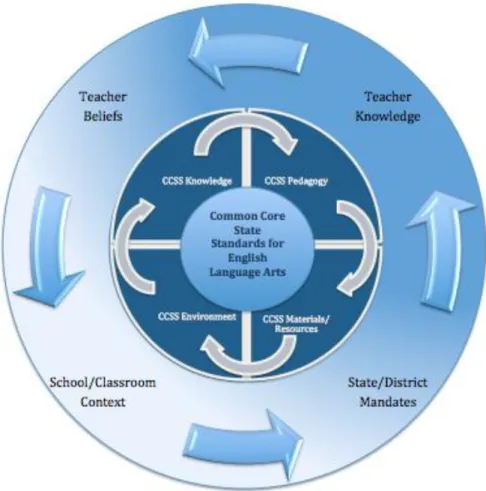
I created a conceptual framework for this study (see Figure 1) based on key CCSS for reading and ideas supported by Achieve, NGA, CCSSO, and other materials for implementation of the CCSS for North Carolina. At the center of my conceptual framework for this study were the key elements of the Common Core State Standards, which included teachers’ knowledge of the CCSS, pedagogy for teaching the CCSS, resources and materials for teaching the CCSS, and classroom environment for teaching the CCSS. Figure 1 also shows how these elements relate to one another and additional factors important to this study: teacher knowledge, teacher beliefs, the school and classroom context, and state and district mandates.
16
Figure 1. Conceptual Framework: Common Core State Standards for Reading and the Role of Teacher Knowledge, Beliefs, Context, and Mandates
The inner layer of my conceptual framework identified four key areas from the CCSS including knowledge, pedagogy, classroom environment, and materials and resources. Because teachers implementing the CCSS must have background knowledge of the standards and the major shifts in instruction they required, this is represented in the center of Figure 1. Once that background was established, a circular motion begins to happen, as indicated by the pointed arrows in the center of Figure 1. These arrows indicate that CCSS knowledge, environment, pedagogy, and materials and resources,
17
once implemented, begin to support one another, showing the standards work together, and emphasizing that one component cannot stand or grow alone. Teachers, according to this diagram, must understand the importance of all these components when they make text selections, group their students, and hold instructional conversations.
The outer rim of the framework includes teacher beliefs, teacher knowledge, classroom and school context, and state and district mandates. Although none of these areas were discussed within the CCSS, these areas were important components of my study because they served as filters for how information about the CCSS is understood, accepted or not accepted, and implemented or not. These components were also
important because in my pilot study of teachers teaching reading in Title I schools, school and classroom context influenced how interactions, conversations, and expectations allowed teachers to enact their beliefs and knowledge. In other words, I found that what teachers believe about the school and the support students have outside of school influenced instruction. State and district mandates for material selection and instruction also influenced how teachers were able to implement their knowledge about the CCSS in ways that they believed were best. The arrows on the outer rim are pointed in the
opposite direction because not only do the components in the outer rim influence each other, they also interact with how the standards are implemented.
The CCSS asks teachers to challenge all students and to move all students
towards being college and career ready by the end of the twelfth grade (U.S. Department of Education, 2010). Although not specifically mentioned in the standards, if all students are able to reach the goals of the standards, even students who attend high-poverty
18
schools and students who are African American should benefit from the instruction provided through the CCSS. Since teachers are the “lynchpin” for student success (Reutzel, 2013), this study was designed to uncover how teachers that teach these populations of students understand and implement the CCSS. Therefore, this study sought to explore how the outer layer of the framework (Figure 1) – teacher knowledge, teacher beliefs, local and state mandates, and school and classroom context - influenced instruction for a group of teachers in Title I elementary schools in North Carolina. In the remaining sections of this literature review, I delve more deeply into the history and research related to each component of this conceptual framework.
Brief Introduction to the Historical Context of Standards
North Carolina adopted the CCSS in 2012 to ensure that all North Carolina graduates were prepared to be nationally and globally competitive (Pitre-Martin, 2012a). According to Pitre-Martin (2012a), the focus in North Carolina was to use the CCSS to help students think at a deeper level of conceptual understanding, to help them
understand why the content of the standards are important, and to help students make the connection between math and literacy standards and other content areas. The North Carolina Department of Public Instruction also made the decision to adopt the standards because students of color and students who are economically disadvantaged were not achieving at the same levels as other groups of students (Pitre-Martin, 2012b). Although there had been some gains in closing the achievement gap and improved student
19
career ready when they graduated by having students engaged in learning that kept them in school (Pitre-Martin, 2012b).
The National Council of Teachers of Mathematics (NCTM) provided a model for developing national standards in 1989 based on recommendations of teachers and
mathematics professionals (Barton, 2009). Although these were national standards, states made decisions about how to use the NCTM standards to create state standards. In 1992, the National Council on Education Standards and Tests made a recommendation to implement national content standards and assessments (Barton, 2009). During the Clinton administration in 1994, the council recommended national standards again, and like before, there was debate about how to implement national standards that were not federally controlled but allowed states flexibility in applying the standards (Barton, 2009). This controversy led to the development of the voluntary NAEP assessments for fourth grade reading and eighth grade math. In 1991, states were required to create cut-points for achievement tests as a part of the federal No Child Left Behind Act (Barton, 2009). There were concerns about cut-points for state-created achievement assessments that measured student proficiency on the state standards that were far below that of the NAEP proficiency cut scores (Hunt, Rizzo, and White, 2008). Then, as a part of the 1994 amendment to the Secondary Education Act of 1965, states were required to create content standards and ways of measuring student achievement in the standards (Barton, 2009). However, differentiated state standards, ways of measuring the state standards, and how states used cut-points to determine standards proficiency made it difficult for
20
states to really assess how instruction and learning was happening in United States classrooms and did not create a way to compare states.
In 2006, the Fordham Foundation conducted a debate on national standards (Barton, 2009). In 2008 the former governor of North Carolina, Jim Hunt, was asked to take the lead in exploring the possibility of common state standards (Hunt et al., 2009). Conversations continued until the James B. Hunt Institute for Educational Leadership and Policy created the “Blueprint for Education Leadership” (Barton, 2009). It was
understood that although the United States had excellent schools where some students benefitted from advanced and honors courses, and lived in communities that supported educational excellence, not all students were fortunate to have these experiences (Hunt et al., 2009). Hunt et al. (2009) concluded the “Blueprint for Education Leadership” stating that:
Standards are not the magic bullet that will transform education and ensure that all our students are prepared for the new economy. But standards help state and local leaders, teachers, schools of education, and textbook and test publishers align their efforts to improve the educational experience of all students. Without high, clear, and rigorous standards, efforts in P-12 education lack direction and goals (p. 7).
In 2010, the CCSS were released and within a short period of time over 40 states adopted them, including North Carolina in 2012. However, before going into more detail about what precipitated the writing of the CCSS, it is important to understand the content of the CCSS for reading, the foundation of this study.
21 Common Core State Standards for Reading
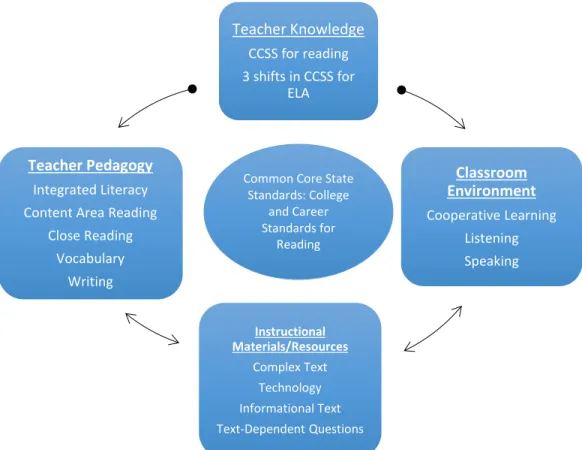
The CCSS for reading (see Figure 2) includes details of the reading standards and reveals the expectations of the standards. I created Figure 2 to show the key ideas in the CCSS for reading that were supported by research collected by the Council of Chief State School Officers (CCSSO) and the National Governors Association (NGA). These key ideas were distributed to North Carolina teachers in the form of CCSS materials and training resources offered on the North Carolina Department of Public Instruction website. Figure 2 also identified key topics and sub-topics based on reoccurring themes and ideas found in the Common Core resources and materials supported by Achieve, NGA, CCSSO, and materials for implementation of the CCSS for North Carolina. These themes highlighted the importance of teacher knowledge, the classroom environment, instructional resources and materials, and the pedagogy teachers used to teach reading as additional factors related to the role of teachers’ knowledge and beliefs when
22 Figure 2. Common Core State Standards for Reading
Figure 2 is organized in a circular fashion with teacher knowledge placed at the top. This represents the importance of studying what teachers understand about the scope and expectations of the standards. Teacher knowledge is at the top because the
knowledge and effectiveness of the literacy instruction and implementation of the CCSS ultimately is dependent upon what the teacher in the classroom knows and is able to do (CCSS, 2010; Reutzel, 2013).
The arrows in Figure 2 demonstrate the relationship between the key ideas in the CCSS. The arrows from teacher knowledge are one-way arrows to indicate that the teacher provides instruction through pedagogy enacted in the classroom environment
Teacher Knowledge CCSS for reading 3 shifts in CCSS for ELA Classroom Environment Cooperative Learning Listening Speaking Instructional Materials/Resources Complex Text Technology Informational Text Text-Dependent Questions Teacher Pedagogy Integrated Literacy Content Area Reading
Close Reading Vocabulary
Writing
Common Core State Standards: College
and Career Standards for
23
using selected instructional materials and resources. The arrows between the pedagogy, classroom environment, and materials and resources have arrows on both ends. These arrows demonstrate the reciprocal relationship between these areas. All of these areas are functioning every day in a CCSS classroom. One area is not more important than the other because all of these things must be in place to represent true implementation of the CCSS.
Teacher pedagogy is a major area in the CCSS that must be studied because teachers are still uncertain about the practices that best support implementation of the CCSS (Hipsher, 2014). Certain teaching practices should be implemented during daily reading instruction to help students meet the CCSS. Teacher pedagogy to support the CCSS includes integrated literacy, content area reading, close reading, vocabulary, and writing. Teacher pedagogy is based on teachers’ knowledge about appropriate pedagogy for teaching reading and is also influenced by the classroom environment and the
materials and resources that are available and are used.
Classroom environment is a major area in this figure because it helps us
understand how components of learning in CCSS classrooms are managed. A big staple of the standards is that learning should happen in cooperative and collaborative classroom settings where speaking and listening are done in a safe space. Classroom environment also includes the organizational structures for whole group, small group, and one on one instruction. Not to be excluded from classroom environment are the types of interactions that occur between students and between adults and students in the room.
24
Finally, the selection of materials and resources is also important for
implementing the CCSS, even though the CCSS do not stipulate what teachers should use for instruction or how they should provide instruction. However, it is clear that if the materials and resources do not match what the standards ask students to be able to do, then the materials will not help students acquire the standards needed to make them good readers. Materials and resources identified by the CCSS that should be a part of every classroom include: complex text, technology resources, informational text, and text dependent questions.
Additional, detailed information about the CCSS for reading are provided later in this literature review. However, before getting into more detail about the content of the CCSS, the historical context for what eventually led to the CCSS is important to understand.
Changes in Reading Instruction: From 1830 to the CCSS
Reading programs have been used in the United States since the development of the graded reader created by McGuffey in the 1830’s to provide both content and
methods for reading instruction (Dewitz, Jones & Leahy, 2009). During the 19th century, reading programs suggested that students articulate the substance of their reading or respond to comprehension questions after reading (Dewitz, et al., 2009). In the 1920’s, basal reading programs provided teachers extension activities including writing activities, plays and drama, and even cross-curricular activities (Dewitz, et al., 2009). Although the importance of comprehension gained momentum during the 1920’s, emphasis in
25
recognition (Rayner, 1998). During this behaviorist period, researchers studied how the eyes moved across the page to read words, sentences, nonsense words, and word parts (Rayner, 1998). Comprehension, during this same period, emphasized vocabulary, word meaning, and skill-based reasoning. There was also a shift, during the 1920’s, from oral reading expression with a focus on pauses, fixation, and reading rate to rapid silent reading.
In the 1930’s and 1940’s, reading instruction became skill-based and focused on finding main ideas, determining author’s purpose, drawing conclusions, distinguishing fact from opinion, and comparing and contrasting what was read (Dewitz et al., 2009). During the 1940’s, teachers used programs that offered systematic development of reading lessons based on progressively difficult skills and passages (Betts, 1946; Gray & Reese, 1957). Basal programs at this time provided teachers with lessons that included preparing students for the reading, supporting them during guided reading, emphasizing skills and drills, and extending learning with follow-up activities (Gray & Reese, 1957).
Reading Practices and Programs 1970’s - 1990’s
In the 1970’s, skills instruction took center stage to accompany basal texts. The use of skills-based worksheets and criterion-referenced tests became a part of basal programs (Dewitz et al., 2009). Implemented as early as the 1940’s, skills-based instruction, with an emphasis on isolated reading skills mastery was the focus of basal reading programs (Afflerbach, Pearson & Paris, 2008).
In the 1980’s and 1990’s whole language was the popular choice for reading instruction that emphasized the natural development of literacy competency (Pearson,
26
2004). Whole language advocates thought that skills were better taught in the act of reading and writing genuine text for authentic purposes, rather than taught directly and explicitly by teachers (Pearson, 2004).
Reading Practices and Programs 1990’s - 2010’s
During the 1990’s, literature-based instruction, or the reading of authentic texts was promoted (Dewitz et al., 2009). Textbook publishers pushed materials for literature-based instruction and classroom libraries and boxed sets of thematically related text were marketed for use in classrooms (Pearson 2004).
In the 2000’s, No Child Left Behind and the National Reading Panel Report (2002) caused a shift in the field of reading instruction back to skills-based forms of teaching reading. Reading First, a national reading initiative that was developed based on the results from the National Reading Panel Report, pushed for materials and instruction to be based on Scientifically Based Reading Research (SBRR) and the Big Five.
Phonemic awareness, phonics, fluency, vocabulary, and comprehension were the
cornerstones of reading instruction during this period (Dewitz et al., 2009). Schools were encouraged to use phonics-based reading programs that required teachers to apply instruction to fidelity as provided by the publisher and based on what SBRR determined was effective (NRP, 2000).
New basal readers, or phonics-based reading programs, were created to prevent any child from being left behind by meeting the reading needs of children most at risk for reading failure (Pease-Alvarez & Samway, 2008). The movement towards basal
27
over what students should learn, and over what and how teachers should teach in public schools (Pease-Alvarez & Samway, 2008). In order to receive federal and state funding, some states, including North Carolina, required teachers to receive intensive professional development to learn to teach using prescriptive core reading programs. The Reading First Model was considered by some to be what was needed to close the achievement gap in reading between minority and majority groups of students (Maniates & Mahiri, 2011) based on socioeconomic and racial status.
Currently, strategy instruction that involves intentional control and deliberate direction of reading behavior (Afflerbach et al., 2008) is expected in many schools. According to Maniates and Mahiri (2011), although schools are in what some call the post-scripted curriculum era, scripted programs continue to be used because these
programs are a way to normalize instruction for teaching reading in kindergarten through third grade. Accountability and assessment has also moved reading instruction towards scripted programs and instructional mandates (Achinstein & Ogawa, 2006; Pease-Alvarez, Samway & Cifka-Herrera, 2010).
The Great Debate
The Great Debate is a key aspect in the timeline of reading instruction. Reading instruction for beginning readers is at the center of this debate. It includes how and when to begin instruction, what instructional materials to use for instruction, and how to organize the classroom for instruction (Chall, 1967). On one side of the debate there is a Code Emphasis perspective that sees speaking and reading as two different
28
process, and learning to read is a cognitive achievement that one must be explicitly taught (Liberman, 1990). On the other side of the debate, there is Whole Language that centers around the idea that children learn to speak and read as their language develops; therefore learning to read should be a natural process and be just as easy as learning to speak (Liberman, 1990).
It should be noted that The Great Debate, with all of its attention since the 1960’s, actually only applies to beginning reading, and not to reading instruction after students have learned to decode text. According to Chall (1967), Code Emphasis is recommended as a beginning reading method because it focuses on teaching children to decode
individual words in print. To work on decoding after students can recognize words in print is a waste of time (Chall, 1967). Although The Great Debate is not a hot topic for discussion today, arguably this debate provided the base for the current policies, mandates, and instruction that we see today. In fact, the most current movement in reading education today, the adoption of the CCSS, does include code-emphasis, or phonics, as seen in the Foundational Skills components of the CCSS. However, it also includes standards for teaching beginning readers how to comprehend text as found in the expectations of the CCSS Reading Information (RI) and Reading Literature (RL)
standards beginning in kindergarten. National Reading Panel
In 1997, the director of the National Institute of Child Health and Human Development (NICHD) and the Secretary of Education were charged with creating the National Reading Panel to survey the research on the effectiveness of instructional
29
approaches used to teach children to read (National Reading Panel, 2000). Based on the 2000 National Reading Panel (NRP) report, practices that should be included in
beginning reading instruction included systematic and explicit instruction in phonemic awareness, phonics, fluency, vocabulary and reading comprehension strategies. These practices, commonly known as the Big Five, are knowledge that teachers should acquire to help children learn to read proficiently and become “good readers.”
The National Research Council (1998) also identified three obstacles that could possibly prevent students from becoming proficient readers that align with the NRP report and its findings. These obstacles included: 1) difficulty in understanding and using the alphabetic principle; 2) failure to acquire and use comprehension strategies and skills; and 3) motivation (NRC, 1998). However, the NRP report and findings did not address the populations of students that NCLB legislation was created to help: minority and low socioeconomic students (Meyer, 2005). The NRP report also did not include studies that focused on how diverse and second-language learners best learned to read (Meyer, 2005).
However, based on the NRP findings, the No Child Left Behind Act (2001) provided low-income schools with funding to support the Reading First initiative. The Reading First initiative was designed to ensure that the NRP findings were implemented in schools and that resources and materials aligned with the expectation of the findings. Later, research conducted on low-income students who received Reading First funding and those who did not receive Reading First funding, indicated that there was no difference found in the performance of the students, and the achievement gap remained the same (Arlington, 2012). Also, the increased amount of time for literacy instruction in
30
Title I schools was found not to impact student achievement growth in reading (Arlington, 2012). The goal of NCLB was to close achievement gaps that existed between groups of students from different socio-economic backgrounds, but there was little change ten years after this legislation (Arlington, 2012).
The Importance of Teacher Knowledge
Teachers’ knowledge of the psychology of reading and knowledge of reading development are essential in overcoming the obstacles identified by the National Reading Panel Report (2000) and for ensuring student growth in reading (Piasta, Connor, Fishman & Morrison, 2009). Along with knowing how language develops, teachers must know that the development of reading begins with instruction that starts with an awareness of sounds, syllables, meaningful word parts, relationship of word meanings, and the structures of written text (Moats, 1999). Teachers who understand reading development understand that although comprehension is the ultimate goal of reading, comprehension cannot take place if students cannot decode. This makes the case of the importance for early teaching of linguistic awareness and phonics explicitly (Moats, 1999).
Reading teachers also should be aware of the language structures that support the reading development of students. Knowledge of phonetics, phonology, morphology, orthography, semantics, and syntax are areas of knowledge that every teacher must have in order to provide reading instruction (Snow, 2002). Teachers without a grasp of the language structure – phonography, morphology, orthography - will most likely be unable to provide students at the greatest risk of reading failure with the instruction that is needed to produce successful readers (Moats, 1996).
31
The findings of the National Reading Panel Report led to the Reading First movement, which had an influence on today’s Common Core State Standards. The Foundational Skills in the CCSS focused on decoding skills found in phonemic awareness, phonics, and fluency (CCSS, 2010). The Reading Information (RI) and Reading Literature (RL) standards focused on various aspects of reading growth that lead to understanding of vocabulary and comprehension (CCSS, 2010).
The Big Five
The Big Five are instructional areas of focus identified by research as beneficial for teaching children to read. The five instructional areas – phonemic awareness, phonics, fluency, vocabulary, and comprehension - come directly from the National Reading Panel findings. Although they are major focus areas, the National Reading Panel findings include other instructional implications that influence how these instructional areas are implemented in the classroom. What follows is a brief review of the research supporting each of these foundational aspects of reading instruction.
Phonemic awareness.“Phonemic awareness refers to the ability to focus on and manipulate phonemes in spoken words” (Ehri & Nunes, 2002, p.111). Studies show that students who have strong phonemic awareness are better readers than students who have low phonemic awareness (Ehri & Nunes, 2002). These students are better readers because they have a strong grasp of the alphabetic system and can apply the system when reading and writing words (Ehri & Nunes, 2002; NRP, 2000). When phonemic awareness
instruction is linked to systematic decoding and spelling, the reading failure of students is significantly decreased (Moats, 1999).
32
Although McCutchen et al. (2002) found that there was little correlation between teacher beliefs and practices; there was a significant correlation between teachers’ phonological knowledge and the activities that they selected. This finding supported the need for teachers to have strong knowledge in phonology. While proficiency in phonemic awareness was found to be the best predictor of student reading success (Moats, 1994), studies showed that teachers lacked the content knowledge necessary to best serve the phonological needs of the students (McCutchen et al., 2002). On average, teacher knowledge of language structure and phonology was relatively low (McCutchen et al., 2002; Moats, 2009). This was concerning because teachers with high knowledge of language and early literacy were able to produce student growth in word identification and reading because of the explicit and intentional instruction they provided (Piasta et al., 2009). In contrast, teachers with low knowledge of language and early literacy had a negative effect on student learning, even when the teacher provided the same amount or more time with instruction (Piasta et al., 2009).
Phonics.Phonics instruction focuses on helping beginning readers understand how letters are linked to phonemes to form letter-sound correspondences and eventually spelling patterns (Kuhn & Stahl, 2003; NRP, 2000). The connection between phonemes and spellings helps students who do not apply alphabetic understandings when they are confronted with unfamiliar text (NRC, 1998). The recognition of letter-sound
relationships and the ability to use them to make meaning of print depends on students’ development of word recognition accuracy and reading fluency (Kuhn & Stahl, 2003;
33
NRC, 1998). Starting the process of reading depends on a student’s ability to map letters and the spellings of words they represent (NRC, 1998).
Teachers must have sound knowledge of the content of reading including the symbol system and its relationship to meanings (Moats, 1999). Not only must teachers be knowledgeable about the speech sounds and symbol system, they should be reflective about their teaching of the content (Moats, 1999). For instance, it is important that
instruction ensures that students not only know the sounds that letters symbolize, but also how to segment pronunciations into phonemes (Ehri, 1987). That is, after instruction students should be able to recognize that single letters, or graphemes make individual sounds in words and that other sounds are digraphs.
A meta-analysis conducted by the National Reading Panel (2000) determined that first grade students who were taught systematic phonics were able to decode, spell, and comprehend text. Older students were also able to demonstrate decoding and spelling with systematic instruction in phonics; however, these same students had difficulty in the area of comprehension (NRP, 2000). Therefore, teachers must know the importance of moving students from phonetic understandings of spelling to morphemic understandings, or understandings where students recognize spelling patterns automatically (Ehri, 1987; McCutchen et al., 2002) toward comprehension development. This supported the NRP (2000) report, which stated that focused and systematic instruction leads to the ultimate goal of reading, comprehension.
As with phonemic awareness, the type of phonologic, morphologic, and
34
reading disabilities have difficulties with spelling regardless of the type of systematic instruction that they received (NRP, 2000). So, systematic instruction alone does not guarantee reading developmental growth. Likewise, teacher degrees, certifications, and conference attendance does not guarantee students’ reading growth and development because participation in these programs was found to have little effect on teacher knowledge about early reading (Carlisle, Correnti, Phelps, & Zeng, 2009). However, in an earlier study by McCutchen et al. (2002), there was a correlation between teacher reading content knowledge and teacher instructional practices for teaching sounds and letter-sound relationships. Therefore, the more knowledge that teachers had about phonology, morphology, and orthography, the better equipped they were for teaching phonics. Solid understanding of phonetic structures allowed for the fluency needed to begin focus on syntax and semantics.
Fluency. Fluency in reading is the ability to read with speed, accuracy, and expression (NRP, 2000). Fluency is the speed or automaticity of word recognition, accuracy in decoding, and appropriate use of stress, pitch, and phrasing, or prosody (Kuhn & Stahl, 2003). Fluency is measured by the reading rate, or words read per minute; word recognition, or number of words correctly identified in a passage; and oral reading comprehension, or the ability to respond to recall or literal questions (Dowhower, 1987). Other measures of fluency include aspects of reading that influence prosody – phrasing, or how words are grouped for pauses, and intonation (Dowhower, 1987).
Good readers not only read accurately, they recognized words automatically, therefore allowing for more focus on the meaning of the text (Kuhn & Stahl, 2003).
35
Multiple exposures to text allowed readers to focus less on the orthographical processing of text towards more focus on automaticity (Kuhn & Stahl, 2003). According to Kuhn and Stahl (2003), prosody may play a role in the connection between fluency and comprehension. While reading at an appropriate rate and with accuracy, readers who demonstrated skill with prosody were able to apply intonation and timing in a way that contributed to the meaning of text (Kuhn and Stahl, 2003).
Reading fluency is an important factor in reading comprehension; however, the strategies most commonly used to impact student fluency, including guided oral reading and silent independent reading, have not been proven to be beneficial (NRP, 2000). Both guided oral reading and silent independent reading lack research to support the use of these techniques for increasing reading fluency (NRP, 2000). However, repeated readings have been found to be beneficial for transitional readers’ rate, accuracy, oral
comprehension, and prosody (Dowhower, 1987). Dowhower (1987) also found that repeated readings increased the number of words that students read correctly in a minute while using appropriate phrasing, which led to greater understanding or comprehension of text passages. In a meta-analysis of fluency research, Kuhn and Stahl (2003) found that with an increase or growth in fluency, there was also an increase in comprehension. Although instruction in fluency may lead to significant gains in word recognition and overall fluency, only moderate gains were made in comprehension of text (Snow, 2002).
There was a consensus in the research that it is not clear if the strategy of rereading for fluency development created growth, or if growth should be attributed to this instructional strategy or the amount of exposure to text required of students