Sustainability
Annual Report
Our Annual Report is a compre-hensive guide to Nordea's business performance during 2015. It includes an overview of Nordea's sustainability work to add context as one of the building blocks of the financial performance of the bank. The Annual Report can be downloaded from nordea.com/ir
Fact Book
Our Sustainability Fact Book offers users all the key data from within the Sustainability Report collected in one place and accessible in excel format.
Responsible Investments Annual Report
Nordea Asset Management’s sixth Annual Report focuses on our com-mitment to being a responsible asset manager. This year we again highlight companies in our Stars funds’ portfolio and present cases from 2015.
Sustainability Report
This is Nordea's eighth annual sustainability report. The goal of the report is to provide a holistic under-standing of Nordea's sustainability work. This year we're proud to intro-duce our new sustainability strategy and showcase the ongoing progress made by the bank during 2015.
Sustainability at Nordea sources
All information of sustainability at Nordea can be found in our annual Sustainability Report, Fact Book, GRI index document and Annual Report. In addition to the reports, nordea.com has a comprehensive overview with download centre. For any feedback, contact us at [email protected].
Website
Visit our section on nordea.com to get an overview of Nordea's sustainability work, download docu-mentation and gain a more in-depth understanding through our regularly updated stories and case studies. Visit the site at nordea.com
GRI index
The Global Reporting Initiative (GRI) index provides reference to compliance with GRI G4. It includes the general and Specific Standard Disclosures and describes the boundaries for our reporting. Download the report from nordea.com
16
Our aim is to run a successful business that makes a positive impact on society.20,4 BN€
Other household lending686,474
Number of financial plans created137,2
BN€
Mortgages12.1million
Number of branch transactions42
We want to manage our own operations responsibly and run our business in a way that promotes the long-term health of our environment.34
Creating opportunities is about mak-ing sure that we employ the right people with the right blend of skills and competences, and that we offer opportunities for development.04
Casper von Koskull describes Nordea's transforma-tional agenda and how the sustainability strat-egy addresses societal challenges.Sustainability at Nordea
04 CEO statement
05 Nordea at a glance
06 Thinking broader, looking farther
08 Developing our new sustainability strategy
09 Determining our material issues
10 Engaging with stakeholders
11 Managing sustainability
Acting with integrity
12 Re-thinking our approach to compliance
14 Towards a more structured framework
15 Ensuring awareness
Making sustainable economic progress
16 Addressing our business impact
17 Helping customers and communities to prosper
20 Aiming for customer satisfaction
21 Focus on climate change
22 Supporting large corporations for sustainable growth
24 Investing responsibly
26 Spending wisely: Responsible procurement
28 Paying taxes responsibly
Building skills in personal finances
30 Working together to teach money management
32 Partnerships and volunteer work in the Nordic countries
Creating opportunities for our people
34 Equipping our people for a changing world
35 Leadership is vital
36 Spotlight on gender diversity
38 Engaging with staff
Managing our environmental footprint
42 Reducing our operational impact
44 Becoming carbon-neutral
46 Nordea EcoFootprint programme
Contents
12
Nordea is committed to creating a com-pliance framework and culture that will over time live up to the best-in-class standards.30
We work with our partners and volunteering pro-gramme to share our expertise and skills to help people understand money management.Any company has to be centred on the needs of its customers. As our customers increasingly engage with us online or by phone, we are now in a transition period to becoming a truly digital bank. We have launched new digital services such as our updated mobile bank and further changes will demand we invest in our competences and IT. The outcome of this transformational agenda will be a more efficient and straightforward structure with benefits to our customers, employees and investors and enable us to become truly “One Nordea”.
As well as taking action because of digitalisation, we have also reflected on how other megatrends such as climate change and ageing demographics affect our business.
We have concluded that our sustain-ability programme should address the societal challenges where we have rel-evant skills and expertise. We must take responsibility for social and environmental issues in our business but we should do more. Banks have an important role to play as enablers of economic success in society. We have therefore identified three key focus areas for our new sustainability ambitions: promoting sustainable eco-nomic progress, building skills in personal finance and ensuring a diverse workforce. In addition, in 2015 we have focused on compliance, which is an essential building block in our customer journey and digital transformation. We are strengthening our
compliance culture and bolstering our efforts to combat financial crime. We have established a Business Ethics and Values Committee to instil a strong group-wide culture that fosters high ethical and professional standards and ensures poli-cies clearly guide decision-making and conduct in daily business. We see this as crucial to our business sustainability and long-term value.
When we reflecton 2015 it is impossible to ignore the issue of climate change and the historic commitments made in Paris. In step with this, we made our own climate change pledge. This includes the com-mitment to be carbon neutral in our own operations, which we achieved this year. Our pledge goes further. We know that decisions about how we invest, who we fund and what we spend our money on have a significant impact. We will there-fore raise concerns about our clients’ impacts on society with them, preferring engagement to exclusion. That said, the need for concerted action on climate change and the risk that some sources of fossil fuels will become ‘stranded assets’ cannot be ignored, and we will not begin new client relationships with companies that primarily depend on coal.
Ensuring people can benefit from economic opportunities and be produc-tive and responsible members of society is another area where we can play a role. Nordea employees make a difference by sharing their expertise and teaching financial skills. Throughout the Nordic
countries we have great partnerships in place that allow us to reach large num-bers of young people.
Helping others in turn helps our employ-ees develop their own skills. In a time of demographic changes with increased competition for skilled people, this is something we value highly. We believe that by attracting and developing a competent workforce we will be well positioned to face this challenge. We have some way to go in achieving gender diversity, and we have combined targets with training for managers to help recognize unconscious bias in our recruitment decisions. Seeing more women in senior management posi-tions is our medium-term goal. It will make us a stronger company, better able to serve our diverse customer base. Committing to actions that drive for-ward our new sustainability strategy is a priority. If we do it well, the prize is great. Not only will it help us be ‘One Nordea’, it will also deepen our engagement with stakeholders – above all our customers – and address the need to rebuild trust in the financial sector. This aligns with our business goal of creating the future relationship bank, and helps us realise the company’s vision of providing great customer experiences in today’s increas-ingly challenging world.
Casper von Koskull,
Group Chief Executive Officer
CEO statement
Sustainability at NordeaWe operate in:
Denmark, Finland, Norway, Sweden, Estonia, Latvia, Lithuania and Russia
•
Operations Centre (NOC) in Poland with 1,466 employees•
International branches in Frankfurt, London, New York, Shanghai & Singapore and representative offices in Beijing and Sao Paulo. A total of 300 employees who are a mix of locals and expatriates (40 in 2015).•
The largest Nordic private bank in Luxembourg and Switzerland.Nordea is the largest
financial services group
in Northern Europe.
Nordea has leading positions in corporate and institutional banking as well as retail banking and private banking. It is also the leading provider of life and pensions products in the Nordic countries.
Formal name: Nordea Bank AB (publ.)
Legally registered in Sweden
with head offices in Stockholm.
32,610
Total number of employees
>10,500,000
Total number of customers
43%
57%
41%
% of women
as managers:
Key figures
9,964 m*
Total operating income, EUR
4,791 m*
Operating profit, EUR
16.5%*
Common Equity Tier 1 capital ratio
12.3%
Return on equity
14 b.p.s.
Loan loss ratio
0.64
Proposed dividend, EUR per share
A Nordic bank with a global reach
Nordea at a glance
Sustainability at NordeaDenmark
Finland
Sweden
Norway
Russia
Estonia
Latvia
Lithuania
* Excluding non-recurring items.
For further explanation please see the Fourth Quarter and Full Year Results 2015 or Annual Report 2015 at nordea.com/ir.
The Nordea share
is listed on
NASDAQ OMX Nordic Exchange
in Stockholm, Helsinki and Copenhagen
In 2015 we launched Nordea’s new sustainability strategy, which represents a significant milestone in our journey. With many years’ experience of man-aging and reporting on our operational sustainability impact, and a growing appreciation of our broader impact on society, we believe it is time to expand our horizons, raise our ambition and embed sustainability even more deeply within our business strategy.
It will always be important for us to act responsibly and ethically and to minimise our negative impacts. However, our analysis is that the world is changing and facing unprecedented challenges, and expectations on business are higher than ever. Our new strategy reflects our belief that we have an important role
in building the future of the societies where we operate, and our desire to be a significant force for good in these societies.
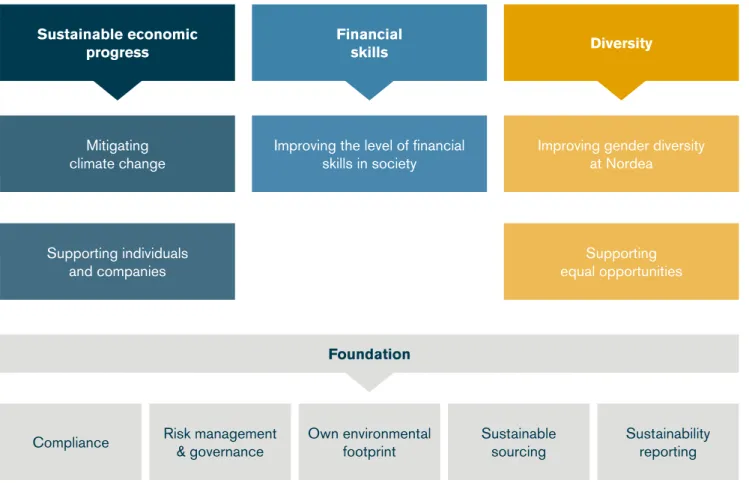
Our strategy is framed around the societal challenges for which we have relevant expertise and competence, and we have identified three specific areas where we feel we have the best opportunity to make a positive difference (see below in Illustration 1). These three priority areas each form a chapter in this report. In each area we have defined the key challenges, clarified the role we can play and our main goals, and made exacting commitments. Our focus is now on working together across the whole business – taking actions that will turn our commitments into reality.
Thinking broader, looking farther
Sustainability at Nordea
Illustration 1:
Sustainability strategy
Sustainable economic
progress
Compliance
Risk management
& governance
Own environmental
footprint
Sustainable
sourcing
Sustainability
reporting
Mitigating
climate change
Supporting individuals
and companies
Financial
skills
Foundation
Improving the level of financial
skills in society
Diversity
Improving gender diversity
at Nordea
Supporting
equal opportunities
Our new
sustainability
strategy is based
on the relevant
societal challenges
where we can
apply our skills and
experience to make
positive change.
Sustainability at Nordea
In 2015
we committed to being more ambi-tious with our sustainability work. Having worked with sustainability actively since our Sustainability unit was established in 2008, we have created a solid founda-tion for our programme. Our 2013 stake-holder dialogue – which gave rise to over 5,000 suggestions for actions we could take to be more sustainable – and the great appetite of our staff to do more, led us to form Sustainability focus areas grouped according to key stakeholders. We want to gain a clearer understanding of the impact of our business on society, and as a part of this process we con-tinue to analyse fundamental changes in the financial industry and in customer demands for our services. We aim to be ahead of these developments and be part of shaping the future of the financial industry.Nordea is a value-based organisa-tion guided by our three values: Great Customer Experiences, It’s all about peo-ple and One Nordea Team. Our business fundamentals need a solid foundation, composed of sound ethical principles. This foundation is our licence to operate. It includes risk management and compli-ance, our own environmental footprint, our supply chain, and our sustainability
reporting. This work continues to under-pin our broader ambitions.
New sustainability strategy based on societal challenges Throughout the year, we have worked closely with key business areas and group functions, first to appreciate societal trends that affect us and then to agree on our next steps. This work successfully led to the Sustainability Committee approving the new sustain-ability strategy in November 2015. Our new sustainability strategy is based on the relevant societal challenges where we can apply our skills and expe-rience to make a positive change. We have articulated our beliefs about our role in tackling these societal challenges, and have made specific commitments in each area. An overview of our sustaina-bility strategy is provided in Illustration 2. It has been an exciting and inclusive process that is good for Nordea and, we believe, good for society too. More remains to be done and in 2016 we will work further with the business areas to define action plans and measurable goals. With those in place society can hold us to account and we will be able to tangibly demonstrate the contribution we make to a more sustainable society.
Letter from Gunn Wærsted
Gunn Wærsted,Head of Wealth Management, Chairman of the Sustainability Committee
Our strategy and materiality analysis were developed concurrently in 2015. We considered external and internal perspec-tives to find the most material issues for our business and the cornerstones for our sustainability strategy. See Illustration 2 for an overview of our process to define the most material issues.
External perspective
We began by analysing global megatrends and considering which were particularly relevant to the financial industry. From there, we identified the ones that most affect our business and shape customer demands.
How did we ‘Identify challenges in society’?
Global megatrends identified were: • Demographic and social changes: These
lead to heightened requirements for a diverse workforce with the right areas of competence and the need to provide equal opportunities so all people can become full members of society • Climate change and resource scarcity:
This leads to demands to mitigate envi-ronmental damage, develop sustainable business, assess exposure to climate risk and grow economies without increasing emissions
• Technological breakthroughs: These require us to radically rethink how to innovate in order to keep pace with agile competitors and develop online services. We have also observed the United Nation’s 17 Sustainable Development Goals (SDGs) to understand both the positive and negative impact of our operations and activity. Our sustainability strategy is totally aligned with the SDGs most relevant to the financial industry.
Internal perspective
Our Sustainability Committee is the gov-erning body on sustainability matters and decided in spring 2015 to set more ambi-tious sustainability goals. We set up a task force with representatives from all three business areas and Group HR. Members of the Sustainability team and the task force held numerous individual and joint meetings to discuss the new ambition level together. We also conducted a stakeholder survey among the top 40 senior manag-ers at Nordea to ensure alignment and obtain input to the strategy work ahead. The outcome was that the future priorities identified were supported.
How did we ‘Define commitment and direction?’
Our values are the foundation for all our
business: ‘Great Customer Experiences’, ‘It’s All About People’ and ‘One Nordea Team’ guide all decisions we make. As these values suggest, people, be they employees or other stakeholders, are at the core of both our business strategy and our approach to sustainability. We engage our employees by working with a group-wide network and aim to retain and further build the trust of our stakeholders in general by further emphasising the role of compliance and risk management in our strategy.
The new business strategy and customer vision launched in spring 2015 were fur-ther internal perspectives that shaped the sustainability ambition. The new customer vision is based on meeting the changing demands of customers and being easy to deal with, relevant and competent, any-where anytime and making Nordea the safe and trusted partner for a personal and digital relationship. The main ele-ments of the new business priorities for 2016-2018 are:
• Simplify for scale and a forceful digital response
• Expand on core strengths and drive cost and capital efficiency
• Maintain a low risk profile. Sustainability at Nordea
External perspective
Mega and industry trends
Mega trends
• Demographic and social changes
• Climate change and resource scarcity
• Technological breakthroughs
New Sustainable Development Goals
Trends in financial services • Regulatory changes • Behavioural changes • Financial environment • Social inclusiveness Internal Sustainability stakeholder network • Retail banking • Wholesale banking • Wealth management • Human resources • Investor relations
• Group credit risk
• Group marketing & communications
Sustainable
economic progress
Financial
skills
Diversity
Solid
foundation
External stakeholders • Customers • Shareholders/investors • Regulators • Suppliers: • Analysts: • NGOs • Government authoritiesIllustration 2:
How we developed our new strategy
Identif ying challenges
in society Internal perspective
Sustainability committee and Sustainability unit
• Values
• Ethics & compliance
• Business strategy
• Customer vision
Defining commitment
and direction
Developing our new sustainability strategy
Ensure diverse range of external views are considered Ensure business fundamentals are considered
Sustainability at Nordea
Determining our material issues
Through bringing together the various external and internal perspectives, we have defined three societal challenges in which Nordea can make the most signif-icant contribution. These are challenges
where, left unaddressed, our business may have a potentially negative impact on society. By investing time and effort in the actions associated with each challenge area, we manage that risk and identify
opportunities to add value to society, support our stakeholders and develop opportunities for our business.
1) Sustainable economic progress
Corresponding GRI aspectsWe believe that our business decisions affect the future and are therefore committed to taking environmental and social issues into account in business selection and in investment decisions. Furthermore, we believe that the success of businesses and individuals are the key to economic growth and social wellbeing
and we are therefore committed to enabling businesses to prosper and supporting individuals so that they can enjoy a good quality of life. Our core commitments on this area relate to:
• Climate change
• Sustainable finance
• Responsible investments
• Responsible procurement.
Economic performance Indirect economic impact Procurement practices & Supplier assessment Investments Product Portfolio Active Ownership
2) Building skills in personal finances
Corresponding GRI aspectsWe believe people need to understand their finances to be a responsible member of society. We therefore support selected groups in society to help them achieve a good level of skills in personal finances so they can
have a good quality of life. Our core commitments on this area relate to:
• Improving the level of financial skills in society.
Local communities Product & services labeling
3) Promoting diversity
Corresponding GRI aspectsWe believe that attracting and retaining the best, diverse expertise in the industry is crucial for successful business and we are committed to attracting a diverse workforce and continuously developing our staff. Companies as employers play a role in providing the platform for people to achieve a good quality of life and fulfil their aspirations.
There is a vital role for leaders in the business in motivating and developing their people. We are committed to increasing our understanding of our potential role in this area. Our core commitments on this area relate to:
• Improving gender diversity at Nordea
• Strengthening leadership competences
• Developing our people.
Employment
Diversity & Equal opportunity Training & Education
4) Developing our solid foundation
Corresponding GRI aspectsWe have long understood that ethical conduct and sound business practices are necessary as a foundation to ensure we continue to enjoy our ‘licence to operate’. Our core commitments on this area relate to: • Compliance
• Risk management and governance
• Developing our sustainable procurement
• Minimising our own environmental footprint • Increasing transparency in sustainability. Anti-Corruption Compliance Grievance mechanisms Energy & Emissions
For our commitments & policies, see nordea.com
Customers
Over 10.5 million
Employees
32,610
Shareholders
466,901
Regulators
Analysts
53
NGO’s
50
Suppliers
700
How we engage• Customer satisfaction survey
• Immediate automated feedback
• Customer Ombudsmen
• Greenwich Large Corporates Survey Topics raised • Service availability • Service quality • Quality of advice • Netbank Cards • Relationship quality • Strategic thinking Topics raised • Relevant advice
• Knowing our customers
Topics raised
Important for Nordea to have a view on emerg-ing ESG issues both regarding investments and lending.
Topics raised • Responsible lending
• Business ethics, compliance
• Tax transparency
• Equal opportunities
• Responsible sales & marketing
Topics raised
• Supply chain transparency
• Corporate policies and procedures at local levels
• Set targets and continuous follow-up in the UNGC areas
• Environmental performance
Topics raised
Various relevant stra-tegic, supervisory and advocacy topics
Topics raised
• Engagement with customers
• Transparency, openness and reliability
• Trustworthiness
• Society and community relations
How we engage
• Employee satisfaction survey
• Performance and Development Dialogue
How we engage
• Roadshows with Investor Relations
• Answering questionnaires How we engage Regular interactions to support good cooperation How we engage • Facilitiated discussion with NGO's How we engage • One-on-one dialogues • Roadshows with Investor Relations • Answering questionnaires How we engage • Sustainability questionnaire • On-spot reviews
• Dialogues during RFP processes
Sustainability at Nordea
Engaging with stakeholders
Every three years, we carry out alarge-scale dialogue with all our stake-holder groups. In spring 2013, participa-tion in the stakeholder dialogue proved to be very fruitful with the number of responses far in excess of our expecta-tion. Based on that dialogue, in 2013 we introduced a new, more comprehensive sustainability strategy.
This has since been amended to include
a series of further stakeholder engage-ments. First, we reflected internally and included some more fundamental aspects of our core business. Second we incorporated some of the insights gained from one-on-one dialogues with international finance sector analysts that we held in 2014. Third, our regular feedback mechanism for customer and employee feedback and satisfaction also proved useful. And fourth, in December
2014, we conducted another survey to understand what proportion of Nordea’s shareholders can be defined as respon-sible investors, who they are and what the changes had been since the end of 2013. Based on these external expec-tations, we are committed to meeting the heightened demands on transpar-ency to keep and build the trust of our stakeholders.
41% of shares owned by responsible investors (representing approx. 75% of institutional free-float)
We establish task forces as needed based on a Sustainability Stakeholder Network, comprised of representatives from around the
business who can drive forward sustainability initiatives once the Sustainability Committee has decided on a course of action. This new
governance model enables us to integrate sustainability activities into all parts of the business.
Sustainability Stakeholder Network
The Sustainability Committee consists of the business areas and functions most important to the development of sustainability at Nordea.
The Committee’s responsibilities include:
• Preparing, following up on and ensuring execution of Nordea’s Sustainability strategy • Defining and following up on Nordea’s
sustainability focus areas
• Defining Nordea’s core sustainability policies
• Ensuring that the decisions made are imple-mented in the business areas and group functions as planned
• Sharing knowledge and identifying sustain-ability trends and opportunities for Nordea.
Sustainability Committee
The Business Ethics and Values Committee oversees that Nordea’s business is conducted responsibly and in adherence with our values and ethical standards.
In addition, the Committee develops the values of the Group and ensures that key policies and strategies reflect these values as well as our ethical standards.
Similarly, the Committee provides guidance to business areas and functions on ethical considerations such as conflicts of interest.
Business Ethics & Values Committee
Decides on: • Code of Coduct • Conflict of interest policy • Sustainability policy
Board of Directors
Approves:
• Sustainability report
Board Risk Committee
Decides on:
• Sustainability strategy • Sustainability report
Group Executive Management
The Sustainability unit:
• Ensures that sustainability is on the busi-ness agenda of the group
• Creates & develops the overall sustainability strategy and goals for the group
• Coordinates sustainability actions and busi-ness area commitment
• Communicates Nordea as a sustainable company and good corporate citizen • Initiates and participates in sustainability
projects as separately agreed.
Sustainability unit
Sustainability at Nordea
Managing sustainability
From 1 January 2016 a new Executive Committee for Business Ethics and Values oversees the company’s efforts to ensure all staff conduct their daily business in accordance with the company’s values and ethical and professional standards. The Committee will decide Nordea’s values, set policies and review rel-evant documents such as the Code of Conduct, the Sustainability policy and the
Sustainability strategy. The Committee comprises senior personnel from business areas including the Heads of Retail and Wholesale Banking, as well as group func-tions such as the Head of Sustainability and representatives from Group HR and Group Risk Management. The Committee minutes are submitted to Group Executive Management and a report will be submit-ted annually to the Group Board on the committee’s findings and insights.
The Sustainability Committee prepares and executes the Sustainability strat-egy and acts as a coordinating body in relation to the business areas and group functions. The Head of Sustainability reports to the Head of Group Marketing and Communications. See the illustration below for an overview of the governance framework.
A governance structure to support integration of sustainability into our core business
At Nordea, business areas are responsible for managing andexecut-ing the implementation of our sustainability work. The Responsible Investment unit in Asset Management and the Sustainable Finance unit in Wholesale Banking work to make responsibility for environmental, social and governance (ESG) issues an integral part of our business.
The sustainability governance model has been built to support the busi-ness areas in achieving this. The Committees include representatives from business areas and group functions as does the Sustainability Stakeholder Network which acts as a task force to prepare and imple-ment the decisions carried out.
For more on our governance, see nordea.com
Building trust is key to Nordea’s success, and being a safe and trusted partner to our custom-ers and other stakeholdcustom-ers is thus an essential part of our customer vision. The importance we place on developing relationships of trust is a main reason why compliance matters, and must have top priority. We see an increasing number of important regulations with the aim of protect-ing our customers and supportprotect-ing efficient and effective financial markets, and we need to be sophisticated and involve all our employees in our efforts to secure that these objectives are achieved.
Facing escalating risks
Banks are now subject to an unprecedented degree of regulatory scrutiny. Compliance is thus increasingly complex and costly, but the conse-quences of non-compliance are also increasingly severe including regulatory fines, greater prec-edents for legal action, C-Suite personal liability, scarcity of financial support and, ultimately, risks to a bank’s licence to operate.
One area of particular importance is the preven-tion of financial crime. This is an escalating chal-lenge all over the world, driven by factors such as political instability and terrorism. Consequently, authorities are imposing more stringent
regula-tions, and we have a crucial role in protecting our customers, our bank and society from these illegal activities.
Rebuilding after a disappointing fine
In the spring of 2015 we received a SEK 50 mil-lion fine from the Swedish Financial Supervisory Authority (SFSA) for insufficient processes to counteract money laundering and terrorist financing. Nordea has taken the fine and warning from the SFSA extremely seriously. Although we had taken thorough measures in recent years to strengthen this area, the fine proved that we had underestimated the complexity and the resources needed to meet all requirements. We acknowl-edged that we have to change the way we oper-ate, and need to become more sophisticated in our efforts to prevent financial crime.
The fine made us realise that it is neither effi-cient nor sustainable to have different processes in different countries and business areas, and that we need a more holistic approach to manag-ing our compliance risks across the organisation. While we were very disappointed to have incurred a fine, this experience has catalysed the devel-opment of a new approach that we believe will strengthen our capacity to meet future challenges.
Acting with integrity
AMBITION: to raise the level of compliance at Nordea and to create a compliance framework and culture that lives up to best-in-class standards over time
GOAL: to develop a holistic, systematic approach, supported by a common strategy, policies and way of working throughout Nordea
1. Strengthening the overall compliance framework
• Establish common, sustainable compliance processes across Nordea • Strengthen implementation capabilities
• Strengthen the oversight function Group Compliance
2. Establishing a Financial Crime Change Programme (FCCP) • Develop a group-wide sustainable model for the prevention of financial crime • Implement common processes, supported by core IT solutions and
communication and training
3. Equipping our people to meet the challenges
• Increase compliance awareness and competence through training
•
Ensure consistency
and quality
•
Meet regulatory
expectations
•
Be more rigorous,
efficient and
competent in
serving our
customers
ACTIONS OUTCOMECompliance Q&A with CEO
Q Today banks are highly
regu-lated and compliance with those regulations is very important for banks. What’s your view, in gen-eral, on compliance?
Compliance is vital for a bank, because we cannot operate without the confidence of our stakeholders. It’s actually quite straightforward: banks enjoy a special place in society as enablers of economic progress and we see compliance as a natural part of our role and responsibility in society. As an industry, we suffer from a trust deficit and one way we can collectively address that is by showing consumers, regulators and others that we comply with the regulations.
When it comes to anti-money laundering (AML) for example, of course we want to ensure the bank is not used for illegal activities. So we have made a concerted effort to address the deficiencies highlighted by the Swedish Financial Supervisory Authority (SFSA) last spring. Our new Financial Crime Change Programme is a group-wide and sustainable standard that will help us prevent financial crime across the business. Q What are your overall ambi-tions for the new compliance programme?
Well, we have set ourselves a very high ambition – we want to run a best-in-class compliance programme here at Nordea. We see that as being consistent with our values and what our customers rightly want and expect from us.
That will take time, but we have made a good start – the key focus in 2015 has been to stabilize and lay the foundation for the future. Now we are working hard to implement our more holistic and robust programme that is flexible enough to adapt to devel-oping regulations while at the same time being rigorously and consistently applied across the whole business.
Q You have talked about the
‘digital transformation’ Nordea is going through. How does this compliance effort contribute to that?
Our compliance work is a great example of both the challenge and the opportunity of our digital transforma-tion programme. It’s a challenge on many levels: updating old processes and ensuring we have the systems to transfer, store and share the right information with the right people in the most efficient way possible.
Then, of course there is the human side of this. Our frontline people implement compliance work every day, and sometimes this is face-to-face with customers. Important, valuable work that contributes to our compli-ance goals. How do we bring the best of that into our digital future? These are not straightforward questions. So, compliance is a great touchstone of the challenges. But also the opportu-nities: when we get this right, we will have a more robust, effective system and deliver it more efficiently.
Q With this work on compliance,
what’s in it for customers?
Banking is built on relationships. If our customers trust us to serve them well, and meet their needs, then we can enjoy mutually beneficial relation-ships. And our compliance efforts are at the heart of that. Our Know Your Customer programme is the bridge that takes us from what we need to do to be compliant to what our customers want us to do for them. So I believe getting our new compliance programme right is fundamental also to seeing an upturn in our customer satisfaction numbers. And of course that in turn builds enduring business success.
Acting with integrity
A more holistic and
robust programme
that is flexible enough
to adapt to developing
regulations while
at the same time
being rigorously
and consistently
applied across the
whole business.”
Casper von Koskull,
Group Chief
Strengthening the overall compliance framework at Nordea
At Nordea, we are currently executing an extensive Simplification programme, with the aim to install a new core bank-ing platform, and establish sustainable common processes across the bank. To support this, we established this year a Chief Operating Officer (COO) organisa-tion, with the embedded Business Risk Implementation and Support (BRIS) units, which will have an important role in developing and implementing sustainable processes in business to ensure regula-tory compliance.
Furthermore, we are strengthening the Group Compliance unit, to be able to meet the increasing regulatory demands on this oversight function. The unit has existed as a centralised function since 1 September 2014, and has embarked on a considerable change journey. We currently have several initiatives in progress to strengthen the core pro-cesses and infrastructure in the unit, and we will in the next few years implement a fundamentally new operating model enhancing common processes. As part of this process, staffing is considerably strengthened to increase competence and capacity.
Establishing a Financial Crime Change Programme (FCCP)
To specifically address the deficiencies highlighted by the Swedish Financial Supervisory Authority (SFSA), we have established a Financial Crime Change Programme, which is a holistic approach to developing a group-wide and sus-tainable standard for the prevention of financial crime.
The programme has been mobilised and a comprehensive plan has been approved by the Board. The objective is twofold: to remedy the outsanding spe-cific issues addressed by the SFSA, but also to work more broadly to ensure a robust platform that can handle the con-tinuously changing regulatory require-ments. This work will be performed in stages and is prioritised based on risk.
The plan is executed by six different work streams:
• Governance
• Know Your Customer (KYC) • Sanctions
• Transaction Monitoring
• Investigating and Reporting, and • Financial Crime Intelligence.
Within the Governance work stream, the first activity is to design a new financial crime operating model which will be implemented in 2016.
Recognising the complexity within financial crime, our expertise has been strengthened. A global head of Financial Crime with international experience, including extensive experience as a UK regulatory executive, has been recruited. Besides hiring in-house resources, Nordea has engaged consultants with experience from working with large international banks’ financial crime programmes. We therefore capitalise on other large institutions’ experience in this complex field.
The daily processing activities have also been addressed to ensure the right focus and resources. A new central shared services unit ”Group Anti-Money Laundering & Sanctions”, was formed in November 2015 and is responsible for transaction monitoring, sanction screening and substantial parts of KYC processing.
The FCCP is sponsored by the head of Group Compliance and senior execu-tives from each business area and rel-evant group functions form the Steering Committee. The committee’s main role is to focus dedicated and disciplined efforts on developing a new model to prevent financial crime – one that will ensure a global approach with collabo-ration across the organisation.
Ultimately, we aim to create a financial crime compliance culture that becomes a natural and embedded part of how the company operates, and equips us to provide the highest level of protection to our customers, our bank and society. Acting with integrity
Financial crime
A financial crime is an offence by or against an individual or corpora-tion that results in a financial loss. The two main types of financial crime that affect our business are money laundering and bribery and corruption.
Money laundering
This is the process by which criminals attempt to conceal the true origin and/or ownership of the proceeds of criminal activities. If successful, the money can lose its criminal identity and appear legiti-mate. Criminals do this by disguising the source, changing the form or moving the funds so they are less likely to attract attention.Bribery and corruption
Bribery is a specific offence which concerns the practice of offering something, usually money, to gain an illicit advantage. Corruption is an abuse of a position of trust in order to gain an undue advantage.Towards a more structured
compliance framework
Acting with integrity
At Nordea, we run two group-wide risk and compliance awareness programmes. The aim is to ensure high awareness among our people about risk and compli-ance requirements and expectations both in the financial industry in general and at Nordea specifically.
Compliance awareness
programme for senior management
The objective of this programme is to outline the responsibilities of a senior manager. The programme enables the senior managers to understand relevant requirements and expectations so that they may identify the actions needed within their area of responsibility. Our target is to launch two new modules a year. In 2015, we updated 13 out of 20 modules in the programme and launched a new module on data governance in December 2015.
Operational risk and compliance awareness programme
for all employees
The objective of this programme is to make all employees understand their responsibilities in connection with opera-tional risk and compliance.
The programme enables the participants through e-learning to:
1) Understand external and internal regulatory requirements
2) Gain awareness of a range of opera-tional and compliance-related risks, threats and challenges
3) Be able to identify the need to act accordingly.
Our target is a participation rate above 90%. In 2015, we closed one module, ‘Acting with integrity builds trust’ on 20 February with a participation rate of approximately 95% of Nordea’s employ-ees. Furthermore, another module was launched in December 2015, called “Prevent manipulation caused by social engineering”. This module will be closed in Q1 2016.
Whistle-blowing
Nordea’s group-wide whistle blow-ing system Raisblow-ing Your Concern encourages employees to speak up if they have a serious concern about any misconduct or irregularities, including any action that constitutes a violation of laws or regulations, or of Nordea’s internal policies, instruc-tions or guidelines.
It also includes actions that could cause harm to Nordea’s business or reputation, or to the health or secu-rity of our employees or customers. It aims to ensure our compliance with the standards set out in the UK Bribery Act and European Banking Authority Guidelines.
There were three known anon-ymously reported whistleblowing cases which all are still considered open and are under investigation. The reported cases relate to Code of Conduct, anti-bribery and cor-ruption and credit instructions. The two open cases from 2014 have been investigated and closed during 2015.
Group Compliance has decid-ed to, during 2016, review the Raising Your Concern process in order to find further improvement opportunities.
Making sustainable economic progress
Addressing our business impact
Through investing, lending,and purchasing we aspire to place money in a way that produces the greatest value. As the leading financial services provider in Northern Europe, Nordea has an important role in these societies. We acknowledge this role and aim to run a successful business that has a positive impact on society.
For Nordea, making sustainable eco-nomic progress means thinking past a narrow approach to value creation, to one that considers the wellbeing of our customers, communities, and the ecosystems that support us. We have reconceived the context of our work to take into account global “megatrends” such as climate change and resource
depletion, an ageing population and the pace of technological change.
Any responsible business needs to analyse how it will run its business in line with society’s expectations of ethi-cal and responsible business practices. The greater challenge – our sustain-ability context – is not only a question for our company, but for all of society. For us, sustainability has crystallised into a set of choices about addressing the environmental and social impact of our business decisions: who we lend money to, how we invest and spend money and how we engage with the communities where we operate to understand how we contribute to soci-etal progress.
Most stable bank
in the Nordic region:
• Strong capital generation
• Lowest volatility in net profit
• AA credit rating
Highlights in 2015
Focus area Activities Plans ahead
Promoting entrepreneurship • Supporting networks and organisations that foster entrepreneurship
• Utilising opportunities to mentor business owners
• Continue developing advisory services and investing heavily in digital offering to businesses • Continue working with networks and
organisations to support SME's
Supporting individuals • Providing advice and services based on knowing our customers and understanding their needs & preferences
• Developing services and products to meet customer expectations in the digital era
• Executing our transformational change agenda to become a truly digital bank
Enhancing awareness and capabilities
in sustainable finance • Enhancing tools and competences to evaluate ESG performance of our customers • Arranging green bonds
• Integrating ESG tool into the credit assessment of large corporate customers • Continuing to promote green bonds
Responsible investments • Increase focus on ESG integration into all investments
• Driving change in our focus areas: Climate change, Corruption, Water waste management, Human rights • Cimate change: Montreal Pledge and
carbon footprint as part of the ESG footprint of our investments
• Continuing ESG integration
• Continuing to develop the work with our focus areas and engage in new initiatives • Continuing to work with the commitments
of the Montreal Pledge
Responsible procurement • Developing a more structured approach to responsible procurement
• Engaging with our stakeholders • Increasing data availability
• Continuing to work with risk assessment of existing and new supplies
• Continue conducting on-spot reviews and training
Achieving a truly sustainable economy is a long-term commitment
The challenges that affect the lives of our stakeholders in the Nordic markets are universal and complex. As we cannot know now what solutions will be most needed in twenty, or even ten years, we commit to proceeding step by step, closely following developments in society, and adjusting our plans accordingly. Markets are not a sufficient mechanism to value non-financial goods. Financial markets, investments and related services have structural shortcomings that may have the unintended consequence of distorting or externalising significant social and environmental costs.
We can offer financial solutions with sustainability in mind, but we cannot hope to solve these problems without collab-oration and leadership from partners in our own and other sectors. We commit to listening to, and supporting, a range of community and sector partners so we can recognise and respond to challenges with the tools, skills and experience that we have to offer.
Our aim is to be the best bank for each customer
The success of businesses and individuals are the key to economic growth and social well-being. We are committed to helping businesses to prosper and supporting individuals in enjoying a good quality of life. We aim to do this in a way that does not sacrifice the ability of future genera-tions to also achieve these goals because we acknowledge that our decisions today will affect the future state of the larger economy and ecosystem that sustains us. This has led us to developing a company-wide position on climate change that increasingly influences our lending, invest-ing and spendinvest-ing decisions.
We know we make our biggest impact by offering our expertise and capacity in finance so our aim is to be the best bank for each customer, whether an individual, small business, or large corporation. By finding mutually beneficial and comple-mentary relationships with our customers we can help create a better future.
Making sustainable economic progress
Sponsorship Community involvement Donations Community investment 2015
Helping customers and
communities to prosper
Nordea’s long-term ambition is to be number one in all of the four Nordic markets in terms of customer satisfaction, profit-ability and employee satisfaction. We have two strategic focus areas for 2016-2018: the first is in advisory, where we will strive to be available “anywhere and anytime”, and this is facilitated by the second focus area of digital experience, where we will tailor our services to individual customer needs and preferences. We will achieve efficiency and scale by unifying our services under one Nordic banking model.
Promoting
entrepreneurship in society
Businesses provide value to society in many ways. They provide direct benefits to individuals in the form of employment and wages. They are a hotbed for techni-cal advancement and innovation that yields improvements to an array of aspects of our daily lives, from energy to food to com-munication and healthcare. Businesses provide opportunities for self-fulfillment and creativity to the entrepreneurs who invest in achieving their personal vision. Businesses
Direct economic impact EURm
Total income, ex. non-recurring items 9,964
Salaries and benefits, ex. non-recurring items -3,058
Supplier spend -2,275
Payments to governments -1,523
Payments to capital providers -2,501
Community investment -7
Economic value retained 600
Community investment 2015* EURt
Sponsorship 5,870
Sports 5,302
Culture (art, music, etc) 568
Community investment 524
Donations 384
Total 6,778
*The figures are based on group- and country-level community investment in the Nordic countries. Regional sponsorships are not included.
Community investment 2015 6% 8% 87%
We want to be
#1
in customer satisfaction, profitability
and employee satisfaction.
Making sustainable economic progress
247,875,365
Number of netbank transactions
Customer impact in 2015
20.4
BN€
Other household lending686,474
Number of financial plans created137.2
BN€
Mortgages
12.1
million
Number of branch
transactions
entrepreneurs we also extended our working hours for business banking, and introduced mobile banking for corporate customers.
Supporting individuals and households in realising their plans
The landscape for financial planning is constantly evolving. We work with individ-uals and families to help them navigate the obstacles in this turbulent financial landscape and find solutions where they can grow their savings and investments into long-term value. We offer competitive lending, savings and financial planning services that help our customers turn their ambitions into reality.
Responsible advice in the digital era
We firmly believe that we need to under-stand our customers’ financial situation and ambitions in order to offer them the best possible advice and services. That is why our advisers meet with customers to discuss their finances and future plans. But customers’ preferences about how they interact with Nordea are changing. There is demand for increased accessibil-ity to suit customers’ diverse schedules. Remote interaction is helpful for cus-tomers who live far from a branch, who live abroad or who find it hard to fit in a traditional meeting with the bank during standard working hours.
We’ve responded by developing a port-folio of services and solutions that suits their wishes and modern-day habits. For example, in 2015 we piloted an online branch offering with increased acces-sibility. Meetings are held face to face via drive prosperity in the market economy;
they are the conduit for the trade rela-tionships that are the source of wealth. Businesses contribute to financing the welfare state.
How does Nordea help businesses create value?
We have a strategic focus on businesses and now have over 500,000 corporate customers. Every day, every time we are in contact with them, we strive to be part of making it possible for those companies to manage their everyday business, face their risks and challenges. We do this by advising companies, lending to them, offering infrastructure and financial prod-ucts, and facilitating partnerships. In turn, we also help them invest the proceeds of their commercial activities.
We actively support business owners, growth companies, and young people with entrepreneurial dreams by offering men-torship, facilitating collaboration within the industry, and helping build networks for new entrants to the market.
We have defined our offering based on customer needs and in 2015 we invested heavily in our offering to SMEs, both in modern digital services and in meeting the needs for advisory services that businesses have. To better serve
In 2015 we
invested heavily
in our digital and
advisory offering
to SMEs."
Accelerating prosperity:
Nordea start-up accelerator programme
Case Nordea’s three-monthaccel-erator programme, run in partnership with Nestholma Venture Accelerator in Helsinki, is aimed at supporting small businesses with pioneering ideas and, in so doing, advancing innovations for providing great customer experiences. We are the first bank in the Nordics to run this type of initiative.
Out of 170 applicants, 12 start-ups were invited to join the first programme, representing a range of potential new services aligned with three themes – ‘payments’, ‘digital touchpoints’ and ‘achieving your dreams’.
One of these is B2B Pay, which provides a simple, low cost payment solution for non-European exporters
to Europe. Its founder, Neil Ambikar, was attracted by the opportunity to collaborate with a bank and gain input from experts in payments, trade, FX and compliance.
Neil said of his experience: “We have been able to validate our service and business proposition by spend-ing time with real experts. We’ve also been able to initiate a pilot project, and have the potential to partner with Nordea in the future. In return, we have shared ideas with Nordea and hopefully inspired some creative solutions.”
Indeed, for Nordea, supporting B2B Pay and other start-ups may lead to professional partnerships and opportunities to provide innovative
products and services – which in turn is good for society.
The 70 employees who volunteer their time and skills – 12 as permanent mentors – also benefit from exposure to fresh perspectives and exercis-ing their skills in a different context. Masood Arai, Senior Project Manager in Digital Banking, supports B2B pay by helping Neil to refine his business model and connecting him to individu-als with relevant expertise.
Masood commented, “This is a bril-liant opportunity to demonstrate that Nordea is more than just a bank, and that we want to support our customers and society. It is also a great way for Nordea to gain a genuine insight into how a start-up can make a difference.”
Left: Nordea volunteers spend time with representatives from the start-ups. Above: Senior Project Manager, Masood Arai, shares his skills with his mentee, entrepreneur Neil Ambikar
Making sustainable economic progress
video camera to enhance communication, improve the connection between bank and customer and increase trust. We’ve also updated our mobile bank to allow customers to easily chat or place calls to Nordea with the app, improving the speed and quality of customer service.
Increasing security
We cannot compromise security and “Know Your Customer” processes in the pursuit of convenience and acces-sibility so we have implemented digital authentication solutions across the Nordic region. In Finland, we’ve launched a log-in app to further increase security, which pre-authenticates customers when they contact Nordea.
Online onboarding (opening new accounts) is now available to corporate customers in Norway and Sweden, as well as to household customers in Sweden and Finland. Customers can onboard at their own convenience, while ensuring that the required information is submitted. Administration security has also been improved. In Denmark, customers can now sign and send documents electroni-cally through the Netbank offering peace of mind, and similar solutions are sched-uled for launch in other countries.
Nordea is more than
just a bank, and
we want to support
our customers
and society."
Masood Arai, senior
Project Manager in
Digital Banking.
The customer decides
what an excellent
customer experience is
In 2009 Pirjo Kuusela was appointed as customer ombuds-man for Nordea Finland, charged with working with employees to implement faster and higher-quality processing of customer feedback. Today, Nordea’s market share of customer complaints to external regulatory bodies is 22%, half of what it was in 2006.
“Our work in recent years has had positive results in three areas – a change in organisational culture, fewer complaints and greater customer satisfaction in the processing of complaints,” says Kuusela. “All customer feedback is now passed to the relevant line management and up to 90% is handled within 24 hours. The remaining 10% goes for further processing, and customers are informed that they will receive a response within 14 days.
“Today, customers are often amazed at how quickly Nordea contacts them. Even when the decision is negative, the way the issue is handled improves cus-tomer satisfaction.
“Nordea has learned as an organisation, and the biggest change has been in the organi-sational culture. Nordea is not there yet, but the organisation is being led by a culture of constant development.”
When a customer
gives feedback,
you know that
it is the truth. It
is the customer
who decides
what an excellent
customer
experience is.”
Pirjo Kuusela, Customer Ombudsman for FinlandMaking sustainable economic progress
Aiming for customer satisfaction
The banking industry is facing unprecedented challenges, not least in terms of meeting customers’ rapidly evolving demands for new ways of bank-ing, accessing information and protect-ing themselves, while at the same time enhancing traditional services such as in-branch banking. In addition, banks are increasingly expected to take an active role in society and to act positively in areas such as anti-money laundering and identity fraud – and it is vital that we meet these expectations if we are to position Nordea as a trusted financial partner.
Inviting feedback
Feedback from customers is an impor-tant indicator of how we are doing, enabling us to learn more about their needs and our performance and to make appropriate changes. We obtain this through an annual customer satisfac-tion survey, communicasatisfac-tions with our Customer Ombudsman and social media channels, as well as through seeking immediate automated feedback follow-ing customer interactions.
In order to promote best practice, in 2015 we focused on creating align-ment between countries and business areas to establish common definitions of different types of complaint, agreed ways of working with these complaints and consensus on what data should be collected.
Results of the Customer Satisfaction Index
After an encouraging increase in our 2014 Customer Satisfaction Index (CSI), we were disappointed that our overall satisfaction score declined by 1.7 index points in 2015 compared with the
previ-ous year. While we saw positive progress in some areas, the overall score high-lights the need to strengthen our focus on being a close and trusted partner for our customers and giving more attention to meeting their everyday needs. Each business area is looking closely at the results and taking the appropriate actions in each country to address the main issues our customers highlighted.
Role of the Ombudsman
A Customer Ombudsman in each Nordic country serves as liaison between the consumer authorities, our customers and our employees. This ensures that we have a consistent process for han-dling feedback, and helps our employ-ees to handle customer complaints appropriately.
About 14% of customer feedback to the ombudsmen in 2015 was positive. Availability is the most important topic of our customer feedback and com-plaints. Availability is connected to all services and products, examples being cards and the Contact Centre. During the year we had a total of 16 substanti-ated complaints regarding breaches of customer privacy and losses of customer data. Nordea has not been subjected to any fines in relation to our producs or services during the past year.
Next steps
We are planning some changes in our approach to obtaining feedback that we believe will deliver greater insight and allow us to respond to our customers’ concerns. We look forward to having a closer dialogue with our customers through more frequent customer satis-faction surveys and customer panels.
Our customer feedback results and topics in 2015
Channel Amount of feedback in 2015 (2014) topics related to:Most frequent Customer Satisfaction
Index survey (CSI)* 52,273 (20,285) • Availability
• Loans • Cards • Transactions Immediate automated feedback* 269,668 (265,518)
Customer Ombudsmen** 155,078 (160,417) *Nordic countries **Nordic and Baltic countries
Financing the Green Shift
– Interview with Thina Saltvedt
Chief Analyst Macro/Oil (Ph.D.)Q How can Nordea contribute to solving the climate change chal-lenge? We can contribute both on the lending and the investment side. We can provide capital to greener solutions and include climate risk in our lending assessment. And we can include environmental criteria when we decide which companies to include in funds in which our customers invest. We have also arranged some green bonds, which raise capital for pur-poses with a positive environmental impact. And finally, as a major bank we can join the global demand for more transparency into companies’ carbon footprint.
Q Why do you feel it is important that carbon and the risk of ‘strand-ed assets’ are includ‘strand-ed in the analy-sis of companies in the fossil fuel sectors? We are starting to feel the effects of climate change and it is vital that we speed up the effort to combat it. Climate change will affect all of us going forward – both individuals and compa-nies. For us, the increased demand for green energy – to meet the target for carbon emission reductions – is affect-ing the profitability of our investments in traditional energy companies.
Q What are your thoughts on the future of carbon trading and the pricing of carbon? The EU ETS
(Emissions Trading Scheme) prices have been too low. Companies were able to save up emission rights when productivity decreased during the financial crisis, and there are now too many emission rights on the mar-ket so prices have not increased as intended.
There are solutions: emissions rights could be removed to increase the price and new sectors could be included in the ETS. Also there could be a carbon tax. It’s not either or – it’s possible to have both trading of emis-sion rights and a carbon tax.
Q You have spoken at climate change events in the past year about financing the ‘green shift’. What is this and how would you describe the developing interest in it? There is no single definition. In my daily work it means a shift from fossil fuel to green energy sources, but it also means resource efficiency, the sharing economy, and reducing consumption.
Companies and individuals are seeing opportunities in the green shift. For example, the loss of jobs in the oil and gas sector in Norway is spurring creativity and new technical solutions such as bioenergy based on seaweed. The green shift has hit us quite fast and hard. It is tough right now, but it definitely brings opportunities.
Making sustainable economic progress
Climate change is one of the big-gest challenges facing humanity today. Doing nothing incurs high costs and increases the likelihood of hitting the ‘tipping point’, after which the conse-quences will be unpredictable, irreversible and severe. As a responsible business we need to take account of the climate risks in the decisions we make about lending, investing and spending money.
In 2015 we agreed on a position that underpins our approach to climate change across our whole company. Nordea’s own operations have a net zero carbon footprint, which is achieved by continuing to reduce our own emissions, purchasing renewable energy and purchasing carbon offsets equal to the amount of CO2 emit-ted. See p 42-44.
Focus on climate change
The impact of our core business:
Ú
LENDING:
We continue the work to enhance our tools and
com-petences in evaluating the ESG performance of our customers and
engage with those to whom climate change and carbon are
rel-evant. We will not start new client relationships with companies that
primarily depend on coal. See p 22-23.
Ú
INVESTMENTS:
We continue to drive change by engaging in new
initiatives and developing our work with existing commitments. We
continue the integration of ESG factors into all our investments. See
p 24-25.
Ú
PROCUREMENT:
We continue to develop a more structured
approach to engaging with our suppliers, increasing awareness
among our stakeholderes and improving availability of information.
See p 26-27.
Thina Saltvedt is a chief oil analyst with Global Research at Nordea Markets, a member of the Research Council of Norway’s board for the Social Science Petroleum Research programme and a member of the Ministry of Climate and Environment’s Climate Council.