Abstract
Objective: As in the rest of the world, there are differences in attitudes and behaviours among physicians in bronchoscopy applications in our country as well. The aim of this study was to put forward the attitudes and behaviours of bronchoscopists using a questionnaire as the Working Group of Interventional Pulmonology of Turkish Respiratory Society.
Methods: The invitation letter prepared individuals for participation in the web-based questionnaire containing 23 questions on the imple-mentation of diagnostic and interventional bronchoscopy; the link to the questionnaire was sent to the e-mail groups of pulmonologists, thoracic surgeons and anesthesia and intensive care specialists. The responses of the physicians participating to the questionnaire were evaluated. The results obtained from the questionnaire were evaluated generally and on the basis of medical branches by statistical analyses. Results: The questionnaire was answered by a total of 146 specialists including 93 pulmonologists, 30 thoracic surgeons and 23 anesthesi-ologists. In total, 73% of the physicians responding to the questionnaire were working at the University or Training and Research Hospital and 47% of the respondents were conducting more than 100 bronchoscopies per year. Here, 36% of the respondents stated that in the bronchoscopies that they carried out, they did not sedate their patients. On the other hand, the most commonly preferred medication for sedation was midazolam (78%). While 77% of the pulmonologists used nebulised lidocaine as a topical anesthetic, these rates were 12.5% and 8.3% respectively for thoracic surgeons and anaesthesiologists (p<0.001). Also, 38% of pulmonologists were conducting 23% of the diagnostic bronchoscopies under general anesthesia. During bronchoscopy, the pulse oximetry follow-up was found to be 97%, and the supplemental oxygen administration was 87%. Overall, 60% of the pulmonologists thought that at least 100 procedures must be performed under the supervision of a specialist during bronchoscopy training and 40% of them were of the opinion that the number of procedures undertaken must be at least 50.
Conclusion: The data of the survey give information about the practice of bronchoscopy in Turkey. It is suggested that the repetition of such questionnaires by increasing the variety of questions and the number of participants will provide an important data source.
Keywords: Bronchoscopic procedures, guideline, questionnaire INTRODUCTION
As for many surgical and medical interventions, efforts to reach to the airways trace back to the period of Hippocrates (B.C. 460-370). Hippocrates suggested that placing a tube in the larynx of patients will prevent asphyxiation and facilitate respiration. The first bronchoscopy procedure in today’s context was conducted by Dr Gustav Killian, who was a rhinolaryngologist in Germany in 1897 (1). Dr Killian removed a piece of pork bone that a patient had aspirated from the right main bronchus. After this first intervention by Dr Killian, fast progress was made technologically in bronchoscopy and the first rigid bronchoscope closest to those used today was developed by Dr Chevalier Jackson in the United States of America in 1904. Until the 1970s, rigid bronchoscopes had been used in the fields of chest diseases (CD) and thoracic surgery (TS). Dr Shigeto İkeda from Japan produced the prototype of flex-ible bronchoscopes for the first time with the company Olympus in 1968 (1). Since the beginning of the 1970s, after flexible bronchoscopes were supplied to the market, bronchoscopy has become an inevitable diagnosis and treatment method for pulmonologists and thoracic surgeons.
Although headway was made in the use of bronchoscopy as a diagnosis and treatment machine in a short time with the help of technology, there may be some differences in the bronchoscopy appli-cations of the physicians. There are many points that cannot be compromised on, such as prepara-tion before the procedure, anesthesia, sedaprepara-tion, and follow-up during and after the procedure. There
Received Date: 08.12.2013 Accepted Date: 24.02.2014 Address for correspondence
Ergun Tozkoparan, Department of Pulmonary Medicine, Gülhane Military Medical Academy, Ankara, Turkey
E-mail: [email protected]
© Copyright 2014 Turkish Respiratory Society (TRS) Eurasian J Pulmonol 2014
DOI: 10.5152/ejp.2014.93685
• Available online at www.eurasianjpulmonol.com
Bronchoscopy Practice in Turkey:
A Questionnaire Study
Ergun Tozkoparan
1, Benan Çağlayan
2, Levent Dalar
3, Semra Bilaçeroğlu
4, Ahmet Ilgazlı
5,
Interventional Pulmonology Study Group of Turkish Respiratory Society
1Department of Pulmonary Medicine, Gülhane Military Medical Academy, Ankara, Turkey
2Dr. Lütfi Kırdar Kartal Research and Trainig Hospital, Department of Pulmonary Medicine, İstanbul, Turkey 3Department of Pulmonary Medicine, İstanbul Bilim University Faculty of Medicine, İstanbul, Turkey 4Dr. Suat Seren Center of Chest Disease and Thoracic Surgery, İzmir, Turkey
have been various guidelines published for different bronchoscopy applications (interventional, diagnostic etc.) by various international associations and institutions (2-8). While these guidelines are actual-ly “guiding”, since randomised controlled clinical trials are generalactual-ly inadequate, their evidence levels are relatively low compared to the guidelines in other medical practices. As some of the recommenda-tions in many guidelines are based on specialist opinion, their evi-dence level was identified as C.
As in the rest of the world, there are differences in attitudes among physicians with regard to bronchoscopy applications in our coun-try as well. The aim of this study was to put forward the attitudes and behaviours of bronchoscopists using a questionnaire as the Working Group of Interventional Pulmonology of Turkish Respira-tory Society.
METHODS
The questionnaire, containing 23 questions prepared by the web-based program “Survey Monkey”, was sent via e-mail to the target groups, including pulmonologists, thoracic surgeons and anesthesia specialists, twice in one month in June 2012. The specialist physicians from the related medical branches were requested to answer the sur-vey, putting forward their attitudes and behaviours. Although ques-tions about specialisation, duration working as a specialist physician in years and the quality of the institution they are working in
(Univer-sity, research hospital, state hospital etc.) were posed, questions such as name, surname, title and name of the institution were not asked. Apart from these first informative questions about the participant, questions such as those regarding the infrastructure of the bron-choscopy unit, anaesthetic methods used for routine diagnostic flex-ible bronchoscopy application, sedative agents used, examinations ordered before bronchoscopy and questions in different categories were used. Only the pulmonologists were asked to reply to questions about bronchoscopy. The answers of the questions were divided into subgroups according to the area of the specialist and are shown in per-centages. Since some participants did not answer all of the questions, each question was analysed on the basis of the total number of replies. While a single alternative could be used in some questions, partici-pants were allowed to mark more than one alternative in some ques-tions. Approval of the Ethics Committee was not required for this study. The survey questions are indicated in Table 1.
Statistical Analysis
The differences in the participant’s replies according to the medical branches were analysed using the SPSS 17.0 software package and chi-square test. P<0.05 value was accepted as significant. The an-swers found to be significant at the end of the statistical analysis are given in table 2.
Question 1: Which institution do you work at?
Question 2: How long have you been working as a specialist physician?
Question 3: Which sections are included in your bronchoscopy unit? (recovery room, disinfection room, etc.) Question 4: How are device cleaning and disinfection processes conducted in your bronchoscopy unit? Question 5: How many bronchoscopy procedures do you perform in average in a year?
Question 6-13: While preparing the patient for bronchoscopy, which of the following examinations do you perform and how often? (a separate question for each examination)
Complete blood count, Coagulation Profile (aPTT, PTZ, INR), Routine biochemistry, markers of viral infectious diseases ( HBV, HCV, HIV etc.),Pulmonary Function Tests, Thorax Tomography, Arterial Blood Gases analysis, ECG
* Question 14: Which of the following applications do you use for pre-bronchoscopy sedation and how often? ** Question 15: Can you get the support of an anesthesiologist for patients undergoing sedation?
Question 16: What do you prefer for atropine application?
* Question 17: Which of anesthesia methods do you prefer for routine diagnostic bronchoscopy and how often (local, general)? * Question 18: Which of patient positions and application ways do you prefer for routine diagnostic bronchoscopy and how often? * Question 19: Which of local anesthesia methods do you prefer for routine diagnostic bronchoscopy and how often?
* Question 20: How often do you perform following applications during bronchoscopy?
Pulse oximetry, ECG, Establishment of vascular access, Supplementary oxygen, Blood pressure follow-up
* Question 21: Which of the following interventional procedures do you perform and how often? How many cases do you examine per year?
Rigid bronchoscopy, Laser application, Electrocauterisation, Argon plasma coagulation (APC), Cryotherapy, Brachytherapy, Photodynamic therapy, Balloon dilatation, Stent placement, Endobronchial ultrasonography (EBUS) (radial or convex probe), Alveoloscopy, Electromagnetic navigation (EMN), Thermoplasty, Endobronchial valve application
*** Question 22: At least how many procedures must be performed under the supervision of a competent expert to have enough experience in routine diagnostic bronchoscopy?
Question 23: At least how many procedures must a trained bronchoscopist perform per year to maintain his/her experience and competence? * Participants can choose more than one alternative for these questions.
** This question was not asked to anesthesiologists. *** This question was asked only to pulmonologists.
RESULTS
The questionnaire was answered by a total of 146 specialists, in-cluding 93 pulmonologists, 30 thoracic surgeons and 23 anesthesi-ologists. Overall, 36% of the participants were working in university hospitals, 14% of them in state hospitals and 14% of them in private hospitals. Also, 80% of the physicians had experience in their special-ism for 6 years or longer.
Bronchoscopy Unit
Among the participant bronchoscopists, 47% of them were per-forming more than 100, 10% of them between 80-100 and 8% were performing between 40-60 bronchoscopies per year. The remaining 28.7% of the physicians were performing less than 40 bronchosco-pies per year.
Overall, 55% of the bronchoscopy units had a recovery room when the bronchoscopy units of all participants were taken into consider-ation; this percentage did not differ statistically between the branch-es (p>0.05) (CD: 58%, TS: 44%, A: 55%). All participants, including CD, TS and A specialists, had disinfection and sterilisation rooms (61%, 67%, 56% and 42% respectively). The cleaning and sterilisa-tion of more than half of the bronchoscopies (57%) were conducted manually and the others were cleaned and sterilised by automated machines. There were no differences observed among the medical branches (p>0.05).
Patient Preparation before Bronchoscopy
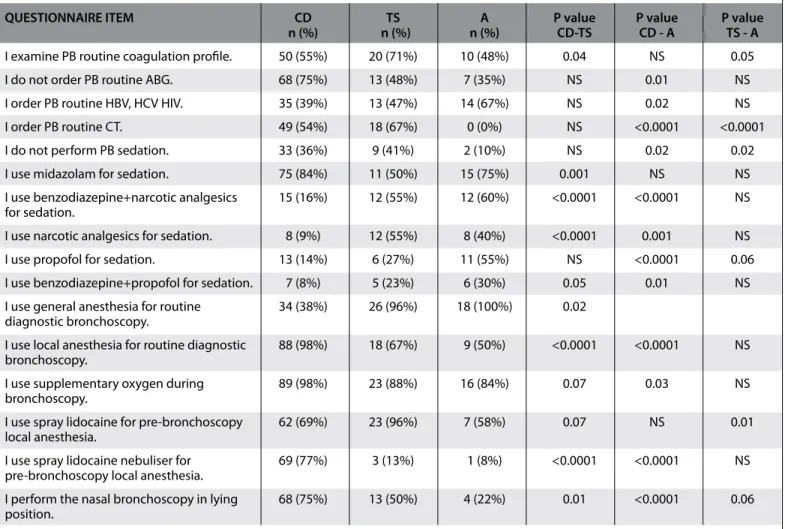
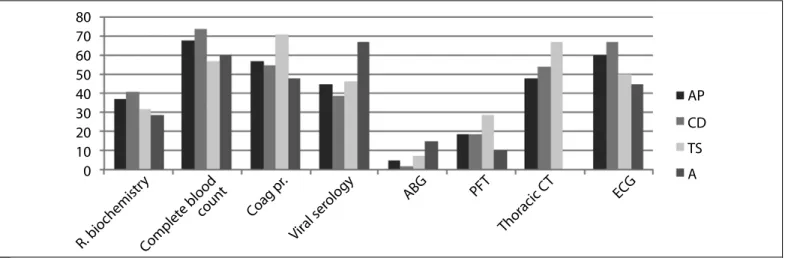
When all of the participants were considered, before bronchosco-py, 37% of the physicians ordered blood chemistry (urea, creatinine, blood glucose, AST, ALT etc.), 57% of them ordered a coagulation profile (aPTT, PT and INR), and 45% of them ordered viral infectious disease reagents (HBV, HCV, HIV). When an evaluation according to the medical branches is made, the ordering of a coagulation profile by CD specialists was significantly higher than that by TS specialists (p=0.04). Moreover, while 68% of all the participants ordered a rou-tine complete blood count before bronchoscopy, 14% stated that if it was not required for the routine follow-up of the patient, they did not perform complete blood count. The rates of ordering complete blood count were 74% for CD specialists, 57% for TS specialists and 60% for A specialists (Figure 1).
Thoracic computed tomography (CT) was ordered by 48% of all the participants routinely before bronchoscopy and it was ordered in cases where transbronchial biopsy (TBB) or transbronchial needle as-piration (TBNA) would be conducted. On the other hand, 13% of all participants stated that they did not order thoracic CT before bron-choscopy. When evaluated according to the medical branches, while 54% of the CD specialists and 67% of the TS specialists stated that they wanted to see the BT of the patient before each bronchosco-py performed (p>0.05), none of the A specialists found BT necessary (p=0.0001 for CD and TS specialists) (Figure 1).
QUESTIONNAIRE ITEM CD TS A P value P value P value
n (%) n (%) n (%) CD-TS CD - A TS - A
I examine PB routine coagulation profile. 50 (55%) 20 (71%) 10 (48%) 0.04 NS 0.05
I do not order PB routine ABG. 68 (75%) 13 (48%) 7 (35%) NS 0.01 NS
I order PB routine HBV, HCV HIV. 35 (39%) 13 (47%) 14 (67%) NS 0.02 NS
I order PB routine CT. 49 (54%) 18 (67%) 0 (0%) NS <0.0001 <0.0001
I do not perform PB sedation. 33 (36%) 9 (41%) 2 (10%) NS 0.02 0.02
I use midazolam for sedation. 75 (84%) 11 (50%) 15 (75%) 0.001 NS NS
I use benzodiazepine+narcotic analgesics 15 (16%) 12 (55%) 12 (60%) <0.0001 <0.0001 NS for sedation.
I use narcotic analgesics for sedation. 8 (9%) 12 (55%) 8 (40%) <0.0001 0.001 NS
I use propofol for sedation. 13 (14%) 6 (27%) 11 (55%) NS <0.0001 0.06
I use benzodiazepine+propofol for sedation. 7 (8%) 5 (23%) 6 (30%) 0.05 0.01 NS
I use general anesthesia for routine 34 (38%) 26 (96%) 18 (100%) 0.02 diagnostic bronchoscopy.
I use local anesthesia for routine diagnostic 88 (98%) 18 (67%) 9 (50%) <0.0001 <0.0001 NS bronchoscopy.
I use supplementary oxygen during 89 (98%) 23 (88%) 16 (84%) 0.07 0.03 NS
bronchoscopy.
I use spray lidocaine for pre-bronchoscopy 62 (69%) 23 (96%) 7 (58%) 0.07 NS 0.01
local anesthesia.
I use spray lidocaine nebuliser for 69 (77%) 3 (13%) 1 (8%) <0.0001 <0.0001 NS
pre-bronchoscopy local anesthesia.
I perform the nasal bronchoscopy in lying 68 (75%) 13 (50%) 4 (22%) 0.01 <0.0001 0.06 position.
A: anesthesiology specialist; CD: Chest diseases specialist; NS: not significant; PB: Pre-bronchoscopy; TS: Thoracic surgery specialist
While pulmonary function tests (PFT) are routinely ordered by 19% of the participants before bronchoscopy, 55% of the participants ordered them in case there were findings that made the physicians consider obstructive or restrictive pulmonary diseases; 25% of the participants did not order PFT before bronchoscopy. The ordering rate of pulmonary function tests (routinely or when necessary) was 75% for CD specialists, 78% for TS specialists and 43% for A specialists (p>0.05).
While arterial blood gas (ABG) analysis was ordered if low oxygen saturation (SpO2) was detected by pulse oximetry or if pulmonary functions were impaired in 64% of the cases to whom bronchoscopy would be conducted, it was ordered by 5% of the participants rou-tinely. On the other hand, 31% of the participants did not order ABG analysis, especially for bronchoscopy. While electrocardiography (ECG) evaluation was carried out routinely by 60% of the participants, 40% of them evaluated ECG when there was a suspicion of heart dis-ease. Also, 67% of pulmonologists, 50% of TS specialists and 45% of A specialists ordered ECG routinely (p>0.05) (Figure 1).
Premedication Sedation and Anesthesia
Overall, 66% of the participants stated that they used general an-esthesia and 85% of them stated that they used local anan-esthesia for routine diagnostic bronchoscopy. The physicians performing bronchoscopy under general anesthesia reported that they pre-ferred to apply this method in 44% of all cases and those perform-ing bronchoscopy under local anesthesia reported that they pre-ferred to apply this method in 89% of cases. The rate of using local anesthesia was 98% for pulmonologists, 67% for TS specialists and 50% for A specialists. The difference between pulmonologists and TS specialists with regard to general anesthesia was significantly high in favour of pulmonologists (p=0.02), and was significantly high in favour of TS specialists for local anesthesia. While 21% of all participants routinely applied atropine in bronchoscopy pre-medication, 37% of them applied it when bradycardia developed during the procedure. On the other hand, 42% of them stated that they did not apply atropine before or during bronchoscopy. These rates were 26%, 26% and 47%, respectively, for pulmonologists, 11%, 44% and 44%, respectively, for TS specialists and 9%, 76% and
14%, respectively, for A specialists. The most commonly preferred sedative agent was midazolam (78% of all the physicians and 68% of their cases). Here, 36% of participants reported that they did not sedate patients in 38% of the bronchoscopies they conducted. The rates of the physicians reporting that they could perform bronchos-copy without sedating for CD, TS and A specialists were calculat-ed as 36%, 41% and 10%, respectively. Not performing scalculat-edation among CD, TS and A specialists was significantly different in favour of anesthesia specialists (p=0.02) (Figure 2). The rate of physicians reporting that they used propofol along with the other medications for sedation was calculated as 14% for CD specialists, 27% for TS specialists and 55% for A specialists (p=0.0001). Midazolam was among the most preferred medications for 84% of CD specialists and 50% of TS specialists. (p=0.001). The rates of agents used for sedation by the participator physicians and physician’s percentage of the use of these medications for their patients are given in figure 2. Whether they took support from the anesthesia specialists for the sedated patients was asked to all participants except the anesthe-sia specialists. While the pulmonologists replied to this question as “yes”, the rate of TS specialists’ taking support from anesthesia was found to be 74%.
Figure 1. Pre-bronchoscopy tendency to order examinations for the physicians participating in the questionnaire (%)
A: Anesthesiology specialists; ABG: Arterial blood gas; AP: All participants; CD: Chest diseases specialists; Coag. pr.: coagulation profile; ECG: Electrocardiogram; PFT: Pulmonary function test; R. Biochemistry: Routine biochemistry; Thorax CT: Computed tomography of the thorax; TS: Thoracic surgery specialists
80
70
60
50
40
30
20
10
0
ECG
Thor
acic C
T
PFT
ABG
Vir
al ser
ology
Coag pr
.
Complet
e blood
coun
t
R. biochemistr
y
AP
CD
TS
A
Figure 2. The tendencies of physicians participating in the questionnaire towards sedation and the frequency rates of the medications used for this aim
Benzd: benzodiazepine; No sedation: I do not perform sedation; Prop: propofol 160 140 120 100 80 60 40 20 0 No seda tion Prop. Diaz epam
Midazolam Opioid Benz d.+Opioid Prop .+Benz d. Frequency of usage (%) 38 52 16 35 31 35 68 36 17 78 15 24 21 16 Frequency of physicians using (%)
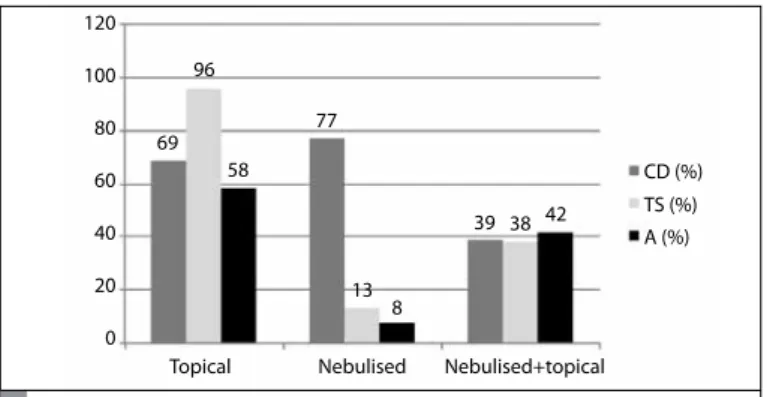
In bronchoscopy procedures conducted under local anesthesia, 67% of all participants preferred only topical lidocaine, 9% preferred nebulised lidocaine, 40% preferred both and 5% of them counted an application method except these as their preferences. These rates were found in CD specialists to be 69%, 77%, 39% and 2%, respec-tively. The preference rate of nebulised lidocaine by pulmonologists was considerably higher compared to TS specialists.
Bronchoscopy Procedure and Patient Follow-up
When the replies of all participants were considered, it was noted that the frequencies of oral and nasal bronchoscopies in the lying position were 81% and 62%, respectively, and the frequency of oral and nasal bronchoscopies in the sitting position were 17% and 21%, respective-ly. Nasal bronchoscopy in the lying position was preferred by CD spe-cialists compared to TS (p=0.01) and A spespe-cialists (p=0.0001) (Figure 3).
The difference between thoracic surgeons and anesthesia specialists was found to be statistically insignificant (p=0.06).
In following-up the patient during bronchoscopy, 97% of all par-ticipants followed-up using pulse oximetry, 70% of them used ECG monitoring, 87% used supplemental oxygen treatment and 71% of them followed-up blood pressure. These rates were 98%, 60%, 90% and 68%, respectively, for the CD specialists and 90%, 84%, 80% and 71%, respectively, for the TS specialists. While SpO2 and ECG fol-low-ups by pulse oximetry during bronchoscopy did not allow dif-ferentiation between the medical branches, supplemental oxygen treatment was considerably higher in CD specialists compared to A specialists (p<0.05).
Interventional Procedures and Education
With regard to the interventional procedures, the participants were asked which and how many procedures they performed per year on average. Here, 29% of the pulmonologists performed rigid bron-choscopy and the average number of procedures they conducted was 35.5 per year. These numbers for pulmonologists were 66% and 80 procedure/year, respectively. The answers taken from the partici-pants for other interventional procedures are found in Table 2. The number of procedures that must be performed in diagnostic intervention in order to gaining sufficient experience under the su-pervision of a competent specialist was only asked to CD specialists. Here, 40% of the respondents stated that 50 procedures were suffi-cient, while 60% of them stated that it was necessary to perform at least 100 procedures. In response to the question of how many pro-cedures a trained and experienced bronchoscopist has to conduct to maintain his experience and proficiency, 32% of the participants replied “below 50” and the remaining 68% replied “50 and above”.
All participants Chest Diseases Thoracic Surgery Anesthesia n=146 n=93 n=30 n=23
Number of Number of Number of Number of
Interventional Number of annual Number of annual Number of annual Number of annual procedure Bronchoscopists procedures Bronchoscopists procedures Bronchoscopists procedures Bronchoscopists procedures
Rigid bronchoscopy 54 (37%) 55.3 27 (29%) 35.5 20 (67%) 80.5 7 (30%) 52.5 Laser application 10 (7%) 43.7 7 (8%) 52.4 6 (20%) 1.1 0 0 Electrocauterisation 34 (23%) 11.6 16 (17%) 19.6 10 (33%) 8.1 0 0 APC 19 (13%) 45.6 17 (18%) 49.8 1 (3%) 20 0 0 Cryotherapy 14 (10%) 41.3 13 (14%) 43 1 (3%) 20 0 0 Brachytherapy 1 (0.6%) 3 1 (1%) 3 0 0 0 Balloon dilatation 21 (14%) 15 14 (15%) 17.4 6 (20%) 5 1 (4%) 40 Stent 29 (20%) 16.5 15 (16%) 24.8 12 (40%) 6.3 2 (9%) 32 EBUS 17 (12%) 112.7 17 (18%) 112.7 0 0 0 Alveoloscopy 1 (0.6%) 7 1 (1%) 7 0 0 0 EMN 2 (1.3%) 152 2 (2%) 152 0 0 0 Thermoplasty 0 0 0 0 0 Endobronchial valve 8 (5%) 6.7 4 (4%) 3.2 2 (7%) 3 2 (9%) 9
APC: Argon plasma coagulation; EBUS: endobronchial ultrasonography; EMN: electromagnetic navigation
Table 3. The number of bronchoscopists performing interventional bronchoscopy procedures and the average number of annual procedures Figure 3. Preferences of the physicians participating in the
questionnaire for the application of local anaesthetic agents according to their branches
CD: Chest diseases specialists; TS: Thoracic Surgery specialists; A: Anes-thesiology specialists 120 100 80 60 40 20 0 Topical 69 96 58 77 13 8 39 38 42 CD (%) TS (%) A (%) Nebulised Nebulised+topical
DISCUSSION
Diagnostic bronchoscopy, which is the most widely used method of bronchoscopy, is an intervention that is generally carried out by flex-ible bronchoscopy and characterised as being almost inevitable for CD specialists, differentiating them from the other internal medicine specialists. Whereas many international organisations, most notably the American Thoracic Society (ATS), European Respiratory Society (ERS), British Thoracic Society (BTS) and American College of Chest Physicians (ACCP), have tried to standardise bronchoscopy and oth-er intoth-erventional pulmonology procedures to some extent, as bron-choscopy education, applications and experience are not uniform, both worldwide and in our country (2-8). For example, in a survey conducted by the ACCP, more than 50% of the participants stated that their training was not adequate for advanced diagnostic proce-dures such as TBNA (2).
By using this questionnaire, the aim was to take a snapshot of bron-choscopy applications in our country and to suggest general tenden-cies of the practitioners. When data obtained from the questions of the survey are evaluated, in our country, as in the rest of the world, there are differences between practitioners, either in the preparation stage or in the procedure; it was observed that these differences cause con-siderable differences in some areas among medical branches.
The most striking answer given to the question in the survey about structuring of bronchoscopy unit was that there was no recovery room in the bronchoscopy unit where 45% of all participants (61/136) and 42% of CD specialists (38/90) worked. Moreover, manual clean-ing of the machine in the bronchoscopy unit was carried out for 57% of all participants and 56% of CD specialists.
In some guidelines, automated machine use for bronchoscope disin-fection is recommended in level of evidence C (7). Nevertheless, it is pointed out that the disinfector and the bronchoscope must be com-patible, otherwise the risk of contamination may increase (5). If the bronchoscope and the machine are not compatible, it will be more suitable to disinfect the equipment manually. While the compati-bility of the disinfector and the machine was not questioned in this study, the rates obtained indicate that automated cleaning machines are still not widely used in our country.
Overall, 37% of the participants stated that they ordered routine bio-chemistry examinations, and 57% of them stated that they ordered routine coagulation profile examinations. In the published interna-tional guidelines, it is recommended in evidence level B not to or-der a complete blood count, blood biochemistry and coagulation parameters in case TBB is not performed and the patient does not have a known coagulopathy, chronic liver or kidney disease (3, 5, 7). In the British Thoracic Society guidelines, if TBB is to be performed, it is recommended in evidence level C to order the above-counted biochemical parameters before procedures, even if the patient does not have a known risk factor (3). In the questionnaire, separate ques-tions were asked about routine blood biochemistry and coagulation parameters. In the questionnaire, the level of physicians who stated that they wanted to see the coagulation parameters for the patients to be performed for TBB and TBNA was 21%. However, it was noted that the coagulation profile was ordered more by TS specialists than by CD specialists. In answer to the question about indicators of viral infectious diseases (HBV, HCV, HIV), whereas 45% of the participants
stated that they ordered these examinations routinely before proce-dure, the distribution of “Yes” replies according to the area of speciali-sation was 39% for CD specialists, 46% for TS specialists and 67% for A specialists. The reason why anesthesiologists more frequently order infection indicators compared to other medical branches is thought to be the habit of ordering these examinations in all patients to be operated upon. The same reason may be valid in the more frequent ordering of the coagulation profile by TS specialists. In the existing guidelines, there are no recommendations about performing these examinations before procedures for infection control. Blood exam-ination, either for coagulation profile or viral infectious diseases, is often ordered unnecessarily. It is understood that pulmonary func-tion tests are ordered for every case by 19% of the participants. In the existing guidelines, it is recommended not to order PFT in ev-idence level C as long as there is no clinical finding that make the physician consider an impaired respiratory function. Routine evalu-ation of ECG is not recommended in the guidelines for cases with-out a known heart disease. On the other hand, arterial blood gas is recommended in cases with advanced airway obstruction (FEV1/FVC <50% or FEV1<1 L) or oxygen desaturation (SpO2 <93%); apart from this, routine examinations are not recommended (3, 5, 7). Although the respondents of the survey generally replied appropriately to the guidelines, they had a different attitude by ordering ECG routinely at a rate of 60% before bronchoscopy. We are of the opinion that sim-ilar thoughts play a role here. As can be understood from the study, excessive amounts of examinations are ordered in our country. The reasons for this condition should be investigated and in case there is a lack of education it should be eliminated. It is possible that the physicians may order an excessive amount of examinations in case of possible complications, making themselves feel secure with regard to the law, and to prevent violence from the patient’s relatives. As an anesthesia method, 66% of all the participants stated that they use general anesthesia and 85% of them stated that they use local anesthesia during bronchoscopy. It was noted that pulmonologists prefer local anesthesia more than TS and A specialists (p<0.05). The high rate of general anesthesia usage among pulmonologists and A specialists can be explained by pulmonologists’ performing bron-choscopy before operation under general anesthesia.
When the medicine spectrum that the participants use as a sedative agent during procedures is considered, it can be seen that midazol-am was the leading medication, with a rate of 78%. Although there is no definite recommendation in the guidelines about which seda-tive agent should be preferred, it is suggested that midazolam is the most commonly used medication in the studies (8). In their survey, Honeybourne et al. (9) reported that 112 of the 218 bronchoscopy units which used intravenous sedation used midazolam; opioids were used in 68 units and midazolam with opioids was used in 41 units. While in all guidelines it is recommended to sedate if there is no contraindication, it is remarkable that 36% of bronchoscopists partic-ipating in our study did not sedate in 38% of cases. It is indicated in the studies that sedation increases the tolerance of the patient and patient/physician comfort. Moreover, when it is necessary to repeat a procedure for the second time, in those cases that were sedated, it was found that the possibility of the patient accepting the procedure was higher (2, 8).
The most secure agent as a topical anaesthetic recommended in all guidelines is lidocaine (3, 5, 7, 8). Almost 97% of the participants of
the survey stated that they use lidocaine in topical anesthesia. How-ever, lidocaine application methods vary (spray, gel, nebulisation). There is no clear recommendation in the guidelines. Among the local anesthetic agents used during bronchoscopy procedures, the efficiency of cocaine (4%), benzococaine (20%), tetracaine (1%) and lidocaine (1-10%) are the same. Nevertheless, cocaine has a risk of misuse and adverse cardiovascular effects. The methemoglobinemia risk of benzocaine and tetracaine is higher than that of lidocaine, meaning that they must be used cautiously. Lidocaine is less toxic and is effective for a shorter time period. These reasons led to lido-caine being the preferred agent. Although in the first studies about lidocaine nebulisation it was reported that this method increased the patient’s comfort, it was suggested in more recent randomised placebo-controlled studies that nebulised lidocaine did not increase patient comfort (8).
When the preferences of patient positions during procedure are considered, 75% of the CD specialists reported that they used nasal bronchoscopy in the lying position and 80% of them reported that they used oral bronchoscopy in the lying position. When anesthesi-ologists and TS specialists are considered, their preferences for oral bronchoscopy in lying position were 83% and 88%, respectively. On the other hand, nasal bronchoscopy in the lying position was not preferred among anesthesiologists and CD specialists (22% and 50%, respectively). In fact, bronchoscopy can be performed nasally or orally. The advantages and disadvantages of the two methods in comparison to one another could not be indicated. However, more than half of the bronchoscopists prefer nasal bronchoscopy. Anna-kkaya et al. (10), reported in their prospective study that during the bronchoscopy performed in lying and sitting positions, there were no significant differences between systolic and diastolic blood pres-sures and average oxygen saturations. In this study, in the evalua-tions of patients after bronchoscopy, the tolerance to the procedure, difficulty of the procedure, cough and zonesthesia scores were found to be similar. In entering from the nasal airways, the nasal mucosa may be damaged and pain may occur after the procedure. If there is impairment in the nasal passage anatomy, the oral passage should be used without forcing the nasal passage. A mouthpiece must be used to enter from the oral airways. Otherwise, the patient may bite and damage the bronchoscope. While the majority of bronchos-copists prefer performing the procedure from behind the patient’s head, some prefer to be in front of the patient in a sitting position. It is generally recommended that the bronchoscopist should use the method that he is most used to.
The questions about patient monitoring during bronchoscopy were answered by the participants, and were consistent with the guide-lines. Overall, 97% of participants stated that they used pulse oxime-try and 95% stated that they established vascular access routinely. In all guidelines, the routine establishment of vascular access and pulse oximetry are recommended. In the guidelines of the British Thoracic Society, although there are no recommendations about blood pres-sure follow-up, ECG is suggested for patients with severe heart dis-ease and for hypoxic patients who do not respond to supplementary oxygen (3). In two other guidelines (Australia-New Zealand Thoracic Society and Israel Lung Association), ECG and blood pressure fol-low-up are recommended for all patients routinely (5, 7). Smyth et al. (11) reported that pulse oximetry follow-up during bronchoscopy
was performed in their study in 99% of cases and ECG monitoring was carried out in 22% of cases routinely in the United Kingdom. Considering all of the physicians in our study, 90% of the participants stated that they performed ECG in 77% of the bronchoscopy proce-dures; similarly, 92% reported that they followed-up blood pressure during the procedure in 95% of cases. No statistical difference was found between the medical branches in terms of electrocardiogra-phy and pulse oximetry follow-up.
Considering evaluation of the responses in terms of interventional bronchology, it can be seen that all procedures except thermoplasty are performed by some of the participants. Since it is not expected for all interventional procedures to be performed in all health centres and by all bronchoscopists, the use of all interventions at least in one centre in our country is a satisfying result.
Since we believe that the physicians from other branches (thorac-ic surgery, anesthesia, intensive care, pediatr(thorac-ics) can only perform bronchoscopy if they receive adequate education from CD special-ists, we only wanted to ask questions about bronchoscopy educa-tion to CD specialists. The number of procedures necessary for ob-taining enough experience under the supervision of an expert was stated to be 50 by 40%, 100 by 40% and 150 or more by the rest of the participants. This number must be at least 100 according to the guidelines of the American College of Chest Physicians (2). The Train-ing Programme on Specialisation in Chest Diseases of Turkish Chest Diseases Competency Board (TCDCB) recommends at least 75 flexi-ble and 20 rigid bronchoscopy applications during training. It is not known how many of the institutions providing specialisation train-ing reach this number. Moreover, the Competency Board suggests the minimum number of EBUS to be 10 and the minimum number of interventional bronchoscopy to be 10 (2). Considering all of the institutions offering training programmes, it is known that EBUS and interventional bronchoscopy are not available in all units. It is ob-vious that educational institutions should study in cooperation for this issue. An educated bronchoscopist is recommended to perform at least 25 procedures per year to maintain competence. Of the par-ticipants, the necessary number of bronchoscopy procedures was stated to be 10 by 8%, 25 by 23%, 50 by 40%, 75 by 8% and 100 by 21% of the physicians.
In conclusion, the data obtained from this questionnaire provide information about the experience of bronchoscopy in our country. In fact, with the results of this study, we have recognised that many different bronchoscopy procedures are available in our country, as in the rest of the world. Interestingly, although there are published guidelines for diagnostic bronchoscopy, it has been detected in questionnaire studies conducted in countries like the USA and En-gland that a great majority of bronchoscopists do not follow these guidelines. Some of the differences in bronchoscopy (for exam-ple, patient position) caused by performers are not as important for patient safety and efficiency of the procedure. However, more standardised approaches should be suggested for issues such as sedation, topical anesthesia applications, patient safety during the procedure and preparation before the procedure. This would be possible with further studies about the efficiency and safety of bron-choscopy. In our country, we can design our guidelines in line with the increased number and quality of these studies and have stan-dardised approaches for bronchoscopy.
Informed Consent: N/A.
Peer-review: Externally peer-reviewed.
Author Contributions: Concept - B.C., E.T., L.D., S.B., A.I.; Design - E.T., B.C.; Supervision - B.C.; Resource - E.T., B.C.; Analysis&/or Interpretation - E.T., B.C.; Literature Search - E.T.; Writing - E.T., B.C.; Critical Reviews - L.D.
Acknowledgements: Authors thank to the all respoders of the questionaire for their valued contributions.
Conflict of Interest: All of the authors declared no conflict of interest.
Financial Disclosure: The authors declared that this study has received no financial support
REFERENCES
1. Becker HD. A Short History of Bronchoscopy. In: Ernest A, editor. Intro-duction to Bronchoscopy. 2nd ed. Newyork: Cambridge Universty Press; 2009.
2. Ernst A, Silvestri GA, Johnstone D, American College of Chest Physicians. Interventional Pulmonary Procedures: Guidelines from the American College of Chest Physicians. Chest 2003; 123: 1693-717.
3. British Thoracic Society Bronchoscopy Guidelines Committee, a Sub-committee of Standards of Care Committee of British Thoracic Society. British Thoracic Society guidelines on diagnostic fexible bronchoscopy. Thorax 2001; 56: i1-21.
4. Du Rand IA, Rintoul RC, Barber PV, Shah PL, Goldring J, Singh S et al. on behalf of the British Thoracic Society Interventional Bronchoscopy Gui-deline Group. British Thoracic Society guiGui-deline for advanced diagnostic and therapeutic flexible bronchoscopy in adults. Thorax 2011; 66: iii1-21.
5. Wood-Baker R, Burdon J, Mcgregor A, Robinson P, Seal P, Thoracic Society of Australia and New Zealand. Fibre-optic bronchoscopy in adults: a po-sition paper of The Thoracic Society of Australia and New Zealand. Intern Med J 2001; 31: 479-87.
6. Bolliger CT, Mathur PN. Beamis JF, Becker HD, Cavaliere S, Colt, et al. ERS/ ATS statement on interventional pulmonology. Eur Respir J 2002; 19: 356-73.
7. Shulimzon TR, Israel Lung Association Task Force. Flexible Bronchoscopy in israel 2010: evidence-Based clinical Practice guidelines for the adult patient: a concise summary of the recommendations of the recommen-dations of the Israel Lung Association Task Force. Isr Med Assoc J 2010; 12: 69-73.
8. Wahidi MM, Prasoon J, Mackensen, Jantz M, Lee P, Burkhard G, et al. Flexible Bronchoscopy in Adult Patients Anesthesia, Analgesia, and Se-dation During Consensus Statement on the Use of Topical American Col-lege of Chest Physicians. 2011; 140: 1342-50.
9. Honeybourne D, Neumann CS. An audit of bronchoscopy practice in the United Kingdom: a survey of adherence to national guidelines. Thorax 1997; 52: 709-13.
10. Annakkaya AN, Bedirhan İ, Tozkoparan E, Özkan M, Yüksekol İ, Bilgiç H, et al. Patient position during fiberoptic bronchoscopy: sitting or supine? Respiratory Diseases 2003; 14: 266-74.
11. Smyth CM, Stead RJ. Survey of flexible fibreoptic bronchoscopy in the United Kingdom. Eur Respir J 2002; 19: 458-63.
12. Kocabaş A, İtil O, Durak H.İ, Törün SE, Taşkıran H.C. Qualifications board of the turkish chest diseases, pulmonary disease specialist training prog-ram. İstanbul: Probiz, 2010.