Preprint of Hayes, P. & Weibelzahl, S. (2009). Text Messaging to Improve Instructor Immediacy and its Role in Multiplatform E-Learning Systems. In: T. T. Goh. Multiplatform E-Learning Systems and Technologies: Mobile Devices for Ubiquitous ICT-Based Education (pp. 57-71). Hershey: IGI.
Text Messaging to Improve
Instructor Immediacy and its Role in
Multiplatform E-Learning Systems
Paul Hayes, National College of Ireland, Ireland
Stephan Weibelzahl, National College of Ireland, Ireland
ABSTRACT
Text messaging has been exploited for supporting learning in a variety of educational settings. However, evidence for its effectiveness and impact is limited. This chapter demonstrates how the use of text messaging can contribute towards enhanced quality of learning. In particular the chapter focuses on the use of text messaging as a means of improving immediacy between instructors and students in third-level education. Immediacy is defined as behaviour which increases psychological closeness between communicators. The results of research in instructional communication suggest that improved immediacy leads to more positive student-instructor relationships engendering positive attitudes, increased interest and motivation by students as well as improved attendance, improved retention, improved student engagement and improved learning. This chapter outlines a theoretical basis for the effect of text messaging on instructor-student relationships, provides empirical evidence for the impact of text messaging on immediacy and discusses the integration of text messaging for improving immediacy in Multiplatform E-Learning Systems.
LEARNING EXPERIENCE OF STUDENTS
The quality of student learning is paramount to the success of any educational institution. There has been a plethora of initiatives recently in third level colleges aimed at improving the quality of the learning experience of students. Some of these have shown to be quite successful while others have not. The purpose of this chapter is to demonstrate how the use of mobile communication technologies can contribute towards enhanced quality of learning. In particular the chapter will focus on the use of text messaging as a means of improving communications between instructors and students in third-level education. Research has shown that the communication between instructors and students is one of the key factors in the quality of the learning experience of students (Christensen & Menzel, 1998; Christophel, 1990; Ellis, 2004).
The chapter will outline how mobile communication can be used to improve the learning experience of students, in particular third-level students, by improving their perception of instructor communication behaviour. Many benefits arise from improving the learning experience of students including improved attendance and retention. These benefits, which provided
motivation for the research, will also be outlined. A theoretical basis for the effect of text messaging on instructor-student relationships will be provided, as will empirical evidence in the form of the findings of a year-long study into the use of text messaging and its effect on student perception of instructor communication behaviour. The chapter will discuss these findings and the integration of text messaging in Multiplatform Learning Management Systems. It will also give some recommendations for effective text messaging in educational settings.
BACKGROUND AND MOTIVATION
Text messaging has been exploited for supporting learning in a variety of ways and in different educational settings. New communication technologies such as mobile text messaging, known as SMS in many countries, provides a means of facilitating frequent and meaningful interaction amongst students and instructors. This interaction engenders feelings in students of being valued, leading to better attendance, student retention and deeper and more meaningful engagement in learning. Text messaging in particular is suitable for supporting out-of-class (OOC) communication between students and instructors since it has the property of being asynchronous, as with email, whereby both parties do not have to be using their devices at the same time in order to send or receive messages. It also has the important advantage of being ubiquitous as there are very few students and instructors these days who do not own at least one mobile device capable of sending and receiving text messages.
There have been numerous examples recently of where text messaging has been used to support education. An interesting research study by Griffith University in Australia relates the experience of a female instructor using OOC text messaging as a means of staying in touch with her students and how it can be used as a way of providing connection and community for first year students (Horstmanshof, 2004). Another study by Kingston University in the UK used OOC text messaging to provide a form of ‘mobile scaffolding’ at a fundamental level to support the needs of first-year students, and guide students towards independent self-management (Stone, 2004). SMS text messaging may also be used to encourage interactivity in the classroom. This results in a more active learning environment, facilitating the building of learning communities. It provides greater feedback for lecturers, and aids student motivation (Markett, Weber, Sanchez & Tangney, 2006).
The use of mobile devices in education, also known as mobile learning, is nothing new. There are numerous areas in education where the functionalities of mobile devices have been used to support learning, including interaction and learning in collaborative groups, enquiry-based learning, constructivist and socio-constructivist learning activities, peer-to-peer communication and OOC communication between instructors and students (Hoppe, Joiner, Milrad & Sharples, 2003; Houser, Thornton & Kluge, 2002; Roschelle, 2003; Sharples, 2002). However the vast majority of cases where it has been used up to now have been attempts to enhance cognitive learning among students either individually or in groups. Most of the literature that has appeared regarding the use of mobile communication in education has also been chiefly concerned with enhancing cognitive learning. There has been very little mention of the huge potential of mobile communication technologies to enhance affective or psychomotor learning. In particular this chapter is concerned with enhancing affective learning, which has long been overlooked.
One of the key factors in affective learning is the quality of the communication between students and instructors. Mobile devices provide a means of improving the quality of this
communication by the use of out-of-class mobile text messaging. A theoretical basis will be presented that provides the link between the use of text messaging as a means of communication between students and instructors, student perception of their quality of learning and improved affective learning. Empirical evidence will also be presented from a year long study of student perception to a text messaging service offered to them by their instructor.
Affective Learning
When we talk about student learning we are usually only referring to one type of learning behaviour, known as the cognitive domain. To understand the different types of learning that take place we have to refer to Bloom’s Taxonomy (1956). Bloom's Taxonomy categorises the hierarchy of learning behaviours into three interrelated and overlapping learning domains; the cognitive (knowledge), affective (attitude) and psychomotor (skills).
Learning in the cognitive domain involves mental processes such as knowledge manipulation and the development of intellectual skills. These include the recall or recognition from memory of specific facts, pattern recognition and concepts that help in the development of intellectual abilities. There are six major categories of cognitive learning behaviours and these categories can be thought of as degrees of difficulties. That is, the first one must be mastered before the next one can take place. The six categories are: knowledge, comprehension, application, analysis, synthesis and evaluation (Bloom, 1956).
In contrast, learning in the affective domain includes the manner by which we deal with things emotionally, such as feelings, values, appreciation, enthusiasms, motivations and attitudes. There are six categories of affective learning behaviours: listening and awareness, responding and active participation, valuing, organisation and internalising values. Learning in the psychomotor domain includes physical and kinesthetic movement, coordination and mastery of activity. While all three domains are important, educational institutions usually place most emphasis on student cognitive learning at the expense of the other two.
The imbalance that exists between the cognitive and affective learning domains is further underlined in the following quote from the seminal publication “Affective Learning – A Manifesto”:
“The use of the computer as a model, metaphor, and modelling tool has tended to privilege the ‘cognitive’ over the ‘affective’ by engendering theories in which thinking and learning are viewed as information processing and affect is ignored or marginalised. In the last decade there has been an accelerated flow of findings in multiple disciplines supporting a view of affect as complexly intertwined with cognition in guiding rational behaviour, memory retrieval, decision-making, creativity, and more. It is time to redress the imbalance by developing theories and technologies in which affect and cognition are appropriately integrated with one another.” (Picard et al, 2004, p.1)
As with all areas of research in education, exploration of mobile learning has also placed too much emphasis on cognitive learning at the expense of affective learning. There has been very little research done in the area of affective learning even though recent research has shown that it is critical to the quality of the learning experience of students and in producing lifelong learners (McCombs, 1991).
Motivation
When it comes to instructional communication, results of research suggest that instructor communication behaviour may have its strongest impact on student learning behaviour in the affective domain, out of these three domains (McCroskey, 1994). In fact, affective learning has been identified as the central causal mediator between instructor communication behaviours and cognitive learning amongst students (Andersen, 1981; Rodriguez, 1996). The communication between instructors and students is one of the key factors in the quality of the learning experience of students (Allen, Witt & Wheeless, 2006; Andersen, 1981; Gorham, 1988; Pogue & Ahyun, 2006).
Enhanced communication between instructors and students has been linked to positive student-instructor relationships engendering positive attitudes, increased interest and motivation by students (Christensen & Menzel, 1998; Christophel, 1990; Ellis 2004). A review of research literature in higher education reveals positive relationships between enhanced student perception of instructor communication behaviour and the following desirable qualities, many of which have now become critical to some institutions: improved attendance, improved retention, improved student engagement, improved cognitive learning, improved affective learning, improved classroom behaviour, as well as improved student satisfaction (Allen, Witt & Wheeless, 2006; Kearney, Plax & Wendt-Wasco, 1985; Rocca, 2004; Witt, Wheeless & Allen, 2004).
The motivation behind our research is to try to enhance the communication channel between students and instructor through the use of a text messaging service and thereby improve the quality of the learning experience of students. Our aim is to improve student perception of their instructors’ communication behaviour and reap the benefits gained from this enhanced communication which are detailed above.
INSTRUCTOR IMMEDIACY
A significant body of research has found that positive open communication behaviours by instructors are central to the learning process. Positive open communication behaviours have been found to promote affective and cognitive learning in traditional instructional settings. This would suggest that improved instructor communication behaviour can lead to enhanced affective and cognitive learning and may also positively affect student perception of the quality of their learning experience.
The area of instructional communication is based on the assumption that verbal and nonverbal messages conveyed by instructors have the potential to significantly affect student learning outcomes (Witt 2000). When it comes to instructor communication behaviour one important construct is that of instructor immediacy. Immediacy is defined as behaviours, both verbal and nonverbal, that reduce physical or psychological distance between individuals (Andersen, 1979; Mehrabian, 1969, 1971, 1981). The results of a significant body of research conducted on instructor immediacy behaviours indicate that it can have a positive influence on student learning outcomes. For this reason instructor immediacy should be treated with great importance by any person or institution concerned with improving the quality of student learning (Witt, 2000).
Immediacy is based on the principle of approach-avoidance that “people approach what they like and avoid what they don’t like” (Mehrabian, 1981, p. 22). Research on instructional communication suggests that nonverbal immediate behaviours by instructors such as physical proximity (Argyle & Dean, 1965; Mehrabian, 1971), direct eye contact (Argyle & Dean, 1965; Kendon, 1967), smiling (Ekman & Friesen, 1975) and head nods (Mehrabian & Williams, 1969) can be used to express affinity with or liking for students (Witt, 2000). In traditional classrooms students generally perceive the immediate behaviour of their teachers as expressions of personal warmth and affinity toward the students (Ryans, 1964), which in turn enhances student affinity for the teacher, course, and subject matter (Andersen, 1979). Andersen’s (1979) study was the first to document a significant relationship between student perceptions of teacher nonverbal immediacy and learning outcomes (Witt, 2000).
Immediacy research entered a new era with Gorham’s (1988) investigation of verbal immediacy. Up to that time the actual content of messages had not been considered much in research (Witt, 2000). Research in verbal immediacy found that perception by students of instructors’ verbal messages was always within a context that was influenced by the instructors’ nonverbal immediacy behaviours (Witt, 2000). Therefore researchers concluded that, in relation to student affective learning, perceived “nonverbal behaviour of teachers served as mediators for teachers’ verbal behaviours” (McCroskey & Richmond, 1992). Thus both verbal and nonverbal behaviours should be taken into account when evaluating the effects of instructor communication on student affective learning.
Gorham (1988) developed a more unified model of immediacy, integrating both verbal and nonverbal behaviours. According to her model, teachers should employ verbal strategies to “reduce psychological distance by recognizing individual students and their ideas and viewpoints, by incorporating student input into course and class design, by communicating availability and willingness to engage in one-to-one interactions, and by enhancing their ‘humanness’ via humour and self-disclosure” (Gorham, 1988, p. 52).
Research studies have shown a linear relationship between student reports of teacher immediacy behaviours and perceptions of state motivation, and of cognitive, affective and behavioural learning (Christensen & Menzel 1998; Pogue and Ahyun, 2006; Witt & Wheeless, 2001). This relationship has been shown to hold true for divergent classes (Kearney, 1985) and also in multi-cultural studies (McCroskey, 1996)
EVIDENCE OF EFFECT OF TEXT MESSAGING ON IMMEDIACY
As shown in the previous section, there is no doubt that instructor immediacy has a significant bearing on student affective learning and hence their perception of their learning environment. In third-level education contact time between instructors and students is limited to usually only a few hours a week. It is usually the case that students have very little interaction with their instructors. These are some of the constraints that prompted us to ask the following types of questions: What if we could increase the availability of instructors to the students at any time in a way that would not impact too much on the mobility of instructors and their busy schedules? What if a student could send a query to an instructor from anywhere and outside normal class times? What if an instructor could choose when and where they would deal with and respond to the student’s query?
We felt that this type of availability would greatly improve student perception of instructor immediacy and hence student affect which is the goal of this research project. This level of
availability needed a system that was both asynchronous like email and also ubiquitous, so that it could be used anytime and from anywhere. Such availability was implemented by making a mobile text service available to students for OOC communication with their instructor.
We not only wanted to provide a theoretical basis for the improvement in student affect as a result of increased availability to their instructor through the use of a text messaging service, we also wanted to demonstrate the effect empirically also. We designed a research study to do just that.
We set up a study to explore whether and to what degree OOC communication between instructors and students using text messaging improved student perception of instructor immediacy. Measuring immediacy effects in real world settings is a complex task as many other factors that may influence immediacy are also at play. Immediacy may depend on factors that are not under the instructor’s control such as duration of exposure, subject domain, student status (part-time vs. full-time) and class size. The question was if the effect on the immediacy could be attributed to the text messaging and not other factors. For this reason we were very careful in our experimental design so that we could isolate other factors that may affect the immediacy.
Study Set-up
In total 101 participants from seven different classes took part in the study, four classes of full-time students and four classes of part-full-time students (see Table 1). Five of the classes were offered a text messaging service by their instructor (treatment groups) while the remaining three were not (control groups). All classes covered technical domains such as databases and networking for computing students.
Table 1. Categorisation of groups participating in the study
Full-time Part-time Total Treatment group 3 2 5
Control group 1 2 3
Total 4 4 8
Each student who agreed to use the text messaging service was requested to fill in a consent form giving permission the instructor to send them text messages. Over 95% of students who were offered the text messaging service agreed to participate. Reasons mentioned by a few students for not participating included having been the victim of prank and hoax calls in the past and simply wishing to keep their mobile numbers private. Participants provided their mobile phone number and received a contact number from the instructor in return and were given guarantees of confidentiality concerning their numbers and their communication.
Throughout the college semester, the treatment group received a number of messages of different types, some for administration purposes (e.g., change of room), some based on the course content (e.g., multiple-choice question), some designed to encourage students to attend class and other miscellaneous messages. The messages were sent and received by a smartphone connected to the instructor’s computer in order to ease the administration work needed to run such a service, including message-writing.
Measurement
In order to measure the impact of the text messaging service we assessed the level of students’ immediacy at the end of the treatment period of 12 weeks anonymously, using two standardised scales. The immediacy levels of students in both the treatment groups and the control groups were measured to allow for comparison. The first scale used was the Generalised Immediacy Scale (GIS) (Andersen, 1979). The GIS measures a general or gestalt impression of an individuals overall level of immediacy. It comprises 9 items using a 7-point Likert-Scale. Accordingly, the score ranges between 9 and 63. Typically the GIS is used to measure students’ perceptions of their instructor’s level of immediacy (Witt, Wheeless & Allen, 2004). GIS is a highly reliable scale with estimates ranging from .84 to .97 (Andersen, 1979; Kearney, Plax & Wendt-Wasco, 1985; Plax, Kearney, McCroskey & Richmond, 1986). The scale correlates highly with other measures of self-efficacy (Andersen, 1979) and students’ affective learning (Kearney, Plax & Wendt-Wasco, 1985). The second scale used was the 10-item Revised Nonverbal Immediacy Behaviours (NIB) instrument (McCroskey, Fayer, Richmond, Sallinen & Barraclough, 1996). The scale has also been checked for reliability and validity with consistently high and positive results (e.g., Christophel, 1990; Gorham, 1988; Gorham & Zakahi, 1990). The NIB scale was chosen as we expected to see an effect related to non-verbal behaviour as opposed to verbal behaviour.
Participants were presented with a series of statements describing nonverbal behaviours of instructors. Participants were asked to indicate the frequency of their instructor’s use of each behaviour. Having completed the two assessments, participants in the treatment group were also asked to fill out a comprehensive questionnaire about their attitudes and perceptions of the text messaging service and in what way, if any, it had impacted on them and their learning experience. A series of open questions explored their individual perception of the instructor and reasons given. Moreover, to get an even more detailed picture, students in some of the treatment classes were interviewed about their perceptions and attitudes by an independent person.
Results
Out of the 101 participating students, 63 received text messages on a regular basis from their instructor, while the remaining 38 did not. The text messaging service was well accepted by the participating students. The fact that none of the students in the treatment group dropped out, suggests that the messages were generally welcome and appreciated. In a free form comment at the end of the questionnaire several students expressed their appreciation of the service (“good service to students”, “very good idea”) and recommended further extension (“should be used with all lectures”, “should be applied to all”).
A total of 283 messages were sent out to students, 156 of them broadcast messages to the whole class and 127 messages to individual students usually answering individual questions (see Table 2). This shows that many students not only received messages but actively participated in the communication.
Table 2. Number of messages sent and received by instructor
class A class B class C class D class E total
teaching mode part-time full-time full-time part-time full-time
sent to individuals 22 43 46 22 23 156
sent to class 34 38 27 14 14 127
sent total 56 81 73 36 37 283
received 38 80 76 28 23 245
received/sent ratio 68% 99% 104% 78% 62% 87%
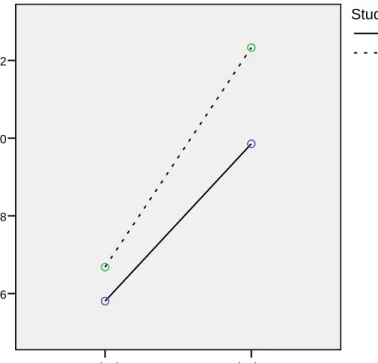
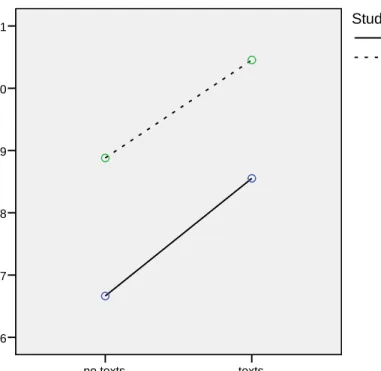
The treatment groups perceived the instructor as significantly more immediate than the control groups. This effect was observed with both the General Immediacy Scale, GIS (see Figure 1; F=10.4, p=.007), and the Nonverbal Immediacy Behaviour Scale, NIB (see Figure 2; F=9.0; p=.004), i.e. students who received messages perceived their instructor on average 6% - 10% more immediate than those who did not receive messages. As expected, the two scales correlate highly (r = .40**). Text messages texts no texts Es ti ma te d Marg in al M ea ns 52 50 48 46 Full-Time Part-Time Student Status
Text messages texts no texts Es ti ma te d Marg in al M ea ns 31 30 29 28 27 26 Full-Time Part-Time Student Status
Figure 2. Effect of text messaging service on Nonverbal Immediacy Behaviour Scale (NIB)
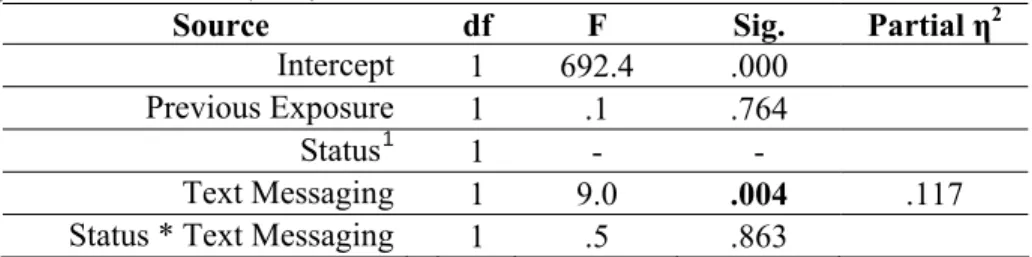
We expected that student status and previous exposure to the instructor might have an effect on immediacy, too. In order to control for these two factors, we computed an ANCOVA with the number of semesters of previous exposure as covariate and student status as additional factor (see Table 3 and Table 4). The results demonstrate that neither status nor previous exposure can explain the observed differences between the groups. While part-time students score lower on average, there is no significant difference between the groups. An interaction effect was also not observed. The treatment effect on GIS is considered to be very large (η2= .473), while the effect on NIB seems to be smaller in comparison (η2=.117), but is still considered to be a large effect.
Table 3. Results of ANCOVA showing effect of duration of previous exposure to instructor (covariate), status of student (full-time vs. part-time) and text messaging on General Immediacy Scale (GIS)
Source df F Sig. Partial η2
Intercept 1 278.6 .005 Previous Exposure 1 .6 .433
Status 1 15.5 .769
Text Messaging 1 10.4 .007 .473
Table 4. Results of ANCOVA showing effect of duration of previous exposure to instructor (covariate), status of student (full-time vs. part-time) and text messaging on Nonverbal Immediacy Behaviour Scale (NIB)
Source df F Sig. Partial η2
Intercept 1 692.4 .000 Previous Exposure 1 .1 .764
Status1 1 - -
Text Messaging 1 9.0 .004 .117
Status * Text Messaging 1 .5 .863
The questionnaire gave students the opportunity of stating their opinions on the text messaging service and its effects. The comments of the students are very revealing and they evaluated the service positively. They mentioned that the text messaging encouraged them to view their instructor as being more open and available to them i.e., more immediate. Students could see a variety of benefits of the service, including the availability of immediate feedback to questions and issues arising as well as the opportunity to stay in touch with the instructor (“made me feel closer”, “easy to stay in touch”).
When asked for their opinions about being in contact with the instructor, who was their lecturer, by text messaging students typically replied that it “shows a good example of commitment to students”, it is “good because it helps to keep us up to date. More friendly and natural relation with your lecturer” and “if you have any questions about the class you can text your lecturer and get the answers you’re looking for”. Very few negative comments were received. Critique referred to costs (“it wastes my credit”; “cost for lecturer”), time of sending (“might be intrusive if messages are sent at in-appropriate times”) and content (“sometimes it can be difficult what to say in the texts”). When asked about what they thought about the effect of the text messaging service on their education they typically replied, “it has made me feel closer to the lecturer, more comfortable therefore I am more comfortable asking questions in class or outside of class about my course. I feel I have benefited greatly from this”, “it is good because the lecturer asks you questions in texts and that refreshes your memory about the class” and it is beneficial “for the simple reason that my lecturer informs me on what’s going on to give me time to prepare for the class”. Again there were very few negative comments. When asked for their opinions about the effect of the text messaging on their class and their relationship with their instructor the comments were again very positive. When asked about the effect on their learning some students mentioned “encouragement (positivity)”, “think it just makes you feel at ease coming to class” and “it has motivated me into attending lectures & seeing the lecturer as a person”. This is further evidence of enhanced instructor immediacy and improved affective learning as a direct result of the text messaging.
Discussion of Study Results
We have seen from the results that OOC communication using text messaging has a positive effect on student perception of instructor immediacy, as evidenced by the increased scores on the GIS and NVIB scales and from feedback in the form of comments by individual students. The students who received the text messages perceived the instructor as closer and were therefore
more likely to ask questions in class and engage in discussions with the instructor. Other studies have shown that immediacy enhances affective learning, leading to improved attendance, retention and student engagement as well as other desirable traits.
While immediacy is very important to the success of learning it is of course not the only factor. However its contribution to affective learning should not be underestimated. While every effort was made to ensure that there was no bias in the treatment of classes, double-blind treatment was not possible. The instructor was aware of the different treatments of groups but students were not. Every precaution was taken to ensure that bias was not introduced.
Of course such a service to students requires some additional effort on the part of instructors, however the effort from our experience is minimal and the benefits gained are well worth the extra effort, including better class attendance and engagement, better rapport with instructors and better student learning experience in general.
Costs of sending messages were hardly mentioned by students. On average each student sent very few messages in comparison to the total of messages sent by the instructor. Free text message contracts are becoming more and more common and some students had free text messaging with the instructor. These particular students were more likely to communicate using the text messaging service. Universities might introduce text messaging as part of student services in the same way as email services are considered a standard now.
Despite these overwhelmingly positive experiences, the study design imposes a number of limitations. First, the study involved only five different classes, all of them on technical subjects. We argue that text messaging is popular among students of all disciplines, however, some subject areas might not lend themselves to texting in the same way e.g., due to the restrictions of expressiveness of text (cf. mathematical or chemical formulas; special characters in foreign languages), and due to restriction in length of messages to 160 characters (cf. philosophical arguments).
Secondly, our classes are relatively small. Entering communication with classes of hundreds of students might be unfeasible or impossible. In that case messaging might be restricted to sending broadcast messages.
Thirdly, the study explored the impact on immediacy in detail, combining qualitative and quantitative methods. However, the consequences of increased immediacy on learning effect and other factors were not assessed. The close relationship between learning and immediacy has been demonstrated many times, but we cannot prove that students actually benefited.
TEXT MESSAGING IN LEARNING MANAGEMENT SYSTEMS
Mobile text messaging has some advantages for increasing perceived instructor immediacy and decreasing social distance between instructor and student over other means of on-line communication. This is due to its ubiquitous property as discussed earlier and also because of the fact that mobile text messaging is generally perceived by students as being personal in nature (Horstmanshof, 2004; Naismith, Lonsdale, Vavoula & Sharples, 2004).
Garrison, Anderson and Archer (1999) showed how critical inquiry could be supported in a text-based on-line environment and the importance of cognitive presence, social presence and teaching presence as elements of an educational experience. Mobile text messaging also supports critical inquiry in much the same manner, with the added advantage that students may send or receive messages at any time and do not have to be logged-in to a system. There is no reason why existing on-line text-based communication cannot be integrated with mobile text messaging. Such
a communication system would support e-moderation requirements as well as provide students with support when they are not on-line.
Integration of Text Messaging
For this study the instructor used a laptop with a special software package that worked just like an email program, recording each message sent and received. While this worked fine for the purpose of this study, experience shows that for text messaging usage as described here to be used to improve immediacy on a larger scale the following requirements would need to be met. First of all, integration with the student record system would be required in order that instructors would not have to collect student phone numbers individually. In many cases these numbers are included in the student records anyway.
Secondly, students should complete a consent form when registering to allow all instructors to send text messages to them as part of the teaching. The consent form should outline students’ rights and obligations as discussed below.
Thirdly, text messaging needs to be integrated with an existing Learning Management Systems (LMS) to reach its full potential. The LMS would allow instructors to address complete classes by a single click. It would also serve as a permanent record of all communication. Such integration would also allow easy reference to subjects and learning resources (e.g., URL included in message text). In the context of this study all these things had to be added manually.
Fourthly, a set of guidelines and rules need to be established that describes how the service is to be used and what students can expect. Enhancing immediacy through text messaging directly affects the student-instructor relationship.
Guidelines for Text Messaging
To avoid wrong expectations and misunderstandings the following aspects of text messaging should be stated explicitly from the outset of the service: firstly, the quality of service should be defined including maximum response times and office-hours. For example, some students noted that they do not want to receive messages in the evening. Sending messages during exam periods to individual students might be perceived as unfair advantage by their peers.
Secondly, the type and content of text messages should be defined. For example, information sent out to students should be redundant, i.e., messages should be posted as email or through other available channels as well and a permanent record should be kept. Students may be encouraged to ask questions when they arise rather than waiting for the next session or not asking them at all. Normally, answers to individual students would be available to the whole class to avoid any unfair advantage.
Thirdly, the ad-hoc use and often colloquial nature of communication via texts might potentially lead to misuse of the service, a phenomenon often observed in the early days of the introduction of email in organisations. Students should be made aware that text messages in this context are still part of the learning experience and thus need to comply with general communication rules. Our experience shows that there is a fine but significant line between high perceived instructor immediacy and close personal friendship. Students might misinterpret the higher availability and closer interaction with the instructor as a kind of peer relationship. They
might then be surprised or disappointed when the instructor executes the necessary duties of his/her role such as disciplining students or allocation of marks.
IMMEDIACY THROUGH OTHER COMMUNICATION CHANNELS AND
DEVICES
In this chapter we have shown how the use of mobile communication technology in the form of OOC text messaging can be used to increase instructor immediacy. Text messaging of course has the properties of being asynchronous and ubiquitous which make it very suitable for supporting OOC communications. There are a number of other channels of communication which can also be used to enhance instructor immediacy.
The Internet in particular offers a plethora of possible communication channels by which students could have contact with their instructors. We are not advocating the use of all these technologies but are simply pointing out that they provide possible channels of communication both now and in the future. The technologies include simple asynchronous email, instant messaging (IM) services such as MSN and Google Chat and also voice-over-IP (VOIP) services including Skype and Google Talk. Going even further in exploiting latest technologies, some universities already have a presence on the virtual reality sites such as Second Life.
Mobile technologies also offer the options of speech, text messaging, multimedia messaging, instant messaging, wireless networking and Bluetooth connections. Many mobile devices also have access to the Internet, making available services such as MSN and Skype.
Immediacy and other variables such as social distance and teaching distance (Garrison, Anderson & Archer, 1999) are being viewed with more and more importance in the field of e-learning and distance education. With the rapid adoption of the Internet into a mainstream communication medium, there has been a recognition of the importance of the dynamics of interpersonal communication in the online environment. There is significant overlap between discussion of traditional immediacy producing behaviours and discussions of online interpersonal communication (Woods Jr & Baker, 2004).
While text messaging has the advantage that nearly everyone has a mobile device that supports it, be it a standard mobile phone, smartphone or PDA, it has not yet been fully incorporated into existing multiplatform e-learning systems such as LMSs. There have been some efforts made to implement a text messaging interface for Moodle and a few other types of LMS but it has not yet become a standard feature. As e-learning systems develop and become increasingly multiplatform more and more systems will have the capacity to communicate with registered students by sending and receiving text messages.
The other communication channels we have mentioned as a possible means of facilitating communication between instructors and students are increasingly available on different platforms. For example, a lot of mobile devices and laptops now support Bluetooth, regardless of system architecture or operating system. Any device with a web browser, large or small, can access MSN and social networking sites. Instant messaging is becoming more common not just on PCs and laptops but also on mobile devices.
CONCLUSIONS AND FUTURE PERSPECTIVES
In this chapter we provided evidence that text messaging between students and instructor can increase perceived immediacy and affective learning. Both quantitative measures of immediacy and qualitative feedback from students show that the instructor is perceived as closer, more positive and responsive when text messaging services are offered. Students expressed their wish to increase the use of text messaging in the future. Similar services might be offered through other channels (e.g., instant messaging, Bluetooth in the classroom) and on a variety of devices. Even virtual realities environments (such as Second Life) may be used to increase instructor immediacy.
However, experience in real world settings also makes it obvious that clear rules and guidelines for such services are required to set students’ expectations. Integrating messaging with existing infrastructure such as student registration and learning management systems would make these services easily available to instructors and students on a large scale.
Future work will be needed to explore the scalability of the results reported in this chapter across organisations and subject domains. Text messaging might also be used in school settings with similar effect. More work is also required on the impact of text messaging on other learning factors. For example, we anticipate that both student motivation and learning affect would benefit.
In conclusion, we have shown that increasing instructor immediacy has great potential in positively affecting student behaviour and learning. Our results indicate that text messaging may be used for this purpose. Moreover, we argue that other channels and devices used for in-class and out-of-class communication may have similar potential.
REFERENCES
Allen, M., Witt, P. L., & Wheeless, L. R. (2006). The role of teacher immediacy as a motivational factor in student learning: Using meta-analysis to test a causal model. Communication Education, 55(1), 21.
Andersen, J. F. (1979). Teacher immediacy as a predictor of teaching effectiveness. In D. Nimmo (Ed.), Communication Yearbook 3 (pp. 543-559). New Brunswick, NJ: Transaction Books. Andersen, J. F. (1981). Three investigations exploring relationships between perceived teacher communication behaviors and student learning. Communication Education, 30(4), 377-392. Argyle, M., & Dean, J. (1965). Eye-contact, distance and affiliation. Sociometry, 28(3), 289-304. Bloom, B. S. (1956). Taxonomy of educational objectives: The classification of educational goals. New York: McKay.
Christensen, L. J., & Menzel, K. E. (1998). The linear relationship between student reports of teacher Immediacy behaviors and perceptions of state motivation, and of cognitive, affective, and behavioral learning. Communication Education, 47(1), 82-90.
Christophel, D. M. (1990). The relationships among teacher immediacy behaviors, student Motivation, and learning. Communication Education, 39(4), 323-340.
Ekman, P., & Friesen, W. V. (1975). Unmasking the face: a guide to recognizing emotions from facial clues: Prentice-Hall, Englewood Cliffs, NJ.
Ellis, K. (2004). The impact of perceived teacher confirmation on receiver apprehension, motivation, and learning. Communication Education, 53(1).
Garrison, D. R., Anderson, T., & Archer, W. (1999). Critical Inquiry in a Text-Based Environment: Computer Conferencing in Higher Education. The Internet and Higher Education, 2(2-3), 87-105.
Gorham, J. (1988). The relationship between verbal teacher immediacy behaviors and student learning. Communication Education, 37(1), 40-53.
Gorham, J., & Zakahi, W. R. (1990). A Comparison of Teacher and Student Perceptions of Immediacy and Learning: Monitoring Process and Product. Communication Education, 39(4), 354.
Hoppe, H., Joiner, R., Milrad, M., & Sharples, M. (2003). Guest editorial: Wireless and Mobile Technologies in Education. Journal of Computer Assisted Learning, 19(3), 255-259.
Houser, C., Thornton, P., & Kluge, D. (2002). Mobile learning: cell phones and PDAs for education. Computers in Education, 2002. Proceedings. International Conference on, 1149-1150. Horstmanshof, L. (2004, 5-8 December). Using SMS as a way of providing connection and community for first year students. Paper presented at the Beyond the Comfort Zone: Proceedings of the 21st annual conference of the Australasian Society for Computers in Learning in Tertiary Education, Perth.
Kearney, P., Plax, T. G., & Wendt-Wasco, N. J. (1985). Teacher immediacy for affective learning in divergent college classes. Communication Quarterly, 33(1), 61.
Kendon, A. (1967). Some functions of gaze-direction in social interaction. Acta Psychologica, 26(1), 22-63.
Markett, C., Sanchez, I. A., Weber, S., & Tangney, B. (2006). Using short message service to encourage interactivity in the classroom. Computers & Education, 46(3), 280-293.
McCombs, B. L. (1991). Motivation and Lifelong Learning. Educational Psychologist, 26(2), 117-127.
McCroskey, J. C. (1994). Assessment of affect toward communication and affect toward instruction in communication. In M. Morreale S. and Brooks (Ed.), 1994 SCA Summer Conference Proceedings and Prepare Remarks (pp. 55-65).
McCroskey, J. C., Fayer, J. M., Richmond, V. P., Sallinen, A., & Barraclough, R. A. (1996). A multi-cultural examination of the relationship between nonverbal immediacy and affective learning. Communication Quarterly, 44(3), 297.
McCroskey, J. C., & Richmond, V. P. (1992). Increasing teacher influence through immediacy. Power in the classroom: Communication, control, and concern, 45, 200-211.
Mehrabian, A. (1969). Some referents and measures of nonverbal behaviour. Behavior Research Methods and Instrumentation, 1(6), 205-207.
Mehrabian, A. (1971). Silent Messages. Belmont, CA: Wadsworth.
Mehrabian, A. (1981). Silent Messages (2nd ed.). Belmont, CA: Wadsworth.
Mehrabian, A., & Williams, M. (1969). Nonverval concomitants of perceived and intended persuasiveness. Journal of Personality and Social Psychology, 13(1), 37-58.
Naismith, L., Lonsdale, P., Vavoula, G., & Sharples, M. (2004). Literature Review in Mobile Technologies and Learning. Bristol: NESTA FutureLab.
Picard, R. W., Strohecker, C., Papert, S., Bender, W., Blumberg, B., Breazeal, C., et al. (2004). Affective learning - A manifesto. BT Technology Journal, 22(4), 253-269.
Pogue, L. L., & Ahyun, K. (2006). The effect of teacher nonverbal immediacy and credibility on student motivation and affective learning. Communication Education, 55(3), 331.
Plax, T. G., Kearney, P., McCroskey, J. C., & Richmond, V. P. (1986). Power in the classroom VI: Verbal control strategies, nonverbal immediacy and affective learning. Communication Education, 35(1), 43.
Rocca, K. A. (2004). College student attendance: impact of instructor immediacy and verbal aggression. Communication Education, 53(2), 185.
Rodriguez, J. I. (1996). Clarifying the relationship between teacher nonverbal immediacy and student cognitive learning: Affective learning as the central causal mediator. Communication Education, 45(4), 293-305.
Roschelle, J. (2003). Keynote paper: Unlocking the learning value of wireless mobile devices. Journal of Computer Assisted Learning, 19(3), 260-272.
Ryans, D. G. (1964). Research on teacher behavior in the context of the teacher characteristics study. Contemporary Research on Teacher Effectiveness.
Sharples, M. (2002). Disruptive devices: mobile technology for conversational learning. International Journal of Continuing Engineering Education and Life Long Learning, 12(5), 504-520.
Stone, A. (2004). Mobile scaffolding: An experiment in using SMS text messaging to support first year university students. Paper presented at the IEEE International Conference on Advanced Learning Technologies, ICALT 2004, Joensuu, Finland.
Witt, P. L. (2000). An experimental of teachers' verbal and nonverbal immediacy, student motivation, and cognitive learning in video instruction. University of North Texas.
Witt, P. L., & Wheeless, L. R. (2001). An experimental study of teachers' verbal and nonverbal immediacy and students' affective and cognitive learning. Communication Education, 50(4), 327-342.
Witt, P. L., Wheeless, L. R., & Allen, M. (2004). A meta-analytical review of the relationship between teacher immediacy and student learning. Communication Monographs, 71(2), 184. Woods Jr, R. H., & Baker, J. D. (2004). Interaction and immediacy in online learning. International Review of Research in Open and Distance Learning, 5(2).
KEY TERMS & DEFINITIONS
Affective Learning: Learning behaviours in the affective learning domain of Bloom’s taxonomy that deal with things emotionally, such as feelings, values, appreciation, enthusiasms, motivations and attitudes.
Approach-Avoidance Principle: Immediacy research is grounded in the principle of approach-avoidance, which suggests that people approach what they like and avoid what they don’t like. Approach indicates preference, positive evaluation, and liking, whereas avoidance indicates lack of preference, dislike and, in extreme cases, fear. Thus, a person’s affinity for or liking for another person may provide motivation to approach them, to reduce the physical or psychological distance between them.
Asynchronous Communication: Communication where both parties do not have to be connected at the same time for either party t o send information, the other party can access the information at a later time.
Cognitive Learning: Learning behaviours in the cognitive learning domain of Bloom’s taxonomy that involve mental processes such as recall or recognition from memory of specific facts, knowledge manipulation and the development of intellectual skills.
Non-Verbal Immediacy: Immediacy is an important construct used in communication research and is based on the principle of approach-avoidance. Non-verbal immediacy describes non-verbal behaviours such as physical proximity, direct eye contact, smiling and head nods that reduce physical or psychological distance between individuals.
Psychomotor Learning: Psychomotor behaviours in the psychomotor learning domain of Bloom’s taxonomy used to describe learning behaviours such as physical and kinesthetic movement, coordination and mastery of activity.
Verbal Immediacy: There are two-types of immediacy, verbal and nonverbal. Verbal immediacy is used in communication research to describe verbal messages that convey interpersonal approach or liking, thus reducing the psychological distance between individuals.
Ubiquitous Communication: Information can be sent and received at any time and from any place. This has been made possible with the proliferation of mobile communication devices.