EVALUATION OF THE ELITE SPORTS RESULT FROM THE VIEWPOINT
OF DIFFERENT TYPES OF PUBLIC
Edvard Kolar
1, Jakob Bednarik
2, Radoslav Bubanj
3, Marjeta Kovač
21Center for University Sport, University of Ljubljana, Ljubljana, Slovenia 2Faculty of Sport, University of Ljubljana, Ljubljana, Slovenia
3University of Niš, Niš, Serbia
Submitted in January, 2009
A sports result fulfi ls its true goal only after monitoring the public and its response, and thus the result acquires additional important dimensions. The signifi cance of a sports result is most often evaluated intuitively and on the basis of emotional reactions and beliefs about its importance on a national and not the worldwide level. An analysis of the evaluation of an elite sports result, achieved at the most important competitions, reveals that various types of public value sports results diff erently. A sports result is signifi cantly more appreciated by the general and expert pub-lic, whilst journalists appreciate it the least. The latter strive to remain objective even when reporting about a one off event, such as major sports event; nevertheless, at the same time they do not suffi ciently recognise that an important achievement is the product of a long term training process. The expert public appreciates a competitive sports result more than journalists; presumably, this is a result of the understanding of the importance of the prior training proc-ess for the competition achievement. The general public appreciates a sports result the most, which indicates two things – fi rstly, although media can create public opinion, it has a small infl uence on the general public; secondly, the results are appreciated mostly on an emotional basis, caused by the road to success and not only by the moment of the achievement of success. Obviously people long for “stories” as well as for “heroes”. Thus far the media has not been able to provide these stories for the public.
Keywords: Elite sports result, diff erent types of public, evaluation.
INTRODUCTION
People often evaluate the sports results of national and foreign sportspeople. The evaluation is based not only on the actual understanding of the sports discipline and personal experience, but also on the basis of previ-ously formed beliefs and preconceptions. According to the previously achieved results, the level of competition and the “knowledge” of an individual sports discipline, people somehow form an expectation of the level of results sportspeople should achieve. Therefore, it often comes as a surprise if results are not in accordance with the expectations of people (Godnič, 2005; Kolar, 2005; Starc, 2005).
People carry around a variety of unspoken beliefs and expectations and they are not aware of how often they use them to evaluate things (Musek, 1997). As a result, people constantly form and check their as-sumptions and constructs about themselves, others and the world and they evaluate these intuitive judgments on the basis of available information (Kelly, 1955). A characteristic of this so called intuitive evaluation is a relatively low level of informedness (Sruk, 1995); the
make mistakes in intuitive evaluation. Their evaluations are often one sided, their conclusions superfi cial and unreliable (Kolar, 2005).
An elite sports result is usually subjected to very superfi cial and most often entirely intuitive judgment and evaluation (Kolar, 2005). As the elite sports result is being claimed by everyone (Kolar, Bednarik, Kovač, & Jurak, 2007), the present study examined how it is be-ing evaluated by the representatives of diff erent types of public – the laypersons with intuitive evaluation (general public), experts with previous knowledge and experience (the expert public) and others with knowledge about the diff erent eff ects and roles of a specifi c sports result (journalists, sponsors). The expert public most often creates the elite sports result, sponsors and journalists give it a certain external value and the general public consequently creates an opinion about this result in their role of observers, who as taxpayers support the elite sport (Elvin & Emery, 1997; Kolar, 2005).
Sports events and the achieved elite results have an extensive social, cultural and economic impact, as they encourage greater interest for active sports participa-tion (Bartoluci, 2003; Bednarik, 1996; Elvin & Emery, 1997; Gratton & Taylor, 2000). At the same time, they are an important factor in the formation of the national identifi cation of individuals and groups (Kovač, Starc, & Doupona Topič, 2005). Consequently, it matters sig-nifi cantly how diff erent types of the public evaluate the result, with media playing a signifi cant role, particularly the television and press, as they are important in the production, reproduction and distribution of numerous discourses related to sport in the modern world (Boyle & Haynes, 2000).
METHODOLOGY
Sample of measured subjects
Sampling of the general public was carried out by the Slovenian statistical offi ce, while sampling of other types of the public was carried out by the Public insti-tution for sport in Slovenia. The representative sample of the general public includes 855 people; Slovenian residents aged 19 to 65. The sample of the expert public included 574 people, representatives of national sports governing bodies, coaches, members of the Association of Slovenian sports, pedagogues and members of the highest executive committees in sport. The sample of journalists included 40 journalists and members of the Association of Slovenian sports journalists. The sample of sponsors included 494 potential sponsors – managers of Slovenian medium and large companies.
Sample of measured variables
The sample of variables consists of the evaluation of the achievements of sportspeople (divided into six levels of participation: 1st–3rd place, 4th–8th place, 9th–16th place, 17th–32nd place, worse than 32nd place,) at major international competitions (Olympic Games, World and European senior and junior championships). Questions were included within the segment “Evalua-tion of competitive sports results”, which formed a part of a questionnaire entitled “Sport in the role of national identity of the Slovenian people” SNI–01 – general pub-lic; SNI–02 – expert sports pubpub-lic; SNI–03 – journalists and SNI–04 – sponsors (Kovač, Doupona-Topič, Bedna-rik, Jurak, Brenk, Starc, Majerič, & Kolar, 2003). The evaluation included 77 sports disciplines, which in 2004 had categorised sportspeople according to the criteria of Slovenian Olympic Committee (report by SOC, Feb-ruary 2004). The measured subjects evaluated achieve-ments of sportspeople on a six level Likert scale.
Data collection method
Data were collected within the research project Sport in the role of national identity of the Slovenian people (Kovač et al., 2003, 2005). Interviewing of the general public took place in February 2004 with the assisted individual approach of the interviewer. All the interviewed subjects were previously notifi ed of the pur-pose and procedure of the study. Interviewing was car-ried out with the use of standard procedure by trained interviewers, undergraduate and postgraduate students of the University of Ljubljana. Interviewing of all other types of public was carried out by post by the Public institution for sport in Slovenia. Data collection was car-ried out according to the regulations of the law on the protection of personal information (published in offi cial gazette no. 59/99), in order to ensure the anonymity of the interviewed subjects.
Data analysis
An average mark was calculated for each evaluation of every type of public. Diff erences between the evalu-ations of diff erent types of the public were tested with a single factor variance analysis.
RESULTS
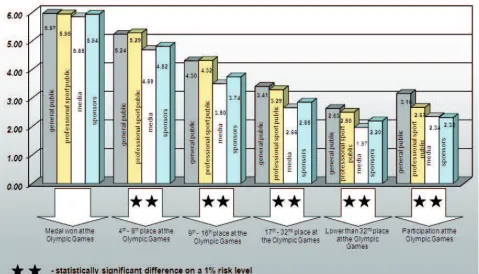
the value of participation at the Olympic Games. The interviewed subjects have marked individual achieve-ments with marks of 1 to 6, where 1 represented “a poor result” and 6 “an excellent result” (TABLE 1).
All types of the public evaluated a medal won at the Olympic Games with very high and consistent marks, so no statistically signifi cant diff erences were observed. For all other levels of achieved results and for participation at the Olympic Games, the marks of individual types of the public were signifi cantly diff erent on a 1% risk level; the evaluations of individual achievements decrease with the level of the achieved result. Participation in the Ol-ympic Games received better evaluation than placement below the 32nd place in all types of public.
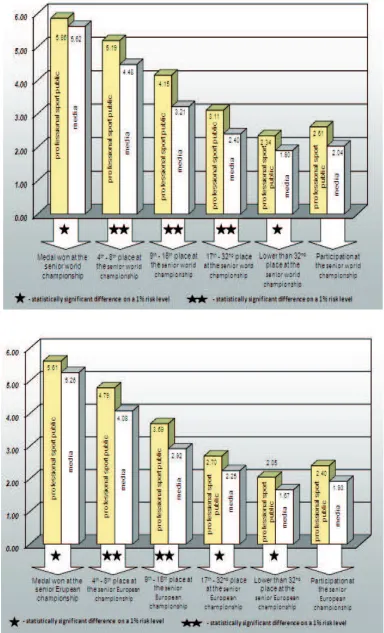
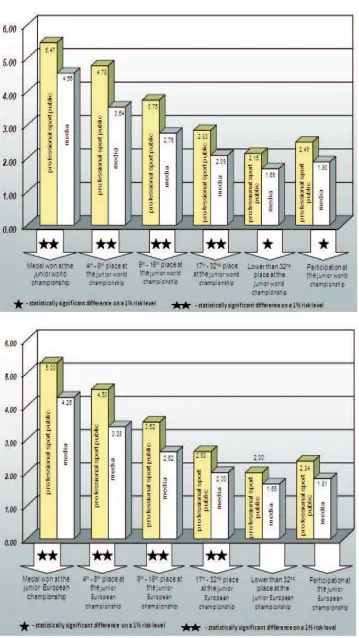
Secondly, representatives of the expert public and the journalists have then “regardless of sports discipline evaluated sports achievements” (1st–3rd place, 4th–8th place, 9th–16th place, 17th–32nd place, worse than 32nd place) and participation at the senior and junior world and European championships. Interviewed subjects marked individual achievements with marks 1 to 6, where 1 represented “a poor result” and 6 “an excellent result” (TABLE 2, 3).
Representatives of the expert public evaluated, with statistically signifi cant higher marks, all levels of
achievements at senior and junior championships in comparison to journalists. The only two results where statistically signifi cant diff erences were not revealed be-tween the marks of selected types of public is “participa-tion in the World and European championships”. Both types of the public marked participation as being higher than a result below the 32nd place.
The evaluation of Slovenian sportspeople at the junior World and European championships reveal the same results as the previous group, regardless of sports discipline.
Thirdly, representatives of the expert public and jour-nalists evaluated “the importance of a medal won by Slovenian sportspeople at the World championships in a particular sports discipline”. The interviewed subjects marked the achievements (a medal won at the World championships) for 77 selected sports disciplines with marks of 1 to 6, where 1 represented “an unimportant result” and 6 “an extremely important result”. Out of 77 selected sports disciplines, the expert public marked a medal won at the World championships with higher marks in 75 sports, whereas the journalists awarded higher average marks to two sports (car racing and mo-torbike racing). The expert public evaluated the impor-tance of a medal signifi cantly higher than the media on
TABLE 1
TABLE 2
TABLE 3
a 1% risk level in 53 sports and on a 5% risk level in 10 sports. Both types of the public evaluated with the high-est average mark the importance of a medal won at the World championships in athletics (expert sports public at 5.88 and journalists at 5.67).
Fourthly, representatives of the expert public and journalists answered the question: “In your opinion, what result of Slovenian sportspeople is considered to be good at the World championship?” The interviewed subjects marked the achievement with marks of 1 (par-ticipation at the WC), 2 (placement worse than 32nd place), 3 (result between 17th and 32nd place), 4 (result between 9th and 16th place), 5 (result between 4th and 8th place) and 6 (1st–3rd place at the WC). Out of 77 sports disciplines, the expert public evaluated a lower achieved result as good in 55 sports whereas the journalists did so in 22 sports. The expert public evaluated as being good signifi cantly lower results on a 5% risk level in two sports (sailing and white water kayak – canoe), where-as the journalists evaluated where-as being good signifi cantly lower results on a 5% risk level in football. Both types of the public evaluated as good mostly high results in tra-ditionally successful Olympic sports (athletics, artistic gymnastics, white water kayak – canoe, swimming, al-pine skiing, ski jumping, rowing) and considerably lower results in some less successful sports (baseball, boxing, water polo, triathlon, etc.).
The expert public evaluated a medal won at the World championships as a good result in a total of 52 sports (with an average mark of between 3.5 and 4.5 in 31 sports), a very good result (an average mark of between 4.5 and 5.5) in 14 sports or an excellent result (an average mark of between 5.5 and 6) in seven sports; in contrast, representatives of journalists shared the same opinion on only 28 sports (a good result for 15 sports, a very good re-sult for 11 sports and an excellent rere-sult for two sports).
The majority of the marks of both types of the public are between the average values of 3 and 5, showing that the representatives of both types of the public evaluated a result around 16th place in most sports at the World championships as a good result. Representatives of the expert public expect the highest results in alpine skiing, as in their opinion a good result would be placement around 4th place at the World championships (average mark – 5.01) and the lowest in baseball (2.97) and golf (2.92). Representatives of journalists would be satis-fi ed only with high results in white water kayak – canoe (5.21), alpine skiing (5.16) and ski jumping (5.14). All three sports have been traditionally successfull, with Slovenian sportspeople achieving the highest places at major international competitions, yet the international degree of presence of these sports is modest at best. The lowest mark has been awarded by journalists to the sport that also receives the most media attention in Slovenia– football (2.72).
DISCUSSION
The fi ndings of the presented comparisons reveal that the four different types of the public evaluate achievements at the Olympic Games differently, al-though all types of public evaluated a medal won at the Olympic Games as an excellent result regardless of the sports discipline. In contrast, the journalists and spon-sors evaluated all other levels of results one mark lower on average than the general and expert public. The latter presumably evaluated sports results on the basis of their understanding about the international competition, the eff ort invested in the development of an individual result and the possibilities for achieving such a result at the Olympic Games. Undoubtedly, the expert public also ac-cepts the Olympic Games as a unique event, where the fi nal results sometimes surprise even the best experts. As a result, their evaluation could be considered the most valid. Sponsors presumably evaluated individual achievement from the marketing value viewpoint and journalists from the media response perspective. The general public probably added, beside the evaluation of the diffi culty of achieved results at the Olympic Games and the media response, an emotional component of the response to the achievement of the result of sportspeople at the Olympic Games. Specifi cally, it has been revealed that the elite sports result has an important infl uence on the national identifi cation of the Slovenian people; furthermore, representatives of the general public listed the elite sports result as a factor that makes them the proudest for the recognition of Slovenia abroad (Kovač, Starc, & Doupona Topič, 2005).
All types of public consider a placement below the 32nd place at the Olympic Games as some kind of disap-pointment and evaluate it lower than more participation at the Olympic Games. Participation opens new pos-sibilities and expectations of achievement, particularly as the Olympic Games represent a one off event where sometimes totally unknown sportspeople sometimes achieve extremely good results. Nevertheless, the evalu-ation shows that the society currently values the motto “to be an Olympian” considerably more than “participat-ing is more important than winn“participat-ing”.
Whereas a comparison of the results achieved at the Olympic Games as the biggest sports event included all four types of the public, the rest of the analysis tested only the diff erences between the expert public and the journalists.
cases of evaluation when compared to the journalists. The diff erences in the evaluation of the achievements of individual competitions are larger in the junior than the senior category, as the representatives of the expert pub-lic presumably evaluate the results in the junior category also from the point of view of the future potential of an individual result. The sports results and the competition ability of a sporter develop in diff erent individual trends and according to the nature of each individual sports discipline. The time needed for the achievement of an elite sports result is as a result of the particularities of specifi c sports disciplines (Bednarik, 1996; Kolar, 2005) and the representatives of the expert public understand that the result can be achieved only with a long term, systematic and continuous process of suitable sports training (Bednarik, Petrovič, & Tušak, 2001). It can be assumed that journalists undervalue the results in the junior category, which results in less media attention towards the achievements of Slovenian sportspeople in junior categories.
Both types of the public evaluated achievements be-low 32nd place as being lower than mere participation in the competition. Presumably, the evaluation also indi-cates that the largest competitions should be for sports-people who can achieve a signifi cant result, concluding that the criteria for participation at the events should be stricter. This can also be explained with the decrease of the costs of competitions, as fi nancial means should not be invested into average results. The primary product of elite sports training as the main activity of sports dis-ciplines, considered as a production process, is an elite sports result (Bednarik, 1996). This result has its value based on the production costs and the trading value of the result (Bednarik et al., 2001). The analyses of recent years show that elite sports results are becoming more expensive (Bednarik, Remih, Močnik, Simoneti, Štiblar, & Šugman, 2000), whereas sponsorship money is being decreased in a smaller environment due to the conditions of globalisation (Chelladurai, 2001); there-fore, the majority of sports require a rationalisation of participation at events.
The diff erence between a medal and 4th–8th place is larger in the case of journalists compared to the expert public on all levels of competition. It can be conclud-ed that the expert public evaluates an achievconclud-ed 4th–8th place mainly through the understanding of the diff er-ence in the quality between the third and fourth placed sportspeople at the big competition, whereas journalists evaluate the result mostly from the media response to the medal or the achieved fourth place. All statistical re-ports in the media show that the success of the country at large competitions is being evaluated by the number of medals won (Kolar, Bednarik, Kovač, & Jurak, 2007; Beijing Competition information. Overall medal
stand-ing, 2008; Lazar, 2003; Yahoo! Sports Overall medal count, 2008).
Both types of the public, out of 77 sports, evalu-ated with the highest average mark a medal won at the World championships in athletics. Athletics is a sport to which diff erent types of the public would award the largest support from public fi nances; furthermore, the results of Slovenian women athletes are extremely high on the scale of achievement that bring out in people feelings of national pride (Kovač, Starc, & Doupona Topič, 2005). Both types of the public, according to the average mark of the achieved medal at the world championships, placed their emphasis on the top ten sports of basketball, swimming, football, ski jumping, artistic gymnastics, handball, volleyball and ice hockey in addition to athletics. The expert sports public also values alpine skiing while the media views road cycling as being highly regarded. All top ten sports disciplines are Olympic sports, which indicates the extreme at-tention paid to the Olympic Games and also gives the Olympic sports special value in various classifi cations, e.g. fi nancial support from public fi nances, interest of sponsors, media coverage, etc. (Kolar, 2005). The ex-pert public evaluated the importance of a medal won at the World championships even more highly than the journalists in the majority of sports and also evaluated a worse result achieved at the World championships as a good achievement. Both types of the public evaluated as a better result those of sports that are highly regarded in Slovenia than of sports, which are not highly success-ful, developed or well known in Slovenia.
For the expert public, the sporting success of Slov-enian sportspeople is considered in a much broader way and in more sports in comparison to the journalists, who have limited this recognition only to few sports. This is also confi rmed by reviewing the articles in daily and weekly newspapers or in daily and weekly sports information programmes, where the amount of report-ing and space allocated for individual sports depend on the type of sport or the achieved result.
expecta-tions are lower and the satisfaction with worse results is considerably higher.
It is expected that both of the observed types of pub-lic possess a high degree of expertise, an understanding of the problems of Slovenian sport and the position of each particular sport in the international sports frame-work. When comparing the selected types of public, it is interesting to notice that the journalists value the achievements of Slovenian sportspeople at the Europe-an Europe-and World championships as being at a signifi cEurope-antly lower level than the expert public does and the achieve-ments at the Olympic Games are regarded as the lowest by all types of public. According to Bednarik (1996), a sports result has psychological and fi nancial aspects in trading value; both aspects infl uence the evaluation of a sports result. The present study is concerned with the psychological aspects of the sports result, which are experienced by both the expert type of public, who di-rectly or indidi-rectly participate in the making of a result, and the journalists, who monitor the making and the achievement of the result, write about it and present it to other types of public. As the psychological aspects of a sports result are measurable mainly by the satisfac-tion of participants at the achievement of the result and as they infl uence the evaluation of sports achievement (Bednarik, 1996), it is understandable that the direct producers of the sports result (the expert public) value the achievement higher than passive observers (journal-ists). Nevertheless, this argument does not withstand scrutiny, as the representatives of the general public should, at the achievements of elite sports results of Slovenian sportspeople, consequently experience even a smaller degree of satisfaction than the journalists and this should have been refl ected also in their evaluation of the importance of the result in comparison to the journalists. The results of general public proved the op-posite, as they experienced a larger degree of satisfaction than the expert public by evaluating the achievements of Slovenian sportspeople with the highest marks out of all studied types of public.
It is possible that the reasons for the low evalua-tion of sports achievements by the journalists should be looked upon from the fi nancial perspective of the trading value of a sports result. This argument also does not withstand a serious examination, as the sponsors, whose purpose are commercial goals (Hong, 1997) ex-pressed in the fi nancial aspect of the trading value of the sports result, evaluated sports results higher than the journalists (Kolar, 2005). Therefore, it is reasonable to ask why the journalists evaluate sports achievements of Slovenian sportspeople with low marks. Is jealousy a possible reason due to the “merely” passive role of the media in sport, or are the other types of public over evaluating the value of the sports result? Or is perhaps the real reason the insuffi cient understanding and
un-derestimation of the actual circumstances needed for the achievement of the elite sports result? Under evalu-ation of the elite sports results of sportspeople by the journalists is not a problem in itself, as it only refl ects the opinion of the journalists about the importance of the sports achievements of Slovenian sportspeople. The problem occurs when the expression of this opinion in the articles and reports about the sports achievements of Slovenian sportspeople influences the attitude of other types of the public to the sport. The results of the present and other studies (Godnič, 2005; Kolar, 2005) reveal that the media do not significantly influence the formation of public opinion, despite the contrary arguments of several other authors (Boyle & Haynes, 2000; Košir & Ranfl , 1996). Signifi cant diff erences in the evaluation of sports achievements between the ex-pert public and the journalists could be also seen in the lack of expert knowledge of the journalists, which could start a debate about the need for introduction of sports journalism as a separate study programme. Specifi cally, journalists nowadays often prove that the media can use negative topics in sport (scandals, doping, rows between sportspeople and coaches, etc.) and turn them into sell-ing strategies for increassell-ing their audiences (Godnič, 2005), rather than supplying expert commentary, which requires more knowledge.
CONCLUSION
Sport may be seen as a social, cultural, economic and media phenomenon (De Knop, 1998; Larive, 1994). It has various aims and goals such as winning a competition, learning sports skills, relaxation, staying healthy, rehabilitation, creating an income, having fun and mostly a lifestyle which in a “chaotic sense” involves the term “quality of life” (Chelladurai, 1992; De Knop, 1998; Kolar, 2005; Sasser, Olsen, & Wyckoff 1978).
Another way in which sport manifests itself is elite sport. Every result in elite sports has, via its feedback and in line with the logic of system theory, an eff ect on the entire training process as well as on the consumers of top sports: spectators and the sports industry (Bed-narik, 1996). Therefore, such a result can be viewed as a multiplier and creator of other types of sport such as the sport of children and young people, commer-cial sport and sports recreation (Bednarik & Petrovič, 1998).
sports journalists from diff erent media (radio, televi-sion, daily, weekly and monthly newspapers, and the internet), which are often partial and incomplete and present only the opinions of journalists. These opinions are not always objective, as they are limited by the edito-rial policy of individual media, the amount of fi nances an individual sport sets aside for media attention, the knowledge of journalists about particular sports disci-plines, the criteria journalists set when evaluating sports achievement and, fi nally, with the emotional attachment of the journalists to a particular sports discipline. As a result, perception and evaluation are not always a real-istic refl ection of the achieved sports result, but only an emotional response, caused by an achieved sports result according to the expectations of diff erent types of public (journalists, the general public, etc.). Predicted and ex-pected high sports achievements create high expectation and sometimes a sense of euphoria in people that can easily turn into major disappointment. As a result, an elite sports result (e.g. 5th place at the Olympic Games) can be seen as a bad and unsatisfactory result of the sporter from the amateur public point of view. In con-trast, some results with a lower degree of quality, when achieved unexpectedly, can receive positive evaluation and appreciation.
The presented fi ndings can be at least partially ex-plained by means of an introductory discussion about the subconscious aspects of the cognitive acting of peo-ple (Flavell, 1979 in Musek, 1997), which direct and infl uence an understanding of reality with a whole spec-trum of phenomena (implicit understanding, cognitive schemes, prejudice and stereotypes). It is obvious that a representation of reality, in this case an elite sports achievement, is diff erently perceived by representatives of diff erent types of the public and is based solely on intuitive deciding.
The analysed data show that the evaluation subject of the journalists and the evaluation subject of the ex-pert public are two diff erent matters. The more criti-cal evaluation of the journalists could be explained by the fact that the journalists are mostly observers of the events competitions, whereas the expert public is a creator of sports achievement. The latter type of public does not consider an achievement as a unique event that is defi ned with competition placement, but as a result of a long term methodical training process. It is questionable whether the journalists underestimate sports achievements or their evaluation is an expression of expert objectivity without an emotional component, which is always at hand with the creators of elite sports results. Although some researchers consider an elite re-sult as important as the amount of media attention it receives (Boyle & Haynes, 2000; Godnič, 2005), it can be concluded on the basis of analyses that the media in Slovenia do not have a signifi cant infl uence on the
formation of public opinion about the value of sports results.
REFERENCES
Bartoluci, M. (2003). Ekonomika i menedžment sporta.
Zagreb: Kineziološki fakultet.
Bednarik, J. (1995). Klasifi kacija športnih produktov.
Šport, 43(3), 17–20.
Bednarik, J. (1996). Športni trening kot proizvodnja vrhunskega športnega rezultata. Šport, 44(2, 3),
10–11.
Bednarik, J., & Petrovič, K. (1998). Transparentnost funkcije sporta za gledatelje i za aktivno uključene u sportsku rekreaciju (Slučaj Slovenije). Kineziologija 30(1), 51–54.
Bednarik, J., Petrovič, K., & Tušak, M. (2001). The func-tion of sport. In J. Bednarik (Ed.), Some economic aspects of sport in Slovenia (pp. 40–48). Ljubljana: Faculty of Sport.
Bednarik, J., Remih, A., Močnik, R., Simoneti, M., Štiblar F., & Šugman, R. (2000). Izdatki za šport. Nekatere značilnosti fi nanciranja in organiziranosti slovenskih športnih organizacij. Ljubljana: Fakulteta za šport.
(2008). Competition information: Overall medal standing.
Retrieved 28. 9. 2008 from the World Wide Web: www.http://results.beijing2008.cn/WRM/ENG/ INF/GL/95A/GL0000000.shtml
Boyle, R., & Haynes, J. (2000). Power play: Sport, the media and popular culture. Harlow, Essex, Longman: Pearson Education.
Chelladurai, P. (1992). A classifi cation of sport and physical activity services: Implications for sport management. Journal of Sport Management, 6(2),
38–51.
Chelladurai, P. (2001). Managing organizations for sport and physical activity: A system perspective. Scottsdale: Holcomb Hathaway Publishers.
De Knop, P. (1998). Sport tourism: A state of the art. European Journal for Sport Management, 5(2),
5–20.
Elvin, I. T., & Emery, P. (1997). A role for expert sports management. The XXIII Snickers World Cross Country Championships. European Journal for Sport
Management, 4(1), 6–25.
Godnič, V. (2005). Vloga športa pri oblikovanju nacion-alne identitete Slovencev. Master thesis, University of Ljubljana, Faculty of Sport, Ljubljana.
Gratton, C., & Taylor, P. (2000). Economics of sport and recreation. New York: Spon Press.
Hong, F. (1997). Commercialism and sport in China: Present situation and future expectations. Journal of
Kelly, G. (1955). The psychology of personal constructs.
New York: Norton.
Kolar, E. (2005). Model vrednotenja športnih panog v Re-publiki Sloveniji z vidika vrhunskega športnega rezul-tata. Doctoral dissertation, University of Ljubljana, Faculty of Sport, Ljubljana.
Kolar, E., Bednarik, J., Kovač, M., & Jurak, G. (2007). Vrednotenje športnega dosežka. Šport, 55(2), 34– 39.
Kovač, M., Starc, G., & Doupona Topič, M. (2005).
Šport in nacionalna identifi kacija Slovencev. Ljublja-na: Fakulteta za šport.
Kovač, M., Doupona Topič, M., Bednarik, J., Jurak, G., Brenk, K. M., Starc, G., Majerič, M., & Kolar, E. (2003a). Šport in nacionalna identiteta Slovencev (SN 01 – splošna javnost): Anketni vprašalnik. Ljubljana: Fakulteta za šport.
Kovač, M., Doupona Topič, M., Bednarik, J., Jurak, G., Brenk, K. M., Starc, G., Majerič, M., & Kolar, E. (2003b). Šport in nacionalna identiteta Slovencev (SN 02 – strokovna javnost): Anketni vprašalnik. Ljubljana: Fakulteta za šport.
Kovač, M., Doupona Topič, M., Bednarik, J., Jurak, G., Brenk, K. M., Starc, G., Majerič, M., & Kolar, E. (2003c). Šport in nacionalna identiteta Slovencev (SN 03 – novinarji): Anketni vprašalnik. Ljubljana: Fakulteta za šport.
Kovač, M., Doupona Topič, M., Bednarik, J., Jurak, G., Brenk, K. M., Starc, G., Majerič, M., & Kolar, E. (2003d). Šport in nacionalna identiteta Slovencev (SN 04 – sponzorji): Anketni vprašalnik. Ljubljana: Fakulteta za šport.
Košir, M., & Ranfl , R. (1996). Vzgoja za medije. Ljublja-na: Državna založba Slovenije.
Larive, J. (1994). The European community and sports.
European Journal for Sport Management, 1(1), 58–
64.
Musek, J. (1997). Znanstvena podoba osebnosti. Ljublja-na: EDUCY d.o.o.
Olimpijski komite Slovenije – združenje športnih zvez. (2004). Obvestila, X(37) [SOC, Notices]. Ljubljana: OKS – ZŠZ.
Sasser, W. E., Olsen, R. P., & Wyckoff , D. D. (1978).
Management of service operations. Boston: Allyn and Bacon.
Sruk, V. (1995). Leksikon: Filozofi ja. Ljubljana: Cankar-jeva založba.
Starc, G. (2004). Power struggle in the black box of sport: Sport as the arena of Slovenian nationalism. Doctor-al dissertation, University of Ljubljana, Faculty of Sport, Ljubljana.
Starc, G. (2005). Uvod. In M. Kovač & G. Starc (Eds.),
Šport in nacionalna identifi kacija Slovencev (pp. 7– 26). Ljubljana: Fakulteta za šport.
Yahoo! Sports overall medal count. Retrieved 24. 10. 2008 from th World Wide Web: http://sports.yahoo.com/ olympics/beijing/medals
HODNOCENÍ VRCHOLOVÉHO SPORTOVNÍHO VÝSLEDKU Z POHLEDU RŮZNÝCH TYPŮ
PUBLIKA (Souhrn anglického textu)
Sportovní výsledek splňuje svůj pravý účel tehdy, je-li zaznamenán veřejností a podle příslušné odezvy na-bývá případně dalších významných dimenzí. Význam sportovního výsledku je nejčastěji hodnocen intuitivně a na základě emocionálních reakcí a názorů na jeho důležitost v národním, nikoliv celosvětovém měřítku. Analýza hodnocení vrcholového sportovního výsledku dosaženého na nejvýznamnějších soutěžích odhaluje, že různé typy obecenstva hodnotí sportovní výsledky různě. Sportovní výsledek z podstatné části více uznává široká a odborná veřejnost, zatímco novináři jej oceňují nejméně. Posledně jmenovaní se snaží zůstat objektivní, když referují např. o jednorázové velké sportovní akci; nicméně novináři nedostatečně chápou to, že významný sportovní úspěch je výsledkem dlouhodobého tréninko-vého procesu. Odborná veřejnost si sportovních výsled-ků cení více než novináři; toto je zřejmě dáno tím, že odborníci chápou, jaký má předchozí trénink význam pro dosažený výsledek. Široká veřejnost sportovní výsle-dek oceňuje nejvíce, což ukazuje na dvě věci – za prvé, média sice mohou tvořit veřejné mínění, ale na širokou veřejnost mají malý vliv; za druhé, výsledky jsou hod-noceny zejména na emocionální bázi, zahrnující cestu k úspěchu, ne pouze okamžik dosažení výsledku. Lidé očividně touží po „velkých příbězích“ a jejich „hrdi-nech“, avšak média nejsou schopna tyto příběhy lidem prezentovat.
Assis. prof. dr. Edvard Kolar
University of Ljubljana Centre for university sport Gortanova 22
1000 Ljubljana Slovenia
Education and previous work experience
November 1996 – undergraduate study at Faculty of Sport, University of Ljubljana, Ljubljana, Slovenia. December 2001 – postgraduate study at Faculty of Sport, University of Ljubljana, Ljubljana, Slovenia. July 2005 – doctoral study at Faculty of Sport, University of Ljubljana, Ljubljana, Slovenia.
Employment:
December 1996–December 1999 – Faculty of Sport, University of Ljubljana, Ljubljana, Slovenia.
Since January 2000 – expert of Slovenian Gymnastics Federation.
Since June 2001 – acting general secretary of Slovenian Gymnastic Federation.
June 2002–November 2005 – acting director of Public institution of Ivan Cankar for sport, culture and tourism in Vrhnika town.
2006–2007 – director of Public institution of Ivan Cankar for sport, culture and tourism in Vrhnika town.
2008 – director of Centre for university sport at the University of Ljubljana.
First-line publications
Kolar, E., Andlovic Kolar, K., Štuhec, S. (2002). Comparative analysis of selected biomechanic characteristics between support backward swing and support swing for the 1 1/4 straddle-piked forward salto on the parallel bars. Sport. Biomech., 1(1),
69–78.
Kolar, E., Kovač, M., Bednarik, J. (2005). Evaluation of sports disciplines from the general public’s point of view. Acta Univ. Carol. Kinanthropol., 41(1), 63– 76.