American University in Cairo American University in Cairo
AUC Knowledge Fountain
AUC Knowledge Fountain
Theses and Dissertations
2-1-2018
Learner engagement in a MOOC in the Arab world: A case study
Learner engagement in a MOOC in the Arab world: A case study
analysis using the community of inquiry framework
analysis using the community of inquiry framework
Nadine AboulmagdFollow this and additional works at: https://fount.aucegypt.edu/etds
Recommended Citation Recommended Citation
APA Citation
Aboulmagd, N. (2018).Learner engagement in a MOOC in the Arab world: A case study analysis using the community of inquiry framework [Master’s thesis, the American University in Cairo]. AUC Knowledge Fountain.
https://fount.aucegypt.edu/etds/689
MLA Citation
Aboulmagd, Nadine. Learner engagement in a MOOC in the Arab world: A case study analysis using the community of inquiry framework. 2018. American University in Cairo, Master's thesis. AUC Knowledge Fountain.
https://fount.aucegypt.edu/etds/689
This Thesis is brought to you for free and open access by AUC Knowledge Fountain. It has been accepted for inclusion in Theses and Dissertations by an authorized administrator of AUC Knowledge Fountain. For more information, please contact [email protected].
Institutional Review Board
The American University in Cairo AUC Avenue, P.O. Box 74
New Cairo 11835, Egypt. tel 20.2.2615.1000 fax 20.2.27957565
Email: [email protected] CASE #2017-2018-030
To: Nadine Aboulmagd Cc: Dena Riad & Salma Serry From: Atta Gebril, Chair of the IRB Date: Oct. 26, 2017
Re: Approval of study
This is to inform you that I reviewed your research proposal entitled “Learner Engagement in a MOOC in the Arab World: A Case Study Analysis Using the Community of Inquiry
Framework” and determined that it required consultation with the IRB under the "expedited"
heading. The proposal used appropriate procedures to minimize risks to human subjects and that adequate provision was made for confidentiality and data anonymity of participants in any published record. I believe you will also make adequate provision for obtaining informed consent of the participants.
This approval letter was issued under the assumption that you have not started data collection for your research project. Any data collected before receiving this letter could not be used since this is a violation of the IRB policy.
Please note that IRB approval does not automatically ensure approval by CAPMAS, an Egyptian government agency responsible for approving some types of off-campus research. CAPMAS issues are handled at AUC by the office of the University Counsellor, Dr. Ashraf Hatem. The IRB is not in a position to offer any opinion on CAPMAS issues, and takes no responsibility for obtaining CAPMAS approval.
This approval is valid for only one year. In case you have not finished data collection within a year, you need to apply for an extension.
Thank you and good luck. Dr. Atta Gebril
IRB chair, The American University in Cairo 2046 HUSS Building
T: 02-26151919
American University in Cairo Graduate School of Education
Learner Engagement in a MOOC in the Arab World: A Case Study Analysis Using the Community of Inquiry Framework
An MA Thesis by Nadine Aboulmagd
Submitted to the Department of International & Comparative Education In partial fulfillment of the requirements for
The degree of Master of Arts in Educational Leadership
Supervised by Dr. Ted Purinton
2
Acknowledgements
As I look back on this chapter in my life, with all its happy, sad, funny, and difficult moments I went through, I am filled with joy, pride and gratitude. Because it is in these moments, that I’ve had lifetime experiences, lifelong knowledge and endless memories.
I want to first thank God, with all my heart, for blessing me every step of the way.
I wouldn’t have been able to pursue this MA if it weren’t for the generosity of the AUC Staff Scholarship program. This scholarship was complimented by Dr. Aziza Ellozy, the Founding Director of the Center for Learning and Teaching (CLT), who has given me her approval and blessings to pursue this degree alongside my full time job at CLT. I’d like to thank each one of my professors and research supervisors, who have contributed to my journey by mentoring me, challenging me and pushing me, somehow they saw something in me that I didn’t see in myself, they helped me get to the point where I am actually writing the acknowledgements for my MA thesis research. My readers Dr. Maha Bali, Dr. Russanne Hozayin and Dr. Heba El Deghaidy I am very grateful for your support throughout this year. I’d also like to thank Dr. Nagwa Megahed for her research mentorship throughout these two and a half years.
I’d like to thank my family; my mother Hala Salem who has always believed in me and supported me through encouraging words, prayers and positive energy; my father Khaled Aboulmagd for constantly encouraging me to give it my all, believing in me and being understanding as I worked to reach this moment; my older sister Sara who is also graduating with a Master of Science this semester, who has been alongside of me every bit of these couple of years, it has been wonderful learning alongside of you. My younger sister Salma, whose smile and love get me through each day. Finally, I’d like to thank my friends and colleagues; Sherif Kamal, Reham Refaat, and everyone who was part of this journey, with its ups and downs, with its excitement and stressful times, everybody who has encouraged me when I thought I couldn't make it. You all deserve immense recognition, I am grateful for your constant support; honestly I wouldn’t be here without it, so thank you.
3
Abstract
Massive Open Online Courses (MOOCs) have been offered by many institutions around the globe for the better part of a decade, and more recently in the Arab World. Learner engagement in MOOCs has also been researched in attempts to explain the varying degrees of engagement in these courses. This research aimed to explore the factors that affect learner engagement using an Arabic MOOC about E-Marketing offered by Edraak, one of the leading MOOC providers in the region, as a case study. This study used a mixed methods approach to explore the significance of the relationship between a) learner engagement and multiple demographic and psychographic variables of learners, and b) learner engagement and the perception of learners about the Community of Inquiry (CoI) presences; teaching presence, social presence and cognitive presence. Additionally, the research included interviews with some of the learners who participated in the MOOC in order to better understand the factors they themselves attribute to their engagement or disengagement; aiming to also explore the relationship between their engagement levels and their motivations, intentions from enrolling in the MOOC and self-regulated learning strategies. This study used a Chi-square test to explore which variables and presences had statistically significant relationships with engagement, which was defined as the level of learner interaction with the course activities, namely watching the weekly videos and attempting to solve the weekly quizzes. The results of the Chi-square test as well as a thematic analysis of the interviews using the CoI model, theories of motivation, self-regulated learning and andragogy are presented. Results of Chi-square test indicated that there is in fact statistical significance between learner engagement and variables such as age group, goal from enrolling in the MOOC, knowledge about the MOOC subject, eligibility for receiving a course completion certificate, previous enrollment in MOOCs and self-motivation. There was no statistical significance observed between the level of learner engagement and their perceptions of the CoI presences. A discussion on the interpretation of this data, the study limitations as well as recommendations for future research is also presented.
Keywords: MOOCs, engagement, types of MOOCs, motivation, adult learning, self-regulated learning, lifelong learning, community of inquiry, learning analytics.
4
Table of Contents
Acknowledgements 2
Abstract 3
List of Tables/Figures 6
CHAPTER I: Introduction and Context 7
Statement of Research Problem and Research Questions 8
Research Problem 8
Research Questions 9
CHAPTER II: Review of Relevant Literature 9
What are MOOCs? 9
History and Development of MOOCs in the World and the Middle East/Arab
World 12
The Potential and Limitations of MOOCs 14
Conceptual and Pedagogical Frameworks of MOOCs 20
Andragogy, Heutagogy, Self-directed learning and Self-regulated learning
24
Intention, motivation and reasons for MOOC enrollment 27
Definition and Importance of Student Engagement 32
The Community of Inquiry Model 33
Teaching presence 35
Social Presence 37
Cognitive presence 39
CHAPTER III: Research Design and Methodology 42
Research Questions and Hypotheses 43
Research Question 1 43
Research Question 1 Hypothesis (H₁) 43
Research Question 1 Null Hypothesis (H₀₁) (For chi square testing) 43
Research Question 2 43
Research Question 2 Hypothesis (H₂) 43
Research Question 2 Null Hypothesis (H₀₂) (for Chi square test purposes) 43
Sampling 43
Description of the Research Context 44
Data Collection 45
Learning Analytics 45
Learning Analytics and limitations 46
Community of Inquiry Survey Instrument 48
Edraak’s Pre-MOOC Survey 50
Interviews 50
Reporting on Interview process 51
Instructor Interview 51
MOOC Observation 51
Ethical considerations 52
Credibility and Trustworthiness 52
Reporting on Data Handling 53
Matching Individual data across data sets 54
Data Analysis 56
Chi Square Test 57
5
CHAPTER IV: Presentation of Results 59
MOOC Learners Demographics 59
Descriptive Statistics 61
Research Questions and hypotheses 62
Research Question 1 62
Hypothesis for Research Question 1 (H₁) 62
Null Hypothesis for Research Question 1 (H₀₁) (For chi square testing) 63
Research Question 2 74
Research Question 2 Hypothesis (H₂) 74
Research Question 2 Null Hypothesis (H₀₂) (for Chi square test purposes) 74
Chapter V: Discussion, Conclusions, Limitations, and Future Research 86
Discussion of Results for Research Question 1 86
Discussion of Results for Research Question 2 90
Limitations of Study 94
Conclusions 97
Recommendations for Future Research 104
References 107
Appendix A: Community of Inquiry Survey Instrument 122
Appendix B: Learners Interview Questions 124
Appendix C: Chi-square Test Results 127
Appendix D: Chi Square Cross Tabulations 130
Appendix E: All Codebooks 154
Appendix F: Consent Form 163
Appendix G: IRB Approval 164
6
List of Tables/Figures
Table 1: Comparison between for-credit traditional face-to-face and online
courses, and MOOCs. ... 11
Table 2: MOOC Platforms in the World and in the Middle East and Arab world .. 14
Figure 1: Community of Inquiry Diagram ... 35
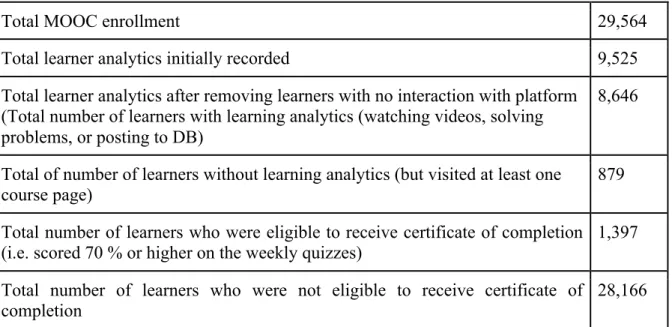
Table 3: Numbers of Learners in MOOC and Learning Analytics ... 59
Figure 2: Gender distribution in the MOOC ... 60
Figure 3: Learner distribution by country ... 60
Table 4: Averages calculated for engagement ... 61
Table 5: Standard deviation for engagement ... 61
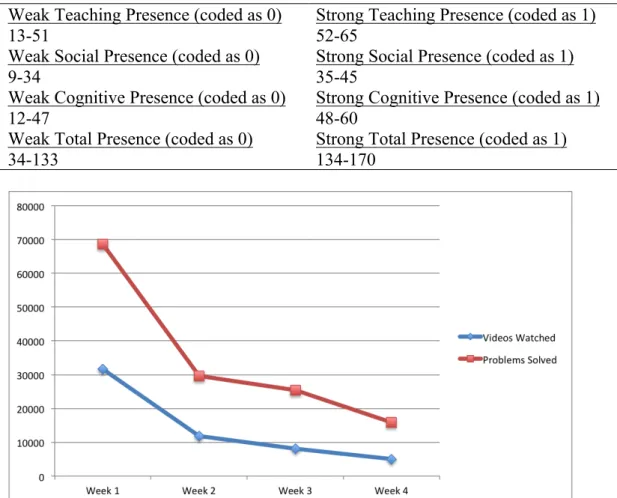
Table 6: Coding for Weak and Strong CoI Presences ... 62
Figure 4: Engagement pattern of video watching and solving problems across weeks ... 62
7
Learner Engagement in a MOOC in the Arab World: A Case Study Analysis Using the Community of Inquiry Framework
CHAPTER I: Introduction and Context
Online learning has not only grown in popularity over the last decade, but it has also spread to various corners of the overall higher education landscape. Thus, researching ways in which to make online courses engaging for students is very important in order to create more successful online learning experiences (Dixon, 2010; Guo, Kim & Rubin, 2014). More specifically, Massive Open Online Courses (MOOCs) have increased exponentially in numbers over this past decade (McMinn, 2013; Shah, 2016c); more specifically, in 2016, 23 million unique MOOC registrations occurred worldwide, making the total number of learners enrolled in at least one MOOC approximately 58 million (Shah, 2016c). In addition to having spread globally, MOOCs have also strongly perforated the Arab World, with various MOOC platforms established and exponential numbers of learners enrolling in MOOC providing platforms (Zafar, 2016; Sallam, 2017; ArabNet, 2013). However, there is a great deal of challenge in engaging students in MOOCs, which is said to be as a result of learners’ diverse backgrounds and the large enrollment numbers, to name a few factors (Hew, 2016). O’ Shea, Stone and Delahunty (2015) cite several scholars in stating that “effectively engaging students early in their program is a key strategy to reducing student attrition” (p. 42). Moreover, studies conducted in both face-to-face and online learning environments indicate that student engagement is instrumental for successful learning in that it enhances the overall student experience and reduces attrition, therefore it is a main element in effective online teaching (Guo, Kim & Rubin, 2014; Hew, 2016; Walji, Deacon, Small & Czerniewicz, 2016; Dixon, 2010).
It is no surprise that online learning is gaining this momentum; the role of technology in teaching and learning has evolved rapidly, and learners of the 21st century are quickly adopting the new technologies that arise on a daily basis, accordingly spending more time engaging with these technologies and the online environment through social media platforms (Black, 2010). Additionally, higher educational institutions are moving towards online learning, as it is a way to increase
8
student enrollment and education access at a lower cost (Green, 2010). Economic downturn is actually one of the main reasons why online learning and distance education have been growing rapidly in the past few decades (Allen & Seaman, 2013, Allen & Seaman, 2010; Green, 2010). This demand for online education, stems from economic downturn, has lead to universities offering online courses, since students can save time and money on commuting to campus, and can carry out their work schedules while also completing their education (Green, 2010). It is therefore the responsibility of educators to look deeper into these trends and find ways in which to adapt to students’ needs and engaging environments (Lieberman & Pointer-Mace, 2010).
Massive Open Online Courses (MOOCs), in their most basic form, are free online courses that are open to a large or massive number of participants to enrol. A more detailed definition of MOOCs, their structure and types are provided in the ‘History of MOOCs’ and ‘Conceptual Frameworks of MOOCs’ sections of this paper. While MOOCs are growing rapidly and spreading widely across the globe, they face high attrition rates, which means students drop out of the course before completion. This is often credited to lack of learner engagement, for which reasons vary greatly among learners. Some of these reasons are the massive enrollment numbers, diversity of learners, lack of human interaction between learners and teachers and among students, free admission and varied intentions or motivations in MOOC enrolment. (Hew, 2016; as cited in O’ Shea, Stone & Delahunty, 2015; Jordan 2015b; MOOC Maker, 2016). Understanding the design factors and elements that lead to higher learner engagement in MOOCs is accordingly of imperative benefit to their advancement and development. This research project is a case study that aims to explore the factors that affect learner engagement in an E-Marketing MOOC in the Arab World, using the Community of Inquiry (CoI) model, and theories of motivation and self regulated learning, both as data collection methods, among other methods, as well as a frameworks of analysis; as lenses to explore factors that lead to higher engagement in MOOCs.
Statement of Research Problem and Research Questions Research Problem
9
many factors. Learners in MOOCs are different from fully enrolled online or face-to-face students and MOOCs themselves are different in their designs, implementation, assessment, requirements and pedagogies from formal or credit-bearing online or face-to-face courses. There hasn’t been much research conducted on the topic of increasing learner engagement in MOOCs in particular, thus it’s important to explore factors that would lead to more adequately engaging learners in MOOCs.
Research Questions
RQ 1: What is the nature of the relationship between learner engagement and selected learner variables for the learners who participated in the E-Marketing MOOC?
RQ2: What is the nature of the relationship between low/high engagement and perceptions of weak/strong social presence, teaching presence, and/or cognitive presence by learners who participated in the MOOC?
CHAPTER II: Review of Relevant Literature
This section is a literature review of the topics and areas relevant to this study. The body of research on MOOCs in the Arab world and the Middle East is still in its infancy, therefore this research study contributes to the existing, yet limited, research through the literature review, the data collected and analysis of the results. Moreover, because MOOCs are becoming a trend and are growing rapidly in the Arab world nowadays, a foundation of research on the topic will contribute to its advancement and development in the region, as it will give baseline data to potential researchers, online educators, instructional designers and developers of MOOCs. In addition, this study contributes to the versatile and diverse body of research on the Community of Inquiry (CoI) theoretical framework from a different perspective, as the CoI instrument will be translated and used to collect data on a MOOC in the Arab world.
MOOCs are becoming a trend in international education and are growing rapidly in the Arab world nowadays (Lee et al., 2014). Thus a foundation of research on the topic fosters their advancement and development in the region, as it will offer data to potential researchers and developers of MOOCs.
What are MOOCs?
It is challenging to locate one agreed upon definition of MOOCs as there have been several attempts to coin one definition (European Commission, 2014), which I believe is because there are two main types of MOOCs (cMOOCs and xMOOCs).
10
These types of MOOCs are based on different theories and have different scopes, as will be shown in the comparison between them in the ‘Conceptual and Pedagogical Frameworks of MOOCs’ section. However, The European Commission, in an online published report, defines a MOOC generally as “an online course open to anyone without restrictions (free of charge and without a limit to attendance), usually structured around a set of learning goals in an area of study, which often runs over a specific period of time (with a beginning and end date) on an online platform which allows interactive possibilities (between peers or between students and instructors) that facilitate the creation of a learning community. As it is the case for any online course, it provides some course materials and (self) assessment tools for independent studying” (European Commission, 2014). In many cases MOOCs neither require fees nor prerequisites (Baturay, 2015), and are open to anyone regardless of their age or background (Ozturk, 2015). Additionally, participants flexibly engage with the course according to their availability, self-organize, are assessed by their peers if they choose to be and use open educational resources (Ozturk, 2015). With regards to the characteristics of MOOCs and learners who enroll in them, learners usually enroll in MOOCs for the purposes of professional interests, to gain education in a field and/or to receive certificates for their careers, or as a hobby (Baturay, 2015). Further characteristics are: the great majority of learners in MOOCs are adults (above 18 years old), MOOCs average between 5 and 12 weeks in length and English is the main language used (Baturay, 2015).
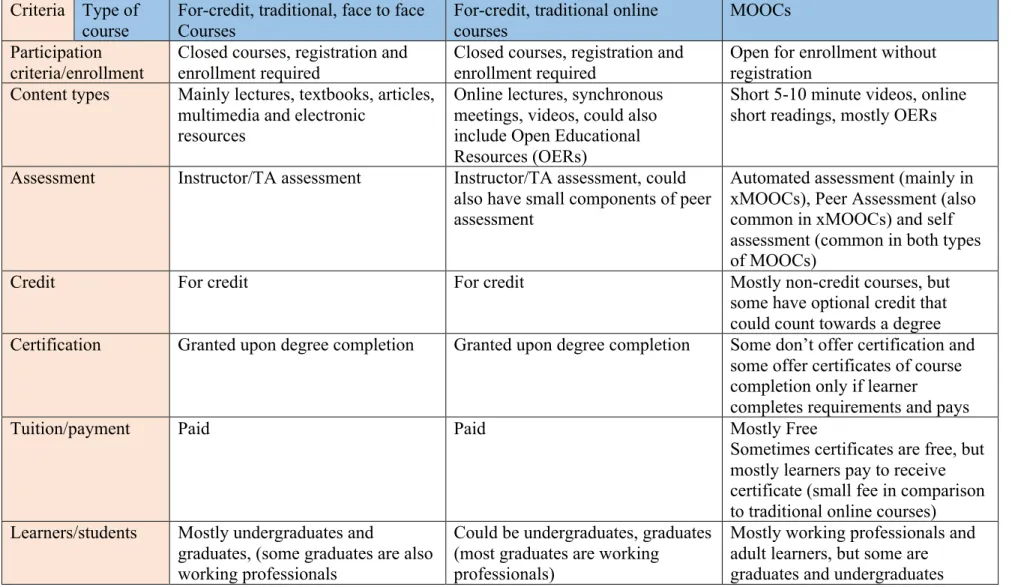
MOOCs differ greatly from traditional, for credit face-to-face and online courses, which is an important distinction to make before going deeper into the particular characteristics and differences between MOOC types and pedagogies. To do so I created Table 1 below, from my understanding of MOOCs throughout my experience with them, which outlines a comparison between traditional for-credit face-to-face courses, traditional for-credit online courses and MOOCs.
Table 1: Comparison between for-credit traditional face-to-face and online courses, and MOOCs.
Criteria Type of course
For-credit, traditional, face to face Courses
For-credit, traditional online courses
MOOCs Participation
criteria/enrollment Closed courses, registration and enrollment required Closed courses, registration and enrollment required Open for enrollment without registration Content types Mainly lectures, textbooks, articles,
multimedia and electronic resources
Online lectures, synchronous meetings, videos, could also include Open Educational Resources (OERs)
Short 5-10 minute videos, online short readings, mostly OERs Assessment Instructor/TA assessment Instructor/TA assessment, could
also have small components of peer assessment
Automated assessment (mainly in xMOOCs), Peer Assessment (also common in xMOOCs) and self assessment (common in both types of MOOCs)
Credit For credit For credit Mostly non-credit courses, but
some have optional credit that could count towards a degree Certification Granted upon degree completion Granted upon degree completion Some don’t offer certification and
some offer certificates of course completion only if learner
completes requirements and pays
Tuition/payment Paid Paid Mostly Free
Sometimes certificates are free, but mostly learners pay to receive certificate (small fee in comparison to traditional online courses) Learners/students Mostly undergraduates and
graduates, (some graduates are also working professionals
Could be undergraduates, graduates (most graduates are working
professionals)
Mostly working professionals and adult learners, but some are graduates and undergraduates
12
The following section will outline the history of MOOC development in general, and their development in the Arab world in particular. Following that, the conceptual frameworks and learning theories that underpin the design and development of MOOCs, as well as this research study are presented.
History and Development of MOOCs in the World and the Middle East/Arab World
MOOCs are growing steadily and rapidly but do not have an extensive history. The history of MOOCs does not extend very far back in time; rather they have been a characteristic of 21st century education with the rise of distance education and online learning programs (Baturay, 2015). Specifically, the first incident where the term appeared was in 2008 when Stephen Downes and George Siemens offered a 12-week MOOC, Connectivism and Connective Knowledge, based on the ‘connectivist’ distributed peer-learning model at the University of Manitoba, Canada (Siemens, 2013). The MOOC aimed to explore the concepts of Connectivism and Connective knowledge and their application to theories of teaching and learning (Downes & Siemens, 2011). Following that, the second MOOC was offered in 2011, the year that MOOCs spread around the world, where professors at Stanford University developed many educational videos and published them, along with supported free web resources, via open online platforms (Baturay, 2015). Preceding MOOCs however, Massachusetts Institute of Technology began the MIT OpenCourseWare initiative in 2001, where the institute placed all materials from their undergraduate and graduate courses online openly available to everyone on the web (Goldberg, 2001). This is believed to have set the stage for this idea of offering educational resources openly online for a massive audience. In 2012 Coursera was established as an independent for-profit platform, along with other independent non-profit initiatives such as Udacity and Udemy. In addition, MIT and Harvard combined their MITx platform into EdX (Baturay, 2015). At this point other European platforms started spreading. UK’s Open University, a leading institution in the field of distance education that has pedagogical experience from offering distance and open courses since 1971, established Futurelearn in 2013. In addition, the German initiative Iversity was founded and is characterized by using the European Credit Transfer System (Baturay, 2015). In the last few years, MOOC enrollment has increased from thousands to millions around the
13
globe; in North America, South America, Europe, Asia, Australia, Africa (Balch, 2013; Breslow, Pritchard, DeBoer, Stump, Ho & Seaton, 2013) and the Arab World (ArabNet, 2013).
Shortly after Coursera, edX and Udacity were established in 2013, the Middle East also saw the flourishing of MOOCs in 2014 (Adham & Lundqvist, 2015). Online learning and MOOCs have started gaining popularity and high enrollment in the Middle East over the past few years (Adham & Lundqvist, 2015). In fact, MOOCs have started appearing in the region in 2013 and 2014, and are continuing to expand as a form of educational technology (Adham & Lundqvist, 2015). MOOCs are spreading across the Arab world at a steady and rapid speed and they are no longer only offered in only the English Language. 2013 saw the launch of Rwaaq, which offers educational material openly on various topics in Arabic (Rwaaq, n.d.) and MenaVersity, which offers a variety of courses and resources in Arabic as well, but it is now in its testing phase (MenaVersity, n.d.). In 2014 the Queen Rania Foundation for Education and Development in Jordan partnered with edX and launched Edraak, the first ever Arabic MOOC platform to partner with academic institutions and offers MOOCs in various disciplines in the Arabic language in order to target Arabic-speaking learners in the region (Adham & Lundqvist, 2015). Table 2 below offers an overview of the major MOOC platforms in the world, as well as all the platforms in the Middle East/Arab world, to provide context and a more holistic picture of MOOC platforms globally, with their launch dates, countries of origin, language of instruction, number of MOOCs offered so far, number of enrollments to date, and whether they are still in operation or not.
14
Table 2: MOOC Platforms in the World and in the Middle East and Arab world Platform Name Launch Date Main Language Number of MOOCs Number of Learners Still in Operation Country of Origin Coursera April 2012 English 1700+ 23 million Yes USA Udacity
January
2012 different 170+ 4 million Yes USA
Udemy 2009 different 15000 14 million Yes Turkey
Edx May 2012 English 1300 10 million Yes USA
Futurelearn September 2013 English (Pilots of non-English language courses are starting) 480 More than 7 million Yes UK
Edraak May 2014 Arabic 36 1 million Yes Jordan
Rwaq
September
2013 Arabic 85 600,000 Yes
Saudi Arabia
MenaVersity 2013 Arabic N/A N/A Yes Lebanon
Skill
Academy 2013 English N/A N/A No Egypt
I developed this table, based on information from a collection of sources (Shah, 2016a; Shah, 2016b; Shah 2016c; Class Central (a); Class Central (b); Rwaaq, n.d.; Edraak, n.d.; MenaVersity, n.d.; Futurelearn, n.d.; Patricia, 2016; Fox, 2017; Udemy, 2017)
The Potential and Limitations of MOOCs
MOOCs have been progressing at a high speed and were seen by some to have the potential to impact teaching approaches in higher education (Adham & Lundqvist, 2015; Yuan & Powell, 2013). At first, the rise of MOOCs gained ample attention from the media, academics, students and policy makers at higher education institutions, and even high school students (Brahimi & Sarirete, 2015; Yuan & Powell, 2013;
15
Friedman, 2012). Since then there has been an ongoing debate about the role, significance, potential and limitations of MOOCs. On the one hand, at the start when there was a hype around MOOCs, which has decreased now, some educators perceived them as the future of higher education, and that MOOCs could bring transformative change to education as well as the how academic institutions are working (Brahimi & Sarirete, 2015). Also, in 2013 there were claims about the possibilities of MOOCs solving the issue of lack of access to education and higher education in both developed and developing countries because anyone in the world can access them as long as they have internet, computer literacy, and have literacy of the language in which the MOOC is offered (Lane, 2013; Liyanaguanawardena et al., 2013; Yuan & Powell, 2013). They also offer a high value for universities with regards to “education access, experimentation and brand extension” (as cited in Adham & Lundqvist, 2015, p. 129). Developing countries face many challenges in education, such as access to education, language and computer literacy among others (Liyanaguanawardena et al., 2013). Thus MOOCs were framed to have the possibility of solving issues related to the lack of university places (as cited in Adham & Lundqvist, 2015, p. 129) and the lack of access to education that arise in these countries, as they provide extensive learning opportunities to vast numbers of participants anywhere around the world as long as they have internet access (Liyanaguanawardena et al., 2013).
Overall, MOOCs were seen to have the potential to positively influence the traditional higher education system in the Arab world, however it was too early to claim that they can go as far as substituting traditional education (Brahimi & Sarirete, 2015). I don’t believe that this claim in particular can be made at this point, since it’s not likely. However, recently there has been a direction of MOOCs counting towards part of a postgraduate degree; Edx in partnership with some universities has introduced the MicroMasters program. This allows learners to apply to the university offering credit for these MicroMasters programs, and if they get accepted they could pursue an accelerated and less expensive Master’s Degree (EdX, n.d.).
On the other hand, there are educators who consider MOOCs as representing the beginning of education downfall (Brahimi & Sarirete, 2015). Faculty members, according to Brahimi & Sarirete (2015) do not reject technology but rather believe in
16
its potential to start transformative change in education, but at the same time they believe that the phenomenon of MOOCs is driven by commercial, rather than pedagogical, considerations. MOOCs are also perceived by some to be moving from “freemium” to “premium” where platforms are aiming to create different business models from offering them (Daniel, Cano & Cervera, 2015). One of the common critiques of MOOCs is the extremely low completion rates (Jordan, 2015a; Jordan, 2015b; Khalil & Ebner, 2014; Clow, 2013; Breslow et al., 2013). Additionally, many educators are skeptical of the quality of education provided by MOOCs, and are concerned about the limitation and devaluation of teacher-student interaction in MOOCs (Brahimi & Sarirete, 2015; Yuan & Powell, 2013). Also, some have mentioned the risk that the enthusiasm about MOOCs is mainly “driven by a self selecting group of highly educated, IT literature individuals who are able to navigate the sometimes complex, confusing and intimidating nature of online learning” (Yuan & Powell, 2013, p. 3). Further, there hasn’t been much discussion about how MOOCs would increase participation in higher education through widening the participation to members of societies who have not traditionally participated in higher education or increase the completion of higher education qualifications (Lane, 2013). Although many MOOCs are offered by prestigious universities, they would not be able to substitute a world class educational experience (Adham & Lundqvist, 2015). Many of these “elite” universities offering MOOCs currently use them in order to flip some of their classrooms, rather than substitute entire university courses (Brahimi & Sarirete, 2015; Yuan & Powell, 2013).
There are further limitations regarding MOOCs, which raise some concerns on what role MOOCs can or should play and how they fit in the higher education system. The first of these is that the vision that MOOCs remove obstacles to education for everyone is not materializing because most MOOCs that are offered still follow a top-down, controlled, teacher-centered, centralized learning model (Yousef, Chatti, Schroeder & Wosnitza, 2015). There have been a few attempts to create student-centered, open, distributed forms of xMOOCs that are more bottom-up, but these have been the exception to the rule (Yousef et al., 2015); however, almost all cMOOCs are like this. In addition there are pedagogical concerns about MOOCs such as; the absence of serious pedagogy (Vardi, 2012); lack of proper assessment and feedback
17
(Hill, 2013); lack of sufficient interactivity between the participants and the material and between participants and instructors (Brahimi & Sarirete, 2015; ).
There is also a concern, criticized as it may be, that the spread of MOOCs would result in teachers being unimportant or obsolete (Hew, 2016). For example, when Philosophy Professors at San Jose University we asked to use a MOOC developed by Edx and taught by a Harvard professor, they formally petitioned against and resisted the push to incorporate MOOCs in their teaching saying that they refuse to enable the push of replacing professors and diminishing education for students in public universities (Kolowich, 2013). They indicated that, in their opinion, it is much more superior for a scholar to teach and engage with his or her students, than to have their students watch a video of another scholar teaching and engaging with other students (Kolowich, 2013). Furthermore, another concern is that there is an average of 15% completion rate of MOOCs, which means there is approximately 85% attrition, according to the comprehensive database of MOOC participation statistics developed by Katy Jordan (2015a). Some argue that the high attrition rates of MOOCs could be attributed to the diversity in both the learners’ backgrounds in terms of demographics as well as motivations and aspirations for enrollment in the MOOCs (Yousef et al., 2015). However, we mustn’t disregard an important issue about these completion rates. Some argue that MOOC completion is the wrong measure of course success and could be misleading, because learners interact with MOOCs very differently than for-credit courses that are either part of their degrees or for professional development, and they have varying intentions and motivations from either enrollment or completion. In other words, many learners enroll in MOOCs much the same way people window-shop; sometimes they are just curious so they enroll to have a look, or get a brief taster or introduction to the subject (Clark, 2016; Reich, 2014). As learners dig deeper into MOOCs, many of them often get sidetracked because of personal commitments, such as their jobs or families, since they are adult learners rather than college students. Therefore, many have argued that that course completion is not the appropriate way to judge MOOC success, since learners still benefit from MOOCs (Clark, 2013).
18
With regards to the Arab world specifically, it is important to note that there are challenges that face developing countries that make it difficult for participants to fully experience and benefit from MOOCs. To highlight a few of these: (1) Not only is the Internet cost high for some families in small towns and rural areas, but also when they are financially capable of paying for internet, it tends to be a poor internet connection there is poor internet connection in small towns and rural areas, if any; (2) the educational technology used in some of the MOOCs require advanced computer skills, which not many possess in the region; and (3) that most MOOCs are offered as well have material and content in the English language, which could limit access for learners who do not have English literacy (Adham & Lundqvist, 2015; Bali, 2014b). As Bali (2014b) put it, “while MOOCs were a great development in openness and access, they are not really benefiting the whole world because they privilege English-speakers, they increase the (colonial) Westernization of knowledge [and] they privilege people who can get online easily, because they have good internet access or technology skills.” In her article on Arab MOOC development, Bali (2014b) posits that while it’s a good advancement that Edraak is on its way to offering MOOCs in Arabic, she also has five cautions. One of these cautions is about Arabic being a complex language because Modern Standard Arabic is different from colloquial Arabic, which is contextualized by every country, thus this could potentially pose problems for lecturers, and the learners in understanding the lecturers’ dialects. Another caution, or rather hope, is about cMOOCs and how it would be a positive thing for MOOC designers and instructors to either use this approach in MOOCs or even a mixed methods approach that combines both xMOOCs and cMOOCs, in order for content to be created by participants themselves (Bali, 2014b).
On the other hand, there are many opportunities for MOOCs to grow and flourish in the Arab world. One of the opportunities is that, according to Anant Agrawal, the Chief Executive of edX, many participants in their MOOCs are from the Arab world1 so there is in general an awareness growing in the region about MOOCs as a concept and educational innovation, and in specific that content of these courses
1This is mentioned in an interview by Tadween Publishing, and Agrawal did not include a numerical
indicator of how many Arab learners are on Edx. Upon researching this but to no avail; Edx's stats, according to their website, do not include country or region to determine learner location. They only collect age, education and gender demographics (Edx, 2018).
19
need to be translated and offered in Arabic (Tadween Editors, 2013). Another major opportunity MOOCs offer as a new educational technology is that they could assist students, alongside their traditional schooling, in understanding and grasping the material better and this in many cases could substitute private tutoring, which has become a major problem facing families in countries such as Egypt, Saudi Arabia and UAE today (Adham & Lundqvist, 2015). There are other platforms that have emerged to address this issue of private tutoring, such as Khan Academy, Nafham and Tahrir Academy. Overall, it seems that MOOC platforms have been positively received in the region and are expected to grow or gain more popularity in the upcoming years. According to Nafez Dakkak, the CEO of Edraak,
“MOOCs will most likely not be the silver bullet that “fixes” higher education – if there will ever be a silver bullet in education (or any sector). However, with no Arab university ranked in the top 100 universities worldwide, and employers complaining about a serious skills gap, MOOCs have the potential to be part of an affordable solution that brings better quality higher education to the Arab world” (Dakkak, 2013, para. 15).
Edraak aims to put the Arab world at the forefront of educational innovation through presenting important opportunities that could play an integral role in the revolution of education and learning (Edraak, n.d.). Edraak, and other MOOC providers and open online resource providers in the region, offer the Arab world two main benefits: one is that it gave the Arab voice an opportunity to address the Arab audience in the Arabic language, which addresses the needs of individuals who do not have English literacy in the Arab world (Bali, 2014b). The other is that, through Edraak, Arab scholars can have a voice and be able to provide knowledge from the Arab world to the worldwide community (Bali, 2014b).
Thus, the disruption that MOOCs had in their early years hasn’t quite materialized to fulfill those aspirations that were initially associated with them. In fact, according to Yuan et al.’s statistics referenced by Adham and Lundqvist (2015), they might not pose an extensive threat after all, as the large majority of students enrolling in MOOCs already hold university degrees and are looking for additional professional and educational development. As much as MOOCs have the potential to
20
be impactful, one must be cautious and look holistically at both the strengths and opportunities of such an educational approach. Additionally, we cannot simply generalize about MOOCs as being “all good” or “all bad” (Bali, 2014a). MOOC designs, participation, outcomes and expectations vary greatly from one MOOC to another, thus they need to be looked at individually rather than be evaluated as a whole genre (Bali, 2014a). Moreover, engagement differs from one learner to the other, due to both design-related and personal factors coming into play when learners join MOOCS. Also, because MOOCs are designed differently, which could be based on different learning theories, as will be shown in a later section of this paper, we cannot have generalized or blanket statements about MOOC designs leading to more or less engagement. Having said all the above, MOOCs are currently another important resource for learning that offers benefits as an interactive content delivery platform that could potentially develop a large number of people’s educational experience (Hew, 2016; Krause, 2013). Thus, studying ways to further improve and develop their design and success is not only crucial but is also expected as a result of their potential impact (Damm, 2016).
It is important to note that MOOCs weren’t initially created to substitute traditional higher education, but rather to improve or widen access to educational material, and later, learning communities. This paper does not aim to look at the implications of MOOCs on higher education, but rather to highlight their role as an additional form of learning as well as a professional development strategy, and offer insights from the study of one MOOC in the Arab world. Before starting the discussion of the research design, it is necessary to outline the key conceptual, theoretical and pedagogical frameworks that MOOCs build on in general, and that the different types of MOOCs embody in particular.
Conceptual and Pedagogical Frameworks of MOOCs
Without intentional, careful and contextual instructional design, any educational experience would face obstacles in reaching its full potential. A deeper look at the most important learning theories and pedagogical frameworks that scaffold the design of MOOCs is thus crucial. Anderson and Dron (2011) discuss the three generations of distance education pedagogies; cognitive-behaviorist; social-constructivist; and connectivist respectively. This may seem like the order in which
21
the types of MOOCs surfaced, but interestingly it’s the opposite; a connectivist MOOC appeared first in 2008 (which is a theory that builds on some aspects of of constructivism) and then the cognitive-behaviorist MOOC appeared afterwords in 2011. Anderson and Dron (2011) specifically discuss distance education pedagogies, with a focus on the three presences (teaching, social, cognitive) outlined in the Community of Inquiry (CoI) model.
The pedagogy most commonly used in MOOCs is cognitive-behaviorist; a type of MOOC usually referred to as xMOOC. Historically, behavioral learning theory surfaced first, which attests that learning is defined as a new behavior or change in current behavior as a result or response to a stimulus or stimuli (Seel, 2011, p. 438). The focus of the behavioral learning theories lies on the individual and the importance of measuring these behaviors, rather than assessing attitudes or capacities (Anderson & Dron, 2011). Major behaviourist learning theorists include Edward Watson, John Thordike, and B.F. Skinner. The cognitivist theory of learning followed, which put the focus more on knowledge or capacity that are stored and recalled in an individual’s memory, rather than behaviors. Part of the reason for cognitive pedagogy surfacing is because of the increasing need to consider motivation, attitudes and mental barriers, which might not all appear in observable behaviours (Anderson & Dron, 2011).
The combination of both of these learning theories lead to to the cognitive-behaviorist pedagogy of distance education, which became very prominent in most xMOOC designs throughout the last decade. Cognitive-behaviorist MOOCs mainly focus on a one-way learning approach, where there are short instructional videos and automated testing techniques to test the learners’ understanding of the content presented in the videos (Rodriguez, 2012). Another definition is that they are free courses that are open to a large number of participants at once and are conducted using videos, online assignments and web-based assessment techniques (Adham & Lundqvist, 2015). Educational videos are predominantly used as an instructional tool with videos ranging between 5 and 10 minutes, and assessment is mainly through multiple choice tests, online self-assessment and peer assessment due to the high number of participants (Baturay, 2015). xMOOCs can also include discussion forums, where learners discuss and share ideas as well as resources, which is the social
22
constructivist angle, but these discussions are neither the main focus nor the space of learning planned in xMOOCs (Anderson & Dron, 2011). The main focus in this type of MOOCs is the instructor-lead content, which usually results in a more linear approach for the learners’ learning experience in the MOOC (Quinn, 2012).
As with everything, there are advantages and disadvantages to xMOOCs. On the one hand, these cognitive-behaviorist models “defined the first generation of individualized distance education”, increased access and student freedom, and made it possible to scale courses to accommodate very large numbers of learners at much lower costs than traditional courses (Anderson & Dron, 2011, p. 3). On the other hand, cognitive-behaviorist MOOCs (xMOOCs) are seen to have less teaching and social presence in the course, as well as formal models of cognitive presence (Anderson & Dron, 2011). Additionally, according to Vaill (1996), who is cited by Anderson and Dron (2011), while cognitive behaviorist models make learning outcomes clear, they “avoid dealing with the full richness and complexity of humans learning to be, as opposed to learning to do” (p. 3).
Afterwards, constructivism as a learning theory surfaced, which posits that learning is a collaborative process, learner centered, and requires learner activity without necessarily needing a teacher to play the role of the authoritative provider of knowledge, but rather the teacher becomes a guide or organizer of learning activities (Seel, 2011, p. 783). Constructivism puts the focus more on individual knowledge, beliefs, and skills emphasizing that the learner constructs their understanding through the combination of previous knowledge and new information (Seel, 2011). Additionally, there are two types of constructivism theories that emerged; cognitive constructivism, which was developed by Piaget in 1973; and social constructivism, which was developed by Vygotsky shortly after in 1978. Social constructivism as a theory emphasizes the importance of the social and cultural context for cognitive development; Vygotsky’s concept Zone of Proximal Development maintains that learners can master concepts, which they cannot understand on their own, through the help of instructors and peers (Seel, 2011). Anderson and Dron (2011) discuss social constructivism in particular as the second generation of distance education pedagogy, which was made possible in distance education only with the affordances of the many-to-many communication of the web, which made it possible for learners to have
23
synchronous and asynchronous social learning experiences. The focus moved from the teacher being the instructor that pours knowledge into the minds of learners, to the teacher as a guide that shapes and designs learning experiences for these learners (Anderson & Dron, 2011). This is important because connectivism as a theory, which is the basis of the other common type of MOOCs, builds on concepts of constructivism and the earlier constructivist models of distance education.
The other common type of MOOCs are based on the connectivist learning theory; cMOOCs. Siemens published an article in 2004 called ‘Connectivism: a learning theory for the digital age’ in which he explains that previous learning theories such as behaviourism, cognitivism and constructivism were established in an era that did not have today’s technologies and did not highlight learning that occurred beyond the realm of organizations and institutions (Siemens, 2004). He maintains that connectivism is the integration of principles explored by chaos, network, and complexity and self-organization theories (Siemens, 2004). Connectivism is based on the ontological view that there is distributed knowledge, in addition to qualitative and quantitative knowledge, that occurs as a result of the diversity in opinions and across a network of learners and connections (Siemens, 2004). However, it is important to note that distributed learning does not connote connectivist knowledge without adding value to what it is connected to due to connectivist knowledge being emergent, chaotic, fragmented, non-sequential and contextualized (Siemens, 2004). In other words, connectivist learning does not occur in the realm of memorization and knowledge transfer, rather it is learning that happens based on learners making connections and ties between information sources, maintaining these connections for continued learning, making decisions in choosing what to learn and having the capacity to learn more than the information that is currently known (Siemens, 2004). Thus, the characteristics of cMOOCs are autonomy, diversity, openness, and interactivity (Siemens 2004; Downes 2012). Learning processes in cMOOCs are inherently personal and subjective because they are based on each learner setting their learning goals and deciding on their own level of engagement. In fact, in their definition of what a MOOC is, McAuley et al. (2010) put it in a connectivist frame, saying “a MOOC integrates the connectivity of social networking, the facilitation of an acknowledged expert in a field of study, and a collection of freely accessible online
24
resources” (McAuley et al., 2010, p. 4).
After outlining the pedagogies that underpin MOOC designs and types, it is important to consider these theories in terms of the application on adult learners, how they learn and how that connects with lifelong learning as one of the main motivations for learners who enroll in MOOCs. It is additionally important to consider these pedagogies in light of the differences between MOOCs and traditional for-credit face-to-face courses and traditional for-credit online courses as shown in Table 1 earlier.
Andragogy, Heutagogy, Self-directed learning and Self-regulated learning
Upon outlining the main approaches and theories of learning in MOOCs, it is important to contextualize this in relation to the idea that MOOC learners are most commonly adult learners, thus it’s important to look into theories of andragogy, heutagogy, self-directed learning and self-regulated learning. Steffens (2015) maintains that it is critical for learners to have the ability to self-regulate their learning to a higher level than what occurs in traditional learning environments. Research aiming to explore intentions and motivation in distance education is varied, but throughout the scholarship on these topics, importance is given to andragogy, self-directed learning, self-regulated learning and heutagogy, which are theories or explanations of adult learning. Thus, this section will focus on discussing these in particular, which are crucial for this study, since the majority of learners in MOOCs are adult learners.
Andragogy
Much of the early research and scholarship on andragogy is credited to Malcolm Knowles, who proposed this concept in order to distinguish it from child or pre-adult education. Pedagogy is defined as “the art and science of helping children learn,” while Knowles (1980) defined andragogy as “the art and science of helping adults learn” (p.43). The main pillars or assumptions underlying andragogy portrays the adult learner as an individual who (1) is independent in developing a self-concept and can direct their own learning, (2) has gone through life experiences that has become a rich resource for learning, (3) has learning aspirations related to society and social roles, (4) is interested in application of knowledge to solve problems, and (5) is intrinsically, rather than extrinsically, motivated (Knowles, 1980). Critique of this concept raises the question of whether it should be considered a theory at all, stating
25
that these are descriptions of “what the adult learner should be like” and this is descriptive of what is already recognized as good practice (Hartree, 1984, p. 205). Additional critique focuses on whether these characteristics are in fact strictly reserved for adult learners; since some adult learners are not independent and often rely on teacher structure, may be extrinsically motivated and that some children are self and intrinsically motivated (Merriam, Mott & Lee, 1996). It is however important to note that Knowles himself did not frame this concept as a theory stating that it is simply a set of assumptions about adult learning or is a conceptual framework that aims to be the basis for an emergent theory (Knowles, 1989). Additionally, Davenport and Davenport (1985) classify andragogy as a theory “of adult education, theory of adult learning, theory of technology of adult learning, method of adult education, technique of adult education, and a set of assumptions” and noted that it could in fact be coined as a theory if empirical studies were made to test these underlying assumptions (p. 158). However, studies done to test the validity of this theory by looking into the difference between instruction of adults and pre-adults have yielded different conclusions (Merriam & Caffarella, 1991).
Self-directed learning and self-regulated learning, and the difference/similarity between both
Self- directed learning, according to Knowles (1975), is a process in which “individuals take the initiative, with or without the help of others, in diagnosing their learning needs, formulating learning goals, identifying human and material resources for learning, choosing and implementing appropriate learning strategies, and evaluating learning outcomes.” It is important to state that this process does not exist in isolation, in other words it usually takes place in association with mentors, teachers and/or peers, who have a sense of mutuality. This can be said about many MOOCs, since most of them are designed to integrate discussion boards where peers and teachers interact with each other. Self-regulated learning stems from the construct of self-directed learning, and has considered students’ independence in learning. Pintrich (2000) states that self-regulated learning is an active, constructive process where learners set goals for their learning and attempt to monitor, regulate and control their cognition, motivation, behavior, guided and constrained by their goals and contextual features on the environment. Zimmerman (2000) has explained self-regulated learning
26
as “self-generated thoughts, feelings and actions that are planned and cyclically adapted to the attainment of personal goals” (p.14). Three phases of self-regulated learning have been identified: forethought, performance and self-reflection and the ability of one to self-regulate their learning depends on affective and cognitive factors as well as contextual-environmental factors (Zimmerman, 2000; Pintrich, 2000; as cited in Littlejohn et. al, 2016). Self-regulated learning has emerged in relation to offline formal learning contexts (Zimmerman, 2000), but Littlejohn et al. (2016) cites research studies (Azevedo & Cromley, 2004; Barnark-Brak, Lan & Paton, 2010) that have linked self-regulated learning to academic achievement in online learning environments. Additionally, there are five sub-processes associated with self-regulated learning, which represent Zimmerman’s three phases, as concluded by Littlejohn et. al (2016): 1) motivations and goal setting, 2) self-efficacy, 3) task interest value, 4) task strategies, and 5) self-satisfaction and 6) evaluation.
It is clear that both constructs are very similar, for many reasons, one of which is that they both focus on lifelong learning as a basis for these theories (Saks & Leijen, 2014). A main difference between them though, is that self-directed learning is a concept of adult education from the 1970s-1980s whereas self-regulated learning is more recent and stems from the fields of cognitive psychology and educational psychology (Saks & Leijen, 2014). Another difference is, because self-directed learning discusses the adult learner it is typically used to describe learning activities outside traditional school environments and involves designing learning environments, whereas self-regulated learning mostly studies the school environment, but should not exclude the idea of designing a personal learning environment (Jossberger et al, 2010). Additionally, in self-directed learning the focus is on the learner having the freedom to manage and control their learning tasks so it is more on the macro level, in self-regulated learning, the teacher or guide may also be in control of the learning activities and the learner is usually concerned with processes of task execution, thus is more micro-level (Jossberger et al, 2010; Loyens et al, 2008). The best way to consider the difference is in the scope of each construct; self-directed learning may include self-regulated learning but not the opposite, in other words, a self-directed learner is expected and is supposed to self-regulate but a self-regulated learner may not self-direct (Jossberger et al, 2010).
27
Heutagogy
Heutagogy is a form of self-determined learning, with ideas and practices stemming from andragogy. It is best described as an extension to pedagogy and andragogy, which basically is learner-centered (Hase & Kenyon, 2000). Heutagogy frames learners as the major agents in their own learning, as highly autonomous and self-directed individuals, who self-determine their capacity and development, which results from personal experiences (Hase & Kenyon, 2000). In other words, a heutagogical learning environment facilitates and emphasizes the development of learners’ competencies and capacity to learn (Ashton & Newman, 2006; Hase & Kenyon, 2000). The root of the principles of heutagogy is that people know how to learn, which is particularly relevant in describing learning in open and distance education contexts, in general, and to learning that occurs when social media is used, in particular (Wheeler, 2012). The importance of heutagogy for this research is due to it being proposed as a theory that applies to emerging technologies in distance education and to guide distance education practices and educators to deliver instruction using new technology, such as social media and Web 2.0 tools. This frames this theory as “net-centric” that makes use of the affordances of the Internet with regards to distance education and the digital age of teaching and learning (Wheeler 2011; Anderson, 2010). New technology in education has created a need to consider new pedagogical approaches, since andragogy was beginning to seem outdated in the light of recent changes and development in teaching methods, digital media and resources (Wheeler, 2011). Additionally, the ethos of heutagogy “extends the learner choice, where students can create their own programs of study, a feature often seen in the loose and unstructured aspects of some MOOCs” (Wheeler, 2012, para. 3).
Concepts such as motivation for student engagement and course completion, intention of enrollment in MOOCs and self-regulated learning are prominent in the literature with regards to the overarching concept of student engagement and MOOCs, it is thus imperative to clearly highlight them.
Intention, motivation and reasons for MOOC enrollment
What motivates learners to learn? To answer this question, we must first discuss the construct of motivation, but since motivation differs from one person to
28
another it does not have a universal definition. However, most psychologists concerned with learning and education use the word ‘motivation’ to describe those processes that “can (a) arouse and instigate behavior, (b) give direction or purpose to behavior, (c) continue to allow behavior to persist, and (d) lead to choosing or preferring a particular behavior” (Wlodkowski, 1985, p. 2) In many instances student engagement is used interchangeably with the term ‘motivation’ (Hew, 2016). Reeve (2012) offers a clear distinction between the two terms by indicating that student engagement could be understood as the observable manifestation of motivation, while motivation itself refers to the reasons why a certain emotional, physical or cognitive response occurs. MOOCs differ in pedagogy, design, accreditation and completion rates than traditional online courses. A major difference between these two types of fully online courses is completion. This is due to the fact that a large percentage of students who enroll in MOOCs do not complete the entire course, which usually does not pose any financial problems for learners since they free courses and dropping out does not cost them a fee (Parr, 2013), whereas in university courses, most students who enroll complete the course (Lee et al., 2014). A study showed that even at universities that have an approximately half dropout rate, students are still completing their courses at a rate almost seven times higher than the average MOOC (Lee et al., 2014). MOOC completion rates are significantly low and attrition rates are significantly high (Lee et al., 2014). According to Anant Agarwal, Chief Executive of edX, from the participants who pay to receive a certificate for MOOC completion, an average only 60% successfully complete the course (As cited in Damm, 2016, p. 142). This is an important statistic that needs to be paid attention to, because these high attrition rates seem to be a principal point of concern and criticism of the efficacy of MOOCs as a course genre for offering quality educational experiences (Damm, 2016).
Reasons for this phenomenon vary; however it is important to note that MOOCs are a fairly new educational innovation and pedagogy, in the sense that MOOCs have only started being offered less than a decade ago (first cMOOC was in 2008 and first xMOOC was in 2011). So in a way they are still finding their ways, whereas distance education started in 1873 with the The Society to Encourage Studies at Home, the first correspondence schools in the US (Miller, 2014), and online university courses started in the 1980s after the affordance of the Internet, when the
29
Western Behavioral Sciences Institute started an online program (Miller, 2014), and of course traditional face to face university courses have even had centuries of practice in teaching and learning methods and overall pedagogies (Lee et al., 2014). Many sources discuss the concept of learner intention and motivation from enrolling in MOOCs in relation to these low completion rates. The majority of learners enrolling in MOOCs have goals other than finishing the full course such as exploring the MOOC format or that they are simply curious. However, the most prominent aspiration learners mention is to learn more about a subject area rather than completing a course (Lee et al., 2014). Because of the large enrollment numbers and the extremely wide variety of participants’ backgrounds, there is a wide range of learners’ motivation for enrolling in a course and thus a lack of a single, linear learning process and progression followed by all students (Littlejohn et.al, 2016). Studies have also explored the role that participants’ educational backgrounds, demographics and gender play in course engagement and successful online learning experiences (Guo & Reinecke, 2014).
In order to fully and holistically understand student engagement in MOOCs, it is imperative to move beyond the constructs of completion and retention rates outlined by learning analytics, into the realm of motivations and drive to engage in these courses (Littlejohn et. al, 2016). Strong links between learning in informal online learning environments such as MOOCs and the concept of self-regulated Learning have been established in the literature (Littlejohn et. al, 2016; Guo & Reinecke, 2014). According to the research conducted by Littlejohn et. al (2016) on participants in a MOOC (n=788) titled Data Science offered by the University of Washington that attracted 50,000 participants from 197 countries, the majority of participants researched in the MOOC with high self-regulated learning scores, pursued the MOOC for professional development purposes. This then indicates that their motivation was intrinsic in that they aimed to acquire knowledge and skills relevant to their workplace and their professional advancement, rather than the extrinsic motivation related to passing assignments or receiving a course completion certificate (Littlejohn et. al, 2016). Moreover, a study conducted by Veletsianos, Reich and Pasquini (2016), who interviewed 92 participants in a MOOC, found that much of the learning that MOOC participants go through happens in spaces outside of the MOOC