Volume 42 Issue 6 Article 5
2017
Exploring the Value of Service-learning on Pre-service Teachers
Exploring the Value of Service-learning on Pre-service Teachers
Amanda Mergler
Queensland University of Technology, [email protected] Suzanne B. Carrington
Queensland University of Technology, [email protected] Peter Boman
Australian College of Applied Psychology, [email protected] Megan P. Kimber
Queensland University of Technology, [email protected] Derek Bland
Queensland University of Technology, [email protected]
Follow this and additional works at: https://ro.ecu.edu.au/ajte
Part of the Higher Education Commons, and the Teacher Education and Professional Development Commons
Recommended Citation Recommended Citation
Mergler, A., Carrington, S. B., Boman, P., Kimber, M. P., & Bland, D. (2017). Exploring the Value of Service-learning on Pre-service Teachers. Australian Journal of Teacher Education, 42(6).
http://dx.doi.org/10.14221/ajte.2017v42n6.5
This Journal Article is posted at Research Online. https://ro.ecu.edu.au/ajte/vol42/iss6/5
Exploring the Value of Service-Learning on Pre-Service Teachers
Amanda Mergler Suzanne Carrington
Megan Kimber Derek Bland
Queensland University of Technology Peter Boman
Australian College of Applied Psychology
Abstract: Service-learning as a transformative pedagogy within university education is becoming increasingly popular in Australia. Advocates of service-learning indicate that the practice of combining community based voluntary work with theoretical in-class academic knowledge leads to a greater awareness about diversity and difference in students. While such claims are enticing, particularly in pre-service teacher education where there is a need for teachers to understand and embrace diversity, it is important to determine the veracity of such claims. The current study used a repeated measures design to explore whether engaging in service-learning as part of an inclusive education unit resulted in changes in pre-service teachers’ willingness to support diverse students and their sense of confidence and
preparedness when teaching such students. Results revealed that fourth year pre-service teachers self-reported significantly higher levels of willingness to include diversity, confidence to support diversity, and preparedness to teach diverse students after service-learning than before. These results indicate that undertaking a service learning experience as part of an inclusive education unit in a teacher education degree may result in positive changes in students that support an inclusive approach to education.
Introduction
Service-learning is a pedagogy that is being used in higher education courses around the world. At its simplest, service-learning entails the connection of theoretical knowledge gained in the classroom with practical experience gained in the community, and has particular resonance in subjects where academics seek to expand and transform their students’
understanding of diversity within their communities. There is a growing qualitative research base about service-learning (Griffith & Zhang, 2013), with a focus on how the practice transforms students’ values (Bamber, 2011; Mergler, Carrington, Kimber, & Bland, 2016). However, as values change can be difficult to measure, there has been limited quantitative and longitudinal research examining such transformation.
The current study used a repeated measures design with two well established
measures, the Ohio State Teacher Efficacy Scale (OSTES) (Tschannen-Moran & Hoy, 2001) and the Pre-Service Teaching Preparedness Survey (PTPS)(Ambrosio, 2001), and a newly developed survey (Willingness to Include Diversity Scale – WIDS) to quantitatively determine changes in pre-service teachers’ willingness to include diversity, confidence to
support diversity, and preparedness to teach diverse students after undertaking a service-learning experience as part of an inclusive education unit. Willingness to include is defined as a state of being positively inclined to include a diverse range of students in the classroom;
confidence to support diversity is defined as the feeling or belief that one can support the diversity of needs in the classroom; and preparedness to teach diverse students is defined as being ready to teach.
Service-learning
Service-learning has been used in universities in Canada and the United States for more than a decade, and more recently in universities in the United Kingdom, Europe, and Australia (Butcher et al., 2003; Campus Compact, 2009; Carrington, Mercer, & Kimber, 2010; Lavery, 2009; Le Grange, 2007; Skinner & Chapman, 1999; Stamopoulus, 2006; Stanton, Giles, & Cruz, 1999). The practice is a versatile and diverse activity used in a broad range of educational settings, where educators aim for students to have meaningful and confrontational learning experiences (Carrington, & Saggers, 2008). We understand service-learning as a pedagogical approach that can provide transformative service-learning experiences for students (Bursaw, Kimber, Mercer, & Carrington, 2015; Butin, 2010). As such, service-learning programs are often embedded within the curriculum, where students’ classroom learning illuminates their experiences within the community and students’ reflection on their experiences deepens their understanding of the theory they are learning. As Mitchell (2008, p. 50) puts it, “the learning in service-learning results from the connections students make between their community experiences and course themes”.
Service-learning can take a variety of forms, and Mitchell (2008) distinguishes between what she refers to as “traditional” and “critical” forms of service-learning. In “traditional” service-learning, students meet the need of an individual, whereas in critical service learning students have an explicit social justice focus and are encouraged to critically examine and consider wider social and systemic issues. While a focus on wider issues is desirable, Iyer, Carrington, Mercer, and Selva (2016) note that a mere desire for social justice is insufficient. They argue that service learning is most effective when it allows for “an identity shift when [students] compare their preconceptions … with their new experiences at community sites” (p.4). It is in this way that critical service-learning can be a transformative pedagogy where students examine their beliefs and how these beliefs inform the way they engage with diversity. Through an explicit focus on inclusion, diversity, and difference, it is possible for students to change their beliefs and values.
In this paper we consider the use of “critical service-learning” (Iyer, Carrington, Mercer, & Selva, 2016, p. 2) to teach a core inclusive education subject undertaken by
advanced level students in a Bachelor of Education course. Twenty hours of experience in the community is combined with learnings at university from lectures, tutorials, and textbook activities that focus on diversity and inclusion. Students complete a reflection log about their experiences that scaffolds them to connect their learning at university with their learning in the community. Service-learning has been used as the pedagogy for this inclusive education subject since 2006, initially providing community experiences for 43 students to now providing such experiences for approximately 300 students. The community organisations where pre-service teachers undertake their service-learning can be as diverse as those that provide services for people with intellectual impairment, people who are homeless, hospital education programs for children with life-threatening illnesses, and English tutoring
The Transformative Power of Service-learning
There has been a growing body of research about service-learning in higher education. Much of this research describes programs, considers theory, and discusses the benefits and challenges of service-learning in a variety of contexts (Bamber, 2011; Crabtree, 2008, 2013; Kiely, 2004; Miller & Gonzales, 2010). Qualitative data from longitudinal research in service-learning conducted primarily in North American universities has begun to emerge showing evidence of post-service-learning transformation in areas such as the
students’ world views, global awareness, civic engagement, and professional skills (Bamber, 2011; Crabtree, 2008, 2013; Kiely, 2004; Miller & Gonzales, 2010; Toncar, Reid, Burns, Anderson, & Nguyen, 2006). While many researchers make claims about the transformative power of service-learning, there is limited quantitative research that measures changes in students’ values, willingness, confidence and preparedness to teach in classrooms with diverse students before and after their service-learning experience.
One quantitative study, undertaken by Smith (2006), used a mixed-methods design to look at the impact of service-learning on students’ political apathy and understanding of power (especially their own power as citizens) in an American undergraduate subject on the American government. While Smith’s results showed that those who engaged in service-learning were more likely to be politically active and interested in “becoming a community leader” than those who had not undertaken service-learning, she noted an important
confounding factor. Smith’s students had chosen to study “Introduction to American
Government” and self-selected service-learning, leading to the likelihood that these students had greater “political interest” and “political trust” at the outset than those who had not selected these opportunities (pp. 158-159).
More recently in the service-learning literature, the notion of teacher efficacy, defined as a teacher’s belief in their own ability to influence positive learning in students despite challenges (Sharma, Loreman, & Forlin, 2012) has gained importance. Focusing specifically on research with pre-service teachers, findings revealed that those who engaged in service-learning showed significant increases in their levels of teacher efficacy after completion of service learning than they had before (Stewart, Allen, & Bai, 2011). These findings are important as levels of teacher efficacy have been shown to impact on the willingness and confidence of teachers when working in inclusive classrooms (Loreman, Sharma, & Forlin, 2013; Woodcock, Hemmings, & Kay, 2012), and teachers with high levels of teaching efficacy have generally demonstrated positive attitudes towards inclusive education and showed more enthusiasm for teaching (Gao & Mager, 2011).
As quantitative studies about service-learning begin to emerge (Stewart et al, 2011), it is essential that a focus on the ways in which the practice impacts on students’ values,
willingness, efficacy and preparedness to teach diverse students is explored. As pre-service teachers’ attitudes and sense of confidence working with diverse groups will impact on how successfully they implement inclusive education (Gao & Mager, 2011), it is valuable to uncover the potential impact service-learning has on these outcomes. Empirical data gathered in this area adds more weight to the argument that service-learning is a valuable student experience that universities should continue to invest in, particularly when considering the need for pre-service teachers to be willing and empowered to work with diverse communities.
The Current Study
The focus of the current study is to explore how service-learning as part of an inclusive education unit in a university setting could lead to transformation of values and
attitudes for a group of pre-service teachers. We focus specifically on teachers’ willingness to include diverse students as being a contributing factor to implementing successful inclusion (Burke & Sutherland, 2004), and explore whether service-learning can develop confidence and preparedness for teaching a diverse range of students at school. This paper reports on a study using a repeated measure design that was undertaken with pre-service teachers at a large urban university in Australia, focusing on the impact that undertaking a service-learning component might have on pre-service teachers’ willingness, confidence and sense of
preparedness to teach diverse students. A quantitative measure created by the researchers, designed to measure the willingness of pre-service teachers to teach diverse students, in conjunction with two other measures from the field were used to determine whether a service-learning experience had resulted in changes in fourth year pre-service teacher’s willingness to include diversity, their sense of confidence, and preparedness to teach diverse learners.
Method
Participants: While data were collected from 158 and 141 participants at Time 1 and Time 2 respectively, only 32 pre-service teachers (20% and 27% respectively) had data at both time points. This discrepancy may have been due to the requirement that participants provide a code at each time point, and there may have been inconsistencies with the codes participants gave. In addition, absenteeism at both data collection times would have meant that some pre-service teachers did not complete the survey at both time points. As it was important to match the participants over time, the following analyses were only completed using those participants who had completed the surveys at both time points. Thirty-two fourth year Bachelor of Education pre-service teachers at one Queensland university participated in the current study. Missing data analyses revealed minimal missing data (<1%, 7 missing data points) with no discernible pattern. These data were replaced in the data set with item mean substitution (Cole, 2008). Twenty-four (75%) pre-service teachers were female. The mean age of all pre-service teachers was 24.28 years (SD = 6.11; age range 20 to 52 years). Most pre-service teachers were Caucasian (n=25; 78%) and reported that they had had previous contact with people with disabilities (84%) and people who were culturally diverse (100%).
Measures: Ohio State Teacher Efficacy Scale (OSTES) (Tschannen-Moran, & Hoy, 2001). This 12-item questionnaire measures pre-service and in-service teacher efficacy beliefs; that is, their judgement of their capabilities to bring about desired change in student engagement and learning. The questionnaire uses a Likert format with responses ranging from ‘1 – None at all’ to ‘9 – A great deal’. Participants circle the response they feel most
accurately reflects them at the present time. Example items include: ‘How much can you do to motivate students who show low interest in school work?’, ‘How much can you do to get children to follow classroom rules?’ and ‘How well can you implement alternative teaching strategies in your classroom?’ Cronbach’s alpha for the questionnaire has been reported at
.90 (Tschannen-Moran, & Hoy, 2001). Cronbach alpha’s for the current study was .91. Pre-service Teaching Preparedness Survey (PTPS) (Ambrosio, 2001). This 10-item questionnaire measures how prepared pre-service teachers feel themselves to be in relation to working with diverse populations. For the purpose of the current study, the questionnaire was adapted to measure the degree to which pre-service teachers feel their degree has prepared them to work with diversity in the classroom, using a Likert format from ‘1 – Unprepared’ to
‘4 – Well prepared’. One diverse population group was changed from ‘Students of the opposite gender’ to ‘Students from different geographical areas’, and an extra diverse group
questionnaire 11 items long. The overarching question for the questionnaire is, ‘Considering
all my coursework to this point, I feel ___________ to deal with’. Examples of diverse
groups noted on the questionnaire include ‘Students with cognitive challenges’, ‘Students from single-parent families’, and ‘Students with physical challenges’. Cronbach’s alpha for
the questionnaire has not been previously reported. Cronbach alpha’s for the current study was .89.
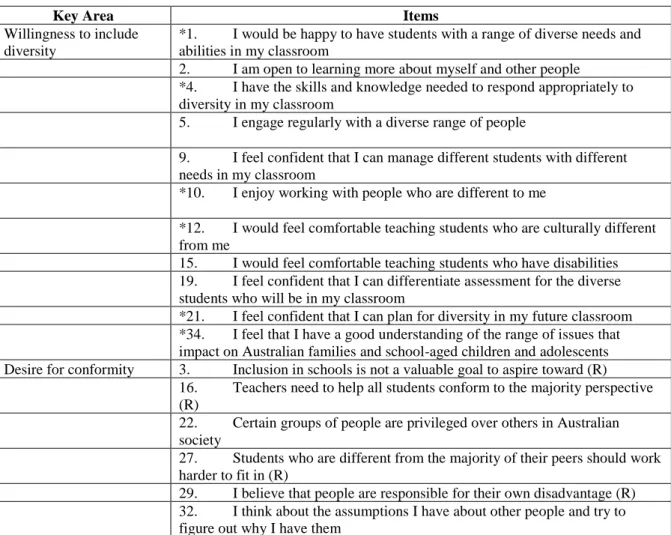
Willingness to Include Diversity Scale(WIDS). This survey was created for the current study. Three of the five researchers involved in this study, each with over 10 years’ experience in researching inclusion and service learning, identified the fundamentally important areas related to pre-service teachers’ dispositions toward inclusion and diversity. Qualitative data from our previous studies on pre-service teachers, service-learning and inclusion (Carrington, Mercer, & Kimber, 2010; Carrington & Saggers, 2008; Carrington & Selva, 2010; Kimber, Carrington, Mercer, & Bland, 2011) were influential in our
considerations of what dispositions we felt most hindered and supported pre-service teachers in their openness to embrace inclusive teaching practices and principles. Two key areas emerged as important in this process — willingness to include diversity and desire for conformity. Previous research in the field of attitudes towards inclusion also focus on
“willingness to teach/accommodate”, (see for example Burke & Sutherland, 2004; Hwang & Evans, 2011). Seventeen items were generated with the aim of capturing these areas (see Table 1 for these items). The survey used a Likert format with responses ranging from ‘1 –
strongly disagree’ to ‘4 – strongly agree’. Participants circled the response they felt most
accurately reflected them at the present time. Example items included, ‘I would be happy to have students with a range of diverse needs and abilities in my classroom’ and ‘Students who are different from the majority of their peers should work harder to fit in’.
To test and validate this measure, 507 Bachelor of Education pre-service teachers (352 first years; 155 fourth years) from a university in Brisbane, Australia, completed the survey. Both an exploratory factor analysis (EFA), using 250 cases randomly selected, and confirmatory factor analysis (CFA), using the remaining cases were performed.
The 17 items of the WIDS were subjected to Principal Axis Factoring (PAF) with an oblimin rotation in SPSS version 21 as the variables were shown to be non-normally
distributed (Costello & Osborne, 2005; Pallant, 2013), and oblimin (oblique) rotation is most appropriate when constructs are likely to be related (Hammond, 2006). PAF revealed the presence of four components with eigenvalues exceeding 1, which accounted for 36% of the variance. Horn’s (1965) parallel analysis indicated that four factors could be retained; however, examination of the rotated factor matrix showed that only one item loaded onto factor 3 and only two items loaded onto factor 4. Thus two factors were retained, which accounted for 29% of the variance, with component 1 contributing 20.77% and component 2 contributing 7.89%. A contextual analysis of the item sets showed that the 9 items in factor 1 grouped around a common theme of ‘willingness to include diversity’, and the 4 items in factor 2 grouped around a common theme of ‘desire for conformity’.
To further test the validity of this measure, a Maximum Likelihood CFA using AMOS version 22 was conducted on the remaining cases in the data set (those not included in the EFA). Testing for multivariate normality by calculating Mardia’s coefficient showed the assumption to be violated and a Bollen-Stine bootstrap was applied to estimate bias free parameters (Bollen & Stine, 1992). A process of testing each factor was undertaken (Anderson & Gerbing, 1988) and items that did not fit well were removed until the model converged. This meant that three items were removed from factor 1, leaving six items. The testing of the model with the remaining six items found that the model converged and fit the data well, Bollen-stine bootstrap p = .505, χ2 (9) = 9.286, p = .411, RMSEA = .011. (.000, .072), CFI = .998. Construct reliability was .57, above the recommended cut off of 0.5, and
the factor accounted for 41% of the variation in the indicator variables. Coefficient H was calculated to be .76 indicating high reliability, and the critical ratio of the parameter estimates were all significant, indicating convergent validity. Based on the context underpinning the six items that comprise this factor, this factor was named “willingness to include diversity”.
The model for factor 2 converged but did not fit the data well, Bollen-Stine p = .002, χ2 (2) = 11.385, p = .003, RMSEA = .136 (.067, .217), CFI = .898. As factor 2 contained only four items, it was not possible to make further modifications to this factor. A decision was made to drop factor 2 as part of the measure.
For this study, therefore, the 6-item Willingness to Include Diversity Scale (WIDS) was used (see Table 1). The WIDS measures the willingness of pre-service teachers to include a range of students with diverse needs in their classrooms. Cronbach alpha’s for the measure in the current study was moderate at .67. This is not unexpected as scales with less than 10 items can produce Cronbach alpha scores in the lower to moderate range (Pallant, 2013).
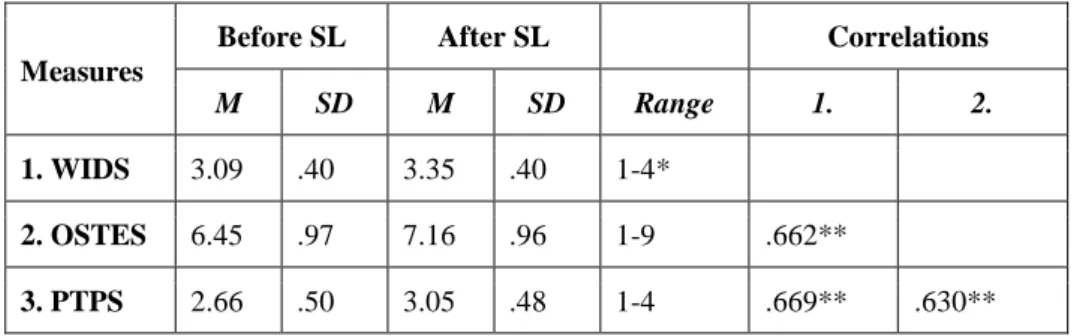
As the WIDS is a new measure created for use in the current study, we further examined the construct validity (Cronbach, 1971; Pallant, 2013) of the measure by assessing the correlation of this new measure and other existing measures of pre-service teacher efficacy and preparedness to work with diversity (see Table 2). As expected, the overall total score on the WIDS was positively related to both the Ohio State Teacher Efficacy Scale (OSTES) (r = .66; r² = .44) and the Pre-service Teaching Preparedness Survey (PTPS) (r = .67; r² =.45). In addition, the OSTES and PTPS were positively correlated (r = .63; r² = .40).
Key Area Items
Willingness to include diversity
*1. I would be happy to have students with a range of diverse needs and abilities in my classroom
2. I am open to learning more about myself and other people
*4. I have the skills and knowledge needed to respond appropriately to diversity in my classroom
5. I engage regularly with a diverse range of people
9. I feel confident that I can manage different students with different needs in my classroom
*10. I enjoy working with people who are different to me
*12. I would feel comfortable teaching students who are culturally different from me
15. I would feel comfortable teaching students who have disabilities 19. I feel confident that I can differentiate assessment for the diverse students who will be in my classroom
*21. I feel confident that I can plan for diversity in my future classroom *34. I feel that I have a good understanding of the range of issues that impact on Australian families and school-aged children and adolescents Desire for conformity 3. Inclusion in schools is not a valuable goal to aspire toward (R)
16. Teachers need to help all students conform to the majority perspective (R)
22. Certain groups of people are privileged over others in Australian society
27. Students who are different from the majority of their peers should work harder to fit in (R)
29. I believe that people are responsible for their own disadvantage (R) 32. I think about the assumptions I have about other people and try to figure out why I have them
Note: (R) = reverse coded; * indicates item retained in final measure.
Procedure: Ethical approval to undertake the current research was obtained from the university research ethics committee. At Time 1 (service-learning experience), pre-service teachers were given the survey during a tutorial in either week 1, 2, or 3 of Semester 1, 2014 (early March). In Semester 1, the study participants were enrolled in the university unit on inclusive education and completed 20 hours of service in a community organisation. In addition, the pre-service teachers attended university lectures and tutorials that support the transformational learning associated with the service-learning experience (Carrington & Selva, 2010). At Time 2 (post-service-learning experience), pre-service teachers were given the survey during a tutorial in July 2014. They were given an information sheet outlining the nature of the survey and advised that their participation was voluntary, anonymous and confidential. They were asked to write a code on their survey so that their responses could be tracked over time.
Results
As a caveat, the findings of this study did not demonstrate that service-learning, or any other aspects of the pre-service teacher’s university degree, were the only factors influencing willingness to include diversity, nor about the efficacy levels or preparedness of pre-service teachers to teach children of diverse backgrounds. The pre- and post-tests were used to quantify growth within the period (one semester) that the per-service teachers undertook the service-learning experience and inclusive education unit.
Total scores for each factor were calculated on the Time 1 (pre-service-learning experience) and Time 2 (post-service-learning experience) data. For the OSTES and PTPS, an average total score was calculated by adding all items and dividing by the number of items in each measure. For the WIDS, the proportional factor weights were used to generate total scores. The mean scores for each measure are presented in Table 2. Data were checked for normality and found to be non-normally distributed, so the non-parametric Wilcoxon signed-rank test was used (Field, 2013).
Measures
Before SL After SL Correlations
M SD M SD Range 1. 2.
1. WIDS 3.09 .40 3.35 .40 1-4*
2. OSTES 6.45 .97 7.16 .96 1-9 .662**
3. PTPS 2.66 .50 3.05 .48 1-4 .669** .630**
*Proportional factor weights used to generate total scores for WIDS, all items added and divided by number of items to generate total scores for OSTES and PTPS.
**Correlation is significant at the 0.01 level (2 tailed)
Table 2: Mean scores on all measures before and after service-learning and correlations between the measures
A series of one-way repeated measures analysis of variance (ANOVA) were conducted to compare scores on the OSTES, PTPS and WIDS at Times 1 and 2. For the OSTES, it was found that a pre-service teachers efficacy beliefs, that is, their judgement of their capabilities to bring about desired change in student engagement and learning, was significantly higher after the service-learning experience (Mdn = 7.08) than before service-learning (Mdn = 6.21), z = 3.34, p = .001. The effect size was medium, r = .42 (Cohen, 1988).
Finally, for the PTPS, it was found that a pre-service teacher’s sense of preparedness in relation to working with diverse populations (PTPS) was significantly higher after the service-learning experience (Mdn = 3.00) than before service-learning (Mdn = 2.73), z = 3.92,
p = .000. The effect size was medium to large, r = .49 (Cohen, 1988).
For the WIDS, a pre-service teacher’s willingness to include diversity (WIDS) was found to be significantly higher after the service-learning experience (Mdn = 3.28) than before service-learning (Mdn = 3.11), z = 3.04, p = .002. The effect size was medium, r = .38 (Cohen, 1988).
Discussion
Results from this study have offered quantitative evidence that positive change occurred in levels of pre-service teachers’ willingness to include diversity, confidence to teach diverse students, and sense of preparedness to teach such students after undertaking a service-learning program and inclusive education unit. We acknowledge that we are using these scales to measure change over a short time period (one semester, 13 weeks). However, in the time between the surveys (approximately 18 weeks), the pre-service teachers engaged in both 20 hours of service in a community organisation that supports diversity in the
community and nine weeks of university study about inclusive education. Both activities were designed to challenge their attitudes toward diversity and inclusion and support reflection about their service-learning experience (Bursaw et al., 2015).
These results further support the potential benefit of service-learning pedagogy to assist students to develop positive attitudes and values to promote diversity and inclusion. Fourth year pre-service teachers in this study seemed to be significantly more confident and aware of difference after undertaking service-learning and the inclusive education unit than before, and were more willing to include students with diverse needs into their classrooms. The pre-service teachers felt they had the skills and knowledge to respond appropriately to diversity and could manage different students with different needs in their classroom, and indicated that they felt confident in differentiating assessment and planning for diversity. Self-reporting that you feel able and confident to support diversity is one thing; performing in such a way in a classroom, when faced with diversity, is another.
This quantitative study builds on a series of qualitative studies that suggest that transformational learning experiences in a service-learning program can facilitate the development of the attitudes and values that support inclusive educational approaches in schools. In previous studies we have acknowledged that, while some pre-service teachers may have already possessed inclusive values and attitudes, the service-learning program provided all pre-service teachers with a foundation on which to develop and build their understanding of inclusive practices. We acknowledge that the pre-service teachers in our study had high means as their starting points on the WIDS: they start fourth year with a high level of willingness to include diversity (or at least, they report they do). This finding is in line with previous research which has shown that pre-service teachers choose teaching as their profession due to their desire to make a positive difference to the lives of students and to help them to become more aware of their needs, abilities and goals (Brookhart & Freeman, 1992; O’Sullivan, 2005; Stiegelbauer, 1992; Richardson & Watt, 2006; Watt & Richardson, 2007). Thus it is to be expected that pre-service teachers would rate themselves high on their willingness to include diverse students. It is also worth remembering that while pre-service teachers did demonstrate high mean scores on all variables prior to service-learning, they did significantly improve in all areas after learning, indicating the value of the service-learning component.
Additionally, it is important to acknowledge some key limitations in the current study. The most pressing speaks to the limitations of self-report data and an acknowledgement that what pre-service teachers self-report is subject to social desirability bias. In addition, while it is true that pre-service teachers may self-report what they think the researchers want to hear, it is also possible that pre-service teachers report the best possible version of themselves as they do believe they would act in such ways in the classroom. It is possible, however, that, once in the classroom, what beginning teachers ultimately do may be quite different from their expectations. Additionally, while this study presents a repeated measures research design, the participant group was small due to missing participants at one of the two data collection points. We are unable to determine the possible impact that those missing from the analysis may have had on the findings, but it is important to consider that the findings are based on a small sample (20 to 27%) of the overall fourth year cohort.
Finally, while students undertook a service-learning experience, they did so alongside an inclusive education unit that asked them to consider their values, beliefs, and prejudices. It is to be expected that the university learnings experienced by the students would have also impacted on their willingness, confidence and sense of preparedness to include diverse students. In order to determine the amount of change that was due to service-learning separate to that which could have occurred through this learning, future research could compare students who undertook an inclusive education unit with a service-learning component with those who undertook an inclusive education unit only. As all fourth year students in the current study undertook a service-learning experience, this was beyond the scope of this study.
Conclusion
This article reported on a repeated measures study that examined whether undertaking a service-learning experience and inclusive education unit enhanced the willingness of pre-service teachers to teach in diverse classroom, and the confidence and preparedness to teach diverse students. Two well-established and one newly created quantitative measure were used to determine change in willingness, confidence and preparedness before and after the service-learning and inclusive education unit. In particular, pre-service teachers in this study were significantly more willing to include diversity, and were more confident and aware of
difference after undertaking the service-learning program. We suggest that an increase in pre-service teachers’ willingness, confidence and preparedness to teach diverse students after undertaking service-learning and an inclusive education unit will support an inclusive approach to education.
Research about how service-learning can prepare teachers for inclusion in schools is a growing body of work in international journals. This research could be expanded to include theorised frameworks and to engage a range of methodologies to report on how service-learning is working as a pedagogical approach in higher education. Much of the previous research, including some of our work, has drawn on qualitative methodologies and we would encourage other researchers to engage with repeated measures designs using quantitative surveys to extend our understanding of the impact of service-learning programs.
References
Ambrosio, A. L. (2001). ESU Multicultural/Diversity Assessment Project. Emporia, KS: Emporia State University.
Anderson, J. C., & Gerbing, D.W. (1988). Structural equation modeling in practice: A review and recommended two-step approach. Psychological Bulletin, 103(3), 411-423.
https://doi.org/10.1037/0033-2909.103.3.411
Bamber, P. (2011). The transformative potential of international service learning at a
university with a Christian foundation in the UK. Journal of Beliefs & Values: Studies in Religion & Education, 32(3), 343-357.
https://doi.org/10.1080/13617672.2011.627700
Bartlett, M. S. (1954). A note on the multiplying factors for various chi square approximations. Journal of Royal Statistical Society, 16(Series B), 296-298. Brookhart, S. M., & Freeman, D. J. (1992). Characteristics of entering teacher candidates.
Review of Educational Research, 62(1), 37-60.
https://doi.org/10.3102/00346543062001037
Burke, K. & Sutherland, C. (2004). Attitudes toward inclusion: Knowledge VS experience.
Education, 125 (2), p. 163-172.
Bursaw, J., Kimber, M., Mercer, K. L., & Carrington, S. (2015). Teaching reflection for service-learning. In M. E. Ryan (Ed.), Teaching reflective learning in higher education: A systematic approach using pedagogic patterns (pp. 153-169). Cham, Switzerland: Springer. https://doi.org/10.1007/978-3-319-09271-3_11
Butcher, J., Howard, P., Labone, E., Bailey, M., Groundwater Smith, S., McFadden, M., McMeniman, M., Malone, K., & Martinez, K. (2003). Teacher education, community service-learning and student efficacy for community engagement. Asia-Pacific Journal of Teacher Education, 31(2), 109-124.
https://doi.org/10.1080/13598660301612
Butin, D. W. (2010). Service-learning in theory and practice: The future of community engagement in higher education. New York, NY: Palgrave MacMillan.
https://doi.org/10.1057/9780230106154
Campus Compact (2009). Campus Compact: Educating citizens, building communities. Boston, MA: Author. Retrieved October 31, 2009, from http://www.compact.org/
Carrington, S., Mercer, K. L., & Kimber, M. (2010). Service-learning in teacher education. In T. Lovat & R. Toomey (Eds.), Taking values education to teacher education. Terrigal, NSW: David Barlow Publishing.
Carrington, S., & Saggers, B. (2008). Service-learning informing the development of an inclusive ethical framework for beginning teachers. Teaching and Teacher Education,
24(3), 795-806. https://doi.org/10.1016/j.tate.2007.09.006
Carrington, S., & Selva, G. (2010). Critical social theory and transformative learning: Evidence from pre-service teachers’ service-learning reflection logs. Higher Education Research & Development, 29(1), 45-57.
https://doi.org/10.1080/07294360903421384
Cohen, J. (1988). Statistical power analysis for the behavioral sciences (2nd ed.). Hillsdale, NJ: Lawrence Earlbaum Associates.
Cole, J. C. (2008). How to deal with missing data. In J. W. Osborne (Ed.), Best practices in quantitative methods (pp. 214–238). Thousand Oaks, CA: Sage.
https://doi.org/10.4135/9781412995627.d19
Costello, A. B., & Osborne, J. W. (2005). Best practices in exploratory factor analysis: Four recommendations for getting the most from your analysis. Practical Assessment, Research and Evaluation, 10(7), 1-9.
Crabtree, R. (2008, Fall). Theoretical foundations for international service-learning. Michigan Journal of Community Service Learning, 18-36.
Crabtree, R. (2013). The intended and unintended consequences of international service-learning. Journal of Higher Education Outreach and Engagement, 17(2), 43-65. Cronbach, L. J. (1971). Test validation. In R. L. Thorndike (Ed.), Educational Measurement
(2nd ed., pp. 443-507). Washington D.C.: American Council on Education.
Field, A. (2013). Discovering statistics using IBM SPSS statistics (4th Ed.). Los Angeles: Sage Publications.
Gao, W., & Mager, G. (2011). Enhancing pre-service teachers’ sense of efficacy and attitudes toward school diversity through preparation: A case of one U.S. inclusive teacher education program. International Journal of Special Education, 26(2), 1-16. Griffith, R. R., & Zhang, G. (2013) Service learning in teacher preparation: Returns on the
investment. The Educational Forum, 77(3), 256-276,
https://doi.org/10.1080/00131725.2013.792908
Hammond, S. (2006). Introduction to multivariate data analysis. In G. M. Breakwell, S. Hammond, C. Fife-Schaw, & J. A. Smith (Eds.), Research methods in psychology (3rd ed., pp. 414-443). London: Sage Publications.
Hwang, Y. & Evans, D. (2011). Attitudes towards inclusion: Gaps between beliefs and practice. International Journal of Special Education, 26, (1), P. 136-146. Iyer, R., Carrington, S., Mercer, K. L., & Selva, G. (2016). Critical Service-learning:
promoting values orientation and enterprise skills in pre-service teacher programmes.
Asia-Pacific Journal of Teacher Education, Published online 29 July.
https://doi.org/10.1080/1359866X.2016.1210083
Kaiser, H. F. (1970). A second generation little jiffy. Psychometrika, 35, 401-415.
https://doi.org/10.1007/BF02291817
Kaiser, H. F. (1974). An index of factorial simplicity. Psychometrika, 39, 31-36.
https://doi.org/10.1007/BF02291575
Kiely, R. (2004). A chameleon with a complex: Searching for transformation in international service learning. Michigan Journal of Community Service Learning, 10(2), 5-20. Kimber, M., Carrington, S., Mercer, K. L., & Bland, D. (2011). Enhancing professional
ethics: Service-learning in teacher education. In J. Millwater, L. C. Ehrich, & D. Beutel (Eds.), Practical experiences in professional education: A transdisciplinary approach. Brisbane, QLD: Post Pressed.
Lavery, S. (2009). Service-learning: Promoting leadership in young people. Principal Matters, Spring, 28-30.
Le Grange, L. (2007). The ‘theoretical foundations’ of community service-learning: From taproots to rhizomes. Education as change, 11(3), 3-13.
https://doi.org/10.1080/16823200709487174
Loreman, T., Sharma, U., & Forlin, C. (2013). Do Pre-service Teachers Feel Ready to Teach in Inclusive Classrooms? A Four Country Study of Teaching Self-efficacy. Australian Journal of Teacher Education, 38(1). https://doi.org/10.14221/ajte.2013v38n1.10
Mergler, A., Carrington, S., Kimber, M., & Bland, D. (2016). Inclusive Values: Exploring the Perspectives of Pre-Service Teachers. Australian Journal of Teacher Education, 41(4). https://doi.org/10.14221/ajte.2016v41n4.2
Miller, K. K., & Gonzales, A. M. (2010). Domestic and international service learning experiences: A comparative study of pre-service teacher outcomes. Issues in Educational Research, 20(1), 29-38.
Mitchell, T. D. (2008). Traditional vs. critical service-learning: Engaging the literature to differentiate two models. Michigan Journal of Community Service Learning, Spring, 50-65.
O’Sullivan, S. (2005). The soul of teaching: Education teachers of character. Action in Teacher Education, 26(4), 3-9. https://doi.org/10.1080/01626620.2005.10463338
Pallant, J. (2013). SPSS survival manual: A step by step guide to data analysis using IBM SPSS (5th ed). Crows Nest, NSW: Allen & Unwin.
Richardson, P., & Watt, H. (2006). Who chooses teaching and why? Profiling characteristics of teacher education students at three Australian universities. Asia-Pacific Journal of Teacher Education, 34(1), 27-56. https://doi.org/10.1080/13598660500480290
Sharma, U., Loreman, T., & Forlin, C. (2012). Measuring teacher efficacy to implement inclusive practices: An international validation. Journal of Research in Special Educational Needs, 12(1), 12–21. https://doi.org/10.1111/j.1471-3802.2011.01200.x
Skinner, R., & Chapman, C. (1999). National Center for Education Statistics: Service-learning and community service in K-12 Public Schools. Rockville, MD: Office of Research and Improvement.
Smith, E. (2006). Learning about power through service: Qualitative and quantitative assessments of a service-learning approach to American Government. Journal of Political Science, 2(2), 147-170. https://doi.org/10.1080/15512160600668983
Stamopoulus, E. (2006). Empowering preservice teachers to embrace diversity. Australian Journal of Early Childhood, 31(4),30-39.
Stanton, T., Giles, D., & Cruz, N. I. (1999). Service-learning: A movement’s pioneers reflect on its origins, practice, and future. San Francisco, CA: Jossey-Bass Publishers. Stewart, T., Allen, K.W., & Bai, H. (2011). The effects of service-learning participation on
pre-internship educators’ teachers’ sense of efficacy. Alberta Journal of Educational Research, 57(3), 298-316.
Stiegelbauer, S. (1992). Why we want to be teachers. Paper presented at the Annual Meeting of the American Educational Research Association, San Francisco.
Toncar, M. F., Reid, J. S., Burns, D. J., Anderson, C. E., & Nguyen, H. P. (2006). Uniform assessment of the benefits of service learning: The development, evaluation, and implementation of the SELEB scale. Journal of Marketing Theory and Practice,
14(3), 223-238. https://doi.org/10.2753/MTP1069-6679140304
Tschannen-Moran, M., & Hoy, A. W. (2001). Teacher-efficacy: Capturing an elusive construct. Teaching and Teacher Education, 17, 783-805.
https://doi.org/10.1016/S0742-051X(01)00036-1
Watt, H.M.G., & Richardson, P.W. (2007). Motivational factors influencing teaching as a career choice. Development and validation of the FIT-choice scale. The Journal of Experimental Education, 75(3), 167-202. doi: 10.3200/JXE.75.3.167-202.
Woodcock, S., Hemmings, B., & Kay, R. (2012). Does study of an inclusive education subject influence pre-service teachers' concerns and self-efficacy about inclusion?
Australian Journal of Teacher Education, 37(6),