Chapter 1
General Introduction
http://hdl.handle.net/1765/112942
1.
Diffuse gliomas
Diffuse gliomas are the most common type of malignant brain tumors in adults, with
an incidence of ~5 per 100 000 adults in the United States each year (1, 2). In the past
decade, diffuse gliomas were classified into astrocytoma, oligodendroglioma and
oli-goastrocytoma based on histological features described by the World Health
Organiza-tion (WHO) in 2007 (3). Diffuse gliomas are graded from II to IV. Grade II/III gliomas
are classified as low grade gliomas (LGG) (3). Grade IV diffuse gliomas are the most
aggressive form of gliomas, also known as glioblastoma multiforme (GBM). GBMs are
further stratified into primary (those that arise de novo, and comprise ~90% of all
GBMs) and secondary GBMs (those that progress from gliomas of lower grades).
Treatment decisions are dependent on the subtype of gliomas. Standard treatments
for diffuse glioma patients include surgical resection followed by either radiotherapy
(RT), chemotherapy (usually temozolomide or TMZ) or a combination thereof (4-6).
However, current treatment strategy has limited improvement on the overall survival
of patients (~6 month for RT and 3 months for TMZ in GBM) and almost all patients
eventually die from disease progression (7-9).
A major problem of the WHO 2007 classification system based on histological
appear-ance has been the significant intra- and inter-observer variation (10, 11). The
techno-logical advances in sequencing technology have led to the identification of almost all
cancer genes in gliomas. Interestingly some of the genetic changes segregate in defined
histological subtypes but correlate better with patient survival than the histological
classification of gliomas (12-15). For example,
isocitrate dehydrogenase 1/2
(
IDH1/2
)
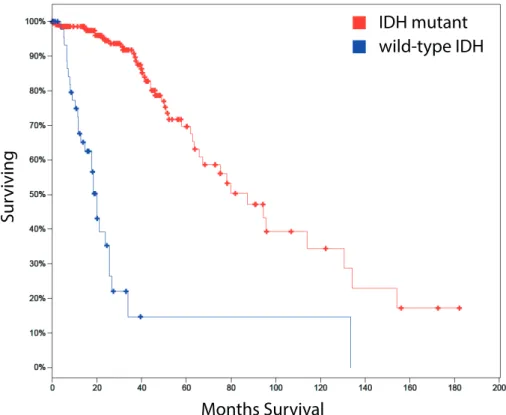
mutations occur in 60-80% of Grade II/III gliomas. However, tumors with wildtype
IDH
have a significantly worse prognosis compared with
IDH
-mutated, even within
tumors of identical grade (Fig. 1). Primary GBMs (pGBM), are mainly
IDH
-wildtype
and they have a median overall survival of 9.9 months (16). Secondary GBMs (sGBM)
account for 10% of GBMs and they often harbor mutations in
IDH
and have a better
prognosis compared with the
IDH
wild-type GBMs, with a median overall survival of
24 months (16).
1p/19q co-deletion has been associated with oligodendroglial histological features and
this patient group was more responsive to chemotherapy than those with intact 1p/19q
(6, 17, 18). Molecular alterations in the
alpha thalassemia/mental retardation syndrome
X-linked
(
ATRX
) or
tp53
gene have been identified in a more astrocytic-like subset of
Grade II/III gliomas and are almost always mutually exclusive with 1p/19q co-deleted
gliomas.
The improvement in prognostic classification of gliomas by the molecular markers
has led to an update of the WHO classification in 2016. In this update, gliomas are
firstly divided into astrocytoma, oligoastrocytoma, oligodendroglioma and GBM based
on histology. They are further classified using molecular markers including 1p/19q
co-deletion, mutations in
IDH1/2
and
alpha thalassemia/mental retardation syndrome
X-linked
(
ATRX)/TP53
(Fig. 2) (16). For example, the combination of mutations in
both
IDH
and
TP53
defines a molecular astrocytic group of gliomas and the
combina-tion of
IDH
mutations and 1p/19q co-deletion defines a molecular oligodendritic group
of gliomas. Within histologically identified GBMs,
IDH
mutational status separates
pGBM from sGBM.
Besides the molecular markers incorporated in the WHO 2016 classification for central
nervous system (CNS) tumors, other molecular markers have been identified that are
significantly associated with classification and clinical outcome (15). For example,
increased telomerase activity has been discovered in several malignancies including
melanomas, liposarcomas and hepatocellular carcinomas (19-21). In diffuse gliomas,
IDH mutant
wild-type IDH
Sur
viving
Months Survival
Figure 1. Diffuse glioma patients with mutations in IDH have a better prognosis than the ones with wild-type IDH (TCGA database_283 LGG samples).
mutations in two different genes result in an increased telomere length: mutations in
the
ATRX
gene and in the
telomerase reverse transcriptase
(
TERT
) promoter. Mutations
in the
TERT
promoter region are present in almost all GBMs and oligodendroglial
tumors (28, 29).
Apart from the prognostic biomarkers listed above, there are only few biomarkers that
predict response to treatment. Of those, MGMT-promoter methylation is the most
robust and is predictive of response to TMZ. TMZ is a commonly used chemotherapy
agent which catalyzes alkylation of thymine and guanine, leading to DNA damages
and initiation of apoptosis (22). O6-methylguanine-DNA methyltransferase (MGMT)
mediates DNA damage repair system by removing alkyl groups and thus prevents
apoptosis (23). Therefore patients with MGMT loss showed relatively better responses
to TMZ treatment (24). In diffuse gliomas, MGMT promoter methylation has been
identifi ed in about 80% LGGs and 40% GBMs (25).
2.
isocitrate DehYDrogenase
Isocitrate dehydrogenase (IDH) catalyzes conversion of isocitrate to
α
-ketoglutarate
(
α
KG) using NAD(P)
+as a co-factor (Fig. 3, left panel) (26). IDH has three isozymes,
IDH1, IDH2 and IDH3. Both IDH1 and IDH2 function as homodimers using NADP+
as co-factors. They differ with respect to their subcellular localization with IDH1 being
localized in the cytoplasm and peroxisomes and IDH2 in mitochondria. IDH3
func-Histology Astrocytoma Oligoastrocytoma Oligodendroglioma Glioblastoma Multiforme
IDH status 1p/19q and other genetic parameters
IDH mutant IDH wild-type IDH mutant IDH wild-type
ATRX loss*
TP53 mutation* 1p/19q co-deletion
Diffuse astrocytoma, IDH mutant
After exclusion of other entities: Diffuse astrocytoma, IDH wild-type oligodendroglioma, NOS
Glioblastoma, IDH mutant
Glioblastoma, IDH wild-type Oligodendroglioma, IDH
mutant and 1p/19q codeleted
Molecular subgroups of
glioma Diffuse astrocytoma, NOS
Oligodendroglioma, NOS Oligoastrocytoma, NOS Glioblastoma, NOS * : Characteristic but not required for diagnosis
NOS: not otherwise specified
Genetic testing not done or inconclusive
tions as a heterotetramer in the mitochondria using NAD
+as its oxidizing agent and
is involved in the citric acid cycle for ATP production (27).
In 2008, one of the first genomic sequencing projects in GBM identified mutations in
IDH1
in 12% of these tumors (28). As mentioned,
IDH1
mutations correlated with
better survival in GBM patients. Subsequent whole genome sequencing efforts have
identified
IDH1/2
mutations in multiple malignancies including LGGs, acute myeloid
leukemia (AML), chondrosarcomas and cholangiocarcinomas (29-32).
IDH
mutations
are a hallmark of LGGs. In gliomas, most of the identified mutations in
IDH
are in
IDH1
and over 90% of reported
IDH1
mutations are a missense mutation, where
argi-nine at position 132 is replaced by a histidine (
IDH1
R132H). Some patients in whom no
mutations in
IDH1
were identified harbored mutations in the
IDH2
gene. Mutations
in
IDH2
affect the amino acid R172, an amino acid that is analogous to R132 in IDH1
(29).
The
IDH1
R132Hmutations are mostly heterozygous and the generated mutant enzyme
is likely to dimerize with the wildtype counterpart (Fig. 3, right panel). Mutant IDH1
uses
α
KG as a substrate to produce D-2hydroxyglutarate or D2HG (33). D2HG shares
structural similarity with
α
KG and the accumulation of D2HG inhibits, via competitive
inhibition, a number of
α
KG-dependent enzymes. As a cellular key component,
α
KG
is involved in a wide range of pathways including regulating epigenetic modifications.
Mitochondrion IDH2 IDH2 αKG IDH1 IDH1 αKG NADPH NADP+ Cytoplasm IDH3 αKG NADH Isocitrate NAD+ IDH3 IDH3 IDH3 IDH1 IDH1m Nucleus
IDH1 mutant in tumor cells IDH in normal cells
2HG NADPH NADPH Isocitrate Isocitrate NADP+ NADPH Isocitrate αKG 2HG 2HG 2HG NADP+ NADP+ NADP+ NADP+ NADP+ NADPH
Examples include Tet methylcytosine dioxygenase 2 (TET2) and Lysine Demethylase
4A (KDM4A)/JMJD2A, enzymes involved in the demethylation of DNA and histones
(34-36). The increased level of D2HG also affects the hydroxylation of HIF-1
α
by
inhibiting the Egl nine homolog 1 (EGLN1) prolyl hydroxylase (37), which leads to
an upregulation of HIF1
α
-inducible genes including
vascular endothelial growth factor
(
VEGF
) (38, 39). It should be noted that, due to the different affinities for D2HG,
the
α
KG-dependent enzymes are affected at various levels (35, 36). As a result of the
competitive inhibition of
α
KG-dependent oxygenases by D2HG,
IDH1
-mutant cells
ultimately remain in an undifferentiated state (40).
Since IDH1 is thought to play a role in oncogenesis and D2HG production is the key
activity of mutant IDH1, several groups have tried to identify mutant IDH1
inhibi-tors. The first report came from
Popovici-Muller et al.
describing a series compounds
with almost 90% inhibition of D2HG production. The most promising compound also
proved active in a U87 glioblastoma xenograft mouse model (41, 42). IDH1 and IDH2
inhibitors are currently being tested in clinical trials (43). A recent clinical trial for
relapsed or refractory AML patients showed that treatment with IDH1 inhibitor,
ivo-sidenib was correlated with persistent remission (44). Results of the trials for gliomas
have not been reported yet.
However, targeting
IDH
mutations by decreasing D2HG production has been rising
concerns and
in vitro
and
in vivo
studies have shown quite conflicting results. For
example, some research groups showed decreased proliferation, less colony formation
and increased differentiation after the inhibitor treatment to glioma, AML and
chon-drosarcoma cell lines and their corresponding xenograft models (45-47). On the other
hand, in the sarcoma cell line H1060 that harbors an endogenous
IDH1
R132Cmutation,
inhibiting D2HG production did not affect the oncogenic properties such as
prolifera-tion or migraprolifera-tion (48). Addiprolifera-tionally,
Molenaar et al.
suggested that D2HG sensitizes
tumor cells to ionizing radiation (IR) and inhibiting D2HG production resulted in
decreased sensitivity to IR (49). Taken all studies together, other therapeutic targets or
treatment strategies for
IDH
-mutated tumors remain to be characterized.
Understanding the molecular mechanism of gliomagenesis driven by
IDH
mutations is
a key to seeking potential therapeutic targets. However, understanding the molecular
mechanisms of mutant IDH1 has been hampered by the lack of good
in vitro
and
in vivo
model systems. It has been suggested that glioma cells with
IDH1
mutations cannot be
propagated in a standard laboratory setting (50, 51), though few successful cultures
have been reported (52).
To date, only few animal models have been described for
IDH
mutations in gliomas.
One of the first attempts using a brain-specific
IDH1
-mutant knock-in mouse model
was embryonically lethal due to D2HG-induced defects in collagen maturation (53).
No glial tumors were formed in this model system.
In 2013,
Leenders et al.
reported on glioma xenografts using a patient derived
high-grade oligodendroglioma cell line with
IDH1
R132Hmutation (54). In a
Drosophila
model, UAS-Idh-R195H, an
IDH1
R132Hmutation homologue, was induced, which
resulted in activation of
tp53
expression and subsequently led to neuronal
degenera-tion and defects in wing expansion (55). Nevertheless, none of the published
in vivo
model systems have generated gliomas by introducing CNS-specific expression of
IDH
mutations alone (53, 55-57).
3.
epiDermal growth factor receptor
Epidermal growth factor receptor or EGFR, is a transmembrane receptor tyrosine kinase
protein. The protein is activated following binding of ligands which include epidermal
growth factor (EGF), transforming growth factor
α
(TGF
α
) and amphiregulin (58, 59).
Activated EGFR triggers several signaling cascades including MAPK, AKT and STAT
pathways. Activation of these pathways ultimately promote cell differentiation and
proliferation (60, 61). Abnormal EGFR activities have been identified in several cancer
types including gliomas and pulmonary adenocarcinoma (62, 63).
EGFR
amplifica-tion and mutaamplifica-tions have been reported in about 57% pGBM patients (64). High copy
DNA amplification in gliomas is often seen as double-minutes (extrachromosomal
copies of the gene). A subset of GBMs with EGFR amplification harbor additional
mutations such as
EGFR variant III
(
EGFRvIII
, an intragenic deletion of exons 2-7).
This mutation results in constitutive activation of the receptor (65). Targeted therapies
for EGFR including monoclonal antibodies or tyrosine kinase inhibitors have been
tested in multiple phase II clinical trials for pGBM patients but did not show significant
improvement on overall survival (66, 67).
4.
scope of this thesis
To improve the clinical outcome of glioma patients, there is considerable need to
dis-cover novel treatment options for patients. This firstly requires better understanding of
the molecular mechanism of the driver mutations in each subgroup of gliomas.
In
Chapter 2 and 3
, we report on the creation of
in vitro
and
in vivo
model systems
for understanding the function of driver mutation
IDH1
in LGG. This includes (a) a
transgenic zebrafish model with CNS-specific expression of mutations in
IDH1
and (b)
short-term primary glioma culture systems using gliomas with
IDH1
mutations. Both
model systems showed increased levels of D2HG due to mutations in
IDH1
and can
be used as drug screen model systems targeting mutations in
IDH1
. Our
in vivo
model
suggests that expression of
IDH1
mutation alone at the early embryonic stage during
zebrafish development is insufficient to promote gliomagenesis and even combining
IDH1
mutation with
Tp53
mutation did not increase the tumorigenesis incidences.
In
Chapters
4
and
5
, we further studied the molecular pathways affected by driver
mutations in LGG and GBM. For both
IDH1
and
EGFR
mutations, we identified novel
binding partners. We discovered that NF-kB, is a novel pathway affected by D2HG
produced by mutant IDH1 enzyme, which ultimately may explain why
IDH
-mutated
glioma cells keep on proliferating. To study tumor-specific effects of
EGFR
mutations
in GBM, we made different
EGFR
clones harboring mutations that are either common
to GBM or lung cancer. Our results suggest that each mutation has different binding
partners and subsequent activation of downstream pathways. These results argue for
the development of mutation specific inhibitors.
Surgical resection of recurrent GBMs is performed only in a minority of patients and
treatment strategies using targeted-therapy are heavily dependent on the molecular
data of primary tumors. In
Chapter 6
we showed that most of
EGFR
amplification in
the primary tumor was retained at tumor recurrence therefore indicates that molecular
data obtained in the primary tumor can be used to predict the
EGFR
status of the
recurrent tumor. However, half of the
EGFRvIII
expression in the initial tumor is not
retained in the recurrent tumor. A final chapter describes gene-expression analysis
of samples included in the EORTC22033-26033 clinical trial. We showed that
previ-ously defined intrinsic glioma subtypes, subtypes based on unsupervised expression
analysis of gene expression data, are prognostic for progression-free survival in
EORTC22033-26033 clinical trial samples.
references
1. Ostrom QT, Gittleman H, Liao P, Rouse C, Chen Y, Dowling J, et al. CBTRUS statistical report: primary brain and central nervous system tumors diagnosed in the United States in 2007-2011. Neuro Oncol. 2014;16 Suppl 4:iv1-63.
2. Schwartzbaum JA, Fisher JL, Aldape KD, Wrensch M. Epidemiology and molecular pathology of glioma. Nat Clin Pract Neurol. 2006;2:494-503; quiz 1 p following 16.
3. Louis DN, Ohgaki H, Wiestler OD, Cavenee WK, Burger PC, Jouvet A, et al. The 2007 WHO classification of tumours of the central nervous system. Acta Neuropathol. 2007;114:97-109. 4. Soffietti R, Baumert BG, Bello L, von Deimling A, Duffau H, Frenay M, et al. Guidelines
on management of low-grade gliomas: report of an EFNS-EANO Task Force. Eur J Neurol. 2010;17:1124-33.
5. Stupp R, Mason WP, van den Bent MJ, Weller M, Fisher B, Taphoorn MJ, et al. Radiotherapy plus concomitant and adjuvant temozolomide for glioblastoma. N Engl J Med. 2005;352:987-96. 6. van den Bent MJ, Brandes AA, Taphoorn MJ, Kros JM, Kouwenhoven MC, Delattre JY, et al.
Adjuvant procarbazine, lomustine, and vincristine chemotherapy in newly diagnosed anaplastic oligodendroglioma: long-term follow-up of EORTC brain tumor group study 26951. J Clin On-col. 2013;31:344-50.
7. Mirimanoff RO, Gorlia T, Mason W, Van den Bent MJ, Kortmann RD, Fisher B, et al. Radio-therapy and temozolomide for newly diagnosed glioblastoma: recursive partitioning analysis of the EORTC 26981/22981-NCIC CE3 phase III randomized trial. J Clin Oncol. 2006;24:2563-9. 8. Buckner JC, Shaw EG, Pugh SL, Chakravarti A, Gilbert MR, Barger GR, et al. Radiation plus
Procarbazine, CCNU, and Vincristine in Low-Grade Glioma. N Engl J Med. 2016;374:1344-55. 9. van den Bent MJ, Carpentier AF, Brandes AA, Sanson M, Taphoorn MJ, Bernsen HJ, et al.
Adjuvant procarbazine, lomustine, and vincristine improves progression-free survival but not overall survival in newly diagnosed anaplastic oligodendrogliomas and oligoastrocytomas: a randomized European Organisation for Research and Treatment of Cancer phase III trial. J Clin Oncol. 2006;24:2715-22.
10. Muragaki Y, Chernov M, Maruyama T, Ochiai T, Taira T, Kubo O, et al. Low-grade glioma on stereotactic biopsy: how often is the diagnosis accurate? Minim Invasive Neurosurg. 2008;51:275-9.
11. Jackson RJ, Fuller GN, Abi-Said D, Lang FF, Gokaslan ZL, Shi WM, et al. Limitations of stereo-tactic biopsy in the initial management of gliomas. Neuro Oncol. 2001;3:193-200.
12. Phillips HS, Kharbanda S, Chen R, Forrest WF, Soriano RH, Wu TD, et al. Molecular subclasses of high-grade glioma predict prognosis, delineate a pattern of disease progression, and resemble stages in neurogenesis. Cancer Cell. 2006;9:157-73.
13. Verhaak RG, Hoadley KA, Purdom E, Wang V, Qi Y, Wilkerson MD, et al. Integrated genomic analysis identifies clinically relevant subtypes of glioblastoma characterized by abnormalities in PDGFRA, IDH1, EGFR, and NF1. Cancer Cell. 2010;17:98-110.
14. Freije WA, Castro-Vargas FE, Fang Z, Horvath S, Cloughesy T, Liau LM, et al. Gene expression profiling of gliomas strongly predicts survival. Cancer Res. 2004;64:6503-10.
15. Erdem-Eraslan L, Gravendeel LA, de Rooi J, Eilers PH, Idbaih A, Spliet WG, et al. Intrinsic molecular subtypes of glioma are prognostic and predict benefit from adjuvant procarbazine, lomustine, and vincristine chemotherapy in combination with other prognostic factors in anaplastic oligodendroglial brain tumors: a report from EORTC study 26951. J Clin Oncol. 2013;31:328-36.
16. Louis DN, Perry A, Reifenberger G, von Deimling A, Figarella-Branger D, Cavenee WK, et al. The 2016 World Health Organization Classification of Tumors of the Central Nervous System: a summary. Acta Neuropathol. 2016;131:803-20.
17. Jenkins RB, Blair H, Ballman KV, Giannini C, Arusell RM, Law M, et al. A t(1;19)(q10;p10) mediates the combined deletions of 1p and 19q and predicts a better prognosis of patients with oligodendroglioma. Cancer Res. 2006;66:9852-61.
18. Cairncross G, Wang M, Shaw E, Jenkins R, Brachman D, Buckner J, et al. Phase III trial of chemoradiotherapy for anaplastic oligodendroglioma: long-term results of RTOG 9402. J Clin Oncol. 2013;31:337-43.
19. Huang FW, Hodis E, Xu MJ, Kryukov GV, Chin L, Garraway LA. Highly recurrent TERT promoter mutations in human melanoma. Science. 2013;339:957-9.
20. Koelsche C, Renner M, Hartmann W, Brandt R, Lehner B, Waldburger N, et al. TERT promoter hotspot mutations are recurrent in myxoid liposarcomas but rare in other soft tissue sarcoma entities. J Exp Clin Cancer Res. 2014;33:33.
21. Chen YL, Jeng YM, Chang CN, Lee HJ, Hsu HC, Lai PL, et al. TERT promoter mutation in re-sectable hepatocellular carcinomas: a strong association with hepatitis C infection and absence of hepatitis B infection. Int J Surg. 2014;12:659-65.
22. Stevens MF, Hickman JA, Langdon SP, Chubb D, Vickers L, Stone R, et al. Antitumor activity and pharmacokinetics in mice of 8-carbamoyl-3-methyl-imidazo[5,1-d]-1,2,3,5-tetrazin-4(3H)-one (CCRG 81045; M & B 39831), a novel drug with potential as an alternative to dacarbazine. Cancer Res. 1987;47:5846-52.
23. Balmforth AJ, Ball SG, Freshney RI, Graham DI, McNamee HB, Vaughan PF. D-1 dopaminergic and beta-adrenergic stimulation of adenylate cyclase in a clone derived from the human astro-cytoma cell line G-CCM. J Neurochem. 1986;47:715-9.
24. van Nifterik KA, van den Berg J, van der Meide WF, Ameziane N, Wedekind LE, Steenbergen RDM, et al. Absence of the MGMT protein as well as methylation of the MGMT promoter predict the sensitivity for temozolomide. Brit J Cancer. 2010;103:29-35.
25. Cohen AL, Colman H. Glioma biology and molecular markers. Cancer Treat Res. 2015;163:15-30.
26. Muro-Pastor MI, Florencio FJ. NADP(+)-isocitrate dehydrogenase from the cyanobacterium Anabaena sp. strain PCC 7120: purification and characterization of the enzyme and cloning, sequencing, and disruption of the icd gene. J Bacteriol. 1994;176:2718-26.
27. Hartong DT, Dange M, Mcgee TL, Berson EL, Dryja TP, Colman RF. Insights from retinitis pigmentosa into the roles of isocitrate dehydrogenases in the Krebs cycle. Nature Genetics. 2008;40:1230-4.
28. Parsons DW, Jones S, Zhang X, Lin JC, Leary RJ, Angenendt P, et al. An integrated genomic analysis of human glioblastoma multiforme. Science. 2008;321:1807-12.
29. Yan H, Parsons DW, Jin G, McLendon R, Rasheed BA, Yuan W, et al. IDH1 and IDH2 muta-tions in gliomas. N Engl J Med. 2009;360:765-73.
30. Amary MF, Bacsi K, Maggiani F, Damato S, Halai D, Berisha F, et al. IDH1 and IDH2 mutations are frequent events in central chondrosarcoma and central and periosteal chondromas but not in other mesenchymal tumours. J Pathol. 2011;224:334-43.
31. Watanabe T, Nobusawa S, Kleihues P, Ohgaki H. IDH1 mutations are early events in the devel-opment of astrocytomas and oligodendrogliomas. Am J Pathol. 2009;174:1149-53.
32. Shang Z, Wang D, Xiao M, Geng Z, Wang HX, Wang J, et al. [Detection of isocitrate dehydroge-nase 1 gene mutation in 205 AML patients and its clinical significance]. Zhongguo Shi Yan Xue Ye Xue Za Zhi. 2012;20:1307-11.
33. Dang L, White DW, Gross S, Bennett BD, Bittinger MA, Driggers EM, et al. Cancer-associated IDH1 mutations produce 2-hydroxyglutarate. Nature. 2009;462:739-44.
34. Figueroa ME, Abdel-Wahab O, Lu C, Ward PS, Patel J, Shih A, et al. Leukemic IDH1 and IDH2 mutations result in a hypermethylation phenotype, disrupt TET2 function, and impair hemato-poietic differentiation. Cancer Cell. 2010;18:553-67.
35. Xu W, Yang H, Liu Y, Yang Y, Wang P, Kim SH, et al. Oncometabolite 2-hydroxyglutarate is a competitive inhibitor of alpha-ketoglutarate-dependent dioxygenases. Cancer Cell. 2011;19:17-30. 36. Chowdhury R, Yeoh KK, Tian YM, Hillringhaus L, Bagg EA, Rose NR, et al. The
oncometabo-lite 2-hydroxyglutarate inhibits histone lysine demethylases. Embo Rep. 2011;12:463-9. 37. Koivunen P, Lee S, Duncan CG, Lopez G, Lu G, Ramkissoon S, et al. Transformation by the
(R)-enantiomer of 2-hydroxyglutarate linked to EGLN activation. Nature. 2012;483:484-8. 38. Fu Y, Zheng S, Zheng Y, Huang R, An N, Liang A, et al. Glioma derived isocitrate
dehydro-genase-2 mutations induced up-regulation of HIF-1alpha and beta-catenin signaling: possible impact on glioma cell metastasis and chemo-resistance. Int J Biochem Cell Biol. 2012;44:770-5. 39. Zhao S, Lin Y, Xu W, Jiang W, Zha Z, Wang P, et al. Glioma-derived mutations in IDH1
domi-nantly inhibit IDH1 catalytic activity and induce HIF-1alpha. Science. 2009;324:261-5. 40. Lu C, Ward PS, Kapoor GS, Rohle D, Turcan S, Abdel-Wahab O, et al. IDH mutation impairs
histone demethylation and results in a block to cell differentiation. Nature. 2012;483:474-8. 41. Davis M, Pragani R, Popovici-Muller J, Gross S, Thorne N, Salituro F, et al. ML309: A potent
inhibitor of R132H mutant IDH1 capable of reducing 2-hydroxyglutarate production in U87 MG glioblastoma cells. 2010.
42. Popovici-Muller J, Saunders JO, Salituro FG, Travins JM, Yan S, Zhao F, et al. Discovery of the First Potent Inhibitors of Mutant IDH1 That Lower Tumor 2-HG in Vivo. ACS Med Chem Lett. 2012;3:850-5.
43. Fujii T, Khawaja MR, DiNardo CD, Atkins JT, Janku F. Targeting isocitrate dehydrogenase (IDH) in cancer. Discov Med. 2016;21:373-80.
44. DiNardo CD, Stein EM, de Botton S, Roboz GJ, Altman JK, Mims AS, et al. Durable Remissions with Ivosidenib in IDH1-Mutated Relapsed or Refractory AML. N Engl J Med. 2018;378:2386-98. 45. Li L, Paz AC, Wilky BA, Johnson B, Galoian K, Rosenberg A, et al. Treatment with a Small
Molecule Mutant IDH1 Inhibitor Suppresses Tumorigenic Activity and Decreases Produc-tion of the Oncometabolite 2-Hydroxyglutarate in Human Chondrosarcoma Cells. PLoS One. 2015;10:e0133813.
46. Rohle D, Popovici-Muller J, Palaskas N, Turcan S, Grommes C, Campos C, et al. An inhibitor of mutant IDH1 delays growth and promotes differentiation of glioma cells. Science. 2013;340:626-30.
47. Chaturvedi A, Cruz MMA, Jyotsana N, Sharma A, Yun HY, Gorlich K, et al. Mutant IDH1 promotes leukemogenesis in vivo and can be specifically targeted in human AML. Blood. 2013;122:2877-87.
48. Suijker J, Oosting J, Koornneef A, Struys EA, Salomons GS, Schaap FG, et al. Inhibition of mutant IDH1 decreases D-2-HG levels without affecting tumorigenic properties of chondrosar-coma cell lines. Oncotarget. 2015;6:12505-19.
49. Molenaar RJ, Botman D, Smits MA, Hira VV, van Lith SA, Stap J, et al. Radioprotection of IDH1-Mutated Cancer Cells by the IDH1-Mutant Inhibitor AGI-5198. Cancer Res. 2015;75:4790-802.
50. Piaskowski S, Bienkowski M, Stoczynska-Fidelus E, Stawski R, Sieruta M, Szybka M, et al. Glioma cells showing IDH1 mutation cannot be propagated in standard cell culture conditions. Brit J Cancer. 2011;104:968-70.
51. Balvers RK, Kleijn A, Kloezeman JJ, French PJ, Kremer A, van den Bent MJ, et al. Serum-free culture success of glial tumors is related to specific molecular profiles and expression of extracel-lular matrixassociated gene modules. Neuro-Oncology. 2013;15:1684-95.
52. Luchman HA, Stechishin OD, Dang NH, Blough MD, Chesnelong C, Kelly JJ, et al. An in vivo patient-derived model of endogenous IDH1-mutant glioma. Neuro Oncol. 2012;14:184-91. 53. Sasaki M, Knobbe CB, Itsumi M, Elia AJ, Harris IS, Chio, II, et al. D-2-hydroxyglutarate
pro-duced by mutant IDH1 perturbs collagen maturation and basement membrane function. Genes Dev. 2012;26:2038-49.
54. Navis AC, Niclou SP, Fack F, Stieber D, van Lith S, Verrijp K, et al. Increased mitochondrial activity in a novel IDH1-R132H mutant human oligodendroglioma xenograft model: in situ detection of 2-HG and alpha-KG. Acta Neuropathol Commun. 2013;1:18.
55. Reitman ZJ, Sinenko SA, Spana EP, Yan H. Genetic dissection of leukemia-associated IDH1 and IDH2 mutants and D-2-hydroxyglutarate in Drosophila. Blood. 2015;125:336-45.
56. Itsumi M, Inoue S, Elia AJ, Murakami K, Sasaki M, Lind EF, et al. Idh1 protects murine hepa-tocytes from endotoxin-induced oxidative stress by regulating the intracellular NADP/NADPH ratio. Cell Death Differ. 2015.
57. Bardella C, Al-Dalahmah O, Krell D, Brazauskas P, Al-Qahtani K, Tomkova M, et al. Expression of Idh1R132H in the Murine Subventricular Zone Stem Cell Niche Recapitulates Features of Early Gliomagenesis. Cancer Cell. 2016;30:578-94.
58. Moghal N, Sternberg PW. Multiple positive and negative regulators of signaling by the EGF-receptor. Curr Opin Cell Biol. 1999;11:190-6.
59. Barton CM, Hall PA, Hughes CM, Gullick WJ, Lemoine NR. Transforming growth factor alpha and epidermal growth factor in human pancreatic cancer. J Pathol. 1991;163:111-6.
60. Oda K, Matsuoka Y, Funahashi A, Kitano H. A comprehensive pathway map of epidermal growth factor receptor signaling. Mol Syst Biol. 2005;1:2005 0010.
61. Wells A. EGF receptor. Int J Biochem Cell Biol. 1999;31:637-43.
62. Lynch TJ, Bell DW, Sordella R, Gurubhagavatula S, Okimoto RA, Brannigan BW, et al. Activat-ing mutations in the epidermal growth factor receptor underlyActivat-ing responsiveness of non-small-cell lung cancer to gefitinib. N Engl J Med. 2004;350:2129-39.
63. Barber TD, Vogelstein B, Kinzler KW, Velculescu VE. Somatic mutations of EGFR in colorectal cancers and glioblastomas. N Engl J Med. 2004;351:2883.
64. Brennan CW, Verhaak RG, McKenna A, Campos B, Noushmehr H, Salama SR, et al. The somatic genomic landscape of glioblastoma. Cell. 2013;155:462-77.
65. Wong AJ, Ruppert JM, Bigner SH, Grzeschik CH, Humphrey PA, Bigner DS, et al. Structural alterations of the epidermal growth factor receptor gene in human gliomas. Proc Natl Acad Sci U S A. 1992;89:2965-9.
66. van den Bent MJ, Brandes AA, Rampling R, Kouwenhoven MC, Kros JM, Carpentier AF, et al. Randomized phase II trial of erlotinib versus temozolomide or carmustine in recurrent glioblastoma: EORTC brain tumor group study 26034. J Clin Oncol. 2009;27:1268-74. 67. Sarkaria JN, Galanis E, Wu W, Peller PJ, Giannini C, Brown PD, et al. North Central Cancer
Treatment Group Phase I trial N057K of everolimus (RAD001) and temozolomide in combina-tion with radiacombina-tion therapy in patients with newly diagnosed glioblastoma multiforme. Int J Radiat Oncol Biol Phys. 2011;81:468-75.