Gridlock and inefficient policy instruments
DavidAusten-SmithKellogg School of Management, Northwestern University
WiolettaDziuda
Harris School of Public Policy, University of Chicago
Bård Harstad
Department of Economics, University of Oslo
AntoineLoeper
Department of Economics, Universidad Carlos III de Madrid
Why do rational politicians choose inefficient policy instruments? Environmental regulation, for example, often takes the form of technology standards and quotas even when cost-effective Pigou taxes are available. To shed light on this puzzle, we present a stochastic game with multiple legislative veto players and show that inefficient policy instruments are politically easier to repeal than efficient instru-ments. Anticipating this, heterogeneous legislators agree more readily on an in-efficient policy instrument. We describe when inin-efficient instruments are likely to be chosen, and predict that they are used more frequently in (moderately) po-larized political environments and in volatile economic environments. We show conditions under which players strictly benefit from the availability of the ineffi-cient instrument.
Keywords. Dynamic games, bargaining, political economy, political instru-ments.
JELclassification. D78.
David Austen-Smith:[email protected]
Wioletta Dziuda:[email protected]
Bård Harstad:[email protected]
Antoine Loeper:[email protected]
This paper has benefited from the comments of seminar participants at Banco de Espana, Cerge–EI, Prague, Columbia University, Nottingham University, University of Oslo, Princeton University, University of Rochester, Stanford University, and Washington University. In particular, we are grateful to Vincent Anesi, Dan Bernhardt, Alessandra Casella, Ying Chen, John Duggan, Tassos Kalandrakis, Navin Kartik, Carlo Prato, Daniel Seidmann, Michael Ting, and Jan Zapal. David Austen-Smith is also grateful for support under the IDEX Chair, “Information, Deliberation and Collective Choice” at IAST, Toulouse. Harstad’s part of the re-search received funding from the European Rere-search Council (ERC) under the European Union’s Horizon 2020 Research and Innovation Program (Grant 683031). Antoine Loeper gratefully acknowledges the sup-port of the Fundacion Ramon Areces, of the Ministerio de Economía y Competitividad (Spain), grants RYC-2015-18326, ECO 2016-75992-P, and MDM 2014-0431, and of the Comunidad de Madrid, grant MadEco-CM (S2015/HUM-3444). Part of this research was conducted while Antoine Loeper was a research fellow at Banco de Espana. All responsibility for any errors or views herein, however, lies exclusively with the authors.
©2019 The Authors. Licensed under theCreative Commons Attribution-NonCommercial License 4.0. Available athttp://econtheory.org.https://doi.org/10.3982/TE3329
1. Introduction
Over the years, the economics profession has converged at a set of effective policy rec-ommendations for a wide variety of policy areas. For example, there is widespread agreement that externalities can be more efficiently internalized with Pigou taxes than with command-and-control interventions, and that it is less distortionary to increase public revenue by eliminating economically unjustified tax deductions and exemptions than by raising tax rates. Likewise, economists have argued that some fiscal consolida-tion policies are less harmful than others. In practice, however, these recommendaconsolida-tions are frequently ignored. Instead, policy makers often intervene with strictly less efficient policy instruments than others that are as readily available. This paper concerns why such apparently irrational (all else equal) political decisions might arise in a world of instrumentally rational agents.
To understand this puzzle, we present a dynamic political economy model in which the government reacts to external shocks by choosing a policy from a given menu of policies, one of which is unequivocally Pareto dominated by another available alterna-tive. Indeed, the inefficient policy is not only Pareto dominated by the alternative at the time of adoption, but in all possible states of the world. Nevertheless, we show that the inefficient policy intervention can arise naturally from a simple legislative bargain-ing model without any extraneous frictions or informational asymmetries: it is the very inefficiency of the policy that makes it appealing to legislators. We further show that the availability of an inefficient policy instrument, either in addition to or in place of an efficient policy, may, at least in equilibrium, improve the welfare of all policy makers.
Our legislative bargaining model rests on three characteristics. First, legislative pol-icy decisions involve two pivotal players. In particular, polpol-icy change requires the con-sent of two veto players who may disagree on when to enact or repeal an intervention. Second, the status quo policy in a dynamic, multiperiod setting is endogenous: the pol-icy implemented in one period becomes the status quo in the next. Third, the environ-ment is subject to shocks across time that affect the state-contingent policy preferences of the veto players in any period, thereby creating the need for periodic renegotiations.
In a closely related model with only one available policy intervention,Dziuda and Loeper(2016) observed that the three characteristics described above imply that the legislator who is pivotal for introducing the intervention is distinct from the legislator pivotal for repealing it. Consequently, the anticipation of her loss of political influence makes the legislator pivotal for implementing the intervention less inclined to introduce it in the first place, fearing that it will be hard to repeal should circumstances change. Loosely speaking, (Markov perfect) equilibrium behavior involves political gridlock. In this paper, however, we show that when players can choose not only whether, but also how, to intervene, the fear of future gridlock can induce an inefficient policy interven-tion: the veto player can agree on an inefficient policy instrument because the inefficient instrument will be easier to repeal. As a result, there may be states of nature in which the more economically efficient intervention is not politically feasible, whereas the less efficient intervention is approved by both veto players.
In particular, we characterize conditions under which the inefficient policy instru-ment is impleinstru-mented with positive probability in equilibrium. Intuitively, for an inef-ficient policy response to be chosen by rational legislators, it must be the case that the inefficiency is sufficiently high (respectively, low) for the more (respectively, less) inter-ventionist legislator to approve repealing the policy in some states, so that the ease of repeal offsets the cost of inefficiency for using the inefficient policy in other states. For any strictly positive level of inefficiency, however, there exist nonpathological distribu-tions of the state of nature under which legislators use the inefficient instrument in all equilibria.
The theory links both the political environment and the level of economic stability to the choice of policy instrument. To see this, fix the level of economic stability and consider the political environment. Suppose that the ideological distance between the legislators increases. This increases gridlock, creating room for the use of easily repeal-able instruments. The relationship between ideological polarization and the use of an inefficient instrument, however, turns out to be non-monotonic in our framework. The relative ease of repealing inefficient policies makes such policies attractive interventions for moderate levels of ideological polarization, but not when ideological polarization is small or when it is large. To see why, note that when the veto players have sufficiently similar preferences, they are likely to agree on when to repeal an efficient intervention. Conversely, when their preferences are sufficiently polarized, they are likely to disagree on when to repeal either type of policy intervention, in which case the strategic benefit of an inefficient intervention is too small to outweigh its cost.
To understand the effect of economic volatility, fix the political environment. For stable economic environments, the current state of nature changes little over time and any policy intervention can be expected to persist for quite some time. Consequently, the expected cost of intervening with an inefficient instrument is larger than the option value of being able to repeal such a policy more readily. Altenatively, if the current eco-nomic environment is volatile, the state of nature can vary considerably and the possi-bility of at least one veto player preferring to repeal an intervention relatively quickly can be high. The relative ease with which inefficient interventions are repealed, therefore, makes the use of such instruments attractive in this situation.
We show that all veto players can be strictly better off in equilibrium if the inefficient intervention is available as a policy option. Hence, our paper not only offers a rationale for the use of inefficient policy instruments, but also implies that they can be beneficial given the political constraints induced by a collective choice mechanism with multiple veto players. The less interventionist player benefits from the availability of the inef-ficient intervention because it is easier to repeal, and the more interventionist player benefits because it makes policy intervention politically feasible.
The model’s logic can be applied to a variety of settings, including infant industry protection, environmental regulation, fiscal consolidation, and financial regulation.
Temporary protection of infant industries. Trade theorists (see, e.g.,Bardhan 1971) have argued that in the presence of dynamic learning externalities, protecting an infant industry from foreign competition (or protecting an established industry from a tem-porary surge in foreign competition) can raise social welfare. The literature has further
shown that subsidies are preferable to tariffs because they do not distort consumption and, because of the double-dividend effect, that tariffs are preferred to quotas and other nontariff barriers to trade. However, an important condition for these measures to be socially desirable is that they must be repealed when the industry matures (or when the temporary increase in foreign competition vanishes), although policy makers do not know ex ante when that will occur (Melitz 2005). The logic of our model suggests that the more free-trade-oriented party might prefer to protect the domestic industry with inefficient nontariff barriers to trade for fear that the more protectionist party will veto a repeal of more efficient protectionist policies. In fact, since World War II, governments have increasingly relied on nontariff barriers to trade to adapt trade policies to changes in trade flows (Bagwell and Staiger 1990).
Environmental regulation. Despite the sometimes considerable differences in per-spective, economists from left to right tend to recommend Pigou taxes to regulate an ex-ternality because they are cost-effective, require little information, and offer a “double dividend” whereby emission taxes generate public revenues that allow governments to reduce other distortionary taxes.1It is thus “a mystery,” according to some economists,
why the Republican party in the United States blocked such a market-based policy dur-ing the Obama administration, since dodur-ing so effectively led to the command-and-control regulation of power plants introduced by that administration in 2015.2 In line with our model, however, some key Republicans may have anticipated that the admin-istration would impose some curbs on the energy sector regardless, forcing them to use inefficient (command-and-control) instruments that would be easier to repeal once Obama’s term was completed.3 Additionally, at the time of writing, the Republican ad-ministration is indeed working to repeal the regulations. It is hard to envision that the same attempt would occur if the intervention to be repealed was an efficient carbon tax combined with a lump-sum subsidy or a tax offset.
Fiscal consolidation.Consider a country deciding how to consolidate its fiscal policy after a shock has put its public debt on an unsustainable path. Although its government can do so along a variety of policy dimensions, we illustrate the logic of our argument by considering only one possibility, namely whether to focus on increasing revenues or
1Following the seminal paper byTullock(1967), there is now a large literature on the double dividend.
For a recent survey, seeJorgenson et al.(2013). In part because of the double dividend, all but4of51 promi-nent economists surveyed in 2011 agreed that a carbon tax would be the less expensive way to reduce car-bon dioxide emissions (http://www.igmchicago.org/igm-economic-experts-panel/poll-results?SurveyID= SV_9Rezb430SESUA4Y).
2See
http://www.nytimes.com/2015/07/01/business/energy-environment/us-leaves-the-markets-out-in-the-fight-against-carbon-emissions.html. While Pigou taxes are also relatively rare internation-ally, a famous exception is British Columbia, which introduced a carbon tax in 2008. Al-though initially controversial, the tax has gained support from all important stakeholders thanks to the rebates in other taxes that the revenues permit (http://www.nytimes.com/2016/03/02/business/ does-a-carbon-tax-work-ask-british-columbia.html?smid=pl-share&_r=0).
3Jim Manzi, a prominent conservative commentator on climate change, said openly that “a carbon tax
would be, mostly likely, a one-way door: Once we introduce it we’re stuck with it for a long time. What if our economic and climate models are too aggressive, and there is no practical economic justification for emissions reductions [. . . ]. There are very large potential regrets to a carbon tax.” (In “Conservatives, Climate Change, and the Carbon Tax”,The New Atlantis, 21, 15–25, 2008).
decreasing outlays. Suppose, as the existing empirical evidence suggests, that a spend-ing cut is less contractionary and, thus, statically preferred by the policy makers to a tax increase. In that case, the less interventionist veto player is the veto player ideologically least inclined to implement a spending cut, that is, the liberal veto player. Our theory suggests that the liberal veto player may veto the spending cut and support instead a more costly tax increase in anticipation that once the fiscal situation improves, it will be easier to convince the conservative player to decrease taxes than to increase spending to its pre-crisis level.4Consistent with this logic, there is empirical evidence indicating that fiscal adjustments based on spending cuts are longer lived than fiscal adjustments based on tax increases, i.e., the efficient adjustment is more persistent than the inefficient one (e.g.,Alesina et al. 1998,Alesina and Ardagna 2013).5
Financial regulation. Financial regulation tends to respond to financial crises. For example, after the financial crisis of 2007–2008, the U.S. Congress passed the Dodd– Frank Wall Street Reform and Consumer Protection Act. Although hailed by many as a step in the right direction, it is a complex piece of legislation that others consider inef-ficient. Its provisions rely on heavy government regulation instead of price instruments recognized as more efficient at curbing systemic risk. Applying the same lens here as for the environmental regulation example, the inefficiencies can be viewed as a price paid by liberals to insure at least some regulation was implemented and, from the perspective of the more laissez faire members of Congress at the time, an acceptable intervention in response to the fallout from the crisis but one that can be more easily unpacked in eco-nomically calmer times. Consistent with this view, on June 9 2017, The Financial Choice Act, legislation that would “undo significant parts” of Dodd–Frank, passed the House 233–186.
Related literature. We are not the first researchers to offer an explanation for why governments implement inefficient policies. However, the logic that underlies our ar-gument is, to the best of our knowledge, novel: inefficient interventions are more likely to be repealed should circumstances change, making them more likely to be accepted in the first place by all veto players. On the abstract level, there are three main features that distinguish our paper from the literature. First, the mechanism does not depend on the specificities of the economic environment, or on how the policy interacts with the private sector, or the electorate. Instead, inefficiency arises solely from the conflict of in-terests between legislators and the need to adapt the policy to a changing environment. Second, the inefficient policy in our model is inefficient in a static sense: there exists a policy that gives a strictly greater flow-payoff to all relevant decision makers in all states of nature. Third, the inefficient policy is not only the result of status quo inertia whereby
4SeeAlesina et al.(2017) for a recent literature review. The findings of that literature are still subject
to intense debate, but we would like to point out that the logic of our model applies equally to the oppo-site case in which a tax increase is more efficient than a spending cut, the only difference being that the interventionist player is then the liberal veto player.
5An alternative explanation for why tax hikes might be chosen even when they are less efficient than
spending cuts is that the latter hurt powerful constituencies such as retirees or unions. However, that ex-planation is harder to reconcile with empirical findings that governments whose austerity programs focus on spending cuts are no less likely to be reelected than those that focus on tax increase (Alesina et al. 1998).
a previously optimal policy becomes obsolete; instead, it is actively implemented by the policy makers.
The paper closest to ours isDziuda and Loeper(2016), who analyze a similar model except that they restrict the policy set to policies that are statically Pareto undominated for some states. They show that inefficient inertia occurs because each pivotal player fears that policy changes approved by her will be hard to repeal when she wishes to do so. As a result, the status quo can persist even when Pareto dominated. Hence, any inef-ficiency takes the form of status quo inertia and any policy change is a Pareto improve-ment. Riboni and Ruge-Murcia(2008), Zapál(2011),Duggan and Kalandrakis(2012),
Bowen et al.(2017), andDziuda and Loeper(2018) consider related models of dynamic legislative bargaining that also lead to policy inertia. Relative to these papers, our con-tribution is to show that adding a Pareto inefficient alternative to the policy space can mitigate policy inertia. In particular, legislators may adopt aPareto-dominatedpolicy change.6
Since our model requires policy makers to respond to shocks, it is related to the liter-ature on policy reforms.Alesina and Drazen(1991) show that legislators can engage in a war of attrition over who should bear the costs of reform.Fernandez and Rodrik(1991) andAli et al.(2017) show that uncertainty over the distributional impact of reforms may stifle them. Spolaore(2004) compares the likelihood of policy adjustment across three stylized institutions. InStrulovici(2010), an endogenous status quo bias arises if a ma-jority learns that the new policy is beneficial for them. Anticipating this situation, policy makers may not want to try out new policies in the first place. Unlike in our model, these papers consider the policy response to a single shock after which legislators’ policy pref-erences are fixed over time and restrict attention to efficient policy adjustments. Hence, inefficiency only takes the form of delays or failure to intervene. In contrast, legislators act without delay in our model, but the solution they adopt is inefficient.
There is also a large political science literature that explores inefficient policy mak-ing due to structural characteristics of legislative decisionmakmak-ing (e.g., the filibuster or committee structure). Important examples here includeKrehbiel(1998) andBrady and Volden(2006), who explore models of gridlock,Ortner(2017), who shows that gridlock is likely near the next election, andWeingast et al.(1981) andCox and McCubbins(2000), who analyze legislative structure and inefficient public good provision more generally.
6In a distributive environment,Bowen et al.(2014) andAnesi and Seidmann(2015) show that
endoge-nous status quo can lead to Pareto inefficient policies, because they allow the proposer or the supporting coalition to extract greater transfers in the future. In these papers, preferences do not evolve over time, as in most of the literature on dynamic policy making with an endogenous status quo. Policy dynamics occur because the proposer changes (e.g.,Baron 1996,Bernheim et al. 2006,Kalandrakis 2004,Anesi and Duggan 2018,Buisseret and Bernhardt 2017) or because the same proposer forms different coalitions over time (e.g.,
Diermeier and Fong 2011). In contrast, in our model, each proposer always seeks the support of the same policy maker and the qualitative nature of policy inefficiencies is, by and large, independent of the alloca-tion of bargaining power.Acharya and Ortner(2013) obtain Pareto inefficient solution in a divide-a-dollar game because, as in our paper and for similar reasons, players cannot commit to trade-off their payoffs in-tertemporally. A different strand of literature assumes that the implemented policy influences future states (seeHassler et al. 2003, for example).Baldursson and von der Fehr(2007) is closer to our story, as they argue that a relatively “brown” party may prefer quotas rather than taxes, because the relatively inefficient quotas are essentially property rights that are difficult to tighten or remove later.
To our knowledge, however, there is as yet no analysis that focuses directly on the delib-erate strategic choice of inefficient policy change when policy change occurs.
Inefficient policy choices by a unitary actor, whether a single legislator or a fully co-ordinated party or group, can also be explained by aspects of the political economic environment other than legislative design. InCoate and Morris(1995),Acemoglu and Robinson (2001), and, to some extent,Glaeser and Ponzetto(2014), inefficient policy choices arise from an incumbent legislator’s efforts to retain office.7Whereas theCoate and Morris(1995) andGlaeser and Ponzetto(2014) accounts rest on asymmetric infor-mation, Acemoglu and Robinson (2001) generate policy inefficiency from a model in which distortionary transfer payments are designed to counter declining political sup-port and influence.Tullock(1993),Grossman and Helpman(1994),Becker and Mulligan
(2003), andDrazen and Limao(2008) argue that any resource transfer increases wasteful lobbying (rent-seeking) activity. By committing itself to inefficient transfers, the govern-ment can reduce the level of wasteful lobbying. More generally, there is an extensive literature on policy distortions induced through special interest groups’ lobbying and campaign contribution activities (seeWright 1996andGrossman and Helpman 2001for overviews of the literature).
The problem at the root of our paper is related to the dynamic lack of commitment studied extensively in the literature. InAcemoglu and Robinson(2000,2001) orFearon
(1998), for example, the inability of the players to commit leads to inefficient conflict (seePowell 2004for an interesting overview). In our paper, the inability of the players to commit to repeal of certain policies leads to Pareto inefficient gridlock. Giving players access to Pareto inefficient alternatives that they frequently may want to repeal due to their inefficiency can mitigate this commitment problem.
Aidt(2003) claims that inefficient command-and-control instruments are more bu-reaucracy intensive and, to the extent that bureaucrats influence policy design and de-rive value from implementing policy, such interventions are favored by bureaucrats.
Alesina and Passarelli(2014) andMasciandaro and Passarelli(2013) offer explanations of socially suboptimal policies that hinge on the median voter failing to internalize the costs and benefits to others when policies have different distributional consequences. However, both available policy choices are Pareto optimal in these papers. In contrast to these approaches, inefficiency in our model does not depend on groups, informational asymmetries, or reelection concerns.
2. Asimple example
In this section we present a stylized example to illustrate the key mechanism and to pre-view some of our results. The mechanism requires two pivotal players, or legislators,L
andR, both of whom must approve any policy change. Specifically, at the start of any legislative period, nature randomly chooses one legislator to propose a change in, or maintain, the status quo policy. The other legislator has a veto right over any proposed change in the status quo. Legislators start with no intervention, denoted byn, and can
7See alsoCanes-Wrone et al.(2001) andBuisseret and Bernhardt(2018) for how electoral incentives can
intervene by introducing either an efficient instrumentpor an inefficient instrumentq. The flow-payoff from policynis normalized at0. Intervention gives everyone a benefit
θ, and the costs associated withpandqarewiandwi+ei, respectively, fori∈ {L R}. We assume thatei>0for eachi, so thateiis the additional benefit of the efficient in-strument.
We can immediately make a simple observation.
Proposition0. Suppose there is only one period. Then the inefficient policyqis never implemented in equilibrium.
Suppose now that there are two periods and letδ >0be the common discount factor. The status quo in the first period isnand the first-period policy becomes the status quo in the second period. Assume further that there are only two states,θandθ > θ¯ , withθ¯
occurring with probabilityπ, and suppose that the costs associated withpandqsatisfy
wL< θ <min{wL+eL wR} ≤max{wL+eL wR+eR}<θ¯ (1) The last inequality in (1) means that in stateθ¯, both players prefer any type of interven-tion ton. The first two inequalities in (1), however, imply that in stateθ, the less interven-tionist playerRprefers no intervention, while the more interventionist playerLprefers to intervene, but only if the intervention is with the efficient instrument. In terms of our environmental application,θ¯can be interpreted as the usual state of the economy in which both parties agree that environmental interventions are desirable, whileθcan be interpreted as an economic downturn that makes theRparty (but not theLparty) want to repeal any regulation that can compromise economic growth. In the case of fiscal consolidation,θmay be interpreted as a business-as-usual state in which parties differ ideologically on whether public spending should be cut, whileθ¯can be interpreted as a fiscal crisis state in which both parties are willing either to cut spending or to increase taxes to bring public debt under control.
Consider the last period in this game. In stateθ¯, both players strictly preferpto any other policy. So, independently of which player has proposal rights,pis implemented in that state. What is implemented in the low stateθ, however, depends on the status quo. Ifnis the status quo,Rdoes not approve (propose or accept, depending on the allocation of proposal rights) any change in policy. Similarly, ifpis the status quo,Ldoes not approve of any change in policy. Finally, ifqis the status quo, then the two players agree that eithernorpis better than the status quo, but they disagree on which is best. In this situation,pis implemented ifLhas the proposal power andnis implemented otherwise. This reasoning implies that, in the second period,pis notrepealable, butq
can be repealable when the realized state in that period isθ.
Consider now the first period and suppose the state isθ¯with status quon. Both play-ers’ first-period flow-payoffs are maximized by policyp. But sincepis not repealable,R
may be reluctant to approve such a change in policy. In particular,Rdoes not approvep
in the first period if the benefit ofprelative tonin stateθ¯is outweighed by the expected cost of being stuck withpin stateθ; that is, if
Thus, players fail to intervene efficiently in the first period if the disagreement state
θis relatively likely (i.e., 1−π is high), if players are patient, and ifR’s preference for intervention in stateθis relatively weak compared toR’s preference for no intervention in stateθ. Alternatively, becauseqis more easily repealed thanp,Rmay be willing to intervene withq. Denoting bybL∈ [01]the probability thatLhas the authority to make a take-it-or-leave-it policy proposal in the second period,Rapproves an interventionq
in the first period if
¯
θ−wR−eR≥δ(1−π)bL(wR−θ)
In addition, sinceLreceives a higher flow-payoff fromqthannin stateθ¯, and the like-lihood that a change from status quoqtopin the second period exceeds that fromnto
p,Lalsoprefers and approvesqovernin the first period. Finally, because players share the same ordinal policy preferences overnandqin both states, we have the following proposition.
Proposition1. Suppose there are two periods and
δ(1−π)bL(wR−θ)+eR≤θ−wR< δ(1−π)(wR−θ)
Then, in the first period of any subgame perfect equilibrium, the following statements hold:
(i) Intervention occurs inθ¯when the policy menu is{n p q}, but not when the menu is{n p}.
(ii) Both players strictly prefer menu{n p q}to menu{n p}.
The fact that efficient policies are hard to repeal can make them politically impossi-ble to agree upon in a dynamic setting. At the same time, as part (i) of the proposition states, it is preciselybecauseof its inefficiency that both legislators may approve a first-period intervention withqin stateθ. Additionally, as part (ii) of the proposition asserts, adding this statically Pareto-dominated choice to the policy menu may not only result in its use, but it also strictly improves equilibrium payoffs for both players.
To our knowledge, the preceding claims are new to the literature. They are, however, derived in a stylized example that raises a number of questions. For instance, the cost of instrumentqis limited sinceqwill always be replaced by eithernorpin the last pe-riod. But what is the desirability ofqin a dynamic model when there is no last period? Furthermore, the binary state space in the example implies that instrumentpwill never be repealed once implemented. But why should the players preferqtopin a more gen-eral setting where both interventions may eventually be repealed? To explore these and several other issues further, the following section generalizes the model to an infinite number of periods and to more general distributions of states.
3. Model
Policies, payoffs, and players.Two infinitely lived players,LandR, must decide in each periodt∈Nwhich of three policies{n p q}to implement. Their preferences over these
policies in a given periodtdepend on the realization of the state of natureθ(t)∈R, and are specified as in the preceding example. That is, normalizing both players’ flow-payoff from policynin any stateθto zero,Ui(θ n)=0,i∈ {L R}, playeri’s flow-payoffs from policiespandqrelative to policyninθare, respectively,
Ui(θ p)=θ−wi
Ui(θ q)=θ−(wi+ei)
(2)
Thus,eiis the period flow-payoff gain for playerifrom implementingpinstead ofq. For simplicity, we assume that this gain is independent ofθ. More importantly, we assume that ei>0for both players. That is, interventionp Pareto dominates interventionq in all states of nature. Although the state of nature does not affect which intervention is best, it affects whether an intervention is needed in the first place: given the zero flow-payoff from no intervention, n, playerigets a greater flow-payoff from policy p
than from policyn whenθ≥wi, and a greater flow-payoff fromq than fromn when
θ≥wi+ei. Importantly, unless we specify otherwise, we assume thatwL=wR, that is, in some states of nature, players disagree whether the efficient interventionpis preferred to no interventionn. By convention,Ldenotes the more interventionist player, sowL<
wR.8At times, we refer towR−wLas polarization over efficient intervention.
Timing of the game. Every periodt∈Nstarts with some status quos(t)∈ {n p q}, withs(0)=n. At the beginning of periodt, both players observe the stateθ(t)∈R. After
θ(t)is observed,LandRmust collectively choose a policy from the set{n p q}. We as-sume that one player makes a take-it-or-leave-it offer to the other regarding which pol-icy to implement. The recognition probability for playeriis denoted bybi(θ s), which may depend on the current stateθand status quos. We assume thatbiis bounded be-low by someb >0. The recognizedproposeroffers a policyy(t)∈ {n p q}. If the other player, theveto player, accepts this proposal, theny(t)is implemented; otherwise, the status quos(t)stays in place. The policy implemented int, whether the proposaly(t)or the status quos(t), generates the flow-payoff for that period, as specified in (2), and be-comes the status quo in the next period,t+1. Each player maximizes her expected dis-counted payoff over the infinite horizon. The common discount factor isδ∈(01). For simplicity, we initially assume that{θ(t):t≥0}is distributed identically and indepen-dently over time according to some continuous cumulative distribution function (c.d.f.)
Fwith full support. This assumption is relaxed inSection 5to permit serial correlation. Equilibrium concept. We denote the above game by and restrict attention to Markov-perfect equilibria, referred to as “equilibria” in what follows. A Markov-perfect equilibrium is a subgame-perfect equilibrium in which players use Markov strategies. In this game, a strategy is Markov if it depends only on the current state, the current status quo, the identity of the proposer, and the current proposal at the action node of the veto player. Letσidenotei’s Markov strategy. A (pure) Markov strategy for playeri∈ {L R}
8The terms “instrument” and “intervention” are used exclusively in reference to alternativespandq.
The term “policy” may refer to any of the available alternatives, includingn. This looseness should cause no confusion. Also, we say that a policyporqis “repealed” when it is the status quo and players agree to replace it byn.
consists of two contingent actions: a function that maps the current state and status quo into a policy proposal, conditional onibeing the proposer, and a function that maps the current state, status quo, and proposal into a choice over accepting or rejecting the pro-posal, conditional onibeing the veto player.9 Letσ=(σL σR). We briefly discuss the robustness of our restriction to Markov strategies at the end ofSection 4.3. We allow for mixed strategies.
Since our interest regards the use of the inefficient instrument q, throughout the paper we focus on the equilibria in whichqis implemented. To this end, the following definition is useful.
Definition1. Letσ be an equilibrium of. Thenσ is aninstrument inefficient equi-librium(IE) ifqis implemented with positive probability on the equilibrium path;σ is aninstrument efficient equilibrium(EE) otherwise.
Remarks on the assumptions. Some of the assumptions are made for simplicity and relaxing them may not change the results. In particular, binary policy levels are not nec-essary for the results. To see this, suppose that players can choose any level ofporqand consider a two-period example again. The inefficient instrumentqwill not be used in the last period and the set of states under whichpis repealed will be independent of its level. The inefficientq, however, will still be easier to repeal at any level, and the logic of our paper applies.
Three assumptions are crucial. First, the mechanics of the model rests on multi-ple veto players. With a unicameral legislature taking decisions under simmulti-ple majority rule, the policy makeriwith the medianwiwould be the unique pivotal decision maker. However, multiple veto players are natural in politics. Bicameralism, supermajority re-quirements, presidential veto power, or powerful interests groups imply the existence of a set of veto players, or pivots, whose approval is necessary and sufficient to enact a policy change. In the case of a unicameral legislature taking decisions under a qual-ified majoritym∈(121], playerLis such that exactly a fractionmof thewis are larger thanwLand, for playerR, exactlymof thewis are smaller thanwR. Thus, the degree of polarizationwR−wLincreases in the majority requirementm.
Second, we assume away explicit side payments and state-contingent contracts. If the players could make unlimited side payments or sign state-contingent contracts, then only efficient policies would be implemented in equilibrium.10In particular, policy
pwould be implemented whenθ > (wL+wR)/2, and policynwould be implemented otherwise. Explicit side payments and state contingent contracts, however, are rare and often unavailable in politics. An important reason for this is that there is no independent third party that can verify a particular realization of the state and enforce any ex ante
9Note that Markov strategies are not allowed to depend on calendar time, as the date is payoff irrelevant
with an infinite horizon. Mixed strategies are admissible. More formally, writing Sfor the set of probability distributions over a setS,i’s proposal strategy takesR× {n q p}into {n q p}, andi’s veto strategy takes
R× {n q p}2into {acceptreject}. Markov strategies are standard in the literature on dynamic bargaining with endogenous status quo.
10For results on the efficiency of state-contingent policies for the allocation of public goods, seeBowen
agreement. In the case of fiscal consolidation, for example,θmay capture the impact of a shock to money markets on the long term sustainability of public debt and whether fiscal consolidation can bring this debt under control. Similarly, in the environmental application,θmay capture changes in the social cost of the polluting activity and the social opportunity cost of regulating the polluting industry, and in the infant industry case,θmight be the impact of a technical innovation that affects where an infant indus-try stands on its learning curve. In all of these applications, it is unlikely thatθcould be measured in a transparent way by a nonpartisan entity. Imperfect verifiable proxies forθ
may exist (e.g., interest rate on government bonds as a proxy for the impact of a shock to money markets), but whether and under what conditions contracts contingent on such proxies improve the efficiency of the policy making is left for future research.
Third, we assume that any implemented policy stays in place until it is actively changed. This is consistent with legislative practice. Most laws and policies enacted by the U.S. Congress, for example, are permanent: they remain in effect until a new leg-islative action is taken. This is the case for mandatory spending policies, which include all entitlements, currently about60%of total federal spending (Austin and Levit 2010), constitutional amendments, most statutes in the U.S. code, the Senate’s rules of pro-ceedings, and international treaties. Likewise, changes to the tax code are permanent unless legislators decide to attach a sunset provision, that is, a clause that specifies a period after which the relevant legislative act automatically expires. Historically, attach-ing sunset clauses to legislation has been the exception rather than the norm, and tends to occur mainly for procedural reasons.11 Nevertheless, in theory, a sunset clause can address the concern of the less interventionist player that an efficient intervention will stay in place too long. Thus, the availability of sunset clauses seems, at least prima fa-cie, to remove the strategic value of inefficient instruments highlighted in this paper. In the working paper version, however, we present an example that shows that even when sunsets are available at no cost, the inefficient instrument might still be implemented. A careful analysis of sunsets is beyond the scope of this paper.
4. Analysis
The following lemma states that an equilibrium exists and that all equilibria have a relatively simple structure: in any equilibrium of , players behave as if they are playing a static version of the game (a single period) with flow-payoff parameters
(wLσ wRσ eσL eσR)rather than(wL wR eL eR).
11See, e.g.,Posner and Vermeule(2002, pp. 1672, 1694, and 1701) on the permanent nature of statutes,
the Senate’s internal rules, or international treaties. As for tax legislation, prior to the Bush administration, the use of sunsets for changes in the tax code applied mainly to relatively small provisions known as tax ex-tenders and were of significantly smaller scaleGale and Orszag(2003),Mooney(2004). Many sunsetted leg-islations are frequently extended beyond the initial duration, often because of the activities of vested inter-ests or the legislative costs of implementing the change. Since the repeal of inefficient instruments requires legislative work only when the state of nature justifies it, and not at predetermined state-independent dates, using inefficient instruments results in lower legislative cost than sunset provisions.
Lemma1. There exist equilibria in. Moreover, for any equilibrium σ, there exists a unique tuple (wσL wσR eσL eσR)∈R4 such that the behavior prescribed by σ is the same as the behavior prescribed by an equilibrium of the game in which players play a single period ofwith payoffsViσ(θ n)=0and
Viσ(θ p)=θ−wσi
Viσ(θ q)=θ−wσi +eσi
All proofs are provided in theAppendix.12We call(wLσ wσR eσL eσR)the continuation payoff parameters induced byσand note that they reflect players’ strategic preferences in the equilibrium, that is, their policy preferences given continuation playσ, as dis-tinct from their exogenous “ideological” preference parameters(wL wR eL eR). Note thatViσ(θ p)−Viσ(θ q)=eσi, soeσi represents the continuation payoff difference for playerifrom some periodtonward from implementingpinstead ofqin that period, given continuation playσ. Hence,eσi reflectsi’s preferences over the efficient and the inefficient intervention in the dynamic game.
To understand the intuition forLemma 1, consider the continuation payoff gain for playerifrom implementingp instead ofnin some t. Playerigets a flow-payoff gain ofθ(t)−wiin periodt, plus the expected continuation payoff gain from having status quopinstead ofnint+1. Since{θ(t):t∈N}is independent and identically distributed (i.i.d.), this expected continuation payoff gain does not depend onθ(t), but only on the anticipated playσ and, hence, is simply a constantCσ. The continuation payoff gain from implementingpinstead of nintis, therefore,θ(t)−wi+Cσ, sowσi is given by
wi−Cσ.13
The main goal of this paper is to understand the strategic underpinnings of IE and why they can be beneficial. Therefore, for the sake of exposition, we focus only on IE. We first derive their properties (Section 4.1) and then the conditions under which they exist (Section 4.2).
Before we proceed, however, let us say a few words about the EE. By definition, in any EE, the inefficient instrument is not used; hence, EE are essentially equivalent to the equilibria of the two-alternative game ofDziuda and Loeper(2016). They show that in such equilibria, the more pro-intervention player distorts her votes in favor ofp, and the less pro-intervention player distorts her votes in favor ofn, that is,wσL< wL< wR< wσR. As a result, even EE are inefficient in that there is excessive status quo inertia: a policy that was once adequate for the environment becomes obsolete, but players do not agree
12Duggan and Kalandrakis(2012) provide a very general existence result for dynamic bargaining games
with an endogenous status quo. But to apply their result directly here requires violating our assumption thatU(θ p)−U(θ q)is constant inθ. Although introducing some noise to the payoffs, to ensure the differ-ence is not locally constant, and letting that noise tend to zero is possible, the result would be a correlated equilibrium that obscures the particular trade-offs of interest here.
13If the process{θ(t):t∈N}is serially correlated,Cσ becomes a function ofθ(t), whose variations
de-pend both on the nature of the serial correlation, and on the set of types for which status quonandplead to different outcomes on the path ofσ. In particular, the continuation payoff gain from implementingp
instead ofn, i.e.,θ(t)−wi+Cσ(θ(t)), might become non-monotone inθ(t), possibly leading to equilibria
to change it. This kind of inefficiency, however, does not explain the puzzle outlined in the Introduction, namely, why interventions that are inefficient in any state of the world are implemented. So IE differ from EE not in whether the equilibrium path is inefficient, but in the nature of inefficiency.
4.1 Properties of IE
The following proposition summarizes the main qualitative properties of any IE. Proposition2. Letσbe an IE. Then the corresponding continuation payoff parameters
(wLσ wRσ eσL eRσ)satisfy the following inequalities for somei j∈ {L R},i=j.
(i) The set of states at whichjprefers to intervene withpis a proper subset of those at whichiprefers to intervene withp:
wiσ< wσj
(ii) Playeriprefers to intervene withprather thanq, andjweakly prefers to intervene withqrather thanp:
eσi >0 and eσj ≤0
(iii) The set of states at which bothiandjprefer to repealpis a proper subset of those at which they both prefer to repealq:
min k∈{LR} wkσ< min k∈{LR} wσk+eσk
Part (i) ofProposition 2states that in any IE, one playeri∈ {L R}is strictly more interventionist than the other playerj. Part (ii) states that, in equilibrium, players dis-agree on the appropriate intervention. In all states, playeriprefers using the efficient instrumentpto the inefficient instrumentq, whereas playerjweakly prefers interven-ing withq rather than p. Finally, part (iii) implies that, consistent with the intuition provided in the Introduction, the inefficient instrumentqis easier to repeal than the ef-ficient instrumentp. To see this, assumepis the status quo. Theneσi >0implies player
ialways vetoes proposalqand, by definition ofwσk, at least one player vetoes the pro-posaln for all states abovemink∈{LR}(wσk). Hence, in all such states, the status quo p remains in place. Conversely, for all states belowmink∈{LR}(wσk), both players prefern
to any instrument, sopis repealed. Both players, however, preferntoqin all states be-lowmink∈{LR}(wkσ+eσk). So (iii) implies thatqis repealed on a larger set of states than isp.
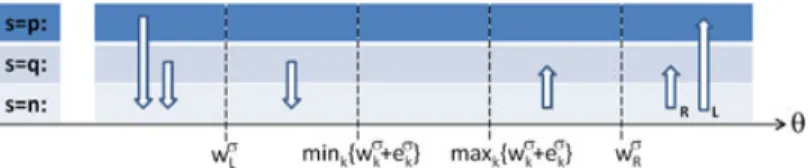
To understand the policy dynamics implied byLemma 1andProposition 2, let us consider first the equilibria in whicheσj <0, that is, equilibria in whichjstrictly prefers to intervene with the inefficient instrument. In that case, there are only two possible equilibrium paths, illustrated by Figures 1 and 2, depending on whether maxk{wσk + eσk}< wσj (Figure 1) orwσj <maxk{wσk+eσk}(Figure 2). For concreteness, in Figures1and
2we illustrate these two possibilities for the equilibria in whichi=Landj=R.14States 14Sincew
L< wR, it is natural to conjecture that necessarilyi=L, but equilibria withi=Rmay arise as
Figure1. An example of IE with both players choosingqfor some states.
Figure2. An example of IE with both players choosingpfor some states.
are measured along the horizontal axis and policies are indicated by the three shaded bars above this axis. An arrow identifies an equilibrium policy change, conditional on the status quo, for any realized state within the same interval of states as that in which the arrow is drawn. For intervals of states where there is no arrow drawn, there is no pol-icy change on the equilibrium path. The status quo at the start of any period in which there is a policy change is indicated by the origin of the relevant arrow; the arrowhead indicates the policy instrument chosen to replace the status quo.
InFigure 1, for example, suppose that the status quo going into the current period isnand the realized state isθ∈(maxk{wσk+eσk} wσR). PlayerLprefers intervening with
pto intervening withq, but stateθis high enough so that she prefers intervening with either instrument to staying withn. PlayerRprefers intervening withq, as the expected benefit fromqbeing easier to repeal outweighs the inefficiency cost, but the difficulty of repealingpmakes her prefer no interventionntop. Hence,qis the only alternative that dominatesnfor both players in that state. As a result,qis implemented indepen-dently of who is the proposer, as indicated by the upward-pointing arrow. Alternatively, ifθ > wσR, the intervention is so desirable that both players prefer intervening with ei-ther policy instrument. Since they differ with respect to their ordering ofpandq, the implemented policy depends on who has proposal power. This is indicated by labeling the upward-pointing arrows for such states by the proposer’s identity. When the status quo is eitherporq, the downward-pointing arrows indicate those states in which the relevant instrument is repealed. As stated inProposition 2,qis repealed for a larger set of states.
Figure 2differs fromFigure 1only in that the less interventionist player,R, is willing to acceptpin some states for whichLis unwilling to accept the inefficient alternative
q. As a result, forθ∈(wσR{wLσ+eσL}),Ris forced to proposepand, therefore,pis imple-mented independently of who has proposal power.
In an equilibrium in whicheσj =0, when it exists, playerj is indifferent between intervening withpandq, so the equilibrium may involve some mixing and the paths depicted in Figures 1 and 2 must be amended. Consider again the case in which
(forθ >maxk{wσk +eσk}), it is because eitherRis the proposer and chooses the inter-vention that is better for her orLis the proposer and proposesqbecauseRwould not acceptp. In an equilibrium witheσR=0, however,Ris indifferent betweenqandp, so in these states,nmay be replaced bypwith positive probability instead. Similarly, when-everqremains in place in Figures1and2(forθ >mink{wσk+eσk}),Rmay agree to replace it withp(given she is indifferent aseσR=0); hence, additional arrows fromqtopshould be drawn.
Since wL< wR, it is natural to conjecture that in any equilibrium, wσL< wRσ, that is, i=Land j=RinProposition 2, as we assumed in Figures 1and2. In addition, one can indeed show that for any w, e, δ, andF, there always exists an equilibrium such thatwσL< wσR, though this equilibrium need not be IE. Moreover, wheneL≥eR, all equilibria have this property.15 However, whene
L< eR, there always exists anF for which the game admits an IE with wσL> wRσ. In such equilibria,wLσ +eσL< wσR+eσR, soRbehaves in a more (less) interventionist way thanLwith the efficient (inefficient) instrument. The intuition for such equilibria is as follows. IfeRis sufficiently large, then
Rstrongly prefers interventionptoq. But when the status quo isnandθis sufficiently large,Rapproves a proposalqbyLif such a proposal is made. To hedge against such a possibility,R’s best response involves a bias againstnwhenpis the status quo; that is,
Rblocks repealingpeven for some states for which her flow-payoff fromnis higher. If this bias is large enough, we may havewRσ< wLσ, which means thatpstays in place for a larger set of states thanLwould like. AnticipatingR’s bias and the resulting inertia under status quop,Lproposes to intervene withqrather than withpwhen the status quo isn, rationalizingR’s best response bias.16
4.2 Use of inefficient instruments in equilibrium
In this section, we discuss how the types of equilibria and the equilibrium parameters
(wσ eσ) vary with the primitives of the model. To understand the discussion below, recall that fromProposition 2, an IE requireseσj ≤0for some playerj, whereeσj isj’s continuation payoff difference from a given periodtonward from implementingp in-stead ofqint, given continuation playσ. Policypyields a greater flow-payoff thanqin
t, but status quopandqmay also induce different continuation policy paths int+1. As illustrated in Figures1and2, int+1, either status quopandqare both repealed (forθ
small enough), in which case they lead to the same continuation path, or they both stay in place (forθlarge enough), in which case players keep on getting a greater flow-payoff frompthan fromq, or status quopstays in place whereasqis repealed (for interme-diate values ofθ), in which case the playerjwho wants to repealpin such states gets a
15The proof thate
L≥eR implies that in any equilibriumσ, wσL< wσR follows directly from (24) in
Lemma 4in theAppendix. The proof that there always exists an equilibrium such thatwσ
L< wσRcan be
found in Proposition 5 in the working paper version of this paper available on the authors’ websites.
16In theAppendix(see the example inAppendix A.4), we consider an environment in whichw
L=wRand
eL< eR, and we construct an IEσsuch thatwσR< wLσ+eLσ< wσR+eσR< wσR. By continuity, for somewL< wR,
there exists a nearby IE whose continuation payoff parameters satisfy the same inequality, which formally proves that there exists an IE in which the more interventionist player behaves as the least interventionist in equilibrium.
greater continuation payoff from status quoq. Thus, foreσj to be negative, the third case must be sufficiently likely and beneficial toj, relative to the inefficiency ofq.
We first discuss how the existence of IE depends on the degree of players’ polar-ization over when to enact and repealp, as captured by (wL wR). FixF and δ, and, for simplicity, consider the case eL=eR =efor some fixed e >0, that is, qis equally inefficient forL andR. In that case, as discussed in Section 4.1, in any equilibrium,
wσL< wσR, so fromProposition 2, an IE requireseσR≤0. In the extreme case of no polar-izationwL=wR, players do not expect any disagreement, and the inefficient instrument
qhas no strategic value. As a result, the only equilibrium is an EE in which players be-have as if they were playing a one-shot game, i.e.,wσL=wσR=wL=wRandeσL=eσR=e (see part (iii) of Proposition 3).17 As players become more polarized (i.e., as wR in-creases andwLdecreases), players’ period preferences disagree over whether to repeal
pwhenθ∈ [wL wR]. IfwR−wLis sufficiently small, these disagreement states are un-likely. Therefore, the greater repealability ofqdoes not compensate for its inefficiency, soeσR >0and all equilibria remain EE. However, each player is now biased in favor of the policy that gives her a greater payoff in the disagreement states, which implies that
wσL < wL< wR < wσR. This means that the set of the states in which players disagree on the policy change is larger than in a one-shot game. As polarization increases fur-ther, players’ equilibrium preferences over when to enact and repealpare more likely to disagree (i.e.,wσLdecreases andwRσ increases further), so the greater repealability of
q becomes more attractive toR. As a result, eσR may become negative and an IE may arise.18
As the conflict of interests becomes severe, i.e., as(wL wR)→(−∞+∞), the play-ers are rarely aligned with respect to whether any intervention is warranted. Thus, both
pandqare unlikely to be repealed, and the players perceive any decision as virtually permanent. As a result,qloses its strategic value and all equilibria become EE again (see part (iii) ofProposition 3).
Now fixF,δ, and players’ polarization over the efficient intervention(wL wR), and consider the role of(eL eR). GiveneL, aseRincreases,qbecomes more inefficient for playerR. So ifeRis sufficiently large, the guarantee of being able to repealqmore eas-ily tomorrow does not offset its inefficiency today and all equilibria are EE. Conversely, wheneR is sufficiently small, the strategic value ofqalways outweighs its inefficiency and all equilibria are IE (see part (i) ofProposition 3).
17Proposition 3part (iii) does not assumee
L=eR. In this more general case, it is still true that an EE
always exists as(wL wR)→(w w). However, an IE may also exist (see the example inAppendix A.4for a
formal proof of that claim). Basically, wheneL=eR, in some states, players’ period preferences disagree
when comparingnandq, and this sincere disagreement betweennandqcan generate a strategic disagree-ment betweennandpas well, even thoughwL=wR. To understand how such equilibria can be sustained,
note that the player with the greaterek, sayLfor concreteness, may be concerned that under status quo
n, forθlarge enough,Rwill proposeqandLwill have no choice but to accept it. To avoid this situation,
Lbecomes biased againstnand prefers to leavepin place for a greater set of sets thanRwould like. To avoid this inertia of status quop,Rprefers to intervene withqrather than withp, rationalizingL’s initial concern.
18EE may disappear or may coexist, depending on the parameters. See the discussion under
Similarly, increasingeL, giveneR, makesqmore inefficient for playerL. In this case, however, there are two countervailing effects. On one hand,Lapproves the repeal of
qin more states, which increases the strategic value ofqforR. On the other hand,L
approves proposalqin fewer states. Regardless of the value ofeL, however, forθlarge enough, Lprefers implementingq ton, andRcan be sureq is accepted and imple-mented on the equilibrium path. Intuitively thenRwill suggestqas long as she does not find it too inefficient. Hence, if for some parameters all equilibria are IE, then all equilibria remain IE asqbecomes more inefficient for playerL(see part (ii) of Proposi-tion 3). This discussion implies that the inefficient policy instrument will be used when it is sufficiently costly for playerLand not too (in relative terms) costly for playerR.
The following proposition formalizes the main claims above.
Proposition3. Fixδ∈(01), the recognition probability functionsbLandbR, and the c.d.f.F. Then the following statements hold:
(i) For anywL,wR, andeL, there existse¯R∈(0+∞)such that all equilibria are IE for alleR<e¯R, and for alleR>e¯R, there exists EE.
(ii) For anywL, wR, and eR, if all equilibria are IE for someeL, they are all IE for
eL> eL.
(iii) For any(eL eR)and any average ideology(wL+wR)/2, as(wR−wL)→ +∞, then all equilibria are EE, and as(wR−wL)→0, there exists an EE.
The last claim ofProposition 3sheds light on how the use of inefficient instruments may relate to the nature of the political system. The existence of checks and balances in a multi-member political system reflects a demand for some degree of “consensus” for policy change. Examples include supermajority voting rules, as mentioned earlier, or agreement between the median voter in a legislature subject to simple majority rule and the president. This sort of consensus in our model is approximated by the level of polarization, (wR−wL): the larger is this distance, the greater is the implicit level of consensus required for policy change (seeDziuda and Loeper 2018andKrehbiel 1998). Consequently, to the extent that more checks and balances are associated with demands for more consensus,Proposition 3implies that inefficient instruments are likely to be used in political systems with moderate polarization and moderate degrees of checks and balances.
We emphasize, however, that the above statements hold for fixed δ and F. So a particular degree of polarization over efficient intervention may lead to EE for some patience and distribution of states of nature, but may lead to IE for other values of these primitives. The following proposition shows that for any payoff parameters
(wL wR eL eR), all equilibria are IE for some patience and distribution of the state. In particular, no matter how inefficient the policy instrumentqis, all equilibria may be IE.
Proposition 4. Let F be a c.d.f. with mean 0and variance1, and let(Fmd)m∈Rd>0
Fmd(θ)≡F(θ−dm). Then for any(wL wR eL eR), there existsd >¯ 0,δ <δ¯, andm <m¯ such that for allδ∈ [δδ¯],m∈ [mm¯], andd∈(0d¯], all equilibria ofare IE for the c.d.f.
Fmd.
The proposition is predicated on the observation that two things must be true for all equilibria to be IE. Players must frequently disagree over whethern orpis a better policy, but they must frequently agree over whethernorqis a better policy. To guaran-tee the former, in the proof, we select[mm¯]within the set of states(wL wR)in which
Lwants to maintainpwhereasRwants to repeal it, and we selectd¯ small enough so that most of the probability mass is concentrated around the meanm∈ [mm¯]ofFmd. To guarantee the latter, we selectm¯ to the left ofwL+eL andwR+eR, so that in the most frequent states close tom, both players prefer no interventionnto the inefficient interventionq. We then choose the minimum level of patienceδsuch that the greater repealability ofqoutweighs its inefficiency forRandRprefers to intervene withqrather than withp. However, if players are too patient, an EE may also exist. The reason is that in states close tom, even thoughLgets a greater flow-payoff fromnthan fromq, under status quoq,Lmay credibly commit to accept and propose onlyp, in which caseRhas no choice but to accept and propose onlypbecauseRprefers a permanentpto a per-manentq. Given these expectations,Rwill prefer not to useqin the first place. Thus, for all equilibria to be IE, we need to impose an upper boundδ¯on players’ patience. It is worth emphasizing, however, that the conditions identified in the proof ofProposition 4
are by no means necessary for the existence of IE.19
4.3 The value of inefficient instruments
In reality, the menu of available policy instruments is often endogenous. For example, if environmental policy is chosen at the local level or by a regulatory body, then the instru-ments that are available may be restricted by the federal government and, in such cases, it is not at all clear whether an inefficient policy instrument would, or should, be made available to decision makers. As argued inSection 2, there is no social welfare gain to be had from the existence ofqin a static environment; the question is whether this holds in dynamic settings. The answer is “yes”: allowing for an inefficient policy instrument can lead to Pareto superior equilibria in the dynamic game. Although a more general existence result is available (Austen-Smith et al. 2019, Proposition 5), we establish the efficiency claim here with a simple two-state example. Additionally, the example pro-vides insight on the environments in whichqcan be expected to be welfare improving.
Let (n p q)denote the original game, let(n p) denote the game in which the inefficient instrument is unavailable, and let(n q)denote the game in which the effi-cient instrument is unavailable. Say that one equilibrium is Pareto superior to another if at the beginning of the game, for any realization of the initial state, both players get a strictly greater continuation payoff in the former. Then we have the following result.
19A similar result for the exclusive existence of EE holds. For instance, for anymandδ, one can show that
Proposition5. Suppose there existθ <θ¯andπ∈(01)such that in every periodt, with probability1−π,θ(t)=θ, and with probabilityπ,θ(t)= ¯θ.
(i) There exists an equilibrium of(n p q)that is Pareto superior to any equilibrium of(n p)if and only if
wL< θ≤min{wi+ei} ≤max{wi+ei}<θ¯ (3)
δ(1−π)(wR−θ) >1−δ(1−π)(θ¯−wR) (4) (ii) Furthermore, all equilibria of(n p q) are Pareto superior to all equilibria of
(n p)if and only if (3), (4), and the following inequality hold:
eL>
δπ
1−δ(θ¯−wL)+
1−δπ
1−δ (θ−wL) (5)
(iii) For any(wL wR eL eR), there existsδandF—i.e., a triple(θθ π)¯ —such that all equilibria of(n p q)are Pareto superior to all equilibria of(n p).
Parts (i), (ii), and (iii) above hold unchanged if we replace(n p q)by(n q).
Proposition 5part (i) characterizes the conditions under which addingqcan make both players strictly better off. To understand the intuition for, and implications of, these conditions, note first that condition (3) is essentially equivalent to the condition (1) in the two-period example ofSection 2and has a similar interpretation as in the two-period setup.20Specifically, the last three inequalities in (3) mean that when choosing between
nandq, players’ static preferences are the same, so in the game(n q), there exists an equilibrium in which players agree to implementnin stateθandqin stateθ¯. The first inequality in (3) means thatpisL’s most preferred policy in either state, so status quo
pis never repealed. Hence, in the game(n p), if nis the status quo andR’s prefer-ence fornoverpin the low stateθis stronger than her preference forpovern in the high stateθ¯,Rwill not approve intervening withpand in any equilibrium, players will stay atn forever. This is assured by condition (4), and in that case, both players are strictly worse off in this nonintervention equilibrium path than in the equilibrium path of(n q), described above.
Now consider the game(n p q). Since, under (4),Rdoes not approvep, adding
p to the game leaves the incentives underlying the equilibria of (n q) unchanged. Agreeing to implementn in stateθ andq in state θ¯, therefore, is also an equilibrium of(n p q), and both players strictly prefer it to the unique equilibrium path of(n p). Hence, for the inefficient instrument to be beneficial in some equilibrium, players’ de-gree of polarization must be sufficiently large so that they disade-gree sufficiently often on when to repealp, but not so large that they agree sufficiently often on when to repealq. Part (ii) shows that the additional condition (5) is required to ensure both players are strictly better off in all equilibria of(n p q)relative to(n p). The reason is that IE
20The only difference between conditions (1) and (3) is that the former requiresθ < w
R, but this extra
and EE may coexist in(n p q): staying withnindefinitely, as in the unique equilibrium path of(n p), may remain an equilibrium in(n p q), leavingLandRindifferent be-tween the two games. To see how this can occur, suppose thatLthreatens to approve onlypif everqis implemented. If such a threat is credible,Rnever approvesqand no intervention is ever implemented. Condition (5) guarantees that no such threat is cred-ible: wheneLis sufficiently large,Lprefers to acceptnrather than stay atqin stateθ. Thus, to guarantee that both players benefit unambiguously from the availability ofq,q
must be sufficiently inefficient for the less interventionist players.
It is worth noting how the conditions of Proposition 5depend onπ and δ. From (4) and (5), the set ofwR,wL, andeLthat satisfies these conditions expands asπ falls. Hence, both players are more likely to benefit fromqif the state in which they disagree over intervening with the efficient policy becomes more likely. In addition, asδincreases and players become more patient, the set ofwR satisfying (4) increases and a welfare improving IE equilibrium, therefore, becomes more likely. However, the right-hand side of (5) first decreases and then increases withδ. Hence, to benefit unambiguously from the presence ofq, players should be sufficiently, but not excessively, patient.21 Part (iii)
further states that for any payoff parameters, the availability ofqunambiguously leads to Pareto better equilibria for some degree of patience and some specification ofF.
The main message ofProposition 5remains unchanged even if we allow for non-Markov strategies. Indeed, if conditions (3) and (4) are satisfied, then there exists a subgame-perfect Nash equilibrium (SPNE) of(n p q)that Pareto dominates any SPNE of(n p). To see this, simply note that under condition (3), having policypforever gives a strictly greater payoff toLthan any other policy path. So in any SPNE of(n p),pstays in place forever once it becomes the status quo. Thus, condition (4) implies than in any SPNE of(n p), the initial status quonstays in place forever. The Markov equilibriumσ
of(n p q)in which players agree to implementnin stateθandqin stateθ¯is a fortiori a SPNE, and from what precedes, it Pareto dominates any SPNE of(n p). Note further that under conditions (3) and (4), allowing for non-Markov strategies does not lead to more efficient outcomes. Since under (3), in any SPNE,pstays in place forever once implemented, the path ofσ is the most preferred path ofRamong all such paths, soσ
isR’s most preferred SPNE. Outside of the environment ofProposition 5, allowing for non-Markov strategies may expand the set of equilibria to include more efficient equi-libria, but the main qualitative message of the paper should survive, namely, thatqmay be used in equilibrium and ruling outq, either by selecting a different equilibrium or by allowing players to commit not to useq, can make them worse off.
5. Volatility and persistent states
Until now, states, and thereby players’ state-contingent preferences, have been assumed i.i.d. draws over time. In many applications, however, there may be periods of relative
21The non-monotonic impact ofδon the value of inefficient instruments is not an artifact of the
two-state distributions considered inProposition 5. Condition (3) guarantees that players are in full ideological agreement when choosing between the inefficient instrumentqand no interventionn. This makesq partic-ularly attractive. If the distribution of the state has full support, sufficiently patient players may introduce an inefficient gridlock also to the choice betweennandq. As a result, unlike in the two-state case,qmay not strictly improve both players’ payoffs if players are sufficiently patient and, further, an IE may not exist.