---
S
---
D
---
S
---
SUBCOMMISSION ON
DEVONIAN STRATIGRAPHY
NEWSLETTER NO. 24
R.T. BECKER, Editor
WWU Münster
Germany
February 2009
ISSN: 2074-7268
CONTENT
Page
Message from the CHAIRMAN
1
Reports
SDS Annual Report to ICS 2008
(Chairman)
2
Minutes of Oslo Business Meeting
(Chairman)
7
Minutes of Kitab Business Meeting
(Chairman)
12
Annual Report of IGCP 499 (P.
Königshof)
16
International Conference on
Palaeozoic Climates, Lille (CM
Mistiaen)
17
SDS Documents
Request and comments concerning
the Emsian GSSP (Carls, Slavik &
Valenzuela-Ríos)
20
Astronomical tuning, Western
Illinois Basin (Clark et al.)
27
Position of the Eifelian-Givetian
boundary in New York (TM Over)
35
Early Devonian Ostracodes, Central
Nevada (Dojen, Evola & Murphy)
36
Conodonts around the Annulata
Events (Hartenfels, Becker &
Tragelehn)
40
Ammonoids and Famennian
Substages (Chairman)
49
Meetings
NAPC June 2009, Cincinatti, with
Devonian fieldtrip
50
IPC summer 2010, London
56
Publications
Palaeogeography,
Palaeoclimatology, Palaeoecology,
269 (3-4) (TM Racki)
57
Stratigraphie von Deutschland
58
Bulletin of Geosciences, 83 (4)
60
Geological Society of London,
Special Publications, 314
60
Palaeogeography,
Palaeoclimatology, Palaeoecology,
Middle Devonian volume
61
Palaeontographica Americana
62
Manuscript invitation by D.
Holloway
63
Frasnian conodonts of the Eastern
Russian Platform (Ovnatanove &
Kononova) n- Abstract
63
Palaeontological Atlas of
Phanerozoic Faunas and Floras of
Uzbekistan
64
Membership News
CM G.C. Baird
65
CM A. Bartholomew
66
TM R.T. Becker and the Münster
Group
67
TM C.E. Brett
72
CM R. Brocke
73
CM P. Bultynck
74
CM C. Burrow
74
TM J.-G. Casier
75
CM C. Corradini
77
CM J. Day
78
CM J. Ebert
81
TM N. Izokh
82
CM U. Jansen (and publications of
P. Königshof)
85
TM Ma X.-p.
87
CM Mark-Kurik
88
TM J. Marshall
89
CM H. Matyja
90
CM M.A. Murphy
92
TM J. Over
93
CM S. Turner
94
TM J.I. Valenzuela-Rios
95
CM C. VerStraeten
97
TM K. Weddige
98
CM M. Whalen
99
EditorialThe SDS Newsletter is published annually by the International Subcommission on Devonian Stratigraphy of the IUGS Subcommission on Stratigraphy (ICS). It publishes reports and news from its membership, scientific discussions, Minutes of SDS Meetings, SDS reports to ICS, general IUGS information, information on past and future Devonian meetings and research projects, and reviews or summaries of new Devonian publications.
Editor: Prof. Dr. R. Thomas BECKER
SDSCHAIRMAN
Institut für Geologie und Paläontologie Westfälische Wilhelms-Universität Corrensstr. 24 D-48149 Münster, Germany [email protected] Circulation 120 hard copies,
pdf files of current and past issues are freely available from the SDS Homepage at
www.unica.it/sds/
Submissions have to be sent electronically, preferably as Word Documents or pdf files, to the Editor or to Mrs. S. KLAUS, IGP, Münster ([email protected]). Submission deadline is the end of each calendar year.
MESSAGE FROM THE CHAIRMAN In behalf of our Subcommission, I wish all members a happy, healthy and scientifically productive 2009.
The highlight of 2008 was certainly our Field Symposium in the Kitab Reserve. It included the incredible hospitality of our Uzbek hosts, a very nice and unexpectedly comfortable logistical set-up, wonderful and well prepared sections, beautiful nature, perfect weather, a very high level of constructive discussions in the field, and most interesting conference contributions with many new data. Our Uzbek team, especially Aleksej KIM, Natalia MESHCHANKINA, Utkir RAKHMONOV, Maya ERINA, Irina KIM, and Firuza SALIMOVA made a wonderful job. Equally important was the scientific and organisational input of the Novosibirsk Group, notably of Zenya YOLKIN, Kolya BAKHAREV, Olga OBUT, and Nadya IZOKH. SDS also gives its deepest thanks to Nariman MAVLYANOV,
Chairman of the State Committee on
Geology and Mineral Resources, Republic
of Uzbekistan (SCGMR RUz), and to
Ilkombay T
URAMURATOV, Chairman of the
Organizing Committee and Deputy
Chairman of SCGMR RUz.
Their highestlevel support and interest in SDS enabled our successful meeting.
The successful work and high level of activity of our Subcommission was acknowledged at the Oslo meeting of ICS, where all SC Chairmen had to give brief reports. As in the last Newsletter, the annual report to ICS from November 2008 is included in the report section. You should read it carefully since it gives a balance of our objectives, goals, and achievements. At the Oslo ICS evening, SDS finished in the spotlight since Carl BRETT, one of our most active TMs, was honoured for his lifetime achievements in stratigraphy by the ICS Digby MCLAREN Medal. CONGRATULATIONS CARL – you really deserved this award.
Whilst our standing within ICS is good, the expected very low attendance to our Business Meeting was rather depressing. I knew that this was coming since the planned SDS symposium was cancelled by the IGC organizers because of too few contributions. I am aware of the high costs of IGC attendance and I do
remember well the bill for a bear in downtown Oslo when John, our secretary, and I sat together to discuss SDS matters. But I hope that we will have more SDS members at the next IGC in Brisbane in 2012. The presence of our Subcommission at IGCs is inevitable and it is the only international meeting where stratigraphers of any part of geological time come together, join forces for the discipline, and where new methods and trends of our science are exchanged. In the Devonian, for example, we will have to learn from other systems how to improve orbital tuning and the quantification of stratigraphical data, using available freeware programs.
The large amount of publications contributes significantly to the reputation of SDS. The official Annual Report of IUGS for 2007 mentions specifically our Geological Society Special Publication on “Devonian Events and Correlations” as the first outcome of co-operation between IUGS commissions and the GSL. In this context we also have to acknowledge the very fruitful and positive collaboration with IGCP 499, which, unfortunately, cannot continue for very long. At the German IGC Meeting at the end of the last year, Peter KÖNIGSHOF, in his function as IGC 499 leader, and I agreed and expressed our support, declared that they will apply to IUGS for a one year project extension.
We will have two SDS-IGCP 499 Devonian sessions at the forthcoming (this June) North American Paleontological Convention (NAPC) in Cincinnati. Please look at the NAPC homepage (some details included in this Newsletter). Carl BRETT, Gordon BAIRD, Alex BARTHOLOMEW etc. promised to lead us to the Devonian of the Ohio-Michigan-Kentucky-Pennsylvania regions, where SDS has never been before. I am sure that the symposia and the excursion(s) will attract many of you and I am looking much forward seeing you in Cincinnati, where we also will have our Annual Business Meeting.
REPORTS
International Commission
on Stratigraphy
Subcommission on
Devonian Stratigraphy
Annual Report 2008
1. TITLE OF CONSTITUENT BODY Subcommission on Devonian Stratigraphy Submitted by:
R. Thomas BECKER, Chair of SDS
Westfälische Wilhelms-Universität, Institut für Geologie and Paläontologie, Corrensstr. 24, D-48149 Münster, Tel. –49-251-83 339 51, fax – 49-251-83 339 68; [email protected] 2. OVERALL OBJECTIVES, AND FIT WITHIN IUGS SCIENCE POLICY
Since SDS has formally defined all its series and stage boundaries since many years, it has worked in the last years on the formal definition of substages and on the improvement of multidisciplinary international correlation, involving both standard and various modern stratigraphic techniques. In addition, after completion of 10 year moratoria, the revision of two GSSPs has arisen as major tasks. SDS objectives for 2008 can be summarized as:
• Formal definition of Givetian, Frasnian and Famennian substages
• Revision of the basal Emsian GSSP and Pragian/Emsian substages
• Revision of the D/C boundary definition, in conjunction with the Carboniferous Subcommission (initiation of a new D/C Boundary Working Group)
• Publication of high-resolution correlation data in special issues of high-level journals/series and in close co-operation with IGCP 499 on “Devonian land-sea interactions”
• Official Business meetings at Oslo IGC and in Uzbekistan (see below)
• International field symposium with focus on the Emsian in the Zinzilban Natural Reserve, Uzbekistan, September 2008 • Support for additional international
Devonian symposia (Lille, August 2008 and Frankfurt a.M., October 2008)
• Compilation and distribution of SDS Newsletter 23
• Intensive cooperation with ICS
• Update and extension of SDS homepage All listed objectives fit the directions of IUGS and ICS:
• development of an internationally approved chronostratigrapical timescale for the Devonian with maximum time resolution;
• promotion of new and modern stratigraphical techniques and their integration into Devonian multidisciplinary schemes;
• application of GSSP decisions internationally and as a base for a better understanding of patterns and processes in Earth History, including Devonian major global environmental changes.
3. ORGANIZATION Officers for 2008-2012
Chair: Prof. Dr. R. Thomas BECKER, WWU Münster, Germany
Vice-Chair: Prof. Dr. Ahmed EL HASSANI, Institute Scientifique, Rabat, Morocco
Secretary: Dr. John E. MARSHALL, University of Southampton, U. K.
The Subcommission has currently further 18 Voting Members that cover many major Devonian outcrop areas and many stratigraphical disciplines (see Appendix).
The SDS Membership covers currently the following 29 countries (in alphabetical order): Australia, Austria, Belarus, Belgium, Bolivia, Bulgaria, Canada, China, Czechia, Estonia, France, Germany, Great Britain, Iran, Italy, Latvia, Lithuania, Morocco, Myanmar, New Zealand, Pakistan, Poland, South Africa, Spain, USA, Uzbekistan, Tadzhikistan, Turkey, Vietnam. There is still a lack of active workers from other countries with important Devonian outcrop, especially from Brazil, Argentine, Chile, Algeria, Libya, Kazakhstan, Kirgisia, Caucasian countries, and Thailand. At national level several Devonian Subcommissions exist in various countries, partly under different organisational names
(e.g., Germany, Russia, “Friends of the Devonian” at GSA meetings).
Website: The website, run by Corresponding Members C.CORRADINI and S.GOUWY at the University of Cagliari (Sardinia), has been established in spring 2007: http://www.unica.it/sds/
The old SDS website at the University of Texas at Arlington is not served any more and should be deleted from links and bookmarks. The new website includes the last three and future issues of the SDS Newsletter, Minutes of SDS Business Meetings since 2002, a list of SDS publications (soon to be updated), its membership with full addresses, GSSP information, links to ICS and IUGS, and information on past and future SDS meetings. Members are offered to establish links to local sites, where Devonian Powerpoint presentations of past talks can be downloaded.
4. INTERFACES WITH OTHER INTERNATIONAL PROJECTS
SDS is traditionally strongly tied with IGCP projects that have a Devonian focus. This is currently IGCP 499 on “Devonian land-sea interaction: evolution of ecosystems and climate” (DEVEC), lead by P. KÖNIGSHOF and colleagues from the Senckenberg Institute, Frankfurt a. M., Germany. There is a strong overlap of SDS and IGCP 499 members and several joint field meetings have been organized: Dra Valley, Morocco (2004), southern Siberia, Salair, Rudny and Gorny Altai (2005), Nevada-Utah (2007), Uzbekistan (2008). SDS members took part in a Devonian fieldtrip to Algeria (in spring 2007), to Libya (in April 2008), and in the final IGCP Symposium at the Senckenberg Institute (October 2008). IGCP 499 meetings are generally advertised on the official SDS Homepage. In 2009 two joint symposia have been formally accepted for the programme of the North American Palaeontological Convention (Cincinnati, June 2009). Plans are currently made for a future Devonian IGCP since IGCP 499 will run out at the end of 2008 (although application for a one year extension has just been submitted to the UNESCO). 5. CHIEF ACCOMPLISHMENTS AND PRODUCTS IN 2007
Chronostratigraphic definitions: The necessity and demand for formally defined substages has
been discussed and outlined repeatedly (for example in SDS Newsletter 18, p. 13-14). This can be summarized as follows:
• Several Devonian stages, especially the Emsian, and Famennian, are much longer than other Phanerozoic stages, which results in a hardly justified, rather uneven chronostratigraphic subdivision of time.
• Several Devonian substages, especially the Emsian, Eifelian, Givetian, Frasnian, and Famennian, are divided naturally by important and short-termed global events, connected with sedimentary (anoxia, eustatic pulses) and evolutionary perturbations (significant extinctions and post-event radiations).
• Recognition of additional time units separated by major events/crises enables a better and more realistic reconstruction of past biodiversity changes. It can serve relevant data bases and prevent the current misleading lumping of different global events of first to third order.
• Devonian substages are widely used in many publications but informally and with regionally or individually very different understanding. Formal chronostratigraphy should bring order into this current chaos.
• Fluctuating and disputed (between different schools of biostratigraphers) zonal schemes of conodont, ammonoids or dacryoconarids cannot replace the rigid framework of a stable chronostratigraphy.
• If a more refined chronostratigraphy is possible, then ICS should provide the overall geoscientific community with a most refined and reliable standard subdivision of time. PRAGIAN/EMSIAN SUBSTAGES
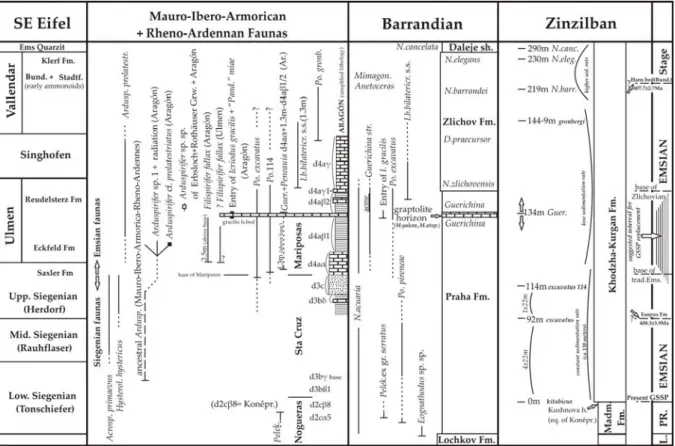
The current revision of the base of the Emsian in the Zinzilban Gorge opens the question how to deal with the status of the current GSSP level. Convincing evidence has been brought forward that the latter is at a position that puts more than half of the classical Pragian (Praha Limestone of Bohemia) into the lower Emsian, very much below the base of the classical Emsian in the German type region. Consequently, it has been proposed at the Kitab Business Meeting to subdivide the Pragian in future into two substages, using the current Zinzilban basal Emsian GSSP, keeping its position and definition, as future GSSP for an Upper Pragian or Zinzilbanian Substage. A name for the Lower Pragian substage has not yet been proposed.
Attempts to subdivide the very long Emsian into formal Lower and Upper substages have not proceeded much in 2008. It has become clear that the very low current basal Emsian GSSP resulted in different perceptions, where the base of an upper substage should be. The working goal for SDS was to search for a good biostratigraphical marker close to the base of the Daleje Shale (or Dalejan) of Bohemia, above the Zlichov Limestone and its globally widespread Anetoceras faunas. It turned out that this is complicated by a diachronous base of the Daleje Shale, by strong endemism in conodonts at the time and by difficulties to trace the supposed eustatic Daleje Transgression internationally. In Russia and Central Asia typical lower Emsian faunas of Europe (from the nothoperbonus Zone onwards) have been proposed to fall in the upper Emsian. A decision on Emsian substages can not be expected before a revision of the Emsian GSSP.
REVISION OF EMSIAN GSSP
The current Zinzilban GSSP section was intensively re-sampled by several groups during the Uzbekistan field symposium. It was agreed that all results have to be reported simultaneously to the SDS Newsletter and to the Uzbek and Novosibirsk colleagues. Eventually a joint publication with all new stratigraphical data shall be compiled. At the SDS Business Meeting there was a very intense and partly controversial discussion concerning traditional and current Emsian boundaries. Based on the high quality of outcrop, its fossil content, the amount of past research, and the excellent local research facilities, there is complete agreement that any revised GSSP shall remain in the Zinzilban section of the Kitab Reserve. Revision of a revised Emsian GSSP will concentrate on levels, where Polygnathus excavatus, including its various morphotypes or subspecies, appears.
GIVETIAN AND FRASNIAN SUBSTAGE SUBDIVISIONS
SDS has formally voted on the base of Middle Givetian, Upper Givetian, Middle Frasnian and Upper Frasnian substages. However, the formal procedure how to deal with the clear voting results was open. At the Oslo ICS meeting it was agreed with the ICS officers that substage proposals will be submitted to
ICS for ratification in the same way as stage proposals, with the exception that there will be no selected/formerly proposed GSSP. Instead, a list of reference sections for different continents will be included that document the potential of chosen levels for international correlation. The supposed best section will be documented in detail as a potential future GSSP section. This will ease a formal GSSP decision if required in future. In the case of the Givetian, new conodont and ammonoid data for the Givetian of Morocco have been presented (ABOUSSALAM & BECKER, 2007, 2009 in press; GOUWY et al., 2007) since the last report to ICS and will become part of the substage submissions.
FAMENNIAN SUBSTAGES
A call to produce new relevant Famennian data for the Oslo Business Meeting did not result in new documents. This indicates that all arguments have been brought forward. Consequently, a formal vote on the base of Middle, Upper, and Uppermost Famennian substages will take place in December 2008. All levels will be based on conodont boundaries. For the Middle Famennian, the base of the rhomboidea and marginifera Zones have been proposed, for the Upper Famennian, the base of the velifer, postera/styriacus and expansa Zones have been proposed, for the base of the Uppermost Famennian the base of the Upper expansa Zone has been proposed. Data presented to the SDS Meeting at Nevada (also HARTENFELS & BECKER in SDS Newsletter 23) and to the resulting SDS volume (see below) strongly speak against the base of the Lower expansa Zone as a substage level. The base of the Upper expansa Zone has been subject of an intensive discussion included in Newsletter 23.
REVISION OF D/C BOUNDARY
At the Oslo IGC members of SDS and SCS came together to formally initiate a new International Working Group on the Devonian/Carboniferous Boundary. There are ca. 10 members both from the Devonian and Carboniferous side. SDS has made two proposals for a working group chairman and vice-chairman; proposals from the Carboniferous side are still pending. It was decided that working group members will vote on the proposals. As a work plan is was agreed that problems of conodont taxonomy have to be addressed first, before any progress can be
made. The new La Serre GSSP conodont data that fully unwrapped the GSSP problems have been submitted by S. KAISER to the Newsletters on Stratigraphy. The Chinese WG members have invited the other members, and especially the conodont workers, for a workshop in summer 2009 in Beijing, with a possibility to visit and sample important boundary sections in South China. Preliminary results of re-sampling in 2007 at Nanbiancun, Muhua and Dapaoshang, unfortunately, proved to be rather unhelpful. At the Uzbekistan field symposium a new D/C boundary section close to the Uzbek/Tadzhikistan border was shown, with detailed conodont data by M. ERINA. Results of re-sampling by BECKER,KAISER & MATYJA should become available in summer 2009. Members of the working group will have the opportunity to meet at the NPC in Cincinnati in June 2009.
PUBLICATIONS:
• YOLKIN, E.A., KIM, A.I., TALENT, J. (Eds.) 2008. Devonian sequences of the Kitab Reserve area. – International Conference “Global Alignments of Lower Devonian Carbonate and Clastic Sequences” (SDS/IGCP 499 project joint field meeting), August 25 – September 3, 2008, Kitab State Geological Reserve, Uzbekistan, Field Excursion Guidebook, 100 pp.; Publishing House of SB Ras, Novosibirsk.
• KIM, A.I., SALIMOVA, F.A., MESHCHANKINA, N.A. (Eds.) 2008. “Global Alignments of Lower Devonian Carbonate and Clastic Sequences” (SDS/IGCP 499 project joint field meeting): Contributions of International Conference, August 25 – September 3, 2008, Kitab State Geological Reserve. - 121 pp.; Publishing House of SB Ras, Novosibirsk.
• KIM, A.I., ERINA, M.V., KIM, I.A. (Eds.) 2008. Atlas of the Paleontological plates. Supplement to a Guidebook of the Field Excursion. – International Conference “Global Alignments of Lower Devonian Carbonate and Clastic Sequences (SDS/IGCP 499 project joint field meeting), August 25 – September 3, 2008, Kitab State Geological Reserve, Uzbekistan, 34 pls; Publishing House of SB Ras, Novosibirsk.
• BECKER, R. T. (Ed.) 2008. SDS Newsletter 23. - 127 pp., Westfälische Wilhelms-Universität Münster.
SDS members contributed significantly to the following other Devonian volumes:
• BULTYNCK,P., NARKIEWICZ, M. (Eds.) 2007. Recent approaches to Devonian conodont zonation. – Geological Quarterly, 51 (4): 339-480. [results of Devonian contributions to Leicester 2006 ICOS meeting] • KÖNIGSHOF, P., LINNEMANN, U. (Eds.) 2008. From Gondwana and Laurussia to Pangaea: Dynamics of Oceans and Supercontinents. – 20th International Senckenberg Conference and 2nd Geinitz Conference. Final Meeting of IGCP 497 and 499, Abstracts and Programme, 241 pp., Frankfurt a. M., Dresden.
Currently there are four more Devonian volumes in preparation, which mostly or partly stem from past meetings with SDS involvement:
• Bulletin of Geosciences [results of 2005 Novosibirsk meeting]
• Palaeontographica Americana (results of Nevada 2007 meeting]
• Palaeogeography, Palaeoclimatology, Palaeoecology [Middle Devonian special issue]
• Geological Society of London, Special Publication [results from past IGCP 499 meetings]
MEETINGS:
• SDS Annual Business Meeting at the 33rd International Geological Congress, Oslo, 6-14th August [the announced special symposium suffered from too few contributions and was eventually cancelled by the organizers]
• International Conference “Global Alignments of Lower Devonian Carbonate and Clastic Sequences (SDS/IGCP 499 project joint field meeting), August 25 – September 3, 2008, Kitab State Geological Reserve, Uzbekistan [including a 2nd Business Meeting]
• International Congress “Palaeozoic Climates”, August 25-29th, 2008 Lille, France [with formal SDS support]
MEMBERSHIP:
Three retired, very experienced voting members, who were part of the backbone of the subcommission for many years, C.E. SANDBERG (USA), T. UYENO (Canada), and K. WEDDIGE (Germany), reached their maximum voting time in 2008 and will
continue as CMs. Unfortunately, no new voting member from Canada is available; based on his work both in the central to western USA and Canada, J. DAY will cover Canada until a new Canadian TM becomes available. K.WEDDIGE will be replaced by U. JANSEN from the same institute.
New corresponding members from Czechia (J. FRYDA) and Uzbekistan (U.D.RAKHMONOV) were elected.
6. CHIEF PROBLEMS ENCOUNTERED IN 2008
Problems with funding raised in the 2007 report continued in 2008. Many members could not afford to attend meetings and the lack of ICS travel support in 2008 is very regrettable. IUGS and ICS should improve the funding situation and joint efforts should be made to raise the interest of companies with industrial stratigraphy in the work of ICS. A refined, stable and precise chronostratigraphy as well as improved biostratigraphic and eustatic scales are of such high value that it should be possible to acquire donations. It seems that missing connections between academic and industrial stratigraphers need to be bridged.
The decline of academic position for stratigraphers is felt in several membership countries, especially in Canada, Belgium, France, Australia, Russia, and China. For several years, SDS has not been able to recruit new young and active Devonian workers from these countries that have a permanent research position.
As it was expected, the number of SDS members that attended the rather (too) expensive Oslo IGC was low. Consequently, the planned symposium on Devonian stratigraphy and correlation across facies belts had to be cancelled. The shift of the Business Meeting from the day between the two conference halfs to a day within the first half resulted in the fact that some members, including the Secretary, missed the Business Meeting. Others, including the Chairman, were unable to give their scheduled talk since business meeting and stratigraphy sessions finished in different congress parts. SDS was not very satisfied with the Oslo organisation and improvements should be made in Brisbane in 2012.
7. SUMMARY OF EXPENDITURES IN 2008
INCOME
carried over from 2007 306 $ IUGS subvention 2008 350 $ Sum 656 $ EXPENSES SDS Newsletter 24, 01/2009 printing/mailing 450 $ balance early 2009 206 $
8. WORK PLAN, CRITICAL MILESTONES, ANTICIPATED RESULTS AND COMMUNICATIONS TO BE ACHIEVED NEXT YEAR (2009)
• Submit proposals for the formal definition of Givetian and Frasnian substages to ICS for ratification
• Publication of a brief note on Givetian and Frasnian substage definition in Episodes after ratification by ICS
• Publication of volume on Middle Devonian stratigraphy and multi-disciplinary correlation in Palaeogeography, Palaeoclimatology, Palaeoecology (TM C. E. BRETT, Ed.)
• Publication of SDS Newsletter 24 in early 2009
• Publication of proceedings volume of 2007 Nevada Field Meeting in Palaeontographica Americana (J. OVER & J. MORROW, Eds.) • Update of Devonian Timescale for next GTS
volume (GRADSTEIN et al.)
• Annual Meeting, two Devonian symposia (already officially accepted), and field excursion to Ohio and Kentucky (led by C.E. Brett and co-leaders) at North American Paleontological Convention, Cincinnati, June 2009 [The two symposia will focus on terrestrial-marine correlation and on an improved sequence stratigraphy/eustatic sea-level curve for the Devonian. Apart from the substage discussion and GSSP revisions, both topics have currently the highest priority in SDS activities]
• Update of SDS homepage
• Communicate outcome of Famennian substage vote and start to prepare substage proposals (starting with the base of the Uppermost Famennian)
• D/C boundary conodont workshop in Beijing, summer 2009
• Intense cooperation with ICS and its bodies (e.g., SCS, ISSC)
9. BUDGET AND ICS COMPONENT FOR 2007
INCOME
balance from 2008 206 $ EXPENSES
SDS Newsletter 25 450 $ support for two SDS members to attend NPC, Cincinnati (business meeting, Devonian excursion and symposia) 1600 $
SUM 2050 $
request for support/subvention from
IUGS/ICS 2000 $
APPENDIX A
SUBCOMISSION OFFICERS
CHAIRMAN + SDS NEWSLETTER EDITOR R. Thomas BECKER
Westfälische Wilhelms-Universität, Geologisch-Paläontologisches Institut, Corrensstr. 24, D-48149 Münster, Tel. –49-251-83 339 51, fax – 49-251-83 339 68; [email protected]
VICE-CHAIRMAN
Ahmed EL HASSANI, Département de Géologie, Institut Scientifique, B.P. 703-Rabat-Agdal, Marokko; [email protected]
SECRETARY
John E.MARSHALL, School of Ocean and Earth Science, University Southampton, Southampton Oceanography Centre, European Way, Southampton SO14 3 ZH, U. K., [email protected]. uk
WEBMASTERS
Carlo CORRADINI, Sofie GOUWY, Dipartimento di Scienze della Terra, Università di Cagliari, Via Trentino 51, I-09127 Cagliari, Italy; [email protected]
List of voting members, country, special fields, email:
1. A. BLIECK: France, micro- and macro-vertebrates; [email protected] 2. C. E. BRETT: Eastern U.S., sequence and cyclostratigraphy;[email protected]
3. J.-G. CASIER: Belgium, ostracods; [email protected]
4. CHEN Xiuqi: Nanjing, brachiopods; [email protected]
5. J. HLADIL: Czechia, stromatoporoids, tabulate corals, various modern stratigraphic methods; [email protected]
6. N. IZOKH: Siberia, Asian Russia, conodonts; [email protected]
7. MA Xueping: Beijing, brachio R. MAWSON: Australia, conodonts;
9. J. OVER: U.S., conodonts; [email protected] 10. M. C. PERRI: Italy,
conodonts;[email protected]
11. G. RACKI: Poland, brachiopods, event and sequence stratigraphy; [email protected] 12. J. DAY, USA/Canada, brachiopods, sequence stratigraphy; [email protected] [to be confirmed] 13. E. SCHINDLER: Germany, tentaculites, event stratigraphy; [email protected] 14. V. TSYGANKO: European Russia, corals; [email protected]
15. J. I. VALENZUELA-RIOS, Spain, conodonts; [email protected].
16. U. JANSEN, Germany, brachiopods; [email protected] [to be confirmed] 17. G. YOUNG: Australia, micro- and
macrovertebrates, general stratigraphy; [email protected]
18.ZHU Min: Beijing, vertebrates; [email protected]
MINUTES OF THE SDS BUSINESS
MEETING,
OSLO, 33
rdINTERNATIONAL
GEOLOGICAL CONGRESS
,Room Akershus, 8th August 2008, 18.30 R. Thomas BECKER
As requested by ICS, as announced by email (distribution of the Agenda) and in SDS Newsletter 23, the formal annual SDS Meeting for 2008 took place in conjunction with the 33rd IGC in Oslo, and in conjunction with various ICS symposia. Because of a shift of the congress talk by the Chairman to 17.30 on the same day, and because of overlap in time and of the meeting room with the Silurian Subcommission, the beginning of the Business Meeting was shifted to 18.30.
Attendance: A very low attendance was anticipated by experience with past IGCs and by the feedback with many members. Therefore, the huge amount of given apologies
will not be reported. Due to the rather late and somewhat unexpected shift of all ICS business meetings from the 10th to the 8th August, the SECRETARY, who was on a field trip at the time, could not attend and, consequently, the Minutes are prepared by the CHAIRMAN. Present TMs: The CHAIRMAN, A. BLIECK, C.E. BRETT, J. HLADIL; CMs: M. NARKIEWICS, S. TURNER, WANG, C.-Y.; Guests: P. HECKEL (outgoing Chairman of Carboniferous Subcommission), B. RICKARDS (new Chairman of Carboniferous Subcommission), Ji QIANG (Beijing).
No Documents were presented. 1. Introduction
The CHAIRMAN welcomed the participants and gave the apology of the SECRETARY, who recognized the change of date too late, and of the VICE-CHAIRMAN, who was not part of the Moroccan delegation to the IGC. He regretted that the planned SDS symposium on neritic-pelagic correlations also had too few contributions. Consequently, it was cancelled and talks were mostly transferred to the HPF-01 symposium on “General contributions to palaeontology and historical geology”. The IGC organizers, unfortunately, were unable to combine, as proposed by the CHAIRMAN and by Peter KÖNIGSHOF, the SDS and IGCP 499 symposia, which then both were cancelled. Session HPF-01 and Session HPF-13 on “Major events in the evolution of marine biota” included several important Devonian talks on Devonian sea-level changes in Algeria (by VIDET et al.), on the classical Pragian (by HLADIL et al.), on Xinjiang (by SUTTNER et al.), on the trilobite faunas and extinction around the Frasnian-Famennian boundary of the Canning Basin (by K. MCNAMARA), on the Taghanic Event in the Baltic Basin (by the SECRETARY), on Frasnian ammonoids in neritic facies (by the CHAIRMAN), and on the Baltic Silurian-Devonian boundary (poster by LAZAUSKIENE et al.).
2. The few members present approved the Minutes of the Nevada Meeting 2007, published in SDS Newsletter 23, pp. 11-19. 3. CHAIRMAN´s Business
Lyudmila NEKHOROSHEVA reported in April 2008 on the death of our long-time CM Svetlana V. CHERKESOVA, who died already on the 28th September 2007. The Devonian
community has not only lost a kind and pleasant person but also an important member with immense knowledge of the Devonian of the Russian Arctic. The CHAIRMAN asked for a minute of memorial silence.
A very pleasant news is the award of the ICS Digby MCLAREN Medal for the outstanding lifetime contributions to stratigraphy to our TM C.E. BRETT. The CHAIRMAN warmly congratulated Carl and emphasized that the well-deserved award also shines some of its light on the progress in Devonian stratigraphy in general.
The annual report to ICS has been included in SDS Newsletter 23 (pp. 5-11) und summarizes the past (2007) goals, achievements and topics, which need to be followed further on. As requested for every four year period starting with an IGC, it includes objectives and a work plan for the period until the next IGC in Brisbane in 2012. All members are asked to read this carefully and to become actively involved with the realisation of the ambitious programme. In 2012 SDS will have to produce a hopefully positive balance of goals and achievements. Our SDS meetings shall be combined with symposia that deal with the major tasks, such as the improvement and revision of the global eustatic curve, advances in cross-facies (terrestrial-neritic-pelagic) correlation, event stratigraphy and in geochronology, for example based on cyclic stratigraphy (“orbital tuning”) and new radiometric ages. Perhaps in 2011 we should give some time for a review of the correlation between formal global and regional chronostratigraphic units.
The CHAIRMAN drew attention to the highly interesting contributions on general aspects of stratigraphy and geochronology that have been made in the various ICS symposia in the past days of the IGC. He specifically mentioned discussions where stratigraphers were reminded about the rather variable and potentially long (several 100 Ka) residual time of crystallized zircons in melt before eventual volcanic eruption and volcaniclastic deposition. In other words, any zircon dating gives the crystallisation, not the depositional age, and the difference can be up to the length of a biozone - and there is no method to know or estimate the difference. The Devonian was used as a case study in a talk by M. VILLENEUVE and M. SCHMITZ (in Session HPS-05 on “Recent developments in the Geological Timescale”) to apply the most
up-to-date knowledge to re-calculate all published zircon ages and their analytical and methodological error bars. Published ages are also assigned to different classes of reliability. In specific cases originally published and new ages differ significantly. The new data will be incorporated into the scaling of Devonian time and stage/zone durations in the Devonian chapter for the planned GTS 2010 timescale. The CHAIRMAN has to revise in co-operation with F. GRADSTEIN the previous HOUSE & GRADSTEIN chapter of the GTS 2004 book and welcomes outside advice and suggestions. He will approach specific persons in order to deal with the various problems.
4. ICS Matters
The new Chairman of ICS, starting with the current IGC, is Stan FINNEY, former ICS Vice-Chairman and Vice-Chairman of the Ordovician Subcommission; the new vice-chairman is Shanshi PENG, former Chairman of the Cambrian Subcommission. Therefore, there is a very deep understanding of problems of Palaeozoic stratigraphy among the current ICS officers. There has been a very positive and fruitful co-operation with the outgoing ICS officers and this will continue in the next four years to come. In addition to the mentioned D. MCLAREN Medal to Carl BRETT, the ICS Medal in honour of single specific stratigraphical achievements was awarded to J. PALFY.
In general, ICS has been exceedingly active in the past year, partly in preparation for the IGC, where it was hoped to have as many new GSSPs decided as possible. Decisions on the base of the Visean, Thanetian, Selandian, Carnian and Bathonian stages were achieved and ratified. The CHAIRMAN took actively part in this process. In addition, the “Quarternary Problem” is far from being solved and, consequently, the IGC included several Quarternary sessions (e.g., symposium HPS-07 on “Plio-Pleistocene correlation and Global Change”), with a special discussion, including representatives of all relevant organisations, that took place on the evening of the 9th August. The selected Holocene GSSP has become unique since it is within a Greenland icecore. The Upper Pleistocene GSSP also has been proposed in a core, at Amsterdam Airport. At the IGC, it was not yet ratified since the proposal was part of the ongoing Quarternary discussion. It has been decided to make a complete new start, which includes
future new decisions on the status and base of the Quarternary, variably at ca. 1.8 Ma or at the base of the Gelasian, which is currently part of the Pliocene (and Neogene). It has to be acknowledged that the Quarternary discussion occupies a large part of ICS activities and capacities and its past handling has, unfortunately, deteriorated the ICS-IUGS relations.
Reports of each Subcommision are included in the voluminous ICS Report for 2007 to IUGS (GRADSTEIN & OGG 2007, 200 pp.), which is available from the CHAIRMAN on request. The same applies to the partly voluminous Newsletters of the International Subcommission on Stratigraphic Classification (ISSC), published by its Chairlady Maria Bianca CITA. Issues no. 12 and 13 were delivered in December 2007 and June 2008, respectively, and deal with much more than classification problems.
A review of all current GSSPs, stratigraphic scales and geochronological ages has been published as an update to the GTS 2004 by OGG, J.G., OGG, G. & GRADSTEIN, F.M. “The Concise Geologic Time Scale”, Cambridge University Press, 177 pp. (published formally under the auspice of IUGS and ICS). For the Devonian it adopted data from the chapter in GTS 2004. Unfortunately, the GSSP updates in “Courier 225” are not recognized. Also, there are multiple recent changes of zonations and correlations that will have to be included in the forthcoming GTS 2010, which will have more than 30 chapters.
Another major task of ICS and of ISSC has been progress towards a new “Stratigraphical Guide” that expands into modern stratigraphical fields, such as sequence, isotope and cyclostratigraphy. Outlines for future chapters on cyclostratigraphy (STRASSER et al. 2007) and chemostratigraphy (WEISSERT et al. 2008) have been published in “Newsletters on Stratigraphy” (42-2 and 42-3) and were meant to form a base for discussion before an eventual completion/revision. Chapters on magnetostratigraphy (LANGEREIS et al. 200) and sequence stratigraphy (EMBRY et al. 2007) have also been distributed. All four proposals can be requested from the CHAIRMAN if not available from local libraries. The current efforts towards a new Guide also lead to Symposium HPS-012 (“New developments in stratigraphic classification”) and Workshop WSS-11 (with the same title) at the IGC. The ICS Business Meeting took place in the early
evening of the 7th August, where the CHAIRMAN gave a short report on current SDS activities.
ICS and ISSC Newsletter 13 drew attention to a new textbook on stratigraphy: REY,A.& GALEOTTI, S. (Eds.), “Stratigraphy - Terminology and Practice” (Editions TECHNIP, Paris, ISBN 976-2-7108-0910-4, 45 € or 54 $ + 6 € postage).
5. Devonian Chronostratigraphic Definitions
The low attendance, lack of new documents, and time restrictions spoke against detailed substage discussions.
5.1. Emsian
A revision of the basal Emsian definition and subdivision into two substages will become the prime focus of the forthcoming Kitab Field Meeting.
5.2. Eifelian
A wealth of new data from North America and Morocco suggests that a subdivision into future formal Lower and Upper Eifelian substages could be achieved. The base of the T. kockelianus australis Subzone should be discussed for the base of the Upper Eifelian but aspects of sequence stratigraphy have to be taken into consideration.
5.3. Givetian
Separate formal substage proposals for the base of the Middle Givetian (base of rhenanus-varcus Zone) and Upper Givetian (base of hermanni Zone) have to submitted soon to ICS for ratification. The Working Group Chairman (CM BULTYNCK) will be asked to take a leading role.
5.4. Frasnian
The same applies to the base of the Middle Frasnian (base of MN 5 or punctata Zone) and Upper Frasnian (transgression-controlled spread of Pa. semichatovae). The Working Group Chairman (TM OVER) will have, as in the past, a coordinating function.
5.5. Famennian
Although members were specifically asked to submit final Famennian documents, this has not happened. Two important papers on European and North African conodont successions by KAISER et al. and HARTENFELS &BECKER have been submitted to the Nevada
Proceedings Volume (see Topic 7) and these results will have to be considered during the vote. In the absence of further contributions it was decided that the formal ballot (by current TMs) should now proceed. No further straw vote will take place.
5.6. D/C Boundary
By the presence of the past (Phil HECKEL) and new (Barry RICKARDS) Carboniferous Chairmen, it was possible to formally start the new International Working Group on the Devonian Carboniferous Boundary. From the Devonian side it will consist of
1. R. Thomas BECKER (Germany) 2. Denise BRICE (France)
3. Carlo CORRADINI (Italy) 4. Brooks ELLWOOD (USA) 5. Ji QIANG (China)
6. Sandra I. KAISER (Germany) 7. John E. MARSHALL (U.K.) 8. Hanna MATYJA (Poland) 9. Claudia SPALLETTA (Italy) 10. WANG, Cheng-yuan (China)
From the Carboniferous side the following members have been proposed:
1. Jim BARRICK (USA) 2. Paul BRENCKLE (USA) 3. Geoff CLAYTON (Ireland) 4. Jiri KALVODA (Czechia) 5. Rich LANE (USA)
6. Svetlana NIKOLAEVA (Russia) 7. Vladimir PAZUKHIN (Russia) 8. Edouard POTY (Belgium) 9. Barry RICKARDS (Canada) 10. Yuan Jin-LIANG (China)
This composition covers the main and classical countries of D/C boundary research, with the exception of Australia. There are specialists for conodonts, ammonoids, spores, foraminiferes, brachiopods, corals, trilobites, sequence stratigraphy, isotope stratigraphy, and magnetostratigraphy. This promises constructive, multi-disciplinary discussions. It is possible to expand the WG membership in order to cover additional fields of science and regions. The Chairman announced that C. CORRADINI agreed to candidate as forthcoming WG Chairman, JI Qiang agreed to be a candidate for the Vice-Chairman position. The voting shall take place amongst the WG members. However, candidates from the
Carboniferous side have to be proposed, too, and probably there will be a competitive poll.
The present WG members agreed that no simple and fast solution (new GSSP) can be expected and that new and high-quality data from old and new sections need to be generated. As a rough work plan, the following major tasks can be formulated.
conodont data for the La Serre GSSP by S. KAISER (first rejected by Episodes but now in print in Newsletters on Stratigraphy) Revision of taxonomy of critical
siphonodellids and protognathodids in the D/C transition.
Re-sampling of well-known sections in the light Publication of the new and critical of these revisions.
Documentation of new or previously poorly studied D/C boundary sections. Improvements of the correlation between
conodonts and other fossil groups.
Application of other modern stratigraphical methods/techniques.
Decision on the boundary level: confirmation of the current “sulcata” level or change to different level.
Selection of suitable GSSP section: La Serre or new section(s).
New, revised GSSP proposal.
JI Qiang proposed a conodont workshop to take place in summer 2009 in Beijing, with the opportunity to re-sample the famous South Chinese sections, especially the recently re-excavated Dapoushang section in Guizhou Province. He promised significant support from the Chinese side, which was well received. The CHAIRMAN reported briefly the rather disappointing results of the re-sampling at Nanbiancun and at the partly covered and inaccessible Muhua and Dapoushang sections in summer 2007, jointly with Sandra KAISER. At the latter, but before the more recent re-excavation, the base of the Carboniferous was not reached (S. KAISER, wr. comm. June 2008) despite considerable efforts and help of some local people. This emphasizes the importance to re-sample and protect the site. The possibility was raised whether some WG members may meet in conjunction with the NAPC in June 2009 or with ICOS in Calgary. It is quite clear that the problems of conodont taxonomy need to be resolved first. In this respect, the CHAIRMAN announced that H.
TRAGELEHN is currently preparing a manuscript on siphonodellids from Franconia, which include pre-Hangenberg forms that in their asymmetric curvature already closely resemble Siph. sulcata. He should be invited to the planned conodont workshop.
6. Membership
In the absence of any Canadian candidate it was proposed that CM J. DAY should follow T. UYENO as future TM to cover the Canadian Devonian. K. WEDDIGE has reached his upper time limit as TM and has also recently retired from the Senckenberg Institute. It was proposed that he should be followed after the IGC by U. JANSEN. CM J. MORROW declined the nomination to follow C.A. SANDBERG as TM for western North America since he felt that he would not have the time and sufficient support to attend future SDS Meetings.
The current TMs still have to confirm the two new TM proposals.
No new CMs have been proposed. 7. SDS Newsletter and Publications
SDS Newsletter 23 was edited by the CHAIRMAN, with significant help by his secretary, Mrs. Susanne KLAUS, and distributed in February 2008. It became the most voluminous Newsletter so far, which in a very positive way reflects the high level of SDS activities. But the increase in length came with an increase in costs.
SDS can be proud that in 2007/2008 seven different volumes with Devonian contributions, involving many SDS members, and mostly in fruitful cooperation with IGCP 499, have been published, are in print, or are in preparation:
1. Geological Society of London, Special Publications, 278, “Devonian “vents and Correlations”, BECKER, R.T. & KIRCHGASSER, W.T. (Eds.) – mostly the outcome of 2004 Morocco Meeting.
2. Geological Quarterly, 51 (4), “Recent approaches to Devonian conodont zonations”, Bultynck, P. & Narkiewicz, M. (Eds) – outcome of Leicester ICOS session.
3. Geological Society of London, Special Publications, 341, IGCP 499 volume on “Devonian Chance: Case Studies in Palaeogeography and Palaeoecology”, P. KÖNIGSHOF (Ed.).
4. Bulletin of Geosciences, 83 (4), P. KÖNIGSHOF, O. OBUT & N. IZOKH (Eds.) – partly the outcome of 2005 Novosibirsk meeting.
5. Proceedings volume of the 2007 Nevada Meeting, to be published in Palaeontographica Americana, J. OVER (Ed.)
6. IGCP 499 special volume in Palaeogeography, Palaeoclimatology, Palaeoecology, “Sea-level and climatic cyclicity and bioevents in Middle Devonian marine and terrestrial environments”, C.E. BRETT, E. SCHINDLER & P. KÖNIGSHOF (Eds.).
7. Palaeogeography, Palaeoclimatology, Palaeoecology, special volume on D/C boundary, P. ISAACSON (Ed.) [cancelled in the meantime, February 2009]
8. Financial Report
balance from early 2007 256 $ private donation 2007 100 $ ICS subsidy 2007 400 $ balance end of 2007 756 $ SDS Newsletter 23 450 $ ICS subsidy 2008 350 $ balance at IGC 656 $ (open: SDS Newsletter 24 450 $)
The poor funding by IUGS/ICS in 2008 did not allow to support any SDS Member to attend the IGC.
9. Future SDS Meetings 2008
Two more conferences with formal SDS support will take place in 2008: The Field Symposium in the Kitab Reserve, Uzbekistan, in late August and early September (25th to 3rd), and, unfortunately in parallel, the International Congress on “Palaeozoic Climates” in Lille, France (25th to 29th August). During the Kitab symposium, a second formal Business Meeting will be conducted.
2009
The Annual Business Meeting 2009 will be held in conjunction with the North American Paleontological Convention (NAPC), in June (12th to 26th) in Cincinnati, Ohio, U.S. (see www.napc2009.org), followed by a Devonian excursion to Ohio, Kentucky and adjacent
states, kindly offered by TM BRETT and collaborators.
2010
The 3rd International Palaeontological Congress has now been scheduled for London. This gives a second opportunity for the formerly cancelled fieldtrip to the Old Red Devonian in Scottland.
10. Any other business None
MINUTES OF THE SDS BUSINESS
MEETING
KITAB STATE GEOLOGICAL
RESERVE, UZBEKISTAN
2nd September 2008, 15.10
R. Thomas BECKER, assisted by CM U. JANSEN (protocol)
Apart from TM HLADIL and the CHAIRMAN, none of the present members and guests attended the Business Meeting at Oslo. Consequently it was decided to go through the complete Agenda of the Oslo Meeting, but giving special emphasis (and time) to the Emsian discussion, the main reason for the Field Symposium. In order to allow everybody to follow the discussion in all details, CM OBUT offered a complete translation from English into Russian and reverse.
The following Minutes will not repeat all the information of the Oslo Minutes. It will only concentrate on additional data and on the Emsian discussion.
Attendance: The CHAIRMAN, TMs J. HLADIL, N. IZOKH, J.I. VALENZUELA-RIOS; CMs N. BAKHAREV, P. CARLS, R. FEIST, U. JANSEN, A. KIM, H. MATYJA, O. OBUT, L. SLAVIK; guests S. BERKYOVA (Prague), P. CEJCHAN (Prague), C. CRÔNIER (Lille), K. DE BAETS (Zürich), C. DOJEN (Münster), I. EVDOKINOVA (St. Petersburg), M. ERINA (Tashkent), J. FRYDA (Prague), F. KARIMOVA (Tashkent), I.A. KIM (Tashkent), V.G. KHROMYCH (Novosibirsk), L. KOPTIKOVA (Prague), O. MESENTSEVA (Novosibirsk), N. Meshchankina (Tashkent), E.D. MICHAILOVA (St. Petersburg), H.-G. MITTMEYER (Schlangenbad, Germany), S V. NIKOLAEVA (Moscow), U.D. RAKHMONOV (Kitab), O.
RODINA (Novosibirsk), F. SALIMOVA (Tashkent), M. SCHEMM-GREGORY (Frankfurt), G.D. WEBSTER (Pullman, Washington).
Document: CARLS, P., SLAVIK, L. & VALENZUELA-RIOS: Request and comments concerning the GSSP for the basal Emsian stage boundary, 9 pp., 1 Fig. [see this newsletter].
1. Introduction
The CHAIRMAN opened the SDS Business Meeting and expressed his warmest thanks to the Uzbek hosts, notably to I.B. TURAMURATOV, in his function as meeting Chairman, to N.G. MAVLYANOV, Chairman of the State Committee on Geology and Mineral Resources of Uzbekistan (SCGMR Ruz), and to the Devonian team of Uzbekistan, with A. KIM, U. RAKHMONOV, N. MESHCHANKINA, M. ERINA, and others. The present SDS members are overwhelmed by the Uzbek hospitality, by the pleasant and comfortable set-up in the Kitab Reserve, by the perfect organisation, the wonderful sections, and the beauty of the nature. The outcrop quality and fossil content are amongst the best on a global scale for the Lower Devonian and this ensures that many Devonian workers will like to return to the area. The CHAIRMAN emphasized the importance of the long Tashkent-Novosibirsk cooperation, which enabled this meeting, which allowed the significant recent research progress, and which is of highest importance for the solution of the current problems of Emsian stratigraphy. Amongst many others, special thanks is given to the unfortunately absent CM YOLKIN, to CM BAKHAREV, TM IZOKH, and CM OBUT. The sometimes tiring translation service of Olga was very crucial for the great success of the meeting and excursion. The oral presentations included many high-quality contributions that covered all of the Devonian and many regions. There were almost 30 talks and 18 posters. It is especially important that a wealth of new data for the Devonian of Uzbekistan and of Russian regions have been made available to the international scientific community. The Kitab Meeting will be long remembered and will result in a lasting improvement of communication between Devonian specialists and in true friendship between workers that had not much previous contact. Independent from the outcome of the Emsian revisions,
there is the unanimous feeling that the excursion and symposium of the last days has been a great success. All SDS members that did not attend will have to regret that they missed the event.
Stratigraphy as a geoscience discipline suffers in general from the lack of a first class journal with high international reputation and high impact factor. In this respect the CHAIRMAN draws attention to the re-juvenation of the “Newsletters on Stratigraphy”, which, since early 2008 (or starting with vol. 43), has the formal support of ICS and IUGS. The journal´s editorial board has been broadened and the format enlarged. SDS members are recommended to grab this improved publication opportunity.
5. Devonian Chronostratigraphic Definitions
5.1. Lochkovian
The CHAIRMAN stated that he recognized that some workers started to use subdivisions of the Lochkovian in publications. He asked whether there was a wish for future formal subdivision. TM VALENZUELA-RIOS, CM CARLS and C. DOJEN confirmed the use of three informal substages (lower, middle, upper). A formal substage recognition seems possible but requires additional work.
5.2. Pragian
In relation with the Emsian, a new Pragian discussion is inevitable. CM SLAVIK explained the difficulties of the basal Pragian definition since Eognathodus sulcatus, the traditional basal index taxon, is very rare in the Barrandian and has been found 20 cm below the GSSP. Currently, the entry of “Icriodus” steinachensis is used as approximation. M. ERINA, consequently, asked for a revision of the Pragian base. CM CARLS and SLAVIK re-iterated the problem (see Document) that the current Emsian GSSP is placing more than half of the type region Pragian (or Praha Limestone) into the lower Emsian. In other words, the Pragian Stage has lost much oft its distinction and duration.
5.3.Emsian
There was a prolonged discussion concerning the base of the Emsian and its substage subdivision. The long and free exchange of arguments, not repeating here the
Document statements, can be summarized as follows:
CM CARLS: The alleged 15.4 Ma duration of the Emsian in the absolute KAUFMANN scale needs to be critically evaluated by biostratigraphers. The current, strongly shortened Pragian, between the Pragian and Kitab GSSPs, as well as the interval between the latter and the traditional (German) Emsian can be re-defined as new chronostratigraphic units (substages).
CM BAKHAREV: A subdivision of the Emsian into three substages, keeping the Kitab GSSP, should be considered. Endemism and strong facies control on distributions characterize many brachiopods; this questions the significance of the German Emsian brachiopod zonation in relation with the conodont stratigraphy. The entry of Po. kitabicus works fine in the Salair.
CM JANSEN: The Siegenian-Emsian brachiopod succession of the Emsian type region has been long and well studied, especially the spiriferid phylogeny. It allows correlations with other European regions (Spain) and to some extent also with North Africa. It uses evolutionary changes, not facies-controlled local occurrences.
M. ERINA: The entry of Po. kitabicus marks a very important step in early polygnathid evolution, which was also emphasized in her oral contribution. Therefore, the GSSP should stay where it is.
TM VALENZUELA-RIOS: The Emsian revision requires a very careful restudy of the Zinzilban conodonts, especially the entry of the Po. excavatus Group, which includes several forms. Po. kitabicus provides a very important and useful time marker, but not for the basal Emsian since it enters much too early.
CHAIRMAN: GSSPs can and are often placed outside the traditional areas of chronostratigraphic units (e.g., Givetian, Frasnian, Famennian) but they should be close to the unit base in their classical type-region. The meaning of a chronostratigraphic term should not change too much in a type region since this would create great confusion. Without purpose, this rule has been violated in the case of the Emsian. A future subdivision of the Emsian into two substages has already been voted on by SDS. A revised GSSP decision must take other fossil groups into consideration, too. Statements are needed in which region the kitabicus boundary has been
successfully applied. As said before (SDS Newsletter 22), the appearance of true Icriodus or of the I. corniger Group is a very useful level in Europe and North Africa to recognize an Upper Emsian substage, also with the oldest anarcestids. Unfortunately, the entry of Icriodus s.str. has not yet been correlated into North America and Asia, mostly because of endemism in conodonts.
CM CARLS: The kitabicus level probably can be recognized in Nevada.
TM HLADIL: The gamma ray spectroscopy and magnetic susceptibility should be studied in the GSSP section, as it has been in the Barrandian. The Czech group has already started work in the Zinzilban Gorge and will complete the field work during an additional week after the meeting.
CM KIM: Studies of the Zinzilban nowakiids continue and the Now. (Dmitriella) praesulcata Group of the Barrandian needs to be re-investigated, too.
J. FRYDA: Investigations of Emsian isotope stratigraphy has started in Czechia and will be expanded to the Kitab sections. P. LUKES is currently finishing an extensive revision of Barrandian nowakiids, including Now. cancellata, which is important for the Emsian substage subdivision. The Bulletin of Geosciences is available for fast publication of new Zinzilban results and correlation summaries.
CM FEIST: New Zinzilban data need to be published quickly.
TM IZOKH: The entry of Po. nothoperbonus seems to be a good level for the intra-Emsian substage boundary but both nothoperbonus and Po. inversus should be restudied carefully.
CHAIRMAN: SDS has decided to search for a level close to the Dalejan Event (e.g. Now. cancellata level) for the substage boundary. Po. nothoperbonus enters much earlier, in the middle of the Zlichovian and in the middle of Anetoceras faunas.
The present members voted formally on the following conclusions:
1. A majority recommended to revise the base of the Emsian. A future GSSP level shall be searched for near the entry of Po. excavatus (its subspecies or morphotypes) in order to correlate more closely with the base of the brachiopod-defined classical Emsian of the German type-region and with the Zlichovian of the Barrandian.
2. In accord with the decision at the Novosibirsk Business Meeting in 2005, any future new Emsian GSSP will be placed in the Zinzilban section, too. 3. The current Emsian GSSP in the
Zinzilban Gorge shall become the GSSP for the base of a formal Upper Pragian substage, possibly named as Zinzilbanian. 4. Formal voting on these issue will await the
outcome of the new re-sampling by various working groups.
5. Results of the re-sampling shall be reported immediately to the Uzbek (CM KIM) and Novosibirsk SDS members and to the SDS Newsletter, preferably no later than in 2010.
6. All results shall be published in a joint international publication, coordinated by the Uzbek-Novosibirsk Devonian team. This requires taxonomic agreements between involved specialists.
7. Brachiopod and other specialists are asked to correlate their zonations better with the conodont and dacryoconarid successions, or to publish updated summaries of such correlations.
8. The Emsian substage definition has to await new dacryoconarid and conodont data and the outcome of the basal Emsian revision.
5.6. D/C Boundary
Based on her excellent work on the new Uzbekistan sdection, M. ERINA has been proposed as additional member of the new D/C Boundary Working Group. CM FEIST commented on the problems of the La Serre GSSP and on the problems to find any other good section in future that is not equally affected by the Hangenberg Event.
6. Membership
Two new CMs were proposed and voted on unanimously:
Utkir J. RAKHMONOV, Kitab State Geological Reserve, specialist of Devonian crinoids
(especially of columnals), [email protected].
Jiri FRYDA, Czech Geological Survey, specialist of gastropods and multiple stratigraphic disciplines.
The CHAIRMAN welcomed both in SDS and emphasized the importance that Uzbekistan is represented by an additional active worker. 7. SDS Publications
Contributions to Newsletter 24 are due at the end of 2008.
9. Future SDS Meetings
The Devonian Meeting 2009 in conjunction with the North American Paleontological Convention (NAPC), in June in Cincinnati, will have a focus on the relation between sea-level changes and evolution. The main goal is to improve and revise the Devonian eustatic curve, a topic that is of highest significance for the hydrocarbon exploration industry. It is hoped to arrange in future some industrial sponsorship but this requires improved industry contacts.
The SECRETARY has repeated his offer to lead a field trip to the Old Red Devonian, in conjunction with the 2002 IPC in London.
The Novosibirsk Group, notably CM BAKHAREV, kindly offered a field meeting in 2011, visiting the Kuznetsk and Kusbass regions of southern Siberia. The area offers fine Middle and Upper Devonian successions and the D/C boundary. Since SDS has not yet been to those regions, and in memory of the wonderful 2005 meeting, the proposal was well received and accepted.
The 2012 Business Meeting will have to be held in conjunction with the Brisbane IGC.
10. Any other Business
CM KIM and CM RAKHMONOV held brief closing speeches, inviting all SDS Members and Devonian specialists to come back to the Kitab Reserve. The CHAIRMAN, once more, thanked everybody involved with the meeting organisation.
Annual report of IGCP project 499
(Devonian land-sea interaction:
evolution of ecosystems and climate)
by Peter KÖNIGSHOFDuring the last five years 16 field meetings and workshops as well as participation at International Congresses on different continents in various countries have been organized: 2004: Morocco (joint SDS /IGCP 499 meeting), Göttingen, Germany (joint meeting with the German Palaeontological Society); 11th International Palynological Congress in Granada, Spain; 32nd IGC, Firenze, Italy; Erlangen, Germany (joint meeting with IGCP 503); Geological Society of America in Denver (USA, November 7-10). 2005: North American Paleontological Convention (NAPC), Halifax, Nova Scotia Canada; joint IGCP 499 / SDS meeting in Novosibirsk, Russia; 6th Baltic Stratigraphic Conference, St. Petersburg, Russia; Istanbul, Turkey (bilateral cooperation project between Germany and Turkey);2006: International Palaeontological Congress (IPC), Beijing, China; Symposium on Palaeozoic Palynology: CIMP-Meeting, Praha, Czech Republic; 2007: Field work in Morocco (Dra Valley, March 14 – 25), field workshop San Juan, (Argentina, May 14 – 22), SDS/IGCP 499 joint meeting, Eureka, Nevada, USA, (September 09 – 14). In the last year of the project three meetings took place:
Field workshop in the Ghadames Basin, Libya (April, 23 – 30, 2008)
The workshop and the field trip were devoted to the stratigraphic evolution of Devonian sequences in the Awaynat Wanin area, Southern Ghadamis Basin, with a focus on sequence stratigraphy, sedimentology and facies, and palaeoecology. The Devonian of Libya is of special interest for the project due to the excellent sequences mainly representing very shallow water environments and even fluvial sequences which are important with respect to similar sequences such as in Morocco. A 43-page abstract volume and a 67-pages field guide book have been published, edited by Milad Ben Rahuma, Jean-Noel Proust, and Remi Eschard. Scientists from seven countries attended the meeting. The report on the workshop has been published in Episodes (2008), vol 31 (4) by Königshof et al.
Kitab State Geological Reserve, Uzbekistan (August 25 – September 03, 2008)
The aim of the joint SDS/IGCP 499 meeting was to examine the successions of the Kitab Reserve in order to clarify questions of Lower Devonian chronostratigraphy (especially of Emsian stage/substage definitions) and of high-resolution correlation between different fossil groups and facies settings. The meeting was entitled “Global alignments of Lower Devonian carbonate and clastic sequences” and colleagues from nine countries attended the meeting. A 97-pages field guidebook and a 122-pages abstract volume have been published.
Final joint meeting of IGCP 497 and 499 (20th International Senckenberg Conference and 2nd Geinitz Conference), Frankfurt, Germany (September 30 – October 10, 2008)
Orogenic events involved in the history of the Rheic Ocean range from the Avalonian-Cadomian orogenies in the Latest Neoproterozoic up to the formation of Pangaea in the Devonian-Carboniferous time. Such incising events played a major role for the evolution of life, climate, palaeogeography, and environmental conditions. This was the major reason to combine the final meeting of IGCP 497 with the one of IGCP 499. A 241-pages abstract volume and a 159-241-pages excursion volume have been published, edited by P. Königshof and U. Linnemann. 130 participants from 26 countries attended the meeting. It was of international interest and we are proud that it was sponsored by the German Science Foundation.
Other activities concerned the participation on the IGC in Oslo and various field trips and meetings held in Turkey and Germany in conjunction with the German/Turkish bilateral IGCP 499 project (DEVEC-TR).
As in the past, many fruitful discussions, meetings (see above) – and not at least publications – do exist and are to be expected in the future (see the next year meetings in Salamanca, Spain and Cincinnati, USA). Also the close cooperation in the final stage of the IGCP`s 497 and 499 has to be mentioned. Based on various working groups – regional and international – new IGCP`s are planned. The international visibility of the project is excellent. Since 2004 more then 500 peer