Foreign Language Teaching
in Schools in Europe
For eign Language T eaching in School s in Eur opeEURYDICE, the information network
on education in Europe
The EURYDICE Network produces reliable, readily comparable information on national education systems and policies. EURYDICE also acts as an observatory, highlighting both the diversity of systems and their common features.
Working on behalf of policy-makers and the world of education, EURYDICE prepares and publishes:
• regularly updated descriptive analyses of the organization of education systems; • comparative studies on specific topics of European interest;
• indicators on the various levels of education from nursery to higher education.
EURYDICE also has its own database, EURYBASE, which constitutes a further highly detailed
reference source on education systems in Europe.
By circulating the results of its work, EURYDICE promotes better mutual understanding of these systems and the common issues that run through them.
Established in 1980, EURYDICE has been an integral part of Socrates, the Community action programme in education, since 1995. The Network comprises National Units and a European Unit. National Units set up by the corresponding education ministries now exist in 30 countries, namely the 15 EU Member States, the three EFTA/EEA countries, ten central and eastern European countries, Cyprus and Malta. These Units provide and check the basic information needed to sustain network activity. The Brussels-based European Unit set up by the European Commission is responsible for management of the network, coordination of its activities, preparation of the comparative analyses, and database design and administration.
EUR
EUR
YDICE on the Internet: http://www.eurydice.org
YDICE on the Internet: http://www
.eurydice.org
Eurydice Studies
Foreign Language
Teaching in Schools
in Europe
Eurydice
Available in German (Der Fremdsprachenunterricht an den Schulen in Europa), English (Foreign Language Teaching in Schools in Europe)and French (L’enseignement des langues étrangères en milieu scolaire en Europe).
D/2001/4008/1 ISBN 2-87116-311-1
This document is also available on the Internet (http://www.eurydice.org).
Text completed in December 2000.
© Eurydice, 2001.
The contents of this publication may be reproduced in part, except for commercial purposes, provided that the extract is preceded by a complete reference to ‘Eurydice, the information network on education in Europe’, followed by the date of publication of the document.
Requests for permission to reproduce the entire document must be made to the European Unit.
Cover photograph: © Photo: 2000 Stock Image, Benelux Press Bruxelles, Belgium.
EURYDICE European Unit Rue d’Arlon 15 B-1050 Brussels Tel. (32-02) 238 30 11 Fax (32-02) 230 65 62 E-mail: [email protected] Internet: http://www.eurydice.org Printed in Belgium
PREFACE
Following the lead given by the European Commission and the Council of Europe, 2001 has been declared the European Year of Languages. The year will be marked by an impressive series of events and initiatives which we hope will result in the increasingly active promotion of both foreign language teaching and the linguistic diversity characteristic of Europe. Indeed, the issue of languages is unquestionably at the heart of the development of a Europe synonymous with culture and citizenship.
Furthermore, it has now been formally stated that the command of at least two foreign languages by the time young people complete school should be a cen-tral objective enabling all citizens to derive full benefit from their right to free movement and actively contribute to better mutual understanding among the peoples of Europe.
From this standpoint, the comparative study carried out by Eurydice constitutes an original and excep-tionally rich appraisal of the teaching of foreign languages in the 29 countries taking part in the Socrates programme. It is both a timely and essential reference work on the subject, and I wish to express my warmest thanks to the Network for this vital contribution to improved mutual understand-ing between European countries on a topic attractunderstand-ing such strong common interest.
This is, indeed, the most comprehensive study on the teaching of foreign languages to have been completed hitherto at European level. It contains a detailed analysis of the way teaching in this area is organised, the approaches and content of curricula, arrangements for the training and recruitment of teachers and the ini-tiatives developed within education system to provide linguistic support to minority languages. The book is all the more valuable for placing in a historical perspective the many reforms carried out in this area over a period of several decades. These changes bear witness to the steadily increasing importance attached by national poli-cies to the teaching of foreign languages. The account of actions undertaken at Community level since the launching of the Lingua programme is yet a further reminder of the Union’s commitment in this field.
The book thus provides a guide to the steadily increasing effort invested at all levels in the promotion of for-eign language learning. Special mention is made of the way in which pedagogical research is taken into account in approaches recommended in the curriculum, as well as the inclusion of languages among the com-pulsory subjects from the earliest years of primary school in many countries and the increased mobility of teach-ers towards countries speaking the language that they teach. However, further progress is still required to pre-vent the personal and professional development of each of us from being thwarted by linguistic barriers. In this respect, a few questions merit further consideration: what is required to ensure that the consis-tently strong preference among pupils for learning English, or even the status of English as the first com-pulsory foreign language, do not compromise preservation of the linguistic and cultural diversity of Europe? How is one to effectively overcome recurrent urgent problems relating to the recruitment of teachers skilled in languages? How can one be sure that recommended new teaching methods will really be put into practice in the classroom? These questions call for answers both in terms of the resources that should be earmarked for the in-service training of teachers and the adjustments that have to be made to the organisation of teaching as such.
In this respect, Community action is essential. It is for this reason that the Commission will continue to encourage and support action by the Member States and ensure that the linguistic and cultural diver-sity of Europe remains one of its top priorities.
Viviane Reding European Commissioner for Education and Culture January 2001
CONTENTS
I
NTRODUCTION 71. Background to the study 7
2. Scope of the study 8
3. Methodology 11
4. Structure of the study 12
Glossary 15
C
HAPTER1
L
ANGUAGES
UPPORT IN AM
ULTILINGUALE
NVIRONMENT 21Introduction 21
1. The role of language in the education system of countries with several state languages 24
2. The role of minority/regional languages in European education systems 25
3. Language support for children of foreign mother tongue 36
4. Language support for speakers of non-territorial languages 44
C
HAPTER2
H
ISTORICALB
ACKGROUND 47Introduction 47
1. Overview of major reforms 47
2. Main scope of reforms from the 1970s to the present day 58
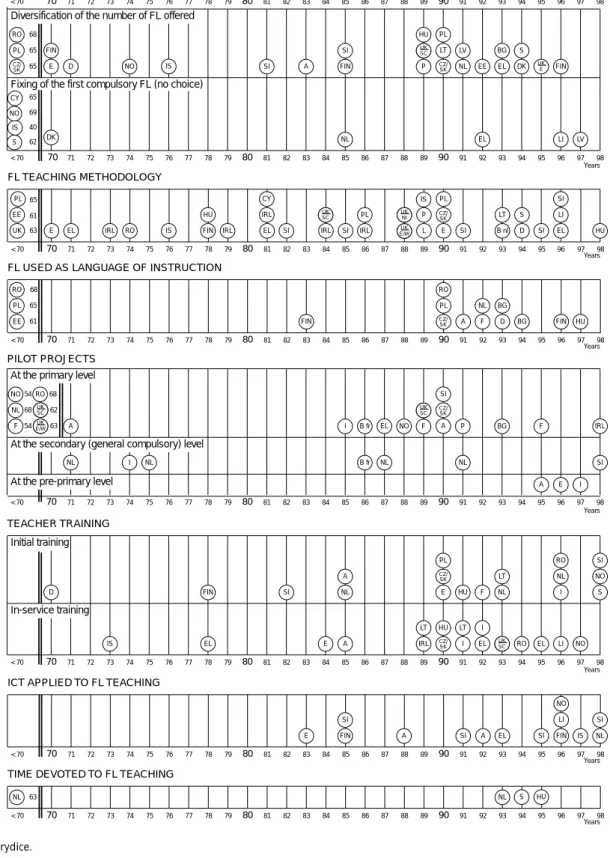
3. Diagrams illustrating the organisation of foreign language teaching in 1974 and 1984 75
C
HAPTER3
O
RGANISATION OFT
EACHING 81Introduction 81
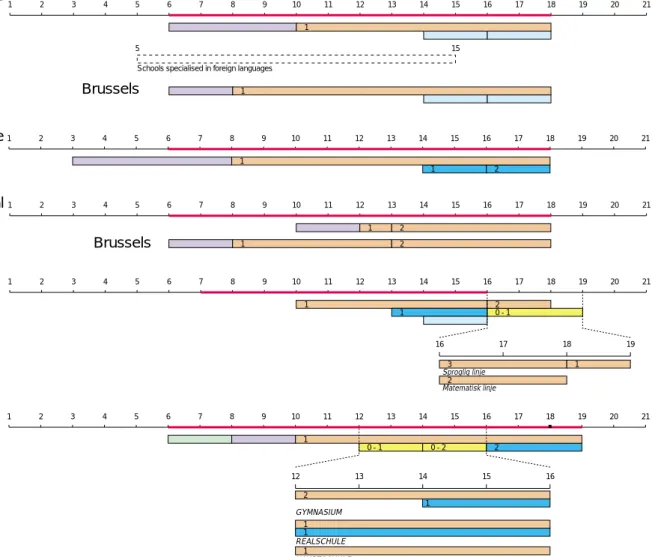
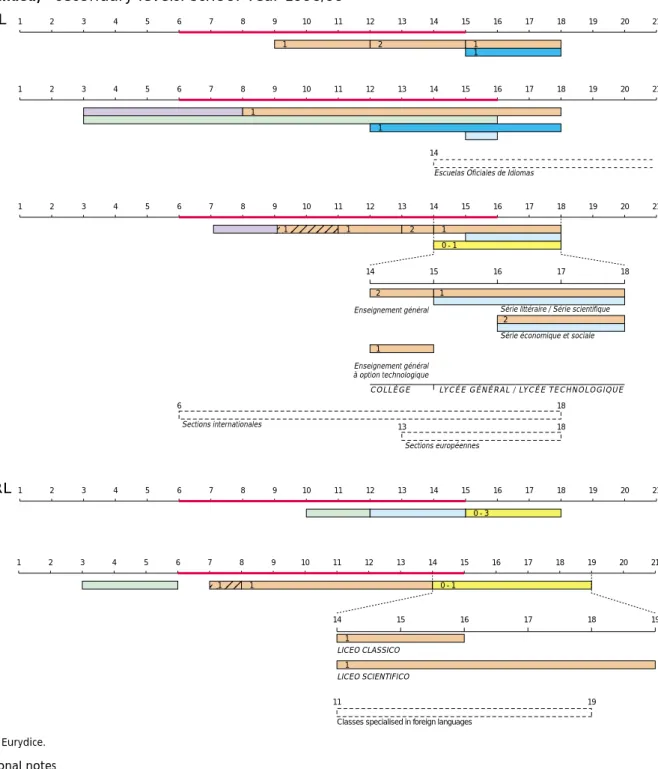
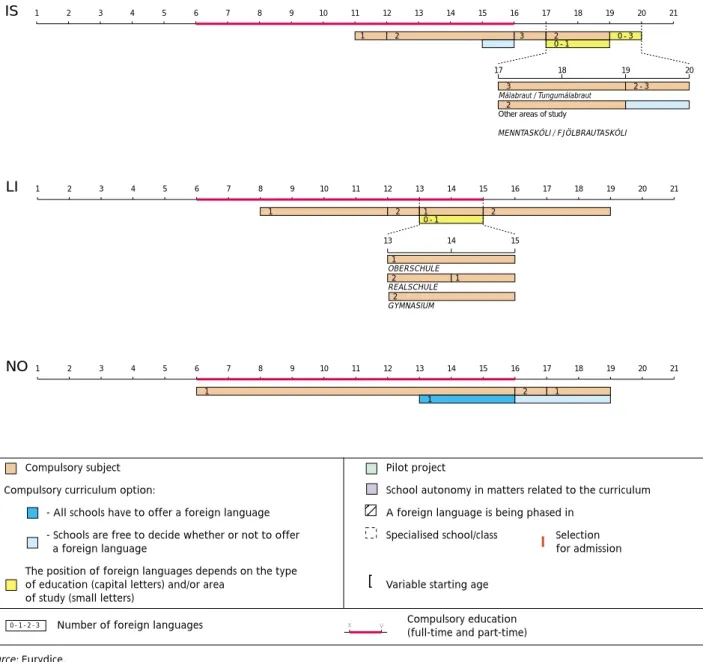
1. The place of foreign languages in education systems 81
2. Range of languages offered in compulsory education 94
3. Time allocated to foreign language teaching 100
4. Standards as to number of pupils in foreign language classes 104
5. Special initiatives: exchanges between foreign language pupils 105
C
HAPTER4
P
ROFESSIONALQ
UALIFICATIONS ANDT
RAINING OFT
EACHERS 113Introduction 113
1. Professional qualifications of foreign language teachers at primary level 113
2. Initial training of foreign language teachers 121
3. In-service training of foreign language teachers 136
Annex 145
C
HAPTER5
F
OREIGNL
ANGUAGEC
URRICULA 149Introduction 149
1. Methods of developing curricula 149
2. Key features of foreign language curricula 151
3. Analysis of the content of foreign language curricula 157
4. Mechanisms for monitoring the application of the curricula 168
C
HAPTER6
E
UROPEANC
OMMUNITYA
CTIONS 173Introduction 173
1. Development of Community policy 173
2. Overview of Community actions 175
3. The Lingua actions in the Socrates programme 1995 – 1999 179
4. New initiatives to promote language learning 186
Annex 190
S
UMMARY ANDC
ONCLUSION 191B
IBLIOGRAPHY 199INTRODUCTION
1. BACKGROUND TO THE STUDY
Europe is the meeting point for a variety of multicultural and multilingual societies, which are the prod-uct of its history and have enriched it and given it strength. This same diversity creates a special need for communication, mutual understanding and tolerance between peoples.
The European institutions have always set much store by this inherent richness of Europe and felt it had to be respected by encouraging the preservation of the continent’s many languages and cultures. Encouraging people to learn the languages that form part of Europe’s cultural heritage has been an established objective of European cooperation in the field of education from the outset. In 1976, the Resolution of the Council and of the Ministers for Education included the aim of ‘offering all pupils the opportunity of learning at least one other Community language’, also advocating that ‘before qualify-ing as a foreign-language teacher a student should have spent a period in a country or region where the language he is to teach is spoken’ (p. 4). Since then, there has been a succession of Community ini-tiatives in the field of teaching and learning foreign languages and the launching of the Lingua pro-gramme in 1989 reflects this sustained commitment.
In present-day Europe, the acquisition of language skills by European citizens has become a prerequi-site for full-fledged participation in the new professional and personal opportunities open to them. This priority is clearly stated in the 1995 European Commission White Paper on education and training, in relation to the following objectives (p. 69):
•
‘Promote the learning of at least two Community foreign languages by all young people.•
Encourage innovatory language-teaching methods.•
Spread the daily use of European foreign languages in schools of all levels.•
Foster awareness of Community languages and cultures, and their early learning.’Fully aware of how important knowledge of foreign languages has become, the European Parliament and the Council, following a proposal by the European Commission, have declared that 2001 should be the ‘European Year of Languages’. The initiative aims to ‘raise awareness of the richness of linguis-tic and cultural diversity’ and to extend the learning of foreign languages to a broader public ‘as a key element in the personal and professional development of individuals’ (p. 3). The Year is organised in close cooperation with the Council of Europe which has also declared 2001 to be the ‘European Year of Languages’.
To date, however, the language proficiency level of young Europeans has not been subject to interna-tional assessment. The only data collected in this respect comes from Eurobarometer survey opinion polls (1). The April 2000 survey revealed that less than half of the citizens of the European Union claim to be able to hold a conversation in a language other than their mother tongue. The results of this opin-ion poll highlight the need to further encourage European citizens to learn foreign languages.
Faced with the challenge of acquiring proficiency in foreign languages, European education systems have made every effort to respond to the wide variety of associated demands. All young Europeans
(1) Eurobarometer surveys are commissioned by the Directorate-General for Education and Culture of the European
attend school and, for many of them, this is where they are most likely to acquire linguistic skills. It is thus important to examine those aspects of the education system which are conducive to language pro-ficiency among children at school.
In this respect, the methodological approaches of the curricula of European countries should be regarded as key elements. Prevailing teaching methods reflect the basic assumptions of one of the most prominent trends in foreign language teaching methodology, namely the communicative approach. Drawing on the work of authors such as S.D. Krashen, this approach is based on the premise that the strategies underlying acquisition of a foreign language are similar to those used in learning the mother tongue. This means exposing learners to the target language through experiences (such as immersion) that are close to the natural context, and focusing on the meaning of what is being communicated rather than on its form. The approach was thus developed by giving priority to the ability to communi-cate. However, researchers have started to identify limits to this approach, which has left its imprint on the educational scene, and already refer to the ‘post-communicative’ era (2).
Implementation of the teaching methods recommended by education authorities requires high stan-dards of competence from those most actively involved – the teachers themselves. It therefore has an impact on the way initial and in-service teacher training is organised. The introduction of foreign lan-guages at school at an increasingly early age also has to confront the issue of difficulty in recruiting teachers as a result of the rising demand for them which appears particularly acute in primary educa-tion.
The urgency and importance of these matters for policy-makers and administrators in the area of teacher training vary from one country to the next. To comply with the new requirements, adjustments need to be made to initial and in-service teacher training systems. The process depends on a number of factors, which vary in accordance with the history, culture and economic structures of the countries in question.
2. SCOPE OF THE STUDY
The objective of the present study is to analyse of how foreign language teaching is organised at school. The scope is, however, restricted to public and grant-aided private education. Private initiatives organ-ised outside the school system, such as language courses offered by enterprises, academies or local authorities, are not covered.
The study focuses on teaching organisation, teacher training and recruitment, the content of curricula, support measures for minority languages and Community actions in the field of language teaching.
L
EVELS OFE
DUCATIONC
ONCERNEDThe information dealt with in this document covers the primaryand the lower and upper general
secondary education levels. However, parts of the study also deal with other levels of education. In
this way, the Community actions described in Chapter 6 concern all levels of education, including ter-tiary education. The same applies to teacher training, in Chapter 4, where all education levels are cov-ered except the pre-primary level.
To the extent that the school path is not always structured around three levels, the International Standard Classification for Education (ISCED) was used to facilitate comparisons between countries.
T
HE‘F
OREIGNL
ANGUAGE’ F
OCUSForeign languages are considered an essential discipline in compulsory education curricula in European countries. This core subject, referred to as ‘foreign language’ in the context of the study, usually occurs in the form of a subject to be taught. However, it can also be used as the language of instruction for other subjects. The point of view of the pupil’s mother tongue is not taken into account in defining the focus of the analysis.
The terms used in the national curricula to refer to the subject of the present study are listed in the table below. This table shows that different forms of the ‘foreign language’ subject are encountered, which often amount to terminological variations related to the cultural tradition underlying the education sys-tem of each country. Expressions such as ‘living languages’, ‘modern languages’ or ‘second language’ occur in the curricula of certain countries. However, considering that the term ‘foreign language’ seems to be the most widely used, it was adopted to serve the purpose of this study.
The so-called ‘dead’ or ‘ancient languages’ such as Latin or Ancient Greek are not covered, except in a few cases where the curricula offer these languages as options that a pupil can choose as alternatives to ‘foreign languages’ in the same timetable slot. These rather exceptional occurrences are reported in the study.
Terminological variations of ‘foreign language’ within curricula
TERM IN THEORIGINALLANGUAGE(3) TRANSLATION
EUROPEANUNION
B fr LANGUE MODERNE Modern language
B de FREMDSPRACHE OR Foreign language or
ZWEITSPRACHEFRANZÖSISCH French as a second language
(the latter specifically refers to French)
B nl TWEEDE TAAL Second language
DK FREMMEDSPROG Foreign language
D FREMDSPRACHE Foreign language
EL Foreign language
E LENGUA EXTRANJERA OR Foreign language or
IDIOMA EXTRANJERO foreign idiom
F LANGUE VIVANTE ÉTRANGÈRE Living foreign language
IRL FOREIGN LANGUAGE
I LINGUA STRANIERA Foreign language
L LANGUE ÉTRANGÈRE(4) Foreign language
NL MODERNE VREEMDE TALEN Modern foreign languages
A LEBENDEFREMDSPRACHE Living foreign language
P LINGUA ESTRANGEIRA Foreign language
FIN VIERAS KIELI/ FRÄMMANDE SPRÅK Foreign language
S FRÄMMANDE SPRÅK Foreign language
UK (E/W) MODERN FOREIGN LANGUAGES
UK (NI) MODERN LANGUAGES
UK (SC) MODERNEUROPEAN LANGUAGES
EFTA/EEA
IS ERLENT MÁL OR ERLENT TUNGUMÁL Foreign language
LI MODERNEFREMDSPRACHEN Modern foreign languages
NO FREMMEDSPRÅK OR Foreign language or
ANDRESPRÅK other language
PRE-ACCESSIONCOUNTRIES
BG Чужд Eзик Foreign language
CZ CIZÍ JAZYK Foreign language
EE VÕÕRKEEL Foreign language
CY XENES GLOSSES Foreign languages
LV SVESVALODA˘ Foreign language
LT UZSIENIO KALBA Foreign language
HU ELÖ IDEGEN NYELV Living foreign language
PL JEZYK OBCY Foreign language
RO LIMBI MODERNE Modern languages
SI TUJI JEZIKI OR Foreign languages or
MODERNI TUJI JEZIKI Modern foreign languages
SK CUDZÍ JAZYK Foreign language
(3) The terms are listed here in the form in which they occur in the curricula of the relevant countries, which is why some may
be in the plural, others in the singular.
(4) The actual term ‘foreign language’ is only used in curricula for the secondary education level and only for languages other
than French and German.
ˇ
‘
R
EFERENCEY
EARThe reference year for the data presented in the different chapters of this publication is the school year
1998/99, except in Chapter 2, which is dedicated to the historical background and contains references
that date back to the 1970s and earlier. Statistical data presented in Chapter 3, on the organisation of teaching, refer to the school year 1996/97.
Reforms introduced after the school year 1998/99 are also mentioned, either in a footnote or the body of the text. In this way, the reader’s attention is drawn to the fact that some situations are still being phased in or should be implemented in the near future.
3. METHODOLOGY
Each chapter of the study is based on the analysis of answers to five specific questionnaires developed by the research team at the Eurydice European Unit, with the exception of Chapter 6, drawn up by the European Commission. In view of the mass of data to be collected and the wide range of aspects to be covered, the questionnaires were mailed to the network’s National Units in several stages, from 1998 onward.
Based on the contributions by the National Units, the European Unit drew up a comparative analysis of each aspect covered by the study. The National Units then carefully re-read this first draft, to ensure that national data are correctly interpreted in the comparative analysis. The text set out in this document is the result of these essential and fruitful exchanges, i.e. it incorporates corrections and improvements suggested by the National Units.
To prepare their contributions, most National Units called upon national experts who specialise in each of the fields examined. The participation of such experts clearly adds value and substance to the pre-sent study. The synergy and close collaboration between the different partners, both at national level and with the European Unit, paved the way for the smoother conduct of this complex analysis. The names of all people involved in drawing up this study are acknowledged at the end of the document.
The analysis in Chapter 1 is based not only on responses to the questionnaires but on publications devoted to the promotion of languages within a multilingual environment. References are included in the bibliography. It is also worth clarifying the methodological approach used to draw up Chapter 5 on the analysis of the content of foreign language curricula. Indeed, this chapter involved processing and analysing a considerable volume of national documents. Prior to developing the data collection ques-tionnaire for this chapter, the European Unit sent the network a set of questions assessing the overall feasibility of such an analysis. Subsequent to the feedback from National Units, it was possible to develop a highly elaborate questionnaire on the content of curricula and the official teaching recom-mendations for foreign language teaching. Strict directions were given to the Units with a view to remaining as faithful as possible to the original text of the curricula. They were asked to identify the passages from curricula containing the information requested.
Thousands of pages were read and processed by the national partners in order to respond to the ques-tionnaire. As a result of this detailed work, the European Unit was not only able to produce a compar-ative analysis of the language curricula’s teaching contents and objectives and of recommendations on teaching methods that they contain, but also to come up with national summary tables for each coun-try. These tables present elaborate information based on the actual text of the curricula.
The Eurydice National Units went to great lengths to include a wealth of invaluable and detailed national information in their responses to the five data collection questionnaires. To add value to the contents of these contributions, they provided reports accounting for specific national characteristics.
These descriptions obey the same logic as the comparative analysis. A section on reforms underway or specific provisions made by national education authorities in the field of foreign language teaching was added to the framework. National descriptions will be available on the Eurydice website during the first half of 2001.
4. STRUCTURE OF THE STUDY
The study is divided into six chapters that can be regarded as self-contained units. Each chapter con-tains all relevant informative items, including diagrammatic representations with explanatory notes. Some chapters include annexes presenting the data broken down per country. The annex to Chapter 3 on the organisation of teaching also contains a guide to reading the diagrams pertaining to the place of foreign languages in education systems.
A glossary presented at the beginning of the document contains the codes and definitions of specific terms used in this study. At the end, an annex presents a synthesis of foreign language curricula in the form of tables.
G
LOSSARYThe glossary contains the country and language codes that are consistently used throughout the docu-ment and national abbreviations in their original language, as well as notes and definitions relating to a range of terms some of which are specific to this study. Only those terms likely to be helpful to the reader in understanding the concepts referred to in the different chapters were retained. Each term comes with a suitable definition.
C
HAPTER1: L
ANGUAGES
UPPORT IN AM
ULTILINGUALE
NVIRONMENTFaced with the cultural and linguistic diversity that characterises the European territory, education sys-tems endeavour to meet varying needs and demands by adjusting school conditions. The first chapter describes measures put in place by the different countries with a view to preserving and promoting their linguistic heritage within the framework of the education system. It describes the array of actions imple-mented for the benefit of pupils belonging to minority/regional language communities, as well as steps taken to assist whose mother tongue is not that of the host country. Support measures developed by education authorities to help such pupils learn the official state language are also examined.
C
HAPTER2: H
ISTORICALB
ACKGROUNDKey events that had an impact on the development of foreign language teaching today are summarised in this chapter. Major changes having occurred during the first half of the 20th century are analysed in summary fashion, so that more time can be spent examining the main domains covered by the reforms implemented as of 1950. In this chapter, the reader will encounter precise references as regards mea-sures affecting various aspects of language teaching. Thus, an entire section illustrates important reforms that affected the organisation of language teaching as well as the training of language teachers.
This chapter is closed by a series of comparative diagrams on the status of foreign languages within the education systems, in 1974 and in 1984. The situation in the reference year 1998/99 is described in the following chapter.
C
HAPTER3: O
RGANISATION OFT
EACHINGThis chapter first presents a comparative analysis of the place and status of the ‘foreign language’ sub-ject within the minimum curricula of education systems. Diagrams showing the situation per country illustrate this analysis.
Other aspects are also considered, such as the range of foreign languages offered in the curriculum and choices made by pupils; time allocated to foreign language teaching; official recommendations as to the maximum/minimum number of pupils per language class; and initiatives regarding linguistic exchanges between European students.
The annex at the end of the chapter contains a guide to reading the diagrams. It also includes a break-down per country of quantitative data on the percentage of pupils learning various languages and the number of hours allocated to foreign language teaching and two other subjects in the curriculum.
The material in Chapter 3 was also used to compile and publish a booklet in the Eurydice Focus series in September 2000. This took a closer look at the place and status of foreign languages throughout school careers in all 29 European countries covered.
C
HAPTER4: P
ROFESSIONALQ
UALIFICATIONS ANDT
RAINING OFT
EACHERSThis chapter analyses how education authorities attempt to cope with new issues that result from the recent introduction of foreign language teaching as of the first years of primary school. It describes measures put in place for initial and in-service training of foreign language teachers as well as methods of recruitment and selection.
An entire section is devoted to the different institutions in charge of initial training of language teach-ers, their admissions criteria, the content of curricula and the organisation of study visits and stays in countries where the target language is spoken.
In-service training of language teachers is also examined, with a description of the type of activities, the bodies responsible for organising them, the content of such programmes and the exchange arrange-ments between teachers of different countries.
The annex presented at the end of the chapter contains available information per country on time allo-cated to command of the foreign language within general training, as well as the proportion of time allocated to language teaching methodology and practical training in the vocational training of future teachers.
C
HAPTER5: F
OREIGNL
ANGUAGEC
URRICULAThis is where the reader will find the results of an in-depth analysis of the content of the curricula and/or the official recommendations on foreign language teaching. The first section focuses on features of the documents that contain foreign language curricula – such as their status, the method used to draw them up, their date of publication, the number of years of study covered and the foreign languages concerned.
The body of the analysis deals with teaching objectives/contents and recommendations relating to teaching methodology as stated in the curricula. The information is structured around four main themes: communication, grammatical aspects, knowledge and understanding of other people, and fos-tering pupils’ independent learning and personality development.
This chapter also presents the results of surveys conducted at national or even international level, inves-tigating various aspects of language teaching.
C
HAPTER6: E
UROPEANC
OMMUNITYA
CTIONSThis publication would fail to be comprehensive if it lacked a presentation of initiatives taken by the European Union in the field of foreign language teaching. In this perspective, Chapter 6 offers a review of Community policy documents (mainly resolutions and recommendations), describes actions under-taken to promote foreign language teaching at different moments of the Community’s history, and takes a closer look at the Lingua programme. A section analyses the different actions of the latter in some detail and illustrates their increasing success since they were developed in 1989.
The authors of this chapter are the people in charge of the programme within the European Commission, Directorate General for Education and Culture.
S
UMMARY ANDC
ONCLUSIONThis closing part summarises all aspects analysed within the framework of the different themes devel-oped in the six chapters. It moreover undertakes to highlight the issues and controversies that form the substance of current debate on the direction that foreign language teaching should take, in a world that is constantly undergoing changes.
A
NNEXLinked with Chapter 5 on the official foreign language curricula, the Annex at the end of the publica-tion contains the napublica-tional summary tables. These present, for each individual country, key informapublica-tion pertaining to the teaching objectives/content and methodology set out in the foreign language curric-ula, including their formal characteristics (exact title of the document in the country’s language, its year of publication, the level of education and foreign languages concerned). The Annex begins with a ‘stan-dard table’, which provides readers with a detailed explanation of the content that they will find under the headings of the tables for each individual country.
GLOSSARY
A. CODES AND ABBREVIATIONS
C
OUNTRY CODESEU EUROPEANUNION
B BELGIUM
B fr BELGIUM– FRENCHCOMMUNITY
B de BELGIUM– GERMAN-SPEAKINGCOMMUNITY B nl BELGIUM– FLEMISHCOMMUNITY
DK DENMARK D GERMANY EL GREECE E SPAIN F FRANCE IRL IRELAND I ITALY L LUXEMBOURG NL NETHERLANDS A AUSTRIA P PORTUGAL FIN FINLAND S SWEDEN UK UNITEDKINGDOM
UK (E/W) ENGLAND ANDWALES UK (NI) NORTHERNIRELAND
UK (SC) SCOTLAND
EFTA/EEA EUROPEANFREETRADEASSOCIATION/ EUROPEANECONOMICAREA
IS ICELAND LI LIECHTENSTEIN NO NORWAY PRE-ACCESSION COUNTRIES BG BULGARIA CZ CZECHREPUBLIC EE ESTONIA CY CYPRUS LV LATVIA LT LITHUANIA HU HUNGARY PL POLAND RO ROMANIA SI SLOVENIA SK SLOVAKIA
N
ATIONAL ABBREVIATIONS IN THEIR LANGUAGE OF ORIGIN AND OTHER ABBREVIATIONSAAP Assessment of Achievement Programme UK
ACCAC Curriculum and Assessment Authority for Wales UK
CCEA Northern Ireland Council for the Curriculum, Examinations and Assessment UK
CE2 Cours élémentaire 2 F
CILT Centre for Information on Language Teaching and Research UK
CLIL Content and Language Integrated Learning
CM1, 2 Cours moyen 1, 2 F
CSPOPE Cursos Secundários Predominantemente Orientados para o Prosseguimento de Estudos P
EAL English as an additional language UK
EGB Educación General Básica E
EPLV Enseignement précoce des langues vivantes F
HAVO Hoger algemeen voortgezet onderwijs NL
HBO Hoger beroepsonderwijs NL
HMSO Her Majesty’s Stationery Office UK
ICT Information and communication technologies
IKY EL
ILSSE Insegnamento delle Lingue Straniere nella Scuola Elementare I
INCE Instituto Nacional de Calidad y Evaluación E
IRRSAE Istituti Regionali di Ricerca, Sperimentazione e Aggiornamento Educativi I IT Information technologies
IUFM Instituts Universitaires de Formation des Maîtres F
KMK Ständige Konferenz der Kultusminister der Länder in der Bundesrepublik Deutschland D
LGE Ley General de Educación E
LOGSE Ley Orgánica de Ordenación General del Sistema Educativo E
MAVO Middelbaar algemeen voortgezet onderwijs NL
MEN Ministerul Educañiei Nañionale RO
NCCA National Council for Curriculum and Assessment IRL
NFER National Foundation for Educational Research UK
OALT Onderwijs in Allochtone Levende Talen NL
OFSTED Office for Standards in Education UK
PEK EL
PGCE Postgraduate Certificate in Education UK
QCA Qualifications and Curriculum Authority UK
SCRE Scottish Council for Research in Education UK
SLO Stichting voor Leerplanontwikkeling NL
SME Small and Medium-sized Enterprises
VBO Voorbereidend beroepsonderwijs NL
VWO Voorbereidend wetenschappelijk onderwijs NL
ÿ/!#. !.2+ 2! 3+
L
ANGUAGE CODES ES SPANISH DA DANISH DE GERMAN EL GREEK EN ENGLISH FR FRENCH IT ITALIAN NL DUTCH PT PORTUGUESE FI FINNISH SV SWEDISH EE ESTONIAN LV LATVIAN RU RUSSIAN SK SLOVAKA
BBREVIATIONS OF STATISTICAL TOOLS AND OTHER CLASSIFICATIONS (:) NOT AVAILABLE(–) NOT APPLICABLE FL FOREIGN LANGUAGES FTE FULL-TIMEEQUIVALENTS
ISCED INTERNATIONALSTANDARDCLASSIFICATION FOREDUCATION
OPEC OFFICE FOROFFICIALPUBLICATIONS OF THEEUROPEANCOMMUNITIES UOE UNESCO/OECD/EUROSTAT
B. DEFINITIONS OF STATISTICAL TOOLS
T
HEUOE D
ATAC
OLLECTIONThe UOE (Unesco/OECD/Eurostat) data collection is an instrument through which these three organiza-tions jointly collect internationally comparable data on key aspects of education systems on an annual basis using administrative sources. Data collected cover enrolments, new entrants, graduates, educa-tional personnel, education institutions and educaeduca-tional expenditures. The specific breakdowns include level of education, gender, age, type of programme (general/vocational), mode (full-time/part-time), type of institution (public/private), field of study and country of citizenship. In addition, to meet the information needs of the European Commission, Eurostat collects enrolment data by region and on for-eign language learning.
T
HEI
NTERNATIONALS
TANDARDC
LASSIFICATION FORE
DUCATION(ISCED)
In order to facilitate comparison between countries, the different levels of national education have been allocated the various ISCED levels as follows:
ISCED 0: pre-primary education. ISCED 1: primary education.
ISCED 2: lower secondary education. ISCED 3: upper secondary education.
ISCED 5: higher education programmes generally leading to an award not equivalent to a university first degree but admission to which requires at least the completion of upper secondary edu-cation.
ISCED 6: higher education programmes leading to a first degree or equivalent.
ISCED 7: higher education programmes leading to a postgraduate degree or equivalent.
Since data was collected for the 1997/98 academic year, a new classification has been used. The levels 0, 1, 2 and 3 remain unchanged. A level 4 has been created, and corresponds to post-secondary edu-cation outside higher eduedu-cation. Level 5 covers university and non-university courses in higher educa-tion leading to a first qualificaeduca-tion. Admission to them requires as a minimum the satisfactory comple-tion of upper secondary educacomple-tion, or equivalent courses offered in post-secondary educacomple-tion. Level 6 covers courses in higher education leading to an advanced research qualification. Level 7 has been abol-ished.
C. NOTES AND DEFINITIONS
Areas of study: the sections/streams chosen by pupils from among the possible general types of
edu-cation and, where the curriculum is flexible, the programmes put together by pupils in preparation for their final examinations. This concept describes what is current practice in a certain number of coun-tries at the general upper secondary level.
Autochthonous language: a language spoken by a population that has been settled in a specific
region for several generations and which is closely associated with the geographical area where it is spo-ken.
Bilingual education/teaching: education during the course of which two or more languages are used
as languages of instruction for the curriculum subjects.
Closed compulsory curriculum option system: a system in which schools are not free to choose the
subjects they offer as compulsory curriculum options.
Communicative approach: methodological approach to language teaching based on the assumption
that the strategies underlying the process of foreign language acquisition are similar to those used in learning the mother tongue. Consequently, it is very important to expose pupils as much as possible to the foreign language and to offer them frequent opportunities to use it in situations closely related to real life. The main objective is to teach pupils to communicate in a foreign language. The ability to pro-duce a comprehensible message is hence regarded more important than the message’s formal aspect.
Compulsory curriculum option: one of a set of subjects offered by the school, from which pupils have
to select a limited number in order to cover part of their minimum curriculum.
Compulsory subject: a subject included in the minimum curriculum drawn up by the central
educa-tion authority, which all pupils are obliged to study.
Foreign language: the term of ‘foreign language’ refers to any language regarded as such or
associ-ated with that concept (living language, modern language, B language, second language) in curricula or other official documents relating to education. In general, curricula consider a foreign language as a subject to be taught. It can, however, also be used as the language of instruction for other subjects. The point of view of the pupil’s mother tongue is not taken into account in this context. The so-called ‘dead’ or ‘ancient’ languages normally fall outside the scope of the definition.
Major skills: the four areas of competence relating to communication activities: listening, speaking,
reading and writing.
Minimum curriculum: a compulsory curriculum drawn up by the central education authorities in the
form of a common core of subjects that must be taught to all pupils. It can also take the form of a flex-ible curriculum in which pupils themselves choose the subjects they wish to study for their final exam-inations.
Minority/regional language: a language that is ‘traditionally used within a given territory of a State
by nationals of that State who form a group numerically smaller than the rest of the State’s population, and is different from’ the state language(s) of that State. (Definition based on the European Charter for Regional or Minority Languages, Council of Europe, 1992). In this context, account is taken only of those minority/regional languages that have been recognised as such by the countries under consider-ation. As a general rule, these are languages of populations that have their ethnic roots in the areas concerned or have been settled in these regions for generations. Minority/regional languages can have
the status of official languages, but by definition this status will be limited to the area in which they are spoken.
Mother tongue: the first language learnt by a child – usually the language spoken by one or both
par-ents.
Non-territorial language: a language ‘used by nationals of the State which differs from the language
or languages used by the rest of the State’s population, but which, although traditionally used within the territory of the State, cannot be identified with a particular area thereof.’ (Definition based on the European Charter for Regional or Minority Languages, Council of Europe, 1992.)
Official language: a language used for legal and public administration purposes within a specified
area of any given State. The official status can be limited to part of the State or extend over its entire territory. Languages with official status for the whole of the country are referred to as official lan-guage(s) of the State or state lanlan-guage(s). They serve as a tool to promote identification with the State and to facilitate interaction between the different linguistic communities present in any given State.
Open compulsory curriculum option system: a system in which the schools are free to choose the
subjects they offer as compulsory curriculum options.
Optional elective subject: a subject which is offered in addition to the minimum curriculum and
which pupils are not obliged to study.
Pilot project: foreign language teaching experiment, limited in time, and at least in part established
and financed by the relevant education authorities. The number of participating schools and the age of the pupils involved are determined by the organising bodies, which make a selection. Such experiments are subject to systematic assessment.
Schools/classes that specialise in foreign languages: schools/classes that offer an education
spe-cialising in foreign languages. These classes are organised and funded by the country’s ministry of edu-cation, and the latter recognises the specialisation awarded. A further distinction can be made between two different types, based on their more specific characteristics:
•
Schools that are part of a structure running in parallel to the ordinary school system and do not teach the minimum curriculum, but just a larger or smaller number of foreign languages, leading to the award of a qualification.•
Schools/classes that offer the whole of the minimum curriculum and, at the same time, offer edu-cation that specialises in foreign languages – by using the target language as the language of instruction for certain subjects (bilingual school/class) and/or by making the study of additional for-eign languages compulsory and/or by allocating a proportionally larger number of teaching periods to foreign languages than in non-specialised schools/classes.Target language: the foreign language that is being taught.
Teaching language/language of instruction: the language used to teach a certain proportion of
subjects included in the curriculum.
Types of education: different types of courses, which are based on different curricula and belong to
general, non-specialised education. For example, the Austrian Hauptschule and allgemeinbildende höhere Schuleare two different types of school within general secondary education.
CHAPTER 1
LANGUAGE SUPPORT
IN A MULTILINGUAL ENVIRONMENT
INTRODUCTION
This chapter is an attempt to give an overview of the different ways in which the countries participat-ing in this study try to promote and preserve their lparticipat-inguistic heritage with the help of the education sys-tem. It offers a description of measures to support languages of minority/regional and foreign mother tongue communities as well as to promote the state language amongst these populations. Where applicable, it addresses specific situations of individual countries with particular reference to those with several state languages and with decentralised multilingual education systems.
It is important to be aware that Chapter 1 deals exclusively with all forms of bilingual/multilingual edu-cation intended to serve the specific linguistic needs of communities whose native language differs from the majority of a country’s population. A discussion of multilingual educational provisions aiming to improve the proficiency of pupils in certain widely used languages rather than preserve and promote the native language of minority, regional or migrant populations is provided in Chapter 3.
Due to the generally very complex nature of linguistic situations in the countries studied, some terms used in the following sections may, within the context of each country, be subject to differing mean-ings and interpretations and embrace varying characteristics and concepts. In order to establish a suit-able common framework to accommodate the great diversity of multilingual environments described by the individual countries, the following terms had to be strictly defined: autochthonous language, official language, state language, minority/regional language and non-territorial language. Please refer to the glossary for further information.
Article 126 of the Maastricht Treaty (1992) specifically refers to the cultural and linguistic diversity of European education systems. Figure 1.1 tries to explore this diversity by providing an overview of the main autochthonous languages benefiting from special support within the education systems of the 29 countries under consideration. Inclusion in this figure, which by no means claims to present an exhaus-tive list, is based on the relaexhaus-tive importance of these languages within each country’s education system.
A quick glance at Figure 1.1 is enough to observe that the majority of European citizens live in a mul-tilingual environment. Only 16 out of the 29 countries under consideration have a single official guage, while the rest employ between 2 and 5, with a concentration of countries with co-official lan-guages in the EU area. Within the group of countries with more than one official language, five (Belgium, Ireland, Luxembourg, Finland, Cyprus) use all their official languages as state languages. This linguistic diversity is further enriched by a large number of minority and regional languages. Their con-centration is highest in the pre-accession countries, with up to seven of these languages used for teach-ing in some of these countries. Amongst the 29 countries under consideration, only five did not signal the presence of any minority/regional language (Ireland, Luxembourg, Iceland, Liechtenstein and Cyprus). In order to complete the European language mosaic we also have to add all languages used by migrant populations and the two non-territorial languages of Romany and Yiddish. Two countries, Iceland and Liechtenstein, can be classified as monolingual, as they signalled only one official language and no minority/regional languages.
B fr B de B nl DK D EL E F IRL I L NL A P FIN S UK UK UK E/NI W SC Basque MRO MR Belorussian Breton MR Bulgarian Castilian S Catalan MRO MR Corsican MR Croatian MRO Czech MR Danish S MR Dutch MR S S English S S S S Estonian Finnish (1) S MR French S MR MR S MRO S Frisian MR MRO Galician MRO German S MR S MRO S S Greek S Hungarian MRO Icelandic Irish Gaelic S MR Italian S Ladin MRO L. Moselle reg. (2) MR Latvian Letzeburgesch S Lithuanian Mirandês MR Norwegian Occitan MR Polish Portuguese S R. L. of Alsace (3) MR Romanian Romany MNT MNT NNTT MNT Russian Ruthenian Sami MR MR Scottish Gaelic MR Serbian Slovak MR
Slovene MRO MRO
Sorbian MRO Swedish S S Turkish MR Ukrainian Valencian MRO Welsh MRO B fr B de B nl DK D EL E F IRL I L NL A P FIN S UK UK UK E/NI W SC S State language
MR Recognised minority/regional language without official language status
Figure 1.1: Main autochthonous languages represented in the European education systems
(1) For Sweden, the line Finnish comprises Tornedalen Finnish.
(2) L. Moselle reg.: languages of the Moselle region (langues mosellanes– France)
IS LI No BG CZ EE CY LV LT HU PL RO SI SK Basque MR MR MR Belorussian Breton S Bulgarian Castilian Catalan Corsican MR Croatian S Czech Danish Dutch English S MR Estonian MR Finnish (1) French Frisian Galician S MR MR MR MR MR MR German S Greek MR S MR MRO MR Hungarian S Icelandic Irish Gaelic MRO Italian Ladin L. Moselle reg. (2) S Latvian Letzeburgesch MR S MR Lithuanian Mirandês S Norwegian Occitan MR MR MR S MR Polish Portuguese R. L. of Alsace (3) MR S Romanian N NTT NNTT NNTT MNT NNTT NNTT NNTT Romany MR MR MR Russian MR Ruthenian MRO Sami Scottish Gaelic MR MR Serbian MR MR MR MR S Slovak MR S Slovene Sorbian Swedish MR S Turkish MR MR MR MR MR MR MR Ukrainian Valencian Welsh IS LI NO BG CZ EE CY LV LT HU PL RO SI SK
MRO Recognised minority/regional language with official language status NT Non-territorial language
MNT Non-territorial language recognised as minority language
Reference Year 1999
(3) R. L. of Alsace: regional languages of Alsace (langues régionales d’Alsace– France).
PRE-ACCESSION COUNTRIES EFTA/EEA
1.
THE ROLE OF LANGUAGE IN THE EDUCATION SYSTEM OF
COUNTRIES WITH SEVERAL STATE LANGUAGES
As shown in Figure 1.1, just over a third of the participating countries use more than one official lan-guage. In general, these comprise one state language, which enjoys official status across the country’s entire territory, and one or several co-official languages. The latter are the autochthonous languages of certain minority populations and their status as official language tends to be restricted to the settlement area of the minority group in question. Most countries have assigned a dominant role to the state lan-guage by imposing it for use in public administration, legislation and jurisdiction, and by using it as the preferred medium of instruction. Far fewer are the countries that grant the status of official language of the State to more than one language. Ireland, Finland, and Cyprus opted for two state languages, Luxembourg and Belgium for three.
According to the Irish Constitution, both Irish and English are official languages for the whole of Ireland. In the Irish-speaking areas, all primary schools use Irish as a medium of instruction and there is support teaching for children whose mother tongue is not Irish. Secondary schools in these areas provide all or part of their teaching in Irish. In the rest of Ireland, Irish can be a medium of instruction at primary level and is taught as a subject at all other primary and secondary schools. English is taught as a subject in all Irish-medium schools.
According to the Luxembourg Language Act of 1984, Letzeburgesch is the national language. French is the language of legislation, and Letzeburgesch, French, and German are all languages of the judiciary and public administration. Letzeburgesch is the vernacular language of the majority of Luxembourg chil-dren and the sole medium of communication at pre-primary level. Once chilchil-dren move on to primary education, German becomes the predominant language of instruction, with French taught as a subject from the second year. During the course of lower secondary education, French gradually replaces German as a medium of instruction but science subjects, as well as history and geography, continue to be taught in German. By the time pupils reach upper general secondary education, all subjects are taught in French. In technical secondary schools, the use of German or French is determined by the spe-cialisation chosen. German is the preferred teaching language in the technologically oriented divisions while French is the dominant medium of instruction in the commercial sections. This trilingual environ-ment can sometimes pose educational problems for children from the migrant population and special support measures have been introduced to combat these difficulties.
The two state languages of Finland are Finnish and Swedish and each language community has its own institutional network from pre-primary to university level. Municipalities with both Swedish- and Finnish-speaking inhabitants must provide separate basic education for both language groups. All pupils learn both state languages at school.
Greek and Turkish, the two state languages of Cyprus, are both used as languages of instruction but never in the same schools. Neither Greek-medium nor Turkish-medium schools make the study of the other language compulsory. If the number of Turkish-speaking pupils is insufficient to warrant the establishment of a separate school with instruction in the mother tongue, the pupils concerned are offered education in private schools of their choice. The cost of this education is borne by the govern-ment.
Two countries, Belgium and Spain, occupy a special position within this context. Both countries have opted for the devolution of a great number of state competencies, including education and culture, to regional entities (Communities in Belgium and Autonomous Communities in Spain) with geopolitical and linguistic coterminous borders. This empowerment has led the Communities to use their regional or autochthonous languages as a tool to reinforce their social, cultural, and political structures and identi-ties. Consequently, these languages have often been the preferred if not the exclusive medium of instruction.
At the federal level, Belgium has three languages of the State: Dutch, French, and German. Following the devolution of a large number of competencies (including education) to the German-speaking, French and Flemish Communities in 1989, each Community made its respective language the only offi-cial language to be used in all matters under its jurisdiction. The situation is further complicated by the fact that Belgium is divided into four language areas: the German, French, and Dutch language areas, and the bilingual Region of Brussels-Capital. The 1963 Federal Law on the Linguistic Regime in Education stipulates that the use of any of these official languages as medium of instruction is limited to the language area concerned, except for certain minority language areas listed in Article 3. In Brussels, the language of instruction for all levels of education is either French or Dutch, with the other language taught as a compulsory subject. For the rest of the country, the three Communities differ in their approaches to teaching the other official languages to their pupils. Primary and secondary schools of the French Community have to offer Dutch, German or English as a foreign language. As a result, pupils can forgo studying either of the other two official languages during their entire school career by opting for English as a foreign language. In the Flemish Community, all schools offer French from the fifth year of primary education (cf. Article 9 of the Decreet van Basisonderwijs 13/7/1963). It is only for pupils in general (not technical and vocational) secondary education that the study of French is a com-pulsory subject during part of their course. In Dutch-medium schools in the Region of Brussels-Capital it is however compulsory to teach French already from the second year of primary education (cf. Article 10 of the Decreet van Basisonderwijs 13/7/1963). The German-speaking Community of Belgium has a large minority population of French speakers and offers their language either as a medium of instruc-tion or as a compulsory subject to all pupils until the end of upper secondary educainstruc-tion. Since schools in all three Communities employ different curricula and fall under the supervision of different authori-ties, any school offering tuition in more than one official language has to establish a separate teaching and administrative infrastructure for each language section.
Article 3 of the Spanish Constitution states that the official language of the State is Castilian and that all Spaniards have the obligation to know and the right to use it. It further states that in the Autonomous Communities the other Spanish languages are also official languages, in keeping with the Communities’ legislation. Since the creation of the Autonomous Communities, Castilian has remained the only official language in 11 out of 17 Communities. The remaining six (the Balearic Islands, Basque Country, Catalonia, Galicia, Navarra and Valencia) all have a second official language and, as a result of the transfer of responsibility for educational matters to the Communities, these languages have been given a more prominent role as a medium of instruction. The obligation to educate all children in Castilian as well as in the regional language of the Autonomous Community is assured in different ways by each of the Communities concerned, details of which can be found in the section on minority/regional languages.
2.
THE ROLE OF MINORITY/REGIONAL LANGUAGES IN EUROPEAN
EDUCATION SYSTEMS
In 1987, the European Parliament in its Resolution on the Languages and Cultures of Regional and Ethnic Minorities in the European Community supported the efforts of the Council of Europe to draw up a Charter of regional and minority languages and recommended that the Member States implement a number of measures, including the following:
•
arranging for all levels of education to be officially conducted in the regional and minority languages in the language areas concerned;•
officially recognising such courses, classes and schools;•
giving particular attention to the training of teaching staff in such languages and making the nec-essary educational resources available;•
promoting information on educational opportunities in the regional and minority languages;•
providing for the equivalence of diplomas, certificates, other qualifications, and evidence of profes-sional skills, so that members of regional and minority groups in one Member State would have eas-ier access to the labour market in culturally related communities in other Member States.Article 8 of the above-mentioned European Charter for Regional or Minority Languages (1992)requires countries to make education or a substantial part thereof available in the relevant regional or minority languages, or to provide for the teaching of such languages as part of the curriculum and to make such provision available at least to those pupils whose families so request, and whose number is considered sufficient.
2.1. C
RITERIA FOR THEI
NTRODUCTION OFM
INORITY/R
EGIONALL
ANGUAGET
EACHINGAnalysis of the information submitted by the participating countries revealed that the vast majority of policies reported are well in line with principles contained in the two texts listed above.
Out of the 29 countries under consideration, only five (Ireland, Luxembourg, Iceland, Liechtenstein and Cyprus) did not report the presence of any minority population with the right to education in its own mother tongue. Their citizens receive their entire education in one of the state languages.
Figure 1.2 provides an overview of the criteria that have to be met in order for a minority/regional lan-guage to be introduced into the education system of the lanlan-guage area concerned. It lists a maximum of three minority/regional languages per country, selected on the assumption that they give a repre-sentative view of this country’s situation. The term ‘legal obligation’ means that, on fulfilment of the necessary criteria, the school or relevant authority is obliged to introduce teaching in or of the minor-ity/regional language. The term ‘legal possibility’ indicates that, if the necessary criteria are fulfilled, the school or relevant authority is invited to consider introducing the minority/regional language as a medium of instruction or otherwise provide adequate support.
Figure 1.2: Criteria for the introduction of measures in support of minority/regional
language teaching in schools located in the language areas concerned. School Year 1998/99
Legal obligation Legal
possibility Country Minority/ For all Parental Minimum Sufficient Sufficient Decision by
regional language schools demand number funds number of individual of pupils qualified school or
teachers relevant authority
European Union B fr Dutch ● 16 B de French ● 16 B nl French ● 16 DK German ● 10 D Danish ● ● ● ● Frisian ● ● ● ● Sorbian ● ● ● ● EL Turkish E Basque ● Catalan ● Galician ● F Basque ● Breton ● Catalan ● IRL (–) I French ● German ● Slovene ● L (–) NL Frisian ● A Croatian ● 1 Hungarian ● 1 Slovene ● 1 P Mirandês ● FIN Sami ● 1 ● S Finnish (Tornedalen) ● 1 ● Romany ● 1 ● Sami ● 1 ● UK(W) Welsh ● UK (NI) Irish ● UK (SC) Gaelic ● ● Source: Eurydice. Explanatory note
Figure 1.2 lists a maximum of three minority/regional languages per country, selected on the assumption that they give a representative view of the country’s situation. The information given in this figure only refers to schools catering for pupils from the minority/regional language population. In the case of each country, languages are listed in alphabetical order.
Additional notes
Belgium: It is the number of families represented by their heads of households, and not the number of pupils, that is used as one of the criteria for
the decision on whether to introduce minority language education. This criterion is only valid for pre-primary and primary education, as secondary pupils are no longer legally entitled to education in their minority language. The German-speaking Community, however, continues to offer French tuition to its minority pupils until the end of upper secondary education.
Germany: Danish is a minority language in Schleswig-Holstein, Frisian in Lower Saxony and Schleswig-Holstein, and Sorbian in Brandenburg and Saxony. In this context only public-sector schools are considered (in Schleswig-Holstein, private Danish-medium schools are governed by their own
regulations). The criteria for introduction vary according to the Land and whether the language is used as a medium of instruction or taught as a subject. As for the introduction of the Frisian language, parental demand is a criteria in Schleswig-Holstein, but not in Lower Saxony. Sorbian enjoys the same status in Saxony as in Brandenburg.
Greece: According to the 1923 Treaty of Lausanne and the legislative arrangements and regulatory decisions issued by the Ministry of National
Education and Religious Affairs within the framework of treaties and agreements relating to international education, the Greek State is obliged to provide the necessary number of bilingual (Turkish and Greek) minority schools. Parents can choose either a Greek-medium or bilingual minority school for their children to attend.
France: Authorisation for minority language teaching is only granted if a minimum number of pupils register and if a sufficient number of teachers
is available.
Netherlands: This legal obligation applies to all primary and lower secondary schools (basisvorming) with possibilities for exemption.
Finland: All Sami children have the right to education in their mother tongue, but schools offering such education are eligible for state subsidies
Figure 1.2: Criteria for the introduction of measures in support of minority/
(continued) regional language teaching in schools located in the language areas concerned.
School Year 1998/99
Legal obligation Legal
possibility Country Minority/ For all Parental Minimum Sufficient Sufficient Decision by
regional language schools demand number funds number of individual of pupils qualified school or
teachers relevant authority
EFTA/EEA IS (–) LI (–) NO Finnish ● 3 Sami ● ● Pre-accession countries BG Turkish ● CZ Polish ● ● Slovak ● ● EE Russian ● Ukrainian ● CY (–) LV Polish ● 8 Russian ● 8 LT Belorussian ● ● Polish ● ● Russian ● ● HU German ● 8 ● Romanian ● 8 ● Slovak ● 8 ● PL German ● 7 (primary) Lithuanian ● Ukrainian ● 14(secondary) RO German ● 20 ● Hungarian ● (min. 10 % of ●
Ukrainian ● any given class) ●
SI Hungarian ● Italian ● SK Hungarian ● ● Ukrainian ● ● Ruthenian ● ● Source: Eurydice. Explanatory note
Figure 1.2 lists a maximum of three minority/regional languages per country, selected on the assumption that they give a representative view of the country’s situation. The information given in this figure only refers to schools catering for pupils from the minority/regional language population. In the case of each country, languages are listed in alphabetical order.
Additional notes
Norway: Across the whole of the country, Sami pupils enjoy the same rights in relation to instruction in Sami. In Sami-speaking areas, pupils are also entitled to have all subjects taught through the medium of the Sami language.
Czech Republic: The establishment of schools in sparsely populated areas, irrespective of their language of instruction, is subject to a minimum num-ber of pupils (15 for pre-primary, 13 for primary and 17 for lower secondary education). In the case of minority language-medium schools the Ministry of Education has the right, after careful consideration of each application, to lower these thresholds.
Latvia: As a general rule, the minimum number of pupils is eight, but it can vary according to the geographical location of the school, the popula-tion density of the area and the level of educapopula-tion concerned. In the capital, Riga, this number can be as high as 18, while in other areas it can, under special circumstances, drop to five.
Hungary: The allocation of government funds to municipalities increases in line with the number of minority pupils. If less than eight pupils request instruction in the minority language, the regional rather than the municipal education authorities are obliged to organise such teaching (e.g. offer free transport in order to group these pupils for after-school minority language teaching).