AutoNet
FRAMEWORK POLICY DOCUMENT
Notes on the Automotive industry in Central Europe:
Slovakia, Slovenia, Italy, Checz Republic, Poland, Germany, Hungary
The automotive industry is crucial to Europe's prosperity, because the EU is the largest producer of motor vehicles in the world. A large pool of skilled workforce is employed in the automotive industry, a sector playing a strategic role as key driver of knowledge and innovation.
Central Europe, in particular, is considered to have become "Europe’s Detroit" with its high concentration of motor vehicles production, due to low-cost but highly skilled labour, EU membership and good transport links with the West.
The sector, though, is highly suffering from global crisis which has affected the supply and sub-contracting network, the manufacturing (motor vehicles, motorcycles and parts thereof), as well as RTD institutions that collaborate with industry on innovative projects. The negative impact is clearly visible in all European regions which appear to be seriously damaged by jobs cut, declining tax revenue, decreased production, arrest of RTD and implementation of innovation projects.
Within this framework, European Union awarded Project AutoNet, led by 9 partners from 7 CE countries, with a financial contribution to strengthen the conditions for innovation in car industry and support the relaunch of its competitiveness. In achieving this goal, part of project activities are addressed to research on framework conditions of automotive industry within relevant territories in CE and, starting from there, outline recommendations to be reported as input to policy-decision-makers in order to stimulate their action to revive the sector.
This document collects and assembly single and personal analysis conducted by each AutoNet partner: AUTOMOTIVE CLUSTER WEST SLOVAKIA (SLOVAKIA), COMUNIMPRESE SCARL CONSORTILE COMPANY LIMITED BY GUARANTEE (ITALY), BUSSINESS INTEREST ASSOCIATION ACS, AUTOMOTIVE CLUSTER OF SLOVENIA (SLOVENIA), MID-PANNON REGIONAL DEVELOPMENT COMPANY (HUNGARY), SAXONY ECONOMIC DEVELOPMENT CORPORATION (GERMANY), PROVINCE OF REGGIO EMILIA (ITALY),
MORAVIAN-SILESIAN AUTOMOTIVE CLUSTER (CZECH REPUBLIC), PODKARPACKA IZBA GOSPODARCZA (POLAND),
LOWER SILESIAN AGENCY FOR ECONOMIC COOPERATION (POLAND).
Each of them offer a personalized elaboration regarding the state-of-the-art of automotive industry within their territory, mapping the excellence of the region, highlighting trends and developments, focusing on needs and priorities and analysing innovation and research.
Notes on the Automotive industry in Slovakia
By Automotive Cluster West Slovakia
C
ONTENTSo Quantitative and Qualitative Analysis of the Automotive Industry in Slovakia
I. Introduction and the main features of the automotive industry in Slovakia II. Structure of the automotive industry in Slovakia
III. Research and Innovation
IV. Main development trends in the automotive industry in Slovakia
o The Construction of the Automotive Network: Cluster Initiatives in Slovakia
o Requirements and Priorities of the Automotive Industry in Slovakia QUANTITATIVE AND QUALITATIVE ANALYSIS OF THE AUTOMOTIVE INDUSTRY
I. Introduction and the main features of the automotive industry in Slovakia
The automotive industry in Slovakia can be divided into three main time periods: I. Period from the 19th century until the end of the 2nd World War
II. Post 2nd World War period and era of socialism
III. Period after the year of 1989
In Slovakia, the current automotive industry is predominantly characterized by passenger car production and represented by the presence of three global automotive companies: Volkswagen, PSA Peugeot Citroen and Kia Motors. At the same time, the automotive industry is also represented by a broad scale of global sub-suppliers of first, second and third tier as well as local companies.
Until the year of 1989, there was not an own Slovak car brand which would represent the local automotive industry.
The end of the nineteenth century has brought significant activities within the automotive industry. In 1850 was established the 3rd the oldest car maker TATRA in the
world after Daimler Mercedes-Benz and Peugeot. In 1895, company SLAVIA was established by Laurin & Klement, than in 1897 company TATRA produced the first motor car in central Europe, the Präsident. At the beginning of the twentieth century Emil Skoda established new enterprise called SKODA (1925). In the post Second World War period the automotive sector of the former Czechoslovak state consisted of state automotive companies known as Škoda, Tatra, LIAZ, AVIA all managed from the headquarters in Prague. Not until the 50s Slovakia had possessed its own manufacturing capacities when the basis of motor vehicle development was founded. As a first company the Trnava based Trnava automobile factory (TAZ) was created during the 60s. However, the key milestone for the Slovak car industry was the establishment of the Bratislava automobile factory (BAZ) in 1971, which was a certain satellite company of the Czech Škoda and Tatra producers. Within its structure, BAZ had its own Department of Motor Vehicle Development employing 373 researchers and employees in the 70s. The actual serial car production was launched only in 1982 (Škoda
GARDE model) lasting till the end of 1989. After the fall of communism both BAZ and TAZ were closed down never returning into their former character.
Beginnings of the modern history of the automobile industry in Slovakia date back to 1991 when the German automotive group Volkswagen has overtaken the facilities and premises of the former BAZ automotive company in Bratislava. From this period the industry has begun to develop and eventually a sub-suppliers network was co-evolving thanks to the arrival of foreign supplier companies but also to local sub-suppliers able to fulfill the strict criteria and requirements of end producer of the vehicles.
Developments of the last twenty years contributed to the current state when there are over 200 automotive companies supplying various automotive components, modules and systems to the three global car manufacturers. From the geographical perspective, the sub-supplying networks have been naturally established in four major areas all carrying potential for doing further related business activities:
Bratislava, the capital city region - (Base of VW Slovakia and its suppliers) Trnava region (Base of PSA Peugeot Citroen and its suppliers)
Žilina region (Base of KIA Motors, VW component plant in Martin and their suppliers)
Košice – Prešov region (established global suppliers: Getrag Ford Transmission, Magneti Marelli, Lear Corporation, etcetera)
The presence of global players in Slovakia has created a solid base for the industry’s future development especially in relation to the sub-supplier sector. For the support of the automotive industry, the Automotive Cluster – West Slovakia has been founded in the proximity of the Trnava based car manufacturer gathering companies providing various services for the automobile producers. This way a structure of the car industry is evolving not only consisting of the global companies but also from entities familiar with local conditions and which are flexible and well qualified when reacting to customer demands.
The present automotive industry is the main driving factor behind the Slovak economy, thus its role being crucial with respect to employment, export, educational and regional development, cooperation with international institutions, cross-border cooperation, etc.
According to the SWOT analyses found in the materials of the agency SARIO, the main features of the automotive industry are listed as follows:
Strengths
Strategic location between West and East Europe with possible development on the East
Strong engineering tradition
Traditionally good quality technical education and developed R&D network Presence of world-class automotive companies
Favourable labour costs and high labour productivity
Automotive Industry Association of the Slovak Republic (AIA SR) - strong and respected professional association supporting the automotive industry in Slovakia
Opportunities
New supplier opportunities due to relocation of global automotive and electronics industries towards CEE
New opportunities in cooperation with foreign companies in development of green cars
Opportunities for creation of cooperative networks and clusters with focus on R&D
Support for the innovative environment in the automotive industry
Emerging automotive and machinery/electronics clusters (North-East Slovakia) with strong domestic supplier base
Strengthening cooperation between automotive producers, sub-suppliers, engineering companies and universities as well as the openness of universities towards cooperation with industries
Opportunities for the creation of new applied research institutions and research institutions
Taking advantage of research networks under the EU framework programs with strong support and interest in establishing new R&D centers
Weaknesses
Educational system suffering from weak financing, weak involvement of private financing, weak R&D activities
Not utilizing the R&D potential of local universities and R&D institutions
Need to renew measuring apparatus and equipment for research and development at Universities
Threats
Unbalanced external dependency of the automotive sector
Automotive industry is too concentrated in Bratislava and Trnava regions causing lack of sufficient skilled labour force
Summary of the automotive industry potential in Slovakia:
Challenge, primarily for sub-supplier companies to enter into the supplying network
Possibility to create own research and development of local companies
Possibility to erect a new sub-supplier network focusing on R&D and engineering services
Design activities of university laboratories
High-tech technologies and requirements of the three automobile companies are forcing suppliers to adopt flexibly to demands
With outlook for five years, growth potential of car production in Slovakia could represent 600-700 thousand vehicles per year.
II. Structure of the automotive industry in Slovakia
The automotive industry is solely oriented on passenger car and component production. Kia Motors also produces motors in its plant near Žilina.
Nonetheless, regarding component production, Slovakia does have a broad range of all type of component, modules and system supplies. Within the country an interestingly diversified supplier structure is present including universities, centers of the Slovak Academy of Science and other companies focusing on engineering services. The sub-supplying sectors themselves are distinguished based on the culture of the particular car producer allowing them to divide into three cultural groups (FRA, GER, KOR). Thus, the diversity of the supplying companies overlaps with the Slovak production and educational culture.
The automotive sub-supplier structure in Slovakia is made up of first, second and third tier suppliers sub-divided into 5 basic groups:
electrical and electronics systems suppliers (cables, bus systems, embedded systems, semiconductors)
interior systems suppliers (cockpit, seats, air-conditioning, trim) body parts suppliers (body, roof, doors, lighting...)
chassis systems suppliers (suspension, brakes, axles, steering, tires)
propulsion systems suppliers (power train, exhaust systems, engines, gearbox, batteries)
Traditional supply chain is systematically changing in Slovakia to a modern supply chain consisting of various types of suppliers and associated organizations:
1-Tier system supplier (Johnson Controls International) 2-Tier suppliers (Brose, HBPO)
3-Tier suppliers (LLEMI)
Integrated Engineering Services suppliers (EDAG) Consultants (IPA Slovakia)
Small engineering firms, universities and academy of sciences (STU in Bratislava) Software service suppliers (SimPlan Optimizations)
Clusters (Automotive Cluster – West Slovakia) Technology suppliers (Robotec)
Local R&D institutions, centres and organizations (CEIT)
Present day world trends and challenges are determining the new development and creation of both automobile producers’ strategies and their sub-suppliers. Specific new technological fields are penetrating into the forefront worldwide that require prompt response. In this respect, Slovakia has several industrial divisions with the potential to adopt and react to current trends, mainly in the following fields:
automotive industry with focus on green cars development and other relevant industrial sectors (energetics, ICT),
electrotechnics and electronics industrials sectors, information and communication technologies, research and development of lightweight materials.
In comparison to the Central and Eastern European region as well as the EU27, Slovakia is among the leaders in the automotive industry when assessing the indicator of the number of passenger cars produced per 1000 inhabitants (in 2009, Slovakia was at the 3rd
rank behind Slovenia and the Czech Republic producing 85 passenger cars per 1000 inhabitants).
Figure 1
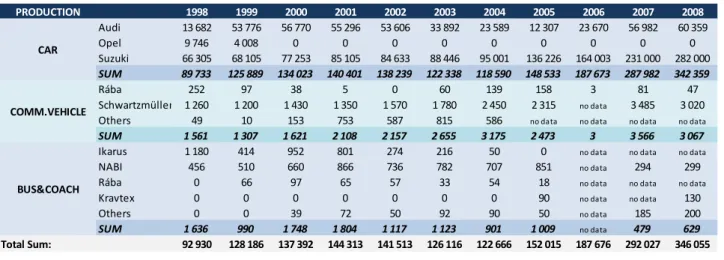
Motor vehicle production in the V4 region (The Visagrad Group: CZ, PL, HU, SK) between 1997-2009, represented an amount of over 20,8 mil vehicles produced in CR: 7 730 036, HUN: 2 135 784, SR: 3 510 859, PL: 7 502 467.
Figure 2
Overall statistics in motor vehicle production in Slovakia:
Car production V4 countries
-200 000 400 000 600 000 800 000 1 000 000 1 200 000 1997 1998 1999 2000 2001 2002 2003 2004 2005 2006 2007 2008 2009 year N o . o f c a rs CZ HU SK PL
2007 2008 2009 % 2009/2008 Slovakia 571 071 575 776 463 140 -19,6%
Volkswagen Slovakia – 105 997 KIA Motors – 150 015
PSA Peugeot Citroen – 207 128
The employment development in the industry is fluctuating at the level of 68.000 employees. In comparison to 2008, a 3,7% drop followed in 2009 in the consequence of the global economic and financial crises. However, from the year 2002 the level of employment within this industry is on the rise labeling the automotive sectors as a key industry in employing workers in Slovakia. The graph below, provided by the Automotive Industry Association of SR indicates the employment development in the sector achieving the highest level in 2007 when 76.000 employees were registered in it.
Figure 3
The sub-supplying sector has a significant position within the automotive industry in Slovakia via the presence of global players – main and direct suppliers of the three automotive plants. The most important global companies operating in Slovakia are:
Mobis Slovakia
Johnson Controls International Faurecia Slovakia
SAS Automotive SE Bordnetze
GetragFord Transmissions Slovakia ZF SACHS Slovakia
Leoni Autokabel Slowakia HBPO Slovakia
Another graph by the Automotive Industry Association of SR depicts the component supplies development from the year 2000.
Figure 4
In mld. SKK 2000 2001 2002 2003 2004 2005 2006 2007 2008 2009 Components
supplies
35,87 41,7 53,3 104,8 140,0 160,0 209,7 280,2 271,4 192,4
III. Research and Innovation
None of the three automobile producers has a direct research and development (R&D) representation in Slovakia, whereas R&D and innovation capacities are present within the sub-supplying networks producing for both the Slovak car producers and for abroad.
One example of the present global supplier companies with their own engineering-technological center in Slovakia is the company Johnson Control International in the town of Trencin. Johnson Control International focuses on production and development of car interiors, especially seating systems, dashboards and other. In Slovakia, the company has established 6 montage units and one Business Center in Bratislava.
Besides the sub-supplier networks, R&D in Slovakia is represented by university laboratories, centers and research laboratories of the Slovak Academy of Science. A broad scale of institutions comprises the structure of the Slovak R&D and innovation environment as the figure below visualizes.
Figure 5
The project AUTOCLUSTERS has been involved in the identification and surveying the innovation capacities of the automotive industry resulting in the creation of an automotive R&D database consisting of 212 automotive R&D capacities in the project partner countries/regions of Southeastern Europe. AUTOCLUSTERS was a project carried our within the European program South-East Europe with the project leader being the Automotive Cluster – West Slovakia. In Slovakia, the project has identified 36 Slovak innovation capacities within the automotive industry regarded as a positive transformation aspect and as an indicator for a promising development phase for the industry.
Recent trends register an interest of foreign investors for not only production-assembly capacities but also for capacities specializing in research, development and innovation activities within the sector. However, more intensive development of these capacities require the state support primarily for completing highly competitive innovation capacities and preparing human resources (talent development).
One of the analytical outcomes of the project AUTOCLUSTERS is the current orientation of the 212 R&D capacities on the following fields:
1. Manufacturing technologies, mechanical engineering and electrotechnics – 40%
2. Material research and chemistry – 15,6%
3. Product development, vehicle development and prototyping – 14,6% Lack of the automotive R&D capacities in the field of:
1. Environmental technologies, engines and power-train components (eco-vehicles) – 3,3%
2. Testing and analysis of new technologies – 7,1%
3. ICT, intelligent components, safety and interior components – 8,5% 4. Chassis and vehicle body parts – 8,5%
Despite some positive trends, Slovakia belongs to a group of countries with lack of science-research centers, innovation centers with focus on green technologies, ICT for the automotive industry. This shortcoming could be considered as a key challenge for future development of the automotive industry in Slovakia.
As a next group of development centers, which we recommend to set up and raise attention to are centers for enhancement and development of effective production processes and systems, cost cutting models, shortening the innovation cycles.
IV. Main development trends in the automotive industry in Slovakia
The current development trend in the automotive industry is characterized by a strong representation of foreign automotive sub-supplying companies, which have implemented in Slovakia their own operating culture and production system. Foreign direct investments are positive factors for the economic development on both the national level and regional level including municipality and town development. Consequently, where the foreign companies are located an encouraging impact is registered in the field of education, resulting in new program, curriculum creation focusing on the real demands of the industrial companies. Another contributive phenomenon is the developing cooperation in the field of
R&D and involvement in international projects. These trends could be summarized as follows:
Employment growth
Modern industrial production (latest technologies)
Specific production systems (Production System PSA, KIA WAY, VW Production System, further production systems of the supplying companies from the USA, Germany, Austria, Japan, etc.)
Regional development Educational development Development of R&D
Impact on local supplier companies Development of project networking
Establishment of cluster and networking initiatives
The automotive industry in Slovakia is affected by the global financial and economic crisis and will have to undergo certain advancement changes due to the influential presence of the global companies compelled to adapt to new trends and requirement in the world.
Notable emphasize within the sector is placed on cost cutting, shortening the innovation cycles and more effective production processes, development of human resources, etc. In addition, the sector is becoming part of the so-called multi-sectoral industry, where dividing lines between individual sectors are vanishing. New demands and worldwide development of the industry contributes to creating narrow cooperation and conjunction of sectors, such as the automotive industry with the energetic industry, chemical sector or the electro technical, security technologies, information-communication technologies for the automotive industry and etcetera.
Main challenges for the Slovak automotive industry are:
Support and development of supplying base for local companies with capacities to develop own research-development capacities
Support for education and developments of talents
Implementation of lean principles into all business processes Development of innovation management in companies Cost cutting
Improved knowledge and orientation on the customer
Support for environmental technology and process implementations Support for project networking (7. FP and other EU program)
Close cooperation with neighboring countries
Development of new supporting services and policies for innovation Update of the National Innovation System
Strategy development for attracting FDI into R&D
THE CONSTRUCTION OF THE AUTOMOTIVE NETWORK: CLUSTER INITIATIVES IN SLOVAKIA
In the past five years, in Slovakia there are in greater degree cluster creation and networking initiatives. The current involvement of clusters in Slovakia creates conditions for establishing business base in the form of cooperation and common projects. Companies have
the opportunity to participate in offered educational course, implemented thanks to various projects. According to the Slovak innovation and energy agency, clusters in Slovakia are divided into two groups: Technological clusters and Clusters of Tourism. Technological clusters are the following:
1. Machinery Cluster, Banska Bystrica self-government region Automotive Cluster – West Slovakia, Trnava self-government region BITERAP cluster, Košice self-government region
Electrotechnical cluster – West Slovakia, Trnava self-government region (Electrotechnics)
Energy cluster – West Slovakia, Trnava self-government region (Energetics) Cluster AT+R, Prešov self-government region (robotics)
Košice IT Valley z.p.o, Košice self-government region (Information Technologies) Slovak plastics cluster, Trnava self-government region (Plastics)
Z@ict, Žilina self-government region (Information Technologies)
In Slovakia, the pioneer in cluster initiative development is the Automotive Cluster – West Slovakia located in the town of Trnava, which is already involved in the process of creating cluster networks around Europe. This known Slovak cluster is the leader of the AUTOCLUSTERS project, which main aim is to develop a first Automotive innovation network in the countries of Southeast Europe. Elevated cooperation with international institutions is a presumption for future successful development of the automotive sector based on intensive international cooperation with entities from both well developed Western countries and catching up states such as Slovakia.
Within the AUTOCLUSTERS project the task is to set up a common automotive network, so-called clusters networking. The following clusters are participants of the project: Automotive Cluster Serbia, Automotive Cluster Slovenia, Automotive Cluster Croatia, Technical University of Gabrovo (BG), Technical University of Iasi (RO), Comunimprese (IT), CREATE-NET (IT), Slovak Technical University in Bratislave (STU), West Pannon Regional Development Company (HU) and as a observer of the project is the Automotive Cluster Vienna region (AT).
REQUIREMENTS AND PRIORITIES OF THE AUTOMOTIVE INDUSTRY IN SLOVAKIA
Based on the current trend of the automotive industry in Slovakia, on historical preferences, monitoring worldwide developments and demands on particular continents, transformation of global automotive companies, growing influence of ecological aspects, project activities and further factors of observance, it is possible to compile a list of fields of requirements for the automotive industry in Slovakia:
1. Energy and Environment 2. Material Research
3. Science & Education & Cooperation 4. Process Improvement and Innovation
These main groups of requirements can be explained as follows:
1. Energy and Environment
Main aim of this group of requirements is the development of e-mobility in Slovakia interconnected with establishing complex infrastructure for ecological vehicles. Another goal is to support the implementation and utilization of renewable energy resources and creating more ecological production units. This field demands investments into building up physical infrastructure, but also investments into educational and R&D infrastructure.
2. Material Research
Slovakia has at its disposal comparatively good scale of research centers and institutions with focus on material research. In this field, specific research institutes have achieved excellent results and cooperation with internationally recognized research-development teams. Key actors and contractors of material research in Slovakia are at the technical universities and within the Slovak Academy of Science. Material research should be oriented primarily on the automotive industry and new material and technology development for implementing ecological automobiles. This research requires narrow cooperation with partner organizations abroad.
3. Science & Education & Cooperation
An important factor, in the overall progress of Slovakia is establishing effective and firm systems of Science and Education, eventually catching up to the quality of recognized universities and research institutions abroad. Unquestionably, a supporting element for this aim is cooperation with foreign partner universities and various scientific bodies. The modern educational system, scientific background together with industrial demand and support from the state establish and enhance a strong triangle for the development of this group of requirements.
4. Process Improvement and Innovation
Enhancement of production and assembly processes is one of the basic challenge the Slovak automotive industry faces. Implementation of lean principles and innovation activities within companies will become a key model for sustaining competitiveness in the coming years. Least but not last, this aim is achieved by the development of human resources by constant improvement of skills and their strong motivation. All these needs are highly demanded challenges for Slovakia.
Interlinking of the four main groups of requirements for the automotive industry in Slovakia creates two key pillars focusing on:
Technology
Development of human resource
These four main groups of identified requirements call for the elaboration of supporting techniques, measurements, policies for supporting innovation and strong
involvement of relevant organizations in project initiatives for the development of the automotive industry in Slovakia.
Notes on the Automotive industry in
Italy – Lombardy Region
By Comunimprese
C
ONTENTSo Quantitative - qualitative analysis of Production System I. Introduction to Production System and its main features II. Products and services produced
III. Markets (characteristics, turnover, geographical distribution, etc ...) IV. Research and Innovation
V. Technological-productive mapping of the system (integration) VI. Mapping of the excellence of the Production System
VII. Main development trends in the Production System (short term)
VIII. Main development trends in the Production System (medium-long term) o The construction of the network: POLI-AUTO Production System
I. Activities implemented under the project to involve enterprises in POLI-AUTO network
o Needs and priorities of the Production System
I. Activities implemented to collect and analyze the needs and priorities of the Production System
II. The methodology for the formalization of needs III. Areas of assistance
Quantitative - qualitative analysis of Production System
I. Introduction to Production System and its main features
Despite Lombardy region has suffered in recent decades the loss of large car manufacturing plants, the automotive industry (including in this area not only cars, but also diversified vehicles and motorcycles) has kept a relevant dimension both nationally and internationally. Although we can not deny that the lack of major car manufacturers would be (in well under certain conditions) a critical factor, is still present in Lombardy a significant industrial base consisting of components companies (many of which are multinationals) diversified vehicles and motorcycles companies with their supply chains.
Are more than 100 the medium-large-sized Lombard companies operating in different automotive sectors, having as reference markets Italy, Europe, South America and the Far East. To these are added the many small and micro-enterprises that are sub-contracted by the medium-large-sized above mentioned, both for components, molds and equipment. The size of the automotive industry in Lombardy is enhanced by the proximity of the most important Italian automotive region, Piedmont, and consequently with the Fiat group and the
equally important region with an engineering tradition, Emilia Romagna. The strong commitment to internationalization that characterizes the companies in Lombardy, has allowed the creation and consolidation of technical and commercial relations with other regions of Europe, particularly Germany, Spain and France.
From a SWOT analysis carried out under the project Belcar (Cestec - Center for technology development, energy and competitiveness – Lombardy Region) it is shown that:
o The automotive industry is certainly ripe but still remains one of the most innovative and dynamic industries; a large part of process and product innovations in the industry comes from automotive.
o The automotive industry is one of the key factors of sustainable mobility. Critical Factors
o Lack of car manufacturers.
o Presence of many multinational companies willing to relocate where more convenient. o Presence of many SMEs closely linked to the fate of previous multinationals.
o High labor, land and taxes costs. Opportunities
o Favourable geographical position of Lombardy; proximity to clusters of Piedmont and Emilia-Romagna in Italy, and easy connections with major European automotive regions (Germany in particular).
o Strong and diversified industrial base with the possibility of horizontal transfers of knowledge between different sectors.
o Presence of strong capitals.
o The presence of a network of universities and research centers of excellence. o The availability of qualified human resources.
II. Products and services produced
The automotive industry is particularly developed in Lombardy in the design, construction and sale of vehicle parts. There are really important realities, not only in passenger cars and industrial vehicles but also in motorcycles and diversified vehicles (industrial vehicles, agricultural vehicles and caravans).
With regard to components, there are producers for almost all types, many of them are in Lombardy, but there are also production and research units of multinational companies. It can be noted: wheels, tires, brake systems, pumps, engine components, fuel injection systems, lighting systems, aircraft instrumentation, exhaust systems, car alarms and immobilizer, bodywork and interior, basic electronic components and not, various plastic components, steel, rubber and light alloys, composite materials.
Among services very highly developed is the equipment, prototyping, information technology and organizational consulting field, with particular reference to quality and
safety. There are also primary testing laboratories and research university bodies in support of the activities described above.
The automotive Production System must be understood in the broadest sense and not just referring to the automotive sector and to the industrial production, so we can mention:
o producers of automotive components for cars, motorcycles, industrial vehicles and various vehicles.
o Manufacturers (OEM) of motorcycles, agricultural vehicles, industrial vehicles and caravans.
o Producers of machinery, plant and equipment (molds, assembly equipment, industrial automation systems).
o Service Providers: Design, CAD / CAM, prototyping, simulation, information technology and organizational consulting.
o Testing laboratories for mechanical, electrical, crash testing, failure analysis, acoustic tests and electromagnetic compatibility.
The most important technological fields may include: mechanics, precision mechanics, electronics, mechatronics, new materials development, processing materials technologies (eg rubber and plastics molding, machining with deformation of ferrous alloys and light metals), ICT and telecommunications, lighting, sensors and computer vision. The automotive industry also involves many other components-related areas, including but not limited we can mention: the design industry, the textile industry, information technology. Major settlements in numerical terms, refer to the provinces of Brescia, Milan, Bergamo, Mantova and Lecco.
The automotive chain in Brescia, in particular, is by itself the second largest Italian automotive center after Torino (Piedmont) with about 300 units with 20,500 local employees, with an average size of local units in the chain of 60 people against 11 employees of the manufacturing industry in Lombardy.
The European Observatory on Cluster (www.clusterobservatory.eu) places the automotive cluster in Lombardy seventh in Europe in terms of employment, with over 50,000 employees.
The data ANFIA (National Association of Automotive Industry Chain), partner of automotive production system, rated in 2008 the automotive industry across the Lombardy region in a total of 711 companies, broken down as products of interest:
Suppliers of processes, technologies, systems 300
Modules suppliers 32
Components suppliers 379
The figure brings the average size of companies to over 70 employees, configuring the automotive sector with a size seven times bigger than the reference sector (engineering).
If we consider that the Italian components chain includes about 2,500 companies in the sector, for a total of 375,000 employees (direct and indirect) and a turnover of over 95 billion euro (Italian Centre of Automotive Components 2009), the reality in Lombardy represents almost 15% of national production system, second only to Piedmont.
Total turnover for Lombard automotive sector is estimated at a figure between 15 and 20 billion euros, representing 15% of the total turnover of Italian automotive industry.
Regarding R&D, compared to EUR 20 billion invested annually by the industry at European level, between 2 and 3 billion come from Italian automotive, representing the national leading production system, at a cost that covers about 25% of Italian private spending on R&D.
III. Markets (characteristics, turnover, geographical distribution, etc ...)
Recent surveys of markets in the automotive sector (source ANFIA) speak of a progressive liberation of Lombardy area from the traditional Italian export market (mainly the Fiat group); 72% of the 711 companies surveyed works for non-Italian companies, with a percentage breakdown very balanced on the various geographical areas.
Exports of national automotive industry is in 2008 about 8,1% of total national exports, in line with what recorded in 2007. Exports of Brescia area alone amount to almost 2 billion euros and represent 14% of total exports of the Province of Brescia. The positive balance of foreign trade sector is more than 1 billion euros, which is 25% of the positive import-export of Brescia.
IV. Research and Innovation
The automotive Production System, despite its importance, is not considered a mature industry: most industrial innovations on the market are still generated by the sector's needs. Suffice it to say that in recent years there has been a strong impetus to the search for new solutions to meet the need for greater security and reducing environmental impact. Significant can be transfers of technology from other fields (e.g. aerospace) as well as important is the research on new materials that combine strength, aesthetics, lightness. The automotive sector, for its characteristic of high-tech sector, but with very high volumes and low costs, is a link between high-cost and low volume technologies and their introduction into to mass markets. Traditionally, the introduction of technologies that typically come from sectors such as defence, space, aeronautics find in automotive their high reliable and low cost applications, thus becoming widely available. The role of the automotive business so it is strategic in defining the competitive position of a country from the technological point of view; moreover in this area the collaboration between numerous different sized companies is required by the complexity of the final product and promotes a truly widespread dissemination of innovation.
V. Mapping technological-productive system (integration)
In the system there are the chain of component suppliers (1st, 2nd and 3rd TIERS) vehicles and several motorcycles OEM. Relating to component suppliers, which represent the lion's share, the main glue for their integration is the industrial policy of their clients.
The latter are increasingly requiring their suppliers no longer the single component but 'complete systems' composed by the union of several components. In addition, the other request is the 'full service' demand from the product development (design in co-design) to its realization, production and delivery (integrated logistics). All this will make in the future to an ever closer cooperation between the suppliers of the chain.
This implies the involvement and close cooperation with companies making up the supply chain already in the process of product design (codesign - simultaneus engineering) and then continue during the development of design, prototyping and testing of quality.
In this context, the production companies are bound to compete on the grounds of flexibility, technological content and level of innovation in products and processes.
The logistics processes are often common among the suppliers of the same OEM. The presence of the supply chain driven by first-tier suppliers drag into that integration also the smaller suppliers. It is a custom in the automotive world the just in time delivery order due to minimizing the stores: this involves scheduling of weekly transmission deliveries to suppliers via the Internet, widespread use of MRP II systems, optimization of transport and packing.
VI. Mapping of the excellence of the Production System
Almost all large companies in the sector in Lombardy and several SMEs are engines of innovation. There are some recognized worldwide for their excellence, though:
o SAME DEUTZ-FAHR (SDF) - Treviglio (Bergamo) under the brands: SAME, Lamborghini, DEUTZ-FAHR and Hürlimann
o BREMBO - Curno (Bergamo): a leading manufacturer of braking systems currently operating in 3 continents with production sites in 9 countries
o PIRELLI TYRE – Milan: it is the fifth largest firm in the world in terms of turnover on the tire market, with levels of profitability among the highest in the industry
o IVECO - Brescia for the production of Eurocargo, mid-range and medium-high truck, leader in Europe; Suzzara for the production of DAILY, light truck and medium-light, also a leader in Europe and popular around the world
o Magneti Marelli (Corbetta, Milan) o STMicroelectronics (Agrate, Milan)
From a territorial point of view is to be recorded the excellence in Brescia where there are important multinational groups of automotive components: TRW, GKN, Stanadyne, Hayes Lemmerz, Federal Mogul, SK Wellman, Modine, Timken.
The employees in the sector account for 12% of the total employment in manufacturing in Brescia.
Establishments of foreign multinationals are 12, with 2,300 employees (11% of total employment in the chain). The enterprises in Brescia producing abroad are 14, with 40 plants and 5,000 employees.
Major component suppliers include:
o Mechanical Workshops Rezzatesi of Rezzato - assemblies and components, engine and chassis
o Streparava of Adro - suspensions, axles, engine components and chassis
o CF Gomma Passirano - rubber compounds, suspension motor and transmission o Cromodora Ghedi - light alloy wheels.
VII. Main development trends in the Production System (short term)
Despite the current economic situation (2009) affects in particular the automotive sector, it is conceivable that the automotive industry will be growing on a global scale; circulation of people and goods is rising steadily with the rhythm of a few percent per year in Italy and is expected by 2020, the doubling of the world circulation. The industry is going through a process of transformation that is linked to three main factors:
o reorganization aimed at reducing costs and hence the size of the OEM and their supply network.
o A globalization process that is going to integrate markets so far separated of the first and third world and involving both the OEM and suppliers to several levels of responsibility.
o Technological change induced by a drive for greater environmental sustainability of the mobility system as a whole (particularly in urban areas), of the product car vehicle and related processes and, on the other hand, the introduction of cross-cutting technologies with a strong impact on product (telematics, information technology, bio-materials, storage systems and energy ...).
If Lombardy will become competitive, growth prospects will be even better than projected: the integration of the production chain that has never even been assumed in Lombardy (and which should be created with the project POLI-AUTO) could be a factor for the progress of the local automotive industry.
Looking ahead, one perceives a serious risk of loss of tens of thousands of jobs in the productive system. Beyond the major social impact that this situation can generate, there is a real risk of losing the integrity of the entire chain of Italian components and hence of its product and process know-how and of its strong ability to innovate.
VIII. Main development trends in the production system (medium-long term)
As for the future of the Production System POLI AUTO, you can identify a strong element of weakness, the lack of a regional real automotive cluster that can be a focus and driving force of the production system. The European Observatory on Cluster (www.clusterobservatory.eu) in the table below highlights the important Lombard automotive production system and places it back to seventh place in Europe with over 50,000 employees (this figure corresponds to the figure ANFIA of 711 companies with about 70 employees per company).
It can be seen that, given the importance of the production system, such automotive production system in Lombardy is not represented. Similar production systems belonging to Turkey, Romania and Czech Republic are represented!
The production system POLI AUTO has the following objectives: 1. identity and global visibility
2. collaboration between large companies, SMEs, research centers and universities 3. direct interaction with public administration to address funding opportunities 4. participation in European research projects ( 7th Framework Programme) 5. qualify the local supply network
6. safety net for SMEs
Initially, the Politecnico di Milano - Department of Mechanics, Kilometro Rosso CSMT have signed a letter of intent that promotes the support of the technical-technological activities of the Production Systems.
The construction of the network: Production System POLI-AUTO
I. Activities implemented under the project to involve enterprises in POLI AUTO network
a) Constitution of a Committee representative of Lombard automotive production system
In spring 2009 two promoting committees have been set up (POLI-AUTO and AUTOMOTIVE INDUSTRY CHAIN) to participate in the Lombardy Region Driade / Daphne Programme, both referring to the automotive reality in Lombardy.
To the scope of representing in a coordinated fashion the whole automotive situation in Lombardy, the leader of the project proposal POLI-AUTO, "Politecnico di Milano - Department of Mechanics" and the leader of AUTOMOTIVE INDUSTRY CHAIN, CSMT
Gestione Scarl, have agreed to unite in a single production system (called POLI-AUTO) to promote and develop the creation of a single automotive production system.
b) Creation of the Selected Committee
It was set up a Selected Committee, composed of Politecnico di Milano, Kilometro Rosso Science Park, ComuniImprese Scarl and CSMT, with the main objective of furthering networking actions for the formalization of the new automotive production system.
c) Networking actions – large companies and associations
Following the formalization of the unique system called "Production System POLI-AUTO", large companies and associations participating in the organizing committee have been asked to identify other innovative companies in the automotive sector as potential partners in developing R&D projects within the production system.
d) Networking actions – Selected Committee
Actions aimed at promoting and expanding the production system have been carried out. Each member of the Selected Committee, through its network of industrial relations, has pledged to support actions for the enhancement and promotion of the production system. The strategic role of new participants for the development and consolidation of the network, is summarized in the "DECLARATION of INTENTS for the promotion and development of technical-technological Production System POLI-AUTO”, which defines the basic agreement for the actual formalization of the New Automotive Lombard Cluster, according to the following agreements entered into by the technology partners of the productive system: o share scenarios of technological development, identifying joint interests of members in
the Production System.
o Encourage the technological strategies of POLI-AUTO through actions of networking with companies, universities, research centers, technical, class and territorial associations, development agencies, government agencies involved (also partly) in the automotive sector and other industries who use automotive technologies.
o Support promotional activities within companies operating in the automotive sector, with the contribution of institutions and research organizations at regional, national and international level.
o serve as technical-technological point of reference for public bodies of Lombardy Region to orient its policies in support of technological innovation in the automotive industry; o Favour within the production system, collaboration and technological exchange between
companies, universities and research centers.
o Promote contacts, exchange of knowledge and participation in technical and technological projects at international, national and EU level partnering with other clusters, with particular reference to those who are currently working with Comunimprese Scarl in European projects in place.
o Encourage the participation in calls for proposals launched by Lombardy Region within the DRIADE Programme to support R &D projects within the sevenLombard "production systems" officially recognized.
Needs and priorities of the Production System
I. Activities implemented to collect and analyze the needs and priorities of the Production System
The aim was to consider the present needs for the development of products to be introduced on the market over the next 2-3 years.
II. The methodology for the formalization of needs:
The term "need" can be applied both to the results (performance) of a firm (costs reduction, customer service improvement, innovation) and necessities (critical factors, resources at disposal: money, human resources , flexibility). To better illustrate the concept it is presented a correlation matrix results/critical factors. These are the main ones and are set by the opinion of industry experts and through literature.
The critical factors were grouped into two broad categories:
A. those country-dependent and industrial policies-dependent (last ones not influenced);
B. those that may be influenced by regional policies and by the newly born cluster; Returning to the general objective of the analysis (maintenance and development of the chain in Lombardy), it was concluded that the survey on the needs had to be undertaken to establish the priorities attributed by companies to the factors of group B. In addition, for some of them, especially those concerning the trend of R&D, it was necessary to clarify the issues on which to launch innovation projects.
Another consideration that guided the collection of information on needs and the drafting of the questionnaires is related to the characteristics of automotive production system, which is configured as a supply chain with a pyramidal development, characterized by relatively few large companies (often multinational) and a growing number of SME suppliers as we descend into the supply chain.
The SMEs in the cluster/production system are still in a relationship of great dependency on numerosity CLIENT (OEM) 1st TIER Large Companies 2-3-4th TIER SMEs GENERAL TOPICS SYSTEMS PRODUCTS PARTS AND PROCESSING TECHNOLOGIES
large corporate customers, the latter having a dominant role in their turnover.
Winning new customers in the automotive world is no easy task and requires a lengthy technical and commercial process, long certification procedures, knowledge of languages and the solution of considerable logistical problems for deliveries just in time. Companies can (and often is the case) follow their customers abroad, but this can have a ripple effect even more disruptive in the area.
As the supply chain, also the "technological chain" follows the same pyramidal pattern: a few large general topics at the summit explode into more and more as you go down the chain.
III. Areas of assistance
Relating to the above it has been identified the following priorities for the automotive Production System in Lombardy, listed in alphabetical order because they are considered equally important:
o Energy and environment.
o Weight reduction (with regard to materials and automotive products). o Safety.
These priorities can be explained as follows:
A) Energy and Environment
The main objective is to reduce the use of fossil fuel and its environmental impact, and increase sources of renewable energy, safe, environmentally compatible and in sufficient quantity. Innovation should be addressed to:
o The electrification of vehicles and road transport system. o Mass reduction.
o New vehicle concepts with high energy-efficiency standards. o Primary energy and alternative fuels and drive systems.
B) Reduction of the weight (with reference to materials and automotive products)
There is a need to seek strategic materials and technologies that enable significant reductions in weight and are compatible with the requirements related to economic and industrial production. The weight reduction should not be seen only through the use of innovative materials such as composites, foams, super alloys, etc.., but also through a more efficient use of traditional materials (ferrous, non-ferrous and synthetic):
o Development of structural materials (metallic or not). o Developmnet of supporting technologies.
C) Security
The introduction of new types of vehicles based on the materials 'light' and a new design, alternative fuels and new systems of electric traction, requires that the security features of these vehicles are the same as those conventional:
o safe use of new materials and experimentation.
o Study and implementation of security systems, active / passive safety / ICT for future vehicles.
o Study of the safety features offered by new vehicle types, for example braking system, electric or hybrid traction.
Notes on the Automotive industry in Slovenia
By Automotive Cluster Slovenia
CONTENTS
Background
I. Slovene automotive industry II. A modern industry with roots
III. The crisis and the state of the industry Elements of automotive development strategy
I. Objectives II. Indicators
III. Functioning mode IV. Catalyst
Key Development strategy directions
Background
I. Slovene automotive industry
Proof for the Slovenian automotive industry’s success is the previous period. Based on their own knowledge and intensive investment in technology development, Slovenian automotive suppliers, grew from a small group of unrelated businesses and institutions in a closely linked network of development partners to the most of the world's top automobile manufacturers.
In Slovenia, the production of passenger cars involves only one company - Revoz, while the production of automotive components involves many companies, mostly they are all suppliers of first and second order. Among the most notable suppliers certainly falls Cimos Prevent, TPV, Iskra Avtoelektrika, Hidria, Kolektor, Unior,...
Although Slovenia is small, its automotive sector is relatively extensive. Allowing us to drop through the supply chain a little bit lower, could be found that there are, in this industry, indirectly involved at least several hundred other companies. Today, Slovenian automotive industry unifies 85 companies, over 600 contractors and knowledge institutions with more than 24,500 employees and 147,000 people indirectly related. Companies create more than 5mlrd €, from which over 80% is exported. This represents 21% of total Slovenian export and 10% of total Slovenian GDP. On average, Slovenian automotive industry invests 5% of turnover in research and development and over 12% in the new technologies.
Integration, both vertically and horizontally, has always been an integral part of our policy development. We believe that active cooperation leads to a winning combination for all
parties and that this is the way for all involved actors to achieve goals faster and easier. Therefore, we actively cooperate also with universities and institutes, we are an active member of CLEPA (European Association of Automotive Suppliers), ERTRAC (technology platform for vehicles, roads and transport) and an important member of the cross-border projects of integration in the automotive sector (STARNET, COIN, AutoNet, Autoclusters, ACE, CP50+, etc). Through advisory committees in the European Commission, we influence the industrial policy in the automotive sector, carry out developmental projects for creation the networks of enterprises and support institutions in South Eastern Europe and Russia. Our openness, penetration and in particular the effective recognition and realization of the right ideas, were recognized also outside of Slovenia. ACS is also a regular guest of all major conferences in the field of networking and mutual linkage of suppliers.
Slovene’s automotive industry is highly-technologically developed and operates according to a number of modern organisational principles such as lean production, benchmarking and multifunctional production.
II. A modern industry with roots
Slovenia, with a population of approximately 2 million, is sometimes described as a “mini Switzerland.” With GDP per capita of approximately € 17,076, it is one of the wealthiest of the new EU member states.
Slovenia has a mature automotive market. Car density stands at an impressive 615 cars per 1,000 people, which brings it close to that of many Western European countries. Primarily due to its location, Slovenia was the trading hub of the former Yugoslavia, with most manufacturing taking place in Serbia, Croatia and Montenegro. From the point of view of the automobile industry, this makes the country an attractive gateway to the other former Yugoslavian countries. The port of Koper is used extensively, particularly by Asian automotive manufacturers.
Through an agreement with local manufacturer Revoz, Renault has been present in the country since 1972. The company’s Novo Mesto plant today produces approximately 200,000 passenger cars per year. Revoz is Slovenia’s biggest car producer.
III. The crisis and the state of the industry
Automotive industry counts for one of the biggest victims of past economic and financial crises. Automotive industry in Slovenia is the biggest export industry in Slovenia as there Slovenian companies export most of its production. The decline in demand that had arose from the instability of financial markets and also because of the rising energy prices, has led the Slovenian automotive industry in troubles. Nevertheless there are the first signs of recovery seen, the market is still far from being recovered. Consumer confidence is not falling anymore, however it is still at a very low level. This results in a logical sequence of events:
customers buy smaller and more affordable cars
in average buyers change their minds or postpone buying a car until they have more financial resources
car manufacturers are forced to reduce production and to lower the costs of production
car manufacturers need to lay off workers
Slovenian automotive industry is experiencing all the vigour of competition, in attracting and acquiring new business as well as in meeting the daily needs of customers. Customers are namely increasingly demanding good quality and good delivery terms as well as good price, which of course exist for all segments of customers.
Elements of automotive development strategy
The main competitive advantage of advanced companies is and will be the innovation. This is true both, for large as well as for medium and small enterprises. Companies should offer their customers great added value (uniqueness, diversity), for which they are awarded with the appropriate price. Being innovative is not easy, it requires a lot of knowledge, innovation, teamwork, organizational skills, collaboration, multidisciplinary, an appropriate business environment, happiness and high financial resources.
I. Objectives
A key objective of the new Automotive industrial policy pillar is to provide an appropriate "environment" that will enable companies to invest in research and development in priority areas, identified in the ACS Strategic Development Plan 2009-2014 and the recommendations of the working group for vehicles, transport and logistics in the context of Council for Competitiveness and includes the following areas:
environment and efficient usage of energy safety
comfort
New materials and technologies to implement the above functions for the user of the vehicle.
It is essential that the industrial environment supports projects related to innovation processes, trainings for suppliers, upgrading the developmental infrastructure, information infrastructure as well as the investment in basic knowledge.
With all the above, the government can help to maintain the position and competitiveness of Slovenian automotive industry and to promote and accelerate research and development, as well as technological innovations, that are in line with the policy of the Republic of Slovenia, and provide further technological breakthrough of Slovenian automotive industry.
II. Indicators
Of course, the appropriate industrial policy shows results not earlier than in the long run and for this reason it is essential to continuously monitor the performance indicators:
number of new products and markets growth in sales value
value-added growth number of innovations
number of new suppliers
number of new high skilled jobs
internal rate of return (IRR) and return on assets (ROA)
III. Functioning mode
Effective industrial policy needs to ensure, that the enterprises and the R&D and knowledge institutions will faster adapt to changing market conditions as well as to ensure that these enterprises and institutions will effectively use all the challenges, which are offered and arisen on the market. Special emphasis should be placed to ensure joint research and development, to keep pace and rhythm of development in the most rapidly developing industry in the world, to ensure the emergence of new products and technologies and thereby influence the increased volume of inquiries. The objective is clear; effective, efficient
and profitable growth.
Industrial policy will:
provide easier access to funds for investment in developmental projects and enable to maintain the competitiveness in the market;
increasingly invest in research projects that provide long-term competitive advantage;
ensure efficient use of EU funds which are now, because of the criteria and conditions of a narrow focus on vehicle manufacturers, promoters of development, not reaching the other innovative companies;
to provide technical infrastructure and to link of the industry with knowledge institutions, which ACS can provide with its extensive network of companies and knowledge institutions.
IV. Catalyst
Industrial policy will be a catalyst and driving force behind R&D processes in the automotive business pillar, where it comes, in the process of research, to the generation of new ideas. The main process here is to identify key areas and projects where the potential penetration of new products or technologies exists. In the future, there will be a new important technology, function or a product, which will ensure the existence and further development of the automotive industry in Slovenia.
Key Development strategy directions
In accordance with the development strategy of ACS and the Republic of Slovenia, the following key areas have been defined:
ENVIRONMENT AND ENERGY EFFICIENCY
Efficient use of energy is becoming in terms of (end) users the key characteristics of vehicles, which has the most explicit impact on the environment, but it is also the biggest cause of energy1 loss. This will be one of the main areas in which we see the possibility of penetration
1 In Europe, 11% of greenhouse gas emissions comes from vehicles, while on a global scale the proportion is 5%
and continued growth. All the most developed economies: the United States, European Union, Canada, Japan, Australia and New Zealand, imposed to this area new and more rigorous directives, but at the same time also a financial support for the purchase of environmentally friendly vehicles. Consequently, this requirement will affect the suppliers. The objectives within this area are to develop, validate and manufacture components for propulsion systems that will comply with EURO 5 (6 ...) and thus contribute to reducing of emissions of CO2, NOx and particulate matter, optimization of energy efficiency, the expansion of renewable energy and strengthening the position of the first suppliers tier (Tier-1) in the world automotive industry. R&D projects in this area will upgrade the existing competencies in functions where enterprises and institutions are specialized in, but also tolerate the possibility of a penetration to the other areas.
SAFETY
Safety is one of the core values of modern society and it is as such also very important in the automotive industry as well. The question of security is in fact no longer an issue, but an obligation in all new generation vehicles. On this basis we will support R&D projects in the field of automotive safety, especially those with a clearly stated objective to develop new »principal« solutions, suitable for further development of technology (knowledge transfer in technology).
The objectives will not be targeted only to improving the safety of vehicle occupants, but also to ensure greater safety of other traffic participants, pedestrians and cyclists. Special attention will be devoted to new active and passive safety system that will ensure better protection of the most vulnerable traffic participants.
COMFORT
Comfort is the key characteristic that separates car manufacturers from each other and most importantly, the share of suppliers in this segment is more and more important. While some experts predict that in a period of crisis, comfort will not play a key role, it is clear that at the end of the crisis, comfort at an affordable price is crucial.
This includes various electronic vehicle accessories (power steering equipment, automatic ventilation ...), as well as chassis components, elements in the passenger compartment and interior equipment (seats, covers,...). In this area, works many Slovenian companies which are also willing to invest resources in further development of new products and other related new technologies.
NEW MATERIALS AND TECHNOLOGIES FOR THE IMPLEMENTATION OF THE ABOVE FUNCTIONS FOR USER VEHICLE
Effective and successful growth of companies is based on developing and selling new, innovative products. One can not forget the competences which are essential for effective development and further production of these products. Special attention and support will be draw to the development of new materials and technologies that will provide faster and
more profitable development of new products. It is crucial to support those projects which will be closely involved in the development of new products.
The main principle of the projects will be their environmental orientation. An important role will play the development of new, lighter materials that can directly reduce greenhouse gas emissions. Special attention will also be paid to eco-oriented development and production as well as to reducing emissions, already in the phase of the development and manufacturing of the products. Already in the phase of product development, the requirements for the decommissioning of the product at the end of the life cycle and the possibility of recycling and reusing materials should be taken care for.
In addition to the above orientations, we will pay a special attention to projects that have as its objections:
building of appropriate infrastructure that will create the conditions for long-term work flow and development of creative professionals;
provide the conditions for the global performance of companies in the field of new products and technologies and the increasing competitiveness on the basis of specialization and ability to innovate;
provide the conditions for the growth of knowledge-based institutions in the region; quality development of supplier chains (optimization of production processes,
training, development of suppliers in the SME)
creation of new knowledge, skills and competences in the field of ecology, mobility, security and comfort;
Establish a cooperative network that will base on strong developmental partners,