UNIVERSITY OF LJUBLJANA FACULTY OF ECONOMICS
MASTER THESIS
TRANSDISCIPLINARY SUSTAINABLE DEVELOPMENT
(TRANSDISCIPLINARNI TRAJNOSTNI RAZVOJ)
IZJAVA O AVTORSTVU
Spodaj podpisani Janez Cerar, študent Ekonomske fakultete Univerze v Ljubljani, izjavljam, da sem avtor magistrskega dela z naslovom Transdisciplinarni trajnostni razvoj, pripravljenega v sodelovanju s svetovalcem prof. dr. Bogomirjem Kovačem.
Izrecno izjavljam, da v skladu z določili Zakona o avtorskih in sorodnih pravicah (Ur. l. RS, št. 21/1995 s spremembami) dovolim objavo magistrskega dela na fakultetnih spletnih straneh.
S svojim podpisom zagotavljam, da
• je predloženo besedilo rezultat izključno mojega lastnega raziskovalnega dela;
• je predloženo besedilo jezikovno korektno in tehnično pripravljeno v skladu z Navodili za izdelavo zaključnih nalog Ekonomske fakultete Univerze v Ljubljani, kar pomeni, da sem
o poskrbel, da so dela in mnenja drugih avtorjev oziroma avtoric, ki jih uporabljam v magistrskem delu, citirana oziroma navedena v skladu z Navodili za izdelavo zaključnih nalog Ekonomske fakultete Univerze v Ljubljani, in
o pridobil vsa dovoljenja za uporabo avtorskih del, ki so v celoti (v pisni ali grafični obliki) uporabljena v tekstu, in sem to v besedilu tudi jasno zapisal;
• se zavedam, da je plagiatorstvo – predstavljanje tujih del (v pisni ali grafični obliki) kot mojih lastnih – kaznivo po Zakonu o avtorskih in sorodnih pravicah (Ur. l. RS, št. 21/1995 s spremembami);
• se zavedam posledic, ki bi jih na osnovi predloženega magistrskega dela dokazano plagiatorstvo lahko predstavljalo za moj status na Ekonomski fakulteti Univerze v Ljubljani v skladu z relevantnim pravilnikom.
i
TABLE OF CONTENTS
INTRODUCTION ... 1
1 SD FROM A HOLISTIC SYSTEMS PERSPECTIVE ... 4
1.1 Complexity and Systems Thinking... 8
1.2 Reductionistic and Cause-and-Effect Thinking ... 11
1.3 General Systems Theory ... 12
2 MODES OF DISCIPLINARY COLLABORATION ... 13
2.1 Intradisciplinarity, Multidisciplinarity and Interdisciplinarity ... 14
2.2 Towards TD ... 14
3 FOUNDATIONS OF TD ... 18
3.1 Levels of Reality, Levels of Perception and the Hidden Third ... 18
3.2 The Logic of Included Middle ... 22
3.3 Complexity ... 25
3.4 A Critical View of Foundation of the Concept of TD ... 26
3.4.1 Values Clarification ... 26
4 TD IN THE SD CONTEXT ... 29
4.1 Integrating TD with SD ... 30
4.1.1 The TD Object, the TD Subject and the Hidden Third ... 31
4.1.2 Levels of Reality/Perception and the Logic of Included Middle ... 34
4.1.3 Communication between the TD Object and the TD Subject ... 36
4.2 The TD Solutions at Different Levels of Social Integration ... 39
5 INSTITUTIONALIZATION OF THE CONCEPT OF TD ... 40
5.1 United Nations Decade of Education for SD 2005-2014 ... 41
5.2 TD View of Academic/Research Institutions ... 43
5.3 Evaluating the Quality of the TD Research Endeavors ... 45
5.4 Barriers to the TD Collaboration ... 46
6 RESEARCH OF THE TD INSTITUTIONS ... 48
6.1 Essential Research Information ... 49
6.2 Methodology of the Research ... 50
6.3 Key Findings of the Research Analysis ... 55
6.3.1 Analysis of Institutions in All Groups of Science ... 55
6.3.2 Analysis of Institutions in the SD Field ... 60
6.3.3 SD Institutions vs. “Other” Areas of Science Institutions ... 63
6.3.4 Analysis of “IN VIVO” Institutions ... 66
6.4 The Synthesis of the Research ... 67
CONCLUSION ... 69
LITERATURE AND SOURCES ... 73 APPENDICES
ABSTRACT (English & Slovenian) GLOSSARY (English & Slovenian)
ii
LIST OF FIGURES
Figure 1: Structure of the master thesis ... 4
Figure 2: Current failings of the economy: cause and effect relationships ... 6
Figure 3: A mechanistic relationship between economy, sociosphere, and ecosphere ... 8
Figure 4: Interdependent relationships between the economy, sociosphere, and ecosphere ... 9
Figure 5: Comparison of intra-, inter-, and TD approach ... 16
Figure 6: The TD Object, the TD Subject, and Interaction term ... 19
Figure 7: Symbolic representation of the action of the included middle logic ... 23
Figure 8: Values as a source of beliefs, views, and human behavior ... 27
Figure 9: The four-level hierarchy of values ... 27
Figure 10: Ontological correlations between the concepts of TD and SD ... 30
Figure 11: Ontological interconnectedness of TD and SD ... 32
Figure 12: Two TD Subjects sharing the same TD Object on a different level of Reality ... 37
Figure 13: TD Subject perceiving two TD Objects on different levels of Reality ... 38
Figure 14: Mind-map of the research of TD institutions ... 48
Figure 15: Scientific filed groups with relation to year of establishment ... 56
Figure 16: Type of institutions in different areas of science... 57
Figure 17: Activities of institutions in different areas of science ... 57
Figure 18: Location of institutions by different areas of science ... 58
Figure 19: Areas of science in relation to location of institutions ... 58
Figure 20: Degree of TD integration by areas of science ... 59
Figure 21: Degree of integration by the average year of establishment ... 59
Figure 22: Degree of integration by location and by year of establishment ... 60
Figure 23: Degree of integration of SD institutions ... 60
Figure 24: Degree of TD integration by location and by the year of establishment ... 61
Figure 25: Interest of SD institutions in SD areas ... 61
Figure 26: Degree of TD integration in accordance to the type of SD institutions ... 62
Figure 27: Activities of SD institution in relation to the degree of TD integration ... 62
Figure 28: Interest of different areas of science in the areas of SD ... 63
Figure 29: An unbalanced picture of the “Other” areas of science ... 64
Figure 30: A balanced picture of SD area of science ... 64
Figure 31: Degree of TD integration, areas of SD, founding date, and primary area of science .. 65
Figure 32: Areas of SD in relation to areas of science by location of institutions ... 65
Figure 33: Number of “IN VIVO” institutions ... 66
Figure 34: “IN VIVO” institutions in accordance to location and year of establishment ... 67
LIST OF TABLES Table 1: Comparison of disciplinary knowledge (DK) and TD knowledge (TK) ... 17
Table 2: J. Musek’s scheme of value ... 28
iii
Table 4: Factors that determine degree of TD integration ... 52
Table 5: Structure of the areas of science ... 53
Table 6: Keywords for selecting TD institutions ... 54
1
INTRODUCTION
The introductory section is comprised of four parts: the problem description, the purpose and the hypotheses formulation, the methodology description, and the structure of the master thesis.
Problem description. The global economy is nowadays so large that it already goes beyond the limits of the ecosystem and even social system. New ways of thinking are required in order to develop an economy that can be sustained within the finite biosphere and which would be accepted within social structures. Since sustainable development (hereinafter: SD) is a systems problem, it logically needs a systems solution, and it cannot be derived from a single specific discipline (e.g. economy).
If there was a supercomputer into which one could load all the knowledge from all existing disciplines, than this supercomputer would be capable of knowing everything while understanding nothing. A user of such computer would have immediate access to any results (content) from any discipline, but would be incapable of understanding their meanings. The meaning is hidden in connections between the different disciplines, with other words, each discipline gives other discipline a meaning and consequently also a new content. In this context SD needs understanding of such meanings in order to solve systems problems. Such a complex holistic view is a key topic that is discussed especially in the first section of the master thesis.
Main current SD global problems, like uneven income distribution (poverty and new era slavery), unemployment, overpopulation, neo-imperialism, forced migrations, destruction of ecosystems, governance (neo-liberalism), lack of human development vision, enforced destructive way of living, etc., cannot be adequately tackled from the content of specific individual disciplines. These problems include not only some of the environmental issues (broadly known as climate change and biodiversity loss), but mostly social issues.
In a world characterized by such complex problems, uncertainty, and increasing interconnectedness, there is a growing need for science to contribute to the solution of problems. Up till now, progress in finding solutions has been very slow (Hadorn, Bradley, Pohl, Rist & Wiesmann, 2008, p. vii). Nevertheless, the SD issues indeed constitute the most dangerous and difficult challenge that humanity has ever faced (Heilbroner, 1970, p. 270). In December 2002, the United Nations General Assembly, through its Resolution 57/254, proclaimed the years from 2005 to 2014 the Decade of Education for SD (hereinafter: DESD). Governments from around the world have been invited to strengthen their contribution to sustainability through a focus on education. It also designated UNESCO as the lead agency for the promotion of this decade (UNESCO, 2011).
Unsustainable development leaves behind large areas of poverty, stagnation, marginality, and destruction of the natural environment (United Nations, 1971). The public is becoming increasingly aware that the usual political and economic mechanisms are hardly in a position to provide solutions to such hybrid problems. Developing a readiness to deal constructively with a necessary openness to new approaches is a leading challenge facing society today. A demand for
2
deep and fundamental change, however, stands in conflict with the continued practice of the industrial development model (The Institute for Social-Ecological Research, 2011). Summing up, mainstream “green reformism” is paradoxically trying to save capitalism from collapse. Faced with such a situation, development of an ability to deal with transformations is critically needed.
Purpose and hypotheses of the master thesis. Responsibility towards future and present generations generally implies a responsibility to acquire knowledge. How to establish an environment where complex SD questions could be answered and where appropriate knowledge would be developed? To answer this question is the fundamental goal of the master thesis. I do not try to answer complex questions regarding operationalization of SD, but I rather try to answer the question: under what circumstances, i.e., conditions, could applicable SD questions be solved? Master thesis ideas and understandings might be useful to governmental and nongovernmental environmental organizations, regional development agencies, the academic sphere, and others.
A contribution to a holistic understanding of SD and an introduction of the concept of transdisciplinarity (hereinafter: TD1) to Slovenian academic environment is a big challenge. The key goal of the basic research in the first section is to integrate SD with the concept of TD and to clarify the notion of the concept of human value in relation to the concept of TD. Last but not least, the goal is also to prepare a glossary of new key terms and translate them in Slovene language and by this, introduce them into Slovenian science.
The purpose of the empirical section, i.e., applied research, is to find TD institutions around the world and to find out whether these TD institutions operate according to the principles of TD foundation. The focus is on the SD field, while not excluding other areas of science. A fundamental goal is to select institutions which best suit the definition of TD and to find out which factors importantly influence the degree of TD integration. The hypotheses are listed below:
Hypothesis 1: Most TD institutions were recently established and there is an upward trend in the establishment of institutions.
Hypothesis 2: The main activity of TD institutions is research and much less education.
Hypothesis 3: More than half of the TD institutions are located in North America, fewer in Europe and even fewer in Asia and Australia.
Hypothesis 4: Because TD is in nascent phase of development, institutions implement TD approach in various ways. Less than one quarter of TD institutions fully adopt and implement the concept of TD introduced in the first section of the master thesis.
Hypothesis 5: A strong correlation between SD institutions with the concept of TD exists. Institutions directly related to SD predominantly use a holistic TD approach that integrates economy, ecosphere, and sociosphere. In such institutions the concept of TD is the most consistently applied, unlike in other institutions that are indirectly related to SD.
1
3
According to the hypotheses above I have found a lot of literature and sources to scientifically argue the holistic perception of SD from TD angles of view.
Methodology. In the theoretical part, literature review (summary) is the first method where I collect relevant scientific papers and other literature/sources to find and discuss definitions of different concepts and phenomenon, such as SD, complexity, systems thinking, reductionistic and cause-and-effect thinking, general systems theory, interdisciplinarity, TD, holism, level of Reality, the logic of included middle, human values, etc. This section highlights SD from a holistic point of view and explains the complex, systemic nature of SD. In parallel to this, there is discussed how to deal with such complexity and how holistic supporting knowledge can be created. Afterwards follows basic research with my contributions to a holistic understanding of SD. By using intuition, creativity, and imagination, I integrate SD with the concept of TD. Moreover, I also integrate concept of human value in the concept of TD. Institutionalization of the concept of TD is highlighted at the end of the first section.
The basic research lays down the foundation for the applied research. Combination of a qualitative and quantitative approach is used as the research method in the empirical part, i.e., applied research (second section). The predominant research method is the qualitative interpretative research method; but, to analyze qualitative data, I use also quantitative approach in order to represent data in the graphic figures. To present research findings, I use the critical interpretive synthesis method. However, studies provide a useful review of several institution’s approaches towards the concept of TD.
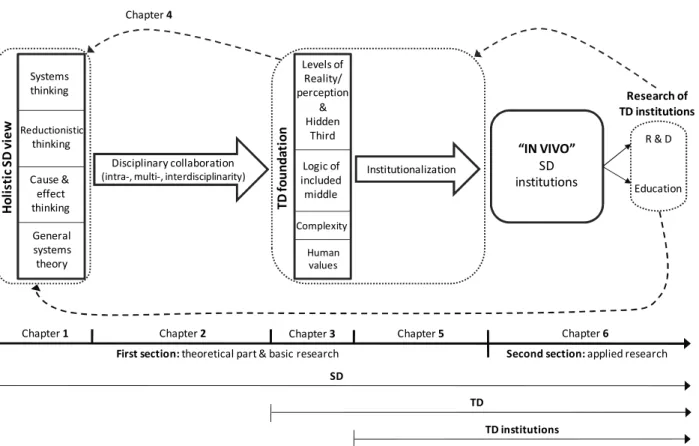
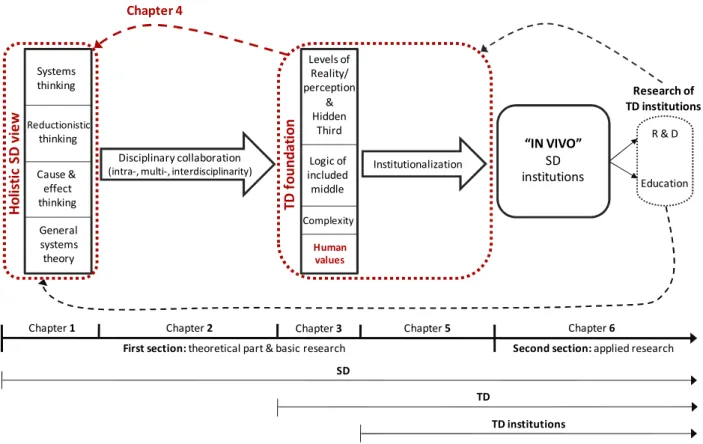
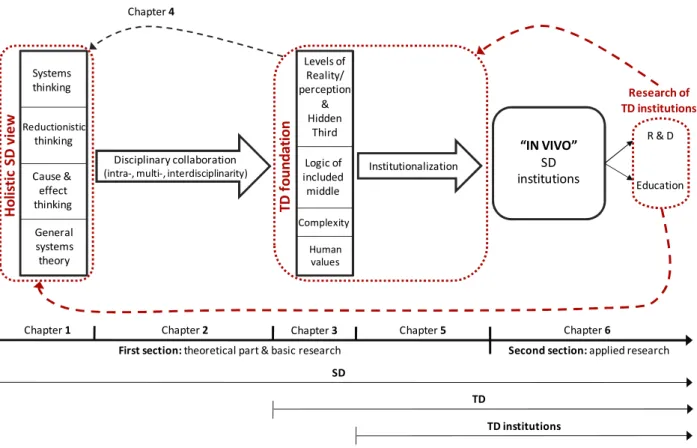
Master thesis structure. The content of the master thesis and its structure are characterized by the holism, reciprocity, feedback loops and dynamics. In other words, the structure is designed to follow the content. The structure frame consists of six main chapters. SD from a holistic and systemic perspective is introduced in Chapter 1. Some general theoretical basis is presented in the context of complexity and systems thinking, reductionistic and cause and effect thinking, and finally general systems theory.
Chapter 2 is dedicated to the introduction of modes of disciplinary collaboration, i.e., intradisciplinarity, multidisciplinarity, interdisciplinarity, and TD. The last also presents an introduction to the next Chapter 3 where the foundation of TD is discussed. The four pillars of TD are introduced including multiple levels of Reality, the logic of the included middle, the complexity of knowledge, and the integral human values. The concept of human values, including their structure, is here more thoroughly analyzed; this could be considered as my contribution to TD evolution as well as integrating SD with the concept of TD (Chapter 4). With my views I indicate a new holistic way how the two concepts can get closer to each other. Chapter 4 concludes with highlighting of the United Nation (hereinafter: UN) decade of education for SD.
4
Figure 1: Structure of the master thesis
Disciplinary collaboration
(intra-, multi-, interdisciplinarity) Institutionalization
R & D Education “IN VIVO” SD institutions H o li st ic S D v ie w T D f o u n d a ti o n Systems thinking Reductionistic thinking Cause & effect thinking General systems theory Levels of Reality/ perception & Hidden Third Complexity Logic of included middle
Chapter1 Chapter2 Chapter3 Chapter5 Chapter6
Chapter4 Research of TD institutions SD TD TD institutions Human values
Second section: applied research First section: theoretical part & basic research
The introduction to the second section is formulated in Chapter 5. The main topics here are the institutionalization of the concept of TD, including TD views of academic/research institutions, evaluating quality of TD research, and analysis of barriers to TD collaboration. Finally, in Chapter 6 the key findings of research of TD institutions are analyzed and discussed. At the end of the master thesis, final thoughts and relevant appendices can be found.
1
SD FROM A HOLISTIC SYSTEMS PERSPECTIVE
SD means different things to different people. There are many reasons for this. To begin with, the concept of SD is used in many locations and contexts, by people from varying cultural backgrounds and disciplinary schools of thought, and for different purposes. Second, the concept of SD has evolved rapidly and over a relatively short period of time. Finally, debates about SD have been influenced by a wide range of underlying views regarding the relationship between human beings, economic systems, and the natural environment of which they are a part. As such, there are various opinions as to how SD should be measured and what is required to move toward the SD goal (Lawn, 2006, p. 13). Eventually, definition of SD is directly dependent to the specific context being observed, whether it concerns development of a certain country, region, firm, institution, etc.
In the broadest sense and for the purpose of SD definition there should be all the dimensions of human being understood and treated simultaneously and equally (Baumgärtner & Quaas, 2010):
5
1. Homo biologicus: how and to what extent is the human being as a biological being determined by, and dependent upon, nature?
2. Homo oeconomicus: how and to what extent does an individually acting human being follow its self-interest?
3. Homo sociologicus: how and to what extent is a human individual determined by, and dependent upon, social relationships?
4. Homo ecologicus: how and to what extent is a human being characterized by its relationship to nature?
5. Homo politicus: how and to what extent does a human being act on behalf of a community as a citizen or politician with an orientation towards justice?
In the following chapters I try to find explanation to the question: “How can we better understand the relationships between these different dimensions of human being, and under what conditions is it feasible?”
SD, as a concept, in the first place incorporates the ethical dimension. Sustainability aims at justice in the domain of human – nature relationships and in view of the long-term and inherently uncertain future. This includes three important relationships (Becker, 2009, p. 23):
1. Intergenerational justice: justice between humans of different generations;
2. Intragenerational justice: justice between different humans of the same generation, in particular the present generation;
3. Physiocentric ethics: justice between humans and nature.
Aspects of intergenerational and intragenerational justice, for instance, are expressed in the widely accepted definition given by the Brundtland-Commission (WCED, 1987, p. 43): “SD is development that meets the needs of the present generation without compromising the ability of future generations to meet their own needs.” While intergenerational and intragenerational justice reflects an anthropocentric idea of justice, SD also includes physiocentric ethics aspect, i.e., the idea of justice towards nature for its intrinsic value (DesJardins, 2005). This interpretation of SD implies nature conservation for its own sake.
One needs to be aware that besides SD (justice in domain of human – nature relationships) there exist other legitimate societal goals, including goals of justice in other specific areas of human life, e.g. labor or education. While justice is the normative foundation of sustainability, neoclassical economics is aimed at the normative goal of an ever better satisfaction of human individual needs and wants (Hausman & McPherson, 2006). It is quite hard to accept this position and take the satisfaction of individual human needs and wants to be a legitimate normative goal that may stand on equal footing with other normative goals such as sustainability or justice in general.
Until now, there have been changes only on relation economy – nature, but necessary changes on the level of human system structures were systematically ignored. The structural problem of capitalism is that it creates an unprecedented social material wealth (big material potential), but
6
at the same time destroys it. With other words, capital creates material value (merchandise) with the purpose to destroy (consume) it (Žižek, 2009). Capitalism perceives maximization of satisfaction through maximization of consumption, but on the other side ecology perceives maximization of consumption as a force that moves world balance to the edge.
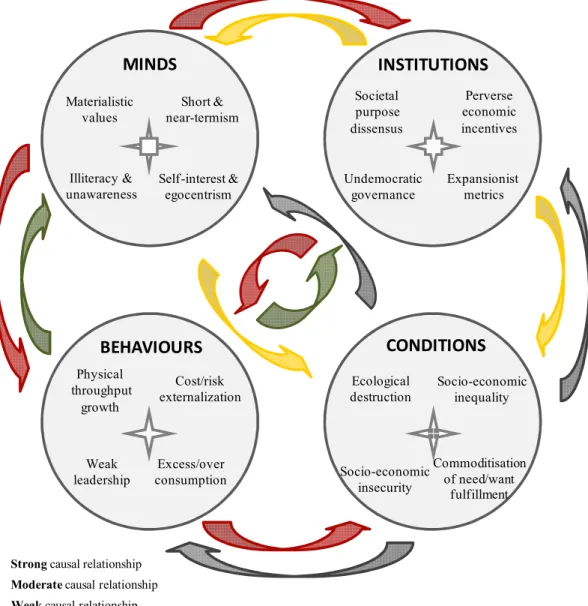
Figure 2: Current failings of the economy: cause and effect relationships
Materialistic values Short & near-termism Illiteracy & unawareness Self-interest & egocentrism Societal purpose dissensus Perverse economic incentives Undemocratic governance Expansionist metrics Physical throughput growth Cost/risk externalization Weak leadership Excess/over consumption Ecological destruction Socio-economic inequality Socio-economic insecurity Commoditisation of need/want fulfillment
Strongcausal relationship
Moderatecausal relationship
Weakcausal relationship
Long-time lag
BEHAVIOURS
INSTITUTIONS MINDS
CONDITIONS
Source:University of Cambridge, 2011.
We have collectively and systemically invented and adopted neoliberal capitalism, but we are still caught up in the dilemma described by John Maynard Keynes many years ago (year 1933): “Capitalism is not a success. It is not intelligent, it is not beautiful, it is not just, it is not virtuous – and it does not deliver the goods. In short, we dislike it, and we are beginning to despise it. But when we wonder what to put in its place, we are extremely perplexed.” The challenge of SD is the central challenge of our time. Great wisdom is needed to realize how to transform capitalism which is possibly the largest, most self-reinforcing, and most seductive and addictive system ever invented (University of Cambridge, 2011). It is quite surprising, that people can easier
7
imagine the end of the world than the end of capitalism. With other words, it is easier for them to imagine the end of infinity (world-cosmos) than the end of finiteness (capitalism). They are not aware of discontinuity of capitalism. Finiteness is only one small particle of the infinity.
The Figure 3 shows current failings of the economy with the cause and effect relationships. One of the key findings is that the human values underlying the current economic system may be incompatible with the principles of SD. Today, people’s minds (TD Subject – consciousness, perception, cognition) are considered as largest source of materialistic values, short & near-termism, illiteracy & unawareness and also self-interest & egocentrism. Consequently, these human pitfalls have their effects to other failings such as human behaviors (physical throughput growth, weak leadership, cost/risk externalization, over consumption), position of institutions in society (perverse economic incentives, expansionistic metrics, undemocratic government, societal purpose dissension) and other conditions (socio-economic insecurity, ecological destruction, commoditization of need/want fulfillment, socio-economic inequality).
Capitalism is a system that supports or even rewards human weakness such as selfishness, greed, corruptiveness as well as prejudice, egoism, individualism, willful denial of knowledge, wrong value system, etc. It creates and develops human relations and relationships in accordance to a Latin phrase “Homo homini lupus est” which means “man is a wolf to man (or his fellow)”. SD remains the only seriously “big idea” that underpin Apollonian values (see Chapter 3.4.1) such as interdependence, empathy, equity, personal responsibility and intergenerational justice. They are the only foundation upon which any feasible vision of a better sustainable world can be constructed (University of Cambridge, 2011).
In this modern economics, it remains open what the “ends” of needs and wants satisfaction are to be. It seems that SD deals with joint problems of efficiency and justice. In this interpretation, “what most distinguishes economics as a discipline is not its subject matter, but its approach with the assumption of maximizing behavior” (Becker, 1978, p. 5).
Anyway, the purpose of the master thesis is not focusing on definitions of SD; I rather depict necessary conditions to find holistic systems solutions to SD challenges. In science systems, it is argued that the only way to fully understand why a problem or an element occurs and persists is to understand the parts in relation to the whole (Capra, 1996, p. 30). Standing in contrast to Descartes’ scientific reductionism2 and philosophical analysis, it proposes to view systems in a holistic manner. Consistent with systems philosophy, systems thinking concerns an understanding of a system by examining the linkages and interactions between the elements that compose the entirety of the system (Systems thinking, 2011).
According to systems philosophy, there are no “systems” in nature. The universe, the world and nature have no ability to describe themselves. That which is, is. With respect to nature,
2Reductionism
can either mean (a) an approach to understanding the nature of complex things by reducing them to the interactions of their parts, or to simpler or more fundamental things or (b) a philosophical position that a complex system is nothing but the sum of its parts, and that an account of it can be reduced to accounts of individual constituents (Reductionism, 2011).
8
conceptual systems are merely models that humans create in an attempt to understand the environment in which they live. The system model is used because it more accurately describes the observations (Laszlo, 1972a). Because systems are models created only for understanding, the most fundamental property of any system is that a system has an arbitrary boundary. Humans create the boundaries to suit their own purposes of analysis, discussion and understanding. This is true of every conceptual model that was devised through which humans try to understand the universe (Laszlo, 1972b).
Figure 3: A mechanistic relationship between economy, sociosphere, and ecosphere
(Human-made capital – producer and consumer goods; labor)
(Natural capital – source, sink, and life-support service) (Institutions, customs, norms, knowledge, beliefs, etc.) ECONOMY ECOSPHERE SOCIOSPHERE
SD
Source: P. A. Lawn, Sustainable development indicators in ecological economics, 2006, p. 14.
Unfortunately, a number of past interpretations of SD have been falsely assumed that ecological, social and economic spheres are independent systems. The circular flow model that forms the centerpiece of the mainstream economic view of the SD process is a case in point. The inadequacy of this approach has led many observers to introduce linkages between the three major systems (see Figure 2) (Mulder & van den Bergh, 2001).
1.1
Complexity and Systems Thinking
W.R. Ashby (1973), one of the fathers of modern systems thinking, defined complexity as the quantity of information required to describe something. This includes the number of parts and their interrelations that make up that “whole”. Complexity is thus in the eye of the beholder. It seems that the more we know about something, the more complex we see it. The same is true for decision making. Hand-in-hand with the accelerating rate of innovation in technology and communications has been the ever increasing complexity of various large infrastructures that regulate our daily lives. Today’s world has increased in complexity and interdependence to a point where the traditional methods of problem solving based on the cause-and-effect model cannot cope any longer (Daellenbach & McNickle 2005, pp. 10–11).
9
With systems we can look at the connections between elements, at new properties that emerge from these connections and feedbacks, and at the relationships between the whole and the part. This worldview is referred to as “systems thinking.” (Voinov, 2008, p. 25).
The roots of systems thinking go back to studies on systems dynamics led by Jay Forrester, who was also the inventor of the random access memory used in all computers today. Even though back in 1956 he never mentioned systems thinking as a concept, the models he was building clearly developed the niche that would be then filled by the holistic, integrative, cross-disciplinary analysis. With his background in electrical and computer engineering, Forrester has successfully applied some of the same engineering principles to social, economic and environmental problems. The main idea is to focus on the system as a whole (see Figure 4 and 37). Instead of traditional analytical methods, when in order to study we disintegrate, dig inside and study how parts work, now the focus is on studying how the whole works, how the parts work together, what the functions are, and what the drivers and feedbacks are (Voinov, 2008, pp. 25–26).
Figure 4: Interdependent relationships between the economy, sociosphere, and ecosphere
Source: P. A. Lawn, Sustainable development indicators in ecological economics, 2006, p. 14.
In Figure 4 each sphere can be considered a holon, as they manifest the independent and autonomous properties of wholes and the dependent properties of parts. Thus, each sphere consists of smaller parts while simultaneously acting as the part of a larger whole (e.g., the macroeconomy serves as a component of the sociosphere while the sociosphere serves as a component of the ecosphere). In a sense, Figure 4 represents the sociosphere as the interfacial system between the macroeconomy and the larger ecosphere, thereby highlighting the crucial
10
role played by institutions and social capital in promoting stable SD. Science systems thinkers consider that (Capra, 1982; Faber et al., 1992; Hodgson, 1988):
• a system is a dynamic and complex whole, interacting as a structured functional unit;
• energy, material and information flow among the different elements that compose the system;
• a system is a community situated within an environment;
• energy, material and information flow from and to the surrounding environment via semi-permeable membranes or boundaries;
• systems are often composed of entities seeking equilibrium, but can exhibit oscillating, chaotic, or exponential behavior.
A holistic system is any set, i.e., group, of interdependent or temporally interacting parts. Parts are generally systems themselves and are composed of other parts, just as systems are generally parts or holons3 of other systems. The systems thinking approach incorporates several tenets (Skyttner, 2006):
• Interdependence of objects and their attributes – independent elements can never constitute a system;
• Holism – system is viewed as wholes, not as collections of parts;
• Inputs and Outputs – in a closed system inputs are determined once and constant; in an open system additional inputs are admitted from the environment;
• Transformation of inputs into outputs – this is a process by which the goals are obtained; • Entropy – the amount of disorder or randomness present in any system;
• Regulation – a method of feedback is necessary for the system to operate predictably; • Hierarchy – complex wholes are made up of smaller subsystems;
• Differentiation – specialized units perform specialized functions;
• Equifinality – alternative ways of attaining the same objectives (convergence); • Multifinality – attaining alternative objectives from the same inputs (divergence).
As an aspect of systems theory, system dynamics is a method for understanding the dynamic behavior of complex systems. The basis of the method is the recognition that the structure of any system is often just as important in determining its behavior as the individual components themselves. Examples are chaos theory and social dynamics. It is also claimed that, in many cases the behavior of the whole cannot be explained in terms of the behavior of the parts (Systems theory, 2011).
Systems thinking has been defined as an approach to problem solving, by viewing problems as parts of an overall system, rather than reacting to specific part, outcomes or events and potentially contributing to further development of unintended consequences. Systems thinking is a set of habits or practices (Waters foundation, 2011) within a framework that is based on the
3
A holon is a term made popular by Arthur Koestler. It is something that is simultaneously a whole and a part. Koestler proposed the word holon to describe the hybrid nature of sub-wholes and parts within “IN VIVO” systems. From this perspective, holons exist simultaneously as self-contained wholes in relation to their sub-ordinate parts, and dependent parts when considered from the inverse direction.
11
belief that the component parts of a system can best be understood in the context of relationships with each other and with other systems, rather than in isolation. Systems thinking focuses on cyclical rather than linear cause and effect. In nature, systems thinking examples include ecosystems in which various elements such as air, water, movement, plants, and animals work together to survive (Systems thinking, 2011).
Large-scale, complex problems include not only the design of engineering systems with numerous components and subsystems which interact in multiple and intricate ways; they also involve the design, redesign and interaction of social, political, managerial, commercial, religious, biological, medical, etc. systems. Further, these systems are likely to be dynamic and adaptive in nature. Solutions to such large-scale, complex problems require many activities which cross discipline boundaries. One needs to consider that economy is seen as an isolated, open sub-system of a larger eco-system. The larger eco-system is finite, non-growing and materially closed. As a result of such thinking, new insights can be gained into how the concept of SD works, why it has problems, how it can be improved or how changes made to one component of the system may impact the other components.
1.2
Reductionistic and Cause-and-Effect Thinking
Responsible decision making must consider the undesirable and/or additional beneficial effects of unplanned outcomes on the system as a whole. A comprehensive systems analysis is more likely to uncover most of the unplanned outcomes than a narrow cause-and-effect analysis (Daellenbach & McNickle, 2005, p. 15).
Russell L. Ackoff4 says that the foundations of the traditional scientific model of thoughts are based on two major ideas. The first is reductionism: the belief that everything in the world and every experience of it can be reduced, decomposed, or disassembled into ultimately simple indivisible parts. Explaining the behavior of these parts and then aggregating these partial explanations is assumed to be sufficient to allow us to understand and explain the behavior of the system as a whole. Applied to problem solving, this translates into breaking a problem into a set of simpler sub-problems, solving each individually and then assembling their solutions into an overall solution for the whole problem (Daellenbach & McNickle, 2005, pp. 17–18).
The second basic idea is that all phenomena are explainable by using cause-and-effect relationships. A thing X is taken to be the cause of Y, if X is both necessary and sufficient for Y to happen. Hence, “cause X” is all that is needed to explain “effect Y”. If we view the world in this way, everything can be explained by decomposing it into parts and looking for cause-and-effect relationships between the parts. But it may be inadequate to examine the causal relationships one by one. New relationships or properties may emerge through the interaction between the various parts or aspects of a situation. Some of these are usually planned, while
4 Russell Lincoln Ackoff
(February 12, 1919 – October 29, 2009) was an American organizational theorist, consultant, philosopher, operations researcher and Anheuser-Busch Professor Emeritus of Management Science at the Wharton School, University of Pennsylvania. Ackoff was a pioneer in the field of operations research, systems thinking and management science (Ackoff, 2011).
12
others may be unexpected and counterintuitive. Furthermore, causal relationships may not be simply one-way. There could be mutual causality (see Glossary) or feedback between two things, that is, X affects Y, but is in turn affected by Y. The two are interdependent. Dealing with one alone, while ignoring the other, may not achieve the desired results (Daellenbach & McNickle, 2005, p. 18).
A systemic view on organizations is TD and integrative. In other words, it transcends the perspectives of individual disciplines, integrating them on the basis of a common “code”. The systems approach gives primacy to the interrelationships, not to the elements of the system. It is from these dynamic interrelationships that new properties of the system emerge. In recent years, systems thinking has been developed to provide techniques for studying systems in holistic ways to supplement traditional reductionistic methods (Systems theory, 2011).
1.3
General Systems Theory
Systems theory is the TD study of systems in general, with the goal of elucidating principles that can be applied to all types of systems in all fields of research. The term does not yet have a well-established, precise meaning, but systems theory can reasonably be considered a specialization of systems thinking and a generalization of systems science. The term originates from Bertalanffy’s General System Theory (hereinafter: GST). In this context the word “systems” is used to refer specifically to self-regulating systems, which are self-correcting through feedback. Self-regulating systems are found in nature, including the physiological systems of our body, in local and global ecosystems, and in climate (Systems theory, 2011).
In Boulding’s mind GST was to be a tool that would enable humankind to effectively move back and forth between the perfectly describable Platonic world of theory and the fuzzy world of practice. Boulding points out that any claims to any sort of theory of everything are misguided as “such theory would be almost without content, for we always pay for generality by sacrificing content, and all we can say about practically everything is almost nothing” (Richardson, 2004). Somewhere, however, between the specific that has no meaning and the general that has no content there must be an optimum degree of generality(Boulding, 1956).
The more science breaks into sub-groups, and the less communication is possible among disciplines the greater chance there is that the total growth of knowledge is being slowed down. The spread of “specialized deafness” means that someone who ought to know something that someone else knows is not able to find it out for lack of generalized ears. It is one of the main objectives of GST to develop these generalized ears, and by developing a framework of general theory to enable one specialist to catch relevant communications from others (Boulding, 1956).
Many of the economic theoretical models and frameworks do not come out of “economic theory” as this is usually taught, but from sociology, social psychology, and cultural anthropology. Students in the department of economics, however, rarely get chance to become acquainted with these theoretical models, which may be relevant to their studies, and they become impatient with economic theory, much of which may not be relevant (Boulding, 1956).
13
Phenomenon of almost universal significance for all disciplines is that of the interaction of an “individual” of some kind with environment. Every discipline studies some sort of “individual” – electron, atom, molecule, virus, cell, plant, animal, man, tribe, church, firm, corporation, etc. Each of these individuals exhibits behavior, action, or change, and this behavior is considered to be related in some way to the environment of the individual, i.e., with other individuals with which it comes in to relation or into some relationship. The behavior of each individual is explained by the structure and arrangement of the lower individuals of which it is composed (Boulding, 1956).
GST is the skeleton of science in the sense that is aims to provide framework or structure of systems on which to hang particular subject matters in an orderly and coherent corpus of knowledge. It is also, however, the “cupboard” in the case being the unwillingness of science to admit the very low level of its successes in systematization, and its tendency to shut the door on problems and subject matters which do not fit easily into simple mechanical schemes (Boulding, 1956).
Boulding’s GST is a sort of manifesto for the systems movement, much of which can be seen to be valid for complex systems theory today. A major role for GST was to facilitate communication between disparate fields of interest and, to provide a common language with which to discuss systemic problems. Modern complex systems thinkers share a lot of the aims and ambitions of the original general systems movement, such as the need for cross-disciplinary communication and the development of analytical tools and processes to interact with a complex (systemic) world (Richardson, 2004).
Integration of knowledge is considered as a key component in an effort to better understand today’s systems problems of all SD sub-systems, i.e., the environmental problems, economic crisis, and socio-political crisis. Unity of knowledge is not a simple task, but could be starting point for creating new knowledge for finding complex solutions for humanity in overall crisis. GST tells us that each discipline has content, but the meaning lies across the disciplinary boundaries. Modes of disciplinary collaboration are further discussed in the following section.
2
MODES OF DISCIPLINARY COLLABORATION
The early Universities such as Salerno, Bologna, Oxford and Cambridge, started with faculties of medicine, philosophy, theology and law. It was around these four areas that the totality of knowledge was contained. With the passing of time, faculties became more and more specialized; thus multiple disciplines have arisen. As long ago as around the 1950’s the University of Illinois published a book that listed over 1100 known scientific disciplines, without including the humanities. Such departmentalization has been significant for the maintenance of disciplinary autonomies, for the competition of research funds, and for the consolidation of academic prestige. Professors and disciples have developed and enhanced disciplinary loyalties up to the point of frequently feeling that theirs is the most important of the entire University (Max-Neef, 2005).
14
When referring to the nature of theory, education, research, and knowledge generation in the academy there are several terms usually employed: intradisciplinarity, multidisciplinarity, interdisciplinarity and, more recently, TD (Schneider, 2003).
2.1
Intradisciplinarity, Multidisciplinarity and Interdisciplinarity
Disciplinarity or intradisciplinarity is about monodiscipline, which represents specialization in isolation. One person may study biology and handle it well without the need for knowledge about physics or psychology (Max-Neef, 2005).
Multidisciplinarity concerns studying a research topic not in just one discipline, but in several at the same time. A person may have studied more than one area of knowledge, without making any connections between them. For example, one may become competent in chemistry, sociology and linguistics, without generating any cooperation between the disciplines. Multidisciplinary teams of researchers are common and frequent nowadays. In them, the members carry out their analyses separately, as seen from the perspective of their individual disciplines, the final result is a series of reports added together, without any integrating synthesis (Max-Neef, 2005).
Interdisciplinarity concerns the transfer of methods from one discipline to another. One can distinguish three degrees of interdisciplinarity. Firstly, degree of application; e.g., when the methods of nuclear physics are transferred to medicine, which consequently leads to the appearance of a new treatments for cancer. Secondly, epistemological degree; e.g., transferring methods of formal logic to the area of general law, which generates some interesting analyses of the epistemology of law. Lastly, degree of the generation of new disciplines; e.g. when mathematical methods are transferred to meterological phenomena or stock market processes, generating chaos theory. Like multidisciplinarity and interdisciplinarity overflows the disciplines, but its goal still remains within the framework of disciplinary research (Nicolescu, 2005).
In the last 30 years (since 1980) there has been increasing interest in the interdisciplinary approaches according to publications on research platform for information in the sciences, social sciences, arts, and humanities called Web of Knowledge (see Figure 35 in Appendix 2). In the year 2009 there were published more than 3000 publications that include “interdisciplinary” or “interdisciplinarity” in the topic.
2.2
Towards TD
TD is radically distinct from multidisciplinarity and interdisciplinarity because of its goal and the understanding of the present world, which cannot be accomplished in the framework of disciplinary research (Nicolescu, 2002). TD means to reach out beyond science and to include aspects of practical contexts and values or normative judgments (sustainability, good-practice), as well as to feed-back results into practical actions (politics, management) (Baumgärtner, Becker, Frank, Müller & Quaas, 2008, p. 387).
15
TD was recognized as a form of disciplinarity nearly 40 years ago at meetings about interdisciplinarity held by the Organization for Economic Cooperation and Development (OECD). In fact, the term TD appeared in academic texts as early as the 1970s (Schneider, 2003). However, there has been substantive progress in TD approaches during the past two decades (Hirsch Hadorn et al., 2008, p. vii).
As the prefix “trans” indicates, TD concerns that which is at once between the disciplines, across the different disciplines, and beyond all disciplines (Nicolescu, 2002). Its goal is the understanding of the present world, of which one of the imperatives is the unity of knowledge. The word itself is quite recent; it was introduced by Jean Piaget in 1970 (Piaget,1972).
In contrast to interdisciplinarity, TD has more than ten times lower circulation (quantity of publications). Anyway, the number of publications, that include “transdisciplinary” or “transdisciplinarity” in the topic, grows with a high degree. The biggest number of such publication was published in year 2010 (see Figure 36 in Appendix 2).
A growing number of scientific publications is also significant in research related to SD, which concludes, that knowledge generated in science and society has become increasingly interdependent (Grunwald, 2004). One aim of TD research is to get natural and social scientists to collaborate, so as to achieve an integrated view of a subject that goes beyond the viewpoints offered by any particular discipline. TD research starts as soon as descriptive (quantitative) and interpretative (qualitative) approaches are related to each other (Pohl, 2005, p. 1163).
The Two Cultures is the title of an influential 1959 Rede Lecture5 by British scientist (nuclear physicist) and novelist C. P. Snow. His basic thesis was that the breakdown of communication between the sciences and the humanities, i.e., the “two cultures”, was a major hindrance to solving the world’s problems. His view of science and the arts was formed at Cambridge in the 1930s. Any communicational problem between the arts and the sciences is now characterized by a much more general fragmentation of human learning. In particular, Snow argues that the quality of education in the world is on the decline (Snow, 2011).
The lack of communication between the two “is making it difficult or impossible for us to take good action” (Snow, 1964). By “good action” Snow meant solving the problem of unequally distributed wealth and goods on earth. His motivation for stressing the difference between the two cultures was to show that it hindered effective problem-driven research.
Although Snow did distinguish two “archetypes” of science that prevail, his distinction may seem too general today. Other concepts of disciplines have emerged that describe the characteristics of “the two” in a much more comprehensive and elaborated way, such as academic tribes and cultures (Becher, 1989). In these examples disciplines are conceived of as communities of researchers that share a particular world view, including, e.g., specific methods,
5The Sir Robert Rede's Lecturer
is an annual appointment to give a public lecture at the University of Cambridge. The initial series of lectures ranges from around 1668 to around 1856. In principle, there were three lectureships each year, on Logic, Philosophy and Rhetoric. The lectures are being held also nowadays (Rede Lecture, 2011).
16
theories and common relevant problems, but also common wordings, journals, conferences and mailing lists. And there are not just two of them, but many (Pohl, 2005, p. 1163).
Along with cross-fertilization among disciplines came the recognition that there were incompatibilities among disciplines arising primarily from differences in underlying assumptions and theoretical foundations. These differences demanded knowledge unification across disciplinary boundaries. This recognition has led to the realization that we need to transcend or go beyond disciplines to fill in knowledge voids and harmonize disciplines. TD collaboration enables achieving knowledge unification across disciplines and domains. Norbert Wiener (1948) was among the first to write about growingly interconnected complex of concepts and models, and about ways of interaction among elements and organization of complex situations and systems (Madni, 2007, p. 5).
TD research is conducted by interdisciplinary teams working on a complex problem requiring expertise in different disciplines. Team member are engaged in TD thinking to fill knowledge gaps that exist among disciplines. The product of such collaboration is not merely a solution to the complex problem, but also unification of knowledge from different domains and from different disciplines. This movement towards TD research is portrayed in Figure 37 in Appendix 2 (Madni, 2007, p. 4).
As shown in Figure 5, while interdisciplinary studies start from a discipline and develop a problem around it, TD studies start from a problem and find the related disciplines which facilitate solving it. TD studies are hard to design, since they require highly prepared and motivated intellectuals (Aalborg University Copenhagen, 2011).
Figure 5: Comparison of intra-, inter-, and TD approach
INTRADISCIPLINARY approach INTERDISCIPLINARY approach TRANSDISCIPLINARY approach PROBLEM PROBLEM = SUBJECT = DISCIPLINE
Source: Aalborg University Copenhagen, 2011.
The TD knowledge (hereinafter: TK), corresponds to a new type of knowledge – “IN VIVO” knowledge. This new knowledge is concerned with the correspondence between the external
17
world of the Object and the internal world of the Subject. By definition, the TK includes a system of human values (see Table 1) (Nicolescu, 2005).
Table 1: Comparison of disciplinary knowledge (DK) and TD knowledge (TK)
Knowledge DK Knowledge TK
“IN VITRO6” “IN VIVO”
External world – Object Correspondence between external world (Object) and internal world (Subject)
Knowledge Understanding
Analytic intelligence New type of intelligence – harmony between mind, feelings and body
Oriented towards power and possession Oriented towards astonishment and sharing
Binary logic Included middle logic
Exclusion of values Inclusion of values
Source: B. Nicolescu, Towards Transdisciplinary Education and Learning, 2005, p. 3.
It is important to realize that the disciplinary knowledge (hereinafter: DK) and the TK are not antagonist but complementary. Both their methodologies are founded on scientific attitude (Nicolescu, 2005). In TD research issues are addressed from more than one viewpoint simultaneously. It is a means to complement the ongoing specialization of science in order to address large societal challenges (Pohl, 2005, p. 1160). These challenges are further characterized by Lawrence and Despre (2004, p. 398): “Our incapacity to deal with SD challenges […] is related to their complexity, to the compartmentalization of scientific and professional knowledge, to the sectoral division of responsibilities in contemporary society, and to the increasingly diverse nature of the societal contexts in which people live”. Our relation with a complex world and a complex nature requires complex thought. Edgar Morin (1992) proposes a radical reformulation of our organization of knowledge, considering its increasing complexity. The idea is to develop a sort of recursive thinking7. That is to say, thinking “capable of establishing feedback loops in terms of concepts such as whole/part, order/disorder, observer/observed, system/ecosystem, in such a way that they remain simultaneously complementary and antagonistic”.
Finally, it is also worth clarifying the subtle differences between system science and TD science. One of the objectives of system science is the unification of knowledge residing in different “worlds.” In contrast, TD science is concerned with discovering hidden connections between different disciplines with a view to establishing a common platform for discourse among people from diverse disciplines (Madni, 2007, p. 4).
6“IN VITRO”
(Latin “within glass”) refers to studies in experimental biology that are conducted using components of an organism that have been isolated from their usual biological context in order to permit a more detailed or more convenient analysis than can be done with whole organisms. In contrast, the term “IN VIVO” refers to work that is conducted with living organisms in their normal, intact state (In Vitro, 2011).
7Recursiveness
– Is a general principle of transdisciplinary research. It implies that the research process has to be shaped in such a way that concepts and methods can be repeatedly tested, and that underlying assumptions can be modified if they are found to be inadequate.
18
3
FOUNDATIONS OF TD
TD represents an epistemological challenge that introduces quantum logic, as a substitute for linear logic8, and breaks with the assumption of a single reality (Max-Neef, 2005). While multi- and interdisciplinarity stem from classical physics and sciences, TD is based on quantum physics (see Appendix 4), chaos theory, living systems theory, consciousness sciences, and other sciences (Nicolescu, 2010). The four pillars of TD determine the methodology of TD research (Nicolescu, 2002):
• Multiple levels of Reality – the ontological axiom (see Chapter 3.1); • The Logic of the Included Middle – the logical axiom (see Chapter 3.2);
• Complexity, complex and emergent knowledge – the epistemological axiom (see Chapter 3.3);
• Integral human values – axiology (see Chapter 3.4.1).
Epistemologically, TD recognizes the simultaneous modes of reasoning, the rational and the relational. Transdiscipline represents a clear challenge to the binary and linear logic of Aristotelian tradition (Nicolescu, 1998).
3.1
Levels of Reality, Levels of Perception and the Hidden Third
In this section of the master thesis (except Chapter 3.4) I present more or less résumé of Nicolescu’s9 book titled “Manifesto of TD” published in 2002. This is fundamental book of TD roots and also of its approach to integrative knowledge where he “uses the unification of the scientific culture and the sacred as his axis to address the problem of fragmentation which plagues contemporary life”. Simultaneously, there are included also elements from his paper titled “Towards TD education and learning” published in 2005 as well as some other contributions of Max-Neef, Morin, Stéphane Lupasco, and others.
For a pragmatic understanding of the different modes of thought, it is necessary to examine the first pillar of TD, namely, “levels of Reality” which absorbs many ideas from modern quantum physics and mechanics. By “Reality” (with a capital “R”) Nicolescu designates that which resists our experiences, representations, descriptions, images, or even mathematical
8Linear logic
is a refinement of classical and intuitionistic logic. Instead of emphasizing truth, as in classical logic, or proof, as in intuitionistic logic, linear logic emphasizes the role of formulas as resources. Linear logic also provides new insights into the nature of proofs in both classical and intuitionistic logic. Given its focus on resources, linear logic has found many applications in Computer Science (Linear logic, 2011).
9Basarab Nicolescu
is the president of the International Center for TD Research (hereinafter: CIRET) and Studies in Paris. He was born in 1942 in Ploiesti, Romania and received his Ph.D. at Pierre et Marie Curie University, Paris in 1972. He is a specialist in the theory of elementary particle physics. He is the author of more than a hundred articles in leading international scientific journals and has made numerous contributions to science anthologies. For many years he has collaborated with G. F. Chew, former Dean of Physics at the University of California at Berkeley and founder of the Bootstrap Theory. They have jointly published several articles on the topological framework of Bootstrap Theory. Nicolescu is a major advocate of the TD reconciliation between Science and the Humanities. Professor Nicolescu is a member of the International Society of Science and Religion (CIRET, 2011).
19
formulations. Nature is an immense, inexhaustible source of the unknown which justifies the very existence of science (Nicolescu, 2002).
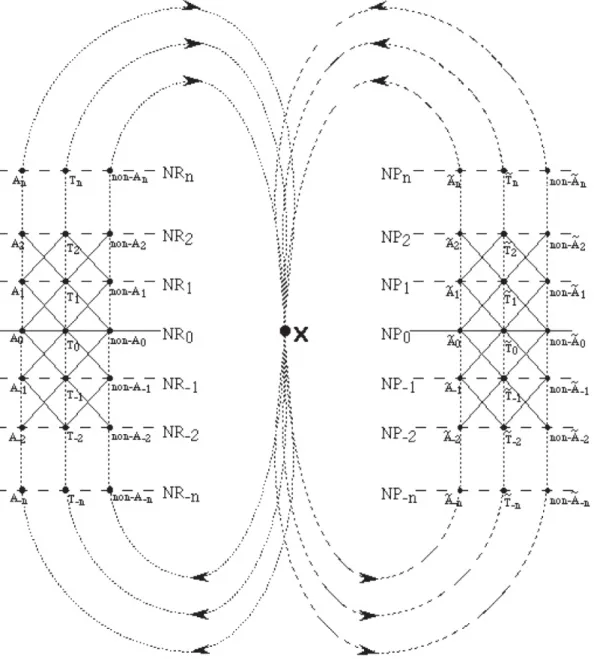
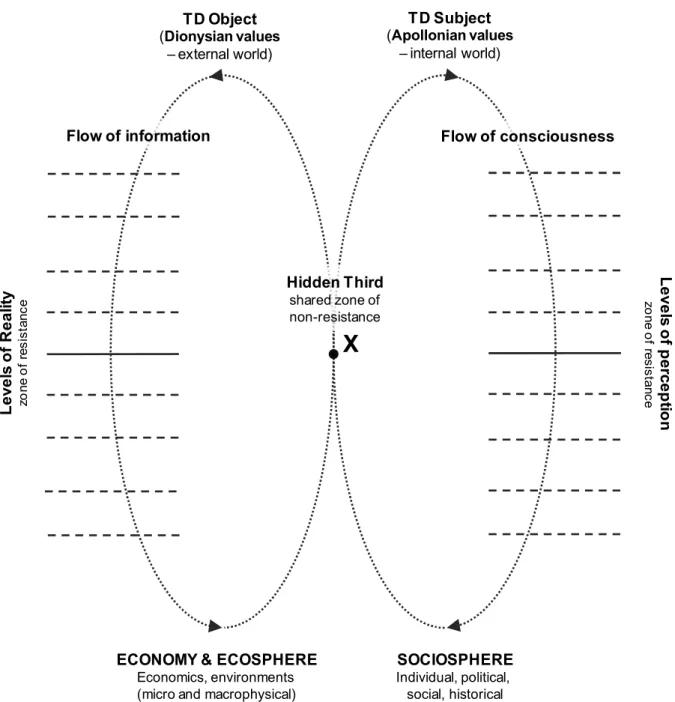
The very core of TD approach can be described through the diagram shown on the figure below. Particularly, multiple levels of Reality (the ontological axiom) and the logic of the included middle (the logical axiom) are explained by Figure 6; it is at the same time the most relevant Figure in the theoretical part of the master thesis. It presents the TD Object, the TD Subject and the Hidden Third, which are introduced later in this chapter.
Figure 6: The TD Object, the TD Subject, and Interaction term
Source: B. Nicolescu, Manifesto of Transdisciplinarity, 2002, p. 155.
In the figure’s left part there are symbolically drawn the levels of Reality
20
According to the TD approach, Reality is structured via a certain number of levels which could be finite or infinite (the index n can be finite or infinite). For the sake of clarity Nicolescu supposes that this number is infinite (n→∞ in Figure 6) (Nicolescu, 2005).
One has to distinguish the word “Real” and “Reality”. Real designates that what is (exists regardless of our sense organs), while Reality is connected to resistance in our human experience. The “Real” is, by definition, veiled forever, while the “Reality” is accessible to our knowledge (Nicolescu, 2002).
The existence of different levels of Reality has been affirmed by different traditions and civilizations. Term “level of Reality” is designated as a group of systems which are invariant under certain laws. Two levels of Reality are different if there is a break in the laws and a break in fundamental concepts (like, for example, causality) (Nicolescu, 2005). For example, economy and physics (biology) belong to very different levels of Reality.
Quantum physics reveals that quantum laws are radically differ from the laws of macrophysical world. However, no rigorous mathematical formalization has been found, to interpret the transit from one to another Reality. There are mathematical indications, however, in the sense that the transit from the quantic world to the macro-physical world is not continuous. The discontinuity that is manifested in the quantum world is also manifested in the structure of the levels of Reality, which means, that at least two worlds coexist. The emergence of at least three different levels of Reality in the study of natural systems (the macrophysical level, the microphysical level and the cyber-space-time) is a major event in the history of knowledge. It can lead us to reconsider our individual and social lives, to give a new interpretation to old knowledge, to explore the knowledge of ourselves in a different way (Nicolescu, 2002).
Disciplinary research concerns, at most, one and the same level of Reality. Moreover, in most cases, it only concerns fragments of one level of Reality. On the other side, TD concerns the dynamics created by the action of several levels of Reality at once. TD is not a new discipline or a new superdiscipline, but is nourished by disciplinary research. In turn, disciplinary research is clarified by TK in a new way. In this sense, disciplinary and TD research are not antagonistic but complementary(Nicolescu, 2002).
The different levels of Reality are accessible to human knowledge thanks to existence of different levels of perception, described diagrammatically at the right of Figure 6. They are found in a one-to-one correspondence with levels of Reality (Nicolescu, 2002). Such levels of perception can be activated as a consequence of different states of consciousness and they can also remain as potentials awaiting to be activated through practices as those taught by Buddhism and Taoism, i.e., by Satori Experience10 or other means that induce altered states of consciousness (Max-Neef, 2005).
10
Satori, in Zen Buddism, is the inner intuitive experience of enlightenment. It is said that Satori is inexplicable, indescribable and impossible to be understood through logic and reason. Satori is normally achieved after a concentrated period of preparation, and can happen spontaneously as a result of a sudden accidental stimuli, manifesting itself as a sudden awakening (break-through) toward a superior consciousness (Max-Neef, 2005).
21
Levels of perception: { NPn, ... , NP2, NP1, NP0, NP-1, NP-2, ... , NP-n}
There exists an oriented coherence of the unity of levels of Reality. If such coherence is limited only to the levels of Reality, it stops at the “highest” level and at the “lowest” level of Reality (see Figure 6). When the coherence continues beyond these two limiting levels (when there is an open unity), we must conceive the unity of levels of Reality as a unity that is extended by a zone of nonresistance to our experiences, representations, descriptions, images, and mathematical formulations. In this zone of absolute transparence there are no levels of Reality. Due to the limitations of our bodies and of our sense organs (regardless of what measuring tools are used to extend these sense organs) the zone of absolute transparence cannot be reached by using them. The zone is Real – that what is, while Reality is connected to resistance in our human experience. The zone of nonresistance corresponds to the sacred – to that which does not submit to any rationalization (Nicolescu, 2002). It is rational but not rationalizable, a distinction often used by Edgar Morin11 (Morin, 1986).
The unity of levels of Reality and its complementary zone of nonresistance constitute the so-called TD Object. As in the case of levels of Reality, the coherence of levels of perception presupposes a zone of nonresistance to perception. In this zone there are no levels of perception. The unity of levels of perception and this complementary zone of nonresistance constitute the TD Subject (Nicolescu, 2002).
Condition for communication between the TD Subject and the TD Object is that the two zones of nonresistance of TD Object and Subject must be identical. A flow of consciousness that coherently cuts across different levels of perception must correspond to the flow of information passing through different levels of Reality. The two flows are interrelated because they share the same zone of nonresistance (Nicolescu, 2002). Flow of information is in Figure 6 marked with the three oriented loops which cut through the levels of Reality, while the flow of consciousness is marked with the three oriented loops which cut through the levels of perception (Nicolescu, 2002).
The loops of information and consciousness have to meet in at least one point (in Figure 6 the point is marked with X) in order to insure the coherent transmission of information and consciousness. This point is called Hidden Third, whichis, in some sense, the source of Reality and perception. The point X and its associated loops of consciousness and information describe the Hidden Third of the TK; the interaction term between the Subject and the Object, which cannot be reduced neither to the Object nor to the Subject(Nicolescu, 2002).
This ternary partition: {Subject, Object, Interaction} is radically different from the binary partition: {Subject, Object}
11
Edgar Morin is a French philosopher and sociologist born Edgar Nahoum in Paris on July 8, 1921. He is of Judeo-Spanish (Sefardi) origin. He is known for the TD of his works (Edgar, 2011).