Technological University Dublin
Technological University Dublin
ARROW@TU Dublin
ARROW@TU Dublin
Conference papers
Audio Research Group
2010-01-01
Harmonic/Percussive Separation Using Median Filtering
Harmonic/Percussive Separation Using Median Filtering
Derry Fitzgerald
Technological University Dublin, [email protected]
Follow this and additional works at:
https://arrow.tudublin.ie/argcon
Part of the
Signal Processing Commons
Recommended Citation
Recommended Citation
Fitzgerald, D. (2010) Harmonic/Percussive Separation using Median Filtering. 13th International
Conference on Digital Audio Effects (DAFX10), Graz, Austria, 2010.
This Conference Paper is brought to you for free and open access by the Audio Research Group at
ARROW@TU Dublin. It has been accepted for inclusion in Conference papers by an authorized administrator of ARROW@TU Dublin. For more information, please contact [email protected],
[email protected], [email protected]. This work is licensed under a Creative Commons Attribution-Noncommercial-Share Alike 3.0 License
Audio Research Group
Articles
Dublin Institute of Technology Year
Harmonic/Percussive Separation using
Median Filtering
Derry Fitzgerald
Dublin Institute of Technology, [email protected]
This paper is posted at ARROW@DIT. http://arrow.dit.ie/argart/9
— Use Licence —
Attribution-NonCommercial-ShareAlike 1.0
You are free:
• to copy, distribute, display, and perform the work
• to make derivative works Under the following conditions:
• Attribution.
You must give the original author credit.
• Non-Commercial.
You may not use this work for commercial purposes.
• Share Alike.
If you alter, transform, or build upon this work, you may distribute the resulting work only under a license identical to this one.
For any reuse or distribution, you must make clear to others the license terms of this work. Any of these conditions can be waived if you get permission from the author.
Your fair use and other rights are in no way affected by the above.
This work is licensed under the Creative Commons Attribution-NonCommercial-ShareAlike License. To view a copy of this license, visit:
• URL (human-readable summary):
http://creativecommons.org/licenses/by-nc-sa/1.0/
• URL (legal code):
Proc. of the 13thInt. Conference on Digital Audio Effects (DAFx-10), Graz, Austria , September 6-10, 2010
HARMONIC/PERCUSSIVE SEPARATION USING MEDIAN FILTERING
Derry FitzGerald,
∗Audio Research Group
Dublin Institute of Technology
Kevin St.,Dublin 2, Ireland
[email protected]
ABSTRACT
In this paper, we present a fast, simple and effective method to sep-arate the harmonic and percussive parts of a monaural audio signal. The technique involves the use of median filtering on a spectro-gram of the audio signal, with median filtering performed across successive frames to suppress percussive events and enhance har-monic components, while median filtering is also performed across frequency bins to enhance percussive events and supress harmonic components. The two resulting median filtered spectrograms are then used to generate masks which are then applied to the origi-nal spectrogram to separate the harmonic and percussive parts of the signal. We illustrate the use of the algorithm in the context of remixing audio material from commercial recordings.
1. INTRODUCTION
The separation of harmonic and percussive sources from mixed au-dio signals has numerous applications, both as an auau-dio effect for the purposes of remixing and DJing, and as a preprocessing stage for other purposes. This includes the automatic transcription of pitched instruments,key signature detection and chord detection, where elimination of the effects of the percussion sources can help improve results. Similarly, the elimination of the effects of pitched instruments can help improve results for the automatic transcrip-tion of drum instruments, rhythm analysis beat tracking.
Recently, the authors proposed a tensor factorisation based al-gorithm capable of obtaining good quality separation of harmonic and percussive sources [1]. This algorithm incorporated an addi-tive synthesis based source-filter model for pitched instruments, as well as constraints to encourage temporal continuity on pitched sources. A principal advantage of this approach was that it re-quired little or no pretraining in comparison to many other ap-proaches [2, 3, 4]. Unfortunately, a considerable shortcoming of the tensor factorisation approach is that it is both processor and memory intensive, making it impractical for use when whole songs need to be processed, for example such as when remixing a song.
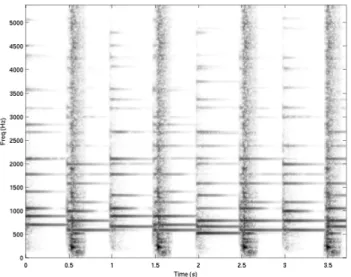
In an effort to overcome this, it was decided to investigate other approaches capable of separating harmonic and percussive components without pretraining, but which were also computa-tionally less intensive. Of particular interest was the approach de-veloped by Ono et al [5]. This technique was based on the intuitive idea that stable harmonic or stationary components form horizon-tal ridges on the spectrogram, while percussive components form vertical ridges with a broadband frequency response. This can be seen in Figure 1, where the harmonic components are visible as
∗This work was supported by Science Foundation Ireland’s Stokes
Lec-turer Program
horizontal lines, while the percussive events can be seen as ver-tical lines. Therefore, a process which emphasises the horizontal lines in the spectrogram while suppressing vertical lines should re-sult in a spectrogram which contains mainly pitched sources, and vice-versa for the vertical lines to recover the percussion sources. To this end, a cost function which minimised theL2norm of the
power spectrogram gradients was proposed.
Figure 1:Spectrogram of pitched and percussive mixture
LettingWh,idenote the element of the power spectrogramW
of a given signal at frequency binhand theith time frame, and similarly definingHh,i as an element ofHthe harmonic power spectrogram andPh,ias an element ofPthe percussive power spectrogram, the cost function can then be defined as:
J(H,P) = 1 2σ2 H X h,i (Hh,i−1−Hh,i)2 + 1 2σ2 P X h,i (Ph−1,i−Ph,i)2 (1)
whereσH andσP are parameters used to control the weights of the harmonic and percussive smoothness respectively. The cost function is further subject to the additional constraints that
Hh,i+Ph,i=Wh,i (2)
Proc. of the 13thInt. Conference on Digital Audio Effects (DAFx-10), Graz, Austria , September 6-10, 2010
Hh,i≥0, Ph,i≥0 (3)
In effect, this is equivalent to assuming that the spectrogram gra-dients(Hh,i−1−Hh,i)and(Ph−1,i−Ph,i)follow gaussian
dis-tributions. This is not the case, and so a compressed version of the power spectrogram,W˜ = Wγ where0 < γ ≤ 1, is used instead to partially compensate for this. Iterative update equations to minimiseJ(H,P)forHandPwere then derived, and the re-covered harmonic and percussive spectrograms used to generate masks which were then applied to the original spectrogram before inversion to the time domain.
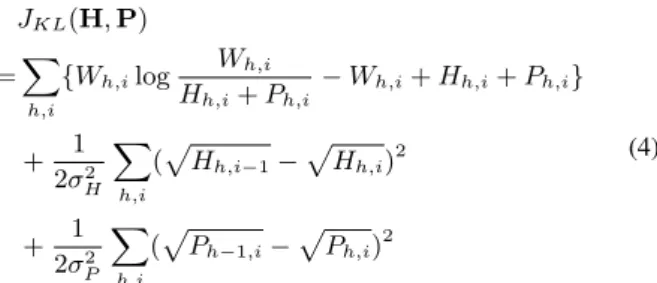
In [6] an alternative cost function based on the generalised Kullback-Liebler divergence was proposed:
JKL(H,P) =X
h,i
{Wh,ilog Wh,i
Hh,i+Ph,i −Wh,i+Hh,i+Ph,i}
+ 1 2σ2 H X h,i (pHh,i−1− p Hh,i)2 + 1 2σ2 P X h,i (pPh−1,i− p Ph,i)2 (4)
and new update equations forHandPderived from this cost func-tion. A real-time implementation of the algorithm using a sliding block analysis, rather than processing the whole signal, was also implemented and described in [6].
The system was shown to give good separation performance at low computational cost, thereby making it suitable as a prepro-cessor for other applications. Further, the underlying principle of the algorithm represents a simple intuitive idea that can be used to derive alternate means of separating harmonic and percussive components, as will be seen in the next section.
2. MEDIAN FILTERING BASED SEPARATION
As was shown previously, regarding percussive events as vertical lines and harmonic events as horizontal lines in a spectrogram is a useful approximation when attempting to separate harmonic and percussive source. Taking the percussive events as an example, the algorithms described above in effect smooth out the frequency spectrum in a given time frame by removing large “spikes” in the spectrum which correspond to harmonic events. Similarly, har-monic events in a given frequency bin are smoothed out by remov-ing “spikes” related to percussive events. Another way of lookremov-ing at this is to regard harmonic events as outliers in the frequency spectrum at a given time frame, and to regard percussive events as outliers across time in a given frequency bin. This brings us to the concept of using median filters individually in the horizontal and vertical directions to separate harmonic and percussive events.
Median filters have been used extensively in image processing for removing speckle noise and salt and pepper noise from images [7]. Median filters operate by replacing a given sample in a signal by the median of the signal values in a window around the sample. Given an input vectorx(n)theny(n)is the output of a median filter of lengthlwhereldefines the number of samples over which median filtering takes place. Wherelis odd, the median filter can be defined as:
y(n) = median{x(n−k:n+k), k= (l−1)/2} (5)
In effect, the original sample is replaced with the middle value obtained from a sorted list of the samples in the neighbourhood of the original sample. In cases wherel is even, the median is obtained as the mean of the two values in the middle of in the sorted list. As opposed to moving average filters, median filters are effective in removing impulse noise because they do not depend on values which are outliers from the typical values in the region around the original sample.
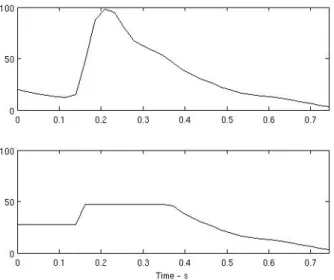
A number of examples are now presented to illustrate the ef-fects of median filtering in suppressing harmonic and percussive events in audio spectrograms. Figure 2(a) shows the plot of a fre-quency spectrum containing a mixture of noise from a snare drum and notes played by a piano. The harmonics from the piano are clearly visible as large spikes in the spectrum. Figure 2(b) shows the same spectrum after median filtering with a filter length of 17. It can be seen that the spikes associated with the harmonics have been suppressed, leaving a spectrum where the drum noise now predominates. Similarly, Figure 3(a) shows the output of a fre-quency bin across time, again taken from a mixture of snare drum and piano. The onset of the snare is clearly visible as a large spike in energy in the frequency bin, while the harmonic energy is more constant over time. Figure 3(b) shows the output of the frequency bin after median filtering, and it can be appreciated that the spike associated with the onset is removed by median filtering, thereby suppressing the energy due to the percussion event.
Figure 2: Spectrogram frame containing mixture of piano and snare a) Original spectrum b) Spectrum after median filtering
Given an input magnitude spectrogramS, and denoting theith time frame asSi, and thehth frequency slice asSha percussion-enhanced spectrogram framePican be generated by performing median filtering onSi:
Pi=M{Si, lperc} (6) whereMdenotes median filtering andlpercis the filter length of the enhancing median filter. The individual percussion-enhanced framesPiare then combined to yield a percussion-enhanced spectrogramP. Similarly, a harmonic-enhanced spectrogram fre-quency sliceHhcan be obtained by median filtering frequency
Proc. of the 13thInt. Conference on Digital Audio Effects (DAFx-10), Graz, Austria , September 6-10, 2010
Figure 3:Spectrogram frequency slice containing mixture of piano and snare a) Original slice b) Slice after median filtering
sliceSh.
Hi=M{Sh, lharm} (7) wherelharmis the length of the harmonic median filter. The slices are then combined to give a harmonic enhanced spectrogramH.
The resulting harmonic and percussion suppressed spectro-grams can then be used to generate masks which can then be ap-plied to the original spectrogram. Two families of masks were then investigated for the separation of the sources. The first of these is a hard or binary mask, where it is assumed that each frequency bin in the spectrogram belongs either to the percussion or to the harmonic source. In this case, the masks are defined as:
MHh,i= ( 1, ifHh,i>Ph,i 0, otherwise (8) MPh,i= ( 1, ifPh,i>Hh,i 0, otherwise (9) The second family of masks are soft masks based on Wiener Fil-tering and are defined as:
MHh,i= Hph,i (Hph,i+Pph,i) (10) MPh,i= Pph,i (Hph,i+Pph,i) (11)
wherepdenotes the power to which each individual element of the spectrograms are raised. Typicallypis given a value of 1 or 2.
Complex spectrograms are then recovered for inversion from:
ˆ
H=ˆS⊗MH (12)
and
ˆ
P=ˆS⊗MP (13)
where⊗denotes elementwise mulitiplication and whereSˆdenotes the original complex valued spectrogram. These complex spectro-grams are then inverted to the time domain to yield the separated harmonic and percussive waveforms respectively.
In comparison to the iterative approach developed by Ono et al., which typically requires 30-50 iterations to converge, only two passes are required through the input spectrogram, one each forH
andP. This means that the median filter based algorithm is faster, which is of considerable benefit when used as preprocessing for other tasks. In tests, the proposed algorithm performs approxi-mately twice as fast as that of Ono et al with the number of itera-tions set to 30. This raises the possibility of performing real-time harmonic/percussive separation on stereo files, as the proposed al-gorithm can easily be extended to handle stereo signals.
3. SEPARATION AND REMIXING EXAMPLES
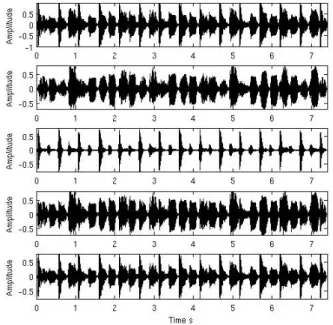
We now present examples of the use of the median filtering har-monic/percussive separation algorithm. Figure 4 shows an excerpt from “Animal” by Def Leppard, as well as the separated harmonic and percussive waveforms respectively, obtained using a median filter of length 17 for both harmonic and percussive filters, as well as using a soft mask withp= 2. It can be seen that the recovered harmonic waveform contains little or no evidence of percussion events, while the percussive waveform contains little or no evi-dence of the harmonic instruments. On listening to the waveforms, some traces of the drums can be heard in the harmonic waveform, though at a very reduced level, while the attack portion of some of the instruments such as guitar has been captured by the percussive waveform, as well as traces of some guitar parts where the pitch is changing constantly. This is to be expected as the attacks of many instruments such as guitar and piano can be considered as percussive in nature, and as the algorithm assumes that the pitched instruments are stationary in pitch. This also occurs in other algo-rithms for separating harmonic and percussive components.
Also shown in Figure 4 are remixed versions of the original signal, the first has the percussion components reduced by 6dB, while the second shows the harmonic components reduced by 6dB. On listening to these waveforms, there are no noticeable artifacts in the resynthesis, while the reduction in amplitude of the respective sources can clearly be heard. This demonstrates that the algorithm is capable of generating audio which can be used for high-quality remixing of the separated harmonic and percussive sources.
Figure 5 shows an excerpt from “Billie Jean” by Michael Jack-son, the separated harmonic and percussive waveforms, and remixed versions with the percussion reduced by 6dB, and the harmonics reduced by 6dB respectively. Again, the algorithm can be seen to have separated the harmonic and percussive parts well. On listen-ing, the attack of the bass has been captured by the percussive part, and a small amount of drum noise can be heard in the harmonic waveform. In the remixed versions, no artifacts can be heard.
Both of the above examples were carried out using an FFT size of 4096, with a hopsize of 1024, with a sampling frequency of 44.1 kHz. Testing showed that better separation quality was achieved at larger FFT lengths. The median filter length was set to 17 for both the harmonic and percussive filters, and testing showed that once the median filter lengths were above 15 and below 30,the separation quality did not vary dramatically, with good separation achieved in most cases. Further, informal listening tests suggest that the quality of separation is comparable to that achieved by the algorithms proposed by Ono et al. The use of the soft masking was found to result in less artifacts in the resynthesis, though at the ex-pense of a slight increase in the amount of interference between the percussive and harmonic sources. In general, it was observed that settingp= 2gave considerably better separation results than
Proc. of the 13thInt. Conference on Digital Audio Effects (DAFx-10), Graz, Austria , September 6-10, 2010
Figure 4: Excerpt from “Animal” by Def Leppard a) Original waveform, b) Separated harmonic waveform, c) Separated per-cussive waveform, d) Remix, percussion reduced by 6dB, e) Remix, harmonic components reduced by 6dB
ingp= 1. Audio examples are available for download athttp: //eleceng.dit.ie/derryfitzgerald/index.php?uid= 489&menu_id=42
4. CONCLUSIONS
Having described an fast effective method of harmonic-percussive separation developed by Ono et al [6], which is based on the idea that percussion events can be regarded as vertical lines, and har-monic or stationary events as horizontal lines in a spectrogram, we then took advantage of this idea to develop a simpler, faster and more effective harmonic/percussive separation algorithm. This was based on the idea that harmonics could be regarded as outliers in a spectrum containing a mixture of percussion and pitched instru-ments, while percussive onsets can be regarded as outliers in a frequency slice containing a stable harmonic or stationary event.
To remove these outliers, we then used median filtering, as me-dian filtering is effective at removing outliers for the purposes of image denoising. The resulting harmonic-enhanced and percussion-enhanced spectrograms were then used to generate masks which were then applied to the original spectrogram to separate the har-monic and percussive components. Real-world separation and remix-ing examples usremix-ing the algorithm were then discussed.
Future work will concentrate on developing a real-time im-plementation of the algorithm and on investigating the use of the algorithm as a preprocessor for other tasks such as key signature detection and chord detection, where suppression of percussion events is helpful in improving results. Further, the use of rank-order filters, where a different percentile other than 50, which is used in median filtering will be investigated as a means of poten-tially improving the separation performance of the algorithm.
Figure 5:Excerpt from “Billie Jean” by Michael Jackson a) Origi-nal waveform, b) Separated harmonic waveform, c) Separated per-cussive waveform, d) Remix, percussion reduced by 6dB, e) Remix, harmonic components reduced by 6dB
5. REFERENCES
[1] D. FitzGerald, E. Coyle, and M. Cranitch, “Using tensor fac-torisation models to separate drums from polyphonic music,” inProc. Digital Audio Effects (DAFx-09), Como, Italy, 2009. [2] K. Yoshii, M. Goto, and H. Okuno, “Drum sound recognition
for polyphonic audio signals by adaptation and matching of spectrogram templates with harmonic structure suppression,”
IEEE Transactions on Audio, Speech and Language Process-ing, vol. 15, no. 1, pp. 333–345, 2007.
[3] O. Gillet and G. Richard, “Transcription and separation of drum signals from polyphonic music,” IEEE Transactions on Audio, Speech and Language Processing, vol. 16, no. 3, pp. 529–540, 2008.
[4] M. Helen and T. Virtanen, “Separation of drums from poly-phonic music using non-negative matrix factorisation and sup-port vector machine,” inProc. European Signal Processing Conference, Anatalya, Turkey, 2005.
[5] N. Ono, K. Miyamoto, J. Le Roux, H. Kameoka, and S. Sagayama, “Separation of a monaural audio signal into harmonic/percussive components by complementary diffusion on spectrogram,” inProceedings of the EUSIPCO 2008 Euro-pean Signal Processing Conference, Aug. 2008.
[6] N. Ono, K. Miyamoto, H. Kameoka, and S Sagayama, “A real-time equalizer of harmonic and percussive components in music signals,” inProc. Ninth International Conference on Music Information Retrieval (ISMIR08), 2008, pp. 139–144. [7] R. Jain, R. Kasturi, and B. Schunck, Machine Vision,
McGraw-Hill, 1995.