
Developments in Hydrobiology 181
Series editor
K. Martens
Rotifera X
Rotifer Research: Trends, New Tools and Recent
Advances
Proceedings of the Xth International Rotifer Symposium,
held in Illmitz, Austria, 7–13 June 2003
Edited by
Alois Herzig,
1
Ramesh D. Gulati,
2
Christian D. Jersabek
3
& Linda May
4
1
Biological Station Neusiedler See, Illmitz, Austria 2
NIOO, Centre of Limnology, Nieuwersluis, The Netherlands 3
University of Salzburg, Austria 4
Centre for Ecology and Hydrology, Penicuik, Midlothian, Scotland
Reprinted from Hydrobiologia, volume 546 (2005)
Library of Congress Cataloging-in-Publication Data
A C.I.P. Catalogue record for this book is available from the Library of Congress.
ISBN 1-4020-3493-8 Published by Springer,
P.O. Box 17, 3300 AA Dordrecht, The Netherlands
Cover illustration:Hexarthra polyodonta, drawing by Walter Koste
Printed on acid-free paper All Rights reserved
2005 Springer
No part of this material protected by this copyright notice may be reproduced or utilized in any form or by any means, electronic or mechanical, including photocopying, recording or by any information storage and retrieval system, without written permission from the copyright owner.
TABLE OF CONTENTS
Preface xi–xiv
Photo of participants xiv
Walter Koste – a K-strategist? A laudatio
N. Walz 1–8
PART I: PHYLOGENY AND EVOLUTION
On the phylogenetic position of Rotifera – have we come any further?
P. Funch, M.V. Sørensen, M. Obst 11–28
Speciation and selection without sex
C.W. Birky Jr., C. Wolf, H. Maughan, L. Herbertson, E. Henry 29–45
Bayesian and maximum likelihood analyses of rotifer–acanthocephalan relationships
D.B. Mark Welch 47–54
Evolutionary dynamics of ‘the’ bdelloid and monogonont rotifer life-history patterns
C.E. King, C. Ricci, J. Schonfeld, M. Serra 55–70
Toward a better understanding of the phylogeny of the Asplanchnidae (Rotifera)
E.J. Walsh, R.L. Wallace, R.J. Shiel 71–80
PART II: GENETICS AND MOLECULAR ECOLOGY
Molecular ecology of rotifers: from population differentiation to speciation
A. Go´mez 83–99
The potential of genomic approaches to rotifer ecology
D.B. Mark Welch, J.L. Mark Welch 101–108
Using amplified fragment length polymorphisms (AFLP) to study genetic variability in several freshwater rotifer species
S. Herna´ndez-Delgado, N. Mayek-Pe´rez, G.E. Santos-Medrano, R. Rico-Martı´nez 109–115
Molecular characterization of Mn-superoxide dismutase and gene expression studies in dietary restrictedBrachionus plicatilis rotifers
G. Kaneko, T. Yoshinaga, Y. Yanagawa, S. Kinoshita, K. Tsukamoto, S. Watabe 117–123
Behavioural reproductive isolation in a rotifer hybrid zone
H.K. Berrieman, D.H. Lunt, A. Go´mez 125–134
PART III: TAXONOMY AND BIOGEOGRAPHY
The ‘Frank J. Myers Rotifera collection’ at the Academy of Natural Sciences of Philadelphia
Tale of a sleeping beauty: a new and easily cultured model organism for experimental studies on bdelloid rotifers
H. Segers, R.J. Shiel 141–145
Life on the edge: rotifers from springs and ephemeral waters in the Chihuahuan Desert, Big Bend National Park (Texas, USA)
R.L. Wallace, E.J. Walsh, M.L. Arroyo, P.L. Starkweather 147–157
PART IV: MORPHOLOGY AND ULTRASTRUCTURE
Euryhaline Brachionus strains (Rotifera) from tropical habitats: morphology and allozyme patterns
T. Kotani, A. Hagiwara, T.W. Snell, M. Serra 161–167
Morphological and morphometrical variations of selected rotifer species in response to predation: a seasonal study of selected brachionid species from Lake Xochimilco (Mexico)
G. Garza-Mourin˜o, M. Silva-Briano, S. Nandini, S.S.S. Sarma, M.E. Castellanos-Pa´ez 169–179
Morphological stasis of two species belonging to the L-morphotype in theBrachionus plicatilisspecies complex
S. Campillo, E.M. Garcı´a-Roger, D. Martı´nez-Torres, M. Serra 181–187
Morphological variation of Keratella cochlearis (Gosse) in a backwater of the River Thames
J. Green 189–196
Trophi structure in bdelloid rotifers
G. Melone, D. Fontaneto 197–202
Study of the trophi of Testudinella Bory de St. Vincent and Pompholyx Gosse (Rotifera: Testudinellidae) by scanning electron microscopy
W.H. De Smet 203–211
Do rotifer jaws grow after hatching?
D. Fontaneto, G. Melone 213–221
External morphology and muscle arrangement ofBrachionus urceolaris, Floscularia ringens,Hexarthra miraandNotommata glyphura (Rotifera, Monogononta)
N. Santo, D. Fontaneto, U. Fascio, G. Melone, M. Caprioli 223–229
The musculature ofTestudinella patina(Rotifera: Flosculariacea), revealed with CLSM
M.V. Sørensen 231–238
Rotifer nervous system visualized by FMRFamide and 5-HT immunocytochemistry and confocal laser scanning microscopy
E.A. Kotikova, O.I. Raikova, M. Reuter, M.K.S. Gustafsson 239–248
Identification of acetylcholinesterase receptors in Rotifera
A. Pineda-Rosas, G.E. Santos-Medrano, M.F. Zavala-Reynoso, R. Rico-Martı´nez 249–253 vi
PART V: MATING, RESTING EGGS, DIAPAUSE, ANHYDROBIOSIS, EMBRYONIC DEVELOPMENT
Brachionus calyciflorus is a species complex: Mating behavior and genetic differentiation among four geographically isolated strains
J.J. Gilbert, E.J. Walsh 257–265
Removal of surface glycoproteins and transfer amongBrachionusspecies
T.W. Snell, C.-P. Stelzer 267–274
Maternal effect by stem females inBrachionus plicatilis: effect of starvation on mixis induction in offspring
A. Hagiwara, Y. Kadota, A. Hino 275–279
Restoration of tropical peat swamp rotifer communities after perturbation: an experimental study of recovery of rotifers from the resting egg bank
S. Chittapun, P. Pholpunthin, H. Segers 281–289
Diapause in monogonont rotifers
T. Schro¨der 291–306
Anhydrobiosis ofAdineta ricciae: costs and benefits
C. Ricci, C. Covino 307–314
A putative LEA protein, but no trehalose, is present in anhydrobiotic bdelloid rotifers
A. Tunnacliffe, J. Lapinski, B. McGee 315–321
The development of a bdelloid egg: a contribution after 100 years
C. Boschetti, C. Ricci, C. Sotgia, U. Fascio 323–331
PART VI: POPULATION AND COMMUNITY ECOLOGY Evolution of rotifer life histories
C.-P. Stelzer 335–346
Insulin-like growth factor signaling pathway involved in regulating longevity of rotifers
T. Yoshinaga, G. Kaneko, S. Kinoshita, S. Furukawa, K. Tsukamoto, S. Watabe 347–352
Combined effects of algal (Chlorella vulgaris) food level and temperature on the demography ofBrachionus havanaensis(Rotifera): a life table study
E.L. Pavo´n-Meza, S.S.S. Sarma, S. Nandini 353–360
Factors affecting egg-ratio in planktonic rotifers
S.S.S. Sarma, R.D. Gulati, S. Nandini 361–373
Factors affecting swimming speed in the rotiferBrachionus plicatilis
M. Yu´fera, E. Pascual, J.M. Olivares 375–380
An evidence for vertical migrations of small rotifers – a case of rotifer community in a dystrophic lake
A. Karabin, J. Ejsmont-Karabin 381–386
Structure distinctions of pelagic rotifer plankton in stratified lakes with different human impact
G.A. Galkovskaya, I.F. Mityanina 387–395
Changes in rotifer species composition and abundance along a trophic gradient in Loch Lomond, Scotland, UK
L. May, M. O’Hare 397–404
Diversity and abundance of the planktonic rotifers in different environments of the Upper Parana´ River floodplain (Parana´ State – Mato Grosso do Sul State, Brazil)
C.C. Bonecker, C.L. Da Costa, L.F.M. Velho, F.A. Lansac-Toˆha 405–414
Relationships between rotifers, phytoplankton and bacterioplankton in the Corumba´ reservoir, Goia´s State, Brazil
C.C. Bonecker, A.S.M. Aoyagui 415–421
Short time-response of psammic communities of Rotifera to abiotic changes in their habitat
J. Ejsmont-Karabin 423–430
The influence of biotic and abiotic factors on psammic rotifers in artificial and natural lakes
I. Bielan´ska-Grajner 431–440
PART VII: LONG-TERM STUDIES
Seasonal rotifer dynamics in the long-term (1969–2002) record from Lake Kinneret (Israel)
M. Gophen 443–450
Seasonality of rotifers and temperature in Lough Neagh, N. Ireland
T.E. Andrew, J.A.M. Andrew 451–455
Abiotic vs. biotic factors: lessons drawn from rotifers in the Middle Loire, a meandering river monitored from 1995 to 2002, during low flow periods
N. Lair 457–472
PART VIII: TROPHIC INTERACTIONS
Freshwater copepods and rotifers: predators and their prey
Z. Brandl 475–489
Life history characteristics of Asplanchnopus multiceps (Rotifera) fed rotifer and cladoceran prey
S. Nandini, S.S.S. Sarma 491–501
Susceptibility of ephemeral pool Hexarthra to predation by the fairy shrimp
Branchinecta mackini: can predation drive local extinction?
P.L. Starkweather 503–508
Decline of clear-water rotifer populations in a reservoir: the role of resource limitation
M. Devetter, J. Sed¢a 509–518
Combined effects of food concentration and temperature on competition among four species ofBrachionus(Rotifera)
M.A. Ferna´ndez-Araiza, S.S.S. Sarma, S. Nandini 519–534
Application of stable isotope tracers to studies of zooplankton feeding, using the rotiferBrachionus calyciflorus as an example
A.M. Verschoor, H. Boonstra, T. Meijer 535–549
PART IX: AQUACULTURE AND ECOTOXICOLOGY Screening methods for improving rotifer culture quality
A. Araujo, A. Hagiwara 553–558
Interaction among copper toxicity, temperature and salinity on the population dynamics ofBrachionus rotundiformis(Rotifera)
J.L. Gama-Flores, S.S.S. Sarma, S. Nandini 559–568
Effect of some pesticides on reproduction of rotiferBrachionus plicatilisMu¨ller
H.S. Marcial, A. Hagiwara, T.W. Snell 569–575
Heat shock protein 60 (HSP60) response ofPlationus patulus(Rotifera: Monogononta) to combined exposures of arsenic and heavy metals
J.V. Rios-Arana, J.L. Gardea-Torresdey, R. Webb, E.J. Walsh 577–585
Subject Index 587–595
Rotifer Species Index 597–601
Preface
The Xth International Rotifer Symposium was held in Illmitz, Austria, 7–13 June 2003, at the Information Centre of the National Park Neusied-ler See – Seewinkel. The Symposium was returning to Austria 27 years after the first rotifer meeting was organized there by Prof. Agnes Ruttner-Kolisko at the Biological Station Lunz in 1976. The Xth meeting was attended by 113 participants from 28 countries. It was organized by Alois Herzig with the assistance of Christian Jersabek, Institute of Zoology, University of Salzburg and Alois Lang, Information Centre of the National-park Neusiedler See – Seewinkel. It was hosted by the Biological Station Neusiedler See (Provincial Administration of Burgenland) and the National Park Society. The symposium venue provided an excellent opportunity for the community of rotifer researchers to follow the scientific programme combined with enjoyable breaks and nice sund-owners.
After the opening ceremony and a short appraisal by Alois Herzig of the contents and topics of the last nine meetings, Norbert Walz paid a tribute to the life-time works of Walter Koste. Subsequently, the scientific programme followed the traditions of the previous symposia with 6 invited main lectures, 56 oral contributions and 45 poster presentations. The papers were grouped into thematic sessions: Phylogeny, evolution and genetics; Molecular ecology; Biogeography and development; Diapause, anhydrobiosis and resting eggs; Morphology, ultrastructure and behaviour; Feeding; Population ecology; Culture of rotifers; Physiology and ecotoxicology. In addition, two late afternoon sessions were devoted to the careers in rotiferology of John Gilbert and Henri Dumont. Special thanks to John J. Gilbert, Ramesh D. Gulati, Charles E. King, Linda May, Claudia Ricci, Terry W. Snell and Robert L. Wallace for their involvement with the arrangements for the scientific programme.
Social activities began with a Welcome Party that was held on Saturday evening at the Information Centre of the National Park. The
occasion was made all the more enjoyable by the wonderful atmosphere created by a brass band playing music typical of Czech Republic, Slovakia and eastern Austria. A full-day excursion was organized on the Wednesday. The participants enjoyed a cruise around Neusiedler See, a visit and an introduction to the activities of the Wine Academy at Rust (which runs courses in the Science of Wine Making) combined with a short wine tasting, a guided tour through the old town of Rust (buildings dating back to the 16th cen-tury), and a visit to the Baroque Esterha´zy Palace at Eisenstadt. As an preamble to Joseph Haydns music, a chamber concert was given in the fa-mous Haydn Hall of the Esterha´zy Palace. Par-ticipants were invited to a lunch by the Head of the Government of the Province of Burgenland, which took place in representative rooms of the Palace. The excursion in the afternoon to Hun-gary included a visit to typical farm houses in a small village situated south of Neusiedler See (Ferto¨sze´plak) and the baroque Esterha´zy Castle of Ferto¨d, the place where Haydn spent nearly two decades of his creative life. The Conference Dinner was hosted by the Government of the Province of Burgenland on Friday at Johanneszeche, a typical restaurant with Hun-garian ambience and Croatian (Tamburizza) and gipsy music in the backdrop. Accompanying guests made several day trips to places of natural, cultural and historical interests in the Neusiedler See area and the adjacent Hungarian neighbour-hood townships.
Kluwer Academic Publishers, now Springer Aquatic Sciences, and Prof. Dr. Koen Martens,
Editor-in-chief Hydrobiologia, have accepted to publish the symposium proceedings as a special volume in the seriesDevelopments in Hydrobiology. The manuscripts accepted for publication have undergone a careful review and revision process and appropriate editorial amendments needed for clarity and conciseness. The final product is the result of the efforts of the authors, reviewers, edi-tors and the Editor-in-chief.
Hydrobiologia (2005) 546:xi–xiv Springer 2005 A. Herzig, R.D. Gulati, C.D. Jersabek & L. May (eds.) Rotifera X: Rotifer Research: Trends, New Tools and Recent Advances DOI 10.1007/s10750-005-4085-6
The Proceedings are composed of nine parts (See Contents). The introductory paper by Funch et al. (Part I) offers a detailed discussion of the phylogenetic position of rotifers vis-a-vis gnathi-feran groups. Originally, Gnathifera only com-prised the hermaphroditic Gnathostomulida and the Syndermata. On the basis of the ultrastructure of the trophy, the rotifers belong to the Gnathi-fera; moreover, molecular evidence strongly sug-gests that they are closely related to the parasitic acanthocephalans and the two together form the clade Syndermata. In his paper Mark Welch pro-vides evidence for a monophyletic Eurotatoria based on maximum likelihood and Bayesian analysis of the protein-coding genehsp82and for the placement of Acanthocephala within the Phy-lum Rotifera as a sister clade to either Eurotatoria or Seisonidea.
Substantial differences in both life-table char-acteristics and reproductive patterns distinguish bdelloid rotifers from monogonont rotifers. King et al. explore some of the adaptive conse-quences of these life-history differences using a computer model to simulate the evolutionary acquisition of new beneficial mutations. Birky et al., isolated more than 100 females of the obli-gately asexual bdelloid rotifers from nature and sequenced their mitochondrial cox1 genes and conclude that in the absence of sexual reproduction the bdelloids have undergone substantial clado-genesis; bdelloid clades are adapted to different ni-ches and have undergone substantial speciation. The authors failed to detect a decrease in the effec-tiveness of natural selection on bdelloid genes.
The development of cost-effective molecular tools that allow the amplification of minute amounts of DNA, effectively opened the field of molecular ecology of rotifers. In Part II (Genetics and Molecular Ecology), Go´mez critically reviews: (1) methodological advances that have facilitated the application of molecular techniques to rotifers, (2) recent advances in the field of rotifer molecular ecology, and (3) future developments and areas which are likely to benefit further from the molecular ecological approach. It is now feasible to obtain representative DNA sequences from identified rotifer species for use in genomic-based surveys for determining rotifers in new sample collections, circumventing the difficulties that go with traditional surveys. D.B. Mark Welch and
J.L. Mark Welch discuss in their paper the appli-cation of two genomic-based tools used in surveys of microbial communities to rotifer taxonomy: serial analysis of gene tags (SAGT) and micro-array hybridization. They also report the con-struction and hybridization of a small microarray of rotifer sequences, thereby demonstrating that these techniques are most powerful if combined with traditional rotifer systematics.
Bdelloids show a rather uniform morphology of jaws (trophi), most recognizably feature is the presence of a series of teeth forming unci plates, each with one to ten major median teeth. Using SEM photomicrographs of trophi and literature data, Melone and Fontaneto deduce that few major teeth are common in species living in water bodies, where these species possibly eat unicellular algae, while more major teeth are more common in species inhabiting mosses and lichens, where they possibly consume bacteria.
Modern techniques can contribute significantly to our understanding of the rotifers anatomy, especially relating to the musculature and the nervous system. Very recently, immunostaining has been applied in combination with confocal laser scanning microscopy (CLSM). Santo et al., applied CLSM to describe the muscle arrangement of Brachionus urceolaris, Floscularia ringens,
Hexarthra miraand Notommata glyphura. Søren-sen describes the musculature of Testudinella patina. Kotikova et al. presents data on the immuno-reactivity patterns in the nervous system of Platyas patulus, Euchlanis dilatata and
Asplanchna herricki using CLSM. That species considered to be cosmopolitan can be complexes of sibling species has been recently clearly dem-onstrated for the rotifer Brachionus plicatilis: within the Iberian Peninsula three species have been described and another three have been iden-tified (see Go´mez, Part II). Gilbert and Walsh who observed mating behaviour and genetic differenti-ation among four geographically isolated strains of Brachionus calyciflorus conclude that it is a species complex in which some geographically and genetically distinct strains are reproductively iso-lated from one another.
Bdelloid rotifers can withstand desiccation by entering a state of suspended animation: anhy-drobiosis. Ricci and Covino describe and discuss costs and benefits of anhydrobiosis of a new xii
species,Adineta ricciae, a new species described by Segers and Shiel (see part III). A comparison of this with Macrotrachela quadricornifera reveals both species suspend their life activities during desiccation as well do not ‘‘age’’ during anhydro-biosis. This meets the prediction of the ‘‘Sleeping Beauty’’ model. Anhydrobiosis is thought to require accumulation of the non-reducing disac-charides trehalose (in animals and fungi) or sucrose (in plant seeds and resurrection plants), which may protect proteins and membranes by acting as water replacement molecules and vitri-fying agents. However, in clone cultures of the bdelloids Philodina roseola and Adineta vaga
Tunnacliffe et al. were unable to detect trehalose or other disaccharides. Instead, on dehydration,
P. roseola upregulates a hydrophilic protein related to the late embryogenesis abundant(LEA) proteins associated with desiccation tolerance in plants. It could well be that hydrophilic biosyn-thesis represents a common element of anhydro-biosis.
A number of studies examine spatial and tem-poral variability in rotifer abundance and com-munity structure in relation to variations in abiotic and biotic factors along gradients in natural water bodies, and in laboratory. M. Gophen presents the results of a long-term study on seasonal rotifer dynamics in Lake Kinneret (Israel) and T.E. Andrew and J.A.M. Andrew in Lough Neagh (Northern Ireland). N. Lair focussed on rotifers in river plankton, especially the response of various rotifer taxa to hydraulic conditions, and the role of rotifers in the river food web.
As a special topic, Z. Brandl reviews the trophic relationship between freshwater copepods and rotifers. Most copepod species, at least in their later developmental stages, predate efficiently, preferably on rotifers. Generally, soft-bodied species of rotifers are more vulnerable to predation than those that possess spines or lorica. But also behavioural characteristics, e.g., movements and escape reactions, and temporal and spatial distribution of rotifers are important in these trophic interactions. The reported predation rates by freshwater copepods can effectively exer-cise a top-down control of rotifer populations.
During the preparation of the present pro-ceedings, we heard about the sudden death of Andrzej Karabin, who had designed logos for
previous Rotifer Symposia as well as contributed a paper to this volume. On behalf of the rotifer family, we extend our profound sympathy to Andrzej’s wife, Jolanta Ejsmont-Karabin.
The editors wish to thank the ‘‘local organiz-ers’’ for their invaluable help during the sympo-sium. They also wish to acknowledge the Government of the Province of Burgenland for financial support. The Editors Alois Herzig Ramesh D. Gulati Christian D. Jersabek Linda May List of Reviewers Ahlrichs, W. Andrew, T.E. Birky, Jr., C.W. Carmona, M.J. Carvalho, G.R. De Meester, L. De Paggi, J. De Smet, W.H. Dingmann, B.J. Duggan, I.C. Dumont, H.J. Ejsmont-Karabin, J. Ferrando, M.D. Fussmann, G. Gilbert, J.J. Go´mez, A´. Gophen, M. Green, J. Gulati, R.D. Hagiwara, A. Hampton, S.E. Herzig, A. Hessen, D. Jersabek, C.D. Joaquim-Justo, C. King, C.E. Lair, N. Lubzens, E. Mark Welch, D.B. May, L. xiii
Melone, G. Miracle, M.R. Morales-Baquero, R. Nandini, S. Nogrady, T. Ortells, R. Raikova, O.I. Rao, T.R. Reckendorfer, W. Ricci, C. Rico-Martinez, R. Rieger, R. Sanoamuang, L. Sarma, S.S.S. Schmid-Araya, J.M. Schro¨der, T. Segers, H. Serra, M. Shiel, R.J. Snell, T.W. Starkweather, P.L. Stemberger, R. Tunnacliffe, A. Van der Stap, I. Viroux, L. Wallace, R.L. Walsh, E.J. Walz, N. Wilke, T. Winkler, H. Yu´fera, M. Zimmermann-Timm, H. xiv
Walter Koste - a K-strategist? A laudatio
Norbert Walz
Leibniz Institute of Freshwater Ecology and Inland Fisheries, Mueggelseedamm 301, D-12555 Berlin, Germany E-mail: [email protected]
Key words: Rotifers, taxonomy, publications, long life
Abstract
Walter Koste is one of the architects of modern rotiferology. Here I take a look at his scientific career using ecological concepts. Although he has more than 150 publications to his credit, he did not start publishing his works on rotifers before the age of 49, and then most of his publications appeared after his retirement. Long life and late reproduction are characteristics for K-strategists. Thus, it appears that Koste has followed K-strategy for his contributions to rotiferology.
Introduction
On July l9th, 2003 Walter Koste celebrated his 91th birthday (Fig. 1). At the Xth Rotifer Sym-posium in Illmitz in 2003 this laudatio was pre-sented in his honour. For additional information on this remarkable scientist the reader is requested to consult Ruth Laxhubers review of his curricu-lum vitae (Laxhuber, 1993) and Ju¨rgen Schwoer-bels tribute presented on the occasion of his 75th birthday (Schwoerbel, 1987).
Although in retrospect Kostes contributions have been outstanding, the way to his success was hard and difficult. While he was interested in biology, especially in aspects of biodiversity since his school days, circumstances prevented him from attending university. This did not deter Kostes innate interest to become skilled at about rotifers. After World War II he became a teacher and a headmaster of a one-class country school in a village in North-Western Germany. After addi-tional training in education at the college level he received a certificate to teach at the secondary school level for biology and geography. Later he moved to Quakenbru¨ck, a small town in Lower Saxony, where until his retirement he was headmaster of the Artland Secondary School. He still resides in this small town.
Even though he did not start to publish his works until he became 49 years Koste has more than 150 publications to his credit, that is the envy of many a university professor. Moreover, a good deal of this work was accomplished during his leisure time, i.e., after his school duties. On his retirement from teaching he continued to publish thereby establishing himself as one of the grand dons of rotiferology. Long life and long and late reproduction of qualitatively good offspring are the life history characteristics termed K-strategy (MacArthur & Wilson, 1967). K-strategists are more competitive and use their energy more effi-ciently. In contrast, r-strategists have rather high reproduction rates early in their life, compensating higher mortality of offspring. Based on these cri-teria I pose the question: is Walter Koste a r- or K-strategist?
Results
Kostes publication career began in 1961 and continued in a modest way with a total of four papers by the mid 1960s. At that point his efforts picked up momentum, so much so that by the end of 1970 he had already quadrupled the pace of his output of his early years. Koste continued to be
Hydrobiologia (2005) 546:1–8 Springer 2005 A. Herzig, R.D. Gulati, C.D. Jersabek & L. May (eds.) Rotifera X: Rotifer Research: Trends, New Tools and Recent Advances DOI 10.1007/s10750-005-4092-7
highly productive until his retirement in 1974. Nevertheless, retirement and aging did not slow down Kostes productivity for nearly 75% of his works, including his revision of Voigts taxonomy of the rotifers (see below), were published after he had stopped formal teaching. However, teaching never left Kostes blood, as was witnessed by many at the rotifer symposia he attended. It was here that a second type of contribution to the rotifer world could be noted: the way Koste helped his colleagues sort out the details of rotifer taxonomy.
Kostes early studies were on the rotifer fauna of the countryside of north-western Germany, near his residence. Here he found many species for the first time. His very successful series, called ‘‘Das Ra¨dertier-Portrait’’ (the rotifer
portrait), published in the monthly journal Mi-krokosmos, is exemplary of the way Koste wedded his teaching interests with his scientific explorations of rotifers. In this series he examines different rotifers both on a scientific level as well as making them understandable for the general public. Through these early years he worked on a revision of the identification guide of M. Voigt ‘‘Rotatoria – the Rotifers of Middle Europe’’ which he published in two volumes in 1978 (Koste 1978). This enormous effort brought him a break-through in public perception. This book demonstrated for the first time to a wide public arena Kostes capacities to combine exact scientific observations of high accuracy with excel-lent artistic illustrations. Through this works we get a glimpse of how deeply impressed Koste was by the famous book of Ernst Haeckel (1899): ‘‘Art Forms in Nature’’, which he received as a present from a former teacher when he was about 16 years old.
Recognition of the importance of ‘‘Rotatoria’’ by the scientific community was a critical point in Kostes scientific career as it legitimised him in the field as a major force, but it also allowed him to expand his studies from Middle Europe to the whole world. Beginning about 1980 many scientists began to send him rotifer samples for identification from different countries and this contributed to his success as expert in the rotifer fauna from many geographical regions, including Australia and South America, especially the Amazon region, fol-lowed later by Africa, Canada, India, Sri Lanka, Malaysia, Indonesia, China, and others. Along with
Figure 2. Number of scientific publications per year by Walter Koste.
Figure 1. Walter Koste at the occasion of his 91st birthday at July 19th, 2003.
this work he described many new species and sub-species (Schwoerbel, 1987). Altogether his publica-tion record stands at 153 papers (Fig. 2).
One wonders if any other person will equal Kostes achievements, considering that he was equipped with only a good microscope and simple sampling equipment. Koste literally carried out all this work single handed and financed the costs from his pension as a retired teacher. I doubt very much if future generations will be able to exhibit such a patience and observe rotifers so precisely using a limiting equipment as Koste did. This is in sharp contrast with the present generation of tax-onomists who are now using highly sophisticated techniques as scanning electron microscopy and molecular techniques to carry out their taxonomic studies. This, of course, is not an attempt to crit-icise those who aim at advancing the discipline. Clearly researchers must include other methods to reach other levels of understanding. So Koste – like a dinosaur – simultaneously marks the cul-mination of an ongoing development since the discovery of the animalcules by Antonio van Leeuwenhoek (1674). A few years after the publi-cation of ‘‘Rotatoria’’ Koste began to win the honours appropriate to his accomplishments. In 1980 the University of Kiel promoted him to ‘‘Doctor honoris causa’’, a title very rarely con-ferred on scientists in Europe. The raison deˆtre given by the university for this honour makes it especially interesting: ‘‘For his achievements in the assessment of freshwater and marine life. For his exemplary and outstanding achievements in the taxonomy, biogeography, biology and ecology of rotifers,’’ and: ‘‘For his efforts in imparting his knowledge and his enthusiasm for science to fol-lowing generations’’. The latter has been Kostes hobby horse. For many years he gave courses at the University of Osnabru¨ck (Germany) and other locations (e.g., Plo¨n, Germany; Illmitz, Austria) in rotifer taxonomy, limnology, hydrobiology, and plankton biology as well as helping countless stu-dents in rotifer taxonomy from all over the world to identify their samples. In 1981 the Federal Or-der of Merit of the FeOr-deral Republic of Germany was conferred upon him. And in 1985 he was elected to a Corresponding Member of the Sen-ckenberg Museum in Frankfurt and as an Hon-orary Member of the Queckett Microscope Club of the British Natural History Museum in
Lon-don, and in 1986 he was established as an Asso-ciate Member of the Royal Society of South Australia of the South Australia Museum in A-delaide.
As Walter Koste had no external funding for his travels he was invited to many countries (Australia, Austria, Belgium, Brazil, China, England, France, Italy, Kenya, Romania, Scotland, Spain, Ukraine) to attend symposia or to introduce local scientists to the regional rotifer fauna at the expense of this hosting country.
Discussion
Kostes publication list of 153 papers is phenom-enal! Between 1968 and 1998 he published at least 2 publications per year but often more so that he had on average 4.8 publications per year. It is however, most astonishing that he (1) did not start publishing his work until the age of 49, (2) pub-lished >75% of his work after his retirement in 1974 and (3) that he reached 77 years of age when he reached his output maximum 10 publications per annum. When Schwoerbel (1987) congratulated him to his 75th birthday he referred to Kostes publication list comprising over 100 publications, but he also reported that Koste was looking for-ward to go on with his scientific pursuits. . .Ju¨rgen Schwoerbel was quite right in his prediction because Koste added nearly 50% more to his already long list of publications.
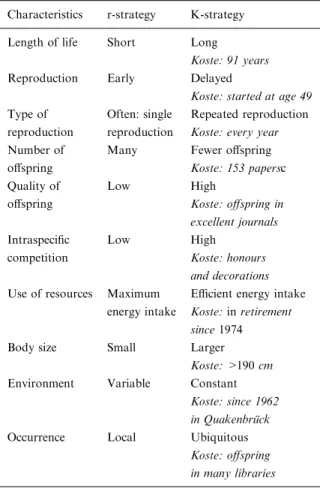
Has Koste been following a K-strategy? The answer: it appears he is because long life with de-layed but repeated reproduction is characteristic for this life history (Table 1). However, Koste had also numerous offspring (papers), a characteristic that is typical for r-strategists. R-strategists pro-duce many offspring but they usually do not invest much energy in each. Clearly, this is not the case with Kostes publications. His papers have ap-peared in respected international journals such as Amazoniana, Annales de Limnologie, Archiv fu¨r Hydrobiologie, Australian Journal of Marine and Freshwater Research, Hydrobiologia, Interna-tional Review of Hydrobiology, Limnologica, and Transactions of the Royal Society of South Australia. In fact, Koste has succeeded in com-bining the characteristics of both r- and K-strat-egist into a super-K-stratK-strat-egist.
Not many are able to comprehend why Koste has been investing so much energy in scientific work at an age by which other senior people would have doing so already for long time. I think he simply could not have done otherwise. This way of life has been his hobby and his passion. I suppose his daily work observing rotifers is rather a con-templation for him from where he gets power for his life and for his contact with other people. This is the way how he could sustain such a steady output even long after his retirement. With this as basis Koste likes always to meet with friends and to share his humour. With this way of life Koste is a ‘living fossil’; in the contemporary scientific environment where, unfortunately, r-strategy is the predominant paradigm and where people are urged to present them as young as possible and to burn up early like meteors. We, his friends and his students, living today with a longer life expectancy
than ever before, have with Koste hopefully not a run-out model, which shows us how to combine scientific work and true life. He oversees his situ-ation perfectly. Not for nothing is he often coquetting with his role as Methuselah. On the other side, nothing is farther away from him than to demonstrate his as a role as a super-K-strategist or as a king of rotiferologists. In fact, for all who like him, and these are many, he remains our ‘‘Uncle Walter’’.
A robust health has been a physical prerequisite for his success. This we, the members of the international family of rotiferologists, wish him many more years of healthy life – and, of course, we wish him to study and discover many new species of rotifers under his microscope.
Acknowledgements
I thank Walter Koste for many discussions where he also reported details of his life. It was always a true enrichment for me to visit him. Ruth Lax-Hubers documentation was also inspiring to me. I am very thankful to Bob Wallace who improved the English style.
References
Haeckel, E., 1899–1904. Kunstformen der Nature: Leipzig und Wien, Verlag des Bibliographischen Instituts.
Laxhuber, R., 1993. Das Ra¨dertierportrait: Walter Koste. Hydrobiologia 255/256: xxiii–xxvi.
MacArthur, R. H. & E. O. Wilson, 1967. The Theory of Island Biogeography. Princeton University Press, Princeton NJ, 216 pp.
Pianka, E. R., 1978. Evolutionary Ecology (2nd edn). Harper & Row, Publishers, New York, 397 pp.
Schwoerbel. J., 1987. Dr. h. c. Walter Koste zum 75. Geburt-stag. Archiv fu¨r Hydrobiologie 110: 631–638.
Bibliography of Walter Koste
Koste, W., 1961. Paradicranophorus wockei nov. spec., ein Ra¨dertier aus dem Psammon eines norddeutschen Nie-derungsbaches. Zoologischer Anzeiger 167: 138–141. Koste, W., 1962. U¨ber die Ra¨dertierfauna des Darnsees in Epe
bei Bramsche, Kreis Bersenbru¨ck. Vero¨ffentlichungen Na-turwissenschaftlicher Verein Osnabru¨ck 30: 73–137. Koste, W. & K. Wulfert, 1964. Rotatorien aus der Wu¨ste Gobi.
Limnologica 2: 483–490.
Table 1.Characteristics of r-and K-strategy according to Pianka (1978) with data from Walter Koste
Characteristics r-strategy K-strategy Length of life Short Long
Koste: 91 years
Reproduction Early Delayed
Koste: started at age 49
Type of reproduction
Often: single reproduction
Repeated reproduction
Koste: every year
Number of offspring
Many Fewer offspring
Koste: 153 papersc Quality of offspring Low High Koste: offspring in excellent journals
Intraspecific Low High competition Koste: honours
and decorations
Use of resources Maximum energy intake
Efficient energy intake
Koste:inretirement since1974 Body size Small Larger
Koste:>190cm
Environment Variable Constant
Koste: since 1962 in Quakenbru¨ck
Occurrence Local Ubiquitous
Koste: offspring in many libraries
Koste, W., 1965. Rotatorien des Naturdenkmals ‘‘Engelbergs Moor’’ in Druchhorn, Kreis Bersenbru¨ck. Vero¨ffentlich-ungen Naturwissenschaftlicher Verein Osnabru¨ck 31: 49–82. Koste, W., 1968. U¨ber moosbewohnende Ra¨dertiere von Strohda¨chern alter Geba¨ude. Mitteilungen Kreisheimatbund Bersenbru¨ck Nr. 15: 123–128.
Koste, W., 1968. U¨berProales sigmoida(Skorikow) 1896 (eine fu¨r Mitteleuropa neue Rotatorienart) undProales daphnicola
(Thomson) 1892. Archiv fu¨r Hydrobiologie 65: 240–245. Koste, W., 1968. U¨ber die Rotatorienfauna des
Naturschutz-gebietes ‘‘Achmer Grasmoor’’, Kreis Bersenbru¨ck. Vero¨ff-entlichungen Naturwissenschaftlicher Verein Osnabru¨ck 32: 107–160.
Koste, W., 1968. Das moosbewohnende Ra¨dertierTetrasiphon. Mikrokosmos 57: 334–337.
Koste, W., 1969. Das parasitishe Ra¨ertier Albertia naidis. Mikrokosmos 58: 212–216.
Koste, W., 1969. Das sessile Ra¨dertierPtygura velata. Mikro-kosmos 58: 1–6.
Koste, W., 1969. Notommata copeus und einige verwandte Arten. Mikrokosmos 58: 137–143.
Koste, W., 1969.Filinia, eine pelagisch lebende Ra¨dertiergat-tung. Mikrokosmos 58: 298–301.
Koste, W., 1969.Stephanoceros fimbriatus. Mikrokosmos 58: 370–373.
Koste, W., 1970. U¨ber eine parasitische Rotatorienart.Albertia reicheltinov. spec. Zoologischer Anzeiger 184: 428–434. Koste, W., 1970. Das Putzer-Ra¨dertier Proales daphnicola.
Mikrokosmos 59: 49–51.
Koste, W., 1970. Collotheca trilobata, ein seltenes sessiles Ra¨dertier. Mikrokosmos 59: 195–200.
Koste, W., 1970. Die Ra¨dertiergattung Lindia. Mikrokosmos 59: 134–138.
Koste, W., 1970. Macrotrachela quadricornifera, ein moos-bewohnendes bdelloides Ra¨dertier. Mikrokosmos 59: 328–332. Koste, W., 1970. Zur Rotatorienfauna Nordwestdeutschlands. Vero¨ffentlichungen Naturwissenschaftlicher Verein Osnabru¨ck 33: 139–163.
Koste, W., 1970. U¨ber die sessilen Rotatorien einer Moor-bla¨nke in Nordwestdeutschland. Archiv fu¨r Hydrobiologie 68: 96–125.
Koste, W., 1971. Die Ra¨dertiergattungCollotheca. Mitteleu-rop€aische Arten mit besonders auffallenden Koronafortsa¨t-zen. Mikrokosmos 60: 161–167.
Koste, W., 1971. Kurt Wulfert, ein Nachruf. Archiv fu¨r Hy-drobiologie 68: 457–461.
Koste, W., 1971. Kutikowa, L. A. Die Ra¨dertiere der Fauna USSR (Unterkl. Eurotatoria, Ploimida, Monimotrochida, Paedotrochida). Best. Bu¨cher zur Fauna USSR, Bd. 104: 1–744, Book Review. Archiv fu¨r Hydrobiologie 69: 142. Koste, W., 1972. Ein seltener Außenparasit an
Su¨ßwasser-Oli-gochaeten: Cephalodella parasitica. Mikrokosmos 61: 10–12.
Koste, W., 1972.Collotheca campanulata longicaudata. Mikro-kosmos 61: 97–99.
Koste, W., 1972.Rhinoglena frontalis, ein vivipares Ra¨dertier. Mikrokosmos 61: 358–360.
Koste, W., 1972. U¨ber zwei seltene parasitische Rotatorienar-ten,Drilophaga bucephalusVejdovsky undProales giganthea
(Glascott). Osnabru¨cker Naturwissenschaftliche Mitteilun-gen 1: 149–218.
Koste, W., 1972. U¨ber ein sessiles Ra¨dertier aus Amazonien.
Floscularia noodtin. sp. Archiv fu¨r Hydrobiologie 70: 534– 540.
Koste, W., 1972. Rotatorien aus Gewa¨ssern Amazoniens. Amazoniana 3: 258–505.
Koste, W., 1972. Ein Ra¨dertier des Hochmoores:Monommata arndti. Mikrokosmos 61: 269–273.
Koste, W., 1973. U¨ber ein sessiles Ra¨dertier aus Amazonien,
Ptygura elsterin. sp., mit Bemerkungen zur Taxonomie des ArtkomplexesPtygura melicerta(Ehrenberg) 1932. Interna-tionale Revue der gesamten Hydrobiologie 57: 875–882. Koste, W., 1973.Cupelopagis vorax, ein merkwu¨rdiges
festsit-zendes Ra¨dertier. Mikrokosmos 62: 101–106.
Koste, W., 1973.Horaella thomassonin. sp., ein neues Ra¨dertier aus Gewa¨ssern der Guiana-Brasilianischen Region der Neotropis. Archiv fu¨r Hydrobiologie 72: 375–383. Koste, W., R. Chengalath & C. H. Fernando, 1973. Rotifera
from Sri Lanka (Ceylon). 2. Further studies an the Eurota-toria including new records. Bulletin of the Fisheries Re-search Station, Sri Lanka (Ceylon) 24: 29–62 pp.
Koste, W., 1974. Die GattungNotholca. Mikrokosmos 63: 48– 52.
Koste, W., 1974. Zur Kenntnis der Rotatorienfauna der ‘‘schwimmenden Wiese’’ einer Uferlagune in der Varzea Amazoniens, Brasilien. Amazoniana 5: 25–60.
Koste, W., 1974.Ptygura pectinifera, die ‘‘Kammtra¨gerin’’, eine Einwanderin in Warmwasseraquarien. Mikrokosmos 63: 182–187.
Koste, W., 1974. Rotatorien aus einem Ufersee des unteren Rio Tapajos, dem Lago Paroni. Gewa¨sser and Abwa¨sser 53/54: 43–68.
Koste, W., R. Chengalath & C. H. Fernando, 1974. Rotifera from Sri Lanka (Ceylon) 3. New species and records with a list of Rotifera recorded and their distribution in different habitats from Sri Lanka. Bulletin of the Fisheries Research Station, Sri Lanka (Ceylon) 25(1–2): 83–96.
Koste, W., 1975. Macrochaeten, die ‘‘Igel’’ unter den Ra¨der-tieren. Mikrokosmos 64: 143–147.
Koste, W., 1975. U¨ber den Rotatorienbestand einer Mi-krobiozo¨nose in einem tropischen aquatischen Saumbiotop, derEichhornica-crassipes-Zoneim Litoral des Bung-Borapet, einem Stausee in Zentralthail and Gewa¨sser Abwa¨sser, 57/ 58: 43–58.
Koste, W., 1975.Seison annulatus, ein Ektoparasit des marinen KrebsesNebalia. Mikrokosmos 64: 341–347.
Koste, W., 1975. Ruttner-Kolisko, A., Plankton Rotifers, Biology and Taxonomy, In: Die Binnengewasser Bd. 16/1, Supplement. Stuttgart 1975, 146 pp., Book Review. Archiv fu¨r Hydrobiologie 76: 133–134.
Koste, W., 1976. Trochosphaera aequatorialis, das ‘‘Kugelra¨-dertier’’. Mikrokosmos 65: 266–268.
Koste, W., 1976. U¨ber die Ra¨dertierbesta¨nde (Rotatoria) der oberen and mittleren Hase in den Jahren 1966–1969. Os-nabru¨cker Naturwissenschaftliche Mitteilungen 4: 191–263. Koste, W., 1977.Ptygura pedunculata. Mikrokosmos 66: 37–40. Koste, W., 1977. U¨ber drei neue Formen des GenusHexarthra
Schmarda 1854:H. jenkinae f. nakurun. f.,H. brandorffin.
sp. andH. polyodonta soaplakeiensis n. sp. Gewa¨sser und Abwa¨sser 62/63: 7–16.
Koste, W, 1978. U¨ber Testudinella ohlei Koste 1972, ein Ra¨dertier der U. Ordnung Flosculariacea aus der Guiana-Brasilianischen Region der Neotropis. Archiv fu¨r Hydro-biologie 82: 359–363.
Koste, W., 1978.Synchaeta grandis, ein in Mitteleuropa vom Aus-sterben bedrohtes Planktonra¨dertier. Mikrokosmos 67: 331–336. Koste, W., 1978, Die Ra¨dertiere Mitteleuropas (U¨. Ordnung Monogononta), Begr. von M. Voigt, Textband: 1–8 + 1–673 pp., Tafelband: T. 1–234. Gebr. Borntraeger Verlagsbuch-handlung, Berlin-Stuttgart.
Koste, W., 1979. Hexarthra mira, ein sechsarmiges Plank-tonra¨dertier. Mikrokosmos 68: 134–139.
Koste, W., 1979. New Rotifera from the River Murray, South-eastern Australia, with a review of the Australian species of
BrachionusandKeratella. Australian Journal of Marine and Freshwater Research 30: 237–253.
Koste, W., 1979. Lindia deridderi n. sp., ein Ra¨dertier der Familie Lindiidae (U¨berordnung Monogononta) aus SE-Australien. Archiv fu¨r Hydrobiologie 87: 504–511. Koste, W. & R. J. Shiel, 1979. Rotifera recorded from
Australia. Transactions of the Royal Society of South Aus-tralia 103: 57–68.
Koste, W., 1980.Brachionus plicatilis, ein Salzwasserra¨dertier. Mikrokosmos 69: 148–155.
Koste, W., 1980. Zwei Plankton-Ra¨dertiertaxaFilinia australi-ensisn. sp. undFilinia hofmannin. sp., mit Bemerkungen zur Taxonomie der longiseta-terminalis Gruppe. Genus Filinia
Bory de St. Vincent 1824, Familie Filiniidae Bartos 1959 (U¨berordnung Monogononta). Archiv fu¨r Hydrobiologie 90: 230–256.
Koste, W. & R. J Shiel, 1980. On Brachionus dichotomus
Shephard 1911 (Rotatoria), Brachionidae from the Austra-lian region. With a description of a new subspecies Brachi-onus dichotomus reductus. Transactions of the Royal Society of Victoria 91: 127–134.
Koste, W. & R. J. Shiel, 1980. Preliminary remarks on the characteristics of the rotifer fauna of Australia (Notogaea). Hydrobiologia 73: 221–222.
Koste, W. & R. J. Shiel, 1980. Rotifera from Australia. Transactions of the Royal Society of South Australia 104: 133–144.
Koste, W., 1981. Zur Morphologie, Systematik and O¨kologie von neuen monogononten Ra¨dertieren (Rotatoria) aus dem U¨berschwemmungsgebiet des Magela Creek in der Alligator-River-Region Australiens, N. T, Teil 1. Osnabru¨cker Naturwissenschaftliche Mitteilungen 8: 97–126.
Koste, W., 1981. Einige auffallende Synchaeta-Arten aus Ku¨stengewa¨ssern. Mikrokosmos 71: 169–176.
Koste, W., 1982.Ploesoma truncatum, ein ra¨uberisches Plank-ton-Ra¨dertier. Mikrokosmos 71: 167–173.
Koste, W., 1982. U¨berDicranophorus robustusHarring 1928, ein seltenes carnivores Ra¨dertier aus der Familie Dicrano-phoridae (U¨berordnung Monongononta, Klasse Rotaroria). Osnabru¨cker Naturwissenschaftliche Mitteilungen 9: 65–84. Koste, W., G.-O. Brandorff & N. N. Smirnov, 1982. The composition and structure of rotiferan and crustacean
communities of the lower Rio Nhamunda, Amazonas, Brazil. Studies on Neotropical Fauna and Environment, Amazonas, Brazil Environment 17: 69–121.
Koste, W. & S. Jose de Paggi, 1982. Rotifera of the Superorder Monogononta recorded from Neotropis. Gewa¨sser und Abwa¨sser 68/69: 71–102.
Koste, W, & E. Wobbe, 1982. Kleiner Fu¨hrer fu¨r den Moor-lehrpfad durch das Hahlener Moor, Gemeinde Menslage, Ortsteil Hahnenmoor, Landkreis Osnabru¨ck, 1. Aufl, 1–42, Berge Krs. Osnabru¨ck.
Koste, W., 1983.Lecane, eine formen- und artenreiche Ra¨der-tiergattung. Mikrokosmos 72: 174–180.
Koste, W. & R. Chengalath, 1983. Rotifera from northeastern Quebec, Newfoundland and Labrador, Canada. Hydrobio-logia 104: 49–56.
Koste, W & J. Poltz, 1983. U¨ber einen Fund des seltenen schlammbewohnendenParadicranophorus hudsoni(Glascott, 1893), einem schlammbewohnenden Ra¨dertier im Du¨mmer, NW-Deutschland. Osnabru¨cker Naturwissenschaftliche Mitteilungen 10: 27–41.
Koste, W & B. Robertson, 1983. Taxonomic studies of the Rotifera (Phylum Aschelminthes) from a Central Amazo-nian varzea lake, Lago Camalleao, Ilha de Marchantaria, Rio Solimo˜es, Amazonas, Brazil. Amazoniana 8: 225–254. Koste, W. & R. J. Shiel, 1983. Rotifer communities of
bill-abongs in northern and south-eastern Australia. Hydrobio-logia 104: 41–47.
Koste, W. & R. J. Shiel, 1983. Morphology, systematics and ecology of new monogonont Rotifera (Rotatoria) from Alligator river region, Northern Territory. Transactions of the Royal Society of South Australia 107: 109–121. Koste, W., R. J Shiel & M. A. Brock, 1983. Rotifera from
Western Australian wetlands with descriptions of two new species. Hydrobiologia 104: 9–17.
Koste, W., 1984. Trichotria tetractis (Ehrenberg) und ver-wandte Arten. Mikrokosmos 73: 113–118.
Koste, W. & J. Poltz, 1984. U¨ber die Ra¨dertiere (Rotatoria, Phylum Aschelminthes) des Du¨mmers, NW-Deutschland. Osnabru¨cker Naturwissenschaftliche Mitteilungen 11: 91–125. Koste, W., B. Robertson & E. R. Hardy, 1984. Further taxo-nomical studies of the Rotifera from Lago Camaleao, a Central Amazonia varzea lake (Ilha de Marchantaria, Rio Solimo˜es, Amazonas Brazil). Amazoniana 8: 555–576. Koste, W. & E. R. Hardy, 1984. Taxonomic studies and new
distribution records of Rotifera (Phylum Aschelminthes) from Rio Jatapu and Uatuma, Amazonas, Brazil. Ama-zoniana 9: 17–29.
Hardy, E. R., B. Robertson & W. Koste, 1984. About the relationship between the zooplankton and fluctuating water levels of Lago Camalea˜o, a Central Amazonian varzea lake. Amazoniana 9: 43–52.
Jose de Paggi, S. & W. Koste, 1984. Checklist of the Rotifers recorded from Antarctic and Subantarctic areas. Sencken-bergiana biologica 65: 169–178.
Lair, N. & W. Koste, 1984. The rotifer fauna and population dynamics of Lake Studer 2 (Kerguelen Archipelago) with description ofFilinia terminalis kergueliensisn. sp. and a new record ofKeratella sanctaRussel 1944. Hydrobiologia 108: 57–64.
Tait, R. D., R. J. Shiel & W. Koste, 1984. Structure and dynamics of zooplankton communities, Alligator Region N.T., Australia. Archiv fu¨r Hydrobiologie 113: 1–13. Koste, W., 1985. Zur Morphologie, Anatomie, O¨kologie und
Taxonomie von Paradicranophorus wockei Koste 1961 (Aschelminthes, Rotatoria, Dicranophoridae). Sencken-bergiana biologica 66: 153–166.
Koste, W., 1985. Das Ra¨dertier-Portra¨t.Cephalodella gigantea, ein seltenes Ra¨dertier der Faulschlammzone. Mikrokosmos 74: 168–173.
Koste, W. & R. J. Shiel, 1985. New species and new records of Rotifera (Aschelminthes) from Australian Waters. Transac-tions of the Royal Society of South Australia 109: 1–15. Shiel, R. J. & W. Koste, 1985. Records of rotifers epizoic on
cladocerans from South Australia. Transactions of the Royal Society of South Australia 109: 179–180.
Koste, W., 1986. U¨ber die Rotatorienfauna in Gewa¨sser su¨do¨stlich von Concepcion, Paraguay, Su¨damerika. Os-nabru¨cker Naturwissenschaftliche Mitteilungen 12: 129–155.
Koste, W., 1986. Collotheca edentata, ein sessiles Ra¨dertier ‘‘ohne’’ Za¨hne? Mikrokosmos 75: 302–305.
Koste, W., & R. J. Shiel, 1986. Rotifera from Australian inland waters, 1. Bdelloidea (Rotifera: Digononta). Australian Journal of Marine and Freshwater Research 37: 765–792. Koste, W. & R. J. Shiel, 1986. New Rotifera (Aschelminthes)
from Tasmania. Transactions of the Royal Society of South Australia 109: 93–106.
Shiel, R. J., & W. Koste, 1986. Australian Rotifera: Ecology and Biogeography. In: De Deckker, P., & W. D. Williams (eds), Limnology in Australia CSIRO. Australia, Mel-bourne, Monographiae Biologicae 61: 141–150.
Koste, W., 1987.Asplanchnopus multiceps, ein Ra¨dertier, das Krebse frißt. Mikrokosmos 76: 170–175.
Koste, W. & J. Poltz, 1987. U¨ber Ra¨dertiere (Rotatoria, Phy-lum Aschelminthes) des Alfsees, NW-Deutschland. Os-nabru¨cker Naturwissenschaftliche Mitteilungen 13: 185–220. Koste, W. & R. J. Shiel, 1987. Tasmanian Rotifera: Affinities with the Australian mainland fauna. Hydrobiologia 147: 31–43. Koste, W. & R. J. Shiel, 1987. Rotifera from Australian inland waters, 2.Epiphanidae and Brachionidae, (Rotifera: Monogononta). Invertebrate Taxonomy 1: 949–1021. Koste, W. & W. Tobias, 1987. Zur Rotatorienfauna des
Sankarani-Stausees im Einzugsgebiet des Niger, Republik Mali, Westafrika. Archiv fu¨r Hydrobiologie 108: 499–515. Chengalath, R. & W. Koste, 1987. Rotifera from Northwestern
Canada. Hydrobiologia 147: 49–56.
Koste, W., 1988. Das Ra¨dertierportra¨t. Die Gattung Squati-nella. Mikrokosmos 77: 140–145.
Koste, W., 1988. Rotatorien aus Gewa¨ssern am Mittleren Sungai Makaham, einem U¨berschwemmungsgebiet in E-Kalimantan, Indonesian Borneo. Osnabru¨cker Naturwis-senschaftliche Mitteilungen 14: 91–136.
Koste, W., 1988. U¨ber die Rotatorien einiger Stillgewa¨sser in der Umgebung der Biologischen Station Panguana im tropischen Regenwald in Peru. Amazoniana 10: 303–325. Koste, W. & S. Jose Paggi, 1988. Rotifers from Saladillo River
Basin (Santa Fe Province, Argentina). Hydrobiologia 157: 13–20.
Koste, W., R. J. Shiel & L. W. Tan, 1988. New rotifers (Roti-fera) from Tasmania. Transactions of the Royal Society of South Australia 112: 119–131.
Koste, W. & E. Vasquez, 1988. Form variations of the rotifer
Brachionus variabilis (Hempel, 1896) from the Orinoco River, Venezuela. Annales de Limnologie 24: 127–129. Chengalath, R. & W. Koste, 1988. Composition of littoral
rotifer communities of Cape Breton Island, Nova Scotia, Canada. Verhandlungen Internationale Vereinigung fu¨r Theoretische und Angewandte Limnologie 23: 2019–2027. Koste, W., 1989. U¨ber Ra¨dertiere (Rotatoria) aus dem Lago do
Macaco, einem Ufersee des mittleren Rio Trombetas, Amazonien. Osnabru¨cker Naturwissenschaftliche Mittei-lungen 15: 199–214.
Koste, W., 1989.Octotrocha speciosa, eine sessile Art mit einem merkwu¨rdigen Ra¨derorgan. Mikrokosmos 78: 115–121. Koste, W. & K. Bo¨ttger, 1989. Rotatorien aus Gewa¨ssern
Ecuadors. Amazoniana 10: 407–438.
Koste, W. & R. J. Shiel, 1989. Rotifera from Australian inland waters. 3. Euchlanidae, Mytilinidae, Trichotriidae. Trans-actions of the Royal Society of South Australia 113: 85–114. Koste, W., & R. J. Shiel, 1989. Rotifera from Australian inland waters. 4. Colurellidae. Transactions of the Royal Society of South Australia 113: 119–143.
Koste, W. & R. J. Shiel, 1990. Rotifers from Australian inland waters. Lecanidae. Transactions of the Royal Society of South Australia 114: 1–36.
Koste, W. & R. J. Shiel, 1989. Classical taxonomy and modern methodology. Hydrobiologia 186/187: 279–284.
Koste, W. & W. Tobias, 1989. Die Ra¨dertierfauna der Se´1in-gue-Talsperre in Mali, Westafrika (Aschelminthes: Rotato ria). Senekenbergiana biologica 69: 441–466.
Chengalath, R. & W. Koste, 1989. Composition and distribu-tional patterns in arctic rotifers. Hydrobiologia 186/187: 191–200.
Herzig, A. & W. Koste, 1989. The development ofHexarthraspp. in a shallow alkaline lake. Hydrobiologia 186/187: 129–136. Shiel, R. J., W. Koste & L. W. Tan, 1989. Tasmania revisited:
Rotifer communities and habitat heterogeneity. Hydrobio-logia 186/187: 239–245.
Koste, W. & B. Robertson, 1990. Taxonomic studies of the Rotifera from shallow waters on the Island of Maraca, Roraima, Brazil. Amazoniana 11: 185–200.
Koste, W. & R. J. Shiel, 1990. Rotifers from Australian inland waters. 6. Proalidae, Lindiidae. Transactions of the Royal Society of South Australia 114: 129–143.
Koste, W. & W. Tobias, 1990. Zur Kenntnis der Ra¨dertierfauna des Kinda Stausees in Zentral-Burma (Aschelminthes: Rotatoria). Osnabru¨cker Naturwissen-schaftliche Mitteilungen 16: 83–110.
Koste, W., 1991.Anuraeopsis miraclei, a new planktonic rotifer species in karstic lakes of Spain. Hydrobiologia 209: 169–173. Koste, W., W. Janetzky & E. Vareschi, 1991. U¨ber die Rota-torienfauna in Bromelien-Phytotelmata in Jamaika (Aschelminthes: Rotatoria). Osnabru¨cker Naturwissen-schaftliche Mitteilungen 17: 143–170.
Koste, W. & R. J. Shiel, 1991. Rotifers from Australian inland waters. 7. Notommatidae (Rotifera), Monogononta. Trans-actions of the Royal Society of South Australia 115: 11–159.
Koste, W., E. Vasquez & M. L. Medina, 1991. Variaciones morfologicas del rotiferoKeratella americana(Carlin, 1943) de una laguna de inundacion del Rio Orinoco, Venezuela. Revue dHydrobiologie Tropicale 24: 83–90.
Koste, W. & K. Bo¨ttger, 1992. Rotatorien aus den Gewa¨ssern Ecuadors. 2. Amazoniana 12: 263–303.
Shiel, R. J. & W. Koste, 1992. Rotifera from Australian inland waters.8.Trichocercidae (Monogononta). Transactions of the Royal Society of South Australia 116: 1–27.
Koste. W., et al. (eds.), 1993. Rotifera: Guides to the identifi-cation of the microinvertebrates of the continental waters of the world. The Hague, Vol. 4:1–7,1–137.
Koste, W. & E. D. Hollowday, 1993. A short history of western European rotifer research. Hydrobiologia 255/256: 557–572. Brain, C. K. & W. Koste, 1993. Rotifers of the genusProales
from saline springs in the Namib desert, with the description of a new species. Hydrobiologia 255/256: 449–454. Hirschfelder, A., W. Koste & H. Zucchi, 1993. Bdelloid rotifers
in aerophytic mosses: influence of habitat structure and habitat age an species composition. Hydrobiologia 255/256: 343–344.
Jersabek, C. D. & W. Koste, 1993. Additional notes on tax-onomy and ecology of Anuraeopsis miraclei Koste, 1991 (Rotatoria: Monogononta) from an Austrian alpine lake. Hydrobiologia 264: 55–60.
Kizito, Y. S., A. Nauwerck, J. Chapman & W. Koste, 1993. A limnological survey of some Western Uganda crater lakes. Limnologica 23: 335–347.
Peters, U., W. Koste & W. Westheide, 1993. A quantitative method to extract moss dwelling rotifers. Hydrobiologia 255/256: 339–341.
Shiel, R. J. & W. Koste, 1993. Rotifera from Australian inland waters. 9. Gastropodidae, Synchaetidae, Asplanchnidae (Rotifera: Monogononta). Transactions of the Royal Society of South Australia 117: 111–139.
Koste, W., W. Janetzky & E. Vareschi, 1994. Zur Kenntnis der limnischen Rotatorienfauna Jamaikas (Rotatoria: Aschel-minthes).Teil I. Osnabru¨cker Naturwissenschaftliche Mit-teilungen 19: 103–149.
Janetzky, W., W. Koste & E. Vareschi, 1994. Rotifers of Jamaica: ecology, diversity and biogeography. Jamaica Naturalist 4: 16–20.
Koste, W., W. Janetzky & E. Vareschi, 1995. Zur Kenntnis der limnischen Rotatorienfauna Jamaikas (Rotifera).Teil II. Osnabru¨cker Naturwissenschaftliche Mitteilungen 20/21: 399–433.
Koste, W. & Y. Zhuge, 1995. OnParadicranophorus aculeatus
(Neistwestnova-Shadina 7, 1935), with remarks on all other species of the genus (Rotifera: Dicranophoridae). Interna-tionale Revue der gesamten Hydrobiologie 80: 121–132. Janetzky, W., W. Koste &, E. Vareschi, 1995. Rotatorien in
limnischen Mikrohabitaten: Phytotelmata und Gastrotel-mata. Deutsche Gesellschaft fu¨r Limnologie, Jahrestagung 1994 Hamburg. Erweiterte Zusammenfassungen. 933–937. Janetzky, W., W. Koste & E. Varesci, 1995. Rotifers (Rotifera)
of Jamaican inland waters. A synopsis. Ecotropica 1: 31–40.
Jose de Paggi, S. & W. Koste, 1995. Additions to the checklist of rotifers of the superorder Monogononta recorded from Neo-tropis. Internationale Revue der gesamten Hydrobiologie 80: 133–140.
Koste, W., 1996. On soil Rotatoria from a Lithotelma near Halali Lodge in Etosha National Park in N-Namibia, South Africa. Internationale Revue der gesamten Hydrobiologie 81: 353–365.
Koste, W., 1996. U¨ber die moosbewohnende Rotatorienfauna Madagaskars. Osnabru¨cker Naturwissenschaftliche Mittei-lungen 22: 235–253.
Koste, W. & Y. Zhuge, 1996. A preliminary report on the occurrence of Rotifera in Hainan. Quekett Journal of Microscopy 37: 666–883.
Segers, H., W. Koste & S. M. Yussuf, 1996. Contributions to the knowledge of the monogononta Rotifera of Zanzibar, with a note ofFilinia novaezealandiaeShiel & Sanomuang, 1993. Internationale Revue der gesamten Hydrobiologie 81: 597–603.
Zhuge, Y. & W. Koste, 1996. Two new species of Rotifera from China. Internationale Revue der gesamten Hydrobiologie 81: 605–609.
Janetzky, W. J. & W. Koste, 1997. Rotifera in broemeliad phytotelma. http: //www. ifas. ufl. edu/frank/robrom. htm. Zhuge, Y. & W. Koste, 1997. Rotiferology in China. Rotifer
News 1997: 9–10.
Koste, W. & W. Tobias, 1998. Ra¨dertiere des Manantali-Stausees in der Republik Mali, Westafrika (Aschelminthes: Rotatoria). Senckenbergiana biologica 77: 257–267. Koste, W. & Y. Zhuge, 1998. Zur Kenntnis der
Rotato-rienfauna (Rotifera) der Insel Hainan, China. Teil II. Osnabr€ucker Naturwissenschaftliche Mitteilungen 24: 183– 222.
Holst, H., H. Zimmermann, H. Kausch & W. Koste, 1998. Temporal and spatial dynamics of planktonic rotifers in the Elbe Estuary during spring. Estuarine Coastal and Shelf Science 47: 261–273.
Leutbecher, C. & W. Koste, 1998. Die Rotatorienfauna des Du¨mmers unter besonderer Beru¨cksichtigung der sessilen Arten. Teil 1. Osnabru¨cker Naturwissenschaftliche Mitteil-ungen 24: 223–255.
Zhuge, Y., H. Xiangfei & W. Koste, 1998. Rotifera recorded from China, 1893–1997, with remarks on their composition and distribution. International Review of Hydrobiology 83: 217–232.
Koste, W., 1999. U¨ber Ra¨dertiere (Rotifera) aus Gewa¨ssern des su¨dlichen Pantanal (Brasilien). Osnabru¨cker Naturwissen-schaftliche Mitteilungen 25: 179–209.
Koste, W., 2000. Study of the Rotatoria-Fauna of the littoral of the Rio Branco, South of Boa Vista, Northern Brazil. International Review of Hydrobiology 85: 433–469. Koste, W. & H. Terlutter, 2001. Die Rotatorienfauna einiger
Gewa¨sser des Naturschutzgebietes ‘‘Heiliges Meer’’im Kreis Steinfurt. Osnabru¨cker Naturwissenschaftliche Mitteilungen 27: 113–177.
Part I
On the phylogenetic position of Rotifera – have we come any further?
Peter Funch
1,*, Martin Vinther Sørensen
2& Matthias Obst
1 1Department of Zoology, Institute of Biological Sciences, University of Aarhus, Universitetsparken, Building 135, 8000, A˚rhus C, DK, Denmark
2Invertebrate Department, Zoological Museum, University of Copenhagen, Universitetsparken 15, 2100, Copenhagen Ø,
DK, Denmark
(*Author for correspondence: E-mail: [email protected]; Tel.: +45-89422764; Fax: +45-86125175)
Key words: Gnathifera, jaws, trophi, Syndermata, Micrognathozoa, Cycliophora
Abstract
Rotifers are bilateral symmetric animals belonging to Protostomia. The ultrastructure of the rotiferan trophi suggests that they belong to the Gnathifera, and ultrastructural similarities between the integuments and spermatozoa as well as molecular evidence strongly suggest that rotifers and the parasitic acantho-cephalans are closely related and form the clade Syndermata. Here we discuss the phylogenetic position of rotifers with regard to the gnathiferan groups. Originally, Gnathifera only included the hermaphroditic Gnathostomulida and the Syndermata. The synapomorphy supporting Gnathifera is the presence of pharyngeal hard parts such as jaws and trophi with similar ultrastructure. The newly discovered Micro-gnathozoa possesses such jaws and is a strong candidate for inclusion in Gnathifera because their cellular integument also has an apical intracytoplasmic lamina as in Syndermata. But Gnathifera might include other taxa. Potential candidates include the commensalistic Myzostomida and Cycliophora. Traditionally, Myzostomida has been included in the annelids but recent studies regard them either as sister group to the Acanthocephala or Cycliophora. Whether Cycliophora belongs to Gnathifera is still uncertain. Some analyses based on molecular data or total evidence point towards a close relationship between Cycliophora and Syndermata. Other cladistic studies using molecular data, morphological characters or total evidence suggest a sister group relationship between Cycliophora and Entoprocta. More molecular and morpho-logical data and an improved sampling of taxa are obviously needed to elucidate the phylogenetic position of the rotifers and identify which phyla belong to Gnathifera.
Introduction
Our knowledge about the phylogenetic affinities of the Rotifera has increased a lot within the latest decade. Throughout time they have been considered relatives to the Infusoria, Crustacea, Tardigrada, Nematoda, Annelida, Mollusca, Gastrotricha and Platyhelminthes (Remane, 1929–1933; Hyman, 1951; Cle´ment, 1985) and more recently as a mem-ber of the obviously polyphyletic group named
Aschelminthes(Ruppert & Barnes, 1994; Wallace et al., 1996). A close relationship between the
Rotifera and Acanthocephala has been broadly accepted since Storch & Welsch (1969, 1970) de-monstrated the ultrastructural similarities in the integuments of the two groups, and today most taxonomists unite them in the taxon Syndermata Ahlrichs, 1995.
A possible homology between the jaws of rotifers and gnathostomulids was first suggested by Ax (1956) and Reisinger (1961). An increasing amount of data now supports a close relationship between Rotifera, Gnathostomulida, Micro-gnathozoa and Acanthocephala united in a group
Hydrobiologia (2005) 546:11–28 Springer 2005 A. Herzig, R.D. Gulati, C.D. Jersabek & L. May (eds.) Rotifera X: Rotifer Research: Trends, New Tools and Recent Advances DOI 10.1007/s10750-005-4093-6
named Gnathifera (Ahlrichs, 1995a, b, 1997; Rieger & Tyler, 1995; Haszprunar, 1996a; Melone et al., 1998; Kristensen & Funch, 2000; Sørensen, 2000, 2003; Jondelius et al., 2002; Sørensen & Sterrer, 2002; Zrzavy´, 2003). Several synapomor-phies have been proposed for Gnathifera, and even though some of these may be questionable (see Jenner, 2004), the presence of jaws with a unique ultrastructure appears to be a strong support argument for gnathiferan monophyly.
Some problems, however, still remain and new questions appear. The phylogenetic position of Gnathifera in the Metazoa is still uncertain and recently, new studies have questioned the mono-phyly of Gnathifera (Giribet et al., 2004). Cladistic analyses based partly or solely on molecular data imply that Gnathifera might be polyphyletic (Littlewood et al., 1998; Zrzavy´ et al., 1998; Peterson & Eernisse, 2001) or paraphyletic, for example, in respect to Cycliophora, Gastrotricha or Myzostomida (Cavalier-Smith, 1998; Giribet et al., 2000; Zrzavy´ et al., 2001; Giribet, 2002). Many studies based on morphological as well as molec-ular data have proposed that the Acanthocephala should be considered highly advanced rotifers (Lorenzen, 1985; Garey et al., 1996; Ahlrichs, 1997; Garey et al., 1998; Mark Welch, 2000; Herlyn et al., 2003) and most recently it was sug-gested that the newly described taxon Microgna-thozoa (Kristensen & Funch, 2000) is sister group to the monogonont rotifers (De Smet, 2002).
Here we will discuss some of the conflicting proposals about rotifer relationships. We focus primarily on two newly described taxa, Cyclio-phora and Micrognathozoa, but also make some comments to the position of the Acanthocephala, Myzostomida, and Gnathifera within the Metazoa.
Discussion
Cycliophora – newly discovered taxon with rotifer affinities?
Among metazoans the Cycliophora is the most recently described major taxon. So far, only one marine species Symbion pandora Funch & Kris-tensen 1995 is known. This microscopic animal lives as a commensal on the mouth parts of the Norway lobster Nephrops norvegicus (Linne´).
Throughout the metagenetic life cycle ofS. pandora
six different stages emerge of which the sessile feeding individual is the largest (approx. 350lm) and most prominent one. It is the only stage with an alimentary tract and is permanently attached to the host with an adhesive disc (Fig. 1, ad). The body of the feeding individual has a bell-shaped buccal funnel (Fig. 1, bf) and an ovoid trunk. The buccal funnel carries a mouth ring (Fig. 1, mr1) consisting
of multiciliated cells with compound cilia. The feeding apparatus works as a downstream collect-ing system (Riisga˚rd et al., 2000) that filters food particles generated from the feeding activities of the host. The mouth leads into a U-shaped gut that terminates in an anus that is situated close to the buccal funnel (Fig. 1, an). The entire alimentary apparatus is periodically replaced by internal bud-ding (Fig. 1, ib). A fluid-filled body cavity is absent (Funch & Kristensen, 1997).
Three different stages develop in the brood chamber of the feeding individual (Fig. 1, bc). The asexual developed Pandora larva (Fig. 1, pl) is approximately 120lm long and equipped with an antero-ventral ciliated disc, various frontal glands, long and stiff, sensory cilia, and an internal bud from which a new feeding individual will arise. The asexually developed male larva (Prometheus larva) is approximately 100lm long and has an antero-ventral ciliated disc, various glands and several pairs of long, stiff cilia anteriorly. Several dwarf males arise from internal buds within this larva (Obst & Funch, 2003). The dwarf male, approxi-mately 33lm in length, has a complex morphol-ogy with two ciliated fields covering the anterior and ventral body. It has various sensory struc-tures, gland complexes, a relatively large brain connected to a pair of ventral longitudinal nerves, and numerous muscle cells. The reproductive sys-tem of the male is located in the posterior part of the body and consists of an unpaired testis, several adjacent gland cells, and a ventral penis connected to some of the muscle cells. The female, which is also developed in the brood chamber of the feed-ing individual (Fig. 1, bc), grows to a size of about 150–190lm, and is morphological like the Pan-dora larva. However, the female contains a single egg instead of a bud. After fertilization the embryo grows inside the female, nourished by the degen-erating maternal tissue and develops into a chordoid larva with a size of about 200lm and a 12
Figure 1. A young feeding stage ofSymbion pandora(Cycliophora) on a seta from the hostNephrops norvegicus, lateral view. ad – adhesive disc; an – anus; bc – brood chamber; bf – buccal funnel; es – esophagus; ib – inner bud; mr1– functional mouth ring on
feeding stage; mr2– mouth ring inside developing Pandora larva; mr3– developing mouth ring on inner bud; pl – Pandora larva. From
Funch & Kristensen (1997).



![[(CH3)2NH2]4[H4PMo12O40]Cl2·4H2O](data:image/gif;base64,R0lGODlhAQABAIAAAP///wAAACH5BAEAAAAALAAAAAABAAEAAAICRAEAOw==)