Secure and Usable User Authentication
Zur Erlangung des akademischen Grades eines
Doktors der Ingenieurwissenschaften (Dr.-Ing.)
von der KIT-Fakultät für Wirtschaftswissenschaften
des Karlsruher Instituts für Technologie (KIT)
genehmigte
DISSERTATION
von
Peter Mayer, M.Sc.
geb. in Gelnhausen
Tag der mündlichen Prüfung: 15.11.2019
Hauptreferent: Prof. Dr. Melanie Volkamer
Abstract
Authentication is a ubiquitous task in users’ daily lives. The dominant form of user authentication are text passwords. They protect private accounts like online banking, gaming, and email, but also assets in organisations. Yet, many issues are associated with text passwords, leading to challenges faced by both, users and organisations. This thesis contributes to the body of research enabling secure and usable user authentication, benefiting both, users and organisations. To that end, it addresses three distinct challenges. The first challenge addressed in this thesis is the creation of correct, complete, understandable, and effective
password security awareness materials. To this end, a systematic process for the creation of awareness materials was developed and applied to create a password security awareness material. This process comprises four steps. First, relevant content for an initial version is aggregated (i.e. descriptions of attacks on passwords and user accounts, descriptions of defences to these attacks, and common misconceptions about password and user account security). Then, feedback from information security experts is gathered to ensure the correctness and completeness of the awareness material. Thereafter, feedback from lay-users is gathered to ensure the understandability of the awareness material. Finally, a formal evaluation of the awareness material is conducted to ensure its effectiveness (i.e. whether the material improves participant’s ability to assess the security of passwords as well as password-related behaviour and decreases the prevalence of common misconceptions about password and user account security). The results of the evaluation show the effectiveness of the awareness material: it significantly improved the participants’ ability to assess the security of password-related behaviour as well as passwords and significantly decreased the prevalence of misconceptions about password and user account security.
The second challenge addressed in this thesis is shoulder-surfing resistant text password entry with gamepads (as an example of very constrained input devices) in shared spaces. To this end, thevery first investigation of
text password entry with gamepadsis conducted. First, the requirements of authentication in the gamepad context are described. Then, these requirements are applied to assess schemes already deployed in the gamepad context and shoulder-surfing resistant authentication schemes from the literature proposed for non-gamepad contexts. The results of this assessment show that none of the currently deployed and only four of the proposals in the literature fulfil all requirements. Furthermore, the results of the assessment also indicate a need for an empirical evaluation in order to exactly gauge the shoulder-surfing threat in the gamepad context and compare alternatives to the incumbent on-screen keyboard. Based on these results, two user studies (one online study and one lab study) are conducted to investigate the shoulder-surfing resistance and usability of three authentication schemes in the gamepad context: the on-screen keyboard (as de-facto standard in this context), the grid-based scheme (an existing proposal from the literature identified as the most viable candidate adaptable to the gamepad context during the assessment), andColorwheels(a novel shoulder-surfing resistant authentication scheme specifically designed for the gamepad context). The results of these two user studies show that on-screen keyboards are highly susceptible to opportunistic shoulder-surfing, but also show the most favourable usability properties among the three schemes. Colorwheelsoffers the most robust shoulder-surfing resistance and scores highest with respect to participants’ intention to use it in the future, while showing more favourable usability results than the grid-based scheme.
Abstract
The third challenge addressed in this thesis is secure and efficient storage of passwords in portfolio au-thentication schemes. Portfolio auau-thentication is used to counter capture attacks such as shoulder-surfing or eavesdropping on network traffic. While usability studies of portfolio authentication schemes showed promising results, a verification scheme which allows secure and efficient storage of the portfolio authentica-tion secret had been missing until now. To remedy this problem, the (t, n)-threshold verification scheme is proposed. It is based on secret sharing and key derivation functions. The security as well as the efficiency properties of two variants of the scheme (one based on Blakley secret sharing and one based on Shamir secret sharing) are evaluated against each other and against a naive approach. These evaluations show that the two
(t, n)-threshold verification scheme variants always exhibit more favourable properties than the naive ap-proach and that when deciding between the two variants, the exact application scenario must be considered. Three use cases illustrate as exemplary application scenarios the versatility of the proposed(t, n)-threshold verification scheme.
By addressing the aforementioned three distinct challenges, this thesis demonstrates the breadth of the field of usable and secure user authentication ranging from awareness materials, to the assessment and evaluation of authentication schemes, to applying cryptography to craft secure password storage solutions. The research processes, results, and insights described in this thesis represent important and meaningful contributions to the state of the art in the research on usable and secure user authentication, offering benefits for users, organisations, and researchers alike.
Acknowledgements
First and foremost, I want to thank my supervisor, Melanie Volkamer, for the unwavering support and guidance as well as the time taken for the many discussions about my research. Her insightful mentoring has been an invaluable help in completing this dissertation. Thank you for believing in me, my research, and this whole endeavour.
Furthermore, I want to express my deepest gratitude to Karen Renaud. Thank you for the invaluable feedback on my research projects and this dissertation in particular.
Also I want to thank Andreas Oberweis and Alexander Mädche for agreeing to be part of my dissertation committee and for the interesting discussions during the defence.
Moreover, I would like to give many thanks to my colleagues in the SECUSO research group for their valuable feedback on research ideas, paper drafts, and practice presentations. Their advice and insights helped me to improve my experiments and analyses considerably. In particular, I want to thank all my colleagues for the very fruitful discussions leading to our joint publications.
I also want to thank the project partner usd AG for helping making the KMU AWARE project a success, for making my research possible within the project, and last but not least for the recruiting of the participants for the research underlying the first part of this dissertation.
My thanks also go to Dennis Hofheinz, Willi Geiselmann, Johannes Braun, and Matthias Schempp for their valuable feedback and insights on the third part of this dissertation. I highly appreciate the time taken to listen to my questions and ideas and discuss my research.
I want to thank my family and friends for their steadfast support at all times. I could never express in mere words how much their understanding, enthusiasm, and moral support have helped me throughout the years. I am looking forward to having more time to spend with you now that this dissertation is completed. Finally, I want to thank all the participants of the studies I conducted and the people helping in the recruiting. Much of my research would not have been possible without them.
Contents
Abstract . . . i Acknowledgements . . . iii Table of Contents . . . vIntroduction
1
1 Introduction . . . 31.1 Scope and Structure of this Work . . . 4
1.1.1 Part I: Effective Password Security Awareness Materials . . . 5
1.1.2 Part II: Shoulder-surfing Resistant Text Password Entry on Gamepads . . . 6
1.1.3 Part III: Secure and Efficient Storage of Passwords in Portfolio Authentication . . . 6
1.2 Main Contributions . . . 7
1.2.1 Part I: Effective Password Security Awareness Materials . . . 7
1.2.2 Part II: Shoulder-surfing Resistant Text Password Entry on Gamepads . . . 8
1.2.3 Part III: Secure and Efficient Storage of Passwords in Portfolio Authentication . . . 8
1.3 Related Publications . . . 9
1.3.1 Part I: Effective Password Security Awareness Materials . . . 9
1.3.2 Part II: Shoulder-surfing Resistant Text Password Entry on Gamepads . . . 10
1.3.3 Part III: Secure and Efficient Storage of Passwords in Portfolio Authentication . . . 10
2 Background . . . 11
2.1 Types of User Authentication . . . 11
2.1.1 Knowledge-based Authentication . . . 11
2.1.2 Token-based Authentication . . . 13
2.1.3 Biometric Authentication . . . 14
2.2 The User Access Control Procedure . . . 14
2.2.1 Enrolment . . . 14 2.2.2 Identification . . . 15 2.2.3 Authentication . . . 15 2.2.4 Verification . . . 15 2.2.5 Authorisation . . . 15 2.2.6 Termination . . . 15 2.3 Attacks on Passwords . . . 15
2.3.1 Attacks targeted directly at the user and the interaction with their devices . . . 16
2.3.2 Attacks targeted at the user’s devices . . . 18
2.3.3 Attacks targeted at the communication between devices and remote services . . . 20
2.3.4 Attacks targeted at remote services . . . 20
2.4 Information Security Awareness Materials . . . 20
2.4.1 Relevance and Status-Quo of Information Security Awareness Materials . . . 21
2.4.2 Design of Information Security Awareness Materials . . . 21
2.5 Portfolio User Authentication . . . 22
Contents
I
Effective Password Security Awareness Materials
25
3 Identifying Misconceptions about Password Security . . . 27
3.1 Methodology of the Literature Research . . . 29
3.2 Identified Misconceptions . . . 29
3.2.1 Misconceptions about Password Security . . . 29
3.2.2 Further Misconceptions . . . 35 3.3 Discussion . . . 35 3.3.1 Results . . . 36 3.3.2 Limitations . . . 37 3.3.3 Next Steps . . . 37 3.4 Conclusion . . . 38
4 Development and Evaluation of Effective Password Security Awareness Materials . . . 39
4.1 Systematic Development Process . . . 41
4.1.1 Step 1 – Initial Version of the Material . . . 41
4.1.2 Step 2 – Expert Feedback . . . 41
4.1.3 Step 3 – Lay-user Feedback . . . 42
4.1.4 Step 4 – Study with Lay-users . . . 42
4.2 Development of the Password Security Awareness Material . . . 42
4.2.1 Step 1 – Initial Version of the Material . . . 42
4.2.2 Step 2 – Expert Feedback . . . 44
4.2.3 Step 3 – Lay-user Feedback . . . 45
4.3 Methodology of the User Study . . . 46
4.3.1 Hypotheses . . . 46 4.3.2 Procedure . . . 48 4.3.3 Questionnaire Items . . . 49 4.3.4 Analysis . . . 51 4.4 Results . . . 52 4.4.1 Participants . . . 52 4.4.2 Assessment of Scenarios . . . 52
4.4.3 Password Security Ratings . . . 57
4.4.4 Clearing Up the Misconceptions . . . 59
4.4.5 Qualitative Results . . . 62
4.5 Discussion . . . 62
4.5.1 Results . . . 63
4.5.2 Limitations . . . 69
4.6 Conclusion . . . 72
II
Shoulder-surfing Resistant Text Password Entry on Gamepads
73
5 Requirements and Status Quo of Authentication in the Gamepad Context . . . 755.1 Requirements . . . 77
5.1.1 Security Requirements . . . 77
5.1.2 Technical Requirements . . . 77
5.1.3 Usability Requirement . . . 79
5.2 Assessment of Existing Schemes . . . 79
5.2.1 Schemes Deployed in the Gamepad Context . . . 79
5.2.2 Existing Shoulder-Surfing Resistant Proposals from the Literature . . . 81
5.3 Discussion . . . 91
5.3.1 Results . . . 91
5.3.2 Limitations . . . 92
Contents
5.4 Conclusion . . . 93
5.5 Chapter 5 Post Scriptum: Colorwheels . . . 94
6 Evaluation of Three Authentication Schemes in the Gamepad Context . . . 97
6.1 Methodology of the User Studies . . . 99
6.1.1 Hypotheses . . . 99
6.1.2 Design Decisions for the Methodology . . . 100
6.1.3 Apparatus . . . 101 6.2 Online study . . . 102 6.2.1 Procedure . . . 102 6.2.2 Participants . . . 104 6.2.3 Results . . . 104 6.3 Lab study . . . 105 6.3.1 Procedure . . . 105 6.3.2 Participants . . . 106
6.3.3 Shoulder-Surfing Resistance Results . . . 106
6.3.4 Usability Results . . . 107
6.4 Discussion . . . 110
6.4.1 Results . . . 110
6.4.2 Limitations . . . 111
6.5 Conclusion . . . 113
III Secure and Efficient Storage of Passwords in Portfolio Authentication
115
7 The (t,n)-threshold Verification Scheme for Portfolio Authentication . . . 1177.1 Requirements . . . 119
7.1.1 Required Operations . . . 119
7.1.2 Optional Operations . . . 119
7.1.3 Security Properties . . . 119
7.1.4 Efficiency Properties . . . 120
7.2 The (t,n)-threshold Verification Scheme . . . 120
7.2.1 Variant 1: Based on Blakley Secret Sharing . . . 121
7.2.2 Variant 2: Based on Shamir Secret Sharing . . . 124
7.3 Security Evaluation . . . 127
7.3.1 Guessing Resistance . . . 127
7.3.2 Secure Storage . . . 130
7.4 Efficiency Evaluation . . . 130
7.4.1 Storage Calculation for the Naive Approach . . . 130
7.4.2 Storage Calculation for Blakley (t,n)-threshold Verification Variant . . . 130
7.4.3 Storage Calculation for Shamir (t,n)-threshold Verification Variant . . . 131
7.4.4 Comparison Methodology . . . 131 7.4.5 Comparison Results . . . 132 7.5 Discussion . . . 133 7.5.1 Results . . . 133 7.5.2 Limitations . . . 135 7.5.3 Next Steps . . . 135 7.6 Conclusion . . . 135
8 Use Cases of the (t,n)-threshold Verification Scheme. . . 137
8.1 Use Case 1: Graphical Recognition-Based Passwords . . . 138
8.2 Use Case 2: Partial Passwords . . . 139
8.3 Use Case 3: ZeTA . . . 141
Contents 8.4.1 Results . . . 142 8.4.2 Limitations . . . 143 8.5 Conclusion . . . 144
Conclusion
145
9 Conclusion. . . 147 9.1 Thesis Summary . . . 1479.1.1 Part I: Effective Password Security Awareness Materials . . . 147
9.1.2 Part II: Shoulder-surfing Resistant Text Password Entry on Gamepads . . . 147
9.1.3 Part III: Secure and Efficient Storage of Passwords in Portfolio Authentication . . . 148
9.2 Summary of Contributions . . . 148
9.2.1 Part I: Effective Password Security Awareness Materials . . . 148
9.2.2 Part II: Shoulder-surfing Resistant Text Password Entry on Gamepads . . . 149
9.2.3 Part III: Secure and Efficient Storage of Passwords in Portfolio Authentication . . . 149
9.3 Future Research . . . 150
9.3.1 Part I: Effective Password Security Awareness Materials . . . 150
9.3.2 Part II: Shoulder-surfing Resistant Text Password Entry on Gamepads . . . 151
9.3.3 Part III: Secure and Efficient Storage of Passwords in Portfolio Authentication . . . 151
9.4 Final Remarks . . . 151
Appendix
153
A Appendices to Part I . . . 155A.1 Examples for Attack Automation . . . 155
A.2 Intervention Texts . . . 156
A.3 Scenario Texts . . . 158
A.4 Misconception Items . . . 160
B Appendices to Part II . . . 161
B.1 Overview of the Assessment of Authentication Schemes . . . 161
References
163
List of Figures. . . 165List of Tables . . . 168
1
Introduction
Authenticating as legitimate user is a ubiquitous task in everybody’s daily digital life. In the private life, user authentication protects accounts for e.g. online banking, email, and social networks. In the professional life, it protects all assets of organisations. In both instances, text passwords are the dominant authentication scheme [98]. Every user has on average 6 to 7 text passwords for Internet accounts alone and enters one of these passwords on average 8 times each day [71]. Due to this ubiquity of text passwords, many investigations regarding their properties exist and research has identified serious issues associated with them, leading to challenges faced by both, users as well as organisations.
On the user side, the plethora of challenges caused by text passwords has been well documented over the years. The sheer number of text passwords users are expected to handle has been shown to overwhelm them [194]. While users have on average 25 to 80 [71, 92, 196] accounts, these are only protected on average by 6 to 7 unique text passwords [71, 92, 196]. However, the number of actual unique passwords users appear to be able to memorise is with around 4 to 5 even lower [34, 81]. Additionally, user authentication – and security as a whole – is usually not the user’s primary task, but rather overhead which interferes with them getting their actual (primary) tasks done [33]. Therefore, while users do not have an inherent lack of willingness to behave securely [2, 177], their willingness to spend time and effort is understandably low [97]. However, even users willing to spend additional effort and time to inform themselves about secure practices and clear up their misconceptions might end up following advice that was created unsystematically and contradicts the state of the art in terms of password security [149, 236]. Consequentially, many users face problems when choosing, handling, or remembering their text passwords [107, 194, 195], ultimately leading them to develop potentially insecure coping strategies [194,195] or even authentication fatigue [80,178]. This situation is further aggravated by the increasing need to use text password-protected accounts on devices with constrained input devices relying on on-screen keyboards [217], such as touchscreens on smartphones or gamepads on game consoles. When such devices are used in public spaces (smartphones) or shared spaces (gamepads on game consoles) attacks such as shoulder-surfing become a feasible threat [169]. While traditionally, all the challenges faced by users have caused users being referred to as “the weakest link” in the information security chain [181], this thesis is part of the research focusing on addressing these challenges instead of blaming the user [163, 177, 240].
On the organisation side, the aforementioned challenges on the user side are equally faced by employees of the organisations and therefore translate directly to these organisations. Targeting passwords is the most prevalent tactic for attacks on organisations: in 2016 [213] 63% of breaches could be attributed to leveraging weak, default, or stolen passwords. In 2017 [214] this number was found to have increased to 81%1. Likewise, a 2019 report [18] focusing on the threat landscape in Germany indicates that attacks on passwords are the ones most frequently faced by organisations. In addition to the challenges arising for employees, organisations face issues arising from the operation of text password authentication infrastructure. Two of the most important best practices when operating text password authentication infrastructure is offering
1As of July 2019, the “2017 Data Breach Investigations Report” seems to be the last one including this metric. Therefore, no newer values for this metric can be reported.
1 Introduction
Introduction (chapter 1)
Background (chapter 2)
Part I (chapter 3 & 4)
Effective Password Security Awareness materials
Part II (chapter 5 & 6)
Shoulder-surfing Resistant Text Password Entry on Gamepads
Part III (chapter 7 & 8)
Secure and Efficient Storage of Passwords in Portfolio Authentication
Conclusion (chapter 9)
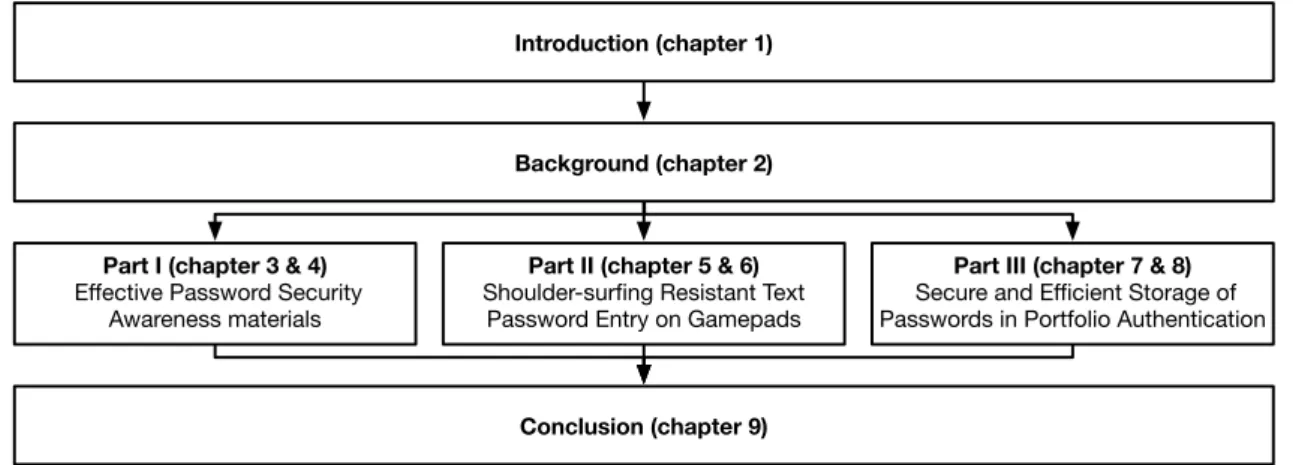
Figure 1.1: Overview of the structure of this thesis.
secure transmission of the password from the client to the server (i.e. using encrypted transmission [28]) and secure password storage on the server side (i.e. using salted hashes [73]). Unfortunately, organisations struggle with these long standing prerequisites of password security on the server side [28]. While Let’s
Encrypt2 has enabled broad availability of securely encrypted transmission of passwords since its launch in 2016 [4], the continued struggle with secure password storage is evidenced by recent lapses regarding this best practice by large Internet companies such as Twitter [5], Google [76], Facebook [43], and Github [225] as well as the long list of other websites storing password in plain text3.
In summary, both, on the user side as well as the organisation side, a plethora of challenges arises pertaining to text passwords.
1.1 Scope and Structure of this Work
User authentication involves three entities: the user who wants to authenticate, the verifier (e.g. de-vice or remote server) the user authenticates to, and theauthentication scheme (including its interface for input/output from/to the user and communication with the verifier) providing the actual authentication procedure. The work presented in this thesis contributes to the body of research on secure and usable user authentication, by addressing three distinct challenges – one with respect to each of the aforementioned entities user, authentication scheme, and verifier: (I: User) the availability of effective password security awareness materials, allowing interested users who are willing to spend time and effort to learn about secure password-related behaviour and clear up common misconceptions about password security, (II:
Authentica-tion Scheme) the availability of shoulder-surfing resistant text password entry on constrained input devices (gamepads) in shared spaces, and (III: Verifier) the availability of secure (i.e. using salted hashes) and efficient (i.e. low storage requirement) password storage in portfolio authentication schemes. Each of these three challenges is presented in one distinct part of this thesis. Thereby, the three parts – together with a preceding chapter introducing the necessary background (chapter 2) and a concluding chapter summarising the overall findings and contributions (chapter 9) – form the structure of the remainder of this thesis (cf. figure 1.1). In the following, the scope of each of the three main parts is described.
2https://letsencrypt.org/(accessed: 2019-08-05)
1.1 Scope and Structure of this Work
1.1.1 Part I: Effective Password Security Awareness Materials
The first challenge addressed in this thesis is the availability of effective awareness materials, allowing interested users who are willing to spend time and effort to learn about secure password-related behaviour and clear up their misconceptions about password security. In general, password security awareness materials are the prime way to (a) making users aware of the different attacks on passwords and user accounts as well as defences against these attacks and (b) clear up the misconceptions about password security the users might have. However, most advice available to end-users was not created in a systematic way, does not reflect the state of the art in password research and best practice, and is seldom formally evaluated. Therefore, the first part of this thesis (chapter 3 & 4) presents a procedure to systematically create awareness materials and describes the application of the procedure to create a password security awareness material, and subsequently evaluates this material with employees in three German small and medium-sized enterprises (SME) in order to validate its effectiveness.
Chapter 3 presents the first step in the creation procedure: a systematic literature review identifying the misconceptions about password security prevalent in users. Identifying and clearing up these misconceptions is vital in order to decrease insecure coping strategies and promote secure coping strategies. The literature review revealed that misconceptions exist in basically all aspects of password security and indicates a strong need to create interventions clearing up these misconceptions. In combination with the attacks and respective defences described in section 2.3 of the background chapter, the identified misconceptions form the basis for the remaining steps in the procedure as presented in chapter 4.
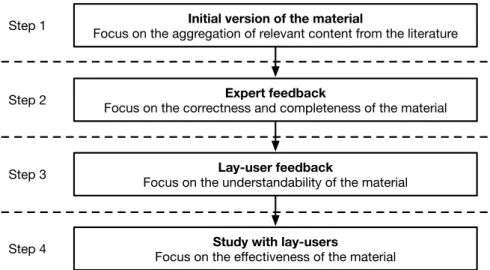
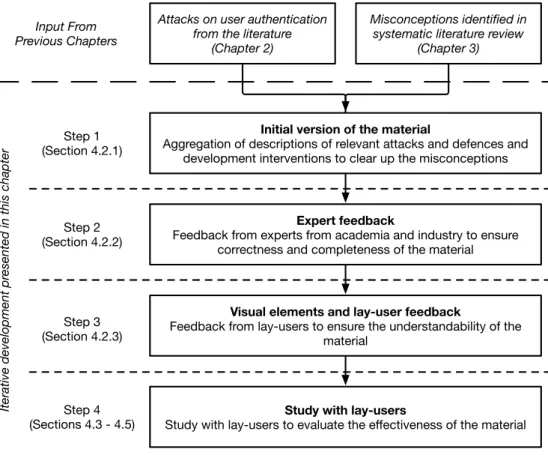
Chapter 4 then presents the development of the password security awareness material. The systematic development process employed as part of the creation procedure is comprised of four iterative steps: (1) the initial version of the material aggregates the relevant content, i.e. descriptions of relevant attacks and defences and newly created interventions to clear up the identified misconceptions, (2) structured feedback of independent experts ensures the material’s correctness and completeness, (3) feedback of lay-users ensures the material’s visual appeal and understandability, and (4) an evaluation in the field with employees of three organisations ensures the material’s effectiveness and provides additional feedback for improvements to create the final version of the material. The results of the evaluation show that the password security awareness material was not only received very positively by the employees, but also validate its effectiveness by showing that it (a) significantly improves the employees capacity to behave securely with respect to their passwords and (b) significantly decreases the prevalence of the identified misconceptions among the employees. The research presented in the first part of this thesis directly benefits both, users and organisations. On the one had, users who are willing to spend time and effort to improve their password-related behaviour and clear up their misconceptions about password security find in the awareness material a correct, complete, and understandable source of information about password security. On the other hand, organisations can distribute the password security awareness material to their employees and rest assured that the time and effort of their employees is well spent to effectively increase the password-related security. This is especially important for organisations which are obligated to distribute awareness materials for compliance reasons, since they can reap additional security benefits beyond pure compliance certifications. Additionally, apart from the direct benefits for users and organisations, the systematic process described in this part can guide researchers and practitioners in the creation and evaluation of awareness materials on topics other than password security.
1 Introduction
1.1.2 Part II: Shoulder-surfing Resistant Text Password Entry on Gamepads
The second challenge addressed in this thesis is the development of shoulder-surfing resistant text password entry, when using constrained input devices such as gamepads in shared spaces. Using gamepad-driven devices like games consoles is an activity frequently shared with others and thus takes place in shared spaces. Consequently, shoulder-surfing becomes a threat in this setting. The second part of this thesis (chapter 5 & 6) presents the first investigation of text password entry on gamepads regarding the shoulder-surfing resistance and the usability of existing and novel authentication schemes in this context.
Chapter 5 first outlines the requirements of text password entry using gamepads and then presents an assessment along these requirements of schemes currently deployed on gamepad-driven devices as well as shoulder-surfing resistant authentication schemes proposed in non-gamepad contexts. The results of this assessment show that none of the currently deployed and only four of the proposals in the literature fulfil all requirements of authentication in the gamepad context. Yet, since the four authentication schemes fulfilling all requirements were developed for non-gamepad context, an empirical evaluation is needed to gauge the performance in terms of shoulder-surfing resistance and usability of the incumbent schemes and the potential replacements.
Chapter 6 presents an empirical evaluation in the form of two user studies - one online study and one lab study - to comparatively evaluate the shoulder-surfing resistance and the usability of three authentication schemes in the gamepad context: the on-screen keyboard (the incumbent and de facto standard in this context), the grid-based scheme (an existing shoulder-surfing resistant scheme identified as viably adaptable during the assessment in chapter 5), and “Colorwheels” (a novel shoulder-surfing resistant authentication scheme specifically geared towards the gamepad authentication context). The results of this evaluation show that on-screen keyboards are highly susceptible to shoulder-surfing attacks, but fare best in terms of usability when compared to the other two schemes. In contrast, the “Colorwheels” scheme, which is specifically designed for usage with gamepads, seems to offer the most robust shoulder-surfing resistance and is rated highest by the participants in terms of intention to use the scheme in the future, while still exhibiting more favourable usability results than the adapted grid-based scheme.
The research presented in this part of the thesis informs the future exploration of text password entry in the gamepad context. The results can inform the design of authentication using gamepads. Furthermore, the evaluation of authentication schemes in this context can benefit organisations that want to enable users to enter text passwords in a socially acceptable way even in shared spaces (i.e. not asking family or friends to look away during password entry) and therefore ultimately users as well.
1.1.3 Part III: Secure and Efficient Storage of Passwords in Portfolio
Authentication
The third challenge addressed in this thesis is the secure and efficient storage of passwords in portfolio au-thentication. Portfolio authentication is a technique to counter-shoulder surfing attacks, originally intended for usage with graphical passwords. In portfolio authentication the password is regarded as a set of elements and every authorised subset of password elements is sufficient to authenticate a user. However, while results in usability studies of portfolio authentication schemes are promising, the lack of a verification scheme which allows secure and efficient storage of passwords in portfolio authentication schemes is an open question. Therefore, the third part of this thesis (chapter 7 & 8) presents the novel(t, n)-threshold verification scheme
1.2 Main Contributions
offering secure and efficient storage of passwords in portfolio authentication schemes. Its usage is illustrated based on three use cases.
Chapter 7 presents the novel(t, n)-threshold verification scheme, which allows to derive the same secret from all authorised subsets of the password elements by utilising cryptographic secret sharing and key derivation functions. Two variants of the scheme are described: one based on Blakley secret sharing and one based on Shamir secret sharing. Security as well as efficiency properties of these two (t, n)-threshold verification variants are evaluated against a naive implementation and against each other. The results of these evaluations show that the(t, n)-threshold verification scheme offers in all instances more favourable properties than the naive approach and that choice between the two variants depends on the specific application scenario. Chapter 8 then presents three use cases of the (t, n)-threshold verification scheme, namely its application to three knowledge-based authentication schemes: graphical recognition-based passwords, partial passwords, and ZeTA (an authentication scheme designed to harness the human capability to build up semantic networks of related concepts). In addition, the application of the proposed(t, n)-threshold verification scheme beyond the knowledge-based authentication use cases is discussed.
The research presented in this part directly benefits all organisations which want to employ portfolio authen-tication schemes to counter capture attacks such as shoulder-surfing or surveillance of network traffic. This in turn allows users to benefit from the deployment of such authentication schemes. The three use cases described in chapter 8 can serve as blueprints for implementations. In addition, the use cases can guide researchers towards secure and efficient storage solutions in the design of novel portfolio authentication schemes.
1.2 Main Contributions
This research contributes to the field of usable and secure user authentication. It addresses three challenges in three distinct parts, as outlined in the last section. The main contributions of each of the three parts are summarised below.
1.2.1 Part I: Effective Password Security Awareness Materials
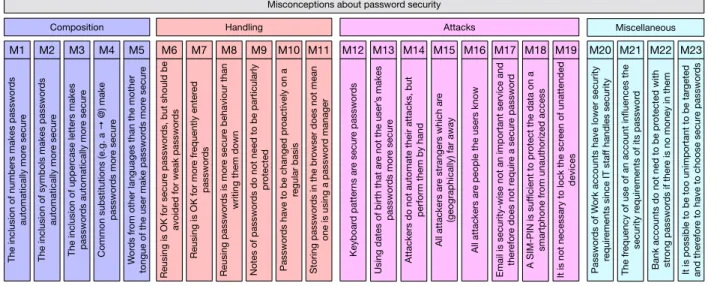
• Overview of misconceptions about password and user account security reported in the literature. The systematic literature review identifies 23 different misconceptions, which can be grouped into four cat-egories: composition, handling, attacks and miscellaneous. This shows that there exist misconceptions with respect to a wide range of aspects of password security.
• Systematic process for the development of correct, complete, understandable, and effective awareness materials. The systematic iterative development process for information security awareness materials presented in this part of the thesis combines the state of the art described in the current scientific literature, the expertise of independent experts from academia and industry, feedback from lay-users, and an evaluation of the awareness material. Thereby, it enables the creation of correct, complete, understandable, and effective information security awareness materials.
• Evaluated password security awareness material. The password security awareness material created by application of the aforementioned systematic process significantly improves users’ ability to assess
1 Introduction
password-related behaviour, improves their ability to assess the security of passwords, and clears up the identified misconceptions decreasing their overall prevalence.
1.2.2 Part II: Shoulder-surfing Resistant Text Password Entry on Gamepads
• Requirements of authentication in the gamepad context. Overall six requirements which all authenti-cation schemes in the gamepad context should fulfil are identified. These requirements can be grouped into three categories: security, technical, and usability. The requirements can inform the design of new authentication schemes in the gamepad context.
• Assessment of authentication schemes along the identified requirements. The authentication schemes currently deployed in the gamepad context as well as a representative set of shoulder-surfing resistant authentication schemes proposed in the literature are assessed along the identified requirements. The results of this assessment show that none of the currently deployed and only four of the proposals in the literature fulfil all requirements.
• Baseline in terms of usability and shoulder-surfing resistance for the incumbent on-screen keyboard. By conducting two user studies – an online study and a lab study using similar methodologies – a baseline for the on-screen keyboard (as incumbent and de-facto standard of authentication in the gamepad context) is established.
• Comparative assessment of two alternatives to the on-screen keyboard. By evaluating them based on the same methodology as in the baseline assessment, the viability in terms of shoulder-surfing resistance and usability of two alternatives of the on-screen keyboard is assessed:
(a) The grid-based scheme, which is a shoulder-surfing resistant authentication scheme proposed in the literature and identified as the most viable candidate adaptable to the gamepad context. (b) The novel Colorwheels scheme which was specifically designed for the gamepad context.
Overall, the Colorwheels scheme seems to exhibit the most robust shoulder-surfing resistance among all three evaluated schemes. In terms of usability, Colorwheels scores better than the grid-based scheme, but the on-screen keyboard scores best in this regard indicating a trade-off between security and usability. However, since Colorwheels is rated highest by the participants in terms of intention to use the scheme in the future, this seems to be a trade-off users are willing to make.
1.2.3 Part III: Secure and Efficient Storage of Passwords in Portfolio
Authentication
• Requirements of verification for portfolio authentication schemes. A compilation of the general oper-ations and properties required of verification schemes in the domain of portfolio authentication gives an overview of the requirements any verification scheme should fulfil.
• The(t, n)-threshold verification scheme. The(t, n)-threshold verification scheme directly addresses the challenge of secure and efficient password storage in portfolio authentication schemes. Two variants of the verification scheme are presented using two different secret sharing schemes, i.e. Blakley secret sharing and Shamir secret sharing.
1.3 Related Publications
• Comparison of the two proposed (t, n)-threshold verification variants and a naive approach regarding security and efficiency. In a comparative evaluation, the security and efficiency properties of the two proposed (t, n)-threshold verification variants are assessed against a naive approach and against each other. The(t, n)-threshold verification variants generally perform better.
• Three use cases for the(t, n)-threshold verification scheme. Application of the(t, n)-threshold verifica-tion scheme is described for three exemplary use cases: graphical recogniverifica-tion-based passwords, partial passwords, and the ZeTA authentication scheme.
• Further areas of application. While the three use cases of the (t, n)-threshold verification scheme described in this thesis all belong to the field of knowledge-based authentication, the area of applica-tion for the scheme covers far more general contexts including different types of authenticaapplica-tion (i.e. knowledge-based, token-based, biometric) in order to provide fault tolerance or authentication schemes which adapt to the types of authentication available in the particular environment where a user acts at any given time (e.g. specific biometric sensors).
1.3 Related Publications
The research presented in this thesis is based on and extends previous publications. Furthermore, several publications have indirectly contributed to this thesis. In the following these publications are presented for each of the three main parts.
1.3.1 Part I: Effective Password Security Awareness Materials
This part of the thesis is based on the following publications:
• P. Mayerand M. Volkamer, “Addressing Misconceptions About Password Security Effectively”, Work-shop on Socio-Technical Aspects in Security and Trust (STAST, co-located with ACSAC), 2017. • P. Mayer, C. Schwartz, and M. Volkamer, “On The Systematic Development and Evaluation Of
Password Security Awareness-Raising Materials”, Annual Computer Security Applications Conference (ACSAC), 2018, pp. 733–748.
The following publications contributed indirectly to this part of the thesis:
• P. Mayer, A. Kunz, and M. Volkamer, “Analysis of the Security and Memorability of the Password Card”, Annual Computer Security Applications Conference Posters (ACSAC Posters), 2017.
The password card is intended to increase password memorability. The investigation of the properties of this solution allowed deciding whether it should be recommended in the password security awareness material or excluded from it.
• P. Mayer, J. Kirchner, and M. Volkamer, “A Second Look at Password Composition Policies in the Wild: Comparing Samples from 2010 and 2016”, Symposium on Usable Privacy and Security (SOUPS), 2017, pp. 13–28.
The overview of password composition policies given in this paper allowed gauging the requirements put on passwords in the wild and therefore consider these requirements in the material.
1 Introduction
• S. Stockhardt, B. Reinheimer, M. Volkamer,P. Mayer, A. Kunz, P. Rack, and D. Lehmann, “Teaching Phishing-Security: Which Way is Best?”, IFIP International Conference on ICT Systems Security and Privacy Protection (SEC 2016), vol. 471, 2016.
The lessons learned from the evaluation of the materials in this publication informed the design of the evaluation of the newly developed password security awareness material in this part of the thesis.
1.3.2 Part II: Shoulder-surfing Resistant Text Password Entry on Gamepads
This part of the thesis is based on the following publication:
• P. Mayer, N. Gerber, B. Reinheimer, P. Rack, K. Braun, and M. Volkamer, “I (don’t) see what you typed there! Shoulder-surfing resistant password entry on gamepads”, Conference on Human Factors in Computing Systems (CHI), 2019.
The following publication contributed indirectly to this part of the thesis:
• P. Mayer, S. Neumann, D. Storck, and M. Volkamer, “Supporting Decision Makers in Choosing Suit-able Authentication Schemes,” International Symposium of Human Aspects of Information Security Assurance (HAISA), 2016, pp. 67–77.
The work on authentication scheme features presented in this publication informed the work on re-quirements presented in this part.
1.3.3 Part III: Secure and Efficient Storage of Passwords in Portfolio
Authentication
This part of the thesis is based on the following publications:
• P. Mayerand M. Volkamer, “Secure and Efficient Key Derivation in Portfolio Authentication Schemes Using Blakley Secret Sharing”, Annual Computer Security Applications Conference (ACSAC), 2015, pp. 431–440.
• P. Mayer and M. Volkamer, “Poster: Secure Storage of Masked Passwords”, European Symposium on Security and Privacy Posters (Euro S&P Posters), 2017.
• A. Gutmann, K. Renaud, J. Maguire, P. Mayer, M. Volkamer, K. Matsuura, and J. Muller-Quade, “ZeTA-Zero-Trust Authentication: Relying on Innate Human Ability, Not Technology”, European Symposium on Security and Privacy (Euro S&P), 2016, pp. 357–371.
2
Background
The goal of this chapter is to provide a broad overview of the required background knowledge and terminology surrounding user authentication, as needed for the understanding of the subsequent chapters. First, the different types of user authentication are described (section 2.1) and the phases involved in a general user authentication procedure are presented (section 2.2). Then, an overview of attacks on user authentication is provided (section 2.3, needed in particular for part I). Thereafter, the background on awareness materials is described, outlining the status quo and design considerations (section 2.4, needed in particular for part I). Last but not least, the portfolio authentication technique is described (section 2.5, needed in particular for part III).
2.1 Types of User Authentication
User authentication serves the purpose of controlling access to protected resources, i.e. grant access to the resources to authorised users and prevent access to the resources from unauthorised users [182]. There are three general types of user authentication [168], each based on a different characteristic of the user [64]:
• Something the user knows (knowledge-based authentication or memometric authentication) • Something the user possesses (token-based authentication)
• Something the user is (biometric authentication)
In the following, each of the basic working principles and properties of these three types of user authentication will be described1. Also, any of these three types can be combined to harness the properties of multiple types.
2.1.1 Knowledge-based Authentication
In knowledge-based authentication, the user must prove knowledge of an authentication secret, which is generally referred to as a password [22]. Knowledge-based authentication schemes can be categorised along two dimensions: the type of data the password is comprised of and the way the user’s memory is strained during the authentication procedure.
The most prevalent type of data used for passwords are textual characters. While text passwords were originally conceived only as a measure to track computation time on mainframe systems, it has evolved into the dominant authentication scheme [98]. However, other types of data have been used for passwords as well. The most promising alternative to textual characters are graphical elements [20]. The motivation behind using graphical elements in passwords is the possibility to exploit the vast human capacity to store and
1The explanation ofknowledge-based authentication will be more detailed than those of token-based authentication and biometric authentication, since it represents the focus of this thesis.
2 Background
process visual information, the so-called pictorial superiority effect [151]. Paivio’s dual-coding theory [156] explains that visual information is processed and stored differently in the human brain compared to abstract information such as text. This difference in encoding leads to a higher probability of memory imprinting and therefore to a higher memorability of visual information. The idea to use graphical elements for passwords was first documented in 1992 [6], but a plethora of schemes aiming to exploit the superior memorability have been proposed in the literature since, displaying different usability and security properties [20, 141, 198]. With respect to the the strain put on the user’s memory when authenticating, three categories of authen-tication schemes are described in the literature [20]: (a) free recall-based schemes, (b) cued recall-based schemes, and (c) recognition-based schemes. Free recall-based schemes are the traditional implementation of knowledge-based authentication: the user has to freely recall the complete secret needed for authenti-cation and enter it in a predefined blank field (e.g. empty text field for text passwords, a blank canvas for graphical authentication schemes, etc.). Such free recall is a cognitively demanding task. Therefore, memorability of free recall-based schemes is often impaired [148, 232]. The ubiquitous text password is the canonical example of an authentication scheme falling into this category. Cued recall-based schemes try to overcome this deficiency in memorability by providing additional information as cues to help users recall their password during authentication. Analogously to the actual password, cues can be of different data types, such as textual characters (e.g. a hint towards the password) or graphical elements (e.g. a rebus). Examples of cued recall-based authentication schemes are the rebus passwords by King [124] and the cued click points scheme by Chiasson et al. [45]. The best option in terms of memorability, however, are recognition-based authentication schemes. Recognition is a cognitively much easier task than free or cued recall [148, 206]. Recognition-based authentication schemes rely on a different mechanism than free recall-based schemes and cued recall-based schemes: instead of recalling the elements of the password, users have to decide whether presented information is part of the password. Usually the password is randomly assigned by the system for recognition-based schemes and presented alongside distractor information in a challenge-response fashion. A simple example of a recognition-based scheme would be to assign a random string as traditional text password to the user during the enrolment phase. During the authentication phase this password could be displayed alongside other random textual strings. The task for the user would then be to point out her/his password among the choices. This scheme is obviously insecure beyond practicality and serves only illustration purposes. However, multiple different recognition-based schemes have been proposed and studied with promising results using both, graphical passwords (e.g. [60, 100]) and (with slightly worse results in terms of memorability) text passwords (e.g. [230]). In particular, combining the memorability advantages of recognition-based authentication and graphical authentication schemes results in highly mem-orable passwords. There are numerous studies which found that graphical recognition-based schemes offer higher success rates and lower reset rates when compared to other knowledge-based authentication schemes (e.g. [32, 60, 141]). The most prominent example of graphical recognition-based authentication (which will also be revisited in chapter 8) is the Passfaces scheme presented in [167] and its derivatives found in the lit-erature. Hlywa et al. [100] evaluated three different Passfaces-style schemes. The password in these schemes is a set of images and usually randomly assigned to the user during enrolment. Each of the images in the password is part of a larger group. During authentication, multiple grids of images are presented to the user, one after another, where each grid displays all images in one of the groups. The user has to point out the one image that is part of their password among the other images (so-called distractors). Figure 2.1 shows a grid resembling one of their schemes.
2.1 Types of User Authentication
Figure 2.1: The interface of a recognition-based graphical authentication scheme resembling the interface2as used in [100]. The scheme shows multiple such grids one after the other. The task for users is to point out the one image that is part of their password.
2.1.2 Token-based Authentication
In token-based authentication, the user must prove possession of a certain object. Any object used for authentication purposes is typically referred to astoken [168]. Tokens are usually categorised with respect to three characteristics [164]: whether they need to be plugged in, whether a specialised reader is required, and whether they are active devices.
One of the typical examples of tokens which have to be plugged in during the authentication procedure are smart cards. Smart cards are among the most widely deployed authentication tokens used, e.g. in banking [118], public transport [162], and physical access [231]. Other tokens which need to be plugged in are USB tokens (such as the Yubikey [52]).
In contrast, tokens that do not need to be plugged in are for example those where users have to transcribe a code from the token to the device. Such tokens come in electronic form (e.g. the RSA SecurID [65]) and in paper form (e.g. TAN lists for online banking [26]).
The second characteristic, namely whether a specialised reader is required, only applies to tokens which need to be plugged in [164]. Requiring a specialised reader which is not widely available in commodity consumer hardware (e.g. for smart cards) might hinder adoption as opposed to tokens without that requirement (e.g. USB tokens).
The third characteristic, namely whether the token is an active device, is determined by the type of storage and cryptographic functionality provided by the token [164]. Thereby, tokens relying on passive storage such as smart cards using magnetic strips are classified as passive. In contrast, tokens offering the possibility to perform computations during the authentication procedure (such as cryptographic functions) are classified as active.
2 Background
2.1.3 Biometric Authentication
In biometric authentication, the user must prove that they exhibit a certain biometric characteristic. Bio-metric authentication schemes form two distinct categories: physiological bioBio-metrics and behavioural bio-metrics [51, 168].
Physiological biometrics represent static biometric information which is stable over time [168]. In physio-logical biometric authentication schemes, the static biometric information is captured using a sensor and matched to a capture of the same biometric stored during enrolment. The most widely applied example of physiological biometrics are fingerprints. In the last years they have become especially popular on mobile devices, such as TouchID [9] on the iPhone and iPad. However, a multitude of other physiological biomet-rics exist, such as iris [185] or retina [99] scans, palm vein recognition [238], face recognition [8], and many more [51, 168].
Behavioural biometrics represent the user’s usage and activity patterns, e.g. mouse movements [114], key-board typing characteristics [145], or gait [30]. Consequently, they can be captured only while the user is performing certain actions and exhibiting the necessary usage and activity patterns, e.g. using the mouse to capture the mouse usage patterns. Therefore, if the user is not performing the required actions anyways, the authentication procedure might take longer in order to collect enough data to judge whether the usage or activity pattern the user exhibits can be matched to the stored pattern for verification.
A problem inherent to all types of biometric authentication is that the sensors used to capture the biometric characteristic of the user have variances that might cause the characteristic of a legitimate user to be misclassified as illegitimate (a so-called false negative) or the characteristic of an illegitimate user might be classified as legitimate (a so-called false positive). For example Apple’s FaceID system has gained attention after its deployment due to false positives [61].
2.2 The User Access Control Procedure
Authentication is part of the procedure to grant users access to protected resources. Thereby, the same overall procedure applies to all knowledge-based authentication schemes. This procedure comprises multiple phases, each fulfilling a distinct function (one of which is the actual authentication step). In the following, the function and scope of all phases are explained. Figure 2.2 gives an overview of all phases.
2.2.1 Enrolment
Before a user can authenticate using a certain authentication scheme, they have to be enrolled. The operation associated with this phase is the creation of the verification information. This phase ideally has to be
Recurring during every authentication attempt of the user
Enrolment Identification Authentication
User enters their password using the
interface of the authentication scheme. User claims to have a
certain identity. User chooses or is assigned password. Verification information is created. Verification Entered password is verified against the
stored verification information.
Authorisation
The legitimate user is granted access.
Termination
The stored verification information is deleted. Re-Enrolment
2.3 Attacks on Passwords
completed only once, but re-enrolment may be necessary in case a password is lost or stolen. In the traditional text password setting, this phase refers to the selection of a password by the user (in case the password is not assigned by the system), hashing the password, and storing the salted hash together with the user name for verification.
2.2.2 Identification
The identification phase is the first phase recurring whenever the user wants to access a protected resource. In this phase the userclaims to have a certain identity. Traditionally the action required from the user in this phase is to supply the system with the user name. In this phase the password is not entered yet.
2.2.3 Authentication
In the authentication phase the userenters their passwordusing the authentication scheme. In the traditional text password setting the respective user action is entering the password in a text field and submitting it to the system.
2.2.4 Verification
In the verification phase the authentication secret entered by the user during the authentication phase is
verifiedagainst the verification information which was stored during the enrolment phase. In the traditional text password setting this refers to hashing the password supplied by the user during the authentication phase and comparing the calculated hash to the hash stored during the enrolment phase.
2.2.5 Authorisation
The fourth recurring phase is the authorisation phase. This phase is only reached when the verification was successful and determines what the authorised user is allowed to do. In this phase, the legitimate user is
being granted accessto the protected resource.
2.2.6 Termination
The termination phase corresponds to deleting the verification information stored during enrolment. The user will not be able to authenticate afterwards. This phase can usually occur only once, unless the user re-enrols.
2.3 Attacks on Passwords
Attacks on passwords3 can be either capture attacks (i.e. the goal is to capture the password by recording or observing it in the clear) or guessing attacks (i.e. the goal is to guess the password utilising some form of
3Due to this thesis’ focus on knowledge-based authentication this section uses the termpasswordinstead ofauthentication secret.
2 Background
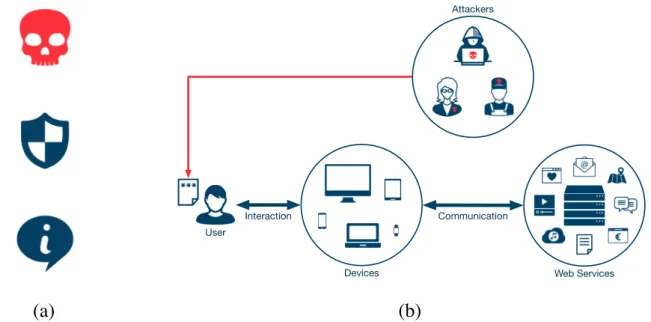
Devices User & Interaction
Ascending Distance from the User
Communication
Web Services Attackers
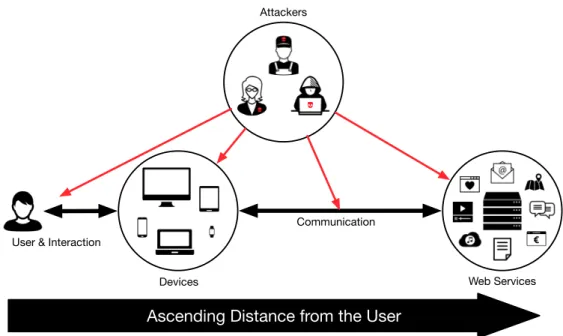
Figure 2.3: The attacks are ordered in ascending distance from the user.
oracle). The strength of passwords (i.e. their character composition and length) is thereby relevant only for guessing attacks, since capture attacks will always target the passwords in the clear and therefore capture all passwords regardless of character composition and length. Attacks are also classified regarding the number of accounts they impact [74] as full compromise (compromising potentially all accounts of the user), group compromise (compromising a group of accounts protected by the same password)4, or single compromise (compromising a single account without acquiring the password, e.g. through session hijacking).
In the remainder of this section, an overview of the possible attacks on passwords and respective defences is given. The selection of attacks is based on those represented by the 11 different security benefits of authentication schemes as defined in the framework for comparative evaluations of authentication schemes5 by Bonneau et al. [26]. Since the framework of Bonneau et al. [26] does not specify a systematic order for the attacks, such an order is introduced here: the attacks are ordered in “ascending distance from the user”, i.e. first attacks on the users themselves, then on the users’ devices, then the communication between the devices and remote services, etc. (see figure 2.3). Table 2.1 gives a birds-eye overview of the attacks on user accounts with the respective classification as full, group, or single attack and the corresponding benefits from [26]. The explanation of theshoulder-surfing attack will be more detailed than those of the other attacks, since it represents the basis of parts II and III of this thesis.
2.3.1 Attacks targeted directly at the user and the interaction with their devices
The attacks “closest to the user” are those targeted the user themselves (e.g. through her/his behaviour) and those targeted at the interaction of the user with her/his devices (e.g. observation of the user).
4Note that it is of course possible to achieve afullcompromise in case all passwords can incrementally be obtained through
groupcompromises. Also the group can – in the worst case for the attacker – be of size 1.
5Relying on this selection implies that firstly, only full and group attacks will be considered, i.e. those attacks whose goal it is to acquire the actual password. This excludes in particular the technique of exploiting a weak reset mechanism. While this is sometimes regarded as an attack, it is in essence the application of any attack presented in this section to the reset mechanism (which is just another authentication scheme), e.g.targeted guessingin the case of “personal security questions” [25]. Secondly, only specific attacks (e.g. phishing) and not categories of attacks (e.g. social engineering) are described.
2.3 Attacks on Passwords
Table 2.1: Overview of the attacks on user accounts with the respective classification as full, group, or single attack and the corresponding counteracting benefits from [26].
Attack Class Counteracting Benefits
Attacks targeted directly at the user and the interaction with their devices
Phishing Full/Group Resilient-to-Phishing
Theft of an Insecurely Stored Physical Copy of the Password Full/Group Resilient-to-Theft
Shoulder-surfing Group Resilient-to-Physical-Observation
Attacks targeting the user’s device as well as remote services
Compromising the User’s Device Full Resilient-to-Internal-Observation Targeted Guessing Group Resilient-to-Targeted-Impersonation Untargeted Guessing Group Resilient-to-Throttled-Guessing Guessing After System Break-In Group Resilient-to-Unthrottled-Guessing
Resilient-to-Leaks-from-Other-Verifiers Resilient-to-Trusted-Third-Party Theft of a Digital Copy of the Password Group Resilient-to-Theft
Resilient-to-Internal-Observation
Attacks targeted at the communication between the user’s devices and remote services
Compromising the network traffic between the users’ devices and the remote services
Group Resilient-to-Internal-Observation
Phishing
The first attack which targets the user directly is sending phishing messages i.e. messages using social engineering techniques or technical subterfuge [7] to lure an unsuspecting user into (a) clicking malicious links that would lead her/him onto a malicious website, or (b) perform actions in the interest of the attacker, e.g. transferring money to their bank account.
As of 2019, this type of attack is still on the rise with more malicious websites being detected in the first quarter of 2019 than in the third and fourth quarter of 2018 [7]. This is also evidenced by successful phishing attacks, such as the ones at the large Internet companies Google and Facebook [105] or even at the security company RSA [170]. Due to the elaborate efforts of the attackers, a combination of technological measures (such as described in [189,216]) and awareness materials (such as described in [128,152]) is advised to thwart attacks based on phishing messages.
An attack using phishing messages is traditionally classified as group compromise, when only one password is entered on a phishing website. However, it must be classified as full compromise, when the phishing attack compromises the user’s password of a password manager which is accessible online (e.g. through a web interface).
Theft of an Insecurely Stored Physical Copy of the Password
The second attack, stealing an insecurely stored note of a password, relates to the problem of password memorability and a potentially insecure common coping strategy of users [194]: writing passwords down and not necessarily storing them securely. Such insecurely stored notes can easily be stolen by attackers with physical access. However, even when physical access is not possible, passwords can still leak, e.g. through inadvertent leaks in press images or video footage [146]. The presence of such notes is widely documented and ranges up to cases involving passwords of military systems which were leaked through press photos [48]. Therefore, it is widely given advice to store any written down password in a secure location [183]. This attack is classified as group compromise, since it affects only the password which was written down. However, if
2 Background
the attacker can obtain a password logbook [126] containing all of a user’s passwords, then this attack is classified as full compromise.
Shoulder-surfing
In shoulder-surfing attacks, the attacker tries to capture the password by observing the user while they authenticate. Such an observation can be performed by the attacker themselves, but also with technical equipment such as cameras [135] or even after the fact using analyses of smudges on touchscreens [111] or thermal residue [1]. It has been identified as viable attack especially in public spaces [215] and shared spaces [169] and has been studied in particular with respect to mobile authentication (e.g. [12, 59, 111, 121]). Shoulder-surfing attacks are generally classified asgroupcompromise attacks.
Due to the breadth of approaches to this attack, Wiese and Roth [227] propose to differentiate four types of attackers: Single Recording (the attacker has access to a small number of recorded authentication proce-dures), Multiple Recording (the attacker has access to a huge number of recorded authentication proceproce-dures), Opportunistic Observer (the attacker can observe a small number of authentication procedures), and Insider Observer (the attacker can observe a huge amount of authentication procedures). In the first two categories (Single Recording and Multiple Recording) the human ability (e.g. memory retention) plays a subordinate role, as the password entries are recorded and can be played back and paused at will. In the second two categories (Opportunistic Observer and Insider Observer) the attackers observe the whole process and try to remember the most important details. Afterwards they depend on their memory retention to try to log in based on the information they observe.
To counteract shoulder-surfing threats, several techniques can be employed. Harbach et al. [94] propose four categories of such techniques: (1) using covert channels to the user, (2) obfuscation of the user’s input through distractors, (3) using indirect input, and (4) using additional biometric layers. In addition, DeAngeli et al. [55] propose (5) the portfolio authentication technique, where only a (random) part of the password is needed in every authentication attempt.
2.3.2 Attacks targeted at the user’s devices
When moving one step further from the user and their interaction with devices, attacks may target the user’s devices (but not the interaction with them).
Compromising the User’s Device
A user’s device can be compromised by attackers that have physical access to the machine or using malware. Opportunities for physical access may arise when devices are unlocked and unsupervised. In such a case, the attacker might be able to either access all passwords directly or by installing malware [184, 201]. Note that both is potentially possible even when a computer is locked: in case the hard drive is not encrypted and given enough time, an attacker could access the hard drive by means of another operating system and extract the data of interest or place malware on the hard drive such that it is installed on the next startup. When physical access is not possible, attackers must resort to other means, such as (a) tricking users into installing malware or enabling remote access by sending malicious attachments to messages or by tricking them to plug-in a USB stick or (b) exploiting unpatched vulnerabilities in software (e.g. operating system) on the user’s device. In particular, the latter can also used for automated attacks using any self-replicating
2.3 Attacks on Passwords
malware such as viruses or worms [201]. Compromising a user’s device is classified as full compromise, due to the wide ranging access an attacker achieves with this attack.
Targeted Guessing
In targeted guessing attacks, the goal of the attacker is to compromise the account of one specific user. To that end, the attacker leverages personal knowledge about the victim, trying to guess passwords which this specific user would be likely to choose [26]. While there do not seem to be any studies establishing how successful acquaintances can be in guessing a user’s password, other knowledge-based authentication schemes like personal knowledge questions are highly problematic in this regard [25]. Targeted guessing attacks are classified as group compromise.
Untargeted Guessing
In untargeted guessing, the attacker uses a more generic approach and uses as guesses for the password those which are the most likely across all users. The most relevant strategy for untargeted guessing is the so-called trawling [27], where attackers try the most frequently chosen passwords in an attempt to access as many accounts as possible until the lock-out mechanisms of the device takes effect. As evidenced by the fact that year after year the same passwords are found the be the most frequently chosen ones, this attack can be highly effective. Untargeted guessing attacks are classified as group compromise.
Guessing After System Break-In
The most powerful guessing attack is offline guessing after a break-in, i.e. when the password hashes were stolen by the attackers from the device. After e.g. having stolen hashes, the number of guesses an attacker can try is only bound by the resources available to them. For such offline guessing attacks, the security of the password is not only determined by its composition and length, but also by the hash that is used to create the verification information: the weaker the hash, the lower the security. Offline guessing usually employs a combination of brute-force attacks (i.e. trying all possible passwords up to the length where this attack becomes unfeasible) and dictionary attacks (i.e. trying as guesses all entries from a dictionary of likely passwords) is used [210]. Software to mount unthrottled automated guessing attacks on passwords is widely available. Such attacks are classified as group compromise.
Theft of a Digital Copy of the Password
The theft of a digital note of passwords represents the final attack targeted at the user’s devices. Some users who are overwhelmed by the number of passwords they have to handle, cope by using unencrypted notes of passwords (i.e. text files) which can be stolen off their devices [194]. Even more dangerous are these when synchronised using cloud services (cf. section 2.3.4). A user might even have such notes on their device unintentionally, when a password manager does not require the user to set a master password or other applications (such as email clients) store the passwords of the accounts used in the application in the clear. Additionally, even when digital notes of passwords are encrypted, they might be at risk, if the key used for the encryption is not strong enough (e.g. derived from a weak password which can be guessed). The theft