1
INFORMATION SYSTEMS SECURITY MANAGEMENT (ISSM) MATURITY FACTORS INE-COMMERCE MALAYSIA
Azah Anir Norman 1 and Norizan Mohd Yasin 2
Postal Address 1 & 2: Faculty of Computer Science and Information Technology, University of Malaya, 50603 Kuala Lumpur Malaysia
E-mail: [email protected] 1 and [email protected] 2 Telephone: +603-79676372 Fax number: +603-79579249
Abstract: ISSM maturity essentially defines the full development of security management (SM) of a business. Organizations consist of many influences and characteristics that contribute to SM practices. As such these issues influence the business to achieve its ISSM maturity. In the small businesses such as SMI/E e-Commerce businesses, specifically in Malaysia, there are increasing challenges in SM implementation due to limited resources. Many of these small businesses sometimes failed to address SM appropriately leading to many security problems and issues, hence inhibited the business to commence its business normally. This research is conducted is based on the aims to investigate and determine the factors influencing ISSM maturity of SMI/E e-Commerce thus predict the relationship of these factors towards achieving ISSM maturity. A predicted framework was design to address the possible issues influencing the ISSM maturity of these businesses. Based on this research framework, a quantitative investigation using the survey as an instrument was carried out to determine the ISSM maturity factors in the small medium industries/enterprises (SMI/E) e-commerce business in Malaysia. The research investigation was conducted to selected e-commerce business based on the research characteristic define earlier in the research. The samples were generated by two different organizations to ensure data investigated is free from bias. Results of the data collection was analysed using the Partial Least Square technique (PLS) from the Structural Equation Method (SEM). The results shows, significant reliability score of 0.84 and above for all constructs involved in this study. The results displayed average variance extracted (AVE) exceeding 0.5, suggesting adequate convergent validity of all the constructs. The R2 value of the ISSM maturity in of this study prove to have significant results which is 50% above, showing the high dependability of each construct in ISSM maturity achievement. It is predicted that the organizational structure together with SM practices are the basis of ISSM maturity. However, only one construct relationship is supported from the findings. This findings suggest that the determine relationship may not be as direct as predicted in the earlier framework. As such it opens up to more opportunity of further studies, which could be conducted to provide better understanding in the ISSM maturity foe e-Commerce business. The discussion of the sections of this paper starts off with the research introduction and the problems of e-commerce and ISSM maturity. The material analysis provides detail information of current ISSM situation and relates the material findings with selected information system (IS) theories. Through which the research framework was constructed. Remaining of the sections continues to discuss the research investigation, analysis and findings, and finally concluding the findings in the conclusion section.
2
1.0 INTRODUCTIONISSM maturity promises effective security management practices as it promotes security management (SM) implementation based on the level of maturity. Before the establishment of the ISSM maturity framework, standards and best practices are developed to guide businesses in their SM implementation. These standards and best practices descend from the security checklist based on software or information systems (IS) field (Siponen, 2002). The progression of these standards and best practices eventually forms the ISSM maturity framework. The difference between the standards and the maturity framework is the introduction of security maturity levels. Maturity levels enable the determination of the businesses’ position when implementing security management. As every business is unique, each business has to adopt and implement the SM relevant to its particular objectives and structure.
Most businesses, particularly the small and medium enterprises (SMI/E), may not be able to implement all types of SM underlined in the ISSM maturity framework. However, this does not mean that these businesses may not achieve the maturity level intended. Currently, majority of the security frameworks are based on big-hierarchical organizations rather than the small and volatile business (Zuccato, 2007). These standards focus on the process of SM instead of giving priority to the content of the standards (Siponen, 2006, Zuccato, 2007). Thus, it provides little help towards the SMI/E which usually has limited knowledge on ISSM. SMI/E, especially businesses involved in e-commerce activities, require a practical approach in SM implementation to combat threats. It is recommended that these businesses apply the ISSM maturity concept in their SM implementation as it directly distinguishes the business IS to a level of security they intend, hence optimising business resources.
According to prior census (BNM, 2005, Aris, 2006), about 99.2% of business establishments in Malaysia are from SMI/E which accounts for 47.3% of the GDP. Hence, SMI/E provides a crucial study context as the results will add value to the establishment’s activities. This paper investigates the factors that promote ISSM maturity in Malaysian SMI/E practicing e-commerce. Subsequently, businesses may predict the type of internal and external issues involved in SM to focus on, thus achieving the ISSM maturity. The study aims to investigate and determine ISSM maturity factors and its relationship with the organizational context in the Malaysian SMI/E e-Commerce.
2.0 MATERIALS AND METHODS 2.1 MATERIALS ANALYSIS 2.1.1 ISSM Maturity Phenomena
ISSM maturity demands effective and well-exercised security management. Standards and best practices have been developed to assist in actualizing effective SM in business and of late, ISSM Maturity frameworks are often discussed. While both standards and maturity criteria can be used to improve IS security, ISSM maturity has the capacity to show the level of IS security as the framework offers an objective scale in classifying IS security maturity (Siponen, 2005). This is useful as it can indicate poor to high levels of maturity (level 0-level 5). Despite this, the ISSM maturity framework also holds glaring disadvantages. Firstly, these frameworks are based on the information systems and computer science perspectives which focus on software development. Secondly, these ISSM maturity frameworks are developed based on the hierarchical business. Thus, the problem of appropriation is still at large in ISSM maturity. Additionally, many businesses, specifically the SMI/E have
3
difficulty in harnessing the SM concept and its advantages as SM demands high resources and time from the business owner (Gillies, 2011), (Werlinger et al., 2009) and (Barlette and Formin, 2008). Finally, the greatest concern from the researcher’s point of view is that most of these ISSM maturity frameworks are conceptually driven (Siponen and Willison, 2009, Siponen, 2006, Siponen, 2005). These frameworks are developed according to the practitioners’ experiences, which reflect tried-and-true practices of security management from the practical business perspective. This may be problematic as each business has its unique requirements and demands unique implementation in accordance with its business objectives.2.1.2 Underlying theories of research
Selected theories are used as the fundamentals of this study. These help to conceptualize the study framework in order to determine the reasons that can inflict ISSM maturity. The use of theories also helps to conceptualize the possible relationships between determined reasons. (Ein-Dor and Segev, 1978) iterate that to develop successful management information systems (MIS), organizational factors are the utmost factors to consider. (Kankanhalli et al., 2003) used organizational factors to determine ISSM effectiveness and showed that they play an important role in influencing effective and successful ISSM in a business (Kankanhalli et al., 2003, Fomin et al., 2008, Barlette and Formin, 2008, Werlinger et al., 2009). Organization factors consist of business types, organization size and top management support. These three factors inevitably guarantee ISSM success.
Figure 1: ISSM Maturity theoretical model
The ISSM maturity concept involves innovative processes which oversee necessary diffusion of SM practices in a business. As asserted by (Rogers, 1983) and (Tornatzky and Fleisher, 1990), process adoption requires communication and a definite social system to agree and accept changes. It involves attributes that influence and support the social system. Hence, to become mature, successful adoption and diffusion of SM
ISSM Maturity
Theoretical Model
SECURITY MANAGEMENT MODEL ANALYSIS (ISSA, 2004; SSE-CMM, 1999; ISM3, 2006; ISO27001; ISF, 2003) TECHNOLOGY ORGANIZATION (Tornatzky, L. G. & Fleisher, M. 1990) ENVIRONMENT (Tornatzky, L. G. & Fleisher, M. 1990) Physical Logical compatibility of technology (Rogers, E. M. 1983) complexity of technology (Rogers, E. M. 1983) relative advantage (Rogers, E. M. 1983)
Usage (Delone, W. H. & Mclean, E. R. 2003.) availibility (Tornatzky, L. G. & Fleisher, M. 1990)
business size (Ein-Dor, P. & Segev, E. 1978)
business type (Ein-Dor, P. & Segev, E. 1978) communication processes (Tornatzky, L. G. & Fleisher, M. 1990) Business length (Prananto et al., 2003) management support (Ein-Dor, P. & Segev, E. 1978) human resources (Tornatzky, L. G. & Fleisher, M. 1990) formal and informal linking structure (Tornatzky, L. G. & Fleisher, M. 1990)
user satisfaction (Delone, W. H. & Mclean, E. R. 2003.) industry characteristics and market structure (Tornatzky, L. G. & Fleisher, M. 1990) technology support infrastructure (Tornatzky, L. G. & Fleisher, M. 1990) government regulations (Tornatzky, L. G. & Fleisher, M. 1990)
4
practices is vital (Melenovsky and Sinur, 2006) and (Mattoon et al., 2011). Decisions to adopt innovative processes in SM dependent upon three main criteria which are technology context, organization context and environment context (Tornatzky and Fleisher, 1990). TOE looks at factors under technology, organization and the environment which could possibly lead to innovation decision making. Subsequently, the degree of diffusion is predicted by the main antecedent of DOI theory which is the relative advantage of the innovation towards one’s business, plus its complexity and compatibility with the business requirements (Rogers, 1983), (Cooper and Zmud, 1990),(Agarwal and Prasad, 1998).Attribution of variables in the TOE framework and DOI theory to the ISSM maturity study is seen to be highly related. Technology characteristics (Monfelt et al., 2011), availability, complexity (Ozkan and Karabacak, 2010, Werlinger et al., 2009) and compatibility (Kraemer et al., 2009) influence the security management practice in a business. Maturity is also related to time (Prananto et al., 2003b, Prananto et al., 2003a). Besides time, two significant items deemed to influence ISSM maturity are usage and user satisfaction. These two attributes form part of the IS success model as posited by (DeLone and McLean, 1992). As ISSM maturity requires continuous involvement of users, usage and user satisfaction are to be considered in this study. The remaining constructs of IS Success model are not evaluated as the study focuses on factors influencing ISSM maturity. Figure 1 below depicts the ISSM maturity model which extends from the ISSM success model (Norman and Yasin, 2012) and developed based on literature analysis in the earlier phase of the study.
2.1.3 Research hypothesis
The literature analysis identified nine main hypotheses:
H1 Business length is positively related to Security Management Practices
There are many big organizations that do not practice SM due to various reasons. (Straub, 1990) asserts that big organizations which have been in business for several years may have problems like legacy and awareness issues in implementing SM.
H2 Organization Size is positively related to Security Management Practices H3 E-commerce stage is positively related to Security Management Practices H4 Top management support is positively related to Security Management Practices
As discussed by (Kankanhalli et al., 2003, Werlinger et al., 2009, Kraemer et al., 2009, Barlette and Formin, 2008, Chang and Ho, 2006, Zhuang and Lederer, 2004), the hypothesis H2, H3, H4 which concern the organization size, e-commerce stages (business type) and top management support, are positively related to SM practices.
H5 Security Management practices are positively related to ISSM maturity
The respective ISSM maturity framework (Aceituno, 2006, Murine and C.L. (Skip) Carpenter, 1984, Carnegie-Mellon, 1999) clearly shows that SM is positively related to the ISSM maturity. These ISSM maturity framework asserted that without security management practices, organization will not achieve ISSM maturity in any point of the business.
5
In (Prananto et al., 2003b, Prananto et al., 2003a), time influences the e-commerce maturity of SMEs in Australia. As e-commerce advances, the security management in e-commerce will underwent a change, hence improvement is achieved, thus level of maturity will be achieved.H7 Organization Size is positively related to ISSM Maturity H8 E-commerce stage is positively related to ISSM Maturity H9 Top management support is positively related to ISSM Maturity
An organization’s characteristics determine its SM practices in order to achieve ISSM maturity. Standards and the ISSM maturity framework also emphasize the important organization characteristics that foster effective information security, thus achieving maturity (Aceituno, 2006, Murine and C.L. (Skip) Carpenter, 1984, Carnegie-Mellon, 1999, ISO/IEC, 2008, ISF, 2003)
2.1.4 Research Conceptual Framework
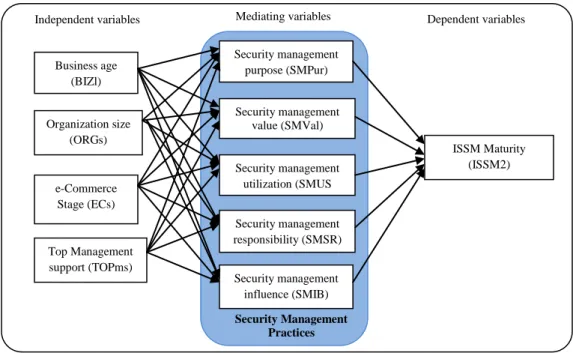
Rationally, researchers predict that what governs an ISSM are the SM practices involved in the business (ISO/IEC, 2008). Unfortunately, SM practices are insufficient to determine the factors achieve maturity. As organization characteristics lead to SM practices in a business (Werlinger et al., 2009, Kraemer et al., 2009, Dzazali et al., 2009), hence, organization characteristics and SM practices are inter-related in determining ISSM maturity. The ISSM maturity theoretical model defines the construct under these main relationships. The conceptual framework of the study is shown in figure 2.
Figure 2: ISSM Maturity conceptual framework
2.2 RESEARCH METHODOLOGY
The research carried out a quantitative investigation to predict the possible ISSM maturity factors based on the conceptual framework.
2.2.1 Population and Sample Business age (BIZl) Organization size (ORGs) e-Commerce Stage (ECs) Top Management support (TOPms) Security management purpose (SMPur) Security management value (SMVal) Security management utilization (SMUS Security management responsibility (SMSR) Security management influence (SMIB) ISSM Maturity (ISSM2) Security Management Practices
6
A mail survey was carried out to carefully selected SMI/Es following the criteria of the study. 130 companies were chosen from two different cases. These companies are micro SMI/Es who claimed to be involved with e-commerce activities related to their business. The 130 companies were given three weeks to complete and return the survey. A total number of 50 companies responded to the survey while the rest refused to participate or had left the business. Thus in total, 38.5% responded to the survey. As SMEs are small businesses, it was expected that there will be issues of business existence. The low return also agrees with (Kotulic and Clark, 2004) assertion that information security research is one of the most intrusive types of organization research.2.2.2 Measurement
A survey instrument was developed covering ten different ISSM issues in business. Business size, business type and business length are grouped in the demographic section and the remaining in 10 appropriate sections of the survey instrument. The subject matters are classified according to Technology (SM Usage, SM structure), Organization (SM Value, SM Purpose, SM Structure ) and Environment (SM Support, SM Influence, SM Barriers, SM Responsibility)
2.2.3 Measures of variables
A survey instrument was created constituting two sections. These two sections consist of sections 4 and 5 which require “Yes, No and Not applicable” answers. Sections 6 to 13 employ the 6-point Likert scale answers, ranging from 1=strongly agree to 5= strongly disagree and 6=Don’t know. The questionnaires were tested by 6 experts who are SM practitioners and academics. The team comprises a security management expert from the government sector, two security experts from the private sector, two academic researchers and a reviewer who indicated ambiguities and identified difficulties with the instrument. Modifications were made based on the expert suggestions. Validity and reliability of scale were tested in consistence with the traditional research process (Neuman, 2009). The reliability of instrument validity was achieved following the composite reliability and Cronbach’s Alpha reading using the PLS analysis.
3.0 Results
The data analysis was carried out using component base structural equation modelling (PLS-SEM) using the SmartPLS (Ringle et al., 2005) software.
3.1 PLS suitability
This technique was used because of the ability to predict a model for specific study (Urbach and Ahlemann, 2010). PLS allows simultaneous testing of relationships between constructs and measures the theoretical relationship among constructs (Kankanhalli et al., 2003). PLS is also able to handle formative and reflective constructs without any problems compared to covariance based structural equation modelling (CBSEM) (Hair et al., 2010, Urbach and Ahlemann, 2010). Finally, sample size for PLS power analysis is based on the largest number of predictors (Urbach and Ahlemann, 2010), thus it is insensitive to sample size consideration (Hair et al., 2010) compared to the CBSEM (Hair et al., 2011). Hence, PLS is the appropriate choice for three reasons. First, the study aims to predict and explore (Hair et al., 2011, Urbach and Ahlemann, 2010, Hair et al., 2010) possible ISSM Maturity Factors based on combined theoretical concepts. Secondly, the epistemic relationship of
7
the model consisted of both formative and reflective constructs (Urbach and Ahlemann, 2010, Hair et al., 2010) support the requirement of the study. Finally, the sample size was less than 100, which suits the number of predictors (Urbach and Ahlemann, 2010).3.2 PLS analysis model
Two analysis models are required in PLS; the measurement model assesses the validity and reliability of the measures towards the constructs while the structural model assesses the model effects and prediction quality.
3.2.1 Measurement model
The strength of the PLS measurement model is demonstrated through convergent and discriminant validity (Hair et al., 1998). Five constructs (top management support, ISSM maturity, communication structure, support-influence and usage-purpose-value) were assessed for convergent and discriminant validity because due to reflective indicators measured using perceptual questions (Kankanhalli et al., 2003). The assessment of the reflective model consists of three tests: (1) consistency reliability using composite reliability/Cronbach’s alpha, (2) discriminant validity using cross loadings and (3) convergence validity using Average Variance Extracted (AVE) which confirm the validity and reliability of the constructs. As displayed in table 2, all constructs show composite reliability above 0.8 indicating high internal reliability (Urbach and Ahlemann, 2010). The cross-loadings of an indicator of a specific construct are also higher than its cross-loadings on all other constructs. As for AVE, the results show all variance are above 0.5, suggesting adequate convergent validity (Baggozi and Yi 1988; Fornell & Larcker, 1981). The latent variance should also explain better its own variance compared to the other latent variance (Chin, 2010,1998) which is illustrated in Table 3.
3.2.2 PLS structural model
Once the measurement model has satisfied three important tests, the hypotheses of this study could be tested using the structural model. The structural model was assessed based on amount variance of endogenous latent variables (R2) of the model. The PLS results show R2 value for communication structure of 0.52, ISSM maturity of 0.55, influence and responsibility of 0.59 and value, purpose and usage of 0.42. According to Chin (1998b), R2 values around 0.333 to 0.67 have average explanatory power. The next evaluation for the structural model is conducted via bootstrapping to assess the path coefficient between the model LV’s (Urbach and Ahlemann, 2010). The path coefficient value (T-value) indicates the magnitude of relationship between two LV in the model. The T-value reading should exceed 0.100 (level of significance) to have a certain impact within the model (Huber et. al, 2007). Since the hypotheses correspond to one path, the negative and positive values of ß determine whether the hypotheses are supported or otherwise. Following table 4 indicates the supported and non-supported hypothesis. H4 is supported as all t-values exceed 0.1. H4 are significant at p>0.01 with the ß > 0.5. H8 has t-value above the significant level but the ß reading is – 0.727 (thus H8 has a negative relation with ISSM maturity)
Table 2: Evaluation of measurement
Construct Items Loadings AVE Composite Reliability Cronbachs Alpha
8
EC Stage ecS 1
ORG Size ORGs 1
Top Management TM2 0.737 0.548 0.879 0.835 TM3 0.738 TM4 0.766 TM5 0.810 TM6 0.720 TM7 0.661 Support-Influence SMI10 0.865 0.559 0.882 0.838 SMI11 0.626 SMI7 0.804 SMS11 0.608 SMS6 0.728 SMS9 0.618
ISSM Maturity SMpos1 0.662 0.502 0.909 0.890 SMpos14 0.716 SMpos18 0.674 SMpos2 0.659 SMpos21 0.666 SMpos30 0.704 SMpos4 0.695 SMpos5 0.830 SMpos6 0.757 SMpos8 0.703
Communication Structure SMUS10 0.799 0.527 0.845 0.769 SMUS12 0.583 SMUS3 0.856 SMUS7 0.635 SMUS9 0.721 Value-Purpose-Usage SMPur3 0.712 0.517 0.950 0.946 SMPur4 0.746 SMPur8 0.680 SMUU1 0.632 SMUU11 0.636 SMUU13 0.773 SMUU4 0.642 SMUU5 0.741 SMUU7 0.785 SMUU8 0.653 SMUU9 0.708 SMVal1 0.753 SMVal2 0.838 SMVal3 0.744 SMVal4 0.723 SMVal6 0.711 SMVal8 0.712 SMVal9 0.715
Table 3: Latent Variable Correlations
BIZ Length Communication Structure EC Stage ISSM Maturity ORG Size Support- Influence-Responsibility Top Management Value- Purpose-Usage BIZ Length 1.000 Communication Structure 0.074 0.527 EC Stage 0.000 0.010 1.000 ISSM Maturity 0.036 0.024 0.468 0.502 ORG Size 0.306 0.017 0.166 0.009 1.000 Support-Influence-Responsibility 0.012 0.299 0.043 0.042 0.007 0.556 Top Management 0.021 0.501 0.019 0.024 0.010 0.541 0.547 Value-Purpose-Usage 0.119 0.429 0.009 0.079 0.041 0.256 0.347 0.517 Note: Diagonals representing the AVE while the off-diagonals represent the squared correlations
Table 4: Result of hypothesis
9
BIZ Length -> Communication Structure H1 0.206 0.186 1.105 Not SupportedBIZ Length -> Support-Influence H1 0.080 0.123 0.655 Not Supported BIZ Length -> Value-Purpose-Usage H1 0.257 0.214 1.201 Not Supported ORG Size -> Communication Structure H2 -0.004 0.240 0.018 Not Supported ORG Size -> Support-Influence H2 -0.154 0.139 1.107 Not Supported ORG Size -> Value-Purpose-Usage H2 0.054 0.210 0.259 Not Supported EC Stage -> Communication Structure H3 -0.029 0.156 0.189 Not Supported EC Stage -> Support-Influence H3 -0.017 0.130 0.128 Not Supported EC Stage -> Value-Purpose-Usage H3 -0.062 0.174 0.356 Not Supported Top Management -> Communication Structure H4 0.662 0.096 6.925** Supported Top Management -> Support-Influence H4 0.705 0.087 8.136** Supported Top Management -> Value-Purpose-Usage H4 0.540 0.119 4.527** Supported Support-Influence -> ISSM Maturity H5 0.031 0.185 0.165 Not Supported Communication Structure -> ISSM Maturity H5 -0.044 0.228 0.192 Not Supported Value-Purpose-Usage -> ISSM Maturity H5 0.249 0.223 1.114 Not Supported BIZ Length -> ISSM Maturity H6 0.061 0.229 0.268 Not Supported ORG Size -> ISSM Maturity H7 0.131 0.214 0.612 Not Supported EC Stage -> ISSM Maturity H8 -0.727 0.133 5.471** Not Supported Top Management -> ISSM Maturity H9 -0.124 0.238 0.524 Not Supported Note: **p<0.01, *p<0.05, *p<0.1
4.0 DISCUSSION
The predicted model is empirically tested. The key discussion is discussed below together with future research directions.
4.1 ISSM Maturity
SM practices (inclusive of the SM usage, SM purpose and value, SM support SM responsibility and SM communication) are not found to be contributing factors to ISSM maturity. (Siponen, 2002), defines current many SM practices as technically oriented. Organization has misinterpreted SM as technically oriented procedure without involving socio-issues. The SM practices of a business must also consider business requirements to guarantee ISSM maturity. Socio-technical issues surrounding ISSM maturity must be considered to ensure a thorough and effective ISSM in a business. Thus, ISSM maturity should not be assessed by examining SM practices only but also to consider the organization, environmental and technological influence.
4.2 Organizational factors
Organizational factors (Ein-Dor and Segev, 1978) have been used by various scholars to assess effectiveness in IS. The same organizational factors are also used to assess ISSM maturity. All factors do not contribute to the maturity of ISSM except for e-commerce stages (business type), which has a negative relationship with ISSM maturity. However, the negative relationship was predicted by the empirical model tested in PLS. There are probable reasons for this. Firstly, the volatile stage of e-commerce requires ever-changing needs for IS processes (Duane et al., 1999), thus ISSM maturity may not be easily achieved. Secondly, the option of outsourcing e-commerce function to a trusted third party may pose a serious problem to a business.
10
The organizational factors show no contributing factors towards SM practices in this study context except for top management support. Similarly, the issues of business type and business size may not be vital. The research has in some ways defined the business size thus no clear relationship could be tested using this model (Yildirim et al., 2011, Werlinger et al., 2009) . SMI/E e-commerce renders two types of businesses which are services and products. As these two types do not involve heavily transacted e-commerce (Kankanhalli et al., 2003), the relationship could not be assessed appropriately, hence the hypothesis is not supported in this research.4.3 Business length
Although time is of essence in achieving maturity (Prananto et al., 2003b, Prananto et al., 2003a), business length has not shown a positive relationship for ISSM maturity. As technology keeps changing, security implementation and practices have to complement the technology. Thus, achieving maturity through time may become a stressful task. Business has to be volatile and ever-changing to keep pace with SM practices.
5.0 CONCLUSION
As the results of the study were generated based on respondents of a specific business context, generalization of the results must be made with the greatest care. The context involved in this study is focused on issues faced by the e-commerce SMI/E. This research uses PLS to predict the important indicators influencing the ISSM maturity of e-commerce SMI/E in Malaysia. The model predicted a negative influence of the e-commerce stage of a business towards achieving ISSM maturity. Remaining independent variables show no support towards ISSM maturity. In sum, this study predicts the factors influencing ISSM maturity using the theoretically developed and empirically tested model. It assesses the relationship between organizational structure and SM practices that fosters ISSM maturity. Although many of the relationships are not supported, there are vital findings regarding this tested model. These provide the impetus for further research and add to much needed research in the SM field of IS (Kankanhalli et al., 2003, Siponen et al., 2008, Siponen, 2002).
The sequence to this research looks at the qualitative investigation with the objective to understand in-depth view of the socio-technical elements influencing of ISSM maturity towards an organization. The participants are selected from the previous quantitative research investigations. The qualitative investigation will investigate in-depth issues which may correspond to the ISSM maturity dynamics in the focus research context, using a semi-structured interview method. This complementary method is adopted to ensure major issues are collated and discussed according to the analysed theoretical perspectives.
6.0 ACKNOWLEDGEMENTS
The researchers would like to acknowledge University of Malaya, Malaysia for the Postgraduate Program Grant 2009/2010 in supporting this research.
7.0 REFERENCES
ACEITUNO, V. 2006. ISM3: A Standard for Information Security Management. ISSA Journal, October 2006, 22-25.
AGARWAL, R. & PRASAD, J. 1998. A Conceptual and Operational Definition of Personal Innovativeness in the Domain of Information Technology. Information Systems Research, 9, 204-215.
11
ARIS, N. M. 2006. SMEs: Building Blocks for Economic Growth. National Statistics Conference. Malaysia:Department of Statistics, Malaysia.
BARLETTE, Y. & FORMIN, V. V. Exploring Suitability of IS Security Management Standards for SMEs. 41st Hawaii International Conference on Systems Sciences, 2008 Hawaii. IEEE.
BNM, B. N. M. 2005. Status and Performance of Small and Medium Enterprises. Kuala Lumpur: Bank Negara Malaysia (BNM).
CARNEGIE-MELLON, U. 1999. Systems Security Engineering Capability Maturity Model (SSE-CMM) Model
Description Document Version 3.0 [Online]. Available:
http://www.sse-cmm.org/docs/ssecmmv3final.pdf [Accessed 18 October 2011].
CHANG, S. E. & HO, C. B. 2006. Organizational factors to the effectiveness of implementing information security management. Industrial Management & Data Systems, 106, 345-361.
DELONE, W. H. & MCLEAN, E. R. 1992. Information Systems Success: The Quest for Dependent Variable.
Information Systems Research, 3, 60-95.
DUANE, P. T., RICHARD, B. & HEINZ, K. 1999. Growing systems in emergent organizations. Commun. ACM, 42, 117-123.
DZAZALI, S., SULAIMAN, A. & ZOLAIT, A. H. 2009. Information security landscape and maturity level: Case study of Malaysian Public Service (MPS) organizations. Government Information Quarterly, 26, 584-593.
EIN-DOR, P. & SEGEV, E. 1978. Organizational Context and the Success of Management Information Systems. Management Science, 24 1064-1077.
FOMIN, V. V., VRIES, H. J. D. & BARLETTE, Y. ISO/IEC 27001 Information Systems Security Management Standard: Exploring The Reasons For Low Adoption. EUROMOT 2008 Conference, 2008 Nice, France.: RSM Erasmus University.
GILLIES, A. 2011. Improving the Quality of Information Security Management Systems with ISO27000. The
TQM Journal, 23, 367-376.
HAIR, J. F., RINGLE, C. M. & SARSTEDT, M. 2011. PLS-SEM: Indeed a Silver Bullet. Journal of Marketing
Theory and Practices, 19, 139-151.
HAIR, J. H., BLACK, W., BABIN, B. J. & ANDERSON, R. E. 2010. Multivariate Data Analysis, New Jersey, USA, Pearson Education, Inc.
ISF, I. S. F. 2003. The Standard of Good Practices for Information Security. USA: Information Security Forum ISF.
ISO/IEC 2008. Corporate Governance of Information Technology. ISO/IEC 38500. Switzerland: ISO.
KANKANHALLI, A., TEO, H.-H., TAN, B. C. Y. & WEI, K.-K. 2003. An integrative study of information systems security effectiveness. International Journal of Information Management, 23, 139-154. KOTULIC, A. G. & CLARK, J. G. 2004. Why there aren't more information security researches studies.
Information & Management, 41, 597-607.
KRAEMER, S., CARAYON, P. & CLEM, J. 2009. Human and organizational factors in computer and information security: Pathways to vulnerabilities. Computer & Security, 28, 509-520.
MATTOON, S., HENSLE, B. & BATY, J. 2011. Cloud Computing Maturity Model Guiding Success with Cloud Capabilities. California, USA: Oracle Corporation.
MELENOVSKY, M. J. & SINUR, J. 2006. BPM Maturity Model Identifies Six Phases for Successful BPM Adoption. Stamford, USA: Gartner.
MONFELT, Y., PILEMALM, S., HALLBERG, J. & YNGSTRÖM, L. 2011. The 14-layered Framework for Including Social and Organizational Aspects in Security Management. Information Management &
Computer Security, 19, 124-133.
MURINE, G. E. & C.L. (SKIP) CARPENTER, J. 1984. Measuring Computer System Security Using Software Security Metrics. In: FINCH, J. H. & DOUGALL, E. G. (eds.) Computer Security: A Global
Challenge. North-Holland: Elsevier Science Publisher B.V.
NEUMAN, W. L. 2009. Understanding Research, United States of America, Pearson Education.
NORMAN, A. A. & YASIN, N. M. Information Systems Security Management (ISSM) Success Factors: Retrospection from the Scholars. 11th European Conference on Information Warfare and Security ECIW-2012, 2012 Laval, France. Academic Conference International (ACI).
OZKAN, S. & KARABACAK, B. 2010. Collaborative risk method for information security management practices: A case context within Turkey. International Journal of Information Management, 30, 567-572.
PRANANTO, A., MCKAY, J. & MARSHALL, P. The Spectrum of e-Business Maturity in Australian SMEs: A Multiple Case Study Approach to the Applicability of the Stages of Growth for e-Business Model. In:
CIBORRA, C. U., MERCURIO, R., MARCO, M. D., MARTINEZ, M. & CARIGNANI, A., eds. 11th European Conference on Information Systems (ECIS) 2003, 16-21 June 2003 2003a Naples, Italy AIS.
12
PRANANTO, A., MCKAY, J. & MARSHALL, P. A study of the progression of e-business maturity in Australian SMEs: Some evidence of the applicability of the stages of growth for e-business model. 7th Pacific Asia Conference on Information Systems, 10-13 July 2003 2003b Adelaide, South Australia. AIS, 68-80.RINGLE, C. M., WENDE, S. & WILL, A. 2005. SmartPLS. 2.0 (beta) ed.: SmartPLS. ROGERS, E. M. 1983. Diffusion of Innovation 3rd Edition, Macmillan Publishing Co., Inc.
SIPONEN, M. 2002. Towards maturity of information security maturity criteria: six lessons learned from software maturity criteria. Emerald Journal, 10, 210 - 224
SIPONEN, M. 2005. An analysis of the traditional IS security approaches: implications for research and practice. European Journal of Information Systems, 14, 303-315.
SIPONEN, M. 2006. Information security standards focus on the existence of process, not its content. Commun. ACM, 49, 97-100.
SIPONEN, M. & WILLISON, R. 2009. Information Security Management Standards: Problems and Solutions.
Information & Management, 46, 267-270.
SIPONEN, M., WILLISON, R. & BASKERVILLE, R. Power and Practice in Information Systems Security Reserach. Twenty Ninth International Conference on Information Systems 2008 Paris. AIS Electronic Libary (AISeL), 1-12.
STRAUB, D. W. 1990. Effective IS security: An empirical study. Information Systems Research 1, 255-276. TORNATZKY, L. G. & FLEISHER, M. 1990. The Process of Technological Innovation, United States,
Lexington Books.
URBACH, N. & AHLEMANN, F. 2010. Structural Equation Modeling in Information Systems Research Using Partial Least Squares. Journal of Information Technology Theory and Application, 11, 5-40.
WERLINGER, R., HAWKEY, K. & BEZNOSOV, K. 2009. An Integrated View of Human, Organizational and Technological Challenges of IT Security Management. Information Management & Computer Security, 17, 4-19.
YILDIRIM, E. Y., AKALP, G., AYTAC, S. & BAYRAM, N. 2011. Factors Influencing Information Security Management in Small- and Medium Sized Enterprises: A Case Study from Turkey International
Journal of Information Management, 31, 360-365.
ZHUANG, Y. & LEDERER, A. L. 2004. The Impact of Top Management Commitment, Business Process Redesign, and IT Planning on the Business-to-Consumer E-Commerce Site. Electronic Commerce
Research, 4, 315-333.
ZUCCATO, A. 2007. Holistic security management framework applied in electronic commerce. Computers & Security, 26, 256-265.
13
Name: Azah Anir NormanAcademic and scientific degrees: Maters in e-Commerce security, Royal Holloway University of London. Currently is in the final stage of PhD studies in University of Malaya.
Full title of your position: Lecturer
Full name of the institution/organization: Department of Information Systems, Faculty of Computer Science and Information Technology, University of Malaya
Office addresses: Department of Information System, Faculty of Computer Science and Information Technology, University of Malaya, 50603 Kuala Lumpur Malaysia
Telephone numbers: +603-79676372 E-mails: [email protected]
Key scientific interests: e-commerce, security, entrepreneurship and ICT Policies (ICT policies, ICT
governance, ICT security, ICT audit)
Name: Norizan Mohd Yasin
Academic and scientific degrees: PhD from University of Manchester, United Kingdom Full title of your position: Senior Lecturer
Full name of the institution/organization
Full name of the institution/organization: Department of Information System, Faculty of Computer Science and Information Technology, University of Malaya
Office addresses: Department of Information Systems, Faculty of Computer Science and Information Technology, University of Malaya, 50603 Kuala Lumpur Malaysia
Telephone numbers: +603-79676353 E-mails: [email protected]
Key scientific interests: Management Information System (Customer Relationship Management (CRM), Decision Support System (Knowledge Management), Decision Support System (Data Mining), Management Information System (Enterprise Resource Planning (ERP) systems), Commerce (Commerce),
E-Government (Electronic E-Government), Management Information System (System design), Management Information System (Distributed Data Processing), ICT Policies (ICT policies, ICT governance, ICT security,