Does it go without saying?
Mathematical thinking in whole class discourse
This thesis is submitted for the degree o f Doctor o f Philosophy
Siún Eithne NicMhuiri
Supervisor: Dr. Dolores Corcoran
St. Patrick’s College 2012
I hereby certify that this material, which I now submit for assessment on the programme o f study leading to the award of Doctor o f Philosophy is entirely my own work and has not been taken from the work of others save and to the extent that such work has been cited and
acknowledged within the text of my work.
Undertaking a PhD is a long process which is demanding on many levels. My sources of support and inspiration have been many. Firstly, I would like to thank my supervisor Dr Dolores Corcoran who treated me as an equal long before I could have hoped to deserve that privilege. Her unfailing enthusiasm sustained and encouraged me throughout the research process. I am also grateful to Dr Thérèse Dooley who provided many words o f wisdom, support and encouragement along the way.
There would be no research to report were it not for the Boards o f Management that granted me permission to access schools and the teachers, students and parents who consented to my research. I am grateful to all o f these people. Much o f the depth o f this research comes from the teaching experiment I carried out in my own classroom. This would not have been possible without the support o f the Board o f Management, parents and students and o f the different principals I served under during the course o f the research. I am thankful to my current principal and Board o f Management who also granted me leave to allow me finish my thesis. It is to my students that I perhaps owe the biggest debt o f gratitude. It is possible that I learned more from them than they ever did from me and I am grateful for their honest,
genuine engagement. I am also grateful to the Teaching Council who recognised the potential o f this research and eased some o f the financial pressures o f undertaking it when they granted me a bursary.
I must finally acknowledge colleagues, friends and family whose friendship supported and encouraged me. Distraction is a powerful motivator and looking forward to my ‘breaks’ with you motivated and reenergised me more than you realise. Also to Joey, the first professor and source o f inspiration. A special word o f thanks to Mum and Andy for proof-reading,
constructive advice and support. Also to Jôrg for his practical support, understanding and patience.
T A B L E O F C O N T E N T S
DECLARATION... ii
ACKNOWLEDGEMENTS... iii
LIST OF FIG U R ES... ix
LIST OF TABLES... xi
LIST OF APPENDICES... xiii
LIST OF ABBREVIATIONS...xv
TRANSCRIPT CONVENTIONS... xvi
ABSTRACT...xvii
C H A PT E R 1. CO N TEX T AND R A T IO N A L E ...1
INTRODUCTION... 1
THE ROLE OF MATHEMATICS ÏN TODAY’S SOCIETY ... 2
Mathematics and the Knowledge Economy... 2
Mathematics and Democracy...3
Creative Mathematics and Higher Order S k ills...4
MATHEMATICS AS A DISCIPLINE, IN EVERYDAY AND SCHOOL MATHEM ATICS... 5
My Experience o f the Discipline o f Mathematics...5
Mathematics in everyday Life...6
Differences between Mathematics as a Discipline and School Mathematics: the Traditional A pproach...6
The Situation in Irish Mathematics Classroom s...7
Reports o f Mathematics Achievement... 8
M ed ia... 8
Programme for International Student Assessment (P IS A )... 9
National Assessments o f Mathematics Achievement (N A M A /N A )...10
Mathematics Achievement in Schools Designated as Disadvantaged...12
DES Response... 15 OUTLINE OF RESEARCH... 16 OVERVIEW OF T H E S IS ...17 2. LITE R A T U R E R E V IE W ...18 INTRODUCTION... 18 W HAT IS MATHEMATICS?... 18
Moving towards Fallibilism... 18
Centrality o f D iscourse...19
R efo rm ...19
Mathematics as Progressive Discourse... 20
THEORIES OF MATHEMATICAL LEARNING...24
Constructivism ...25
S ocioculturalism...25
The Mathematical Aspects o f Mathematical Learning...28
Relational and Structural Understanding... 28
The Process o f Reification... 29
Mathématisation... 31
THE LITERATURE OF MATHEMATICS EDUCATION AND THE CLASSROOM TEACHER...32
The Role o f the Teacher in Educational Research...33
Dissemination o f and access to research... 33
The difference a preposition makes: research by, with and on teachers... 36
The Research answers a Teacher’s Question... 39
Reform context...39
How do I facilitate a mathematical discourse community in my classroom? ... 42
Approaches with similarities to the discourse com m unity...56
MY RESEARCH IN RELATION TO THESE ISSUES... 57
3. M E T H O D O L O G Y ... 59
INTRODUCTION... 59
M ETHODOLOGY... 59
Perspective...59
Conceptual Fram ework... 61
Participation trajectories...61
Communities o f practice and identity... 63
Learning as transformation o f participation in social practices... 65
The conception o f learning in this research...66
Design research...67
Design for learning... 71
Research Questions...74
Influence o f the conceptual fram ew ork... 75
M ETHODS... 75
Data Collection Procedures... 76
Stage 1...76
Stage 2 ...79
Framework for Analysis... 85
Math talk learning community (MTLC) framework...86
W enger’s trajectories o f identity...96
Key practices o f a discourse com m unity... 96
Steps in A nalysis... 97
A note on the transcription process...97
Stage 1 d a ta ... 98
Stage 2 d a ta ... 99
Questions o f V alidity...105
Representation o f Self in Research... 107
SUMMARY... 109
4. TH E L IE O F T H E LA N D ...110
RECORDING 1: JOHN’S LESSON... 110
Dienes’ B locks... 110
Descriptive Synopsis...111
Discourse Community analysis...113
Questioning... 113
Explaining mathematical thinking, source o f mathematical ideas and responsibility for learning... 114
Discussion ...124
Discourse in this C om m unity...126
RECORDING 2: LIA M ’S LESSON... 127
Descriptive Synopsis...127
D iscussion...129
Discourse in this Community...130
A Note on Achievement Levels... 131
RECORDINGS 3A AND 3B: ANNE’S L E SSO N S... 133
Descriptive Synopsis o f Anne’s First L esson... 133
Discourse Community Analysis...135
Questioning... 135
Explaining mathematical thinking, source o f mathematical ideas and responsibility for learning... 138
D iscussion... 143
Discourse in this Community...144
RECORDINGS 4A AND 4B: JOAN’S LESSO N S...145
Descriptive Synopsis o f Joan’s First Lesson... 145
Discourse Community Analysis...147
Questioning... 147
Explaining mathematical thinking, source o f mathematical ideas and responsibility for learning... 149
D iscussion... 156
Discourse in this Community... 157
THE ‘RU DE’ APPROACH TO PROBLEM SO LVING... 157
LIMITS OF STAGE 1 RESEARCH...161
SUMMARY... 161
5. TEA C H IN G EX PER IM EN T LESSONS...164
INTRODUCTION... 164
CLASSROOM C O N TEX T... 164
RECORDING 1: CUTTING PIZZAS... 166
Descriptive Synopsis...166
D iscussion... 170
Discourse in this Recording... 172
RECORDING 2: FRACTION PROBLEMS...172
Descriptive Synopsis...172
Discourse Community A nalysis...176
Q uestioning... 176
Explaining mathematical thinking... 179
Source o f mathematical ideas and responsibility for learning...180
D iscussion... 189
Discourse in this Recording... 190
Descriptive Synopsis... 191
D iscussion...195
Discourse in this Recording...196
RECORDING 4: EQUIVALENCE CHALLENGE...197
Descriptive Synopsis...197
Discourse Community A nalysis... 201
Questioning... 201
Explaining mathematical thinking... 206
Source o f mathematical ideas and responsibility for learning...207
D iscussion... 212
Discourse in this Recording...213
RECORDING 5: PERCENTAGE PRESENT AND A B S E N T ... 214
Descriptive Synopsis... 214
Discussion... 217
Discourse in this Recording...218
SUMMARY...219
6. TH E NATURE O F TEA CH IN G AND LEA RN IN G IN O U R FL ED G LIN G M A T H EM A TIC A L DISCOURSE C O M M U N IT Y ...221
INTRODUCTION...221
PARTICIPATION TRAJECTORIES OF STUDENTS...221
Higher A chievers... 222 Darragh... 222 Anthony... 223 Middle A chievers... 224 Jake...224 Jo h n ...225 Lower A chievers...226 K evin...226 Steven...227 J ared ...230 Discussion...231
QUESTIONS OF MATHEMATICS AND TEACHING ARISING FROM THE EXPERIM ENT... 233
How should a balance be arranged between cognitively demanding and routine tasks?... 233
Routine and complexity, order and disorder... 234
Did the activities o f high cognitive demand or the discourse focussed approach foster the disengagement o f some pupils?... 236
Does this teaching approach disadvantage lower achievers?...238
Initial concerns... 238
Refocusing the lens - the bigger picture...240
Negotiation... 243
Coherence... 244
Summ ary... 247
OVERARCHING QUESTIONS...250
What is the role o f teacher talk in reform m athem atics?... 250
A note on the refinement o f my design for learning... 255
What is the role o f instrumental understanding in learning m athem atics?... 255
7. T H E PA R T IC IPA T IO N TR A JEC TO R Y O F TH E TEA C H ER
R E SE A R C H E R ... 260
INTRODUCTION... 260
CHARTING MY PARTICIPATION TRA JECTO RY...260
Mathematical and Teaching Background...260
The Teaching Experim ent... 263
Ethics... 263
Identity... 264
LOCATING THIS RESEARCH...269
8. SUM MARY AND C O N C LU SIO N S...270
INTRODUCTION... 270
SUMMARY OF STAGE 1...270
Answering the Research Question...271
Directions for Further Study... !...272
SUMMARY OF STAGE 2 ... 273
MTLC Analysis...274
Questioning ... 274
The remaining components: EMT, SMI, R FL ...277
Comparisons with stage 1 data... 278
Student Participation Trajectory A nalysis...280
Identification o f Issues and Tensions involved in facilitating a Discourse Community...2 8 1 Teacher-Researcher Participation Trajectory analysis...283
Answering the Research Q uestions...284
Underlying aspects o f a critical approach... 287
Conflicts with Democratic Research Practice... 288
V A LID ITY ...289
VALUE OF THIS RESEARCH... 289
DIRECTIONS FOR FURTHER STUDIES... 290
Further possibilities for the exploration o f the discourse community approach 291 Opportunities for Professional Development and Teacher Education...292
Research on Textbooks and Support Materials... 293
FINAL W O R D S... 294
R E FE R E N C E S... 295
Figure 4.1 Figure 4.2 Figure 4.3 Figure 4.4 Figure 4.5 Figure 4.6 Figure 4.7 Figure 4.8 Figure 5.1 Figure 5.2 Figure 5.3 Figure 5.4 Figure 5.5 Figure 5.6 Figure 5.7 Figure 5.8 Figure 5.9 Figure 5.10
Dienes’ materials used to represent whole-number values.
Mathemagic 4, page 58 (Barry, Manning, O ’Neill & Roche, 2002) Types and percentages o f teacher questions in John’s lesson according to Boaler and Brodie (2004) question categories.
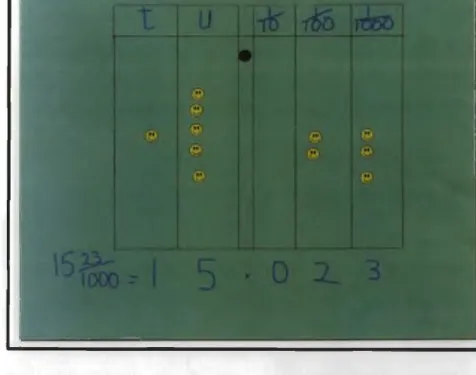
Mathemagic 4, page 85. (Barry, Manning, O ’Neill & Roche, 2002). Notation board used to represent decimal numbers on the interactive whiteboard in Anne’s second lesson.
Types and percentages o f teacher questions in Anne’s lessons according to Boaler and Brodie (2004) question categories. Sample o f fraction identification task used on the interactive whiteboard in Joan’s first lesson.
Types and percentages o f teacher questions in Joan’s lessons according to Boaler and Brodie (2004) question categories.
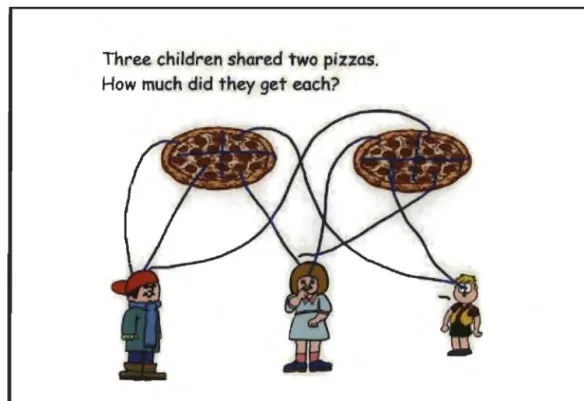
Michael’s solution to the first pizza sharing task in the Cutting Pizzas
lesson.
Board work arising from the discussion o f how to share pizzas in the
Cutting Pizzas lesson.
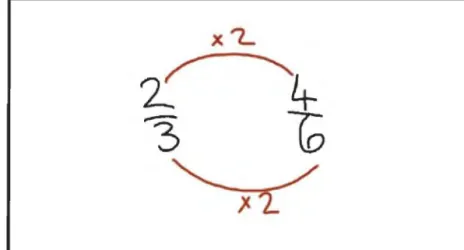
The multiplicative pattern between two-third and four-sixth. A lex’s solution to sharing three pizzas between four people. Task involving sharing 100cm o f ribbon between four people. Task involving finding common fractions o f 1km.
The diagram that accompanied Alex’s explanation o f why - is smaller than
2
The diagram that accompanied Alan’s explanation o f why ^ is smaller than -.
2
Types and percentages of teacher questions in Fraction Problems
lesson according to Boaler and Brodie (2004) question categories. Dienes’ materials used to represent decimal fractions.
Figure 5.11 Figure 5.12 Figure 5.13 Figure 5.14 Figure 5.15 Figure 5.16 Figure 6.1
Darragh’s poster showing common traction and decimal equivalences. The first equivalence challenge task.
‘Find the odd one out.5 Fractions, decimals, percentage equivalence challenge.
Types and percentages o f teacher questions in the Equivalence Challenge lesson according to Boaler and Brodie (2004) question categories.
Task presented to students about the fraction and percentage correct in a spellings test.
Task presented to students about the fraction and percentage present and absent.
Managing tensions as a feature o f facilitating the active engagement of all students in a mathematical discourse community.
Table 3.1 Table 3.2 Table 3.3 Table 3.4 Table 3.5 Table 3.6 Table 3.7 Table 3.8 Table 3.9 Table 4.1 Table 4.2 Table 4.3 Table 4.4 Table 4.5 Table 4.6 Table 4.7 T able 2.1 LIST O F TABLES
Overview o f the levels o f the Math Talk Learning Community (MTLC) framework.
Teacher and student actions at levels 2 and 3 o f the MTLC framework. Overview of recordings collected at stage 1 by school, teachers, class, lesson, topic and recording length.
Overview of research by stages, details o f data and o f analysis.
Levels of the MTLC framework for questioning: Action trajectories for teacher and students.
Boaler and Brodie’s categories o f teacher questions with descriptions and examples.
Levels of the MTLC framework for explaining mathematical thinking: Action trajectories for teacher and students.
Levels o f the MTLC framework for source o f mathematical ideas: Action trajectories for teacher and students.
Levels o f the MTLC framework for responsibility for learning: Action trajectories for teacher and students.
Stage 2 recordings analysed using the MTLC framework by
mathematics topic, date recorded, length, brief description and points o f interest.
Analysis o f teacher questions in John’s lessons by type and number with examples.
Analysis of student questions in John’s lesson by type and number. Summary descriptions of MTLC framework components in John’s lesson.
Summary descriptions of MTLC framework components in Liam’s lesson.
Analysis of teacher questions in Anne’s lessons by type and number with examples.
Analysis of student questions in Anne’s lessons by type and number. Summary descriptions of MTLC framework components in Anne’s lesson.
Table 4.8 Table 4.9 Table 5.1 Table 5.2 Table 5.3 Table 5.4 Table 5.5 Table 5.6 Table 5.7 Table 5.8 Table 5.9
Analysis of teacher questions in Joan’s lessons by type and number with examples.
Summary descriptions o f MTLC framework components in Anne’s lesson.
Summary descriptions o f MTLC framework components in the Cutting Pizzas lesson.
Analysis o f teacher questions in the Fraction Problems lessons by type and number with examples.
Analysis of student questions in Fraction Problems lesson by type and number.
Summary descriptions of MTLC framework components in the
Fractions Problems lesson.
Summary descriptions o f MTLC framework components in the
Dienes ’ Decimals lesson.
Analysis of teacher questions in the Equivalence Challenge lesson by type and number with examples.
Analysis o f student questions in Equivalence Challenge lesson by type and number.
Summary descriptions of MTLC framework components in the
Equivalence Challenge lesson.
Summary descriptions of MTLC framework components in the
1. Letter to principals (stage 1).
2. Plain language statement for teachers (stage 1).
3. Plain language statement to be read to students (stage 1). 4. Plain language statement for students (stage 1).
5. Consent form for students (stage 1).
6 . Plain language statement for parents (stage 1). 7. Consent form for parents (stage 1).
8. List and details o f recordings and transcriptions collected at stage 2 by date recorded, lesson topic, recording length, other data collected.
9. Letter to principal and Board o f Management (stage 2). 10. Plain language statement to be read to students (stage 2). 11. Plain language statement for students (stage 2).
12. Consent form for students (stage 2).
13. Plain language statement for parents (stage 2). 14. Consent form for parents (stage 2).
15. List o f stage 2 transcripts o f recordings by date, lesson, topic, recording length and additional data.
16. Analysis o f teacher questions in the Cutting Pizzas lesson by type and number with examples.
17. Analysis o f student questions in the Cutting Pizzas lesson by type and number with examples.
18. Teacher designed worksheet that students completed in pairs prior to the Fractions problems recording.
19. Analysis o f teacher questions in the Dienes ’ Decimals lesson by type and number with examples.
20. Analysis o f student questions in the D iem s ’ Decimals lesson by type and number with examples.
21. Analysis o f teacher questions in the Percentage Present and Absent lesson by type and number with examples.
22. Analysis o f student questions in the Percentage Present and Absent lesson by type and number with examples.
23. Board work from 3/3/11 (transcript 11) showing a word problem and Steven’s incorrect solution attempt in bottom left comer.
L ist o f A b b rev iatio n s
CAO Central Applications office
CPD Continuous Professional Development CR Collaborative Reasoning
DES Department o f Education and Skills
DEIS Delivering Equality of Opportunity in Schools EMT Explaining Mathematical Thinking
IRE Invitation, Response, Evaluation
LANDS Literacy and Numeracy in Disadvantaged Schools
NA National Assessment o f Mathematics and English Reading NAMA National Assessment of Mathematics Achievement
NCCA National Council for Curriculum and Assessment NCTM National Council ofTeachers ofM athematics (US) NUI National University o f Ireland
OECD Organisation for Economic Co-operation and Development PDST Professional Development Service for Teachers
PGCE Postgraduate Certificate in Education
PISA Programme for International Student Assessment RFL Responsibility for Learning
RME Realistic Mathematics Education RUDE Read, Underline, Draw, Estimate SES Socioeconomic status
SMI Source o f Mathematical Ideas
These conventions were based on Dooley (2010).
A pause or hesitation shorter than three seconds [... ] A pause longer than three seconds
( ) Inaudible speech
(word) Speech that was difficult to hear exactly but likely to be as transcribed [ ] Lines omitted from the presentation o f the transcript based on perceived
irrelevance o f content.
// Encloses overlapping utterances.
(word) Brackets contain the researcher’s/transcriber’s comments.
Teacher The teacher/researcher (myself).
Student A student that I could not identify. In all other cases pseudonyms are used. Students Two or more students speaking at the same time.
Word- Indicates interruption by another speaker
A bstract
My research examines the role of mathematical thinking in whole class discourse. Initially a study exploring the nature o f discourse in some Irish primary mathematics classes was carried out. Six recordings of mathematics lessons from four different teachers were analysed using the Math Talk Learning Community framework (Huffed-Ackles, Fuson & Sherin, 2004) and Boaler and Brodie’s (2004) teacher question categories. Student thinking shared in whole class discourse in these lessons seemed to be limited by the teachers’ central role as evaluative authority and source of mathematical ideas.
The aim o f the second stage o f my research was to create a discourse community in my own classroom. This involved positioning students as mathematical authorities capable of
evaluating mathematical thinking. It was envisaged that the resulting classroom discourse would be progressive and mirror discourse at domain level (Bereiter, 1994). Thirty-one recordings on fractions, decimals and percentage topics were collected, fourteen o f which were transcribed. Five o f these lessons were analysed in the same m anner as at stage 1. This analysis showed that student thinking became an object o f discussion in the teaching
experiment lessons as students commented on and evaluated the thinking o f their peers. The participation trajectories (Dreier, 1999; 2009) o f ten students were tracked across the fourteen transcribed lessons with a view to documenting students’ use o f discourse community
practices such as explaining and justifying thinking, or disagreeing with previous
contributors. Despite initial concerns over the participation o f lower achievers, this analysis showed that all students participated in the practices o f the discourse community to some extent. However it also highlighted differences in the nature o f the experience for different individuals. 1 also interrogated my own experience as teacher-researcher to investigate the issues involved in facilitating a discourse community. This analysis suggested that many of the dilemmas experienced by the teacher are managed rather than resolved (Lampert, 1985).
‘May you live in interesting tim es.’
Chinese Curse (origin contested). The origin and authenticity o f this Chinese curse cannot be verified but the sentiment it expresses, o f a man cursed to live in changeable times, seems an apt way to begin. Whether it is a blessing or a curse, these are interesting, changeable times and it is an exciting, if daunting, time both in Ireland and beyond, to undertake research in mathematics education. Change is occurring in many places at many levels, some o f it voluntary and some forced by economic circumstance or institutional reform. From an economic perspective, the recession has led many people to question Ireland’s future as a knowledge-based economy, that is an economy that uses information or technology to create jobs. Such questions often focus on the nature o f mathematics teaching and learning and link mathematics education to
employment opportunities and financial concerns. Another influence o f the recession on the educational sector in Ireland is the reduction in capitation grants and loss o f allowances for teachers who complete Masters or PhD programmes. These constraints stand in contrast to the reform effort that is occurring at second level with the phased introduction o f Project Maths, which began nationally in September 2010 (www.projectmaths.ie). Project Maths is itself a reflection o f the changing perspectives o f mathematics as a subject and of
mathematics education in particular. For these reasons and others, we live, teach and research in interesting times.
In this chapter I will present an overview o f this context. I will discuss the role o f mathematics in modem society. Then I will discuss the differences between school
mathematics and mathematics as a discipline with reference to practitioners o f mathematics. Following this, I will discuss media reports o f ‘failure’ in mathematics as well as reports that have been carried out on mathematics achievement in Ireland. Finally, I will present the
research questions that have grown from my awareness o f these issues and my own teaching experience and describe the chapters that follow.
The Role of Mathematics in Today’s Society Mathematics and the Knowledge Economy
Apple suggests that “no analysis o f education can be fully serious without placing at its very core a sensitivity to the ongoing struggles that constantly shape the terrain on which the curriculum operates” (2000, p. 244). In Ireland, the widespread public and media debate about the teaching and learning o f mathematics is one influence on the terrain. The economic recession has led many people to question Ireland’s future as a knowledge-based economy. New voices have entered the debate on the teaching and learning o f mathematics. For
example, the professional body Engineers Ireland, representing engineers and those in related professions, has produced a report on the teaching o f science and mathematics (Taskforce on Education o f Science and Mathematics at Second Level, 2010). Also, in a speech to both politicians and academics in February 2010, the former Chief Executive Officer (CEO) o f Intel - a multinational computer manufacturing company, Craig Barrett spoke about falling educational standards. Barrett surprised many by saying that while high educational standards was one o f the reasons Intel had originally come to Ireland more than twenty years ago, educational standards are now only average (Kennedy, 2010). His statement was given extensive coverage in print media, on radio and on television. Improving mathematics education was point one o f his ten point plan for the future recovery o f Ireland’s economy. Mathematics is seen as vitally important because it is a ‘high-yield’ subject, one which is central to the many scientific and technological advances that are occurring at pace in our globalised world (Conway & Sloane, 2005; Lyons, Lynch, Close, Sheeran & Boland, 2003; Steen, 2001). Thus it is generally accepted that society, and Barrett would argue economies, need mathematically able citizens.
Ernest (2000) highlights issues o f power when he suggests that even in a society where mathematics underpins many systems and everyday technology, this mathematics is often hidden from the general public. He suggests that higher level mathematics is only needed by the ‘elite’ minority who create and control the systems that underpin our everyday financial and technological systems. The majority o f the population interact with these systems without using higher level mathematics. For example, it is not necessary to
understand the complex mathematics underlying internet security measures to shop or bank online. Gutstein (2007, p. 10) discusses the “stratified labour force” and how mathematical literacy can be conceived differently at different strata. He suggests that mathematical power is inherent in conceptions o f mathematical literacy for knowledge workers but a more limited mathematical literacy is expected o f workers at different strata. Democratic mathematics education is an approach that opposes such notions o f mathematical elitism. This perspective views democratic access to powerful mathematics as central to the development o f successful citizens in a democratic society (Ellis & Malloy, 2007; Malloy, 2002). Steen discusses how quantitative or mathematical thinking is used in different jobs and also how it has become ubiquitous in every aspect o f society:
The world o f the twenty-first century is a world awash in numbers. Headlines use quantitative measures to report increases in gasoline prices, changes in SAT scores, risks o f dying from colon cancer, and numbers from the latest ethnic war.
Advertisements use numbers to compete over the costs o f cell phone contracts and low-interest car loans. Sports reporting abounds in team statistics and odds on forthcoming competitions. (2001, p .l)
Malloy (2002) notes that because mathematics permeates society, it is impossible to be a democratic citizen without being proficient in mathematics. However the democratic
mathematics education movement goes beyond developing mathematical proficiency and is more akin to teaching mathematics for social justice (Gutstein, 2007). It encompasses ideas o f equity within mathematics education and also proposes that mathematics education can serve as a vehicle for change within the larger society (Ellis & Malloy, 2007; Gutstein, 2007). Hannaford argues that teaching mathematics well also teaches democracy:
Mathematics cannot be politically neutral ... Only a little training in good mathematics gives people more confidence in democracy. This is because good mathematics teaches pupils to listen, to think, and to argue more effectively; to respect others always and to accept ideas which at first they do not understand; and even to accept decisions which they do not like or respect. Democracy depends on attitudes like these ... If children are taught mathematics well, it will teach them much o f the freedom, skills, and o f course the disciplines o f expression, dissent and tolerance, that democracy needs to succeed. (1998, p. 185 - 186)
Moses and Cobb (2001) suggest that because high level mathematics achievement can be associated with power, access to high level mathematics should in fact be a civil right. This statement holds particular meaning for minority groups whose low mathematical attainment often correlates with disadvantaged status within the larger society in terms of both financial gain and social standing (Every Child a Chance Trust, 2009). The review o f research presented by Every Child a Chance Trust (2009) suggests that poor numeracy restricts the opportunities open to people and is linked with antisocial behaviour even when other factors such as home background and general ability are accounted for.
Creative Mathematics and Higher Order Skills
Arguments about both mathematics for the knowledge economy and concerns about equity are audible in the debate about the teaching and learning o f mathematics. There is also another issue that could perhaps be considered as an off shoot of both these perspectives. It
connects with the idea o f supporting and advancing the knowledge economy and also with the ‘powerful mathematical ideas’ element that is present in the democratic mathematics movement. It is suggested that because o f the pace o f change in society, influenced by growth in technology and globalisation amongst other issues, the skills that will be needed by
students in their future lives are different from the skills prioritised in traditional curricula (Boix M ansilla & Jackson, 2011). For this reason, it can be argued that there should be a focus on meaningful problem solving, effective communication and higher order thinking skills that help develop flexible, creative thinking in students so that they can adapt and succeed into the future. These areas are not always prominent in traditional approaches to mathematics education.
Mathematics as a Discipline, in Everyday Life and School Mathematics M y Experience of the Discipline of Mathematics
When considering mathematics as a discipline, I am referring to the types o f mathematical activities that are carried out by professional mathematicians or those who study mathematics at university level. Unlike the main cohort o f primary school teachers, I had the good fortune to study mathematics to Masters level in the National University o f Ireland (NUI) Galway before finding my way into primary teaching via a PGCE at the University o f Exeter. Though much o f the specific course content that I learned in NUI, Galway is forgotten now, the mathematical ways o f working are not. These included peer discussion as well as lecturer-led whole class discussion. My engagement with mathematics also involved long periods o f solitary struggle, intense concentration, and persistence. It involved, almost exclusively, tasks that were cognitively demanding. These tasks and methods o f working demanded creativity, flexibility and logical thinking. Persistence, creativity, motivation and even jo y would seem to be common themes that emerge when mathematicians speak about their work (Boaler, 2009; Hersh, 2005; Pólya, 1945/1990).
Mathematics in Everyday Life
Mathematics in everyday life can be more difficult to identify. There are some situations where the mathematics in everyday practice is obvious. For example a carpenter measuring planks o f wood or a person in a supermarket counting her change. Other situations where mathematical thinking is used are less obvious and often involve some kind o f
estimation or a problem in context. For example, in the case o f decorating a house, one may do some straight forward mathematical activities like taking measurements or money
calculations to inform budgeting choices but decisions will also be informed by practicalities and features o f the local environment. In real life, problem solving is highly situated and the context o f a problem can both form the problem itself and suggest a solution method (Lave, 1988). This contrasts with mathematical problem solving as it is experienced by students in classrooms. There is evidence to suggest that mathematics as it is carried out in everyday life is very different from the mathematics o f the classroom and also that the procedures used to solve problems in real life vary immensely from the procedures used to solve problems in the classroom (Brown, Collins & Duguid, 1989; Carraher & Schliemann, 1985; Lave, 1988). Differences between Mathematics as a Discipline and School Mathematics: the Traditional Approach
One would suppose that having experience o f the discipline o f mathematics would make it easier to approach school mathematics but in m y own case, I have not found this to be true. In fact at times they have seemed almost completely unrelated. Features o f working mathematically such as patterns o f dialogue involving making conjectures and examining the mathematical thinking o f others and justifying ones’ own mathematical opinions seem central to the mathematical activities o f those working with mathematics as a discipline (Lampert, 1990; Polya, 1945/1990). However these features are often absent from mathematical activities carried out at school level (Boaler, 2009). School mathematics often consists o f
traditional style lessons where the teacher models a procedure or strategy and then students practice examples o f this type o f task often from a textbook. Boaler states:
In many maths classrooms a very narrow subject is taught to children, that is nothing like the maths o f the world or the maths that mathematicians use. This narrow subject involves copying methods that teachers demonstrate and reproducing them accurately again and again. (2009, p. 2)
As a result the cognitive challenge, persistence, creativity and often the jo y experienced by mathematicians are not often experienced by students. Lampert (1990) notes that instead o f emergent mathematical thinking being shared in the form o f conjectures, school mathematics is instead associated with certitude and mathematical authority rests with the teacher and textbook. Lampert’s comments about the differences between school mathematics and mathematics as a discipline were written almost twenty years before Boaler (2009), who with experience o f both the UK and US systems, reported that the traditional approach is still common.
The Situation in Irish Mathematics Classrooms
Evidence from studies carried out at secondary level suggests that this traditional approach o f teacher exposition followed by pupil practice is also common in Ireland. Lyons, Lynch, Close, Sheeran and Boland (2003) conducted a video study o f twenty mathematics lessons involving second year students in ten different schools. They found that all twenty observed mathematics lessons followed the traditional approach outlined above. The results o f the 2009 National Assessment of Mathematics and English reading (NA 2009) provide some insight into the situation at primary level (Eivers, Close, Shiel, Millar, Clerkin,
Gilleece, & Kiniry, 2010). Mathematical assessments were carried out on almost 4000 second class students and a similar number of sixth class students from a variety o f schools. Second class students are generally 7 - 8 years old and sixth class students are generally 1 1 - 1 2
years old. Relevant contextual details were gathered by means of questionnaires completed by students, parents, class teachers and principals. These questionnaires indicated that textbooks were widely used by teachers both as a planning tool and as the source o f mathematical activities students undertake in lessons. The teachers o f 82% o f second class pupils and 94% o f sixth class pupils indicated that the main class textbook had been used in planning lessons the previous week. Textbooks and workbooks or worksheets were also used in the majority o f classes with almost all pupils in classes where teachers indicated that textbooks were used most days or at least once or twice a week (98% at second class level and 99% at sixth class level). Eivers at al. state that these results combined with data on the prevalence o f group work and use o f concrete materials or technology suggest that the traditional approach o f “whole class, textbook-based teaching still predominates in Sixth class maths lessons” (2010, p. 64). The use of textbooks was also found to be very prevalent in the 1999 and 2004 National Assessments of Mathematics Achievement (NAMA) which were carried out on over 4000 fourth class students (Shiel & Kelly, 2001; Shiel, Surgenor, Close & Millar, 2006). Fourth class students are generally 9 - 1 0 years old. Eivers et al. (2010) note that although the Inspectorate reviewed textbooks in the past, no agency is presently responsible for carrying out this work. They suggest a review o f textbooks should be considered for future research. The influence o f the traditional approach on students’ beliefs about mathematical authority in the classroom will be discussed in Chapter 2. Reports of Mathematics Achievement
M edia
I have already noted that speculation about achievement levels in mathematics and possible future economic opportunities for the country has been widely discussed in the Irish media. Another issue that regularly makes headlines is that o f Leaving Certificate and Junior Certificate mathematics results and Project Maths, the new approach to the teaching of
mathematics at second level. For example consider the following extract from an article which was published after last year’s Leaving Certificate results were released.
In a now familiar trend, 10 per cent of students failed maths at ordinary level. Overall, 4,367 students failed maths across all levels, making them ineligible for many third- level courses. Results were marginally better among the 1,900 students who took the new ''user-friendly" Project Maths course in 24 schools. But the Government will be disappointed by the poor take-up for higher level maths in these schools. Only 16 per cent took the subject at higher level, the same number who took the mainstream exam. (The Irish Times, 17/8/2011)
The low numbers taking higher level mathematics as well as the failure rate at ordinary level in the Leaving Certificate is often discussed in the media. Project Maths and adjustments to the Central Applications Office (CAO) points system which controls entry to third level courses, are often suggested as approaches to tackling these problems (NCCA, 2005).
Programme for International Student Assessment (PISA)
The results o f the Programme for International Student Assessment (PISA) shed further light on mathematics achievement at second level. PISA is carried out every three years by the Organisation for Economic Co-operation and Development (OECD). In each assessment the literacy o f 15 year old students from various countries is assessed in reading, mathematics and science to “assess students’ preparedness for the reading, mathematical and scientific demands o f future education and adult life” (Eivers, Shiel & Cunningham, 2008, p. 1). The three areas o f reading, mathematics and science are assessed in every round o f PISA with one area being assessed in depth, while the other two are assessed more broadly. Mathematics was the focus area in PISA 2003. It was found that in this year, as in PISA 2000 and 2006, students in Ireland achieved a mean score just above the OECD average but not significantly so. In each of these years, students from Ireland performed well above average in reading.
Most countries tend to achieve the same levels across the subjects but Ireland showed differences o f achievement between literacy and mathematics (Cosgrove, Sofroniou,
Zastrutzki, Shortt & Shiel, 2004). However in PISA 2009, Irish students scored significantly below the OECD average in mathematics and Ireland was rated as 26th out o f the 34 OECD countries (Perkins, Moran, Cosgrave & Shiel, 2010). It is possible that students from Ireland are not fully prepared to sit the PISA mathematics tests. PISA mathematics has grown from the Realistic Mathematics Education (RME) movement which has significant differences from the traditional Junior Certificate curriculum. RME is a movement that focuses on the importance o f solving mathematical problems in real world settings and has influenced the development o f the Project Maths syllabus which is currently in initial stages of
implementation. RME will be discussed in more detail in Chapter 2. Analysis o f the
distribution o f mathematics results from PISA 2003, 2006 and 2009 suggest that the overall average score may be relatively low due to the comparatively low performance o f high achievers (Cosgrove et al., 2004; Eivers, Shiel & Cunningham, 2007; Perkins et al., 2010). Perkins et al. (2010) also note that although mathematics achievement scores declined overall in PISA 2009, there was a somewhat greater decline in the scores o f higher achieving
participants. This amplifies the concerns about the low number o f high achievers in mathematics at Leaving Certificate level.
National assessments of Mathematics Achievement (NAMA/NA)
In relation to mathematics at primary level, the main source o f data comes from NAMA 1999 and 2004 and NA 2009. In both NAMA 1999 and 2004 which were carried out at fourth class level, it was found that pupil achievement was higher in tasks that involved the lower-level processes such as ‘understanding and recalling’ and ‘implementing mathematical procedures’ and students performed least well on higher level skills such as ‘applying and problem-solving’ (Shiel et al, 2006). There was a significant improvement in achievement
however in tasks involving the higher order skill o f ‘reasoning’ from 1999 to 2004. NA 2009 which was carried out at both second class level and sixth class level found that the ‘apply and problem solve’ skill category was the most difficult for both sets o f pupils with 47% and 42% correct at second and sixth class level respectively (Clerkin & Gileece, 2010). Eivers et al. (2010) note that most ‘apply and problem solve’ items were set in measures contexts and this was the curriculum content strand in which students performed least well. In NA 2009, pupils at sixth class level scored relatively well on reasoning items.
Both NAMA 1999 and 2004 recommended that schools and teachers should put a greater emphasis on the teaching o f higher-order mathematics skills. In fact, Shiel et al. recommend that:
Schools and teachers should place a stronger emphasis on teaching higher-order skills, including Applying and Problem Solving, to all pupils by implementing in a
systematic way the constructivist, discussion-based approaches outlined in the Guidelines accompanying the 1999 PSMC. (2006, p. 155)
They further recommend that pilot projects linked to problem based approaches to the
teaching of mathematics such as RME should be supported and note that such projects would help to inform those involved in mathematics education. Similar recommendations are made in respect o f NA 2009:
Classroom practice should reflect advances in the teaching o f problem-solving. Pupils should spend more time solving substantial problems, analysing and discussing
problems with other pupils and their teacher, and acquiring improved understanding of the concepts and skills involved. Teachers should ensure that pupils meet a range o f problems across curriculum strands, including complex problems embedded in real-life contexts and those o f a non-routine nature. (Eivers et al., 2010, p. 93)
It was also recommended that continuous professional development be offered to teachers in this and other areas and that schools should identify areas for continuous professional development at both school and individual level. A recommendation for future research also calls for observational data on classroom discourse and problem solving. My research is aligned with some o f these recommendations as can be seen from the outline which I will present at the end o f this chapter.
Mathematical Achievement in Schools Designated as Disadvantaged
The history o f how schools were designated as disadvantaged is complex with no unified approach until relatively recently (Weir & Archer, 2005). Generally approaches included identifying indicators o f socio-economic status and levels o f education in the population o f parents. Indicators included unemployment levels, types o f housing and information on basic literacy and numeracy. The current scheme in place in schools
designated as disadvantaged is known as the Delivering Equality o f Opportunity in Schools (DEIS) scheme. DEIS aims to ensure that the educational needs o f students from
disadvantaged backgrounds are met. At school level it implements a School Support
Programme (SSP) which supports intervention measures such as Ready Set Go Maths, First Steps, Maths Recovery and Reading Recovery (Weir, Archer, O ’Flaherty & Gileece, 2011).
Large scale studies, such as NA 2009, report lower achievement scores for students with low family socioeconomic status (SES) scores and from schools with low SES
enrolment (Eivers et al., 2010). These results are echoed by the findings o f NAMA 1999 and 2004 (Shiel & Kelly, 2001; Shiel et al., 2006). It was found that the mean score o f children who attended designated disadvantaged schools was significantly lower than their
counterparts in non-designated schools for both NAMA 1999 and NAMA 2004.
The Literacy> and Numeracy in Disadvantaged schools (LANDS) report explored literacy and numeracy achievement in twelve designated disadvantaged schools (DES, 2005).
An examination o f the mathematics results achieved on standardised tests in some o f the schools involved in the evaluation suggest that a majority o f the students had very poor numeracy skills with 64% o f students scoring at or below the twentieth percentile and only 2.7% between the eightieth and hundredth percentile (DES, 2005). These mathematics achievement scores are significantly lower than the literacy achievement scores. There was variation across schools with some schools faring significantly better than others in
mathematics. This part o f the study involved only nine out o f twelve schools which were selected from among the one hundred schools with the highest reported levels o f
disadvantage in Ireland. In these schools, there appeared to be a further decline in students’ mathematical achievement in the senior classes with almost three quarters o f fifth and sixth class students (73%) at or below the 20th percentile and only 6 pupils out o f 479 (1.25%) at or above the 80^ percentile in the standardised tests.
It would be interesting to know if decline in mathematical achievement o f such a scale would be found in a larger sample o f designated disadvantaged schools but large scale studies such as N A 2009 do not present this information. The NA 2009 assessment shows differences between the achievement levels o f second class students and sixth class students for students from all school types but the results are mixed. Second class students performed substantially better on ‘understand and recall’ items than sixth class students but sixth class students performed better on reasoning items. In terms o f overall percentage correct scores for the different content strands, the second class results ranged from 49% for measures to 73% for shape and space and the sixth class results ranged from 38% for measures to 64% for data. The percentage o f correct responses to measures and shape and space items decreased from second to sixth class but increased for items on data. Previous national assessments such as NAMA 1999 or 2001 were focussed at fourth class level so varying achievement levels
through the primary school were not tracked. The new form o f national assessment presented in NA 2009 "will allow for such tracking and for trend data to emerge (Eivers et al,, 2010).
A review o f the impact o f the DEIS scheme has recently been published (W eir et al., 2011). A cross-sectional comparison o f achievement on assessments carried out in 2007 and 2010 found that average mathematics scores increased across class levels with the greatest increase at second class and the smallest at sixth class level. Also the proportions o f students scoring below the tenth percentile were lower in 2010 and there was an increase in proportion o f students scoring at or above the 90th percentile in 2nd, 3rd and 6th class, with the increase being lowest at 6th class level. Weir et al. (2011) note however that despite the improvement in achievement levels, average test scores for students attending disadvantaged schools are still below the norm average. Interestingly, when the data was interrogated to investigate the achievement levels o f Travellers, a minority group even in DEIS schools, although increases were found in achievement levels for reading at all class levels, there was no corresponding increase in mathematics. In fact at sixth class level in 2010, 70% o f Traveller students scored at or below the 10th percentile.
As it stands, the widening gap in achievement o f students as they move through the senior classes of designated disadvantaged schools reported in LANDS, is a cause for concern (DES, 2005). It is a serious challenge for teachers to meet the disparate needs o f the pupils in their classes. The dwindling numbers o f high achieving students as pupils
progressed through the senior classes also raises questions. Is this Finding unique to the small group o f schools studied in the LANDS report or might similar findings emerge if other groups o f schools were examined? Is it due to the nature o f the curriculum which grows in complexity as students progress through the senior classes? What other factors are at play? How much time is spent learning new procedures such as algorithms for long division or addition o f fractions versus time spent in solving problems? Do teachers, faced with mixed
ability classes, value computation and procedures more than ‘real’ cognitively demanding mathematics that might develop the higher order skills o f all students and the skills of
potential high achievers in particular? Attempting to address the lack o f achievement outlined above, the LANDS report recommends “differentiated approaches” and “revision and
consolidation o f learning ... assisting pupils in linking concepts and knowledge between the strands o f the curriculum” (DES, 2005, p. 64). Also it is recommended that the development o f higher-order thinking skills should be pursued in both numeracy and literacy. Another inspectorate document that details effective approaches to teaching and learning in designated disadvantaged schools recommends strong school leadership, strategic planning practices, collaboration between teachers and a commitment to continuous professional development (DES, 2009). Whether schools and teachers have the necessary understanding, resources and supports to meet this challenge is another question.
DES Response
The Department o f Education and Skill (DES) has responded to reports o f
underachievement in literacy and numeracy by producing a draft national plan to improve literacy and numeracy in schools (DES, 2010). Some o f the targeted areas for improvement include school leadership and professional development. Literacy and numeracy are to be prioritised above other curricular areas and are to be allocated more teaching time. There is an emphasis on target setting and a drive for continual improvement “by improving radically the assessment and reporting o f progress at student, school and national level and by
focussing school self-evaluation and school inspection on literacy and numeracy” (DES, 2010, p. 13). While the “relentless focus” (DES, 2010, p. 12) on improvement may be
warranted, there is a danger that a relentless focus on assessment data may lead to a ‘teaching to the test’ approach rather than ‘teaching for understanding’. Hiebert et al. comment on a similar testing regime in the American system and ask “how can processes be improved by
inspecting only their outcomesT’ (2005, p. 112, original italics). Rather than focussing on the outcomes, m y research aims to investigate the process of teaching. It is outlined below.
Outline of Research
It is hoped that this chapter has provided an overview o f the context o f mathematics education at this time in Ireland and a rationale for continued research. My research questions are:
• What is the nature of the discourse students in some Irish primary classrooms engage in during mathematics lessons on number strand topics?
• What is the nature o f student learning in a discourse community?
• What is the nature o f the experience for a teacher attempting to facilitate a discourse community?
Discourse community should be understood to mean a community where students engage in sharing and justifying their mathematical thinking and play a central role in the evaluation of the mathematical thinking of their peers. Such a community is intended to reflect authentic mathematical practices and envisaged to position students, rather than teacher, as
mathematical authorities. This conception o f a classroom discourse community is discussed in detail in Chapter 2.
The first question was explored through the gathering o f audio recordings o f
mathematics lessons on number strand topics. Analysis o f these recordings is valuable in its own right but also sets the scene for the teaching experiment that I undertook to explore the second and third question. The aim o f the teaching experiment was the facilitation o f a discourse community. It was undertaken at fifth class level, where students are 10 - 11 years old, in a designated disadvantaged school.
In the following chapter I will present a literature review. This literature review will highlight areas relevant to my research and will also constitute a rationale for the chosen research questions. In chapter 3 , 1 will present details o f the research methodology. In chapter 4 , 1 will present analysis and findings o f the first stage o f the research, which involved
gathering audio recordings o f primary mathematics lessons. Chapter 4 is intended to give a sense o f the 4 lie o f the land’ in relation to mathematical discourse in some Irish primary classrooms. In chapter 5 , 1 will present a similar analysis o f a selection o f lessons carried out in my own classroom during the teaching experiment. This chapter will give some insight into the nature o f teaching and learning in a discourse community. These issues will be examined further in Chapter 6, which will detail some o f the issues faced by me as teacher during the teaching experiment. Chapter 6 will also include details o f some students’ trajectories o f participation through the course o f the teaching experiment. Chapter 7 will examine the nature my own participation trajectory as teacher researcher. Chapter 8 will consist o f summary notes, conclusions and directions for further study.
The title o f my thesis asks if mathematical thinking goes without saying in whole class discourse. This literature review aims to explore this and related questions about the role of shared mathematical thinking in developing mathematical understanding in whole class discourse. The chapter is divided into three sections. The first section will explore different perspectives of the nature o f mathematics. The second will discuss theories o f mathematical learning. The final section will review the literature o f mathematics education from the teacher’s perspective and aims to explore the place o f the teacher in mathematics education research. Also the question ‘how does a teacher facilitate a discourse community?5 will be discussed. This question in central to reform orientated teaching practice.
What is Mathematics? Moving towards Fallibilism
Some o f the issues discussed in chapter 1 raise questions about the ‘true’ nature o f mathematics. There is wide divergence between mathematics as it is experienced by professional mathematicians or people in everyday life and student mathematicians in
traditional classrooms. It can be argued that these experiences reflect different conceptions o f mathematics. One perspective involves a positivist epistemology where knowledge is
understood to be is “hard, objective and tangible” (Cohen & Mannion, 1985, p. 7). This view o f mathematics supports forms o f teaching based on the transmission model, where teachers are perceived as transmitting knowledge to students (Ernest, 1994) and mathematics is understood to consist o f a fixed body o f definite facts and procedures (Schoenfeld, 1989). This absolutist perspective perceives mathematics as black and white, consisting o f right or wrong answers (Mendick, 2006) and procedures to be memorised. Mathematics, as it is experienced by professional mathematicians, people in everyday activity or students in more progressive classrooms, is o f a different character. Such mathematics requires flexibility and
creativity. From this perspective, mathematics is not a rigid body o f facts to be memorised or transmitted from teacher to student (Lave, 1988; Hersh, 2006). Instead it emerges by
engagement in problems. This conception o f mathematics is more akin to the fallibilistic view discussed by Ernest (1999). In recent years, there has been a move away from absolutism in mathematics and positivism in general in the literature o f mathematics education. However the research o f Lyons et al. (2003) illustrates that a didactical traditional approach is still common in some second level mathematics classes in Ireland.
The perspectives that have come to replace the absolutist/positivist perspective tend to focus on the nature o f mathematics and the practices o f mathematicians, both as they are carried out today and from a sociohistorical viewpoint (Ernest, 1994). Ernest states that this movement is “fallibilist in its epistemology” (1994, xi). Fallibilism sees mathematics as ever evolving, with no mathematical truths that cannot be subject to revision. This perspective demands a relativistic approach as it is impossible to view mathematical truths as existing independently either o f the individual learner or o f the wider culture. It is this later
perspective o f mathematics that has become more prominent in recent times as summed up below by Gravemeij er:
In the community o f mathematics educators, the view o f mathematics as a system of definitions, rules, principles, and procedures that must be taught as such is being exchanged for the concept o f mathematics as a process in which the student must engage. (1994, p. 443)
Centrality of Discourse Reform
Reform has been a central theme o f the literature o f mathematics education for a number o f years. Skott (2004) notes that reform cannot be considered as ‘unidirectional’ or indicative o f a single theoretical perspective but suggests that there are considerable
differences in past approaches to mathematics education and what is currently emphasised in the field. For this reason he considers it appropriate to discuss the ‘reform movement’. In response to changing conceptions o f knowledge and changing conceptions o f mathematics, educational reform efforts have been made in many countries, including Ireland. In 1989, The National Council o f Teachers o f Mathematics (NCTM) issued a document that called for widespread reform o f mathematics education practices in North America (NCTM, 1989). Similarities exist on this side of the Atlantic where the Cockcroft report (1982) precipitated various reform measures in the British system. In Ireland, reform o f primary mathematics education took place with the introduction o f the Primaiy Mathematics Curriculum in 1971 and the introduction o f the revised curriculum in 1999 (NCCA, 1999). The reform efforts continue at second level with the changes currently being introduced through Project Maths (www.projectmaths.ie). This involves the introduction o f revised syllabuses for both Junior and Leaving Certificate mathematics. Changes are being made to content and assessment procedures with greater emphasis on problem solving skills and increased use o f meaningful contexts and applications o f mathematics. The phased introduction o f the reformed syllabus is already underway. 1 On the cusp of this major reform o f mathematics education at second level, it is interesting to reflect on the nature of the reform movement at primary level, more than ten years after the introduction o f the revised curriculum. From the nature o f some o f the evidence cited in chapter 1, it may be inferred that lessons at primary level still have features o f traditional teaching, particularly a reliance on textbooks (Eivers et al., 2010; Shiel & Kelly, 2001; Shiel et al., 2006).
Mathematics as Progressive Discourse
On examination o f the pedagogy demanded by newer perspectives o f mathematics, there is much reference to discourse, communication or talk (see for example Cobb, Boufi &
McClain, 1997). In this context, discourse is taken to mean all forms o f communication or “the totality o f communicative activities” (Sfard, 2000, p. 160). Sfard conceptualises learning as “gaining access to a certain discourse” (2000, p. 160) and by extension defines learning mathematics as developing a discourse. She notes that each community, including the mathematical community, can be characterised by the distinct features o f the discourse created by it. In fact, the differences between mathematics as it is experienced by traditional school communities and mathematics experienced by mathematicians themselves or
practitioners o f mathematics, are evident when we examine the discourses these various communities produce (Lampert,1990; Lave, 1988; Richards, 1991). This view o f learning mathematics necessitates the idea that thinking is a form o f communication and discourse with self. Polya described thinking as “mental discourse” (1945/1990, p. 133), where the thinker is in conversation with himself. Sfard argues this case too, suggesting that thinking is a special form o f communication and concludes that “becoming a participant in a
mathematical discourse in tantamount to learning to think in a mathematical way” (2001, p. 5, original italics).
Indeed, the overarching idea connecting these observations is that mathematics itself is progressive discourse. This view follows the arguments put forward by Bereiter for science as progressive discourse (1994). Bereiter suggests that “there is no knowledge beyond
discourse” (1994, p. 5). In fact, Sfard argues that the change to viewing knowledge as discourse leads to the conclusion that knowledge is a human construct and with regard to the communicative aspects o f thought outlined above, the construction o f knowledge must be social in nature (2000). One o f the points made by Bereiter to support the perspective o f science as progressive discourse is the notion o f the process o f dialectic, where those with opposing views engage in a discourse which leads to new understanding, for one or other, or perhaps both sides. This is similar to the view o f mathematics put forward by Lakatos (1976),
where mathematical understanding emerges when the learner follows a zig-zag path between proof and refutation. The work o f Lakatos is a dialogue between teacher and students
discussing various historically significant mathematical proofs. Lakatos implies that this process o f refuting and refining mathematical ideas, occurs both across mathematics as a domain and at an individual level. Bereiter notes that judgements o f progression are subjective but that “we can see a recursive pattern emerging in which new criticisms and alternatives keep being brought into the discourse, thus enlarging with no inherent limit the circle o f those for whom the discourse represents progress” (1994, p. 6).
Considering the discourse o f mathematics through the ages one cannot but notice elements o f progression. Bereiter insists on the importance o f the progressive aspect o f the discourse and suggests that it is this progressive aspect which differentiates scientific discourse from other forms o f discourse. He says that in the long tema, participants must be committed to progress. He lists the “moral commitments” that are necessary to facilitate progressive discourse: the mutual understanding commitment, the empirical testability commitment, the expansion commitment and the openness commitment (1994, p. 7). These commitments involve respectively a willingness to work toward common understanding, a willingness to pose questions and propositions so that they can be tested by others, a willingness to expand the set o f collectively accepted propositions, and a willingness to subject any belief to criticism in order to advance the discourse (1994, p. 7). Bereiter’s descriptions o f the four commitments are similar to the qualities o f courage and modesty that are called for by Polya (1954) who suggested that mathematicians need such qualities in order be able to examine their assumptions and refine them when necessary.
Discourse in the Mathematics Classroom
If one accepts this view of mathematics as progressive discourse, what are the implications for mathematics classes? What shape might mathematical discourse take in the
classroom and where does it fit within the broader picture o f mathematics as a discipline? Bereiter, speaking o f science, attempts to answer these questions:
We may think o f science as a continuing discourse that went on before our time and that will continue after it: a discourse in which various people become involved in various ways and degrees and for various lengths o f time, some o f them altering and advancing the discourse noticeably, but most participating with no discernible effect except on themselves.
On this view, classroom discussions may be thought o f as part o f the larger ongoing discourse, not as preparation for it or as after- the-fact examination o f the results o f the larger discourse. The fact that classroom discourse is unlikely to come up with ideas that advance the larger discourse in no way disqualifies it. (1994, p. 9)
Such an understanding o f classroom mathematics is exciting. The discourse o f school lessons
is mathematics. Learners, at the appropriate levels, can engage with mathematics in the same manner as mathematicians and practitioners of mathematics do. Teachers do not have to wait until students are older or know the ‘basics’. If one accepts the perspective o f mathematics as progressive discourse, then one must accept that the classroom discourse should be
mathematical in nature. The work of Lakatos (1976), taking a mathematical viewpoint and others such as Lampert (1990), working from a mathematics education viewpoint, would suggest that this would mean students arguing various positions, justifying these arguments and refining their solutions if challenged by others in the course o f the mathematical discussion. The work o f Bowers, Cobb and McClain (1999) would suggest that various classroom, sociomathematical and mathematical norms be in place such that moral
commitments mentioned above become ‘taken as shared’ classroom practice. The work o f Freudenthal also supports the perspective o f mathematics as progressive discourse in that
RME aims for learners to actively reinvent the conventional mathematics o f mathematicians by mathematising their own activity and engaging in mathematical discourse (1973).
In this way, the discourse of the classroom would mirror discourse at domain or practitioner level. The fact that presently, in a lot o f cases, it does not, can also be explained by elements o f Bereiter’s perspective. It seems likely that the progressive element of discourse is missing in some traditional classrooms particularly those in which the tripartite initiation-response-evaluation sequence described by Mehan (1979) commonly occurs in response to ‘known answer’ questioning by the teacher. It is likely that this approach is influenced by teachers’ beliefs that rather than reflecting mathematical discourse, classroom discourse should be “as preparation ... or as after- the-fact examination o f the results o f the larger discourse” (Bereiter, 1994, p. 9). If one accepts this view o f mathematics as
progressive discourse, many questions remain, the most pertinent o f which to my mind, at least, is how best to translate this theory into effective classroom practice.
Theories of Mathematical Learning
In general, current theories o f mathematical learning fall into two large categories, either theories created from a constructivist viewpoint or theories created from a sociocultural viewpoint though many theorists see value in both perspectives (Cobb, 1994; Ernest, 1994; Jaworski, 1996). It has been suggested that these perspectives represent respectively a view o f learning as cognitive self-organisation or enculturation into established practices (Cobb,
1994). Often, the divisions between these perspectives are not always absolute and theorists may borrow from both in developing theories such as social constructivism (See Ernest 1994, chapter 6). In this section I will give a brief introduction to constructivist views o f learning but will focus more on sociocultural theories as these are more relevant to my research.