AAMJAF Vol. 12, No. 1, 25–47, 2016
M
JOURNAL
of ACCOUNTING
andFINANCE
EVALUATION OF PERFORMANCE OF MALAYSIAN
BANKS IN RISK ADJUSTED RETURN ON CAPITAL
(RAROC) AND ECONOMIC VALUE ADDED
(
EVA)
FRAMEWORK
Asish Saha1*, Nor Hayati Ahmad2 and Siew Goh Yeok3
1,2,3School of Economics, Finance and Banking,
Universiti Utara Malaysia, 06010 Sintok, Kedah, Malaysia
1National Institute of Bank Management, NIBM P.O., Pune – 411048, India
*Corresponding author: [email protected]
ABSTRACT
As Malaysian banks step into Basel-III era, a close look at their performance on risk adjusted basis using RAROC and EVA would throw significant light on their relative strengths and weaknesses. Post restructuring during 1999–2000, the regulatory framework of Bank Negara Malaysia (BNM) throughout 2001–2010 was mainly centered on capitalisation, risk management and governance practices in banks. Financial Sector Blue Print is viewed as the reference framework for growth of banks in the current decade. Though numerous studies have evaluated the performances of Malaysian banks in terms of efficiency and productivity gains before and after the merger and also at various phases during the last decade, no study has so far been reported to evaluate their performances using the above framework. This paper intends to fill up this gap. The period covered is 2001 to 2013. Findings of this paper would be of keen interest to the policy planners, investors and researchers alike.
Keywords: commercial banks, risk management, performance measurement
INTRODUCTION
Malaysian banking system has developed significantly since the implementation of a conscious strategy of restructuring, mergers, consolidation and rationalisation exercise in the year 2000 to tide over the deleterious effects of the Asian Financial crisis. The post restructuring growth of banks was guided by the Financial Sector Master Plan (FSB) 2001–2010 of Bank Negara Malaysia (BNM). As stated by Zeti (2013), “There has been a tremendous payoff from the development of our financial system, its restructuring, rationalisation, deregulation and subsequent liberalisation”. Since 2001, the financial sector has
expanded at an average annual rate of 7.3%, to account for 11.7% of real GDP in 2010 compared to 9.7% in 2001. Domestic banks have accumulated strong capital and loan loss buffers, with improvements in underwriting and risk management practices. Risk Weighted Capital Ratio (RWCR), Return on Asset (ROA) and Return on Equity (ROE) of the domestic commercial banks went up from 4.2% to 11.7%, 1.1% to 1.5% and 13.7% to 15.7% respectively between the years 2000 to 2013.
As the Malaysian marketplace continues to evolve at a rapid pace under the policy of liberalisation as specified in FSB2011–2020, it has become imperative for domestic banks to remain efficient not only to withstand the competitive pressure, especially from the foreign players, but also to thrive in a rapidly changing environment. It may be recalled that basic touch-stone of success of banks is their inner strengths to absorb shocks arising out of various risks in their business profile. This has become increasingly important bench-mark in the aftermath of the global financial crisis which brought perils to banking system worldwide. As BNM steps up its initittaive to usher-in the requirements of Basel-III, performance of each financial institutions will be under the scanner of the investors as well as those who would like to assess the intrinsic strength of each institution to generate return in accordance with the risk-class to which it belongs. Given this background, there is a need to develop an innovative framework which profiles the performance of banks on a risk adjusted basis. Though there are many reported studies which evaluated the performance of banks using traditional ratio analysis and the Data Envelopment Analysis, there is no published paper literature on the risk adjusted performance measurement of Malaysian banks. This paper aims to fill-in this important gap and provide a framework which can be used by regulator, prospective investors and finally future researchers who might be interested in delving deep into the performance of Malaysian banks in the framework attuned to global best practices.
The assessment was carried out in three stages. In the first stage, the focus was to highlight the key findings of BNM and International Monetary Fund (IMF) assessment about the health of the commercial banks in the country. In the second stage, domestic banking groups were evaluated in the Risk Adjusted Return on Capital (RAROC), Economic Value Added (EVA) framework. In the third stage, relative efficiency of banks was evaluated using Data Envelopment Analysis (DEA) with ‘beta’ as input parameter and RAROC and EVA as output parameters.
THE EVOLVING FRAMEWORK OF BANK PERFORMANCE
Despite increasing complexity in banking business, earnings, efficiency, risk-taking ability and leverage are the four key drivers of performance of banking institutions. Return on Assets, Return on Equity, Cost to Income Ratio and Net Interest Margin are the most popular traditional measures of banks performance. Market based performance measures include Total Share Return (the ratio of dividends and increase of the stock value over market stock price), the Price-Earnings (P/E) ratio and Price to Book Value (P/BV) ratio and the Credit Default Swap (CDS) are among others.
Drawbacks in Using Traditional Ratio Measures
Although variety of indicators, as mentioned above, are used to measure the performance of banks, ROE remains the most used one (Baer, Mehta, & Samandari, 2011). Based on the analysis of a sample of 12 large European and US banks, the Report on EU Banking Structure (European Central Bank, 2010) has however contended that ROE has provided misleading information in discriminating good banks from the bad ones over different phases of the financial crisis. The report has also indicated that the P/E ratio calculated with expected earnings did not predict risks that were accumulating in the financial system in advance. Moreover, it did not clearly differentiate the business models of investment and universal banks and hence the market valuations were akin to “herd-estimations”. The said report also argued that in the time of ‘stress’, when earnings tend to reach zero, P/E ratio becomes meaningless. It has also been stated in the report that though ROA, adjusted for leverage, is considered to be more reliable indicator of profitability of banks than ROE, it failed to provide any meaningful indication of the pending reversal of profitability before the crisis. RAROC and EVA Framework
The economic measures of performance aim to assess the contribution of a bank towards shareholders’ wealth creation by utilising its assets on risk adjusted basis. Risk management in banks has always been an activity of first order importance to ensure efficiency in the operation of banks (Merton, 1995). As risks can trigger losses that can finally corrode the capital base of banks and ultimately their viability, banks are concerned about the potential unexpected losses that are associated with their business activities. Regulators, in turn, are concerned about the potential impact of bank failures on the economy and hence the systemic stability. They focus on the strength of the economic capital positon of banks. Economic capital is defined as the amount of risk capital held by a bank at a predetermined confidence level and the time horizon (Ong, 2012). Economic
capital (Zanjani, 2010) held by banks acts not only as buffer to maintain its credit worthiness but also to meet the regulatory requirements.
Risk Adjusted Return on Capital (RAROC) and Economic Value Added (EVA) are two important planks of the economic measures of performance. Efficiency based indicators like capital adequacy, asset quality, revenue sustainability and market based indicators etc. are used in the evaluation of bank performance. However, economic based indicators like RAROC and EVA are not used often presumably due to their complexity and difficulty in their correct assessment.
RAROC is the assessment of profit as a percentage of economic capital (Kimball, 1998). The numerator of the RAROC equation, as mentioned below, is the net income adjusted for expected loss and it is divided by economic capital which is the bank’s best estimate of the capital required to absorb unexpected losses up to a chosen level of confidence:
RAROC = (Net Income – Expected Loss) / Economic Capital
RAROC, so assessed, needs to be compared with a ‘hurdle rate’, which is the opportunity cost of taking the risk in the business. The hurdle rate, in turn, needs to be benchmarked to a market rate that reflects the shareholders’ expectation of the return from a bank’s stock on a risk adjusted basis. It will vary from bank to bank depending upon their respective ‘beta’, which is the individual stock’s volatility vis-a-vis the volatility in the market index (Bandopadhayay & Saha, 2007). Beta can be derived from the one-factor Capital Asset Pricing Model (CAPM) as the excess return on the market per unit of risk. Based on the interactions with the executives of 11 banks around the globe, Baer et al. (2011) reported that banks use RAROC in a backward looking fashion and instead of using it at the transaction level, banks use it at the aggregate level. They have proposed that adoption of hurdle rates, which captures the contribution of each business to the cost of capital including capital requirement of the banking institution, would be a major improvement in the capital allocation process of banks, performance tracking of their individual business lines and to assess the robustness of risk management. In the present study, Tier-I capital of Malaysian banks has been used as an alternative measure of economic capital of individual banks.
EVA, as a parameter of performance measurement, is defined as excess of the risk adjusted earnings over the opportunity cost of the capital employed (Dunbar, 2013, Everts & Haarhuis, 2005, Sharma & Kumar, 2010):
It is argued that maximisation of ‘earnings’ or ‘earnings growth’ rather than ‘economic profit’ would result in a situation where a bank might be profitable in ‘accounting’ sense but unprofitable in the ‘economic’ sense. Banks which aim to maximise ‘economic profit’ would allocate units of equity capital to activities until the marginal contribution capital is equal to its opportunity cost and hence the average return on equity will be equal to or more than its opportunity cost. It needs to be mentioned in this context that, the concept of economic profit has become increasingly popular in the strategic decision making, pricing, performance evaluation and incentive compensation framework of banks.
DEA Framework
Various approaches and techniques have been used by researchers to evaluate the efficiency of banks. In their review of 130 studies on bank efficiency, Berger and Humphrey (1997) found that 57 of them have used DEA. Fethi and Pasiouras (2010) in their review of 196 studies reported that 151 of them have used techniques similar to DEA. Paradi and Zhu (2013) reported that there are 275 applications of DEA in studies relating to bank efficiency. There are many reported studies (Saha, Ahmad, & Dash, 2014) on the efficiency of Malaysian banks. Present study has also adopted DEA, a non-parametric technique, for the estimation of production frontiers for given inputs and outputs of a set of decision making units (DMUs). Introduced by Farrell (1957) and developed by Charnes, Cooper and Rhodes (1978), DEA assumes that if a unit can produce a certain level of output utilising specific input levels, another unit of equal scale should be capable of doing the same. The most efficient producers can form a 'composite producer', allowing the computation of an efficient solution for every level of input or output as a 'virtual producer' and to make comparisons.
Stage 1
The formulation of the DEA model, with a set of n DMUs, each of which converts m inputs into s outputs, involves finding the weights u and v that are used while calculating the relative efficiencies of the DMUs. A DMU’s efficiency is defined as the sum of weighted outputs divided by the sum of weighted inputs. Each optimisation trial selects the set of weights that results in the highest possible efficiency for the focal DMU associated with that optimisation. The above intuition is represented in the fractional form of the DEA model as shown in the following formulation:
Maximise 1
S r rj r u ySubject to 1 1
m i ij i v x 1 0
S
m r rj i ij r i j u y v x for j =1, …, n, and , 0 r i u v for r =1, …, s and I = 1, …, mIn the above formulation, yrj , xijare all positive known outputs and inputs of the
jth DMU and ur ,vi≥ 0 are the variable weights to be determined by the solution of
the problem.As the above formulation is not linear and thus cannot be solved by linear optimisation methods, Charnes et al. (1978) transformed the same to a linear problem by multiplication of the denominator in the side condition as below: 1
S
m r rj i ij r i j u y v x for j = 1, …, nThe objective function has been linearised by normalising the denominator, i.e. requiring the weighted sum of inputs to take a constant value say 1, as below:
1
m i ij i j v xAfter the linearisation of the basic and side functions, the complete formulation is as below: Maximise 1
S r rj r u y Subject to 1
m i ij i j v x 1 0
S r rj
m i ij r i j u y v x for j = 1, …, n, and ur ,vi≥ 0, for r = 1, …, s and I = 1, …, mApplication of DEA to a set of DMUs results in efficiency scores of 1 or less than 1 for each DMU. DMUs with efficiency score of 1 are relatively efficient as falling on the efficient or “best practice” frontier, while those with scores of less than 1 are inefficient and fall within the frontier curve. On applying DEA, a set of weights are also obtained for the inputs and outputs of every DMU. The weights obtained are optimally determined from the viewpoint of the base branch. A complete DEA analysis involves the execution of the program for all the DMUs leading to many different weight sets. Improvements to the inefficient DMUs can then be made by projecting the same onto the frontier. Depending upon the application of DEA as either input or output oriented, different improvement strategies, such as rationalisation of input resources or enhancement of business output respectively, can be determined.
Interpretation of results using DEA must be done with care. Firstly, DEA results are sensitive to the selection of inputs and outputs. The technique cannot test for the best specification and it is found that the number of efficient firms on the frontier tends to increase with the number of inputs and output variables. In the present study, ‘beta’ is used as input parameter and ‘RAROC’ and ‘EVA’ as output parameter in variable return to scale (VRS) formulation of DEA framework. It needs to be mentioned that in view of the “positivity” (Charnes, Cooper, & Thrall, 1991) requirement of the basic DEA formuations, the negative values of output parameters may be substituted with small positive number and such translation will not adversely affect the efficiency score (Bowlin, 1998). Stage 2
Researchers using non-parametric methods like DEA face criticisms that it is difficult to draw statistical inference. Dyson and Shale (2010) suggested that bootstrap procedures produce confidence limits on the efficiencies of DMUs to capture the true efficient frontier within the specified interval to enable interpretation of results. DEA scores obtained in Stage 1 of the analysis were therefore corrected by using the formulation of Bogetoft and Otto (2011).
Bias in DEA estimates and bias corection (Bogetoft & Otto, 2011)
In absence of measurement errors in the estimated efficiency score ˆEkin DEA, all of the observations in the sample are from the technology set ˆT T. However, the DEA estimate is biased upward and hence the estimated efficiency ˆEkmay be higher than the actual efficiency Ek. As the size of ˆT depends on the sample, Eˆk
is sensitive to sampling variations. In the presence of measurement errors, there is no direct subset relationship between ˆT and T. In order to remove the bias, the bias is estimated as:
k* ˆ bias EV(k)k
As the distribution of kis unknown, one cannot compute EV(ˆk). kb
is used as a bootstrap replica estimate of k. In such case, the estimated bias through bootstrap is k* * 1 1 ˆ ˆ ˆ bias
Bkbk = k k b B and, k* * * ˆ = ˆ bias ˆ + ˆ 2ˆ k k k k k k where, k= The true efficiency based on the true but unknown technology T
ˆ
k
= DEA-estimated efficiency and T the estimated DEA technology
kb
= The bootstrap replica b estimate based on the replica technology Tb
*
k
= The bootstrap estimate of k ˆ
k
= The bias-corrected estimate of k
The variance of the bootstrap estimate as specified below is used for the computation of the confidence interval:
2 * 2 1 1 ˆ ( )
B kbk b BFRAMEWORK OF ANALYSIS AND FINDINGS
In the first phase of analysis, the RAROC and EVA framework as elaborated in “The Evolving Framework of Bank Performance” has been adopted for the purpose of analysing the performances of eight domestic banks in Malaysia for the period 2001 to 2013. It may be recalled here that in the aftermath of the Asian Financial crisis, BNM initiated a major merger exercise in the banking and financial system in the country. It also released the Financial Sector Master Plan (2001–2010) which delineated the regulatory expectation of the central bank of the country about the growth profile of banks during the decade. The Financial Sector Blue Print (2011–2020) of BNM has similarly become the reference document for the country’s banking and financial system for the current decade. It may also be mentioned in this context that BNM has also ensured the development of risk management system in banks in the country since 2001 and aligning the same to the requirements of Basel Accords through its regulatory nudge on a periodic basis. Present studyaimed at taking a comprehensive view of the performance profile of domestic banks on risk adjusted basis since the major
merger exercise in 2000. The choice of period of the study from 2001 to 2013 was conditioned by the study objective. The analysis culminates into the evaluation of relative efficiency of Malaysian banks using DEA framework as explained above.
Relevant data was collected from the DataStream database and the annual reports of the respective banking groups. The daily share-price data of these banking groups and KLCI Index for the period January 2001 to December 2013 were also extracted from the DataStream for the computation of β of the shares of the individual banking groups. In the computation of β, the Yield on MGS 1-Year Security over the years have been taken as the relevant risk free rate and a benchmark return of 15% has been assumed as the benchmark market return. The Yield on MGS securities were collected from Fully Automated System for Issuing /Tendering (FAST) of BNM. The Tier-I capital of individual banks was taken as a proxy measure of the economic capital maintained by individual banks to meet estimate of unexpected losses every year. In arriving at the RAROC figures of individual banks, the Expected Loss (EL) percentage is computed using the following relationship:
EL = Probability of Default (PD) × Loss Given Default (LGD)
The default rate is computed as the ratio of non-performing loan to the average loan. Three-year average default rate has been used for the computation of PD. LGD is computed as the average loan write-off as percentage of non- performing loans during the period of reference.
Reflections on the Financial Health of Malaysian Banks
The key performance indicators of the domestic banking system in the country as has been carried out by BNM over the years are presented in Table 1.
Financial Stability and Payment Systems Report 2013 (Bank Negara Malaysia, 2013) indicates that as Basel-II regulatory requirements are being phased in, the banks have strengthened their capital base with an accretion to reserve by 21% and new issuance of equity by 9.1%. The loss absorption buffer of the banking system over the minimum regulatory requirement stood at RM79.3 billion. Risk weighted assets of banks was 63.3% compared to 62.1% in the previous year. The key driver of the earnings performance of banks was reported to be funding activities which grew by 7.1% during 2013 and constituted 42.8% of the gross operating income of banks. Banks have reported been able to grow the fee based income in the recent years to compensate the decline in margin from highly competitive retail lending market. The interest margin net of loan loss provision declined from 0.66% in 2012 to 0.61% in 2013.
Table 1
Some of the key financial indicators of Malaysian banks (Figures in %)
Particulars 2003 2004 2005 2006 2007 2008 2009 2010 2011 2012 2013 Risk weighted capital ratio 13.8 14.4 13.7 13.5 13.2 12.6 15.4 14.8 15.7 15.7 14.3* Core capital ratio 11.1 11.4 10.7 10.7 10.2 10.6 13.8 13.0 13.7 13.9 12.8** Return on assets 1.3 1.4 1.4 1.3 1.5 1.5 1.2 1.5 1.6 1.6 1.5 Return on equity 15.6 16.7 16.7 16.2 19.8 18.6 13.9 16.6 17.4 17.4 15.7 Liquid assets to total assets 8.2 8.0 8.0 8.7 9.3 10.3 14.2 15.6 16.0 13.8 n.a. Liquid assets to short-term liabilities 10.7 10.6 10.2 11.1 11.8 13.1 42.9 48.1 45.4 42.5 n.a. Net non-performing loans ratio-3 months 8.9 7.5 5.8 4.8 3.2 2.2 1.8 2.3 1.8 1.4 2.6
*Basel-III complaint Tier-1 Capital Ratio; **Basel-III compliant total capital ratio
Source: Financial Stability and Payment Systems Reports (Bank Negara Malaysia, 2007, 2010, 2014) and Quarterly Bulletin (Bank Negara Malaysia, 2013)
The gross non-performing loan ratio of the banks is found to be slightly higher compared to peers’ average but collateral cover is reported at comfortable level. It has however, raised concern about the possible impact of weakened ability of household to service loans. The Probability of Default (PD) and Loss Given Default (LGD) for residential mortgage lending were estimated to be at 3.1% and 19% respectively. Deposits from business houses constituted 37% of total banking deposits compared to 35% by household deposits with one large corporate accounting for 24% of total business deposits.
Performances of Malaysian Banks on Risk Adjusted Basis
Table 2, Table 3 with corresponding Figure 1 and Figure 2 presents the Expected Loss (EL), Probability of Default (PD), Loss Given Default (LGD), RAROC and EVA for the Malaysian banks during the period of reference respectively.
(a) Profile of PD of bigger Malaysian banks
(b) Profile of LGD of bigger Malaysian banks
(c) Profile of RAROC of bigger Malaysian banks
0.00% 1.00% 2.00% 3.00% 4.00% 5.00% 6.00% 2000 2010 2020 May Bank CIMB PUB 0.00% 10.00% 20.00% 30.00% 40.00% 50.00% 2000 2010 2020 May Bank CIMB PUB HLB 0.00% 5.00% 10.00% 15.00% 20.00% 25.00% 30.00% 35.00% 1 4 7 10 13 May Bank CIMB PUB HLB
(d) Profile of EVA of bigger Malaysian banks
Figure 1. Profile of bigger Malaysian banks
It is evident from the above profiles that the PD of Malaysian banks fell significantly over the years in tandem with the benign economic situation in the country. The profile of LGDs of the banking groups is however, not commensurate with the profile of PDs of banks; larger swings were observed during the period 2008 to 2012 than during the earlier periods. The swings were more pronounced in the case of PBB, HLB, Affin and AMMB; LGD of MayBank went-up over the years and varied between 6.61% to 40.53%, between 22.14% to 44.76% for PUB, between 3.84% to 68.67% in AMMB. Affin’s made a large write-off in 2008 and hence LGD was as high as 163.31% of net non-performing loans in the said year. It needs to be highlighted, apart from the quality of the loan portfolio, loan write-off percentage by banks clearly portray the policy of the top management of banks regarding the timing of the write-off according to the individual profit position in any particular year.
There are distinct differences in the profile of RAROC and EVA across the Malaysian banking groups and it also varied across the clusters viz. bigger and smaller banking groups. In general, RAROC of banks fell, though not significantly, during 2008 to 2013. CIMB dominated others in terms of its profile of RAROC followed closely by PUB. In terms of EVA, PUB however, occupied the dominant position in terms of EVA during 2008 to 2013 period. RAROC of three smaller banks viz., Affin, Alliance and RHB fell rather sharply between 2008–2012 periods. In the case of AMMB, it moved up from 4.64% in 2008 to 18.08% by 2011 but dropped-off later to 11.68% in 2013. The EVA of the smaller Malaysian banking groups was rather patchy during most of the period of reference. -15.00% -10.00% -5.00% 0.00% 5.00% 10.00% 15.00% 20.00% 1 3 5 7 9 11 13 May Bank CIMB PUB HLB
(a) Profile of PD of smaller Malaysian Banks (b) Profile of Write-off by smaller Malaysian banks
(c) Profile of RAROC of smaller Malaysian banks
(d) Profile of EVA of smaller Malaysian banks
Figure 2. Profile of smaller Malaysian banks
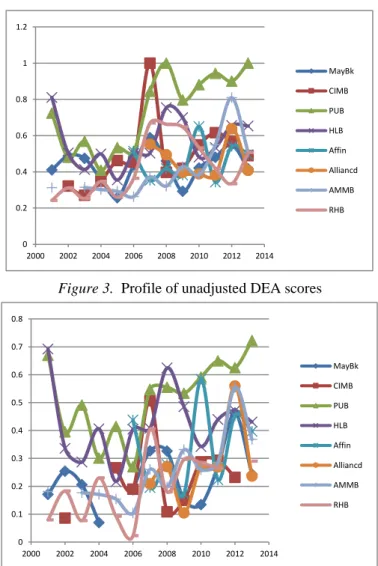
The DEA results based on ‘beta’ as input parameter and ‘RAROC’ and ‘EVA’ as output parameters without bias correction and after bootstrap correction are presented in Table 4 and Table 5 respectively; 2000 iterations were taken for the boot strap correction. The detailed results have been added as Appendix A.
0.00% 5.00% 10.00% 15.00% 20.00% 2000 2020 Affin Alliance AMMB RHB -50.00% 0.00% 50.00% 100.00% 150.00% 200.00% 2000 2020 Affin Alliance AMMB RHB -60.00% -40.00% -20.00% 0.00% 20.00% 40.00% 1 4 7 10 13 Affin Alliance AMMB RHB -80.00% -60.00% -40.00% -20.00% 0.00% 20.00% 1 4 7 10 13 Affin Alliance AMMB RHB
Table 4
Profile of unadjusted DEA score of domestic Malaysian banks using risk adjusted parameters
MayBk CIMB PUB HLB Affin Alliancd AMMB RHB
2001 0.41029 0.72428 0.81068 0.31186 0.24208 2002 0.48818 0.32144 0.47957 0.5036 0.31092 2003 0.47405 0.27058 0.56807 0.41281 0.31371 0.25254 2004 0.35989 0.34748 0.40827 0.49839 0.30217 0.34686 2005 0.25709 0.46199 0.53337 0.35468 0.29217 0.25979 2006 0.43657 0.45353 0.51271 0.50068 0.51395 0.26276 0.36394 2007 0.58763 1 0.84443 0.50314 0.35256 0.55192 0.37164 0.66898 2008 0.45870 0.39644 1 0.75359 0.41724 0.494 0.32132 0.66223 2009 0.29232 0.41932 0.79646 0.69875 0.38157 0.39609 0.42868 0.64739 2010 0.42045 0.54794 0.8808 0.48104 0.64939 0.38883 0.38462 0.53193 2011 0.47945 0.61548 0.9433 0.53386 0.34302 0.38123 0.54951 0.41867 2012 0.55008 0.55008 0.90017 0.65511 0.54073 0.63785 0.80915 0.33446 2013 0.41644 0.48861 1 0.65282 0.4944 0.40752 0.50766 0.50548 Table 5
Profile of bootstrap corrected DEA score of domestic Malaysian banks using risk adjusted parameters
MayBk CIMB PUB HLB Affin Alliancd AMMB RHB
2001 0.17055 0.66971 0.69198 0.18089 0.07948 2002 0.25371 0.08561 0.3947 0.33584 0.1829 2003 0.20581 0.4908 0.28645 0.17678 0.07686 2004 0.06936 0.30117 0.40591 0.1709 0.23028 2005 0.26585 0.41404 0.21681 0.15429 0.09211 2006 0.18738 0.18956 0.27024 0.40455 0.43723 0.10397 0.02235 2007 0.32644 0.50652 0.5473 0.40804 0.19496 0.20876 0.26058 0.40542 2008 0.32574 0.10812 0.55505 0.62406 0.27854 0.27083 0.19687 0.1798 2009 0.15191 0.14925 0.53354 0.48491 0.17271 0.10472 0.33101 0.29639 2010 0.13379 0.2877 0.59146 0.34241 0.58363 0.27098 0.25959 0.28428 2011 0.27143 0.29307 0.64973 0.43932 0.22317 0.26945 0.2852 0.26514 2012 0.46234 0.23189 0.62469 0.47084 0.45251 0.55919 0.55414 2013 0.24272 0.72221 0.43067 0.39678 0.23634 0.36821 0.2898
Figure 3. Profile of unadjusted DEA scores
Figure 4. Profile of bootstrap corrected DEA scores
The profile of DEA scores on a market based approach and assuming a hurdle rate of 15% reflect that PUB and HLB led the rest throughout the period 2001 to 2013. CIMB and MayBank had a mixed profile: the efficiency scores of these banks tapered off in the latter half of the period under study. The swings are quite sharp for smaller Malaysian banks.
CONCLUSION
The aim of this paper was to bring into focus the increasing importance of risk adjusted performance measurement of banks in view of the critical limitations of
0 0.2 0.4 0.6 0.8 1 1.2 2000 2002 2004 2006 2008 2010 2012 2014 MayBk CIMB PUB HLB Affin Alliancd AMMB RHB 0 0.1 0.2 0.3 0.4 0.5 0.6 0.7 0.8 2000 2002 2004 2006 2008 2010 2012 2014 MayBk CIMB PUB HLB Affin Alliancd AMMB RHB
the traditional ratio based measures of performance like ROE, ROA, P/E, P/B ratio. An in-depth analysis using the framework of RAROC and EVA show that although the bigger banks did not portray robust performance in terms of their EVA, on the whole however, they have become more resilient over the years. The situation however, is not entirely true in the case of the smaller banks in the country. Business repositioning to attune them to meet the emerging challenges in the increasingly competitive marketplace has become a necessity. Situation will become more demanding for these banks as BNM phases in the requirements of Basel – III over the next few years. Possibilities of a second phase of consolidation, voluntary or otherwise, cannot be ruled out in the near future. It needs to be mentioned here the EVA values reported in the paper have been computed assuming a hurdle rate of 15% and hence the position may change in case a lower/higher benchmark is used. It is no doubt true that the present analysis is based on the data collected from secondary sources and hence can only be indicative in nature. For future research, granular bank level data would significantly improve the robustness of the analysis and hence the findings. Moreover, looking at the performance of Public Bank Berhad and Hong Leong Bank Berhad, as emerged from the present study, might prompt researchers’ attention to assess the effect of the ownership structure and hence the managerial decision-making processes in Malaysian banks on their financial performance.
ACKNOWLEDGEMENTS
High Impact Project Research Grant (PBIT) of the Universiti Utara Malaysia for the research project “Evaluation of Risk Management Systems in Malaysian Banks”.
APPENDIX A
Efficiency score of banks before and after bootstrap correction Code Theta (Efficiency) Bias
Bias Corrected Theta 95% confidence interval Lower Upper MAYBK2001 0.4103 0.2397 0.1706 0.3353 0.4057 MAYBK2002 0.4882 0.2345 0.2537 0.3847 0.4799 MAYBK2003 0.4740 0.2682 0.2058 0.3793 0.4623 MAYBK2004 0.3599 0.2905 0.0694 0.2926 0.3545 MAYBK2005 0.2571 0.3872 –0.1301 0.2099 0.2540 MAYBK2006 0.4366 0.2492 0.1874 0.3504 0.4295 MAYBK2007 0.5876 0.2612 0.3264 0.4564 0.5699 MAYBK2008 0.4587 0.1330 0.3257 0.3943 0.4574 MAYBK2009 0.2923 0.1404 0.1519 0.2578 0.2919 MAYBK2010 0.4204 0.2867 0.1338 0.3371 0.4105 MAYBK2011 0.4794 0.2080 0.2714 0.3947 0.4726 MAYBK2012 0.5501 0.0877 0.4623 0.4801 0.5490 MAYBK2013 0.4164 0.1737 0.2427 0.3524 0.4149 CIMB2002 0.3214 0.2358 0.0856 0.2706 0.3201 CIMB2003 0.2706 0.3144 –0.0438 0.2250 0.2688 CIMB2004 0.3475 0.3596 –0.0121 0.2674 0.3430 CIMB2005 0.4620 0.1961 0.2658 0.3814 0.4585 CIMB2006 0.4535 0.2640 0.1896 0.3639 0.4452 CIMB2007 1.0000 0.4935 0.5065 0.5716 0.9333 CIMB2008 0.3964 0.2883 0.1081 0.3190 0.3898 CIMB2009 0.4193 0.2701 0.1493 0.3286 0.4128 CIMB2010 0.5479 0.2602 0.2877 0.4112 0.5386 CIMB2011 0.6155 0.3224 0.2931 0.4378 0.6000 CIMB2012 0.5671 0.3352 0.2319 0.4048 0.5553 CIMB2013 0.4886 0.5859 –0.0973 0.3188 0.4793 PUB2001 0.7243 0.0546 0.6697 0.6391 0.7233 PUB2002 0.4796 0.0849 0.3947 0.4231 0.4789 PUB2003 0.5681 0.0773 0.4908 0.4995 0.5671 PUB2004 0.4083 0.1071 0.3012 0.3591 0.4076 PUB2005 0.5334 0.1193 0.4140 0.4578 0.5309 PUB2006 0.5127 0.2425 0.2702 0.4089 0.5028 PUB2007 0.8444 0.2971 0.5473 0.5809 0.8076 PUB2008 1.0000 0.4450 0.5550 0.5917 0.9375
PUB2009 0.7965 0.2629 0.5335 0.5648 0.7765 PUB2010 0.8808 0.2893 0.5915 0.6036 0.8438 PUB2011 0.9433 0.2936 0.6497 0.6374 0.8981 PUB2012 0.9002 0.2755 0.6247 0.6286 0.8667 PUB2013 1.0000 0.2778 0.7222 0.6851 0.9342 HLB2001 0.8107 0.1187 0.6920 0.6726 0.8045 HLB2002 0.5036 0.1678 0.3358 0.4220 0.4993 HLB2003 0.4128 0.1264 0.2864 0.3586 0.4120 HLB2004 0.4984 0.0925 0.4059 0.4367 0.4975 HLB2005 0.3547 0.1379 0.2168 0.3093 0.3540 HLB2006 0.5007 0.0961 0.4045 0.4369 0.4997 HLB2007 0.5031 0.0951 0.4080 0.4393 0.5022 HLB2008 0.7536 0.1295 0.6241 0.6248 0.7468 HLB2009 0.6987 0.2138 0.4849 0.5432 0.6809 HLB2010 0.4810 0.1386 0.3424 0.4121 0.4786 HLB2011 0.5339 0.0945 0.4393 0.4645 0.5328 HLB2012 0.6551 0.1843 0.4708 0.5263 0.6453 HLB2013 0.6528 0.2221 0.4307 0.5121 0.6362 AFFIN2006 0.5140 0.0767 0.4372 0.4535 0.5133 AFFIN2007 0.3526 0.1576 0.1950 0.3054 0.3518 AFFIN2008 0.4172 0.1387 0.2785 0.3603 0.4162 AFFIN2009 0.3816 0.2089 0.1727 0.3194 0.3796 AFFIN2010 0.6494 0.0658 0.5836 0.5712 0.6483 AFFIN2011 0.3430 0.1199 0.2232 0.3024 0.3425 AFFIN2012 0.5407 0.0882 0.4525 0.4723 0.5397 AFFIN2013 0.4944 0.0976 0.3968 0.4315 0.4934 ALLIANCE2007 0.5519 0.3432 0.2088 0.3980 0.5346 ALLIANCE2008 0.4940 0.2232 0.2708 0.3959 0.4855 ALLIANCE2009 0.3961 0.2914 0.1047 0.3196 0.3874 ALLIANCE2010 0.3888 0.1178 0.2710 0.3408 0.3881 ALLIANCE2011 0.3812 0.1118 0.2695 0.3354 0.3806 ALLIANCE2012 0.6379 0.0787 0.5592 0.5551 0.6365 ALLIANCE2013 0.4075 0.1712 0.2363 0.3486 0.4055 AMMB2001 0.3119 0.1310 0.1809 0.2751 0.3114 AMMB2003 0.3137 0.1369 0.1768 0.2760 0.3132 AMMB2004 0.3022 0.1313 0.1709 0.2666 0.3018 AMMB2005 0.2922 0.1379 0.1543 0.2578 0.2918 AMMB2006 0.2628 0.1588 0.1040 0.2313 0.2623
AMMB2007 0.3716 0.1111 0.2606 0.3275 0.3711 AMMB2008 0.3213 0.1245 0.1969 0.2835 0.3209 AMMB2009 0.4287 0.0977 0.3310 0.3773 0.4280 AMMB2010 0.3846 0.1250 0.2596 0.3357 0.3839 AMMB2011 0.5495 0.2643 0.2852 0.4133 0.5391 AMMB2012 0.8091 0.2550 0.5541 0.5751 0.7911 AMMB2013 0.5077 0.1395 0.3682 0.4312 0.5049 RHB2001 0.2421 0.1626 0.0795 0.2136 0.2418 RHB2002 0.3109 0.1280 0.1829 0.2743 0.3105 RHB2003 0.2525 0.1757 0.0769 0.2217 0.2521 RHB2004 0.3469 0.1166 0.2303 0.3060 0.3464 RHB2005 0.2598 0.1677 0.0921 0.2285 0.2594 RHB2006 0.3639 0.3416 0.0223 0.2901 0.3593 RHB2007 0.6690 0.2636 0.4054 0.4893 0.6518 RHB2008 0.6622 0.4824 0.1798 0.4245 0.6435 RHB2009 0.6474 0.3510 0.2964 0.4539 0.6235 RHB2010 0.5319 0.2477 0.2843 0.4214 0.5189 RHB2011 0.4187 0.1535 0.2651 0.3582 0.4175 RHB2012 0.3345 0.6603 –0.3259 0.2409 0.3250 RHB2013 0.5055 0.2157 0.2898 0.4138 0.4963
Note: negative bias corrected scores reflect large bias in the original DEA estimates of the banks for those specific years
REFERENCES
Baer, T., Mehta, A., & Samandari, H. (2011). The use of economic capital in performance measurement for banks: A perspective. McKinsey Working Papers on Risk, No. 24.
Bandopadhayay, A., & Saha, A. (2007). RAROC: The new drivers of business growth in Indian banks, MRPA Paper. Retrieved 28 June 2014 from http://mpra.ub.uni-muenchen.de/8920/1/RAROC_and_EVAAB_and_AS-Revised-Final-Oct12-07. pdf Bank Negara Malaysia (2007). Financial stability and payment system report 2007.
Retrieved 24 December 2014 from http://www.bnm.gov.my/files/publication/ fsps/en/2007/cp01.pdf
Bank Negara Malaysia (2010). Financial stability and payment system report 2010. Retrieved 24 December 2014 from http://www.bnm.gov.my/files/publication/ fsps/en/2010/zcp07_table_A.02.pdf
Bank Negara Malaysia (2013). Quarterly Bulletin, Fourth Quarter 2013. Retrieved 24 December 2014 from http://www.bnm.gov.my/files/publication/qb/2013/ Q4/p5.pdf
Bank Negara Malaysia (2014). Financial stability and payment system report 2014. Retrieved 24 December 2014 from http://www.bnm.gov.my/files/publication/ fsps/en/2014/zcp07_table_A.01.pdf
Berger, A. N., & Humphrey, D. B. (1997). Efficiency of financial institutions: International survey and directions for future research. European Journal of Operational Research,98(2), 175–212.
Bogetoft, P., & Otto, L. (2011). Benchmarking with DEA, SFA and R. London: Springer. Bowlin, W. F. (1998). Measuring performance: An introduction to data envelopment
analysis (DEA). Journal of Cost Analysis,7, 3–27.
Charnes, A., Coopers, W. W., & Rhodes, E. (1978). Measuring the efficiency of decision making units. European Journal of Operational Research,2(6), 429–444. Charnes, A., Cooper, W. W., & Thrall, R. M. (1991). A structure for characterizing and
classifying efficiency and inefficiency in data envelopment analysis. Journal of Productivity Analysis,2, 197–237.
Dunbar, K. (2013). Economic value added: A thematic bibliography. Journal of New Business Ideas & Trends,11(1), 54–66.
Dyson, R. G., & Shale, E. A. (2010). Data envelopment analysis operational research and uncertainty. The Journal of the Operational Research Society, 61(1), 25–34. European Central Bank (2010). Beyond ROE –How to measure bank performance.
Appendix to the Report on EU Banking Structure, September.Retrieved 4 July 2014 from http://www.ecb.europa.eu/PBB/pdf/other/beyondroehowtomeasure bankperformance201009en.pdf
Everts, H., & Haarhuis, C. K. (2005). Handbook management accounting, finance and control. Retrieved 4 July 2014 from http://www.finance-control.nl/artikel/7502 Farrell, M. J. (1957). The measurement of productive efficiency. Journal of the Royal
Statistical Society (Series A),120(3), 253–281.
Fethi, D. M., & Pasiouras, F. (2010). Assessing bank efficiency and performance with operational research and artificial intelligence technique. European Journal of Operational Research,204(2),189–198.
International Monetary Fund (IMF). (2014). Financial sector performance vulnerabilities and derivatives - Technical note. IMF Country Report No. 14/98. Retrieved 24 December 2014 from https://www.imf.org/external/pubs/ft/scr/2014/cr1498.pdf Kimball, R. C. (1998). Economic profit and performance measurement in banking. New
England Economic Review, July/August, 35–53.
Merton, R. C. (1995). A functional perspective of financial intermediation. Financial Management,24(2), 23–41.
Ong, M. K. (Ed.). (2012). Managing and measuring capital: For banks and financial institutions. London: Risk Books.
Paradi, J. C., & Zhu, H. (2013). A survey on bank branch efficiency and performance research with data envelopment analysis, Omega,41(1), 61–79.
Saha, A., Ahmad, N. H., & Dash, U. (2014). Drivers of technical efficiency in Malaysian banking: A new empirical insight. Asia Pacific Economic Literature, 29(1), 161– 173.
Sharma, A. K., & Kumar, S. (2010). Economic Value Added (EVA): Literature review and relevant issues. International Journal of Economics & Finance,2(2), 200– 220.
Zanjani, G. (2010). An economic approach to capital allocation. The Journal of Risk and Insurance,77(3), 523–549.
Zeti, A. A. (2013). Reflections on financial reform - Malaysia's experience. Speech at the 2013 China Business News (CBN) Annual Meeting and Finance Summit, Beijing, 8 December 2013.