Dublin City University
A Reception Study of Machine Translated
Subtitles for MOOCs
Ke Hu
B.A., M.E.
Thesis submitted for the degree of Doctor of Philosophy
School of Applied Language and Intercultural Studies
Jan 2020
Supervisors:
Declaration
I hereby certify that this material, which I now submit for assessment on the programme of study leading to the award of Doctor of Philosophy is entirely my own work, and that I have exercised reasonable care to ensure that the work is original, and does not to the best of my knowledge breach any law of copyright, and has not been taken from the work of others save and to the extent that such work has been cited and acknowledged within the text of my work.
Signed: _____________________________________________________ (Candidate)
ID No.: _____________________ Date: _______________________
Acknowledgements
It is a genuine pleasure for me to express my sincere gratitude to my supervisors Prof Sharon O’Brien and Prof Dorothy Kenny for making my wish to study here come true. Their scholarly advice, prompt inspirations, meticulous scrutiny, and kind encouragement have helped me to a very great extent to accomplish this task.
I am extremely indebted to Dr Jinhua Du, Dr Longyue Wang, and Tianbo Ji for all their IT assistance with my experiment and data analysis. They kindly donated a lot of time for my research, and their advice helped me to implement new ideas from a different perspective. I would also like to thank Dr Carlos Teixeira for his instructions on eye-tracking.
My deep gratitude goes to all the participants in this research who kindly accepted to participate in this experiment.
I thank the ADAPT Centre for letting me be a part of it and start a new life on this beautiful island.
I thank my friends Liting and Marissa for making me feel at home thousands of miles away. I thank my friends Daria and David for all the chats and craic throughout the four years.
My utmost gratitude belongs to my open-minded father, who has always been supporting me and giving me the freedom to do what I want.
A special thank you goes to Cian for letting me know that there are miracles in the world. Thank you for loving me, supporting me, encouraging me, and making me laugh! Finally, I would like to thank myself for my perseverance, positive attitude and overcoming all difficulties in this PhD journey.
Doing this PhD has been an invaluable and fulfilling experience in my life. It has changed me in so many ways and I am grateful to everyone I have met during this time.
Publications and Presentations from this Research
Publications:Hu, K., O’Brien, S. and Kenny, D. (2019) ‘A reception study of machine translated subtitles for MOOCs’, Perspectives, pp. 1-18.
Toral, A., Castilho, S., Hu, K. and Way, A. (2018) Attaining the unattainable? Reassessing claims of human parity in neural machine translation, Proceedings of the Third Conference on Machine Translation, Volume 1: Research Papers. Brussels, Belgium, 31 October – 1 November 2018. Association for Computational Linguistics, pp. 113–123. Available at: https://arxiv.org/abs/1808.10432 (Accessed: 13 October 2019)
Hu, K. (2018) ‘MT use in China’, MultiLingual,29(6), pp. 32-38.
Hu, K. (2016) ‘A Comparative Study of Post-editing Guidelines’, Multilingual, 27(7), pp. 53-57.
Hu, K. and Cadwell, P. (2016) ‘A comparative study of post-editing guidelines’, Baltic Journal of Modern Computing,4(2), pp. 346-353.
Presentations:
Hu, K. O'Brien, S. and Kenny, D. (2019) ‘Quality Assessment of Machine Translated and Human Translated Subtitles for MOOCs’, Translation Technology in Education – Facilitator or Risk? 5 Jul 2019, Nottingham, UK.
Hu, K. O'Brien, S. and Kenny, D. (2018) ‘Machine Translation for Subtitling - a way to improve access to MOOCs’, UMAQ (Understanding Media Accessibility Quality) Conference 2018, 4 – 5 June 2018, Barcelona, Spain.
Hu, K. O'Brien, S. and Kenny, D. (2017) ‘A Reception Study of Machine Translated Subtitles for MOOCs’, The 16thMachine Translation Summit, 18 – 22 September 2017, Nagoya, Japan.
Hu, K. and O'Brien, S. (2016) ‘Applying TAM (Technology Acceptance Model) to Testing MT Acceptance’, 12th International Postgraduate Conference in Translation and Interpreting (IPCITI), 12 – 13 December 2016, Dublin, Ireland.
Hu, K. and O'Brien, S. (2016) ‘Applying TAM (Technology Acceptance Model) to Testing MT Acceptance’, TranslatingEurope Forum 2016, 27 – 28 October 2016, Brussels, Belgium.
Hu, K. and Cadwell, P. (2016) ‘A Comparative Study of Post-editing Guidelines’, The 19th Annual Conference of the European Association for Machine Translation (EAMT), 30 May – 1 June 2016, Riga, Latvia.
Table of Contents
List of Figures ...vii
List of Tables ... ix List of Abbreviations ... xi Abstract ... xiii Chapter 1 Introduction ... 1 1.1 Motivation ... 1 1.1.1 Why MOOCs? ... 1 1.1.2 Why MT? ... 3 1.1.3 Why reception? ... 5 1.2 Thesis overview ... 6
Chapter 2 MOOCs, Subtitles and Reception Studies ... 7
2.1 Introduction ... 7
2.2 MOOCs ... 7
2.2.1 Practical perspectives ... 10
2.2.2 MOOCs in China ... 15
2.2.3 The language barrier ... 19
2.2.4 Translating MOOC subtitles ... 23
2.2.4.1 Human translation ... 23
2.2.4.2 MT and post-editing ... 29
2.3 MT of subtitles ... 34
2.3.1 MT of subtitles for films and shows ... 34
2.3.2 MT of subtitles for MOOCs ... 39
2.4 The reception of subtitles ... 43
2.4.1 Gambier’s reception model ... 44
2.4.2 Existing AVT reception studies ... 45
2.4.2.1 Use of Eye-tracking ... 48
2.4.2.2 Use of questionnaires ... 54
2.4.3 Discussion... 56
2.5 Conclusions ... 59
Chapter 3 Translation Quality Assessment (TQA) ... 61
3.1 Introduction to TQA ... 61
3.2 Quality assessment of human-translated subtitles... 64
3.3 Quality assessment of MT ... 70
3.3.1 Human evaluation ... 70
3.3.1.1 Human evaluation based on judgements at segment level ... 72
3.3.1.2 Human evaluation based on error classification ... 74
3.3.1.3 Human evaluation based on usability judgements... 76
3.3.2 Automatic evaluation ... 80
3.3.3 Generic frameworks used in industry ... 84
3.3.3.1 Industry approaches ... 85 3.3.3.2 MQM ... 87 3.4 Conclusions ... 90 Chapter 4 Methodology ... 91 4.1 Introduction ... 91 4.2 A mixed-methods approach ... 91
4.2.1 Eye-tracking ... 95
4.2.2 Questionnaires ... 99
4.2.2.1 Advantages and disadvantages ... 99
4.2.2.2 Likert scales ... 101
4.2.2.3 Questionnaire design ... 104
4.2.2.3.1 Technology Acceptance Model ... 106
4.2.3 TQA... 110
4.2.4 Frequency analysis ... 113
Chapter 5 Design and Implementation ... 116
5.1 Research design ... 116 5.1.1 Reception model ... 117 5.1.2 Participants ... 118 5.1.3 MOOC video ... 119 5.1.4 Google Translate ... 121 5.2 Pilot Study ... 122
5.2.1 Participant overview (Pilot) ... 125
5.2.2 Subtitles ... 126
5.2.3 Questionnaires ... 127
5.2.4 Pilot study findings ... 136
5.2.4.1 MT usage ... 136
5.2.4.2 Data analysis ... 137
5.2.5 Reflections... 143
5.3 Main experiment ... 146
5.3.1 Similarities and differences with the pilot ... 147
5.3.2 Conduct of the experiment ... 147
5.3.3 TQA... 149
5.3.4 Frequency analysis ... 157
5.4 Conclusions ... 159
Chapter 6 Findings and Data Analysis I - Questionnaires ... 160
6.1 Introduction ... 160
6.2 Pre-task questionnaire and English test ... 160
6.2.1 Pre-task questionnaire ... 161
6.2.2 Online English test ... 171
6.3 Question and hypotheses ... 174
6.4 Post-task questionnaire ... 176
6.4.1 Comprehension testing ... 176
6.4.1.1 ANOVA... 178
6.4.1.2 LSD test... 181
6.4.2 Attitude survey... 183
Chapter 7 Findings and Data Analysis II - Eye-tracking Data ... 198
7.1 Introduction ... 198
7.2 Valid data ... 198
7.3 Hypotheses and testing ... 202
7.3.1 Hypotheses related to eye-tracking... 202
7.3.2 Hypothesis testing... 203
7.4 Outliers ... 234
7.5 Discussion ... 235
Chapter 8 Findings and Data Analysis III – TQA and Frequency Analysis ... 244
8.1 Introduction ... 244
8.2.1 TQA procedure ... 244 8.2.2 Inter-annotator agreement ... 247 8.2.3 Results ... 248 8.2.4 Discussion... 251 8.3 Frequency analysis ... 252 Chapter 9 Conclusions ... 264 9.1 Research aims ... 264 9.2 Contributions ... 267 9.2.1 Contributions to MOOCs ... 267
9.2.2 Contributions to reception studies ... 268
9.2.3 Contributions to the mixed-methods approach ... 270
9.2.4 Contributions to MT ... 270
9.3 Limitations ... 272
9.4 Future work... 274
References ... 276
Appendices ... 307
Appendix A1: Informed Consent Form (English) ... 308
Appendix A2: Informed Consent Form (Chinese) ... 309
Appendix B1: Plain Language Statement (English) ... 310
Appendix B2: Plain Language Statement (Chinese) ... 312
Appendix C1: Pre-task Questionnaire (English) ... 314
Appendix C2: Pre-task Questionnaire (Chinese) ... 316
Appendix D1: Post-task Questionnaire for Pilot Study (English) ... 318
Appendix D2: Post-task Questionnaire for Pilot Study (Chinese) ... 321
Appendix E1: Post-task Questionnaire for Main Experiment (English) ... 325
Appendix E2: Post-task Questionnaire for Main Experiment (Chinese) ... 329
Appendix F: QA Guidelines (English and Chinese) ... 333
List of Figures
Figure 2.1 Translated English subtitles for Spanish-speaking video ... 21
Figure 2.2 Embedded same language subtitles (green colour) for Flemish-speaking video along with translated English subtitles (white colour)... 22
Figure 2.3 Home page of OOPS ... 25
Figure 3.1 A screenshot of bullet screen ... 67
Figure 3.2 MQM Core (MQM, 2015) ... 89
Figure 5.1 Screenshot of Two AOIs (the orange rectangle is AOI_IMA and the blue one is AOI_SUB)... 137
Figure 5.2 Screenshot of the QA work interface... 151
Figure 6.1 Age of participants (n=66) ... 162
Figure 6.2 Gender balance of participants (n=66) ... 162
Figure 6.3 Year of participants in university (n=66) ... 163
Figure 6.4 Major of participants (n=66) ... 163
Figure 6.5 Participant has experience of using MT tools (n=66) ... 164
Figure 6.6 First time using MT tools (n=61) ... 164
Figure 6.7 Rate of MT usage (n=60) ... 165
Figure 6.8 Quality of MT (n=63) ... 166
Figure 6.9 Reasons to not use MT (n=32) ... 166
Figure 6.10 Participant has experience of watching videos with machine translated subtitles (n=66) ... 167
Figure 6.11 Participant has experience of using MOOCs (n=66) ... 168
Figure 6.12 Participant has experience of watching MOOCs with machine translated subtitles (n=42) ... 169
Figure 6.13 Participant believes MT can fully transfer the meaning of source language (n=66) ... 170
Figure 6.14 Level of agreement with the statement: “The subtitles allow me to fully understand the contents of the MOOC” (percentage of participants) ... 187
Figure 6.15 Level of agreement with the statement: “The subtitles are useful to me” (percentage of participants) ... 187
Figure 6.16 Level of agreement with the statement: “The subtitles are easy to understand” (percentage of participants) ... 188
Figure 6.17 Level of agreement with the statement: “Interacting with the subtitles does not require a lot of my mental effort” (percentage of participants) ... 189
Figure 6.18 Level of agreement with the statement: “I would find it easy to get the information I need from subtitles” (percentage of participants) ... 189
Figure 6.19 Level of agreement with the statement: “The subtitles are clear and understandable” (percentage of participants) ... 190
Figure 6.20 Level of agreement with the statement: “I enjoyed reading the subtitles” (percentage of participants) ... 191
Figure 6.21 Level of agreement with the statement: “I’m satisfied with the subtitles” (percentage of participants) ... 192
Figure 6.22 Level of agreement with the statement: “If I have a chance, I would use machine translation to translate English subtitles in the future, because I know it will do a good job” (percentage of participants) ... 193
Figure 6.23 Level of agreement with the statement: “I would recommend machine translation to my friends if they need to translate subtitles” (percentage of
participants) ... 193
Figure 6.24 Level of agreement with the statement: “I could comprehend the subtitles if there was no one around to tell me what to do as I go” (percentage of participants) ... 195
Figure 6.25 Level of agreement with the statement: “I could comprehend the subtitles if I could call someone for help if I got stuck” (percentage of participants) ... 195
Figure 6.26 Level of agreement with the statement: “I could comprehend the subtitles if I have a lot of time” (percentage of participants) ... 196
Figure 6.27 Level of agreement with the statement: “I could comprehend the subtitles if I had just the built-in help facility (i.e.: online dictionary) for assistance” (percentage of participants) ... 196
Figure 7.1 Eye deviation data (left eye deviation is smaller than right eye deviation) 200 Figure 7.2 Scan path of right eye ... 200
Figure 7.3 Scan path of left eye ... 201
Figure 8.1 Age of evaluators ... 246
Figure 8.2 Year of degree of evaluators ... 246
List of Tables
Table 2.1 cMOOC and xMOOC comparison (Panchenko, 2013, p.157)... 9
Table 5.1 Reception Model and Associated Measurement Tools ... 117
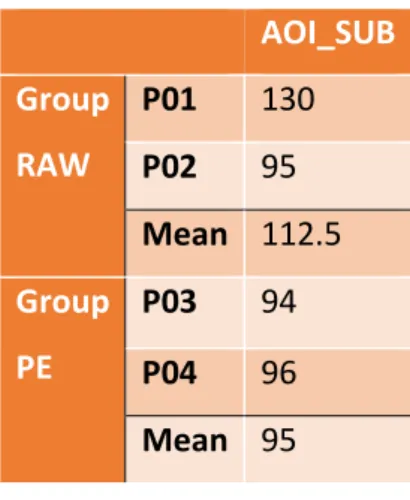
Table 5.2 Glance Count in Subtitle AOI of Each Group ... 138
Table 5.3 Glance Count in Image AOI of Each Group ... 139
Table 5.4 Fixation Count in Both AOIs of Each Group ... 139
Table 5.5 Glance Duration [s] in Both AOIs of Each Group ... 140
Table 5.6 Comprehension Testing Results of Each Group ... 141
Table 5.7 Average Fixation Duration [ms] in Both AOIs of Each Group ... 142
Table 5.8 Attitude Survey Results of Each Group ... 142
Table 5.9 Translation quality categories in this study ... 152
Table 6.1 Participants’ English Scores ... 173
Table 6.2 Comprehension testing score per group... 177
Table 6.3 Comprehension testing score of the seven participants reporting Level C competence... 180
Table 6.4 ANOVA between Group PE, Group RAW and Group HT ... 180
Table 6.5 Attitude survey results per group ... 185
Table 6.6 Percentage of agreements (including “strongly agree” and “agree”) on the four statements per group ... 190
Table 6.7 Percentage of agreements (including “strongly agree” and “agree”) on the four statements in each group ... 197
Table 7.1 Tracking ratio of participants from each group (R for ‘right eye’, L for ‘left eye’) ... 201
Table 7.2 Glances Count in Subtitle AOI of Each Group ... 204
Table 7.3 ANOVA for Glances Count (AOI_SUB) of Group RAW and Group PE ... 206
Table 7.4 ANOVA for Glances Count (AOI_SUB) of Group RAW and Group HT ... 207
Table 7.5 ANOVA for Glances Count (AOI_SUB) of Group PE and Group HT ... 208
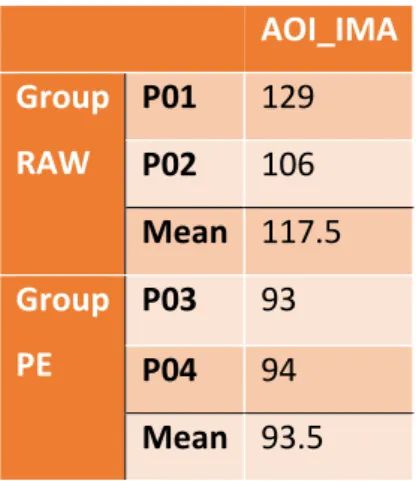
Table 7.6 Glances Count for Image AOI of Each Group ... 209
Table 7.7 ANOVA for Glances Count (AOI_IMA) of Group RAW and Group PE ... 210
Table 7.8 ANOVA for Glances Count (AOI_IMA) of Group RAW and Group HT ... 211
Table 7.9 ANOVA for Glances Count (AOI_IMA) of Group PE and Group HT ... 212
Table 7.10 Fixation Count for Both AOIs for Each Group ... 213
Table 7.11 ANOVA for Fixation Count (AOI_SUB) of Group RAW and Group PE ... 214
Table 7.12 ANOVA for Fixation Count (AOI_IMA) of Group RAW and Group PE ... 215
Table 7.13 ANOVA for Fixation Count (AOI_SUB) of Group RAW and Group HT ... 216
Table 7.14 ANOVA for Fixation Count (AOI_IMA) of Group RAW and Group HT ... 217
Table 7.15 ANOVA for Fixation Count (AOI_SUB) of Group PE and Group HT ... 218
Table 7.16 ANOVA for Fixation Count (AOI_IMA) of Group PE and Group HT ... 219
Table 7.17 Glance Duration [s] in both AOIs of Each Group ... 220
Table 7.18 ANOVA for Glance Duration (AOI_SUB) of Group RAW and Group PE ... 221
Table 7.19 ANOVA for Glance Duration (AOI_IMA) of Group RAW and Group PE ... 222
Table 7.20 ANOVA for Glance Duration (AOI_SUB) of Group RAW and Group HT ... 223
Table 7.21 ANOVA for Glance Duration (AOI_IMA) of Group RAW and Group HT ... 224
Table 7.23 ANOVA for Glance Duration (AOI_IMA) of Group PE and Group HT ... 226
Table 7.24 Average Fixation Duration [ms] in Both AOIs of Each Group... 227
Table 7.25 ANOVA for Average Fixation Duration (AOI_SUB) of Group RAW and Group PE ... 228
Table 7.26 ANOVA for Average Fixation Duration (AOI_IMA) of Group RAW and Group PE ... 229
Table 7.27 ANOVA for Average Fixation Duration (AOI_SUB) of Group RAW and Group HT ... 230
Table 7.28 ANOVA for Average Fixation Duration (AOI_IMA) of Group RAW and Group HT ... 231
Table 7.29 ANOVA for Average Fixation Duration (AOI_SUB) of Group PE and Group HT ... 232
Table 7.30 ANOVA for Average Fixation Duration (AOI_IMA) of Group PE and Group HT ... 233
Table 7.31 Measurement data of P14, P29 and P52 ... 234
Table 7.32 Results of comprehension testing and attitude survey ... 236
Table 7.33 Summary for results of ANOVA and means ... 237
Table 7.34 English scores (full score: 25) and comprehension scores (full score: 13) of all participants (n=61) ... 240
Table 7.35 ANOVA for the number of Chinese characters of PE subtitles and HT subtitles ... 242
Table 8.1 English score of the eligible evaluators ... 245
Table 8.2 QA scores given and errors identified by the ten evaluators ... 249
List of Abbreviations
ANOVA Analysis of Variance AOI Area of Interest AOI_IMA Image AOI AOI_SUB Subtitle AOI
ASR Automatic Speech Recognition BLEU Bilingual Evaluation Understudy DQF Dynamic Quality Framework
EN English
HT Human Translation
HTER Human-targeted Translation Edit Rate IAA Inter-Annotator Agreement
ISO International Organization for Standardization LISA Localization Industry Standards Association LSD Least Significant Difference
LSP Language Service Provider MOE Ministry of Education
MOOC Massive Open Online Course MQM Multidimensional Quality Metrics MT Machine Translation
OOPS Opensource Opencourseware Prototype System PE Post-Editing
PEOU Perceived Ease of Use PU Perceived Usefulness QA Quality Assessment
RBMT Rule-Based Machine Translation RTF Real Time Factor
SMT Statistical Machine Translation TAM Technology Acceptance Model TAUS Translation Automation User Society TER Translation Edit Rate
TM Translation Memory
TQA Translation Quality Assessment VNC Visual Nonverbal Cues
WER Word Error Rate
“It takes backbone to lead the life you want.” Revolutionary Road
Abstract
A Reception Study of Machine Translated Subtitles for MOOCs Ke Hu
As MOOCs (Massive Open Online Courses) grow rapidly around the world, the language barrier is becoming a serious issue. Removing this obstacle by creating translated subtitles is an indispensable part of developing MOOCs and improving accessibility. Given the large quantity of MOOCs available worldwide and the considerable demand for them, machine translation (MT) appears to offer an alternative or complementary translation solution, thus providing the motivation for this research.
The main goal of this research is to test the impact machine translated subtitles have on Chinese viewers’ reception of MOOC content. More specifically, the author is interested in whether there is any difference between viewers’ reception of raw machine translated subtitles as opposed to fully post-edited machine translated subtitles and human translated subtitles.
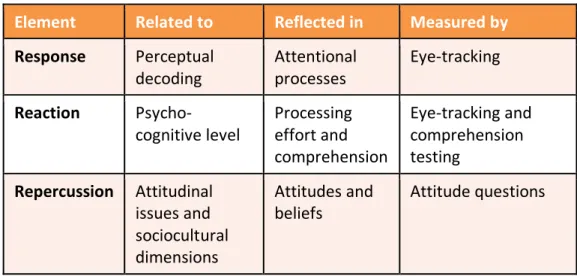
Reception is operationalized by adapting Gambier's (2007) model, which divides ‘reception’ into ‘the three Rs’: (i) response, (ii) reaction and (iii) repercussion. Response refers to the initial physical response of a viewer to an audio-visual stimulus, in this case the subtitle and the rest of the image. Reaction involves the cognitive follow-on from initial response, and is linked to how much effort is involved in processing the subtitling stimulus and what is understood by the viewer. Repercussion refers to attitudinal and sociocultural dimensions of AVT consumption. The research contains a pilot study and a main experiment. Mixed methods of eye-tracking, questionnaires, translation quality assessment and frequency analysis were adopted. Over 60 native Chinese speakers were recruited as participants for this research. They were divided into three groups, those who read subtitles created by raw MT, post-edited MT (PE) and human translation (HT). Results show that most participants had a positive attitude towards the subtitles regardless of their type. Participants who were offered PE subtitles scored the best overall on the selected reception metrics. Participants who were offered HT subtitles performed the worst in some of the selected reception metrics.
Chapter 1 Introduction
1.1 Motivation
This section outlines the motivation for the component parts of the research described in this thesis, i.e.: MOOCs, MT and the concept of reception.
1.1.1 Why MOOCs?
Massive Open Online Courses, or ‘MOOCs’, are increasingly being used by universities, companies and organizations globally. On the one hand, they are used to promote courses and share knowledge resources; on the other hand, they showcase brands and attract more students. Through the years, popular platforms such as Coursera,1 edX,2
Udacity,3 XuetangX4 and FutureLearn5 have partnered with hundreds of universities to
offer thousands of courses to millions of users. By the end of 2018, the number of MOOC learners had reached 101 million, and over 900 universities had announced or launched 11,400 MOOCs (Shah, 2018). With the development of MOOCs, many problems have been exposed. Taking some recent studies as examples, a study by the Massachusetts Institute of Technology (MIT) shows that MOOCs struggle to lift rock-bottom completion
1www.coursera.org (Accessed: 5 December 2019) 2www.edx.org (Accessed: 5 December 2019) 3www.udacity.com (Accessed: 5 December 2019) 4www.xuetangx.com (Accessed: 5 December 2019) 5www.futurelearn.com (Accessed: 5 December 2019)
rates as the researchers found that the average dropout rate for online courses over the past five years was about 96% and this figure had not improved between 2013-14 and 2017-18 (Murray, 2019). Another recent study by the University of Michigan shows that providing certificates for a fee can boost MOOC completion rates (Sriram, 2019). However, there are objections that charging fees can reduce access to education and detract from the spirit of the first MOOCs, and make MOOCs less massive and less open (Murray, 2019). Other well-known issues with MOOCs are related to intellectual property, ethics, the language barrier, etc. Among them, the language barrier is the focus of this thesis.
It is a fact that the vast majority of MOOCs are produced and made available in English nowadays. While English accounts for about 50% of Internet content and English speakers only make up 30% of the total users, over 80% of the courses on Coursera and edX are instructed in English, which is against the mission statements of Coursera and edX, whose mottos are “anyone, anywhere”, 6 and “everyone, everywhere”, 7
respectively (Agudo, 2019). Due to the shortage of labour and capital, only selected courses are being translated into selected languages, which can lead to imbalance in the subjects which are translated. Removing this language barrier, is of key importance to the development of MOOCs worldwide. Taking China as an example, MOOCs have become an important pillar in China’s thriving e-learning industry: according to its Ministry of Education, China is now the world’s largest MOOC provider in terms of volume (MOE, 2018). But despite the growth in Chinese-language MOOCs, a
6 blog.coursera.org/about/ (Accessed: 3 March 2019) 7 edx.org/about-us (Accessed: 3 March 2019)
considerable number of MOOCs accessed in China are in other languages, due to collaboration between Chinese and foreign MOOC platforms or universities. For instance, one of the leading MOOC platforms in China, XuetangX, is in partnership with edX and provides MOOCs from Stanford University, Queensland University, and the University of California, Berkeley, among others. The use of MOOCs in languages other than Chinese can present problems, however. In one survey on MOOC usage in China that attracted some 3,300 responses (Guokr MOOC Academy, 2014), language was cited as an important barrier to learning via MOOCs: of the more than 2,440 respondents who answered that they had tried MOOCs before, 47% claimed that the obstacle that stopped them learning via MOOCs was ‘language’. For the respondents who answered they had not tried MOOCs before, 17.5% gave the ‘language barrier’ as the reason. There appears therefore to be scope for translation in the popularisation of MOOCs in China. Volunteer groups clearly have a role to play in such translation (Beaven et al., 2013), but there is still a large unmet demand for translated MOOCs.
1.1.2 Why MT?
The globalization of the world and the acceleration of internationalization, especially with the deepening of China’s “One Belt and One Road” initiative, have promoted international political, economic, and cultural exchanges, thereby enhancing the world-wide demand for language and translation services. Meanwhile, the rapid development of the Internet, big data, cloud computing, and other modern technologies have also brought opportunities for MT (machine translation). In regard to the considerable
demand for translating MOOCs, given limited availability of human translators and budget for translating content, MT could be part of the solution.
Over the past decade or so, several projects have addressed subtitling by MT, including MovRat (Armstrong et al., 2006; Flanagan, 2009), Volk’s ‘Stockholm system’ (Volk, 2008), SUMAT (Etchegoyhen et al., 2014) and DialogueMT (Wang et al., 2016). Research in the area has been supported by the increasing availability of large parallel corpora of subtitles (e.g.: the OpenSubtitles corpus in Lison and Tiedemann, 2016), However, these projects mostly focus on films and TV shows, and subtitling MOOCs by MT is a fledging field. That said, the recent TraMOOC project (Kordoni et al., 2016) focuses on the MT of subtitles for MOOCs. The project established an open-source online neural MT platform (http://www.translexy.com/) that can automatically translate English-language MOOCs into 11 languages including Chinese. Despite such initiatives, MT still has an image problem and is not always trusted by end users. To improve the quality of MT output, and to establish trust among human subtitlers and end-users, post-editing could be a solution. Several sources (Plitt and Masselot, 2010; Aranberri et al., 2014) have reported productivity increases when using post-editing compared to traditional human translation. Castilho et al. (2014) further show that post-editing significantly increases the usability of machine-translated (online help) text. Their work sheds light on how end-users engage with raw and post-edited machine-translated text, which is also the focus of this research.
1.1.3 Why reception?
According to Gambier (2018), reception studies of translated audio-visual texts are relatively scant. Apart from that, most of them are about films and TV shows, none of them is about the subtitles of MOOCs. As MOOCs are becoming more and more popular these days, more research is needed to explore the use of MOOCs and users’ reception of the translated subtitles for MOOC videos. Another problem of the existing reception studies is that they mainly focus on studying viewers’ reception of human-translated subtitles. While MT has gained considerable attention in both academia and industry, the usability of machine translated subtitles and post-edited MT subtitles is worth investigating. In addition, as MT quality has been the focus of controversy, it would be a good idea to compare the reception of raw MT output, full post-edited output and human translation. Therefore, the researcher includes raw MT, full post-edited MT and human translation conditions in the research design. As for the language pair to be studied, although Chinese viewers have been exposed to subtitles for a long time and fansubbing is very popular in China, little research has been done on the viewer’s reception of English-Chinese subtitles; thus this research focuses on studying the English-Chinese language pair.
In regard to the methodology for reception studies of subtitles, translation scholars often adopt eye-tracking technology, questionnaires and sometimes a mix-methods approach. Results show that these methods and the approach are effective, and hence they have been adopted in this research.
1.2 Thesis overview
In summary, by using a mixed-methods approach, this research investigates Chinese end users’ reception of MOOC subtitles that have been translated from English into Chinese in three conditions: human translation (HT); raw, i.e. un-edited, MT (RAW); and post-edited MT (PE). The research aims to answer the following question: is there a difference in reception between participants who are offered raw MT subtitles and those who are offered full PE subtitles or HT subtitles?
This thesis is organised as follows: Chapters 2 and 3 constitute the literature review, the former focuses on MOOCs, subtitles and reception studies, and the latter on translation quality assessment; Chapter 4 outlines the mixed-methods approach of this research while Chapter 5 discusses the research design, including the set-up and outcome of the pilot study, and provides a brief introduction to the main experiment; Chapters 6, 7 and 8 are the data analysis part of the research, with a focus on questionnaire data (Chapter 6), eye-tracking data (Chapter 7), and the data collected from the Translation Quality assessment (TQA) and frequency analysis (Chapter 8) respectively; Chapter 9 presents the conclusions and suggestions for future work.
Chapter 2 MOOCs, Subtitles and Reception Studies
2.1 Introduction
This chapter reviews relevant literature on MOOCs, subtitling, MT and reception studies. First, Section 2.2 outlines the focus of this research: MOOCs, and presents the options for removing the language obstacle for better online knowledge sharing: human translation and MT. Section 2.3 gives an overview of MT of subtitles. Then, a discussion about the reception of subtitles is provided in Section 2.4. Finally, Section 2.5 gives the concluding remarks.
2.2 MOOCs
Education is important to people of all ages from all places. In the Information Age, education has become highly technologized. To improve student learning, researchers have been interested in integrating technology into education for a long time. A typical practice is e-learning, which means delivering courses through the Internet. E-learning is rooted in the concept of Computer-Assisted Learning (CAL), which can be dated back to “programmed instruction delivered via mainframe computers in the 1950s and 1960s” (Mayer, 2017, p.403). Apart from being increasingly used in schools, with the advance of technology, e-learning has developed into many creative forms, such as educational
network platforms that aim to help children study after class (e.g.: ABCmouse8), and
online self-learning services that aim to train people in specific skills (e.g.: Khan Academy9). Over the years, one of the most important initiatives that has been
introduced in the context of e-learning is ‘massive open online courses’, or MOOCs.
The term ‘MOOC’ was coined in 2008 by Dave Cormier of the University of Prince Edward Island in Canada (Cormier, 2008). Since then, MOOCs have received widespread attention in the USA especially since Sebastian Thrun, a Stanford professor, offered an online course on Artificial Intelligence for free (Hu, 2013). Currently, universities worldwide are using platforms such as Coursera, Udacity, and edX to offer MOOCs. Taking Coursera, one of the most notable MOOC platforms (Tahmassebi et al., 2018), as an example, it is offering 3,449 courses and has 185 partners (including universities and organizations) across 28 countries up to the date of March 3, 2019.10 In terms of the
number of registered users, the top five MOOC providers in 2018 are as follows (Shah, 2018): Coursera (37 million), edX (18 million), XuetangX (14 million), Udacity (10 million), and FutureLearn (8.7 million). Andrew Ng, founding lead of Google Brain, had enrolled over 1.7 million students in his first machine learning course by the end of Feb 2019.11
Stephen Downes and George Siemens distinguish two types of MOOCs which they call cMOOC and xMOOC (Nobre et al., 2018). They define the differences between them as follows: the “c” in cMOOC refers to connectivist while the “x” in xMOOC means extended (Jacoby, 2014). The former is based on the principles of connectivism,
8https://www.abcmouse.com/ (Accessed: 3 March 2019) 9https://www.khanacademy.org/ (Accessed: 3 March 2019)
10https://www.coursera.org/about/partners (Accessed: 3 March 2019) 11https://www.coursera.org/learn/machine-learning (Accessed: 3 March 2019)
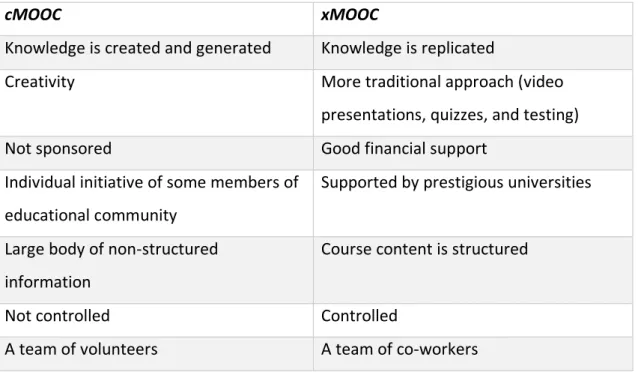
openness, and participatory teaching (ibid.), whereas the latter is based on the Behaviourist Learning Theory; it is teacher-centered, and the student acts as the receiver of knowledge (Gao, 2014a). Panchenko (2013) summarizes the differences between the two types of MOOC, as presented in Table 2.1. xMOOCs are usually associated with Coursera and other popular MOOC platforms. The research scope for this PhD study is limited to xMOOCs.
Table 2.1 cMOOC and xMOOC comparison (Panchenko, 2013, p.157)
cMOOC xMOOC
Knowledge is created and generated Knowledge is replicated
Creativity More traditional approach (video
presentations, quizzes, and testing)
Not sponsored Good financial support
Individual initiative of some members of educational community
Supported by prestigious universities
Large body of non-structured information
Course content is structured
Not controlled Controlled
A team of volunteers A team of co-workers
Costa-Jussà et al. (2014 and 2015) provide a good example of a MOOC relevant to this thesis. They explain the process of designing, developing, and analysing a MOOC on MT that is entitled “Approaches to Machine Translation: Rule-based, statistical and hybrid” in detail, including course topic and contents, activities, recording equipment, platform, and promotion.
2.2.1 Practical perspectives
Much of the literature on MOOCs comes in the form of overviews and case studies, with government and industry white papers featuring strongly in the Chinese context (these will be discussed in the next section). Academic papers have been published on the introduction and development of MOOCs. Across this literature a number of recurring themes can be discerned, the most relevant of which are addressed below. These include advantages of MOOCs, participation in MOOCs, and problems associated with MOOCs.
Panchenko (2013) participated in and analysed several MOOCs offered by Coursera, Udacity and edX in order to study the advantages of MOOCs as an alternative form of advanced training for university teachers. He studied the dynamics of Coursera, Udacity, and edX search engines with the help of the Google Trend Service. He conducted a comparative analysis of the three providers arguing that the advantages of MOOCs are as follows (ibid., p.168):
a) participation is free of charge;
b) opportunity for on-the-job advanced training;
c) introduction to individual teaching styles of the leading professors of some well-known universities;
d) possibility to compare the methodological basis of different courses; e) distance learning experience in the role of a student;
f) participation in forum discussions; g) experience of peer assessment practices;
h) broadening one’s horizons and knowledge of teaching methodology;
i) opportunity to expand the courses taught at the university incorporating knowledge of MOOC;
j) intercultural competency development;
k) English listening, reading, and writing skills enhancement; l) expanding the range of software;
n) reflecting on one’s own educational activity from a new angle.
We can see that some elements in the list, such as b), d), e), f), h), j), m) and n), are not specific to MOOCs; other e-learning forms also contain these elements. Elements like i) and l) are unclear. Element k) is questionable because, although the majority of MOOCs on those well-known platforms are in English, the lingua franca in many countries, a large number of MOOCs are in other languages. Given the worldwide accessibility of MOOCs, language can be a barrier for online learning, a point to which we return below. Regarding Element a), up to now, most MOOCs on platforms like Coursera, Udacity, and edX are free to audit, but if students want their assignments graded or to earn a certificate, they will need to pay. Element g) is worth highlighting. On Coursera, for example, students have to do assignments and also review two or three assignments of their peers to progress. In this way, everyone has to complete assignments on time and can have them graded, creating a virtuous circle for online learning.
In China, Yuan and Liu (2014) investigated how six Chinese universities dealt with MOOCs and identified their specific concerns as follows: stressing the significance of educational reform based on MOOCs; focusing on self-promotion, supplemented by the support and guidance of government; introducing foreign MOOCs and producing domestic MOOCs; and sharing resources between universities and enterprises. The development of MOOCs in China is closely related to their promotion by the government. In recent years, the scale of state financial investment in education has continued to grow. The ratio of national fiscal expenditure on education to GDP has also steadily increased and exceeded 4.0% since 2012 (iiMedia, 2018). More information about Chinese government policies will be presented in Section 2.2.2.
The rapid development of MOOCs is based on the merits of MOOCs, but also on participants’ willingness to use them. As Hew and Cheung (2014) point out, students and instructors join MOOCs for different reasons. For students, they join MOOCs because of curiosity and personal challenge, and to extend their knowledge and collect completion certificates. For instructors, they join MOOCs because of a sense of intrigue, or egoism, or altruism. Meanwhile, Hew and Cheung also point out the challenges for learning and teaching using MOOCs. As they put it, the nearly 90% drop-out rate in MOOCs is due to a lack of incentive, inability to understand the content and having no one to ask for help, and having other priorities to fulfil. Instructors find it hard to teach without students’ presence and immediate feedback. Assessing students’ work, a lack of student participation in online forums, and the high demand for time and energy, have also increased the difficulty of their job.
For MOOCs, high enrolments come with high drop-out rates. According to Hew and Cheung (2014, p.51), the main differences between MOOCs and traditional university courses are as follows: “the large and diverse student enrolment in MOOCs, the high drop-out rate of MOOCs compared to that of traditional courses, and the relatively [sic] lack of instructor presence or support in MOOCs compared to traditional courses”. Low completion rates are also a big problem for MOOCs in China (Gao, 2014a). According to the 2016 Educated Youth Report (Guokr MOOC Academy, 2017), jointly issued by several education websites in China, 14.18% of learners completed all their online courses, 33.23% of learners completed most courses and gave up a few, 21.52% of learners completed around half of the courses, and 4.74% of learners did not complete any course. We can see from Hew and Cheung’s work (ibid.) that an important reason for
people to join MOOCs is curiosity. However, curiosity can be short-lived. For example, the 2016 Educated Youth Report shows that 15.4% of respondents enrolled in a course “because of curiosity” but didn’t actually want to complete the course. The most cited reason for dropping-out was “terrible self-discipline and procrastination”, which accounts for 55.88%. Another reason - “too busy and no time to complete the course” - accounts for 53.63%. MOOC users come from different backgrounds, which may lead to different user behaviour. Jia et al. (2019a) conducted a study on a Chinese MOOC platform with 57 “blended learners” (those who studied both in college and via MOOCs) and 4,049 “social learners” (those who studied only via MOOCs) to find out who can benefit more from MOOCs. Results show that the course completion rates for blended learners and social learners are 100% and 7.14% respectively, and blended learners benefit more from MOOCs than social learners. The disparity in the number of participants between the two groups may have some influence on the results, but the huge gap between 100% and 7.14% elucidates the problem to some extent.
Apart from problems on the user side, MOOCs have other issues. Gao (2014b) finds that currently MOOCs are beset by a number of problems: lack of creativity in the mode of teaching (still based on outdated behaviourist teaching theory), difficulty to achieve personalised learning, lack of real learning experience for students (such as that based on interaction between teacher and student), difficulty in assessing student work, and lack of official acknowledgement for the learning outcome. Qi (2019) also points out the current status and problems of MOOCs in China, for example, the teaching quality cannot be guaranteed, credit certification is confusing and not standardized, copyright issues exist etc.
As for other sceptics regarding MOOCs, Jacobs (2013) is concerned that MOOCs would offer a watered-down education, have a negative impact on less prestigious education institutes, and raise the risk of further cuts to public school budgets. Kolowich (2013) is not sure how viable the notion of awarding formal course credit to MOOC students is, since in the survey he conducted on 103 professors, 72% of the respondents held the opinion that students who succeeded in MOOCs did not deserve to get formal course credit from their home institutions. 66% of them believed that their home institutions would not grant formal credit to those students. Furthermore, the professors were worried that the person who submitted assignments on a MOOC was not actually the one who was enrolled in the course in question. Hew and Cheung (2014) believe MOOCs are a good platform for people who want to learn something but are not interested in receiving a credit. They conclude that MOOCs are merely another learning resource and they doubt they could replace the traditional mode of education. Haggard et al. (2013) agree that the value of MOOCs is called into doubt by many educators, and the conflicting views on MOOCs lead to a disparity between prestigious universities and small academies, which may cause a potential threat to higher education. Nevertheless, they emphasize that the feedback on learning experiences with MOOCs is positive. They hold that the borderless format of MOOCs will accelerate the globalization of higher learning content and accreditation systems.
2.2.2 MOOCs in China
China has a thriving e-learning industry which is keen to globalize. At present, the most popular Chinese MOOC platforms are as follows: 学 堂 在 线
(http://www.xuetangx.com/),12 中国大学MOOC (http://www.icourse163.org/), 华文
慕 课 (http://www.chinesemooc.org/), and 好 大 学 在 线
(http://www.cnmooc.org/home/index.mooc).
In 2015, the Ministry of Education (MOE) launched several initiatives to stimulate the development of MOOCs. In October 2016, the MOE Research Centre for Online Education in China, in cooperation with the HCR Company (慧辰资讯), published the
White Paper on China’s MOOC Industry 2016 (hereafter abbreviated as 2016 White Paper). According to the White Paper (HCR, 2016), Chinese MOOC platforms mainly focus on higher education. The development of Chinese MOOCs is led by universities, while Internet companies and online education companies establish platforms and cooperate with foreign platforms. More than 30 universities sponsored by Project 98513
and a number of universities sponsored by Project 21114 have participated in the
establishment of MOOCs. In January 2018, the Ministry of Education claimed that China is the world’s largest MOOC provider in terms of volume (MOE, 2018). Chinese colleges and universities have established over 10 MOOC platforms providing more than 3,200
12 Or it can be called XuetangX
13 Project 985 is a project for founding world-class universities in the 21st century conducted by the government of
the People’s Republic of China. On May 4, 1998, President Jiang Zemin declared that “China must have a number of first-rate universities of international advanced level”, so Project 985 was launched (China Education Center, Online).
14 Project 211 is the Chinese government's new endeavour aimed at strengthening about 100 institutions of higher
education and key disciplinary areas as a national priority for the 21st century. There are 112 universities in the project 211 (ibid.).
courses from over 460 universities throughout the country, which have been accessed by 55 million people (ibid.). Meanwhile, the Ministry of Education launched 490 national premium quality online open courses, which were selected from the abovementioned 3,200 MOOCs (ibid.). This was the first time that MOOCs were certified at the national level.
As the 2016 White Paper suggests (the data in this and the following paragraphs is all extracted from this source), the users of MOOCs in China are mainly 18 – 35 year olds. Among them, 47.9% are aged between 18 - 25, 20.4% are aged between 26 - 30, and 15.2% are aged between 31 – 35. It seems that men are more interested in MOOCs than women, since 60.1% of users are male while 39.9% are female. Due to an imbalance in levels of overall development in different regions in China, it is not surprising that most users are from first and second-tier cities: 29.2% of users live in first-tier cities, 47.5% in second-tier cities, and 23.3% in third and fourth-tier cities.15 Due to the popularity of
computers and easy access to the Internet, 61.5% of users learn about MOOCs from educational websites. 37.1% of users are introduced to MOOCs through their teachers, classmates or friends, and 28.3% of users learn about MOOCs through search sites and application stores. The most popular MOOCs were those on professional skills, taken by 61% of users.
15 The tier system in China was introduced in the 1980s as a way of facilitating urban development. In the beginning,
cities were ranked by tier according to the government’s development priorities (Starmass, 2019), but now ranking has become a proxy for demographic and social segmentation in China (Liu et al., 2014). In May 2019, CBN Weekly, a business news magazine in China, issued a new list of Chinese tier cities. They investigated 337 cities and graded them according to five dimensions: quantity of commercial resources, transport hub or not, activeness of urban people, diversity in lifestyles, and future plasticity. The first-tier cities in this list are, for example, Beijing, Shanghai, Guangzhou, Shenzhen along with 15 more cities (CBN Weekly, 2019).
MOOCs are popular mostly among well-educated people, as 38.5% of users are students, 26.5% are white-collar office workers, and 11.5% are middle-senior managers. In addition, 68.6% of users have a Bachelor’s degree, 12.5% have a Master’s degree, and 12.3% are Junior College16 graduates. Compared to the reasons for joining MOOCs
summarized by Hew and Cheung (2014) mentioned in Section 2.2.1, the White Paper reveals that Chinese MOOC users have similar motivations: some people use MOOCs out of their desire for new knowledge and self-development, some use them for specific interests and hobbies, and others use them due to the influence of their positive experience of watching TED talks and other online open courses. Knowledge improvement is an important reason for learning through MOOCs. Students hope to access better resources and teachers in famous universities, while employees hope to gain more skills. Regarding the length of video used in MOOCs, 87% of users preferred the MOOC to be 10 – 20 minutes long.
In December 2018, iiMedia Research Group, a mobile Internet organization in China focused on third-party data mining and integrated marketing, released its 2018 China Online Education Industry White Paper (iiMedia, 2018. Hereafter abbreviated as 2018 White Paper). Here, ‘online education’ equals e-learning, which not only includes MOOCs, but also other types of online learning sites or apps (especially those platforms designed for preschool education, secondary education, and interests and hobbies education). According to this White Paper, ‘AI + education’ has become the keyword of the online education industry in 2018. AI technologies such as intelligent-checking of homework, face recognition technology, personalized recommendations, and AI
16 Junior college program is a form of higher education in China and usually lasts 2-3 years (Embassy of the People’s
teachers have been applied in the multiple scenarios of online education to continuously improve user experience.
This White Paper also suggests that online learners are mainly distributed in first-tier cities in China. Regarding the gender of learners, males (59.2%) are more active in learning than females (40.8%). As for the age, Chinese online learners are mainly 16 – 35 year olds. These findings are in line with those of the 2016 White Paper. In regard to fees, the 2016 White Paper states that 22.4% of Chinese users had experience of paying for MOOCs. Their low cost could be a potential reason for this. For instance, 71.7% of the prices were below 300 yuan (approximately 40 euros), and the price paid by students was mainly below 100 yuan (approximately 13.5 euros). The 2018 White Paper suggests that nearly 80% of online education users intend to spend more than 200 yuan (approximately 26 euros) per month. Among them, 36.8% of online education users intend to spend between 500 yuan (approximately 65 euros) and 1,000 yuan (approximately 132 euros) per month. We can see that both the number of paying users and the fees themselves have increased over the two years. According to the 2016 White Paper, the anticipated number of registered users on Chinese MOOC platforms is more than 10 million for the year ending 2016. According to the updated information, by the end of 2018, the number of registered users of XuetangX alone had already reached 14 million. According to the 2018 White Paper, the number of online education users in China is expected to reach 296 million by 2020, which is nearly 30 times more than that anticipated in the 2016 White Paper (note: the figure in the 2018 White Paper includes but is not limited to MOOC users).
2.2.3 The language barrier
Despite the growth in Chinese-language MOOCs, a considerable number of MOOCs accessed in China are in other languages due to the collaboration between Chinese MOOC platforms and foreign MOOC platforms or universities. For example, XuetangX is in partnership with edX and also provides MOOCs from Stanford University, Queensland University, University of California Berkeley, etc. Wu and Bai (2018) emphasize the impact of low English level on MOOC learners. They found that most Chinese learners’ English level is not high, while the required English level is high in English-speaking MOOCs. Chinese learners could not communicate easily with other foreign learners in the forums, and the learners found it difficult to learn from English MOOCs even if they had English subtitles. Wu and Bai (ibid.) argue that the language barrier reduced learners’ interest in learning and is an important factor in the high dropout rate.
The results of other surveys are consistent with the argument of Wu and Bai (2018). In the 2014 MOOC Learners Survey (Guokr MOOC Academy, 2014), approximately 3,300 responses were collected and 74% of the respondents indicated that they had taken MOOCs before. Of relevance here is that for both users and non-users of MOOCs, language was cited as an important barrier to learning via MOOCs. For the respondents who answered they had tried MOOCs before, 47% of them claimed that the obstacle that stopped them learning via MOOCs was ‘language’. For the respondents who answered they had not tried MOOCs before, 17.5% of them chose the ‘language barrier’ as the reason for not learning via MOOCs. In the Online Learning Survey 2015, conducted by Guokr MOOC Academy (2015) in conjunction with several other education platforms,
for those who had not taken online courses, the reason “cannot adapt to English courses” accounts for 31%, while for those who had taken but not completed the course, the reason “language barrier” accounts for 11%. In addition, 82% of learners said they had to have the Chinese subtitles to keep up with the course.
The 2016 White Paper shows that among the factors that influence users’ selection of MOOC platforms, “availability of Chinese courses” is selected by 29.6% of users, and “whether I can improve my English here” by 13.4% of users.17 This is worth highlighting
because learning English is very popular in China. English is a compulsory subject for Chinese secondary schools and even a subject in some kindergartens. Many people try to make use of all the available resources to learn English. As time goes by, rather than dubbing, adding subtitles to English-speaking videos is becoming more popular (Wang, 2013; Qian, 2014).
In summary, language is an obstacle for Chinese people to learn via MOOCs, and removing this obstacle, by, for example, creating translated subtitles, is an indispensable part of developing MOOCs and broadening access. In fact, not only in China, but also in other countries, the translation of subtitles is an important demand made by users. An interesting example of this is the MOOC entitled “Accessibility to the Scenic Arts”,18
developed under the ACT (Accessible Culture and Training) project,19 which aims to
improve the accessibility of cultural events to all people. While different languages (Spanish, Dutch/Flemish, English, German) are used for instruction in this MOOC, all of its videos have English subtitles (Orero, 2018). For those videos in English, automatic
17 Note: all the quotes in this section are originally in Chinese and translated by the researcher. 18https://www.coursera.org/learn/accessibility-scenic-arts (Accessed: 9 June 2019)
subtitles are provided; for those not in English, some of them have translated English subtitles only (see Figure 2.1), while others have embedded same language subtitles and users can choose to turn on/off the translated English subtitles (see Figure 2.2).
Figure 2.1 Translated English subtitles for Spanish-speaking video20
20
Figure 2.2 Embedded same language subtitles (green colour) for Flemish-speaking video along with translated English subtitles (white colour)21
In the discussion forum of this MOOC, a user commented:
“I've got a little German, and English at C2 level, so if the videos in Flemish are subtitled, I can sort of understand what is being said. But when there are no subtitles, I can grasp a word here and there, but not enough to comprehend the details. Is there a way to get English or French subtitles? Even German would be better than none! Help, please? These videos are so informative, so well written and filmed!”22
While a discussion of the similarities between languages is beyond the scope of this thesis, it is clear that the translation of subtitles is an important requirement of MOOC users and a necessary part of creating and disseminating MOOCs.
21https://www.coursera.org/learn/accessibility-scenic-arts/lecture/sQk63/mini-docu-ad-in-the-theatre (Accessed: 9
June 2019)
22
2.2.4 Translating MOOC subtitles
From the three surveys by Guokr MOOC Academy and the two White Papers mentioned in the previous section, we can see that China has a big market for MOOCs. Since their introduction to China in 2013, MOOCs have developed very quickly. Because of the language barrier, translation plays a significant role in making MOOCS more accessible. Thus far, a number of attempts have been made to translate MOOCs, either by human translation or MT. These are discussed below. Translation quality will be frequently mentioned in this section, but will be elaborated upon in Chapter 3.
2.2.4.1 Human translation
As one of the leading MOOC platforms in the world, Coursera now has a well-established global translator community, which consists of Coursera learners who translate course subtitles from English into over 65 languages.23 Anyone who is fluent in English and one
other language can join this community. The Coursera Chinese community landing page has detailed instructions for people who want to be translators and a number of translation rules. Translators use Smartling, a cloud-based translation management platform that is integrated into Coursera, to work. Some other MOOC platforms work in
23https://coursera.community/gtc-news-announcements-17/join-the-coursera-global-translator-community-45
partnership with crowdsourcing platforms for translating their MOOCs. For example, edX works with transifex,24 and Udacity works with Amara.25
Another example is Opensource Opencourseware Prototype System (OOPS),26 an
independent grassroots project in Taiwan initially designed to translate and adopt MIT OpenCourseWare27 (it now also includes some courses by Harvard University, Yale
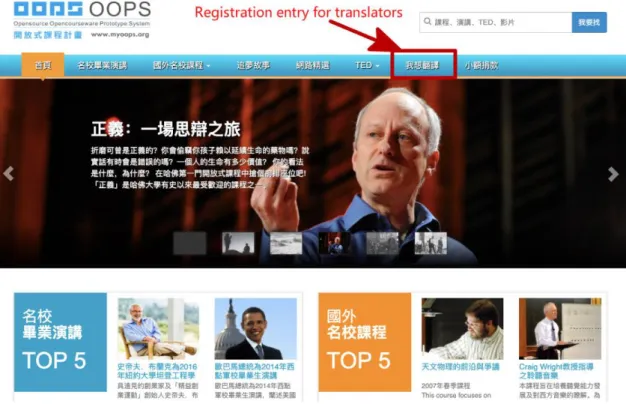
University and Utah State University) for the Great China Region, mainly run by volunteers from various disciplines worldwide. Similar to Coursera, OOPS also has a translation community. On the home page of OOPS, there is a clear entry point for people who want to join its translation community (see Figure 2.3). Once potential users have submitted the basic information online, including which language pair they can work with (English-Chinese or Japanese-Chinese), an editor will contact them directly. Lee et al. (2007) found that the success and sustainability of the community are related to three key issues: democratic leadership, participation incentives, and a forum for discussion and story sharing.
24https://www.transifex.com (Accessed: 5 March 2019) 25https://amara.org/en/ (Accessed: 5 March 2019) 26http://www.myoops.org (Accessed: 5 March 2019)
27 A web-based publication of virtually all MIT course content (https://ocw.mit.edu/index.htm Accessed: 5 March
Figure 2.3 Home page of OOPS
Regarding the tools for translating MOOCs, the work of Beaven et al. (2013) may be insightful. They researched a MOOC on open translation tools and practices. The MOOC aims to help students learn a range of online open translation tools (Amara, Transifex, Google Translator Toolkit) for the crowdsourcing of translation, dubbing and subtitling. Participants in the MOOC undertake hands-on translating work (from and into Spanish/English, French/English, and Brazilian Portuguese/English) by using different translation tools. The findings show that while MOOCs do play a role in bringing communities together to some extent, they don't always achieve effective collaboration, so the results in translation output are variable and there are challenges in quality assurance. They concluded that crowdsourcing can be the only solution to meet the large demand for the open translation of MOOCs.
At this point in time, there is no evidence of professional translation of MOOCs in China. Rather, MOOCs are translated either by amateur subtitling groups who are in partnership with MOOC platforms or by crowdsourcing. For instance, the EduInfinity Translation Group (http://www.edu-infinity.org/) is a Chinese fansub group which focuses on translating subtitles for MOOCs. They cooperated with Coursera in 2013 and edX in 2014, providing Chinese subtitles for the two platforms. The content of 网易公 开课 (http://open.163.com/), a Chinese website of open courses that is affiliated with the NetEase company, is similar to OOPS. However, unlike OOPS or Coursera, the website does not have an integrated translation platform, and the sources of its subtitles are unclear and varied. As Zhao (2013) put it, the website finds its translators either from fansub groups or by recruiting people who love subtitling and translating part-time or full-time for reimbursement. The translators usually focus on translating one type of course according to their expertise. After uploading their translated subtitles, the staff of the website will proofread them, record any errors in a form and send it to the translators for revision. Besides, the subtitles of some courses are just borrowed from the existing resources, as on the website there is a line saying: “The translation of some courses is reproduced from the free subtitles published by YYeTs, TLF and other fansub groups. NetEase disseminates and retains all subtitle copyright information. We sincerely thank them for their contributions.”
It can be seen that fansub groups play an important part in the translation of MOOCs in China. Fansubbing is a sub-set of audio-visual translation (AVT). As the name suggests, fansubbing refers to subtitling videos by fans. The emergence of fansubbing in the 1980s is a result of the work of Japanese anime fans, who produced and distributed subtitles
through anime clubs (Leonard, 2005). In 2006, Díaz-Cintas and Muñoz Sánchez defined a fansub as “a fan-produced, translated, subtitled version of a Japanese anime programme” (p.37). Looking back now, this definition is rather restrictive. As time went by, fansubbing was no longer limited to Japanese anime. It can now refer to any foreign TV show or movie, or any video of a superstar, as long as they have fans who are willing to translate the subtitles. Fansubbing is also called ‘amateur subtitling’ (Lepre, 2015) or ‘non-professional subtitling’ (Orrego-Carmona, 2015), which implies that fans do not have to be professional translators or receive any translation training. Thanks to the great accessibility of many means of interacting online and sharing different cultures in the 21st century, fans from around the world can easily and conveniently engage in collaborative work related to their idols or admired products, which leads to the proliferation of fansubbing. The fansubbing process usually involves raw video providers, translators, timers, typesetters, editors, proof-readers and encoders (Díaz-Cintas and Muñoz Sánchez, 2006). Usually, each role is played by a different person, and each member only completes the assigned task, but sometimes the same person can play different roles.
As Qi (2019) has pointed out about MOOCs, fansubbing is also entangled in copyright issues. A number of researchers have written about the legal issues that involve the copyright of releasing the subbed audiovisual programs (González, 2007; Rembert-Lang, 2010; He, 2014; Hsiao, 2014; Lee, 2014; Cai, 2015; Wang, 2015; Wongseree, 2019). The very act of translating copyright material may also be a breach of Intellectual Property Law, even before translated materials are distributed. The legal issues in fansubbing are very complex, because the distribution of anime, TV shows and movies is done via the
Internet, “a medium in which borders and nationalities” are “difficult” to delineate (Díaz-Cintas and Sánchez, 2006, p.45). The lack of enforcement of copyright laws is also a thorny problem, as different stakeholders hold different attitudes towards copyright (ibid.).
In China, people rely heavily on subtitles, both intralingual and interlingual. According to the experience of the researcher, almost all news, movies and TV shows have Chinese subtitles. As for Chinese fansubbing, Cai (2015) elaborates on its history in her study. She mentions BitTorrent, a forum providing the largest downloading and uploading of audiovisual products for Chinese netizens. This forum gained popularity between 2003 and 2004, giving rise to the emergence of fansubs in China (Hu, 2009). For instance, in 2006, the American TV series Prison Break was a big hit in China. Meanwhile, a report on Chinese fansubbers by Howard W. French (2006) was published in The New York Times. Cai mentions that both of these facts accelerated the development of fansubbing in China. The large number of fansubbing subtitles on the Internet has also become a valuable resource that can be used for constituting various corpora for training MT systems. For example, the OpenSubtitle corpus is a collection of parallel translated movie subtitles from http://www.opensubtitles.org/, which includes lots of fansubbing subtitles in various languages. The corpus (ZH-EN) has been used for the frequency analysis of the machine translated subtitles in this PhD research, see Sections 2.3.1 and 8.3 for more information.
2.2.4.2 MT and post-editing
MT has already been applied to language learning. For example, Zhang and Lu (2014) researched the application of MT in learning Chinese by Irish students. Briggs (2018) studied Korean students using MT to learn English. MT has also begun to play a role in the translation of MOOCs. This section provides an introduction to MT and post-editing. Section 2.3 will deal with MT of subtitles in depth.
Due to the fast-growing popularity of artificial intelligence, MT has gone through a series of changes and developments in the 21st century. To increase productivity, reduce cost and save time, MT has already been applied by a number of language service providers (LSPs). Milengo GmbH, a Berlin-based LSP reports in 2019 that compared to the traditional translation model, both cost and time-to-market is reduced by nearly 80% with managed MT.28 MT is also booming in China, with various local offerings emerging
in an endless stream (Hu, 2018). As Mike Dillinger (2016, p.4) stated in the keynote speech at the 12th conference of the Association for MT in the Americas, “75% of small
and large LSPs have at least a year’s experience with MT in 2016. In 2006, it was more like 5%.” Koponen (2016, p.143) reports that “post-editing of MT is indeed already an established part of the translation workflow in many professional contexts”. In the face of the large demand for MOOCs with short timelines, can MT be a solution? Before delving into this question, a brief introduction to MT and post-editing (PE) is presented.
28