Copyright by
Rebecca Ann Roesler 2013
The Dissertation Committee for Rebecca Ann Roesler Certifies that this is the approved version of the following dissertation:
Development and Application of a Framework for Observing Problem
Solving by Teachers and Students in Music
Committee:
Robert A. Duke, Supervisor Laurie S. Young
Eugenia Costa-Giomi Judith Jellison
Development and Application of a Framework for Observing Problem
Solving by Teachers and Students in Music
by
Rebecca Ann Roesler, B.Music; M.Music
Dissertation
Presented to the Faculty of the Graduate School of The University of Texas at Austin
in Partial Fulfillment of the Requirements
for the Degree of
Doctor of Philosophy
The University of Texas at Austin
August 2013
iv
Acknowledgements
A project of this magnitude is only possible through the contributions of countless individuals. I would like to acknowledge those who have influenced both the writing and the writer of this dissertation, to whom I am indebted and grateful.
To my colleagues, professors, and the energetic students of the Butler School of Music: thank you. You have brought joy and richness to this experience. My advisor, Robert A. Duke, has been a steadying anchor. He has wisely offered, in critical moments, invaluable suggestions that have increased the clarity and quality of this dissertation. My professors Laurie Scott, Eugenia Costa-Giomi, Judith Jellison, Jacque Henninger, and Diane Schallert have enlarged my understanding regarding this project and well beyond. My colleagues Da-Laine Chapman, Rebecca Atkins, Laura Brown, Ellary Draper, James Fidlon, and Travis Marcum provided valued feedback and assisted with reliability.
I must acknowledge my greatest cheerleaders, my family. To my parents, Pam and Larry Roesler, who taught me early the value of an education and the discipline of work before play, thank you. To my siblings, Eric, Teresa, and Amy, who have shaped me in ways they and I do not fully understand, thank you.
I do not know how I could have survived this journey without my friends in the Shoal Creek Ward of The Church of Jesus Christ of Latter-day Saints. They have been there for me from day one, “in every time of trouble.” Their presence in my life has been one of the greatest blessings of this season.
Finally, I thank my God, from whom all blessings flow, for body and mind, a rich and beautiful world, and the gift of knowledge.
v
Development and Application of a Framework for Observing Problem
Solving by Teachers and Students in Music
Rebecca Ann Roesler, Ph.D. The University of Texas at Austin, 2013
Supervisor: Robert A. Duke
The development of problem solving capabilities is an essential part of intellectual independence, yet the nature of problem solving in music instruction has not been investigated systematically. The purposes of the current study were to describe the process of problem solving in the context of music learning and to elucidate the relationship between teacher behavior and learners’ active participation in solving musical and technical problems.
I analyzed approximately 43 hours of private and small-group lessons taught by five internationally-renowned artist-teachers in music. I also analyzed in greater detail 161 rehearsal frames (intervals of instructional time devoted to definable proximal goals) excerpted from recorded lessons by describing the behaviors of teachers and students that led to productive learning outcomes.
The process of problem solving was found to comprise five components: establish goals, evaluate performance, conceive and consider options, generalize and apply principles, and decide and act. In assessing the extent of teachers’ and students’ involvement in problem-solving, I found that teachers promoted change-effecting behaviors in learners by instigating the pursuit of a goal, and then prompting learners to assume responsibility for one or more of the subsequent problem-solving components. In
vi
this way these teachers not only brought about change in learners’ performance, but also structured ways for learners to practice bringing about change in their own performance.
Table of Contents
List of Tables ... xiii
List of Figures ...xv
List of Rehearsal Frames ... xvi
Chapter 1: Introduction ...1
Why learner independence? ...2
Why not learner independence? ...6
Active participation in problem solving ...8
Goal pursuit as problem solving ...9
Purposes of the study ...10
Limitations of the study ...12
Chapter 2: Review of Literature ...13
What is involved in problem solving? ...14
Models describing the process of problem solving ...18
Creative problem solving within corporate business ...19
Problem solving during children’s monetary decision- making ...20
Problem solving by patients with diabetes ...22
Mathematics problem solving ...24
Science problem solving ...26
Infant problem solving during spoon-feeding ...26
Establish goal ...29
Evaluate performance ...31
Conceive and consider options ...33
Apply principles ...34
Decide and act ...37
Problem solving in music settings ...40
Problem solving by music learners ...45
Problems with problem solving ...48
Problems with components of problem solving ...48
Working memory capacity ...51
Knowledge base ...53
Inappropriate transfer ...55
Teacher assistance with learner problem solving ...56
Literature investigating how to facilitate problem solving ...57
Promoting generalization and transfer of knowledge through principles and examples ...58
Presenting contrasting options, positive/negative exemplars ...61
Adjusting the complexity of the goals learners seek ...62
Scaffolded problem solving ...63
Feedback and goals ...64
Literature investigating teacher-facilitated learner problem solving in music ...68
Training error detection and self-evaluation ...68
Training expressive performance through problem solving ...71
Further investigation recommended ...73
Chapter 3: Development of a Framework for Describing Problem Solving: A Model for Analysis ...74
Participants ...74
Development of the Model ...79
Preliminary analysis of full-length lessons ...79
Analysis of rehearsal frames ...80
Selection of rehearsal frames ...80
Systematic description of the components of problem solving ...82
Examples of problem solving ...83
Observations of problem solving components ...88
Establish goals ...88
Conceive and consider options ...92
Generalize and apply principles ...94
Decide and act ...97
Application of the model to define teachers’ and learners’ contributions to problem solving ...98
Observation procedure ...99
Behavior Codes ...99
Verbalizations ...99
Inferences based on non-verbal behaviors ...100
Teacher and learner performances ...102
Reliability ...105
Results ...106
Frequency of problem solving behaviors across full-length lessons and rehearsals ...106
Examples of combinations of teacher and learner problem- solving behaviors ...109
Other examples of combinations of teacher and learner problem- solving behaviors observed ...114
Discussion ...116
Chapter 4: Teacher Behaviors Preceding Learner Problem Solving ...118
Method ...119
Definitions of teacher behaviors preceding learner problem solving 119 Varying specificity of directives ...120
Varying specificity of feedback ...121
Conceiving and demonstrating contrasting options ...122
Stating principles ...122
Asking questions that invite practice of problem solving skills ...123
Deliberately refraining from solving the problem for the learner ...124
Learner problem solving behaviors following each teacher behavior ...124
x
Reliability ...125
Results ...126
Discussion ...129
Discussion and examples of each teacher behavior preceding learner problem solving ...132
Specificity of directives ...132
Specificity of feedback ...135
Learners’ own performances as options ...139
Reconstructing problems, components of problems ...140
Stating principles ...141
Asking questions that invite practice of problem-solving skills ...143
Deliberately refraining from solving problems for learners ...145
Chapter 5: Teacher Behaviors That Address Future Learner Problem Solving ..148
Examples and discussion of each teacher behavior ...149
Acknowledging choices, goals of learners ...149
Acknowledging learners’ agency ...152
Giving Practice Directives ...154
Gradually decreasing teacher involvement ...155
Applying the same principle in different contexts throughout a lesson ...157
Chapter 6: Frequency of Teacher Behaviors and Learner Problem-Solving Behaviors in Full-length Lessons and Chamber Rehearsals ...161
Full-length lessons ...161
Results ...162
Discussion ...165
Two chamber music rehearsals ...168
Results and Discussion ...169
Chapter 7: Discussion ...172
Problem solving model ...172
Problem solving by teachers and learners ...174
Discussion of findings ...175
Complexity and interrelatedness of problem solving: Why students may struggle ...176
Toward learner independence: Scaffolded problem solving ...178
Directing attention ...180
Feedback and directives: When less is more ...181
Knowledge is power ...183
Implications for education ...184
Teacher education and teacher evaluation ...185
Teaching learners to practice ...186
Creative problem solving and expressive performance ...187
Suggestions for further research ...188
Apply this study within other contexts ...188
Experimental exploration of successful and unsuccessful problem solving ...189
Questions related to teacher education ...189
A framework for further research ...190
Appendix: Transcripts of Rehearsal Frames Illustrating Teacher Behaviors and Learner Problem Solving Behaviors ...192
Organization: Teacher Behaviors ...192
Directives: Non-Specific ...193 Directives: Outcome-Specified ...195 Directives: Specific ...197 Feedback: Non-Specific ...198 Feedback: Outcome-Specified ...199 Feedback: Specific ...200 Demonstrating Options ...201 Stating Principles ...208
Questions Prompting Principle Statements ...216
Questions Prompting Decisions ...219
Refraining from Answering the Learner ...220
Acknowledging Learners’ Choices or Goals ...224
List of Tables
Table 1! Problem-solving components of models developed through analysis of creative problem solving in business ...21! Table 2 Problem-solving components of models developed through analysis
of daily decision-making pertaining to money
(Lee et al., 2012) and personal health (Hill-Briggs, 2003) ...21! Table 3 Problem-solving components of models developed through analysis
of science (Camacho & Good, 1989) and mathematics
(Polya, 1957; Zelazo et al., 1997) learning ...25! Table 4 Problem-solving components identified in behaviors of infants
attempting to spoon feed, within 3 stages of development as
outlined by McCarty et al. (1999) ...27! Table 5 Characteristics of Teachers ...78! Table 6 Rates per hour of teacher and student problem-solving behaviors
within 15 lessons ...107! Table 7 Mean rates per hour of teacher and learner problem-solving
behaviors within 15 lessons (3 lessons per teacher) ...108! Table 8 Rates per hour of teacher and learner problem-solving behaviors
within two chamber music rehearsals ...109! Table 9 Number and type of problem solving behaviors attributed to
teachers and learners within 10 rehearsal frames, in order
from least to most learner involvement ...115! Table 10 Learner problem-solving behaviors following each teacher
Table 11 Teacher problem-solving behaviors, learner problem-solving
behaviors, and other teacher behaviors per hour in 15 lessons ...163! Table 12 Teacher problem-solving behaviors, learner problem-solving
behaviors, and other teacher behaviors per hour, averaged across three lessons for each teacher ...164! Table 13 Teacher problem-solving behaviors, learner problem-solving
behaviors, and other teacher behaviors per hour during two
List of Figures
Figure 1. Description of problem-solving components in business by Isaksen and Dorval (1993), from Buijs et al. (2009), p. 287. ...19! Figure 2. Description of problem solving components of monetary decision
making, from Lee et al. (2012), p. 29. ...20! Figure 3. “A schematic of disease self-management behaviors in diabetes,” from
Hill-Briggs (2003), p. 183. ...23! Figure 4. Analysis of four stages of infant spoon-feeding, from McCarty et al.
(1999), p. 1100. ...28! Figure 5. Rate at which each learner problem solving behavior followed each
List of Rehearsal Frames
Rehearsal Frame 1:! Problem solving by Donald McInnes ...84!
Rehearsal Frame 2:! Problem solving by Richard Killmer ...85!
Rehearsal Frame 3:! Problem solving by Nelita True ...86!
Rehearsal Frame 4: ! Problem solving by Joseph Alessi ...87!
Rehearsal Frame 5:! Problem solving by Stephen Clapp ...87!
Rehearsal Frame 6:! Problem solving by Stephen Clapp and his student ...110!
Rehearsal Frame 7:! Problem solving by Richard Killmer and his student ...111!
Rehearsal Frame 8:! Problem solving by Donald McInnes and his student ...112!
Rehearsal Frame 9:! Problem solving by Nelita True and her student ...113!
Rehearsal Frame 10:! Problem solving by Joseph Alessi and his student ...114!
Rehearsal Frame 11:! Transcript of DirectiveNS1-Alessi identifying Alessi’s non-specific directives. ...134!
Rehearsal Frame 12:! Transcript of DirectiveA1-Clapp identifying Clapp’s attention directive. ...135!
Rehearsal Frame 13:! Transcript of FeedbackNS1-Clapp identifying non-specific feedback. ...136!
Rehearsal Frame 14:! Transcript of FeedbackAD1-Killmer identifying attention-directing feedback. ...137!
Rehearsal Frame 15:! Transcript of Options4-True identifying True’s demonstrations of options. ...138! Rehearsal Frame 16:! Transcript of Options3-True identifying True’s
Rehearsal Frame 17:! Transcript of Options6-Alessi identifying Alessi’s
reconstruction of the learner’s performance. ...140!
Rehearsal Frame 18:! Transcript of Refrain1-McInnes identifying the principle McInnes provided to guide the learner’s decision. ...142!
Rehearsal Frame 19:! Transcript of QuestionE1-Alessi and QuestionP1-Alessi identifying Alessi’s questions prompting the learner to evaluate and later apply a principle. ...144!
Rehearsal Frame 20:! Transcript of QuestionD1-True identifying True’s question prompting the learner to make a decision. ...145!
Rehearsal Frame 21:! Transcript of Refrain2-Alessi identifying Alessi’s deliberate restraint from answering the learner’s question. ...146!
Rehearsal Frame 22:! Transcript of LearnerChoice1-True. ...150!
Rehearsal Frame 23:! Transcript of LearnerChoice2-True. ...151!
Rehearsal Frame 24:! Transcript of LearnerChoice3-McInnes. ...152!
Rehearsal Frame 25:! Transcript of Principle4-Clapp and Principle5-Clapp discussing the learner’s ability to independently apply a principle practiced frequently in different contexts throughout a lesson. ...159!
Rehearsal Frame 26:! Transcript of DirectiveNS1-Alessi. ...193!
Rehearsal Frame 27:! Transcript of DirectiveNS2-Alessi. ...195!
Rehearsal Frame 28:! Transcript of DirectiveO1-Clapp. ...195!
Rehearsal Frame 29:! Transcript of DirectiveO2. ...196!
Rehearsal Frame 30:! Transcript of DirectiveS1-True. ...197!
Rehearsal Frame 31:! Transcript of DirectiveS2-McInnes. ...197!
Rehearsal Frame 33:! Transcript of FeedbackNS2-Clapp. ...198!
Rehearsal Frame 34:! Transcript of FeedbackO1-Alessi. ...199!
Rehearsal Frame 35:! Transcript of FeedbackO2-Killmer. ...200!
Rehearsal Frame 36:! Transcript of FeedbackS1-Killmer. ...200!
Rehearsal Frame 37:! Transcript of Options1-Clapp. ...201!
Rehearsal Frame 38:! Transcript of Options2-True. ...202!
Rehearsal Frame 39:! Transcript of Options3-True. ...203!
Rehearsal Frame 40:! Transcript of Options4-True. ...203!
Rehearsal Frame 41:! Transcript of Options5-Alessi. ...204!
Rehearsal Frame 42:! Transcript of Options6-Alessi. ...205!
Rehearsal Frame 43:! Transcript of Options7-Clapp. ...205!
Rehearsal Frame 44:! Transcript of Options8-True. ...206!
Rehearsal Frame 45:! Transcript of Options9-Killmer. ...207!
Rehearsal Frame 46:! Transcript of Principle1-McInnes. ...208!
Rehearsal Frame 47:! Transcript of Principle2-Killmer. ...209!
Rehearsal Frame 48:! Transcript of Principle3-Alessi. ...210!
Rehearsal Frame 49:! Transcript of Principle4-Clapp. ...211!
Rehearsal Frame 50:! Transcript of Principle5-Clapp. ...212!
Rehearsal Frame 51:! Transcript of Principle6-McInnes. ...213!
Rehearsal Frame 52:! Transcript of QuestionE1-Alessi...214!
Rehearsal Frame 53:! Transcript of QuestionE2-Alessi...215!
Rehearsal Frame 54:! Transcript of QuestionP1-Alessi. ...216!
Rehearsal Frame 55:! Transcript of QuestionP2-Clapp. ...217!
Rehearsal Frame 56:! Transcript of QuestionP3-Clapp. ...218!
Rehearsal Frame 58:! Transcript of Refrain1-McInnes. ...220!
Rehearsal Frame 59:! Transcript of Refrain2-Alessi. ...221!
Rehearsal Frame 60:! Transcript of Refrain3-Alessi. ...223!
Rehearsal Frame 61:! Transcript of LearnerChoice1-True. ...224!
Rehearsal Frame 62:! Transcript of LearnerChoice2-True. ...225!
Rehearsal Frame 63:! Transcript of LearnerChoice3-McInnes. ...226!
Rehearsal Frame 64:! Transcript of LearnerChoice4-True. ...227!
Chapter 1: Introduction
Most learners engage in music study with the intention of accomplishing musical goals. Whether those goals are defined by teachers, parents, or the learners themselves, success in music instruction and practice is best measured by the extent to which goals are achieved (Duke, 1999). The extent and complexity of goals vary throughout the course of music learning. Expanding the tonal palette, increasing facility and speed, playing a double-stop in tune, or conveying an expressive idea in a phrase in Beethoven’s Emperor Concerto are all goals to which learners may aspire. As goals are met, progress is made. Until goals are met, they are problems to be solved. Thus, music learners make progress as teachers and learners solve perceptual, physical, expressive, and intellectual problems.
It is often the case that learners’ problems are solved more quickly and effectively under the guidance of teachers than when learners are working on their own (Hallam, 2001), which is why learners seek training from “more knowledgeable others” (Vygotsky, 1978). Skillful teachers lead the way through the morass of challenges in guiding students toward positive change, and make it possible for learners to move along the path to competence.
Armed with a rich knowledge base and keen perceptual skills, excellent teachers employ a vast repertoire of strategies as they guide learners through the identification, prioritization, and solution of problems. They hear differences to which learners have not yet become attuned. They can model techniques or musical ideas that learners have not attempted or mastered.
Yet most dedicated music students spend the majority of their practice time outside the presence of their teachers, confronting problems on their own. To be effective
during independent practice, learners must decide which problems to pursue in the moment and must determine how to overcome them without the aid of their teachers. Further, to learn new material, even when related to what was learned during instruction, students must apply learned skills in other contexts that have not been taught explicitly. What happens when guidance from the “more knowledgeable other” is removed? Will skills acquired in lessons be sustained during individual practice? Will learners be able to continue improving during the interim between lessons, when they will inevitably encounter problems that have not been addressed by their teachers?
Teachers may expect students to solve problems independently. But the capacity to do so seldom develops on its own; it is taught and nurtured by skillful teachers who recognize learner independence as a requisite component of successful musicianship.
WHY LEARNER INDEPENDENCE?
Teachers share many common aspirations for their students: achieve a high standard of performance, perform expressively, participate in music throughout life, experience joyful music making. The attainment of each of these objectives is, at least in part, related to the attainment of another objective: developing independence. Accomplishing most meaningful music goals is possible only if learners can continue to progress beyond the presence of their teachers. Learners who are dependent on their teachers, who learn only through the active involvement of their teachers, are limited in their ability to acquire and refine the skills and thinking required or successful music making. Learners learn more, learn better, and learn more happily if they receive opportunities and develop the capacity for independent learning (Deci & Ryan, 2000; Hmelo-Silver, 2004; McPherson & McCormick, 1999; Smolej Fritz & Peklaj, 2011;
Zimmerman & Pons, 1986). Learner independence can encompass multiple learner behaviors and attitudes. Many research terms are related to learner independence, including autonomy (Deci & Ryan, 2000), agency (Contento, Koch, Lee, Sauberli, & Calabrese-Barton, 2007), regulated learning (McPherson & Zimmerman, 2002), self-directed learning (Loyens, Magda, & Rikers, 2008), and problem-based learning (Hmelo-Silver, 2004). Autonomy refers to one’s freedom to act on the basis of internal motivation as opposed to external controls. It includes the opportunity to make choices rather than be directed by another. Agency, as used in the literature, refers to one’s attribution of causality to self. If one has agency, she feels and acknowledges she has been the impetus behind a resulting action or circumstance. Self-regulated learning research has investigated learners’ behaviors during independent learning tasks, and has described planning, evaluating, and seeking help from other sources as components of these processes.
The aspects of learning listed above have all been investigated in relation to their contributions to learners’ success in acquiring knowledge and skills. For example, learner motivation has been found to increase as learner autonomy increases. Under some circumstances, intrinsic motivation has been found to decrease with the use of external rewards, threats, deadlines, directives, and other external controllers (Amabile, DeJong, & Lepper, 1976; Deci, 1971; Deci, Koestner, & Ryan, 1999, 2001; Deci & Ryan, 2000; Koestner, Ryan, Bernieri, & Holt, 1984; Lepper, Greene, & Nisbett, 1973; Reeve & Deci, 1996), whereas intrinsic motivation has been associated with opportunities for choice and self-directed behavior (Deci et al., 1999; Isen & Reeve, 2005; Reeve & Deci, 1996; Zuckerman, Porac, Lathin, Smith, & Deci, 1978). Further, students in classroom environments that are supportive of autonomy are more curious and willing to take on
challenges than are those in more controlling classroom environments (Deci, Nezlek, & Sheinman, 1981; Ryan & Grolnick, 1986).
Other authors have also found connections between self-regulated learning and motivation (e.g., McPherson & McCormick, 1999; Smolej Fritz & Peklaj, 2011). Zimmerman and Pons (1986) found that self-regulated learning was a predictor of achievement in school, and independent learning has been shown to increase the effectiveness of learning activities (Hmelo-Silver, 2004). A similar link has been found between self-regulated learning abilities and achievement in music (Cantwell, Jeanneret, Sullivan, & Irvine, 2000). Chung (2006) observed a correlation between music students’ use of self-regulated learning strategies and higher music jury scores.
Musicians’ health has also been linked to self-regulating abilities (Williamon, Wasley, Burt-Perkins, Gingsborg, & Hildebrandt, 2009), which is perhaps not surprising, since, to avoid injury, many musicians must solve problems in technique that may be physically detrimental. Technical problems, especially those involving tension, are sometimes difficult for an observer to detect; yet a music learner, through his own awareness and problem solving, may identify and ameliorate physical practices that are ultimately unhealthy.
Expressivity and creativity are particularly dependent on learners’ ability to act for themselves. Students are more likely to explore, extend themselves, risk, and think creatively when teachers and parents provide opportunities for choice (Benware & Deci, 1984; Grolnick, Deci, & Ryan, 1997; Grolnick & Ryan, 1987). Consider that a learner who has limited independence also has limited opportunities to be creative. Learners who develop the ability to solve problems have a greater capacity for creativity than those who do not (see Isaksen & Treffinger, 2004; Lin & Cho, 2011). Learner creativity is thus contingent on learners’ abilities to act for themselves—to organize the materials and
skills available to them to accomplish goals they pursue. Broomhead (2009) found that expressivity increased as learners had opportunities to develop the skills of problem solving.
All of these findings provide a rationale for ensuring that learners receive opportunities to learn independently and, at least as important, develop skills that increase their success in doing so. This is particularly consequential in music, given the fact that learners commonly spend a majority of their music learning time outside the presence of teachers, and that learners’ capabilities for independent progress are consistently found lacking (Bergee, 1993, 1997; Hewitt, 2002, 2005, 2011a; McPherson, 2005). Both Bergee (1993, 1997) and Hewitt (2002, 2005, 2011) found that music learners often struggle to evaluate themselves accurately. Rohwer and Polk (2006) reported that 8th
-grade students could identify few practice strategies that they used in practice. Students interviewed by McPherson practiced largely without purpose; they reported that much of their independent practice time was spent playing through pieces, not seeking to accomplish positive musical change (McPherson, 2005).
Problem solving in practice is a hallmark of expert musicianship and separates successful from unsuccessful music learners (Chaffin & Imreh, 2001; Rohwer & Polk, 2006). Rohwer and Polk (2006) found that 8th
graders whose practice involved proactive error correction made significantly higher practice gains than did those who played through pieces holistically without correction. Teachers who increase learners’ capability to progress independently thereby increase the productivity of learners’ practice and the quality of their music experience.
WHY NOT LEARNER INDEPENDENCE?
Several obstacles may limit the opportunities students are afforded to increase their independence. These obstacles may include limited rehearsal or lesson time, or a lack of positive results when teachers relinquish some control of the learning process to their students.
One challenge in pursuing learner independence as an instructional priority is simply the time it requires. Music instruction time is often extremely limited given its expected outcomes. Looming performances, difficulty of repertoire, and other pressures demand the most efficient use of instruction time. Teachers often solve problems far more quickly than learners do, and many teachers are loath to sacrifice efficiency and pacing and relinquish decision-making to learners.
Another obstacle teachers often encounter when seeking to develop learner independence is that attempts to allow learners to solve problems on their own are often unsuccessful (Bergee, 1993, 1997; Hewitt, 2002, 2005) and can be negative experiences for teachers and learners. An anecdote provided by Broomhead (2005) exemplifies the discrepancy between teachers’ expectations about student independence and students’ ability to apply skills and knowledge independently:
I taught a high school chamber ensemble composed mostly of senior students whom I had taught continually since the eighth grade. What a wonderful experience it was to conduct students who had received the expressive training I offered to eighth graders and who had been sensitized to my conducting gestures for years. This was the most expressively responsive group I had ever conducted. I thought that if ever a group of ensemble students was ready to strike out on its own musically, this was the group.
I assigned the students to select and prepare a song with no help from me and perform it at their graduation ceremony. The performance was disheartening. After all those years of great training, the students sang with no noticeable phrase shaping. What could have gone wrong? They
had been carefully watching an expressive conductor and skilled interpreter of music for a long time. They had also heard countless verbal explanations regarding musical expression. They had even demonstrated an ability to shape phrases! But somehow their training had not been enough to establish independent expressiveness. (Broomhead, 2005, p. 64)
As did Broomhead, teachers and learners may fail to anticipate the challenges involved in solving what seem to be conquerable problems, and as a result teachers may simply avoid ceding decision-making responsibilities to their students.
Many teachers are surprised by the extent to which learners experience such difficulty solving problems on their own. Broomhead (2005) acknowledges above that he had not provided learners the means to create expressiveness independently.
Of course, experienced teachers and musicians have largely automatized many of the skills required for performing and teaching music. Clearly identifying the components of problem solving in music may assist teachers in their planning and teaching by increasing their attention to the aspects of problem solving that can be cultivated in their students. This has yet to be accomplished in music research. Learner independence in music has not been adequately defined, the skills involved in promoting learner independence have not been identified, and no consensus exists as to the means of investigating these skills.
Considering the benefits of learner independence and difficulties associated with its development, it is surprising that there is a dearth of literature on the subject within music education research. One reason for this may be that there is no systematic means for describing and analyzing this aspect of learning. As can be seen in the research cited above, different terms have been used to express various facets of learner independence. The definitions of these terms overlap to some degree, but there is a lack of clear consensus as to their precise meanings and the relationships among them. What is learner independence? How is it measured? How does it manifest itself in learners’ behavior?
Certain aspects of learner independence are included in studies involved in self-regulated learning (Byrne, 2005; McPherson & McCormick, 1999; McPherson & Zimmerman, 2002; Nielsen, 2001; Smolej Fritz & Peklaj, 2011; Zimmerman & Pons, 1986), which examine behaviors such as goal setting, self-evaluation, self-monitoring, and seeking assistance from teachers and peers. These studies reveal benefits of self-directed learner behavior, but they do not clearly identify or explain learner behaviors that lead to solutions of specific problems. It is thus difficult to determine which learner behaviors contribute to learners’ success. What is needed is a means of measuring learner independence and a framework that explains the skills involved in learner independence.
ACTIVE PARTICIPATION IN PROBLEM SOLVING
Measuring the extent to which learners become independent is a daunting challenge that is beyond the scope of the current research. Yet, it seems clear that if learners are to function independently, they must actively participate in solving musical problems while they acquire knowledge and develop skills. If learners are not actively participating in problem solving in the presence of their teachers, it is likely the case that their capacity to do so in the future will be limited.
If learners are to become independent, they must assume a more active role as agents of change—active contributors in formulating solutions to the problems they encounter. In other words, learners who can function independently in the future must practice doing so in the present, when their teachers are available to provide scaffolded opportunities to try and fail and adjust and succeed.
As students engage in various aspects of problem solving in the presence of teachers, making meaningful contributions to their own progress, they make steps toward
learning on their own. This central feature of musical development is the focus of the current study: the means by which learners engage in problem solving while in the presence of their teachers.
Goal pursuit as problem solving
The stuff of human progress is the accomplishment of goals. Human activity comprises conscious and subconscious goal pursuits. Out of a desire to see indoors at night, people invented candles, gaslights, and light bulbs. People who wish to eat initiate behavior that makes eating possible, such as planting and harvesting, or obtaining money and driving to the store. People who wish to communicate purchase cell phones and set up chat accounts. Goal pursuit also includes short-term intentional action, such as grabbing a fork to eat food, smiling to express friendship, and opening a door to enter a room.
Goals that are not yet accomplished can be conceived as problems to be solved. Progress in learning, then, is a sequence of goal setting, problem solving, and eventual attainment.
The accomplishment of instructional goals (targets) is the fundamental element that defines progress in music instruction. It is for this reason that Duke (1999) recommended that systematic research be organized around units of analysis he dubbed rehearsal frames, periods of instructional time in which attention is devoted to accomplishing identifiable proximal goals. Prior to Duke’s proposal, research analyses had typically been conducted over entire rehearsals or lesson without regard for learners’ accomplishment moment to moment (e.g. Francisco, 1998; Menchaca, 1988). Instead, Duke argued, analysis of music learning will be most effective when analyses are structured around the achievement of proximal goals.
Since Duke’s call to action, a number of authors have analyzed music learning at the instructional target level. Studies utilizing the rehearsal frame as the unit of analysis thus far have focused on pacing as measured by the duration of student and teacher activity (Cavitt, 2003; Colprit, 2000; Worthy & Thompson, 2009), rehearsal frame target categorization (Colprit, 2000; Worthy & Thompson, 2009), duration and extent of modeling (Colprit, 2000; Worthy, 2003), and type and frequency of feedback associated with various target categories (Cavitt, 2003).
Although these extant observations are instructive and important, they do not fully describe the actual process by which targets are accomplished. Given the assertion that learners’ achievement of instructional goals should guide the analysis of teaching effectiveness, then the process by which these goals are achieved is a critical element demanding illumination. It seems important to define with some precision the individual components that contribute to the solution of problems in music study.
Before learner problem solving and its development can be considered, the process of problem solving in music settings must be described clearly. A description of the problem solving process to guide future analyses is an important step in understanding the means by which learners attain independence and learn to solve problems on their own. For the purposes of my work in this dissertation, I sought to observe the degree to which learners actively participated in problem solving while in the presence of teachers.
PURPOSES OF THE STUDY
The purposes of the current study were to develop a framework for describing the problem-solving process in music learning and to apply the framework in the analyses of
music instruction by master teachers. My analyses describe learners’ involvement in problem solving and how teachers promote learners’ involvement in problem solving. The study was designed to answer the following questions:
1. What are the components of the problem solving process? How do they interact to bring about change?
2. To what extent to teachers and students assume responsibility for each component of problem solving?
3. What teacher behaviors precede learner problem-solving? I sought to accomplish the following goals:
1. Describe the components of musical problem solving and the role of each component in accomplishing musical targets. (Chapter 3)
2. Identify the problem-solving components that are performed by teachers and students within individual rehearsal frames. (Chapter 3)
3. Identify teacher behaviors that precede learner problem solving, and describe the extent of learners’ involvement in problem solving following specific teacher behaviors. (Chapter 4)
4. Describe teacher behaviors that do not prompt learner problem solving in the moment, but may affect learner problem solving over the long-term. (Chapter 5) 5. Measure the rates of teacher and learner problem solving components during the
Limitations of the study
The observations in the current study focused on problem solving, starting from initial observations during which I identified instances of productive changes in student performance or thinking. Although I observed problem-solving components outlined throughout the course of the recorded lessons I analyzed, other aspects of teaching and learning that I did not include in my definitions of problem-solving activity most certainly affected teacher and student behaviors and their interaction in ways not accounted for in my analyses.
The current study does not involve experimental comparisons of successful and unsuccessful teaching. All of the observations involved teachers and students performing at the highest levels of accomplishment, and as such the results I obtained from this sample may not generalize to other levels of instructional or musical skill. Although there are many similarities among the teachers I observed, the sample was relatively small and was not selected randomly; therefore generalizations even to other teachers of this caliber should be made with appropriate cautions.
Further, the analyses involve one-on-one teacher-student interactions in private studio settings, with the exception of two chamber music rehearsals. The application of this framework has yet to be investigated in large ensemble settings. Further investigation is required to assess the generalizability of these findings to large groups.
I assessed the frequency and relative timing of behaviors by the teachers and students I observed. Although it would be tempting to ascribe causality to the relationships among behaviors I observed, such assertions are unjustifiable without considerable additional research.
Chapter 2: Review of Literature
Progress in music performance comprises the realization of numerous intermediate goals, each acquired through the application of a host of behavioral and perceptual skills. In the process of developing technical capacity or preparing repertoire, musicians make numerous corrections, adjustments, and decisions about what they do. Ideally, their ongoing behavior is guided by clearly defined goals that help focus attention and effort advantageously. Each performance goal, each technical goal, each communicative goal, until realized, is a problem to be solved. Thus, the process of musical development is replete with goal pursuit, requiring ongoing problem solving.
Problem solving, the process by which learners achieve goals (see Blech & Funke, 2010; Gerlach, et al., 2011), is a critical human activity that has been widely discussed in the literature of mathematics education (e.g., Erbas & Okur, 2012; Kotsopoulos & Lee, 2012; Levav-Waynberg & Leikin, 2012; Moore & Carlson, 2012; Reed, et al., 2012), science education (e.g., Camacho & Good, 1989; Solaz-Portolés & Sanjosé-López, 2009; Tsai, Hou, Lai, Liu, & Yang, 2012), information processing, (e.g., Argelagós & Pifarré, 2012), creativity (e.g., Isaksen & Treffinger, 2004; Lin & Cho, 2011; Walinga, et al., 2011), corporate business (e.g., Buijs, Smulders, & van der Meer, 2009), infant and child development (e.g., Lee, Koh, Cai, & Quek, 2012; Elsner & Schellhas, 2012; Keen, 2011; Madhavi, 2008; Ryu, 1994; Willatts, 1999), educational psychology (e.g., Price & Driscoll, 1997), educational neuroscience (e.g., Ablin, 2008), crime analysis (e.g., Celik, 2011), health care (e.g., Briggs & Gemmell, 2007; Hill-Briggs, 2003; Hill-Briggs et al., 2011; Wang et al., 2012), and occupational health (e.g., Schmitt, Zacher, & Frese, 2012). As illustrated by this great diversity of domains that depend on successful problem solving, it is a nearly ubiquitous human activity. It follows,
then, that improving the effectiveness of music teaching and learning would also benefit from the study of problem solving.
In this review I describe the studies cited above in some detail and explain their contributions to a general understanding of problem solving. The research included in this review investigates problems encountered in varied domains of human activity, and in so doing includes different populations of participants performing a wide range of different activities. The target tasks, the end goals, and the consequences associated with solving the problems participants encounter all vary in terms of their nature and complexity. Yet, all of the research considers basic elements of problem solving that are generally applicable. From infants learning spoon-feeding (McCarty, Clifton, & Collard, 1999) to children making monetary decisions (Lee et al., 2012) to adults stabilizing blood glucose levels (Hill-Briggs, 2003), the problems encountered represent the process of problem solving and thus are germane to the topic of the present investigation: the process of problem solving during music learning.
WHAT IS INVOLVED IN PROBLEM SOLVING?
Examination of studies of problem solving in varied human experiences reveals common components of thinking and behavior that individuals encounter as they confront problems. To begin the review, I first describe two experiments that investigated problem solving by infants. The method of describing the infants’ behavior and the findings from the studies illustrate the fundamental features of working toward solutions to problems. The fact that the participants were nonverbal infants performing a very basic operation helps clarify the process under investigation while demonstrating the difficulties involved in conducting research of this type.
Consider the challenges an infant encounters as he attempts to bring food to his mouth with a spoon (McCarty et al., 1999; McCarty & Keen, 2005). McCarty et al. (1999) investigated the development of spoon-feeding ability in 9-, 14-, and 19-month-olds. They presented a spoon with food to infants over multiple trials, varying the orientation of the spoon relative to the infants’ hands. In their analysis of the infants’ behaviors, they described the following sequence: First, to initiate action, the child must want the perceived food—this is the desired goal, which presents a problem to be solved. In pursuing the goal, he must grasp the spoon and bring it to the mouth. This action requires the infant to choose which hand and what kind of grip to use in order for the bowl of the spoon to face the right direction. He then must hold and balance the spoon as the food travels to the mouth, then close the mouth over the bowl of the spoon. At this point, he evaluates whether he obtained the food. When presented a spoon with food again, the process begins again.
This analysis offers a detailed description of components of problem solving: seeking a goal (eat food), considering options for actions that may contribute to the attainment of the goal (manipulating the spoon orientation, choice of grasping hand, and grip on the spoon), making a decision about which option(s) to choose (evidenced by what the child actually does), and evaluating the extent to which the goal is achieved (was the food received?). This description reveals that something as seemingly simple as spoon-feeding actually involves a rather complex problem-solving process requiring a number of behavioral and perceptual skills.
Other studies offer similar descriptions of identifiable behaviors that can be observed within various human pursuits. As another example, consider monetary decision-making. What thought processes occur as one determines how money is spent? Lee et al. (2012) sought to identify these cognitive and metacognitive behaviors by
investigating the monetary decision-making of 136 5th-grade students through focus groups, drawings, and one-to-one interviews. The authors considered a decision to be made as a problem to be solved (Jonassen, 2012). They gathered data and identified the component behaviors that contributed to solving the problem of monetary decision-making.
Their results reveal the components of participants’ financial decisions, including establishing goals, evaluating, acquiring and applying knowledge, and considering options. Participants reported various goals that they sought when confronting a financial decision; these included meeting needs such as transportation, filling wants such as eating cake or acquiring a model airplane, purchasing a gift, or saving for future needs or wants. Participants’ descriptions of the decision-making process also included evaluations, such as evaluating the quality and price of products; acquiring and applying declarative knowledge such as financial principles learned from parents or knowledge as to why prices differed; and the consideration of options available such as different models of products, different places to buy the same products, and different prices. All of these components were found to influence participants’ final financial decisions.
As yet another example, consider patients with diabetes who must solve problems to regulate their blood glucose each day (Hill-Briggs, 2003). In a study establishing a model of patients’ self-management behavior, Hill-Briggs also describes evaluating, considering options, acquiring and applying knowledge, and making decisions. First, patients evaluate their glucose. If patients’ glucose monitors indicate they are hyperglycemic or hypoglycemic, there is a problem to be solved. In order to alter blood glucose, these adults must consider the food options available to them and decide which foods to eat and how much to eat. They may also consider altering their physical activity, or they may take medication. In order to make effective decisions, they must acquire
knowledge regarding the effects of foods, activities, and medication on glucose levels. As they make decisions about whether to change their behavior and how to act, they observe the effects of these decisions, potentially informing future decisions.
The components of problem solving that are present as children attempt spoon-feeding are strikingly similar to the components involved monetary decision-making and responses to a glucose monitor. Within all of these situations, participants seek goals (e.g., eat food, save money, or normalize glucose level), evaluate their current status and possibilities (e.g., assess food acquisition, the quality of products, or blood glucose levels), consider options (e.g., ways to grasp the spoon, products to be purchased, strategies that may alter glucose levels), apply knowledge (e.g., stores that have the best prices, or how often to take medication), and make decisions (e.g., turn the spoon, buy a plane, or eat less sugar).
Several studies have been conducted that describe the process of problem solving as a whole (Buijs et al., 2009; Camacho & Good, 1989; Lee et al., 2012; Hill-Briggs, 2003; S. G. Isaksen & Dorval, 1993; Kotsopoulos & Lee, 2012; McCarty et al., 1999; Osborn, 1953; Parnes, 1967; Polya, 1957; Zelazo, Carter, Reznick, & Frye, 1997). Although different authors and different disciplines describe the process of problem solving using varied language, nearly all of the studies I reviewed identify common components of the process. I identified five problem-solving components that appear within these various problem-solving analyses, and I use them as an organizing scheme for clarifying the current understanding of the process of problem solving. The five components are
• Establish goal
• Evaluate performance
• Apply principles
• Decide and act
Identifying these components is important for the informed investigation of problem solving in any field, including music instruction. In the sections that follow I first review the models of the problem solving process, and then consider studies that have examined the components of problems solving individually.
Models describing the process of problem solving
Models describing the components of problem solving have been developed through observing the problem solving experiences encountered in business (Buijs et al., 2009; Isaksen & Dorval, 1993; Osborn, 1953; Parnes, 1967), science and math learning (Camacho & Good, 1989; Kotsopoulos & Lee, 2012; Polya, 1957; Zelazo et al., 1997), infant spoon feeding (McCarty et al., 1999), and daily decision making pertaining to money (Lee et al., 2012) and personal health (Hill-Briggs, 2003). Strikingly similar models of problem solving emerged independently from these very different settings. Figures 1, 2, 3, and 4 illustrate these models. Tables 1, 2, 3, and 4 provide a comparative synthesis of the models to illustrate their parallel components, labeled with the terms I listed above.
Creative problem solving within corporate business
The Creative Problem Solving (CPS) model found in literature related to the field of business, as reviewed by Buijs et al. (2009), has evolved since Osborn’s original model (Osborn, 1953). Osborn first conceived of a model that described two stages: a divergent stage, labeled “generating options,” and a convergent stage, labeled “focusing options.” Other models followed. Parnes (1967) built on Osborn’s model but expanded it to include five components: fact finding, problem finding, idea finding, solution finding, and acceptance finding.
Later, Isaksen and Dorval (1993) generated a model with components similar in function to the components of the model by Parnes
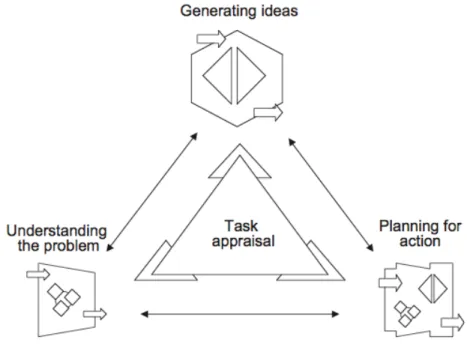
(1967): understanding the problem, generating ideas, planning for action, and task
Figure 1. Description of problem-solving components in business by Isaksen and Dorval (1993), from Buijs et al. (2009), p. 287.
appraisal. Although the component behaviors are similar, Isaksen and Dorval’s model represents a departure from previous models of creative problem solving, in that the four components in their model are interdependent rather than sequential (see Figure 1).
Others have described components of problem solving as having an interdependent nature, including the following two studies involving daily decision-making.
Problem solving during children’s monetary decision-making
Lee et al. (2012) established the interdependent nature of behavioral components of problem solving through their analysis of children’s monetary decision making. The
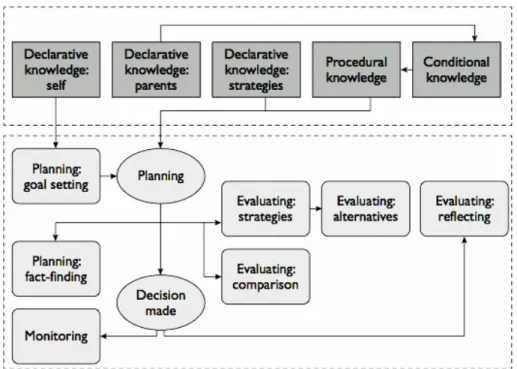
Figure 2. Description of problem solving components of monetary decision making, from Lee et al. (2012), p. 29.
T abl e 1 P robl em -s ol vi ng c om pone nt s of m ode ls de ve lope d t hr ough anal ys is of c re at iv e pr obl em s ol vi ng in bus ine ss P rob le m s ol vi n g c omp on en ts O sb or n ( 1953) P ar n es ( 1967) Is ak se n an d D or val ( 1993) E st abl is h G oa ls D ive rge nt s ta ge : G ene ra ti ng opt ions P robl em f indi ng U nde rs ta ndi ng t he probl em Cons ide r O pt ions Ide a f indi ng G ene ra ti ng i de as A ppl y P ri nc ipl es Conve rge nt s ta ge : F oc us ing opt ions F ac t f indi ng U nde rs ta ndi ng t he probl em M ake D ec is ions S ol ut ion f indi ng P la nni ng f or a ct ion E va lua te A cc ept anc e f indi ng T as k a ppra is al T abl e 2 P robl em -s ol vi ng c om pone nt s of m ode ls de ve lope d t hr ough anal ys is of dai ly de ci si on -m ak ing pe rt ai ni ng t o m one y (L ee et al ., 2012) and pe rs onal he al th (H il l-B ri ggs , 2003) P rob le m s ol vi n g c omp on en ts Le e et al . ( 2012) Hil l-Br iggs ( 200 3) E st abl is h G oa ls P la nni ng: goa l s et ti ng S ee k t o norm al iz e bl ood gl uc os e Cons ide r O pt ions E va lua ti ng: s tra te gi es , a lt erna ti ve s Cons ide r c ont rol li ng re spons es (n ut ri ti on , p hys ic al A ct ivi ty , or m edi ca ti on ) E va lua te E va lua ti ng: c om pa ri son, re fl ec ti ng M on it or bl ood gl uc os e ( S M BG ) G ene ra li ze a nd A ppl y P ri nc ipl es D ec la ra ti ve know le dge P la nni ng: f ac t-fi ndi ng O bs erve c ha nge i n bl ood gl uc os e t o inf orm f urt he r c ont rol li ng re spons es M ake D ec is ion s D ec is ion m ade Choos e c ont rol li ng re spons e( s) !
researchers acquired data about decisions, thoughts, and experiences that children reported through focus groups, individual interviews, and drawings. In the description that emerged, knowledge and skills are shown to be reciprocal and interactive (Figure 2).
Problem solving by patients with diabetes
Patients with diabetes are required to solve problems related to their health care (Hill-Briggs, 2003; Wang et al., 2012). Hill-Briggs (2003) identified four behavioral categories as patients self-manage blood glucose levels: self-monitoring of blood glucose, nutrition, exercise, and medication. The relationship among these behaviors is illustrated in Figure 3. Further, Hill-Briggs emphasized the importance of domain-specific knowledge: an understanding of diabetes and how each strategy outlined affects glucose levels. And she acknowledged that evaluation of the effects of choices potentially informs subsequent choices—knowledge is gained through experience. This description therefore corroborates those by Lee et al. (2012) and Isaksen and Dorval (1993) in establishing problem-solving components as interdependent.
Figure 3. “A schematic of disease self-management behaviors in diabetes,” from Hill-Briggs (2003), p. 183.
Mathematics problem solving
Problem solving has long been a topic of concern in the field of mathematics education. Polya (1957) developed a four-step model for analyzing the process of mathematical problem solving:
1. Understanding the problem 2. Devising the plan
3. Carrying through the plan
4. Looking back and evaluating the outcome
Zelazo et al. (1997) developed a model of problem solving which they applied in their analysis of executive function:
1. Problem Representation 2. Planning
3. Execution 4. Evaluation
Kotsopoulos and Lee (2012) note that the four steps of Zelazo et al.’s model align with the model Polya (1957) developed.
These models have been applied in mathematics education research (e.g. Kotsopoulos & Lee, 2012; Lee, Ee Lynn Ng, & Swee Fong Ng, 2009) and in efforts to improve classroom learning (e.g., Leong, Toh, Tay, Quek, & Dindyal, 2012). For example, Kotsopoulos and Lee (2012) applied the model by Polya (1957) in a naturalistic setting, observing students working through mathematical homework problems. They found differences among types of executive function that were involved during each phase of mathematical problem solving, thus establishing at the cognitive level that the components are differentiable within the process of problem solving.
! Tabl e 3 P robl em -s ol vi ng c om pone nt s of m ode ls de ve lope d t hr ough anal ys is of s ci enc e (Cam ac ho & G ood, 1989) and m at he m at ic s (P ol ya, 1957; Z el az o, Car te r, R ez ni ck , & F ry e, 1997) l ear ni ng P rob le m s ol vi n g comp on en ts C amac h o an d G ood ( 1989) P ol ya ( 1957) Z el az o, e t al . ( 1997) E st abl is h G oa ls Ca re ful a na lys is a nd re as oni ng of t he t as k U nde rs ta ndi ng t he P robl em P robl em Re p re se nt at ion Cons ide r O pt ions P roc edura l a nd s tra te gi c know le dge D evi si ng t he P la n P la nni ng G ene ra li ze a nd A ppl y P ri nc ipl es U se of re la te d pri nc ipl es a nd c onc ept s t o jus ti fy a ns w ers U nde rs ta ndi ng t he P robl em P robl em Re pre se nt at ion M ake D ec is ion s Ca rry ing t hrough t he pl an E xe cut ion E va lua te F re que nt c he cks of c ons is te nc y of a ns w ers L ooki ng ba ck/ eva lua ti ng E va lua ti on ! ! ! !
Science problem solving
The field of science education has also extracted components from analyses of problem solving behavior. Observations of successful and unsuccessful problem solvers by Camacho and Good (1989) reveal the following characteristics of successful problem solvers:
• Careful analysis and reasoning of the task
• The use of related principles and concepts to justify their answers
• Frequent checks of consistency of answers and reasons
• High quality of procedural and strategic knowledge
Infant problem solving during spoon-feeding
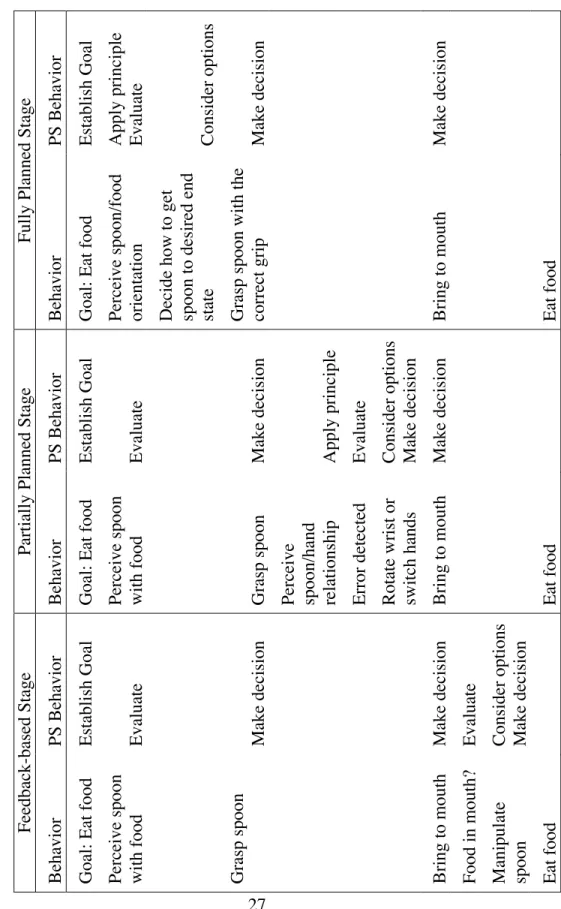
As mentioned earlier, problem solving has also been studied in the context of infant and child development. McCarty et al. (1999) observed infants attempting to use a spoon to bring food to the mouth. They outline four stages of the learning process: feedback-based, partially planned, fully-planned, and habitual solution. Their analysis includes categorizations of perception, action, and thought processes. These are illustrated in Figure 4.
The models and analyses above offer an important depiction of the interactive yet distinctive behavioral components of problem solving. Although developed independently in essentially unrelated domains, all of these models have elements in common. Problem solving in science requires behavioral and perceptual abilities similar to those involved in problem solving by infants desiring food and problem solving in
T abl e 4 P robl em -s ol vi ng c om pone nt s i de nt if ie d i n be hav ior s of i nf ant s at te m pt ing t o s poon f ee d, wi thi n 3 s tage s of de ve lopm ent as out li ne d by Mc Car ty e t al . (1999) F ee dba ck -ba se d S ta ge Pa rt ia ll y P la nne d S ta ge F ul ly P la nne d S ta ge Be ha vi or P S Be ha vi or Be ha vi or P S Be ha vi or Be ha vi or P S Be ha vi or G oa l: E at f ood E st abl is h G oa l G oa l: E at f ood E st abl is h G oa l G oa l: E at f ood E st abl is h G oa l P erc ei ve s poon w it h f ood E va lua te P erc ei ve s poon w it h f ood E va lua te P erc ei ve s poon/ food ori ent at ion A ppl y pri nc ipl e E va lua te D ec ide how t o ge t spoon t o de si re d e nd state Cons ide r opt ions G ra sp s poon M ake de ci si on G ra sp s poon M ake de ci si on G ra sp s poon w it h t he corre ct gri p M ake de ci si on P erc ei ve spoon/ ha nd re la ti ons hi p A ppl y pri nc ipl e E rror de te ct ed E va lua te Rot at e w ri st or sw it ch ha nds Cons ide r opt ions M ake de ci si on Bri ng t o m out h M ake de ci si on Bri ng t o m out h M ake de ci si on Bri ng t o m out h M ake de ci si on F ood i n m out h? E va lua te M ani pul at e spoon Cons ide r opt ions M ake de ci si on E at f ood E at f ood E at f ood
! Figur e 4 A na lys is of f our s ta ge s of i nf ant s poon -f ee di ng, f rom M cCa rt y, e t a l. ( 1999) , p. 1100 . ! 28
corporations. These universally critical abilities may likewise be found to be necessary for successful problem solving in music.
The studies cited above provide a reference point for developing a framework for analyzing problem solving in music, which to date has not been accomplished. In the sections that follow, I describe the literature that has addressed these components either individually or in combination.
Establish goal
A goal is defined by a desired outcome. In a learning situation in which structured change occurs, teachers and/or learners are seeking a defined goal or goals (see Aarts & Elliot, 2012). Both Wickelgren (1974) and Mayer (1992) identified pursuing a goal as the first component of problem solving. Goals are the building blocks of progress and the instigating feature of problem solving. If there is no goal sought, there is no perceived problem to be solved.
Instructional goals are the organizing element of units of analysis called rehearsal frames (Duke, 1994). A rehearsal frame is defined as an interval of instructional time devoted to the pursuit of a particular goal. As mentioned in Chapter 1, Duke proposed that analysis of music learning is most meaningful if done in consideration of specific goals sought.
Several researchers have conducted analyses that consider the type of musical target (proximal goal) identified by teachers and conductors (e.g., Cavitt, 2003; Doerksen, 1999; Worthy & Thompson, 2009). Doerksen (1999) identified some of these possible musical goals as he categorized teachers’ comments in response to music performance in nine target categories: tone quality, intonation, blend/balance,
rhythm/precision, articulation, technical facility, musical interpretation, phrasing, and dynamics.
Many goals comprise complex structures made up of smaller, intermediate subgoals (Catrambone, 1995a, 1996, 1998; Elsner & Schellhas, 2012; Fishbach, Dhar, & Zhang, 2006; Willatts, 1999). To achieve a given goal, one must first consider the possible actions that might lead to the desired end and be capable of performing those actions. Subgoals are often the focus of a problem to be solved: what one does (subgoals) to achieve the desired end (superordinate goal), or, as Catrambone (1998) expressed, subgoals are “mini-problems in the context of solving the overall problem” (p. 357).
Musical goals are outcomes of creation and communication. A performer with a musical goal desires to represent her own or a composer’s ideas and communicate them to an audience. Within musical goals are many, often technical, subgoals—specific skills that serve a musical end, such as tonguing or shifting accurately.
Goals direct the attention of teachers and learners (Dreisbach & Haider, 2009; Simons & Chabris, 1999; Vogt, De Houwer, & Crombez, 2011; Vogt, De Houwer, Moors, Van Damme, & Crombez, 2010), and because attentional capacity is limited, all of the goals that may be identified at a given point in a music learning sequence cannot be pursued at once (Johnstone & El-Banna, 1986; Solaz-Portolés & Sanjosé-López, 2009; Tsaparlis & Angelopoulos, 2000). Colprit (2000), for example, observed that Suzuki teachers usually pursued only one performance goal at a time in lessons. Pursuing goals, then, is a function of choice and priority (Vogt et al., 2011). Attention may be directed toward certain stimuli and away from others depending on the goal sought. As a result, some events, errors in music performance for example, may go unnoticed (Simons & Chabris, 1999). Thus, the definition of goals influences other components of problem solving and, therefore, the effectiveness of music teaching and learning.