Title
One Laptop Per Child (OLPC): A Novel Computerization Movement?
Permalink
https://escholarship.org/uc/item/4pg4h6xw
ISBN
9781424496181
Authors
Kraemer, Kenneth L
Dedrick, Jason
Sharma, Prakul
Publication Date
2011
DOI
10.1109/hicss.2011.327
License
CC BY 4.0
Peer reviewed
One Laptop Per Child (OLPC): A Novel Computerization Movement?
Kenneth L. Kraemer Jason Dedrick Prakul Sharma
University of California, Irvine Syracuse University University of California, Irvine
[email protected] [email protected] [email protected]
Abstract
This study applies concepts about computerization movements (CMs) to a case study of the diffusion of innovation in the developing world and thereby to draw lessons for undertaking similar technology projects. We identify the key characteristics of a computerization movement in the scholarly literature and then review the One Laptop Per Child (OLPC) Project in terms of each, identifying where OLPC adds new understanding about CMs. The OLPC project is an example of a computerization movement that has launched a new generation of low-cost computers in the developing world, while failing in its own ambitious goals. The OLPC project provides insights into the nature of computerization movements, in particular the process of mobilization, the diffusion of innovations in the developing world, and the overlap of multiple movements. OLPC’s limited success to date illustrates the importance of having: (1) financial resources beyond deployment for economic sustainability, (2) local skills, infrastructure and deployment capability for operational sustainability, and (3) a replicable and scalable deployment model for ease of implementation across many sites.
1. Introduction
In January 2005, Nicholas Negroponte unveiled the One Laptop Per Child (OLPC) program. The OLPC project is targeted to the 4 billion people that live on less than $2 a day—the so-called “base of the pyramid” that Prahalad [17] and others argue represents a great market opportunity for business. The OLPC project also is a classic example of an initiative that started what Kling and Iacono [11] call a computerization movement (CM)—a kind of techno-social movement that mobilizes individuals and institutions towards a utopian vision of using computers for reform and betterment in society.
The CM framework has been used to analyze different movements like urban information systems, office automation, personal computing and open
source software [11]. The push towards use of technology to transform elementary education in developing countries [14, 21] is another computerization movement in which the OLPC project has become important, influencing firms in the PC industry as well as educators and government officials in developing countries.
Although the OLPC movement is part of a broader, historical movement to use computers in education (CIE), developing countries and young children have been largely left out of earlier efforts. The OLPC movement is unique in its goal to provide literally “one laptop per child” for poor elementary school children in developing parts of the world. Our analysis of the OLPC movement helps to refine the classical CM model and improve understanding of three core concepts: mobilization of support, diffusion of technology and interactions among multiple CMs.
This paper builds on the concept of CMs and explores the vision and the reality of the OLPC’s development and deployment. Our analysis provides lessons for undertaking similar technology projects and predicts the future direction of the movement. It also explores the unanticipated effect on innovation in the low cost notebook sector and the formation of a new CM centered on the concept of “netbooks”.
2. Methodology
Our analytical approach was to identify the key characteristics of a computerization movement (CM) from the scholarly literature and then to review the OLPC Project in terms of each, identifying where OLPC adds new understanding about CM concepts or reinforces existing concepts. We then used this understanding to explain how the lack of sustainability, scalability and replication—features of ICT projects that are especially important in the developing world-- have limited OLPC’s success
The study is based on the academic literature on CMs and a vast source of secondary material about the OLPC Project. Specific sources here include: articles about the OLPC project in scholarly journals and in
1 1530-1605/11 $26.00 © 2011 IEEE
the media; evaluation reports about OLPC projects in different countries, regions and schools; materials and data on the OLPC website; reports about the project on an independent website which monitors and critiques OLPC developments (led by Wyan Volta and about 25 other contributors around the world); written accounts of field experiences by OLPC workers and volunteers; and a very detailed descriptive case study of the project by the authors (Kraemer et al., 2009).
3. Concept of computerization movements
Kling and Iacono [11, 12] pioneered the concept of computerization movement, defining it as “a kind of movement whose advocates focus on computer-based systems as instruments to bring about a new social order” [12 p.3]. This conception is consistent with Blumer’s [5] general definition of social movements as “collective enterprises to establish a new social order” and his idea that the social movements acquire organization and form.
Drawing from the literature, a CM may be defined and characterized by the following:
• Technology: At the core of a CM is a technology (or a set of technologies) that is posited to offer the possibility to reform or revolutionize an organization or society. In the context of a CM, the technology includes not only the physical hardware but also other aspects such as software, infrastructure, people (users, IT specialists) and organizational practices for its effective use.
• A utopian vision: The technology does not stand by itself. It is accompanied by a vision that directs the use of the technology and its prospects of mainstream adoption. The CM vision is “utopian” in the sense that it depicts an ideal socio-technical world where technology does what it is supposed to do and fits in with the adoption context. Particular CMs are distinguished by their utopian visions about what the technology can do and how it should be organized for effective use [7].
• Mobilization: With a core technology and a utopian vision, a CM is set to take off. However, the actual impetus for adoption comes from the mobilization of participants through public discourses. The participants of a CM might include advocates of technology, developers, users, vendors, media, business and government. While some participants might lead, broad public discourse about the utopian vision is essential in mobilizing other participants to join and advocate the CM.
• Organization: The participants who mobilize the CM might be individuals, an organization or coalitions of organizations that “generate resources,
structure membership expectations, educate the public and ensure the presence of recognized leaders who can lend their prestige and inter-organizational connections to the movement” [9]. Organizational structures in CMs are mostly complex and networked with complexity increasing with the diversity of participants.
• A historical trajectory: Any movement, social or technological, usually persists for some time and hence illustrates a historical trajectory. CMs are characterized by interplay of complex forces which shape these historical trajectories. Some CMs may lose momentum and recede only to emerge again with stronger technology and discourse. Others just fade away. The essential point is that CMs rarely have a linear trajectory.
• Opposition: CMs may run into opposition or a counter-computerization movement (CCM). The utopian visions that steer a CM may not always be realistic and hence contending discourses may arise. These contending discourses may frame the technologies in alternative ways and influence the development of another movement, the CCM, countering the original CM.
The following section analyzes the OLPC movement in terms of these six characteristics and shows how it offers new understanding about three CM concepts: mobilization of support, diffusion of technology and interactions among multiple CMs. Finally, it draws implications for developing countries from the analysis.
4. The OLPC movement
OLPC is an example of a specific computerization movement within computer-based education, but specifically targeted towards the elementary school children in developing countries. The OLPC project has been the driving force behind the movement, which is why we name it the OLPC movement although it includes a broader social ecology than simply the OLPC organization.
4.1 Utopian Vision
The utopian vision of the OLPC movement is to transform the education system by developing and distributing low cost laptops to children in the developing nations, thereby upgrading their human capital and ultimately bringing about economic and social development. The vision for this movement had its roots in Negroponte’s OLPC project whose vision was as follows:
“OLPC is a non-profit organization providing a means to an end—an end that sees children in even the most remote regions of the globe being given the opportunity to tap into their own potential, to be exposed to a whole world of ideas, and to contribute to a more productive and saner world community”. (http://www.olpcnews.com/people/negroponte/ne w_olpc_mission_statement.html)
Although the OLPC movement was subsequently influenced by interactions with other movements, the vision has remained the same: providing better educational opportunities for poor children using low cost laptops on a 1:1 basis, or literally “One Laptop per Child”.
4.2 Technology
The pioneering technology for the OLPC movement was the so called “$100 laptop” or “XO”, designed and developed by the OLPC project. To realize the vision of “One Laptop per Child”, the project worked on reducing cost and developing a laptop specifically designed for children and the harsh environment of the poor in developing countries.
It involved hardware innovations in the power supply, display, networking, keyboard, and touchpad to provide a durable and interactive laptop. The shell of the laptop is resistant to dirt and moisture, with all key parts behind the display. It contains a pivoting, reversible display, movable rubber Wi-Fi antennas with wireless mesh networking, and a sealed rubber-membrane keyboard that can be customized for different languages. For low power consumption and ruggedness, the design of the laptop intentionally omitted all motor-driven moving parts.
The software for the XO consists of a pared-down version of the Fedora Linux operating system and a specially designed graphical user interface called Sugar. It was developed by the project to explore more naturalistic concepts related to learning, openness and collaboration. However, recently OLPC accepted installation of Microsoft Windows as well.
By itself, the low cost laptop does not serve the purpose of the OLPC movement. The critical part is the infrastructure that enables these laptops to connect to each other and the internet. In the remote regions of the developing countries where access to clean water and electricity could take years to materialize, establishing an infrastructure to support the OLPC movement is an arduous task and adds considerable cost to these projects. Multiple pilots by OLPC and others have shown that it is possible to build this infrastructure but questions about sustainability and scalability still remain.
In sum, the OLPC project not only pioneered the development of a low cost PC for education in developing countries, but stimulated competition and innovation in the industry, which has led to competing technologies and models for use in education and beyond.
4.3 Mobilization
The OLPC movement is especially distinguished by Negroponte’s exploitation of the media and events with high profile officials for publicity, which continues to benefit the movement by “buzz” about the project whether positive and negative.
Initially, the focus of OLPC was to get support for the vision and create expectations that would help the organization to gain funding and social acceptance. Multiple rhetorical strategies like public speeches, media articles and network connections with international organizations and governments were used for gaining support for the project. Initially, each flurry of activity by Negroponte was followed by excited discourse in the media and on the web in both developed and developing countries, creating a positive image of the project. This resulted in many developing countries coming onboard with big orders for the $100 laptop and several other companies like eBay, Squid Labs, and Pentagram joining as partners providing funding for the non-profit initiative.
Once the technology was developed, it was time for OLPC to meet the expectations it had set. However, the project stumbled, falling behind schedule, allowing for-profit players to develop competing products. OLPC used pilot implementations to demonstrate the success of the technology, but problems with these implementations ranging from operations and logistics snags to social and cultural compatibility overshadowed the successes. The strategy of collaborating with Intel also failed; acrimony between Negroponte and Intel officials flamed by Intel’s competing product, the Classmate, led Intel to suddenly quit the project in January 2008 after only nine months. Thereafter, Intel created its own initiatives to support diffusion of its Classmate laptop to children in developing countries [13]. This competition, government politics and implementation problems resulted in several countries defecting from their initial commitments, setting back the movement. Despite some defections from OLPC, the net effect was greater mobilization of the vision of one laptop per child as more players entered the market and more developing countries got onboard with pilot implementations and even some big orders. These sales motivated Negroponte to open the XO hardware design in February 2009, in an effort to promote the
standard. The open design meant that any company could produce and sell the hardware on its own using the supply base built for the XO. The goal was to make XO laptops broadly available, whether through OLPC or other manufacturers.
4.4 Organization
The OLPC project is a non-profit organization, which depends on charity for its own survival and to promote its vision to developing countries. OLPC had about 75 full time staff at its peak and half as many after budget cuts in January 2009. There is also a volunteer force around the world but we have not seen any estimates for the size, stability or effectiveness of this force. This non-profit, philanthropic, voluntary character of the OLPC movement distinguishes it from other CMs, many of which have been for-profit and not philanthropic. Managing such complex structures and competing with established companies like Intel that can leverage people, infrastructure and business partners around the world is a daunting task.
4.5 Historical Trajectory
The OLPC movement evolved from a confluence of four important CMs promoting computerization: the PC movement, the computers in education (CIE) movement, the open source software (OSS) movement and the Internet movement. Most developing countries missed out on earlier stages of the computer revolution, but since the introduction of the PC in the early 1980s, many were eager to adopt the technology. They were keenly aware of the so-called digital divide, had seen benefits of computer use in developed countries, and wanted these same benefits for their own human and economic development. Thus, there was great enthusiasm from the developing world for the OLPC project when it was first announced in 2005.
On the education side, computer use in both the developed and developing world had been largely an adjunct to the educational mission rather than integral to it. The idea behind the OLPC project that has influenced this movement had its roots in the theory of constructionism espoused by Alan Kay [10] and Seymour Papert [15]. According to the theory, learning is a process wherein learners actively construct mental models and theories of the world around them. Constructionism holds that learning can happen most effectively when people are actively making things in the real world. Constructionist learning involves students drawing their own conclusions through creative experimentation and the making of social objects. The computer potentially
fosters constructionist learning by allowing children to create, explore and experiment on their own.
Although Negroponte worked with Papert in 1982 on a computer-based constructionist project in Senegal, the OLPC concept did not materialize until 2005. Whereas the Senegal project used conventional computers, the OLPC project sought to design a low cost laptop computer and a user interface specifically tailored to constructionist learning by children. The laptops would be connected to one another via a mesh network so children could easily share with one another and learn from one another. Teachers would support the students but no longer lead the instruction.
4.6 Opposition and CCMs
Opposition to the OLPC movement was more a counter social movement than a counter computerization movement with many stakeholders concerned more about the social impacts of the technology introduction and use rather than the technology itself. Although OLPC paid attention to the micro-environment of children, it insufficiently considered the socio-cultural environment of technology diffusion [13].
In the often hierarchical societies of the developing world, the thought of a student being much more informed than a teacher could be threatening to teachers and might result in their loss of power and prestige. Another concern was the possible influence of western ideas on local cultures that have been cherished and promoted for centuries. With access to the World Wide Web, children were more vulnerable to disorientation from their cultural beliefs and to migration towards a more westernized culture which in many cases is unacceptable to the parents and the religious leaders in these countries.
Opposition also developed among industry proponents who advocated alternative use of the technology. Whereas the OLPC project focuses on children in elementary and primary schools, the PC industry emphasizes use of the technology in secondary and higher education, arguing that such use might provide a faster return on investment. Opposition also was caused by mismanaged expectations and operational failures of the OLPC project, such as [13]:
• Mismatch between early predictions and actual adoptions by developing countries
• Inability to meet the initial cost estimate of $100 • Slow adoption due to lack of pilot projects
demonstrating benefits
• Concern about lack of support for Windows • Distribution and deployment problems
These failures, which were reported by the media, revealed gaps between the vision and reality, deployment claims vs. actual accomplishments and socio-cultural issues in implementation. When used skillfully by opponents, they helped to undermine the movement and promote alternative technologies. Beyond Intel’s Classmate, other for-profit companies like Asus, Acer, Dell and HP developed “netbooks,” which were intended for use on the Internet where data and applications could reside. In addition to targeting markets in developing countries where OLPC was building its presence, these competitors targeted a wide audience including students, travelers and small business owners in the U.S. and Europe.
In summary, the utopian vision of “one laptop per child” was successful in mobilizing participants ranging from big corporations to poor students in developing countries; however it faced myriad diffusion challenges over the last few years. The innovative technology developed to achieve this vision of educational transformation through computer use not only influenced the lives of a handful of poor children through pilot implementations of OLPC’s XOs, but also changed the dynamics of the PC industry. Like many CMs, the OLPC movement did face growing competition from the proponents of counter movements who believe in alternative conception of the society and the role of low cost computing in education. The OLPC movement demonstrates many characteristics of a CM. However, the nature of some of these characteristics differs from the classical paradigm and hence augments our understanding of the CMs. The next section highlights some of these differences and their significance for research on CMs.
5. Analysis of the movement
The OLPC movement differs in several ways from previously studied CMs and has implications for three core concepts in CM, namely: mobilization of support, diffusion of technology and the interactions between CMs. Analysis of this movement also highlights specific challenges with sustainability, scalability and replication that CMs in the developing world need to overcome.
5.1 Mobilization of Support
Mobilization of participants in a CM is critical for its success. Mobilization occurs through what Kling and Iacono [11] call the ideology of CM and Allen [2] calls the rhetoric of technology. In a study of the PDA industry over ten years, Allen conceptualized technology development and adoption as infused with
rhetoric and counter-rhetoric and concluded that there is a close overlap between the rhetoric of technology and the ideology of CM. Rhetoric is defined as “discourse aimed at an audience to gain either intellectual or active adherence” [16]. In CMs, rhetoric is used to legitimize investments in some unproven technological idea, the so called “next big thing”. However, research on how the dynamics of rhetoric play out in mobilization of support for a technology is still missing. The OLPC movement provides insight into these dynamics and helps to refine our understanding of the mobilization concept.
In his study of PDAs, Allen concluded that in most CMs the vision mobilizing support is not explicitly social but rather focuses on the technical and business needs that legitimize the investments. However, there is always an implicit social aspect to these visions. In contrast, the OLPC movement had an explicit social vision. This vision and the nonprofit nature of OLPC have been important for mobilizing the support of international organizations like the United Nations, the governments in developing countries, charitable foundations and numerous volunteers. The large scale and the scope of the vision, which must meet the needs of many different socio-cultural environments, have made the mobilization of support for the movement a major challenge. These and other challenges can be seen by examining the OLPC movement in terms of three distinct stages.
The first stage focuses on gathering social support for the vision and financial support for development of the technology to realize the vision. During this stage the vision and expectations for the future of the technology are defined. People are mobilized to join the movement using disparate rhetorical strategies ranging from public speeches to media articles to academic writings.
In the case of the OLPC movement, the advocates faced an enormous task because the technology did not yet exist. The idea of laptop-based self-directed student learning was untested and at odds with directed-learning model followed in most of the world. Further, the vision also made mobilization difficult because it portended educational change that might be unacceptable to many stakeholders such as teachers, teacher unions, education ministries and cash-strapped governments in developing countries.
The non-profit nature of the movement made things even more difficult as it became critical to first mobilize participants who could support the project financially. Selling the vision to gain financial support could only be achieved if international organizations like the United Nations and governments of some of the developing countries saw promise in the idea. This was achieved only by the persistent efforts and global
connections of Negroponte, the leader of the OLPC movement. Once the vision was endorsed by these international advocates and a potential market seemed to emerge, the opportunity appealed to important industry players as a worthy cause for investment.
Thus, this CM shows that for mobilization to be successful it is essential to have the most important participants onboard as early as possible. Hence, the industry partners that were later critical for funding, deployment and distribution of laptops, and the governments of developing countries were among the first ones to be mobilized. The CM also highlights the significance of early mobilization of financial supporters for a non-profit CM such as OLPC. However, early financial support does not guarantee the sustenance of the CM.
The second stage involves mobilization of support for actual technology. Once support for the movement has been mobilized, early adoption of the technology becomes critical. In this stage, the primary focus is on mobilizing the customers and adopters. Different strategies like free pilot implementations, co-branding with established industry players and comparisons with successful technologies might be used. Operational challenges are faced in this stage as the technology is delivered to the customers. It is the operational and implementation success that makes the future financial sustainability of a CM possible.
The OLPC movement faced multiple impediments in this second stage ranging from its own organizational and operational challenges to manufacturing and distribution challenges of its partners. Also, many countries that were onboard early now started to defect due to problems in delivering the technology to the end users, doubts raised by key industry players about the technology, and lack of results from early pilot projects. It was during this stage that competing players like Intel came into the picture. OLPC and Intel tried different strategies; however the most important one was pilot implementations at reduced or no cost.
The OLPC movement is still in this second stage of mobilization today. If this stage fails, the CM generally dies off or goes back to the first stage where an alternate or a new vision is defined. However, success in this stage moves the mobilization to the third and final stage, which involves mobilization for mass adoption.
The third stage is where a CM is at the peak of its success with initial pilots of the technology generating excitement and more financial support. The opposition to the movement starts to subdue as more and more adopters jump onboard. The cost of the technology is further reduced due to economy of scale and the technology itself mobilizes further support. This is
also the stage when many complementary products flow into the market and the real potential of the technology is realized. The OLPC movement has yet to reach this stage although other CMs like the PC movement, illustrate success in this third stage.
5.2 Diffusion of Technology
Being one of the few CMs with a revolutionary vision that target developing countries, the OLPC movement enhances our understanding of CM diffusion by highlighting some of the important challenges that these movements face and the strategies that can mitigate these difficulties. The OLPC project dedicated a great deal of effort to designing a laptop that would function well in a developing country environment, but gave limited attention to the diffusion process that is so critical for the success of a new technology.
However, diffusion of an IT innovation does not depend only on the nature of the innovation itself. Often more important is the social and cultural environment in which the innovation is introduced [3, 4, 22]. Information technologies are not standalone innovations, but system innovations whose value depends largely on an ecosystem that includes hardware, applications, peripherals, network infrastructure, and services such as installation, training, repair and technical support. Deployment involves training of teachers, creating software and digital content, maintenance and support, and sustaining a long term commitment. Such capabilities are in short supply in developing countries [8, 22] and the non-profit OLPC movement did not have the resources to provide them.
The plan of the important CM participants was to rely on governments to buy the laptops, distribute and support them, train teachers to use and maintain them, and even to sponsor development of local language software. This movement leveraged voluntary organizations in some countries to help with the implementation. For distribution globally, OLPC signed a comprehensive agreement with cell phone distributor Brightstar, to help it manage the complexities of entering diverse markets [13]. However, none of these institutions had the ability to scale up to deployment of millions of laptops. This situation is common in developing countries where endemic problems of infrastructure, financial resources, technical skills and waning political support “hinder both the completion of IS innovation initiatives and the realization of their expected benefits” [4] The diffusion process in this environment becomes even more challenging for non-profit players like the OLPC project.
IT innovations also are part of socially embedded systems, whose use cannot be isolated from the social and cultural environment or norms of practice [1, 20]. There has been resistance in some cases by teachers and the educational establishment to an innovation that requires a significant change in pedagogy and may reduce the status of teachers. Even when the laptops are adopted, they are not always used as OLPC or education ministers envision. Such resistance is not surprising to students of innovation diffusion, or of IT for development. Rogers [18] points to examples where innovation diffusion has failed because of cultural norms and failure to address the impacts of such innovations on existing institutional arrangements. Avgerou [4] noted that attitude to hierarchy is particularly problematic in developing countries.
The fate of a CM depends primarily on the diffusion of the technology which in turn depends on multiple factors, especially the socio-cultural context. The example of this CM and the discussion above enhances our understanding of the important characteristics of a CM that can ultimately lead to successful diffusion of the technology.
5.3 Interactions between CMs
The analyses of Kling and Iacono [9, 11, 12] have predominantly focused on the study of the structure, ideology, opposition and the rhetorical characteristics that promote, advance or impede CMs. The dynamics of the CMs and interactions among multiple CMs has been largely ignored with one exception. Scacchi [19] described three CMs and their interactions - open source software development, computer gaming and grid computing. He argued that CMs are much more complex and diverse than shown in earlier studies, and their outcomes also depend on the interactions which could be both subsuming and exuding.
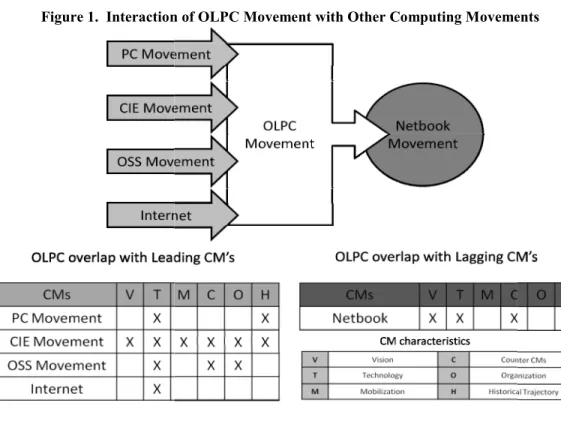
As discussed earlier, a CM is defined by six characteristics: vision, technology, mobilization, opposition (CCMs), organization, and historical trajectory. An interaction is said to exist between two or more CMs if there is a noticeable overlap between one or more of these characteristics of the respective movements. Figure 1 shows the overlap of the OLPC movement with other movements that have either influenced or are being influenced by it: Computers in Education (CIE), Personal Computing (PC), Open Source Software (OSS), Internet and the Netbook movement. Four of these movements are termed leading movements as they have influenced OLPC whereas the Netbook movement, which was influenced by the OLPC movement, is called a lagging movement. The technology overlap, both hardware
and software, is the most predominant interaction between these CMs (Figure 1).
The OLPC movement illustrates the manner in which the CMs might interact. A CM can lead, accompany or lag another CM. A leading or accompanying movement can either positively influence another CM or oppose it. A lagging CM can again be complementary to the existing CM or can also subsume it irrespective of how strong and mature the existing CM might be. Though this is largely influenced by the individual characteristics of the movements, the dynamics are predictable by understanding the influencing characteristics.
The OLPC movement shows how existing CMs provide the foundational support to novel movements in terms of vision, technology, organization and mobilization. The OLPC movement might not have materialized if any of the leading movements had not preceded it. The CIE movement provided the guiding vision and legitimacy through prior adoption of computers in education. The PC, OSS and the Internet movement were crucial in terms of the technological capabilities, both hardware and software, that would be required to achieve the goal of one laptop per child.
The netbook movement, which followed the OLPC movement, also demonstrates the importance of leading movements. The vision of the netbook movement is to provide small, light and inexpensive laptops for general computing and web based applications residing on the cloud (internet) thus reducing the overall cost of computing. Multiple reasons have been cited for the promotion of this movement. The three most common reasons are: increasing reliance of consumers on the internet (the internet movement influence), technological advancements in hardware and mobile network technology (the PC movement influence) and low price. However, most reports ignore the influence of the OLPC movement. The multiple innovations in the OLPC technology that made it possible to produce one of the cheapest laptops inspired the for-profit players to build similar hardware thus reducing the price tags on commercially available laptops. Thus, the unanticipated innovations in the low cost computing industry inspired by interactions between multiple CMs led to a new disruptive CM that changed the industry dynamics.
The OLPC movement also shows how CMs with overlapping visions might interact differently from CMs with overlapping technology. The Computers in Education and OLPC movements have the same polarity of visions and the five characteristics are complementary, providing foundational support to almost all aspects of the new OLPC movement. In contrast, the PC movement with its competing
“Wintel” technology was a colliding movement, threatened by the technology development in OLPC.
The OLPC movement illustrates another interaction that might occur when CMs have common participants, as illustrated by the Open Source Software and OLPC movements. Participants who write software for OLPC also are members of the OSS movement and share the ideology of free and open software.
The final interaction illustrated by the OLPC movement is the concept of CMs being segmented and polycentric with multiple projects working towards one common vision [19]. Though these projects work towards the same general vision, the interaction among projects is not always complementary. For example, a conflict developed between the hardware and software side of OLPC when Negroponte allowed Windows to be installed on XO machines. It resulted in the Sugar software group splitting off from OLPC and establishing a new private foundation to further develop and promote a Sugar interface that would run on any PC.
This analysis shows that the interactions among the CMs are important as they influence the formation, growth and the success or demise of a movement. Understanding the characteristics that cause these interactions can help the lead participants to influence the direction of a movement.
6. Sustainability and implications for the
developing world
The distinctive focus on developing countries of the OLPC movement provides an opportunity to understand the importance of three key factors identified by Dias and Brewer [6] for the success of ICTs in this environment: sustainability, scalability and replication. The problems of the OLPC movement illustrate their importance.
Philanthropy alone is insufficient for economic sustainability.
Sustainability is the capacity of a project to endure in economic, operational and technological terms. Economic sustainability is the ability of a project to finance itself once the technology is deployed. Dias and Brewer [6] suggest that philanthropy is acceptable for “kick starting” a project, but not for supporting routine operational costs. This is particularly relevant in the case of the OLPC movement which was organized as a non-profit project and required philanthropy not only for its own existence but also for executing its vision. OLPC was able to gain philanthropic support initially, but has not been able to obtain sufficient buy-in from developing country governments to finance deployments.
Participants in developing countries may be able to employ philanthropy to try out pilot implementations using different deployment models and use the results of the pilots to marshal ongoing support from existing country institutions.
Local skills, infrastructure and deployment capability are needed for operational sustainability.
Operational sustainability includes having a sustainable distribution model, local skills and needed infrastructure [13]. The logistical challenge of getting the laptops in the hands of the end user and making them work has been an arduous task delaying distribution and use in schools. The lack of local computer and networking skills for setup, trained teachers to help the students, and local language content and applications, has further delayed deployment to schools. Limited power and Internet infrastructure have been major challenges in deployment and use, requiring additional investments. Operational sustainability remains a challenge in places where the technology has been deployed. Thus, other developing countries would be well advised to face these realities and tailor the scale of deployment to what they can sustain operationally. This may require political decisions about which populations and regions will be served as well as the education model for use.
The ease of the technology’s adaptation to the local environment is more important than the features of the technology.
The OLPC laptop is a partial success in technological sustainability. The laptop is designed to work in the hands of school children in the harsh environments of developing countries. The open source software model has the advantage of low cost content development. Newer models of the XO are overcoming earlier problems with the hardware and adding e-book functionality. The supply chain and business partnership remains intact. However, OLPC has failed to be widely diffused due to issues of scalability and replicability.
Scalability refers to the ability to easily achieve massive deployments, whereas replicability refers to the ease of moving a deployment model in one country to other countries. Scalability has been difficult to achieve because ICTs are not simply an artifact, but a “package” of hardware, software, people, procedures and organizational capabilities. These capabilities are lacking in developing countries and OLPC lacked the ability to provide them.
Moreover, OLPC had in mind one replicable deployment model for all countries—one laptop per child in a self-learning mode. This model proved unacceptable to many developing countries where education ministers felt computer labs might be more
economically feasible and teachers believed that directed learning was superior. When its model failed to be accepted, OLPC became more flexible, but soon learned that the heterogeneous, multi-cultural environment of developing countries meant that different countries require different deployment models. It is likely that low cost laptops similar to the XO will evolve and be more useable and useful in the developing country environment. But the appropriate educational model is dependent on the socio-cultural context and requires that developing countries experiment and evaluate what works for them while learning from the experience of others.
7. Conclusion
The aim of this study was to apply concepts about computerization movements to a case study of the diffusion of innovation in the developing world and thereby to draw lessons for undertaking similar technology projects. Our analytical approach was to set up the key characteristics of a computerization movement in the scholarly literature and then to review the high profile One Laptop Per Child (OLPC) Project in terms of each, identifying where it adds new understanding about CMs and about some requirements for success of IT projects in developing countries.
The vision of providing one laptop per child is a formidable, if not impossible, task. Designing and developing the technology is only a small part of the big challenge where such issues as understanding of socio-cultural context, mobilizing support for the vision and effectively getting the technology to the end users in the most remote parts of the world are critical to the success of the project. With myriad issues and difficult unforeseen circumstances, a framework to understand the dynamics and predict the future direction can help provide the essential push to the project.
The concept of CM is one framework that has been used in the past for understanding the process of technology diffusion. As shown in this study, the OLPC project fits well with the CM framework and provides new insights into some important concepts that govern a CM. With a non-profit organization and a revolutionary vision the OLPC project gained considerable support at the beginning only to see it later fade away due to issues highlighted in this study. Nonetheless, the movement did change the direction of the PC industry by inspiring a new breed of low-cost laptops, the netbooks.
Further, the analysis of the OLPC movement helps to understand CMs better and provide lessons on sustainability of similar projects in developing
countries. Though the OLPC project is still facing many of the same issues, the influence of the for-profit players is changing the direction of this movement. The future of the movement might be the realization of its vision of “one laptop per child”; however the OLPC project itself might just end up being an inspiration for the stronger for-profit players that are already on the path of overtaking OLPC in deployments across the developing world.
A limitation of the study is that the source material only spans the period from announcement of OLPC in 2005 to 2010, yet the project is on-going and therefore any conclusion about success must be tentative. However, this is not a limitation of the analysis about OLPC as a computerization movement or of the lessons for developing countries.
References
[1] Al-Gahtani, Said S. (2003). “Computer technology adoption in Saudi Arabia: Correlates of perceived innovation attributes”, Information Technology for Development Vol 10, No. 1, 57–69.
[2] Allen, J.P., (2008). “Visions of the next big thing: computerization movements and the mobilization of support for new technologies”, in M.S. Elliott and K.L. Kraemer (eds), Computerization Movements and Technology Diffusion: From Mainframes to Ubiquitous Computing, Medford, NJ: Information Today, 145-172.
[3] Avgerou, Chrisanthi (2001).“The significance of context in information systems and organizational change”,
Information Systems Journal, Vol. 11: 43-63.
[4] Avgerou, Chrisanthi (2008). “Information systems in developing countries: a critical research review”, Journal of
Information Technology, Vol. 23:133-146.
[5] Blumer, H. (1951). “Social movements. In “New outline of the principles of sociology”, ed. A. M. Lee, pp. 199–220. New York: Barnes & Noble.
[6] Dias, M.B. and Brewer, E. (2009). “How computer science serves the developing world”, In Communications of ACM, Vol. 52, No. 6, 74-80.
[7] Elliott, M. S. and Kraemer, K. L., (2008). Computerization movements and technology diffusion: From mainframes to ubiquitous computing. Medford, NJ: Information Today.
[8] Farrell, G. (2007). ICT in Education in Rwanda. Washington DC: World Bank.
[9] Iacono, S., and Kling, R. (1996). “Computerization movements and tales of technological utopianism”, In Computerization and Controversy: Value conflicts and
Social Choices, 2nd ed., ed. R. Kling, Academic Press, 85–105.
[10] Kay, A. C., (1972). “A Personal com of all ages”, ACM National Conference, B [11] Kling, R and Iacono S. (1988). “Th support for computerization: the role o movements”, Social Problems, Vol. 35, No [12] Kling, R., and Iacono, S. (1995). movements and the mobilization computerization”, In Ecologies of Knowl Albany, NY: SUNY Press, 119–153. [13] Kraemer, K., Dedrick, J., and Sharma Laptop Per Child: vision vs. reality.” C the ACM, Vol. 52, No. 6, 66-73.
[14] Osin, L. (1998). “Computers in educa countries: Why & How?” Education and T Vol. 3, No. 1.
[15] Papert, S. (1993). The Children’s Ma School in the Age of Computers. Basic Bo
Figure 1. Interaction
San Diego, CA: mputer for children Boston, Aug 1972. he mobilization of of computerization o. 3, 226-243. “Computerization of support for ledge, ed. L. Starr,
a, P. (2009). “One Communications of
ation in developing Technology Series, achine: Rethinking ooks, New York.
[16] Perelman, C., (1982). The Realm Bend, IN: University of Notre Dame Pr [17] Prahalad, C.K, (2004). The Fortune Pyramid. Wharton School Publishing, 2 [18] Rogers, Everett M. (1995). Diff (5th ed). New York: Free Press. [19] Scacchi, W., (2008). “Emerging pa and segmentation when computer interact”, in M.S. Elliott and K.L Computerization Movements and Te From Mainframes to Ubiquitous Comp Information Today, 381-404.
[20] Walsham, G. and Sahay, S. (20 information systems in developing landscape and future prospects”, Inform
Development, Vol 12, No. 1, 7-24.
[21] Warschauer, M., (2000). “Tech reform: A view from both sides of the Policy Analysis Archives, Vol. 8 No. 4. [22] Warschauer, M. (2003).” Dissectin a case study in Egypt”, The Information
No.4, 297-304
n of OLPC Movement with Other Computing Moveme
m of Rhetoric. South ess.
e at the Bottom of the 2004 fusion of Innovations atterns of intersection rization movements L. Kraemer (Eds.), echnology Diffusion: puting, Medford, NJ: 004). “Research on g countries: current
mation Technology for
hnology and school e tracks”, Education ng the ‘digital divide’:
n Society, Vol.19,