NATALIA
GONCHAROVA
(1881
‐
1960)
A
SCANDAL
Natalia
Goncharova.
‘Discoveries’
Introduction.
3
Background.
4
Stylistic
comparisons.
4
‐
7
Negative
certificates
of
expertise.
8
Pre
‐
1915
paintings
by
Natalia
Goncharova.
9
Absence
of
credible
provenance
or
exhibition
history
10
The
artist
parodied.
11
‐
12
The
artist
ridiculed
13
‐
14
Signatures
14
Denouement.
15
Selling
aids
and
price
15
Conclusions
15
Natalia Goncharova. ‘Discoveries’
Introduction.
In June 2013 German police broke up a major faking ring and seized 1,000 paintings
purported to be by the major Russian avant garde artists, including Kandinsky, Malevich,
Exter, Popova and the most expensive female artist at auction, Natalia Goncharova.
In this document, the International Confederation of Antique & Art Dealers of Russian and
the CIS (ICAAD) together with leading Russian specialists, museum directors and collectors
wish to bring the attention of the wider public this systematic faking of work by Goncharova
and to protect her legacy.
With a major retrospective of the artist to open in Moscow on October 15th, we believe
that the time is right to close the debate once and for all regarding hundreds of ‘new’
paintings by Goncharova, all given credence and purported authenticity with their
reproduction in two monographs on the artist by misguided Western scholars and the
author’s subsequent protection by a UK‐based convention of long‐since discredited
historians of Russian Art.
“Imagine.
In
Moscow
a
monograph
is
written
on
William
Turner
by
a
Russian
art
historian
and
within
its
pages
are
reproduced
tens
of
new
works,
previously
unknown
both
to
a
wider
public
and
to
specialists
by
the
great
Englishman.
Imagine
the
battle
between
English
museums
to
be
first
in
the
queue
to
buy
these
paintings.
A
sensation”.
Andrei
Sarabianov,
‘The
Alternative
Goncharova’.
Artchronika
magazine
No.
2011
Background.
Natalia Goncharova is one of the greatest artists of Russia, an innovator, a revolutionary
and, according to auction sales data, now the world’s most expensive female artist with
prices up to $10,000,000.
In October 2010 and March 2011 two illustrated monographs about Goncharova were
published in the West, ‘Goncharova. The Art and Design of Natalia Goncharova’ by Anthony
Parton and the first volume of, ‘Natalia Goncharova. Her oeuvre, between tradition and
modernity’, by Denise Bazetoux.
Whilst, normally, the attention of Western art historians to work by this Amazon of the
Russian avant‐garde and the popularization of her heritage would be welcomed, these
books by Parton and Bazetoux saw reproduced, next to the well‐known masterpieces and
for the first time, hundreds of previously unknown paintings. These works which, at the very
least, should be referred to as questionable from the point of view of authenticity (do not
be fooled by the neutrality of this statement), have astounded Russian Art experts,
collectors and connoisseurs of Goncharova’s work.
These ‘discoveries’ have been found in the main among those works connected with the
period of Goncharova’s greatest innovativeness and of highest value at auction (is this a
coincidence?) – those created during her life in Russia, pre‐1915. It should be noted that the
point under discussion is not one or two ‘discoveries’, which could potentially be explained
by mistaken attribution on behalf of the authors, but about 150 strange new pictures,
utterly lacking in credible provenance or exhibition history, which have caused
bewilderment and horror.
In the first volume of the monograph by Denise Bazetoux are reproduced about 430 oils by
Goncharova painted before 1915. 148 of these works are from museums and another 130
have a detailed provenance and exhibition history. Yet it is well known that Goncharova
painted about 300 oils pre‐1915 of which only 22 are unaccounted for. How, therefore, has
Mme. Bazetoux come to the vastly inflated figure of 430?
The appearance of 150 new works by any major artist in such a short period of time (roughly
the last 20 years) would be a major cause for doubt, even rigmarole, in many quarters but
this is the situation and, with their publication in these two books, these mystery paintings
Stylistic comparisons.
An experienced art dealer or historian, when confronted with the comparison shown below,
would have little difficulty spotting which painting was of dubious authenticity. When
however, these paintings are analysed deeper, their absurdity and that of the other 150
paintings becomes clearer.
Figure 1
Natalia Goncharova (?)
‘Still life with a coffee pot and a fan’.
Anthony Parton : ill. 46, Denise Bazetoux; ill. 191
‘Private collection’
Figure 2
Natalia Goncharova
‘Flowers with a coffee pot’.
Aside from the total lack of creativity in the first illustration a comparison of the two coffee
pots alone should be enough to convince of the dubious authenticity of Figure 1. It has a
bent look with a lid more akin to that on a scent bottle, the handle has become rectangular
and the entire composition shows a lack of confidence on behalf of the author, unsure
whether the pot is multi‐layered or smooth or how many corners the objects should have.
By way of contrast, the coffee pot in figure 2 alone, to say nothing of the overall painting,
clearly shows the subtle cubism and colour for which Goncharova was famous.
Further stylistic absurdities abound, for example the variations on themes, a concept which
Goncharova virtually never applied to her pre‐1915 oeuvre. Compare the subtlety of Figures
3 and 5 with the crude imitations of Figures 4 and 6.
Figure 3
Natalia Goncharova
‘Peacock in sunlight’ (1911)
Tretyakov Gallery, Moscow
Figure 4
Natalia Goncharova (?)
‘Multi‐coloured peacock’ (1910).
Denise Bazetoux; ill. 547
Figure 5 Natalia Goncharova ‘Sheep shearers’ (1907) Museum of Serpukhov Figure 6 Natalia Goncharova (?)
‘Work in the fields’ (1906‐7).
Denise Bazetoux; ill. 131
Negative certificates of expertise.
Whilst our doubts as to the authenticity of a whole section of works and the apparent
absence of a responsible approach to the material chosen by these authors is based not only
on artistic and art historical facts, there is also further damning evidence.
Specialists from the Tretyakov Gallery which, it must be noted, holds the largest collection
of works by the artist and her archives, travelled to Europe to view both ‘Still life with a
coffee pot and fan’ (illustrated in figure 1) and ‘Still life with sunflowers’ (figure 7) and gave
both paintings negative certificates of authenticity. Yet these paintings are reproduced in
Anthony Parton’s book as genuine.
Figure 7
Natalia Goncharova (?)
‘Still life with sun flowers’ (1909).
Anthony Parton; ill. 47
It would be intriguing to know on what basis Anthony Parton authenticated these paintings
and whether he is aware how his certificates, and those of Denise Bazetoux have been used
as selling aids on the European art market? Indeed the question must be posed as to how
many paintings by Goncharova Anthony Parton and Denise Bazetoux have actually
physically seen, aside from photos?
We make such an accusation as neither author has investigated the Goncharova archives at
Pre‐1915 paintings by Natalia Goncharova.
It is theoretically possible that original works by Goncharova created before 1915 with
obscure provenance exist, but it is scarcely probable: this period has been well documented
by contemporary art historians, whilst her work was actively exhibited and recorded in
catalogues of the time.
There is an comprehensive, authorized list of works by Goncharova published in the
brochure by Eli Eganbyuri in 1913 and a further list of works made by N.D. Vinogradov. The
fate of the artist’s works which were left in Russia after her emigration to France with
Larionov is also well known.
By way of an example as to our detailed knowledge of the movement of her paintings, in the
Spring of 1914, Goncharova and her husband Larionov took about 50 of her paintings to
Paris for their joint exhibition at the Paul Guillaume Gallery between 17th and 22nd June
(there are actually 55 works of Goncharova). Of these paintings, 36 according to archive
material at the Tretyakov Gallery from 1921, have special markings in German on the
reverse and were returned to the artist in January 1921.
In 1915 Goncharova left Russia permanently and the greater part of her work was left in her
Moscow flat. Between 1918 and 1919 some of the works were bought by the Department of
Fine Arts of the People’s Commissariat for Enlightenment and were transferred to the
Museum of Painting Culture. Later these works were handed over to the State Tretyakov
Gallery and various provincial museums. Another significant part of their heritage was
removed by N.D. Vinogradov, an architect, from the flat into the Moscow Depositary of
Contemporary Art works founded by Vinogradov himself. On the reverse sides of these
paintings special labels were stuck with the abbreviation of the depositary ‐ ‘МХПСИ’, the
first letters of the artists’ names ‘Г’ and ‘Л’ and numeration.
Between 1925‐1926 the artist Lev Zhegin, acting on Larionov’s instructions, organized the
shipment of these works to Paris. ‘Before transportation on the reverse of both Larionov’s
and Goncharova’s paintings were inscriptions with the consignee’s name (purportedly in
Zhegin’s hand): ‘Larionow’ and ‘Ларионов (this referred to the addressee as opposed to the
author)’’ writes Irina Vakar, a senior specialist of the State Tretyakov Gallery on Russian Art
of the first half of the 20th century.
Thus, most of the works created before 1915 have special marks on the reverse of the
paintings. In the publications by Anthony Parton and Denise Bazetoux this vital information
is often missed. These characteristic inscriptions, marks and stickers, well‐known to
specialists, could have thrown light on the movement and exhibition history of these
questionable works.
Could one make an educated guess at the reason for the absence of such information?!
Total absence of credible provenance or exhibition history
We have already examined the stylistic and historical factors behind our accusations. The
total absence of provenance with these dubious paintings is another part of our argument.
Most dealers or experts working in any field of the arts will tell you that ‘miracles do not
happen’ or, if they do, it is on a very rare basis. Yet here we have 150 ‘miracles’, a statistic
unheard of in the history of the art market which the authors and the organisation that
represents them, INCORM, seek to convince us is the truth? Let us examine just one
painting to show the total absence of provenance, exhibition history and compare it with
paintings which are held by museums and beyond any dispute.
With the dubious painting on the right a Western art historian has used two words, ‘private
collection’, which could refer to just about anyone and anywhere, as a provenance for a
seemingly important futurist painting of the 1910’s. Taking into account the numerous
exhibitions of Goncharova’s work, how is it that such an ‘important’ painting has never been
before exhibited? Indeed how is it that none of the mystery 150 have ever been shown
publicly? What possible set of circumstances are there? As the authors and INCORM have
resolutely refused to answer, or avoided, our questions since 2011 we can only guess. That
The artist parodied.
“We consider that the publication of Professor Parton’s book to be unforgiveable: Insulting,
as it does the memory of great artists who are not in a position to stand up for themselves
and need us to defend them”. Irina Vakar’s words may sound strong but are relatively weak
when stacked up against the evidence of appalling versions of ‘Wrestlers’ and ‘Cyclist’
reproduced in these two books.
Figure 8
Natalia Goncharova
‘Wrestlers’ (1908‐09)
Pompidou Centre, Paris
Figure 9
Natalia Goncharova
‘Wrestlers’ (1909‐10)
It beggars belief, not just stylistically, to see a third version of ‘Wrestlers’, passed off as
being by the brush of Goncharova by Anthony Parton. With no provenance and exhibition
history, something of which we are becoming all‐too familiar, this wooden, colour‐free
version becomes a veritable pastiche when set alongside the detail of a 1910 photograph
that has clearly been used as its inspiration.
Figure 10
Natalia Goncharova (?)
‘Wrestlers’ (1900‐10).
Anthony Parton; ill. 124
‘Private collection’
Photograph of the 1910 All‐Russian championship of French wrestling.
The artist ridiculed
“Her contemporaries were struck by the diversity of her work, the richness of fantasy. She
hardly ever repeated a composition” Irina Vakar
Figure 11
Natalia Goncharova
‘Cyclist’ (1911‐12)
State Russian Museum, St. Petersburg Figure 12
Denise Bazetoux, ‘Natalia Goncharova. Her oeuvre, between tradition and modernity’
Figure 12 is surely the most damning piece of evidence in this pamphlet? It is a known fact
that Goncharova hardly ever repeated a composition and yet here we have seven versions
on a theme. So primitive is the attempt to connive the viewer that we have a series of
bicycles going in a different direction from the original, various automobiles going from right
to left on a variety of backgrounds and, absurdly, what is probably the first representation
of the pushbike in Western Art history. Figure 12 also shows that every one of the seven to
have the same non‐provenance, ‘private collection’. Why was not one of these miracles
exhibited in Goncharova’s lifetime? Is Western Art history really so backward as to believe
that an artist as revolutionary as Goncharova created seven paintings on the same theme in
the space of a couple of years?
Signatures
“A signature is a major rarity for works by Natalia Goncharova of her Russian period”
Had the authors investigated the pre‐1915 work of Natalia Goncharova in any detail, they
would have discovered that a signature on her work pre‐1915 is a major, major rarity. It
therefore almost goes without saying that of the 12 dubious paintings we have shown in this
document, every single one is signed or monogrammed. When mass faking of Russian Art
became public knowledge around 2000, it was a well‐known that the majority of these
dubious paintings were signed in an attempt to fool the buying public.
Selling aids and price
Should the authors doubt that these books and their certificates of expertise that proliferate
on the Western Art market are used as selling aids, a glance at auctions in Germany over the
last 10 years, or France will confirm the facts. For example, Lot 78 at a Paris auction house
(illustrated below) in April 2011. The only credible evidence (the remainder of the
provenance is entirely thought‐up and cannot be proved) offered for the painting’s
authenticity being a reproduction in Denise Bazetoux’s book and a certificate of authenticity
from the author. It is instructive to note that the estimate for the painting is a fraction (20%)
of what it would have been had the picture been genuine. Coupled to this is the fact that
the major London auction houses, the centre of the Russian Art market, have long ago
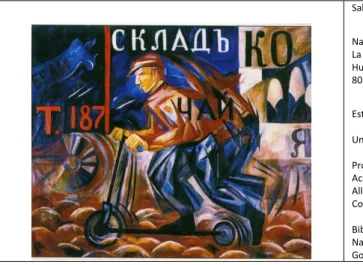
rejected certificates from these two authors as well as other members of INCORM. Why? Sale 9611 Lot 78 Natalia Sergeevna Goncharova (1881‐1962) La trottinette Huile sur toile. Signée du monogramme en bas à gauche 80 x 99 cm 31 1/2 x 39 in Estimation : € 800,000‐1,000,000 Une attestation de Madame Denise Bazetoux sera remise à l'acquéreur Provenance : Acquis directement auprès de l'artiste. Collection Edward Ellenberg, Allemagne. Collection Egon Ellenberg, Paris Collection particulière, Paris Bibliographie: Natalia Gontcharova, Catalogue raisonné de l'œuvre de Natalia Sergeevna Goncharova, Denise Bazetoux, éditions Arteprint,
Denouement.
In a May 2011 news conference, leading figures in the world of Russian Art including Irina
Lebedeva, Director of the Tretyakov Gallery and Pyotr Aven, a major collector and specialist
on Goncharova voiced their accusations. In reply, the authors were defended by the
aforementioned ‘INCORM’ whose President, Patricia Railing, is herself an art historian.
The reply consisted largely of subterfuge and at no point answered the questions posed by
the news conference nor those that have subsequently been aired on the artInvestment.ru
site. Now, with the opening of the Goncharova exhibition at the Tretyakov Gallery we again
seek dialogue to avoid the name of Goncharova being further besmirched.
To our request to have the dubious paintings chemically analysed to remove all doubt as to
authenticity, we also offered to pay all costs, Mrs. Railing replied that these paintings “have
“technological” expertises accompanying them by known and reputable scientists which
reveal without a shadow of a doubt that the works were not “painted in our time” but were
executed at least 60 years ago”.
These certificates to which Mrs Railing refers were, in the main, written by Erhardt and
Elizabeth Jagers and yet we know that, according to the Press, German police have
questioned the former who confesses in the Russian language version of the Art Newspaper
from September 2013 that ‘if these (dubious paintings) were fakes, they were done
extremely well’.
From the evidence of this document, we find this very difficult to believe.
Conclusions
In this document we have offered several factors for consideration:
Stylistic
Historical
Provenance
Copying and repetition
Signature
Price
Chemical analysis
ICAAD feels that the time for answers has come. The Art world at large needs to know about
these books, the harm they have done to the reputation of a great artist. We request that all
copies are withdrawn from circulation, libraries and institutions. In addition we need to
remind Anthony Parton, Denise Bazetoux and Patricia Railing of their responsibilities as art
historians and to cease writing certificates on paintings that, on our evidence alone, cannot