This is the author’s version of a work that was submitted/accepted for
pub-lication in the following source:
Nakai, Yuto,
Perrin, Dimitri
, Ohsaki, Hiroyuki, & Walshe, Ray
(2013)
Performance evaluation of cloud-based parallel computing. In
2013 IEEE 37th Annual Computer Software and Applications Conference
(COMPSAC 2013)
, IEEE Computer Society, Kyoto, Japan, pp. 351-355.
This file was downloaded from:
http://eprints.qut.edu.au/82682/
c
Copyright 2013 IEEE
Personal use of this material is permitted.
However, permission to
reprint/republish this material for advertising or promotional purposes or
for creating new collective works for resale or redistribution to servers or
lists, or to reuse any copyrighted component of this work in other works
must be obtained from the IEEE.
Notice
:
Changes introduced as a result of publishing processes such as
copy-editing and formatting may not be reflected in this document. For a
definitive version of this work, please refer to the published source:
Performance evaluation of cloud-based parallel
computing
Yuto Nakai
‡∗, Dimitri Perrin
†∗, Hiroyuki Ohsaki
§‡and Ray Walshe
∗ ‡Graduate School of Information Science and Technology, Osaka University, Osaka, Japan.Email: [email protected]
∗Cloud Computing Research Centre, Dublin City University, Dublin, Ireland. Email: [email protected]
†Laboratory for Systems Biology, RIKEN Center for Developmental Biology, Kobe, Japan. Email: [email protected]
§Department of Informatics School of Science and Technology, Kwansei Gakuin University, Hyogo, Japan. Email: [email protected]
Abstract—As computational models in fields such as medicine and engineering get more refined, resource requirements are increased. In a first instance, these needs have been satisfied using parallel computing and HPC clusters. However, such systems are often costly and lack flexibility. HPC users are therefore tempted to move to elastic HPC using cloud services. One difficulty in making this transition is that HPC and cloud systems are different, and performance may vary. The purpose of this study is to evaluate cloud services as a means to minimise both cost and computation time for large-scale simulations, and to identify which system properties have the most significant impact on performance. Our simulation results show that, while the performance of Virtual CPU (VCPU) is satisfactory, network throughput may lead to difficulties.
I. INTRODUCTION
Computational modelling is increasingly used in fields such as Earth and Life Sciences, Engineering, Physics and Chemistry. While such approaches have resulted in number of breakthroughs, they require large resources. For a long time, the only way to meet such requirements of High-Performance Computing (HPC) was to use a dedicated cluster.
However, as the need for more flexible and cheaper re-sources is increasing, the focus has recently been shifting to Cloud services. HPC clusters involve large capital expenditure costs to build and operate their own computing infrastructure and IT services to meet the computing needs of local users [1]. It is also important to note that, by nature, such clusters have to be scaled for the largest possible job (or set of concurrent jobs) the owner wants to run on the machine, even if, in practice, complete utilisation rarely occurs.
Moreover, when using a cluster, users have to submit their simulations as batch jobs to a resource management system responsible for job scheduling and resource allocation [2]. This usage model has served the requirements of a large number of users and the execution of numerous simulations. However, this usage model requires the user to know very well the environment on which the simulation will execute. In addition,
users can sometimes require administrative privileges over the resources to customise the execution environment by updating libraries and software required, which is not always possible using the job model.
On the other hand, Cloud computing outsources computing infrastructure services to the cloud provider, reducing or eliminating the need for organisations to offer extensive IT hardware and services. This may provide certain economic advantages to its users. Since Cloud computing is provided as a ”pay-as-you-go” cost structure, it allows the amount of computational power that is used, and the cost, to expand and shrink according to the user’s specific needs [1]. Moreover, since users lease a number of virtual machines with the operating system of their choice, they can customise these virtual machines further to provide software and libraries required to execute user simulation [2].
The main obstacle to this transition from clusters to clouds is a performance issue as the architectures are very different. In fact, previous works in benchmarking parallel scientific programs in Amazon EC2 indicate performance degradation compared to the local cluster [3]–[5].
The long-term goal of our research is to use the flexibility of cloud services to our advantage, and design a system that, for a given parallel simulation, request resources corresponding to the lowest possible cost and shortest possible execution time. A first step is to clearly understand the various factors influencing computing performance, and to propose a resource allocation method accounting for these. This is the focus of this paper. Our results are based on the Amazon Elastic Compute Cloud1 (Amazon EC2).
The structure of this paper is as follows. In Section II, we introduce the Amazon EC2 cloud services and the MPI protocol used for inter-process communication. In Section III, we look at the experimental results and discuss their impact on
performances of cloud-based simulations. In Section IV, we propose a design solution based on these results, and relate this solution to existing research efforts. Finally, in Section V, we conclude and give an overview of future directions.
II. EXPERIMENTALSETUP
In this section, we give background information on MPI and Amazon EC2 and explain the measurement method and experimental setup.
A. Message Passing Interface (MPI)
MPI is a message-passing application programmer interface, together with protocol and semantic specifications for how its features must behave in any implementation. MPI includes point-to-point message passing and collective operations, all scoped to a user-specified group of processes [6]. MPI has become thede factostandard for parallel scientific applications that require coordinated and distributed code execution across cluster resources.
B. Amazon Elastic Compute Cloud (EC2)
Amazon EC2 is a commercial cloud service provided by Amazon.com. Amazon EC2 allows users to rent virtual ma-chines, called instances on the service, on which to run their own computer applications. The system gives flexibility as to how and when the users can create, launch and terminate instances, and pricing is by the hour for active instances. It is a typical example of “elastic” computing.
Flexibility also exists in the type of instances a user can request, with various configurations available, (each with specific CPU speed, memory, I/O performance, etc.). For this study, we used the “Cluster Compute Quadruple Extra Large Instance” type. It closely relates to a classic HPC cluster (in terms of structures, network performance, etc.), and therefore represent the best-case scenario when considering the transition from such a cluster to cloud-based environments. We used two quad-core CPUs, giving us a total of eight computing cores.
C. Measurement Setting and Tools
As mentioned above, we used Cluster Compute Quadruple Extra Large Instances on Amazon EC2 as our experimental environment. These instances were configured with Ubuntu Server 12.04.1 LTS as operating system, and OpenMPI2 version 1.6.3 as the MPI library. Moreover, each process is assigned to one Virtual CPU (VCPU), which correspond to one of the above-mentioned cores, and we parallel-execute the program using this setup.
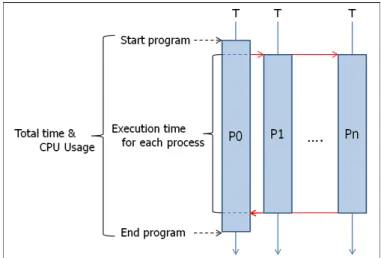
For each process, we measure the CPU usage and the execu-tion time. We do likewise for the overall resource consumpexecu-tion. This is summarised in Figure 1. The code initially used for measurement is a well-known estimation of Pi using a parallel implementation of the classic Monte Carlo method [7]. Once again, this is a best-case scenario, as communication between processes is lower than for most other parallel applications. It
2OpenMPI: http://www.open-mpi.org/
Fig. 1. Measuring execution time and CPU usage
Fig. 2. Measuring throughput with one-to-one communication between processes(P1-Pn)
is, therefore, a useful baseline of what performances can be expected from cloud-based executions.
We also look at inter-process communication and measure the throughput. This is done using one-to-one communication and a 100 MB file, as shown in Figure 2. This process is repeated 20 times, and we report the average throughput.
III. EXPERIMENTAL RESULTS A. VCPU performance
As detailed above, our experiments are set up to measure the performance of the cluster instances, particularly focusing on CPU usage and throughput. We are interested in the differences on a process by process basis, but also in the impact of such differences on the overall behaviour of the parallel code.
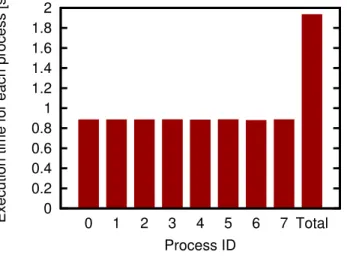
We measured the execution time for each individual process, as well as for the execution of the entire program. This process was repeated 20 times, and confirmed that the results are statistically significant. For illustrative purposes, we show in Figure 3 one of these 20 runs. We can see that, as one would expect, all the VCPUs have a similar processing performance. We also measured the CPU usage for each of the VCPUs. As for the execution, this was repeated 20 times to ensure
0 0.2 0.4 0.6 0.8 1 1.2 1.4 1.6 1.8 2 0 1 2 3 4 5 6 7 Total
Execution time for each process [s]
Process ID Fig. 3. Execution time for each process
40 42 44 46 48 50 0 1 2 3 4 5 6 7 8 9 CPU Usage [%] CPU ID
Fig. 4. CPU usage for each VCPU
statistical significance, and we show the results from one of these runs in Figure 4. Once again, the overall behaviour is satisfactory: there is very little difference in usage across the set of VCPUs. Here, we are not interested in the absolute value (it is below 50% because the Monte Carlo code is not extremely resource consuming), but rather in the fact that the load appears to be evenly balanced.
Finally, we measured the throughput between all pairs of VCPUs. As for the previous metrics, this was measured over 20 runs. The average throughput over these 20 repeats is shown in Figure 5. Contrary to what was observed for the performance of individual VCPUs, there are significant variations in throughput. We can identify two main groups with an average throughput of approximately 11.9 Gbps and 14.8 Gbps, respectively. Interestingly, within each group the values are very consistent. In Section III-B, we investigate whether this 20% performance drop for the first group has an impact on the execution of more complex parallel codes.
10 11 12 13 14 15 16 17 [0]-[1] [0]-[2] [0]-[3] [0]-[4] [0]-[5] [0]-[6] [0]-[7] [1]-[2] [1]-[3] [1]-[4] [1]-[5] [1]-[6] [1]-[7] [2]-[3] [2]-[4] [2]-[5] [2]-[6] [2]-[7] [3]-[4] [3]-[5] [3]-[6] [3]-[7] [4]-[5] [4]-[6] [4]-[7] [5]-[6] [5]-[7] [6]-[7] Throughput [Gbps] Pair of VCPUs(Processes)
Fig. 5. Throughput between VCPUs
B. Impact of VCPU performance on simulation execution As shown in Section III-A, moving to a cloud-based simu-lation environment may lead to difficulties: while each VCPU performed as expected, there are significant difference in the throughput between these VCPUs, with one group performing 20% worse than the other.
The more inter-process communication a given code re-quires, the more significant the impact of such difference is likely to be. To better understand this impact, we therefore need to work with a code more complex than the Monte Carlo computation used earlier, (as this one was chosen as a best-case scenario precisely because of the low amount of communication).
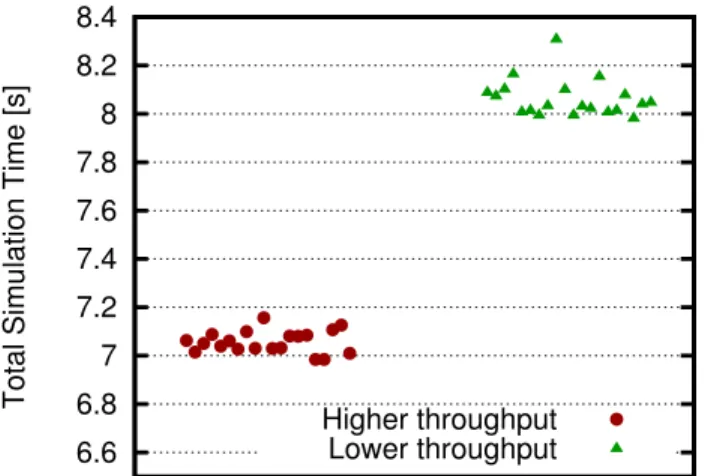
Here, we use an agent-based systems where individual agents perform random walks over a network. As this net-work is divided into subnetnet-works, each allocated to a VCPU, communication occurs after each time step, to transfer agents that are moving from one subnetwork to a neighbouring one. In Figure 6, we show the results of two sets of twenty simulations. These correspond to a configuration where the network is split in two parts, each assigned to a VCPU. In red, we show the simulation time when using VCPUs between which the throughput is higher. In green, the same information is shown for VCPUs with lower throughput.
Within each set of runs, there is a slight variation in the total simulation time: it ranges from 7 to 7.2 seconds when the throughput is higher, and 8 to 8.3 seconds when the throughput is lower. The difference is therefore significant and represent a performance degradation of about 14%.
As explained above, this degradation grows with the amount of communication, (i.e. if we split in more than two parts for this simulation, or if we consider a parallel code with a higher data exchange), so throughput needs to be taken into account when allocating resources and distributing a parallel code.
IV. DISCUSSION
Performance degradation when moving from a dedicated HPC cluster to cloud services is not surprising, and has been
6.6 6.8 7 7.2 7.4 7.6 7.8 8 8.2 8.4
Total Simulation Time [s]
Higher throughput Lower throughput
Fig. 6. Impact of throughput on the total simulation time for the agent-based network walk program
documented before. Walker benchmarked HPC applications using “CPU extra large” instances provided by EC2 and a similar set of local hardware nodes, and showed performance degradation of over 40% [3]. Evangelinos and Hill reported that significant performance deficiency arises from messaging performance where latencies and bandwidths are between one and two orders of magnitude inferior to large computing facilities [4]. Here, we confirmed and extended these results by showing that performance degradation is aggravated by discrepancies in throughput between VCPUs.
As the parallel code gets larger and more complex, com-munication increases, and throughput gaps degrade the overall performance by creating new bottlenecks. It is therefore crucial to take this gap into account. An obvious solution is to favour communication between VCPUs with high throughput, and to try to reduce between VCPUs with a lower performance.
We can try to formalise this, and to take into account the fact that most parallel simulations will run several times, (as these are usually non-deterministic and therefore require a large set of runs for statistical purposes). We propose the algorithm shown in Figure 7.
Network partitioning was proved to be a useful technique. Ohsaki et al. developed a network model partition method called QD-PART (Quasi-Dynamic network model PARTition method) aimed at accelerating parallel network simulation [8]. The key idea, which is the basis for our algorithm above, is to account the fact that a network simulation is typically repeated several times with the same parameter set. QD-PART therefore analyses the simulation behaviour (e.g. total simulation time, CPU usage, traffic intensity) and after each run re-partitions the network model based on such information with the objec-tive of minimising communication overhead among computing resources and balancing load of sub-network models executed on computing resources.
Earlier methods exist, focusing specifically on an estimation of traffic intensity at each link [9], [10] and relying, to divide the network, on either a simple min-cut algorithm [11] for the
Fig. 7. Proposed dynamic partition algorithm
former or a dedicated partitioning tool (METIS [12]) for the latter.
V. CONCLUSION ANDFUTURE WORK
The long-term objective of this study is to provide methods for parallel simulations to run at the lowest possible cost and in shortest possible time using cloud-based computing services. The first step in achieving this goal, and the focus of this paper, was to understand the factors influencing performance when making the transition from HPC to cloud.
We showed that, while VCPUs perform as expected, there can be significant variations in the throughput between these VCPUs, (up to 20%). Further, we showed that these have an impact on the behaviour of the simulations, and lead to degraded performances, (over 14% even on simple cases). In a “pay-as-you-go” model, this is an important drawback, and we proposed a method to minimise the impact of the throughput gap.
This method still needs to be tested and evaluated. This will be the focus on our future work, along with additional tests on the impact of the throughput gap for very large simulations.
ACKNOWLEDGMENTS
The parallel implementations discussed in this paper were tested in-house on the cluster made available by the Centre for Scientific Computing & Complex Systems Modelling, Dublin City University.
The authors would like to thank Amazon for their support in getting access to the EC2 resources.
Financial support from Osaka University through the GLO-COL Internship program is also warmly acknowledged (YN).
REFERENCES
[1] R. M. Fujimoto, A. W. Malik, and A. J. Park, “Parallel and distributed simulation in the cloud,”SCS Modeling and Simulation Magazine, vol. 1, no. 3, Jul. 2010.
[2] M. D. de Assuncao, A. di Costanzo, and R. Buyya, “Evaluating the cost-benefit of using cloud computing to extend the capacity of clusters,” in Proceedings of the 18th ACM international symposium on High performance distributed computing”], Jun. 2009, pp. 141–150. [3] E. Walker, “Benchmarking amazon EC2 for high-performance scientific
computing,” Oct. 2008. [Online]. Available: http://www.usenix.org/ publications/login/2008-10/openpdfs/walker.pdf
[4] C. Evangelinos and C. N. Hill, “Cloud computing for parallel sci-entific HPC applications: Feasibility of running coupled atmosphere-ocean climate models on amazon’s EC2,” inCloud Computing and Its Applications (CCA 2008), Oct. 2008.
[5] J. Ekanayake and G. Fox, “High performance parallel computing with clouds and cloud technologies,” inFirst International Conference on Cloud Computing(CloudComp09), Oct. 2009, pp. 20–38.
[6] E. Lusk, N. Doss, and A. Skjellum, “A high-performance, portable implementation of the MPI message passing interface standard,”Parallel Computing, vol. 22, pp. 789–828, 1996.
[7] J. M. Hammersley, D. C. Handscomb, and G. Weiss, Monte Carlo Methods. Taylor & Francis, 1964.
[8] H. Ohsaki, G. Oscar, and M. Imase, “Quasi-dynamic network model partition method for accelerating parallel network simulation,” in Pro-ceedings of the 14th IEEE International Symposium on Modeling, Analysis, and Simulation of Computer and Telecommunication Systems (MASCOTS 2006), Sep. 2006, pp. 255–261.
[9] H. Ohsaki, S. Yoshida, and M. Imase, “On network model division method based on link-to-link traffic intensity for accelarating parallel distributed simulation,” inProceedings of 4th International Conference on Networking (ICN 05), Apr. 2005, pp. 749–757.
[10] D. Xu and M. Ammar, “BencHMAP: Benchmark-based, hardware and model-aware partitioning for parallel and distributed network simula-tion,” in Proceedings of the IEEE Computer Society’s 12th Annual International Symposium on Modeling, Analysis, and Simulation of Computer and Telecommunications Systems (MASCOTS 2004), Oct. 2004, pp. 455–463.
[11] M. Stoer and F. Wagner, “A simple min-cut algorithm,”Journal of the ACM, vol. 44, no. 4, pp. 585–591, Jul. 1997.
[12] G. Karypis and V. Kumar, “METIS: a software package for partitioning unstructured graphs, partitioning meshes, and computing fill-reducing orderings of sparse matrices.” [Online]. Available: http://www-users.cs.umn.edu/karypis/metis/.