PhD Programme Epidemiology
Utrecht University, Graduate School of Life sciences April 20091. Name of the PhD programme
Epidemiology2. Focus area
The PhD Programme is organised by the research groups of the focus area Epidemiology. Coordinators of the Focus Area Epidemiology: Prof. JAP Heesterbeek, PhD (Faculty of Veterinary Sciences) and Prof. KGM Moons, PhD (University Medical Center Utrecht).
Epidemiology is the science that studies patterns in space and time in the origin, diagnostics, prognos-tics, treatment and prevention of diseases in populations, and identifies factors that contribute to or influence these phenomena. The word ‘population’ is key to this. In populations one can find descriptive or causal patterns between factors on the one hand and disease occurrence and dynamics on the other. These patterns are essential for understanding and controlling these diseases. Unlike most groups of epidemiologists at Utrecht University this is approached from a multidisciplinary perspective, combin-ing clinical, veterinary, pharmacological/pharmaceutical, environmental and theoretical epidemiology, and biostatistics, in close interaction with medical, veterinary and pharmaceutical specialists. Based on real and clinically relevant problems, we contribute through research, knowledge dissemination and education to an improved understanding of the etiology, diagnosis, prognosis, treatment and prevention of disease. These diseases notably include cardiovascular diseases, cancer, allergy, and infectious dis-eases, occurring both in humans and animals.
3. Mission statement and objectives
The PhD programme Epidemiology is aimed at optimal preparation of PhD fellows to become inde-pendent researchers, research consultants, or continue their career at an academic level in
(non)governmental institutions or the pharmaceutical industry. The core of the educational programme consists of formal epidemiological training, with research methodology as its core knowledge area, offered by the participating research groups of the UU focus area Epidemiology. Sharing and distribu-tion of knowledge takes a central part in the aims of this focus area. Collaborative educadistribu-tional activities are primarily aimed at providing PhD fellows with the required knowledge base and skills to conduct their current research and design future research. Simultaneously these interfaculty educational activities aid in the development of a shared view on concepts and terminology, and stimulate research collabora-tion.
Next to training in research methodology the PhD programme is aimed at the development of more generic skills like teaching and communication. By selection of elective courses, the programme allows PhD fellows to tailor their educational programme to their individual needs and interests.
At the start of the project the PhD fellow discusses the educational programme with the (co)promoters and describes the plans in the Training and Supervision Agreement (TSA). Revision of the plans along the trajectory is possible to optimize the individual benefits of the PhD training. Yearly, the PhD fellow reports on proceedings and future (renewed) plans. After completion of the programme a graduate school certificate is issued upon request.
4. Name of the programme director and programme coordinator
Programme Director: Prof. D.E. Grobbee, MD, PhD(in case of absence to be replaced by Prof. A.W. Hoes, MD, PhD) Programme Coordinator: M. Kluijtmans, PhD
5. Programme Committee
Prof. DE Grobbee, MD, PhD Chair
Prof. AW Hoes, MD, PhD Specialisation Program Director (SPD) Clinical Epidemiology Prof. MJM Bonten, MD, PhD SPD Epidemiology of Infectious Diseases
Prof. JAP Heesterbeek, PhD SPD Veterinary Epidemiology Prof. HGM Leufkens, PharmD, PhD SPD Pharmacoepidemiology
Prof. DJJ Heederik, PhD SPD Environmental and Occupational Health Prof. KGM Moons, PhD Coordinator Seminars and Capita Selecta
SG Uijl, PhD MSc programme coordinator
GJMG van der Heijden, PhD Programme committee
G Hoek, PhD Programme committee
M Kluijtmans, PhD Programme committee OA Klungel, PharmD, PhD Programme committee MEE Kretzschmar, PhD Programme committee M Nielen, DVM, PhD Programme committee Prof YT van der Schouw, PhD Programme committee
6. Relation PhD- and MSc programme Epidemiology
At Utrecht University, three master programmes are being offered in the field op epidemiology. The MSc programmes are being managed by the same programme committee as the PhD programme. The three programmes are:
Programme Degree EC
Epidemiology (EPIM) MSc in Biomedical Sciences 120
Epidemiology Postgraduate (EPIPG) MSc in Health Sciences 90
Veterinary Epidemiology and Economics (VEE) MSc in Veterinary Sciences 90
The two year EPIM programme (120 EC) is aimed at biomedical BSc students. The shorter EPIPG programme (90 EC) is aimed at health professionals and researchers in health care, including PhD
fellows. Entrance criteria are an MSc, MD, PharmD, or equivalent degree. The VEE programme (90 EC) is similar to the EPIPG programme but aimed specifically at veterinarians. Entrance criteria are a DVM degree, and preferably professional experience. The principals of epidemiology are being thought in half a year of theoretical courses, also referred to as the ‘core courses’. These core courses are at-tended by students of the three programmes together. Additional to the core courses students choose a direction of specialisation, and attend elective courses. More details about the programme’s can be found in appendix 1.
In the preferred form attendance to the EPIPG or VEE programme is an integral part of the PhD pro-gramme. Alternatively, a selection of courses from this programme is being attended. For more details see paragraph 10.
7. Admission criteria
PhD fellows are accepted for the PhD programme Epidemiology by the programme director if the nature of their research is epidemiological and the Training and Supervision Agreement (TSA) adheres to the guidelines outlined in this document. All PhD fellows must have an appointed tutor from one of the participating research groups of the focus and mass area Epidemiology.
Required prior knowledge for the PhD programme is a (bio)medical academic study, including know-ledge of basic medical terminology, and proficiency in written and spoken English. If deficiencies exist, the TSA should clearly specify how these will be repaired. For lack of medical terminology this can be met by selfstudy or attendance of dedicated courses, to be decided upon and guided by the tutor. When doubt exists about English proficiency a formal exam (TOEFL, IELTS or Cambridge EFL, similar criteria for MSc students as specified by Utrecht University) may be asked for by the programme direc-tor.
8. Implementation and monitoring (TSA & Graduate School Certificate)
Within two months after the start of their PhD project, PhD fellows fill in the Training and Supervision Agreement (TSA) of the Graduate School of Life Sciences. The signed TSA is sent to the programme director for approval. After approval a signed copy is returned to the PhD fellow and the supervisor. The original form is sent to the dean.
Monitoring is performed according to the procedures proposed by the Graduate School of Life Sciences. The PhD fellow receives guidance on a regular base by the (co)supervisors. On a yearly basis the super-visor evaluates the progress of both the research project and training programme. This yearly evaluation is documented in a written report. The yearly report is sent to the programme director.
Upon completion of the PhD programme, preferably upon sending the manuscript to the PhD commit-tee, a final training programme report is handed in with the programme director, together with proof of all components of the training programme (course certificates, journal club certificates, proof of confer-ence attendance) and a request for the graduate school certificate. The request for the certificate should be made at least 6 weeks before the PhD defence date.
Information regarding the PhD track, including a downloadable TSA form to request the GS-LS certifi-cate application can be found at the UU website:
http://www.uu.nl/uupublish/homeuu/faculteiten/graduatedivision/graduateschoolof/phdprogrammes/phd track/45307main.html
Immediately upon approval of the training programme, the PhD fellow has to request ‘Exemption and Admission to Doctoral Studies’ (in Dutch: ‘Verzoek tot ontheffing en toelating tot de promotie’). The request can be made via the following UU website.
http://www.uu.nl/uupublish/homeuu/homeenglish/research/doctoraldegreeph/formrequestforex/41844m ain.html
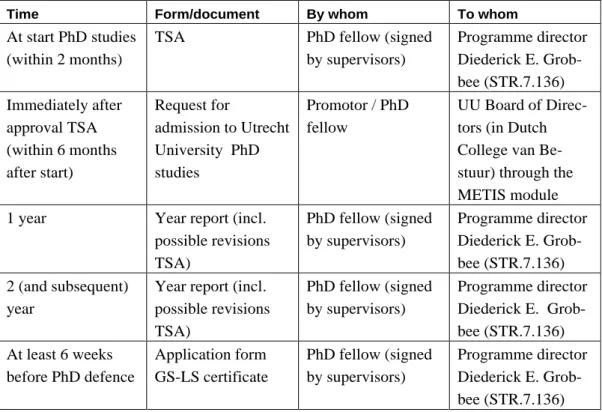
Table 2. Monitoring scheme PhD programme
(Note: The request for admission to Utrecht University PhD studies is not part of the training pro-gramme but is the obvious starting point of the project and is therefore included in the scheme)
Time Form/document By whom To whom
At start PhD studies (within 2 months)
TSA PhD fellow (signed
by supervisors) Programme director Diederick E. Grob-bee (STR.7.136) Immediately after approval TSA (within 6 months after start) Request for admission to Utrecht University PhD studies Promotor / PhD fellow UU Board of Direc-tors (in Dutch College van Be-stuur) through the METIS module 1 year Year report (incl.
possible revisions TSA) PhD fellow (signed by supervisors) Programme director Diederick E. Grob-bee (STR.7.136) 2 (and subsequent) year
Year report (incl. possible revisions TSA) PhD fellow (signed by supervisors) Programme director Diederick E. Grob-bee (STR.7.136) At least 6 weeks before PhD defence Application form GS-LS certificate PhD fellow (signed by supervisors) Programme director Diederick E. Grob-bee (STR.7.136)
9. Number of PhD fellows
Yearly, 20-30 PhD fellows are expected to start the PhD programme Epidemiology. Contract length differs between three and four years, the majority of PhD-fellows having a three year contact. Therefore the programme will comprise of in total 60-100 fellows.
January 1, 2009, 67 fellows were registered for the programme with a completed TSA form. This num-ber is expected to increase slightly in 2009 when the Utrecht University policy of all PhD fellows join-ing one of the PhD programmes will be fully implemented.
10. Contents of the PhD programme
The PhD programme Epidemiology consists of several elements: Epidemiology courses which can be subdivided into mandatory core courses and elective specialisation courses, Generic courses such as statistical courses, and attendance of seminars, at least one visit to an international conference, participa-tion in teaching activities, and opparticipa-tionally also participaparticipa-tion in journal or book clubs. All these activities contribute to the development of competencies of the PhD fellow and are therefore part of the educa-tional programme.
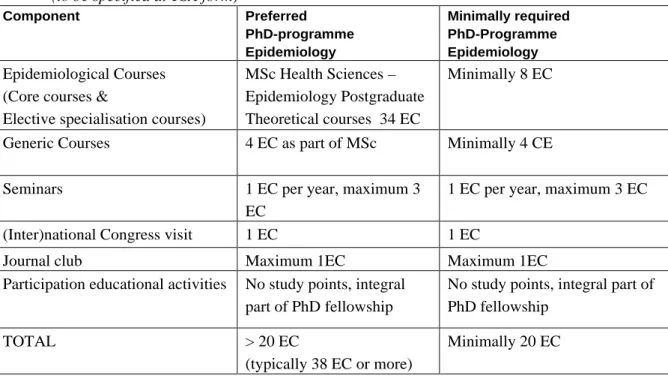
In the preferred form of the PhD training programme, the epidemiological and generic courses are being covered by participation in the Health Sciences - Epidemiology Postgraduate MSc programme. PhD fellows are expected to attend the full programme unless they have already attended the two-year regu-lar MSc programme in Epidemiology before the start of their PhD studies. For the latter fellows a mini-mally required variant is available as specified in Table 1. In this variant the PhD fellow broadens and deepens the prior obtained epidemiological knowledge by attending a selection of specialisation courses not yet attended during the master phase (only one of the five available specialisations is attended during the MSc programme, therefore the PhD fellow may now choose courses from one of the other speciali-sation directions or the generic advanced courses). Next to seven core courses attended by all MSc students, over twenty specialisation courses are offered at Utrecht University (see appendix 1) of which on average 4 to 6 are being attended during the master’s programme, leaving ample opportunity to select additional relevant courses during the PhD fase. In addition to specialisation courses offered at Utrecht University, courses may be also attended at one of the collaborating partner institutes (e.g. the MSc programme’s in epidemiology at Mainz University, or University of Groningen).
The minimal variant may also be attended by fellows with other compelling reasons not to attend the full masters’ programme (to be judged by the programme director), in which case they may opt for 8 EC in epidemiological core courses as well as specialisation courses.
Table 1. Overview preferred and minimal variant PhD programme epidemiology (to be specified at TSA form)
Component Preferred PhD-programme Epidemiology Minimally required PhD-Programme Epidemiology Epidemiological Courses
(Core courses &
Elective specialisation courses)
MSc Health Sciences – Epidemiology Postgraduate Theoretical courses 34 EC
Minimally 8 EC
Generic Courses 4 EC as part of MSc Minimally 4 CE
Seminars 1 EC per year, maximum 3
EC
1 EC per year, maximum 3 EC
(Inter)national Congress visit 1 EC 1 EC
Journal club Maximum 1EC Maximum 1EC
Participation educational activities No study points, integral part of PhD fellowship
No study points, integral part of PhD fellowship
TOTAL > 20 EC
(typically 38 EC or more)
Epidemiological training
PhD fellows enter the Epidemiology Postgraduate programme which after completion presents them with a postgraduate MSc degree and qualifies them for registration as Epidemiologist A (in Dutch: ‘Epidemioloog A’) by the Netherlands Epidemiological Society. Attendance of individual courses is also possible, provided the participant complies with the prerequisites of the course and the course is not fully booked. In principles, both for individual courses and the full MSc programme a course fee is due. An exception is the first course of the programme, ‘Introduction to Epidemiology’, which is offered without costs to all Graduate School of Life Sciences participants. For details on the MSc programme or individual courses see www.msc-epidemiology.eu
The programme consists of 7 core courses (21.5 EC), in which epidemiological principles and generic statistical knowledge are being addressed and which are being attended by all PhD fellows.
- Introduction to Epidemiology - Introduction to Statistics - Study Design
- Classical Methods in Data Analysis - Modern Methods in Data Analysis - Research Ethics and Society
- Presentation and Writing Research Proposal
Additionally PhD fellows attend advanced courses by choosing one of the five specialisation pro-gramme’s (12.5 EC) being offered:
- Clinical epidemiology
- Epidemiology of Infectious Diseases
- Veterinary Epidemiology / Epidemiology of Animal Diseases - Pharmacoepidemiology
- Environmental and Occupational Epidemiology
The specialization programmes consist partly of advanced courses obligatory for that specific specialisa-tion, and partly of elective courses. The elective courses can be chosen from the variety of advanced courses being offered at Utrecht University (can be courses from any of the specialization directions, for a list of courses see appendix 1), or courses at one of our partner institutes within or outside the Nether-lands. E.g. student may select a course at Erasmus University offered by the Netherlands Institute of Health Sciences, or courses of the Research Master programme Psychiatric Epidemiology at Groningen University. Opportunities also exist to attend courses in Germany (Mainz University). The elective courses allow fellows to design their own individual programme, optimally tailored to their personal needs or research project.
Preferably PhD fellows attend the full EPG programme as described. Exceptions are allowed if the specific background or situations requires so. In those cases the PhD fellow together with the supervi-sors designs an individual programme which covers at least 20 EC. The programme should ensure a sufficient knowledge level of epidemiology for the PhD fellow as is to be judged by the concerning programme director for the area, who will have to agree with the proposed training plan by signing the Training and Supervision agreement.
All courses of the Epidemiology Postgraduate programme are in principle open for other PhD fellows. Prerequisites are fulfilment of the prior knowledge requirements that exists for the course, as well as course capacity. For the attendance of courses a course fee should be paid.
The postgraduate masters programme has been accredited by the NVAO in July 2008 and has in January 2009 been registered by law with CROHO code 75054. The accreditation warrants quality assurance of the epidemiological training component of the PhD programme Epidemiology.
Seminar series
Each department has its own cycle of seminars. Attendance by the PhD fellows of these seminars is mandatory and PhD-fellows are expected to regularly present their work at these seminars. The seminars typically are being held once a week. With a lower frequency also interfacultary seminars are being offered, with international renowned speakers, such as life sciences seminars, and focus area/ PhD programme seminars and capita selecta.
(Inter)national congress visit
PhD fellows are expected to at least once present work (in progress) at a national or international con-gress. At national level there is the annual WEON meeting for epidemiological research. The congress may be either in the field of epidemiology or in the application field of the PhD fellow’s research. Generic courses
PhD fellows have to attend at least 4 EC generic courses which are not subject oriented but rather sup-port their personal development and competences. Currently, the decision which courses will be part of the generic programme is pending. The statistical courses from the postgraduate master’s programme may be part of the generic courses. Even though courses in statistics are being offered already, students have frequently indicated the need for a wider variety of generic courses than currently available and/or affordable. These courses are not, and can not, be delivered by the epidemiological research groups, and it is a great asset that these will be provided by the graduate school Life Sciences. Currently several courses are being offered by institutions such as the Boswell Institute, NWO, and others.
There is need for courses in: - Scientific English
- Advanced English (leading to Cambridge certificate for Proficiency in English) - Science writing
- Oral presentation - Career development - Grant writing
- Teaching in small groups - Press contact
The UMC Directorate Teaching and Training (in Dutch: Directoraat Onderwijs en Opleidingen; DOO) will offer generic courses on behalf of the graduate School of Life Sciences. Once these will be avail-able PhD fellows will be stimulated to attend a selection of the offered courses.
Teaching activities
PhD fellows should participate in the teaching activities of their research group, typically supervise practicals or guide a student workgroup. The teaching activities never exceed 5% of the PhD’s appoint-ment, and usually only exists of contributing to one or two courses during the full PhD Period. No study points are awarded for these activities, teaching is considered to be part of the participation in an aca-demic research group.
Journal club (optional)
These meetings aim at the critical appraisal of (top) publications, and/or the discussion of (chapters of) epidemiological standard books. The initiative for the organization of the meetings is primarily with the PhD fellows. The staff supports the initiatives by providing supervision. Not all departments have journal clubs but PhD fellows of all epidemiological research groups are welcome to join the initiatives that are present.
Appendix 1. Course information
Course information of the education offered by the PhD programme Epidemiology.
A prostgraduate MSc programme is being offered of which also single courses can be attended. More detail on content of the courses and course fees is available at
www.msc-epidemiology.eu.
Epidemiology Postgraduate Master Programme
Introduction to Epidemiology 3.0 ECTS
Introduction to Statistics 1.5 ECTS
Study design 4.5 ECTS
Classical Methods in Data analysis 6.0 ECTS
Modern Methods in Data analysis 4.5 ECTS
Presentation and Writing Research Proposal 1.0 ECTS
Research Ethics and Society 1.0 ECTS +
Total Core curriculum 21.5 ECTS
Research project 56.0 ECTS
Specialization programme 12.5 ECTS+
Total 90.0 ECTS
Within the Master programme five specialisation tracks are available: - Clinical Epidemiology
- Epidemiology of Infectious Diseases - Epidemiology of Animal Diseases - Pharmacoepidemiology
- Environmental and Occupational Epidemiology.
De specialisatierichting dient inhoudelijk aan te sluiten bij het promotieonderzoek Mandatory courses and electives for the five specialisation tracks
Clinical Epidemiology, programme director Prof AW Hoes
Clinical Epidemiology, 3wk
Advanced Diagnostic Research, 1 wk Prognostic Research, 1wk
Clinical Trials and Drug Risk assessment, 1wk At least one of the next two courses:
Meta-analysis 1 wk,
Etiologic Research: confounding and effectmodification
And 10 additional days to be selected from the elective programmes of other specialisation tracks
Epidemiology of Infectious Diseases, programme director Prof MJM Bonten
Basics of mathematical modelling of infectious diseases, 4days Advanced mathematical modelling of infectious diseases, 1 wk Meta-analysis 1 wk
And 15 additional days to be selected from the elective programmes of other specialisation tracks
Epidemiology of Animal Diseases, programme director Prof JAP Heesterbeek
Clinical Epidemiology, 3wk
Animal health economics I + II, 5 days Veterinary epidemiology 4wk
Introduction to GIS and spatial epidemiological data analysis 1 wk Introduction to Bayesian Analysis 4 days
Estimating R0 from data, 1 day
Pharmacoepidemiology, programme director Prof HGM Leufkens
Clinical Epidemiology, 3wk
Clinical Trials and Drug Risk assessment, 1wk Pharmacoepidemiology & Drug Safety, 1wk Pharmaceutical Policy Analysis, 1wk
And 15 additional days to be selected from the elective programmes of other specialisation tracks
Occupational and Environmental Epidemiology (OE), programme director Prof D Heederik
Assessment of exposure to chemical & biological agents, 2 wk Health effects of chemical and biological agents, 4 wk
Risk assessment and risk management, 2wk
Environmental and occupational epidemiology, 2 wk
General specialisation courses
Molecular Epidemiology of Chronic Diseases, 1 wk Nutritional Epidemiology, 1 wk
Schematische samenhang onderwijsprogramma en eindkwalificaties (Dutch) Doelstellingen en kwalificaties Intr o d u c ti o n t o E p id e m io lo g y S tu d y D e si g n S ta ti st ic a l C o u rs e s W ri ti n g & P re se n ta ti o n R e se a rc h P ro p o sa l R e se a rc h P ro je c t R e se a rc h E th ic s a n d S o c ie ty S p e c ia li sa ti o n P ro g ra m m e W e rk b e sp re k in g e n , se m in a rs , e in d p re se n ta ti e
1 Kennis gezondheid en ziekte √ √ √ √ √ √ 2 Ontwikkelingen Health Sciences √ √ √ √ √ √ 3 Onderzoeksvraag formuleren √ √ √ √ √ 4 Studieopzet √ √ √ √ √ √ √ 5 Data-analyse √ √ √ √
6 Presenteren en integreren theorie √ √ √ √ √ √ 7 Kan functioneren in een
multidisciplinair team
√ √ √ √
8 Inzicht interactie maatschappij √ √ √ √ √ √ 9 Resultaatgerichte instelling √ √
Appendix 2 Participants Focus Area Epidemiology
Five research groups participate in the research focus area Epidemiology, covering three faculties of Utrecht University:
Faculty of Medicine
- UMC Utrecht, Julius Center for Health Sciences and Primary Care (JC)
Faculty of Veterinary Medicine
- Department of Farm Animal Health, Epidemiology (FVM-EPI) - Institute for Risk Assessment Sciences (IRAS)
Faculty of Science
- Utrecht Institute for Pharmaceutical Sciences, Pharmacoepidemiology and Pharmacotherapy (PHARM)
- Department of Mathematics, Mathematical Institute (MATH)
UMC Utrecht - Julius Center for Health Sciences and Primary Care
Prof. A Algra, MD, PhD Epidemiology of thrombosis treatment & prevention Prof. MJM Bonten, MD, PhD Molecular epidemiology
Prof. Y van der Graaf, MD, PhD Clinical epidemiology of diagnostic imaging Prof. DE Grobbee, MD, PhD Clinical epidemiology
Prof. AW Hoes, MD, PhD Clinical epidemiology in general practice Prof. YT van der Schouw, PhD Epidemiology of chronic diseases
Prof. KGM Moons, PhD Clinical epidemiology, with a focus on methodology Prof. PHM Peeters, MD, PhD Cancer epidemiology
UMC Utrecht – DP&S
Prof. C. Kalkman Aneasthesiology, Epidemiology & Patient Safety Faculty of Veterinary Medicine - Dept. of Farm Animal Health
Prof. JAP Heesterbeek, PhD Theoretical epid. & modelling infectious diseases Prof. JA Stegeman, PhD Epidemiology of infectious diseases
Institute for Risk Assessment Sciences
Prof.ir. B Brunekreef, PhD Environmental Epidemiology
Prof.ir. DJJ Heederik, PhD Occupational epidemiology / Health risk analysis Prof.ir. H Kromhout, PhD Occupational Hygiene and Exposure Assessment Faculty of Science - Pharmacoepidemiology & Pharmacotherapy
Prof. A de Boer, MD, PhD Pharmacotherapy
Prof. ACG Egberts, PharmD, PhD Clinical pharmacoepidemiology Prof. HGM Leufkens, PharmD, PhD Pharmacoepidemiology
Department of Mathematics, Mathematical Institute Prof. O. Diekman, PhD Mathematical modelling