Digital Commons @ ACU
Digital Commons @ ACU
Electronic Theses and Dissertations Electronic Theses and Dissertations
4-2020
Evaluation of the Role of Self-Efficacy as a Retention Strategy in
Evaluation of the Role of Self-Efficacy as a Retention Strategy in
the Implementation of a Nurse Residency Program
the Implementation of a Nurse Residency Program
Judith Diane JacksonAbilene Christian University, [email protected]
Follow this and additional works at: https://digitalcommons.acu.edu/etd Part of the Adult and Continuing Education Commons
Recommended Citation Recommended Citation
Jackson, Judith Diane, "Evaluation of the Role of Self-Efficacy as a Retention Strategy in the
Implementation of a Nurse Residency Program" (2020). Digital Commons @ ACU, Electronic Theses and Dissertations. Paper 205.
This is brought to you for free and open access by the Electronic Theses and Dissertations at Digital Commons @ ACU. It has been accepted for inclusion in Electronic Theses and Dissertations by an authorized administrator of Digital Commons @ ACU.
fulfillment of the requirements for the degree
Doctor of Nursing Practice
Dr. Joey Cope, Dean of the College of Graduate and Professional Studies
Date: ___03 / 16 / 2020______________
Doctoral Project Committee:
Dr. Linda Gibson, Chair
Dr. Sandra Cleveland
School of Nursing
Evaluation of the Role of Self-Efficacy as a Retention Strategy in the Implementation of a Nurse Residency Program
A doctoral project submitted in partial satisfaction of the requirements for the degree of
Doctor of Nursing Practice
by
Judith Diane Jackson April 2020
Dedication
I would like to dedicate this study to my husband, Robert, who has provided me with endless support, encouragement, and outpouring of love through this entire journey. I also would like to dedicate this study to my children, parents, and paternal grandmother whose voices I heard when I wanted to quit. Without any of them, none of this would have even been possible.
Acknowledgments
There are so many people who deserve recognition and gratitude. First, the author would like to express her sincere gratitude to Dr. Cathy Northrup, my cheerleader and friend, for her patience, guidance, and encouragement throughout the intricacies of the DNP Project process. Additional gratitude to the members of the committee, especially Dr. Linda Gibson, for never giving up. Finally, the author would like to recognize Stacey Hays, Senior Graduate Admissions Advisor, and Dr. Mark Riggs for going above and beyond one Saturday to help a frantic
© Copyright by Diane Jackson (2020) All Rights Reserved
Abstract
Newly licensed graduate nurses are transitioning to practice with low self-efficacy and
competency gaps leading to poor patient outcomes and low retention rates within this population of nurses. These low rates of retention create an environment in which newly licensed graduate nurses have failed or are delayed in their transition from novice to expert. The purpose of this study was to evaluate the impact of the implementation of the Vizient/AACN nurse residency program on the first-year retention rate of newly licensed graduate nurses within an organization in central Texas. The program was evaluated utilizing newly licensed graduate nurse pre- and postimplementation data related to retention rates of the organization and the Casey Fink Graduate Nurse Experience Survey. The study design was a quantitative approach utilizing a cross-sectional survey. A convenience sample of newly licensed graduate nurses hired from November 2017 to September 2018 was used. All 48 residents enrolled in the nurse residency program were included in the study. Data were analyzed utilizing a power analysis and a paired-samples t test. The sample size was lower than 43, indicating a low confidence level. A strong correlation was noted for a standardized NRP and self-efficacy (r = .822), but there was no significant difference identified between pretest and posttest means (p > .05). Retention rates improved by 11.65% following implementation of the NRP. Findings of this study can influence the development of standardized NRPs which could increase self-efficacy and reduce turnover rates among newly licensed graduate nurses.
Keywords: newly licensed graduate nurse, transition to practice, novice to expert, self-efficacy, retention, nurse residency program
Table of Contents
Dedication ... i
Acknowledgments... ii
Abstract ... iv
List of Tables ... vii
List of Figures ... viii
Statement of the Problem ...2
Background ...2
Need for the Project ...3
Purpose of the Study ...4
Significance of the Study ...4
Implementation ...5
Research Question ...6
Null Hypothesis ...6
Hypothesis...7
Theoretical Framework ...7
Definition of Key Terms ...8
Scope and Limitations...9
Chapter Summary ...10
Chapter 2: Literature Review ...11
Theoretical Framework Discussion ...23
Conceptual Framework Discussion ...25
Chapter Summary ...26
Chapter 3: Research Method ...27
Research Design...27
Setting ...28
Institutional Review Board Process ...28
Sample Process ...29
Consent ...29
Intervention ...29
Outcome Measurement Tools ...30
NLGN Self-Efficacy ...31
NLGN Retention Rate...32
Data Collection Procedures...32
Project Timeline ...33
Threats to Validity ...35
Chapter Summary ...36
Chapter 4: Results ...37
Project Analysis ...37
Strengths and Weaknesses of the Project...38
Recommendations for Future Research ...38
Implications for Nursing Practice ...40
Limitations ...40
Discussion of Data ...40
Interpretation of Findings ...41
Inferences of Findings...45
Chapter Summary ...47
Chapter 5: Discussion, Conclusions, and Recommendations ...48
Implications of Analysis for Leaders ...48
Evidence-Based Practice Findings ...49
Recommendations for Future Research and Clinical Practice ...51
Chapter Summary ...52
References ...54
Appendix A: Casey Fink Graduate Nurse Experience Survey (revised) ...60
Appendix B: Permission Letter GN Experience Survey ...67
Appendix C: Ethics CORE ...68
Appendix D: NIH Certificate ...69
Appendix E: Abilene Christian University IRB Approval ...70
List of Tables
Table 1. Timeline ... 34
Table 2. Self-Efficacy Evaluation as a Retention Strategy ... 35
Table 3. NGLN Skills Descriptive Statistics ... 42
Table 4. NLGN Self-Efficacy Descriptive Statistics ... 43
List of Figures
Chapter 1: Introduction
In the increasingly complex field of nursing, nursing education is tasked with bridging the gap between nursing theory and the bedside in the preparation of newly licensed graduate nurses (Casey et al., 2011). Nursing schools are expected to teach nursing skills along with clinical judgment with the end result being the student’s ability to perform these skills within the context of demanding clinical reasoning and application (Casey et al., 2011). However, newly licensed graduate nurses (NLGNs) report a feeling of inadequacy in the clinical practice setting leading to high turnover rates within this population (Kavanagh & Szweda, 2017). This
phenomenon has been defined as an educational gap leading to a discrepancy between nursing education and the actual lived experience in the role of the nurse in a real clinical practice setting (Bennett, Grimsley, Grimsley, & Rodd, 2017).
The discrepancy between nursing education and clinical practice is not limited to skills. According to Huston et al. (2018), competency gaps exist within the realms of critical thinking, communication, clinical knowledge, time management and accountabilities, professionalism, skills, physical assessment, and teamwork. These gaps can effect each individual’s belief that they are able to effectively communicate with other medical professionals, patients and families, perform the skills and tasks of a professional nurse, and maintain patient safety. The belief or perception that they can achieve these expectations has been associated with better clinical judgement, persistence and more effective problem solving leading to improved patient safety, quality of care, and increased NLGN retention rates (Denler, Wolters, & Benzon, 2014; Huston et al., 2018).
Statement of the Problem
Newly licensed graduate nurses are experiencing a gap between academia and the practice setting (Huston et al., 2018). This gap leaves the NLGN struggling with the perception versus the reality of nursing and often leads to disillusionment, isolation and frustration (Huston et al., 2018). The participation of the NLGN in the Vizient/AACN NRP builds a foundation of confidence, competence, and a passion for the profession of nursing as evidenced by increasing retention rates (AACN, 2018; Africa, 2017).
Background
Newly licensed graduate nurses trade the protective environment of academia and the imaginary world of National Council Licensure Examination (NCLEX) for a real job working with real people (Johnson, 2016). These NLGNs begin work on the nursing units ready to practice what they have learned and to learn from the experienced nurses everything else they need to know. Yet, what they most often find is an expectation of increased responsibility, minimal support systems, bullying, and their own lack of confidence and clinical judgment (Kavanagh & Szweda, 2017; Schub & Heering, 2016; Van Camp & Chappy, 2017). When their idealistic expectation is not met, the stage is set for disillusionment, isolation and frustration (Huston et al., 2018).
Internal perspective. In the practice setting, nurse preceptors report that NLGNs lack basic assessment and nursing skills and require extensive support in the safe administration of medications and other safety areas (Van Camp & Chappy, 2017). Employers expect NLGNs to be able to assume their responsibilities with little assistance, and when this expectation is not met, it is often times seen as a failure of the academic system (Huston et al., 2018). In addition,
each facility’s educational program differs in length and content, creating further difficulties in the transition to practice (TTP) period.
Patient perspective. In the acute care setting, patients depend on the registered nurse to assess and intervene quickly for optimal outcomes. However, inexperienced nurses lack the skill and confidence at times to meet this expectation (Bloomfield & Kendall, 2012). This can lead to NLGNs who do not ask for assistance or who become dependent on the more experienced nurses for guidance leading to an overall loss of productivity or high turnover rates as NLGNs struggle with transitioning to professional practice (McCall-Graham & De Gagne, 2015). As attrition rates and patient ratios increase, loss of productivity becomes a reality and patient outcomes are negatively affected.
Organizational perspective. Poor patient outcomes related to NLGNs failure to TTP has a significant financial impact resulting in organizations seeking strategies to retain all nurses in clinical practice. Newly licensed graduate nurses are departing their first professional nursing job at a rate of 17.5%-60% (Kovner et al., 2016; Schub & Heering, 2016; Van Camp & Chappy, 2017) costing the organization an average of $300,000 per 1% increase in overall nursing turnover (Cochran, 2017; Nursing Solutions, Inc., 2018). Drilling further down to the direct cost to the organization of NLGN turnover, it costs $62,100 to $67,000 to recruit and train one NLGN (Cochran, 2017).
Need for the Project
The purpose of this project was to evaluate the impact of the implementation of the Vizient/AACN NRP on the first-year retention rate and self-efficacy of NLGNs within an organization in Central Texas. According to the Department of Education nurse manager (June 12, 2018), this hospital is licensed for 522 beds and hires an average of 120 NLGNs per year. If
this hospital follows the national trend of a turnover rate within the NLGNs of 17.5%, then an average of 21 nurses will decide to leave the job or will be terminated within the first year. With the average cost of each turnover at $62,100 to $67,000 (Cochran, 2017), the annual cost of turnover will range from $1,304,100 to $1,407,000 on turnover within the population of first-year graduate nurses alone. This is also important because the disruption in the continuity of care related to these turnovers can result in adverse patient outcomes (Africa, 2017).
Purpose of the Study
It is during a nurse’s first few years of practice that they are most at risk for the highest turnover rate of their career (Kovner, Brewer, Fatehi, & Jun, 2014). Bridging the gap between academia and the practice setting has the biggest potential impact on effecting nursing turnover within that timeframe (Kovner et al., 2014). The NRP was designed to provide NLGNs with the support, leadership, and resources they need and desire to be successful during the first 12 months of practice (Vizient/AACN Nurse Residency Program, 2018).
Long term. It was anticipated that successfully bridging the gap between academia and the practice setting through the implementation of the NRP would decrease turnover rates within the population of NLGNs (Bennett et al., 2017; Vizient/AACN Nurse Residency Program, 2018) creating an environment in which nurses learn and grow in confidence at the bedside gradually transitioning from novice to expert (Benner, 1984). This transition would improve patient outcomes and continuity of care. Additionally, the organization hoped that by investing in the Vizient/AACN NRP, the overall cost for recruitment and retention would significantly decrease. Significance of the Study
Following the national trend of over 33% of the NLGNs leaving their first jobs within two years of graduating, the study site was struggling to find retention strategies that worked
(Kovner et al., 2014). As individual organizations track registered nurse turnover, the results are beginning to illuminate the high financial impact of nursing turnover. For every percent increase in nursing turnover, the cost to an organization is an additional $337,500 (Nursing Solutions, Inc., 2018). Compounding the problem, negative clinical outcomes such as falls, increased medication administration errors and decreased patient satisfaction were directly linked to high turnover rates of new graduates (Bae, Mark, & Fried, 2010). All of these things combined with the growing nursing shortage serve to highlight the growing realization that retaining NLGNs has become more than just a priority. It is essential.
Implementation
The project included implementation of the Vizient/AACN NRP within an organization in central Texas with the ultimate goal of meeting national standards for accreditation through the Commission on Collegiate Nursing Education (CCNE). This NRP was specifically chosen based on the organization’s overall goal of a consistent, high-quality program that meets accreditation standards. It was a 12-month program designed specifically to support NLGNs during this crucial transitional period. Each new nurse would be expected to attend monthly seminars and group discussions as recommended by the Vizient/AACN NRP (Vizient/AACN Nurse Residency Program, 2018). These seminars and group discussions would be based on curriculum developed by Vizient/AACN and individualized to meet the unique needs of the study site. Each new nurse would be assigned a facilitator and any concerns would be addressed as they arose.
Participation in the NRP culminated with an evidence-based practice project that was presented at the end of residency. During the NRP, new graduate nurses would be completing the Casey Fink Graduate Nurse Experience Survey (CFGNES), the Resident Progression Survey, a
Graduate Nurse Residency Program Evaluation (GNRPE) and a Post-Residency Survey (Vizient/AACN Nurse Residency Program, 2018). For this project, only the data from the CFGNES survey were utilized for data collection (see Appendix A). In addition to this survey, NLGN retrospective and current turnover data for the organization were utilized to evaluate the effectiveness of the program. The Vizient/AACN NRP also provided additional benchmarking reports that would allow the study site to compare its results with other organizations within the program (Vizient/AACN Nurse Residency Program, 2018). These results were intended to empower the study site to evaluate the cost-benefit of the NRP in comparison to the anticipated money saved from significantly decreasing the turnover rate within this specific population of nurses.
Research Question
Q1. For newly employed graduate nurses (population), does participation in the Vizient Nurse Residency Program (intervention), compared to newly employed graduate nurses who were not included in this program (comparison), affect retention rates and self-efficacy (outcomes) after one year of employment (time)?
Because this is a new NRP, retrospective data were used for newly employed graduate nurses who were not included in this program prior to this date. All data collected after the initiation of the NRP included information on all newly employed graduate nurses who have completed the one year NRP.
Null Hypothesis
Implementing a 12-month NRP in which all newly licensed graduate nurses are required to actively participate will not affect retention rates and self-efficacy within the first year of practice as measured by the CFGNES.
Hypothesis
Implementing a 12-month NRP in which all newly licensed graduate nurses are required to actively participate will positively affect retention rates and self-efficacy rates within the first year of practice as measured by the CFGNES. These nurses will engage in healthy coping behaviors and will feel empowered to overcome obstacles that have historically led to job or profession abandonment, and, ultimately, lead to new graduate nurses finding the joy in nursing as evidenced by increased retention rates.
Theoretical Framework
Newly licensed graduate nurses entering the workforce are characterized as advanced beginner nurses according to Benner’s (1984) From Novice to Expert framework. A NLGN has limited experience in the clinical setting but is able to demonstrate minimal competency based on those limited experiences (Benner, 1984). During this transitional period, the NLGN needs frequent feedback and guidance to progress through this stage. As the NLGN gains knowledge and skills through clinical experiences, performance is based increasingly on past nursing situations with these experiences beginning to guide their actions (Benner, 1984). In order to transition from advanced beginner to the next stage of competent nurse, the NLGN must have the time, teaching and learning required to begin exhibiting competent nursing practice (Park & Jones, 2010). This process takes between two to three years of experience in a consistent clinical setting to become a reality (Benner, 1984). Yet, research shows that within the population of NLGNs in the United States turnover rates can range from 17.5% to 60% within the first year of practice (Kovner et al., 2016; Schub & Heering, 2016; Van Camp & Chappy, 2017). With up to 60% of NLGN never making it past the first year of practice, the turnover within this population is delaying the higher levels of competency within the profession of nursing.
Definition of Key Terms
Key definitions and phrases were identified and utilized to establish a foundation for the literature review. The following terms created the groundwork for this project.
Newly licensed graduate nurse. An advanced beginner nurse who has completed an accredited nursing program. This nurse has passed the National Council Licensure Examination (NCLEX) and is entering the nursing workforce with less than 12 months of acute clinical experience. They require additional time, practice, and support to develop the skills necessary to meet the increasing demands of patient care and safely recognize and manage changes in patient conditions for multiple patients (Friday, Zoller, Hollerbach, Jones, & Knofczynski, 2015).
Self-efficacy in nursing practice. An individual’s belief and confidence in one’s ability to accurately and successfully complete all skills, tasks, and critical thinking correlated with the identity of a nursing professional (Bandura, 1999; Denler et al., 2014).
Transition to practice. The first year of clinical practice by a newly licensed graduate nurse. The transition to practice has been identified as a period of uncertainty and doubt leading to high levels of stress and frustration (Chandler, 2012; Draper et al., 2012; Phillips, Esterman, Smith, & Kenny, 2013). The greatest opportunity for organizations to increase nursing job satisfaction and retention occurs in the transition to practice period (Chandler, 2012; Cubit & Lopez, 2012; Friday et al., 2015).
Vizient/AACN Nurse residency program. A 12-month program in which NLGNs attend learning seminars and support groups designed to support them through the transitional period (Stokowski, 2015).
Scope and Limitations
This project focused on all NLGNs at the study site who had less than 12 months of clinical experience or had been identified by their nurse manager as at risk. An example of an at risk nurse may be an immigrant nurse even though that nurse may have more than 12 months of clinical experience in their country of origin. Twelve seminars were planned and prepared intercollaboratively with expert nurses from different departments within the organization. These seminars were planned based on the unique needs of the organization and the recommendations from area nursing school faculty. These seminars were approximately four hours long and concluded with NLGNs meeting in groups with the designated facilitator to discuss victories, failures, and feelings while gaining support through shared experiences.
One unique aspect of the central Texas organization’s NRP was the exchange program. In this program, each nurse resident was assigned a monthly exchange unit in which the resident spent an afternoon in a different unit or department within the hospital. By the end of the NRP, the nurse resident had been exposed to 10 different units and/or departments, promoting
collegiality, intercollaboration, and an increased sense of belonging.
In addition, each nurse resident was expected to present an evidence-based practice (EBP) project during the final graduation seminar in the twelfth month. These EBP projects were chosen before the sixth month by the resident and approved by the nurse manager of their home unit. At the completion of the project, the EBP project was put into practice on the home unit with the potential of being implemented throughout the hospital.
For this study, the Casey Fink Graduate Nurse Experience Survey (CFGNES) was offered. Other data included in this study was obtained from the hospital’s human resources
department on retrospective NLGN turnover statistics prior to the implementation of the NRP and NLGN retention rates after the implementation of the NRP.
The data from the CFGNES was quantitatively analyzed to look for common themes in resident self-efficacy. A power analysis was calculated with 95% confidence level and 5% margin of error. Range scores, standard deviations, and means for each variable were identified and a paired samples t test was calculated to determine if the variables predict the outcome. Lastly, a chi-square test for independence was attempted to compare retention rates pre- and post-NRP implementation.
Chapter Summary
This chapter provided a general overview of the NLGN and the disillusionment that leads to job abandonment within the first year of practice. Research shows that high turnover rates within this population is detrimental to the profession and clinical outcomes. In addition, the cost of high turnover rates is not sustainable for acute care organizations and retention strategies have become the focus of hospital leaders. One such retention strategy is implementing NRPs.
Chapter 2: Literature Review
This chapter provides a review of relevant nursing literature. The purpose of this literature review was to exam the scope of the problem regarding NLGN turnover rates in the first year of practice and to evaluate the effectiveness of Nurse Residency Programs (NRPs) in decreasing these numbers. For this study, NLGNs were defined as newly licensed nurses with less than 12 months of clinical experience. The NRP specifically evaluated was the
Vizient/American Association of Colleges of Nursing (AACN) Nurse Residency Program. From September 2017 to January 2019, electronic databases were searched for relevant literature. These electronic databases included Academic Search Complete, CINAHL
(Cumulative Index for Nursing and Allied Health Literature) Complete, Journals@OVID, PsycINFO, and Supplemental Index. All searches were completed in English and included key words new graduate nurse, newly licensed nurse, newly licensed graduate nurse, transition to practice, retention rate, turnover, intent to leave, nurse shortage, readiness for practice, nursing self- efficacy, support program, nurse residency program, and Vizient/AACN.
Articles chosen for inclusion were peer reviewed and focused on registered nurses (RNs) with less than 12 months of clinical experience in an acute care setting within the United States. Articles related to countries outside of the United States, outpatient and nonacute care settings, advanced practice nurses and student nurses were excluded from the review. A total of 32
articles and two organizational websites were reviewed examining NLGNs in the transition from student to professional via the NRP experience, including two qualitative research articles, six quantitative and qualitative research articles, three literature reviews, three systematic reviews, one white paper, one survey panel, and three fact sheets.
Nurse shortage. The literature review found that as the population of the United States ages, the need for nurses will increase as care demands increase. In addition to aging Baby Boomers and their increasing health care needs, nurses themselves are aging and will soon be seeking to leave the profession through retirement. According to the American Association of Colleges of Nursing (AACN), a projected shortage of registered nurses is predicted with the southern and western United States being the most affected (AACN, 2017). The American Nurses Association (2015) reports that the average age of a working nurse is 50 years. Cochran (2017) stated that 75% of all registered nurses are 50-64 years old and it is estimated that 55% of all employed registered nurses will be retired by the year 2020. The current projection is that an additional 1.09 million nurses will be required for the continued expansion of rising care
demands and the replacement of these retirees (AACN, 2017). To compound these numbers, NLGNs who are coming into the profession to replace these RNs are choosing to leave their first jobs within the first year of employment at high rates. In the United States alone, this is a
staggering 17.5-60% of NLGNs who will be leaving their first job within that first year of practice (Kovner et al., 2016; Schub & Heering, 2016; Van Camp & Chappy, 2017). With these types of numbers leaving their jobs, by the year 2020, the demand for RNs will exceed the supply (Van Camp & Chappy, 2017).
With a demand that exceeds the supply and an aging nursing population approaching retirement, the rate at which NLGNs are leaving clinical practice is unsustainable in the current climate of nursing shortage (McCalla-Graham & De Gagne, 2015). Add to this a shortage of nursing faculty, elevated levels of stress in the workplace, and high turnover rates and organizations are faced with a dawning realization. The nursing shortage is creating higher patient loads that are directly linked to higher hospital readmission rates and poor patient
outcomes (Snavely, 2016; Tubbs-Cooley, Cimiotti, Silber, Sloane, & Aiken, 2013). In the current value-based reimbursement environment, higher readmission rates and poor patient outcomes are creating financial hardships for all acute care organizations (LaPointe, 2018).
Cost of the problem. With these rising financial pressures, organizations are searching for strategies to improve their financial standing. One of these strategies is looking for answers to the continued rise in NLGN turnover. Registered nurse (RN) turnover can cost organizations $62,100 to $67,000 to recruit and retain a nurse and to restore the loss in productivity (Cochran, 2017; Goode, Lynn, McElroy, Bednash, & Murray, 2013; McCalla-Graham & De Gagne, 2015). According to the 2018 Nursing Solutions, Inc. report (2018), 83.8% of hospital organizations within the United States understand that nurse retention is a strategy that cannot be ignored.
Each time a NLGN is hired, costs to the hospital approximates $65,000 in recruitment and training costs (Booth, 2011; Cochran, 2017; McCalla-Graham & De Gagne, 2015). One study broke it down even further. The direct cost of hiring a NLGN for a four-month orientation period is approximately $41,624 and each time a NLGN has to be replaced the cost to the agency is up to $88,000 for a total financial loss of more than $120,000 per NLGN who completes orientation and then leaves the organization (Green, Warren, & Perkins, 2016; Van Camp & Chappy, 2017).
The indirect costs of NLGN retention rates are far reaching. The American Nurses Association (ANA) released a white paper in 2015 that identified a link between inadequate registered nurse staffing and poor patient outcomes. “Poor, inadequate nurse staffing levels lead to higher rates of adverse outcomes, including hospital-acquired conditions (HACs), falls, hospital readmissions, and patient mortality due to surgical complications” (ANA, 2015, p. 9). Instability in nurse retention creates instability in the work environment and patient outcomes.
Identified gaps. In the consideration of why high turnover rates within the population of NLGNs is now the norm, a gap between academia and practice has been identified (Van Camp & Chappy, 2017). According to Cochran (2017), NLGNs reach a crisis point around the five to seven month mark after beginning their professional practice. The reality of nursing in this transitional phase between nursing school and nursing practice often times leads to
disillusionment. As NLGNs are faced with the challenges of nursing, they lack the experience to make rapid clinical judgments in critical situations (Schub & Heering, 2016). Often times, a NLGN also lacks the support needed to confidently make these judgments which adds stress to an already difficult environment. In addition, a NLGN may experience doubt in their skills and knowledge (Van Camp & Chappy, 2017). Without support and training from more experienced nurses, new graduate nurses become frustrated, burn out easily and rapidly lose job satisfaction leading to turnover.
In the descriptive phenomenology study completed by McCalla-Graham and De Gagne (2015), three themes were identified as factors in NLGN turnover.
Knowledge gap. The knowledge gap that has been identified occurred between nursing
school and actual practice. According to the participants in this study, because the National Council Licensure Examination (NCLEX) is the nationwide examination for the licensing of nurses in the United States, nursing schools focus on students being able to pass this beginner level exam. Therefore, students graduate with the ability to pass the NCLEX but are not fully prepared for conceptual knowledge-base that is required to make rapid clinical judgments and perform appropriate and timely interventions that are essential to the ability to meet the high expectations of an acute care setting (McCalla-Graham & De Gagne, 2015).
Skills. The second factor identified in this study was a lack of skills. These skills ranged
from coping mechanisms to multitasking in an increased patient load environment. Nursing schools historically have eight-hour clinical days and low patient loads. However, upon graduation, the NLGN is expected to work 12-hour shifts and often times with heavy patient loads. This in turn can lead to poor time management. According to Booth (2011), learning how to management time effectively is vital to a NLGN. Prioritization of care, documentation and essential multitasking skills may be negatively affected by poor time management skills. Add to this the NLGN’s inability to cope effectively in a rapidly changing environment and a merging clinical gap is clearly identified (McCalla-Graham & De Gagne, 2015).
Environment. The final factor identified in the McCalla-Graham and De Gagne study
was the environment. NLGNs are entering the workforce unsure of their role leading to low levels of confidence and becoming easily overwhelmed by their patient loads. Booth (2011) identified role conflict as very common among NLGNs. These nurses often times still perceive themselves in the role of student. As a student, caring for one or more patients was commonplace but ultimate responsibility fell on the primary licensed nurse. Everything completed as a student was double checked by the licensed nurse and clear lines were drawn. In the transition to
practice, the NLGN struggles with understanding the new role as an employee, team member and primary nurse. In this environment of uncertainty, the NLGN struggles with accepting
accountability for patient outcomes and their new role within the team (Booth, 2011).
Lateral violence. A final factor in NLGN turnover was identified as lateral violence or
bullying (Booth, 2011). Booth (2011) described lateral violence as verbal and nonverbal behaviors that manifest themselves as peer confrontations, setting peers up as an easy mark to become victims of the moment, holding back vital information, gossiping or sarcasm, unfair or
harsh judgments, failure to allow participation within the team, and negative body language. NLGNs have been identified as easy targets for lateral violence and are often times poorly equipped to fend off any perceived attack (Booth, 2011). Because of this type of behavior perpetrated by fellow nurses, NLGNs may choose to leave the environment, or in some cases, may choose to stay in the hostile environment creating job conflict and added stress. As NLGNs stay in these hostile environments they may become afraid to ask questions, feel isolated and fail to seek learning opportunities delaying or even preventing professional growth (Booth, 2011).
Self-efficacy. With the goal of decreasing this turnover and improving patient outcomes through the retention of skilled licensed nurses, organizations are looking for solutions. For NLGNs, the gap between academia and the actual practice setting has been identified as the greatest milestone in the transitional period (Huston et al., 2018). Hospital administrators and nursing educators are seeking ways to help NLGNs transition successfully thereby improving turnover rates. While there are multiple strategies currently being developed, the goal of this study is to evaluate the role of self-efficacy as a retention strategy in the implementation of a Nurse Residency Program (NRP). In his book, Bandura (1977) identified the importance of self-efficacy in this statement:
People make causal contributions to their own psychosocial functioning through
mechanisms of personal agency. Among the mechanisms of agency, none is more central or pervasive than beliefs of personal efficacy. Unless people believe they can produce desired effects by their actions, they have little incentive to act. Efficacy belief, therefore, is a major basis of action. People guide their lives by their beliefs of personal efficacy. (p. 2)
Self-efficacy is important to nursing practice as it affects NLGN clinical judgment, critical-thinking skills, and overall competency (Bloomfield & Kendall, 2012). When a NLGN lacks self-efficacy, they are unable to cope long-term, approach difficult problems, or adapt effectively to the fast-paced environment that is healthcare today (Bandura, 1977). This leads to high levels of stress and results in high turnover rates during the first year of practice.
Orientation programs that are being developed to assist the NLGN throughout this transitional period are known as Transition to Practice (TTP) programs or Nurse Residency Programs (NRPs). These programs vary in length and curriculum and are based on a standardized,
evidence-based approach (Africa, 2017). One such program is the Vizient/American Association of Colleges of Nursing (AACN) NRP. This program enlists NLGNs in the development and implementation of evidence based practice (EBP) while providing support from facilitators (Hosking et al., 2016). Facilitators are chosen based on organizational practices and serve in the role of mentor. The Vizient/AACN NRP was designed specifically to support the NLGN during the crucial period of transition from student to professional nurse (AACN, 2018).
Nurse residency programs. Throughout the early 2000s, as the complexity of health care increased, so did the need for increasing NLGN retention rates. In 2002, an
intercollaborative team of chief nursing officers (CNOs) from the University HealthSystem Consortium (UHC) and deans from the American Association of Colleges of Nursing (AACN) baccalaureate programs formed a partnership and quickly identified the lack of support and education between academia and professional practice as drivers of high attrition rates (Goode et al., 2013). Over the next two years, this partnership made up of a team of CNOs, deans, and nurse educators created a curriculum to address this widening gap. The first pilot UHC/AACN NRP was initiated in 2002 and included six hospitals partnered with a school of nursing (Goode
et al., 2013). As of August 2012, data have been collected from over 100 hospitals who have participated in the UHC/AACH NRP program. The results of this longitudinal study clearly show increased retention rates and improved self-efficacy among NLGNs who attended the one-year program (Goode et al., 2013).
Recommendation. In 2010 and 2015, the Institute of Medicine (IOM) recommended the
implementation of NRPs to support NLGNs in the transition into professional nursing practice (Cochran, 2017; Greene, Warren, & Perkins, 2016; Ulrich, 2015). Currently, NRPs have also gained the support of the AACN, the National Council of State Boards of Nursing (NCSBN), The Joint Commission (TJC), and the Robert Wood Johnson Foundation (Van Camp & Chappy, 2017). A Carnegie Foundation report also supports a requirement of a one-year NRP for all new graduate nurses (Goode et al., 2013). These NRPs provide consistent support, socialization and continuing professional development during the first year of practice. NLGNs who enter a NRP significantly improve their knowledge level, skill level, and coping skills necessary to overcome the stressors of the workplace (McCalla-Graham & De Gagne, 2015).
In response to this recommendation, organizations began to develop, offer and market their own version of NRPs. Today, there are many different types of NRPs throughout the United States. Some of these programs are homegrown and consistency is nonexistent (Cochran, 2017). Cochran advocates for an effective support system for NLGNs on a nationwide basis through the development of a standardized format. In Cochran’s literature review (2017), the need for at least a 12-month, consistent NRP for continued support was identified. In a white paper published by TJC (2001), the recommendation was made to utilize the UHC/AACN NRP as a model for all other standardized NRPs (Goode et al., 2013).
Vizient/AACN Nurse Residency Program. The UHC/AACN partnership approached the Commission on Collegiate Nursing Education (CCNE) in 2008 regarding an accreditation process (Goode et al., 2013). The goal of accreditation was to confirm the quality of all NRPs and to ensure consistency in compliance with the standards. These standards included program quality in regards to program faculty, institutional commitment and resources and curriculum, as well as, program effectiveness (Goode et al., 2013). Once these standards were approved by the CCNE, any NRP was eligible for CCNE accreditation as long as it met the criteria of each standard. Today, there are a variety of accredited NRPs offered throughout the United States (Goode et al., 2013).
The UHC/AACN partnership, seeking to standardize the NRP, chose to partner with Vizient (AACN, 2017). Vizient is an organizational management system that organizes, plans, leads, and controls resources with the overall goal of achieving its objectives (AACN, 2017). This collaboration resulted in the development of a structured program that utilized the AACN Essentials of Baccalaureate Education for Professional Nursing Practice standards and became known as the Vizient/AACN NRP program (Goode et al., 2013; Greene et al., 2016). This program can now be purchased by facilities that are actively seeking solutions for the retention of NLGNs and desire a CCNE accredited NRP (Greene et al., 2016). According to Cochran (2017), the estimated annual program cost of a NRP is $482,000 and can be a costly strategy in the battle to retain NLGNs. However, with an estimated cost savings of $300,000 per 1% increase in NLGN retention rates, a result of a 2% increase in NLGN retention rates would justify program costs (Cochran, 2017).
According to the AACN (2017), the Vizient/AACN NRP is reviewed and updated every three years to meet accreditation standards. Facilities who purchase the program receive expert
assistance and a formatted curriculum that may be adapted to meet the facility’s specific needs. Adaptations to the curriculum are made in collegial partnership with a school of nursing with an emphasis on learning to lead patient care at the bedside, patient safety and outcomes, and
professional role (Goode et al., 2013).
Longitudinal study. The CFGNES instrument is used to evaluate the NRP at the
beginning, six month, one year, and the 18 month point. The CFGNES focuses on skills the resident is uncomfortable performing, demographics, stressors, and provides quantitative scoring from reliability estimate and exploratory factor analysis. This survey was used in a 10-year longitudinal study that identified five relationship factors: support, organizing and prioritizing, stress, professional satisfaction, communication, and leadership (Goode et al., 2013).
Further results of the 10-year longitudinal study revealed that residents started out with a high self-perception but within six months, the residents experienced a significant decrease in perception of support and professional job satisfaction. However, by the end of the NRP, the resident’s perceptions significantly increased (Goode et al., 2013). In addition, the CFGNES survey indicates a significant increase in overall confidence, competence, organization and prioritization, and communication and leadership. These were significant predictors of
commitment to the current job position (R2 = 0.44) and to nursing as a profession (R2 = 0.33) with an increase in retention rates from 88% to 94.6% (Goode et al., 2013). The skills that residents were most uncomfortable performing were identified as code and emergency response, chest tube care, and vent care and management (Goode et al., 2013). The overall impression of the NRP by residents were positive.
Case study. In the literature review by Cochran (2017), two case studies, a cost-benefit
the reduction of attrition rates among NLGNs. The attrition rate of NLGNs prior to the
implementation of the NRP was 36.8% with a decrease of 30.4% after implementation for a final NLGN attrition rate of 6.4%. According to Cochran (2017), net savings from the implementation of a NRP are $10-$50 per patient day over two years.
The literature also supports the implementation of the Vizient/AACN NRP as a strategy for NLGN retention initiatives.
Vizient/AACN Nurse Residency Program Roles. Successful implementation of the Vizient/AACN NRP begins with the CNO. A full investment includes assuring that the budget allows for the cost of the program, the resources needed to implement the program and resources required to cover for participants of the NRP while they attend the sessions (Greene et al., 2016). It also entails that the CNO set expectations and standards for management. These expectations ensure nurse managers support participants through scheduling and NRP completion
requirements. In addition, the CNO’s expectations include the participants in regards to
participation and consequences of nonparticipation. Further support for the NRP is shown when the CNO attends any celebration in which the participants display and celebrate the fruits of their labor (Greene et al., 2016).
Supporting the CNO is the core team made up of a Nurse Residency Coordinator (NRC), facilitators, and coaches. The job of the NRC is to educate all staff, manage the program and analyze and disseminate data (Greene et al., 2016). The NRC is also integral to the development and training of highly engaged resident facilitators and coaches. While these two roles are not the same, each are voluntary and focuses on the support of the NLGN. A resident facilitator focuses more on integrating the NLGN into the new setting, assists them with the transition from new graduate to professional, and ensures the joy in nursing is maintained and developed into a long
lasting career (Schub & Heering, 2016). The goal of each resident facilitator is to assist the NLGN in role identity. A resident facilitator meets with residents as a group during the monthly sessions and discussions focus on the residents. Each resident is encouraged to share
experiences, frustrations, fears and successes with their group. A commonality is established and successes are celebrated. These discussions are confidential, presented in a safe environment, and provide residents with support throughout the program. Resident facilitators are expected to meet individually with residents within their work environment as well. In comparison, a coach’s focus is more on the immediate need of developing unit specific skills, integration into a team and improving overall performance (Schub & Heering, 2016). This role is essential to job identity for the NLGN.
The Vizient/AACN NRP also recommends the establishment of an interdisciplinary Nurse Residency Advisory Board (NRAB). The board consists of the CNO, the Residency Coordinator, and representatives from the following: (a) human resources, (b) nurse recruitment, (c) finance, (d) other disciplines, (e) dean or faculty from the collegiate partner, and (f) a recent graduate of the NRP at that organization (Green et al., 2016). It is this intercollaborative group that will recommend standards and implementations or follow-up processes to be approved and implemented by the CNO. They are also instrumental in gaining support for the program through education and working to incorporate the NRP into the culture of the organization. Their goal is to establish the NRP as a facility developed, fully vetted, supported, and recognized standard for all NLGNs who are beginning their professional nursing careers (Green et al., 2016).
The final participants in the NRP are the NLGNs themselves. Goode et al. (2013) referred to participants in the NRP as residents. Residents are expected to attend 12 monthly sessions in which they participate in interprofessional exercises, simulations, presentation of expert content,
and discussion of actual clinical situations. These face-to-face sessions introduce the residents to expert nurses and role models throughout their first year of clinical practice. These sessions are in addition to the unit orientation in which coaches guide residents through experiential learning at the bedside. In the twelfth and final month of the NRP, each resident is expected to present an evidence-based project (EBP). It is highly recommended that these EBPs be displayed in a poster presentation with all administration and staff invited to attend to celebrate the NLGN’s
graduation from the NRP (AACN, 2017). Theoretical Framework Discussion
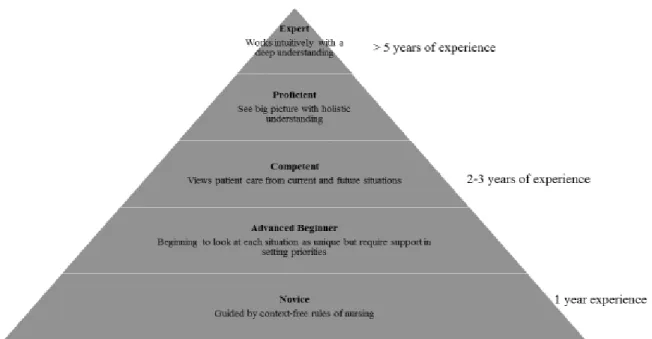
In the research by Del Bueno (2005), it was found that only 35% of NLGNs meet entry-level expectations for clinical judgment. She found that educational preparation and credentials did not play a role in these findings. This means that the other 65% of NLGNs are deficient but they were able to pass the NCLEX. According to Benner’s From Novice to Expert framework (1984; see Figure 1), NLGNs entering the workforce should be characterized as beginning stage II. However, with Del Bueno’s research, it is clear that most NLGNs are leaving academia and beginning work in the clinical setting as a professional nurse characterized more as stage I novice nurses.
Figure 1. Novice to expert model (Benner, 1984).
Benner describes five stages of clinical competence (Benner, 1984). In stage I, novice nurses are guided in their decision making by theories and context-free rules of nursing. They have no experience with different situations and rely on these rules for guidance. In stage II, the advanced beginner nurse has some prior experience but focuses more on tasks. These nurses are able to perceive that every situation is different but do not yet operate outside of general
guidelines. They are able to begin looking at each situation as unique but require support in setting priorities.
Stage III, or the competent nurse, occurs after two-three years of experience within the same clinical area. These nurses are able to view patient care from the aspect of current and future situations. Stage IV, or the proficient nurse, occurs when the nurse develops a holistic understanding of clients and is able to adapt plans to specific settings or situations. This overall picture enables these nurses to quickly recognize when normal is absent. It can take up to five years of experience within the same clinical area to reach stage V. In this final stage, the stage V
expert nurse displays an intuition based on a deep understanding and knowledge. They are not guided by rules, guidelines, or normalcy. Instead, these nurses intuitively focus in on the problem without wasting time on other possibilities or ‘what ifs.’
In Benner’s theory, the emphasis is placed on developing nursing skill steadily over time resulting in progressively safer nursing practice. As the NLGN gains knowledge and skills through clinical experiences, performance is based increasingly on past nursing situations with these clinical experiences beginning to guide their actions (Benner, 1984).
Conceptual Framework Discussion
During the transition to practice period, the NLGN needs frequent feedback and guidance to progress through the stages of the Novice to Expert framework. It is through this theory that organizations have gained a greater understanding of the need for apprenticeships in the training of NLGNs. This is expressly seen in the organizational programs that pair NLGNs with an expert nurse as a part of the clinical training process to help develop the NLGN’s clinical eye and the development of NRPs.
In order to transition from novice to expert, the NLGN must have the time, teaching and learning required to begin exhibiting competent nursing practice based on clinical judgment and intuition (Park & Jones, 2010). This process takes years of experience in a consistent clinical setting to become a reality (Benner, 1984). Yet, research shows that within the population of NLGNs in the United States turnover rates can range from 17.5% to 60% within the first year of practice (Kovner et al., 2016; Schub & Heering, 2016; Van Camp & Chappy, 2017). With up to 60% of NLGN never making it past the first year of practice, the turnover within this population is delaying the higher levels of competency within the profession of nursing.
Chapter Summary
NLGNs historically are finding themselves in jobs and situations that create frustration, stress and disillusionment leading to high attrition rates. These attrition rates cost organizations millions of dollars and create environments in which patient care is compromised. NRPs were developed to address this growing problem. An NRP that meets accreditation standards has shown to markedly improve organizational attrition rates for NLGNs within the first year of practice. Utilizing the Novice to Expert model to predict NLGN intentions and behaviors, the NRP specifically designed for the organization in central Texas will provide a support system that will elicit a commitment to the organization and the profession of nursing.
Chapter 3: Research Method
The DNP scholarly project translated evidence into clinical practice. For this project, the researcher examined the relationship between the NRP, self-efficacy and retention rates in NLGNs. The independent variable, NLGNs, was defined as newly licensed graduate nurses in their first 12 months of practice. The independent variable, NRP, was defined as the
Vizient/AACN 12-month residency program. The dependent variable, self-efficacy in nursing practice, was defined as the NLGN’s perception of their ability to carry out the responsibility and work of a licensed nurse. The dependent variable, retention rate, was defined as retaining a NLGN for a 12-month period.
In this chapter, the DNP scholarly project methodology, including the research design, setting, sample process, consent, intervention, outcome measurement tools, the data collection procedures, threats to validity and ethical considerations will be outlined.
Research Design
The study design was a quantitative approach to examine the relationship between the independent variables, NLGNs and the NRP, and the dependent variables, self-efficacy and retention rate. Retrospective data were obtained from the human resources department of the project setting to compare 12-month retention rates of NLGNs prior to and after implementation of the NRP. For measuring resident self-efficacy, a cross-sectional survey was administered. This survey collected demographic data, information regarding the NLGN resident’s school of nursing academic program and evaluated the NLGN’s perceptions of readiness for accepting the responsibilities and workload of a licensed nurse.
Setting
The project setting was a faith-based, private, nonprofit, 522 bed, level III trauma, acute care organization in Central Texas serving 22 counties. The organization had a hierarchy leadership structure with the Chief Executive Officer (CEO) at the top. Staff nurses were supervised by nurse managers (NMs). The NMs were organized into clusters and reported directly to one of the five cluster directors. These directors reported directly to the Chief Nursing Officer (CNO) and she reported to the CEO. Both the CEO and CNO were members of the Board of Trustees.
The organization chose the Vizient/AACN NRP for all incoming NLGNs who have less than 12 months of clinical practice experience. All NLGNs were required to attend the
organization’s nursing orientation designed to orient all nurses to the hospital. Upon completion of nursing orientation, NLGNs reported to their units to be assigned to a coach by the department nursing educator. These coaches were chosen based on their nursing skills, approachability, people skills and the completion of coach training. The length of coaching varied according to department, but averaged between 12 and 16 weeks. Because applications were accepted anytime throughout the year, the NRP had set start dates three times a year and NLGNs could start the NRP immediately after nursing orientation or during the coaching period.
Institutional Review Board Process
Upon defense proposal approval, the researcher began the process of obtaining
Institutional Review Board Process (IRB) approval. The facility had an IRB but deferred to the researcher’s university IRB where doctoral studies were sought for approval. The researcher completed Ethics CORE and the NIH protection of human participants’ courses and applied for
IRB approval before beginning the project (see Appendix C and Appendix D). Upon IRB approval, data collection began (see Appendix E).
Sample Process
This study used a convenience sample of NLGNs hired within an acute care organization in Central Texas who were participating in the NRP. No NLGNs who qualified for the NRP were excluded from the study.
Consent
All NLGNs in the study were employees of the organization. Because all NLGNs with less than 12 months of clinical practice must participate in the NRP, the NLGN’s application to the organization was implied consent for participation in the NRP evaluation process. The completion of the evaluation surveys were an expectation of their role as a NRP resident. Intervention
All NLGNs with less than 12 months of clinical experience participated in the 12-month evidence-based NRP that was based on the Vizient/AACN NRP model, but individualized to meet specific organizational needs. Groups of NLGNs were assigned cohorts and attended 12 monthly sessions that were structured according to the Vizient/AACN NRP curriculum. These sessions were scheduled for five hours and included didactic classes and expert nurse topic presentations based on organizational priorities. In the last hour of every session, the NLGNs met in groups according to clusters with their designated facilitator to discuss clinical experiences, feelings, perceived wins and failures. Facilitators used this time to help identify NLGNs who were struggling and perceived to be at risk. These NLGNs were then referred to the appropriate support system in an effort to retain the nurse. Upon completion of sessions two through eleven, each NLGN were assigned to an exchange unit for an additional three hours. These units were
grouped according to the NLGNs home unit cluster and were chosen based on intercollaborative roles and relationship building. Upon completion and graduation from the NRP, each NLGN had visited 10 different units in which she/he would be working closely. Throughout the 12 months, each NLGN would research and prepare a poster board presentation of an EBP that had been approved by their nurse manager. During the twelfth and final session, all nursing employees and nursing administration were invited to a NRP poster presentation at which time these EBPs were introduced to nursing staff in preparation for implementation on the units. In addition to and separate from the NRP, each NLGN was assigned to a coach by their department educator and they worked side-by-side this coach during the formal orientation period which lasted from 12 to 16 weeks depending on the area of specialty.
Outcome Measurement Tools
The CFGNES was developed in 1999 by Kathy Casey, MSN, RN and Regina Fink, PhD, RN, AOCN, FAAN after an extensive, comprehensive literature review (Fink, Krugman, Casey, & Goode, 2004). The CFGNES’s latest revision was in 2006 and it has been used in the
University Health System Consortium/AACN Post Baccalaureate Residency program by over 10,000 NLGNs. This instrument discriminates between nurses during the first year of practice. The CFGNES is a copyrighted instrument. Permission to utilize this survey was obtained via the University Health System Consortium website (see Appendix B). This survey takes
approximately 15 minutes to complete (Fink et al., 2004).
Content validity was established through the review of expert nurse directors and
educators in both academic and private hospital settings (Fink et al., 2004). The CFGNES can be quantitatively summarized. The authors used exploratory factor analysis and identified latent constructs through principal axis factoring. A five-factor solution was found and these factors
were labeled support, patient safety, stress, communication and leadership, and professional satisfaction. This solution accounts for 46% of the variation in total scores (Fink et al., 2004).
The analysis found an overall Cronbach’s alpha of .89 (Goode et al., 2013). Reliability estimates for each individual factor demonstrates for support r = .90, patient safety r = .79, stress r = .71, communication/leadership r = .75, and professional satisfaction r = (see Appendix F).
Demographic data are collected in section 5 of the CFGNES and these questions include age, gender, ethnicity, current area of specialty, basic nursing education information, previous health care work experience, date of hire and tenure, and orientation questions (Fink et al., 2004). These demographics were to be utilized to evaluate the NRP for retention potential.
NLGN Self-Efficacy
In sections one, two, three, and four the CFGNES evaluates the NLGN’s self-efficacy in nursing practice. This survey was given to NLGNs to analyze the faith in their ability to
communicate with other medical professionals, patients and families, perform nursing skills and tasks, and maintain patient safety (Fink et al., 2004). In section 1, the NLGN selected from a drop down list the top three skills that they were the most uncomfortable performing. Section 2 evaluated the NLGN’s comfort and confidence level with 25 questions using a Likert scale: 1 = strongly disagree, 2 = disagree, 3 = agree, 4 = strongly agree (Fink et al., 2004). Section 3
evaluated job satisfaction with a 9-item aspects list using a Likert scale: 1 = very dissatisfied, 2 = moderately dissatisfied, 3 = neither satisfied nor dissatisfied, 4 = moderately satisfied, 5 = very satisfied (Fink et al., 2004). Section 4 contained four open-ended questions regarding role transition and work environment and cannot be quantitatively summarized (Fink et al., 2004).
Self-efficacy was measured at three points throughout the NRP. Beginning self-efficacy was measured at the beginning, six-month point, and at the twelfth month point of the NRP. NLGN Retention Rate
Retrospective and current retention rates were obtained from the human resources department. The retention rates from previous years in which NLGNs did not participate in the NRP were compared to the one-year retention rate of current NLGNs who had completed one year of the NRP. For this study, current retention rates included all residents from cohorts one of the NRP.
Data Collection Procedures
For this study, all current NRP residents in cohorts received the link to the CFGNES. The NLGNs were provided with instructions on how to complete the survey by the organization’s Department of Education representative and researcher.
The platform that was used to collect survey data was the Vizient/AACN website. Each NLGN was given unique identifiers that were only known to Vizient/AACN. The surveys were completed away from the work environment during the NRP sessions. The data were analyzed by Vizient/AACN and reports were made available for organizational and researcher use. Quantitative data analysis was aligned to the research question and hypotheses. Data analysis was completed using SPSS Statistics software.
A power analysis was calculated for 48 participants with a 95% confidence level and 5% margin of error. A chi-square test was attempted, but due to small sample size, could not be verified as accurate. Descriptive statistics were to be used to analyze the demographic questions. However, this data were not made available to the student. The range scores, standard deviations, and means were calculated for each variable. Sections one to four of the CFGNES were
calculated and summarized. A paired samples t test analysis was calculated to compare NLGN retention rates pre- and post-NRP implementation. These calculations were completed using SPSS Statistics software. The quantitative analysis answered the research question related to the relationship and prediction of the outcome, retention rates and self-efficacy in nursing practice, to the predictor variable, the NRP.
Project Timeline
The timeline of the DNP Project was determined by IRB approval and the project site’s determination of applicable NRP cohort and data availability (see Table 1). Project planning occurred over a 16-week period beginning in October 2017. The inaugural NRP began in February 2018 and continued over a 12-month period. Data were collected as a requirement of the organization’s NRP in February 2018 and March 2019, but were not made available to the researcher until IRB approval in April 2019. The DNP Project began in April 2019 (see Table 2). Project evaluation and data analysis was conducted from April 2019 through January 2020.
Table 1 Timeline
October 2017 Site approval Project planning NRP development
December 2017 NRP Curriculum Training – meeting with AACN and site leadership
January 2018 NRP Advisory Board Meeting
Developed introductory letter for NRP
Meeting with Director of Education for letter approval Worked with Department of Education to develop facilitator training
February 2018 Facilitator packets developed Facilitator training
Session one – NRP
CFGNES #1 – Data collected by Vizient/AACN March 2018 Educator training
Rubric developed for NRP essay requirement Session two – NRP
April 2018 Session three - NRP May 2018 Session four - NRP
June 2018 NRP Advisory Board Meeting Session five - NRP
July 2018 Session six - NRP August 2018 Session seven - NRP September 2018 Session eight - NRP October 2018 Session nine - NRP November 2018 Session ten - NRP December 2018 Session eleven - NRP January 2019 Session twelve - NRP
February 2019 NRP Graduation & Poster Presentation
March 2019 CFGNES #2 – Data collected by Vizient/AACN April 2019 IRB approval
Survey data received from Vizient/AACN Data analysis
May 2019 Met with Human Resources to receive retention data Data analysis
August 2019 Data analysis discussed with statistician for accuracy January 2020 Edited data analysis discussed with statistician for accuracy
Table 2
Self-Efficacy Evaluation as a Retention Strategy
Task Oct ‘17 Feb ‘18 Mar ‘19 Apr ‘19 May ‘19 Jun ‘19 Jul ‘19 Aug ‘19 Sep ‘19 Oct ‘19 Nov ‘19 Dec ‘19 Jan ‘20 Planning & NRP Develop Cohort 1-NRP CFGNES #1 CFGNES #2 Evaluation of Data Analysis of Data Present Results NRP Advisory Board Threats to Validity
Threats to validity for the study were related to the NRP and the population. Because the NRP was based on Vizient/AACN NRP curriculum, the individualization of components could potentially create difficulty in replication of the findings in other populations. In addition, the majority of these NLGNs graduated from central Texas nursing schools and were primarily from that area. Therefore, in order to generalize the findings, additional studies in diverse settings will be necessary.
Ethical Considerations
Facility support was obtained in October 2017 via email. The university IRB and ethics courses completed by the researcher ensured the protection of human participants and ensured all ethical considerations were reviewed.
The researcher further protected the human participants by introducing self, explaining the survey process, purpose and benefit of the project, confidentiality, and person to person contact if concerns arise. Participants were given the opportunity to ask questions. This informed consent process did not require a signature due to implied consent upon hire to the organization.
Upon completion of the project, confidentiality was maintained for all participants through unique identifiers that were only known to the Vizient/AACN NRP. No personal
discernable data were available to the researcher. Data will be kept within the organization for at least five years within the Department of Education and the Department of Human Resources. The researcher stored all data relevant to the project on a personal USB flash drive that was protected by a username and password. All data were collected and results were disseminated accurately.
Chapter Summary
An evaluation framework for the newly implemented NRP was implemented for the DNP project. This framework focused on the effect of the NRP on retention rates and self-efficacy of NLGNs in their first year of practice. Data were collected utilizing the CFGNES. The project began following approval from the ACU IRB. The results were analyzed using descriptive statistics, power analysis, and paired samples t tests to evaluate any relationships and predictors of the outcome in Summer/Fall 2019. Results were disseminated accordingly.
Chapter 4: Results
The DNP scholarly project was guided by Patricia Benner’s novice to expert theory. The purpose of this study was to examine the relationship between a standardized NRP and self-efficacy and retention in NLGNs with less than 12 months of clinical experience. A convenience sample of NLGNs participating in the inaugural NRP was utilized for data collection, and retrospective data were utilized for pre-NRP implementation data. The CFGNES was utilized to evaluate the NLGN’s experience throughout the NRP.
In this chapter, the DNP scholarly project’s quantitative analysis will be outlined for the following research question.
Q1. For newly employed graduate nurses (population), does participation in the Vizient Nurse Residency Program (intervention), compared to newly employed graduate nurses who were not included in this program (comparison), affect retention rates and self-efficacy (outcomes) after one year of employment (time)?
Project Analysis
The inaugural NRP began on February 28, 2018, and concluded February 28, 2019. The Vizient/AACN NRP evaluation framework dashboards were utilized to quantitatively measure NLGN survey data. Of the 48 NLGN residents, 32 participated in the initial survey, 28
participated in the six-month survey, and 26 participated in the 12-month survey. The initial response rate was 67%, with a decreasing response rate at six months of 58%, and a final response rate of 54% at the 12-month survey. Quantitative data analysis was aligned to the research question and the Vizient/AACN NRP evaluation framework dashboard results were verified utilizing the SPSS Statistics software. Inferential statistics were used to compare the