215 Lee Petherbridge*
Cite as: Lee Petherbridge, The Claim Construction Effect
15 Mich. Telecomm. Tech. L. Rev. 215 (2008),
available at http://www.mttlr.org/volfifteen/petherbridge.pdf
I. Introduction ...215
II. Study Design & Methodology...222
A. Database Construction...226
B. Measurement Criteria ...227
III. Results & Discussion ...228
A. The Claim Construction Effect ...230
B. The Revolution of 2000...236
C. Did Phillips Correct the Claim Construction Effect?...253
IV. Concluding Remarks & Some Implications for the Success of the Federal Circuit...261
A. The Impact of Claim Construction ...261
B. On the Judicial Contribution to the Claim Construction Effect ...262
C. A View on the Significance of Phillips...264
I. Introduction
The experiment in institutional design embodied in the United States Court of Appeals for the Federal Circuit is passing its twenty-fifth anni-versary.1 During that time, the Federal Circuit has come to be a dominating force in the patent system.2
There has been a dramatic
* Associate Professor of Law, Loyola Law School, Los Angeles. Thanks to Polk Wagner for comments on this study, on earlier drafts, and invaluable help in establishing the project, and to Doug Stenstrom for comments on earlier drafts and invaluable statistical ad-vice; to David McGowan, Mark Lemley, John Allison, Kim West-Faulcon, Rick Hasen, Jennifer Rothman, Gregory Mandel, Chris Cotropia, Tim Holbrook, Dave Schwartz, Jeff Lef-stin, Michael Waterstone, the many scholars who participated at the 7th Annual Intellectual Property Scholars Conference at DePaul University College of Law, the 8th Annual Intellec-tual Property Scholars Conference at Stanford Law School, and the University of San Diego School of Law Faculty Colloquia Series for helpful comments concerning the project and earlier drafts; and to Kanita Viranond for valuable research assistance. Comments are appreci-ated: [email protected].
1. The Federal Circuit was created by the Federal Courts Improvement Act of 1982.
See Pub. L. No. 97-164, 96 Stat. 25 (relevant provisions codified as amended in scattered sections of Title 28 of the U.S. Code).
2. See, e.g., Mark D. Janis, Patent Law in the Age of the Invisible Supreme Court, 2001 U. Ill. L. Rev. 387, 387 (stating that the “Court of Appeals for the Federal Circuit . . . has become the de facto supreme court of patents”); Arthur J. Gajarsa & Lawrence P.
increase in the significance of patents to the national economy3
and a concomitant increase in the court’s visibility.4
The rise to prominence of the Federal Circuit is, however, no acci-dent.5 Rather, it is exactly what Congress intended. The premise of the Federal Circuit is widespread dissatisfaction with the confusion and un-certainty that followed from regional circuit involvement.6 The
Cogswell, III, Foreword: The Federal Circuit and the Supreme Court, 55 Am. U. L. Rev. 821, 822 (2006) (reporting that until April 2006, the Supreme Court had granted certiorari in only sixteen patent cases).
3. See Nat’l Research Council of the Nat’l Acad., Patents in the Knowl-edge-Based Economy (Stephen Merrill, Richard C. Levin & Mark B. Myers eds., 2004) (broadly discussing the economic significance of patents).
4. The court has recently been the subject of high profile reports, see Nat’l Re-search Council of the Nat’l Acads., A Patent System for the 21st Century
(Stephen A. Merrill, Richard C. Levin & Mark B. Myers eds., 2004) (discussing the role of the Federal Circuit in the patent system); see generallyFed. Trade Comm’n, To Promote Inno-vation: The Proper Balance of Competition and Patent Law and Policy (2003),
available at http://www.ftc.gov/os/2003/10/innovationrpt.pdf (addressing the role of the Fed-eral Circuit in setting the appropriate balance between competition and patent law and policy), and popular literature, James Bessen & Michael Meurer, Patent Failure: How Judges, Bureaucrats, and Lawyers Put Innovators at Risk (Princeton Univ. Press 2008) (argu-ing that, inter alia, the Federal Circuit has helped to undermine innovation); Adam B. Jaffe & Josh Lerner,Innovation and Its Discontents (2004) (discussing and criticizing the per-formance of the court). Even some Federal Circuit Judges have noted the debate surrounding the court. Paul R. Michel, The Court of Appeals for the Federal Circuit Must Evolve to Meet the Challenges Ahead, 48 Am. U. L. Rev. 1177, 1182–85 (1999) (addressing the debate over the Federal Circuit’s increasing role). The court has also been involved in a number of high profile cases. A few recent ones include: MercExchange, L.L.C. v. eBay, Inc., 401 F.3d 1323, 1339 (Fed. Cir. 2005) (reversing the district court’s denial of a permanent injunction against infringement), vacated by 126 S. Ct. 1837 (2006); Teleflex, Inc. v. KSR Int’l Co., 119 F. App’x 282 (Fed. Cir. 2005) (vacating the district court’s grant of summary judgment on the ground of obviousness), rev’d, 127 S. Ct. 1727 (2007); NTP, Inc. v. Research in Motion, Ltd., 418 F.3d 1282 (Fed. Cir. 2005) (deciding a patent infringement lawsuit in part unfavorably against the makers of the Blackberry wireless email system).
5. For work considering the theoretical basis of the formation of the Federal Circuit,
see Rochelle Cooper Dreyfuss, The Federal Circuit: A Case Study in Specialized Courts, 64
N.Y.U. L. Rev. 1 (1989); see also Charles W. Adams, The Court of Appeals for the Federal Circuit: More than a National Patent Court, 49 Mo. L. Rev. 43 (1984) (noting that the Federal Circuit was formed in part to deal with the harmful effects that can arise from multiple federal appellate courts deciding matters arising from the same laws); Pauline Newman, The Federal Circuit in Perspective, 54 Am. U. L. Rev. 821 (2005) (discussing the context of the creation of the Federal Circuit).
6. Legislators were confronted with evidence that the legal infrastructure of the patent system lacked order and coherence, seeS. Rep. No. 97-275 at 5 (1981), reprinted in 1982 U.S.C.C.A.N. 11, 15 (reporting that “patent law [is] an area in which the application of the law to the facts of a case often produces different outcomes in different courtrooms in substan-tially similar cases”), that uncertainty in the patent system was harmful to innovation, seeid.
at 6, reprinted in 1982 U.S.C.C.A.N. at 16 (reporting the comments of Harry F. Manbeck, Jr., General Patent Counsel of the General Electric Company, who testified that doctrinal stability has an effect on innovation and that decreasing uncertainties is important to business decision-making), and that wasteful collateral litigation was rampant, seeid. at 3–6, reprinted in 1982 U.S.C.C.A.N. at 15 (discussing claims that forum shopping “increases the cost of litigation
justification for the court follows somewhat naturally from this premise: establishing a more centralized7 source of legal authority will produce a clearer, more stable, and more predictable legal infrastructure for the patent system.8
As the patent system has grown in terms of economic significance and complexity,9 conventional wisdom suggests that Congress’s struc-tural goals have been realized. But while the Federal Circuit has expanded its influence over patent jurisprudence in a number of doctrinal areas,10
no area of law has garnered more angst and attention than the
and ‘demeans the entire judicial process and the patent system as well’”). Studies also re-vealed marked disparities in patent adjudication across regional circuits. See Dreyfuss, supra
note 5, at 7 (citing Thomas Cooch, The Standard of Invention in the Courts, inDynamics of the Patent System 34, 56–59 (William B. Ball ed., 1960)), reporting that patents were “twice as likely to be held valid and infringed in the Fifth Circuit than in the Seventh Circuit, and almost four times more likely to be enforced in the Seventh Circuit than in the Second Circuit.”). Coordinating guidance from the Supreme Court was not likely to be forthcoming; the Senate Report notes that at the time the Supreme Court was having difficulty with the size of its docket. SeeS. Rep. No. 97-275, at 3 (1981), as reprinted in 1982 U.S.C.C.A.N. 11, 13 (noting that the Supreme Court “appears to be operating at—or close to—full capacity; there-fore, in the future the Court cannot be expected to provide much more guidance in legal issues than it now does.”); see also Adams, supra note 5, at 45. This is consistent with the view that patent cases may have been avoided by the high court due to the high level of legal and tech-nical difficulty presented by the subject matter. See Dreyfuss, supra note 5, at 6.
7. The Federal Courts Improvement Act unified jurisdiction over patent appeals in the Federal Circuit. Accordingly, patent appeals, whether from the U.S. Patent and Trademark Office, the U.S. district courts, the Court of Federal Claims, or the Court of International Trade, may now be heard by a single appellate court having national jurisdiction. But see
Holmes Group, Inc. v. Vornado Air Circulation Sys., Inc., 535 U.S. 826 (2002) (returning jurisdiction to the regional circuits in limited circumstances, such as when plaintiff does not allege a patent-law cause of action, and defendant’s answer contains a patent-law counter-claim).
8. See Comm’n on Revision of the Federal Court Appellate System, Structure & In-ternal Procedures: Recommendations for Change, reprinted in 67 F.R.D. 195, 219–20 (1975);
S. Rep. No. 97-275, at 4–5 (1981), reprinted in 1982 U.S.C.C.A.N. 11, 14–15 (stating the benefits of more efficient administration of patent claims); id. (“[T]he Federal Circuit also provides a forum that will increase doctrinal stability in the field of patent law.”).
9. See John R. Allison & Mark A. Lemley, The Growing Complexity of the United States Patent System, 82 B.U. L. Rev. 77 (2002).
10. See, e.g., the standard for obviousness, Lee Petherbridge & R. Polk Wagner, The Federal Circuit and Patentability: An Empirical Assessment of the Law of Obviousness, 85
Tex. L. Rev. 2051 (2007) (discussing the development of obviousness jurisprudence); Chris-topher A. Cotropia, Nonobviousness and the Federal Circuit: An Empirical Analysis of Recent Case Law, 82 Notre Dame L. Rev. 911 (2007) (same); remedies, Dreyfuss, supra note 5, at 18–19; procedural issues, seeid. at 30–52 (discussing some of the areas where the court has been influential); anticipation, id. at 10–11; the doctrine of equivalents, Festo Corp. v. Shoketsu Kinzoku Kogyo Kabushiki Co., 234 F.3d 558 (Fed. Cir. 2000) (en banc), vacated by
535 U.S. 722 (2002); Warner-Jenkinson Co. v. Hilton Davis Chem. Co., 62 F.3d 1512 (Fed. Cir. 1995) (en banc), rev’d, 520 U.S. 17 (1997); and inequitable conduct, Dreyfuss, supra note 5, at 21–22.
law of claim construction.11
Claim construction refers to the task of construing, or interpreting, the words of patents’ claims to establish the metes and bounds of a patent. Theoretically, the task of claim construc-tion serves to operaconstruc-tionalize the concept of “invenconstruc-tion,” which lies at the heart of the U.S. patent system.
In broad strokes, the U.S. patent system is founded on the normative principle that giving inventors property rights in their inventions—the exclusive rights12 to make, use, sell, and import13—should promote inno-vation in the United States. As this statement suggests, the property rights granted are particularly with respect to an invention, a concept that, among other things, delimits the scope of the right to exclude. To determine the invention, U.S. patent law relies on textual definitions, i.e., claims set forth in the patent document.14
Specifically, a patent’s claims define the subject matter to which a patentee is entitled the right to ex-clude.
The task of claim construction requires translating the words of the claim into a meaningful technological context, so it is perhaps no sur-prise that claim construction presents one of the most difficult problems in patent law. Patents address intangible concepts, and the precision that has evolved in the definition of tangible property has proven difficult to reproduce for patents. The problem is exacerbated by the fact that the genus of patentable subject matter is at once vastly broader than that of
11. Claim construction is a topic of great scholarly interest. A search of the LEXIS— “US Law Reviews and Journals, Combined” database on February 13, 2009, with the terms “claim /2 constr! or interp! /100 patent,” yielded 1529 hits. As this suggests, in the context of a law review article it is impossible to cite to all of the important contributions in this area. The reader will find citations to some of the most on point to this study scattered throughout this article. See, e.g., infra notes 23, 24, 82; for a small sampling of some of the earlier papers in this area that concern themselves with the federal circuit’s performance, see, e.g., Arti K. Rai,
Engaging Facts and Policy: A Multi-Institutional Approach to Patent System Reform, 103
Colum. L. Rev. 1035 (2003) (arguing that the Federal Circuit’s claim construction rules in the context of the patent system could lead to indeterminacy); William F. Lee & Anita K. Krug,
Still Adjusting to Markman: A Prescription for the Timing of Claim Construction Hearings, 13
Harv. J.L. & Tech. 55, 67 (1999) (presenting the view that the Markman holding might lead to less predictability); Craig Allen Nard, Process Considerations in the Age of Markman and Mantras, 2001 U.Ill. L. Rev. 355 (arguing for the use of interlocutory appeal); John M. Romary & Arie M. Michelsohn, Patent Claim Interpretation After Markman: How the Federal Circuit Interprets Claims, 46 Am. U. L. Rev. 1887 (1997) (collecting case digests to predict the use of intrinsic evidence after Markman).
12. U.S. Const. art. I, § 8. 13. 35 U.S.C. § 271 (2000).
14. See Phillips v. AWH Corp., 415 F.3d 1303, 1312 (Fed. Cir. 2005) (“It is a ‘bedrock principle’ of patent law that ‘the claims of a patent define the invention to which the patentee is entitled the right to exclude,’” quoting Innova/Pure Water, Inc. v. Safari Water Filtration Sys., Inc., 381 F.3d 1111, 1115 (Fed. Cir. 2004)). The patent statute is consistent with this as it requires a patent to “conclude with one or more claims particularly pointing out and distinctly claiming the subject matter which the applicant regards as his invention.” See 35 U.S.C. § 112 (2000).
tangible property and is also at the leading edge of human knowledge, where descriptive vocabularies are necessarily less developed.
Compounding the difficulty and complexity of claim construction is the central role it plays in the patent system. As private parties, individu-als must construe claims to assess the legal risks associated with particular behaviors, as well as to make rational investment decisions. As dispute resolution institutions and enforcers of the laws and policies of the patent system, courts construe claims to make determinations of in-fringement and invalidity. Claims also define the invention that is examined against the requirements for patentability.15 So as the public’s agent, the patent office must construe claims in assessing patentability. Because nearly everything in a patent case turns on claim construction (e.g., whether infringement has occurred, or whether the patent meets the requirements for patentability), it is thought to be a key and dispositve issue most patent cases.16
Thus, as Judge Giles S. Rich famously wrote, “the name of the game is the claim.”17
Given the centrality of claim construction, it should come as little surprise that as the Federal Circuit sought to address Congress’s demand that it bring coherence and stability to patent law, claim construction be-came the centerpiece of its reform efforts. Briefly,18 in Markman v. Westview Instruments,19
the Supreme Court affirmed the Federal Circuit’s understanding that the question of patent claim construction is not sub-ject to the 7th Amendment right to a jury trial. The Court assigned the question to judges on the rationale that they are deemed to have special skill when it comes to the interpretation of documents20
and that the allo-cation of interpretive authority to judges should promote the policy goals of jurisprudential certainty and uniformity.21
Shortly thereafter, the Fed-eral Circuit took total control of issue, holding in Cybor Corp. v. FAS Technologies, Inc., that the question of claim construction is “purely
15. See, e.g., 35 U.S.C. § 101 (2000) (subject matter and utility requirements); § 102 (novelty requirement); § 103 (nonobviousness requirement).
16. See Markman v. Westview Instruments, Inc., 52 F.3d 967, 989 (Fed. Cir. 1995) (en banc) (Mayer, J., concurring) (“to decide what the claims mean is nearly always to decide the case”).
17. Giles Sutherland Rich, Extent of Protection and Interpretation of Claims— American Perspectives, 21 Int’l Rev. Indus. Prop. & Copyright L. 497, 499 (1990). 18. See R. Polk Wagner & Lee Petherbridge, Is the Federal Circuit Succeeding?: An Empirical Assessment of Judicial Performance, 152 U. Pa. L. Rev. 1105 at 1120–24 (2004) (providing a more extensive analysis).
19. Markman v. Westview Instruments, Inc., 517 U.S. 370 (1996), aff ’g 52 F.3d 967 (Fed. Cir. 1995).
20. Id. at 388 (in contrast to “jurors unburdened by training in exegesis”). 21. Id. at 391.
legal,” and thus subject to de novo review.22
In view of the central role claim construction plays in the patent law, this framework of judicial interpretation of patent claims confers upon the Federal Circuit the sole authority to decide a significant fraction of patent disputes.
While the consolidation of judicial power embodied in the Federal Circuit’s current claim construction doctrine has generated a variety of concerns,23
perhaps the most persistent is the concern that the pragmatic rationale underlying the current doctrine—that it should help bring sta-bility and predictasta-bility to patent law—is deeply flawed. Perhaps no body of scholarship reflects this more strongly than the body of scholar-ship associated with assessing how often the Federal Circuit reverses lower court claim construction determinations.24 The basic thrust of the criticism is that a high reversal rate on the issue of claim construction introduces costly unpredictability25 into the patent system.
22. 138 F.3d 1448, 1456 (Fed. Cir. 1998) (“[W]e therefore reaffirm that, as a purely legal question, we review claim construction de novo on appeal . . . .”).
23. For scholarly argument criticizing the Cybor decision, see William H. Burgess,
Simplicity at the Cost of Clarity: Appellate Review of Claim Construction and the Failed Promise of Cybor, 153 U. Pa. L. Rev. 763, 774–90 (2004). See also, e.g., John F. Duffy, On Improving the Legal Process of Claim Interpretation: Administrative Alternatives, 2 Wash. U. J.L. & Pol’y 109 (2000); Nard, supra note 11; Christian A. Chu, Empirical Analysis of the Federal Circuit’s Claim Construction Trends, 16 Berkeley Tech. L.J. 1075 (2001). For judi-cial criticism of Cybor, consider the remarks of Judge Mayer in Phillips v. AWH Corp.:
This court was created for the purpose of bringing consistency to the patent field. Instead, we have taken this noble mandate, to reinvigorate the patent and introduce predictability to the field, and focused inappropriate power in this court. In our quest to elevate our importance, we have, however, disregarded our role as an ap-pellate court; the resulting mayhem has seriously undermined the legitimacy of the process, if not the integrity of the institution.
415 F.3d 1303, 1330 (Fed. Cir. 2005) (Mayer, J., dissenting).
24. See David L. Schwartz, Practice Makes Perfect? An Empirical Study of Claim Con-struction Reversal Rates in Patent Cases, 107 Mich. L. Rev. 223 (2008) (providing a measure of reversal rate); Michael Saunders, Note, A Survey of Post-Phillips Claim Construction Cases, 22 Berkeley Tech. L.J. 215 (2007) (analyzing the effect of Phillips); Andrew T. Zidel, Patent Claim Construction in Trial Courts: A Study Showing the Need for Clear Guid-ance From the Federal Circuit, 33 Seton Hall L. Rev. 711, 741–42 (2003) (discussing the American Bar Association’s 2000 survey of claim construction timing); Kimberly A. Moore,
Are District Court Judges Equipped to Resolve Patent Cases?, 15 Harv. J.L. & Tech 1, 17–31 (2001) (also discussing the 2000 study); see also Kimberly A. Moore, Markman Eight Years Later: Is Claim Construction More Predictable?, 9 Lewis & Clark L. Rev. 231, 243–47 (2005) (updating the prior study); Chu, supra note 23, at 1100–06; Gretchen Ann Bender,
Uncertainty and Unpredictability in Patent Litigation: The Time is Ripe for a Consistent Claim Construction Methodology, 8 J. Intell. Prop. L. 175, 207 (2001) (providing a measure of reversal rates).
25. See, e.g., Schwartz, supra note 24, at 225–27 (describing some aspects of unpre-dictability); Kimberly A. Moore, Markman Eight Years Later, supra note 24, at 232 n.2 (collecting sources raising this issue). But see, e.g., Jeffery A. Lefstin, Claim Construction, Appeal, and the Predictability of Interpretive Regimes, 61 U. Miami L. Rev. 1033 (2007) (questioning scholarly emphasis on predictability in claim construction).
It is often useful to measure a problem, and studies of claim con-struction reversal rates have measured other variables to valuable affect. But with one exception, the main studies in this area concern themselves with data sets comprised of cases selected by the presence of a judicial analysis of claim construction.26
The study presented here departs from this model. Rather than fo-cusing on the set of cases in which the Federal Circuit addresses claim construction, this study focuses on a set of cases defined by a different patent doctrine.27
The basic idea is to explore the impact of claim con-struction on other areas of patent law.
The logic behind this study may already be apparent to the reader. If claim construction really is central to all things patent, then one can hy-pothesize that the development of uncertainty and unpredictability in claim construction—documented in the reversal rate studies just dis-cussed—might infect, or bleed into, other doctrinal areas of patent law. If so, one might expect that as claim construction becomes at once more unpredictable and more prominently involved in other areas of the patent law, the court’s treatment of other areas of law might, by association, also become more unpredictable.28
The Article labels this hypothesis the claim construction effect.
The hypothesis of the claim construction effect can be empirically tested, and this Article’s first and most significant contribution is to test the hypothesis using empirical techniques. Ultimately, it argues that the hypothesis finds support in four central pieces of evidence. First, the Ar-ticle shows that the average rate at which the Federal Circuit uses claim
26. See, e.g., Schwartz, supra note 24, at 238 (establishing an appellate database that “includes all Federal Circuit cases in which the parties disputed the district court’s construc-tion of a claim limitaconstruc-tion”); Kimberly A. Moore, Markman Eight Years Later, supra note 24, at 239 (“This original database now contains all precedential, non-precedential, and Rule 36 (summary affirmances) decisions of the Federal Circuit on claim construction from the Su-preme Court's Markman decision (1996) through 2003.”). The exception is the Chu study, which collected all patent cases between January 1, 1998 and April 30, 2000. See Chu, supra
note 23, at 1092. But although it collects a broad swath of information, it uses the information differently than this study. Moreover, it addresses relatively small period of time in Federal Circuit history, making it difficult to discern broad patterns.
27. This study uses the doctrine of equivalents. It will be introduced in more detail,
infra.
28. As used here, unpredictability refers to a measure of how frequently the Federal Circuit concludes that trial courts are incorrect in their understanding of the law; it does not refer to a measure of whether, as a matter of ultimate outcomes, an issue resolves itself in a non-random manner. In other words, in the context of this study, a decline in the rate at which the Federal Circuit affirms lower court judgments on an issue (e.g., the doctrine of equiva-lents) is evidence of destabilization even if as a matter of ultimate outcomes on the issue patentees have a high loss rate, cf., Allison & Lemley, infra note 30 (conflating Federal Circuit and trial court data and concluding that overall there has been a decline in successful ultimate outcomes for patentees on the doctrine of equivalents).
construction in the dataset has increased over the last fifteen years. Sec-ond, the Article shows that the average rate at which the court modifies lower court claim construction determinations has increased over the last fifteen years. Third, the Article shows that as the Federal Circuit in-creased the rate at which it modified lower court claim construction determinations, there was a complementary decrease in the power of the court to affirm. The fourth piece of evidence, while supporting the hy-pothesis, also suggests an explanation. It argues that the claim construction effect is largely the product of an intracircuit dispute over the development of claim construction doctrine. The appearance of the claim construction effect associates well with the strengthening of dis-tinctly different judicial approaches to the task of construing claims.
The second general contribution made by this article is an empirical analysis of whether the Federal Circuit corrected the claim construction effect with its opinion in Phillips v. AWH Corp.,29
which, by attempting to clarify how claim construction should be analyzed, seeks to resolve relevant differences in judicial approaches to claim construction. Here, the results paint a decidedly mixed picture. Some predictability appears to have returned after Phillips, with some judges significantly changing their authorship patterns. There is evidence, though, that the fundamen-tals of the claim construction effect remain strongly entrenched in Federal Circuit jurisprudence.
The Article proceeds in four additional parts. Part II describes the study design and methodology, and includes a description of the doctrine that defines the data set—the doctrine of equivalents. Part III presents the results and provides an analysis of their meaning. Part IV offers some concluding remarks.
II. Study Design & Methodology
The overall design of this study is straightforward. It relies on a widely accepted data collection and analysis technique generally known as “content analysis”30 to gather information from judicial
29. Phillips v. AWH Corp., 415 F.3d 1303 (Fed. Cir. 2005) (en banc) (attempting to resolve the conflicting methodological approaches to claim construction highlighted in Wag-ner & Petherbridge, supra note 18, at 1148–70).
30. Content analysis refers to the systematic reading and analysis of texts, including judicial opinions. In contrast to more traditional forms of legal scholarship, it seeks a compre-hensive, objective understanding of a body of law as opposed to an interpretation of symbolic or important judicial opinions. It thus permits scholars to verify, analyze, or refute empirical claims about case law that are implicit or explicit in all branches of legal scholarship. For an article describing content analysis and its application to legal studies, see Mark A. Hall & Ronald F. Wright, Systematic Content Analysis of Judicial Opinions, 96 Cal. L. Rev. 63 (2008). For some examples of legal scholarship that have used content analysis as an approach
opinions.31
The basic approach is to systematically categorize (or “code”) judicial opinions and to utilize the data that result to empirically analyze the jurisprudence.
The study also takes the form described in the previous part. The data set is not determined by whether a written opinion contains an analysis of claim construction. Its composition is instead determined by the presence of another patent doctrine, known as the doctrine of equiva-lents. Thus, only a subset of the full dataset contains a Federal Circuit claim construction determination. This framework allows for the explo-ration of the behavior of claim construction and other variables within a particular area of the court’s law.
The doctrine of equivalents is well-suited to this study for several reasons, some of which are quite straightforward and practical. For ex-ample, the doctrine of equivalents is widely known and discussed among legal scholars32
and is also widely applied,33
providing an ample number of opinions to study. The doctrine of equivalents is also well-suited to this study for more conceptual reasons. Below, I introduce some of the
to examining a body of law, see John R. Allison & Mark A. Lemley, The (Unnoticed) Demise of the Doctrine of Equivalents, 59 Stan. L. Rev. 955 (2007); Petherbridge & Wagner, supra
note 10; Cotropia, supra note 10; Wagner & Petherbridge, supra note 18; Schwartz, supra
note 24.
31. Using judicial opinions as a dataset naturally imports a set of well-recognized bi-ases, the most important of which affect not only content analysis, but also more traditional interpretive forms of legal scholarship. These include unobserved reasoning, selection bias, and strategic behavior. See Wagner & Petherbridge, supra note 18, at 1128–30. But while these biases should be kept in mind, they should not be overemphasized. The source of infor-mation relied upon in this sort of study—judicial opinions—is essentially the same source that is traditionally relied upon by legal scholars and patent system participants on a day-to-day or case-by-case basis. Taking a comprehensive approach to the examination of that information can provide benefits that outweigh the limitations of the approach, and can avoid some of the limitations presented by using more traditional approaches to legal scholarship.
32. Some recent legal scholarship examining this issue includes Allison & Lemley,
supra note 30; Charles W. Adams, The Doctrine of Equivalents: Becoming a Derelict on the Waters of Patent Law, 84 Neb. L. Rev. 1113 (2006); Doug Lichtman, Substitutes for the Doc-trine of Equivalents: A Response to Meurer and Nard, 93 Geo. L.J. 2013 (2005); Michael J. Meurer & Craig Allen Nard, Invention, Refinement, and Patent Claim Scope: A New Perspec-tive on the Doctrine of Equivalents, 93 Geo. L.J. 1947 (2005); Douglas Lichtman, Rethinking Prosecution History Estoppel, 71 U. Chi. L. Rev. 151 (2004); R. Polk Wagner, Reconsidering Estoppel: Patent Administration and the Failure of Festo, 151 U. Pa. L. Rev. 159 (2002); S. Jay Plager, Challenges for Intellectual Property Law in the Twenty-First Century: Indetermi-nacy and Other Problems, 2001 U. Ill. L. Rev. 69 (2001); Paul R. Michel, The Role and Responsibility of Patent Attorneys in Improving the Doctrine of Equivalents, 40 IDEA 123 (2000); Hal C. Wegner et al., The Future of the Doctrine of Equivalents, 26 AIPLA Q.J. 277 (1998); Robert P. Merges & Richard R. Nelson, On the Complex Economics of Patent Scope, 90 Colum. L. Rev. 839 (1990).
33. Allison & Lemley, supra note 30, at 977 (stating that “a patentee is almost always arguing the doctrine of equivalents as an alternative to a theory of literal infringement”); see infra Part II.A (reporting that the Federal Circuit has decided 991 equivalents analyses in its written opinions in the last fifteen years).
details of the doctrine of equivalents and explain why it is could be a fairly sensitive substrate for detecting the presence vel non of the claim construction effect.
As noted earlier, the boundaries of a patentee’s right to exclude are set by the limits defined from the words that comprise the patent claim. To give this principle legal and technical context, patent doctrine utilizes the two-step analysis set forth in the following familiar refrain: “First, the claim must be properly construed to determine its scope and mean-ing. Second, the claim as properly construed must be compared to the accused device or process.”34
This approach to assessing liability for patent infringement makes the following real world scenario reasonably possible: a competitor might often be capable of both avoiding infringement liability and ap-propriating the substance of an invention by developing accused devices or processes that differ insubstantially in connection with even a single limitation. While patentees inevitably strive to draft claims that thwart this form of competition, the task may be quite difficult for several rec-ognized reasons. Words present an imperfect means to describe the boundaries of patented subject matter.35
A patentee may mistakenly fail to claim all commercially useful embodiments. Alternatively, future technological advances may make unforeseen and (therefore unclaimed) embodiments practicable.
The doctrine of equivalents exists specifically to deal with the eco-nomic consequences of the widespread realization of this scenario. In a leading case, Graver Tank & Manufacturing Co. v. Linde Air Products Co.,36 the Supreme Court set forth the policy implicated by the doctrine: to protect the incentive structure of the patent system. The court rea-soned that allowing putative infringers to escape liability by practicing trivial changes would discourage potential patentees from taking the risk of innovation, as well as discourage “unscrupulous copyists” from pursu-ing innovations of their own.37
Thus, the Court reasoned, to prevent “fraud on a patent,”38 the doctrine of equivalents would be available to
34. See, e.g., Carroll Touch, Inc. v. Electro Mech. Sys., Inc., 15 F.3d 1573, 1576 (Fed. Cir. 1993) (setting forth the two steps of infringement). The doctrine also prescribes this in-fringement inquiry take place within the context of the all elements rule. See Warner-Jenkinson Co. v. Hilton Davis Chem. Co., 520 U.S. 17 (1997) (holding that the determination of equivalence in an infringement action should proceed on an element-by-element basis). Thus, each element of the claimed invention must be present literally or equivalently in the accused device.
35. See, e.g., Clarisa Long, Information Costs in Patent and Copyright, 90 Va. L. Rev.
465 (2004).
36. Graver Tank & Mfg. Co. v. Linde Air Prods. Co., 339 U.S. 605 (1950). 37. Id. at 607.
patentees to exclude others from subject matter beyond the literal scope of a patent.
In general terms then, the doctrine of equivalents is, as a colleague recently and succinctly put it, a “close enough” doctrine.39 It determines whether an accused infringer’s conduct, while not infringing the letter of a patent, may still be enjoined because it is “close enough” to the letter of a patent.
The doctrine of equivalents could be a sensitive substrate when it comes to detecting the impact of claim construction. The conceptual rea-son for this is that expanding or contracting the literal meaning of a claim can—and might often be expected to—have an impact on the scope of available equivalents. The following example helps to illustrate this point. Assume the following claim:
A means for striking comprising: a stick,
a nail, and a rope.
Assume next that the patent itself discloses only an iron nail, and that this narrow disclosure is used by the trial court to determine that “nail” is defined in the context of this claim as “iron nail.” Barring the application of some other rule restricting the use of equivalents, an iron nail has a range of equivalents, i.e., a range of things from which it is only insubstantially different in this context (perhaps, an iron screw, or an iron tack). But if the Federal Circuit examines this determination and concludes that it was inappropriate to limit the scope of “nail” to an “iron nail,” and returns the scope of the limitation to “any nail,” the ge-nus of available equivalents—things not insubstantially different from a nail—likely becomes larger. Not only might steel screws and alloy tacks be equivalents, but nonmetallic embodiments are more plausibly equiva-lent—e.g., wooden screws, ceramic rivets, or plastic pegs, might be included.40
Indeed, without a metallic limitation, more general fasteners, like tape or Velcro-type fasteners, might fall within the scope of equiva-lents.41
Similarly, the scope of equivalents might be expected to contract if the original literal interpretation of the claim was that a “nail” means “any fastener that affects fastening by penetration,” and the Federal
39. Dan Schechter, pers. comm. (2008).
40. To be clear, I do not mean to say that it would be theoretically impossible for a court to conclude that these embodiments were not insubstantially different from an iron nail. The point is that one might, as a matter of theory, expect a shift in likelihood that these em-bodiments could be found to be only insubstantially different if the literal scope of the claim was adjusted from “iron nail” to “nail.”
Circuit, finding error, limits the literal scope to a short metallic rod with a flat head, a smooth shaft, and a pointy end.
A. Database Construction
The data set used in this study includes all observable Federal Cir-cuit analyses deciding the doctrine of equivalents over a roughly fifteen (15) year period spanning January 1, 1992 to May 2, 2007.42 The data set was assembled from a search of the LEXIS “Federal Circuit—US Court of Appeals Cases” database. Using no date restrictions, the following terms were searched:
patent! and equivalent! and (“prosecution history estoppel” or “file wrapper” or “estoppel” or “all elements” or “vitiate” or “vitiation” or “dedicate” or “dedication” or “disclaim” or “disclaimed” or “disavow” or “disavowal” or “graver tank” or “hilton” or “warner-jenkinson” or “festo” or “doctrine”) and not name (in re) and not “sec’y.”
The search returned 1,235 cases. The data set was then truncated to the above described date ranges, and manually screened for decisions on the doctrine of equivalents. Cases directed to the so-called “reverse doc-trine of equivalents” were excluded, as well as all other cases not deciding the doctrine of equivalents.
Each observable analysis deciding the doctrine of equivalents was entered as a record in the data set. If an opinion decided the issue of in-fringement by equivalents of three claims, using distinct analyses for each claim, each analysis counted as a separate record in the data set. If an opinion decided the issue of infringement by equivalents for several claims from a single patent with a single analysis, e.g., a single incidence of estoppel barred resort to equivalents for more than one claim, that analysis received a single entry in the data set. However, if the court de-cided claims from two or more different patents with a single equivalents analysis, each patent was scored as a single analysis. Multiple analyses per opinion were not uncommon. This approach yielded 991 analyses.
For this particular study, the data set was truncated even further. Only analyses that were clear with respect to claim construction status
42. These dates have general, but not specific, significance. January 1, 1992 was selected because it provides for a large set of data records before a number of Supreme Court and Federal Circuit opinions that are conventionally seen as notable in the history of claim construction doc-trine and the docdoc-trine of equivalents. May 2, 2007 was chosen because that was the date of the most recently issued relevant opinion at the time the search for opinions was conducted, and because it provided a roughly five-year window—a relatively large number of opinions—after the most recent major Supreme Court decision concerning the doctrine of equivalents, see Festo Corp. v. Shoketsu Kinzoku Kogyo Kabushiki Co., 535 U.S. 722 (2002).
were included. Thus, to be included, analyses had to show that claim construction had been considered and report whether the court agreed with the lower court’s construction, or contain no indication that claim construction had been considered in the analysis. Opinions that were ambiguous with respect to claim construction status were excluded. Only opinions for the court (not dissents or concurrences) were included. This reduced the total number of analyses used in the study from 991 to 878.
B. Measurement Criteria
The measurement criteria for the Federal Circuit’s doctrine of equivalents jurisprudence encompassed a broad array of variables. Vari-ables used in this study are shown in Table 1.
Table 1
Measurement Criteria Used in the Study
Field ID Description Form Coding
Serial Serial number [ Integer ] Machine
Date Date issued [ Date ] Machine
Author Author of court’s opinion [ Text ] Machine Summary
Judgment
Is appeal from summary
judgment? [ Yes, No ] Human
Outcome 1 [ Affirm, Reverse, Vacate ] Human Discernable CC Presence of claim
construction [ Yes, No ] Human Disposition 2 Disposition of claim
construction [ CC modified, CC unmodified, N/A ] Human PHE Amendment43
Presence of doctrine [ Yes, No ] Human
43. The amendment form of prosecution history estoppel seeks to prevent a patentee from recapturing through the doctrine of equivalents subject matter surrendered by the amend-ing of patent claims duramend-ing patent prosecution, see, e.g., Festo Corp. v. Shoketsu Kinzoku Kogyo Kabushiki Co., 535 U.S. 722 (2002) (adopting a rebuttable presumption that a narrow-ing amendment surrenders an equivalent), or by cancellation and rewritnarrow-ing of patent claims during patent prosecution, see Honeywell Int’l Inc. v. Hamilton Sundstrand Corp., 370 F.3d 1131 (Fed. Cir. 2004) (en banc).
Field ID Description Form Coding Equivalent
Specific Totals44
Presence of specific doctrines associated with
the doctrine of equivalents
[ Grouped variable ] Human
Opinion [ Court, Concur, Dissent ] Human
III. Results & Discussion
Analysis of the collected data proceeds by first examining the rate which the Federal Circuit applies claim construction in the context of analyzing the doctrine of equivalents. Finding that there has been a sig-nificant increase in the rate at which the court applies claim construction, the analysis next examines the rate at which the Federal Circuit modifies lower courts’ claim construction determinations. Because the evidence indicates that there has been a sharp increase in the rate that the Federal Circuit modifies claim construction, the analysis moves to examining the relationship between claim construction modification and the power of the court to affirm lower courts’ judgments.
It finds that over the last fifteen years, there is a complementary de-crease in the power of the court to affirm. The analysis characterizes the decrease in the power to affirm decisions on the doctrine of equivalents as a decline in doctrinal predictability.45 The evidence supporting the analysis indicates that the overall decline in predictability is more strongly predicted by the modification of lower court claim interpreta-tions than it is by doctrines conventionally understood as affecting the application of the doctrine of equivalents.
These results are interpreted as evidence supportive of the hypothe-sis of claim construction effect. There has been an increase in the rate that the court uses claim construction in connection with decisions on the doctrine of equivalents and an apparent increase in the impact of
44. This variable collects analyses positive for a number of doctrines involved in decid-ing the doctrine of equivalents. Specific descriptions of their characteristics are unnecessary to the analysis presented; but for those who are interested, beyond the amendment form of prose-cution history estoppel, the doctrines grouped in this variable comprise: argument-based prosecution history estoppel, the “All Elements” Rule, the prohibition against a scope of equivalents that encompasses prior art, the prohibition against a scope of equivalents that encompasses subject matter disclosed but not literally claimed in a patent specification, the limitation of the doctrine of equivalents in some cases to only after arising technologies, and the two major standards for performing the equivalents comparison between an accused de-vice and the patent, known as the “function-way-result” test and the “insubstantial differences” test.
45. Recall that doctrinal predictability here refers to a measure of how frequently the Federal Circuit concludes that a trial court is incorrect; it is not a measure of how frequently a patentee might ultimately prevail in any given case. Seesupra note 28.
claim construction decision-making on equivalents decisions. The im-pact takes the predicted form—a decline in doctrinal predictability.
The analysis then seeks additional support for the hypothesis of the claim construction effect by looking for potentially explanatory jurispru-dential and doctrinal happenings. To find potential explanations, the analysis screens the last fifteen years of Federal Circuit jurisprudence for periods of unpredictability. It finds that an increase in unpredictability developed around the year 2000, and that it associates well with the strengthening of distinctly different judicial approaches to the task of construing claims. Together the results suggest that the claim construc-tion effect is largely the product of an intracircuit dispute over the development of claim construction doctrine.
With this information in hand, the final Part examines whether the Federal Circuit’s recent efforts to resolve the diversity in its claim con-struction jurisprudence46
has diminished the claim construction effect and restored some measure of doctrinal predictability.
The analyses undertaken in this section rely heavily on two response variables. The first is affirmed. This response variable was scored as positive (a “1”) when a Federal Circuit analysis affirmed a lower court’s decision on the doctrine of equivalents. When an analysis did not affirm the decision of the lower court, a negative score (a “0”) was awarded. The variable affirmed is the primary measure of unpredictability used in this study. The basic logic is that where the Federal Circuit is unable to affirm lower court decisions, it signals unpredictability in the law.
The second response variable used extensively in the analyses pre-sented in this section is claim construction modification. This variable is a measure of whether a Federal Circuit analysis modified a lower court’s construction of a claim limitation involved in an equivalents dispute. A positive (i.e., construction modified) analysis was scored as a “1,” while a negative (i.e., construction not modified) analysis was scored as a “0.”
The empirical evidence reported in this study comes from the appli-cation47 of several statistical techniques. Some are simple descriptive statistical techniques, such as graphical representations, reports of per-centages and reports of odds of success with respect to response variables at various points in the history of patent law. The study also employs more complex statistical arguments, including linear regres-sion, the chi square test, which is useful for exploring whether there are relationships between certain variables, and logistic regression, which is a particularly good complement to chi square in the context of this study
46. Phillips v. AWH Corp., 376 F.3d 1382 (Fed. Cir. 2004) (attempting this).
47. The software used for the majority of statistical calculations includes SPSS and Microsoft Excel. The graphical representations are produced with Numbers.
because it is highly effective at estimating not only the probability that certain variables predict (or explain) positive outcomes for response variables, but also the strength of the predictive power.
The analysis will from time to time report statistical significance. Statistical significance indicates whether the observed results are likely due to chance, and is indicated by the letter p, which stands for probabil-ity. Any p-value less than .05 is considered statistically significant because it indicates that the probability that the results are due to chance is less than 5-percent. Values less than .1 are considered marginal, indi-cating that the probability that the observed results are due to chance is less than 10-percent.
A. The Claim Construction Effect
Figure 1 shows the trend in the rate at which the Federal Circuit used claim construction in written analyses deciding the doctrine of equiva-lents over the last fifteen years. As is evident, there is an impressive increase in the average rate at which the Federal Circuit applies claim construction. Figure 1, therefore, provides evidence of the first pillar of the claim construction effect—an increase in the use of claim construc-tion in Federal Circuit analyses.
Figure 148
Trend in Rate of Claim Construction in Equivalents Analyses
Equivalents Analyses of the Federal Circuit 1992–2007
The second pillar of the claim construction effect is the proposition that accompanying the increase in the use of claim construction in the context of the doctrine of equivalents is an increase in the impact of claim construction. The putative increase in impact is wrought by an in-crease in the rate at which the Federal Circuit rejects lower court claim constructions.
Several pieces of evidence suggest that this is a characteristic of equivalents jurisprudence. First, Figure 2 shows than when the Federal Circuit considers lower court claim construction determinations, there is
48. The ordinate represents a 30-analysis lagged average of the percentage of success-ful outcomes for the response variable claim construction (to be successful, the analysis had to indicate that the Federal Circuit considered claim construction in connection with a claim limitation involved in an equivalents dispute), plotted against the number of analyses (n=878). On the abscissa, the analysis number moves from left to right (1992–2007). A moving, lagged average is used. The lagged average provides a measure of the recent average frequency over thirty analyses of any given content at any given point in the data set. It approximates what a lawyer might see if he or she were to sample the court’s most recent 20–25 opinions on the topic at any point in time. The linear trend line is a least squares line, having the following statistical characteristics: r=.696, r2=.485, t-obs=28.236, p=.000.
a sharp upward trend in the rate at which the Federal Circuit rejects them. Thus, Figure 2 is evidence supportive of the presence of the sec-ond pillar of the claim construction effect. The putative means through which claim construction could be affecting this area of law—rejection (or modification) of lower court claim construction—is present and in-creasingly frequent.
Figure 249
Trend in Rate of Claim Construction Modification in Equivalents Analyses that Contain Claim Construction
Equivalents Analyses of the Federal Circuit 1992–2007
But the real world impact of the Federal Circuit’s rejection of claim construction determinations in this area of law is theoretical. In other words, the Federal Circuit could be modifying many lower court claim interpretations, but it might have no significant impact on the court’s
49. The ordinate represents a 30-analysis lagged average of the percentage of success-ful outcomes for the response variable claim construction modification, plotted against the number of analyses containing a claim construction (n=681). On the abscissa, the analysis number moves from left to right (1992–2007). A moving, lagged average is used. The lagged average provides a measure of the recent-average frequency over thirty analyses of any given content at any given point in the data set. The linear trend line is a least squares line, having the following statistical characteristics: r=.597, r2= .357, t-obs=18.990, p=.000.
propensity to affirm lower court determinations concerning the doctrine of equivalents. To gather evidence on whether the increase in average rate of claim construction modification translated into appellate unpre-dictability in the doctrine of equivalents, Figure 3 examines the trends in average rates of claim construction modification and affirmed throughout the data set. It also provides the next piece of evidence supporting the real world presence of the second pillar of the claim construction effect.
Figure 350
Trends in Rates of Affirmed and Claim Construction Modification
Equivalents Analyses of the Federal Circuit 1992–2007
Figure 3 shows that the average rate of affirmed is relatively high for approximately the first half of the data set. In contrast, the average rate
50. The ordinate represents a 30-analysis lagged average of the percentage of success-ful outcomes for the response variables affirmed and claim construction modification, plotted against the number of analyses (n=878). On the abscissa, the analysis number moves from left to right (1992–2007). A moving, lagged average is used. The lagged average provides a meas-ure of the recent-average frequency over thirty analyses of any given content at any given point in the data set. The linear trend lines are least squares lines, having the following statisti-cal characteristics: Affirmed, r=.468, r2=.219, t-obs=-15.426, p=.000; Claim Construction Modification, r=.708, r2=.501, t-obs=29.157, p=.000.
of claim construction modification during the same period is relatively low. Around (roughly) analysis number 400, the average rate of affirmed appears to fall sharply. Simultaneously, the average rate of claim con-struction modification appears to begin a steep climb. After this apparent change in behavior, the average rates do not seem to stabilize at their earlier levels.
Notably, the rates of positive outcomes for the response variables may reflect a pattern. When rates of affirmed are higher, rates of claim construction modification appear lower.51
When rates of claim construc-tion modificaconstruc-tion are higher, rates of affirmed appear lower. This pattern is evidence suggesting a relationship between affirmed and claim con-struction modification; in particular, that the Federal Circuit’s behavior toward lower court claim constructions may be responsible for the un-predictability that enters Federal Circuit equivalents jurisprudence after the year 2000.
But while the patterns suggest a relationship between affirmed and claim construction modification, its evidentiary force is somewhat mod-est. Focusing on the downward trend in the rate of affirmed, it is possible that it might be accounted for by some variable or variables other than claim construction modification. For example, the Federal Circuit’s fa-mous, controversial,52
and now reversed Festo decision,53
which involved the amendment form of prosecution history estoppel, falls at analysis number 382. And while there are reasons to think that the Festo decision should not be a significant predictor of unpredictability,54 the results ex-amined thus far do not rule out the possibility that the unpredictability that arises might be a consequence of the Festo decision or some other decision of the courts involving the doctrine of equivalents.
To gather some evidence on the strength of claim construction modi-fication as an explanation for the observed decrease in predictability, logistic regression was used. Table 2 presents the results of a logistic
51. This is apparent from a visual inspection of Figure 3.
52. See Allison & Lemley, supra note 30, at 956–57 (stating that the Festo case “whipped the patent bar into an unprecedented frenzy”).
53. Festo Corp. v. Shoketsu Kinzoku Kogyo Kabushiki Co., 234 F.3d 558 (Fed. Cir. 2000) (en banc), vacated by 535 U.S. 722 (2002).
54. One major reason is that Festo dealt primarily with only a narrow question concern-ing the doctrine of equivalents: the proper application of amendment-based prosecution history estopppel. See Wagner, supra note 32, at 162 n.8 (making this point). This form of estoppel limits the range of legally permissible equivalents based on amendments to claim language made by an applicant in the course of prosecuting a patent application and is thus relevant in only a fraction of equivalents cases. Another reason is that Festo imposed the strictest limits to date on the application of this form of estoppel, allowing no range of equiva-lents for claim limitations amended for reasons of patentability. Thus, one might expect it enhance rather than disturb doctrinal stability.
regression model employing affirmed as a response variable and testing a number of explanatory variables.
Table 255
Claim Construction Modification Is the Strongest Predictor of a Decrease in the Odds that the
Federal Circuit Affirms on the Doctrine of Equivalents Wald χ2 Exp(b) % Change in Odds of affirmed p SJ 1.981 1.298 29.8 .159 CC 13.251 2.243 124.3 .000 CC Modified 213.344 .046 -95.4 .000 Eq Sp Totals 26.231 2.680 168.0 .000 PHE Amendment 1.967 .678 -32.2 .161
Table 2 shows that claim construction modification (CC modified) most strongly predicts a decrease in the odds that the Federal Circuit will affirm a lower court’s decision on the doctrine of equivalents. This con-trasts to the more general variable claim construction (CC), which predicts an increase in the odds that the court will affirm (and thus, probably does not explain the decline in predictability). Notably, the amendment form of prosecution history estoppel (PHE Amendment) has no significant effect on affirmed, suggesting that it does not explain the decline in predictability. Grouping all equivalents-specific doctrines (Eq Sp Totals) predicts an increase in the odds of affirmed, suggesting that when the court authors analyses discussing these doctrines, it is on the
55. Table 2 shows a logistic regression model for the response variable affirmed. The explanatory variables are as follows: SJ—summary judgment, positive when an analysis is from an appeal of summary judgment; CC—claim construction, positive when an analysis contains a claim construction; CC Modified—claim construction modification, positive when an analysis modifies a lower court claim interpretation; Eq Sp Totals—equivalent specific totals, positive when an analysis discusses at least one doctrine conventionally involved in deciding the doctrine of equivalents (see Part II.B n.45), and PHE Amendment, positive when an analysis discusses the amendment form of prosecution history estoppel (the subject of numerous federal circuit decisions, and two Supreme Court decisions during the period stud-ied, see Festo Corp. v. Shoketsu Kinzoku Kogyo Kabushiki Co., 535 U.S. 722 (2002); Warner-Jenkinson Co. v. Hilton Davis Chem. Co., 520 U.S. 17 (1997)). % Change in Odds ofaffirmed reports the change in odds of a positive outcome for affirmed predicted by the explanatory variable. It is calculated by subtracting one from the exponentiated logistic regression coeffi-cient Exp(b) and multiplying by 100, (i.e., (.046-1) x 100 = -95.4%). p reports the statistical significance of the result. Wald χ2 reports a chi square value for the predictive effect; the higher the value, the more strongly significant the result. A constant is incorporated in the model. Overall, the model is significant: χ2(5)=370.159, p=.000, R-Sq (Nagelkerke)=.463.
whole more likely to affirm. Thus, it does not explain the decline in pre-dictability. Finally, Federal Circuit analyses written in response to an appeal from summary judgment (SJ) have no significant effect, suggest-ing that they too do not explain the decline in predictability that has happened over the last fifteen years.
Taken together, these results support the hypothesis of the claim construction effect. The Federal Circuit is using claim construction in equivalents analyses at an increasing rate. While it is doing so, the rate at which it rejects lower courts’ claim construction determinations has in-creased sharply. Appellate predictability has declined in a pattern consonant with the observed increase in claim construction modification. Finally, regression analysis provides evidence that the Federal Circuit’s rejection of lower court claim construction determinations most strongly predicts a decrease in predictability, while other variables that could have explained it, like changes in the rules surrounding the doctrine of equivalents have either no impact or predict predictability rather than unpredictability.
B. The Revolution of 2000
This section presents more evidence of the claim construction effect, but has an additional purpose: it also seeks to provide a jurisprudential explanation for it. In other words, it concerns itself with the question of how the claim construction effect came to be.
A word of caution: this does not claim to present the sole explana-tion, and it does not claim to present what is necessarily an “ultimate” explanation.56
Rather, using an empirical foundation, this section sets forth an explanatory theory centered on proximate jurisprudential and doctrinal happenings that can explain how the claim construction effect developed.
The kernel of the explanation is that the claim construction effect is predominantly the product of an intracircuit dispute over the develop-ment of claim construction doctrine as the court labored to meet the mandate set by the Supreme Court in Markman II. The evidence for this rather remarkable claim is set forth in more detail below and includes: an examination of the patterns in rates of affirmed and claim construction modification that support the claim that the most meaningful shifts in variable behavior occurred around the year 2000; an examination of
56. For example, I do not claim that Markman I and Cybor necessarily play no role in the claim construction effect. While for reasons that will soon become clear, this section em-phasizes factors brought to bear on Federal Circuit jurisprudence proximal to the year 2000, it is possible (and more likely, probable) that distal factors, such as the Markman and Cybor
judicial behavior revealing that in the pre-2000 period, there are no sig-nificant differences in the propensity of individual Federal Circuit judges to author opinions modifying lower court claim constructions or affirm-ing lower court judgments, but that in the post-2000 period significant differences emerge; and evidence that the most significant judge-dependent changes associate with judges who have been implicated in prior work as instrumental in the development of polarized methodologi-cal approaches to claim construction.
The analysis begins with an examination of the patterns in rates of affirmed and claim construction modification. Figure 4 is similar to Fig-ure 1, but emphasizes an interpretation of the graphical data that the most apparent changes in variable behavior seem to take place around the year 2000.
Figure 457
Trends in Rates of Affirmed and Claim Construction Modification Around 2000
Equivalents Analyses of the Federal Circuit January 1992–March 2004
57. The ordinate represents a 30-analysis lagged average of the percentage of success-ful outcomes for the response variables affirmed and claim construction modification, plotted against the number of analyses (n=685). On the abscissa, the analysis number moves from left to right (1992–2004). The arrowed lines identify the span of period constructs discussed in accompanying text. The linear trend lines are least squares lines; their statistical characteristics are depicted in the figure.
The table embedded in Figure 4 provides evidence of the strength and direction of the linear relationships between the response variables affirmed and claim construction modification, and analysis number (Analysis No), which, while imprecise, reflects a measurement of time. The strength and direction of the linear relationships show marked dif-ferences between the pre-2000 and post-2000 periods. Pre-2000, the trend in rates of affirmed moves upward significantly,58
accompanied by a positive and somewhat strong correlation with Analysis No.59 At the same time, the trend in rates of claim construction modified is apparently flatter, although it too moves upward modestly, albeit with a weaker positive correlation to Analysis No.
The post-2000 period is characterized by a marked strengthening of the linear relationships as well as by changes in their respective direc-tions. The trend in rates of affirmed now moves downward sharply and significantly.60
Instead of a positive correlation to Analysis No, affirmed now reflects a significant61 negative correlation that is both stronger and significantly different62
than in the pre-2000 period. On the other hand, post-2000, the trend in rates for claim construction modification reveals a sharper upward movement, accompanied by a significant63
positive cor-relation that is both stronger and significantly different64 than in the pre-2000 period.
This suggests the interpretation that something important likely hap-pened in Federal Circuit jurisprudence in or around the year 2000. Before 2000, the linear relationships between Analysis No, and claim construction modification and affirmed, are positive. This suggests that during this period, while the court was increasingly likely to modify a lower court’s construction of relevant claim language, it also experienced an increase in its ability to affirm lower court judgments on the doctrine of equivalents. The pattern is absent in the post-2000 period. Something tipped. The linear relationships change, strengthening significantly and moving in opposite directions.
58. With a significant, positive slope.
59. As a general rule of thumb the strength of linear relationship represented by r is as follows: r=.1, small; r=.3, medium; r=.5, large.
60. With a significant, negative slope.
61. The r to p calculations were performed with the assistance the Statistical Tables Calculator at http://faculty.vassar.edu/lowry/tabs.html#r. Here, the probability that the post-2000 correlation coefficient is due to chance is p=.000.
62. The r to r comparisons were performed using the Fisher r to z transformation for two independent samples; calculated with the assistance of http://faculty.vassar.edu/lowry/ rdiff.html. Here, the probability that the differences in the correlation coefficients for affirmed
between the pre-2000 and post-2000 periods is due to chance is Z=-12.73, p=.000. 63. p=.000
Looking at the trends in rates of affirmed and claim construction modification is one way to screen for important changes in the jurispru-dence over the last fifteen years. To further screen the last fifteen years for evidence of significant changes in the response variables, period con-structs were developed and chi square testing was performed. The period constructs tested are set forth with arrows in Figure 4, and while the pe-riod constructs collectively span much of the last fifteen years, some were specifically constructed to examine events conventionally inter-preted as significant to claim construction jurisprudence.
For chi square testing, except as described below, each period con-struct was divided into a symmetrical subset. For example, the Markman I construct examines the proportion of positive outcomes for the re-sponse variables in the 79 analyses before Markman I and the 79 analyses after the decision. In another example, the period construct 6– 205 examines the proportion of positive outcomes for the response variables between analyses 6–105 and analyses 106–205. The other pe-riod constructs were similarly tested, except for the constructs labeled pre-2000 and post-2000. Response variable outcomes were compared between these constructs, which, as noted earlier, encompass the 300 analyses preceding the year 2000, and the 300 analyses following the year 2000.
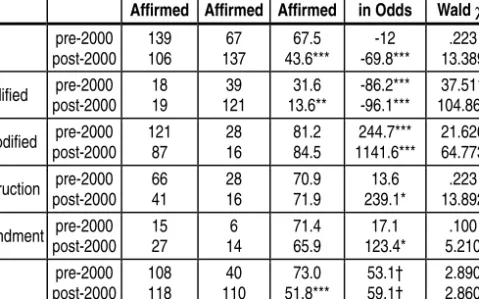
Table 3 summarizes the results from the screening of the last fifteen years of Federal Circuit equivalents analyses for differences in claim construction modification and affirmed. It shows that around the Federal Circuit’s Markman I decision—in which the Federal Circuit established that claim construction was a question for the judge—there are no sig-nificant differences in the likelihood that a Federal Circuit analysis either modifies a lower court claim construction, or affirms a lower court judgment concerning the doctrine of equivalents.65
Indeed, the most marked change around the time of Markman I is that after the decision, the Federal Circuit affirmed lower court judgments at a somewhat higher rate than before.