Nokia's Network – Gaining
Competitiveness from Co-operation
Publisher: Taloustieto Oy 2001
ETLA – The Research Institute of the Finnish Economy B174 Series
ETLA – The Research Institute of the Finnish Economy Lönnrotinkatu 4 B 00120 Helsinki FINLAND
ISBN 951-628-335-7 ISSN 0356-7443
Printed in Tummavuoren kirjapaino Oy, Vantaa 2001 Photo has been taken in the Tefen Industrial Park (Israel)
100 p. (ETLA B Series, ISSN 0356-7443; no. B174) ISBN 951-628-335-7. ABSTRACT: Nokia is a good example of a company whose operation is more and more based on co-operation with other organisations. During the past ten years Nokia has actively built and developed its supplier network. Rather than aim to produce everything itself, the company is increasingly turn-ing to outside suppliers. Hence, the extensive orchestration of the supply chain has become an important factor helping the company gain competitive ad-vantage. According to this study, many suppliers have positive experiences in co-operation, which has produced mutual benefits to both partners. The most visible fruit of co-operation is that companies grow fast not only in terms of net sales but also geographically. A number of suppliers have internationalised in the wake of Nokia. In addition to plants, they have also established R&D units abroad. Due to this global operation mode, the companies have been able to offer global services also to other customers, helping them obtain new clients. Moreover, co-operation has promoted know-how among the part-ners. Therefore, one important outcome of co-operation has been corporate learning. This knowledge accumulation does not include only technological issues but also information about market circumstances and the requirements of the market.
KEY WORDS: Nokia, ICT cluster, telecommunications, network, network-ing, partnership, co-operation, subcontracting.
ALI-YRKKÖ, Jyrki, NOKIA’S NETWORK – GAINING COMPETI-TIVENESS FROM CO-OPERATION. Helsinki, ETLA, Elinkeino-elämän Tutkimuslaitos, The Research Institute of the Finnish Economy, 2000, 100 s. (ISSN 0356-7443; no. B174) ISBN 951-628-335-7.
TIIVISTELMÄ: Nokia on hyvä esimerkki yrityksestä, jonka toiminta perus-tuu yhä enemmän yhteistyöhön muiden yritysten kanssa. Erityisen selvästi tämä kehitys näkyy Nokian toimittajasuhteissa. Kaikkea ei pyritä tekemään itse, vaan mahdollisuuksien mukaan palvelu tai tuote ostetaan yrityksen ulkopuolelta. Arvo- ja tuotantoketjun hallinnasta on tullut yritykselle tärkeä kilpailutekijä. Monet yhteistyökumppanit kokevat, että yhteistyö Nokian kanssa on tuot-tanut molemminpuolisia etuja. Perinteisen osto-myynti -asetelman sijasta näissä suhteissa pyritään yhteiseen onnistumiseen. Selkeimmin yhteistyön hedelmät näkyvät toimittajayritysten kasvussa. Moni yritys on kasvanut nopeasti sekä liikevaihdollisesti että maantieteellisesti. Toimittajayritykset ovat seuranneet avain-asiakkaitaan ulkomaille ja perustaneet sinne tehtaita sekä tutkimusyksiköitä. Tätä kautta nämä yritykset ovat kyenneet tarjoamaan globaalia palvelua myös muille yrityksille. Useat yritykset ovatkin saaneet uusia asiakkaita yhteistyön kautta joko suoraan tai välillisesti. Yhteistyö on myös lisännyt yritysten osaamista. Sekä Nokia että sen toimittajat ovat pystyneet saamaan uutta osaamista ja tietotaitoa yhteistyön avulla. Uuden tiedon karttuminen ei rajoitu vain teknologiaan vaan sisältää myös tietoja markkinoiden muutoksista ja vaatimuksista.
AVAINSANAT: Nokia, tieto- ja viestintäklusteri, telekommunikaatio, verko-stoituminen, verkottuminen, yhteistyökumppani, yhteistyö, alihankinta.
Preface
1. Introduction
Inter-firm alliances have multiplied and deepened Perspective
Purpose and structure of the study
2. The Finnish Information and Communications Technology (ICT) Cluster
What is a cluster?
Dynamics in the Finnish ICT cluster Economic relevance
3. Development of Nokia
From an industrial supermarket to a focused telecommunications company
Customers and employees all over the world Increasing research and development efforts Advanced branding – a key to success Nokia and its competitors
4. Nokia – a Company with Web Make or buy? – Rationale of outsourcing
What to make? – The strategy of the core company How to buy? – Rationale of co-operation
Different forms of alliances Network management strategy
5. What Does Nokia's Supplier Network Consist of? Data
6. Impacts and Challenges of Networking
The role of social capital in knowledge acquisition and learning
Strategies and operation practises have changed Outcomes of relationships 11 12 12 13 15 16 16 19 23 24 28 33 34 35 37 38 39 40 41 44 51 52 55 57 62 69
cluster
A big company in a small country
The motives and modes of networking has been changed Networking as a competitive advantage
Are there limits to networking? Appendix References 82 82 83 85 89 93 98
In the 1990s, Nokia grew to become one of the world’s leading high-tech companies. This coincided with a very rapid structural change in the Finnish economy and industry. Nokia has played a major role in the restructuring process.
Nokia has become a multinational company, but a major part of its activities are located in Finland, the original home base of the compa-ny. Nokia’s role in the Finnish economy is considerable, especially in exports and R&D. Since the mid-1990s, Nokia has contributed signif-icantly to the economic growth of the country, which has been one of the fastest in Europe.
But there is more than just Nokia. The whole information and com-munication technology (ICT) cluster has expanded rapidly. There are hundreds of small and medium-sized fast growing companies in the cluster. Many of them are Nokia’s suppliers and partners or have their roots in the same ICT-related know-how.
The interim report of this project, Nokia – A Big Company in a Small Country, was published in February 2000. This study was financed by the National Technology Agency (Tekes), which we would like to thank for its support.
Helsinki, January 2001 Pentti Vartia
Nokia has had an increasing impact on the Finnish economy during the 1990s. In addition to Nokia’s direct impact on GDP growth, there also exist indirect effects through Nokia’s supplier network.
This study concentrates on Nokia’s external relationships with other companies. Hence, the focus is to consider the company as an extend-ed enterprise. Of special interest in this study is the question of how Nokia has impacted the development of other companies.
This book is the result of collaboration on several fronts. Laura Paija (ETLA) wrote Chapter 2, the first sub-sections of Chapters 4 and 7. Furthermore, she contributed to the design and implementation of the research and provided important insights and comments through the whole research process. I wish to acknowledge the contribution of all the managers and experts who gave me their valuable time. I also would like to thank Erkko Autio (Helsinki University of Technology) for his ideas and comments on the survey, Pekka Ylä-Anttila (ETLA), Petri Rouvinen (ETLA), Heli Koski (ETLA) and Pentti Forsman (Bank of Finland) for their useful comments and suggestions. Kimmo Aalto-nen (ETLA) and Laila RiekkiAalto-nen (ETLA) deserve special thanks for their patience and help with editing the book. Furthermore, I would like to thank Ville Kaitila (ETLA) who revised the report and im-proved my English language.
Helsinki, January 2001 Jyrki Ali-Yrkkö
1
Inter-firm alliances have multiplied and deepened
The number of inter-firm alliances has multiplied during the past few years. Every day newspapers are full of news about different kinds of alliances. The alliance palette includes ‘horizontal’ alliances between competitors, ‘diagonal’ alliances between companies in different in-dustries and ‘vertical’ alliances between buyers and suppliers.One driving force behind this phenomenon is a widely accepted core competence paradigm according to which a company must focus on its core competence and outsource other activities.
Despite the fact that alliances are formed in every industry, par-ticularly industries with time-based competition are active in making co-operation agreements with different parties. In these industries, short product life cycles, delivery times and product variety push companies to operate in networks. Moreover, these industries are characterised by a difficulty to forecast demand and future development. Hence, the role of information and knowledge is pivotal. Companies can obtain more information about the technologies, requirements and future de-velopment of the market through co-operation with other companies. The Information and Communication Technology (ICT) indus-try is a good example of an indusindus-try with active alliance policy. Firms in this industry have made co-operation agreements that include all three kinds of alliances mentioned above.
In addition to a growing number of alliances, inter-firm co-op-eration has also deepened. Co-opco-op-eration includes not only manufac-turing or marketing operations, but also research and development (R&D) activities. In R&D co-operation companies often exchange high-ly confidential information, for example, about the latest technology. Thus, the co-operation is very deep including also strategic issues.
Perspective
To arrive at a good analysis of co-operative relationships, a focused approach is needed. Hence, instead of trying to cover the entire field of alliances, this study concentrates on vertical relationships, i.e., buyer-supplier relationships.
The traditional view of purchasing as a mandatory support func-tion is rapidly changing. Suppliers are seen as a permanent and impor-tant element of the supply chain. Rather than considering them as providers of raw materials and services only, an efficient supply chain is a competitive advantage to a firm. This wider perspective not only covers managing the flow of goods and services but also managing the entire supply process. Because many companies have outsourced ac-tivities previously done within the company, purchasing and supplier co-operation have become a part of firms’ strategic decision-making. From a supplier’s point of view this development has led to closer co-operation with customers. Particularly in rapidly growing industries, suppliers are required to have the ability to grow with their customers. Hence, a number of suppliers have expanded their capacity remarka-bly. Moreover, they have also made customer-specific investments.
Purpose and structure of the study
The question arises: Why do firms network and form alliances and what effects do these alliances have on each partner? While a number of previous studies have emphasised the importance of supply chains, only a few studies have examined concrete impacts of networking (as an example of such a study, see Yli-Renko 1999).
Rather than to view an alliance as a zero-sum game, it can be considered as a possibility to achieve a ‘win-win’ situation that creates mutual benefits. Hence, the aim of the study is to find out the effects of networking on firms’ financial performance, structures and behav-iour. Furthermore, we try to shed some light on the everyday life of companies with networks.
This study focuses on the networking of Nokia Corporation. We consider the development of Nokia after the mid-1980s, and how co-operation relationships have developed during this time. Nokia is an interesting case because the company has built a wide network of co-operation partners. Furthermore, the company operates in the tele-communications industry with a high growth rate and rapidly develop-ing technology.
The report focuses on following issues: - How wide is Nokia’s network?
- How do networked companies operate?
- How knowledge and learning spread between companies? - What effects co-operation has had on suppliers?
- What kind of opportunities and risks networking may create? - Which issues have caused disagreement within the network? - What is the future of networking?
The structure of the study is as follows. Chapter 2, written by Laura Paija, gives an overview of the Finnish ICT cluster, Chapter 3 describes the metamorphosis and growth of Nokia during the past 15 years. Chapter 4 considers the rationality of outsourcing and Nokia’s network management strategy. Chapter 5 gives a description of the data and methods used in the study, and Chapter 6 analyses in detail the effects of networking on suppliers. Finally, Chapter 7 concludes and discusses opportunities and threats of networking.
2
The Finnish Information and
Communications Technology
What is a cluster?
In a knowledge-intensive economy firms are dependent on the knowl-edge resources of other firms, in which they seek to get access. This is done by inter-firm contracts, i.e. networking. Intertwined networks can develop into a ‘network of networks’, or a cluster.
Clusters cross traditional industry boundaries by connecting cus-tomers, suppliers, related industries as well as the research sector via co-operative relationships, in which knowledge transfers and technol-ogy spill-overs generate new abilities and innovations. Dynamic inter-action between actors strengthens the competitive advantage of the entity, and ultimately the economy in which it operates. A cluster is thus more than the sum of its components.
Dynamics in the Finnish ICT cluster
1)During the 1990s, there has emerged in Finland an internationally com-petitive information and communications technology (ICT) cluster, which is the outcome of mutually enforcing dynamic relations between its actors (figure 2.1).
Companies in the key industries form the core of the cluster. The Finnish telecommunications sector has its roots in the 1880s when the first telephone companies were established. The large number of private operators – quite exceptional from an international perspec-tive – nurtured the equipment market, which was, however, dominat-ed by foreign equipment manufacturers (Ericsson, Siemens, ITT, Al-catel) until the gradual emergence of national equipment industry in the 1960s.
Radio technology aroused enthusiasm in a few local companies (notably Suomen Kaapelitehdas (lit. Finnish Cable Works), Televa and Sa-lora), which eventually, in the 1980s, combined their knowledge resources under Nokia’s organisation. Intensive co-operation between companies and advanced operators was vital for the development of the domestic telecommunications industry.
The supporting industries have increasingly specialised in serv-ing the ICT companies. Global growth in the demand for ICT equip-ment together with increased outsourcing have surged the number of new suppliers, and tuned existing companies’ supply more directly to-wards ICT manufacturers’ demands.
Indeed, growing requirements of globally operating customers have had a direct bearing on the upgrading of supplier competence. And conversely, the strengthening of the scale and scope of the do-mestic supplier sector has provided home-base advantage for Finnish ICT companies.
The competence of Finnish supporting industries lies in cus-tomised inputs and services, particularly in the contract manufactur-ing of certain parts and components (ASIC, rf-filters, hybrid circuits, silicon wafers, printed circuit boards and surface mounting techniques), electronic manufacturing services (EMS), automation and precision mouldings. In more standardised components, however, requiring mass
Figure 2.1 The ICT cluster
Supporting industries Education and R&D Components Contract manufacturing End user terminals Associated services Distribution VC finance ICT consultancy Related industries Other services Entertainment Traditional media Buyers / Appliers Organisations Individuals Key industries Packaging Digital content Operation Network infrastructure
production facilities and efficient global distribution channels, local providers can seldom compete price-effectively with international sup-pliers.
The universities and research institutes have been successful in producing advanced human resources and R&D for the use of the cluster. The industry, the ICT-oriented universities (in Helsinki, Lap-peenranta, Oulu and Tampere) and the public Technical Research Centre (VTT) have long traditions in technology development co-op-eration. The shortage of skilled labour has further activated the sci-ence-industry dialogue to better meet the increasing requirements in labour volume and skills.
The concentration of advanced ICT knowledge has attracted leading foreign manufacturers (e.g. Ericsson, Hewlett Packard, IBM, ICL, Lotus, Siemens) to base R&D centres in Finland. Nokia, too, despite its extensive global network of research centres (52 units in 14 countries), expends some 60 per cent of its total R&D input in Fin-land.
Digitising of content and transaction services – provided by re-lated industries – is seen as the most important factor in boosting the future demand for ICT equipment. The Finnish digital content indus-try is still in its early stage of evolution, but the ICT cluster provides an advanced development base with sophisticated customers, devel-oped technology platforms, and ‘intelligent’ capital provided by the newly emerged venture capital market.
The portrait of the ICT cluster is becoming increasingly blurred, as cluster actors are penetrating new – and to a large extent each oth-er’s business areas. In addition, they merge vertically (e.g. content pro-viders, packagers, distributors and service providers; or, business con-sultants, IT integrators and new media) to take hold of a wider range of the value chain. The ICT cluster is under significant restructuring. Finally, technology-attracted end-customers have provided both the ICT manufacturers and service providers an advanced home mar-ket to develop consumer-oriented products. The Finnish marmar-ket is, however, losing its importance in economic terms for global actors, like Nokia for whom it represents only 2 per cent of total revenue, but it still serves as an important test bed for novel product launches.
Economic relevance
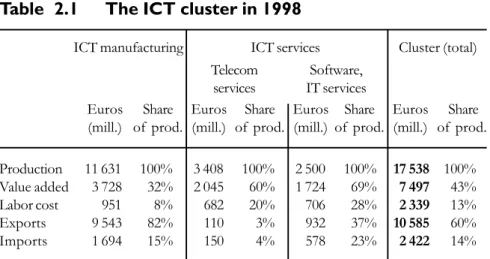
The key activities of the ICT cluster generated a turnover of EUR 17.5 billion in 1998 (see table 2.1).2) The cluster output lies heavily in
equipment manufacturing, accruing two thirds of the value. The sig-nificance of software production is underestimated by the figures, since it is partly included in the production of ICT manufactures containing an important amount of embedded software and other IT services.
In 1998, the share of the ICT cluster of the GDP was 6.6 per cent, and that of Nokia 2.4 per cent. In 2000, the company accounted already for 4.6 per cent of the GDP.
The cluster accounted for 3 per cent of total employment. 21 000 of the total 75 000 cluster employees worked in Nokia. The company’s disintegrated production strategy has had an important ef-fect on cluster employment, engaging approximately 14 000 persons in the first-tier supplier firms. Total multiplier effect on domestic em-ployment is much larger but cannot be quantified.
Some 85 per cent of the total ICT equipment manufacture were exported in 1998, representing around 20 per cent of total exports, while in 1990 the share was only five per cent.
Production 11 631 100% 3 408 100% 2 500 100% 17 538 100% Value added 3 728 32% 2 045 60% 1 724 69% 7 497 43%
Labor cost 951 8% 682 20% 706 28% 2 339 13%
Exports 9 543 82% 110 3% 932 37% 10 585 60%
Imports 1 694 15% 150 4% 578 23% 2 422 14%
Table 2.1 The ICT cluster in 1998
Sources: Statistics Finland, Ministry of Transport and Communications
Euros Share Euros Share Euros Share Euros Share (mill.) of prod. (mill.) of prod. (mill.) of prod. (mill.) of prod.
Telecom Software, services IT services
ICT manufacturing ICT services Cluster (total)
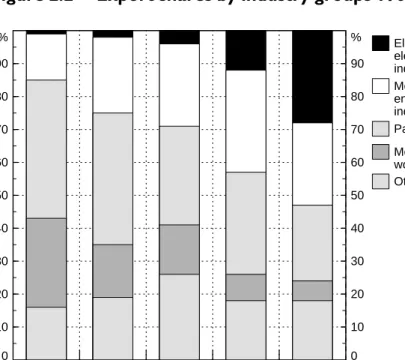
Indeed, the intensive growth of the electronics industry has lead to an industrial restructuring in the former forest and metal based Finn-ish economy. The electronics and electrotechnics industry has caught up with the main trading sectors in export shares, rendering the econ-omy less vulnerable to fluctuating raw material based industries (fig-ure 2.2).
Figure 2.2 Export shares by industry groups 1960-1999
Source: National Board of Customs.
0 10 20 30 40 50 60 70 80 90 % 0 10 20 30 40 50 60 70 80 90 % 1960 1970 1980 1990 1999 Electronics and electrotechnics industry Metal and engineering industries Paper industry Mechanical wood industry Other
During the 1990s, Finland became the world-leader in high-tech trade surplus (high-tech exports/imports ratio) among indigenous pro-ducers. It is also the most specialised country in telecommunications equipment exports among the OECD countries, in other words, the share of telecommunications equipment of total exports is higher than in the industrialised countries on the average (figure 2.3). Finland’s share of total OECD telecommunications equipment exports was in 1998 around 5 per cent while, to contrast, the share of total OECD exports was 1 per cent.
Figure 2.3 Telecommunications exports specialisation (RSCA index)
Source: OECD
Note: The 1998 data was not yet available for all countries. See Appendix 2 for the definition of the RSCA index. -0.1 -0.1 0 0.1 0.2 0.3 0.4 0.5 0.6 USA Japan United Kingdom Sweden Finland ICT 1998 ICT 1997 ICT 1990 RSCA index
3
This section describes some recent development and restructuring of Nokia. We start by considering Nokia’s road from a highly diversified conglomerate to the focused telecommunications company that it is now. Next, we examine the compa-ny’s internationalisation process and the development of its technology. The final part of this section considers Nokia in the global competition by comparing No-kia to its main competitors.
From an industrial supermarket to a focused
telecommunications company
In the beginning of the 1980s, Nokia started to strengthen its position in the consumer electronics and telecommunications market by ac-quiring several electronics companies including Luxor, Salora and Standard Elektrik Lorenz’s consumer electronics industry.
Due to the historic background and acquisitions, Nokia had no less than eleven business lines during 1986-88. Figure 3.1 shows how the significance of major lines has shifted over time.
A former president of Nokia (Kari Kairamo) forecasted coming changes in 1984 (Nokia’s annual report):
“We have attempted to change the structure of the group by directing in-vestment and research and development activities towards high-tech products and production methods. This structural change has been supported by corporate ac-quisitions at home and abroad. At the same time, internationalisation has also been promoted.”
Since then, Nokia has gone through a comprehensive metamor-phosis. The company has acquired and, on the other hand, sold several business units. From a conglomerate with a high number of different business lines Nokia has been transformed into a pure telecommuni-cations company.
The example of Nokia shows how the focus of a company may change over time. In order to focus on telecommunications, Nokia has divested all of its previous core competence businesses. In fact, Nokia has reinvented itself so many times that it seems almost impossible to forecast what kind of structure or core competences Nokia will have in five to ten years’ time.
Figure 3.1 History of the development of radiotele-phones in Nokia
Source: Häikiö, M. (1998), Alkuräjähdys, Edita, Helsinki. 1945 Salora Oy 1979 Mobira Oy Nokia 50% 1982 Mobira Oy Nokia 100% 1966 Nokia Oy 1977 Telefenno Oy 1962 Televa 1976 Televa Oy 1981 Telenokia Oy Nokia 51%, State 49% 1989
Nokia Mobile Phones
1992 Nokia Telecommunications 1928 Nordell & Koskinen Oy 1917 Suomen Kaapeli-tehdas Oy 1945 Valtion Sähköpaja St ate owned electric workshop
1966 Merge to Nokia 1987 St ate sells stocks to Nokia 1984 Nokia bought Salora Oy 1983 Radiotelephones Radio- tele-phones Exchange deve-lopment 50% 50% 50% 50%
Box 3.1 History of Nokia Background 3)
The roots of Nokia go back to 1865 and the establishment of a forest industry enterprise in south-western Finland by mining engineer Fredrik Idestam. This enterprise ran a groundwood mill on the Nokia river, hence the company name.
Elsewhere, the year 1898 witnessed the foundation of Finnish Rubber Works Ltd, and in 1912 Finnish Cable Works began operations. Gradual-ly, the ownership of these two companies and Nokia began to shift into the hands of just a few owners. Finally in 1966 the three companies were merged to form Nokia Corporation.
History of radio technology development in Finland and in Nokia 4)
The roots of the Finnish radio technology development go back to the 1920s. The wars against the Soviet Union revealed the strategic role of radio technology whose development was initiated in Valtion Sähköpaja (lit. State Electric Works) of the Finnish Army. In the 1950s it introduced its first radio phones and automated base stations.
After the wars, Valtion Sähköpaja was organised under the PTO (the national public telecommunications operator) and renamed Televa. In the 1970s, the company started investing in digital technology. Despite in-house opposition, a couple of persistent engineers managed to proceed with their digital exchange project that ultimately led to its introduction – only a short time after the leading foreign competitors.5)
Suomen Kaapelitehdas (lit. Finnish Cable Works, founded in 1917), in turn, was a cable manufacturer for the telecommunications industry. In the 1950s, the new managing director perceived the business potential of electronics. Regardless suspicion within the company’s management, in-novative but costly R&D in new radio and digital technology were sus-tained in the ‘back stage’ of the factory.
The trade relationship with the Soviet Union was decisive to the develop-ment of the technical knowledge of the company. The Soviet Ministry proved a demanding but also patient customer. Thus, Suomen Kaapelite-hdas had an invaluable opportunity to develop modern digital
technolo-3) Source: http://www.nokia.com/inbrief/history. 4) Source: Paija, (2000).
gy. The voluminous exports provided also necessary income and contacts to develop later exports of telecommunications equipment.
The third central company in the industry development process was Sa-lora (founded in 1928). Like in Televa and Suomen Kaapelitehdas, radio technology was being developed aside the core activities, TV and radio set production. Unlike the two other companies, Salora was a strong TV-brand also beyond national borders and had experience of serial produc-tion and marketing.
A pivotal stimulus to the birth the Finnish radio communications industry was given in 1963 by the Finnish Army. It put out an invitation for tenders for a radiophone that was to meet challenging technical requirements. It was the first time the firms were given an economic motive to develop a radiophone, generally regarded as a toy for a marginal group of users. In fact, rather than a business opportunity, firms considered the competition a chance to give a physical form to the knowhow cumulated ‘behind the curtains’. Five companies (Televa, Kaapelitehdas, Salora, Vaisala and Swed-ish Sonab) bid for orders. Ultimately, the Army did not have the funds to redeem the phone, thus the contestants had to look for other customers. Indeed, for all the participators the prototypes served in developing new portable phones, some of which became new export articles.
In 1966, Suomen Kaapelitehdas was merged with Suomen Gummiteh-das (lit. Finnish Rubber Works) and Nokia, a 100 year-old paper factory that gave its name to the new corporation. The merger secured further R&D investments in digital technology that was now regarded as one of the strategic business areas.
In the 1970s the state-owned Televa and Nokia founded a joint venture. Combining the forces proved a crucial step towards the later breakthrough of Nokia. The introduction of the digital exchange finally in 1982 had required a lengthy, costly and laborious period of development both in Nokia and Televa. But it was with this product launch that Nokia finally convinced the market of its competence vis-à-vis foreign manufacturers. For years the exchange was for the most successful export article of Nokia In 1979, Nokia and Salora, in turn, joined their complementary resources. The fifty-fifty owned Mobira was established to market and develop radio technology and especially the NMT terminal that was under design in the Nordic Telecom Conference. The joint venture was perfectly timed as it enabled the launch of the first NMT phone approved to the new network. Finally, in 1982, Nokia got full ownership of both Mobira and in 1987 the State’s share in the joint venture, in which occasion the Finnish
Customers and employees all over the world
Up till 1980, Nokia sold approximately half of its products to the domestic market and the rest was exported. In the early 1980s, how-ever, Nokia started to strengthen its international operations (figure 3.2).
In addition to exports, Nokia proceeded in its internationalisa-tion by acquiring producinternationalisa-tion units abroad during the 1980s. The aim was to grow rapidly and expand operations to new lines of business. According to this strategy, Nokia acquired a number of foreign sub-sidiaries; hence net sales and employment increased rapidly (see fig-ures 3.2 and 3.3). The acquired units operated mostly in the
electron-telecommunications industry was organised under Nokia’s roof.
The introduction of the NMT in 1981-82 marked the start of a fast-expanding new industry. The Conference had an outspoken objective to press down the prices of equipment by promoting technical compatibil-ity and competition between manufacturers.
The Conference made active use of the manufacturers’ knowledge dur-ing the NMT design phase. In Finland, Mobira was among the most active cooperators providing its expertise in terminal technology. At that time, however, the Finnish industry was not yet able to contribute to the design of the network specifications.6) There was strong pressure from
the PTO’s side to engage the industry in cellular exchange development. Ultimately, the alliance between Salora and Nokia (i.e. Mobira) encour-aged the companies to supply an NMT base station in 1981 – which later turned out to be crucial in maintaining the position in the emerging mar-ket.
Mobira became famous for its ‘crazy’ organisational spirit that referred to the passionate, pioneering and risk-taking style with which it pursued its ambitious targets both in technology development and internationalisation. The same kind of stamina and general enthusiastic – if not fanatic -attitude towards new radio technology has been seen behind much of the technological progress in the Finnish telecommunications industry.
6) In fact, Salora had been most reluctant to start developing an NMT base station as it was focusing on terminals. Nokia instead had been directing all of its resources on the deve-lopment of a digital exchange for fixed networks.
ics industry, and many of these new subsidiaries manufactured prod-ucts (televisions, monitors and videos) directed to consumers. Thanks to acquired units, Nokia became the second biggest electronics com-pany in the Nordic countries.
The acquired companies were mostly located in Europe. How-ever, Nokia’s mobile phone unit, called Mobira at that time, expanded by making more global alliances. Together with Tandy Corporation, Nokia established a joint venture in Korea. Tandy had experience in Asian operations, but more importantly, it had an extensive distribu-tion network in the United States.
Thus, the 1980s were a decade of growth and internationalisa-tion for Nokia. Net sales grew five-fold during ten years, and a sub-stantial amount of this growth was obtained by acquiring foreign com-panies.
Today, Nokia is a highly internationalised company with a number of production and R&D units in Europe, Asia and America. Furthermore, the company sells its products in to more than 130 coun-tries. Its increased foreign activities have been mirrored in the location Figure 3.2 Sales of Nokia by industrial group, %
1967 70 75 80 85 90 95 0 20 40 60 80 % 0 20 40 60 80 % 99 Electronics Cable Forest Rubber
of personnel. Thus, more and more employees are working in business units outside Finland. However, despite the rapid expansion of for-eign production, Nokia has increased its exports from Finland, as well. Therefore, Finland remains an important place for Nokia to create value-added.
Figure 3.4 shows how the number of personnel has developed during the past twenty years.
However, in the early 1990s Nokia ran into a crisis. It had just invested heavily in new businesses when the Finnish economy went into a severe recession. Nokia started streamlining its activities to-wards the electronics industry. Due to heavy losses and the decreased strategic significance of some business lines, the company decided to sell a number of business groups. The business lines to be sold includ-ed, for example, the forest industry, distribution of electricity and the rubber industry businesses. The heavy divestment program was also Figure 3.3 Net sales of Nokia, bill FIM7)
1980 82 84 86 88 90 92 94 96 98 0 10 20 30 40 50 60 70 80 90 100 110 Bill. FIM 0 10 20 30 40 50 60 70 80 90 100 110 Bill. FIM 99 Export Production abroad Domestic sales
reflected in the number of employees which decreased by 15 000 be-tween 1989 and 1993.
In 1992, Jorma Ollila was appointed CEO. Under his leadership Nokia made a major strategic decision to focus on telecommunica-tions by divesting its non-core operatelecommunica-tions. The most recent large di-vestments took place in 1996, when Nokia sold its cable industry op-erations and television business. Thus, Nokia focused more and more on the telecommunications industry.
A booming telecommunication business has pushed Nokia to rapid growth. During the past five years (1995-1999), the company has grown on average more than 30 percent a year. Furthermore, No-kia has grown mainly internally without major acquisitions. In fact, Nokia has acquired only few companies whose contribution to group net sales or personnel is slight. The acquired companies have been small firms specialised in Internet technologies.
The high growth rate has become a challenge for Nokia. The increased sales have reflected in increases in capacity. In addition to Figure 3.4 Foreign and domestic employment of Nokia
1980 82 84 86 88 90 92 94 96 98 0 10 20 30 40 50 1000 pers. 0 10 20 30 40 50 1000 pers. Domestic employment Foreign employment
the fact that Nokia has outsourced more and more its operations, the company has also increased its own capacity. As a result, the company has recruited several thousands of employees in the past few years. Nokia has increased its personnel in Finland, but now the focus has become more international.
The fast growth of the Finnish telecommunication industry has led to shortage of qualified engineers in Finland. Companies operating in the ICT cluster have difficulties in finding new employees. Thus, it is hardly surprising that the number of Nokia’s staff outside Finland has increased. Furthermore, Nokia’s market focus is increasingly glo-bal, for currently the company sells less than 2.5 percent of its prod-ucts in the domestic market.
Figure 3.5 shows how net sales were distributed in 1994 and 1999. Europe still brings more than a half of Nokia’s net sales and South and North America account for nearly one fourth. However, the significance of the Asia/Pacific region has substantially increased during the past few years. While in 1994 its share was 13 percent of net sales, in 1999 the share had risen to 22 percent. The United States, China, the UK and Germany were the most important individual coun-tries.
Figure 3.5 Net sales of Nokia by market area
Others 5% Asia and Pacific 13% North and South America 12% Finland 11% Other Europe 59% North and South America 25% Asia and Pacific 22% Finland 2.4% Other Europe 51% 1994 1999
Increasing research and development efforts
Nokia’s investment in R&D increases year after year following closely the growth rate of sales. In the past few years, the growth rates of both net sales and R&D have accelerated.
Developing new models and technologies for the third genera-tion mobile systems has required addigenera-tional R&D investments includ-ing new R&D centres. In addition, the company’s R&D personnel has grown from 10 000 to 17 000 during the past two years, and currently roughly 30 percent of the total personnel work in R&D.
The growth rate of R&D investments has been particularly fast during the end of the 1990s as Nokia has focused more and more on telecommunications. Furthermore, the increased growth rate of tech-nology development has forced Nokia to increase its R&D efforts in order to respond to tighter competition.
The company has expanded its global R&D network. As a re-sult, with R&D units in twelve countries, Nokia has 44 R&D centres world-wide (in 1999).
Figure 3.6 R&D and net sales of Nokia, bill. FIM
1980 82 84 86 88 90 92 94 96 98 0 2 4 6 8 10 12 Bill. FIM 0 20 40 60 80 100 120 Bill. FIM R&D (left-hand scale)
During the 1990s, the share of Nokia Mobile Phones (NMP) of total R&D expenditure has grown. While in 1992 the R&D costs of Nokia Networks (before Telecommunications) clearly exceeded those of Mobile Phones, in 1999 the situation was turned controversial. Thus, the development of cellular phone models has required more and more R&D efforts.
Advanced branding – a key to success
Investment in R&D alone does not guarantee success in the market. The high growth of Nokia’s sales shows that the company has ad-vanced well in selling and marketing, too. It has created a well-known brand.
An American company called Interbrand ranks companies ac-cording to their brand values. As the first non-American company, Nokia has been ranked in 5th position, while the top ten list is
dominat-ed by American companies, such as Coca-Cola, Intel and Microsoft. Generally, successful branding is an endorsement and indication of quality. Thus with a well-known and respected brand image a pany can mark its product prices above those of its less known com-petitors. Brands, then, are one of the most important and valuable assets for many companies.
In addition to technology, Nokia’s success is a consequence of understanding consumer needs. Unlike its competitors, Nokia under-stood rather early that in order to make mobile phones desirable, one also has to make them look attractive. Accordingly, Nokia put a lot of effort into designing their products. They replaced the former angular appearance with a rounder design.
Moreover, an effort was made to make the user interface of mobile phones easy to use – to make a phone as simple to use as possible. Another noteworthy change of direction was seen in Nokia’s style of marketing.8) In the early 1990s, the advertising style for
cellu-lar phones was changed. Instead of advertising the mobile phone as a status symbol, Nokia began to market it as a regular consumer product without the stamp of luxury.
The change of marketing style was revolutionary, for, after that, not only businesses but also private individuals bought more cellular phones.
Nokia and its competitors
Heavy investment in telecommunication R&D, successful marketing and rapid internationalisation have made Nokia to one of the leading telecommunication companies in the world. This subsection compares Nokia to its major competitors, Ericsson and Motorola.
Measured by net sales, Nokia is currently smaller than its main competitors. However, the company is more focused on cellular prod-ucts than Ericsson or Motorola. Contrary to its main competitors, Nokia does not manufacture semiconductors. Thus, the company has chosen the strategy of buying semiconductors from the market instead of pro-ducing them itself.
Due to the high growth rate of Nokia, however, the size differ-ences between the companies are narrowing. The growth rate of No-kia is considerably faster than its main competitors. There are at least two reasons for this. First, as mentioned earlier, Nokia is more focused on the fast growing cellular business. Second, Nokia has managed to expand its market share. The demand for Nokia’s cellular phones has
Table 3.1 Major telecommunication companies in the world, 1999
Nokia Ericsson Motorola Net Sales, bill. FIM 117.6 144.9 172.5 Return on investment, % 55.4 19.0 5.5 Earnings before taxes, bill. FIM 23.3 11.0 6.5
% to sales 19.8 7.6 3.8
R&D expenditures, bill. FIM 10.4 19.0 19.2
% to sales 8.9 13.1 11.1
Year-end employment 55 260 103 290 na Global market share of mobile
phones (7-9/2000)* 30.6 9.7 13.3
been particularly brisk in the past few years. As a result, the annual growth rate of Nokia Mobile Phones averaged approximately 55 per-cent during 1997-1999.
There are notable differences between the profitability of the three companies. Measured by ROI (return on investment) or by oper-ating profit, the yield of Nokia is clearly above its competitors.
The size of Nokia is still smaller than its main competitors. The difference, however, is disappearing. Furthermore, Nokia does not in-vest as much as Ericsson or Motorola, but Nokia clearly outperforms its competitors in financial terms (see also Ali-Yrkkö et. al., 2000).
4
Nokia – a Company with
Web
A shift in the production paradigm towards increased specialisation and out-sourcing has made supplier management a central function of the firm. A success-ful firm cannot afford aloofness in supplier its relationships, whose role grows with increased business focus.
Nokia provides an illustrative example of a firm that has gone through an organisational transformation induced by such strategic considerations. Next we shall have a general look at the rationale for outsourcing and inter-firm collab-oration.
Make or buy? – Rationale of outsourcing
In order to maximise efficiency, the firm needs to make an assessment of the organisation of a production phase, or ‘transaction’ in the lan-guage of Williamson (1985). Both integration (‘to make’) and out-sourcing (‘to buy’) of the production phase incur governance costs, or ‘transaction costs’ from planning, implementing and controlling the job.
The choice between make or buy decisions is seldom unambig-uously the first best. There are trade-offs related to the divergent in-centives of the buyer and the supplier.9) Transaction costs are also vitally related to the existing in-house core skills. Activities in which a firm has embedded expertise are extremely costly, if not impossible to contract out. Correspondingly, functions only distantly related to the firm’s core competencies are primary candidates for outsourcing.
In order to enforce efficient fulfilment of an outsourced trans-action, firms make contracts. Contracts can be seen as an intermedi-ate arrangement between hierarchies and markets, combining the co-ordination ability of the former and the flexibility and incentives of the latter.
Ultimately, the arrangement minimising the cost of transaction determines the organisational boundaries of the firm. But, as pointed out by Langlois & Robertson (1995), the boundaries of a firm – a function of its core competencies – are dynamic in the sense that
firm-9) For example, highly transaction-specific assets lower the incentive of an outside actor to make
the required investments. Also, uncertainty increases transaction costs by complicating the for-mulation of a complete contract, which in turn, gives rise to opportunism. Finally, frequency of the transaction is a factor that tends to reduce the cost of writing a contract; recurrent transac-tions generate routines that increase cost efficiency in inter-firm arrangements (Williamson, 1985).
specific knowledge tends to spill over to the market. Increased know-how in the market thus enables the firm to gradually contract out more specialised activities.
What to make? – The strategy of the core
company
The primary task of the firm is to identify and enhance its distinct, inimitable and non-substitutable competencies (Prahalad & Hamel, 1990). The resource view of the firm (originating from Penrose, 1959) emphasises firms’ heterogeneity in absorbing, cumulating and exploit-ing knowledge resources. Thus, competencies are mostly firm-specific and path-dependent, residing tacitly in employees hands and heads, organisational structure, procedures and corporate culture (Nooteboom, 1999a).
The resource view has implications for firms’ interaction, or net-working, since specialisation on certain resources makes the firm de-pendent on other firms for complementary assets. Consequently, the firm needs to enhance its attractiveness as a network partner by en-hancing its competitive advantage. The stock of competencies virtu-ally defines the firm’s power position in the network, and thus, the external resources to which it can get access (Forsgren et al., 1995).
As Hamel et al. (1989) point out, global competition has been characterised by a battle over key technology-based competencies that fuel new business development. A successful firm needs to build and enhance embedded skills that breed new generations of products. There-fore, it is dangerous to outsource the production of key technology-based core products without running the risk of surrendering core com-petencies indispensable in transition to the next product generation (see also Prahalad & Hamel, 1990).
Indeed, there is a limit to the extent the firm can outsource its activities without running the risk of hollowing out its core activities. A careless outsourcing strategy can make the company increasingly dependent on its suppliers, who may ultimately turn into competitors.10)
10) See e.g. Chesborough & Teece (1996), Prahalad & Hamel (1990), and Lorenzoni & Baden-Fuller
“Outsourcing can provide a shortcut to a more competitive prod-uct but it typically contributes little to building the people-embodied skills that are needed to sustain product leadership. Nor is it possible for a company to have an intelligent alliance or sourcing strategy if it has not made a choice about where it will build competence leader-ship.” (Hamel et al., p. 84)
Lorenzoni & Baden-Fuller (1995) formulated, on the basis of their study of successful networked companies, an agenda of critical competencies that needs to be nurtured in-house. These include (in slightly modified form):
·
The vision – a perception of the industry structure and develop-ment trend; orchestration of the partner network to realise the vision.·
The brand – investment in brand management.·
The partners – developing mechanisms for selecting and manag-ing partner network.·
The climate – creating an atmosphere of trust and reciprocity in the network.Thus, successful networked firms perceive themselves as ‘stra-tegic centres’ who “reconcile the flexibility of market relationships with the long-term commitment of hierarchically centralised manage-ment” (ibid., p. 146).
How to buy? – Rationale of co-operation
As companies focus on cumulating their core skills they necessarily run the risk of not perceiving opportunities and threats in other fields. Complexity and variability of technologies and markets further increase uncertainty caused by imperfect knowledge. To enlarge its cognition, the firm needs complementary external sources of knowledge, which must be adequately distant to provide novelty, yet proximate to allow for understanding and appropriation (Nooteboom, 1999a).11)
A contract provides a right of entry to other firms’ knowledge resources, which provide diversity and novelty, required by innova-tion (Nelson & Winter, 1982, cif. Nooteboom, 1999a). Knowledge
11) Nooteboom suggests that mergers and acquisitions may destroy the ‘cognitive distance’ crucial
sharing provides a shortcut in the development of technology. A crucial function of the firm, as seen e.g. by the Uppsala school (see e.g. Forsgren et al., 1995 and Aoki et al., 1990), is then to manage the set of its contracts, or network relations. This includes building, establishing and maintaining favourable network relations, and co-or-dinating activities related to partner firms (cif. Paasche et al, 1993).
However, contract making is problematic and costly in a com-plex and unstable environment. It is also difficult to capture and con-tractually enforce creativeness and flexibility in transactions.
In order to diminish transaction costs incurred by contract for-mulation firms are increasingly looking for non-contractual ways to enforce mutually beneficial relationships. Short-term contracts are re-placed with long-term agreements to build trust and reciprocity.12) Cumulated sense of confidence can work as a powerful means to de-crease the need for all-encompassing formal contracts and to create an atmosphere of mutual commitment and positive problem solving (e.g. Helper, 1993; Hines, 1994; Lorenzoni & Baden-Fuller, 1995).
Different forms of alliances
Despite the emphasis on vertical relationships in the above discus-sion, firm interaction takes different configurations depending on the dimension and depth of the relations. Nokia is an illustrative case of a company operating in the core of a multidimensional network envi-ronment (figure 4.1). Owing to the loose every-day usage of the con-cepts related to different forms of firm relationships the basic charac-teristics of different forms of co-operation will be discussed next.
The dimensions
According to Nooteboom (1999b), an alliance is the general term for a number of inter-firm relationships that go beyond pure market trans-actions. The dimensions of alliances can be categorised as horizontal, vertical and diagonal.
Horizontal alliances refer to collaboration between firms that are in a competitive relationship in some phase of the value chain. Competitors enter co-operation to enhance their core competencies through complementarities, yet simultaneously limiting the partner’s access to proprietary skills.
Horizontal alliances are often formed to develop a de-facto tech-nology standard to spur growth in a future market, in which the part-ners intend to compete with compatible products and applications. Nokia is a member of standard forums like Bluetooth Special Interest Group, and WAP Forum, whose mission is to set standards and to enable a mass market for wireless information devices.
R&D co-operation with universities and research centres is also regarded as horizontal, since it is usually targeted at core competence development.
Diagonal alliances, in turn, aim at ‘market making’; i.e., devel-oping new applications or product combinations with companies in third industries. For example, Nokia develops mobile banking servic-es, intelligent home appliances and health-related applications togeth-er with respective stogeth-ervice or product supplitogeth-ers, like Nordea Bank,
Figure 4.1 Nokia’s network environment
Par tne r a pplicatio ns & prod uct su ppliers
Universities, resear ch institutes Related indu stries Competito rs System supplier s Consumers Sub -contracto rs Par tne r-supplier s Par tne r-integra tor s Nok ia Distribu tion channe ls Customer s
Whirlpool and ENACT Health Management Systems.
Finally, vertical alliances are established between buyers and suppliers in the production value chain, and thus refer to the organisa-tion of a producorganisa-tion phase, discussed in secorganisa-tion 4.1.
As to Nokia, supplier (upstream) alliances involve joint devel-opment of specialty inputs and sub-systems. Customer (downstream) alliances, in turn, engage network operators in co-operation to design and develop solutions to fit their future requirements. Specialised IT companies, so-called systems integrators, are also a part of the verti-cal production chain by providing compatibility and interoperability among different vendors’ equipment in client technology environ-ment.13)
The depth of relationship
In addition to the dimension, inter-firm relationships differ also in their depth. As vertical alliances are the focus of this book, we shall next consider different supplier strategies that vary in the intensity of co-operation.
Supplier strategies can be illustrated within a continuum indi-cating the depth of co-operation (figure 4.2).14) The least sophisticated form of supplier relationship is characterised by price competition, used primarily in the purchase of standard components requiring basic production technology. The number of suppliers is kept high to in-crease independence and to stimulate competition. There is no knowl-edge interchange between parties beyond routine operative contacts. Price competition upholds an atmosphere of indifference and uncer-tainty, suppressing client-related investments and product development by the supplier.
At the other end of the continuum, as the most comprehensive form, there is strategic partnership in which supplier involvement is utilised to increase innovation, specialisation, quality, and price effi-ciency. Delegating planning and production responsibility to the
sup-13) Downstream relations with distribution channels are excluded as they do not fall under the
definition of alliances.
plier aims at effective technology solutions, and allows the firm to focus on its core activities. Mutual commitment is supported by long-term contracts, in which price efficiency is pursued, not in every trans-action, but over an extended time period. Communication between partners is intensive and confidential taking place in all organisational levels, and ranging from operative to strategic issues.
Close interaction is likely to spur innovation and knowledge transfers on both sides of the partnership, accruing ultimately to the benefit of both parties. Owing to its confidential and all-embracing nature, the number of strategic partnerships in the supplier portfolio cannot be high.
Between these two extremes of the continuum there is a variety of intermediate styles applicable in supplier strategy formulation.
In the following discussion supplier is used as a generic term for an input provider, with no indication to the depth of the relationship. Subcontracting, in turn, refers to standard outsourcing with an empha-sis on price factors, while partnerships are used to describe inter-firm relationships which take use, to a varying extent, of complementary assets to induce synergy and mutually beneficial knowledge transfer.
Figure 4.2 Supplier strategy continum
Subcontracting Partnerships
Price competition Strategic partnership
Network management strategy
History of outsourcing and subcontracting in Nokia
The width and depth of Nokia’s co-operation with other companies have changed remarkably during the past twenty years. From pure
sub-contracting, co-operation has now moved toward partnerships. The development of Nokia’s co-operation with supplier compa-nies can be categorised into four steps. It is noteworthy that different phases do not fully exclude one another. Hence, co-operation takes place in different phases and forms at the same time.
In the 1980s, co-operation with other companies was mostly traditional subcontracting (phase 1). With the exception of a few com-panies very close co-operation did not exist. Nokia used subcontrac-tors mainly as buffers to stabilise its manufacturing capacity. At the time, the amount of subcontracting depended on business cycles with no systematic co-operation strategy.
The 1990s marked profound changes. The global telecommuni-cations market exploded and also Nokia benefited from this growth. Volumes of telecommunications products rose strongly and Nokia start-ed to ponder new manufacturing strategies. This development also had an impact on the co-operation with other companies as outsourcing was now seen as an alternative to in-house manufacturing. In a larger
Figure 4.3 The development Nokia’s co-operation with its suppliers PHASE 2. Partnerships in manufacturing 1980 1990 2000 PHASE 1. Subcontracting in manufacturing PHASE 4. R&D partnerships Depth of co-operation PHASE 3. R&D subcontracting Time
scale, this option was first used in the manufacturing of accessories (phase 2). At the same time, Nokia started a search for long-term co-operation partners. Consequently, subcontracting and co-co-operation became more systematic when subcontracting and outsourcing were seen as a permanent mode of manufacturing operation instead of a way to stabilise the utilisation rate of capacity.
In the latter part of the 1990s, co-operation was gradually ex-panded from accessories to other areas. Nokia started to use more and more component providers and manufacturers. Due to high demand, shorter life-cycles of products and increased weight of foreign sales, Nokia had to place more emphasis on logistics. Moreover, as described earlier, there was an acute need to distinguish product life-cycles from production-equipment life-cycles. As a consequence, Nokia among other telecommunications vendors, reorganised its supply chain and started to use assembler services more than before (figure 4.4). Elec-tronic manufacturing service (EMS) providers base their business idea on serving a large number of customers in varying industries and phases of technology, applying the most advanced technology first in fore-runner sectors and then gradually in other sectors. Thus, by pooling the products from different generations of technology, EMS providers are able to prolong the service life of production facilities. In this way they have resolved the vendors’ original problem which is related to the mismatch life spans of product and production technologies.
EMS companies, or more generally sub-system suppliers, also serve to alleviate the co-ordination task of vendors by organising the suppliers of parts and components under their direct management. Hence, the re-organising process led to a decreased number of direct suppliers because many suppliers began to deliver their products to the assembler or system suppliers instead of to Nokia. In the produc-tion of telecommunicaproduc-tions equipment, the role of Nokia is gradually tapering to being a co-ordinator of few key suppliers.
But there were also changes other than just reorganisation. Dur-ing the past few years, Nokia has also started to use software and R&D subcontractors (phase 3). Consequently, in addition to manufac-turing companies, Nokia’s network also includes companies special-ised in the software development. However, this is a very new form of co-operation. Despite long-term agreements, in many cases the
rela-tionship can be classified as subcontracting rather than a true partner-ship because invoicing is usually based on hours rather than results.
In the near future, also co-operation in R&D and software will change toward partnership (phase 4). This will probably lead to sup-pliers not being paid extra for their development efforts but rather if the product is successful, profits being shared between the partners. Hence, the supplier should take more responsibility for long-term de-velopment and also bear more financial risk. In other words, moving toward true partnership will lead to changes in risk sharing and also the sharing of the rewards from R&D co-operation.
In sum, Nokia’s co-operation modes have changed remarkably during the past fifteen years. Co-operation has become deeper and it has been expanded to new areas. However, the different phases of co-operation do not fully exclude one another. Hence, while today the focus is on partnerships, the company continues to use subcontract-ing. Increased networking and outsourcing raises a question about the limits of networking. Can a company outsource everything? We will consider this question in more detail in the concluding chapter.
Selection process of suppliers
The tendency toward long-term relationships places great challenges to choosing suppliers. The breaking in of a new supplier is
time-con-Figure 4.4 The re-organisation of supplier network
Brand Owner
Sup-plier Sup-plier Sup-plier Sup-plier Brand Owner Distributor Distributor EMS Brand Owner Brand Owner
Sup-plier Sup-plier Sup-plier Sup-plier Distributor Distributor EMS EMS Brand Owner Brand Owner
Sup-plier Sup-plier plierSup- Sup-plier Distributor Distributor
suming and includes issues such as auditing, contracting and training among other things. Not all firms are compatible to become supplier. Consequently, companies must choose their suppliers carefully. As a consequence, Nokia has developed standardised practises and audit-ing processes for potential suppliers.
The first requirement of a potential supplier is its economic health. The financial position of the supplier should be stable thus making possible long-term co-operation without a great risk of bank-ruptcy. It also indicates that the supplier is able to invest in new ca-pacity. However, economic health is only a basic requirement for co-operation, for the entire auditing list includes dozens of items such as the supplier’s management, technical skills, security and environment issues. Depending on the industry of supplier, an auditing team typi-cally includes persons specialised in issues, among other things, qual-ity systems, sourcing, production and technology. Fulfilling the items of the auditing list forms a basis for potential co-operation, i.e, the necessary conditions, but these criteria are not sufficient conditions for co-oper ation.
There are also ‘softer’ criteria for co-operation. Often, these is-sues are difficult to measure. They include the values of the supplier and a company culture match, as well. Co-operation will not be suc-cessful if partners’ values and ways of action deviate significantly from one another. Furthermore, it is important that the potential supplier has goals and visions. Thus, in order to reach its aims, the supplier should be keen to develop itself, for instance, by training its person-nel. The purpose of development and learning makes possible a recip-rocal exchange of knowledge and know-how. Hence, it is important that suppliers have the willingness and the ability to develop their own operations.
The careful auditing process with standardised practises shows that co-operation and networking are seen as an important and con-stant operation mode. Nokia searches for dynamic partners and sub-contractors with visions and views about the future in order to find and develop long-term relationships with reciprocal learning.
Building and developing supplier relationship
A key element in successful co-operation is continual development. Rather than to see co-operation as a stable situation, companies must never stop their efforts for developing their operations for better per-formance. The primary objective should be to make the entire chain more effective.
Often, co-operation begins with the transfer of know-how be-tween the partners, for example, by lending employees to partner. Hence, in the early phase of co-operation, companies should make sure that both parties have the necessary know-how. Furthermore, in order to create synergy between different firms in the demand chain, the inte-gration of partners’ processes is often necessary. For example in soft-ware development, companies may integrate their development tools, while in manufacturing it is important to make sure an effortless refin-ing of extension.
Improving the efficiency of the supply chain means not only optimising material flows but especially information flows. Therefore, it is necessary to build an infrastructure which assures an efficient exchange of information between the parties. All parties must name the persons who are responsible for the exchange of information. In addition to these persons, it is important that there exists direct com-munication between other employees, too. Direct discourse between different levels and functions without the necessity to pass informa-tion ‘up-over-and-down’ through funcinforma-tional hierarchies makes it pos-sible to exchange information in real time. In addition to this personal communication, another element of efficient communication is the use of modern information technology. If necessary, partners should modernise their information systems. The aim should be to enhance transparency between the companies.
Successful co-operation is often expanded to new areas. One example of broadened co-operation is geographical widening. Plant-to-plant or unit-to-unit collaboration is expanded to other units within the companies. Often this leads to global co-operation agreements. Moreover, through successful co-operation the supplier may obtain the status of a first-tier supplier with greater responsibility.
into larger sub-networks. While the manufacturing network has already been organised into different levels, including first-tier partners, sec-ond-tier partners and so on, it is probable that in the long run similar development will also occur with R&D partners. Thus, first-tier part-ners take care of contacts to other companies operating in their own respective sub-networks. On the other hand, this change will also mean that the first-tier supplier has to take more responsibility for product or technology development.
5
What Does Nokia's Supplier
Network Consist of?
In this chapter we start to look at Nokia’s supplier network in Finland. While this chapter gives an overview of suppliers, following chapters will consider the impact of network relationships on the companies.
Data
As described in the first chapter, the main focus of the study is to consider the effects of networking on companies. In addition to com-pany growth and other easily measurable key figures, our special inter-est is on knowledge sharing, learning and other qualitative issues. There-fore, public databases that only include financial statements were not useful. Consequently, a wide questionnaire was designed based on ex-isting literature and on exploratory interviews.15)
The questionnaire was sent at the end of 1998 to more than 300 Finnish firms operating in the ICT equipment and service industry in different supplying sectors such as part and component manufactur-ing, software development and electronics manufacturing services. The firms were asked to answer the questions with their most important (measured by net sales) customer in mind. Of the 123 usable respons-es, we selected those companies which had reported that their main customer is manufacturing telecommunications equipment or that their main customer delivers its products to a manufacturer of telecommu-nications equipment. After this selection, a total of 83 companies were left that we could use for a proper analysis. Thus, the database in-cludes companies belonging either to the first-tier or the second-tier network of a manufacturer of telecommunications equipment.
Most of the questions in the survey were in the form of state-ments. The relevance of the different questions to the company was measured with a 7-step scale (Likert-scale) indicating whether the firm disagrees or agrees with the statement. Scale values were interpreted as follows: 1-3 indicate disagreement, 4 implies indifference an 5-7 suggest agreement with the statement. In addition to the statements, firms were also asked to provide some quantitative data such as net sales and the key customer’s share in total revenue.
15) We would like to thank professor Erkko Autio of Helsinki University of Technology for his
In addition to the survey, we also made interviews in order to deepen our knowledge about networking. The questions were based on issues that came out in the statistical analysis of the survey. The total number of interviews was 15.
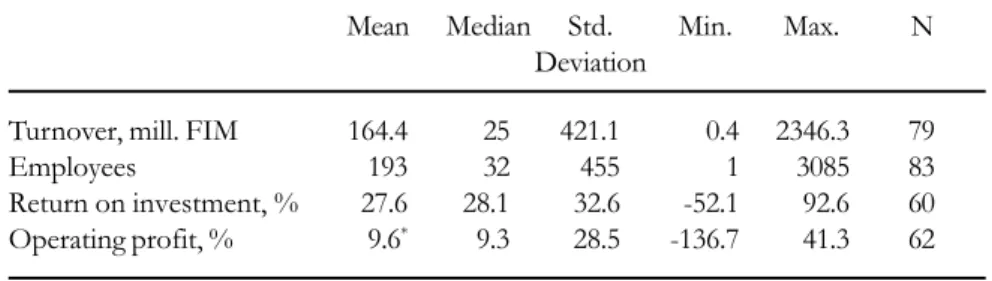
The following table gives some basic information about our sur-vey data.
Table 5.1 Descriptive statistics of key ratios of the sample firms (in 1998)
Mean Median Std. Min. Max. N Deviation
Turnover, mill. FIM 164.4 25 421.1 0.4 2346.3 79
Employees 193 32 455 1 3085 83
Return on investment, % 27.6 28.1 32.6 -52.1 92.6 60 Operating profit, % 9.6* 9.3 28.5 -136.7 41.3 62
* Two outliers were eliminated from the data when calculating the mean of operating profit. As table 5.1 shows, the sample firms are on average rather small. Median turnover is only FIM 25 million per year and the median number of employees is a bit over 30. However, our sample also includes big companies, for the turnover of the biggest company was FIM 2.3 bil-lion and employed more than 3 000 persons.
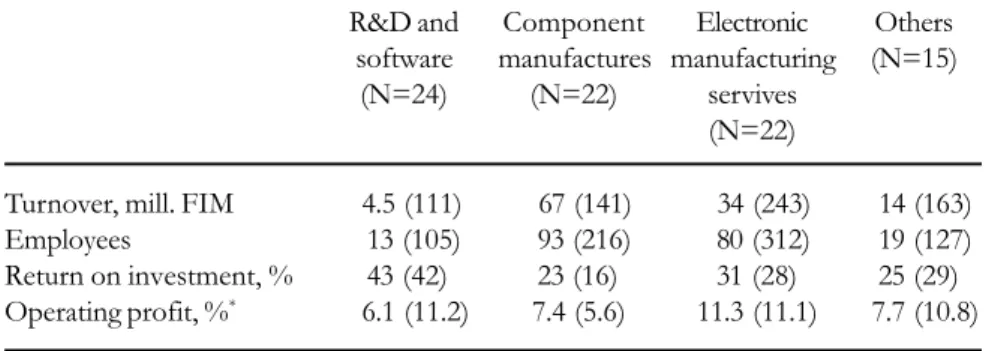
The companies operate in many different fields including manu-facturing business like component and contract manumanu-facturing as well as software development. Table 5.2 gives an overview of key figures of the companies by sectors. Companies have been grouped into four categories, namely component providers, electronics contract manu-facturing, software and planning systems and others.
As can be seen from table 5.2, there are some notable differenc-es between the groups. First, software and R&D companidifferenc-es are small-er than companies in the othsmall-er groups. The size diffsmall-erence remains regardless of whether we consider turnover or the number of person-nel. Second, return on investment of software and R&D companies clearly exceeds corresponding values in the other groups. However, if we consider operating profit the situation changes. Thus, the good