Supporting Software Process
Improvement with Project Assessments
Jesper Arenta, Jakob H. Iversenb, Carsten V. Andersenc, Stig Bangd [email protected], [email protected], [email protected], and[email protected] Aalborg Universitya+b,
Danske Data A/Sc, L.M. Ericsson Danmark A/Sd
Abstract
One of the most popular ways to improve the software development capability in organizations is to embark upon a Software Process Improvement (SPI) program based on one of the existing capability maturity models. Some of the challenges in norm-based SPI are to create commitment to the norm in the organization, to involve all parts of the organization in the SPI program, and to create opportunities for continuous improvement. We suggest the use of project assessments to support SPI programs in addressing these and other important challenges. In this paper we present two techniques to perform project assessments. The two techniques have been tried out in two longitudinal SPI projects and have proven to be effective tools to support improvements to the software development process. The paper contains actual results from applying the techniques in Danske Data and L.M. Ericsson, and we discuss in what ways project assessment support the SPI process in terms of benefits and pitfalls for three important stakeholders in SPI.
Keywords: Software Process Improvement, Maturity Model, CMM, Maturity Assessment, Self-Assessment, Organizational Change, Action Research.
BRT Keywords: DA04, AF10, AC03, AI0101, AI0102, AI0103, AI0104, AI0108
Introduction
Since its start in the late ‘80s the Software Process Improvement (SPI) movement has gained considerable momentum, and is now a dominant approach for improving quality, productivity, adherence to schedule etc. in software-developing companies. Many excellent guidelines exist that support practitioners in implementing SPI in their organization (Caputo 1998;Emam, Drouin & Melo 1998;Grady 1997;Kaplan, Clark & Tang 1994;Zahran 1997). Many of these rely on normative models for good software engineering practices to support the SPI process. The most popular and widely used norms are the Capability Maturity Model (CMM) (Paulk et al. 1993), BOOTSTRAP (Kuvaja et al. 1994), and SPICE (Emam, Drouin & Melo 1998). These norms contain maturity levels indicating good software practices and are primarily used to identify the weak areas in the existing software practice and to prioritize future improvements. One of the challenges in norm-based SPI is to create commitment towards the norm in the
organization.
Another challenge in SPI is to involve all parts of the organization to participate in the program (Humphrey 1989;Goldenson & Herbsleb 1995;Grady 1997). The focal point in SPI is often a Software Engineering Process Group (Fowler & Rifkin 1990) or
equivalent group1 with clearly defined duties and responsibilities to effectively manage
the SPI program for the entire organization. However, this group should not be solely responsible for implementing the improvements. By involving practitioners in identifying and improving their own problems, the improvements will become situated in the proper context or practice, i.e. in their daily activities, making it far more likely that the
practitioners will be committed to change their practice. By involving management, the SPI program will become linked to the organization’s vision and appropriate resources to do improvements will be allocated and distributed.
A third challenge in SPI is to create mechanisms to help the organization
institutionalize continuous process improvement. SPI is not a one-shot effort; but should be an evolutionary, incremental improvement initiative involving continuous learning. The basic idea behind CMM is to create an organization at the highest maturity level that is able to continuously optimize its software processes (Paulk et al. 1993).
SPI is a complex and challenging change process, and there will be many difficulties on the way. Successfully addressing the three challenges described above, might help SPI practitioners carry out the SPI process to ensure lasting changes in the software development process. One approach that can be used to address these SPI challenges, is project assessments. Project assessments is an assessment technique that determines the maturity of a single software development project relative to one of the maturity models. The results are then used to discover new areas for improvement, implement incremental improvements to the project’s practices, provide feedback to the project, and monitor improvement progress.
In this paper we describe two project assessment techniques that have been used in two different organizations’ SPI programs, and we examine how these techniques address challenges to support the SPI process. Both project assessments techniques are based on normative models to support the SPI process and they aim to involve all parts of the organization as part of the SPI program. In the first case, project assessments were primarily introduced to quickly move the projects to CMM level 2. In the second case, project assessments were seen as part of a long-term improvement effort to establish a grass-root movement among project managers to take responsibility for their own learning and professionalization. The discussion will focus on how project assessments might create commitment towards the norm, how project assessments might involve all parts of the organization in SPI, and how project assessments might create opportunities for continuous improvement.
The research is based on a large longitudinal action research project involving four Danish software-developing companies and a number of researchers from Aalborg University and Denmark’s Technical University as well as consultants from DELTA. For three years the researchers participate and assist the SPI projects in the four companies (Johansen & Mathiassen 1998). Two of the authors of this paper are SPI members in the two companies and have been deeply involved in developing and applying project assessments in their respective organizations. The other two authors are researchers and have actively participated in the SPI projects and project assessments of the companies. The next section of this paper describes and compares the two approaches used for project assessment in Danske Data and L.M. Ericsson. The discussion identifies potential benefits and pitfalls related to the use of project assessments, and we finish the paper with a conclusion and a discussion of possible future research.
1
Software Process Improvement and Norms
Improvements to the software development process have been going on for several decades. The primary effort has been focused on approaches such as defining and
adopting better methods and automated technology to support software development. The effective use of software methods and tools has shown to be limited by several factors: an ill-defined process, inconsistent implementation, and poor process management
(Humphrey, 1989). In the last decade, the Software Engineering Institute (SEI) in Pittsburgh, USA, has developed a notion of managing and improving the software
process based on the principles of total quality management and statistical process control (Humphrey, 1989; Paulk, 1995). This notion is expressed in detail in the Capability Maturity Model (CMM) (Paulk et al. 1993) (See Figure 1).
Quality management
Process measurement and analysis
Initial (1)
Repeatable (2)
Software configuration management Software quality assurance Software subcontract management Software project tracking and oversight Software Project Planning
Requirements Management
Defined (3)
Peer reviews Intergroup coordination Software product engineering Integrated software management Training program
Organization process definition Organization process focus
Managed (4)
Process change management
Technology change management Defect prevention
Optimizing (5)
Software quality management Quantitative process management
Continually improving process Predictable process Standard, consistent process Disciplined process
Figure 1. The five maturity levels of CMM. The CMM is a five-level model, describing the process capability of software
organizations as they mature. One of the fundamental assumptions of the CMM is that an organization at a high maturity level will perform better than one at a low maturity level. The model contains a number of Key Process Areas (KPA), each of which describes an important area to address in SPI. The KPAs are grouped into different maturity levels, as illustrated in Figure 1.
There are no KPAs, and thus no requirements to be at Level 1, which is
consequently often described as ad hoc or chaotic. Success at this level depends entirely on a competent project team with the necessary experience to do the job. At Level 2, the focus is on getting project management under control, and thus enabling the projects to
perform on schedule with predictable levels of productivity and quality. A level 2
organization should be able to repeat past successes and avoid past failures. When project management gets under control, attention at Level 3 turns to standardizing the processes used in the projects across the entire organization. This enables the creation of a common software process definition to be tailored by all projects. At Level 4, quantitative
measurements are used to ensure that the process operates within statistically predictable limits. At Level 5, the entire organization is focused on continually optimizing the process based on the quantitative data from level 4.
Other examples of maturity models include BOOTSTRAP and SPICE, both of which have a five-level maturity scale like CMM. But instead of the staged architecture where all KPAs of one level must be fulfilled for the organization to be assessed at a certain level, these models use a continuous architecture where the level is determined by calculating some kind of weighted average across all KPAs. These models also cover a wider array of KPAs. Whereas CMM largely have KPAs that address issues independent of the development process, then BOOTSTRAP, for instance, includes KPAs that specifically address the development process (e.g. user requirement specification, architectural design, testing etc.).
Several examples of norm-based project assessment techniques are already known in the literature: Synquest (Steinmann & Stienen 1996), Progress Assessment
(Daskalantonakis 1994), Interim Profile (Whitney et al. 1994), CMM Overview Workshop, Project Manager Interviews (Caputo 1998), Paper-and Pencil Quality Maturity Assessment, Baldridge Score Cards (Kaplan, Clark & Tang 1994).
Project Assessment in Practice
We illustrate how project assessment can be applied in practice by describing two different companies’ use of project assessment in their SPI efforts.
L.M. Ericsson A/S: Compelling Projects to Reach CMM Level 2
L.M. Ericsson A/S is a subsidiary of the Swedish international telecommunication company, Ericsson. The corporation is among the largest suppliers of telecom equipment in the world, and software is an ever-increasing part of the product portfolio. Realizing that, Ericsson started a software improvement program in 1992 called Ericsson System Software Initiative (ESSI2), which initially focused on improving SW quality by reducing
the fault density by 50% every year in the company’s public telephone exchanges. Gradually, the ESSI program has spread to all SW intensive operations within Ericsson, and includes a variety of other improvement goals that applies for a specific product (such as reduced development lead time, increased lead time precision, increased in-service performance, better usability, etc.). The ESSI program is founded on two main improvement frameworks: Policy Deployment for goal setting and follow-up, and The Capability Maturity Model (CMM) for software.
2 Note that the Ericsson ESSI is not a part of the European System Software
SPI in L.M. Ericsson A/S, Denmark
Ericsson in Denmark (LMD) has been developing software for almost two decades and within five different product areas, and has participated in the corporate ESSI program from 1993. The first CMM assessment of LMD was conducted in 1995, and the result was level 1. Before the assessment, no improvement activities had focused on improving the CMM level, and the assessment was therefore used as a kick-off for a focus on CMM, mainly on level 2 Key Process Areas. The scheduled interval of CMM assessments for a SW producing site within Ericsson is 2 years, but the CMM activities had shown little progress when the assessment in1997 was to be held. A lot of effort had been used on focus groups working on defining procedures for the Key Process Areas of the CMM, but the implementation in the development projects was scarce. The next CMM assessment was therefore postponed until 1998, while working on implementing CMM level 2 related activities in the projects.
Why Self-assessments
The contents of the CMM on level 2 is not beyond the normal level of policies, processes, procedures and rules within Ericsson, but it is a comprehensible amount of new terminology to most Ericsson employees and managers. Earlier attempts at implementing CMM at LMD had been unsuccessful because project managers had conceived the CMM to be overly theoretical, and they didn’t feel they had time for improvement; a typical attitude in low-maturity organizations. The problem was that the project managers couldn’t get a feel for CMM until they had actually tried to use it, and they didn’t use it because they didn’t have a feel for it. It was a vicious circle, making it difficult to succeed with a CMM project in LMD.
Another problem was that the results of the focus groups was sometimes so generic, that the projects had to put too much extra effort into making a practical routine that worked for the project. They needed support for that, which were not sufficiently available, and hence they could easily claim that they were unable to live up to CMM level 2, as required.
The third problem was the ”management commitment” problem facing every improvement program. Even though management was indeed committed, they had very little expertise and insight into the progress of the CMM implementation, and therefore couldn’t take the appropriate actions needed. In order for management commitment to be effective management information must be available in the form of measurements.
Experiences from other Ericsson companies had indicated that the regular use of a so-called CMM Ultra Light Assessment could speed up the implementation process by addressing the above mentioned problems. LMD therefore decided to adopt CMM Ultra Light Assessments for every project in the organization.
The Technique
There are several assessment types in use within Ericsson: A full-blown CBA-IPI
assessment with assessors external to the site and lasting two weeks, a Light Assessment performed internally in the organization and lasting two days, and then the Ultra Light Assessment performed by a SW development project themselves and lasting 1/2 - 1 day.
What is different about the Ultra Light Assessment is that the practitioners themselves (usually the project management team) perform it, while CMM experts perform the other assessment types. In the early Ultra Light Assessments, the projects received assistance in interpreting the CMM terminology, but gradually the projects
became able to perform the assessment without extra help.
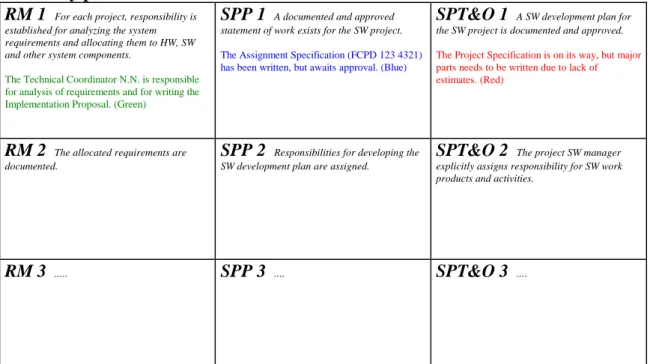
The Ultra Light Assessment process is simple. It consists of a document, where the text for all key practices in the CMM (level 2 only) has been copied into separate boxes in black text. The project then has to write their ”compliance statements“ in the boxes right under the CMM text, and write it with a color according to the degree of compliance:
GREEN = The key practice is in place and working/planned (stated with a reference)
BLUE = Minor things missing, or unsure of question/status
RED = The key practice is not in place
The text filled out by the projects is meant to be as concrete and precise as possible, and reflect the actual names of people ”with the designated responsibility for carrying out task X” and references to the actual project documents where ”task Y is described according to a documented procedure” (or whatever the CMM key practice clause demands). An example is given in Table 1.
Table 1. Sample ULA questions from Ability to Perform. Text in italics is the CMM key practices.
RM 1 For each project, responsibility is established for analyzing the system requirements and allocating them to HW, SW and other system components.
The Technical Coordinator N.N. is responsible for analysis of requirements and for writing the Implementation Proposal. (Green)
SPP 1 A documented and approved statement of work exists for the SW project.
The Assignment Specification (FCPD 123 4321) has been written, but awaits approval. (Blue)
SPT&O 1 A SW development plan for the SW project is documented and approved.
The Project Specification is on its way, but major parts needs to be written due to lack of estimates. (Red)
RM 2 The allocated requirements are documented.
SPP 2 Responsibilities for developing the SW development plan are assigned.
SPT&O 2 The project SW manager explicitly assigns responsibility for SW work products and activities.
RM 3 ... SPP 3 .... SPT&O 3 ....
In the period leading up to the 1998 assessment this exercise was performed every month, and took a whole day in the beginning. Gradually, when the boxes in the document were already filled out, and more and more text became green, the time to perform the
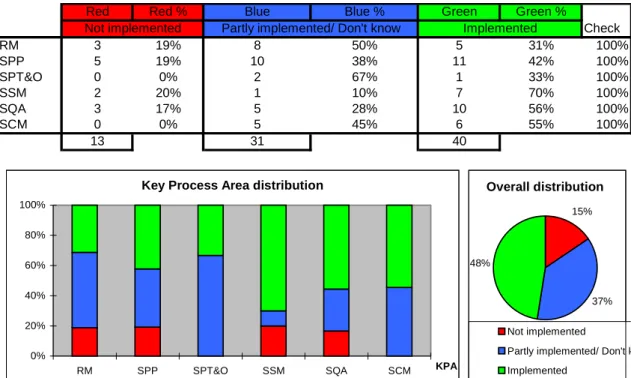
assessment went down to half a day. The result was reported to management using a spreadsheet summarizing the number of red, blue, and green statements (see the example in Figure 2).
Red Red % Blue Blue % Green Green %
Not implemented Partly implemented/ Don't know Implemented Check
RM 3 19% 8 50% 5 31% 100% SPP 5 19% 10 38% 11 42% 100% SPT&O 0 0% 2 67% 1 33% 100% SSM 2 20% 1 10% 7 70% 100% SQA 3 17% 5 28% 10 56% 100% SCM 0 0% 5 45% 6 55% 100% 13 31 40
Key Process Area distribution
0% 20% 40% 60% 80% 100%
RM SPP SPT&O SSM SQA SCM KPA
Overall distribution 15%
37% 48%
Not implemented Partly implemented/ Don't k Implemented
Figure 2. Overview of ULA results for one project.
Experiences
The experiences with using The CMM Ultra Light Assessment technique as a tool for implementing both awareness of CMM and implementation of CMM level 2 has been very positive. Compared to previous approaches it felt like a turbo-charged
implementation of CMM.
One of the key benefits of CMM Ultra Light Assessments is that the result is well suited to give a quantitative and visual indication of the status in every project, for every Key Process Area, or, as an aggregation, on department and company level. This
visibility made it very easy for management to pinpoint problems, set goals like ”75% green” at a certain milestone, and easily track progress towards them. The simple reporting format is a powerful tool for management to focus, and show active commitment and support without deep insight into the details of CMM.
The project managers also liked the pragmatic approach to CMM, and
(eventually) viewed the CMM Ultra Light Assessment document as a usable document for the project itself. Many projects printed out large-scale versions of the CMM Ultra Light Assessment document and posted it on the walls outside the project manager’s office for the project staff to see. In that way it served as a means for capturing and communicating important project decisions, responsibilities and standards, as a supplement to the normal web-pages and minutes of project meetings.
Since the CMM Ultra Light Assessment documents is structured according to the CMM model and was familiar to all projects, the wall postings of the assessment
documents also played the role of “best practice mapping” of the entire organization. If a project manager had specific problems in the area of, say, Requirements Management, Activity 3, he could get inspiration to solve them by looking at how other project managers had implemented that Key Practice.
Soon, project managers realized that it was important to “think CMM” right from the beginning of a project in order to achieve the CMM implementation goals set by management. If the project manager e.g. hadn’t recorded his planning data during the
planning of the project, the Project Planning, Activity 15 box (requesting the recording of project planning data) would stay red for the rest of that project. This created some frustration when the CMM Ultra Light Assessment technique was introduced, since the projects already running at that time could not get satisfactory levels of “green” Key Practices, no matter how hard the project managers tried to satisfy CMM level 2.
Recommendations and future work
The use of CMM Ultra Light Assessments is today institutionalized at LMD, although not at the intensive level as before the formal CMM assessment in 1998. The requirement is now for the projects to perform an CMM Ultra Light Assessment at least two times during the project planning phases and at least once during project execution, or every 3 months (whichever comes first).
It has proven to be a good technique to break the “level 2 wall” by involving both practitioners and managers to identify, map, and develop real everyday routines against the CMM while maintaining the sense of purpose of solving real problems in the projects and the organization. That, instead of adopting “CMM proof” procedures first made to satisfy the CMM and then, sometimes only after tailoring, would satisfy the business. The latter approach is a tempting, but unfortunate, approach in a level 1 organization,
especially if the organization actually expects better business results from maturing the organization, and not only the “CMM level 2” rating. Since level 2 represents the threshold of maturity (as defined in the CMM), it also represents the biggest mental barrier for the organization. The CMM Ultra Light Assessments is a good instrument to break that barrier.
It is a less obvious approach to use when trying to reach level 3, though. The CMM level 2 consists of 121 Key Practices, each represented by a box that must be filled out by every project according to their status. If the CMM Ultra Light Assessment
document were expanded to include level 3 Key Practices, it would be a cumbersome task for the projects to fill out. Furthermore, many of the Key Practices on level 3 are organizational, and must be addressed outside the projects. The positive reaction to the CMM Ultra Light Assessment technique has nevertheless inspired some projects to continue with the applicable level 3 Key Practices on their own. A general approach for doing that, however, has not yet been decided at LMD.
Danske Data A/S: Establishing Grass Root Improvement
Danske Data A/S (DD) is a subsidiary company of Den Danske Bank Koncern (the Danske Bank Group) which is the biggest banking group in Denmark. With its 850 employees divided in divisions in four major cities in Denmark, DD can be characterized as a large software developing organization. The main objective of DD is to supply the group with IT solutions and to maintain the operation of these systems as well as the group’s central IT resources. DD systems thus provide service to about 11,000
workstations with approximately 9 million transactions each day. Although the main part of the deliveries is to customers within the Danske Bank Group, DD enjoys an increasing number of external customers.
In August 1997, DD went from being the IT department of Den Danske Bank into being an independent project oriented company within the group. This meant that DD had to compete with other software developing organizations for customers both within and outside the group. DD has since grown concurrently with the number of purchases and
mergers by the Danske Bank Group. DD has chosen to use SPI as one of the mechanisms to stay competitive and manage growth in a controlled way.
SPI in Danske Data A/S
A central staff department, Analysis & Methods runs SPI in DD. The department is branched into four decentralized units, each of which functions as the connecting link to one of the four divisions. Analysis & Methods set the overall directions and goals for SPI initiatives for the organization, whereas the decentralized units carry out and support initiatives within the four divisions.
Previously, SPI in DD was characterized by local improvement initiatives, driven by the immediate needs of the individual divisions. These initiatives were rarely
coordinated across the organization and the outcomes of the initiatives were therefore often limited to the local division. At the same time, organization-wide initiatives were difficult to implement due to the different cultures and lack of focus on improvements. This situation was seen as problematic, as DD wished to create coherence and consensus for SPI in the organization. This is why DD entered into the three-year research project. The first maturity assessment in DD was conducted in May 1997. On that occasion, DD was assessed to be a CMM Level 1 organization (Iversen et al. 1998). The project terminates by the end of the year 1999 with an assessment, which is to show the result of the initiative. The goal of DD is to reach CMM Level 2 status at the
conclusion of the project.
Why Self-assessment
On the basis of the first maturity assessment, the assessors listed seven improvement areas for DD. One of these was ”Strengthen project management”. The assessors argued that “…project management in DD lacks formal control” and that “…management rests primarily on the experience of the individual project manager”.
The SPI group, which addressed this area for improvement, established a competence center for project management within DD. The cornerstone of the competence center is an in-house developed standard for project management - the Danske Data Standard for Professional Project Management. The standard, which to a large extent is based on CMM Level 2, enjoys the commitment of the senior management and “…defines the level for good and competent project management” within DD. The competence center additionally offers a 9-day education program in project management, where the main purpose is to enable the project managers to meet the requirements of the standard.
One of the fundamental ideas of the competence center is that the project managers at DD must participate actively in their own professionalization. The project managers must be able to assess and compare themselves to the standard and in this way identify and prioritize areas for which they feel a need for improvement. This has been the main reason for DD to develop a method for project managers to assess how they live up to the standard as well as a tool enabling the assessment via DD’s intranet.
The primary purpose of project manager self-assessments is to contribute to establishing a grass-root movement in which the project managers are self-reflective and improving. The secondary purpose is to use data from the project managers’ self-assessments in Analysis & Methods to monitor and analyze the SPI development as well as to prioritize and focusthe department’s initiatives for improvement within the
The Technique
The self-assessment concept of DD differs from other model-based self-assessments by being based on a model developed especially for DD. Project manager self-assessment in DD is based on a questionnaire concretizing the overall goals of the standard within ten key process areas (KPAs), shown in Table 2. The technical KPAs are based on CMM Level 2, whereas the organizational KPAs are based on subjects that project managers and senior managers in DD felt were important.
Table 2. The KPAs of the DD Standard for Professional Project Management
Technical KPAs Organizational KPAs
Requirements Management Business Innovation
Project Planning Interest Handling
Project Tracking and Oversight Team Building
Quality Assurance Competence Development
Subcontract Management
Document- and Configuration Management
The questionnaire comprises 130 questions each phrased as two scenarios describing the best and worst practice, respectively, on a bipolar scale. Table 3 shows one of the
questions under the item Project Tracking and Oversight of the questionnaire. Table 3. Sample Question from self-assessment questionnaire (Project Tracking and Oversight)
A: In my project we update the project plan every time plans for the project are altered.
B: In my project we do not update the project plan every time plans for the project are altered. Alterations can be seen from summaries and/or e-mails.
❍ Just like A ❍ Mostly like A ❍ Mostly like B ❍ Just like B ❍ I don’t know ❍ Not relevant Comments:
The questionnaire reveals how projects are managed at DD. The project manager fills in the questionnaire on the basis of his own experience from a particular project of which he is in charge.
The questionnaire is initiated with a series of questions concerning the project manager’s background. The subsequent part of the questionnaire is grouped in the same ten KPAs, which form the standard. The questions to each of the KPAs are preceded by a brief description of the area covered by the KPA in question. After the regular questions of each area are two open-ended questions where the project manager is encouraged to evaluate his good and bad experiences with the project as well as to state any proposal for improvement within the area in question.
The project managers complete the questionnaire via a Lotus Notes-based tool from their own workstation. The tool processes the questionnaire electronically and presents the results of the self-assessment to the project manager. The result comprises three aspects:
?
the project manager’s score for each KPA of the standard?
the project manager’s score for each goal of each KPA.All three scores are related to the DD average. This enables the project manager to compare his score with the present level of project management at DD. Furthermore, the result contains a number of references and direct links to relevant on-line guides and instructions which will help the project manager in meeting the requirements of each of the KPAs.
Data from the project manager’s self-assessment is stored in a central database. Authorized staff in Analysis & Methods have access to the database for analyzing the data through a number of views, which enables differentiation on such parameters as time, type of project, the project manager’s organizational location, the project manager’s experience and educational background and, the individual questions, goals and KPAs. Each project manager is only able to view his own score.
The self-assessment concept in DD is characterized by obligation to initiative resting with the project manager himself - otherwise it would not be a grass-roots movement. The self-assessment is voluntary and it thus becomes the project manager who decides when and on which project to base the self-assessment. However, other project participants can be involved in the completion of the questionnaire on the initiative of the project manager.
Experiences
The immediate response to the introduction of the concept in the organization is positive. For instance, the project managers who have participated in the project manager
education program have evaluated the relevance of the concept to just below 5 on a scale ranging from 1 to 6 with 6 as the maximum score.
The fact that self-assessment in DD is based on the free initiative of the project managers has however made the implementation of the concept in the organization very difficult and somewhat a balancing act. It has proven necessary to make the project managers realize that the self-assessment concept is an advantage to themselves and the entire organization, but without giving them the impression that they were being imputed a need. The success depends upon the project managers acknowledging this need
themselves. In order for this goal to be obtained, several ‘organizational levers’ have been pulled:
Analysis & Methods supports the project managers’ self-assessment through a direct hotline. It has proven important that Analysis & Methods is considered a driving force in order to make the project managers feel that the organization has an interest in their self-assessment. In this connection, Analysis & Methods considers introducing the concept of self-assessment and teaching the fundamental employment of the tool at local project manager meetings for all project managers. The project manager education at DD contains a module on assessment and the project managers have to carry out a assessment as preparation for the training. It appears that project managers’ self-assessment is a natural initiation to the education as it contributes to the individual project manager’s awareness and identification of his own needs for competence development. Convinced project managers are used as ambassadors to introduce the concept to their colleagues. It is very convincing when a colleague who has good experiences with self-assessment introduces the idea of self-assessment.
From the project manager’s point of view, concretizing the standard has been beneficial. The self-assessment equips the project managers with a better understanding
of the - very often - superficial and ambitious management visions. Furthermore, the project managers now operate within a common frame of reference, making exchange of experience and discussion of the standard across the organizing units possible.
Especially the project manager education program has proven to be an excellent forum for this purpose. One of the main reasons for the positive reception of the concept is that project managers via the self-assessment are able to influence Analysis & Method’s identification and prioritization of new SPI initiatives, like for example the further development of the standard.
Seen from the SPI group’s point of view, the introduction of project manager self-assessment at DD has resulted in an increased focus within the organization on the ten areas of the standard, among these CMM Level 2, and project management in general. The project manager self-assessment is a testing-ground, which provides the SPI group with feedback from the organization on new initiatives within the ten KPAs and the standard in general. Additionally, the SPI group can use the self-assessment to monitor the SPI development in DD, and use the results in management reporting.
The results of the project manager’s self-assessments add to a more detailed understanding of the organization within the SPI group. It is currently being considered whether to use this data in connection with the final maturity assessment that concludes the action research project. However, the SPI group is worried that an increased focus on the self-assessment results will lead to data contamination, and that the project managers merely obtain the knowledge on how to fill in the questionnaire correctly instead of becoming self-improving.
Another pitfall is that the amount of work that the SPI group has to invest in the management of the project manager self-assessment could cause an administrative overhead. It may turn out as a resource intensive task to keep the project managers committed and maintain a continuous flow of self-assessments.
Seen from the management’s point of view the project manager self-assessment is beneficial, in that the visions stated in the standard are being concretized and made subject for discussion. The management thus engages in dialogue with the organization about the visions already stated. Some of the vice presidents have successfully used the self-assessment questionnaire as the basis for adaptation of expectations to a project in co-operation with the project manager. The questionnaire thus bridges visions and practice. However, the management may be deceived in the case that the project managers show opportunistic behavior and contaminates the data.
Recommendations and Future Work
It is still too early to conclude on the effectiveness of the initiative, but it is expected that the project manager self-assessment concept will be a strong contributor to the maturing of DD to CMM Level 2.
The experiences from DD have shown that it is possible to tailor a model - the DD Standard for Professional Project Management - and a method to self-assessment. Provided the necessary SPI competence is present, we recommend to any organization that it defines its own goals for SPI and conducts tailored self-assessment in order to track progress and redefine its goals.
Comparing the Techniques
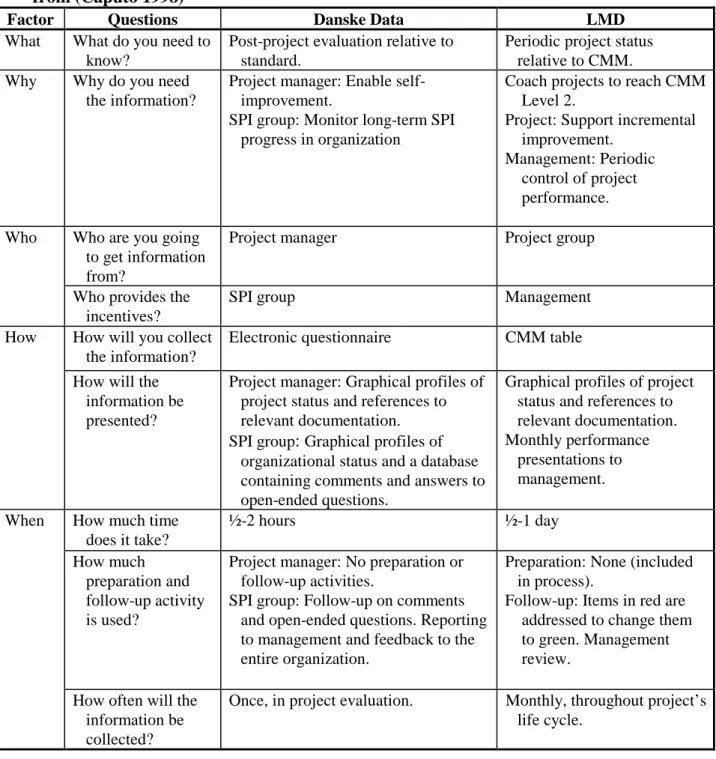
similarities based on a general framework for selecting an assessment technique (Caputo 1998). Table 4 shows the dimensions that we use to compare the two techniques and a brief version of the comparison.
Table 4. Comparison of the two techniques. Factors and questions adopted from (Caputo 1998)
Factor Questions Danske Data LMD
What What do you need to know?
Post-project evaluation relative to standard.
Periodic project status relative to CMM. Why Why do you need
the information?
Project manager: Enable self-improvement.
SPI group: Monitor long-term SPI progress in organization
Coach projects to reach CMM Level 2.
Project: Support incremental improvement.
Management: Periodic control of project performance. Who are you going
to get information from?
Project manager Project group Who
Who provides the incentives?
SPI group Management How will you collect
the information?
Electronic questionnaire CMM table How
How will the information be presented?
Project manager: Graphical profiles of project status and references to relevant documentation. SPI group: Graphical profiles of
organizational status and a database containing comments and answers to open-ended questions.
Graphical profiles of project status and references to relevant documentation. Monthly performance
presentations to management. How much time
does it take? ½-2 hours ½-1 day How much preparation and follow-up activity is used?
Project manager: No preparation or follow-up activities.
SPI group: Follow-up on comments and open-ended questions. Reporting to management and feedback to the entire organization.
Preparation: None (included in process).
Follow-up: Items in red are addressed to change them to green. Management review.
When
How often will the information be collected?
Once, in project evaluation. Monthly, throughout project’s life cycle.
The table shows that both techniques rely on some kind of normative guidelines for software engineering practice (DD’s standard and CMM). At DD, the objective is to help the individual project manager to improve his future project management practice, whereas LMD uses project assessments to support continuous improvement of the project group’s practices throughout each project’s life cycle in order to quickly move projects to CMM level 2. In addition, LMD involves management more actively than DD. Each month every project presents the results of project assessment to senior management in
order to facilitate a discussion about problems, challenges, future strategy, etc. This enforces a fruitful involvement of senior management in the project and a closer collaboration between projects and management. However, the time spent at LMD on project assessments exceed the time spent at DD. At LMD, it takes ½-1 day to carry out the assessment in addition to the presentation and discussion with senior management. At DD, project assessments are carried out at the final project evaluation, where each project manager fills in an electronic questionnaire. There are no requirements that results must be discussed with management, but this is one way of using the project assessment results that has been considered and is open to the project managers.
Supporting SPI with Project Assessments
Project assessments may be of great benefit to any SPI program. As indicated in our cases, such a technique might support development projects, the SPI group and
management to deal with some of the main challenges involved in SPI. In this section, we discuss some of the benefits and pitfalls that may be experienced by the SPI group, the development project, and management when using project assessment to support the SPI process.
Development Projects
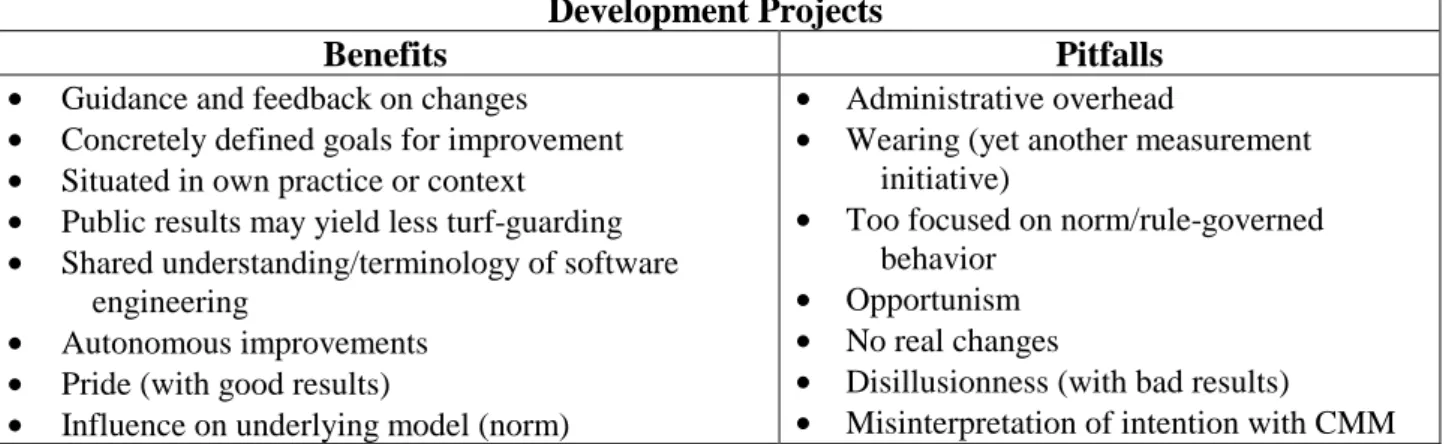
Table 5 shows the pitfalls and benefits that a single project may experience. As the primary purpose of project assessment usually is to enable projects or project managers to get a better understanding of the project’s situation and the most important areas for improvement, it is not surprising that projects may experience significant benefits from using project assessments. As an integrated part of the improvement process, projects get guidance and feedback from the project assessment on whether they are moving in the right direction or not. Project assessments may also provide the project group or the project manager with the necessary information to initiate local improvement activities based on their immediate needs and concerns, and continuously monitor the progress of implementing these and other improvement initiatives, situating the improvements in the project’s practice and context. One of the key enabling factors to obtain these benefits, is that projects are given the autonomy to act on their own in applying the self assessment method and are ensured that the results will not be used against the project. This implies that if results are made public, it should be at the discretion of the project only.
However, if the organization is not careful when implementing the assessment process, the result may be that the projects only experience an administrative overhead causing weariness among project members of yet another initiative to feed data to management or the SPI group. The projects may also become overly opportunistic if, for instance, good self-assessment results are rewarded.
Both Danske Data and L.M. Ericsson have been aware of some of these benefits and pitfalls. Both organizations have specifically targeted the self-assessment process toward increased improvement and learning for the project managers, and neither has awarded good assessment results. In Danske Data, it has been considered letting active use (rather than good results) of the self-assessment tool be one of the factors in appointing the project manager of the year. L.M. Ericsson has experienced that when projects make their results public, learning between projects is stimulated; one project group may note which other projects are doing well in an area where they are struggling,
and may then consult these projects on that topic. In addition, LMD experienced that project assessments enforced a common terminology in the organization, making it easier for projects to transfer people and experiences between projects. However, LMD also experienced that some projects would ‘chase green percentages’ (partly due to
management pressure, and were therefore not always considering what the real intention of the CMM is, namely continuous improvement, but would rather just look at what is written in the self-assessment table (Table 1). For instance, a project may have appointed someone to be responsible for quality assurance on the project, but if that person doesn’t act accordingly, then it would be wrong to count that as positively fulfilling that
requirement.
Table 5. Potential benefits and pitfalls of project assessment as seen from the development projects.
Development Projects
Benefits Pitfalls
• Guidance and feedback on changes
• Concretely defined goals for improvement
• Situated in own practice or context
• Public results may yield less turf-guarding
• Shared understanding/terminology of software engineering
• Autonomous improvements
• Pride (with good results)
• Influence on underlying model (norm)
• Administrative overhead
• Wearing (yet another measurement initiative)
• Too focused on norm/rule-governed behavior
• Opportunism
• No real changes
• Disillusionness (with bad results)
• Misinterpretation of intention with CMM
SPI Group
Even if the development projects become empowered to improve their own practice, the SPI group is still important in the SPI program. The SPI group may also experience significant benefits as a result of increasing the autonomy of projects (see Table 6). Perhaps the most notable change for the SPI group is that they will change from the role of enforcing improvements in the projects to a role of facilitating and supporting the projects’ improvement effort.
Table 6. Potential benefits and pitfalls of project assessment as seen from the SPI group.
SPI Group
Benefits Pitfalls
• Identify “best practices”
• Common terminology in organization
• Continuous accumulation of data/knowledge about SPI
• Monitoring progress
• Improvement ‘pull’ from projects
• Increased commitment in projects
• Less resistance to change among practitioners
• Requires few SPI resources
• Increased assessment detail
• SPI group will be able to justify its existence to management and software practitioners.
• Loss of control
• Inadequate co-ordination
• Project specific, not organization-wide
• Data contamination (data not to be trusted)
• No real change
In most cases, the SPI group will be instrumental in establishing the assessment process, and maintaining tools, databases, and other assessment instruments. And, as Table 6 shows, by introducing project assessments, the SPI group will also be able to influence the organization in terms of introducing a common terminology and frame of reference based on the norm integrated in the technique. They will also be able to identify which projects are handling some process particularly well, and then study that process in more detail, and possibly disseminate this practice as a best practice to all projects in the organization. Compared to traditional, formal assessments, the project assessments can be conducted continuously with increased detail, and with fewer resources from the SPI group. In addition, the ownership of the need to improve shifts from the SPI group to the projects, changing the SPI group’s role from ‘pushing’ improvements to the organization to responding to the organization’s ‘pull’ for improvements from the SPI group.
However, such a project-based SPI process may encourage discrete,
un-coordinated improvements, resulting in loss of control of the overall SPI initiative. Since the SPI group is responsible for the organization-wide SPI, they might experience that the use of project assessments makes it difficult to create strategic and tactical SPI plans and develop an organization-wide strategy and status for improvements. There is also a danger that some projects don’t take the opportunity to improve, resulting in slower improvement rate throughout the organization. To compensate for this, peer pressure or competition can be used, depending on the organizational culture.
The SPI group at LMD experienced increased commitment toward CMM-based improvements, when they introduced project assessments. Improvements were now situated in the projects’ own practice, and they got hands-on experience with the CMM as guidance for practice. This made the projects suddenly realized how CMM could be used and tailored to be applicable to their practice. In addition, the SPI group changed role from primarily driving and implementing improvements to primarily facilitating and coordinating improvements. However, they now face the challenge of coordinating the improvement activities throughout the 4 accounts in the organization. At DD, the SPI group was able to track the overall state of the maturity of the company, and thus be able to tell if the improvement initiatives had any effect on the development process.
Management
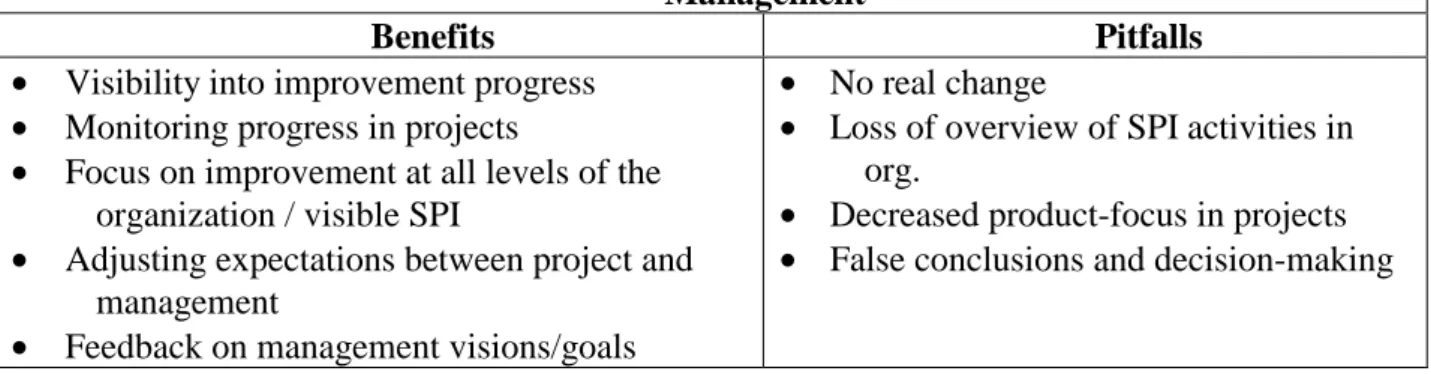
Finally, project assessments may introduce benefits and pitfalls for management as well (see Table 7).
Table 7. Potential benefits and pitfalls of project assessment as seen from Management.
Management
Benefits Pitfalls
• Visibility into improvement progress
• Monitoring progress in projects
• Focus on improvement at all levels of the organization / visible SPI
• Adjusting expectations between project and management
• Feedback on management visions/goals
• No real change
• Loss of overview of SPI activities in org.
• Decreased product-focus in projects
• False conclusions and decision-making
1998). A senior manager can use project assessments to show commitment towards SPI, if he actively monitors the results and shows visible interest in project performance. By providing the necessary resources and infrastructure for project assessments, senior management sends out a clear signal about focus on improvement in the organization. However, managers must also focus on the products that are delivered to customers. In this perspective, project assessments might impose a decreased focus on the product in projects and increase the focus on the process. This should, however, be seen in a long-term perspective, where the use of project assessments to support the SPI process should result in better products and more satisfied customers. There is also the danger that senior management focuses too much on the results of the assessments and makes hasty
decisions on the ground of these results. For instance, in the LMD case, having an average of 90% green, management could be mislead to conclude that the organization operates at level 2. However, many of the issues in CMM are organizational (e.g. organizational policies), and if they are not in place, project managers are likely to say that many questions are irrelevant.
At LMD, senior management was actively involved in the monthly assessments when each project presented its results and improvement plans. In this way, they showed commitment towards SPI and in addition they acquired actual insight in the existing practice in the projects. They got involved in the activities of the projects and were more capable of making proper and informed decisions. At DD, management has been aware of the assessments and has actively participated in the development of the standard and the design of the analysis part of the assessment tool.
Conclusion
In this paper we have illustrated how two different project assessment techniques can support SPI projects. The results indicate that project assessment can be an important means to achieve success in a SPI program. It is likely that LMD would not have reached CMM level 2 without the ULA to guide and motivate the projects to improve and comply with CMM. At Danske Data it is still too early to make similar conclusions, but the preliminary results indicate that this approach could have a great impact on many levels of the organization.
The discussion also shows that the three challenges of creating commitment towards the norm, involve all parts of the organization, and create opportunities for continuous improvement have been addressed in both cases. Addressing these challenges has been vital for the success that LMD had when applying ULA and the considerations that DD had on how to ensure success in the implementation of its project assessment technique.
LMD had much experience with the CMM both at the local and corporate levels, and this, combined with competition from other corporate development centers formed strong incentives to adopt CMM. Applying ULA proved to be a successful strategy for achieve the objective of reaching CMM level 2. Project members (both managers and developers) have now accepted the norm as a guideline for good practice and have learned how to apply it, and all parts of the organization have been and still are involved in the project assessments. All projects use the technique periodically, which actively involve management during project execution in evaluating the performance of the projects.
develop a tailored model, based on the CMM. This model has become the Danske Data Standard for Professional Project Management, and is thus instrumental in defining success criteria for project managers. Even though the technique has not yet been in widespread use, the initial experiences indicate that project managers accept the norm and welcome it as good project management practice. Project managers use the project assessment tool to evaluate their own practice against the standard, and the SPI group uses the assessment result to tailor the standard and provide oversight to management.
There are many possibilities for future research on this topic. It would be interesting to follow the two companies over longer time to see how using project
assessment methods facilitate continuos improvement. It might also be relevant to expand the study to include more companies and different paradigms of project assessment.
Another area for future research would be to investigate how different learning paradigms relate to project assessment. Brown and Duguid’s notion of communities-in-practice (Brown & Duguid 1991) and how project assessments relate to working,
learning, and innovating could reveal interesting observations. Also Argyris and Schön’s notion of single-loop and double-loop learning (Argyris & Schön 1978) could reveal interesting insight. Do projects really learn through project assessments (double-loop learning) or do they just change practice without really changing behavior (single-loop learning)?
Acknowledgement
This research has been financially supported by The Danish National Center for IT Research and The Danish Agency for Development of Industry and Trade. Many thanks to Danske Data and L.M. Ericsson Denmark for assisting in making the research possible. The following colleagues have provided valuable insights and comments: Gro Bjerknes, Karlheinz Kautz, Lars Mathiassen, Peter Axel Nielsen, and Jacob Nørbjerg.
References
Argyris, C. & Schön, D. A. 1978, Organizational Learning: A Theory of Action Perspective, Addison-Wesley Publishing Company.
Brown, J. S. & Duguid, P. 1991, 'Organizational Learning and Communities-of-Practice',
Organization Science, vol. 2, no. 1.
Caputo, K. 1998, CMM Implementation Guide: Choreographing Software Process Improvement, Addison-Wesley, Reading, Massachussets.
Daskalantonakis, M. K. 1994, 'Achieving Higher SEI Levels', IEEE Software, vol. 11, no. 4, pp. 17-24.
Emam, K. E., Drouin, J.-N. & Melo, W. 1998, SPICE: The Theory and Practice of Software
Process Improvement and Capability Determination, IEEE Computer Society, Los Alamitos,
California.
Emam, K. E., Goldenson, D., McCurley, J. & Herbsleb, J. 1998, Success or Failure? Modeling
the Likelihood of Software Process Improvement, International Software Engineering
Research Network, ISERN-98-15.
Fowler, P. & Rifkin, S. 1990, Software Engineering Process Group Guide, Software Engineering Institute, Pittsburgh, Pennsylvania, USA, CMU/SEI-90-TR-24.
Goldenson, D. R. & Herbsleb, J. D. 1995, After the Appraisal: A Systematic Survey of Process
Institute, Pittsburgh, Pennsylvania, SEI-95-TR-009.
Grady, R. B. 1997, Successful Software Process Improvement, Prentice Hall PTR, Upper Saddle River, New Jersey.
Humphrey, W. S. 1989, Managing the Software Process, 1st edn, Addison-Wesley, Pittsburgh, Pennsylvania.
Iversen, J., Johansen, J., Nielsen, P. A. & Pries-Heje, J. 1998, 'Combining Quantitative and Qualitative Assessment Methods in Software Process Improvement', in European Conference
on Information Systems 1998, ed. W. R. J. Baets, Aix-en-Provence, France, pp. 451-466.
Johansen, J. & Mathiassen, L. 1998, 'Lessons Learned in a National SPI Effort', in EuroSPI'98, Gothenburg, Sweden.
Kaplan, C., Clark, R. & Tang, V. 1994, Secrets of Software Quality: 40 Innovations from IBM, McGraw-Hill.
Kuvaja, P., Similä, J., Krzanik, L., Bicego, A., Saukkonen, S. & Koch, G. 1994, Software
Process Assessment and Improvement - The BOOTSTRAP Approach, Blackwell.
Paulk, M. C., Curtis, B., Chrissis, M. B. & Weber, C. V. 1993, Capability Maturity Model for
Software, Version 1.1, Software Engineering Institute, Pittsburgh, Pennsylvania, 93-TR-024.
Steinmann, C. & Stienen, H. 1996, 'SynQuest - Tool Support for Software Self-Assessment',
Software Process - Improvement and Practice, vol. 2, no. 1, pp. 5-12.
Whitney, R., Nawrocki, E., Hayes, W. & Siegel, J. 1994, Interim Profile: Development and Trial
of a Method to Rapidly Measure Software Engineering Maturity Status, Software
Engineering Institute, Pittsburgh, Pennsylvania, CMU/SEI-94-TR-4.
Zahran, S. 1997, Software Process Improvement: Practical Guidelines for Business Success, Addison-Wesley, Essex, England.