This is a peer-reviewed, post-print (final draft post-refereeing) version of the following published document and is licensed under Creative Commons: Attribution-Noncommercial-No Derivative Works 4.0 license:
Berragan, Elizabeth (2013) Conceptualising learning through simulation: An expansive approach for professional and personal learning. Nurse Education in Practice, 13 (4). pp. 250-255. ISSN 1471-5953
Official URL: https://doi.org/10.1016/j.nepr.2013.01.004 DOI: http://dx.doi.org/10.1016/j.nepr.2013.01.004 EPrint URI: http://eprints.glos.ac.uk/id/eprint/5208
Disclaimer
The University of Gloucestershire has obtained warranties from all depositors as to their title in the material deposited and as to their right to deposit such material.
The University of Gloucestershire makes no representation or warranties of commercial utility, title, or fitness for a particular purpose or any other warranty, express or implied in respect of any material deposited. The University of Gloucestershire makes no representation that the use of the materials will not infringe any patent, copyright, trademark or other property or proprietary rights.
The University of Gloucestershire accepts no liability for any infringement of intellectual property rights in any material deposited but will remove such material from public view pending investigation in the event of an allegation of any such infringement.
Conceptualising learning through simulation: an expansive approach for professional and personal learning in nursing
This paper considers Benner and Sutphen’s (2007) pedagogical model for professional learning in relation to expansive approaches to learning and offers different perspectives for understanding learning through simulation. Benner and Sutphen’s work highlights the complex nature of situated knowledge in practice disciplines such as nursing. They suggest that knowledge must be constantly integrated within the curriculum through pedagogies of interpretation, formation, contextualisation and performance. These pedagogies present a framework, which may enhance our understanding of the impact of simulation upon student learning. Engeström’s (1994) work on activity theory and expansive learning supports the contribution of this model towards the revelation and elucidation of effective learning through simulation in nurse education. His notion of expansive learning may offer nurse education a way of reconceptualising the learning that occurs during simulation. This paper offers illustrations of the different activity systems to which student nurses are exposed, together with analysis of the expansive learning processes that occur between these systems as the students learn to be nurses. Together these frameworks present an opportunity for nurse education to take a different look at simulation and offer potential to articulate and theorise the learning inherent in simulation activities.
Simulation and expansive learning
Activity theory offers a way of conceptualising aspects of the learning experienced through simulation, and in particular the notion of expansive learning articulated in the context of workplace learning by Engeström (2001). Activity theory emphasizes change rather than stability, with its focus on the dynamics of learning rather than the learner as a participant in an established system. Simulation experiences may provide an opportunity for expansive learning, where students can be supported to consider the contradictions between what is taught in university and clinical practice leading to learning, development and change. According to Engeström and Sannino (2010):
as activity systems are increasingly interconnected and interdependent, many recent studies of expansive learning take as their unit of analysis a constellation
of two or more activity systems that have a partially shared object. (p.6)
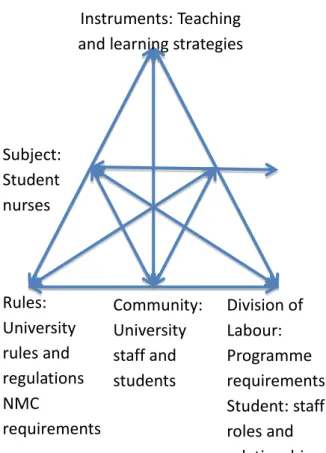
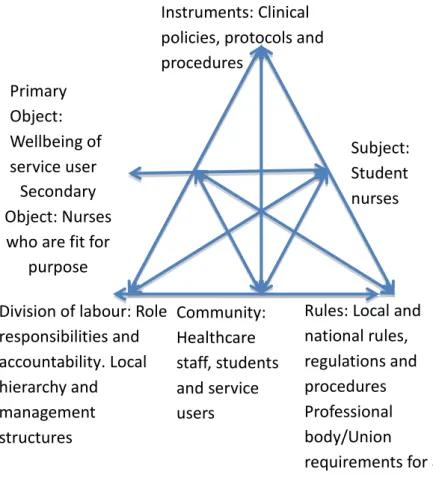
The context of nurse education has changed significantly over the last four decades from an apprenticeship model of learning based primarily in healthcare settings to graduate level learning in university combined with practical experience in healthcare settings. Thus the activity systems for nurse education today are the university and the healthcare setting. The diagrams below illustrate the activity systems for nurse education. Figure 1 represents the activity system for the university and Figure 2 the healthcare setting.
Figure 1: The activity system of the University
Figure 1 shows the activity system of the university where the object is to produce graduate nurses who are capable of questioning and developing nursing practice in response to service user needs and changing evidence bases (Haigh, 2007). They are subject to the influences of the university community such as staff student relationships and academic and professional rules and regulations.
I st u e ts: Tea hi g a d lea i g st ategies Su je t: Stude t u ses Rules: U i e sit ules a d egulatio s NMC e ui e e ts Co u it : U i e sit staff a d stude ts Di isio of La ou : P og a e e ui e e ts Stude t: staff oles a d elatio ships
In contrast, the activity system of the healthcare setting (Figure 2) has as its primary object the well-being of each service user. In this system, student needs are necessarily a lower priority and the object, in relation to nurse education, is to produce a nurse who is fit for purpose in a specific context with specific working practices.
Figure 2: The activity system of the Healthcare setting
In this activity system, students are exposed to a community where additional rules, regulations and responsibilities apply. In this environment the prime focus is safe and effective care.
These activity systems produce and are subject to influences, tensions and contradictions, which offer different conceptions of learning and different views of nursing practice. According to Engeström (2001) these contradictions and tensions can be addressed by means of an expansive learning process, in which the two parties together generate a new, shared
Se o da O je t: Nu ses ho a e fit fo pu pose Di isio of la ou : Role espo si ilities a d a ou ta ilit . Lo al hie a h a d a age e t st u tu es Su je t: Stude t u ses I st u e ts: Cli i al
poli ies, p oto ols a d p o edu es Co u it : Health a e staff, stude ts a d se i e use s P i a O je t: Well ei g of se i e use Rules: Lo al a d atio al ules, egulatio s a d p o edu es P ofessio al od /U io e ui e e ts fo all staff
object and concept for their shared activity. In effect, the many different elements of these activity systems lead to rethinking and consideration of how things should be done in order to continue to achieve the collective objective of enabling student nurses to learn to care.
Figure 3: The inter-dependent activity systems of the university and the healthcare setting Figure 3 demonstrates the potential for expansive learning to occur as the activity systems generate a new shared object and concept for their shared activity. In this case, the shared activity or object focuses upon student nurses learning to nurse. The concept which supports this activity highlights the experiences that may be shared by students as they engage in
F o rm a o n In te rp re ta o n C o n te xt u a li sa o n P e rf o rm a n ce N u rs e s w h o a re fi t fo r p u rp o se R e sp o n si v e , q u e s o n in g g ra d u a te n u rs e s In st ru m e n ts : T e a ch in g a n d le a rn in g st ra te g ie s S u b je ct : S tu d e n t n u rs e s S u b je ct : S tu d e n t n u rs e s R u le s: U n iv e rs it y ru le s a n d re g u la o n s N M C re q u ir e m e n ts C o m m u n it y : U n iv e rs it y st a ff a n d st u d e n ts D iv is io n o f La b o u r: P ro g ra m m e re q u ir e m e n ts S tu d e n t: st a ff ro le s a n d re la o n sh ip s In st ru m e n ts : C li n ic a l p o li ci e s, p ro to co ls a n d p ro ce d u re s R u le s: Lo ca l a n d n a o n a l ru le s, re g u la o n s a n d p ro ce d u re s P ro fe ss io n a l b o d y /U n io n re q u ir e m e n ts fo r a ll st a ff C o m m u n it y : H e a lt h ca re st a ff , st u d e n ts a n d p a e n ts / cl ie n ts D iv is io n o f la b o u r: R o le re sp o n si b il i e s a n d a cc o u n ta b il it y . Lo ca l h ie ra rc h y a n d m a n a g e m e n t st ru ct u re s T h e U n iv e rs it y T h e H e a lt h ca re se n g W e ll b e in g o f p a e n t/ cl ie n t
simulation activities and is drawn from Benner and Sutphen’s (2007) pedagogical model for professional learning. The environment that supports this activity is simulation.
The real test of a theory about learning is its capacity to generate learning which helps us to make sense of our world and prepares us in some way for the future (Engeström, 2001). Engeström (2001) states that there is a tendency to depict learning and development as vertical processes, ‘aimed at elevating humans upward, to higher levels of competence’ (p.153) (see Figure 4). Traditionally nursing students engaged in clinical nursing skills following step-by-step procedural guidelines, learning to perform the nursing task (for example, measurement and performance of blood pressure or a simple wound dressing) in class and then refining their skills on placement in a healthcare setting. Through this vertical model of learning the students began to act like nurses and gain competence in specific nursing skills.
Figure 4: Vertical learning
Engeström (2001) suggests a complementary perspective, where learning can also be viewed in terms of horizontal or sideways development.
Pe fo a e of task i lass Step step i st u tio s A t like u se Stude t u se
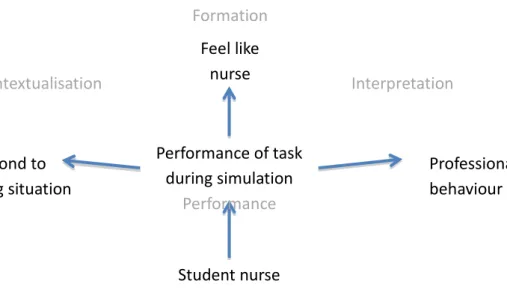
Figure 5: Horizontal or sideways learning
Figure 5 illustrates the notion of horizontal or sideways expansion of learning through simulation. It highlights the learning that students may experience as they participate in simulation and learn to become attuned to nursing situations (Lasater, 2007; Cant and Cooper, 2010). Rather than performing procedural tasks in a step-by-step manner, as students engage with the simulation environment and the care of service users in this environment, they begin to respond, behave and feel like nurses, albeit in a simulated environment. The discussions that follow offer evidence of expansive approaches to learning and engagement with horizontal or sideways learning and development (Engeström, 2001).
Simulation and expansive learning for the formation of nursing identity
There are many issues pertinent to the development of nursing identity, such as the role of the nurse mentor, the role of the nurse educator, the notion of practice, the role of employment and the need to acquire practical and theoretical knowledge. There are also aspects of peer collaboration, role modelling and social participation, which benefit and support the development of professional identity for student nurses. Simulation may have a part to play here, offering an environment where students have an opportunity to practise, rehearse and refine their nursing skills developing confidence in their identity as nurses (Leigh, 2008; Berragan, 2011). Stude t u se Pe fo a e of task du i g si ulatio Pe fo a e Respo d to ha gi g situatio P ofessio al eha iou Feel like u se Co te tualisatio I te p etatio Fo atio
This initial development of professional identity is important for students, offering valuable opportunities to enable them to begin to understand the complexities of nursing (Scholes, 2008). Morgan (2006) suggests that it is important that the development and formation of a nursing identity takes place in a setting which can provide support, encouragement and feedback in order to help the students to gain confidence. Professional identity may then be further enhanced and nurtured within clinical practice through role modelling and mentorship (Gordon, 2005).
Student nurses begin to develop a way of conducting themselves (a habitus of practice) formed from new understandings, new skills and judgments and new perceptions (Benner and Sutphen, 2007). As they begin to engage with their learning and participate in simulation sessions, there are opportunities to become attuned to nursing situations. In this way there is the potential that simulation can support students to demonstrate an expansive approach to learning and engage in what Engeström (2001) calls horizontal or sideways learning and development (see Figure 5).
Simulation and expansive learning for the interpretation and contextualisation of care
All nurses are required to contextualise and interpret a range of information in order to provide optimum care. Within nurse education, as students are encouraged to learn the skills of interpretation, they are advised to consider their knowledge and understanding of a particular situation. This knowledge is based upon past lessons, learning in university and healthcare settings, scientific theories and explanations, and interpretation of data from technological equipment. Students begin to make links between theory and practice and, as a result, they learn to interpret and contextualise information. Interpretation and contextualisation in nursing also require critical thinking and deconstruction in order to
challenge ‘the taken for granted assumptions’ inherent in health care traditions (Zeitz and
McCutcheon, 2005). Nurse educators encourage nursing students to explore and challenge the traditions of nursing (Walsh and Ford, 1989) and to strive for evidence-based, critically analysed nursing care. Nurses must have ‘a tradition of practice that enables them to stand, act, improve and criticize. A self-improving practice must allow professionals to critically reflect on the practice tradition and science and technology’ (Benner and Sutphen, 2007, p.106).
Both the university and the healthcare settings are contexts that give meaning and coherence to learning. Some elements of healthcare contexts may be perceived by students to be similar to university contexts; students may perceive themselves to be horizontally transferring (Engeström, 2001) more or less the same knowledge in largely unchanged forms into a different setting. Conversely, students may be aware that the clinical practice setting is quite different although not unrelated to what was learnt at university. The students would need to engage in some form of reflective process in order to question what is happening in the clinical setting and why it is being done in that way and not another. In this situation, the students would be abstracting or theorizing the clinical situation, referred to by Schön (1995)
as ‘reflective transfer’. In clinical practice the primary object of activity is the well-being of
the service user. The context of this activity is a busy and demanding environment where it can be difficult for students to find time to reflect on an episode of care either during or after the event. In the simulated environment time can be taken to address the needs of the student and provide opportunities for deliberation and reflection upon episodes of care (Alinier et al., 2006).
According to Lasater (2012) and Levitt-Jones (2012) simulation can provide space for students to identify what they already know about the clinical practice setting from previous placement experience or university learning, to identify what this may contribute to clinical practice and what the gap is between clinical practice and university. Simulation is said to require a controlled learning environment where students can take part in activities which reflect the realities of a real and unpredictable nursing environment (Jeffries, 2005). Jeffries (2005) suggests that simulation is used to facilitate ‘connections between and among concepts and engage students in the learning process’ (p. 99). It is in this environment that students may begin to acquire the skills of clinical judgment and to recognise the influence of contextual factors on the development of that judgment (Benner et al., 1996; Rhodes and Curran, 2005: Benner et al., 2010). In essence, simulation may offer an opportunity to support ‘reflective transfer’ and enable students to explore the contradictions (Engeström, 2001) between the activity systems of the university and healthcare settings and develop their skills of interpretation and contextualisation.
Simulation and expansive learning for the development of a competent nursing performance
Performance is a difficult concept to capture. It occurs in a particular situation or context, it involves understanding in action and evidence-based interpretation and requires well-formed practitioners with well-honed skills of practical reasoning and clinical judgment (Benner and Sutphen 2007). Benner (1984), in her seminal work From Novice to Expert suggested that nursing performance could begin to be understood through the examination of the performance of an expert practitioner. However, as Polyani (1958) notably suggested, the tacit knowledge of experts is not easily captured in words. There are elements of nursing performance which evade description and analysis, concealing themselves as intuitive and personal knowledge (Moch, 1990) deeply embedded in the subconscious until required in a particular clinical situation (Meerabeau, 1992; Berragan, 1998). Nursing performance is problematic in terms of explanation, yet it is something that nurses continue to pursue as they attempt to define nursing and elucidate the art and science of nursing practice.
Cognitive issues often dominate nurse education in university settings, and less attention is paid to the emotional content and performance element of learning experiences. There is clearly a strong affective element to nursing performance and the experiences encountered through nursing interventions with service users. Most nurses can give examples of inspirational care episodes that profoundly affected the development of their nursing performance. Equally, however, most can also tell of occasions where they felt humiliated or inadequate in front of service users and colleagues, not knowing how to manage a difficult situation. Such experiences often endure in the memory for decades.
In real health care settings, learning is, in a sense, a by-product of care. The health care needs of the service user must always take priority over the educational needs of the student. In this environment, nursing performance may be less of a priority as student nurses focus upon the needs of service users and the tasks delegated to them by other members of staff. Simulation, however, deliberately places the student’s needs at the centre of attention and provides the opportunity to create conditions of best practice for learning (Berragan, 2011). This is an ‘educative environment’ (Engeström, 1994) where students have access to authentic tasks, plentiful interactions, and learning in preparation for nursing practice. Simulation may offer
an ‘educative environment’ providing opportunities to confront the emotional climate within
environment (Morgan, 2006). As such, this may enable students to consider their professional performance, to consider the human experience of illness and begin to prepare to bear witness to human life and death.
Whilst the discussion so far has attempted to offer some examples that illustrate the potential for simulation to offer an expansive approach to learning, the very nature of activity theory and diagrammatic representation of activity systems is abstract in its portrayal. In order to
counter this and to ‘ascend from the abstract to the concrete’ (p.7), Engeström and Sannino
(2010) propose the use of specific epistemic or learning actions which together form an
‘expansive cycle or spiral’ (ibid). An expansive learning cycle provides illustration of the
learning process and how it might evolve. It offers a heuristic conceptual device to assist movement from abstract theorization to concrete learning actions.
Expansive learning cycles
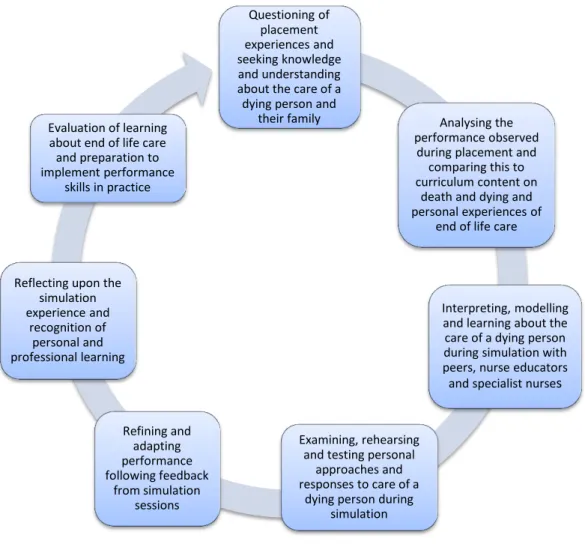
Maintaining the theme of nursing performance, as discussed in the previous section, there are many options for the development of expansive learning cycles which may help students to move from theorization of issues in nursing to more concrete learning actions. An expansive learning cycle which focuses upon performance, may include some of the following learning actions as student nurses engage in simulation learning to explore end of life care:
Figure 6: An expansive learning cycle for end of life care
The expansive learning cycle illustrated above (Figure 6) offers an heuristic device through which simulation learning in relation to end of life care can be conceptualised with particular reference to nursing performance. The opportunity for students to begin to develop a nursing performance and to start to understand what is required for the development of therapeutic relationships with service users (Rogers, 1957) is important. The ability to confront difficult human situations, to experience personal responses to illness and death, and to begin to practise, rehearse and refine these specific skills of nursing through simulation offers potentially valuable learning opportunities. The use of the simulation environment to learn to question, criticize and transform nursing practice, illustrated in Figure 6, links well with the central tenets of an expansive approach to learning (Engeström and Sannino, 2010). It is with the learning environment in mind that I move to consider Fuller and Unwin’s (2004) work, and their characterisations of expansive and restrictive learning environments.
Questioning of placement experiences and seeking knowledge and understanding about the care of a dying person and
their family Analysing the
performance observed during placement and
comparing this to curriculum content on
death and dying and personal experiences of
end of life care
Interpreting, modelling and learning about the care of a dying person during simulation with peers, nurse educators and specialist nurses
Examining, rehearsing and testing personal
approaches and responses to care of a
dying person during simulation Refining and adapting performance following feedback from simulation sessions Reflecting upon the
simulation experience and recognition of personal and professional learning Evaluation of learning about end of life care
and preparation to implement performance
Expansive and restrictive learning environments
In order to help make sense of the lived reality of learning (and apprenticeship) Alison Fuller & Lorna Unwin (2004) identified two characterisations, using the terms expansive and restrictive to provide a helpful way of analysing learning environments. They characterised expansive and restrictive forms of apprentice experience which they observed in their work with young people undertaking vocational education and training. They argue that an apprenticeship characterised by features of expansive learning will create a stronger and richer learning environment than that comprising features associated with the restrictive end of the continuum.
Fuller and Unwin’s (2004) use of the term expansive builds upon the work of Engeström
(1994) who writes:
We speak of expansive learning, or third order learning, when a community of practice begins to analyse and transform itself. Such expansive learning is not any more limited to pre-defined contents and tasks. Rather it is a long-term process of re-defining the objects, tools and social structures of the workplace.
(Engeström, 1994, p. 43)
Fuller and Unwin’s (2004) work offers exciting possibilities for conceptualizing and framing
learning through simulation. As well as applying the term expansive to learning, Fuller and Unwin (2001) use it as an analytical tool to shed light on the interaction between institutional context, workplace learning, and individual development. They suggest that focusing upon the ways in which different companies constructed apprenticeship programmes provides a window on the wider culture of learning in organisations. Fuller and Unwin (2004) advocate that companies which offer an expansive approach to apprenticeship are more likely to create learning opportunities for all their employees which foster ‘deep learning’ (Marton et al,
1984), ‘investigative deep-level learning’ (Engeström, 1994), and ‘the work of the
imagination’ (Wenger, 1998).
The potential for simulation to foster deep learning is an interesting area for further research. The focus upon apprenticeship learning and learning cultures has many parallels with the workplace organisations in which student nurses are currently placed for their clinical
experience. For those students who may not be successful and who are struggling to become nurses, it could perhaps be said that restrictive characteristics act as barriers to their learning and development.
This resonates with Fuller and Unwin’s (2003) work on workplace learning and the potential
of the expansive-restrictive framework to illuminate dimensions of organisations, such as ‘learning culture’, relevant to the creation of learning environments (Cole, 1999; Daniels, 2004). Nursing has, for some time, highlighted the importance of the clinical environment for learning (Fretwell, 1982). The move to an expansive learning culture where the emphasis is upon participation, questioning, and reflection supports this view, yet may offer an approach which some students may find difficult. The previous health care experience and personal assumptions concerning abilities to carry out the fundamentals of nursing care held by some nursing students, may be challenged by new approaches introduced during simulation. Clearly, if the aim of simulation is to enable students to learn and begin to develop their identities as nurses in an environment that authentically mimics the clinical nursing environment, then learning must be adequately supported. Identification of potential barriers or restrictive aspects of the learning environment must be identified and addressed. The essential elements of the simulation environment must be realistic and provide a safe environment in which students can observe and practise different approaches to nursing care. An expansive approach to learning through simulation may also offer a setting where students can be supported to explore and examine the role of the student nurse and the responsibilities incumbent upon them in that role to deliver safe, evidence-based nursing care.
Summary
This paper has explored four pedagogies for learning (Benner and Sutphen, 2007) as a means of conceptualizing and establishing an expansive understanding of the learning that may occur during simulation. Simulation may have the potential to offer an environment in which the students can begin to practise the performance of nursing and bear witness to human
events (performance) and acquire the skills of ‘practical reasoning’. It may also offer the
opportunity to consider the context of care (contextualisation), interpret nursing information (interpretation) and learn to develop identities as nurses (formation). These features support the contribution of this pedagogical model towards elucidation of an effective and expansive approach to learning through simulation in nurse education. They also help to illustrate the different activity systems to which student nurses are exposed, and the expansive learning
process that may occur between these systems, and be experienced by students as they learn to be nurses.
References
Alinier, G., Hunt, B., Gordon, R. and Harwood, C. (2006) Effectiveness of intermediate fidelity simulation training technology in undergraduate nursing education. Journal of Advanced Nursing. 54, 3, 359-369.
Benner, P. (1984) From Novice to Expert: Excellence and power in clinical nursing practice Menlo Park, California: Addison-Wesley Publishing Company.
Benner, P. and Sutphen, M. (2007) Learning across the professions: the clergy a case in point.
Journal of Nursing Education. 46, 3, 103-108.
Benner, P., Sutphen, M., Leonard, V. and Day, L. (2010) Educating Nurses: A Call for radical Transformation. San Francisco, California: Jossey-Bass.
Benner, P., Tanner, C. and Chesla, C. (1996) Expertise in nursing practice: caring, clinical judgment and ethics New York: Springer.
Berragan, L. (1998) Nursing practice draws upon several different ways of knowing. Journal
of Clinical Nursing. 7, 3, 209-217.
Berragan, L. (2011) Simulation: An effective pedagogical approach for nursing? Nurse
Education Today. 31, 7, 660-663.
Cant, R.P and Cooper, S.J. (2010) Simulation based learning in nurse education: systematic review. Journal of Advanced Nursing. 66, 1, 3-15.
Cole. M. (1999). Cultural psychology: some general principles and a concrete example. In Y. Engeström, R. Miettinen, & R.L. Punamaki (Editors.). Perspectives on activity theory (pp. 87-106). Cambridge: Cambridge University Press.
Daniels, H. (2004) Activity theory, discourse and Bernstein. Educational Review. 56, 2, 121-132.
Engeström, Y. (1994) Training for change: new approach to instruction and learning in
Engeström, Y. (2001) Expansive Learning at Work: Toward an activity theoretical reconceptualization. Journal of Education and Work. 14, 1, 133-156.
Engeström,Y. and Sannino, A. (2010) Studies of expansive learning: Foundations, findings and future challenges. Educational Research Review. 5, 1, 1-24.
Fretwell, J.E. (1982) Ward Teaching and Learning: Sister and the Learning Environment. London: Royal College of Nursing.
Fuller, A. and Unwin, L. (2003) Fostering Workplace Learning: looking through the lens of apprenticeship. European Educational Research Journal. 2, 1, 41-55.
Fuller, A. and Unwin, L. (2004) Expansive Learning environments: integrating personal and organizational development. In: Evans, K., Hodkinson, P., Rainbird, H. and Unwin, L. (Editors) Improving Workplace Learning. London: Routledge.
Gordon, S. (2005) Nursing against the odds. Cornell University Press: New York.
Haigh, J. (2007) Expansive learning in the university setting: the case for simulated clinical experience. Nurse Education in Practice. 7, 2, 95–102.
Jeffries, P.R. (2005) A Framework for designing, implementing and evaluating simulations used as teaching strategies in nursing. Nursing Education Perspectives. 26, 2, 96-103.
Lasater, K. (2007) Clinical judgment development: Using simulation to create an assessment rubric. Journal of Nursing Education. 46, 11, 496-503.
Lasater, K. (2012) Controversies in simulation. Personal communication. Fringe Event NETNEP 2012 Nurse Educators Conference, Baltimore Maryland.
Leigh, G. T. (2008). High-fidelity patient simulation and nursing students’ self- efficacy: A review of the literature. International Journal of Nursing Education Scholarship. 5, 1, Article 37.
Levett-Jones, T. (2012) Controversies in simulation. Personal communication. Fringe Event NETNEP 2012 Nurse Educators Conference, Baltimore Maryland.
Marton, F., Hounsell, D. and Entwistle, N. (Editors) (1984) The Experience of Learning, Edinburgh: Scottish Academic Press.
Meerabeau, L. (1992) Tacit nursing knowledge: an untapped resource or methodological headache? Journal of Advanced Nursing. 17, 1, 108-112.
Moch, S.D. (1990) Personal knowing: evolving research and practice. Scholarly Inquiry for Nursing Practice. 4, 2, 155-165.
Morgan, R. (2006) Using clinical skills laboratories to promote theory–practice integration during first practice placement: an Irish perspective. Journal of Clinical Nursing. 15, 2, 155– 161.
Polyani, M. (1958) Personal knowledge: Towards a post-critical philosophy. Chicago: Chicago University Press.
Rhodes, M. & Curran, C. (2005) Use of the human patient simulator to teach clinical judgment skills in a baccalaureate nursing program. CIN: Computers, Informatics, Nursing. 23, 5, 256-264.
Rogers, C. (1957) The necessary and sufficient conditions of therapeutic personality change. Journal of Consulting Psychology. 21, 95-104.
Scholes, J., (2008) Coping with professional identity crisis: Is building resilience the answer?
International Journal of Nursing Studies. 45, 7, 975-978.
Schön, D. (1995) The Reflective Practitioner: How Professionals Think in Action (reprint) USA: Basic Books.
Walsh, M. and Ford, P. (1989) Nursing rituals, research and rational actions. Oxford: Heinemann Nursing.
Wenger, E. (1998) Communities of Practice: learning, meaning and identity. New York: Cambridge University Press.
Zeitz, K. and McCutcheon, H. (2005). Tradition, rituals and standards, in a realm of evidenced based nursing care. Contemporary Nurse18, 3, 300-308.