Modified profile likelihood for
fixed-effects panel data models
F. Bartolucci
∗, R. Bellio
†, A. Salvan
‡and N. Sartori
‡September 6, 2013
Abstract
We show how modified profile likelihood methods, developed in the statistical literature, may be effectively applied to estimate the structural parameters of econo-metric models for panel data, with a remarkable reduction of bias with respect to ordinary likelihood methods. Initially, the implementation of these methods is illus-trated for general models for panel data including individual-specific fixed effects and then, in more detail, for the truncated linear regression model and dynamic regres-sion models for binary data formulated along with different specifications. Simulation studies show the good behavior of the inference based on the modified profile likeli-hood, even when compared to an ideal, although infeasible, procedure (in which the fixed effects are known) and also to alternative estimators existing in the econometric literature. The proposed estimation methods are implemented in an Rpackage that we make available to the reader.
Keywords: autoregressive models; bias reduction; dynamic logit model; dynamic probit model; incidental parameter problem; truncated regression.
∗Dipartimento di Economia, Finanza e Statistica, Universit`a di Perugia, Via A. Pascoli, 20 06123
Perugia, Italy,[email protected]
†Dipartimento di Scienze Economiche e Statistiche, Universit`a di Udine, via Tomadini, 30, I-33100
Udine, Italy,[email protected]
‡Dipartimento di Scienze Statistiche, Universit`a di Padova, via C. Battisti, 241, I-35121 Padova, Italy,
1
Introduction
Panel data models usually include individual-specific fixed-effects parameters accounting for unobserved heterogeneity. Several solutions have been proposed to cope with the en-suing incidental parameters problem (Neyman and Scott, 1948). See Arellano and Hahn (2007) for a comprehensive review.
In estimating the structural parameters, which typically correspond to the parameters of interest, fixed effects may be removed when a marginal or conditional likelihood is available for these parameters (see e.g., Severini, 2000, Ch. 8). A well-known example is the conditional likelihood for the static logit model. However, the existence of these likelihoods depends on the assumptions of the model and is not guaranteed in general. For instance, a conditional likelihood is not available for the dynamic logit model, which includes the lagged response variable among the regressors, or for general probit models.
Several alternative solutions to the ones mentioned above have been developed in the literature; some of them are model-specific (e.g., Honor´e and Kyriazidou, 2000, Bartolucci and Nigro, 2012) and some are of wider applicability. Here we focus on this second class of solutions. In their interesting review, Arellano and Hahn (2007) classify these general methods among: (i) those based on a bias correction of the maximum likelihood estimator, (ii) those based on a correction of the estimating equation, and (iii) those based on a cor-rection of the target function, which typically is the profile (or concentrated) log likelihood function for the parameters of interest. Among the more recent contributions, we consider Fern´andez-Val (2009) and Fern´andez-Val and Vella (2011) for the first approach, Carro (2007) for the second, and Pace and Salvan (2006) and Bester and Hansen (2009) for the third. A common effect of the above corrections is that they lead to a reduction of the bias of the estimator of the parameters of interest from O(T−1) to O(T−2), where T is the number of time occasions.
Among the most effective solutions proposed in the statistical literature, there is the modified profile likelihood, which falls in class (iii) above and originates from the work of Barndorff-Nielsen (1980, 1983); see Severini (2000, Ch. 9) for an updated account. The properties of the modified profile likelihood and its approximations have been studied in
detail by Sartori (2003) in a two-index asymptotic setting (in N, the sample size, and in
T), which is a natural framework for panel data models. In particular, under fairly general conditions, a sufficient condition for the usual χ2-asymptotic distribution of Wald, score,
and likelihood ratio statistics is thatN =o(T3), whereas it is thatN =o(T) for the profile
likelihood.
Aim of the present paper is to show how a convenient version of the modified pro-file likelihood (Severini, 1998) may be effectively applied to estimate fixed-effects versions of some important econometric models for panel data. In particular, we illustrate its use in truncated linear regression and in dynamic logit and probit models, and we pro-vide an assessment of its properties through a series of simulations. An R code for the methods used in this paper is included in the package panelMPL, which is available at http://www.dies.uniud.it/index.php/software-bellio.html.
The paper is organized as follows. In the next section we describe the modified profile likelihood, which is then applied to some relevant cases in Section 3. Some final remarks are given in Section 4.
2
Modified profile likelihood
2.1
Background and notation
With reference to a sample ofN units observed atT occasions, letyit denote the response
variable and let xit denote the column vector of covariates observed for sample unit i at
occasion t, with i = 1, . . . , N and t = 1, . . . , T. The covariates are considered strictly exogenous, with a possible exception being that of the lag of the endogenous variable in-cluded among the covariates. Let alsof(yit|xit;θ, αi) denote the probability mass or density
function of yit given xit. It is assumed that, given xit, yit is conditionally independent of
yi1, . . . , yi,t−1, or it is independent of yi1, . . . , yi,t−h for a suitable h for dynamic models in
whichyi,t−h+1, . . . , yi,t−1 are included inxit. The vector of structural parameters is denoted
Likelihood inference about θ is based on the profile, or concentrated, log likelihood `P(θ) = X i `i(θ,αˆi(θ)), where `i(θ, αi) = P
tlogf(yit|xit;θ, αi) is the log likelihood contribution for sample unit i,
i = 1, . . . , N, and ˆαi(θ) is the constrained maximum likelihood estimate of αi for fixed θ,
that is,
ˆ
αi(θ) = arg max αi
`i(θ, αi),
which is typically the solution of`αi(θ, αi) =∂`(θ, αi)/∂αi =∂`i(θ, αi)/∂αi = 0.
Through-out the paper we use the convention that when the range of the sum is not explicitly indicated it is equal to 1, . . . , N (for the sums ini) or it is equal to 1, . . . , T (for the sums in t). Note that maximizing the profile log likelihood `P(θ) leads to the same solution as
maximizing the overall log likelihood, that is,
`(θ, α) =X
i
`i(θ, αi),
with respect to θ and α, where α is the vector of all individual-effects, with elements
α1, . . . , αN.
Typically, maximization of `P(θ) is performed numerically, obtaining in this way the
maximum likelihood estimator ˆθ; see, for instance, Greene (2004). Moreover, standard output of optimization routines provides the Hessian of`P(θ) at ˆθ, which produces
asymp-totically correct estimates of the standard errors.
2.2
Severini (1998)’s modified profile likelihood
The maximum likelihood estimator ˆθ is in general asymptotically biased, with bias of order O(T−1). A substantial reduction of this bias may be obtained by the estimator
which maximizes the modified profile log likelihood, which has the general form
where, because of the independence of the sample units, the adjustment functionM(θ) has the additive form
M(θ) = X
i
Mi(θ). (2)
Each term Mi(θ) is of order Op(1) under repeated sampling, so that the total adjustment
to the profile log likelihood is of orderOp(N) when bothT and N tend to infinity. We will
denote by ˆθM the estimator based on the maximization of `M(θ).
The first version of (1) that has been developed is the modified profile log likelihood of Barndorff-Nielsen (1980, 1983), introduced with the aim of obtaining an accurate approxi-mation of a marginal or a conditional log likelihood, when either exists. The computation of this version of the modified profile likelihood requires the specification of an exact, or approximate, ancillary statistic; see Severini (2000, Ch. 6). This is usually straightforward in full exponential or composite group families. See Brazzale et al. (2007) for an overview. The drawback of the original formulation of the modified profile likelihood is that it may be difficult to compute in most models which do not belong to full exponential or composite group families. However, several approximations are available which maintain the same asymptotic properties; for a review, see Severini (2000, Sec. 9.3). These approximations are to a large extent equivalent in terms of accuracy.
When θ and α are orthogonal, that is, when the corresponding block of the expected information matrix has all elements equal to 0, the generic term of the modification (2) can be taken equal to
Mi(θ) = −
1
2log | −`αiαi(θ,αˆi(θ))|.
This modification gives the approximate conditional likelihood of Cox and Reid (1987); see Lancaster (2002) for applications to panel data models. Although leading to a strong simplification, an orthogonal parameterization may be difficult to find or even it could not exist when θ is multidimensional. Moreover, the Cox and Reid approximate conditional likelihood is not invariant under interest-preserving reparameterizations, that is, under one-to-one functions from (θ, α) to (φ(θ), ψ(θ, α)).
Different approximations of the modified profile log likelihood are available which over-come these difficulties and avoid the specification of an ancillary statistic (see Severini,
2000, Sec. 6.7, for a review). Here, in particular, we focus on the version proposed by Severini (1998), which relies on modification (2) with
Mi(θ) =
1
2log | −`αiαi(θ,αˆi(θ))| −log |Iαiαi(ˆθ,αˆi;θ,αˆi(θ))|, (3)
where
Iαiαi(θ0, αi0;θ1, αi1) =Eθ0,αi0(`αi(θ0, αi0)`αi(θ1, αi1)). (4)
Example 1 First order autoregressive model. Consider the model
yit−µi = (yi,t−1−µi)ρ+εitσ, i= 1, . . . , N, t= 2, . . . , T, (5)
with the error termsεitindependent and normally distributed with mean zero and variance
σ2, and with ρ ∈ (−1,1) and µ
i ∈ IR, i = 1, . . . , N. Note that, when ρ = 0, this model
simplifies to the classic example of Neyman and Scott (1948). As for the initial condition, we assume that yi1 ∼N µi, σ2 1−ρ2 .
Equation (5) can also be written in the form
yit =δi+yi,t−1ρ+εitσ, (6)
where δi = µi(1 −ρ) is an individual-specific intercept. Specifications (5) and (6) are
equivalent for the inference problems considered here. In particular, we considerθ = (ρ, σ2) as the structural parameter, whereas the vector of individual-specific effects α =µ, with
µ= (µ1, . . . , µN), will be treated as a nuisance parameter.
Profile likelihood and modifications are better expressed using matrix notation. There-fore, we let yi = (yi1, . . . , yiT)>, with yi ∼ NT(αi1T,Ω), where 1T is a vector of ones of
t, u= 1, . . . , T. The inverse of Ω is Ω−1 =σ−2 1 −ρ 0 · · · 0 0 −ρ 1 +ρ2 −ρ · · · 0 0 0 −ρ 1 +ρ2 · · · 0 0 .. . ... ... . .. ... ... 0 0 0 · · · 1 +ρ2 −ρ 0 0 0 · · · −ρ 1 . Then, we have `i(θ, αi) =− 1 2log|Ω| − 1 2(yi−αi1T) > Ω−1(yi−αi1T), where |Ω|= (σ2)T/(1−ρ2), and `αi(θ, αi) = (yi−αi1T) > Ω−11T , so that ˆ αi(θ) = yi>Ω−11 T 1>TΩ−11 T .
The contribution of the ith unit to `P(θ) is given by
`i(θ,αˆi(θ)) =− 1 2log|Ω| − 1 2y > i Ψyi, with Ψ = Ω−1IT −1T(1>TΩ −1 1T)−11>TΩ −1 ,
and IT being the identity matrix of order T.
It is straightforward to verify that
−`αiαi(θ,αˆi(θ)) =Iαiαi(ˆθ,αˆi;θ,αˆi(θ)) = 1
>
TΩ
−1
giving `M(θ) =`P(θ)− N 2 log|1 > TΩ −11 T|.
Note that α and θ orthogonal and in this case `M(θ) coincides with the approximate
conditional log likelihood of Cox and Reid (1987).
A marginal likelihood forθ is available for this model, see Cruddas, Reid and Cox (1989) and the references therein. Its ith contribution is proportional to the marginal density of
di =yi−1Ty¯i, with ¯yi =T−11>Tyi, and its expression is most easily obtained as
Lmarg(θ;di) =
Z +∞
−∞
Li(θ, αi)dαi;
see, for instance, Barndorff-Nielsen and Cox (1994), Sec. 2.8. It is easily checked that, for this model,P
ilogLmarg(θ;di) is equivalent to`M(θ), so that the latter provides a consistent
estimator as N diverges, even with fixedT. On the contrary, the profile likelihood has the usual problems, especially related to the bias and the ensuing poor coverage of confidence intervals, as proved by simulation results that are not reported here; these results also confirm the extremely accurate behavior of `M(θ).
Covariates may be added to the model by considering yi ∼NT(µi1T +Xiβ,Ω), withXi
being a covariate matrix withT rows, still giving that`M(θ) is equivalent to a marginal
like-lihood, where nowθalso includesβ. 2
2.3
Computational aspects
Typically, the estimate ˆθM which maximizes `M(θ) is obtained through numerical
opti-mization. Evaluation of standard errors is obtained by using the second derivative of
`M(θ) at the maximum, which is a standard output of most numerical algorithms. This is
what we implemented in the R package panelMPL. The estimate ˆθM and the
correspond-ing estimated standard error can be used to compute Wald confidence intervals, based on asymptotic normality of the estimator. In general, intervals based on the likelihood ratio statistic constructed using `M(θ) would be preferable for various reasons, including
equivariance under reparameterizations. However, given that the information is of order
a quadratic function in a neighborhood of the maximum and, therefore, Wald confidence intervals are almost indistinguishable from those based on the likelihood ratio statistic.
Regarding the computation of Severini (1998)’s version of `M(θ), analytical calculation
of (4) is fairly simple in a number of important models as those in Example 1 and Section 3.1; see also Bellio and Sartori (2006). Exact computation by enumeration is feasible in discrete models for moderate T, while Monte Carlo calculation offers a general solution (Pierce and Bellio, 2006); both alternatives are used in the following Section 3.2.
If observations within units are independent, as in static models, an asymptotically equivalent version of (3) is obtained by replacing Iαiαi(ˆθ,αˆi;θ,αˆi(θ)) by its empirical
ana-logue ˆ Iαiαi(ˆθ,αˆi;θ,αˆi(θ)) = X t ∂logf(yit|xit; ˆθ,αˆi) ∂αi ∂logf(yit|xit;θ,αˆi(θ)) ∂αi ;
see Severini (1999; 2000, Sec. 9.5.5). A similar empirical approximation is considered by Di Ciccio and Stern (1993) and DiCiccio et al. (1996); see also Arellano and Hahn (2007) that, apart a constant term, found the following expression
Mi(θ) = 1 2log| −`αiαi(θ,αˆi(θ))| − 1 2log X t ∂logf(yit|xit;θ,αˆi(θ)) ∂αi 2 .
However, adjustments involving model based quantities are typically superior to their em-pirical counterparts, in particular when the unit sample size is small (see, for instance, Severini, 1999, and Bester and Hansen, 2009).
3
Examples
We illustrate the application of the methods outlined in Section 2 to some models of inter-est. In particular, we consider the truncated linear regression model and dynamic regression models for binary data. We also show the results of a set of simulations performed, under different scenarios, along the same lines as in Honor´e and Kyriazidou (2000) and Carro (2007) among others. Based on these simulation results, the performance of the estimators of the parameters of interest are measured in terms of bias (B), median bias (MB), root mean squared error (RMSE), and median absolute error (MAE). For these estimators, we
also report the standard deviation (SD) and the ratio SE/SD, where SE stands for the aver-age over simulations of likelihood based estimates of the standard error, and the empirical coverage of 0.95 confidence intervals constructed assuming the asymptotic normality of the corresponding estimator. Moreover, in order to measure the actual improvement of the modified profile likelihood estimator (MPL estimator for short) over the estimator based on the standard profile likelihood (ML estimator), we compute for each simulation scenario the index
∆(B) = |B(ML)| − |B(MPL)|
|B(ML)| − |B(IL)| , (7) where B(IL) stands for the bias of the infeasible likelihood estimator (IL estimator), which uses the fixed effects as one of the explanatory variables and treats the corresponding regression coefficient as unknown; see Honor´e and Kyriazidou (2000). Indices analogous to (7) are also computed for MB, RMSE, and MAE and are denoted by ∆(MB), ∆(RMSE), and ∆(MAE), respectively. An additional comparison with other proposals in the literature is considered for the dynamic logit model in Section 3.2.
3.1
Truncated linear regression model
Letyit be distributed as yit∗ conditionally on y
∗
it>0, with
yit∗ =ηit+εit, i= 1, . . . , N, t = 1, . . . , T, (8)
where ηit =ηit(αi, β) is a linear predictor of the form
ηit=αi+x>itβ, i= 1, . . . , N, t = 1, . . . , T,
with parameters αi ∈IR, i= 1, . . . , N, β ∈IRp. The errors εit are assumed to be
indepen-dent and normally distributed with mean zero and variance σ2. Then,y
it has density f(yit|xit;β, σ, αi) = 1 σ φ yit−ηit σ Φ ηit σ ,
where φ(·) is the density function of the standard normal distribution and Φ(·) is the corresponding cumulative distribution function. We considerθ = (β>, σ) as the parameter of interest, whereas α = (α1, . . . , αN) is treated as a vector of nuisance parameters.
The full log likelihood for model (8) is
`(θ, α) =−N T logσ− 1 2σ2 X i X t (yit−ηit)2− X i X t log Φηit σ ;
the profile log likelihood for θ has the same expression with every αi substituted by ˆαi(θ),
which is the solution with respect to αi of the equation
1 σ X t (yit−ηit) = X t φ ηit σ . Φ ηit σ .
Simulation results in Greene (2004, Sec. 3.2), with N = 1000 and T ranging from 2 to 20, show that ˆθ has a non-negligible negative bias. In particular, negative biases are accompanied by extremely poor coverage of the confidence intervals. These results are confirmed by our simulation study described below.
We compute the modified profile log likelihood given by (1) and (2) using expression (3) for Mi(θ). The quantities needed for the adjustment term Mi(θ) are
`αiαi(θ,αˆi(θ)) = − 1 σ2 " T −X t φ(˜ηit/σ) Φ(˜ηit/σ) 2 − 1 σ X t φ(˜ηit/σ) Φ(˜ηit/σ) ˜ ηit # , Iαiαi(ˆθ,αˆi;θ,αˆi(θ)) = 1 σ2 " T −X t φ(ˆηit/σˆ) Φ(ˆηit/σˆ) 2 − 1 ˆ σ X t φ(ˆηit/σˆ) Φ(ˆηit/σˆ) ˆ ηit # ,
where ˜ηit =ηit( ˆαi(θ), β) and ˆηit =ηit( ˆαi,βˆ). Thus, discarding additive terms that do not
depend on θ, we have `M(θ) = `P(θ) +Nlogσ+ 1 2 X i log " T −X t φ(˜ηit/σ) Φ(˜ηit/σ) 2 − 1 σ X t φ(˜ηit/σ) Φ(˜ηit/σ) ˜ ηit # .
In order to assess the accuracy of the inference based on `M(θ) in short panels with
many sample units, we implement a simulation experiment based on 5000 random samples withN = 250,500,1000 andT = 4,8. Under this model,β =σ= 1, whereas, for each pair
(T, N), covariates xit are generated from a standard normal distribution and the values of
the incidental parameters αi are chosen as follows:
αi = √ Tx¯i+ui, i= 1, . . . , N, where ¯xi =T−1 P txit and ui ∼N(0,1).
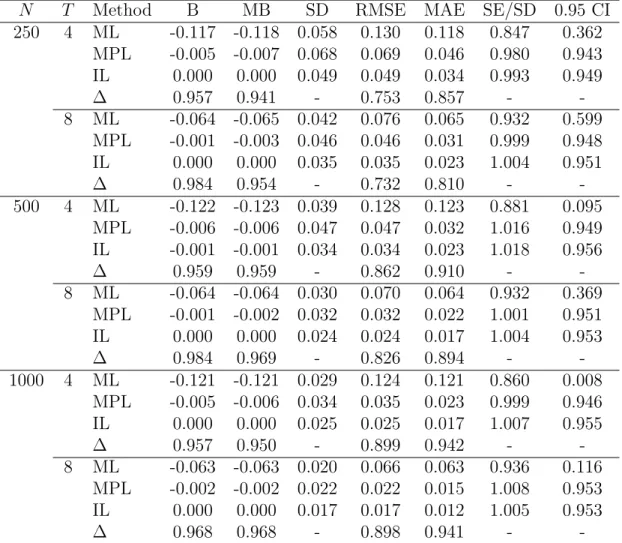
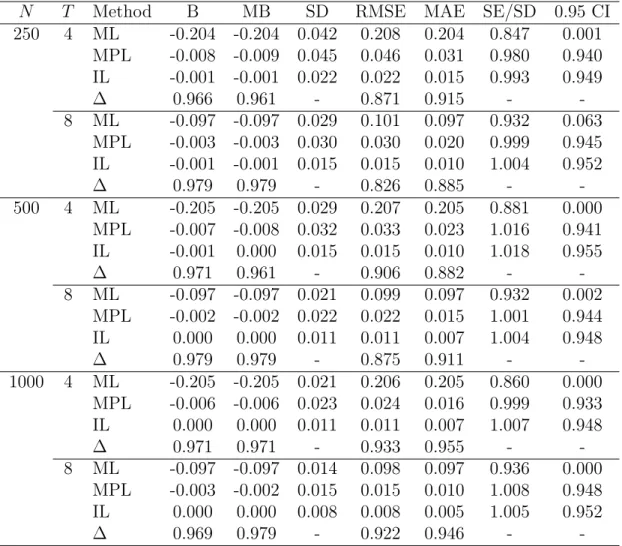
Tables 1 and 2 report the results for β and ω = logσ, respectively. The latter parame-terization was chosen for numerical convenience.
[Table 1 about here.]
[Table 2 about here.]
Bias and median bias are approximately equal in all cases and MPL gives a substantial improvement over ML. As expected, the bias decreases asT increases, whereas it does not depend on N. On the other hand, the root mean square error depends both onT and on
N. Again, this was expected, since the variance of the estimator is of order O(1/(N T)). Notice that all the ∆ indices are larger than 0.73, and often larger than 0.90. For instance, with N = 1000 and T = 8 we get ∆(RMSE) = 0.898, implying that MPL produces about 90% of the RMSE reduction from ML to the infeasible estimator. Coverage properties of MPL confidence intervals are excellent. The improvement over ML is remarkable and this is largely due to bias reduction. There is also a curvature correction, being SE/SD for MPL much closer to one than for ML. Unreported simulation results confirm that confidence intervals based on the likelihood ratio statistics are indistinguishable from Wald confidence intervals, as commented in Section 2.3.
3.2
Dynamic regression models for binary data
Let yit be observations from Bernoulli variables with success probabilities G(ηit), where
G(·) is a given continuous cumulative distribution function on IR with densityg(·) andηit
is a linear predictor including a dynamic effect, that is,
with parametersαi ∈IR,i= 1, . . . , N,β ∈IRp, and ρ∈IR. Typical choices ofG(·) are the
logistic distribution and the normal distribution, leading to the logistic regression model and the probit regression model, respectively. We assume that the initial observation yi1
is a fixed non-stochastic constant for unit i, as in Carro (2007) and Fern´andez-Val (2009), among others.
Honor´e and Kyriazidou (2000) proposed an estimator that forT = 4 is based on a par-ticular weighted likelihood, whereas forT >4 it is based on a pairwise weighted likelihood. In either case, their solution provides a consistent estimator but it has some limitations, such as the impossibility of estimating the effects of time dummies or other categorical covariates. See Bartolucci and Nigro (2010, 2012) for more specific comments and alter-native approaches based on the conditional likelihood. Hahn and Kuersteiner (2011) and Fern´andez-Val (2009) provided formulas for removing the O(T−1) leading term of the bias
of the maximum likelihood estimator. Carro (2007) removed the leading term of the bias of the profile score for θ = (β>, ρ). The dynamic logit model is also one of the examples considered by Bester and Hansen (2009) for their approach based on penalization.
Under assumption (9), the profile log likelihood for θ = (β>, ρ) is
`P(θ) = X i X t>1 [yitlogG(˜ηit) + (1−yit) log (1−G(˜ηit))],
where ˜ηit = ˆαi(θ) +xit>β+yit−1ρis the constrained maximum likelihood estimate of ηit for
the ith unit.
The computation of the adjustment terms Mi(θ) given by (3) requires
−`αiαi(θ,αˆi(θ)) = X t>1 g(˜ηit)2 G(˜ηit) (1−G(˜ηit)) −C(˜ηit) , with C(˜ηit) = (yit−G(˜ηit)) g0(˜ηit) G(˜ηit) (1−G(˜ηit)) − g(˜ηit) 2(1−2G(˜η it)) G(˜ηit)2(1−G(˜ηit)) 2
and Iαiαi(ˆθ,αˆi;θ,αˆi(θ)), which does not have a closed-form expression and cannot be
based on the fact that the sample space Y of all the possible vectors (yi2, . . . , yiT) has
cardinality 2T−1. Therefore, for moderate values of T it is possible to explore all Y for
computing Iαiαi(ˆθ,αˆi;θ,αˆi(θ)). In other words, letting s= (s2, . . . , sT)∈ Y, we compute
p(s; ˆθ,αˆi) = p(s2, . . . , sT; ˆθ,αˆi) = Y t>1 G(ˆηit)st(1−G(ˆηit))1−st, Iαiαi(ˆθ,αˆi;θ,αˆi(θ)) = X s∈Y " X t>1 g(ˆηit)(st−G(ˆηit)) G(ˆηit)(1−G(ˆηit)) # " X t>1 g(˜ηit)(st−G(˜ηit)) G(˜ηit)(1−G(˜ηit)) # p(s; ˆθ,αˆi).
Fort >2, the estimated linear predictors are ˆηit = ˆαi+x>itβˆ+ ˆρst−1 and ˜ηit = ˆαi(θ) +x>itβ+
ρst−1, while fort= 2 they are ˆηi2 = ˆαi+x>i2βˆ+ ˆρyi1and ˜ηi2 = ˆαi(θ)+x>i2β+ρyi1. With larger
values of T, say T > 10, full exploration of Y may become computationally costly. An alternative strategy relies on a Monte Carlo approximation, that is, Iαiαi(ˆθ,αˆi;θ,αˆi(θ))
. = Iα∗ iαi(ˆθ,αˆi;θ,αˆi(θ)), with Iα∗ iαi(ˆθ,αˆi;θ,αˆi(θ)) = 1 R R X r=1 " X t>1 g(ˆηit∗)(yr,it∗ −G(ˆηit∗)) G(ˆηit∗)(1−G(ˆηit∗)) # " X t>1 g(˜ηit∗)(yr,it∗ −G(˜ηit∗)) G(˜ηit∗)(1−G(˜ηit∗)) # ,
where y∗r,i = (yr,i2, . . . , yr,iT), r = 1, . . . , R, is generated from the model with θ = ˆθ and
αi = ˆαi. The linear predictors ˆη∗itand ˜ηit∗ involve the simulated data as lagged variables, but
are otherwise computed using the parameter estimates (ˆθ>,αˆi) and ˆαi(θ), respectively. The
computation ofIα∗iαi(ˆθ,αˆi;θ,αˆi(θ)) only requires the score function`αi(θ, αi) and simulation
from the model, without any additional fitting; therefore, it is easily applicable in wide generality. This solution, used for the results in Tables 7 and 8, has also the advantage of having a moderate computational cost, which is only slightly affected by the value ofT. In our experience, values ofR even lower than 1000 may be sufficient for reasonable accuracy in most cases, though in specific applications this fact may require some trial and error with more than one value ofR. We note that computation of `M(θ) using Iα∗iαi(ˆθ,αˆi;θ,αˆi(θ)) is
only partially akin to simulated maximum likelihood, as Monte Carlo computation is used for computing part of the adjustment term, rather than the entire likelihood function. Nonetheless, it is advisable to generate observations employing the same set of random
draws during the maximization of `M(θ), as customary in simulated maximum likelihood
(i.e., Hajivassiliou, 2000).
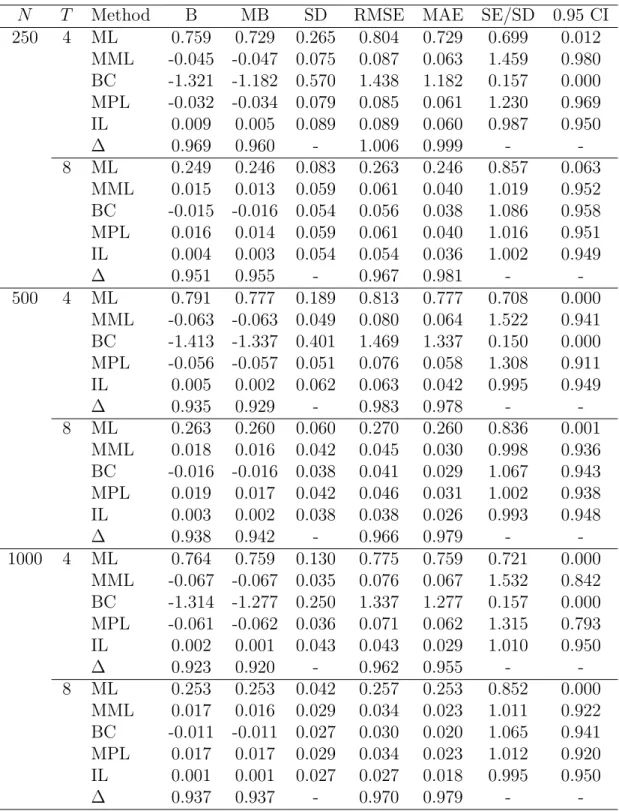
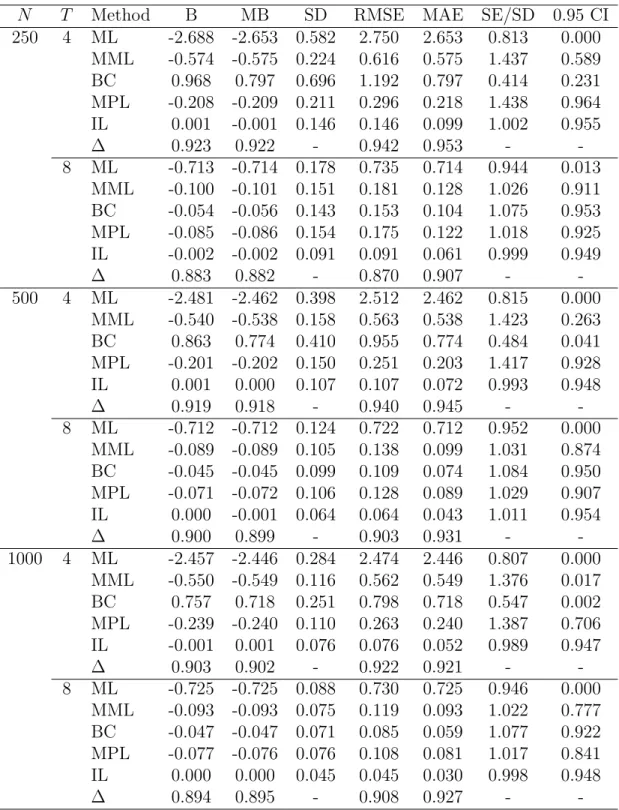
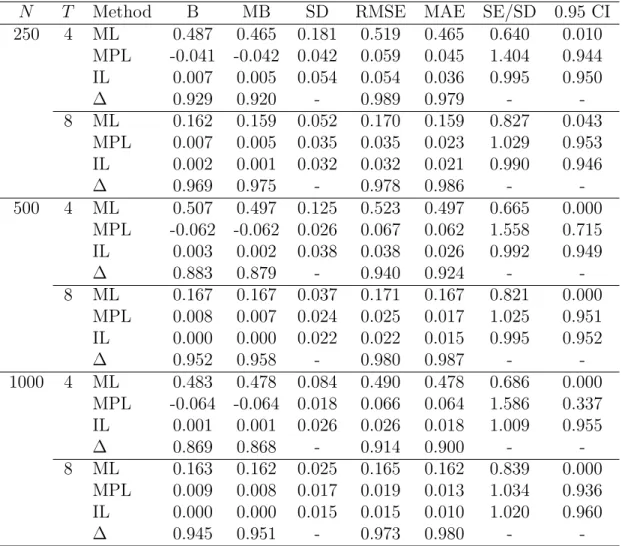
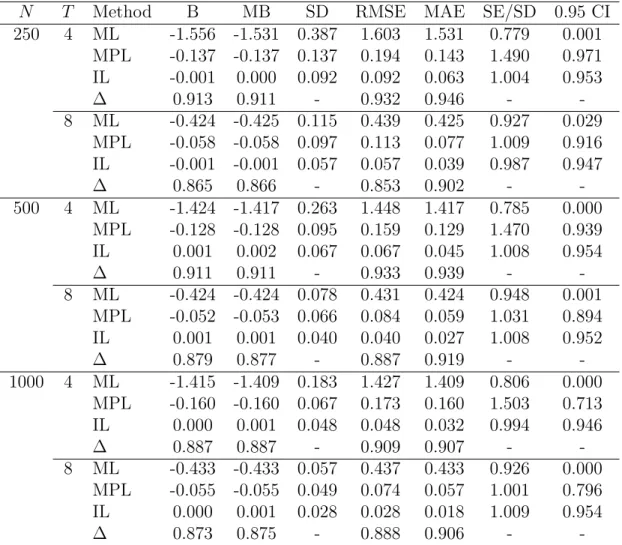
Tables 3–6 summarize results for the logit and probit models in simulations wherexit ∼
N(0, π2/3) and α
i = T−1
PT
i=1xit, with the inclusion of the lagged response among the
covariates. The regression parameter in the probit model has been set equal to that of the logit parameter divided by 1.6, in order to make the two regression functions approximately equivalent. The initial conditions yi1 were generated using the linear predictor (9) with
ρ= 0. As noted by Carro (2007), and analogously to the static case, units with no variation in the response do not contribute to the profile or the modified profile likelihood, hence the actual sample size is reduced.
[Table 3 about here.]
[Table 4 about here.]
[Table 5 about here.]
[Table 6 about here.]
The relative behavior of the profile and modified profile likelihood inference is quite similar to that observed in the simulation study for the truncated regression model and most of the comments to Tables 1 and 2 apply here as well, with ∆ indices close to 0.90 or even higher. However, the finite sample properties of the maximum likelihood estimator are so poor that the adjustment provided by `M(θ) is at times only partially successful,
that is, theO(T−2) bias of ˆθ
M can be at times not negligible and the curvature correction is
less good than in the static case (ρ = 0), simulation results for which are not reported here. This fact can be observed in some of the entries of Tables 3–6, with notable undercoverage particularly for T = 4. At any rate, the results based on `M(θ) are in line with the
best proposals in the literature. For the logit case, which is the most analyzed by other authors, the setting of this paper is very similar to that in Honor´e and Kyriazidou (2000), Carro (2007), Bester and Hansen (2009), Fern´andez-Val (2009), and Hahn and Kuersteiner (2011). In particular, all these studies report the results for T = 8 and N = 250. Among the more general large T-consistent estimators, the solution proposed here is comparable
with the best performing ones, that are Carro (2007) (MML) and Fern´andez-Val (2009) (BC), which are also included in the simulation studies summarized in Tables 3 and 4. WithT = 4, MPL outperforms the other methods, with BC showing a very poor behavior. On the other hand, when T = 8, BC is quite good, even slightly better than MPL. Both are preferable to MML.
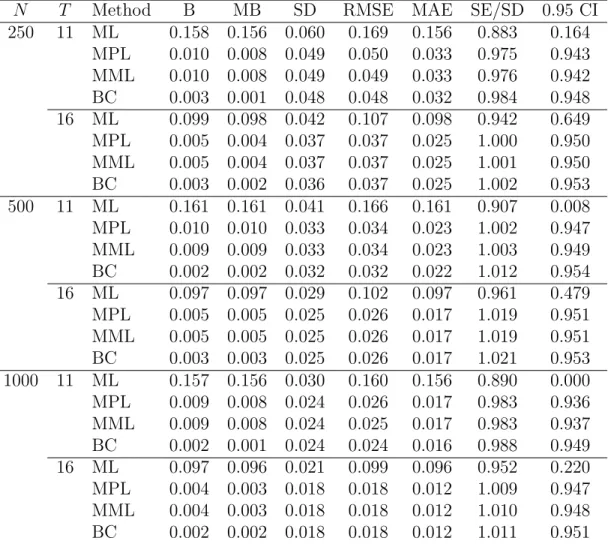
Finally, Tables 7 and 8 show a comparison forT = 11 andT = 16 of MPL with BC and MML. Here, computation of (4) needed for MPL has been performed using Monte Carlo withR = 500 replications. We note that all methods are quite accurate in all cases, giving very small biases and empirical coverages of confidence intervals close to the nominal level. As a check of the accuracy of the Monte Carlo version of MPL we also ran simulations in the case T = 8. Results are almost indistinguishable from those of the exact version reported in Tables 3 and 4, and therefore are not reported here.
[Table 7 about here.]
[Table 8 about here.]
4
Conclusions
We study the application of modified profile likelihood methods to econometric models for panel data. These methods have been mainly developed in the statistical literature, starting from the fundamental work of Barndorff-Nielsen (1980, 1983), and are specially tailored to deal with models with incidental parameters (Sartori, 2003); see also Severini (2000, Ch. 9). Thus, we establish a bridge between the statistical and the econometric literature regarding inference for incidental parameters models. Modified profile likelihood is not only general and interpretable, but also quite effective for inference about structural parameters. Our results also indicate that it is highly competitive with existing estimation methods developed in the econometric literature.
The implementation of the modified profile likelihood in general models can be quite straightforward, in particular if a Monte Carlo version is considered to compute certain
quantities required for the implementation. An R package panelMPL for the models used in the paper is available to the reader.
In this paper, we focus on estimation of structural parameters, while we have not explic-itly considered marginal or partial effects. These are typically function of all parameters in the model. One way to estimate these effects is to use ˆθM and ˆα1(ˆθM), . . . ,αˆN(ˆθM), where,
as before, ˆαi(θ) is the constrained maximum likelihood estimate of αi for fixed θ. This is
the same approach considered in Carro (2007), which proved to be quite satisfactory. Finally, we note that a possible extension to estimating equations could be obtained using the approach of Severini (2002), as done in the context of generalized estimating equations by Wang and Hanfelt (2008).
Acknowledgement
Francesco Bartolucci acknowledges the financial support from the “Einaudi Institute for Economics and Finance” EIEF (Rome - IT) and the Italian Government (FIRB - “Futuro in Ricerca”). Nicola Sartori was supported by the Cariparo Foundation Excellence grant 2011/2012. Ruggero Bellio, Alessandra Salvan and Nicola Sartori were supported by MIUR PRIN 2008. We thank the reviewers for their constructive comments.
References
Arellano, M., Hahn, J. (2007). Understanding bias in nonlinear panel models: some recent developments. In: R. Blundell, W. Newey, T. Persson (Eds)Advances in Economics and Econometrics, ninth world congress, Vol.3, Ch.12. Cambridge University Press, Cambridge.
Barndorff-Nielsen, O.E. (1980). Conditionality resolutions. Biometrika, 67, 293–310.
Barndorff-Nielsen, O.E. (1983). On a formula for the distribution of the maximum likeli-hood estimator. Biometrika,70, 343–365.
Barndorff-Nielsen, O.E., Cox, D.R. (1994). Inference and Asymptotics. Chapman and Hall, London.
Bartolucci, F., Nigro, V. (2010). A dynamic model for binary panel data with unobserved heterogeneity admitting a root-n consistent conditional estimator. Econometrica,78, 719–733.
Bartolucci, F., Nigro, V. (2012). Pseudo conditional maximum likelihood estimation of the dynamic logit model for binary panel data, Journal of Econometrics, 170, 102– 116.
Bellio, R., Sartori, N. (2006). Practical use of modified maximum likelihoods for stratified data. Biometrical Journal,48, 876–886.
Bester, C.A., Hansen, C. (2009). A penalty function approach to bias reduction in non-linear panel models with fixed effects. Journal of Business and Economic Statistics, 27, 131–148.
Brazzale, A.R., Davison, A.C., Reid, N. (2007). Applied Asymptotics. Cambridge Uni-versity Press, Cambridge.
Carro, J.M. (2007). Estimating dynamic panel data discrete choice models with fixed effects. Journal of Econometrics, 140, 503–528.
Cox, D.R., Reid, N. (1987). Parameter orthogonality and approximate conditional infer-ence (with discussion). Journal of the Royal Statistical Society B, 49, 1–39.
Cruddas, A.M., Reid, N., Cox, D.R. (1989). A time series illustration of approximate conditional likelihood. Biometrika, 76, 231–237.
DiCiccio, T.J., Martin, M.A., Stern, S.E., Young, G.A. (1996). Information bias and adjusted profile likelihoods. Journal of the Royal Statistical Society B, 58, 189–203.
DiCiccio, T.J., Stern, S.E. (1993). An adjustment to profile likelihood based on observed information. Technical Report, Department of Statistics, Stanford University.
Fern´andez-Val, I. (2009). Fixed effects estimation of structural parameters and marginal effects in panel probit models. Journal of Econometrics, 150, 71–85.
Fern´andez-Val, I., Vella, F. (2011). Bias correction for two-step fixed effects panel data estimators. Journal of Econometrics, 163, 144–162.
Greene, W. (2004). The behaviour of the maximum likelihood estimator of limited de-pendent variable models in the presence of fixed effects. The Econometrics Journal, 7, 98–119.
Hahn, J., Kuersteiner, G. (2011). Bias reduction for dynamic nonlinear panel models with fixed effects. Econometric Theory, 27, 1152–1191.
Hajivassiliou, V. (2000). Some practical issues in maximum simulated likelihood. In: Mariano, R., Schuermann, T., Weeks, M.J. (Eds.) Simulation-based Inference in Econometrics, p. 71–99. Cambridge University Press, Cambridge.
Honor´e, B.E., Kyriazidou, E. (2000). Panel data discrete choice models with lagged dependent variables. Econometrica, 68, 839–874.
Lancaster, T. (2002). Orthogonal parameters and panel data. Review of Economic Stud-ies,69, 647–666.
Neyman, J., Scott, E.L. (1948). Consistent estimates based on partially consistent obser-vations. Econometrica, 16, 1–32.
Pace, L., Salvan, A. (2006). A new motivation for adjustments of the profile likelihood.
Journal of Statistical Planning and Inference,136, 3554–3564.
Pierce, D.A., Bellio, R. (2006). Effects of the reference set on frequentist inferences.
Biometrika,93, 425–438.
Sartori, N. (2003). Modified profile likelihoods in models with stratum nuisance parame-ters. Biometrika,90, 533–549.
Severini, T. (1998). An approximation to the modified profile likelihood function. Biometrika, 85, 403–411.
Severini, T. (1999). An empirical adjustment to the likelihood ratio statistic. Biometrika, 86, 235–247.
Severini, T. (2000). Likelihood Methods in Statistics. Oxford University Press, Oxford.
Severini, T. (2002). Modified estimating functions. Biometrika, 89, 333–343.
Wang, M., Hanfelt, J. (2008). Robust modified profile estimating function with appli-cation to the generalized estimating equation. Journal of Statistical Planning and Inference,138, 2029–2044.
N T Method B MB SD RMSE MAE SE/SD 0.95 CI 250 4 ML -0.117 -0.118 0.058 0.130 0.118 0.847 0.362 MPL -0.005 -0.007 0.068 0.069 0.046 0.980 0.943 IL 0.000 0.000 0.049 0.049 0.034 0.993 0.949 ∆ 0.957 0.941 - 0.753 0.857 - -8 ML -0.064 -0.065 0.042 0.076 0.065 0.932 0.599 MPL -0.001 -0.003 0.046 0.046 0.031 0.999 0.948 IL 0.000 0.000 0.035 0.035 0.023 1.004 0.951 ∆ 0.984 0.954 - 0.732 0.810 - -500 4 ML -0.122 -0.123 0.039 0.128 0.123 0.881 0.095 MPL -0.006 -0.006 0.047 0.047 0.032 1.016 0.949 IL -0.001 -0.001 0.034 0.034 0.023 1.018 0.956 ∆ 0.959 0.959 - 0.862 0.910 - -8 ML -0.064 -0.064 0.030 0.070 0.064 0.932 0.369 MPL -0.001 -0.002 0.032 0.032 0.022 1.001 0.951 IL 0.000 0.000 0.024 0.024 0.017 1.004 0.953 ∆ 0.984 0.969 - 0.826 0.894 - -1000 4 ML -0.121 -0.121 0.029 0.124 0.121 0.860 0.008 MPL -0.005 -0.006 0.034 0.035 0.023 0.999 0.946 IL 0.000 0.000 0.025 0.025 0.017 1.007 0.955 ∆ 0.957 0.950 - 0.899 0.942 - -8 ML -0.063 -0.063 0.020 0.066 0.063 0.936 0.116 MPL -0.002 -0.002 0.022 0.022 0.015 1.008 0.953 IL 0.000 0.000 0.017 0.017 0.012 1.005 0.953 ∆ 0.968 0.968 - 0.898 0.941 -
-Table 1: Inference on β for the truncated regression model. Simulation results with 5,000 replications, β = 1.
N T Method B MB SD RMSE MAE SE/SD 0.95 CI 250 4 ML -0.204 -0.204 0.042 0.208 0.204 0.847 0.001 MPL -0.008 -0.009 0.045 0.046 0.031 0.980 0.940 IL -0.001 -0.001 0.022 0.022 0.015 0.993 0.949 ∆ 0.966 0.961 - 0.871 0.915 - -8 ML -0.097 -0.097 0.029 0.101 0.097 0.932 0.063 MPL -0.003 -0.003 0.030 0.030 0.020 0.999 0.945 IL -0.001 -0.001 0.015 0.015 0.010 1.004 0.952 ∆ 0.979 0.979 - 0.826 0.885 - -500 4 ML -0.205 -0.205 0.029 0.207 0.205 0.881 0.000 MPL -0.007 -0.008 0.032 0.033 0.023 1.016 0.941 IL -0.001 0.000 0.015 0.015 0.010 1.018 0.955 ∆ 0.971 0.961 - 0.906 0.882 - -8 ML -0.097 -0.097 0.021 0.099 0.097 0.932 0.002 MPL -0.002 -0.002 0.022 0.022 0.015 1.001 0.944 IL 0.000 0.000 0.011 0.011 0.007 1.004 0.948 ∆ 0.979 0.979 - 0.875 0.911 - -1000 4 ML -0.205 -0.205 0.021 0.206 0.205 0.860 0.000 MPL -0.006 -0.006 0.023 0.024 0.016 0.999 0.933 IL 0.000 0.000 0.011 0.011 0.007 1.007 0.948 ∆ 0.971 0.971 - 0.933 0.955 - -8 ML -0.097 -0.097 0.014 0.098 0.097 0.936 0.000 MPL -0.003 -0.002 0.015 0.015 0.010 1.008 0.948 IL 0.000 0.000 0.008 0.008 0.005 1.005 0.952 ∆ 0.969 0.979 - 0.922 0.946 -
-Table 2: Inference on ω = logσ for the truncated regression model. Simulation results with 5,000 replications,σ = 1.
N T Method B MB SD RMSE MAE SE/SD 0.95 CI 250 4 ML 0.759 0.729 0.265 0.804 0.729 0.699 0.012 MML -0.045 -0.047 0.075 0.087 0.063 1.459 0.980 BC -1.321 -1.182 0.570 1.438 1.182 0.157 0.000 MPL -0.032 -0.034 0.079 0.085 0.061 1.230 0.969 IL 0.009 0.005 0.089 0.089 0.060 0.987 0.950 ∆ 0.969 0.960 - 1.006 0.999 - -8 ML 0.249 0.246 0.083 0.263 0.246 0.857 0.063 MML 0.015 0.013 0.059 0.061 0.040 1.019 0.952 BC -0.015 -0.016 0.054 0.056 0.038 1.086 0.958 MPL 0.016 0.014 0.059 0.061 0.040 1.016 0.951 IL 0.004 0.003 0.054 0.054 0.036 1.002 0.949 ∆ 0.951 0.955 - 0.967 0.981 - -500 4 ML 0.791 0.777 0.189 0.813 0.777 0.708 0.000 MML -0.063 -0.063 0.049 0.080 0.064 1.522 0.941 BC -1.413 -1.337 0.401 1.469 1.337 0.150 0.000 MPL -0.056 -0.057 0.051 0.076 0.058 1.308 0.911 IL 0.005 0.002 0.062 0.063 0.042 0.995 0.949 ∆ 0.935 0.929 - 0.983 0.978 - -8 ML 0.263 0.260 0.060 0.270 0.260 0.836 0.001 MML 0.018 0.016 0.042 0.045 0.030 0.998 0.936 BC -0.016 -0.016 0.038 0.041 0.029 1.067 0.943 MPL 0.019 0.017 0.042 0.046 0.031 1.002 0.938 IL 0.003 0.002 0.038 0.038 0.026 0.993 0.948 ∆ 0.938 0.942 - 0.966 0.979 - -1000 4 ML 0.764 0.759 0.130 0.775 0.759 0.721 0.000 MML -0.067 -0.067 0.035 0.076 0.067 1.532 0.842 BC -1.314 -1.277 0.250 1.337 1.277 0.157 0.000 MPL -0.061 -0.062 0.036 0.071 0.062 1.315 0.793 IL 0.002 0.001 0.043 0.043 0.029 1.010 0.950 ∆ 0.923 0.920 - 0.962 0.955 - -8 ML 0.253 0.253 0.042 0.257 0.253 0.852 0.000 MML 0.017 0.016 0.029 0.034 0.023 1.011 0.922 BC -0.011 -0.011 0.027 0.030 0.020 1.065 0.941 MPL 0.017 0.017 0.029 0.034 0.023 1.012 0.920 IL 0.001 0.001 0.027 0.027 0.018 0.995 0.950 ∆ 0.937 0.937 - 0.970 0.979 -
-Table 3: Inference on β for the dynamic logit model. Simulation results with 5,000 repli-cations,β = 1.
N T Method B MB SD RMSE MAE SE/SD 0.95 CI 250 4 ML -2.688 -2.653 0.582 2.750 2.653 0.813 0.000 MML -0.574 -0.575 0.224 0.616 0.575 1.437 0.589 BC 0.968 0.797 0.696 1.192 0.797 0.414 0.231 MPL -0.208 -0.209 0.211 0.296 0.218 1.438 0.964 IL 0.001 -0.001 0.146 0.146 0.099 1.002 0.955 ∆ 0.923 0.922 - 0.942 0.953 - -8 ML -0.713 -0.714 0.178 0.735 0.714 0.944 0.013 MML -0.100 -0.101 0.151 0.181 0.128 1.026 0.911 BC -0.054 -0.056 0.143 0.153 0.104 1.075 0.953 MPL -0.085 -0.086 0.154 0.175 0.122 1.018 0.925 IL -0.002 -0.002 0.091 0.091 0.061 0.999 0.949 ∆ 0.883 0.882 - 0.870 0.907 - -500 4 ML -2.481 -2.462 0.398 2.512 2.462 0.815 0.000 MML -0.540 -0.538 0.158 0.563 0.538 1.423 0.263 BC 0.863 0.774 0.410 0.955 0.774 0.484 0.041 MPL -0.201 -0.202 0.150 0.251 0.203 1.417 0.928 IL 0.001 0.000 0.107 0.107 0.072 0.993 0.948 ∆ 0.919 0.918 - 0.940 0.945 - -8 ML -0.712 -0.712 0.124 0.722 0.712 0.952 0.000 MML -0.089 -0.089 0.105 0.138 0.099 1.031 0.874 BC -0.045 -0.045 0.099 0.109 0.074 1.084 0.950 MPL -0.071 -0.072 0.106 0.128 0.089 1.029 0.907 IL 0.000 -0.001 0.064 0.064 0.043 1.011 0.954 ∆ 0.900 0.899 - 0.903 0.931 - -1000 4 ML -2.457 -2.446 0.284 2.474 2.446 0.807 0.000 MML -0.550 -0.549 0.116 0.562 0.549 1.376 0.017 BC 0.757 0.718 0.251 0.798 0.718 0.547 0.002 MPL -0.239 -0.240 0.110 0.263 0.240 1.387 0.706 IL -0.001 0.001 0.076 0.076 0.052 0.989 0.947 ∆ 0.903 0.902 - 0.922 0.921 - -8 ML -0.725 -0.725 0.088 0.730 0.725 0.946 0.000 MML -0.093 -0.093 0.075 0.119 0.093 1.022 0.777 BC -0.047 -0.047 0.071 0.085 0.059 1.077 0.922 MPL -0.077 -0.076 0.076 0.108 0.081 1.017 0.841 IL 0.000 0.000 0.045 0.045 0.030 0.998 0.948 ∆ 0.894 0.895 - 0.908 0.927 -
-Table 4: Inference on ρ for the dynamic logit model. Simulation results with 5,000 repli-cations,ρ = 0.5.
N T Method B MB SD RMSE MAE SE/SD 0.95 CI 250 4 ML 0.487 0.465 0.181 0.519 0.465 0.640 0.010 MPL -0.041 -0.042 0.042 0.059 0.045 1.404 0.944 IL 0.007 0.005 0.054 0.054 0.036 0.995 0.950 ∆ 0.929 0.920 - 0.989 0.979 - -8 ML 0.162 0.159 0.052 0.170 0.159 0.827 0.043 MPL 0.007 0.005 0.035 0.035 0.023 1.029 0.953 IL 0.002 0.001 0.032 0.032 0.021 0.990 0.946 ∆ 0.969 0.975 - 0.978 0.986 - -500 4 ML 0.507 0.497 0.125 0.523 0.497 0.665 0.000 MPL -0.062 -0.062 0.026 0.067 0.062 1.558 0.715 IL 0.003 0.002 0.038 0.038 0.026 0.992 0.949 ∆ 0.883 0.879 - 0.940 0.924 - -8 ML 0.167 0.167 0.037 0.171 0.167 0.821 0.000 MPL 0.008 0.007 0.024 0.025 0.017 1.025 0.951 IL 0.000 0.000 0.022 0.022 0.015 0.995 0.952 ∆ 0.952 0.958 - 0.980 0.987 - -1000 4 ML 0.483 0.478 0.084 0.490 0.478 0.686 0.000 MPL -0.064 -0.064 0.018 0.066 0.064 1.586 0.337 IL 0.001 0.001 0.026 0.026 0.018 1.009 0.955 ∆ 0.869 0.868 - 0.914 0.900 - -8 ML 0.163 0.162 0.025 0.165 0.162 0.839 0.000 MPL 0.009 0.008 0.017 0.019 0.013 1.034 0.936 IL 0.000 0.000 0.015 0.015 0.010 1.020 0.960 ∆ 0.945 0.951 - 0.973 0.980 -
-Table 5: Inference on β for the dynamic probit model. Simulation results with 5,000 replications, β = 1/1.6.
N T Method B MB SD RMSE MAE SE/SD 0.95 CI 250 4 ML -1.556 -1.531 0.387 1.603 1.531 0.779 0.001 MPL -0.137 -0.137 0.137 0.194 0.143 1.490 0.971 IL -0.001 0.000 0.092 0.092 0.063 1.004 0.953 ∆ 0.913 0.911 - 0.932 0.946 - -8 ML -0.424 -0.425 0.115 0.439 0.425 0.927 0.029 MPL -0.058 -0.058 0.097 0.113 0.077 1.009 0.916 IL -0.001 -0.001 0.057 0.057 0.039 0.987 0.947 ∆ 0.865 0.866 - 0.853 0.902 - -500 4 ML -1.424 -1.417 0.263 1.448 1.417 0.785 0.000 MPL -0.128 -0.128 0.095 0.159 0.129 1.470 0.939 IL 0.001 0.002 0.067 0.067 0.045 1.008 0.954 ∆ 0.911 0.911 - 0.933 0.939 - -8 ML -0.424 -0.424 0.078 0.431 0.424 0.948 0.001 MPL -0.052 -0.053 0.066 0.084 0.059 1.031 0.894 IL 0.001 0.001 0.040 0.040 0.027 1.008 0.952 ∆ 0.879 0.877 - 0.887 0.919 - -1000 4 ML -1.415 -1.409 0.183 1.427 1.409 0.806 0.000 MPL -0.160 -0.160 0.067 0.173 0.160 1.503 0.713 IL 0.000 0.001 0.048 0.048 0.032 0.994 0.946 ∆ 0.887 0.887 - 0.909 0.907 - -8 ML -0.433 -0.433 0.057 0.437 0.433 0.926 0.000 MPL -0.055 -0.055 0.049 0.074 0.057 1.001 0.796 IL 0.000 0.001 0.028 0.028 0.018 1.009 0.954 ∆ 0.873 0.875 - 0.888 0.906 -
-Table 6: Inference on ρ for the dynamic probit model. Simulation results with 5,000 replications, ρ= 0.5/1.6.
N T Method B MB SD RMSE MAE SE/SD 0.95 CI 250 11 ML 0.158 0.156 0.060 0.169 0.156 0.883 0.164 MPL 0.010 0.008 0.049 0.050 0.033 0.975 0.943 MML 0.010 0.008 0.049 0.049 0.033 0.976 0.942 BC 0.003 0.001 0.048 0.048 0.032 0.984 0.948 16 ML 0.099 0.098 0.042 0.107 0.098 0.942 0.649 MPL 0.005 0.004 0.037 0.037 0.025 1.000 0.950 MML 0.005 0.004 0.037 0.037 0.025 1.001 0.950 BC 0.003 0.002 0.036 0.037 0.025 1.002 0.953 500 11 ML 0.161 0.161 0.041 0.166 0.161 0.907 0.008 MPL 0.010 0.010 0.033 0.034 0.023 1.002 0.947 MML 0.009 0.009 0.033 0.034 0.023 1.003 0.949 BC 0.002 0.002 0.032 0.032 0.022 1.012 0.954 16 ML 0.097 0.097 0.029 0.102 0.097 0.961 0.479 MPL 0.005 0.005 0.025 0.026 0.017 1.019 0.951 MML 0.005 0.005 0.025 0.026 0.017 1.019 0.951 BC 0.003 0.003 0.025 0.026 0.017 1.021 0.953 1000 11 ML 0.157 0.156 0.030 0.160 0.156 0.890 0.000 MPL 0.009 0.008 0.024 0.026 0.017 0.983 0.936 MML 0.009 0.008 0.024 0.025 0.017 0.983 0.937 BC 0.002 0.001 0.024 0.024 0.016 0.988 0.949 16 ML 0.097 0.096 0.021 0.099 0.096 0.952 0.220 MPL 0.004 0.003 0.018 0.018 0.012 1.009 0.947 MML 0.004 0.003 0.018 0.018 0.012 1.010 0.948 BC 0.002 0.002 0.018 0.018 0.012 1.011 0.951
Table 7: Inference on β for the dynamic logit model, T = 11,16. Simulation results with 5,000 replications,β = 1.
N T Method B MB SD RMSE MAE SE/SD 0.95 CI 250 11 ML -0.466 -0.467 0.130 0.484 0.467 0.970 0.048 MPL -0.035 -0.035 0.120 0.125 0.085 1.006 0.943 MML -0.040 -0.039 0.119 0.126 0.086 1.012 0.941 BC -0.026 -0.027 0.113 0.116 0.078 1.062 0.958 16 ML -0.287 -0.286 0.097 0.303 0.286 0.984 0.090 MPL -0.013 -0.012 0.093 0.093 0.062 1.005 0.951 MML -0.014 -0.013 0.092 0.094 0.062 1.007 0.953 BC -0.015 -0.014 0.089 0.090 0.060 1.046 0.958 500 11 ML -0.466 -0.466 0.094 0.476 0.466 0.955 0.000 MPL -0.035 -0.035 0.086 0.093 0.063 0.992 0.934 MML -0.040 -0.040 0.086 0.094 0.064 0.997 0.928 BC -0.025 -0.025 0.082 0.085 0.058 1.046 0.954 16 ML -0.290 -0.291 0.068 0.298 0.291 0.987 0.004 MPL -0.013 -0.014 0.065 0.066 0.045 1.007 0.952 MML -0.014 -0.015 0.065 0.067 0.045 1.008 0.952 BC -0.014 -0.015 0.062 0.064 0.044 1.050 0.959 1000 11 ML -0.464 -0.464 0.065 0.469 0.464 0.961 0.000 MPL -0.035 -0.034 0.060 0.069 0.047 0.996 0.912 MML -0.040 -0.039 0.060 0.072 0.050 1.004 0.899 BC -0.024 -0.023 0.057 0.062 0.041 1.050 0.939 16 ML -0.288 -0.289 0.049 0.292 0.289 0.976 0.000 MPL -0.014 -0.014 0.047 0.048 0.033 0.998 0.939 MML -0.015 -0.015 0.046 0.049 0.033 1.001 0.938 BC -0.014 -0.015 0.045 0.047 0.032 1.038 0.946 Table 8: Inference on ρ for the dynamic logit model, T = 11,16. Simulation results with 5,000 replications,ρ = 0.5.