II.
Studying
in
Hungary
Hungarian higher education is again an integral part of the international higher education system of Europe. The increasing number of students, departments, professors and the democratically appointed leadership of the autonomous universities and colleges co-operate in the necessary development of higher education in accordance with the Bologna Statement.
The Bologna experience turned attention to those questions that were put forward by the European Union as well in order to ensure the free flow of workforce and intellectual assets. Among these, the achievement of greater compatibility and comparability of the requirements and the assessment, the preservation of cultural heritage and the competitiveness of diplomas in the work market constitute as the most significant challenges. Consequently, the reform program of the past decade and the improvement of relations and co-operation of Hungarian higher education were considered with special attention to such issues.
During the 1990s the number of students in Hungarian higher education increased significantly. Elite education has been replaced by mass instruction. Today, more than one-third of universit y age Hungarians participate in higher education. The mid-range perspective for higher education policy is to provide higher education to every second young Hungarian. A nother important goal is to reform the training structure, by ensuring a multi-level training system (with multiple possible outcomes) as suggested in the Bologna Statement.
The integration of the previously fragmented institutional system led to the successful establishment of multidisciplinary universities and colleges with multiple faculties serving as regional and professional intellectual centres. The credit-system will be introduced at every institution from September 2002. This should provide a more flexible training structure and greater student mobility. Hungarian Nobel Prize winners
1905_Lenárd Fülöp
X-rays
1914_Bárány Róbert
physiology and pathology of the vestibular apparatus
1925_Zsigmondy Richárd
colloid chemistry
1937_Szent-Györgyi Albert
Vitamin C and the catalysis of fumaric acid (in Hungarian paprika)
1943_Hevesy György
isotopes as tracers
1961_Békésy György
stimulation within the cochlea
1963_Wigner Jenô
structure of the atom and its nucleus (atomic bomb and nuclear engineering)
1971_Dennis Gábor
holography
1986_John Polányi
elucidate energy relationships
1994_Oláh György
ingredients of oil and natural gas
1994_Harsányi János
equilibrium in the theory of “non-co-operative games”
II
These issues are especially important given the exceptionally wide range of educational options – the number of majors available is approximately 4,000.
A large number of students (approximately half of all admitted applicants) have the opportunity to complete their studies with the financial support of the state. Several other grants and allowances are also available (e.g., Bursa Hungarica Scholarships, student loans, social allowances based on educational achievement). The number of students participating in in-service retraining programs is also growing. This suggests that the educational structure has to develop with increasing interest in life-long learning in mind.
In summary, Hungarian universities and colleges entered the 21st century with similar challenges and development
programs as those of European higher education in general. The outstanding achievements of the previous century – innovations, Nobel-prizes, institutions of excellent reputation – bode well for retaining quality education in the future.
Higher Education System
Two types of institutions issue higher education diplomas in Hungary: universities (after 5-6 years of study) and colleges (after 3-4 years of study). The relatively new type of high level vocational training programs also offer practical education in two years providing competitive qualifications.Since 1993, higher education institutions offer both tuition based and state financed training. Every student can obtain one degree that is financed by the state, on the condition that they have been successfully admitted to an institution of higher education. In considering the forms of education, a number of choices are available. There are regular, correspondence, and evening courses, as well as distance education programs.
Students can obtain second degrees or complete supplementary training to their existing diplomas.
In addition to state universities and colleges, a number of religious and private institutions have been established. These generally offer tuition based courses (often without requiring entrance examinations for admission). Some of these institutions are subsidised by the state. This generally means free tuition for certain majors (e.g. social work training in religious universities and colleges).
The capital of the country plays a significant role in higher education. Ministries, organisations dealing with higher education as well as most universities and colleges are located in Budapest. Approximately half of the students in Hungarian higher education study in the capital.
The Hungarian Accreditation Committee (Magyar Akkredi-tációs Bizottság) ensures the soundness of educational programs, while the quality and content of training are guarded by the Higher Education Science Council ( Felsô-oktatási Tudományos Tanács). The necessary requirements for introducing a new major are determined in co-operation with other ministries such as education, defence and health. From the school year of 2002/2003 most higher education institutions will also adjust to the European Credit Transfer System (ECTS). Institutions are currently negotiating the acceptance of credits. Coming to full agreement might take some time, but the goal is unanimous: completed studies and requirements should correspond to each other at various institutions, thus ensuring greater student mobility. This also can help those foreign students studying in Hungary when it comes to getting credits at their home institution for their studies abroad.
The rights of students are protected by multiple organisations and government offices. In case of an injury, any participant in the education system (institution, applicant, student, parent) can turn to the Office of the Government Commissioner for Educational Rights. Possible infringement of lawful rights will be examined with the insurance of full anonymity for the complainant. In the case of a legitimate complaint, the Office will prepare a resolution proposal for the violator. This proposal is influential, but not legally binding.
The National Office of Higher Education Admissions (Országos Felsôoktatási Felvételi Iroda) is responsible for the co-ordination and implementation of the admission procedures as well as for providing official information to those interested The Office of the
Government Commissioner for Educational Rights (Oktatási Jogok Biztosának Hivatala)
1055 Budapest, Szalay u. 10-14.
(1) 473-7097 www.oktbiztos.hu
through its publications, Website (www.felvi.hu), and information service office. The Office works in close co-operation with higher education institutions and the Ministry of Education.
Universities and Colleges
Following is the list of Hungarian higher education institutions as well as foreign institutions with permission to operate in Hungary. The telephone numbers for these institutions were selected with special attention to offices that provide details about foreign language training.Faculty of Civil Engineering Faculty of Architecture
www.epitesz.bme.hu
Faculty of Mechanical Engineering Faculty of Ecomomic and Social Sciences
www.gtk.bme.hu
Faculty of Transportation Engineering
1111 Budapest, Bertalan Lajos u. 2
Faculty of Natural Sciences
www.ttk.bme.hu
Faculty of Chemical Engineering
Faculty of Electrical Engineereing and Informatics
1111 Budapest, Egri József u. 18. www.vdk.bme.hu
Debreceni Egyetem
(University of Debrecen) Debrecen
www.unideb.hu
Medical Education Program for International Students
(36-52) 447-751, (36-52) 423-783 [email protected] www.eduoffice.dote.hu International Office 4010 Debrecen, Egyetem tér 1 (36-52) 512-963 [email protected]
Centre of Agricultural Sciences International Section 4032 Debrecen, Böszörményi út 138. (36-52) 508-408 [email protected] www.date.hu STATE UNIVERSITIES
Budapesti Közgazdaságtudományi és Államigaz-ga tási Egyetem (Budapest University of Economic Sciences and Public Administration) Budapest
www.bkae.hu
International Studies Center (ISC)
1093 Budapest, Fôvám tér 8. Room 136 and 153 (36-1) 217-0608 [email protected] http://isc.bke.hu
Office for International Relations
1093 Budapest, Fôvám tér 8. II. em. 213. (36-1) 215-4375
Faculty of Business Administration Faculty of Economics
Faculty of Social Sciences Faculty of Public Administration
1118 Budapest, Ménesi út 5.
Budapesti Mûszaki és Gazdaságtudományi Egyetem (Budapest University of Technology and Economics) Budapest
www.bme.hu
BUTE International Education Center (IEC)
1111 Budapest, Bertalan Lajos u. 2. (36-1) 463-3548
[email protected] www.tanok.bme.hu
Office for International Relations
1111 Budapest, Mûegyetem rkp. 3. K épület, mfsz. 8. (36-1) 463-2271
Institue of Sociology and Social Policy
1117 Budapest, Pázmány Péter sétány 1/A. www.elte.hu/elte/sociology
Faculty of Teacher Training
1075 Budapest, Kazinczy u 23-27. www.tfk.elte.hu.
Faculty of Nursery and Elementary School Teacher-training
1126 Budapest, Kiss János altb. u. 40. www.btf.hu
Faculty of Science
1088 Budapest, Pázmány Péter sétány 1/A. http://teo.elte.hu/fs
Szent István Egyetem
(St. Stephen University) Gödöllô
www.szie.hu
International Affairs Office
2103 Gödöllô, Páter Károly u. 1. (36-28) 522-003 [email protected] Socrates Office 1118 Budapest, Villányi út 35-43. (36-1) 343-0890 [email protected]
Faculty of Veterinary Science, Budapest
1078 Budapest, István utca 2. www.univet.hu
• Secretariat of International Study Programs
1078 Budapest, István utca 2.
(36-1) 478-4106 – English, (36-1) 478-4116 – German [email protected]
Faculty of Food Science, Budapest
1118 Budapest, Villányi út 29-43. www.szie.hu
Faculty of Mechanical Engineering
2103 Gödöllô, Páter Károly u. 1. www.mgk.gau.hu
Faculty of Economics and Business Administration
www.gtk.szie.hu
Faculty of Agriculture, Gyöngyös
3200 Gyöngyös, Mátrai út 36. www.gyfk.hu
Faculty of Teacher-training, Jászberény
5102 Jászberény, Rákóczi u 53. www.gyfk.hu
Faculty of Horticulture, Budapest
1118 Budapest, Villányi út 35-43. www.kee.hu Faculty of Medicine www.dote.hu Faculty of Arts 4010 Debrecen, Egyetem tér 1. www.klte.hu
Faculty of Health, Nyíregyháza
4400 Nyíregyháza, Sóstói u. 2. www.doteefk.hu
Wargha István Faculty of Education, Hajdúböszörmény 4220 Hajdúböszörmény, Désány I. u. 7-9. www.klte.hu Institute of Law 4010 Debrecen, Egyetem tér 1. www.klte.hu Conservatory 4032 Debrecen, Egyetem tér 2.
Faculty of Economics and Business Administration 4028 Debrecen, Kassai u. 26. www.econ.klte.hu Faculty of Engineering 4028 Debrecen, Ótemetô út 2-4. www.tech.klte.hu Faculty of Agriculture 4015 Debrecen, Böszörményi út 138. www.date.hu Faculty of Science 4010 Debrecen, Egyetem tér 1. www.klte.hu
Eötvös Loránd Tudományegyetem
(Eötvös Loránd University) Budapest
www.elte.hu
Rector’s Office Educational and Research Organisation
1052 Budapest, Szerb u. 21-23. (36-1) 266-4140, 267-5907 [email protected] http://caesar.elte.hu/elte/nko
Faculty of Law and Political Science
1053 Budapest, Egyetem tér 1-3. http://caesar.elte.hu/ajk/
Faculty of Humanities
1052 Budapest, Pesti Barnabás u 1. www.btk.elte.hu
Bárczi Gusztáv Faculty of Special Education
1097 Budapest, Ecseri út 3. www.bghs.hu
Színház- és Filmmûvészeti Egyetem
(Hungarian Academy of Drama and Film)
www.filmacademy.hu 1088 Budapest, Vas u. 2/c. (36-1) 338-475
Miskolci Egyetem (University of Miskolc) Miskolc
www.uni-miskolc.hu
Foreign Students Office
3515 Miskolc – Egyetemváros (36-46) 565-367/1147 [email protected]
Faculty of Law
www.uni-miskolc.hu/law
Faculty of Materials and Metallurgical Engineering
www.uni-miskolc.hu/univ/kohasz
Bartók Béla Institute of Music Faculty of Arts
Comenius Faculty of Teacher-training, Sárospatak
www.ctif.hu
3950 Sárospatak, Eötvös u 7.
Faculty of Mechanical Engineering
www.uni-miskolc.hu/univ/gepesz
Faculty of Economics
www.uni-miskolc.hu/home/vgt/economic
Faculty of Mining Engineering
www.uni-miskolc.hu/~mfk
Nyugat-Magyarországi Egyetem
(University of West-Hungary) Sopron
www.nyme.hu
Assistant of the Vice-Rector for Education
9401 Sopron, Bajcsy Zs. u. 4. (36-99) 518-105 [email protected] www.nyme.hu/erasmus
Apáczai Csere János Faculty of Teacher-training
9022 Gyôr, Liszt Ferenc u. 42. www.atif.hu
Benedek Elek Faculty of Teacher-training
9400 Sopron, Ferenczi J. u. 5. www.bepf.hu
Faculty of Forestry
9401 Sopron, Ady Endre u 5. www.nyme.hu/hu/emk/emk.php
Faculty of Geoinformatics
8002 Székesfehérvár, Pirosalma 1-3. www.cslm.hu
Faculty of Agriculture and Environmental Studies www.fa.gau.hu • BSc-MSc Postgradual Programmes 2103 Gödöllô, Páter Károly u. 1. (36-28) 522-082 [email protected]
Faculty of Landscape Architecture, Protection and Development, Budapest
www.kee.hu
1118 Budapest, Villányi út 35-43.
Faculty of Ybl Miklós Polytechnik, Budapest
www.ymmf.hu
• Erasmus Office
1146 Budapest, Thököly u. 74. 101.szoba (36-1) 343-0890
Kaposvári Egyetem
(University of Kaposvár) – Kaposvár Faculty of Animal Science
7401 Kaposvár, Guba Sándor u. 40. (36-82) 412-091
www.atk.u-kaposvar.hu
Csokonai Vitéz Mihály Faculty of Teacher-training
7400 Kaposvár, Bajcsy-Zs. u 10. (36-82)424-935
www.csvmtkf.hu
Liszt Ferenc Zenem\ûvészeti Egyetem
(Liszt Ferenc Academy of Music) – Budapest
www.musicacademy.hu
International Department
1061 Budapest, Liszt Ferenc tér 8. (36-1) 462-4615
Magyar Iparmûvészeti Egyetem (Hungarian University of Craft and Design) – Budapest
www.mie.hu
International Relations Office
1121 Budapest, Zugligeti út 11-25. (36-1) 392-1182
Magyar Képzômûvészeti Egyetem
(Hungarian University of Fine Arts) -Budapest
www.mke.hu
International Office
1062 Budapest, Andrássy út 69-71. (36-1) 478-0980
Faculty of Wood Industry Engineering
9401 Sopron, Ady Endre u 5. www.efe.hu
Faculty of Economics
9401 Sopron, Bajcsy Zs. u. 4. www.nyme.hu/hu/ktk/ktk.php
Faculty of Agricultural Sciences, Mosonmagyaróvár 9201 Mosonmagyaróvár, Vár u. 2 www.mtk.nyme.hu. Pécsi Tudományegyetem (University of Pécs) Pécs www.pte.hu
International Studies Center (ISC)
7633 Pécs, Szántó K. J. u. I/B. I. 119. (36-72) 251-300
www.pte.hu/for_our_visitors
Center for European Studies
7622 Pécs, 48-as tér 1. (36 -72) 211-433/3179 [email protected] www.pte.hu/eu_kozpont
Office of International Relations
7633 Pécs, Szántó K. J. u. I/B. (06-72) 501-509 [email protected] Faculty of Law 7622 Pécs, 48-as tér 1. www.law.pte.hu Faculty of Medicine www.aok.pte.hu
• Medical School English Program
7624 Pécs, Szigeti u 12. (36-72) 536-110 [email protected] www.pote.hu/englishprogram Faculty of Humanities 7624 Pécs, Ifjúság útja 6. www.btk.pte.hu
Faculty of Health Sciences
7623 Pécs, Rét u. 4. www.efk.pte.hu
Illyés Gyula Faculty of Teacher-training, Szekszárd
7100 Szekszárd, Rákóczi út. 1. www.ipf.hu
Faculty of Business and Economics
www.ktk.pte.hu
• Business Degree Programmes in English
7622 Pécs, Rákóczi út 80. (36-72) 214-064 [email protected] Faculty of Arts 7624 Pécs, Damjanich u. 30. http://art.pte.hu
Pollack Mihály Faculty of Technology
7624 Pécs, Boszorkány u 2. www.pmmf.hu Faculty of Sciences 7624 Pécs, Ifjúság útja 6. www.ttk.pte.hu Semmelweis Egyetem
(Semmelweis University) Budapest
www.usn.hu Faculty of Medicine www.sote.hu • English Secretariat 1085 Budapest, Üllôi u. 26. (36-1) 266-0452, (36-1) 266-6734, (36-1) 317-0932 (German) [email protected]
Faculty of Health Sciences
1135 Budapest, Szabolcs u. 35. www.hiete.hu
Faculty of Health Care
http://efk.sote.hu
Faculty of Dentistry
www.sote.hu
Faculty of Pharmacy
www.sote.hu
Faculty of Physical Education and Sport Sciences
www.hupe.hu
• International Studies Office
1123 Budapest, Alkotás u 44. (36-1) 487-92-46 [email protected]
Széchenyi István Egyetem (Széchényi István University of Applied Sciences) Gyôr
www.sze.hu
Office of Research and International Relations
9026 Gyôr, Hédervári u. 3. (36-96) 503-418 [email protected]
Conservatory
6722 Szeged, Tisza Lajos krt. 79-81. www.music.u-szeged.hu
Faculty of Agriculture, Hódmezôvásárhely
6801 Hódmezôvásárhely, Andrássy u. 15. www.mfk.u-szeged.hu
Faculty of Food Industry
6724 Szeged, Mars tér 7. www.szef.u-szeged.hu
Faculty of Sciences
6720 Szeged, Aradi vértanúk tere 1. www.sci.u-szeged.hu
Veszprémi Egyetem
(University of Veszprém) Veszprém
www.vein.hu
International Relations and Project Office
8220 Veszprém, Egyetem út 10. (36-88) 422-022
Georgikon Faculty of Agriculture, Keszthely
8360 Keszthely, Deák Ferenc u. 16. (36-83) 312-330 [email protected] www.georgikon.hu Faculty of Engineering www.vein.hu/mk/ Faculty of Teacher-training www.vein.hu/tk/
Zrínyi Miklós Nemzetvédelmi Egyetem (Zrínyi Miklós National Defence University) – Budapest
1101 Budapest Hungária krt 9-11. www.zmne.hu
Bolyai János Faculty of Military Technology
1090 Budapest, Üllôi út 133-135. www.bjkmf.hu
Faculty of Military Science, Szentendre
2001 Szentendre, Dózsa György út 12.
Faculty of Management and Organisation
CHURCH UNIVERSITIES
Debreceni Református Hittudományi Egyetem
(Debrecen Theological University of the Reformed Church) – Debrecen
4044 Debrecen, Kálvin tér 16. (36-52) 414-744
[email protected] www.drk.hu
Faculty of Building and Environmental Engineering
Faculty of Economics
Faculty of Information Technology and Electronical Engineering
Faculty of Transportation and Electronical Engineering
Faculty of Musical Art
Institute of Social Care and Nursing
Szegedi Tudományegyetem
(University of Szeged) Szeged
www.u-szeged.hu
Hungary and Eastern-Central Europe International Studies Centre
6725 Szeged, Tisza Lajos krt. 103. (36-62) 420-894
www.arts.u-szeged.hu/hungarianstudies
International Relations Office
6720 Szeged, Dugonics tér 13. (36-62) 544-009, 544-006 [email protected] www.jate.u-szeged.hu/jate/intnl
Faculty of Law
6720 Szeged, Tisza Lajos krt. 54. www.juris.u-szeged.hu
Faculty of Medicine
www.szote.u-szeged.hu 6720 Szeged, Zrínyi u. 9.
• Secretariat of Albert Szent-Györgyi Medical and Pharmaceutical Center
6722 Szeged, Dóm tér 12. (36-62) 545-458, (36-62) 545-030 [email protected] www.szote.u-szeged.hu/angoltit Faculty of Arts 6722 Szeged, Egyetem u. 2. www.arts.u-szeged.hu
Faculty of Health Sciences
6726 Szeged, Temesvári krt. 31. www.efk.szote.u-szeged.hu
Faculty of Economics and Business Administration 6720 Szeged, Honvéd tér 6. www.eco.u-szeged.hu Faculty of Pharmacy 6720 Szeged, Zrinyi u 9. www.szote.u-szeged.hu/gytk
Juhász Gyula Faculty of Teacher-training
6701 Szeged, Boldogasszony sgt. 6. www.jgytf.u-szeged.hu
STATE COLLEGES AND POLYTECHNICS
Berzsenyi Dániel Fôiskola
(Berzsenyi Dániel College) Szombathely
www.bdtf.hu
Institute for Social and European Studies
www.ises.hu
9701 Szombathely, Berzsenyi tér 2. (36-94) 329-918
Budapesti Gazdasági Fôiskola
(Budapest Business School) Budapest
www.bgf.hu
Faculty of International Management and Business Studies
www.kkf.hu
• International Relations Office
1165 Budapest, Diósy Lajos u. 22-24. (36-1) 467-7800/377
Faculty of Commerce, Catering and Tourism
www.kvif.hu
• Training on Tourism and Commerce
1054 Budapest, Alkotmány u. 9-11. (36-1) 374-6231, (36-1) 374-6284 (German) (36-1) 374-6230 (English) [email protected] • Erasmus co-ordinator (36-1) 374-6210, (36-1) 374-6211 [email protected]
Faculty of Finance and Accountancy
1149 Budapest, Buzogány u. 10-12. www.pszfb.bgf.hu
Budapesti Mûszaki Fôiskola
(Budapest Polytechnic) Budapest
www.bmf.hu
BMF Erasmus Office
1084 Budapest, Tavaszmezô u. 17. (36-1) 210-2651
Bánki Donát Polytechnic
1081 Budapest, Népszínház u. 8. www.banki.hu
Keleti Károly Faculty of Economics
1084 Budapest, Tavaszmezô u. 15-17. www.bmf.hu/keleti
Kandó Kálmán Faculty of Electrical Engineering
www.kando.hu
Evangélikus Hittudományi Egyetem (Evangelican Lutheran Theological University) Budapest
1141 Budapest, Rózsavölgyi köz 3. (36-1) 383-4537, (36-1) 363-6451 [email protected] http://teol.lutheran.hu
Károli Gáspár Református Egyetem (Károli Gáspár University of Reformed Church) Budapest
1091 Budapest, Kálvin tér 9. (36 -1) 215-8820 www.kgre.hu
Faculty of Law and Political Science
1042 Budapest, Viola u. 2-4.
Faculty of Humanities
1088 Budapest, Reviczky u. 4/c.
Faculty of Teology
1092 Budapest, Ráday u. 28.
Teacher’s Training College
2750 Nagykôrös, Hôsök tere 5. www.reftkn.hu
Országos Rabbiképzô Intézet – Zsidó Egyetem
(Jewish Theological Seminary – University of Jewish Studies) Budapest
www.or-zse.hu
1084 Budapest, Bérkocsis u. 2. (36-1) 317-2396
Pázmány Péter Katolikus Egyetem
(Pázmány Péter Catholic University) Budapest
www.ppke.hu
Faculty of Humanities, Piliscsaba
www.btk.ppke.hu 2087 Piliscsaba, Egyetem u. 1.
• Centre for European Studies
(36-26) 375-375/ 2889 [email protected] • International Office 2087 Piliscsaba, Egyetem u. 1. (36-26) 375-375/2029 [email protected] www.btk.ppke.hu/nki/angol/index.htm Faculty of Theology 1053 Budapest, Veres Pálné u. 24.
Faculty of Law and Political Science
www.jak.ppke.hu
• Dean’s Office
1088 Budapest, Szentkirályi u. 28-30. (36-1) 429-7237
Faculty of Teacher-training www.ketif.hu • Socrates Office 6000 Kecskemét, Kaszap u. 6-14. (36-76) 501-776 [email protected]
Magyar Táncmûvészeti Fôiskola
(Hungarian Dance Academy) Budapest
www.mtf.hu
1372 Budapest, Columbus u. 87. (36-1) 273-3442
Nyíregyházi Fôiskola
(College of Nyíregyháza) Nyíregyháza
www.nyf.hu
International Relations Office
4401 Nyíregyháza, Sóstói út 31/b (36-42) 402-488/123 [email protected]
Faculty of Arts and Humanities Faculty of Economics and Sciences
4400 Nyíregyháza, Rákóczi u. 69. http://nemesis.nyf.hu
Faculty of Technology and Agriculture
4400 Nyíregyháza, Rákóczi u. 69.
Faculty of Sciences
Szolnoki Fôiskola (College of Szolnok) Szolnok
www.kgf.hu 5000 Szolnok, Tiszaliget (36-56) 511-750/361 [email protected]
Tessedik Sámuel Fôiskola
(Tessedik Sámuel College) Szarvas
www.kf.hu
Faculty of Business, Békéscsaba
www.kf.hu
• Erasmus Program
5600 Békéscsaba, Bajza u. 33. (36-66) 447-447/1031 [email protected]
Faculty of Agriculture, Mezôtúr
5401 Mezôtúr, Petôfi tér 1. www.mfk.hu
Faculty of Agriculture, Water and Environmental Management
5540 Szarvas, Szabadság út 1-3.
Faculty of Teacher-training
5540 Szarvas, Szabadság út 4. www.tsf.hu
Neumann János Faculty of Informatics
1034 Budapest, Nagyszombat u. 19. http://ultra.obuda.kando.hu
Rejtô Sándor Faculty of Light Industry Engineering
www.kmf.hu
• Office of International Relations
1034 Budapest, Doberdó u. 6. [email protected] www.kmf.hu/intezet/nki
Dunaújvárosi Fôiskola (College of Dunaújváros) Dunaújváros
2400 Dunaújváros, Táncsics Mihály u. 1/a. (36-25) 551-214
[email protected] www.poliod.hu
Eötvös József Fôiskola (Eötvös József College) Baja
www.ejf.hu
Faculty of Pedagogy
• Department of Foreign Languages
6501 Baja, Szegedi út 2. (36-79) 321-655 [email protected] Faculty of Techology 6500 Baja, Bajcsy Zs. u. 14. (36-79) 326-344 [email protected]
Eszterházy Károly Fôiskola
(Eszterházy Károly College) Eger
www.ektf.hu International Office 3300 Eger, Egészségház u. 4. (36-36) 520-427 [email protected] Kecskeméti Fôiskola
(College of Kecskemét) Kecskemét
www.kefo.hu Rector’s Office 6000 Kecskemét, Ceglédi u. 2. (36-76) 501-964 [email protected] Faculty of Horticulture
6000 Kecskemét, Erdei Ferenc tér 1-3. www.kfk.hu
Faculty of Technology
www.gamf.hu
• Technology Transfer Office
6001 Kecskemét, Izsáki u. 10. (36-76) 516-306
CHURCH COLLEGES
Kölcsey Ferenc Református Tanítóképzô Fôiskola
(Kölcsey Ferenc Teacher Training College of the Reformed Church) Debrecen
www.kfrtkf.hu
International Rapporteur
4026 Debrecen, Péterfia u. 1-7. (36-52) 518-527
Apor Vilmos Katolikus Fôiskola
(Apor Vilmos Catholic College) Zsámbék
www.avkf.hu
Socrates Office
2072 Zsámbék, Zichy tér 3. (36-23) 342-415 [email protected]
FOREIGN INSTITUTIONS WITH PERMISSION TO OPERATE TO HUNGARY
Central European University
www.ceu.hu 1051 Budapest, Nádor u. 9. (36-1) 327-3009, (36-1) 327-3208 [email protected] Fernuniversitätgesamthochschule in Hagen 1114 Budapest, Villányi út 11-13. (36-1) 466-7522, (36-1) 372-0265 [email protected]
Western Maryland College
1071 Budapest, Bethlen Gábor tér 2. (36-1) 413-3025, (36-1) 413-3026 [email protected] www.wmcbp-ci.hu
PRIVATE COLLEGES
Általános Vállalkozási Fôiskola
(Budapest College of Management) Budapest
www.avf.hu
Office of International Relations
1114 Budapest, Villányi u. 11-13. (36-1) 466-7410
Gábor Dénes Fôiskola (Gábor Dénes College for Information Technology) Budapest
www.gdf.hu
1115 Budapest, Etele út 68. (36-1) 203-0304
Kodolányi János Fôiskola
(Kodolányi János College) – Székesfehérvár
www.kodolanyi.hu
International Office
8000 Székesfehérvár, Szabadságharcos u. 59. (36-1) 543-377
Modern Üzleti Tudományok Fôiskolája
(College for Modern Business Studies) Tatabánya
www.mutf.hu
Career Office
2800 Tatabánya, Stúdium tér (36-34) 512-931
Mozgássérültek Petô András Nevelôképzô és Nevelôintézete (Petô András Institute for Conductive Education of the Motor Disabled and Conductors College) Budapest
www.peto.hu
1125 Budapest, Kútvölgyi út 6. (36-1) 224-1521, (36-20) 922-2631 [email protected]
Nemzetközi Üzleti Fôiskola
(International Business School) Budapest
www.ibs-b.hu
1021 Budapest, Tárogató út 2-4. (36-1) 391-2541
Budapesti Kommunikációs Fôiskola
www.bkf.hu
1147 Budapest, Nagy Lajos király út 1-9. (36-1) 235-0339
II
The Hungarian Academy
of Sciences
Count Széchenyi founded the Hungarian Academy of Sciences in the mid-19th century in order to develop Hungarian languageand science. After World War II the society of respected scholars and writers was transformed into a Soviet-style academic research institution, covering the entire spectrum of academic disciplines. The central library of the Academy, as well as the libraries of the different related institutes provide good research opportunities. The Hungarian Academy of Sciences still fulfils a very important role in Hungarian academic life since it offers large research funds, and has the special privilege of nominating candidates (akadémikus) for the most distinguished academic qualification.
Education
Applicants to Hungarian colleges and universities must have a secondary school certificate. In most general admission procedures, secondary school credits and the results of oral and written entrance exams are included in a score that then becomes the basis of acceptance or rejection. This latter possibility will end from 2003, all applicants will have to pass an entrance exam.Training is based primarily on a compulsory seminar and lecture system. Seminars are, in general, informal, smaller discussion groups, specialised in certain topics and involve the active participation of students. They usually conclude with an independently written paper or an examination. Lecture courses follow the classic model, held for big audiences, where students have little chance to make comments or ask questions. Attendance is not obligatory. Lecture grades are usually awarded on the basis of exams (vizsga or kollokvium), though in a few cases on the basis of a written paper or essay.
S T U D I E S
Hungarian Academy of Sciences (Magyar Tudományos Akadémia)
1051 Budapest, Roosevelt tér 9.
(1) 411-6100 www.mta.hu
The most frequent timetable of an academic year is the following:
autumn semester First half of September_
student and course registration
Second half of September – middle of December_
preparation period
Second half of December_
winter holiday (however, examinations can also take place during this period)
January_examination period
spring semester Beginning of February_
registration
Middle of February – first half of May_preparation period (one week Easter Holiday at the end of March)
The general use of the credit system will facilitate the recognition of courses at other higher education institutions.
Exams • Grading System
Hungarian higher education institutions are quite exam centred. In colleges in particular grades are considered to be crucial in terms of evaluating both knowledge and ranking.
The highest grade is a 5. This stands for ‘excellent’. Grade 4 is ‘good’, 3 ‘average’, and 2 ‘satisfactory’. Exams or papers graded 1
must be repeated – the other grades are considered passing. Grades matter when determining scholarships and tuition. Also, high grade point averages can be important when applying for certain scholarships, social allowances of the institution or other foundation support.
Research Activity
Students do have opportunities to show their creativity through individual research. The oldest traditional form of organising individual student research is through student conventions (Tudományos Diákkör or TDK). The TDK-student has a consultant teacher who provides continuous guidance. Alternatively, students become involved in the teachers’ research work. Students awarded prizes at the institutional and
TDK conventions may hope for successful scholarly careers or at the least admission to Ph.D. programmes.
In every discipline, scientific student organisations have been established in order to promote individual scientific research activities. Given the strong co-operation between the higher education system and the business sector, students in such fields have other ‘external’ research possibilities (primarily in the technical, agrarian and economic sectors).
The so-called professional colleges (szakkollégium) that are organised around certain universities and maintain some amount of independence, also represent serious workshops for scientific activities. The results and developments of such colleges are published on a regular basis.
Libraries
Financial difficulties have had a negative effect on the present technical facilities and book collections of traditional Hungarian libraries. However, the necessary books can be obtained with some effort (with increasing difficulty as the exam period approaches). In addition to department and university libraries, we recommend that you should visit both municipal and national libraries.In Budapest there are a number of special (national) libraries, such as:
National Széchényi Library (Országos Széchényi Könyvtár)_ contains every book published in the Hungarian language.
1027 Budapest, Budavári Palota, ‘F’ épület (1) 224-3845
www.oszk.hu
Szabó Ervin Metropolitan Library(Fôvárosi Szabó Ervin Könyvtár)_practically every book published in Hungarian language can be found here and it also has an important foreign language collection, and two good selections on Budapest and Sociology.
1088 Budapest, Szabó Ervin tér 1. (1) 411-5000
www.fszek.hu
The Library of the Hungarian Academy of Sciences
(Magyar Tudományos Akadémia Könyvtára)_specialises in Hungarian and foreign language scientific publications (the world famous Eastern Collection is here).
1051 Budapest, Arany János u. 1. (1) 411-6100
Eötvös Loránd University Library
(ELTE – Egyetemi Könyvtár)_ 1053 Budapest, Ferenciek tere 6. (1) 266-5866
http://lib.elte.hu
Central Library of the Budapest University of Economic Sciences and Public Administration (Budapesti Közgaz-daságtudományi és Államigazgatási Egyetem Könyvtára)_
1093 Budapest, Közraktár u. 18-20. (1) 217-6827
www.lib.bke.hu
Hungarian National Technical Information Centre and Library(Országos Mûszaki Információs Központ és Könyvtár)_
1111 Budapest, Budafoki út 4-6. (1) 463-2441
www.omikk.bme.hu
Library of the Ethnographic Museum
(Néprajzi Múzeum Könyvtára)_ 1055 Budapest, Kossuth Lajos tér 12. (1) 473-2438
http://www.neprajz.hu/konyvtar/konyvtar_gyujt.shtml
Library of the Fine Arts Museum
(Szépmûvészeti Múzeum Könyvtára)_ 1146 Budapest, Szondi u. 77. (1) 311-6478
Library of the Hungarian Parliament (Országgyûlési Könyvtár)_an outstanding collection on International Law and the European Union.
1055 Budapest, Kossuth Lajos tér 1-3. (1) 411-4468
www.ogyk.hu
Hungarian Central Statistical Office, Library and Documentation Service
(KSH Könyvtár és Dokumentációs Szolgálat)_ 1024 Budapest, Keleti Károly u. 5. (1) 345-6036
www.ksh.hu/pls/ksh/docs/index_eintezmenyek.html
II
Central European University, Library
(Közép-Európa Egyetem Könyvtára)_ 1051 Budapest, Nádor u. 9. (1) 327-3099
www.library.ceu.hu
Common Electronic Catalogue of Libraries:
www.kozelkat.iif.hu
Hungarian Electronic Library:
www.mek.iif.hu
Diplomas
To receive a university or college diploma all required curricula exams must be passed and certified. In addition to the completion of compulsory courses – which differ from one institution to the other – one or two language exams are also required that certify an expected level of language competence. After coursework and exams have been completed students must write and defend a thesis within the framework of a state exam. The completion of this thesis and its defence entitle the student to receive the formal diploma. Since only completed diplomas have any value in the labour market, and as they are only issued to students who have completed their state exams, the proportion of students not completing their studies is very low.The main difference between diplomas is that some jobs differentiate between college and university diplomas. In general, over the last decade, higher education degrees have earned a higher value in Hungary, which is partly due to the increasingly competitive domestic labour market.
Academic honours (e.g., rite, laude and summa cum laude) that appear in diplomas are only formal, but the value of a degree does depend on the reputation of the given higher education institution.
International recognition and equivalence of diplomas is based on inter-state agreements. Official recognition, however, also depends on legal regulations that are highly influenced by the local labour market and professional lobby interests. The Hungarian Equivalence and Information Centre – a background office of the Ministry of Education – can provide more detailed
C E R T I F I C A T E S
Hungarian Equivalence and Information Centre (Magyar Ekvivalencia és Információs Központ) 1055 Budapest, Szalay u. 10-14. 1884 Budapest, Pf. 1. (1) 302-0600/ ext. 13-21, 13-82 (1) 332-1932
II
information related to this topic. The recognition of educational content depends on the actual field. Medical, technical and agrarian degrees are usually highly valued in Europe.
Doctoral Degrees
The present system has been in operation for only a few years – in practice it is similar to the structure of American Ph.D.
programmes. Doctoral degrees can only be conferred officially by universities, after the Ph.D. candidate has completed the programme (attended the required courses and passed the exams of the accredited higher education institution). By the end of this period – officially three years (though in practice more often four or five) – a dissertation (thesis) must be written and defended. The Ph.D. degree is a prerequisite for college or university careers and for certain jobs.
As a relic of the former degree system, the title of Candidate (C.sc.) still exists. This is an accepted equivalent to a Ph.D.
Academic Doctor (D.sc.) is a title conferred by the Hungarian Academy of Sciences for a second dissertation; it was formerly a requirement for university professor positions.
Medical and law institution graduates are given the title of ‘dr.’.
Institutional Hierarchy
The ‘basic cells’ of colleges and universities are the departments and institutes (tanszék and intézet) organised on the basis of the various disciplines. In general, these are independent units with a small amount of administration.
The appointment of the Head of the Department is approved by the faculty or university council on the basis of the proposal of the other faculty members associated with the department. Lecturers are granted significant freedom in setting up the
timetables and course schedules of their departments. Student representation in this process is direct, although in a less institutionalised form.
In universities, the next level of institutional hierarchy is the faculty council. This body includes the Dean, their Deputies, Heads of Departments, professors, students delegated by the student self-government bodies, as well as the various institution administrators. The council makes higher-level decisions. The head of the faculty is the Dean, who is elected by the faculty council. He has no say over department-specific issues.
Student self-governments have a highly significant representation at this level, and, if united, they can achieve their objectives on most important issues.
There are various committees operating at the faculty (or institutional) level dealing with students’ educational, social, and disciplinary matters. Students must appeal to these committees if they have complaints. Student self-governments have a decisive role on such committees.
University councils deal with general institutional policy issues and are also the venue for various lobbying efforts. Election of the Rector and voting on the university budget also fall within the competence of this body.
Positions
College-university staff are ranked in a traditional hierarchy, comprising elements of the French, Russian and German systems:Assistant Lecturer (tanársegéd)_a beginner, young lecturer in general, appointed mainly to conduct exercises, assist in training assignments and to hold simple seminars.
Lecturer (adjunktus)_a lecturer with a doctoral degree entitled to lecture with a certain degree of independence and supervise theses.
Associate Professor (docens)_a qualified, chief lecturer, sometimes they are selected to be the head of a department. Duties include holding lectures, presiding over examination committees, and supervising doctoral degrees. Can be elected head of an institution.
Full Professor (university professor) (professzor
conferred on the most honourable professors. These professors may become the heads of departments, and have the right to conduct courses. Heads of institutions are generally elected from among them.
Following admission to a Ph.D. training program, Ph.D. candidates may also assist in the training of undergraduate students.
Frequently departments and faculties invite and employ visiting or part-time professors. It is also customary to confer ‘honorary’ titles (honorary university professor, honorary
associated professor, etc.) on those who are not full-time employees of the institution. These titles are conferred at both colleges and universities.
Administration in
Universities/Colleges
The administrative office for students is called in Hungarian
Tanulmányi Osztály (Registration Office). For foreign students, a German or English speaking student councillor is appointed. The registration office supports the work of departments and faculty councils with administrative work, registration of students, and the co-ordination of academic affairs etc. Along with student self-governments, registration offices deal with all the administrative work related to university studies: they collect grade books and theses, register applications for state exams, provide student identity cards, collect exam fees, etc. The office is valuable for all students. It even provides certificates about school attendance which are necessary when applying for a temporary residency or work permits.
Admission and registration are the most important administrative tasks. These have to be completed by a designated deadline prior to each semester. Students will then receive their student grade books (index), which contain the timetable of their courses. In case of popular courses, it is advisable to inquire ahead as to whether there are available seats. The student grade book is also required during exams for recording of grades.
It is equally important to obtain and validate a student identity card. This is usually possible in the Registration Office that also issues school attendance certificates necessary for work permits and application forms for financial assistance.
Student self-governments are also involved in the administration of student affairs. They primarily assist in the organising and granting of social assistance and scholarships. They provide information on student career possibilities and accommodation, as well as on social programmes.
Student Organisations
Student interests and concerns are heard at elected bodies – the so-called student self-governments,Hallgatói Önkormányzat (HÖK). These bodies have no political or trade union affiliations, and do not operate on a membership basis. Students delegate representatives by holding elections – each institution has only one general student representative body. Their main task is to represent students’ interests in the committees of the institution. In general, their representation amounts to between a fifth and a third of these committees. Through them students gain access to information on professional requirements, they can communicate their opinions and can seek legal remedies for their grievances.
In addition, the organisation of student life is carried out within the framework of the student self-governments. Student career offices and accommodation arrangements, the organisation of cultural and student community events, legal advisory services, international relations, students’ newspapers and clubs frequently operate under the auspices of student self-governments. They have offices in almost every institution. They also play a role in the operation of the increasingly widespread Student Counselling Offices
(Diáktanácsadó Iroda).
The national organisation of student self-governments,
HÖOK (National Union of Students in Hungary), is the most influential and most extensive organisation representing students at the national level. They are also involved in the planning of various ministerial organisations. The HÖOK
is a member of ESIB, a European association of student organisations.
Although Ph.D. candidates have student status, they also have a separate national organisation, the DOSZ (Association of Hungarian Ph.D. Students). The DOSZ operates on the basis of membership support. It is the founder of ‘π-net’, the association of European and American doctoral candidate
Doktoranduszok Országos Szövetsége (DOSZ) (Association of Hungarian Ph.D. Students)_
1149 Budapest, Ajtósi Dürer sor 19-21. Professzorok Háza (1) 321-3232 www.phd.hu
Hallgatói Önkormányzatok Országos Konferenciája (HÖOK)
(National Union of Students in Hungary)_
1149 Budapest, Ajtósi Dürer sor 19-21. Professzorok Háza (1) 343-6492 www.hok.hu
Central European Student Network 7633 Pécs, Szántó K. J. u. 1/B. A/1. (72) 251-444/2038 (72) 251-300 [email protected] www.jpte.hu/ehkb/csn/ [email protected] www.esn.org
Eötvös Loránd University Faculty of Humanities, Student Self-government, ESN section
1052 Budapest, Pesti Barnabás u. 1
(1) 266-2098 [email protected], [email protected]
organisations. The DOSZ also aspires to be a professional forum – its most significant manifestation is an annual conference, since 1997, of young Hungarian researchers and doctoral candidates.
The Central European Student Network was established for Ceepus scholarship holders to serve as an information and discussion forum of the local and Central European student organisations. It aims to protect the interests of exchange students and to improve the social and practical adaptation at the host institutions.
The following Hungarian universities joined the international network of the Erasmus Student Network: Eötvös Loránd University and Budapest University of Technology and Economics, and the universities of Pécs, Szeged and Veszprém. The fundamental goal of the organisation is to support student mobility, and the adaptation of exchange students to their host institutions.
The Student Service Association’s Higher Education Aid Centre of Challenged Young People provides help for the challenged. It organises the procuring and transportation of special tools for challenged people living in Budapest.
International Relations
The Hungarian higher education system is linked to the Western European system through various ties, while co-operation with American universities is also significant. In the course of negotiations on Hungary joining the European Union, higher education was the first field where an agreement between the two parties was reached.
A majority of Hungarian teachers have worked as visiting professors in foreign universities and participated in conferences in Europe and the USA. A large amount of Hungarian scientific research activities are connected to international research projects. In addition, Hungary frequently hosts international scientific conferences, and has initiated various international co-operation projects.
Budapest University of Technology and Economics, ESN section 1111 Budapest, Mûegyetem rkp. 3. (1) 463-3983 [email protected] University of Pécs, Office of International Student Relations
7633 Pécs, Szántó K. J. u. 1/b. A/1. (72) 251-444 ext. 2038 [email protected] University of Veszprém 8200 Veszprém, Egyetem u. 12. (88) 422-022/4771 [email protected] 1053 Budapest, Curia u. 4. (06-1) 267-7305 [email protected]
II
Hungarian higher education institutions are gradually becoming part of the international circuit. This process has been stimulated by the recent increase in the number of Hungarian students studying in Western European and American universi-ties. At the same time, the number of foreign students studying in Hungary has also increased continuously.
Hungary is considered to be the regional centre for higher education and research. Collegium Budapest, for example, is a member of one of the best-known European research networks; the Central European University offers courses for Eastern European and American students; and the country has joined major European educational programmes such as Socrates,
Ceepus, Leonardo, and Aupelf-Uref.
Hungarian higher education institutions and Hungarian scholars are also active members in the most important European professional and scientific organisations.
Traditions
A general freshman’s get-together is the so called gólyatábor(stork-camp or freshmen’s camp). A few days prior to the beginning of the autumn semester college students introduce freshmen to college life, their prospective courses and lecturers. Another freshmen’s programme is the stork-ball or freshmen’s ball (gólyabál), organised towards the end of the first semester.
The national student meeting, called EFOTT, organised every summer at a different location, now has a decade long history. It is Hungary’s largest student event, lasting three or four days, and is comprised of cultural and sporting events, as well as a wide variety of entertainment.
The university/college days (Egyetemi/Fôiskolai napok) is another tradition in the majority of Hungarian colleges and universities, offering cultural, sports and entertainment programmes, which differ from one institution to another.
There is no serious tradition of sports in most colleges and universities, and the organisation of national student sport events leaves much room for improvement. However, almost every institution organises sports programmes (rowing, bicycle and ski tours) on a regular basis, which also facilitate the social initiation of students.
S T U D E N T S
Tradition in Higher Education
A famous tradition that involves the recital of traditional songs and stories through strictly directed performances in traditional formal clothes dates back to the 19th century Academy of Selmecbánya. The legal successor of this institution today is the University of Sopron. The University of Miskolc and the College of Dunaújváros have also adopted this rite. Such events are designed to involve freshmen in local community life – as well as to facilitate the consumption of alcohol in an organised way.
TPF-Programmes
for International Students
The Tempus Public Foundation, founded in 1996, is supervised by the Hungarian Ministry of Education. The Foundation integrates the European Community’s educational and training programmes and incorporates the Hungarian Tempus Office and the Hungarian Socrates and Leonardo national agencies. It hosts the Ceepus Hungarian Office, the European Social Fund National Training Institution and the European Studies Centres Secretariat.
Participation in mobility programmes:
The
Socrates/Erasmus
programme
It is designed to enhance European co-operation in the higher education sector, thereby contributing to the improvement of the quality of education as well as developing a European dimension to studies. Support is provided for the various forms of co-operation among higher education institutions (student exchange, credit-system development and curricular projects). Since 1997, Hungary can carry out student exchange programmes with all EU member states.
With the help of the Erasmus programme a great number of students can participate in mobility activities, which is realised by the exchange of students among partner institutions.
The European Commission does the selection of institutional applications. On the basis of this selection, the home country provides the sending institutions with Erasmus mobility grants. The amounts differ based on the host country. The financial support does not necessarily cover accommodation, subsistence and travel costs, but it aims to assist studies abroad. Erasmus students do not pay tuition at the host institution.
Procedures for student mobility under the Erasmus programme
Partner institutions submit Institutional Contracts on which they apply for support in the field of student mobility. If the TPF_Tempus Public Foundation
1082 Budapest, Üllôi út 82. Mailing adress: 1438 Budapest 70, Pf. 510. Info line: (1) 210-9710 (1) 210-9700 (1) 210-9701 [email protected] www.tpf.iif.hu
mobility project is approved, the home institution informs the students about the mobility opportunities. Students in turn apply for Erasmus scholarships at their home institution.
Home institutions select the students who wish to study at the partner institution (in this case in Hungary). When a student is selected, the formalities (visa, residence permit, study programme, Learning Agreement, accommodation, etc.) are arranged with the help of institutional Erasmus co-ordinators (home and host institutions).
N.B.1.:
Studies at the host institutions may last from three to twelve months, but they must last one semester/trimester at a minimum, including the examination period.
N.B.2.:
The Erasmus grant might include support for a study abroad period; the completion of the student’s thesis or the support of a study abroad period that includes a practical placement. In the latter case, the study period must take at least 3 months before or after the practical placement.
N.B.3.:
Study periods must be organised in a way that the home institution is able to recognise the studies of the student at the receiving institution.
For further information please contact:
Mr. Bokodi Szabolcs
[email protected] www.tpf.iif.hu/socrates
The CEEPUS programme
The aim of the programme is to create conditions for teacher and student mobility, participation in language and vocational courses, and summer courses. These opportunities are designed to strengthen the professional and personal relationships of Central European intellectuals.
To satisfy the need for such a programme, in 1993, the governments of Austria, Bulgaria, Hungary, Poland, Slovenia and Slovakia established the CEEPUS programme (Central
Selected students must:
be studying at a higher education institution in the sending country;
have completed two semesters/one academic year by the time of the study abroad period;
be a citizen of, or have a permanent residence permit in a SOCRATES country;
have the support of their home institution.
European Exchange Programme for University Studies). Since then Croatia, Romania and the Czech Republic have become members of this circle.
The exchange programme started in March 1995, making pos-sible active teacher and student mobility.
The CEEPUS countries cover the costs of the programme. The host country assumes the costs for CEEPUS grants and grantee living costs, and therefore these figures vary between the dif-ferent countries.
Financial support includes a stipend, accommodation, and social security but excludes travel costs. CEEPUS students do not pay tuition fees.
The first step in applying for CEEPUS support is to establish a ‘Network’. This is the organisational framework in which teacher and student mobility takes place. At least three partner Universities/Faculties/Institutes, at least two of them from dif-ferent CEEPUS countries form a so-called ‘Network’. The ‘Net-work’, as a project consortium, applies for funding. The grant is used to support students, graduates and university teachers who study and teach abroad.
The network application deadline is January 15.
Free movers:
If you study at a university with no Hungarian partners, you can come as a free-mover.
In this case you should:
check whether your home institution and/or national office supports free movers;
find the institution you wish to study at, or
contact the CEEPUS National Office in Hungary to help you find a suitable institution.
For further information please contact:
Ms. Csernovitz Adél
[email protected] www.tpf.iif.hu/ceepus Student/Teacher Mobility
Requirements for students:
student of a higher education institution in their home country; two completed semesters; maximum age of 35; must be a citizen of a CEEPUS country; support from the co-ordinator of the network at the home institution.
N.B.:
applicants cannot receive a grant to the country of their citizenship duration of the stay is 1-12 months the study period can be extended once but altogether cannot be longer than 12 months
Thematic networks:
There is a possibility of co-operation with South-eastern European countries (Albania,
Bosnia-Hercegovina, Macedonia, Yugoslavia). Within the thematic network,
the CEEPUS Program allows co-operations with such South-eastern higher education institutions that are officially not members of the program. The thematic networks are co-ordinated through the central office of CEEPUS in Vienna.
The purpose of the co-operation:
personal mobility to Hungary from the region personal mobility to the region from Hungary 40 months of scholarship
Mobility application deadlines:
June 15 (autumn semester) November 15 (spring semester)
Socrates/Comenius
Teacher Assistants
The Comenius Language Assistants scheme is intended to give future language teachers the opportunity to enhance their knowledge of foreign languages, other European countries and other education systems. It also aims to improve their teaching and general language skills, to increase their interest in the Assistant’s country and culture, and their motivation to learn languages.
Who may be a Comenius Language Assistant?
Future teachers of an official language of the EU (or Irish or Letzeburgesch) as a foreign language can apply to become a Language Assistant. In addition, other teachers, for example primary school teachers, who are likely to be required to teach foreign languages, are eligible to participate.
What does a Comenius Language Assistantship consist of ?
Comenius Language Assistants spend between 3-8 months at
a host school or adult education establishment (though not at a higher education institution) in a participating country other than their own – hopefully Hungary.
The host institution designates a fully qualified and experienced teacher to act as a supervisor for the Assistant.
The tasks to which a Comenius Language Assistant may contribute to:
improving pupils’ comprehension and expression in the Assistant’s mother tongue, or other languages mastered by the Assistant;
providing support for disabled or less advantaged pupils, and pupils experiencing difficulties with foreign language learning;
providing information on the Assistant’s country of origin; producing teaching materials;
helping to prepare and/or implement a Comenius 1 project between the host school and a school from the Assistant’s home country.
Throughout the course of their duties, Comenius Language Assistants should be fully integrated into school life and should be encouraged to play a role in the local community.
At the time they apply, applicants must:
hold or be studying towards a qualification leading to a career as a foreign language teacher;
demonstrate a clear intention to pursue such a career;
never have been previously employed as a foreign language teacher.
At the time of commencing the assistantship, Assistants must:
either hold a recognised qua-lification allowing them to teach foreign languages;
or have completed a mini-mum of two years of study at higher education level towards a qualification as a foreign langu-age teacher.
Applicants are selected by national agencies on the basis of academic performance, motivation and level of competence in the language of the host country. The grant award is intended to cover the cost of return travel to the host institution and a contribution towards subsistence expenses. It will normally cover the cost of essential items such as lodging, food and local travel.
How and when to apply:
Applications must be made to the National Agency in the applicant’s own country (postmarked) by March 1 every year (for assistantships beginning in September of that year).
For further information please contact:
Ms. Jánosik Orsolya
[email protected] www.tpf.iif.hu/socrates
Leonardo da Vinci Placements
and Exchanges
Leonardo da Vinci is a European Community action programme that supports the development of vocational training and the enhancement of a European dimension in vocational training. It especially supports mobility programmes between EU Member States, EFTA countries and CEEC countries, such as Hungary. The two types of mobility programmes within Leonardo are Placements and Exchanges as specified below:
Placements
A ‘placement’ is a period of training and/or work experience spent in a host organisation in another country under Cupertino
arrangements involving training organisations (including universities) and undertakings. It aims at improving the skills and employability of the grant holders.
The different types of placements are:
those concerning persons undergoing initial vocational training, where the placement is in a vocational training institution or in an undertaking that forms an integral part of the training programme followed in the country of origin;
those concerning students registered in higher education institutions, where the placement is in an undertaking;
those concerning young workers and recent graduates, where the placement is in a training institution or an under-taking.
Exchanges
The aim of exchanges is the transfer of competencies, and/or innovative methods and practices in vocational training, within a co-operation framework involving training organisations (including universities) and undertakings. The exchanges aim at improving and updating the competencies of training, human resources and occupational guidance personnel by offering them an opportunity to share their knowledge and experience in a different country and in another organisational context.
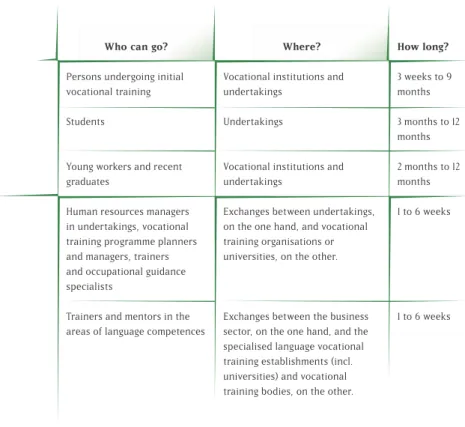
Therefore, an exchange project differs from a placement in terms of content as well as in terms of the target group and duration (see Table 1).
The exchanges are intended for:
Human resources managers in undertakings, vocational training programme planners and managers, particularly trainers, and occupational guidance specialists. They involve undertakings, on the one hand, and vocational training organisations or universities on the other.
Trainers and mentors in the area of language competencies. These exchanges take place between undertakings on the one hand and specialised language vocational training establishments, including universities or vocational training bodies, on the other.
The duration of these different types of placements are listed in Table 1.
Table I: The various mobility actions
Each country initiates its transnational placement and exchange programmes. Proposals are submitted by promoters (i.e. by private, public and semi-public organisations, but not by private individuals). Selection will take place at least once a year. For the exact deadline for submitting proposals, you are requested to contact the Leonardo National Agency in your country.
Who can go? Where? How long?
Persons undergoing initial vocational training
Vocational institutions and undertakings
3 weeks to 9 months
Students Undertakings 3 months to 12
months Young workers and recent
graduates
Vocational institutions and undertakings
2 months to 12 months Human resources managers
in undertakings, vocational training programme planners and managers, trainers and occupational guidance specialists
Exchanges between undertakings, on the one hand, and vocational training organisations or universities, on the other.
1 to 6 weeks
Trainers and mentors in the areas of language competences
Exchanges between the business sector, on the one hand, and the specialised language vocational training establishments (incl. universities) and vocational training bodies, on the other.
Placements
must form an integral part of the beneficiaries’ vocational training or vocational integration or reintegration;
should include some kind of teaching supervision and arrangements for monitoring the beneficiaries within the host organisations, in conjunction with the sending organisations;
should have a link to the overall strategy and general development work done in the sending/host organisation;
should strengthen co-operation between training institutions (including universities) and undertakings.
Exchanges
must be planned in light of the beneficiaries’ continuing vocational training arrangements and having regard to their real practices and working methods;
should aim primarily at the acquisition of new know-how and experience;
should create the framework for the transfer of know-how, experience and innovative practices in terms of training and human resources management, with special reference to the use of information and communication technologies (ICTs);
should strengthen co-operation between training organisations (including universities) and undertakings.
For further information please contact:
Ms. Hermándy-Berencz Judit
[email protected] www.tpf.iif.hu/leonardo