©2013 International Monetary Fund
IMF Country Report No. 13/329
MEXICO
REPORT ON THE OBSERVANCE OF STANDARDS
November 2013
CODES—DATA MODULE
This Report on the Observance of Standards and Codes—Data Module for Mexico was prepared by a staff team of the International Monetary Fund as background documentation for the periodic consultation with the member country. It is based on the information available at the time it was completed on November 8, 2013. The views expressed in this document are those of the staff team and do not necessarily reflect the views of the government of Mexico or the Executive Board of the IMF.
The Response by the Authorities to this report and the Detailed Assessments Using the Data Quality Assessment Framework (DQAF) are also included.
The policy of publication of staff reports and other documents by the IMF allows for the deletion of market-sensitive information.
Copies of this report are available to the public from International Monetary Fund Publication Services
700 19th Street, N.W. Washington, D.C. 20431 Telephone: (202) 623-7430 Telefax: (202) 623-7201 E-mail: [email protected] Internet: http://www.imf.org
Price: $18.00 a copy
International Monetary Fund
Washington, D.C.
MEXICO
REPORT ON THE OBSERVANCE OF STANDARDS AND
CODES (ROSC)—DATA MODULE VOLUME I
The Report on the Observance of Standards and Codes (ROSC)—Data Module provides an assessment of Mexico’s macroeconomic statistics against the Special Data
Dissemination Standard (SDDS) complemented by an assessment of data quality based on the IMF’s Data Quality Assessment Framework (DQAF) 2012. The DQAF lays out internationally accepted practices in statistics, ranging from good governance in data-producing agencies to practices specific to datasets.
The datasets covered in this report are consumer and producer price indices statistics. The agency that compiles the datasets assessed in this report is The National Institute of Statistics and Geography (INEGI).
The datasets to which this report pertains can be accessed in print and on the Internet: INEGI (http://www.inegi.org.mx)
Approved By
Louis Marc Ducharme and Adrienne Cheasty
Prepared By
The Statistics Department
This report is based on information provided prior to and during a staff mission from November 26 to November 30, 2012 and publicly available
information. The mission was conducted by Mr. Dale Smith (Expert),
Mexico is a member of The Group of Twenty, the Organization for Economic Cooperation and Development, and the North American Free Trade Agreement.
MEXICO
2 INTERNATIONAL MONETARY FUND
GLOSSARY _________________________________________________________________________________________ 3 OVERALL ASSESSMENT __________________________________________________________________________ 4 ASSESSMENT BY AGENCY AND DATASET ______________________________________________________ 6 STAFF'S RECOMMENDATIONS _________________________________________________________________ 14 TABLES
1. Data Quality Assessment Framework 2012—Summary Results _________________________________ 7 2. Assessment of Data Quality—Dimensions 0 and 1—National Institute of Statistics
and Geography ____________________________________________________________________________________ 8 3a. Assessment of Data Quality—Dimensions 2 to 5—Consumer Price Index ___________________ 10 3b. Assessment of Data Quality—Dimensions 2 to 5—Producer Price Index ____________________ 12 APPENDIX TABLE
Practices Compared to the SDDS Coverage, Periodicity, and Timeliness of Data ________________ 15
CONTENTS
Glossary
1993 SNA System of National Accounts 1993 2008 SNA System of National Accounts 2008
COICOP Classification of Individual Consumption by Purpose CPI Consumer Price Index
DQAF Data Quality Assessment Framework DSBB Dissemination Standards Bulletin Board EEA European Economic Area
ENIGH National Survey of Household Income and Expenditure GDDS General Data Dissemination System
INEGI National Institute of Statistics and Geography
LSNIEG National System of Statistical and Geographical Information Law PPI Producer Price Index
ROSC Report on the Observance of Standards and Codes SDDS Special Data Dissemination Standard
MEXICO
4 INTERNATIONAL MONETARY FUND
OVERALL ASSESSMENT
1. Mexico has been a subscriber of the Special Data Dissemination Standard (SDDS) since August 1996, posting its metadata on the Fund’s Dissemination Standards Bulletin Board (DSBB) in March 1998. Mexico is in observance of the SDDS, meeting the specifications for data coverage, periodicity and timeliness, and the dissemination of advance release calendars. Mexico avails itself of a flexibility option on the timeliness of general government or public sector
operations. Appendix Table 4 provides an overview of Mexico’s dissemination practices compared with the SDDS. This Report on Observance of Standards and Codes—Data Module (data ROSC) focuses on the consumer price index (CPI) and the producer price index (PPI), complementing a 2010 data ROSC covering Mexico’s national accounts, government finance, monetary, and balance of payments statistics. This data ROSC is based on the 2012 version of the IMF’s Data Quality Assessment Framework (DQAF), which explicitly incorporates international standards updated since the July 2003 version on which the 2010 data ROSC was based. The relevant updates for this assessment are:
The Consumer Price Index Manual (CPI Manual) was published in 2004 by the Inter Secretariat Working Group on Price Statistics,1 updating previous guidance from the International Labor
Organization of 1983.
The Producer Price Index Manual (PPI Manual) was published in 2004 by the Inter Secretariat Working Group on Price Statistics.
The System of National Accounts was updated from its 1993 version (1993 SNA) to 2008 version (2008 SNA).
2. This data ROSC contains the following main observations. Mexico’s CPI and PPI have solid institutional, conceptual and methodological, and source data foundations achieved through implementation of international best practices. Implementation of good practice extends to the serviceability and dissemination aspects of both indexes. Responsibility for compiling and releasing the CPI and PPI were transferred from the Bank of Mexico (BM) to the National Institute of Statistics and Geography (INEGI) in July 2011. This evaluation found the collaboration between the BM and INEGI in the transfer of these two key economic indicators exceptionally successful in view of the improvements concurrently implemented in both the CPI and PPI with the move. A new total quality management system was implemented at INEGI, a new Technical Committee Specializing in Price Statistics (TCSPS) was organized to obtain feedback from user groups, a new system for analysis of the index series was developed, and improvements were made for several important CPI modules such as mobile telephone service, automobile purchase, electricity, gas, and computers.
1 The membership of the IWGPS comprises Eurostat, International Labor Organization (ILO), IMF, Organization for Economic Cooperation and Development (OECD), and United Nations Economic Commission for Europe (UNECE).
3. In applying the IMF’s DQAF, the remainder of this section presents the mission’s main conclusions. The presentation is done at the level of the DQAF’s quality dimensions, by agency (INEGI) for the first two dimensions and across datasets for the remaining four.
4. The CPI and PPI are produced by INEGI under a strong legal and institutional
environment preserving the professional independence of, and providing adequate resources for, statistical compilations. The National System of Statistical and Geographical Information Law places INEGI at the center of the statistical system and gives it substantial autonomy in the statistical sphere.
5. The CPI and PPI both benefit from the application of sound practices in concepts and methods. The CPI has commendable coverage of expenditure, including both equivalent rent of owner-occupied dwellings and employer-provided goods as compensation in-kind. The PPI’s product indices have a commendably broad coverage of industrial activities comprising 80 percent of total output; however, industry price indexes inclusive of the secondary products of each industry are not available.
6. The price surveys of both indices are well designed and carefully implemented,
following systematic quality assurance practices. The household expenditure data underlying the CPI’s weights need to cover a full year rather than the current three months so that the weights cover a full seasonal cycle. INEGI has begun a continuous household expenditure survey that will supply such information in the future. The PPI weights derive directly from the national accounts supply and use system. Index quality adjustment methodology in both index programs is strong. Both index programs conduct studies of the impacts of weight, methodology, and source data revisions.
7. Both indexes exceed SDDS periodicity and timeliness requirements. The set index revision policy is every four years for the CPI, with weight updates at a more frequent two year interval, and every five years for the PPI, consistent with international good practice. Data are monitored for consistency over time and with other comparable price indicators. Revision policy is clear and public for current revisions to both indexes—up to four months for the PPI—as well as major revisions including to scope, methodology, weights, and baskets. The CPI is internally consistent in aggregation by product/expenditure category and geographic area. Both indexes are available at high levels of detail.
8. Accessibility to users is very good. Data are published in several formats and are available in detail. Detailed and summary methodology documents are available for both indexes. INEGI provides quick and reliable service to index users who have questions, or who need publications or further information on the index, via telephone, through its sales centers, and through its website, including an online chat facility. The INEGI website allows the user to create and download tables and graphs with virtually any format using the data available on the website.
MEXICO
6 INTERNATIONAL MONETARY FUND
9. Section II provides a summary assessment by agency and dataset based on a four-part scale. This is followed by staff recommendations in Section III. Practices compared to the SDDS are summarized in Appendix I. The authorities’ response to this report and a volume of detailed assessments are presented in separate documents.
ASSESSMENT BY AGENCY AND DATASET
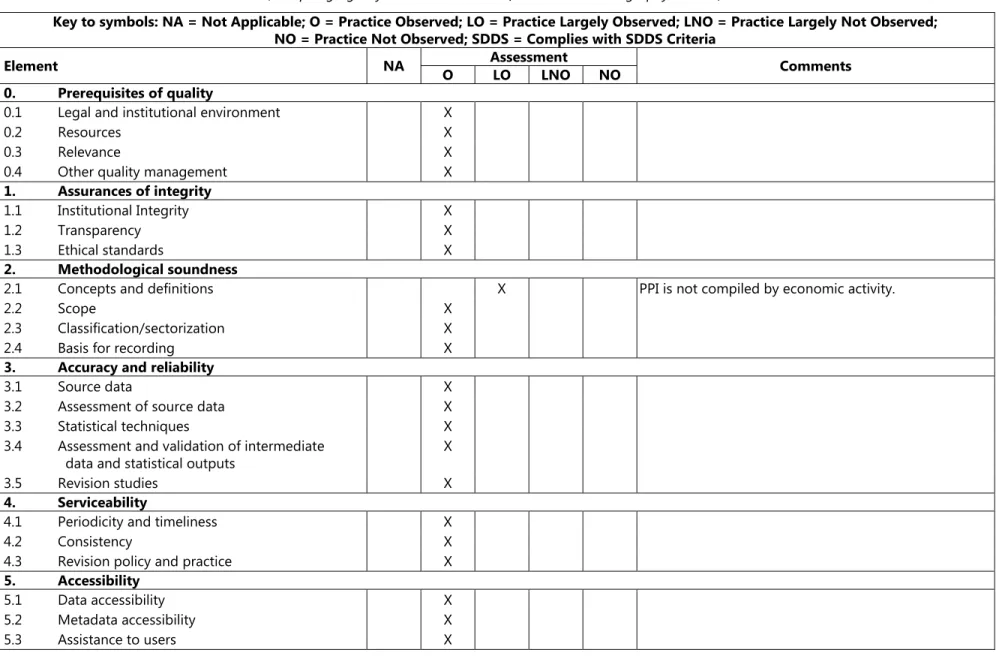
10. Assessment of the quality of two macroeconomic datasets—CPI and PPI statistics— were conducted using the DQAF. In this section, the results are presented at the level of the DQAF elements and using a four-point rating scale (Table 1). Assessments of the prerequisites of data quality and the assurances of integrity (Dimensions “0” and “1” of the DQAF) are presented in Table 2. For each dataset, the assessment of methodological soundness, accuracy and reliability, serviceability, and accessibility (Dimensions “2” to “5” of the DQAF) are shown in Tables 3a and b.
Table 1. Data Quality Assessment Framework 2012—Summary Results
Key to symbols: O = Practice Observed; LO = Practice Largely Observed; LNO =Practice Largely Not Observed; NO = Practice Not Observed; NA = Not Applicable
Datasets Dimensions/Elements
Consumer Price Index Producer Price Index 0. Prerequisites of quality
0.1 Legal and institutional environment O O
0.2 Resources O O
0.3 Relevance O O
0.4 Other quality management O O
1. Assurances of integrity
1.1 Institutional integrity O O
1.2 Transparency O O
1.3 Ethical standards O O
2. Methodological soundness
2.1 Concepts and definitions O LO
2.2 Scope LO O
2.3 Classification/sectorization O O
2.4 Basis for recording O O
3. Accuracy and reliability
3.1 Source data LO O
3.2 Assessment of source data O O
3.3 Statistical techniques O O
3.4 Assessment and validation of intermediate data and statistical outputs O O
3.5 Revision studies O O
4. Serviceability
4.1 Periodicity and timeliness O O
4.2 Consistency O O
4.3 Revision policy and practice O O
5. Accessibility
5.1 Data accessibility O O
5.2 Metadata accessibility O O
5.3 Assistance to users O O
Practice observed: Current practices generally meet or achieve the objectives of DQAF internationally accepted statistical practices without any significant deficiencies. Practice largely observed: Some departures, but these are not seen as sufficient to raise doubts about the authorities’ ability to observe the DQAF practices. Practice largely not observed: Significant departures and the authorities will need to take significant action to achieve observance. Practice not observed: Most DQAF practices are not met. Not applicable: Used only exceptionally when statistical practices do not apply to a Mexico’s circumstances.
INTERNATION
AL MONETA
RY
Table 2. Assessment of Data Quality—Dimensions 0 and 1—National Institute of Statistics and Geography (INEGI)
0. Prerequisites of quality 1. Assurances of integrity
Legal and institutional environment. INEGI’s responsibility for compiling and disseminating the consumer and producer price indexes (CPI and PPI) is established under Article 59 of the National System of Statistical and Geographical Information Law (LSNIEG) of April 16, 2008. Article 52 of the LSNIEG provides that INEGI is an agency with technical and managerial autonomy, its own legal status, and its own assets and liabilities. INEGI is responsible also for regulating and coordinating the National System of Statistical and Geographical Information. Under Article 26 of the Constitution it is a public institution with technical and managerial autonomy. All of the key data used for the compilation of the CPI and PPI are generated within INEGI; data sharing across relevant statistical programs is effective. Personnel involved in price index production are aware of the confidentiality of data, which is stressed in personnel training sessions, and in requests for price information to respondents. The legal powers of INEGI to compile information are clearly set out in Chapter V of the LSNIEG. Article 45 defines the obligations of respondents, while Article 40 requires respondents to provide the information requested in a truthful and timely manner.
Resources. There is sufficient staff to carry out current activities. Gaps in the skills required for the staff are continuously analyzed and identified, with the aim of reducing them through the training program. There are yearly training cycles to introduce new methodology and to refresh instructions for price collectors. The prices program has sufficient computer equipment and administrative support for the efficient compilation and management of databases. Computing resources are adequately protected, inter alia, by providing emergency backup systems for the retrieval of statistical series and updates in the event of natural disasters, accidents or other extraordinary events. Contingency plans have been tested during drills, achieving the compilation of the CPI in remote locations. The headquarters building and regional office space are adequate to perform activities involved in the collection of data and the compilation of the CPI. The ongoing activities for price collection and compilation of the CPI and PPI have adequate funding.
Professionalism. Professional competence is the basic principle for recruitment and promotions of the INEGI staff. The choice of sources and methods is governed only by statistical considerations.
The INEGI prepares press notes stating its position against errors of
interpretation, making these notes available to the public on the web page of the Institute.
Transparency. Press releases indicate that the published data are compiled under the responsibility of INEGI and in accordance with the LSNIEG. The autonomy conferred to the INEGI guarantees that no government authority has access to the statistics before their release. The data are published in a press release with the logo of the INEGI. Changes in the base years or methodologies of the CPI and PPI and any substantial modification of the source data are publicized in advance.
Ethical standards. The conduct of INEGI’s staff is subject to the norms and sanctions established by the Federal Law on Administrative Responsibilities of the Public Servants and to INEGI’s ethical code issued under Article 7 of LSNIEG. 8 INTERNATION AL MONETA RY FUND MEXICO
Table 2. Assessment of Data Quality—Dimensions 0 and 1—National Institute of Statistics and Geography (INEGI) (concluded)
0. Prerequisites of quality 1. Assurances of integrity
Relevance. The public is able to make requests for information as well as suggestions through the Information Request System provided by INEGI at the web link http://www.infomex.inegi.org.mx/infomex/. In addition, INEGI is able to monitor user needs by studying requests for information received via information sales centers and e-mail. INEGI recently
established a Committee of Users of Information on Prices (CUIP) that meets regularly to discuss issues relating to the CPI and the PPI. The CUIP membership includes representatives from outside the government. Other quality management. Article 3 of the LSNIEG states that the INEGI has the objective of providing to society and to the State quality
information that is relevant, trustful, and timely, in order to promote national development. ISO 9001:2008 governs the development of INEGI price indexes. Quality standards are designed to enhance efficiency in the use of resources.
INTERNATION
AL MONETA
RY
Table 3a. Assessment of Data Quality—Dimensions 2 to 5—Consumer Price Index (CPI) 2. Methodological soundness 3. Accuracy and reliability 4. Serviceability 5. Accessibility Concepts and definitions. The
compilation of the CPI uses concepts and definitions that follow international standards given in the 2008 SNA and the 2004 CPI Manual
Scope. The CPI measures the change in prices of a fixed basket of goods and services
representative of the final consumption expenditures of households located in urban areas with population greater than or equal to 15,000. The CPI weights do not cover expenditures from rural households as well as some urban households from smaller towns. Scope of expenditures by type is notably complete, including the equivalent rent of owner occupants of dwellings and expenditure on goods received as salary in kind.
Classification/sectorization. The CPI is based on the Classification of Individual Consumption by Purpose (COICOP). The market basket for the index consists of 283 elementary items classified into the twelve divisions (major groups) of COICOP.
Source data.The item sample and market basket weights for the CPI are derived from the 2008 National Survey of Household Income and Expenditures (ENIGH), which covers households from all
socio-economic groups in all geographic areas. However, the information for the survey was only collected during a three month period between August and November of 2008, which could lead to potential seasonal biases in the weights. Approximately 117,500 price quotations are collected fortnightly from 20,500 outlets in 46 cities located in 31 states and the Federal District. Rents for approximately 6,500 rental units are also collected semi-annually.
Assessment of source data. Price and product specification data collected for the fortnightly price survey, as well as expenditure data collected for the ENIGH are processed and audited according to procedures established using the total quality management system ISO 9001. These include filters to identify atypical values, temporal and geographic inconsistencies, and periods of no price change.
Periodicity and timeliness.The CPI is published on a fortnightly basis, exceeding SDDS
requirements on both periodicity and timeliness.
Consistency. Compilations are identical regardless of the order of aggregation. The CPI has been compiled and published for elementary concepts
(aggregations) that have been in place since January 1969. Revision policy and practice. Major CPI revisions were carried out in 1968, 1980, 1994, 2002, and 2010. The next major revision is scheduled for 2014 using expenditure data from the
continuous household expenditure survey (ENGASTO) for 2012 or 2013. Major revisions are
scheduled for every four years with a weight revision at the two year interval between the major revisions. Detailed documentation for all CPI revisions is available on the INEGI website.
Data accessibility.Data are disseminated regularly in detail and in time series, according to a well established production and release schedule, through a fortnightly publication, a press release, and by electronic means. All INEGI publications on the CPI are professionally presented with tables and charts alongside the data to facilitate analysis. These publications are all available on INEGI’s website.
Metadata accessibility. A detailed methodological document on the current CPI is available on INEGI website. INEGI has also published a less technical document covering the most frequently asked questions and answers for the CPI, and also has posted the questions and answers on its website. Assistance to users. INEGI provides quick and reliable service to the index users who have questions regarding the CPI, or who need publications or further information on the index telephone, through its sales centers, and through its website, including an online chat facility. The INEGI website allows the user to create and download tables and graphs with virtually any format using the data available on the website. MEXICO 10 INTERNATION AL MONETA RY FUND
Table 3a. Assessment of Data Quality—Dimensions 2 to 5—Consumer Price Index (CPI) (concluded) 2. Methodological soundness 3. Accuracy and reliability 4. Serviceability 5. Accessibility Basis for recording. The prices
used correspond to market prices paid by households (deducting discounts and rebates, and including all taxes levied on the products). For vehicles, purchases net of sales are used to derive the weights.
Statistical techniques.Missing prices are imputed using observed price changes of other varieties in the same group. Replacement items and or varieties are introduced as needed. Quality adjustments are made using internationally recommended techniques. Elementary aggregates are calculated using geometric means.
Assessment and validation of intermediate data and statistical outputs. Intermediate CPI price data are validated using
corresponding data from the PPI. Revision studies. Significant research relating to major index updates (revisions) is carried out on a continuous basis. This research includes estimates of variance in expenditure data from the bi-annual ENIGH, the effects of changes in market basket weights, and possible index substitution bias.
INTERNATION
AL MONETA
RY
Table 3b. Assessment of Data Quality—Dimensions 2 to 5—Producer Price Index (PPI) 2. Methodological soundness 3. Accuracy and reliability 4. Serviceability 5. Accessibility Concepts and definitions. The
overall structure of the PPI is based on the concepts and definitions contained in the 1993 SNA, updated to the 2008 SNA, as well as the 2004 PPI Manual.
Nonetheless, indices are compiled only by product classified by economic activity. They are not compiled by economic activity in a process that includes the
secondary production of each activity.
Scope. The PPI coverage of 80 percent of domestic production is broad compared to the typical coverage in other countries. It encompasses most economic activities including agriculture, forestry, fishing, mining, manufacturing, electricity and energy, water resource exploitation, transport,
communication, health services, and professional services. Also included are public and private final consumption services such as paid rent, imputed rent for homeowners, and outsourcing for businesses and equipment repair.
Source data.Each month, approximately 110,000 price observations are collected, corresponding to around 32,400 specific items in 6,410 exclusive information sources for the PPI, and in 14,896 information sources shared with the CPI. Sampling frequency depends on the volatility of prices exhibited by the goods and services of each elementary concept. Farm products prices are processed every working day, while construction products prices are processed every two weeks. The weight structure of the new PPI was determined using the input output matrix updated to 2010.
Assessment of source data. Monthly price data are audited according to procedures established using the quality management system ISO 9001. These include filters to identify atypical values, temporal and geographic inconsistencies, and periods of no price change.
Periodicity and timeliness.The PPI is published on a monthly basis, meeting SDDS requirements on both, periodicity and timeliness. Consistency. Compilations for the PPI are identical regardless of the order of aggregation (by origin or by destination of production). Time series are consistent for elementary concepts since January 1980. Revision policy and practice. Published PPI data are subject to revision for up to four months after publication. Virtually all revisions are due to revisions in oil prices. Major revisions of the PPI were carried out in 1980, 1994, 2003, and 2012. It is expected that the next major PPI revision will be carried out in 2016 based on the 2014 economic census covering data from calendar year 2013. INEGI has established a plan to carry out major revisions for the PPI every five years following the schedule for the economic census conducted every five years.
Data accessibility.Data are disseminated regularly in considerable detail and in time series, according to a well
established production and release schedule, through a monthly publication, a press release, and by electronic means. All INEGI publications on the PPI are professionally presented with tables and charts alongside the data to facilitate analysis. These publications are all available on INEGI’s website.
Metadata accessibility. There are two detailed methodological documents available on the INEGI website for the PPI: Methodological Document of the National
Producer Price Index; and Methodological Note on the Producer Price Index. Assistance to users. INEGI provides quick and reliable service to index users who have questions regarding the PPI, or who need publications or further information on the index telephone, through its sales centers, and through its website, including an online chat
MEXICO 12 INTERNATION AL MONETA RY FUND
Table 3b. Assessment of Data Quality—Dimensions 2 to 5—Producer Price Index (PPI) (concluded) 2. Methodological soundness 3. Accuracy and reliability 4. Serviceability 5. Accessibility Classification/sectorization. For
the new PPI, economic activities and products are classified using the North American Industrial Classification System (NAICS). Basis for recording. Factory gate prices are obtained from a monthly survey of producers, and do not include taxes, transportation costs, and insurance fees. Prices are determined for specific products and not for unit values. The specifications include all price determining characteristics including the terms of the transaction, brand, presentation, weight, and number of units sold. Due to the broad nature of the index and, in order to avoid double counting, the weights are based on net output.
Statistical techniques.Missing prices are imputed using observed price changes of other product specifications in the same establishment and/or elementary aggregate. Replacement
specifications are introduced as needed. Quality adjustments are made using internationally recommended techniques. Elementary aggregates are calculated using geometric means. Assessment and validation of intermediate data and statistical outputs. PPI index data are validated by comparing these data with corresponding index data from the CPI.
Revision studies. Research relating to major index updates (revisions) is carried out on a continuous basis, including to assess the potential for long-term substitution bias. The results of these studies are presented to the quality committee, which meets monthly, and decisions are made to determine the actions to be taken to correct potential problems with the index. These index reviews, as well as the actions taken, are documented and audited as part of ISO 9001 procedures.
facility. The INEGI website allows the user to create and download tables and graphs with virtually any format using the data available on the website. MEXICO INTERNATION AL MONETA RY FUND
MEXICO
14 INTERNATIONAL MONETARY FUND
STAFF'S RECOMMENDATIONS
11. Based on the review of Mexico’s statistical practices, discussions with the data producing agencies, and responses from data users, the mission has developed a set of recommendations. They are designed to increase further Mexico’s adherence to internationally accepted statistical practices and would, in the mission’s view, enhance the analytical usefulness of Mexico’s statistics.
Consumer price index
The CPI weights should be based on survey data (among other sources) covering a full seasonal (annual) cycle; forthcoming continuous household expenditure survey data can be used to compile these weights.
Research the impact of covering rural and small urban areas, with population less than 15,000, near urban clusters already in the area sample.
Producer price index
Appendix Table. Practices Compared to the SDDS Coverage, Periodicity, and Timeliness of Data
SDDS Data Category (meets SDDS Coverage requirement)
Periodicity Timeliness
Comments SDDS Mexico SDDS Mexico
Real Sector
National accounts Yes Q Q 1Q 53D
Production index/indices Yes M M 6W
(1M encouraged) NLT 42D
Forward-looking indicators Yes
(encouraged data category M or Q M 1M or1 Q 3W Employment Yes Q M 1Q NLT 25D Unemployment Yes Q M 1Q NLT 25D Wages/earnings Yes Q M 1Q 2M
Consumer price index Yes M M 1M 10D
Producer price index Yes M M 1M NLT 10D
Fiscal Sector
General government operations Yes A A 2Q 19M Timeliness
Flexibility
Central government operations Yes M M 1M 30D Timeliness
Flexibility
Central government debt Yes Q Q 1Q 30D
Financial Sector Analytical accounts of the
banking sector Yes M M 1M 1M
Analytical accounts of the central
bank Yes M(1W
recom-mended)
W 2W
(1W encouraged)
2WD
Interest rates Yes D D … D
Stock market: share price index Yes D D … D
External Sector
Balance of Payments Yes Q Q 1Q 10W
Official reserve assets Reserves template Yes M (W recom-mended) M W 1W M 4D
Merchandise trade Yes M M 8W
(4–6W encouraged)
25D International investment position Yes A
(Q recom-mended)
A 3Q
(1Q encouraged) 6M
External debt Yes Q Q Q 1Q
Exchange rates Yes D D … D
Addendum: Population Yes A A … 10M
Note: Periodicity and timeliness: (D) daily; (W) weekly or with a lag of no more than one week from the reference data or the closing of the reference week; (M) monthly or with a lag of no more than one month; (Q) quarterly or with a lag of no more than one quarter; (A) annually; and (…) not applicable.
MEXICO
REPORT ON THE OBSERVANCE OF STANDARDS AND
CODES (ROSC)—DATA MODULE VOLUME II
RESPONSE BY THE AUTHORITIES
This document contains the authorities’ response to the IMF’s data quality assessment (Volumes I and III).
CONTENTS
GLOSSARY ___________________________________________________________________________ 2 INTRODUCTION _____________________________________________________________________ 3 PREVIEWS OF PROGRESS AND SOUNDNESS ______________________________________ 3 RESPONSE TO THE IMF’S RECOMMENDATIONS __________________________________ 4 A. Consumer Price Index (CPI) ________________________________________________________ 4 B. Producer Price Index (PPI) __________________________________________________________ 5 IMPROVEMENTS TO THE PRICE INDEXES SYSTEM IN 2013 ______________________ 5
Glossary
CPI Consumer Price Index
DQAF Data Quality Assessment Framework DSBB Dissemination Standards Bulletin Board
ENIGH National Survey of Household Income and Expenditure ENGASTO Continuous Household Expenditure Survey
GDDS General Data Dissemination System
INEGI National Institute of Statistics and Geography
LSNIEG National System of Statistical and Geographical Information Law PPI Producer Price Index
PPP Producer Price Parity
ROSC Report on the Observance of Standards and Codes SDDS Special Data Dissemination Standard
SNIEG National System of Statistical and Geographical Information TCSPS Technical Committee Specialized in Price Statistics
MEXICO
INTERNATIONAL MONETARY FUND 3
INTRODUCTION
1. The National Institute of Statistics and Geography (INEGI), in response to the IMF on recent Volume I and Volume III of the Report on the Observance of Standards and Codes (ROSC)—Data Module for Mexico, focused on the consumer price index (CPI) and the producer price index (PPI), found it useful to identify “opportunity areas” that allow improving data quality and procedures. The ROSC promotes statistical best practices and provides one way of assessing the quality and
suitability of the program in applying the 2012 version of the IMF’s Data Quality Assessment Framework (DQAF).
2. The ROSC recommendations were analyzed by INEGI and the conclusions are discussed in the next topics:
INEGI is grateful for the allocation of IMF personnel to perform the evaluations; we recognize their quality and professionalism; we learned from their comments and recommendations in this mission.
INEGI agrees with the observations of the ROSC, and as noted in the report, Mexico is in observance of the Special Data Dissemination Standard (SDDS), meeting the specifications for data coverage, periodicity, timeliness and the dissemination of an advance release calendar.
As described in the report, INEGI understands the importance of staying at the forefront in the application of quality standards in the generation of price statistics, and appreciates the IMF recognition on the implementation of international best practices.
PREVIEWS OF PROGRESS AND SOUNDNESS
3. For INEGI, the transference of the price indexes calculation system from Mexico´s Central Bank was successful, because both institutions developed a plan and strategy. The technology, methodology, processes, and procedures were assimilated for INEGI, and the historical information preserved and stored appropriately. After the transference, significant progress has been achieved to the processes and systems of calculation of price indexes, compilation of products and practical information for users.
4. The first progress for the price indexes began with a Quality Management System that has been implemented by INEGI. The purpose is the continuous users’ satisfaction and the compliance of legal regulations applicable to National Price Indexes. The design and approach of the Quality Management System of National Price Indexes respond to the original processes of Quality Management Model ISO 9001:2008 "Quality Management Systems Requirements" and its national equivalent (NMX-CC IMC-9001-2008 Management Systems Quality-Requirements). In December 2011 the certificate of quality was extended, ISO 9001:2008, for processes Production of National Consumer Index and National Producer Index.
5. The second achievement was in transparency. A new Technical Committee Specialized in Price Statistics (TCSPS) was installed to obtain feedback from user and producer information groups. The TCSPS is integrated by representatives of the relevant ministries and public institutions. In addition, the committee members include representative firms, business associations, as well as academics.
6. The CPI and PPI are produced by INEGI under a strong legal and institutional environment in which the staff preserves their professional independence and provides adequate resources for statistical compilations. The National System of Statistical and Geographical Information Law places INEGI at the center of the statistical system. This law comes from paragraph B of Article 26 of the Mexican Constitution in which INEGI is defined as an autonomous entity.
7. Another achievement was the updating of the CPI weights on April 24, 2013 using National Survey of Household Income and Expenditure (ENIGH) 2010. In the future, the weights will be updated every two years using the ENIGH data, while Continuous Household Expenditure Survey (ENGASTO) data could be used to perform major index revisions every four or five years, to account for seasonal issues .
8. Furthermore, a new system for the analysis of the index series was developed and
improvements for several CPI modules such as cellular phones, car purchases, electricity, gas, and computers were made.
9. Dissemination of information is a priority for INEGI. For that reason, several tools were developed for the users and specialists in prices indexes, for example, prices mapping, kaleidoscope, inflation simulator, inflation calculator, average prices by specific product, among others. The efforts in the dissemination and socialization of the price indexes information received an Honorific
Mention in the award to the innovation in transparency for the progress of the institutional management on August 9, 2013.
RESPONSE TO THE IMF’S RECOMMENDATIONS
10. The ROSC Data Module Volume I report on the CPI and PPI recommended a number of improvements. Set out below is INEGI’s response to the IMF’s recommendations.
A. Consumer Price Index (CPI)
11. The CPI weights should be based on survey data (among other sources) covering a full seasonal (annual) cycle; forthcoming ENGASTO data can be used to compile these weights. Response
12. Since 2012 INEGI is performing fieldwork for the ENGASTO designed for the CPI use, among others. With these data, INEGI will build weights for CPI, because it provides information on Mexican household expenditures in the country. The fieldwork and data collection provides information
MEXICO
INTERNATIONAL MONETARY FUND 5
throughout the year to avoid seasonal biases and covers a full seasonal (annual) cycle. In the actual plan the weights will be updated every two years using the ENIGH data, while ENGASTO data could be used to perform major index revisions every four or five years, to account for seasonal issues . 13. Research the impact of covering rural and small urban areas, with population under 15,000, near urban clusters already in the sample area.
Response
14. ENGASTO and the ENIGH provide information of household spending according to the size of the locality for urban and rural areas, so that it is possible to undertake studies to measure the impact of including calculation of the CPI weights to communities under 15,000 inhabitants. 15. Statistical analysis will be run to understand the impact of including rural areas in the weights of the CPI, if rural data improves data quality, reliability and accuracy of consumption and gain precision for CPI weights, before rural areas data is used.
B. Producer Price Index (PPI)
16. Compile a set of PPIs by economic activity including secondary products. Response
17. INEGI will analyze information from the 2014 Economic Census when results are available, economic surveys, and other sources. The goal is to assess the viability of this recommendation on the compilation of a set of PPIs by economic activity and include secondary products. Before implementing any changes, Mexico will continue its usual practice of consulting users on the best way to improve its price indexes statistics.
IMPROVEMENTS TO THE PRICE INDEXES SYSTEM IN
2013
18. Having a new national expenditure survey (ENGASTO). As mentioned before, ENGASTO will promote benefits on the information’s accuracy and reliability. It also will avoid information bias on weights. This survey has rural areas coverage, useful to analyze the impact of including rural areas in the weights of CPI.
19. Changing CPI weights every two years (since 2013). Up to now, we have information from ENIGH, every two years. We could update the weights in the same period, and this will lead us toward improving the quality of those weight estimators. We will analyze seasonality issues with ENGASTO every four or five years. In 2013, a new sample design for the PPI was defined: it is now more robust and accurate because the size was calculated with greater reliability and the most representative companies of national economic activity by sector were selected.
20. New technology and new control systems for fieldwork, monitoring, sample management, as well as calculation of price indexes. A new calculation system and data collection is being developed to improve all the stages of the CPI and PPI calculation process, which should improve the quality of the information received at the same time in which the registration of prices throughout the country occurs. Another variant is to add data directly from the respondents who are requested to send their data by electronic media or internet, in a more timely and reliable way.
21. Another value is the integration of databases that can be shared among CPI and PPI. Both calculation indexes are independent and will have their own methodology and technology for obtaining elementary and aggregated indexes. The new system will make an improvement in the administration of the samples, since there is a control module that will allow managing: the distribution chain, products basket and informants sample.
22. Further improvement of the process for price indexes is the integration of the Purchasing Power Parities (PPP) program with the CPI. These two processes have enriched each other and provide quality advantages. The new calculation system for price indexes will support all: PPI, CPI, and PPP. In 2012 the PPP program was included in our quality management system.
MEXICO
REPORT ON THE OBSERVANCE OF STANDARDS AND
CODES (ROSC)—DATA MODULE VOLUME III
DETAILED ASSESSMENTS USING THE DATA QUALITY ASSESSMENT
FRAMEWORK (DQAF)
Approved By
Louis Marc Durcharme and Adrienne Cheasty
Prepared By
The Statistics Department
This document contains a detailed assessment by dataset of the elements and indicators that underlie the data quality dimensions discussed in Mexico’s Report on the Observance of Standards and Codes (ROSC)—Data Module. It also
includes as appendices the DQAF generic framework and the results of the users’ survey. November 8, 2013
CONTENTS
GLOSSARY _________________________________________________________________________________________ 3 PRICE STATISTICS (CONSUMER PRICE INDEX) __________________________________________________ 4 0. Prerequisites of Quality ________________________________________________________________________ 4 1. Assurances of Integrity _______________________________________________________________________ 14 2. Methodological Soundness __________________________________________________________________ 18 3. Accuracy and Reliability ______________________________________________________________________ 21 4. Serviceability _________________________________________________________________________________ 28 5. Accessibility __________________________________________________________________________________ 30 PRICE STATISTICS (PRODUCER PRICE INDEX) ________________________________________________ 37 0. Prerequisites of Quality ______________________________________________________________________ 37 1. Assurances of Integrity _______________________________________________________________________ 45 2. Methodological Soundness __________________________________________________________________ 49 3. Accuracy and Reliability ______________________________________________________________________ 52 4. Serviceability _________________________________________________________________________________ 57 5. Accessibility __________________________________________________________________________________ 59 TABLES
1. Data Quality Assessment Framework (2012): Summary of Results for Price Statistics
(Consumer Price Index) _____________________________________________________________________ 36 2. Data Quality Assessment Framework (2012): Summary of Results for Price Statistics
(Producer Price Index) ______________________________________________________________________ 63 APPENDIXES
I. Summary of the Special Data Dissemination Standard _________________________________________ 64 II. Data Quality Assessment Framework—Generic Framework ___________________________________ 66 III. Users’ Survey __________________________________________________________________________________ 69
MEXICO
INTERNATIONAL MONETARY FUND 3
Glossary
1993 SNA System of National Accounts 1993 2008 SNA System of National Accounts 2008 BM Bank of Mexico
CPI Consumer price index
COICOP Classification of Individual Consumption by Purpose DOF Official Gazette of the Federation
DGAIP Deputy Directorate General for Price Indexes DSBB Dissemination Standards Bulletin Board DQAF Data Quality Assessment Framework ENGASTO Continuous Household Expenditure Survey
ENIGH National Survey of Household Income and Expenditure ESPC Regulations (Statute) of the Professional Career Service CFF Fiscal Code of the Federation
IMF International Monetary Fund
INEGI National Institute of Statistics and Geography
ISSSTE Institute of Social Security and Services of State Workers
LSNIEG National System of Statistical and Geographical Information Law OECD Organisation for Economic Co-operation and Development PPI Producer price index
ROSC Report on the Observance of Standards and Codes SCNM Mexican System of National Accounts
SDDS Special Data Dissemination Standard
SNIEG National System of Statistical and Geographical Information STA IMF Statistics Department
DETAILED ASSESSMENT USING THE DATA QUALITY ASSESSMENT
FRAMEWORK (DQAF)
The following detailed information on indicators of statistical practices in the areas of prices statistics was gathered from publicly available documents and information provided by the Mexican officials. This information, which is organized along the lines of the generic DQAF (see Appendix II), was used to prepare the summary assessment of data quality elements, based on a four-part scale of observance, shown in Mexico’s Report on the Observance of Standards and Codes (ROSC)—Data Module.
PRICE STATISTICS (CONSUMER PRICE INDEX)
0.
Prerequisites of Quality
0.1 Legal and institutional environment
0.1.1 The responsibility for collecting, processing, and disseminating the statistics is clearly specified.
Mexico’s price indexes are compiled and disseminated by the National Institute of Statistics and Geography (INEGI).
INEGI’s activity is governed by the National System of Statistical and Geographical Information Law (LSNIEG), published in the Official Gazette of the Federation (DOF) on April 16, 2008. Article 52 of the Law indicates that INEGI is an agency with technical and management autonomy, its own legal status and its own assets and liabilities, and it is responsible for regulating and coordinating the National System of Statistical and Geographical Information (SNIEG).
The priority objective of the INEGI is to take steps to ensure that information in the national interest is subject to the guiding principles of the SNIEG which are: accessibility, transparency, objectivity, and independence. Likewise, the purpose of the SNIEG is to provide society and the State with information that is of good quality, relevant, truthful, and timely, in order to facilitate efforts to pursue national development (Article 3, LSNIEG).
Article 4 states that the SNIEG has the following objectives: produce information, ensure timely dissemination of information for consultation purposes, promote knowledge and use of
information, and safeguard information. The composition of the SNIEG is defined in Article 5 and is as follows: the National Consultative Council, the National Information Subsystems, and the INEGI, which is the unit coordinating the system.
MEXICO
INTERNATIONAL MONETARY FUND 5
Article 59 states that the INEGI shall have as exclusive powers: carry out national censuses, establish the national accounts system. Finally, the Article states that the terms national census or national accounts may not be used in the names or advertising for records, surveys, or listings other than those carried out by the INEGI.
Article 78 of the LSNIEG gives the system of national accounts the status of information in the national interest.
The Law is available on the INEGI’s website at
https://sc.inegi.org.mx/Normateca2010/menuNormateca.jsp?codigo=0102. There are Bylaws (DOF of National Accounts March 31, 2009) to govern the INEGI’s operations and regulate the form and basis on which the INEGI exercises the functions and powers conferred upon it by the Political Constitution of Mexico (Article 26), the LSNIEG, and other laws, regulations, decrees, and resolutions of the Governing Board.
Regarding the responsibility for collecting, processing and disseminating National Price Indices (NPI), the LSNIEG in Article 59, Fraction III, gives exclusive capacity to the INEGI to: “Elaborate the following national price indices:
(a) Consumer Price Index (b) Producer Price Index.”
The first and the eleventh transitory articles of the LSNIEG specify the establishment of a working group between the Bank of Mexico (BM), which was previously responsible for the NPI and the INEGI in order to ensure that the transfer of the NPI would be carried out in a manner that guaranteed the preservation of the quality of the NPI. As a result, there was an environment of cooperation as work meetings between the BM and INEGI were held with regularity during the period July 2008 through July 2011. The transfer was completed on July 15, 2011. From that date, In accordance with the provisions of the LSNIEG the responsibility for price collection, processing and disseminating the CPI was transferred from the BM to the INEGI.
The Chamber of Deputies approved the modification of the Fiscal Code of the Federation (CFF) that entered into effect on January 1, 2012. Some principal changes were made reflecting the transfer of responsibility for compiling the CPI from the BM to the INEGI. In the second paragraph of Article 20 the modified code states that:
“In the cases where tax laws so provide in order to determine the contributions and accessories, the Consumer Price Index calculated by National Institute of Statistics and Geography will be applied and it will be published within the first ten days of the month following the
corresponding.”
The legal requirements governing the compilation of the CPI are specified in the Article 20bis of the CFF. The legal requirements for the CPI are:
I. “Price quotations will be collected in at least 30 cities located in at least 20 federal states. The selected cities must have a population of 20,000 or more inhabitants, and the 10 most populated metropolitan areas or cities must be always included.”
II. “Price quotations must be collected for at least 1000 products and services grouped in 250 consumption concepts, spanning at least 35 branches of agriculture, livestock, industry and services, according to the catalogue of economic activities elaborated by the National Institute of Statistics and Geography.”
III. “For food, the price quotations will be made at least three times per month. The remaining quotations for other products and services will be obtained one or more times per month.” IV. “The price quotations to calculate the Consumer Price Index of each month must correspond to the month in question.”
V. “The Consumer Price Index of each month will be calculated using the Laspeyres formula. Weights will be applied to each family consumption category considering the following concepts: Food, beverages and tobacco; clothing, footwear and accessories; housing; furniture and
domestic appliances; health and personal care; transportation; education and recreation; other services.”
“The National Institute of Statistics and Geography will publish in the Official Gazette of the Federation the states, metropolitan areas, cities, items, services, consumption concepts and branches referred in Fractions I and II, as well as the price quotations used to calculate the index.” 0.1.2 Data sharing and coordination among data-producing agencies are adequate. All of the key data used for the compilation of the CPI are generated within INEGI. Expenditure data generated from the National Survey of Family Income and Expenditure (ENIGH) serve as the main input for determining the CPI basket weights and the selection of the sample of items used for monthly price collection. The monthly price survey is also carried out by INEGI. The
relationship of INEGI with other institutions and public agencies is established within the framework of the SNIEG through the Executive Committees and the Specialized Technical
Committees in which the appropriateness of the methodologies employed for the compilation of the price indices are evaluated. In the specific case of the national price indices a Specialized Technical Committee on Price Statistics has been created. This Committee has been functioning well since its creation. In addition, on the basis of the special relationship between the INEGI and the BM, detailed price data are provided to the BM on a regular basis for analysis.
MEXICO
INTERNATIONAL MONETARY FUND 7
0.1.3 Individual reporters’ data are kept confidential and used for statistical purposes only.
Personnel involved in the CPI development are aware of the confidentiality of CPI data. This is stressed in personnel training sessions, and in requests for price information made to
respondents. These requests include an explanation that confidentiality will be observed and that the data will be used exclusively for statistical purposes. Also, pricing information that is
published in the Official Gazette of the Federation has a code that protects the identity of the informant.
In addition, as an autonomous agency, INEGI is also governed by the Federal Law of
Administrative Responsibilities of Public Servants (LFRASP). Fraction V of Article 8 establishes that every public servant has the obligation of custody and care of the documentation and
information under his/her responsibility, and to not impede or avoid its use, subtraction, destruction, concealment, or deactivation.
Article 13 of the LFRASP establishes mechanisms for imposing penalties on civil servants on grounds of administrative conduct deriving from their failure to fulfill their obligations pertaining to the custodianship of documentation and information, which mechanisms shall consist in: a private or public warning; suspension; removal from office; economic penalty; and temporary disqualification from engaging in the employment, post, or commission for a period of not less than 3 days, and not more than one year in public service.
Also, Title Two in Chapter V of the LSNIEG guarantees the confidentiality of statistical data supplied to INEGI, stipulating that such data may be used only for statistical purposes. Article 37 of the Law states that, “data provided for statistical purposes by system respondents to units under the law, shall be strictly confidential, and under no circumstances may they be used for any purpose other than a statistical purpose.”
Article 38 of the Law declares that “data and reports provided by private parties for statistical purposes or derived from administrative or civil records shall be handled, for purposes of this law, with due regard to the principles of confidentiality and may not under any circumstances be disclosed in a personalized (nominative) or individualized manner, nor may they be used as evidence before an administrative or fiscal authority, in judicial or other proceedings. When it is necessary to disclose information, said information must be aggregated in such a way that it is not possible to identify system respondents or those individuals or legal entities that are the focus of the information in question.”
Article 104 of the LSNIEG defines the violations imputable to civil servants at the INEGI or civil servants at the system units as follows: “the disclosure of confidential statistical data; violations of industrial or commercial secrets, or the provision by system respondents of data that is
individualized or identified by name” (paragraphs I and II). Consequently, Article 108 of the Law provides administrative penalties for anyone who discloses confidential data: “A fine of 2,000 to
up to 30,000 times the minimum monthly wage valid for the federal district at the time the violation was committed.”
By the same token, in the resolution establishing the Regulations (Statute) of the Professional Career Service (ESPC) for the INEGI (DOF of May 8, 2009), specific provision is made for
disciplinary measures for personnel on grounds of noncompliance with current law, in particular Article 38, Fraction V, which establishes that one of the grounds for separation from the INEGI shall be failure to fulfill the obligations inherent in the employee’s post or those established in the Statutes or in the regulations deriving from it.
The ESPC points out that government employees must abide by the principles of confidentiality and privacy with respect to respondent data provided for statistical purposes, as well as with respect to confidential information obtained from administrative records and the application (in the performance of their duties) of the SNIEG code of ethics.
0.1.4 Statistical reporting is ensured through legal mandate and/or measures to encourage response.
The legal powers of INEGI to compile information are clearly set out in Chapter V of the LSNIEG, referring to the rights and obligations of users and respondents of “National Statistics and Geographic Information Systems.” Article 45 defines the obligations of respondents, while Article 40 requires respondents to provide the information requested in a truthful and timely manner.
Article 45 of LSNIEG states:
“System respondents will be obliged to provide with truth and timeliness, the data and reports requested by the competent authorities for statistical, census and geographic purposes, and will support them.”
On confidentiality of information, Article 46 reads:
“Data provided to the system by the informants will be confidential in the terms of this Law and in terms of the general rules dictated by the Institute.”
Chapters I and II of Title IV of the LSNIEG spell out the administrative misconduct perpetrated by system respondents and the sanctions to which they are subject. Article 48 states that “In the exercise of its powers under this Law, the INEGI may conduct inspections to verify the
authenticity of information, when the data provided are incompatible, incomplete, or inconsistent.”
Article 49 indicates that verification inspections must be done under a written order from the competent authority: Paragraph I (d) states that “the order must specify the statistical or
MEXICO
INTERNATIONAL MONETARY FUND 9
geographic information to be verified, as well as the documentation that must be exhibited for inspection by the system respondent.”
The Law also provides penalties for refusing to provide, or falsifying, information. Article 106 imposes a fine of, “from 5 to 500 times the minimum daily wage valid for the federal district at the time the violation was committed.”
Despite the existence of legal provisions for obtaining information, and penalties for
noncompliance, they have rarely been enforced. The intent is to encourage voluntary reporting by explaining to respondents, in detail, the use that will be made of their information, its
confidential nature, and its importance for the country in terms of quantifying the characteristics and economic behavior of its activity.
0.2 Resources
0.2.1 Staff, facilities, computing resources, and financing are commensurate with statistical programs.
Staff resources for compiling the statistics are adequate to perform required tasks.
In general terms, there are sufficient staff to carry out current activities. Gaps in the skills required for the staff are continuously analyzed and identified, with the aim of reducing them through the training program. There are yearly training cycles to introduce new methodology and to refresh instructions for price collectors.
The CPI’s compilation, processing and disseminating team is headed by an Assistant General Director in collaboration with four Area Directors.
Price collecting activities and analysis of information are carried out by the following staff attached to the Direction of Field Operations:
Price researchers (also collaborating with the PPI) 92
Price researchers (support) 5
Supervisors 9 Analysts 6
Operational chiefs 3
Logistic support chief 1
Additionally, there is an information technology and methodology team that collaborates in the information processing and conceptual design. The information technology team which services the price statistics systems is comprised of ten staff members attached to the Direction of Information Processing, and the methodology team with four staff members is attached to the
Direction of Conceptual Design. Finally, there is a team of nine quality auditors seconded to the Direction of Documentation and Certification.
Computing resources for compiling the statistics are adequate to perform the required tasks. The prices program has sufficient computer equipment and administrative support for the efficient compilation of the CPI and the management of CPI databases. In particular, the workstations are up to date and have the necessary requirements for the compilation of the index.
Computing resources are adequately protected, inter alia, by providing emergency backup systems for the retrieval of statistical series and updates in the event of natural disasters, accidents or other extraordinary events. Contingency plans have been tested during drills, achieving the compilation of the CPI in remote locations.
The system for the computation of the CPI that allows for all processes associated with the compilation of the CPI to be carried out automatically (capture, transmission, review and processing of the information) in a safe, effective, and efficient manner.
Some of the advantages of this system are: (i) Reduction in processing times.
(ii) Increase in security and information consistency.
(iii) Increase in speed, security, and efficiency in data transmission from CPI cities to headquarters.
(iv) Versatility to modify the structure and methodology of price indices. (v) Facilitation of the transmission and preservation of institutional knowledge. (vi) Simplification of the detection of outliers, an improvement in the quality of
information, and a reduction in human errors.
(vii) Reduction of maintenance needs and technical support. (viii) Facilitation of the transmission of price statistical to INEGI.
The CPI’s computation system is a transactional system developed by BM’s staff. This system was transferred to INEGI and amended by staff seconded to the Directorate of Information
Processing. The system uses a client server architecture centered in data, having as a main repository relational database, a Sybase Adaptive Server for online transaction processing, using the Delphi development language for the creation of clients, and Java for the creation of the communication service between CPI cities and the headquarters in Mexico City.
MEXICO
INTERNATIONAL MONETARY FUND 11
Physical facilities and other resources are adequate to perform required tasks.
The headquarters building and regional office space are adequate to perform activities involved in the collection of data and the compilation of the CPI.
Price researchers commute among points of sale using public transportation, for which they receive a monthly stipend. Price researchers are affiliated to the Institute of Social Security and Services of State Workers (ISSSTE), which provides medical service if needed, in addition they have all the social benefits provided by law.
Funding for compiling the statistics is adequate to perform required tasks.
The ongoing activities for price collection and compilation of the CPI have adequate funding. The production of the basic statistics necessary for compiling the index is financed by INEGI, and in some cases, by other public entities.
When critical needs arise, there is sufficient flexibility in financing to cover them. In this regard, when INEGI saw the need for the ENIGH to cover the entire calendar year, rather than only the three-month period covered by the current ENIGH, the resources were obtained, and a new continuous monthly household expenditure survey was initiated. This new survey, referred to as ENGASTO, resolves the problem of possible seasonal biases in the expenditure data used to calculate weights for the CPI basket.
0.2.2 Measures to ensure efficient use of resources are implemented. Management ensures that resources are used efficiently.
The management system of ISO 9001:2008, which governs the development of the CPI, requires that audits are carried out twice a year. The audits evaluate use of resources and staff
performance. These audits document the results and, if necessary, provide measures to remedy the problems encountered.
This process also seeks to improve the efficiency of procedures through continuous analysis. In particular, a Quality Committee to discuss and follow up proposals to improve the operation has been established.
Costing and budgeting practices are in place and provide sufficient information to management to make appropriate decisions.