Abstract
This works deals with the power-aware job dispatching problem in supercom-puters; broadly speaking the dispatching consists of assigning finite capacity resources to a set of activities, with a special concern toward power and energy efficient solutions. We tackle the problem from different angles and introduce novel optimization approaches to address its multiple aspects.
The proposed techniques have a broad application range but are particu-larly aimed at applications in the field of High Performance Computing (HPC) systems. In recent years there has been a remarkable increase in the world-wide installed capacity and the peak computational performance of HPC ma-chines. Together with the computational increase the HPC community observed a growing power demand that would lead supercomputers to unacceptable power consumptions. For this reason, lately the focus has been steadily shifting from maximum peak computational performance towards a more balanced and power-aware approach.
Devising a power-aware HPC job dispatcher is a complex and multi-faceted problem, where diverse, partially contrasting goals must be satisfied. An ad-ditional layer of difficulty is represented by the online nature of the problem: generally speaking, supercomputers do not run the same set of application over their entire life but rather have to react to new and unexpected job requests. Hence, a solution to the problem must be computed in real time and there-fore stringent time limits must be respected in order not to disrupt the system behaviour. This aspect discourages the usage of exact methods and instead sug-gests the adoption of heuristic techniques. Historically, this have always been the case in the HPC practice and literature, at the cost of settling for extremely suboptimal solutions. The application of optimization techniques to the dis-patching task is still an unexplored area of research and can drastically improve the performance of HPC systems.
In this work we first tackle the job dispatching problem on a real HPC ma-chine, the Eurora supercomputer hosted at the Cineca research center, Bologna. We propose a Constraint Programming (CP) model that outperforms the dis-patching software currently in use. An essential element to take power-aware decisions during the job dispatching phase is the possibility to estimate jobs power consumptions before their execution. To this end, we applied Machine Learning techniques to create a prediction model that was trained and tested on the Euora supercomputer, showing a great prediction accuracy. Then we finally develop a power-aware solution, considering the same target machine, and we devise different approaches to solve the dispatching problem while cur-tailing the power consumption of the whole system under a given threshold. We propose a heuristic technique and a hybrid method combining CP with a heuristic algorithm. Both our methods are able to solve practical size instances and outperform most of the current state-of-the-art techniques.
Contents
1 Introduction 1 1.1 Content . . . 2 1.2 Contribution . . . 4 1.3 Outline . . . 5 2 Related Work 7 2.1 HPC systems . . . 7 2.1.1 HPC Workloads . . . 8 2.1.1.1 HPC Jobs Models . . . 92.1.2 HPC Systems Dispatching Problem . . . 11
2.1.2.1 Existing Heuristics Techniques . . . 12
2.1.3 Power/Thermal Considerations . . . 15
2.1.3.1 Over-provisioning . . . 18
2.1.3.2 Energy Proportionality . . . 18
2.1.3.3 Voltage & Frequency Scaling . . . 19
2.1.3.4 RAPL-based techniques . . . 21
2.1.3.5 Configuration Selection . . . 22
2.1.3.6 Idle Power Consumption & Workload Consoli-dation . . . 22
2.1.3.7 Cooling Infrastructure . . . 23
2.1.3.8 Resource Heterogeneity . . . 24
2.1.3.9 Power Aware Workload Management . . . 25
2.1.3.10 Compilation-based Methods . . . 26
2.1.3.11 Power Capping . . . 26
2.2 Constraint Based Job Dispatching . . . 27
2.2.1 Constraint Programming . . . 27
2.2.1.1 Modeling in CP . . . 28
2.2.1.2 Global Constraint . . . 29
2.2.1.3 Search in CP . . . 30
2.2.2 Modeling a scheduling problem with CP . . . 31
2.2.3 Objective Functions . . . 33
2.2.4 Filtering for Cumulative Constraints . . . 34
2.2.5 Search Strategies in Scheduling Problems . . . 37
2.2.6 Decomposition Techniques . . . 38
2.2.6.1 Benders Decomposition . . . 39
2.2.6.2 Large Neighborhood Search . . . 39
2.2.6.3 Adaptive Randomized Decomposition . . . 41
2.3.1 Supervised Learning . . . 42
2.3.1.1 Decision Trees . . . 43
2.3.1.2 Artificial Neural Networks . . . 45
2.3.1.3 Statistical Learning . . . 48
2.3.1.4 Instance-based Learning . . . 50
2.3.1.5 Support Vector Machines . . . 51
2.3.1.6 Ensemble Methods . . . 54
2.3.2 Unsupervised and Reinforcement Learning . . . 55
2.3.2.1 Unsupervised Learning . . . 55
2.3.2.2 Reinforcement Learning . . . 56
2.3.3 Applying Machine Learning to HPC Systems . . . 57
3 Job Dispatching in HPC systems 61 3.1 Problem Statement . . . 62
3.2 Eurora System . . . 63
3.2.1 System Description . . . 63
3.2.2 Current Dispatcher . . . 64
3.3 Online Dispatching . . . 65
3.4 Job Dispatching in HPC: a CP Approach . . . 65
3.4.1 Rolling Horizon . . . 66
3.4.2 Formal Problem Definition . . . 66
3.4.3 Model Definition . . . 67
3.4.3.1 Modeling Decisions and Constraints . . . 67
3.4.3.2 Handling the Objective Function . . . 69
3.4.3.3 Example of a solution . . . 69
3.5 Experimental Results . . . 70
3.5.1 Evaluation of Our Models . . . 71
3.5.2 Comparison with PBS . . . 72
3.6 Chapter Summary . . . 77
4 Predicting Power Consumptions in HPC Sytems 79 4.1 Eurora Data . . . 81
4.1.1 Collecting Infrastructure . . . 81
4.1.1.1 HW Sensors . . . 82
4.1.1.2 Workload Information . . . 85
4.1.2 Example of Collected Data . . . 87
4.2 Job Power Profiling . . . 90
4.2.1 Shared Resource Power Consumptions . . . 92
4.3 Powers Prediction Model . . . 95
4.3.1 Exclusive Resources . . . 96
4.3.2 Shared Resources . . . 97
4.3.3 Outliers Management . . . 99
4.4 Experimental Results . . . 99
4.5 Chapter Summary . . . 102
5 HPC Job Dispatching under Power Cap Constraints 103 5.1 Context . . . 104
5.2 Job Dispatcher with Power Cap . . . 105
5.2.1 Problem Definition . . . 105
CONTENTS vii
5.2.3 Hybrid Approach . . . 107
5.2.3.1 Scheduling Problem . . . 108
5.2.3.2 Allocation Problem . . . 110
5.2.3.3 Subproblems Interaction . . . 111
5.2.3.4 Difference with classical LBBD . . . 111
5.2.4 Preliminary Results . . . 112
5.2.4.1 Evaluation of Our Models . . . 112
5.3 Comparison with State-of-Art . . . 117
5.3.1 Scalability-oriented Modifications . . . 117
5.3.2 Experimental Setup . . . 118
5.3.2.1 Impact of the power reduction/frequency scaling 119 5.3.2.2 Evaluation Metric . . . 119
5.3.3 Results . . . 120
5.3.3.1 Initial State Impact . . . 121
5.3.3.2 Instance Size Impact . . . 122
5.3.3.3 Job Arrivals Mode Impact . . . 124
5.3.3.4 Historical Traces . . . 126
5.3.3.5 Mispredictions Impact . . . 131
5.4 Case Study: Integration with Cooling System . . . 132
5.4.1 Eurora cooling system . . . 133
5.4.2 Free-cooling Modeling . . . 134
5.4.3 Experimental Results . . . 136
5.5 Variable Power Budget . . . 139
5.5.1 Frequency Reassignment Problem . . . 140
5.5.1.1 Problem Definition . . . 141 5.5.1.2 Problem Extensions . . . 141 5.5.2 Greedy Algorithm . . . 142 5.5.3 CP Approach . . . 143 5.5.3.1 Search Strategy . . . 145 5.5.3.2 Extensions . . . 147 5.5.4 MIP Approach . . . 147 5.5.5 Methods Comparison . . . 148 5.5.5.1 Models Evaluation . . . 148 5.5.5.2 Problem Extensions . . . 151 5.6 Chapter Summary . . . 153 6 Conclusion 157
List of Figures
2.1 Two supercomputers hosted by CINECA [CIN] in Bologna . . . 8
2.2 Example of resource consumption profile. Source Global Con-straint Catalog [glo15] . . . 32
2.3 TTB propagation example . . . 35
2.4 Edge-finding propagation example . . . 36
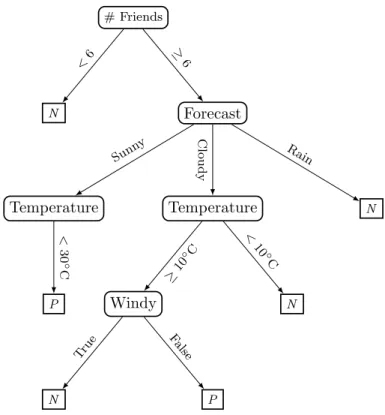
2.5 Decision Tree Example . . . 43
2.6 Example of perceptron . . . 46
2.7 Example of ANN . . . 47
2.8 Separating Hyperplane . . . 52
3.1 EURORA Architecture . . . 63
3.2 Eurora utilization on the first trace (BATCH1) . . . 73
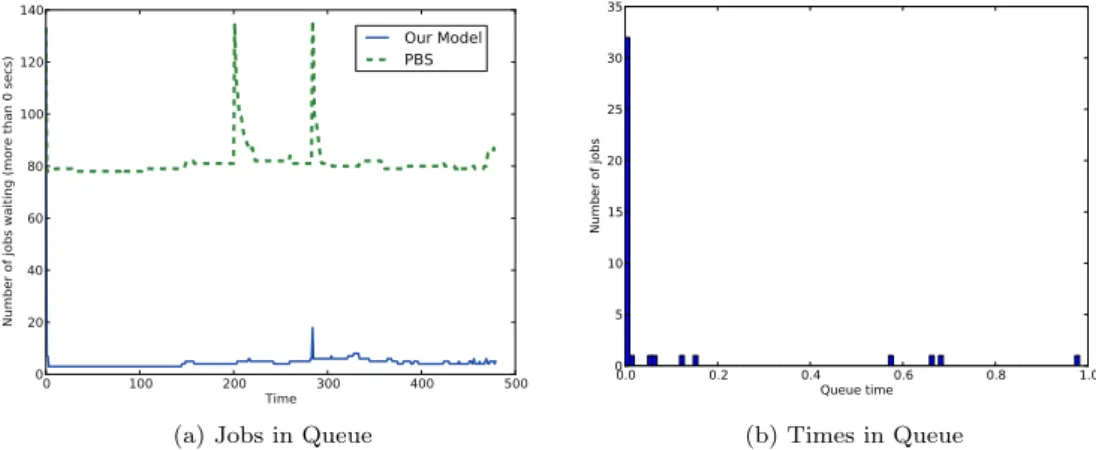
3.3 Waiting jobs and queue time for BATCH1 . . . 73
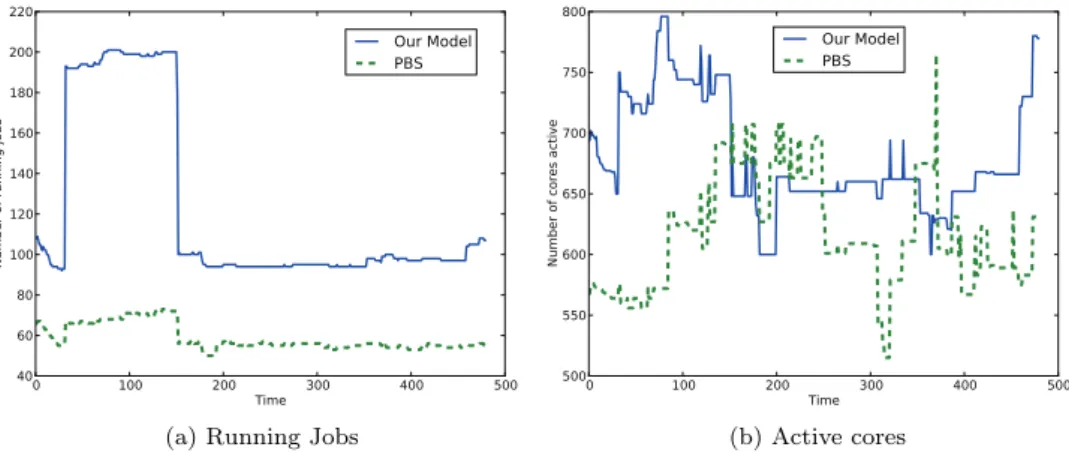
3.4 Eurora utilization on the second trace (BATCH2) . . . 74
3.5 Waiting jobs and queue time for BATCH2 . . . 75
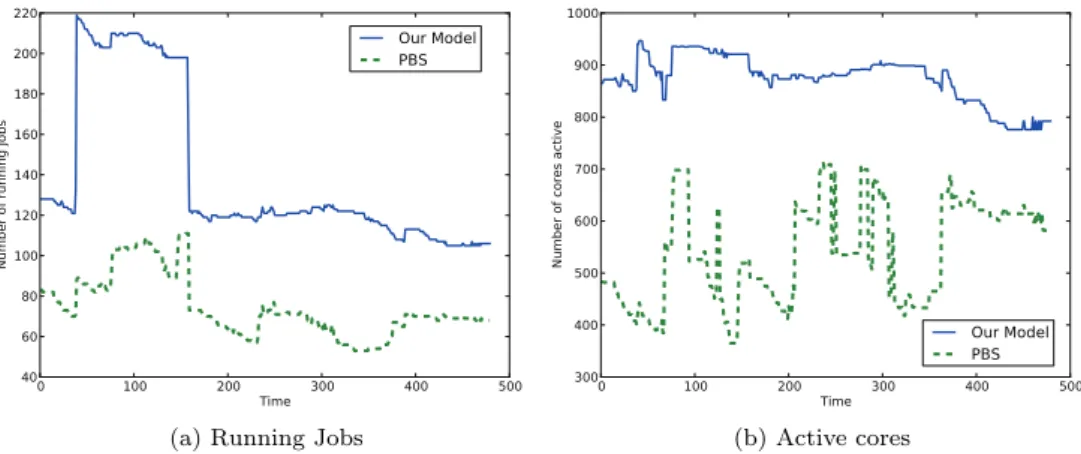
3.6 Eurora utilization on the third trace (BATCH3) . . . 76
3.7 Waiting jobs and queue time for BATCH3 . . . 76
3.8 Proactive dispatching VS PBS: an example . . . 77
4.1 HW data flow . . . 82
4.2 HW Data and Tables . . . 83
4.3 Jobs Info and Tables . . . 86
4.4 Percentage of requested resources, grouped by queue . . . 88
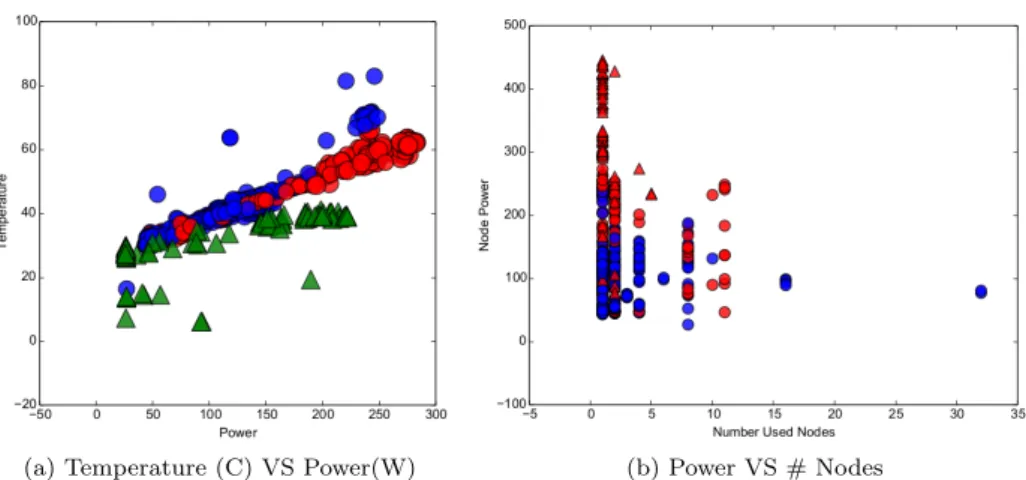
4.5 (a) Temperature and power for CPU and GPU; (b) Power Con-sumed and number of nodes used by job. . . 89
4.6 (a) Power and Load; (b) Power and Instructions Per Seconds. . . 89
4.7 Power and duration of a job, grouped by user . . . 90
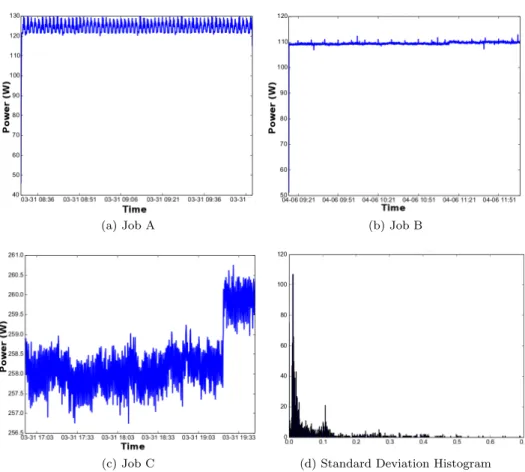
4.8 Real power consumptions of 3 jobs (A, B and C) and standard deviation distribution histogram . . . 93
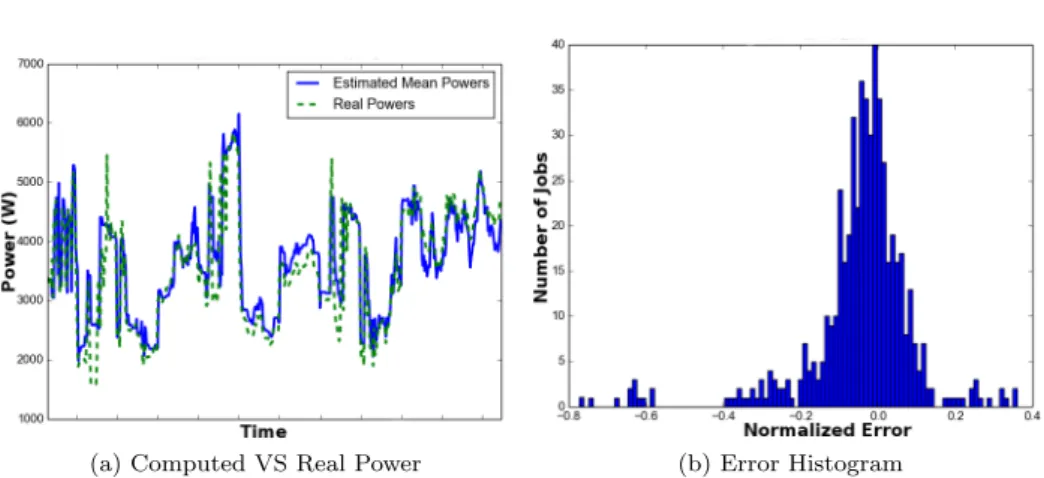
4.9 Comparison between the real aggregated power and the computed aggregated power. Mean Error: 0.011 . . . 94
4.10 Predictors Scheme . . . 96
4.11 Prediction errors histograms for two test sets . . . 97
4.12 Prediction error histograms of two different users . . . 98
4.13 Comparison between the real total power and the predicted total power. Mean Error: 0.056 . . . 101
5.1 Decomposition Scheme . . . 109
5.2 8 Node -Base Set . . . 114
5.3 8 Node -HighLoad Set . . . 115
5.4 8 Node -ManyUnits Set . . . 115
5.5 32 Node -Base Set . . . 116
5.6 32 Node -Highload Set . . . 116
5.7 Average BSLD; 50 jobs 300s; HS=0%; uniform distribution . . . 122
5.8 Average BSLD; 200 jobs in 300s; HS=0%; burst arrival . . . 123
5.9 Average BSLD; 400 jobs in 300s; HS=0%; burst arrival. Test-ing the importance of a power-aware job admission control for DynShare methods . . . 125
5.10 Uniform distribution . . . 126
5.11 Left-skewed distribution . . . 127
5.12 Burst arrival . . . 127
5.13 Average BSLD; 100 jobs from historical traces . . . 128
5.14 Average BSLD; 200 jobs from historical traces . . . 129
5.15 Average BSLD; 400 jobs from historical traces . . . 129
5.16 Average BSLD; 100 jobs from historical traces . . . 130
5.17 Average BSLD; 100 jobs in 900s; HS=0%; uniform distribution . 132 5.18 HPC cooling system scheme. . . 134
5.19 Overall cooling system power consumption (a) and correspond-ing PUE (b) for different Tamb and HPC workloads producing thermal powerPth. Maximum power budget as a function of Ta and PUE upper bounds (c). . . 136
5.20 Idle Power and Active Power Ratio VS Power Budget (%) . . . . 137
5.21 Base Problem - 100 Jobs (Duration increase and energy difference)150 5.22 Base Problem - 600 jobs) . . . 151
List of Tables
2.1 HPC Applications Taxonomy [FR96] . . . 10
2.2 Training Set Example . . . 42
3.1 Access requirements and waiting times for the PBS queues in Eurora . . . 65
3.2 An example of problem instance . . . 70
3.3 A feasible solution for the instance from Table 3.2 . . . 70
3.4 Models comparison, queue times . . . 70
3.5 Models comparison, system load . . . 71
3.6 Job traces composition . . . 72
4.1 CPUs tables entry fields . . . 84
4.2 Cores tables entry fields . . . 84
4.3 GPUs tables entry fields . . . 84
4.4 MICs table entry fields . . . 85
4.5 Boards table entry fields . . . 85
4.6 Jobs table entry fields . . . 87
4.7 Jobs to nodes table entry fields . . . 87
5.1 Eurora Cooling System Parameters . . . 135
5.2 Impact of the proposed power budgeting ambient temperature-aware on one year supercomputer center usage scenario. . . 138
5.3 Extensions Experiments Summary. Each value represents the percentage (%) of solved instances. . . 153
Chapter 1
Introduction
This work addresses the workload dispatching problem in High Performance Computing (HPC) systems – also referred to as supercomputers. Given a work-load composed by a set of activities (or jobs) the dispatching problem consists in assigning a pool of finite capacity resources and a start time to each activity to produce a feasible schedule, i.e. a schedule respecting the resource capacity constraints at any time. Job dispatching in supercomputers is a branch of the wider Scheduling and Allocation problem (S & A) that arises in several differ-ent computing fields. Workload dispatchers in real HPC systems must satisfy a number of different requirements, ranging from respecting the users’ needs to meeting system owners’ productivity goals. We are especially concerned with the issue of power consumption, a matter which is acquiring increasing relevancy along with the growth of worldwide HPC installed capacity.
Supercomputers peak performance, measured in FLOPs (floating point op-eration per second), has been growing steadily since their introduction in the 1960s and it is expected that the Exascale (1018) will be reached around 2023,
even though a handful of more optimistic estimates forecast the Exascale as early as 2020. Nonetheless, a very concerning obstacle towards reaching this goal is posed by the power consumption of nowadays HPC machines. Predic-tion trends indicate that simply scaling up current architectures would lead to unsustainable power demands (hundreds of MWatts). Several diverse research avenues are currently being explored in order to improve the energy efficiency of supercomputers by at least one order of magnitude, ranging from novel hardware solutions to improved system management.
HPC systems are large machines composed by numerous physical parts that need to be carefully orchestrated. An essential role of any software infrastructure overseeing a supercomputer is workload dispatching, whose policies and actions can have deep repercussions on the overall system performance. Job dispatching is a notoriously complex task, due in part to the sheer scale of the problem (supercomputers easily have hundreds or thousands of computing nodes where tens of jobs need to run simultaneously) and in part to its online nature, because optimization must be performed respecting real-time constraints (theoretically no delay to workload execution should be introduced by the dispatching system). This happens since the applications which are going to be submitted to the supercomputer are not known in advance (except a few exceptions) and therefore it is not possible to compute an optimal schedule offline, but a dispatcher must
rather be able to respond to unforeseen jobs arrivals.
The online requirement of HPC job dispatching coupled with the intrinsic difficulty of S & A problems (which have been known to be NP-hard since long time) has led to overwhelming preponderance of heuristic solutions, with an almost complete disregard of combinatorial optimization techniques. This is partially due to the fact that many combinatorial methods aim at finding exact, optimal solutions but typically require excessively long times to explore the space of possible solutions and have been therefore confined within domains where the optimization can be performed offline (i.e. embedded systems).
Nevertheless, if the exactness constraint is relaxed, i.e. settling for good solutions rather than optimal ones, combinatorial techniques have been proved to be very effective in finding solutions outperforming many heuristic approaches while respecting the time limit. For example, Constraint Programming (CP) has a long history of success when dealing with Scheduling problems. The important point is to find the right trade-off between solution quality and effort spent in searching for solutions. Another promising approach relies in decomposing the job dispatching problem in simpler sub-problems, reducing its complexity, and mixing methodologies from combinatorial optimization and heuristic techniques, exploiting their respective strong suits.
1.1
Content
We deal with the job dispatching problem in HPC systems which can be de-composed in two components: 1) the Allocation problem, i.e. choosing the set of finite capacity resources to be assigned to each activity and 2) the Scheduling problem, i.e. deciding the start time for each job in order to produce a feasible schedule that respect all the involved constraints. We are particularly interested in devising a power-aware solution capable to bound the power consumption of the HPC system. The main content of this work can be divided in three parts.
Scheduling & Allocation in HPC Systems: We begin with addressing the job dispatching problem on a real HPC system (namely the Eurora supercomputer hosted at CINECA in Bologna). We aim at finding solutions that maximize the Quality-of-Service perceived by users (measured in terms of waiting time) and at the same time maximize also the system utilization; these two goals are not mutually exclusive but finding the right trade-off is a non-trivial problem. Keeping the system utilization at a high level serves a two-fold purpose: 1) satisfying more users requests per period of time (with a positive effect for the system owners thanks to the higher revenues) and 2) reducing the number of idle computational units, which would otherwise consume significant amounts of unused power. We focus on devising an online job dispatcher and therefore the time needed to find a solution must respect strict limits.
While the vast majority of current job dispatchers present a reactive na-ture and their scheduling and allocation policies can usually be described by simple set of rules (i.e. First-In-First-Out), we define a novel, proactive job dis-patcher that explores a much wider space of possible decisions. At the core of our approach there is a Constraint Programming model. Due to the real-time requirements of online dispatching, the proposed approach does not strive to find optimal solutions but it specializes in finding the best among the feasible ones encountered within the time limit. We show that the proposed model leads
1.1 Content 3 to remarkable improvements in terms of both machine utilization and waiting times for queued jobs with respect to the currently used dispatcher, i.e. Portable Batch System (PBS).
Predictive Model for the Power Consumption of HPC Jobs: The funda-mental advantage of proactive dispatching is long-term reasoning over a group of activities rather then taking immediate, short-term rewarding decisions that can lead to performance degradation over longer periods. An effective reasoning process relies on the possibility of making informed choices, i.e. the dispatcher needs to evaluate the consequences of its scheduling and allocation decisions. A good schedule can be produced only if we know at decision time (within a degree of confidence) how a workload will evolve; for example, job dispatchers tend to assume that the amount of resource requested by each activity will be constant throughout its whole duration.
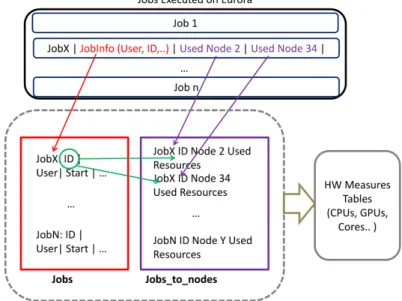
Having this in mind it is clear that, in order to preserve the benefits provided by a proactive dispatcher while adding power awareness, the ability to predict the power consumption associated to any workload before its execution assumes a critical importance. We therefore consider the problem of estimating the power consumption of HPC applications using predictive models created with Machine Learning techniques. For this scope, we implemented an information gathering infrastructure that assembled measurements from a variety of physical sensors (such as power consumption, temperature, etc.) on the Eurora supercomputer. We then take advantage of this infrastructure and the collected information to create a data set that we use to train a collection of predictive models to estimate the power consumption of any job. These models take as inputs only information available at dispatch time. We then tested the quality of our predic-tions against historical traces of past workloads executed on the supercomputer. The results of our analysis show that the power consumption of each job, in-cluding jobs never encountered before, can be predicted with a very high level of accuracy.
Power-Aware Job Dispatching: Finally, we take into account the power-related issues and we propose two methods to create a job dispatcher able to contain the power consumption of a real HPC system within an administrator-decided power budget. To reach this end we devise two approaches: 1) a heuris-tic algorithm and a 2) hybrid approach that decomposes the problem in the scheduling stage and the allocation stage, solving the former via Constraint Programming and the latter with a heuristic technique. The introduction of the power constraint adds a new layer of complexity and consequently we refrain again from obtaining optimal solutions due to real-time constraints. The goal of the dispatcher is to minimize the performance degradation and QoS decrease that are inherently associated with the imposition of a bound on the power consumption.
The approach we propose is orthogonal to the most commonly used tech-niques in today’s supercomputers, which generally rely on power monitoring infrastructure and dynamic power management through an intervention on the performance of computational resources, i.e. reducing the operating frequency of a CPU leads to a decreased power consumption. In our method we want to act on the Scheduling & Allocation decisions alone, for example with a careful planning of the execution order. Since Scheduling & Allocation decisions take place during the dispatching phase the capability of estimating the power
con-sumption of any HPC job during this phase assumes a paramount importance. For this reason we integrate into the dispatcher the ML models to predict jobs power consumptions described previously.
The experimental analysis reveals that our approach is able to outperform the current State-of-the-Art methods used in power capped supercomputers. Moreover, we demonstrate that it is possible to combine our approach with other techniques such as those acting on the computing node performance; mix-ing non-mutually exclusive methods allows to exploit their respective strengths, resulting in the best final outcome. We apply our dispatcher to a real super-computer (again the Eurora HPC system), taking into consideration its cooling infrastructure, and we show how the novel power capping method enables to maximize the supercomputer efficiency. Lastly, we consider the case of variable power budgets focusing on the case of sudden power cap decrease, i.e. criti-cal situation where the power consumption of the current workload must be drastically lowered due to the malfunctioning of other components of the HPC machine. We therefore add a module to the power capped dispatcher that is able to cope with these situations through a reduction of the computing nodes performance.
1.2
Contribution
This work is positioned at the intersection of High Performance Computing, combinatorial optimization and Machine Learning. The main contributions of this work regard the development of novel approaches to solve Scheduling & Allocation problems in the context of High Performance Computing, with a special emphasis on power-aware solutions. In particular we both applied state-of-the-art and devised original methods belonging to the area of combinatorial optimization and Machine Learning in order to tackle S & A in supercomputers. The contributions of this work are the following:
A novel, proactive, Constraint Programming based job dispatcher for su-percomputers. The basic idea of the CP model is to consider multiple jobs (i.e. all jobs in the waiting queue) whenever a new schedule is com-puted and explore a broad space of possible solutions, instead of using the reactive, rule-based policy adopted by the vast majority of current supercomputers. The use of Constraint Programming allowed us to beat the system currently adopted on the HPC machine used as a case study and at the same time the high flexibility of the CP paradigm simplifies the implementation of the new model to other real world systems. This work was published in [BBB+14].
A new methodology to develop predictive models to estimate the power consumption of HPC applications employing existing Machine Learning techniques. The most important element we provide is the development and description of the entire process leading from the data collection in-frastructure to the creation and use of the predictive models. We deal with several challenges that arise in real supercomputer, ranging from establishing the minimal amount of data needed to guarantee a good pre-diction accuracy and how to create a good training set to feed the Machine Learning models starting from the raw measurement data. We devise a
1.3 Outline 5 method that was tested on the historical power consumption traces of a real system; a key strength of our approach is the possibility to be applied to different systems. This work was partially presented in [BBL+16a]
Two novel approaches to deal with the problem of job dispatching in a HPC system with power cap. We propose a heuristic algorithm and an innovative hybrid technique combining CP and a heuristic technique. The hybrid methods is loosely inspired by the decomposition techniques found in the combinatorial optimization literature but solves the problem in a new way. The comparison with the state-of-the-art power capped job dispatchers in HPC reveals that our methods perform extremely well. Moreover, our approach is extremely flexible and can be easily integrated with different techniques from the state-of-the-art in order to achieve even better performance or address sudden changes in the available power bud-get. Parts of this work have been published in [BCLB15, BCL+15] and
another part (the comparison with the state-of-the-art) should appear on the journalTransactions on Parallel and Distributed Systems.
1.3
Outline
The structure of the thesis is the following. Chapter 2 gives a panoramic overview of the Scheduling & Allocation problem in HPC machines, with a particular focus on power related issues. The chapter also provides a brief in-troduction and state-of-the-art discussion on the enabling methodologies used to tackle the main problem, namely the Constraint Programming paradigm and Machine Learning. Chapter 3 then formally introduces the job dispatching prob-lem and presents a model to solve it. Chapter 4 addresses the issue of predicting the power consumption of HPC applications, describing the predictive models created for that purpose and the data collecting process employed to gather the information needed to effectively use Machine Learning techniques. Chapter 5 introduces the power dimension to the job dispatching problem. The chapter describes a novel job dispatcher able to bound a supercomputer power con-sumption and compares its performance with other methods from the current state-of-the-art.
Chapter 2
Related Work
This chapter gives a panoramic view on the existing research related to High Performance Computing systems, with a focus on optimization of workload man-agement. The chapter is split in three main subsections. First, Section 2.1 intro-duces the High Performance Computing problem, focusing on the main issues considered in this work, i.e. workload management optimization and power-awareness. Afterwards, the following sections discuss the enabling technologies that will form the grounds for the approaches presented in the rest of the work. Section 2.2 considers the Constraint-Based Scheduling approach, describing the Constraint Programming paradigm and its application to Scheduling and Allo-cation problems. Section 2.3 discusses Machine Learning, its techniques and its relevance in High Performance Computing setting.
2.1
HPC systems
The term High Performance Computing (HPC) systems – also called super-computers– refers to machines with very large computational capacities, which have reached nowadays tens of PetaFLOPS1, i.e. the number of floating point
operations per second. Trends in the last twenty years show an exponential increase of the peak performance; following these trends the ExaFLOPs (1018)
scale is expected to be reached in 2020-2023 [KR13, Kha11]. Supercomput-ers are used in a wide range of computationally intensive applications, such as weather forecasting, physical modeling, aerodynamic research, probabilistic analysis, molecular dynamics simulation and many others [Rus78,AAA01,Jos97, KAB+00, Gid86, CW03, Mis90, EHB+13, CKL+13, ABD+14, MKM15, VFHB14,
HBBD16, KHO+16]. HPC systems are also part of those computing centers
which play a key role in modern ICT architectures, running our internet ser-vices, managing several infrastructures, making our research possible.
Whereas earlier HPC systems used innovative designs and parallelism to achieve superior computational performance [CLHH09] and usually only a few processors, since the end of the 20th century machines with thousands of pro-cessors began to appear and today supercomputers are usually composed by a very large number (tens or hundreds of thousands) of “off the shelf”, general
1FLOPS is an acronym for FLoating-point Operations Per Second, 1 PetaFLOPS
(a) Eurora (b) Fermi
Figure 2.1: Two supercomputers hosted by CINECA [CIN] in Bologna
purpose processors – CPUs, graphical units, hardware accelerators – linked by fast connections [HJS00, HT89]. As the number of components increases, su-percomputers managers have to address and solve numerous challenges in order to guarantee good performance for the customers and maintain reasonably low functioning costs for the owners. Another aspect adding an additional layer of complexity is the heterogeneous nature of the HPC systems, since they may in-clude various types of resources (CPU, HW accelerators, Random Access Mem-ory, hard disks,..), as well as various different kinds of computing units, each of them with specific characteristic and ability to fulfill different requirements.
Typically, supercomputers have several users which submit their own com-putationally intensive applications (usually called “jobs” or “tasks” in the lit-erature). These jobs need to be assigned to a portion of the system resources – according to their requirements – and then be executed. From the users point of view the notion of good performance entails that the applications are correctly run and complete their execution, possibly with the smallest delay possible be-tween the submission of the task and its start. Conversely, HPC systems owners must satisfy all the users requests but at the same time have their own peculiar set of concerns: keep as low as possible the operational costs of the machine (power consumption – see Section 2.1.3, maintenance costs..) while maximiz-ing profits2, i.e. servicing the greatest possible number of customers without
degrading users’ performance.
2.1.1
HPC Workloads
The behaviour of a supercomputer strongly depends on the characteristics of the applications running on it, i.e. its workload [CS93, CCF+99, Stu, YZ13b].
Typically, users submit their jobs into the system specifying a set of resource requirements. For example each job may specify the number of execution nodes,
2They also have to take into account the finite lifespan of HPC machines, usually no more
2.1 HPC systems 9 the number of needed CPUs, the number of hardware accelerators (such as GPUs), the amount of volatile memory (RAM), etc. In most of HPC systems users must also declare an estimated maximum duration for each submitted job, the wall time, and if the job lasts longer than this expected duration the workload manager is authorized to kill the job. For this reason, users tend to over-estimate the wall time of their applications, in order not to risk their task being killed.
In the literature there are several works dedicated to model HPC work-loads [LF03,DF99,Dow98,MHCD10,AF01], which are useful to understand how systems are used and what could be done to improve their performance (and this is especially important in large scale system). Usually, workload models are composed by the set of statistical distributions describing the parameters characterizing HPC tasks, i.e. the runtime, the amount of requested resources and resource actually used, network communications, etc. The data used to create these models can be generally found in the accounting logs generated by HPC systems.
Cirne et al. [CB01b] investigate the relation between requested time and the real execution time and then study the jobs arrival pattern of several different systems. As it turns out, the arrival pattern of HPC applications is strongly de-pendent on the considered system (it is not trivial to generalize the observations made on a particular supercomputer) and there is a clear correlation between requested and execution time.
2.1.1.1 HPC Jobs Models
The vast majority of applications executed on supercomputers belong to the class ofparallel jobs, that is they are composed by independent communicating activities. From the dispatcher point of view parallel jobs can be broadly divided in four categories. Such categories depends on how and when the amount of requested resources is specified; such an amount can be specified by the user (either within the program itself or through the job submission specific format) or it may be decided by the dispatcher. Moreover, the resource used (number of nodes, cores, etc.) can be fixed at the start of the execution or it can vary dynamically at run-time [Str03, HJS+04].
The categories are the following (summarized also in Table 2.1):
Rigid jobs require a fixed number of resources, no more nor less than the amount specified by the user at submission time; they are fine-tuned for specific resources configurations and they cannot cope with situations such as a reduction of the number of available cores. These tasks are commonly written in the message passing paradigm (MPI [mpi16, GLDS96]), where all communication between processors is designed to have low latency. Evolving jobs may change the number of used resources at run-time; it is
important to notice that the change is initiated by the application itself. The system must satisfy the request or the job will not be able to continue its execution. The scheduler is only aware of the amount of resources needed by the application at any time.
Moldable jobs have a fixed amount of resources which is determined by the scheduler when the job starts; the decision of the scheduler depends on
who decides when the decision is taken at submittal at run-time
User Rigid Evolving
System Moldable Malleable
Table 2.1: HPC Applications Taxonomy [FR96]
the job properties and on the state of the system. Moldable jobs usually work with a wide range of resources, but also have a minimum number of resources to use; additional resources might improve the performance, possibly up to a saturation point.
Malleable jobs can run on a variable set of resources and the configuration change is initiated by the system. The scheduler decides if the job has to release resources or if additional ones are assigned; the job has no influence on this decision.
Nowadays, the vast majority of HPC applications running in supercomputers belong to the rigid category. There are two main reasons behind this prefer-ence: 1) managing rigid jobs is much simpler than the dealing with the other job models, thanks to their fixed amount of requested resources; 2) rigid jobs require a fine-tuned set of resources, often carefully optimized by the user, and that implies that their behaviour can be reasonably predicted – conversely, us-ing different configurations might have unexpected repercussions (both positive and negative) on an application performance. However it is important to notice that rigid jobs have indeed their disadvantages, in particular their lack of flexi-bility can easily lead to an increased resource fragmentation and/or not optimal performance.
Research in the moldable jobs area is very active and has lead techniques that are currently experiencing a rise in their adoption [CB00,SKS03,SSK+02,CB02,
SLS06, HSC09, HHTC14]. Many modern applications written in MPI [mpi16] exhibit moldable features, allowing them to choose to exploit different paral-lelisms for execution just before their start. Downey [Dow97] studies the run-time speedup of moldable jobs with different numbers of allocated processors and builds a model for them. Using this model as basis, Wu et al. [WTJ+15]
investigate how resource allocation affects the average turnaround time of mold-able jobs in clusters.
Cirne et al. [CB01a] propose a workload model for moldable jobs, which is based on a users’ survey and analytical models. Their moldable job model takes as input a rigid job with only one known shape (partition size and execution time) and provides as output a realistic set of shapes for the job. Some existing supercomputer workload management systems already support submission of moldable jobs. For example, Load Sharing Facility (LSF) [lsf16], owned by IBM, lets users specify a range of processors requirements at submission time. However, its scheduling mechanism for moldable jobs is quite simple, basically adopting a greedy method to allocate as many processors as possible within the range specified by a moldable job.
The benefits granted by evolving and malleable jobs have been studied ex-tensively in the literature [NVZ96, GTU91, MVZ93, CV96, SML+07, UCL04],
al-2.1 HPC systems 11 though very few works went beyond the proof of concept phase. Typically, these analysis compare the cost of dynamic reconfiguration to the performance improvement but fail to give a full picture. Dynamically changing the number of resources in most cases requires complex interactions between the operating system and the application run-time system [ABLL92] and this complexity of-ten makes the implementation of malleable (or evolving) jobs too hard for real machines. A few works have tried nevertheless to exploit dynamic adaptability within data centers and HPC systems [Kal93, KAJ+12, AGJ+14].
2.1.2
HPC Systems Dispatching Problem
In order to optimally manage a HPC system a wide array of issues, which may arise in different phases during the life of these systems, needs to be addressed; many of these issues can be framed as optimization problems (finding the best solution from all feasible solutions). An essential element to successfully deploy a HPC job is deciding which resources will be allocated and providing an efficient run-time schedule, balancing the system users and owner different needs. This task is often referred to asScheduling & AllocationorDispatching problem and it is a widely studied in the literature [Gre75, ET96, ABSM01, MBS01, BSM01, SDA96, HL05]. In addition toallocation, the task of assigning a set of resource to an application is also referred to asmapping; in the rest of this work we will use both equivalent expressions. To summarize, the fundamental aspects of the HPC dispatching problem (as we are going to see in Chapter 3) consists in 1) optimally allocating the resources required by each task in its description, and 2) provide an optimal job execution order (explicitly assigning a start time to each task).
The problem of mapping and scheduling a set of tasks to different machines has been shown to be NP-complete in the general case [GJ79, BLK83, LKB77, FB89, IK77] as well as some restricted cases [Ull75], such as scheduling tasks with one or two time units to two processors and scheduling unit-time tasks to an arbitrary number of processors. The problem complexity is the reason why the majority of the approaches adopted in real-world systems rely on heuristic techniques and are more committed to finding feasible solutions rather obtaining optimal ones.
We can distinguish betweenofflineandonlineapproaches to the dispatching process. In the former the allocation and the schedule are computed before the actual execution; this method requires many details regarding the workload to be known a priori. For example, this approach is useful in the case of embedded systems because these devices usually run the same set of applications during their entire lifetime. In the HPC setting the required knowledge about the jobs which are going to run on the supercomputer is a major drawback, since it is not always possible to know in advance which tasks are going to be submitted by the users (except some particular cases, i.e. weather forecast applications need to run periodically). In the second approach, online methods, mapping and scheduling decisions are taken atrun-time, upon the arrival of new tasks in the system. On one hand this removes the requirement of oracle-like knowledge of workloads, but on the other hand the mapping/scheduling algorithm must be extremely fast – preferrably with constant or low-degree polynomial time. Since, as mentioned before, multiprocessor allocation and scheduling on bounded re-sources is NP-hard, online approaches, in general, cannot guarantee optimality,
but they concentrate on satisfying “safe acceptance” criteria, i.e. schedulable tasks may be rejected but non-schedulable ones will never be accepted.
The problem of parallel job scheduling on HPC systems and large data cen-ters has been extensively studied for many years [FR95, FR97, Fei97, CCS+06,
MCF+98,TTDB13,CPS+96]. Existing mapping and scheduling approaches
typ-ically assume to have a precise and formal description of input applications (i.e. the jobs to be scheduled), able to explicitly expose task parallelism. For exam-ple, in the HPC context usual applications are composed by independent tasks executing without interfering with others, each having its own subset of assigned and non-shared resources. Usually an abstract representation of the system re-sources is supposed to be available. In [FRS+, FR98] Feitelson et al. carry out
a thorough review of theoretical and practical results in the field, providing an insightful classification of different scheduling methods.
2.1.2.1 Existing Heuristics Techniques
As said previously, online job dispatching presents strict time constraints and therefore a common way to cope with this problem in real time is to use heuris-tic approaches, which do not guarantee optimal solutions but conversely are extremely fast. For example, the forefather of all scheduling algorithms might be theFirst-Come-First-Served (FCFS) scheduling algorithm, which is also re-ferred to asFirst-In-First-Out, FIFO, policy. FCFS is a simple and static job scheduling policy, where a job is served on arrival basis; it is a classic example of a very simple but quick algorithm to decide which job to schedule – the first job to enter the system is also the first to be executed. While FIFO and its basic variants are extremely fast, their excessive simplicity is not well suited to deal with the complexity of job dispatching in a HPC system; for instance, a job requiring a large amount of unavailable resources can prevent the execution of other later jobs that would fit on the system. In many circumstances it could be more useful, from the system level perspective, to delay the execution of certain jobs disregarding their arrival time.
Currently, the vast majority of existing approaches, both in the literature and in real systems do not explore in depth the solution space. Most dispatchers settle with “good” solutions, neither globally nor locally optimal. Most commer-cial solutions, like PBS [Wor15] or Torque [Sta06] follow this approach. In many systems the burden of producing good schedules is still a task strictly reserved to system administrators. While their expertise in the field helps them reach-ing good practical solutions, the implicit complexity, with its multiple resource constraints and conflicting objectives, naturally makes the HPC job dispatching problem well suited to be addressed exploiting more advanced and automated optimization techniques. In the next paragraph we are going to discuss three commonly used heuristic techniques categories.
Backfilling Algorithm An important component of many commercial dis-patchers is thebackfillingalgorithm [FRS05,SF09,SF03], which extends the core FIFO algorithm. The main idea of this algorithm is to fit smaller jobs on re-sources not used by the system due to fragmentation. Therefore, the jobs in the queue are executed (partially) disregarding the submission or priority order. In practice smaller jobs are moved ahead in order to fill gaps in the schedule, if they do not delay the execution of other jobs waiting in the job queue. This widely
2.1 HPC systems 13 spread technique must be used carefully because it can lead to fairness problems (newly arrived jobs can be executed before those waiting from a long period) and, in more dangerous cases, to starvation (the new jobs that keep on arriving prevent an old, low priority job to begin its execution indefinitely) [YWZL14].
The most commonly used version of the backfilling algorithm is the so called
EASY backfilling algorithm, introduced by Mu’alem and Feitelson in [MF01]. This algorithm is a more aggressive version of typical backfilling methods be-cause it moves ahead small jobs to fill holes in the schedule provided that they not delay only thefirstjob in the job queue – in opposition to the more standard approach which requires all or multiple waiting jobs not to be delayed by the backfilling action. The performance of EASY backfilling depends heavily on the workload but in the majority of cases it performs better than more conservative backfilling algorithms. The same paper presents also a very interesting result: backfilling actually works better when users overestimate jobs run-times by a substantial factor.
Another backfilling technique is theK-reserved basedpolicy [ABM11], where each job in the waiting queue has a counter containingK number of times that it has been overtaken by subsequent requests. K-reserved based policy works by defining a window of waiting jobs of sizek, ordered in FIFO fashion. If a new job with high priority enters the system, the oldest job waiting for allocation can be bypassed provided the subsequent job is within a window ofK consecutive jobs that start with the oldest waiting job. When all jobs within the window have been started, the backfilling mechanism is suspended until a large-enough set of resources becomes available for allocation to the oldest job, at which point the window is moved forward to the next oldest waiting job. This strategy tries to combine the benefit of backfilling (out-of-order execution) without disrupting the fairness of FIFO policies.
The behaviour of many heuristic scheduling techniques depends on the esti-mate of job durations, i.e. the preference is often given to shorter jobs. Usually an estimate is provided by the user at submission time, but this value might be inaccurate. In fact users typically over-estimate the duration of a job be-cause they do not want their application to be abruptly terminated bebe-cause the allotted time slot has expired while the job is still running. To deal with this issue, Tsafrir et al. [TEF07] propose a backfilling algorithm (EASY++) which does not rely on the user-provided duration estimate but instead employs a system-generated duration prediction.
Lawson et al. present [LSP02] a self-adapting, multiple-queue backfilling algorithm for parallel systems that directs incoming jobs to different queues according to the user-estimated job execution time. The key idea is to separate short and long jobs (using two distinct queues) thus decreasing the likelihood that a short job is overly delayed in the queue behind a very long job. Each queue is assigned to a non-overlapping partition of system resources on which jobs from the queue can execute; these partitions dynamically adapt in response to the workload evolution and system utilization.
Gang Scheduling Many scheduling techniques employed in real time sys-tems adopt thepreemptionmechanism [ZRS87, SA˚A+04, KSS+05, Ves07, CV01,
Sch96]: jobs can be stopped and re-allocated (possibly in different resource par-titions). This means jobs do not have to run to completion once they have
started and the scheduler can interrupt the execution of a job at any time for starting a different job; the total processing time is not affected by preemption. Despite the proven fairness of preemption and time slicing techniques [SY00], these mechanisms are not widely used in real HPC systems due to the require-ments in terms of hardware (high interconnection bandwidth is needed) and software (due to limitations on the message-passing architecture).
An extension of the base preemption is the ability to preempt all the sub-tasks of a parallel job at the same time, as well as restarting all the members of another job. This mechanism is called gang scheduling [Ous82, FR92, Fei96, FJ97]. In this case preemption is used to improve performance in face of un-known run-times. Gang scheduling prevents short jobs from being stuck in the queue waiting for long ones, and improves fairness. Gang scheduling works with every programming model, but has some limitations: the overall system perfor-mance is not always optimal, though it benefits individual jobs. There could also be a high overhead due to processors fragmentation and context switching.
Priority Rules Based Scheduling Many heuristic algorithms used to quickly produce good quality schedules fall in thePriority Rules Based (PRB) schedul-ing category [Hau89, THS02, KA96, SL93, ERL90]. The main idea underlyschedul-ing these methods is to sort the set of tasks which need to be scheduled, construct-ing the ordered list by assignconstruct-ing a priority to each task. Tasks are selected according to the priorities order and each selected task is mapped on the re-quested resources and started (if there are enough resources available), trying to minimizes a cost function. The algorithms in this category provide schedules of good quality and their performance is comparable to other approaches, usually with lower scheduling times [KA99].
The rules used by PRB algorithms can be fairly simple. For instance, Small-est Job First(SJF) [Lam14] andLargest Job First (LJF) [LC91] update the job queue – the jobs waiting to be executed – in, respectively, increasing and de-creasing order in terms of job size3. The jobs are then selected for execution
drawing them from the sorted queue. Other examples of job queue ordering are
Minimum estimated Execution Time (MinET) andMaximum estimated Execu-tion Time (MaxET), that sort the jobs depending on their expected durations – in an ascending and descending order, respectively.
PRB algorithms are often coupled with simple allocation strategies, such as
First-Fit (FF), a strategy that, as the name says, tries to map a job in the first partition of system resources that can satisfy the job requirements. Alterna-tively, also the order in which the set of available resources is considered can be influenced by priority rules. For example, a power-aware job dispatcher op-erating in a heterogeneous supercomputer can prefer computational nodes with lower power/energy consumption (given that more than one node can satisfy the resources request).
We distinguish two approaches which are part of the PRB scheduling class. The first method is known as serial or list scheduling [KW59]. In algorithms belonging to this typology, at every stage the set of already scheduled activi-ties and a decision set – containing activiactivi-ties whose predecessors have all been scheduled and thus can in turn start themselves – are identified. The priority
3Job size can be defined in different ways, for example job duration, job width (number of
2.1 HPC systems 15 rules are used to select an activity from the decision set and then this task is scheduled at the earliest possible time, guaranteeing to respect precedence and resource feasibility constraints. The other approach is generally called parallel scheduling [BB99]. In this method, at each stage the set of activities which can be scheduled, the decision set, contains only those tasks whose precedences and resource requirements can be satisfied in that time instant; among those activities a single one is selected using the priority rules. The main difference compared to the serial method is that resources and their finite capacities are considered when building the decision set, rather then when the start times are assigned.
An example of priority rule-based heuristic applied to a resource constrained scheduling problem can be found in [BK07]. The exact problem tackled by the authors consists of the scheduling of a set of activities which can be split if nec-essary. All resources considered are renewable and each resource unit may not be available at all times due to resource vacations, which are known in advance. Splitting an activity has a direct cost and impact on the total completion time and this is taken into account in a priority rule-based heuristic which allows to control activity splitting (i.e. minimize the number of times it happens). Klein et al. [Kle00] present several heuristics and meta-heuristics aimed at dealing with real-world resource constrained project scheduling problems. Tradition-ally, such heuristics construct a schedule by planning in a forward direction starting from the project’s beginning; this work introduces new backward and bidirectional planning strategies, integrating them into priority rule-based al-gorithms. Kolisch et al. [Kol96] provide an analysis of several classical priority rules used for resource constrained project scheduling, showing their limitations and drawbacks, and then propose two new rules which lead to a better manage-ment of the finite-capability resources.
Chandio et al. [CXT+13] investigate the performance of several job
schedul-ing strategies in large-scale parallel computational systems. They conducted their experimental evaluation on a real system with several heterogeneous work-loads, taking into account different metrics to establish the best scheduling pol-icy. Their analysis revealed that a single policy is not sufficient for resource management in parallel computing environments. This happens because differ-ent operational conditions and workloads are best served by differdiffer-ent schedul-ing strategies; to overcome this limit, they suggest the adoption of dynamic and adaptive policies. Aida [Aid00] investigates the impact of job sizes on the scheduling policy performance. The paper evaluates the performance of job scheduling algorithms under various workload models, composed by different ty-pologies of jobs (with different average sizes). The results indicate that, broadly speaking, algorithms classified in the first-fit category are less affected by jobs sizes than priority rules-based techniques.
2.1.3
Power/Thermal Considerations
The large number of processing units employed in current HPC machines re-quires a huge amount of electrical power, creating many power related issues (i.e. thermal design power, CPU power dissipation, power consumption) which generally have greater relevance than the case of more traditional computing systems due to the sheer number of involved resources.
has been guided by the “performance at any cost” mentality, which aimed at increasing the computational capability with an almost complete disregard of corollary issues. This attitude is perfectly exemplified by the Top500 list [DMS94], which ranks the best supercomputers in the world depending on their computational peak power (GFLOPS)4. This mentality has to be abandoned
because it is no longer sustainable due to the power aware considerations limit-ing the further growth of HPC systems [Fen03]. New solutions and more energy efficient approaches need to be developed and applied to the next generation of supercomputers if we want to reach the Exascale [FFG08].
The growing concern about power consumption and dissipation issues in supercomputers led to the birth of Green500, an organization that ranks the Top500 supercomputers based on their energetic efficiency [FC07]. The Green500 list takes into consideration an energy efficiency metric, GFLOPS per Watt (GOPS/W), for “big” enough supercomputers, i.e. able to pass the 96 TFLOPS threshold. Nowadays, the most powerful system is Sunway TaihuLight which reaches 93 PetaFLOPS with 15.371 MWatts of power dissipation [FLYeA16]. Thanks to its innovative design, it is also ranked 3rd in the Green500, with
6.05GigaFLOPS/Watt. The second fastest machine (and record holder from 2013 until 2016) is Tianhe-2 and can be found at position 33rdof the Green500,
with 1.9GigaFLOPS/Watt.
Exascale supercomputers built with today’s technology would led to an un-sustainable power demand (hundreds of MWatts of power) while according to [BBCea08] an acceptable range for an Exascale supercomputer is 20MWatts. For this reason, current HPC systems must significantly increase their energy efficiency, with a goal of 50GFLOPS/W. Today’s “greenest” supercomputers achieve around 9 GFLOPS/W, thus a wide gap still needs to be closed in or-der to satisfy Exascale requirements. Koomey et al. [KBSW11] examined the relationship between computing power and electricity required to operate a com-puting unit. The conclusion is that computation per kilowatt-hour has doubled every 1.575 year. While this is a promising finding, the implications for the
HPC context still have to be clarified [SSSF13].
A detailed survey of the research on power management techniques for high performance systems can be found in [LZ10, CGF05]. As clearly pointed out by Hsu et al. [HFA05], a change of the current perspective is required: the fo-cus must shift from performance-based metrics (such as the performance-power ratio) to new ones which take into account different aspects of the problem, i.e. integrating the notions of total cost of ownership, productivity and relia-bility. Wilde et al. [WAS14] complain that most of the research in the field of power-aware systems tends to focus on specific areas and does not try to com-bine its findings with the results obtained in different (but related) sectors. To overcome this situation they propose a comprehensive Framework for Energy Efficient HPC Data Centersthat should be used by infrastructure managers to evaluate their systems from a holistic point of view. They identify four “pillars” establishing the basis of the evaluation: 1) Building Infrastructure; 2) HPC Hardware; 3) HPC System Software; and 4) HPC Applications. While most HPC centers already perform partial optimizations within each of the pillars,
4The rankings are based on the score obtained while running HPL [PWDC], a portable
implementation of the high-performance LINPACK benchmark written in Fortran for distributed-memory computers
2.1 HPC systems 17 optimization efforts crossing the pillars’ boundaries are still rare.
The power consumed by HPC systems is converted into heat, therefore, beside the IT power strictly needed for the computation, the additional power consumption of the cooling infrastructure must be taken into account. The extra infrastructure needed for cooling down the HPC systems has been proved to be a decisively limiting factor for the energy performance [Bel07]; a common approach taken to address this problem is the shift from air cooling to the more efficient liquid cooling. To further reduce the cooling cost HPC systems uses hot water recycling and free-cooling solutions [KRA12a]. Indeed when environmental conditions allow it, it is possible to decrease the computing units’ temperatures through direct exchange of heat with the ambient. The amount of heat removed with this approach is proportional to the temperature gradient between the supercomputer outlet temperature (water or air) and the inlet ambient temperature. During cold days the gradient increases, enabling a larger heat portion to be removed without switching on the chillers. At the same time a hot internal temperature (i.e. hot-water cooling) increases the heat exchanged with the ambient.
A broadly used metric for power efficiency is the PUE index (Power Usage Effectiveness), i.e. the ratio between the power consumption of the whole data center and the power consumption of the IT equipment alone. Equation 2.1 illustrates how PUE is computed, given that PT is the total amount of power
consumed by the whole HPC facilities andPIT is the power consumption of the
IT equipments.
P U E= PT PIT
(2.1)
Nowadays PUE is by far the most widespread metric to evaluate the power efficiency of HPC systems, but it is not exempt from flaws. For example Yuventi et al. [YM13] argue that PUE is an instantaneous representation of electrical energy consumption that encourages operators to report the minimum observed values of PUE. Hence, PUE only conveys an understatement of the minimum possible energy use. As a fix they propose the use of different energy-based metrics or average PUE over a significant time period (e.g., a year).
One mainstream solution to reduce the gigantic power consumption is to employ efficient hardware or efficient design. By doing so, it is possible to obtain remarkable reductions of the PUE index. However, reducing the PUE is just a half of the problem. Data by McKinsey [McK] for US data centers reveals that, on average, only 6-12% of the power is employed for actual computation. The reason for this dramatically low value lies in how efficiently the existing IT resources are used. In particular, redundant resources are usually employed to maintain the quality of service under workload peaks. More redundant resources are also needed to compensate for the fragmentation resulting from suboptimal dispatching choices. As a consequence, a typical data center ends up packing a lot of idle muscles. Unfortunately, idle resources still consume energy: for a 1MW center with a 1.5 PUE, a 30% utilization means a 1Me annual cost and 3,500 tons of CO2. In this context, optimization techniques can enable
dramatic improvements in the resource management, leading to lower costs, better response times, and fewer emissions.
The rest of this section is devoted to describe some of the most commonly used approaches to create power-aware HPC systems.
2.1.3.1 Over-provisioning
Supercomputers’ components such as CPUs and memory possess a vendor-specified Thermal Design Power (TDP) corresponding to the maximal power required by the subsystem. Generally, the maximum power consumption of a HPC system is determined by the sum of the TDP of its subsystems to take into account worst-case scenario where all components work at their TDP level. This design approach is called worst-case provisioning and can be optimal in contexts where power is plentiful and nodes are scarce resources; since power is now one of the limiting factors in HPC systems, worst-case provisioning became a drag on performance. An alternative solution comes from the observation that the system components rarely operate at their TDP limit. Recent advances in processor and memory hardware designs have made it possible to control the power consumption of the CPU and memory through software. The ability to constrain the maximum power consumption of the subsystems below the vendor-specified TDP value allows us to add more machines while ensuring that the total power consumption of the data center does not exceed its power budget, i.e. over-provisioning[SLGK14, PLS+15]. Over-provisioning means that not all
the processing units in a supercomputer can run at their peak performance and power consumption. Hence, either only a subset of available computing units can execute at its full capability or all the computing nodes are active but at lower power levels.
Patki et al. [PLR+13] study how a policy of over-provisioning combined with
hardware-enforced power bounds leads to better performance across a range of standard benchmarks. In particular, leveraging over-provisioning requires that applications use efficient configurations; the best configuration depends on application scalability and memory contention. The paper makes the (strong) assumption that the jobs are moldable; while this is true in the supercomputer used as a case study (and moldable jobs keep on getting more widespread), this cannot be taken for granted in all HPC systems, yet.
In [SLGK14], Sarood et al. describe an ILP model to enforce power capping in a HPC cluster through provisioning. Their approach combines over-provisioning with a power-aware scheduler. However, this work focuses on data centers and is based on assumptions that do not hold in typical HPC workloads. For example, the proposed method requires to change the number of nodes used by a job during its execution – malleable jobs. While this is very common in data centers, where virtualization and migration allow to move around and reshape the workload, in the majority of today’s HPC environments this is not possible yet, since resources are locked to a job for its entire duration.
2.1.3.2 Energy Proportionality
Research in power and energy aware HPC systems has been a very active area in recent years and many different topics have been studied. Follow-ing the trend born in the servers field, current data center and HPC ma-chines are moving towards the development of energy proportional systems [SF13, AMW+10, VG10, LCG+14]. The concept of energy proportionality
im-plies that the power consumption should be proportional to the current work-load: if the workload is low (not computationally intensive) the machine should consume little energy, and when the workload intensifies the power
consump-2.1 HPC systems 19 tion subsequently rises too. Most of the current supercomputers instead operate always at the maximal operational frequency, therefore at the maximum level of power consumption. Energy-proportional machines would present a wide dy-namic power range and they would enable great savings in terms of energy and power [BH07a, Cam10].
Although energy proportionality was proposed as a measure orthogonal to provisioning, it is expected to reduce the energy-saving benefits of over-provisioning. Energy proportionality has the goal to reduce the energy waste caused by the partially utilized severs; energy-proportional computing systems strive to spend only as much energy as required by the given load. Theoretically, in an ideal energy proportional system the idle servers would consume no power. However, this clashes with the reality where idle resources keep on consuming, if they are not completely shut down. Since in an over-provisioned system we cannot turn off the nodes6, the idle power consumption is an unresolved issue
that prevent the realization of a complete energy proportional machine [VAG10].
2.1.3.3 Voltage & Frequency Scaling
In recent years a growing popularity has been associated to Dynamic Voltage and Frequency Scaling (DVFS) [HF05a,ECLV12b], a technique that trades pro-cessor performance for lower power consumption. With DVFS a propro-cessor can run at one of the supported frequency/voltage pairs lower than the nominal one. Lower frequency and voltage lead to significantly lower power consumption, al-lowing more jobs to run simultaneously without changing the power target. Several runtime systems that apply DVFS to reduce application energy con-sumption have been proposed [LFL06, KFL05, FL05]. These runtime dispatch-ers are often designed to take advantage of certain application characteristics, such as load imbalance or different computational phases, and therefore they may save power consumption only when applied to specific tasks. Usual DVFS approaches [LWW07, WC08] select the optimal power state (specified in terms of voltage or frequency) for each application, given the power budget available and the current power consumption, with the goal of decreasing the QoS for the users as little as possible
Previous studies [SMB+02, BM01] have shown clear gains in terms of power
and energy savings when employing approaches based on varying frequencies and voltages. One of the main practical problems limiting the adoption in DVFS is the trade-off between reduced power consumption and increased ex-ecution time, which could be unacceptable in several contexts. Consequently, many research works try to exploit frequency reduction without impacting, as far as possible, the application duration. Rountree et al. [RLdS+09] developed a
run-time system, calledAdagio, to make DVFS practical for real-world scientific applications, with the aim of minimizing execution delays while obtaining sig-nificant energy savings. Their algorithm works at the application level: the key point is to consider the tasks composing the whole HPC job (analyzing internal MPI calls between the sub-tasks) and identify which tasks can be slowed down through frequency scaling without impacting the final job duration.
In other cases, in spite of the job runtime increase due to frequency scal-ing, overall performance (often measured with several, diverging metrics) may
6At least not without degrading the system performance due to the mandatory delay
improve with DVFS application thanks to shorter job wait times [ECLV12a, ECLV10a]. If we focus on the thermal power problem currently there exist a few insightful case-studies about the feasibility of employing DVFS to reduce the thermal power envelope of HPC machine nodes, thus improving reliabil-ity and diminishing the power spent for cooling while minimizing the impact on performance [FGC05, MGSG12]. A variant of frequency scaling is intro-duced by Gandhi et al. [GHBD+09]. Their technique works by alternating
be-tween high-performance state and low-power idle states on the execution nodes. This methods switches between extreme states, whereas more usual DVFS ap-proaches utilize a wider range of possible frequencies. This approach has yet to be properly tested on a real supercomputer.
The problem of when and how to change frequencies in order to optimize energy savings is NP-complete and this has led to many heuristic energy-saving algorithms. Rountree et al. [RLF+07] present a method to estimate an optimal
energy savings bound for a given MPI application using DVFS, using a Linear Programming model. The experiments on real HPC benchmarks show that existing techniques exploiting voltage and frequency scaling can work well for some programs, but for others little energy savings is possible.
Raghu et al. [RSB13] propose an ILP model to solve the scheduling & al-location problem with a focus on energy reduction and load balancing. Their model uses DFVS and relies on the knowledge of the optimal frequency/voltage combination for each application to be scheduled. This knowledge is obtained executing several offline runs of the considered HPC jobs, each run using differ-ent frequency and voltage values; in this way the approach builds a knowledge base. This knowledge base is then used at run time by the ILP to dispatch jobs in an optimal way (aiming at minimal makespan, load balancing and energy minimization). An obvious drawback of this technique is the requirement of a knowledge base that needs to be constructed offline and the issue of dealing with HPC jobs never seen before (and therefore not in the knowledge base).
The main issue with DVFS-based approaches is the trade-off between power savings and decrease in performance: reducing the operating clock clearly in-creases the duration of the applications which run on the slowed-down resources. To overcome this issue, several methods try to apply DVFS only in periods of low system activity or in particular phases of a job execution. For example, in [FLP+07], Freeh et al. study the energy-time trade-off of high performance
cluster nodes with several power states available. They conclude that applying DVFS to applications with memory or communication bottlenecks does not im-ply large time penalties. A clear weakness of this strategy is that it strongly relies on the nature of the running applications, which must be known and modeled in advance, before their actual execution. Their analysis requires fine-grained monitoring of the execution of HPC jobs (i.e. run-time monitoring of the MPI calls), which is not available in most supercomputers and for all workloads. In [HF05b] Hsu et al. propose to solve this problem through a power-awareadaptive algorithm which does not employ any application-specific information a priori, but implicitly gathers such information. Unfortunately, this requires specific monitoring instruments to collect the needed data and these tools are not currently available in the majority of supercomputers.
A method to extend the EASY-backfilling algorithm with power budgeting capability through frequency scaling is discussed by Etinski et al. [ECLV10a]. The results show clear improvements in terms of energy savings and also a better
![Figure 2.1: Two supercomputers hosted by CINECA [CIN] in Bologna](https://thumb-us.123doks.com/thumbv2/123dok_us/9040857.2801882/20.892.227.746.195.474/figure-two-supercomputers-hosted-by-cineca-cin-bologna.webp)
![Figure 2.2: Example of resource consumption profile. Source Global Constraint Catalog [glo15]](https://thumb-us.123doks.com/thumbv2/123dok_us/9040857.2801882/44.892.295.665.647.915/figure-example-resource-consumption-profile-source-constraint-catalog.webp)