Evidentiality
and
interrogativity
Lila
San
Roque
a,b,*
,
Simeon
Floyd
a,
Elisabeth
Norcliffe
aaLanguage and Cognition Department, Max Planck Institute for Psycholinguistics, PO Box 310, 6500AHNijmegen,TheNetherlands
b
CentreforLanguageStudies,RadboudUniversity,POBox9103,6500HD,Nijmegen,TheNetherlands Received29May2013;receivedinrevisedform21August2014;accepted12November2014
Availableonline31January2015
Abstract
Understandingofevidentialsisincompletewithoutconsiderationoftheirbehaviourininterrogativecontexts.Wediscusskeyformal, semantic,andpragmaticfeaturesofcross-linguisticvariationconcerningtheuseofevidentialmarkersininterrogativeclauses. Cross-linguisticdatasuggestthatanexclusivelyspeaker-centricviewofevidentialityisnotsufficienttoexplainthesemanticsofinformation sourcemarking,asinmanylanguagesitistypicalforevidentialsinquestionstorepresentaddresseeperspective.Comparisonof evidentialityandtherelatedphenomenonofegophoricityemphasiseshowknowledge-basedlinguisticsystemsreflectattentiontothe wayknowledgeisdistributedamongparticipantsinthespeechsituation.
©2014ElsevierB.V.Allrightsreserved.
Keywords: Conjunct/disjunct;Egophoricity;Epistemics;Evidentiality;Interrogativity;Perspective
1. Introduction
Interrogativeutterancesthataremarkedforevidentialitybringtogethertwofacetsoftheexpressionofepistemicityin language.Evidentialmorphologyisusuallyunderstoodasencodingtheexpressionofknowledge,inparticular,thesource ofinformationonehasforaproposition(e.g.,Anderson,1986;Aikhenvald,2004;Willet,1988).Interrogativemarkingis typicallyassociatedwiththespeechactofquestioning(Chisholm,1984;SadockandZwicky,1985),acentralfunctionof whichistorequestinformationthatisnotknowntothespeaker.1Evidentialmarkingininterrogativesthusseemsinsome waysparadoxical,asthethingsweaskaboutarelikelytobethosethingsthatweknowlittleabout.Indeed,evidentially markedinterrogativesarereportedtobeinfrequentinvariouslanguages(e.g.,Maslova,2003),andinsomelanguages evidentials apparently cannot be used in interrogatives at all (e.g., Aikhenvald, 2004a). Yet many languageswith evidentialsdoallowtheiroccurrenceininterrogatives.Whilelittle attentionwaspaidtothisdistributionalfactinearly literature on evidentiality, our understanding of evidentials is incomplete without considering their behaviour in interrogativecontexts,especiallygiventhatevidentialmarkerscanmeandifferentthingsinquestionsthaninstatements (see,e.g.,Aikhenvald,2004a;Davisetal.,2007;Faller,2002a;Garrett,2001;deSchepperanddeHoop,2012).Wemust beabletoaccountforsuchdifferencesandexplainhowevidentialsemanticsareoperationalisedinthegive-and-takeof conversationalinteraction,the primary siteoflanguage useandchange (Enfieldand Levinson,2006; Nuckollsand Michael,2012).Evidentialuseininterrogativesisalsoessentialtotheissueofwhetherevidentialsareconsidereddeictic
www.elsevier.com/locate/lingua
Availableonlineatwww.sciencedirect.com
ScienceDirect
Lingua186--187(2017)120--143
*Correspondingauthor.
E-mail addresses:[email protected] (L.SanRoque), [email protected] (S.Floyd), [email protected] (E.Norcliffe). 1Althoughtheymayalsoaccomplishmanyotherthingsbesides,see,e.g., deRuiter(2012), Harris(1984), Levinson(1983), Searle(1969), Stiversetal.(2010).
http://dx.doi.org/10.1016/j.lingua.2014.11.003 0024-3841/©2014ElsevierB.V.Allrightsreserved.
(e.g.,asexplicitlyarguedbyDeHaan,2005anddiscussedbyHanks,2012)andthus,perhaps,toourunderstandingof referentialindexicalsor‘shifter’categories(Jespersen,1924;Jakobson,1957)moregenerally.
Inthispaper,wedevelopapartialtypologyofevidentialsininterrogativesentences(or‘interrogativeevidentials’for short), building onearliertypological work(see especiallyAikhenvald,2004a:242--249) andcharting cross-linguistic variation withrespectto certainformal, semanticand pragmatic properties.Our dataare drawnfrom field noteson Quechua (as spokenin Ecuador),Duna (Papua NewGuinea) and two Barbacoanlanguages (Ecuador/Colombia), augmentedwithothersourcesconcerningfurtherrelevantlanguages.Because,atleasthistorically,therehasbeenlittle systematicdocumentationofinterrogativeevidentials(oneexceptionbeingthestudiesinAikhenvaldandDixon,2003), oursurveyisnecessarilyrestrictedinscope.Asecondaryobjectiveofthispaperisthereforetosignpostareasinneedof furtherdocumentationandanalysis.
Example(1)isa(constructed)Dunaquestion-answerpairthatillustratesanevidentiallymarkedinterrogativeclause. Thequestionisformallymarkedasinterrogativewiththeparticle=peandincludestheevidential-yaruawhichindicates non-visualsensoryinformationsource(inthiscase,thesensationofinternaltemperature).Thesamemorphemeisused inthe(declarative)response.2
(1) A: ko roro-yarua=pe 2SG hot-SENS=INTER
‘Areyouhot(youfeel)?’ B: no roro-yarua
1SG hot-SENS
‘Iamhot(Ifeel).’
Examplessuchas(1)illustratetheimportanceofunderstandingevidentialsaslinguisticmarkersthatnotonlysupply informationaboutinformation,butalsorelatethatinformationtotheparticipantsinthespeechsituation.Thisismade possible(orinevitable)becauseoftheir‘perspectivising’quality.Evidentialsencodeperceptualorcognitiveexperience, presentingasituation‘‘withreferencetoitsperceptionbyaconscioussubject’’(Johanson,2000:61).Theconceptualrole ofthisconscioussubject---thepersonwhosees,hears,infers,andsoon---hasbeenlabeledvariouswaysintheliterature, forexample‘observer’(Aikhenvald,2004a),‘experiencer’(Mushin,2001),and‘evidentialorigo’(BrugmanandMacaulay, 2010;Garrett,2001).Speas(2004)goessofarastoarguethatthe‘witness’roleprojectedbyevidentialsisinfactan implicitargumentthatcanhavesyntacticrealityintheclause(seealsoSpeasandTenny,2003;Tenny,2006).3Butwhois thiswitness?Andistheiridentityspecifiedaspartofthemeaningoftheevidential(indexicallyorotherwise),ordetermined onanadhocbasis?
Theperceptualanchorofaninformationsourcemarkerinanindependentclauseisoftenco-identifiedwiththespeaker, sothatthepersontalkingchoosesanevidentialappropriatetohisorher(espoused)perspectiveonthesituation.For example,in(1),above,weunderstandthatspeakerB,inansweringthequestion,usesthenon-visualsensoryevidential -yaruawith referenceto his or her ownperceptual experience. Thefeature of ‘speaker’sevidence’ has evenbeen incorporatedintodefinitionsofevidentiality;BrugmanandMacaulay(2010)foundthat27outof38sampledefinitionsinthe literatureexplicitlycharacterisedthespeakerasevidentialorigo.Thisisinkeepingwithageneralexpectationthatsubjectivity inlanguageisconcernedwithspeakerbeliefsandattitudes(e.g.,Lyons,1982)and,morebroadly,apossiblecognitivebias towardegocentricperspective(e.g.,BarrandKeysar,2007;Rubio-Fernández,2008).Somescholarshavefurtherargued that,throughtheassociationbetweenspeakerandevidentialorigo,evidentialityisinfactadeicticcategorythat‘‘fulfillsthe samefunctionformarkingrelationshipsbetweenspeakersandactions/eventsthat,say,demonstrativesdoformarking relationshipswithinspeakersandobjects’’(DeHaan,2005;seealsoSchlichter,1986:56--58).
Whilespeakerperspectivemaybethemostprototypicalinevidentialusage,manystudiesofindividuallanguages haveindicatedthatanexclusivelyspeaker-centricviewofevidentialperspectivegreatlyoversimplifiesthesituation.For
2
AbbreviationsininterlinearglossesfollowthosesuggestedintheLeipzigGlossingRules( http://www.eva.mpg.de/lingua/resources/glossing-rules.php)withthefollowingadditions:AG,agent;ASSERT,assertion;ATTR,attributive;DEP,dependent;DIR,directionalprefix;DISC,discontinuative;EGO, egophoric;EV,bestevidence;EXIS,existential;FP,farpast;HS,hearsay;II,intransitiveinanimate;INDB,indubitative;INF,inferential;INTER,interrogative marker;N.EGO,non-egophoric;PLN,placename;PROX,proximal;PSN,personalname;REAS,reasoning;REP,reportative;SENS,non-visualsensory; SPEC,specific;TI,transitiveinanimate;UNC,uncertainty;VIS,visual;Y/N,yes/noquestion.DunalanguageexamplesarefromSanRoque’sfieldnotes andcorpus(seealsoSanRoque,2008;SanRoqueandLoughnane,2012).EcuadorianQuechuaandCha’palaaexamplesarefromFloyd’sfield notesandcorpora(seealsoFloyd,2005,2010,2011formoregeneralinformationonCha’palaaandEcuadorianQuechua),andGuambiano examplesarefromNorcliffe’sfieldnotesandcorpus.
3In Jakobson(1957) termsandwithrespecttoreportedevidentiality,thisrolecanbedefinedasaparticipant(thehearer)inthe‘narrated speechevent’,Pns.However,seealso Kockelman(2004) and Mushin(2001) fordifferenttreatmentsofJakobson’sframeworkwithrespecttothe evidentialorigo.
example,inspeechreportsanevidentialmayreflecttheperspectiveofthereportedspeaker(e.g.,Arakaki,2013;Forker, 2014),andeventsinnarrativesmaybepresentedfromtheperspectiveofacentralprotagonist(e.g.,Lawrence,1987; McLendon,2003;Mushin,2001).However,todate,therehasbeennocomprehensivecross-linguisticsurveyofthekinds ofperspectiverelationshipsthatcanbeexpressedbygrammaticisedevidentials(althoughthisissueisdiscussedinsome detailinAikhenvald,2004a).Ourcomparativestudytakesasmallsteptowardsthisendthroughfocusingspecificallyon interrogativecontexts,whereformanylanguagesthespeakerperspectiveofanevidentialinadeclarativechangesto addresseeperspective(asconstruedbythespeaker)inaninterrogative.ThisisillustratedinourDunaexampleabove, wherespeakerA’suseoftheevidential-yaruaintheinterrogativeconstructionisorientedtowardstheaddressee.
Ingeneral,wehavefollowedsourceauthors’terminologyinregardtowhetheramorphemeorconstructionis‘evidential’. Ourmainfocusisonlanguagesthatalsofitafairlynarrowdefinitionofevidentiality(cf.Mushin,2001,concerningChafe, 1986),thatis,thosethathavegrammaticalmorphemes(asopposedtolexicalorperiphrasticconstructions)withinformation sourceasaprimarymeaning(althoughthisisdebatableinsomecases).However,wedonottreatobligatorymarkingofthe categoryasadefinitionalproperty.Indiscussingquestions,wedealwithexamplesthatareformallymarkedasinterrogative, forexamplewithaninterrogativeparticleorpro-form.Acompletestudyofevidentialsinquestionswillneedtogobeyond clausesthathaveinterrogativemorphosyntax,andaddress,forexample,declarativesentencesthatareinterpretedas questions(see,e.g.,Heritage,2012;LabovandFanshell,1977;Quirketal.,1989:814).Throughoutthepaperweusethe word‘perspective’inaninformalsensetotalkaboutthepointofviewthatanevidentialappearstoevoke(althoughwe recognisethatperspective-takingisattributabletomyriadotherlinguisticphenomenabesidesevidentials,andthatother approachestreatperspectiveorsimilarasamorerigorouslydefinedconcepttobemodeledindifferentways,e.g.,DuBois, 2007;Mühlbauer,2008;DancygierandSweetser,2012).Werefertotheperspective-holder,thatis,thepersonwhose perceptualexperienceispurportedtobeexpressedbyanevidential,asthe‘evidentialorigo’.
Theremainderofthispaperisstructuredasfollows.Insection2,wesurveytheformaldistributionofevidentialsas usedininterrogativeclauses,illustratingthekindsofstructuralrestrictionsthatapply.Wefindthatitisunusualforall relevantmarkerswithinasinglelanguagetoshowthesamebehaviourwithrespecttointerrogativity.Thisisoften---butnot always---aconsequenceof the fact that evidentialmarking is ‘scattered’ througha language’sgrammar ratherthan comprising a single paradigmatic system (see,e.g., Jacobsen, 1986; Aikhenvald, 2004a). In section 3,we turn to perspectivalinterpretations,discussingattestedrelationshipsbetweendeclarativeandinterrogativeclauses.Section4
addressesthe phenomenonofegophoricity(conjunct/disjunctmarking), atypologicalcategorythathasbeenclosely linkedtoevidentiality.‘Egophoric’markerscanonically(althoughnotexclusively)occurinstatementswithfirstperson subjectsandquestionswithsecondpersonsubjects,associatingwiththespeechactparticipantwhoisthe‘epistemic authority’foragivenconversationalturnandbringingtotheforethequestionofwhoseknowledgeisatissue.Section5
providesasummaryandconcludingremarks,linkingevidentialinterrogativestoafamilyofrelatedepistemicphenomena thatarecharacterisedbyperspectiveswitching.
2. Issuesinformaldistribution
Wereviewfourattesteddistributionalpatternsofevidentialmarkingwithrespecttosentencetype:languageswhere evidentialmarkingininterrogativesisformallyunrestricted(section2.1);thosewhereevidentialinterrogativesarepartially restricted(section2.2);languageswhereevidentialscannotbeusedininterrogatives(section2.3);andfinally,those whereevidentialityismarkedindistinctwaysaccordingtosentencetype(section2.4).Section2.5presentsasummary anddiscussionofcertainpossiblegeneralisations.
2.1. Formallyunrestrictedevidentials
AsdiscussedbyAikhenvald(2004a:242),incertainlanguagesthesameevidentialmarkersthatoccurindeclaratives canalsobeusedininterrogatives.Theseare‘symmetric’systemswithregardtosentencetype(Miestamo,2011).For example,thethreeevidentialsuffixesofQiang(Tibeto-Burman)canbeusedindeclaratives,polarinterrogatives,and contentinterrogatives(Table1).
Aikhenvald(2004a:242)notesthattheevidentialmarkersofTsafiki(Barbacoan,Colombia)andNganasan(Uralic, Russia)canallbeusedininterrogativeaswellasdeclarativesentences,andDuna(Duna-Bogaia,PapuaNewGuinea) alsoappearstobeofthistype.4TheMacedonian(Slavic)confirmativeandnon-confirmativeevidentialstrategiesarealso
4Dunaevidentialmarkersbelongtooneoffour(or,arguably,five)broadinformationsourcecategories(seeSanRoque,2008),andcomprise thirteenmorphemesinall(notincludingadditionalallomorphsthatcombinewithirregularverbs).Whileatleastonemorphemefromeach categoryisattestedinbothapolarandcontentinterrogative,afewofthethirteenformsarenotattestedinquestionsatallintheavailabledata. However,weknowofnostructuralreasonwhysuchinterrogativescouldnotoccur(althoughtheymaybeveryoddpragmatically).
attestedinpolarandcontentinterrogativeenvironments(Friedman,2003).Thus,thisfacilityisnotrestrictedtoasingle phylogeneticgrouporlinguisticarea.
2.2. Partialrestrictionofevidentialinterrogatives
Theuseofevidentialmarkersininterrogativesisoftenpartiallyrestrictedsothateither(i)onlyasubsetofthepossible declarativeevidentialmarkerscanbeusedinquestionsand/or(ii)onlysomeinterrogativestructuresofthelanguagecan includeevidentialmarkers.
Asanexampleof(i),Valenzuela(2003:40)describeshowinShipibo-Konibo(Panoan)thedirectandreportedevidentials occur inthe sameslot asthe generalinterrogativemarker,but theinferentialmarkerdoesnot.Thus,only inferential interrogativesarepossibleinthislanguage.AnotherpossiblecaseisEasternPomo(Pomoan),wherethedirect,non-visual andinferentialmarkersareattestedinquestions,butthereportedmarkerisnot,suggestingthatthisisadisallowedstructure (McLendon,2003).Partialrestrictionssuchasthesemaybeaconsequenceofthefactthat,withinasinglelanguage,the markers that belong to the semantic domain of information source are formally disparate (constituting ‘scattered evidentiality’,seeAikhenvald,2004a).Itremainstobeseenhowinteractingfactorssuchasthedegreeofgrammaticisation (e.g.asinflection,clitic,particle,etc.)andthecorenatureofamarker’sevidentialmeaning(e.g.,asopposedtoapragmatic inference)mayaffectthelikelihoodthatanevidentialorevidentialstrategywillbepossibleinaninterrogativestructure.
Asanexampleof(ii),polarandcontentinterrogativesoftenhavequitedifferentformalproperties(Sadock,2012),and thus differentcombinatorial possibilities withevidentials.For example,in Jarawara(Arauan)witnessed/unwitnessed evidentialitycanbeexpressedin polarinterrogatives,but notincontentquestions(Dixon,2003).ThelanguageHup (Maku/Guaviaré-Japurá)showsarestrictionthatrelatestobothinformationsourcetypeandthepolar/contentdistinction. Huphasfiveevidentialsindeclaratives:avisual/unmarkedinflection,non-visual,inferentialandreportativeclitics,andan additional inferential suffix, -ni. The unmarked/visual and the evidential clitics are used in both polar and content interrogatives.However,whileinferential-nicanoccurincontentinterrogatives,itcannotbeusedinbasicpolarquestions. Thisisbecause-niisrestrictedtoclause-finalpredicates,andpolarinterrogativesaremarkedusingwordorderinversion; thepredicateisthusnolongerfinal,and-nibecomesungrammatical(Epps,2008:642--662;784--787).
Cheyenne(Algonquian)exemplifiesanotherwaythatevidentialscanberestrictedtoasubsetofquestionstructures (Murray,2010).Here,thequestionmarker-hecompetesforthesamemorphologicalslotasevidentials(compare2aand b)andisincompatiblewiththem.However,evidentialquestionscanstillbeformedusingtheinterrogativeclitic,mo´=(2c). (2) a) é-nemene-sėste
3-sing-REP.3SG
‘Hesang(reported)’ b) é-nemene-he Floyd
3-sing-Y/N Floyd
‘DidFloydsing?’ c) mo´=é-nemene-sėste
Y/N-3-sing-REP.3SG
‘Didhesing(reported)?’ (Murray,2010)
InEcuadorianQuechua,blockingofcertainevidentialinterrogativesisaconsequenceoffocusproperties.The‘best evidence’suffix,-mi,canaffixtodifferentconstituentsinadeclarativeclauseandinteractswithinformationstructure.For example,in(3)thespeakerclaimstohavegoodevidenceforthekeysbeingtheforgottenobject.Thesuffix-micould alternativelyoccuronthepronounpay,inwhichcasethespeakerwouldbeclaiminggoodevidenceforknowingwho
Table1
Qiangevidentialsuffixesindeclarativesandinterrogatives(compiledfromLaPolla,2003a,2003b;emailcommunicationsfromC.HuangandR. LaPolla).
DECLARATIVE
‘S/he went to Chengdu’
POLAR INTERROGATIVE
‘Did s/he go?’
CONTENT INTERROGATIVE
‘Where did s/he go?’ visual: -u the: dyta ha 3SG Chengdu:LOC the: dyta 3SG Chengdu:LOC the: dyta 3SG Chengdu:LOC DIR-go-VIS the: ha-qə-u -qə-k -qə-i -qə-u
3SG DIR-go-VIS INTER
the: t ala
3SG where go-VIS INTER
inferred: -k ha DIR-go-INF the: ha -qə-k
3SG DIR-go-INF INTER
the: t ala kə-k
kə-u
3SGwhere go-INF INTER
hearsay: -i ha DIR-go-HS the: ha -qə-i 3SG DIR-go-HS INTER
the: t ala ha-qə-i ŋua ŋua ŋua ŋua ŋua ŋua 3SGwhereDIR-go-HS INTER
forgotthem.Andif-miweretooccuronthefinalpredicate,thespeakerwouldbeclaimingtohavebestevidenceforthe actualactofforgetting.
(3) llaves-ta-mi pay kunka-shka keys-ACC-EV 3 forget-PTCP.3
‘He’sforgottenhiskeys.’
Incontentinterrogatives,however,thefocuspropertiesof-mimeanthatitisrestrictedtooccurringonthequestionword itself(4a)andisjudgedungrammaticalifaffixedtootherconstituentsintheclause(4b--c).(SeealsoFaller,2002a:229.) (4) a) May-man-mi llaves-ta apa-rka-nki?
where-ALL-EV keys-ACC take-PAST-2
Wheredidyoutakethekeys?
b) *May-man llaves-ta-mi apa-rka-nki? where-ALL keys-ACC-EV take-PAST-2
c) *Mayman llaves-ta apa-rka-nki-mi? where-ALL keys-ACC take-PAST-2-EV
Inpolarquestions,theevidential-micompetesforthesamemorphologicalslotastheinterrogativemarker-chu,sothese formscannotco-occur.(However,-chuisnotobligatoryinpolarquestionsanda‘question’readingcanstillbeobtained fromasentencethatismorphosyntacticallyindistinguishablefromadeclarative.)
Thelanguagesdiscussedsofarillustratethatthequestionofwhetherevidentialsoccurinquestionsrarelyhasasimple answer.Indifferentlanguages, differentinformationsource types(e.g.,as inShipibo-Konibo v. EasternPomo) and different question types (e.g., as in Jarawara v. Quechua)are barred from participating in evidential interrogative structures.Thus,eveninapreliminarysurveyof‘basic’polarandcontentinterrogatives,wefindcomplexinteractionsof morphosyntactic,modal,andinformationstructureconstraints,andmuchcross-linguisticvariability.
2.3. Noevidentialsininterrogatives
In certain languages the co-occurrence of evidential and interrogative structures is not partially restricted, but completely blocked. This situation appears to be quite rare cross-linguistically; just howrare is difficult to assess definitively, as descriptive works are very unlikely to include an exhaustive list of examples that illustrate the incompatibilityofeachevidentialmarkerwitheachpossibleinterrogativetype.Nevertheless,severalscholarshavemade clearstatementsconcerningtheimpossibilityofevidentialsininterrogativestructures.InregardtoEnets(Samoyedic), Künnapstatesthat‘‘[t]herearenotevidentialsininterrogativeclauses’’(2002:149),andAikhenvald(2004b:11)notesthat thisisalsothecaseinmostotherSamoyediclanguages.Chirikba(2003:254--255)describeshowtheAbkhazevidential (aninferentialconstruction)isnotpossibleininterrogativesbecauseitinvolvesafiniteverbform,andinterrogativesare basedonnon-finiteverbforms.5
Thefactthatevidentialmarkersoccurinthesamemorphologicalslotasinterrogativemarkersinsomelanguages suggestsa relationshipbetweeninformationsourceandsententialmood.IndescribingJaqaru(Aymaran),Hardman (1986:129--130)notesthatevidentialsandinterrogativemarkersformasetofcontrastingsentencetypesandstatesthat interrogativesuffixescanbethoughtofaspartoftheevidentialparadigminthat‘‘theystatespecificallythatthespeaker does not have the information’’. Example (5) shows the content interrogative (a), polar interrogative (b), personal knowledge(c)andreportative(d)‘‘datasource’’suffixes.Animplication(notexplicitlydiscussedbyHardman,1986or
Hardman,2000)isthatevidentialandinterrogativemarkingdonotco-occur.6
(5) a) Qamisha-sa
‘HowisX?’ b) Amrucha-txi
‘IsXwell?’
5
However,Chirikba(2003)notesthatthisdoesnotexcludethepossibilityofevidentiallymarkedsentencesbeingusedtoform‘echoquestions’ withthecliticba,utteranceswhichimplythatthequestionerisnotsurehehascorrectlyheardtheaddressee’spriorstatement,and/orisseeking confirmation(Hewitt,1979:22);seealsoKehayov(2008).IftheseareconsideredasubtypeofinterrogativethenAbkhazwouldseemtobean exampleofalanguagethathaspartiallyratherthancompletelyrestrictedinterrogatives.
6Hardman(1986) describestheAymaranlanguageAymarainsimilarterms.However, Coler’s(2014) workontheMuy’laqAymaravarietyof thelanguageidentifiesadifferentsetofmorphemesas‘evidentials’,andmaintainsthatatleastsomeofthesedooccurininterrogativecontexts.
c) Amrucha-wa
‘Xiswell(frompersonalknowledge)’ d) Amrucha-mna
‘Xiswell,theysay’
(Jaqaru,Hardman,1986:129)
LanguagessuchasAbkhazandJaqarurepresentanextremekindof‘asymmetry’inthatevidentialdistinctionsthatcan bemadeindeclarativescannotbemadeininterrogatives(althoughanalternativewayofviewingtheJaqarucaseisthat
‘interrogative’isactuallyasubtypeofevidential).Thesystemsdescribedinthefollowingsectionexemplifyadifferentkind ofasymmetry,wherebythecategoryismarkedindifferentsentencetypesbydifferentformalmeans.
2.4. Specialinterrogativeevidentials
Certainlanguageshaveinterrogativeevidentialmarkingthatisdistincttothatusedindeclaratives(althoughthetwo maybetransparentlyrelated).Oneofthebest-describedcasesisthatofTariana(Aikhenvald,2003;seealsoMalone’s (1988)description ofa similarsituationinTuyuca).Anexampleofanon-visualquestion-answerpairfromTarianais shownin(6).Thenon-visualmarker-thaintheinterrogativeisrespondedtousingthenon-visualaffirmative-mha.
(6) A: pi-na-tha litena
2SG-want-PRES.SENS.INTER more
‘Doyouwantmore?’ B: nu-na-mha
1SG-want-PRES.SENS
‘Yes,Ido(lit.Iwant).’ (Aikhenvald,2003:314)
Table2showsthe(recent)pastTarianaevidentialmarkersfromtheaffirmativeandinterrogativesystems.Thenumberof evidentialchoicesisreducedfromfiveinstatementstothreeinquestions.Thetwosystemsmaybesomewhatinflux,as
Aikhenvald(2003:317)notesthatyoungerspeakerssometimesuseaffirmativeevidentialsincontentquestions.
ForTariana,itseemsthatthedeclarative/interrogativesplitoccursbecauseinformationsourceandspeechactare indicatedasaportmanteaucategory,reiteratingthecloserelationshipbetweenevidentialityandmoodasmentionedin theprevioussection.
Anotherexample ofa‘split’evidential systemisseenin Foe(PapuaNewGuinea),describedbyRule (1977) as markinguptosixevidentialdistinctionsonverbs.FornearlyhalfoftheFoeparadigm,themarkersusedinpolarand contentinterrogativesdiffer(insystematicways)fromthoseusedindeclaratives.Forexample,thefarpastvisualmarker is -bo’owa’aein a declarative, and -bo’oriyein an interrogative,as shownin (7).The morpheme -be is a general interrogative marker thatoccurs in allpolarinterrogatives, suggestingthat theinterrogative evidential isnot initself sufficienttomarksentencetype.7
(7) A: yo hera wa-bo’oriye-be 3SG yesterday come-FP.VIS.INTER-INTER
‘Didhecomeyesterday(seen)?’
Table2
Tariana(recent)pastevidentials(compiledfrom Aikhenvald,2003:289,311;2004a:86). Affirmative
(recentpast)
Interrogative (past)
VISUAL -ka -nihka VISUAL
NON-VISUAL (SENSORY)
-mahka -mha NON-VISUAL
(SENSORY)
INFERRED -nihka -sika INFERRED
ASSUMED -sika
REPORTED -pidaka
7Themarker-beistransparentlysimilartotheinterrogativemarkerofneighbouringlanguagesfromtheEnganfamily,andisprobablyborrowed fromthem(cf.alsoDuna-pe,likelytohavebeenborrowedfromDuna’sEnganneighbour,Huli).ItseemspossiblethattheFoemarkersoriginally consistedofanevidentialortenseelementincombinationwithanerstwhilesentencetypeormoodmarker.AstheEnganquestionmarkertook hold,theFoemarkerswerereanalysedasnon-compositionaltense/evidentialinflections.
B: Ao! yo hera wa-bo’owa’ae
yes 3SG yesterday come-FP.VIS
‘Yes!Hecameyesterday(seen).’ (Foe,Rule,1977:86,ourgloss)
Duna,spokeninthesamebroadregionasFoe(wheretheevidentialsystemsofNewGuineaareconcentrated),alsohas distinctconstructionsforatleastsomeevidentialcategoriesininterrogativesasopposedtodeclaratives.However,these areoptionalratherthantheonlypossibilityforevidentialquestions(seeSanRoque,2008:378--379).
Finally, we note that Jacobsen (1986:16--19) describes the presence of special interrogative quotative/indirect constructionsinMakah,whileWaldie(2012)providesin-depthdiscussionofasimilarsituationinNuu-chah-nulth(both Wakashan languages). Example (8) from Makah illustrates the hearsay marker -wa:t (which is incompatible with interrogatives, asare otherevidential suffixes in the language).Example(9) showsthat a hearsaycontrast canbe expressedinquestionsbysubstitutingthemarker-i:’čaforthethirdpersonending-a:ł.Theform-i:’čaisalsousedin subordinateandcounterfactualclauses,anditseemslikelythattheconstructionexemplifiedisanevidentialstrategy ratherthanadedicatedmarkerofinformationsource.
(8) a) x̣u·bit’adibʔu‘Hewassnoring’
b) x̣̣u·bit’adibit·wad‘Hewassnoring(Iwastold)’ (Jacobsen,1986:16) (9) a) ba·qi·dax̣a·Õa·łteʔiłiq‘Howisthesickperson?’
b) ba·qi·dax̣a·Õi·̓čateʔiłiq‘Howdidhesaythesickpersonis?’ (Jacobsen,1986:19) Evidentialsystemsthat‘split’accordingtosentencetypearethusfoundindiversepartsoftheworld.Forallcasesthat weareawareof,thelanguagesinquestionhavecomplexsystemsinthattheymarkatleastthreeevidentialdistinctionsin declaratives;however,thenumberofdistinctionsisalwaysreducedininterrogatives(e.g.,asinTable2).ForTarianaand Foe,thedeclarativeandinterrogativeevidentialformsshareatleastsomecontent(e.g.,bo’ointheFoevisualmarkers), butthisisnotsoforMakah.TheMakahcasesuggeststhat,whereevidentialandinterrogativemarkersareincompatible, speakersmayfinda‘workaround’toexpresscontraststhatareavailableindeclarativesbyothermeans(seealsothe Guambianodatadiscussedinsection4.2.4).
2.5. Formaldistribution:summaryanddiscussion
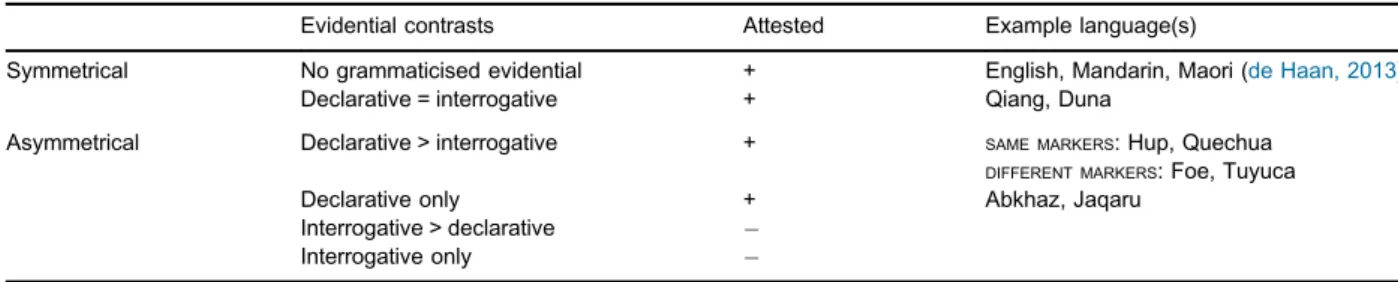
Table3summarisesmajordistributionalpatternsofevidentialmarkerswithrespecttodeclarativeandinterrogative sentencetypes.(Notethatwefocushereonpossibleformalcombinations,notonwhethertheresultantconstructiondoes ordoesnotfunctionasatypicalinformationquestion.)Languagescanbesymmetrical(eitherevidentialityisnotmarkedat all,orthesameevidentialitymarkersareequallyavailableinbothsentencetypes,asrepresentedbyanequalssign,=),or asymmetrical,eitherexcludingevidentialityfromonesentencetype,orhavingmoreevidentialpossibilitiesinonethanthe other(asrepresentedbythe‘greater/lessthan’sign,>).Languagesthatmarkevidentialityininterrogatives,butwithsome restrictions,areprobablythemostcommontype,sothatingeneralfewerevidentialitychoicesarefoundinquestionsthan instatements(Aikhenvald,2004a:242).
Table3showsthatasymmetryappearstobeunidirectional,inthatweknowofnolanguagewhichhasmoreevidential choicesforinterrogativesthanfordeclaratives,orwhereevidentialityisonlymarkedininterrogatives.Intuitively,thiskind ofsituationappearsunlikely,butwenotetwopoints.First,themuch-discussedassociationbetweenevidentialityand epistemicmodalitysuggestsapathwaywherebyaninformationsourcemarkercouldbecomeaproxyforindicatinga questioningspeechact,forexample,inasimilarwaytothe‘uncertainty’markerofMatses(Panoan)thatisassociatedwith
Table3
Evidentialcontrastsininterrogativesanddeclaratives.
Evidentialcontrasts Attested Examplelanguage(s)
Symmetrical Nogrammaticisedevidential + English,Mandarin,Maori(deHaan,2013) Declarative=interrogative + Qiang,Duna
Asymmetrical Declarative>interrogative + SAMEMARKERS:Hup,Quechua DIFFERENTMARKERS:Foe,Tuyuca
Declarativeonly + Abkhaz,Jaqaru
Interrogative>declarative Interrogativeonly
polarinterrogatives(Fleck,2003:292),orthe‘speculative’morphemeinShipibo-Konibothatformsself-directedquestions (Valenzuela,2003:47--49;seealsoBoye,2012:52).RelatedphenomenaaretheNovoSelo‘nonconfirmative’evidential thatisreportedtobe‘‘especiallycommon’’inquestions(Mladenov,1969,ascitedinFriedman,2003)andtheTucanoan interrogativeformsthatarearguedtoderivefromaninferential/mirativeconstruction(IdiatovandvanderAuwera,2008). Secondly, itseems possible that a non-declarative, minor sentence type could encode specificinformation source semanticsthatdonothaveadeclarativecounterpart.Forexample,the‘potentialobservation’markerinDunaindicates thatanaddresseecouldhavevisualinformationforsomething.Clausesmarkedwiththismorphemedonotsharekey formalfeaturesofDunadeclarativeclauses,andgenerallyfunctionasquestions(SanRoque,2008).
Whileforthemajorityoflanguagesatleastsomeevidentialsareformallycompatiblewithinterrogatives,thisisnotto saythatsuchcombinationsarenecessarilycommonindiscourse.Evidentialinterrogativeshavebeenreportedtobe relativelyinfrequentitems,evenwheretheyareformallyunproblematic(e.g.,Yukaghir,Maslova,2003;WesternApache,
deReuse,2003),andprobablelowfrequencycanbeinferredfromthefactthatmanydescriptionsoflanguageswith evidentialsdonotincludeexplicitdiscussionoftheiroccurrenceininterrogatives.Inasampleof80interrogativeclauses from Dunaconversational data(inutterances concerningpast timeevents, whereevidential contrastsare the most numerous),evidentialmarkerswereusedin31instances,or39%ofthetime,comparedwithasampleof74declaratives, where43clauses(58%)weremarkedwithevidentials.ThissmallsamplethussuggeststhatevidentialmarkersinDuna conversationarelikelysomewhatmorefrequentinstatementsthaninquestions.
Asalreadymentioned,onemotivationforlowerfrequencyofevidentialinterrogativesmaybethemismatchbetween thetypicalevidentialdomain(expressinghowsomethingisknown)andthetypicalinterrogativedomain(tryingtofindout somethingthatisnotknown).Otherfactorsthatmayaffectfrequencyarethepossibledifficultiesofmakingspecificclaims aboutaddressee knowledgeand the(perhapsconsequent) conventionalisationofcertainevidentialinterrogativesas pragmaticallyspecialisedquestiontypes.Theseissuesarediscussedfurtherinthefollowingsection.
3. Perspective
Evidentialsareperspectivisinginthattheypresentaneventfromthepointofviewofanevidentialorigo.Forsome evidential markers in some languages, speaker-anchored perspective is the default in both declaratives and interrogatives(section3.1).Inmanycasesofinterrogativeevidentials,however,theidentityoftheperspective-holder shiftsfromatypical,declarativeinterpretationofspeakertothatoftheaddressee(section3.2),8whereasforothers,either speaker oraddresseeperspectivecanbeevoked(section3.3).Section3.4briefly reviewsseveralotherperspective relationships,includingthosethatareassociatedwithspecialspeechacttypes,andthosewherespeakerperspectiveis notthedefaultinterpretationfordeclarativeclauses.Section3.5givesasummaryanddiscussion.
3.1. Speakerperspectivemaintainedininterrogatives
Insomelanguages,evidentialsininterrogatives,asindeclaratives,willbeunderstoodasgivingthespeaker’s‘take’onthe describedevent.Aikhenvald(2004a:244)notesthatthemaintenanceofspeakerperspectiveininterrogativesis‘‘somewhat rarer’’thanotherpossibilities.Declarative(10)andinterrogative(11)examplesfromEasternPomoshowtheinterpretationof thenon-visualsensoryinflection-ink’eisconsistentlyinterpretedasreflectingthespeaker’sinformationsource. (10) ba· háyu-heʔmì·-p’ khé·sˇ ka·Nú·l-ink’e du·we
that dog-3SG-M.AGENT lots talk/bark-SENS last.night
‘Thedogwasbarkinglastnight(Iheardit).’ (McLendon,2003:103)
(11) kiyá=t’a ʔéc-ink’e? who=INTER sneeze-SENS
‘Whosneezed?(Iheard,butdon’tknowwhosneezed).’ (McLendon,2003:115)
Yukaghirmarksindirect(inferential)evidence(12),contrastingwithadirect/unmarkedconstruction.Maslova(2003)notes thatinferentialevidentialityisveryrarelymarkedininterrogatives,butthat,whenitdoesoccur,itreflectstheperspectiveof
8Thisitselfcanbeunderstoodasakindof‘‘complexperspective’’(see Evans,2007),asthespeakermaysimultaneouslyimplytheirown epistemicstancetowardsaneventthroughtheveryactofquestioning;seeBergqvist(thisissue)concerningthepresenceofspeakerepistemic perspectiveinutterancesthatostensiblypurporttoencodeaddresseeepistemicperspective.
thespeaker,asindeclaratives.In(13),‘‘theInferentialindicatesthatthespeakerhasnotwitnessedpeoplegoingaway fromhiscurrentlocation’’(Maslova,2003:228).
(12) taŋ me:me: naha: motlorqo-j-ben=no:-l’el that bear very thin-ATTR-NR=COP-INF(INTR:3SG)
‘Thatbearwasverythin(ascanbeseenfromhistraces).’ (Maslova,2003:222)
(13) qodo ti:-t kebej-nu-l’el-ŋi? how here-ABL go-IPFV-INF-3PL:INTR
‘Howdopeoplegoawayfromhere?’ (Maslova,2003:228)
Examples(14)and(15)illustratethereportedmarker,néh1,inSochiapanChinantec(Otomanguean).Inadeclarative,
néh1indicatesthat‘‘the speaker ispassing onsecondhandinformation’’,and in aninterrogativeit‘‘implies that the speakerispuzzledbysomethingthats/hehasheard’’(Foris,1993:544).FromForis’description,anexamplesuchas(17) maybemorelikeaconjecturalquestionthananinformation-seekingquestion(seesection3.4.2).
(14) La3 nɨ2 néh1 tɨ2 juáh23 tsá2daun32 idea that REP DISC say.TI.PRES.3 old.person
‘That,itissaid,iswhattheoldpeopleusedtosay.’ (15) hí1 ca3-jɨéh32 néh1 hué32 Engo3jmáɨ2 dí1?
QUERY PAST-shake.II REP land Mexico.City INDB
‘DidMexicoCityhaveanearthquake(asI/wehaveheard)?’ (Foris,1993:544)
According to examples in Friedman (2003, 2004), the Macedonian non-confirmative evidential (which canexpress inference,report,doubtand/orsurprise)istypicallyinterpretedwithspeakerperspectiveinbothstatementsandquestions (althoughseealsosection3.3).Otherexamplesoflanguageswhereevidentialmarking ininterrogativesreflectsthe speaker’sinformationsourceareBora(Aikhenvald,2004a:244),andpossiblyShipibo-Konibo(inferentialandreported markers,Valenzuela,2003:46)andJarawara(witness/non-witnessdistinction,Dixon,2004:203).
Examples(10)--(15)suggestthatthespeakerasevidentialorigoisastablecomponentofthemeaningofinformation sourcemarkers(seealsoWaldie,2012);wecouldthinkoftheevidentialasbeing‘speaker-anchored’inmuchthesame wayasademonstrativesuchasEnglishhereisspeaker-anchored(alwaysallowingthatthe‘speaker’maybetransposed toareportedspeaker,andnotingthatmanyscholarsfindspatialanchoringinadequatetocharacterisedemonstratives, seee.g.Enfield,2003;Hanks,1990,2005).Suchexamplessupportadeicticviewofevidentiality.
Most(butnotall)examplesofspeakerperspectivequestionsthatwehavefoundinthecitedliteraturearecontent interrogatives(see,e.g.,11and13).Thisisstrikinggiventhatpolarquestionsaresuggestedtobemuchmorefrequent thancontentquestionscross-linguistically(Stiversetal.,2010).Itseemspossiblethatspeakerperspectivewillbemore compatiblewithcontentquestionsthanwithpolarquestionsas,fortheformer,therealityoftheeventistosomeextent presupposedbythespeaker.Itisperhapsinthesesituations---whereaspeakerknowsthataneventhashappened(e.g., theysawJohnhitsomeone),butdoesnotknowallthedetails(e.g.,whomJohnhit)---thatwecanmosteasilyimaginea questionthatspellsouttheinformationsourceofthespeaker.
3.2. Addresseeperspectiveininterrogatives
Evidentialsininterrogativescan‘flip’toreflecttheaddressee’sinformationsource,orrather,theaddressee’sinformation sourceasframedbythespeaker.Changingfromthespeakerastheperspective-holderinstatementstotheaddresseein questionsisthemostcommonpatternforevidentialscross-linguistically.Thephenomenonisillustratedinexamples(16--17) fromDuna,takenfromatextwherethespeakerdescribesafrighteningincidentfromhischildhood.Whileheandhislittle brotherwerehomealone,astrangestormblewupandasupernaturalcreaturebrokeintothehouseandattackedhislittle brother.Thespeakerwasadirectwitnessofthisattack,anddescribesitusingavisualevidential(16).
(16) eh, nane no keni khete=na sutia hes boy 1SG brother small=SPEC strike.PFV.VIS
‘Ah,somethingstrucktheboy,mylittlebrother(Isaw).’
Later,thespeaker’smotherreturnshomeandaskshimwhathappenedtohisbrother.Herquestionisrepresentedinthe textasfreedirectspeech(17a).Themotherexpectsthathereldersonwasavisualwitnesstotheevents,andthususesa
visualevidentialinherquestion,takingtheanticipatedperspectiveofheraddressee.Inhisresponsetothisquestion(also relayed asdirect speech), the speaker againuses the visualevidential, confirming hismother’sassessment ofthe informationsourcehehasforthisevent(17b).
(17) a) ai-ka sutia?
who-ERG strike.PFV.VIS
‘Whostruckhim(yousaw)?’
b) a, yiAo honene-ka=rape sako
ah nothing thing-ERG=UNC be.confused
makura-na si wa-ye sutia
club-SPEC hold come-DEP strike.PFV.VIS
‘Ah,something,Idon’tknowwhatitwas,broughtaclubandhithim(Isaw).’
Thesuppositionimpliedbytheuseofavisualevidentialinaninterrogative---thattheaddresseehaswitnessedthe scene---ismadeexplicitinthereal-lifeexchangeshownin(18).Thespeaker(D)uses-tia‘VIS’inaskingherdaughter(R)where
anotherrelativehasgone.InherresponsespeakerRrejectsthetermsofD’squestion,assertingthatshehasnotseen Joshua.
(18) D: Jotua pa-na ngutia
PSN QUERY-SPEC go.PFV.VIS
‘WherehasJoshuagone(yousaw)?’ R: Jotua no na-ke-ya=nia
PSN 1SG NEG-see-NEG-ASSERT
‘Ididn’tseeJoshua.’
Example(19)showsaninterrogativefromWintu(Wintuan)thatusesanon-visualevidential,and(20)showsaMagar (Tibeto-Burman)interrogativeformedwiththeinferentialmarker-sa.Inbothcases,thespeakeranticipatesthekindof evidencethatisavailabletotheaddressee,thatis,theypurporttotaketheperspectiveofthehearer.
(19) Henuni mis yi·la-kintheri·? how you send-SENS.INTER
‘Howdidheinstructyou(inyourhearing)?’ (Schlichter,1986:48)
(20) kus-kat kitab a-laN mu-le-sa? which-one book R.DEM-LOC sit-IMPF-INF
‘Whichbook(doyouthink)isleftthere?’(Thespeakerbelievesthe respondentmustinfer)
(Grunow-Hårsta,2007:163)
A question--answerpair (21)from Gitksan(Tsimshianic) illustratesaddressee perspective in aninterrogativethat is markedasreportative,whilethedeclarativeresponseillustratesspeakerperspectivewiththesamemarker.Thescenario isthatSpeakerAandBareabouttogoonatriptogether,forwhichSpeakerBbookedthetickets.
(21) A: taxgwi=kat tim bakw-m’
when=REP FUT arrive.PL-1PL
‘Whenisit(didtheysay/didyouhear)we’llgetthere?’ B: silkwsax t’aahlakw=kat
noon tomorrow=REP
‘(Iheard/Theysaid)atnoontomorrow.’ (Littelletal.,2010:102)
Theexamplesofspecialinterrogativemarkingdiscussedinsection2.2alsoillustrateperspectiveshiftforsensory,visual, andreportedevidentiality.Asfarasweknow,alllanguagesthathavespecialinterrogativeevidentialmorphologyalso practiceinterrogativeperspectiveshift.
As mentioned previously, evidential marking has been reported to be less frequent in interrogatives than in declaratives.InregardtoTariana(and,byextension,otherlanguageswhereperspectiveflipisthenorm),Aikhenvald (2004a)suggeststhatonepro-socialreasonforavoidingevidentialinterrogativesisthatsuchquestionsare‘‘dangerous’’ inthattheyexpressaspecificassumptionabouttheaddressee’sknowledge,andthismaybefeltasakindoftrespass
(seealsoLevinson,2012onthe‘‘potentialsocialcosts’’ofaskingquestionscross-linguistically).Aquestionthatismarked withanevidentialmayalsobe‘coercive’(cf.StiversandRossano,2010,2012)inthatitprojectsaveryparticularkindof response,essentially puttingmorphemesinto theaddressee’smouth.9(However,itseems likelythatthesekindsof
considerationscouldhaveverydifferenteffectsinlanguageswhereevidentialmarkersareobligatoryasopposedtothose wheretheyareoptional.)
While itmay be risky, for at least somelanguages ithas beenclaimed that a shift from speaker to addressee perspectiveisanobligatorycomponentofevidentialinterrogatives(e.g.,Lim,2011:429inregardtoKorean;Garrett,2001
inregardtoTibetan;seealsoAnderson,1986:277--278).Suchcasessuggestthattheidentityoftheevidentialorigois predetermined and predictable from sentence type: it is the speaker in a declarative, and the addressee in an interrogative.However,formanylanguagesitisnotclearwhethertheidentityoftheevidentialorigoisinferablefrom formalsentencetype,orwhetheritismoreofa‘‘standardimplicature’’(Levinson,1983;seealsoBoye,2012:271--273,
McCready,2007).10Thatis,speakerandaddresseearethedefaultperspective-holdersinstatementsandquestions,
respectively,but other configurations(e.g.,addressee perspectivein declaratives) arealsopossible,given theright pragmaticcircumstances.Underthislatterscenario,identifyingtheevidentialorigoisanissueof‘‘pragmaticresolution’’ (seeLevinson,2004),asweusuallyexpecttomakestatementsaboutourownknowledge,andaskquestionsabout others’knowledge(seealsoHeritage,2012;Kamio,1997;LabovandFanshell,1977;McCready,2007).
3.3. Speakeroraddresseeperspective
Whilecertainevidentialsseemtorequire,oratleaststronglypredict,theadoptionofoneparticularperspectivein interrogatives, we also find cases where either speaker or addressee perspective are viable interpretations (e.g., MacedonianasdescribedbyFriedman,2003:201--202).Thesecanbethoughtofasgradientlyratherthancategorically distinctfromlanguageswhereacertainperspectiveisthedefault,butisnotobligatory.Insuchcases,therelationshipof theaddresseetothepropositionexpressedmaybeacrucialfactorindetermininghowtheinterrogativeisinterpreted. Dunavisual,sensoryandresultsevidentialsininterrogativesaretypically(althoughnotnecessarily)understoodas takingaddresseeperspective(see1and17,above).However,the‘reasoning’evidentialshowsadistinctpatterninthat, while it typically takes speaker perspective in declaratives, interrogatives are readily interpreted as having either addresseeorspeakerperspective.Example(22)illustratesthereasoningevidentialinadeclarative:itindicatesthatthe speakerhas‘figuredout’something,andusuallyimpliesthatheorsheissurprisedthatthissituationisthecase.Inthis instance,thespeakerhasjustobservedanon-DunapersoncorrectlyrespondtoacommandgiveninDuna. (22) haka kone waki-noi-na
talk real hear-REAS-SPEC
‘SheunderstandsDuna[lit.‘realtalk’]!’
Examples(23--24)illustrateahypotheticalscenariowhereitwouldbeappropriatetousethereasoningevidentialinan interrogative.Thespeaker(Annabel)isatthehouseofafriend,Jenny.WhileJennyisoutoftheroom,Annabelnoticesan emptymedicinepacket onthetable, andaskshercompanion(Sarah)whether Jennyhasbeensick.Therearetwo possibleinterpretationsofthereasoningmarker.InasituationwhereSarahhasarrivedwithAnnabel,andAnnabelthus assumesthatthe sameevidenceisavailabletobothofthem,the evidentiallymarkedinterrogativeisunderstoodas havingaddressee perspective.Withherquestion, Annabelina sense‘directs’Sarahtomakea reasonedinference concerningJenny’shealth.Inthisimaginedsituation,Sarahco-operateswiththisagenda,andherresponsealsousesthe reasoningmarker(23).
(23) A: Jeni siki so-nei=pe?
PSN sickness take/get-REAS=INTER
‘HasJennybeensick(doyouthink)?’
S: Siki so-nei-na
sickness take/get-REAS-SPEC
‘She’sbeensick(Ithink).’
9Wenotethatthesuitabilityofanaddresseeperspectiveevidentialinterrogativeislikelytobeespeciallycontingentonsequentialcontext,as whatevertheaddresseehasjustsaidcould‘setthestage’forsubsequentturnsthatorienttowardsaddresseeknowledge.
10Aformalexplanationthathasbeenproposedforperspectiveflipisthatquestionscontain‘monstrous’operators(inthesenseof Kaplan,1989) thatmanipulatecontext(Schlenker,2003).Theseapplytoanindexthat Lasersohn(2005) and McCready(2007) callthe‘judge’(arolethatcould beunderstoodtosubsumeevidentialorigo).
Alternatively,SarahisamemberofJenny’shousehold.Inthiscase(24),AnnabeldoesnotexpectSarahtoassessthe propositionbasedonreasoningevidence,asSarahwillhavemoredirectknowledgeofJenny’sstate.Thereasoning evidentialhereretainsspeakerperspective,andexpressesAnnabel’ssurmiseandsurprisethatJennymaybeill,asthis wasnotsomethingsheexpected.Sarah’sresponseusesanunmarkedperfectiveform,whichtypicallyimpliesclose personalexperienceofaneventandismoreappropriatetoherstatusassomeonewholiveswithJenny.
(24) A: Jeni siki so-nei=pe?
PSN sickness take/get-REAS=INTER
‘Oh,hasJennybeensick?(Ithink---I’msurprised)’
S: Ẽ, siki so
yes sickness take/get.PFV
‘Yes,she’sbeensick.’
LaPolla(2003b:207--208)notesthattheinferentialparticleinQiangisusedinquestionswherethespeaker‘‘assumesthe addressee[...]doesnothavevisualevidence’’,thatis,reflectingtheperspectiveoftheaddressee(25).However,where thesubjectoftheinterrogativeclauseissecondperson,theinferentialmarkerisunderstoodtobespeaker-oriented,and
‘‘represent[s]aguessaboutsomeaspectofthesituation’’(26). (25) the: hɑ-qə-k ŋuɑ
3SG DIR-go-INF INTER
‘Didhego?’(speakerassumesaddresseedoesnothavevisualevidence) (26) ʔũ ʑdʑytɑ: ɦɑ-qə-k-ən dʑɑ
2SG Chengdu:LOC DIR-go-INF-2SG INTER
‘DidyougodowntoChengdu?’(speakermakesaguess) (LaPolla,2003b:208)
Wherethevisualmarkeroccursinquestionswithanaddresseesubject,itissimilarlyinterpretedasrepresentingspeaker perspective(27).
(27) ʔũ tɕalakə-u-n-a 2SG go-VIS-2SG-INTER
‘Wheredidyougo?’(Isawyougo,butwherewasityouweregoing?) (ChenglongHuang,emailcommunication)
InboththeDunaandtheQiangcase,therelationshipoftheaddresseetothequeriedpropositionisimportanttohow the evidential is interpreted. Where the addressee is not closely involved in the situation, the evidential can be unproblematicallyunderstoodasreferringtotheaddressee’sinferential(orvisual)knowledge.Wheretheaddresseeis connectedtothesituationinsuchawaythatvisualorinferentialknowledgeisnotappropriate(e.g.,theyarethesubject,or anintimateassociateofthesubject),theevidentialisbetterinterpretedasreferencingspeakerperspective.
3.4. Otherperspectiverelationships
Inthissection,wepresentaselectionofotherattestedperspectiverelationshipsininterrogativeevidentialstoshowthe potential for semantic and pragmatic variability in these structures. Sections 3.4.1--3.4.3 illustrate how evidential interrogatives are used in specialised question types (see, e.g., Aikhenvald, 2004a) with specific perspectival interpretations.Section3.4.4remindsusthat,althoughthispaperfocusesonevidentialsforwhichspeakerperspectiveis thedefaultinterpretationfordeclarativeclauses,therearealsootherpossibilities.
3.4.1. Self-directedquestions
InEcuadorianQuechuathe‘bestevidence’marker-mitypicallytakesaddresseeperspectiveininterrogatives.Itisthus restrictedtocontextsinwhichthespeaker canreasonablyclaimsomeknowledgeabouttheaddressee’sinformation source(forexample,whenaspeakerisqueryingthelocationofanobjectthathehasseenearlierintheaddressee’s possession).However,whiletypicalinformation-seekingquestionswith-miarepossible,inasampleofseveralhoursof recording,questionsmarkedwiththedirectevidential-miwerealmostexclusivelyself-directed,asin(28),wherethe speakertriestoremembersomethingusedforcuringmaladies.Insuchexamplesthespeakersimultaneouslydisplays ignorance(asaquestioner)andknowledge(asanaddressee).
(28) Kutin shuk-ka ima-mi? ima-mi?
again one-TOP what-EV what-EV
‘Anotherone,whatisit?Whatisit? Ima-ku-pash tiya-n-lla-mi jampi-pa-pash what-DIM-also exist-3-LIM-EV cure-for-also
Somethingelseexists,forcuring.’
Self-addressedquestionsrepresentaspecialpragmaticsituationwherequestionerandresponderareoneandthesame; theperspectiveoftheaddresseeevokedbytheevidentialis,inasense,alsothatofthespeaker.Thissituationisfreeof theusualpracticalandinterpersonalhurdlesoftheinterrogativeflip,asitonlyinvolvesmakingclaimsaboutone’sown informationsourceratherthanthatofanother(although,seeGawne,2013concerningself-directedquestionsinLamjung Yolmo(closelyrelatedtoStandardTibetan)astargeting‘other’selves).
3.4.2. Conjecturalquestions
Aspecialisedfunctionofevidentialquestionsnotedintheliteratureisthecombinationofinterrogativemarkingand inferentialevidentialitytoindicatethatthespeakeris‘wondering’aboutsomething.Littelletal.discusstheseutterances as‘conjecturalquestions’,forwhichtheansweris‘‘notknowntotheSpeakerortheAddressee,andtheybothalsothink thattheotherdoesnotknowtheanswer’’(2010:96).Conjecturalquestionsinvite,butdonotrequire,ananswerfromthe addressee.Example(29)fromSt’át’imcets(LillooetSalish)showsastatementthatismarkedforinferencewiththeclitic =k’a.Example(30)showsanordinarycontentquestionthatisunmarkedforevidentiality(a)andacontrastiveconjectural question,whichincludestheinferentialclitic(b).
(29) ts’aqw-an’-ás=k’a=tu7 k=Lennyti=kíks-a eat-DIR-3.ERG=INF=then DET=LennyDET=cake-EXIS
‘Lennymusthaveeatenthecake’(uponlookinginthefridgeanddiscoveringthereisnoneleft) (Matthewsonetal.,2007,asreproducedinLittelletal.,2010:97)
(30) a) swat ku=lhwál-ci-ts-as ti=ts’úqwaz’=a who DET=leave-APPL-1SG.OBJ-3ERG DET=fish=EXIS
‘Wholeftmethisfish?’
b) swát=as=k’a ku=lhwál-ci-ts-asti=ts’úqwaz’=a
who=SBJV=INF DET=leave-APPL-1SG.OBJ-3ERGDET=fish=EXIS
‘Iwonderwholeftmethisfish?’ (Littelletal.,2010:90)
Littelletal.provideexamplesofconjecturalquestionsformedasinferentialinterrogativesinSt’át’imcets,Nɬeʔkepmxcín (ThompsonSalish),Gitksan,andCuzcoQuechua.Theyspeculatethatthisisacommonpatternandthatonlyrelatively
‘weak’(i.e.,indirect)evidentialscanbeemployedinthisway(cf.alsoAikhenvald’s(2003:319)descriptionofinferentially markedquestionsinTarianathatdisplayspeakerlackofknowledgeratherthanrequestinformation).Ifthisistrue,it suggeststhat‘straightforward’questionswithaddresseeperspectivemaybedispreferredforinferentialevidentials(see section3.5).Instead,thesestructurescanbeusedtoimplythatneitherparticipantinthespeechsituationhasknowledge oftheproposition,anditisthusamatterforsharedconjecture.Theperspectivalrelationshipinthiscasecanbeanalysed inatleasttwoways.Ifwemaintainastrictdefinitionofevidentialsasmarkinginformationsource,thentheissuebecomes moot:no-one is actually claimedto haveinferentialevidencein this situation,and there is, therefore,no evidential perspectivetoidentify.Alternatively,ifweconsiderthemoregeneralsenseof‘epistemicdistance’thattheinferentially markedquestionappearstoconvey,theperspectiveisthespeaker’sandpossiblyalsotheaddressee’s(seeEvans,2007
concerning‘multipleperspective’constructionsmoregenerally). 3.4.3. Relayedquestions
Faller(2002a)describesanothersituationwherewecanunderstandanevidentialinaninterrogativeashavingtwo perspectivalinterpretations,similartoexamplesdiscussedinsection3.3.InCuzcoQuechua,aninterrogativemarkedfor reportedevidentialitycanbeinterpretedasreflectingaddresseeperspectiveinthetypicalway(31),thatis,thespeaker
‘‘expectsthehearertohavereportativeevidenceforhisorheranswer’’(2002a:230). (31) Pi-ta-s Inés-qa watuku-sqa
who-ACC-REP Inés-TOP visit-PTCP
Alternatively,a speakercanusethereported markerto‘relay’aquestionaskedbysomebodyelse.Thus, thesame sentencewouldalsobeappropriatewhereSpeakerChassaid‘WhodidInésvisit?’,intendingBasthe addressee. SpeakerArepeatsthequestiontoB,withtheadditionofthereportedmarker(32).
(32) Pi-ta-s Inés-qa watuku-sqa who-ACC-REP Inés-TOP visit-PTCP
‘(Someonesaidtoyou,)whodidInésvisit?’ (Faller,2002a:230)
Inthe relaycase(32),the perspectiveisin onesenseanchoredto thespeaker,but theperspectivising operatesat locutionarymeta-level:SpeakerAisexpressingher‘source’forthequestionasanutterance(i.e.,itisareportofspeaker C’swords),without anyreference toevidence forthe propositionthat isconveyed in the question (i.e.,Inés’ visit).
Johanson (2003:286) comments on similar alternation in Turkic languages, and Aikhenvald (2004a:248)describes reportativesinKham(Tibeto-Burman)asoperatinglikeQuechuaexample(32).Thisphenomenontapsintothecommon dualfunctionofreportativemorphemesasbothevidentialsandquotativemarkers(cf.Guldemann,2008).Intherelay interpretation,thereportativemarkerfunctionsasaquotativethatindicatesreportedspeechratherthanasamarkerof informationsource. Thus,as withconjectural questions,one couldclaim that relayedquestionsdo nothave a true evidentialorigotoidentify.Thebehaviourofaso-called‘reportative’markerinquestionscouldbediagnosticforwhether itsprimarymeaningistheexpressionofinformationsource(inwhichcase,wewouldexpectthemorenarrowlyscoped addresseeperspectiveinterpretationinaquestion)orreportedspeech(whichpredictsthe‘relay’interpretation).Ifonlya
‘relay’interpretation ispossible,thiscould beanargument fortreating the markeras a quotativeratherthanas an evidential.
3.4.4. Evidentialsthatdonotexpressspeakerperspectiveindeclaratives
Theperspectiverelationshipswehaveillustratedthroughoutthissectionshowsomecomplexityandvariation,butthe markersinquestionsharethecommonfeatureoftakingspeakerperspectiveasadefaultindeclarativeclauses.Whilethis isthelimitofourscopeinthispaper,wenotethatitisonlythetipoftheiceberginunderstandingtherangeofperspectival possibilitiesthatmaybefoundinevidentialsystems.Insomeevidentialconstructions,forexample,theevidentialorigois indexedthroughpersonmarking,andcanvaryindeclaratives(e.g.Nanti,Michael,2008).Itispossibleforbothspeaker andaddresseeperspectivetobeexpressedinevidentialmarkers(e.g.Kroeker,2001;Madden,nd),orforevidentialsto evokeanunspecifiedorimpersonalperspective(e.g.,Dalabon,Evans,2010;Duna,SanRoque,2008).Furthermore,in manylanguagesitispossibletostacktwoevidentials(typicallyembeddingoneevidentialwithinareportedevidential structure), so that there are two distinct perspectives represented. Formost of these casesthere iscurrently little informationavailableonwhathappensininterrogativeclauses(although,seeSanRoque,2008concerningtheuseof impersonalevidentialsinconjecturalquestions).
3.5. Perspectiverelationships:summaryanddiscussion
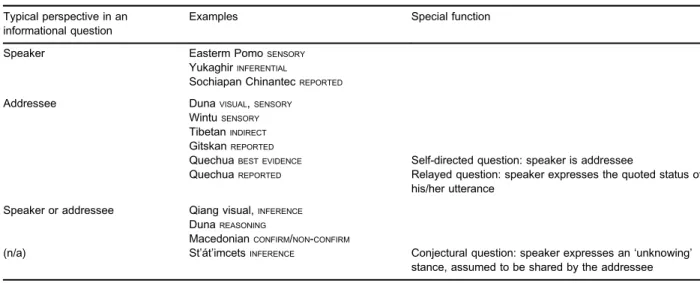
The perspective relationships discussed in the preceding sections, in combination with the special evidential interrogativefunctionsexemplified,aresummarisedinTable4.
Is itpossible to makecross-linguistic generalisations concerning which evidentials might be especially likely to exemplifyparticularperspectiverelationsinquestions?Itwouldbeprematuretomakestrongclaims,butthedatado suggesthypotheses.Theserelatetothenotionofevidentialhierarchies(Barnes,1984),wherebydifferentinformation sourcemarkersareunderstoodtoberanked‘higher’or‘lower’ona(languagespecific)hierarchyofpreference.For example,ifaspeakerwhohasbothseenandheardaneventchoosesavisualevidentialtodescribethatevent,this indicatesthatvisualevidenceisrankedhigherthanothersensoryevidenceforthatlanguage,atleastinrelationtothe preferred linguistic encoding. In general, the ‘higher’ end of the hierarchyrepresents evidence that ismore direct, correlating with greater reliability (although the directness-reliability relationship is not always a given, see, e.g.,
Matthewsonetal.,2007).Thus,whilenotnecessarilyuniversal,atypicalorderingonanevidentialhierarchyissomething likeparticipation>vision>othersensoryexperience>inference/report(seeBarnes,1984;Faller,2002b;Oswalt,1986
forexamplesanddiscussion).11
11Suchahierarchydoesnotnecessarilymakeclaimsabouttheculturalvaluethatmaybeattachedtodifferentkindsofevidencenortowhatwill alwaysbeselectedasthemostfittingevidentialmarkerinallcontexts.Forexample,Hill(2013:48--50)discussesanexampleinwhichaLhasa Tibetanspeakerchoosesavisual-sensoryevidentialoveramoreexpectedpersonalknowledgeevidentialwhencountermandinganother’s assertion, foregroundingthat he hasrecentlywitnessed thedisputed stateofaffairs (seealso Aikhenvald,2004:316; Bendix,1993:240; Schlichter,1986:57,interalia).
Thelikelihoodthatspeakerperspectivewillbeusedinquestionsmayinteractwithpositionsonthehierarchy.For example,whileweseereport,inference,andnon-visualsensoryevidentialmarkersthatshowspeakerperspectivein interrogatives(section3.1),wehavenotfoundclearexampleswhereaspecificallyparticipatoryand/orvisualevidential behavesin thisway.(Although,wenotethat‘direct evidence’EasternPomointerrogativespresented byMcLendon (2003:15)areambiguousbetweenspeakerandaddresseeperspective.)Afeasiblehypothesisisthatsuchexamplesare unusualbecausewearelesslikelytoneedtoaskquestionsabouteventsthatweseeorparticipatein.Inotherwords,we arelesslikelytofindinterrogativeevidentialsthatexpressspeakerperspectiveforthoseevidentialcategoriesthatare higheronageneralisedevidentialhierarchy.
Asapartialcorollarytothisprediction,informationsourcetypesthatareloweronthehierarchymaybelesslikelyto expressaddresseeperspective.12Arangeofdifferentevidentialcategoriesindifferentlanguages(e.g.visual,non-visual sensory,inferred,reported,direct,indirect)areattestedasexpressingaddresseeperspectiveininterrogatives.However, evidentialswithinferentialorindirectmeaningsmaybeespeciallylikelyto‘optout’offlippingtoaddresseeperspective,for examplemaintainingspeakerperspective,and/orexpressing‘wondering’orotherwiserhetoricalmeaningswhenusedin aninterrogativeclause(section3.4).Anysuchtendencycouldhaveitsorigininbothinformationaldynamics(whyaska questionofsomeonewhomyoudonotexpecttohavepreferredevidence?)andinteractionalappropriateness(howmuch isitpolitetoassumeaboutaddresseeknowledge?).
Thehypothesisedrelationbetweenanevidential’spositiononageneralisedhierarchy,anditslikelihoodofmaintaining speakerperspectiveisrepresentedinFig.1.Accordingtothishypothesis,wewillnotfindalanguagewhereamoredirect evidentialshowsspeakerperspectiveinquestions,butalessdirectevidentialflipstoaddresseeperspective;andindeed, wehavenotasyetfoundanysuchlanguage.However,wenotethatitisproblematictogeneraliseabouttheplaceof reportedmarkersunder thescenario expressedinFig.1.Amoreimportant issuethandirectnessorindirectnessof evidencemaybewhetherthereportedmarkeralsofunctionsasaquotative(section3.4.3).Ifitdoes,wemayexpectthat reportativeinterrogativescan(orevenmust)beinterpretedasrelayedquestions,sothattheissueofperspectiveisno longerrelevantinthesameway.
Fig.1. Hypothesisedrelationshipbetweenevidentialtypeandperspectiveininterrogatives. Table4
Perspectivalinterpretationsofevidentialsininterrogatives(wherethedefaultdeclarativeperspectiveisthatofthespeaker).
Typicalperspectiveinan informationalquestion
Examples Specialfunction
Speaker EastermPomoSENSORY
YukaghirINFERENTIAL
SochiapanChinantecREPORTED Addressee DunaVISUAL,SENSORY
WintuSENSORY TibetanINDIRECT GitskanREPORTED
QuechuaBESTEVIDENCE Self-directedquestion:speakerisaddressee
QuechuaREPORTED Relayedquestion:speakerexpressesthequotedstatusof his/herutterance
Speakeroraddressee Qiangvisual,INFERENCE DunaREASONING
MacedonianCONFIRM/NON-CONFIRM
(n/a) St’át’imcetsINFERENCE Conjecturalquestion:speakerexpressesan‘unknowing’ stance,assumedtobesharedbytheaddressee
12Wesaypartial corollarybecausethereisnotasimplebinarychoicebetweenspeakeroraddresseeperspective.Amorphemecanalso express,forexample,jointperspective,etc.Thus,unlikelihoodofspeakerperspectivedoesnotentaillikelihoodofaddresseeperspective,and viceversa.
Arelatedareaofstudyinrelationtoperspectiveininterrogativestructuresismirativemarkers(seeAikhenvald,2012; DeLancey,1997;Hill,2012;Lazard,1999concerningrelationshipsbetweenevidentialityandmirativity).Itmaybemore commonformirativesininterrogativestoexpressspeakerperspective,ratherthan(oraswellas)addresseeperspective. Forexample,accordingtoFriedman(2003:202),theAlbanianadmirativeexpressesspeakersurpriseinbothdeclaratives andinterrogatives(seealsoOlbertz,2009concerningEcuadorianHighlandSpanish).Aswiththeapparentlyscarceuse of direct evidentials with speaker perspective in questions, the expression of mirativity in interrogatives may be conditionedbytheinformationalandpragmaticdynamicsofthespeechsetting.Thatis,afliptoaddresseeperspectiveis not predictedinthiscase:firstly,aspeaker isunlikelytoaskforinformationfromsomeonewhos/hesimultaneously expectstobesurprisedaboutthatinformation;andsecondly,itmaybepresumingtoomuchtoasserttheaddressee’s attitudeinthisway(however,seedeReuse,2003:88--89forapossiblecounterexampleinAthabaskan,andHengeveld andOlbertz(2012:492)concerningaddressee-centredmirativityinrhetoricalquestions).
4. Personrestrictions,perspective,andegophoricmarking
Intheprecedingdiscussion,wesuggestedthatdirect knowledgeevidentialsmaybeespeciallycompatible witha switchtoaddresseeperspectiveininterrogatives,asanassumptionthatourinterlocuterhasdirectknowledgeprovides goodgroundsforaskinghimorheraquestion.Itseemsto‘makesense’thatwewouldtreatourowndirectknowledgeas groundsforassertion(i.e.,expressingspeakerperspective)buttreatthedirectknowledgeofothersasgroundsforinquiry. Weturnnowtoagrammaticalphenomenonthatconcernstrackingthedirectknowledgeofinterlocutersacrossdifferent speechacttypes:egophoricity.Egophoricityiscanonicallydefinedbycertainscholarsasapattern ofmorphological markinginwhichspeakersubjectsinstatementsaremarkedthesamewayasaddresseesubjectsinquestions(see,e.g.,
Curnow,2002a),althoughthisdefinitionisrarelysufficienttoaccountforthecomplexitiespresentinindividuallanguages (see,e.g.,Tournadre,2008).13Whiletheevidentialliteraturehasfocusedon‘kindsofknowing’,anexceptionallystrong interactionwiththecategoryofpersonhasmotivatedtheliteratureonegophoricitytofocuson‘whoknows’.
Webeginourexaminationofegophoricitywithbackgrounddiscussionofperson-sensitiverestrictionsonevidential use (section 4.1) before turning to perspective shifting properties of egophoric systems and their relationship to evidentiality(section4.2).Throughoutthisdiscussionweusetheterm‘subject’followingsourceauthors’terminologyand inafairlybroadsensetorefertoaprivilegedargumentrolethatusuallyequatestothesingleargument(S)ofamonovalent verbandthemoreagent-likeargument(A)ofamultivalentverb.Moreprecisesyntactic,semanticanddiscourse-related properties will differ across languages(for example,for inverse agreementsystemsrelative animacymay bemore importantthanagencyforassigningsubjecthood).
4.1. Personrestrictionsinevidentialmarking
Evidentialsinstatementsoftenhavestrongbiasesregardingparticularsubjectpersoncategories,forexample,an evidentialmaybefrequentwiththirdpersonsubjects,butveryscarcewithfirstpersonsubjects(seeCurnow,2002b; Aikhenvald,2004a).Formanylanguages,thereiscurrentlylittleinformationconcerninghowtheserestrictionsandeffects operate ininterrogative clauses.However, inat leastsomelanguagesoneconsequenceofperspective shift isthat featuresofusethatcentrearoundthespeakerindeclarativestransfer(atleastinpart)totheaddresseeininterrogatives. ThisisthecaseinDuna,whereallevidentialmarkersaredispreferredforspeakersubjectsindeclaratives.InDuna, actions that one performs oneselfare not usuallydescribed through referenceto one’s externalperception (cf. the oddnessofsomethinglikeIsawmyselfreadinginEnglish).Forexample,Dunaspeakersjudgeconstructeddeclarative clausesthathavebothvisualmarkingandafirstpersonsubjectpronoun(33a)asincorrectandunsayable(althoughsuch combinationscanoccurinnaturalspeechinparticularcircumstances,seeSanRoque,2008).Evidentialscanbeused unproblematicallywithasecondpersonsubject(33b)andwiththirdpersonsubjects(see,e.g.,16and17b).
(33) a) ?*no hutia 1SG come.PFV.VIS
Icame(Isaw) b) ko hutia
2SG come.PFV.VIS
‘Youcame(Isaw).’
13Egophoricityisknownbyanumberoflabels,including‘conjunct/disjunct’(Hale,1980andothers),‘assertorinvolvement’(Creissels,2008), ‘congruent/non-congruent’(Dickinson,2000),and‘locuter/non-locuter’(earlierworksof Curnow,e.g.,1997),whiletheterm‘egophoric’wasfirst establishedinthisparticularcontextby Tournadre(e.g.,1996).Theproliferationoftermsindicatesthelackofgeneralagreementastoitsfunction anditsstatusasatypologicalcategorysuigeneris.
CoreargumentNPsarenotobligatoryinDuna,andthedispreferenceforevidentialswithspeakersubjectscanaffectthe interpretation of clausal argument structure. For example, for the constructed declarative clause (34), speakers interpretedthe first personpronounasanobjectargument,andassumed therewasanelidedthirdpersonsubject. Thus,evidentialscanworkasaproxyfor(non-first)subjectpersonmarking.14
(34) no ke-ya hutia 1SG see-DEP come.PFV.VIS
‘(Someone)cametoseeme(Isaw).’
Ininterrogativeclauses,therestrictionappliestosecondpersonratherthanfirstperson,astheeventisnowpresented inrelationtotheaddressee’s(assumed)perceptualexperience.Evidentiallymarkedinterrogativeclauseswhichhavea secondpersonsubject arejudgedunacceptable (35). Intransitiveclauses anovertsecondpersonpronouncanbe interpretedasanobject,withanelidedthirdpersonsubject(36).(Interrogativeclausesthatcombinefirstpersonand evidentialmarkingareacceptable,butconstructedexamplesareusuallyinterpretedashavingsomekindofrhetorical valueowingtotherelativerarityofaskingafirstpersonquestion.)
(35) ?*ko ayu angu hutia=pe
2SG now only come.PFV.VIS=INTER
Didyoucomejusttoday(yousaw)? (36) ko ri-yarua=pe
2SG say-SENS.C=INTER
‘Are(they)talkingaboutyou(youhear)?’
In sum, Duna evidential semantics and typical perspective interpretations combine to create a negative prediction concerningsubjectidentity.InDuna,declarativesmarkedwithevidentialsareunlikelytohaveaspeakersubject,and interrogativesmarkedwithevidentialsareunlikelytohaveanaddresseesubject.
4.2. Egophoricmarking 4.2.1. Thebasicpattern
IncontrasttotheDunasituation,thepositivegroupingofdeclarativespeakersubjectsandinterrogativeaddressee subjectsisacentralfeatureoflanguageswithso-calledegophoric(‘conjunct/disjunct’)markingsystems.Suchlanguages employspecial‘egophoric’verbforms(generallyinvolvingspecialverbalinflectionalmorphologyordedicatedauxiliaries) where the subject (and/or another privileged argument role) is first person in declaratives or second person in interrogatives.15 Examples (37--42) from Cha’palaa (a Barbacoan language of Ecuador) illustrate this pattern. In statements,theEGOmarker-yuoccurswherethesubjectofthesentenceisthespeaker,whiletheNON-EGOmarker-we occurswhereverthesubjectisthe addresseeoranon-speechactparticipant(thirdperson).Personalpronounsare optional,butcanbeusedfordisambiguationifnecessary.
(37) (i-ya) pipe-yu 1-TOP bathe-EGO
Ibathed. (38) (ñu/ya) pipe-we
2/3 bathe-N.EGO
You/shebathed.
Inquestions,theEGOmarker-yuassociateswithaddresseesubjects(39--40),inoppositiontoothermorphemesthat
associatewiththird-person(41)andfirst-person(42)subjects(seeFloyd,inpressforfurtherdetailsanddiscussion).
14Dunaalsohas‘optional’ergativemarkingonsubjectpronounssothefactthatthepronounin(34)isnotergativesupportsitsinterpretationas anobject.However,ergativemarkingisconditionedbyanimacyandinformationstructureaswellassyntacticrole,andthepronounno ‘1SG’ wouldbeaviablesubjectargumentiftheevidentialwerenotalsopresent.
15
(39) (ñu-ya) pipe-yu 2-FOC bathe-EGO
‘Didyoubathe?’ (40) Ti-ee ke-yu (ñu)
what-FOC do-EGO 2
‘Whatdidyoudo?’ (41) (ya-a) pipe-n
3-FOC bathe-N.EGO.Q
‘Didshebathe?’ (42) (i-ya) pipe-wa
1-FOC bathe-SPKR.Q
‘DidIbathe?’
Thebasicegophoricpatterncanbeobservedinunrelated languagesin placesasdiverseas theHimalayas,the Caucasus,theAndes,andHighlandsNewGuinea.However,itisonlyrecentlythatthesedotshavebeenconnectedtotry anddevelopacross-linguisticallycoherentaccountofthisdistinctivemorphologicaldistribution,forexampleas person-marking,evidentiality,orsomethingelsealtogether(see,e.g.,Creissels,2008;Floyd,inpress).Webrieflyreviewthese alternativeviewpointsbeforelookingathowegophoricinterrogativescomparetoevidentialinterrogatives.
4.2.2. Egophoricmarkersandthecategoryofperson
Typologicalliteratureconcerningthecategoryofpersonhasproposedthattheegophoricpatternisakindofperson marking(e.g.,BickelandNichols,2007:223;Cysouw,2003;Dixon,2010:222--223;althoughseealsoBickel,2008fora subtlydifferentview).Unlikepersonmarkersastheyareusuallyunderstood,egophoricmarkersdonotclearlyindexa singlespeechactrolesuchasspeaker oraddressee(nora predictableconflationofsuchroles, e.g.,asin non-first agreementsystems).However,ithasbeensuggestedthattheyshow‘agreement’forthealternative,epistemicallybased roleof‘epistemicauthority’,looselydefinedasthesupplierorsourceofinformation.Typically,thiswillbethespeakerina statementandtheaddresseeinaquestion(see,e.g.,Hargreaves,1991,2005;Creissels,2008;Evans,1996;Post,2013
andWechsler,inpressforricherdiscussionsofthisproposedroleinregardtospecificlanguages).
Underaperson-markingaccount,egophoricmarkersflagthecoincidenceoftheepistemicauthorityandanargumentrole (usually,althoughnotalways,thesubject)inagivenspeechact(BickelandNichols,2007).Thus,whatexamples(37)and (39--40)haveincommonisthattheepistemicauthorityisalsothesubject,andthisiswhattriggersegophoricmarking.This analysiscandescribemuchofthecross-linguisticdata,buthastroubleaccountingforadditionalsemanticandpragmatic factorsthatareimportantinconditioningegophoricmarkinginindividuallanguages---forexample,inKathmanduNewar, egophoricmarkingisappropriateforvolitionalsubjectsbutcannotbeusedfornon-volitionalactivities(Hale,1980),whilein Mangghuer(Mongolic),co-identityoftheepistemicauthorityandanexternalpossessorcanalsotriggeregophoricmarking (Fried,inpress).Infact,most(ifnotall)languagesthathavebeenidentifiedasegophorichavequirksandcaveatsthat confoundastraightforwardagreementanalysis.Furthermore,unliketherolesofspeakerandaddressee,thereisnoreliable waytoidentifytheepistemicauthorityexceptinrelationtothespecificcontentandsequentialcontextofanutterance(e.g.,as aquestion,statement,etc.),andthisconsiderablyweakensananalysisofegophoricmarkersasprimarilyindexical. 4.2.3. Egophoricmarkersandpersonalknowledge
Analternativeapproachistoviewegophoricformsasmarkingaspecialkindofknowledge,thatis,directpersonal experienceofanevent.Likeevidentialmarkersthatshiftperspective,egophoricmarkersreflectthespeaker’sknowledge ofthenarratedsituationinastatement,andfliptoexpresstheaddressee’s(presumed)knowledgeinaninterrogative.As a subject will normallyhave goodgroundsto assert directpersonal knowledgeof anevent, itnaturallyfollows that declarativeswithafirstpersonsubjectusuallytakeegophoricmarking(Iassertmyownactionswithreferencetomy relationshipofpersonal knowledge),asdointerrogativeswitha secondpersonsubject(Iquestion youractionswith referencetoyourrelationshipofpersonalknowledge).Thedistributionofegophoricmarkersisthustheinverseofvisual evidentialsinDuna,whereaspeakercannotappropriatelyasserttheirownactionswithreferencetotheirownvisual experience(etc.),norquestiontheactionsofanaddresseeinthisway.
Severalscholarshavethusproposedthategophoricmarkersareaspecialevidentialcategoryof‘ego’evidentiality, specifyingthatoneknowsaboutaneventorsituationfrom personalexperienceoragentiveparticipation(DeLancey, 2001:372; Garrett, 2001:102; Tournadre,2008:284). While an‘information source’interpretation hasbeenexplicitly