2019
Acceptée sur proposition du jury
pour l’obtention du grade de Docteur ès Sciences par
LUCA FABIETTI
Présentée le 25 janvier 2019
Thèse N° 9264
resources in smart grids
Dr A. Karimi, président du jury Prof. C. N. Jones, directeur de thèse Prof. M. Zeilinger, rapporteuse Dr P.-J. Alet, rapporteur Prof. M. Paolone, rapporteur
à la Faculté des sciences et techniques de l’ingénieur Laboratoire d’automatique 3
This thesis would not have been possible without the support of many people who, in one way or another, have helped me to get to the end of this fantastic four-year journey.
First of all, I would like to warmly thank my supervisor, Colin Jones, for mainly two reasons. For believing in me and giving me the possibility to carry out my doctoral studies. That choice you made has changed my life in so many positive ways and I am deeply grateful to you for that. Second, for being the best mentor one could hope for. Your guidance, positive attitude, and invaluable advises have helped me improving on both a professional and personal level.
I would also like to thank the members of my thesis committee Prof. Paolone, Prof. Karimi, Prof. Zeilinger, Dr. Alet for dedicating their valuable time to read my thesis giving great suggestions to improve the quality of the manuscript. I would also like to thank them for letting my defence be an enjoyable and interesting experience.
I always like to say that my Ph.d. has been an atypical one in that rarely I have been working on my own. On the contrary, I was lucky enough to extensively collaborate with many bright people. I am sure that this allowed me to accomplish far more than I would have alone. A special thanks to Tomasz, Faran, Altug and Georgios for your friendship and for being as second supervisors to me. You are really great people and I hope we will keep in touch in the future.
A big big thank you to ALL the LA (laboratoire d’automatique) family from the professors to the secretaries, and of course all my amazing colleagues. From the very first day I stepped into LA I felt at home thanks to warm and welcoming atmosphere one can breathe in the laboratory. This is a very precious thing that I am sure the lab will (and definitely should) preserve in the years to come thanks to the great people who populate it. I would like to reserve a special thanks to Christophe Salzmann, the pillar of LA. Thank you for your immense patience and for always finding the time to help us solving all sorts of problems.
v
years so pleasant. I refrain from listing names for fear of forgetting some dear friends. A special mention to my volleyball buddy Amadou with whom I have won some many matches (and lost at least as many). I would also like to reserve a very warm thank-you to my extended family here in Lausanne. Thank you to Christiane, Roland, Jess, Marc and the little Ellie and Alessia for always making me feel welcome in your beautiful family.
My gratitude and love goes to my family, especially my parents. First, for teaching me, through your optimism and positive attitude, the difference between important and futile things in life. Then for always supporting me in achieving what mattered the most to me. Without you I would not be even close to where I am today.
Finally, my last thanks go to my significant other, Audrey. Thank you for having taken my already beautiful life and having made it even more special.
Power grids are undergoing massive changes to reach ambitious targets in terms of reduced carbon dioxide emissions, higher energy efficiency, economic competitiveness and increased security of supply. However, the increasing share of intermittent renewable energy sources connected to the grid challenges the current power grid stabilization paradigms. The increasing need for reserve power, which is now mostly provided by carbon-based generation resources, has brought attention to the provision of regulation services by Distributed Energy Resources (DER)s such as commercial and residential loads, storage devices, electric vehicles, etc. In this respect, this thesis develops optimization-based techniques for the control of DERs to provide multiple services to the power network. It is divided into three parts.
The first part of this thesis focuses on the development of a framework for the efficient control of a single resource that is subject to the effect of periodic stochastic uncertainties. More specifically, resources that can be described by the general class of periodic constrained linear systems are considered and a method, based on Stochastic MPC, to control the over-time-average constraint violations is developed. Finally, the effectiveness of the control framework is tested, by means of a simulation analysis, for the case of the climate control of a building.
The second part of the thesis introduces the required background for the electric power grid, en-ergy markets, and distributed enen-ergy resources providing grid support services. First, the control problem of scheduling the operation of a set of energy resources offering multiple services to the grid is formally stated as a multi-stage uncertain optimization problem. In particular, the prob-lem is designed so as to maximize the provision of a shared tracking service while enforcing the satisfaction of the operational constraints on both the individual resources, as well as on the host-ing distribution network. Two computationally tractable approximated solution methods are then presented, which are based on robust-optimization techniques and on a linearization of the power flow equations around a general linearization point. A simulation-based analysis demonstrates the capability of the proposed framework to adapt to different levels of uncertainty acting on the overall system. Finally, a quantitative and qualitative comparison between the two approximation schemes is presented and general guidelines are given.
The last part of the thesis demonstrates the practical relevance of the control framework developed in part II. In particular, the aggregation of an electrical battery system and of an office building is
vii
considered, and two case studies are investigated. In both cases, we show how to adapt the general framework of Part II so as to accommodate the given application. Then, we design a hierarchical multi-timescale controller in order to reliably deliver the service by coordinating the resources during real-time operation.
The first case study deals with the provision of secondary frequency control in the Swiss market. An experimental platform comprised of a fully-occupied auditorium building on the EPFL campus and of an emulated electrical battery is developed. We run experiments, in full compliance with the current Swiss regulations, and for nine consecutive days. The second case study deals with the problem of dispatching the operation of an active distribution feeder characterized by the presence of stochastic prosumers. The experimental platform is represented by the EPFL 20 kV distribution feeder and it is comprised of five uncontrollable office buildings, PV generation, a utility-scale electrical battery, and a living multi-zone office building which has been completely retrofitted. Closed-loop experiments are conducted over an extended period of time (12 full days). The results of both experimental campaigns demonstrate the effectiveness and robustness of the control methodology against the wide range of uncertainty involved. In fact, in both cases, high-quality tracking performance could be achieved without jeopardizing the occupants’ comfort in the building nor violating the operational constraints of the battery. Finally, the results also show the benefit of combining resources with complementary technical capabilities as the building and the battery.
Keywords: MPC, predictive control, robust and stochastic optimization, model identification, smart grid, frequency control, battery energy storage system, building control
Les réseaux électriques subissent des changements massifs pour atteindre des objectifs ambitieux en termes de réduction des émissions de dioxyde de carbone, d’amélioration de l’efficacité énergétique, de compétitivité économique et de sécurité de l’approvisionnement. Toutefois, la part croissante des sources d’énergie renouvelable intermittentes raccordées au réseau remet en question les paradigmes actuels de stabilisation du réseau électrique. Le besoin croissant d’électricité de réserve, qui est maintenant principalement fourni par des ressources de production à base de carbone, a attiré l’attention sur la fourniture de services de régulation par des ressources énergétiques distribuées (DERs) comme les charges commerciales et résidentielles, les dispositifs de stockage, les véhicules électriques, etc. À cet égard, cette thèse développe des méthodes basées sur l’optimisation pour le contrôle des DERs afin de fournir de multiples services au réseau électrique. Elle est divisée en trois parties.
La première partie porte sur le développement d’une méthode de contrôle efficace d’une ressource unique soumise à l’effet d’incertitudes périodiques et stochastiques. Plus précisément, les ressources qui peuvent être décrites par la classe générale des systèmes linéaires périodiques avec contraintes sont prises en compte et une méthode, basée sur “Stohastic MPC”, est développée pour contrôler la moyenne dans le temps de violations des contraintes. L’efficacité de la méthode de contrôle est testée, par une analyse numérique, pour le cas de la climatisation d’un bâtiment.
La deuxième partie de la thèse présente les concepts du réseau électrique, des marchés de l’énergie, et des ressources énergétiques distribuées fournissant des services de soutien au réseau. Première-ment, le problème de la planification de l’exploitation d’un ensemble de ressources énergétiques, offrant des services multiples au réseau, est formellement énoncé comme un problème d’optimisation incertain multi-périodes. En particulier, le problème est conçu de manière à maximiser la fourni-ture d’un service de suivi partagé tout en veillant à la satisfaction des contraintes opérationnelles tant sur les ressources individuelles que sur le réseau de distribution. Deux méthodes offrant des solutions approximatives calculables et traçables sont ensuite présentées. Elles sont basées sur des techniques d’optimisation de la robustesse et sur une linéarisation des équations de flux de puis-sance autour d’un point général de linéarisation. Une analyse fondée sur des simulations démontre la capacité du système de contrôle proposé à s’adapter à différents niveaux d’incertitude agissant sur l’ensemble du système. Enfin, une comparaison quantitative et qualitative entre ces deux méthodes d’approximation est présentée et des recommandations générales sont données.
ix
La dernière partie de la thèse montre la pertinence pratique du cadre de contrôle développé dans la partie II. En particulier, l’agrégation d’un système de batteries électriques et d’un bâtiment commercial est considérée, et deux études de cas sont examinées. Dans les deux cas, nous montrons comment adapter le cadre général de la partie II afin de tenir compte de l’application donnée. Ensuite, nous concevons un contrôleur hiérarchique multi-échelles de temps afin de fournir le service de manière fiable en coordonnant les ressources en temps réel.
La première étude de cas porte sur la fourniture d’une régulation secondaire de fréquence sur le mar-ché suisse. Une plateforme expérimentale composée d’un bâtiment d’audience entièrement occupé sur le campus de l’EPFL et d’une batterie électrique émulée est développée. Nous effectuons des expériences, dans le respect de la réglementation suisse en vigueur, pendant neuf jours consécutifs. La deuxième étude de cas porte sur le problème de la répartition de l’exploitation d’un réseau de distribution actif caractérisé par la présence des consommateurs et producteurs d’énergie stochas-tiques. La plateforme expérimentale est représentée par la ligne de distribution de 20 kV de l’EPFL et se compose de cinq bâtiments non-contrôlés, d’une production photovoltaïque, d’une batterie électrique à échelle utilitaire ainsi que d’un bâtiment multizone contrôlable. Les expériences en boucle fermée se déroulent sur une période prolongée de 12 jours complets. Les résultats des deux campagnes expérimentales montrent l’efficacité et la robustesse de la méthode contre le large éven-tail d’incertitudes. En fait, dans les deux cas, il était possible d’obtenir des performances de suivi de haute qualité sans compromettre le confort des occupants de l’immeuble, ni violer les contraintes d’exploitation de la batterie. Enfin, les résultats montrent également l’avantage de combiner des ressources avec des capacités techniques complémentaires comme le bâtiment et la batterie.
Mots-clés : MPC, contrôle prédictif, optimisation robuste et stochastique, identification de modèles, réseau intelligent, contrôle de fréquence, système de stockage d’énergie sur batterie, contrôle du bâtiment
Abstract vi
Résumé viii
List of Figures xiii
List of Tables xv
List of abbreviations xvii
List of symbols xix
1 Introduction 1
I MPC for distributed energy resources 9
2 Preliminaries 11
2.1 Mathematical Preliminaries . . . 11
2.1.1 Set Theory . . . 11
2.1.2 Systems and Control Theory . . . 12
2.2 Receding Horizon Control . . . 12
2.2.1 MPC for distributed energy resources . . . 13
2.2.2 MPC for Building Control . . . 14
2.2.3 Additional preliminaries for MPC . . . 18
3 Stochastic MPC for Controlling the Average Constraint Violation of Periodic Linear Systems with Additive Disturbances 20 3.1 Introduction . . . 20 3.2 Problem Statement . . . 21 3.3 Main Result . . . 23 3.3.1 Multi-layer version . . . 26 3.4 Implementation . . . 28 3.4.1 SPCI Parametrization . . . 28
CONTENTS xi
3.5 Numerical Example . . . 31
3.6 Conclusions . . . 35
Appendices 36 A Proof of Theorem 1 38 II Provision of grid services using distributed energy resources: Theory 42 4 Provision of multiple grid services with distributed energy resources: Theory 44 4.1 Introduction . . . 44
4.1.1 Traditional power system - overview . . . 44
4.1.2 Motivation . . . 47
4.1.3 Grid services with DERs . . . 48
4.1.4 Review on the provision of multiple grid services by DERs . . . 50
4.1.5 Contribution of the chapter . . . 53
4.1.6 Preliminaries and notation . . . 53
4.2 Problem Statement . . . 54
4.3 Resource Models and Constraints . . . 54
4.4 Power Network Models and Constraints . . . 55
4.4.1 Partition of the grid state . . . 56
4.4.2 Grid constraints . . . 57
4.5 Problem Formulation . . . 58
4.6 Problem approximation . . . 60
4.6.1 PF approximation . . . 60
4.6.2 Parametrization of the uncertainty sets . . . 64
4.6.3 Control Policies and intraday . . . 66
4.7 Simulations and Results . . . 69
4.7.1 Simulation Setup . . . 70 4.7.2 Service Provision . . . 70 4.7.3 Resource Modeling . . . 72 4.7.4 Computations . . . 73 4.7.5 Results . . . 73 4.8 Conclusions . . . 80 Appendices 82 B Derivation of the transition matrices 84 C Robust Solution 86 C.1 Robust counterpart . . . 86
5 Comparison between the two-stage and the multi-stage approximation schemes 91
5.1 Introduction . . . 91
5.1.1 Structure of the chapter . . . 91
5.2 LADR experimental platform . . . 92
5.2.1 Testbed description . . . 92
5.2.2 Building model and constraints . . . 92
5.3 Problem statement . . . 94
5.4 Solution to the planning problem . . . 96
5.4.1 Two-stage approximation . . . 97 5.4.2 Multi-stage approximation . . . 97 5.5 Simulation results . . . 98 5.5.1 Simulation setup . . . 98 5.5.2 Analysis of results . . . 98 5.6 Experimental results . . . 100 5.6.1 On-line operation . . . 100 5.6.2 Experiments . . . 100 5.7 Concluding remarks . . . 101
III Provision of grid services using distributed energy resources: Experi-ments 106 6 Multi-Time Scale Coordination of Complementary Resources for the Provision of Ancillary Services 108 6.1 Introduction . . . 108
6.2 Review of related experimental works . . . 109
6.2.1 Motivation . . . 110
6.3 Core Idea - Intuition . . . 111
6.3.1 Fast and Slow Resources . . . 111
6.4 Experimental setup . . . 114
6.4.1 Commercial Building . . . 115
6.4.2 Electrical battery . . . 118
6.4.3 Total Power Consumption . . . 120
6.5 Control Architecture . . . 120 6.5.1 Planning Module . . . 121 6.5.2 Tracking Module . . . 125 6.6 Forecasting Module . . . 127 6.6.1 Weather forecast . . . 127 6.6.2 AGC Predictor . . . 127 6.7 Experiments . . . 132 6.7.1 Multiplier effect . . . 133 6.7.2 Cost of Operation . . . 133 6.7.3 Comfort . . . 135 6.8 Discussion on Scalability . . . 137
CONTENTS xiii
6.9 Conclusion . . . 139
Appendices 140 D Comfort Modeling 142 7 Enhancing the dispatchability of distribution networks through utility-scale bat-teries and flexible demand 145 7.1 Introduction . . . 145
7.1.1 Structure of the chapter . . . 146
7.2 Problem Statement . . . 146
7.3 Problem setup . . . 148
7.3.1 Building model and constraints . . . 148
7.3.2 Battery model and constraints . . . 148
7.3.3 Uncontrollable prosumers . . . 150 7.4 Day-Ahead Problem . . . 151 7.4.1 Day-ahead problem . . . 152 7.4.2 Approximate solution . . . 153 7.5 Real-time operation . . . 154 7.5.1 High-Level Controller . . . 155 7.5.2 Low-level Controller . . . 157 7.6 Simulations . . . 157 7.6.1 Simulation Setup . . . 157 7.7 Experiments . . . 160
7.7.1 Battery electric storage system (BESS) . . . 161
7.7.2 Non-controllable units . . . 161
7.7.3 Controllable Building . . . 161
7.7.4 Results and discussion . . . 162
7.8 Conclusion . . . 166
8 Conclusion 168 8.1 Future directions . . . 170
Bibliography 172
3.1 Possible evolution of the state process. . . 27
3.2 Periodic disturbances. . . 32
3.3 Monte Carlo simulations: state trajectories. . . 33
3.4 Monte Carlo simulations: probability leeway. . . 34
3.5 Monte Carlo simulations: weighted average loss. . . 34
3.6 Monte Carlo simulations: layer for nested sets. . . 35
4.1 Overview of a traditional electrical power system . . . 45
4.2 Sequential activation of frequency control reserves. . . 46
4.3 Scheme of the 56 buses test feeder. . . 70
4.4 Uncertainty of the buses power injections. . . 71
4.5 BESS resistance-based model. . . 72
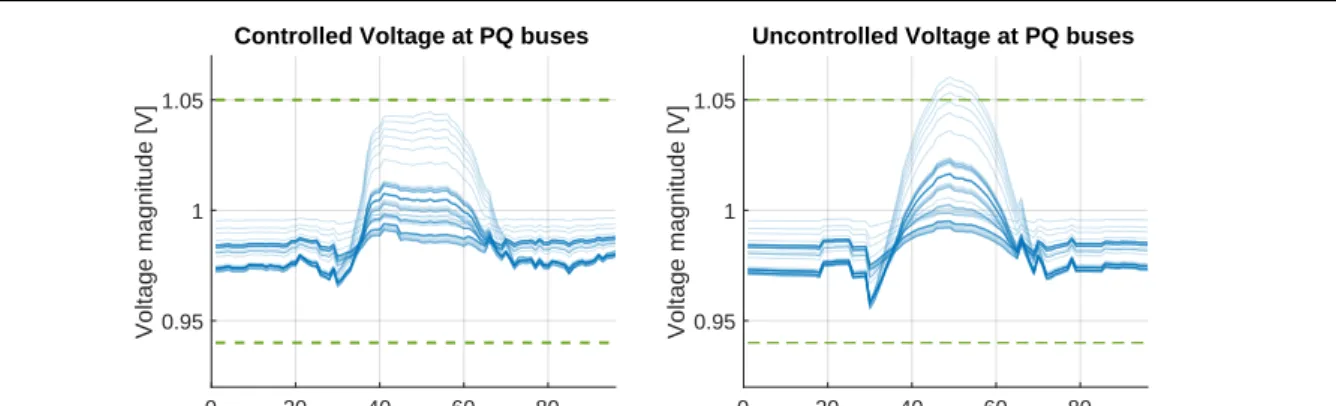
4.6 Simulations: Voltage levels . . . 74
4.7 Simulations: Peak shaving at node 40. . . 75
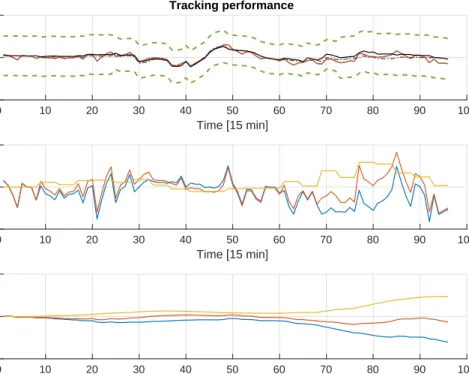
4.8 Simulations: Tracking and intraday trades. . . 76
4.9 Simulations: tracking of one selected AGC. . . 77
4.10 Simulations: BESS trajectories for Scenario A. . . 78
4.11 Simulations: BESS trajectories for Scenario A. . . 79
4.12 Simulations: Comparison of offered capacity . . . 80
5.1 Floor map of LADR. . . 93
5.2 Architecture of the control system for tracking service procurement with LADR. . 95
5.3 Conceptual sketch of the construction of setsΞts and Ξms. . . 96
5.4 Simulations: open-loop predictions for the multi-stage and two-stage controllers. . . 99
5.5 Experiments: First comparison of the two-stage and multi-stage controllers . . . . 102
5.6 Experiments: Second comparison of the two-stage and multi-stage controllers . . . 103
6.1 Spectrum of the AGC signal . . . 113
6.2 Overview of the experimental setup. . . 115
6.3 Validation of the building model. . . 117
6.4 Overview of the control architecture. . . 122
6.5 Performance of the AGC predictor. . . 130
6.6 RMSE of the AGC predictor. . . 131
LIST OF FIGURES xv
6.8 Experiments: economic costs during SFC provision. . . 136
6.9 Experiments: economic costs during normal operation. . . 136
6.10 Experiments: Cost of operation vs Comfort . . . 138
7.1 Experimental setup. . . 147
7.2 Architecture of the real-time controller. . . 155
7.3 Prosumer tracking errors. . . 158
7.4 Simulations: BESS . . . 159
7.5 Simulations: Building + BESS. . . 160
7.6 Experiments: Two selected days . . . 163
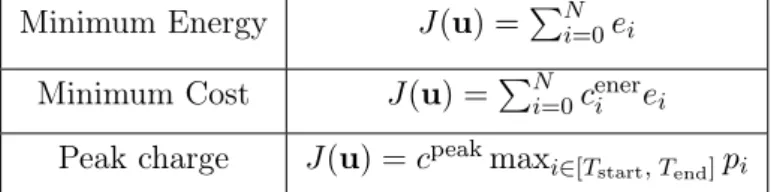
2.1 Cost function in typical MPC control problems for buildings. . . 17
3.1 Parameters for the control policies under analysis. . . 32
3.2 Cost improvement comparison. . . 33
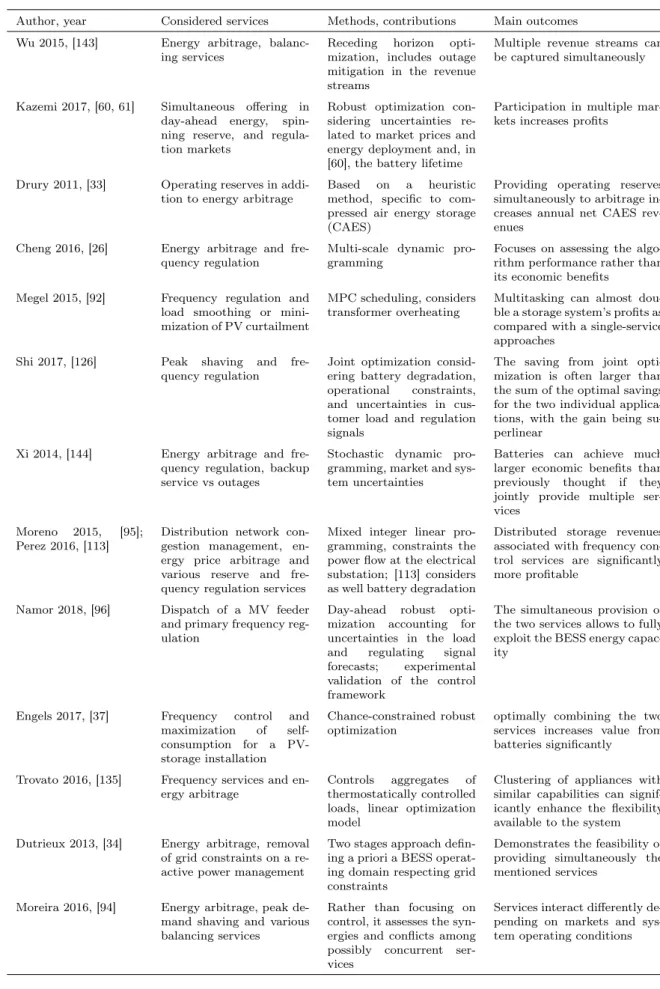
4.1 Review on the provision of multiple grid services by DERs. . . 52
4.2 Technical specifications of the connected loads and distributed generation. . . 71
4.3 Technical specifications of the controllable BESSs. . . 72
6.1 Nomenclature. . . 112
6.2 Qualitative comparison between BESS and commercial buildings. . . 114
6.3 Technical specifications for the BESS considered in the experimental campaign. . . 119
6.4 Outputs and sampling times of the modules in Figure 6.4. . . 121
6.5 Closed loop performance of the AGC predictor. . . 131
6.6 Experiments: offered capacity. . . 133
7.1 Nomenclature. . . 149
7.2 Simulations: statistics. . . 161
7.3 Experiments: statistics for the two selected days. . . 164
List of abbreviations
AGC Area Generation Control
AHU Air Handling Unit
ALD ASHRAE Likelihood of Dissatisfied
AS Ancillary Services
ASP Ancillary Services Provider
BEMS Building Energy Management System
BESS Battery Energy Storage Systems
BMS Battery Management System
DER Distributed Energy Resource
EPFL École Polytechnique Fédérale de Lausanne
HLC High Level Controller
HP Heat Pump
HVAC Heating, Ventilation, Air conditioning
LLC Low Level Controller
LP Linear Programming
MPC Model Predictive Controller
PCC Point of Common Coupling
PRBS Pseudorandom Binary Signal
PV Photovoltaic
PF Power Flow
PHEV Plugin Hybrid Electric Vehicles
SFC Secondary Frequency Control
SMPC Stochastic Model Predictive Controller
SoC State of Charge
TFC Tertiary Frequency Control
TCL Thermal Controllable Loads
Notation
Throughout the thesis, scalars and vectors are denoted with lower case letters (a, b, . . .), matrices are denoted with upper case letters(A, B, . . .). Sets are denoted with upper case blackboard bold letters (R,N, . . .) for number sets, and with calligraphic upper case letters (A,B, . . .) for general
sets. airepresents the value of vectoraat timei, whereas bold letters are used to denote sequences over time,e.g.,a= [aT
0, aT1, . . . , aTN−1]T.
General Operators and Relations
· general placeholder
j the imaginary unit,j :=√−1
:= left-hand side is defined by the right-hand side
| such that
∈ is element of (belongs to)
∀ for all ∃ there exists / ∈,@ / denotes negation ∧ and ⇒ implies
Sets, Spaces, and Set Operator {·, . . .} set or sequence ∅ empty set R real numbers N natural numbers C complex numbers
N+ set of non-negative natural numbers
Nkj set of consecutive non-negative integers{j, . . . , k}
Rn space ofn-dimensional (column) vectors with real entries Rn×m space ofnby m matrices with real entries
Cn space ofn-dimensional (column) vectors with complex entries Cn×m space ofnby m matrices with complex entries
(⊂) ⊆ (strict) subset (⊃) ⊇ (strict) superset
× Cartesian product, X×Y:={(x, y)|x∈X, y ∈Y} Operators on Vectors and Matrices
[·, . . .] a matrix (or a vector)
A⊗B Kronecker’s product between matrix A and B
vT row vector, transpose of vectors
||v|| (any) vector norm
||v||1 l1-norm or vector 1-norm (sum of absolute values)
||v||2 l2-norm or vector 2-norm (Euclidian norm)
||v||∞ l∞-norm or vector∞-norm (largest absolute element)
In×n identity matrix of dimensions n×n 0n×n zero matrix of dimensionsn×n 0n n-dimensional vector of zeros
1n n-dimensional vector of ones
MT transpose of a matrix
M−1 inverse of a square matrix
M >(≥)0 all elements of the matrix M are positive (non-negative)
M ()0 the matrix M is positive definite (positive semidefinite) ¯
M the complex conjugate of the matrix M.
||M|| (any) matrix norm
||M||1 induced matrix 1-norm
||M||2 induced matrix 2-norm
LIST OF TABLES xxi
Systems and Control Theory
nx number of states, nx∈N+ nu number of inputs,nu ∈N+ nw number of disturbances, nw ∈N+ ny number of outputs,ny ∈N+ x state, x∈Rnx u control input, u∈Rnu w disturbance,w∈Rnw y output, w∈Rny
X set of state vectors, X⊆Rnx U set of input vectors,U⊆Rnu W set of disturbance vectors, W⊆Rnw Y set of output vectors,Y⊆Rny Probability Theory
P(·) probability measure
E{·} expectation with respect of the probability measure P I[x >0] indicator function for the event[x >0]
Introduction
The need to modify the current structure of the electric grid into a more sustainable configuration motivates a rapid increase in renewable generation. However, renewable energy sources are intrin-sically volatile and uncertain and this poses new engineering challenges in order to guarantee the proper and safe functioning of the grid [93]. The balance between demand and generation of active power, at any time, is typically guaranteed by a set of fossil fuel-based spinning reserves which are kept on standby and activated to compensate for any mismatch between generated and consumed power. The increasing share of uncontrollable power units, e.g., photovoltaic panels or windmills, will jeopardize the current controlling mechanism resulting in an electric grid that strongly relies on the active control of physical as well asvirtual storage systems.
Potential candidates could be represented by,e.g., battery energy storage systems (BESS) or ther-mal storage systems by controlling the heating, ventilation and air conditioning (HVAC) of large commercial buildings. BESSs are very well suited for the provision of services to the grid since they are highly controllable devices that exhibit very fast ramp rates [105]. In a landscape where the overall rotational inertia of the grid is decreasing, having such fast-responding Ancillary Services Providers (ASPs) could help reducing frequency deviations and, thus, better stabilizing the opera-tion of the electric grid. However, when providing grid services, BESSs can be required to absorb significant energy biases over time which makes the management of the State of Charge (SoC) a challenging task.
Recent research has also shown the potential of the demand-side as a provider of services to the grid. These services are commonly referred to as Demand-Response (DR) programs and they require the load-side to vary its energy consumption profiles to meet the current needs of the grid. In particular, buildings represent a tremendous source of untapped energy storage. This is due to the fact that they are responsible for 40% of total energy consumption worldwide [29]; furthermore, buildings are inherently characterized by a large thermal inertia and this allows one to think of them as virtual
storage devices capable of decoupling production from consumption. In particular, commercial buildings are good candidates for providing services to the grid for the following reasons: 1) they are typically characterized by a large HVAC system with respect to residential buildings. This
2 Chapter 1. Introduction
corresponds to larger energy consumption per unit which in turn means a smaller cost of acquisition. 2) Most commercial buildings are already equipped with Building Energy Management Systems (BEMS) that can be readily used to monitor and control the operation of their HVAC systems [87]. All these factors make commercial buildings an excellent target for providing flexibility to the grid. At the same time, however, there are also a number of challenges related to it. First of all, the primary objective of any controller should be to maintain occupant comfort which is typically specified in terms of a temperature range. This should be guaranteed against a wide range of disturbances that typically display periodic cycles such as occupancy, outside temperature, and solar radiation. Second, typical HVAC systems are quite complex in nature with multiple cascade control loops, self-correcting behaviors, and physical limitations of the equipment. For this reason, their power consumption cannot, in general, be modulated reliably and at very high frequencies.
Motivated by the aforementioned reasons, in recent years, the research community has started to explore the technical and economic feasibility of providing grid services with distributed energy resources such as BESSs and commercial buildings. This thesis follows these directions by examining the following research questions:
1. How to efficiently control resources, such as buildings, that are subject to external perturba-tions which are characterized by periodic patterns?
2. How can one formally determine the amount of services that an aggregation of distributed energy resources can offer to the power grid?
3. Is it possible to demonstrate in practice the feasibility of providing such services, and which resources should be aggregated in order to maximize their full exploitation?
4. When providing ancillary services, is there a noticeable deterioration to the primal purpose that these resources should individually fulfill?
We report the research that was conducted, over the course of the Ph.D., in order to address all the questions above. The thesis is structured in three main parts, and the main contributions of all the following chapters are summarized below.
Part I - MPC for distributed energy resources
Chapter 2 - Preliminaries
This part provides the foundations for the remainder of the thesis. First, it provides some back-ground and mathematical material that is relevant for the comprehension of the following chapters. Second, it reviews the current practices for the control of energy resources. Finally, it introduces the formulation and main components of Model Predictive Control (MPC) giving an example for the building climate control case.
Chapter 3 - Stochastic MPC for Controlling the Average Constraint Violation of Pe-riodic Linear Systems with Additive Disturbances
This chapter deals with the problem of enforcing the satisfaction of state constraints for general linear systems subject to periodically time-varying uncertainty. In particular, we consider additive disturbances that are bounded and described by periodically time-dependent probabilistic distribu-tions. The aim of the chapter is to develop a strategy that controls the over-time-average constraint violations. The effectiveness of the proposed algorithm is demonstrated through an extensive sim-ulation study on a building climate control case.
The main novelties introduced in this part are:
• the generalization of the concept of periodic controlled invariant sets, available in the robust framework, to the stochastic case.
• the formulation of a receding horizon control scheme that enforces recursive feasibility for the closed-loop trajectories of a system subject to periodic disturbances.
The chapter is based on the following paper:
• L. Fabietti and C. N. Jones, “Stochastic MPC for controlling the average constraint violation of periodic linear systems with additive disturbances”, 2016 American Control Conference (ACC), Boston, MA, 2016, pp. 5395-5400. doi: 10.1109/ACC.2016.7526515
Part II - Provision of grid services using distributed energy resources: Theory
Chapter 4 - Multi-service provision through coordination of energy-constrained re-sources
Our objective is to investigate the provision of multiple services to the grid using a set of heteroge-neous energy resources. In particular, in this chapter, the problem of formally characterizing the amount of services that can be offered to the grid is tackled. The general planning problem is first introduced. It accounts for both local and network constraints while maximizing the amount of fast regulation that the resources can collectively offer. Then, two tractable reformulations, based on data-driven robust optimization methods, are proposed. The efficacy of the control framework is demonstrated in simulations.
The main novelties introduced in this part are:
• the formulation of the optimal day-ahead planning problem that determines the allocation of the available control power across multiple local and shared services. The problem is formulated as a multi-stage uncertain optimization problem and it differs from existing works in: i) it accounts for both the uncertainty across the network as well as the uncertainty of the tracking signal received from the TSO,ii) it explicitly considers power flow (PF) constraints,
iii) to increase the offerable flexibility, it encodes directly the possibility to adjust the baseline power consumption in the intraday market.
4 Chapter 1. Introduction
• the formulation of two novel approximated solutions of the planning problem. The approx-imations are based on data-driven robust optimization techniques and rely on a multi-stage linearization of the PF constraints around a general point of operation.
• the formal investigation of the properties of the considered PF linearization which is used to explicitly express voltages and currents across the network as a function of the controllable active and reactive injections.
• the presentation of an extensive simulation study that demonstrates the capability of the pro-posed framework to adapt to different levels of uncertainties while guaranteeing the provision of both local and shared services.
The chapter is based on the following papers, and most of the text and content in Chapter 4 has appeared in these papers.
• L. Fabietti, E. Namor, P. Nahata, M. Paolone, C. N. Jones, “Multi-service provision through coordination of energy-constrained resources”, Applied Energy (to be submitted), 2018.
• Tomasz T. Gorecki, Luca Fabietti, Faran A. Qureshi, Colin N. Jones, “Experimen-tal demonstration of buildings providing frequency regulation services in the Swiss market”, Energy and Buildings, Volume 144, 2017, Pages 229-240, ISSN 0378-7788, https://doi.org/10.1016/j.enbuild.2017.02.050.
Chapter 5 - Comparison of the two approximation schemes
This chapter complements chapter 4 by comparing the previously proposed approximation schemes both from a qualitative as well as from a quantitative perspective. In particular, advantages an disadvantages of each method are described and an extensive simulation and experimental analy-sis is conducted to build some intuition on which method is most appropriate for a given application. The content of this chapter is mostly taken from the following paper:
• L. Fabietti, T. T. Gorecki, F. A. Qureshi, A. Bitlislioglu, I. Lymperopoulos and C. N. Jones, “Experimental Implementation of Frequency Regulation Services Using Commercial Build-ings”, in IEEE Transactions on Smart Grid, vol. 9, no. 3, pp. 1657-1666, May 2018. doi: 10.1109/TSG.2016.2597002
Part III - Provision of grid services using distributed energy resources: Experi-ments
This part demonstrates the technical feasibility of deploying the control methods developed in Part II by means of two extensive experimental campaigns. Specifically, we consider two campus-scale experimental setups that comprise both controllable resources, stochastic on-site renewable generation, and uncertain consumption.
Chapter 6 - Multi-Time Scale Coordination of Complementary Resources for the Pro-vision of Ancillary Services
This chapter presents a predictive control scheme for coordinating a set of complementary resources for the provision of fast regulation services. In particular, a commercial building (slow resource) and a battery energy storage systems (fast resource) are combined to augment the flexibility that can be provided to the grid compared to the flexibility that any of these resources can provide individually. An extensive experimental campaign (9 consecutive days) is conducted using a large auditorium building and an electrical storage system on the EPFL campus. The control method of Chapter 4 is adapted to this specific case in order to formally compute the flexibility of the aggregated system. A multi-level control scheme based on data-driven robust optimization methods is also developed to coordinate the resources in real-time.
The key outcomes of the study are:
• By optimally splitting the regulation signal, each resource can track the components that best suit its technical capabilities. In particular, this enlarges the number of commercial buildings that could be considered for such an application irrespective of the HVAC system in place. Moreover, the energy requirements on the BESS can be reduced by tapping the abundant thermal storage of the building.
• Combining complementary resources (fast and slow) can significantly augment the flexibility that can be provided to the grid.
• Closed-loop performance can be greatly improved when exploiting the time-correlation of the regulation signal in order to predict its future realization.
• The occupants’ comfort in the building is not jeopardized when providing ancillary services.
• Optimally combining such resources allows one to achieve excellent tracking performance. Thus, the experimental results, that are in full compliance with the current Swiss regulations, show the practical feasibility of the developed method.
The chapter is based on the following paper, and most of the text and content in Chapter 6 has already appeared in this paper.
• L. Fabietti, F. A. Qureshi, T. T. Gorecki, C. Salzmann, C. N. Jones, “Multi-time scale coordination of complementary resources for the provision of ancillary services”, Applied Energy, Volume 229, 2018, Pages 1164-1180, ISSN 0306-2619, https://doi.org/10.1016/j.apenergy.2018.08.045.
Chapter 7 - Enhancing the dispatchability of distribution networks through utility-scale batteries and flexible demand
This chapter investigates the problem of dispatching the operation of an active distribution feeder which is comprised of PV generation, uncertain consumption, and two controllable resources. More precisely, the 20kV distribution feeder on the EPFL campus is considered. The experimental
6 Chapter 1. Introduction
platform, developed with other two Ph.D. students (Tomasz Gorecki, Emil Namor) and in collaboration with the DESL laboratory, comprises: five office uncontrollable buildings (350kWp), a roof-top photovoltaic installation (90kWp), a grid-connected electrical storage (720kVA-500kWh), and a fully-occupied multi-zone office building (45 kWp). The objective is to precisely track a power trajectory, called thedispatch plan, which is fixed the day before the beginning of operation. To this aim, the two-stage method described in Chapter 4 is adapted so as to compute a suitable dispatch plan, and closed-loop experiments are carried out for an extended period of time (12 full days of operation). A hierarchical real-time controller is designed to coordinate the BESS and the building so as to track the dispatch plan while maintaining comfort and respecting the operational constraints of the battery.
The main novelties of this chapter are:
• The adaptation of the general control method of Chapter 4 to a particular case of practical interest. In particular, the resulting day-ahead problem optimizes the operation of the feeder while allocating enough local reserves to absorb real-time deviations.
• The design of a hierarchical multi-timescale MPC controller to accurately track in real-time the committed dispatch plan by coordinating the BESS and the building.
• The experimental validation of the control method of Chapter 4 against a wide range of modeled and unmodeled uncertainties.
The content of this chapter is mostly taken from the following papers:
• L. Fabietti, T. T. Gorecki, E. Namor, F. Sossan, M. Paolone, C. N. Jones, “Enhanc-ing the dispatchability of distribution networks through utility-scale batteries and flexi-ble demand”, Energy and Buildings, Volume 172, 2018, Pages 125-138, ISSN 0378-7788, https://doi.org/10.1016/j.enbuild.2018.04.056.
• L. Fabietti, T. T. Gorecki, E. Namor, F. Sossan, M. Paolone and C. N. Jones, “Dispatching active distribution networks through electrochemical storage systems and demand side man-agement," 2017 IEEE Conference on Control Technology and Applications (CCTA), Mauna Lani, HI, 2017, pp. 1241-1247. doi: 10.1109/CCTA.2017.8062629
Additional Publications
The following paper was published during the Ph.D., but is not included in this thesis.
• R. Gupta, F. Sossan, E. Scolari, E. Namor, L. Fabietti, C. N. Jones, and M. Paolone (2018). An ADMM-Based Coordination and Control Strategy for PV and Storage to Dispatch Stochastic Prosumers: Theory and Experimental Validation. 2018 Power Systems Computa-tion Conference (PSCC), 1-7.
This paper is inspired by the results provided in Chapter 7. In particular, it proposes a control framework to coordinate the operation of a curtailable PV facility and a battery system in order
to achieve the dispatchability of an active distribution feeder. A multi-time scale hierarchical controller, similar to the one of Chapter 7, is designed. The lower layer is represented by an MPC controller executed at 10 s resolution to achieve fine tuning of a given setpoint. The upper layer is a slower MPC controller coordinating the two resources. It runs at a 5 minutes resolution and it is solved in a distributed fashion. The control framework is validated experimentally using the same platform of Chapter 7 with the only difference being the replacement of the controllable building with a 13 kWp curtailable PV facility.
My contribution to the paper was the development of the hierarchical controller, the formulation of the high-level centralized MPC problem, and the reformulation of the latter in order to be solved using the alternating direction method of multipliers (ADMM). The tuning, deployment, and testing of the algorithm was instead conducted by the co-authors.
Preliminaries
This chapter serves as a reference for the rest of the manuscript as the main building blocks used in the thesis are presented. It is divided in two parts, the first presents some mathematical preliminaries and the second describes MPC while keeping in mind the objective of applying it to control distributed energy resources.
2.1
Mathematical Preliminaries
2.1.1 Set Theory
Definition 1 (Convex set). A set X ⊆ Rn is convex if by selecting any pair of points in X the
segment that connects them lies entirely in X,i.e.
x1, x2∈ X, λx1+ (1−λ)x2 ∈ X forλ∈[0,1].
Definition 2 (-ball). The open n-dimensional-ball inRn around a fixed point (center)xc∈Rn
is defined as the set
B(xc) :={x∈Rn| ||x−xc||< },
where the radius of the ball is >0 and|| · || can be any norm (typically the Euclidean norm).
Definition 3 (Closed set). A setX ⊆Rn isclosed if every point not belonging toX has a disjoint
neighborhood from X,i.e.
∀x /∈ X, ∃ >0 such that B(x)∩ X =∅.
Definition 4 (Bounded set). A set X ⊆Rn isbounded if it is contained inside some ball B
r(·) of finite radiusr,i.e.
∃r <∞, x∈Rn such that X ⊆ Br(x)
12 Chapter 2. Preliminaries
2.1.2 Systems and Control Theory
Definition 6 (Discrete-time system).
xi+1 =f(xi, ui, wi) Non-linear time-invariant
xi+1 =Axi+Bui+Ewi Linear time-invariant (LTI)
(2.1)
with time step i∈N, system state xi ∈Rnx, control inputui ∈Rnu, and disturbancewi∈Rnw.
Definition 7 (Constrained system). A discrete-time system is a constrained system if the state
and/or the control inputs are enforced to belong to the sets
ui∈U⊂Rnu
xi∈X⊂Rnx
(2.2) where it is assumed that the constraint sets Uand X are compact and both of them contain the origin.
Definition 8 (Disturbance set). For bounded disturbances,w, thedisturbance set Wis defined by
wi∈W⊂Rnw
where the setW is assumed to be compact and contain the origin.
Definition 9(Positive invariant set). A setX ∈Rnx is apositive invariant set for the autonomous
systemxi+1=f(xi), if f(xi)∈ X for allxi ∈ X.
Definition 10 (Robust positive invariant set). A setX ∈Rnx is arobust positive invariant set for
the systemxi+1=f(xi, wi), if f(xi, wi)∈ X for allxi∈ X and for allwi ∈ W.
Definition 11(Controlled invariant set). A setX ∈Rnx is acontrolled invariantset for the system
xi+1=f(xi, ui), if ∃ui ∈Usuch thatf(xi, ui)∈ X for allxi∈ X.
Definition 12 (Robust controlled invariant set). A set X ∈Rnx is a controlled invariant set for
the system xi+1 = f(xi, wi, ui), if ∃ui ∈ U such that f(xi, wi, ui) ∈ X for all xi ∈ X and for all
wi∈ W.
Definition 13 (Maximum controlled invariant set). A set X ∈ Rnx is the maximum controlled
invariant for the systemxi+1 =f(xi, ui), ifX is a controlled invariant set as defined in Definition
11, and any other controlled invariant set, S is a subset of X,i.e. S ⊆ X.
Definition 14 (Maximum robust controlled invariant set). A set X ∈Rnx is the maximum
con-trolled invariant for the systemxi+1=f(xi, ui), if X is a robust controlled invariant set as defined
in Definition 12, and any other robust controlled invariant set,S is a subset ofX,i.e. S ⊆ X.
2.2
Receding Horizon Control
This section provides a brief description of the main building blocks of an MPC controller. Some-times also called receding horizon control, MPC is an optimization-based control strategy that has been extensively and successfully used in many areas to perform constrained control [91].
The main idea is the following, at every discrete sampling time i, a measurement of the current state of the system, xi, is obtained. Then, the system evolution is computed, over a pre-defined prediction horizon, N, by propagating the initial state through a model such as (2.1). Finally, an optimization problem is solved that minimizes some optimality criterion given the system evolution and constraints (2.2). By solving such an optimization problem, a sequence of inputs and states over the prediction horizon is obtained. In particular, these sequences respect the system dynamics and constraints while minimizing the given optimality criterion. The optimal input sequence is given by
u∗(x0) :={u∗0, . . . , u∗N−1}
According to the receding-horizon structure of the MPC controller, the first inputu∗0of the sequence is applied to the system whereas the rest is discarded. At the next time instant, the new state is measured and the whole process is repeated with the prediction horizon shifted by one time step. In particular, this receding-horizon structure of the controller is the key mechanism that introduces feedback into the control loop in order to compensate for modeling errors, external perturbations, etc.. A sketch of the resulting MPC algorithm is reported in the following
Algorithm 1 MPC controller algorithm
1: Obtain the current state of the systemx0
2: Obtain the optimal input sequenceu∗(x0)by solving an optimization problem over the
predic-tion horizon,N.
3: Apply the first input,u∗0 of the sequence to the system 4: Repeat from 1 at the next time iteration.
Remark 1. As described in this section, the basic structure of the MPC problem consists in
opti-mizing directly over input sequences. Another possibility, that will be exploited later in this thesis, is to optimize over control laws, i.e., over functions of the system states or disturbances. To keep this introduction as simple as possible, we focus herein on input sequences. The reader is referred to Chapter 4 for the formulation using control laws.
2.2.1 MPC for distributed energy resources
There is a vast literature that supports the efficacy of MPC for the optimization and control of complex energy systems. Possible applications range widely from industrial processes [42], wind turbines [77], fuel cells [151], residential and commercial building climate control [123], just to cite a few. Thus, in this part, rather than providing an in-depth literature review across all applications, we focus on describing the main motivations for using MPC for the control of flexible resources. While doing this, we also summarize the most important findings appearing throughout the litera-ture. In particular, as it will be one of the most recurrent systems considered in this thesis, we will focus on the particular example of the development of MPC controllers for building control.
14 Chapter 2. Preliminaries
2.2.2 MPC for Building Control
Traditionally, the control of commercial building is obtained by means of PID controllers which are coordinated by a number of rule-based controllers. In most cases, the resulting overall controller can achieve good performance by means of an iterative tuning procedure which aims at occupants’ comfort. However, this usually comes at the cost of high energy expenditure and commissioning. Moreover, these controllers are not suitable for the interaction with a smart grid in order to provide support services such as secondary frequency control, peak shaving or load shifting.
Recently, the common trend is to improve HVAC system performance using more advanced predic-tive controllers such as MPC that are inherently able to incorporate several pieces of information. Thus, many contributions have appeared that consider a variety of different objectives, such as total cost minimization [83, 100], peak power reduction [84, 103], optimal energy use [53], etc.. The conclusions of these studies is that significant performance improvements can be obtained if an appropriate model for the building is available, as well as reliable forecasts for weather conditions and occupancy.
In particular, in an important contribution [106] Olderwurtel et al. present an investigation into the energy saving potential of integrated room automation through a large-scale simulation study. In the paper, different control schemes are considered and compared for several simulation set-ups varying building type, HVAC system, and environmental perturbations. The main outcome of this study is that, in most cases, MPC outperforms industry-standard rule-based controllers. A particular class of MPC controllers, named Stochastic MPC (SMPC), has also been shown to achieve better performance with respect to its deterministic or robust counterpart. This is due to its ability to directly account, in the problem formulation, for uncertainty in environmental conditions and to formulate comfort constraints in a probabilistic fashion, allowing violations under certain situations.
In most SMPC schemes for HVAC control, in order to simplify the tractability of the problem formulation, the disturbances acting on the system are assumed to be extracted from a normal distribution. A different approach is taken in [110, 111], where a tractable-scenario-based approxi-mation of a chance constraint problem is considered. Another scenario-based approach can be found in [146], whereZhang et al. propose an iterative bilinearization of the building model around nominal trajectories and sample occupancy pattern from a set of historical data.
The design and the real-world implementation of a predictive controller for a campus building connected to thermal storage are analyzed in [85, 86]. The resulting nonlinear MPC is shown to improve plant performance by 19% with respect to the previously installed baseline controller, and this percentage corresponds to a total of US$1,280 weekly saving. This is obtained by fully exploiting the active control of thermal storage operating the chilling system when economically convenient and, therefore, enhancing the efficiency of the chiller and cooling tower.
Summarizing the findings in the literature, the main advantages of predictive control, in the context of building control, are:
• The ability to exploit all the available information: MPC offers a very natural way to incor-porate a wide range of factors also including future quantities such as weather conditions, electricity prices, occupancy.
• The capability of directly accounting for operational and comfort constraints.
• The possibility to specify and optimize over complex economic costs in an intuitive manner.
Optimization problem
Starting from the introduction given above, we provide herein an overview of the main ingredients used in MPC for buildings. We start from a standard MPC formulation
Problem 1 (General MPC Problem).
J(u∗) := minimize x,u J(u) (2.3) xi+1 =f(xi, ui, wi) (2.4) yi=g(xi) (2.5) (xi, ui)∈(X,U) (2.6) yi∈Y (2.7) x0 = ˆx (2.8) i= 1, . . . , N
The term (2.3) represents the cost function to be minimized. Equations (2.4) and (2.5) capture the dynamics of the system and the effect of external perturbations that may affect the system. Equations (2.6), (2.7) express the constraints on the states, inputs, and the outputs of the considered system. Equation (2.8) fixes the initial state of the system. Finally, N represents the numbers of steps in the future over which the system trajectories are optimized. To build some intuition, in the following sections, we provide possible examples of how each component can be chosen for the case of buildings.
Modeling
We focus on commercial buildings served by an HVAC system that is either fully or partially controllable through an Building Energy Management (BEMS) system. In such a scenario, it is quite common to divide the model into two components: the model for the thermodynamics of the building, and the model for the HVAC system.
The building thermodynamics can be typically characterized by a set of linear equations of the form:
16 Chapter 2. Preliminaries
xi+1=Axi+Bui+Ewi
yi=Cxi
(2.9) where the output,y, is represented by the air temperature in different zones of the building, and the inputs are the control variable of the HVAC system such as massflow rates, supply temperatures, temperature setpoints, etc..
As buildings are affected by large disturbances that can have a significant impact on the internal dynamics of the temperature, it is of paramount importance to capture these dependencies in the model. This is reflected in the term wi that can encompass a wide range of disturbances such as occupancy, outside temperature, sun irradiance, and internal gains.
The HVAC system consumes electrical energy, phvac, and produces the required thermal energy to maintain occupants’ comfort in the building.
phvaci =hhvac(ui, di) (2.10) where hhvac(·) is, in general, a non-linear static map that captures the dependence of the electric consumption on the input commands and the external perturbations.
It is quite well-known that obtaining models such as (2.9) and (2.10) represents the most time-consuming and challenging task in the design of MPC controllers for buildings. Thus, this has been the topic of an intense research activity and many different approaches have been proposed [2, 74]. Broadly speaking, these approaches can be divided in three categories - first principle models (white-box), data-driven (black-box), and a combination of the previous two (grey-box). Each of them has its own advantages and disadvantages and the ultimate decision on which method to consider should depend on the particular case at hand. In this thesis, the model has either been obtained by means of available modeling software [50], or, as in the experimental part, has been identified using data-driven approaches on available input-output data.
Current state
As detailed in (2.8), the dynamics of the system are initialized with the current state which can be either directly measurable or it can be estimated by means of a global observer relying on a state estimation technique (e.g. weighted least squares, Discrete Kalman filter, etc.).
Constraints
As already mentioned, one of the main reasons to consider an advanced control technique such as MPC, is its inherent ability to handle constraints on the inputs and states of the system. In the case of a building, comfort constraints on the indoor air temperature of the building zones can be seamlessly included by specifying a temperature range[Tref−βi, Tref+βi]within which the indoor
Minimum Energy J(u) =PN i=0ei
Minimum Cost J(u) =PN
i=0ceneri ei Peak charge J(u) =cpeakmax
i∈[Tstart, Tend]pi
Table 2.1 – Cost function in typical MPC control problems for buildings.
temperature should be maintained. The termTref is the ideal temperature to be tracked andβiis a user-defined parameter which determines the maximum allowed deviation fromTref. Please notice how β is allowed to be time-varying (typically periodic) as temperature constraints are often times relaxed during non-working/unoccupied hours. In the same manner, operational constraints are considered to guarantee the safe operation of the HVAC system. Possible examples are represented by maximum limit on the electrical power drawn from available compressors, minimum running time to avoid significant wear of mechanical components, etc..
Objective function
The second advantage of MPC is represented by the possibility of directly considering various types of cost function which is chosen to fulfill two purposes:
• Stability which is the property of a system to respond to bounded inputs with bounded
outputs. In general, to achieve this goal, the cost function is chosen so that the corresponding optimal cost function, J(u∗) is a Lyapunov function for the system (2.4). In particular, this
guarantees the closed-loop stability of the system [91].
• Performance the cost captures a given optimality criterion that we wish to minimize over
time. Multiple objectives are also possible and the cost should be designed to directly express the relative importance of these different objectives.
When dealing with buildings, being an inherently stable system, the stability requirement is typi-cally relaxed, and, as a consequence, the focus is purely on performance. One example of such cost is, for instance, the minimization of energy use:
J(u) = N X i=0
ei
with ei representing the energy use of the resource, e.g. energy consumption of an HVAC system over a one-day period. Similarly, the minimum cost is expressed as:
J(u) = N X i=0 cener i ei
withcener the cost of energy that is, in general, time-varying. In particular, depending on the type of resource considered the price of energy could vary according to a fixed schedule or continuously.
18 Chapter 2. Preliminaries
An example of fixed schedule is represented by on-peak/off-peak tariffs that are typically applied to commercial buildings. In this situation a higher price is fixed during hours with overall high consumption whereas a lower price is set during non-peak hours. Hence, while in the static case the cost function can be readily formed using the pre-determined tariffs, in the case of dynamic prices, one would need to forecast them before setting up the MPC problem.
Another common objective is to minimize the peak demand over a specified period of time:
J(u) =cpeak max i∈[Tstart, Tend]
pi (2.11)
where cpeak is a fixed cost associated to the peak power consumption over the time period [Tstart, Tend].
Finally, it is quite common to consider multi-objective cost functions. For instance, if the HVAC system of a building is controlled to reduce the peak charges, besides considering the economic met-ric (2.11) one could also include a term penalizing large deviations from the reference temperature,
Tref. In such situations the cost function would be of the form:
J(u) =Jecon(u) +ρ(u)
whereJecon(u) represents one of the economic costs previously introduced, and the termρ(u) is a penalization term.
2.2.3 Additional preliminaries for MPC
We conclude this chapter by providing some additional definitions that will be essential for the comprehension of the following chapters.
Definition 15 (Admissible). A control input, sequence, or control law is called admissible if it
satisfies the input constraints.
Definition 16 (Feasible set). The feasibility set X0 is defined as the set of initial states x0 ∈Rn
for which the MPC Problem (1) with horizonN is feasible, i.e..
X0 :={xˆ∈ Rnx | ∃(u
0, . . . , uN−1) s.t. (xi, ui)∈X×U, yi ∈Y, i= 1, . . . , N} .
Definition 17 (Recursive feasibility). The MPC Problem 1 is called recursively feasible, if for all
Stochastic MPC for Controlling the
Average Constraint Violation of Periodic
Linear Systems with Additive
Disturbances
3.1
Introduction
As underlined in the previous chapter, when dealing with the control of complex distributed energy resources such as buildings, SMPC has been shown to be the best option with respect to standard rule-based controllers or robust controllers. This is due to the fact that SMPC is designed to directly account for the stochastic nature of environmental disturbance and it is, therefore, capable of reducing the conservatism of robust control schemes. Moreover, in many situations, constraint specification is, by nature, probabilistic so that it is reasonable to allow violations to occur with a certain frequency or when the amount by which the constraint is violated is small.
Standard methods for SMPC consider point-wise in time constraint specifications such as expecta-tion, probabilistic or integrated chance constraints. These constraints are then typically enforced by implementing a mixed stochastic-worst-case tightening procedure [23, 24, 69]. However, these approaches do not consider past trajectories of the state process and this generally results in a conservative formulation. A different approach was first proposed in [67] and then extended in [68]. The main idea is to reduce the conservatism of previous methods by looking at the whole history of the state trajectory. Hence, rather than controlling the amount of constraint violation at each time separately, the quantity of interest is the average over time of constraint violation.
All the aforementioned approaches focused on LTI systems subject to time-invariant disturbances which is a quite restrictive assumption in many applications. Periodic linear systems offer a use-ful generalization of time-invariant systems providing a natural framework for modeling various
3.2 Problem Statement 21
phenomena [11]. A relevant example of this is represented by building climate control where the system is subject to time-varying environmental perturbations that typically present periodic, seasonal/daily patterns. MPC of linear/nonlinear periodic systems has been tackled in many con-tributions [15, 62, 73]. The case of linear periodic systems subject to additive uncertainties has been considered, yet in a robust setting, in [45]. Thus, the control of periodic systems has not been addressed in an SMPC framework which was one of the main motivations of this research.
The contribution, and novelty of this chapter is twofold. First we generalize the concept of periodic controlled invariant sets, available in the robust framework [45], to the stochastic case. Second we provide the extension of the least-conservative approach of [68] to the powerful and more general class of discrete-time periodic linear systems with periodically time-varying system dimensions and subject to additive time-varying disturbances. Third, we demonstrate in simulation the effectiveness of the control strategy on a building climate control case.
3.2
Problem Statement
First, we provide an extension of the general linear time-invariant state-space model defined in Chapter 2 to the general class of periodic systems:
Definition 18. A discrete time linear periodic system is defined by
xi+1 =Aσixi+Bσiui+wi
σi:=mod(i, p) σi : N→Np0−1
(3.1)
with system time step i ∈ N, period length p ∈ N+, intra-period step index function σ(·), state xi ∈Rnσi, inputui ∈Rmσi, disturbance wi∈Rlσi and Aσi ∈R
nσi+1×nσi,B σi ∈R
nσi+1×mσi.
Remark 2. The dimensions of state, input and disturbance vectors are allowed to be periodically
time-dependent and have to satisfy nj, mj, lj ∈N+∀j∈Np0−1. The possibility to consider systems
characterized by time-varying dimensions can be useful in many practical situations, e.g., to model systems with asynchronous control inputs [45]. Another evidence of this fact is reported in Section 3.4.2.
We assume that the state of the system is perfectly known at time i. The inputs are subject to hard constraints of the form:
ui ∈Uσi, i∈N+ (3.2)
At each time stepk, we assume the support ofwi to belong to a compact polyhedronWσi. Finally
the closed-loop state of the process is required to satisfy, in a probabilistic fashion, the following constraint:
gTσixi≤hσi (3.3)
wheregσi ∈R
nσi and h σi ∈R.
Remark 3. To simplify the development, a single linear constraint is considered in the
follow-ing. We highlight, however, that more complex constraints can be easily considered using the same methodology [68].
In order to quantify the amount of violation occurring at timekwe introduce the concept of aloss
function.
Definition 19. A function l : R → R is a loss function if it is non-decreasing and
lower-semicontinuous and it is zero at the origin.
In loose terms, one wants the state to remain in the half space defined by (3.3) “most of the time” or alternately not to exceed it “very much”. Note that thestate constraint can be time-varying as well.
A possible way to formalize this requirement is to imposepoint-wise in time constraints such as
E{l(gTσixi−hσi)} ≤ξ, i∈N+ (3.4)
where ξ ≥0. In general, due to the fact that constraints of this type are hard to deal with, one wants to enforce (3.4) by means of the one-stepconditional constraint.
E{l(gσTi+1xi+1−hσi+1)|xi)} ≤ξ, i∈N+ (3.5)
However, constraint (3.5) is, in general, very conservative which reduces the potential benefit of the probabilistic constraint specification. Instead of focusing on point-wise in time probabilistic constraints such as (3.4), we enforce constraints directly on the closed loop state process as a whole.
To this aim, we first introduce the weighted cumulative loss up to time i
vi:= i X k=0
γi−kl(gσTkxk−hσk) i∈N+ (3.6)
whereγ ∈[0,1] determines the forgetting rate of past losses.
Secondly, we define the normalization factorsi
si := i X k=0 γi−k= ( 1−γi+1 1−γ γ∈[0,1) i+ 1 γ= 1 (3.7)
3.3 Main Result 23
of interest of this chapter. In particular we require that: Ei{ vi+1 si+1 } ≤ξ if vi si ≤ξ lim k7→∞ vmin(i+k,τi) smin(i+k,τi) ≤ξ if vi si > ξ (3.8a) (3.8b)
where the integer numberτi is the first time of return. More precisely, if at time ithe amount of violation exceeds the maximum allowed value,i.e. vi > ξsi,τi represents the first time afteriwhen the conditionvτi ≤ξsτi is satisfied again, that is:
τi :=inf{k≥i|vk/sk≤ξ} ∈ {i, i+ 1, . . .} (3.9)
3.3
Main Result
In this section a recursively feasible receding horizon control policy that enforces the constraint (3.8) for the closed-loop state process is presented. The main idea is to apply feedback on the ratio
vi/si acting on the one-step conditional constraint (3.5). If the quantity vi/si is “small” we will loosen it, on the other hand, if it is “large” we will enforce (3.5) as it is.
As a first step, it can be observed that, by exploiting the state dynamic (3.1), the conditional constraint (3.5) can be written as
E{l(gTσi+1(Aσixi+Bσiui+wi)−hσi+1)} ≤ξ (3.10)
The evaluation of (3.10) is in general difficult, hence to obtain a sufficient condition for its satis-faction, we first observe that the constraint (3.10) can be arranged as
E{l(gTσi+1(Aσixi+Bσiui)−hσi+1
| {z }
µ
+gT
σi+1wi)} ≤ξ
now, considering the function
fσi(µ) :=E{l(µ+g
T
σi+1wi)} (3.11)
one immediately recognizes that it can be written as
fσi(µ) :=
Z ∞
−∞
l(µ+y)pdfgT
σi+1wi(y)dy
Finally, the inequality (3.5) is satisfied if and only if
gTσi+1(Aσixi+Bσiui)≤qσi(ξ) +hσi+1 (3.12)
whereqσi : R→Ris defined as
and its existence is guaranteed by the assumptions on the loss functionl(·).
In the following we will introduce key concepts that are useful for the understanding of the proposed algorithm.
Definition 20. The stochastic feasibility set Xs
j corresponding to the intra-period index j = 0, . . . , p− 1 is defined as Xs j ={x∈Rnj : ∃u∈Uj | gTσj+1(Ajx+Bju)≤qσj(ξ) +hσj+1} (3.13) Essentially,Xs
j represents the set of all states from which there exists an admissible input for the intra-period index j such that the state process will satisfy the constraint (3.5) for all the possible disturbance realizations contained in the current disturbance support setWj.
In many practical situations, besides the stochastic constraint (3.8), it is desirable that the amount of violation is constrained by a maximum admissible loss at each time iteration.
l(gTσix−hσi)≤ξ¯σi (3.14)
Typically the parameterξ¯σi is derived from the problem specification and can be, in general,
time-varying as well. This requirement defines thefeasible set X¯j for eachj= 0, . . . p−1 ¯ Xj :={x∈Rnj|gTσjx≤hσj+l −1( ¯ξ σj)} (3.15) where l−1(a) :=sup{y∈R|l(y)≤ξ} ∈[−∞,∞]
The second important concept that needs to be introduced is that ofStochastic Periodic Controlled
Invariance sequence (SPCI).
Definition 21. A collection of sets(S0, S1, . . . , Sp−1), is an SPCI sequence if it satisfies for each
j= 0,1. . . , p−1 Sj ⊆ Xjs∩X¯j and
∀x∈Sj ∃u∈Uj : Ajx+Bju+w∈Sσj+1 ∀w∈Wj
∧ gσTj+1(Ajx+Bju)≤qj(ξ) +hσj+1
(3.16)
In the following, the parameter that will adjust the loosening of theone-stepconditional constraint (3.5) is presented. Starting from the first line of (3.6) one can observe that the expected value
Ei{vi+1} can be written as
![Figure 3.1 – Possible evolution of the state over several time steps when starting from set S 0 1 at time k = 0, with p = 3, n s = 3, γ = 1 and l(·) = I[x > 0] which corresponds to the classic chance constraint formulation](https://thumb-us.123doks.com/thumbv2/123dok_us/9015838.2799371/48.892.227.692.451.775/figure-possible-evolution-starting-corresponds-classic-constraint-formulation.webp)
![Figure 4.1 – Overview of a traditional electrical power system. Source: [58]](https://thumb-us.123doks.com/thumbv2/123dok_us/9015838.2799371/66.892.127.800.187.414/figure-overview-traditional-electrical-power-source.webp)