Brookman-Byrne, Annie and Mareschal, Denis and Tolmie, Andrew K and
Dumontheil, Iroise (2019) The unique contributions of verbal analogical
reasoning and non-verbal matrix reasoning to science and maths
problem-solving in adolescence. Mind, Brain, and Education 13 (3), pp. 211-223.
ISSN 1751-2271.
Downloaded from:
Usage Guidelines:
Please refer to usage guidelines at
or alternatively
The Unique Contributions of
Verbal Analogical Reasoning
and Nonverbal Matrix
Reasoning to Science and
Maths Problem-Solving
in Adolescence
Annie Brookman-Byrne
1,2, Denis Mareschal
1,2, Andrew K. Tolmie
2,3, and Iroise Dumontheil
1,2ABSTRACT—Relational reasoning, the ability to detect meaningful patterns, matures through adolescence. The unique contributions of verbal analogical and nonverbal matrix relational reasoning to science and maths are not well understood. Functional magnetic resonance imaging data were collected during science and maths problem-solving,
and participants (N= 36, 11–15 years) also completed
relational reasoning and executive function tasks. Higher verbal analogical reasoning associated with higher accuracy and faster reaction times in science and maths, and higher activation in the left anterior temporal cortex during maths problem-solving. Higher nonverbal matrix reasoning associ-ated with higher science accuracy, higher science activation in regions across the brain, and lower maths activation in the right middle temporal gyrus. Science associations mostly remained significant when individual differences in executive functions and verbal IQ were taken into account, while maths associations typically did not. The findings
1Centre for Brain and Cognitive Development, Department of Psycho-logical Sciences, Birkbeck, University of London,
2Centre for Educational Neuroscience, University of London, 3Department of Psychology and Human Development, UCL Institute of Education, University College London,
Address correspondence to email and address: Annie Brookman-Byrne, Department of Psychological Sciences, Birkbeck, Univer-sity of London, Malet Street, London WC1E 7HX, UK; e-mail: [email protected]
indicate the potential importance of supporting relational reasoning in adolescent science and maths learning.
Relational reasoning is the ability to consider relations between multiple mental representations (Crone et al., 2009) and detect meaningful patterns (Alexander, Dumas, Grossnickle, List, & Firetto, 2016). Relational reasoning can occur in the verbal domain, for example, in verbal ana-logical reasoning tasks (e.g., Leech, Mareschal, & Cooper, 2007; Richland & Burchinal, 2013), or in the visuospatial domain, for example, in nonverbal matrix reasoning tasks (e.g., Alexander et al., 2016). Supporting relational reason-ing in science and maths classrooms may help students to learn better in these disciplines (Richland, Zur, & Holyoak, 2007; Vendetti, Matlen, Richland, & Bunge, 2015). There is cross-sectional and longitudinal evidence of associations between individual differences in relational reasoning and maths (e.g., Dumontheil & Klingberg, 2012; Green, Bunge, Briones Chiongbian, Barrow, & Ferrer, 2017). However less is known regarding the link between individual differ-ences in relational reasoning and science, with studies thus far focusing on the importance of relational reasoning in the learning of scientific material (Dumas, Alexander, & Grossnickle, 2013). Relational reasoning and the underlying neural systems show prolonged development which con-tinues into adolescence (Dumontheil, 2014), a time when pupils are presented with increasingly complex science and
maths concepts and problems (Department for Education, 2013a, 2013b). Establishing the roles of different aspects of relational reasoning, in different domains, namely verbal analogical reasoning and nonverbal matrix reasoning, in science and maths problem-solving during adolescence may lead to more concrete advice for secondary school educators.
The (left) rostrolateral prefrontal cortex (RLPFC; Brod-mann Area [BA] 10/47) has been proposed to play a specific role in relational integration (Bunge, Helskog, & Wendelken, 2009), whether the information being manipulated is seman-tic or visuospatial (Wendelken, Chung, & Bunge, 2012). In addition, the processing of single relations and relational integration rely on a network including the dorsolateral prefrontal cortex (DLPFC; BA9/46), ventrolateral prefrontal cortex (VLPFC; BA 45), and the parietal cortex (BA 7/40) (Wendelken et al., 2012), across childhood, adolescence, and adulthood (Crone et al., 2009; Dumontheil, Houlton, Christoff, & Blakemore, 2010; Whitaker, Vendetti, Wen-delken, & Bunge, 2017). Over the course of development there is evidence of increased specialization of the RLPFC for relational integration, versus the manipulation of single relations (e.g., Crone et al., 2009; Dumontheil et al., 2010; Wendelken, O’Hare, Whitaker, Ferrer, & Bunge, 2011; see Dumontheil, 2014 for review). In addition, developmental changes in RLPFC structure and functional connectivity associate with changes in relational reasoning performance during adolescence (Bazargani, Hillebrandt, Christoff, & Dumontheil, 2014; Dumontheil et al., 2010; Wendelken, Fer-rer, Whitaker, & Bunge, 2016).
A number of cross-sectional studies have provided evi-dence for a link between nonverbal matrix reasoning and maths performance, such as in 5- to 19-year olds (Taub, Floyd, Keith, & McGrew, 2008) and 15- to 16-year olds (Kyttälä & Lehto, 2008). Stronger evidence comes from longitudinal studies. One study found that nonverbal matrix reasoning was a predictor of maths performance in 6- to 16-year olds 2 years later (Dumontheil & Klingberg, 2012). Another found that in 6- to 21-year olds fluid reasoning (including nonverbal tests of matrix reasoning, analysis syn-thesis, and concept formation) was a greater predictor of maths 18 months later than previous maths performance (Green et al., 2017). A third study revealed that a combined measure of relational reasoning, which included numerical reasoning, verbal analogical reasoning, and spatial reason-ing, predicted maths learning in 11- to 14-year olds over 2 years (Primi, Ferrão, & Almeida, 2010). Other studies have shown teaching by analogy to improve maths performance in adults (Richland & McDonough, 2010), and science per-formance in 9- to 10-year olds (Matlen, Vosniadou, Jee, & Ptouchkina, 2009) and adults (Jee et al., 2013).
These findings have led to suggestions that relational rea-soning may play a key role for maths development (Green
et al., 2017; Miller Singley & Bunge, 2014). First, relational reasoning skills are likely to play a role in science and maths reasoning during problem-solving, by allowing individuals to extract the relations between key elements of a given prob-lem, compare and integrate them into a solution. Whether verbal-semantic or visuospatial relational reasoning skills are recruited likely depends on the way the problem is pre-sented. Second, relational reasoning skills have been pro-posed to support maths conceptual learning, by allowing a gradual build-up of understanding of relations between, for example, single digit numbers, fractions, and equations with abstract terms (Miller Singley & Bunge, 2014), as well as by allowing understanding of concepts through analo-gies (Vendetti et al., 2015). Emphasizing and scaffolding the use of relational reasoning in the classroom therefore may lead to improved conceptual knowledge acquisition and problem-solving (Miller Singley & Bunge, 2014; Vendetti et al., 2015).
Science and maths problem-solving are supported by domain-specific factual knowledge, procedural skills, and conceptual understanding (e.g. Cragg & Gilmore, 2014; Zimmerman, 2000). Although little research has focused on specific associations with these three components (although see Cragg, Keeble, Richardson, Roome, & Gilmore, 2017), a range of cognitive functions have been shown to associate with individual differences in science and maths achieve-ment more broadly in late childhood or adolescence: these include spatial ability (Hodgkiss, Gilligan, Tolmie, Thomas, & Farran, 2018), vocabulary (Donati, Meaburn, & Dumon-theil, 2019), processing speed (Donati et al., 2019), and executive functions (Cragg et al., 2017; Cragg & Gilmore, 2014), including inhibitory control (Brookman-Byrne, Mareschal, Tolmie, & Dumontheil, 2018; Gilmore, Keeble, Richardson, & Cragg, 2015; Khng & Lee, 2009) and working memory (Donati et al., 2019; Kyttälä & Lehto, 2008; Rhodes et al., 2014; Rhodes et al., 2016). Since relational reason-ing also associates with executive functions (Richland & Burchinal, 2013), any links between relational reasoning and science and maths may be driven by shared reliance on executive functions. Controlling for executive function is therefore important in considering the link between relational reasoning and science and maths performance.
In the current study, we first investigated behavioral asso-ciations between verbal analogical reasoning and nonverbal matrix reasoning and science and maths problem-solving while controlling for possible shared associations with exec-utive functions. Second, we examined whether individual differences in relational reasoning associated with individ-ual differences in brain activation during science and maths problem-solving, since neural data can reveal associations not seen in behavioral data alone (Dumontheil, Wolf, & Blakemore, 2016).
Secondary school participants aged 11–15 years solved science and maths problems while functional magnetic res-onance imaging (fMRI) data were collected. Participants also completed tests of verbal analogical reasoning, non-verbal matrix reasoning, response inhibition, semantic inhi-bition, visuospatial working memory (VSWM), and verbal working memory (VWM). We predicted that better rela-tional reasoning on both tasks would be associated with bet-ter science and maths performance (higher accuracy and faster reaction times (RTs)), when controlling for executive functions. We predicted that higher relational reasoning scores on both tasks would be associated during science and maths problem-solving with greater recruitment of brain regions involved in relational reasoning, namely the RLPFC (BA 10/46), DLPFC (BA 9/46), VLPFC (BA 45/47), and pari-etal cortex (BA 7/40).
In terms of type of relational reasoning, we predicted that verbal analogical reasoning would be more important in sci-ence, since the language requirements are greater in science than maths; it is thought that verbal encoding of associations is a key skill in science learning (Tolmie, Ghazali, & Morris, 2016). Reversely, we predicted that nonverbal matrix rea-soning would be more important in maths, which requires less language and more visuospatial processing, in line with the previous research, albeit with a younger sample (van der Sluis, de Jong, & van der Leij, 2007).
METHODS Participants
Thirty-eight participants (20 girls and 18 boys) aged 11–15 years, with no known neurological or developmental disorders, from schools in a range of demographic areas, took part. Written informed parental and participant con-sent was obtained in accordance with the guidelines of the local ethics committee, which approved the study. Partici-pants were given pictures of their brain and £20, and travel expenses were reimbursed. One participant was excluded due to low accuracy in the science and maths task (15-year old girl), and another because of movement in the science and maths task (12-year old girl). The final sample con-sisted of 18 girls and 18 boys (age range = 137–185 months,
M= 161,SD= 16).
Tasks
Science and Maths
The science and maths task was adapted from
Brookman-Byrne et al. (2018). Participants were shown science and maths statements relating to a wide range of topics from school curricula in England, and judged whether they were true or false by pressing one of four buttons (Figure 1 for more information).
Stimuli appeared in four alternating runs of separate sci-ence and maths trials, with the first topic counterbalanced across participants. Each run comprised different stimuli and included 24 trials, each lasting 16 s. Stimuli remained on screen until a response was given or 12 s had passed, at which point participants were presented either with a fix-ation cross (1/3 of trials) or an active baseline task (2/3 of trials) to keep participants engaged during delays between trials, while moving their attention away from the problems. Participants saw one of two sets of 96 problems. Cronbach’s alpha and Spearman-Brown split-half reliability were calcu-lated in SPSS for each set, demonstrating acceptable relia-bility given that the items were intentionally disparate and included both disciplines (Cronbach’s alpha = .66 and .83, Spearman-Brown coefficient = .87 and .76). The active base-line presented a series of arrows pointing left or right, and participants pressed the corresponding key. A central fixa-tion cross appeared for 10 s at the start and end of each run, and 15 s in the middle of each run. The task lasted approx-imately 30 min in total. Accuracy and RT were recorded. Stimuli and a detailed task description are available online (https://osf.io/4saeu/).
Relational Reasoning
A verbal analogical reasoning task adapted from Leech et al. (2007) was administered on a laptop using a Google Form. Twenty-four questions were presented, with four response options to choose from (e.g., Nose is to Smelling as Eye is
to… Stink/Glasses/Seeing/Listening). The number of
cor-rect responses was recorded.
Raw scores from the Matrix Reasoning subtest of the WASI-II (Wechsler, 2011) provided a measure of nonverbal matrix reasoning ability.
Executive Functions
Two inhibitory control tasks were administered (see Appendix S1, Supporting Information). The Go/No-Go, adapted from Watanabe et al. (2002), measured simple and complex response inhibition. Key measures were RT costs in Go trials of the presence of No-Go trials in the simple and complex blocks. The numerical Stroop, adapted from Khng and Lee (2014), measured semantic inhibition. Key mea-sures were accuracy and RT costs in incongruent compared to congruent trials.
The Dot Matrix test of the Automated Working Memory Assessment was adapted from Alloway (2007), measuring VSWM. VWM was assessed using a backwards digit span. The total number of correct trials was recorded for each task. Verbal IQ
Raw scores from the Vocabulary subtest of the WASI-II (Wechsler, 2011) provided a measure of verbal IQ.
a d
b e
c f
Fig. 1. Example science(a–c)and maths(d–f)problems. Participants judged whether each statement was definitely true, probably true, probably false, or definitely false, by pressing one of four buttons with their index and middle fingers. A time limit of 12 s was imposed, with a warning appearing at 9 s to encourage participants to answer. Each participant answered 96 problems, of which half were science and half were maths. Half of the problems in each discipline were true and half were false. All problems were relevant to Key Stage 3 for England curricula in science and maths. Problems varied in difficulty, with half of the problems targeting a common counterintuitive concept (a, c, e). Note that text size has been increased here to enhance legibility. All stimuli and a detailed description of the task are available online: https://osf.io/ytcwk/.
Procedure
Practices of the fMRI tasks were given first. The fMRI pro-cedure lasted approximately 50 min; participants first com-pleted the science and maths task, then a structural scan, then the Go/No-Go and finally the numerical Stroop. Behav-ioral tasks took approximately 30 min in total, and were administered in a quiet room before or after scanning.
STATISTICAL ANALYSIS Behavioral Analysis
Repeated measures ANOVAs were run on science and maths accuracy and RT. Analyses relating to the other tasks are reported in Appendix S1. Correlations were run between key variables. Hierarchical multiple regressions investigated
Table 1
Pearson Correlation Coefficients of Regression Variables for Science and Maths by Discipline
Variable 1 2 3 4 5 6 7 8 9 10 11 12 13
1. Verbal analogical reasoning
2. Nonverbal matrix reasoning .52**
3. Science accuracy .69*** .35* 4. Science RT −.49** −.28 −.21 5. Maths accuracy .50** .23 .62*** −.31 6. Maths RT −.39* −.12 −.13 .73*** −.29 7. Simple Go RT cost .35* .21 .38* −.30 .01 −.12 8. Complex Go RT cost .12 .01 .07 −.32 .04 −.09 .57***
9. Stroop accuracy cost .18 .10 .10 .03 .20 .01 −.03 −.04
10. Stroop RT cost −.11 .19 −.16 −.05 .05 .14 .01 .13 −.16
11. VSWMa .36* .44** .30 −.23 .33 −.25 .09 −.01 −.01 .21
12. VWM .24 .45** .40* −.26 .24 −.19 .23 −.05 −.07 .19 .44**
13. Verbal IQ .51** .20 .64*** −.36* .53** −.22 .30 .25 .15 −.23 .06 .14
14. Age (months) −.01 −.14 .33 .03 .37* −.19 .03 .06 .13 −.06 .15 −.10 .37*
Note. Statistically significant (two-tailed) correlations are highlighted in bold. RT = reaction time; VSWM = visuospatial working memory; VWM = verbal working memory.
aReduced sample size of 35 participants.
*p<.05
**p<.01
***p<.001.
the extent to which relational reasoning could account for individual differences in science and maths accuracy and RT by discipline. Block 1 variables included the control vari-ables, inserted stepwise so that only significant predictors were kept in the model: verbal IQ, VSWM, VWM, simple Go RT cost, complex Go RT cost, Stroop accuracy cost, Stroop RT cost. Block 2 contained the relational reasoning mea-sures entered stepwise: verbal analogical reasoning, nonver-bal matrix reasoning.
MRI Analysis
Detailed descriptions of MRI acquisition and preprocessing are reported in Appendix S1. Scanning runs were treated as separate time series, each of which was modeled by a set of regressors in the general linear model (GLM). Science and maths trials in each run were modeled by box-car regres-sors using each trial’s RT as the duration, and arrows blocks were modeled using 16 s minus each preceding trial’s RT as the duration. All regressors were convolved with a canon-ical haemodynamic response function and, together with the separate regressors representing each censored volume and the session mean, comprised the full model for each run. Coordinates are given in Montreal Neurological Insti-tute (MNI) space, region labelling was completed with Auto-mated Anatomical Labelling (Tzourio-Mazoyer et al., 2002), and BA labelling with MRIcron (Rorden & Brett, 2000).
First-level contrasts of science and maths trials versus the
arrows task (Science>Arrows; Maths>Arrows) were
cal-culated. Contrasts were entered into one samplet-tests to
create SPM maps thresholded atp<.001 uncorrected at the
voxel level and at family-wise error (FWE) correctedp<.05
at the cluster level. Peak voxels significant at FWE corrected
p<.05 at the voxel level are also indicated. Associations
between blood-oxygen-level dependent (BOLD) signal and relational reasoning performance were investigated by run-ning separate whole-brain regressions entering either ver-bal analogical reasoning or nonverver-bal matrix reasoning as a regressor.
Follow-up analyses (see Appendix S1) assessed whether associations remained after controlling for significant behav-ioral factors. Additionally, whole-brain multiple regressions were performed.
RESULTS Behavioral Results
ANOVAs showed that accuracy was higher and RTs faster
in science (accuracy = 75.0% [SD= 1.5], RT = 5,675 ms
[SD= 139]) than maths (accuracy = 71.0% [SD= 1.4],
RT = 6,191 ms [SD= 141]), p’s<.004. Participants
com-pleted an average of 468 arrows trials, with a mean accuracy
of 84.4% (SD= 0.2), and mean RT for correct trials of 501 ms
(SD= 41).
Correlations (Table 1) showed that those with better ver-bal analogical reasoning were more accurate and faster in both disciplines. Those with better nonverbal matrix reason-ing were more accurate in science. Verbal IQ correlated with science and maths, and verbal analogical reasoning. VSWM correlated with both relational reasoning measures but not science or maths, while VWM correlated with nonverbal
Table 2
Regression Models for Science and Maths Accuracy
Dependent variables Independent variables β t p
Science accuracy
Model 1a:F(1, 34) = 23.63,p<.001,R2= 41.7% Constant 0.39 .701
Verbal IQ .65 4.86 <.001 Model 1b:F(2, 34) = 17.75,p<.001,R2= 52.6% Constant 0.24 .180 Verbal IQ .60 4.89 <.001 VWM .33 2.71 .011 Model 1c:F(3, 34) = 18.76,p<.001,R2= 64.5% Constant 0.02 .987 Verbal IQ .40 3.15 .004 VWM .25 2.26 .031
Verbal analogical reasoning .42 3.22 .003
Maths accuracy
Model 2a:F(1, 34) = 12.97,p= .001,R2= 28.2% Constant 1.00 .325
Verbal IQ .53 3.60 .001
Model 2b:F(2, 34) = 9.37,p= .001,R2= 36.9% Constant 0.76 .451
Verbal IQ .51 3.64 .001
VSWM .30 2.10 .043
Science RT
Model 3a:F(1, 34) = 4.74,p= .037,R2= 12.6%, Constant 5.62 <.001
Verbal IQ −.36 −2.18 .037
Model 3b:F(2, 34) = 5.64,p= .008,R2= 26.0%, Constant 6.22 <.001
Verbal IQ −.13 −0.73 .470
Verbal analogical reasoning −.43 −2.42 .022
Maths RT
Model 4a:F(1, 34) = 5.41,p= .026,R2= 14.1% Constant 8.58 <.001
Verbal analogical reasoning −.38 −2.33 .026
Note. Significant predictors (p<.05) are highlighted in bold. β= standardized coefficients; RT = reaction time; VSWM = visuospatial working memory; VWM = verbal working memory.
matrix reasoning and science accuracy. Higher simple Go RT cost associated with verbal analogical reasoning and science accuracy.
The first regression investigated whether relational rea-soning could account for individual differences in science accuracy when relevant verbal IQ and executive function differences were taken into account. Model 1a selected
verbal IQ (R2= 41.7%, p<.001), model 1b added VWM
(ΔR2= 10.9%, p= .011), and model 1c added verbal
ana-logical reasoning (ΔR2= 11.9%,p= .003, Table 2). In maths,
model 2a selected verbal IQ (R2= 28.2%,p= .001), model 2b
added VSWM (ΔR2= 8.7%,p= .043), and no relational
rea-soning measures were selected (Table 2).
Regressions performed on science RT showed that model
3a selected verbal IQ (R2= 12.6%,p= .037), model 3b added
verbal analogical reasoning (ΔR2= 13.5%, p= .022), with
verbal IQ no longer significant. In maths, verbal analogical reasoning was the only significant predictor (Table 2).
Although the sample is small, age correlated with maths accuracy and verbal IQ (r’s = .37). Regressions were repeated controlling for age; this did not change the pattern of results. FMRI Results
Both the Science > Arrows (Figure 2a) and the Maths >
Arrows (Figure 2b) contrasts showed increased BOLD signal
in a broad bilateral network of regions. There was greater BOLD signal in a range of regions in maths compared to science (Figure 2c). No regions showed greater activation for science than maths.
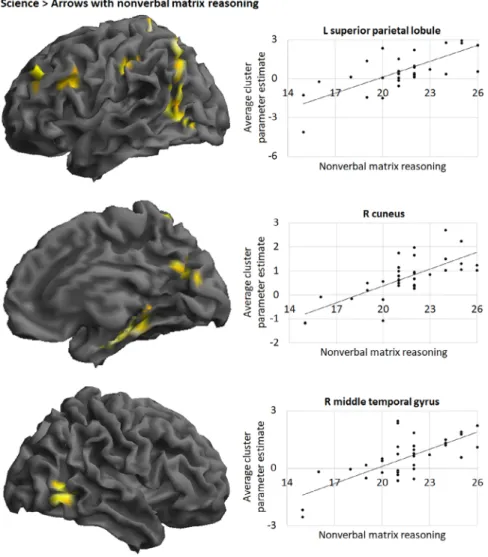
Nonverbal matrix reasoning, but not verbal analogical
reasoning, was a significant covariate of the Science >
Arrows contrast, with higher nonverbal matrix reasoning associated with higher BOLD signal in parietal, frontal and
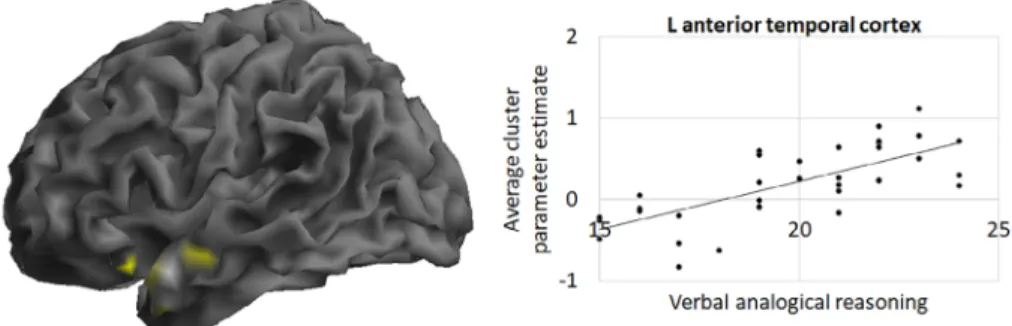
temporal cortex clusters (Figure 3,Table 3). Higher verbal
analogical reasoning associated with higher BOLD in the
left anterior temporal cortex in the Maths >Arrows
con-trast, while higher nonverbal matrix reasoning associated
with lower BOLD in right middle temporal gyrus (Figure 4,
Table 4). Plotted average parameter estimates indicate that these associations were not due to outliers but general trends across participants.
Follow-up analyses (see Appendix S1) showed that when controlling for relevant performance measures, relational reasoning predicted additional variance in BOLD signal within the clusters identified. At the whole-brain level, non-verbal matrix reasoning remained a significant predictor of
activation in the Science >Arrows contrast in a subset of
regions (cerebellum, left superior parietal lobule, and left middle temporal gyrus) when controlling for other vari-ables. Neither of the relational reasoning measures predicted
Fig. 2. Regions of increased BOLD signal in the(a) Science> Arrows contrast,(b) Maths> Arrows contrast, and(c) (Maths> Arrows)>(Science>Arrows) contrast from the one samplet-tests with no covariates added. In both disciplines, there was extensive bilateral activation covering most of the occipital cortex, superior and inferior parietal gyri and the precuneus, the pre-supplementary motor area and posterior parts of the superior and middle frontal gyri, the anterior insulae, posterior parts of the inferior and middle temporal gyri, the posterior parts of the hippocampi and parahippocampal gyri, and finally subcortically parts of the thalamus and caudate. In addition, there was mostly left-lateralized activation of the precentral and inferior frontal gyri, and activation in the left middle temporal gyrus extending into the anterior temporal cortex. Maths problems were associated with increased BOLD signal bilaterally in the pre- and postcentral gyri, the supplementary motor area and middle cingulate cortex, the thalamus, and, mostly in the right hemisphere inferior frontal gyrus, superior temporal gyrus and parts of the occipital cortex.puncorr<.001 at the voxel level,pFWE<.05 at the cluster
level. Images are rendered on the canonical brain in SPM, showing from left to right: the lateral view of the left hemisphere, and medial and lateral views of the right hemisphere. Contrasts are available online: https://osf.io/ytcwk/.
activation in the Maths>Arrows contrast when controlling
for other variables.
DISCUSSION
This study investigated the unique contributions of verbal analogical reasoning and nonverbal matrix reasoning to sci-ence and maths problem-solving in adolescsci-ence. Verbal ana-logical reasoning was associated with higher accuracy and faster RTs in both science and maths, although the asso-ciation with maths accuracy disappeared when verbal IQ and VSWM were taken account of. Nonverbal matrix rea-soning was associated only with science accuracy, and this effect was not maintained after controlling for verbal IQ and VWM. Nonetheless, nonverbal matrix reasoning was
related to broad activation during science problem-solving, with three clusters remaining significant after controlling for other variables. Verbal analogical reasoning was positively associated with activation in the right anterior temporal cor-tex during maths problem-solving, while nonverbal matrix reasoning was negatively associated to activation in the left middle temporal gyrus. Neither of these maths associations remained when controlling for other variables.
We predicted that both types of relational reasoning would be associated with higher accuracy and faster RTs in science and maths, and as such, our findings did not always meet our predictions. Further, we predicted that verbal ana-logical reasoning would be more important in science than maths, and this was supported by the behavioral analyses: correlations with science were higher, and the correlation with maths disappeared when verbal IQ and VSWM were
Fig. 3. Brain regions where BOLD signal during science problem-solving positively correlated with nonverbal matrix reasoning, showing from top to bottom: the lateral view of the left hemisphere, and medial and lateral views of the right hemisphere. Three clusters have been chosen to demonstrate the positive association between average parameter estimates and nonverbal matrix reasoning on illustrative scatterplots. Contrastspuncorr<.001 at the voxel level andpFWE<.05 at the cluster level. Images are rendered on the canonical brain in
SPM. L = left; R = right. R cuneus refers to the whole cluster including the L and R precuneus.
controlled for. These results are in line with the suggestion that science learning requires verbal encoding of associa-tions (Tolmie et al., 2016) and is supported by analogical rea-soning (Jee et al., 2013; Matlen et al., 2009; Vendetti et al., 2015). Although participants recruited the RLPFC, DLPFC, VLPFC, and parietal cortex regions previously implicated in relational reasoning when resolving science problems, we did not observe the predicted correlation between activa-tion in these regions and individual differences in verbal analogical reasoning scores. Our results further suggest that previous evidence linking analogical reasoning to maths (Alexander et al., 2016; White, Alexander, & Daugherty, 1998) may be in part attributable to executive functions and verbal IQ, since we saw this link disappear when individ-ual differences in executive functions and verbal IQ were taken account of. The results highlight the importance of
controlling for verbal IQ and executive functions when investigating associations with relational reasoning.
We hypothesized that nonverbal matrix reasoning would be more important in maths. This was not supported by the behavioral analyses, which showed that nonverbal matrix reasoning was only significantly related to science accuracy. This is in contrast to previous evidence that showed matrix reasoning measures to relate with maths (Dumontheil & Klingberg, 2012; Green et al., 2017; Kyttälä & Lehto, 2008; Wei, Yuan, Chen, & Zhou, 2012). The greater link between maths and verbal analogical reasoning compared to non-verbal reasoning differs from other research (van der Sluis et al., 2007). This may be due to the relatively high lan-guage requirements of the current maths problems, since the problems used by van der Sluis et al. (2007) were all arith-metic, requiring addition, multiplication, and subtraction.
Table 3
Regions Where BOLD Signal in the Science>Arrows Contrast Positively Correlated with Nonverbal Matrix Reasoning
MNI
Brain region L/R BA x y z Z-score Cluster size
Fusiform gyrus L 30 −27 −28 −28 5.52* 1,141**
Lobule III of vermis R 30 6 −46 −22 5.00*
Cerebellum L −9 −55 −31 4.87*
Superior parietal lobule L 7 −30 −64 53 4.43 169**
Angular gyrus L 39 −39 −64 35 4.32 Precuneus L 18 −6 −67 29 4.36 192** Cuneus R 18 21 −73 26 4.22 Precuneus R 23 9 −67 29 3.92 Paracentral lobule L 4 −3 −34 59 4.35 264** Precuneus L 5 −12 −46 68 4.34 Midcingulate area L 5 −3 −40 50 4.33
Middle temporal gyrus L 39 −36 −55 14 4.30 270**
Middle temporal gyrus L 37 −45 −61 5 4.30
Middle temporal gyrus L 39 −54 −67 17 4.22
Middle temporal gyrus R 37 54 −58 −1 4.30 146**
Calcarine sulcus R 19 33 −67 2 3.74
Inferior parietal lobule L 40 −33 −34 38 4.03 104**
Inferior parietal lobule L 48 −42 −28 35 3.81
Supramarginal gyrus L 44 −51 −25 41 3.79
Middle frontal gyrus L 8 −27 11 53 3.89 169**
Inferior frontal gyrus L 48 −33 23 29 3.75
Inferior frontal gyrus L 48 −42 20 26 3.54
Superior frontal gyrus L 9 −27 41 38 3.62 83**
Superior frontal gyrus L 9 −21 38 32 3.57
Middle frontal gyrus L 46 −39 44 23 3.34
Note. L = left; R = right; BA = Brodmann area; MNI = Montreal Neurological Institute. *pFWE<.05 at the voxel-level.
**pFWE<.05 at the cluster-level (cluster defining threshold:puncorr<.001).
Nonetheless, the maths tasks in the previous literature that show a link with relational reasoning are varied, with some more verbal (Kyttälä & Lehto, 2008) and others less verbal (Dumontheil & Klingberg, 2012; Wei et al., 2012) in nature. It is also possible that the mismatch between the current results and the previous literature is due to the different ages of participants, with much of the previous literature pertain-ing to younger or older participants, or a very wide age range, or to a lack of sensitivity of the WASI Matrix Reasoning to individual differences.
Although nonverbal matrix reasoning was not associated with science behaviorally when controlling for other fac-tors, it was positively associated with increased BOLD signal during science problem-solving across a broad network. It is possible that those who were better at nonverbal matrix reasoning engaged those brain networks more during sci-ence problem-solving, but they did not necessarily hold the knowledge necessary to get the answers correct. It is worth noting that other studies have shown behavioral and neu-roimaging data may not map directly onto each other. This may be due to the sensitivity of different methods, since there are likely factors that influence behavioral data which might not be reflected in imaging data (Dumontheil et al., 2016).
Of the hypothesized regions, only activation during science problem-solving in the superior parietal lobule (BA 7) was associated with relational reasoning. Beyond its role in the manipulation of single relations and integration of relations (Crone et al., 2009; Dumontheil, 2014; Ferrer, O’Hare, & Bunge, 2009), this region is thought to be critical for the manipulation of information in working memory (Koenigs, Barbey, Postle, & Grafman, 2009). Importantly, the associa-tion remained when executive funcassocia-tions were controlled for, suggesting that it was not solely the requirement of working memory that led to individual differences in SPL activation. During maths problem-solving, increased BOLD signal in the left anterior temporal cortex was associated with bet-ter verbal analogical reasoning. This region is thought to be critical for semantic processing of conceptual knowl-edge (Pobric, Lambon Ralph, & Jefferies, 2009; Rice, Lambon Ralph, & Hoffman, 2015) and the construction of com-plex meaning (Westerlund & Pylkkänen, 2017). Recruitment of anterior temporal cortex may therefore reflect shared requirements for construction and processing of complex concepts during maths problem-solving and verbal analog-ical reasoning. There was a negative association between activation in the right middle temporal gyrus and nonverbal
Fig. 4. Brain regions where BOLD signal during maths problem-solving(a)positively correlated with verbal analogical reasoning (shown in yellow) and(b)negatively correlated with nonverbal matrix reasoning (shown in green), with corresponding scatterplots. Contrasts
puncorr<.001 at the voxel level andpFWE<.05 at the cluster level. Images are rendered on the canonical brain in SPM.
matrix reasoning, such that those who performed better in nonverbal matrix reasoning recruited this region less dur-ing maths problem-solvdur-ing. There is some evidence that this posterior region of the middle temporal gyrus supports lan-guage and reading processing (Saur et al., 2008; Xu et al., 2015), so one possible interpretation is that participants who were better at nonverbal relational reasoning relied less on language processing to solve the maths problems. However, follow-up whole brain analyses showed that these associa-tions did not hold when covarying for the other measures. This indicates that the neural activations described here may reflect executive processes or verbal IQ.
It is possible that the neural activations reported for these contrasts reflect increased task difficulty. The multiple-demand (MD) network is a system that refers to common recruitment of certain brain areas in response to cognitive challenge (Duncan, 2010). The system extends over regions of the prefrontal and parietal cortex, and incorporates the intraparietal sulcus, inferior frontal sulcus, anterior insula and frontal operculum, rostral prefrontal cortex, pre-supplementary motor area, and anterior cingu-late cortex (Duncan, 2010). There is no overlap between MD regions and those that showed associations with relational reasoning during maths problem-solving in the present study, while in science, some regions that correlated with
nonverbal matrix reasoning align with typical MD regions (superior parietal lobule (BA 7) and middle frontal gyrus (BA 8)). Overall, this suggests that activation in these regions may reflect cognitive demand common to science and nonverbal matrix reasoning.
A strength of this study was in using a broad range of sci-ence and maths problems relating to the school curriculum, ensuring that conclusions are related to classroom reason-ing. It also considered relational reasoning over and above executive functions and verbal IQ to uncover unique con-tributions. Further establishing the nature of the association between different types of relational reasoning and science and maths problem-solving may lead to recommendations for teaching and learning. If those with better relational rea-soning also perform better in science and maths, this sug-gests that encouraging relational reasoning during science and maths problem-solving may support the development of both skills concurrently. Since maths requires understand-ing difficult abstract concepts, teachunderstand-ing by analogy may sup-port learning (Richland et al., 2007). This teaching approach would be similar to that already tested in studies of science learning (Jee et al., 2013; Matlen et al., 2009). Vendetti et al. (2015) emphasized the importance of supporting relational reasoning within science, arguing that explicit explanation of comparisons is essential, as teachers may assume that
Table 4
Regions Where BOLD Signal in the Maths>Arrows Contrast Positively Correlated with Verbal Analogical Reasoning and Negatively Correlated with Nonverbal Matrix Reasoning
MNI
Brain region L/R BA x y z Z-score Cluster size
Maths>Arrows and verbal analogical reasoning
Middle temporal gyrus L 21 −51 −1 −19 4.70* 214**
Superior temporal pole L 38 −42 14 −25 4.03
Inferior temporal gyrus L 20 −42 5 −34 3.99
Maths>Arrows and nonverbal matrix reasoning
Middle temporal gyrus R 21 63 −40 −7 4.39 122**
Note. L = left, R = right, BA = Brodmann area, MNI = Montreal Neurological Institute. *pFWE<.05 at the voxel-level.
**pFWE<.05 at the cluster-level (cluster defining threshold:puncorr<.001).
analogous relations are obvious, when they are not to learn-ers. These suggested approaches highlight the importance of supporting a cognitive skill within the discipline, which is in contrast to largely unsuccessful attempts to improve discipline-performance through training cognitive skills in isolation (Melby-Lervåg & Hulme, 2013).
This study investigated different types of relational reasoning in science and maths problem-solving within behavioral and neuroimaging data. Overall, verbal ana-logical reasoning predicted unique variance in science performance, with more limited behavioral, but some neu-ral associations, in maths. Nonverbal matrix reasoning showed minimal behavioral associations, but was related to neural activation in science and maths. Associations between relational reasoning and science problem-solving mostly remained after controlling for executive functions, while associations with maths problem-solving typically dis-appeared, suggesting a unique role of relational reasoning in both science and maths.
Acknowledgments—ABB received funding from the UK Economic and Social Research Council, grant number ES/J500021/1, and the Wellcome Trust / Birkbeck ISSF scheme, grant number 204770/Z/16/Z. DM was also sup-ported by a Wolfson Royal Society research merit award. Birkbeck, University of London contributed funding for the scanning. We thank Jack White-Foy and Minh Nguyen for help with data collection, schools for handing out flyers, teachers for discussing stimuli with us, and the adolescents who took part.
SUPPORTING INFORMATION
Additional supporting information may be found online in the Supporting Information section at the end of the article.
Appendix S1. Supporting information
REFERENCES
Alexander, P. A., Dumas, D., Grossnickle, E. M., List, A., & Firetto, C. M. (2016). Measuring relational reasoning.The Journal of Experimental Education, 84(1), 119–151. https://doi.org/10 .1080/00220973.2014.963216
Alloway, T. P. (2007)Automated working memory assessment. Lon-don, UK: Pearson Assessment.
Bazargani, N., Hillebrandt, H., Christoff, K., & Dumontheil, I. (2014). Developmental changes in effective connectivity associated with relational reasoning.Human Brain Mapping,
35(7), 3262–3276. https://doi.org/10.1002/hbm.22400 Brookman-Byrne, A., Mareschal, D., Tolmie, A., & Dumontheil,
I. (2018). Inhibitory control and counterintuitive science and maths reasoning in adolescence.PLoS One,13(6), e019873. https://doi.org/10.1371/journal.pone.0198973
Bunge, S. A., Helskog, E. H., & Wendelken, C. (2009). Left, but not right, rostrolateral prefrontal cortex meets a stringent test of the relational integration hypothesis.NeuroImage,46, 338–342. https://doi.org/10.1016/j.neuroimage.2009.01.064 Cragg, L., & Gilmore, C. (2014). Skills underlying mathematics: The
role of executive function in the development of mathematics proficiency.Trends in Neuroscience and Education,3, 63–68. https://doi.org/10.1016/j.tine.2013.12.001
Cragg, L., Keeble, S., Richardson, S., Roome, H. E., & Gilmore, C. (2017). Direct and indirect influences of executives on mathematics achievement.Cognition,162, 12–26.
Crone, E. A., Wendelken, C., Van Leijenhorst, L., Honomichl, R. D., Christoff, K., & Bunge, S. A. (2009). Neurocognitive devel-opment of relational reasoning.Developmental Science,12(1), 55–66. https://doi.org/10.1111/j.1467-7687.2008.00743.x Department for Education. (2013a).Mathematics programmes of
study: Key stage 3. London, England: Author.
Department for Education. (2013b).Science programmes of study: Key stage 3. London, England: Author.
Donati, G., Meaburn, E., & Dumontheil, I. (2019). The specificity of associations between cognitive and attainment in English, maths and science during adolescence. Learning and Indi-vidual Differences,69, 84–93. https://doi.org/10.1016/j.lindif .2018.11.012
Dumas, D., Alexander, P. A., & Grossnickle, E. M. (2013). Relational reasoning and its manifestations in the educational context:
A systematic review of the literature.Educational Psychology Review,25(3), 391–427.
Dumontheil, I. (2014). Development of abstract thinking during childhood and adolescence: The role of rostrolateral prefrontal cortex. Developmental Cognitive Neuroscience, 10, 57–76. https://doi.org/10.1016/j.dcn.2014.07.009
Dumontheil, I., Houlton, R., Christoff, K., & Blakemore, S.-J. (2010). Development of relational reasoning during adoles-cence. Developmental Science, 13(6), F15–F24. https://doi .org/10.1111/j.1467-7687.2010.01014.x
Dumontheil, I., & Klingberg, T. (2012). Brain activity during a visu-ospatial working memory task predicts arithmetical perfor-mance 2 years later.Cerebral Cortex,22, 1078–1085. https:// doi.org/10.1093/cercor/bhr175
Dumontheil, I., Wolf, L. K., & Blakemore, S.-J. (2016). Audience effects on the neural correlates of relational reasoning in adolescence.Neuropsychologia,87, 85–95. https://doi.org/10 .1016/j.neuropsychologia.2016.05.001
Duncan, J. (2010). The multiple-demand (MD) system of the pri-mate brain: Mental programs for intelligent behaviour.Trends in Cognitive Sciences,14(4), 172–179. https://doi.org/10.1016/ j.tics.2010.01.004
Ferrer, E., O’Hare, E., & Bunge, S. (2009). Fluid reasoning and the developing brain.Frontiers in Neuroscience,3(1), 46–51. https://doi.org/10.3389/neuro.01.003.2009
Gilmore, C., Keeble, S., Richardson, S., & Cragg, L. (2015). The role of cognitive inhibition in different components of arithmetic.
ZDM Mathematics Education,47, 771–782. https://doi.org/ 10.1007/s11858-014-0659-y
Green, C. T., Bunge, S. A., Briones Chiongbian, V., Barrow, M., & Ferrer, E. (2017). Fluid reasoning predicts future mathemat-ical performance among children and adolescents.Journal of Experimental Child Psychology,157, 125–143. https://doi.org/ 10.1016/j.jecp.2016.12.005
Hodgkiss, A., Gilligan, K. A., Tolmie, A. K., Thomas, M. S. C., & Far-ran, E. K. (2018). Spatial cognition and science achievement: The contribution of intrinsic and extrinsic spatial skills from 7 to 11 years.British Journal of Educational Psychology,88(4), 675–697. https://doi.org/10.1111/bjep.12211
Jee, B. D., Uttal, D. H., Gentner, D., Manduca, C., Shipley, T. F., & Sageman, B. (2013). Finding faults: Analogical comparison supports spatial concept learning in geoscience.Cognitive Pro-cessing,14(2), 175–187. https://doi.org/10.1007/s10339-013-0551-7
Khng, K. H., & Lee, K. (2009). Inhibiting interference from prior knowledge: Arithmetic intrusions in algebra word problem solving.Learning and Individual Differences,19(2), 262–268. Khng, K. H., & Lee, K. (2014). The relationship between Stroop and
stop-signal measures of inhibition in adolescents: Influences from variations in context and measure estimation.PLoS One,
9(7), e101356. https://doi.org/10.1371/journal.pone.0101356 Koenigs, M., Barbey, A. K., Postle, B. R., & Grafman, J. (2009).
Superior parietal cortex is critical for the manipulation of information in working memory. Journal of Neuroscience,
29(47), 14980–14986. https://doi.org/10.1523/JNEUROSCI .3706-09.2009
Kyttälä, M., & Lehto, J. E. (2008). Some factors underlying mathematical performance: The role of visuospatial working memory and non-verbal intelligence. European Journal of
Psychology of Education, 23(1), 77–94. https://doi.org/10 .1007/BF03173141
Leech, R., Mareschal, D., & Cooper, R. P. (2007). Relations as trans-formations: Implications for analogical reasoning.Quarterly Journal of Experimental Psychology,60(7), 897–908. https:// doi.org/10.1080/17470210701288599
Matlen, B., Vosniadou, S., Jee, B., & Ptouchkina, M. (2009). Enhanc-ing the comprehension of science text through visual analo-gies.Proceedings of the Annual Meeting of the Cognitive Science Society,33(33), 2910–2915.
Melby-Lervåg, M., & Hulme, C. (2013). Is working memory training effective? A meta-analytic review.Developmental Psychology,
49(2), 270–291. https://doi.org/10.1037/a0028228
Miller Singley, A. T., & Bunge, S. (2014). Neurodevelopment of relational reasoning: Implications for mathematical pedagogy.
Trends in Neuroscience and Education,3, 33–37. https://doi .org/10.1016/j.tine.2014.03.001
Pobric, G., Lambon Ralph, M. A., & Jefferies, E. (2009). The role of the anterior temporal lobes in the comprehension of concrete and abstract words: rTMS evidence.Cortex,45, 1104–1110. https://doi.org/10.1016/j.cortex.2009.02.006
Primi, R., Ferrão, M. E., & Almeida, L. S. (2010). Fluid intelligence as a predictor of learning: A longitudinal multilevel approach to applied math. Learning and Individual Differences, 20, 446–451. https://doi.org/10.1016/j.lindif.2010.05.001 Rhodes, S. M., Booth, J. N., Campbell, L. E., Blythe, R. A., Wheate,
N. J., & Delibegovic, M. (2014). Evidence for a role of executive functions in learning biology.Infant and Child Development,
23(1), 67–83. https://dx.doi.org/10.1002/icd.1823
Rhodes, S. M., Booth, J. N., Palmer, L. E., Blythe, R. A., Delibegovic, M., & Wheate, N. J. (2016). Executive functions predict con-ceptual learning of science.British Journal of Developmental Psychology, 34(2), 261–275. https://dx.doi.org/10.1111/bjdp .12129
Rice, G. E., Lambon Ralph, M. A., & Hoffman, P. (2015). The roles of left versus right anterior temporal lobes in conceptual knowl-edge: An ALE meta-analysis of 97 functional neuroimaging studies.Cerebral Cortex,25(11), 4374–4391. https://doi.org/ 10.1093/cercor/bhv024
Richland, L. E., & Burchinal, M. R. (2013). Early executive function predicts reasoning development.Psychological Science,24(1), 87–92. https://doi.org/10.1177/0956797612450883
Richland, L. E., & McDonough, I. M. (2010). Learning by anal-ogy: Discriminating between potential analogs. Contempo-rary Educational Psychology,35(1), 28–43. https://doi.org/10 .1016/j.cedpsych.2009.09.001
Richland, L. E., Zur, O., & Holyoak, K. J. (2007). Cognitive supports for analogies in the mathematics classroom. Sci-ence,316(5828), 1128–1129. https://doi.org/10.1126/science .1142103
Rorden, C., & Brett, M. (2000). Stereotaxic display of brain lesions.
Behavioural Neurology,12, 191–200.
Saur, D., Kreher, B. W., Schnell, S., Kümmerer, D., Kellmeyer, P., Vry, M.-S., … Weiller, C. (2008). Ventral and dorsal path-ways for language.Proceedings of the National Academy of Sciences,105(46), 18035–18040. https://doi.org/10.1073/pnas .0805234105
Taub, G. E., Floyd, R. G., Keith, T. Z., & McGrew, K. S. (2008). Effects of general and broad cognitive abilities on mathematics
achievement. School Psychology Quarterly, 23(2), 187–198. https://doi.org/10.1037/1045-3830.23.2.187
Tolmie, A. K., Ghazali, Z., & Morris, S. (2016). Children’s sci-ence learning: A core skills approach.British Journal of Edu-cational Psychology,86(3), 481–497. https://doi.org/10.1111/ bjep.12119
Tzourio-Mazoyer, N., Landeau, B., Papathanassiou, D., Crivello, F., Etard, O., Delcroix, N., … Joliot, M. (2002). Automated anatomical labeling of activations in SPM using a macroscopic anatomical parcellation of the MNI MRI single-subject brain.
NeuroImage,15(1), 273–289.
van der Sluis, S., de Jong, P. F., & van der Leij, A. (2007). Execu-tive functioning in children, and its relations with reasoning, reading, and arithmetic.Intelligence,35(5), 427–449. https:// doi.org/10.1016/j.intell.2006.09.001
Vendetti, M. S., Matlen, B. J., Richland, L. E., & Bunge, S. A. (2015). Analogical reasoning in the classroom: Insights from cognitive science.Mind, Brain, and Education,9(2), 100–106. https:// doi.org/10.1111/mbe.12080
Watanabe, J., Sugiura, M., Sato, K., Sato, Y., Maeda, Y., Matsue, Y., … Kawashima, R. (2002). The human prefrontal and pari-etal association cortices are involved in no-go performances: An event-related fMRI study.NeuroImage,17(3), 1207–1216. https://doi.org/10.1006/nimg.2002.1198
Wechsler, D. (2011) Wechsler abbreviated scale of intelligence (WASI-II). (2nd ed.). San Antonio, TX: Pearson.
Wei, W., Yuan, H., Chen, C., & Zhou, X. (2012). Cognitive correlates of performance in advanced mathematics.British Journal of Educational Psychology,82, 157–181. https://doi.org/10.1111/ j.2044-8279.2011.02049.x
Wendelken, C., Chung, D., & Bunge, S. A. (2012). Rostrolateral pre-frontal cortex: Domain-general or domain-sensitive?Human
Brain Mapping, 33(8), 1952–1963. https://doi.org/10.1002/ hbm.21336
Wendelken, C., Ferrer, E., Whitaker, K. J., & Bunge, S. A. (2016). Fronto-parietal network reconfiguration supports the development of reasoning ability. Cerebral Cortex, 26(5), 2178–2190. https://doi.org/10.1093/cercor/bhv050
Wendelken, C., O’Hare, E. D., Whitaker, K. J., Ferrer, E., & Bunge, S. A. (2011). Increased functional selectivity over development in rostrolateral prefrontal cortex. Journal of Neuroscience,
31(47), 17260–17268. https://doi.org/10.1523/JNEUROSCI .1193-10.2011
Westerlund, M., & Pylkkänen, L. (2017). How does the left anterior temporal lobe contribute to conceptual combination? Inter-disciplinary perspectives. In J. A. Hampton, & Y. Winter (Eds.),
Compositionality and concepts in linguistics and psychology. (Vol.3, pp. 269–290). Cham, Switzerland: Springer Nature. https://doi.org/10.1007/978-3-319-45977-6_11
Whitaker, K. J., Vendetti, M. S., Wendelken, C., & Bunge, S. A. (2017). Neuroscientific insights into the development of analogical reasoning.Developmental Science,21(2), e12531. https://doi.org/10.1111/desc.12531
White, C. S., Alexander, P. A., & Daugherty, M. (1998). The relation-ship between young children’s analogical reasoning and math-ematical learning. Mathematical Cognition, 4(2), 103–123. https://doi.org/10.1080/135467998387352
Xu, J., Wang, J., Fan, L., Li, H., Zhang, W., Hu, Q., & Jiang, T. (2015). Tractography-based parcellation of the human middle temporal gyrus.Scientific Reports,5, 18883. https://doi.org/10 .1038/srep18883
Zimmerman, C. (2000). The development of scientific reasoning skills.Developmental Review,220(1), 99–149. https://doi.org/ 10.1006/drev.1999.0497