AUTHOR(S):
TITLE:
YEAR:
Publisher citation:
OpenAIR citation:
Publisher copyright statement:
OpenAIR takedown statement:
This publication is made freely available under ________ open access.
This is the ___________________ version of proceedings originally published by _____________________________
and presented at ________________________________________________________________________________
(ISBN __________________; eISBN __________________; ISSN __________).
This publication is distributed under a CC ____________ license. ____________________________________________________
Section 6 of the “Repository policy for OpenAIR @ RGU” (available from
http://www.rgu.ac.uk/staff-and-current-students/library/library-policies/repository-policies
) provides guidance on the criteria under which RGU will
consider withdrawing material from OpenAIR. If you believe that this item is subject to any of these criteria, or for
any other reason should not be held on OpenAIR, then please contact
[email protected]
with the details of
the item and the nature of your complaint.
GREEN
MCDERMOTT, C.D., MAJDANI, F. and PETROVSKI, A.V.
Botnet detection in the internet of things using deep learning approaches.
2018
MCDERMOTT, C.D., MAJDANI, F. and PETROVSKI, A.V. 2018. Botnet detection in the internet of
things using deep learning approaches. In Proceedings of the International joint conference on
neural networks 2018 (IJCNN 2018), 8-13 July 2018, Rio de Janeiro, Brazil. Piscataway: IEEE
[online], article ID 8489489. Available from: https://doi.org/10.1109/IJCNN.2018.8489489
MCDERMOTT, C.D., MAJDANI, F. and PETROVSKI, A.V. 2018. Botnet detection in the internet of
things using deep learning approaches. In Proceedings of the International joint conference on
neural networks 2018 (IJCNN 2018), 8-13 July 2018, Rio de Janeiro, Brazil. Piscataway: IEEE,
article ID 8489489. Held on OpenAIR [online]. Available from: https://openair.rgu.ac.uk
AUTHOR ACCEPTED
IEEEInternational joint conference on neural networks 2018 (IJCNN 2018), 8-13 July 2018, Rio de Janeiro, Brazil
9781509060146 2161-4393
© 2018 IEEE. Personal use of this material is permitted. Permission from IEEE must be obtained for all other uses, in any current or future media, including reprinting/republishing this material for advertising or promotional purposes, creating new collective works, for resale or redistribution to servers or lists, or reuse of any copyrighted component of this work in other works.
BY-NC 4.0 https://creativecommons.org/licenses/by-nc/4.0
https://mirrors.creativecommons.org/presskit/buttons/88x31/png/by-nc.png[10/10/2017 09:37:50]
OpenAIR at RGUDigitally signed by OpenAIR at RGU Date: 2018.12.17 14:52:38 Z
Botnet Detection in the Internet of Things using
Deep Learning Approaches
Christopher D. McDermott, Farzan Majdani, Andrei V. Petrovski
School of Computing Science and Digital Media Robert Gordon University
Aberdeen, United Kingdom
Emails:{c.d.mcdermott, f.majdani-shabestari, a.petrovski}@rgu.ac.uk
Abstract—The recent growth of the Internet of Things (IoT) has resulted in a rise in IoT based DDoS attacks. This paper presents a solution to the detection of botnet activity within consumer IoT devices and networks. A novel application of Deep Learning is used to develop a detection model based on a Bidirectional Long Short Term Memory based Recurrent Neural Network (BLSTM-RNN). Word Embedding is used for text recognition and conversion of attack packets into tokenised integer format. The developed BLSTM-RNN detection model is compared to a LSTM-RNN for detecting four attack vectors used by the mirai botnet, and evaluated for accuracy and loss. The paper demonstrates that although the bidirectional approach adds overhead to each epoch and increases processing time, it proves to be a better progressive model over time. A labelled dataset was generated as part of this research, and is available upon request.
Index Terms—Deep Learning, LSTM, Word Embedding, IoT, Botnet, Mirai, DDoS.
I. INTRODUCTION
The Internet of Things (IoT) is expected to usher in an era of increased connectivity, with an estimated 50 billion devices expected to be connected to the Internet by 2020 [1]. At its core, the aim of the IoT is to connect previously unconnected devices to the Internet [2], thus creating smart devices capable of collecting, storing and sharing data, without requiring human interaction [3] [4]. Many of these IoT devices are aimed at consumers, who value low cost and ease of deployment over security. These market forces have resulted in IoT manufacturers omitting critical security features, and producing swathes of insecure Internet connected devices, such as IP cameras and Digital Video Recorder (DVR) boxes. Such vulnerabilities and exploits are often derived and epit-omised by inherent computational limitations, use of default credentials and insecure protocols. The rapid proliferation of insecure IoT devices and ease by which attackers can locate them using online services, such as shodan, provides an ever expanding pool of attack resources. By comprising and lever-aging multitudes of these vulnerable IoT devices, attackers can now perform large scale attacks such as spamming, phishing and Distributed Denial of Service (DDoS), against resources on the Internet [5].
The rise in IoT based DDoS attacks, witnessed in recent years, will likely continue until IoT manufacturers accept
responsibility and incorporate security mechanisms into their devices. Until such a time, the IoT has the potential to become the new playground for future cyber attacks and therefore presents a number of challenges. Since an increasing number of DDoS attacks seek to leverage consumer level IoT devices, the issues highlighted previously, coupled with a lack of technical knowledge or awareness of inherent vulnerabilities, by owners of these devices, presents one such problem. This challenge is further compounded by a lack of convenient user interface on many consumer IoT devices, making detection and awareness of attacks in home networks practically impos-sible for consumers.
To substantiate this issue, we undertook preliminary re-search and created a secure sandboxed botnet environment. An IoT IP Camera was successfully infected, and leveraged to perform a sequence of DDoS attacks against a selected target. During the infection process and attacks, the camera did not display any adverse symptoms of infection, and continued to function as expected. Remote access to the device was still possible, and performance did not appear to be degraded. Live video streaming continued to be as responsiveness as prior to the attacks, therefore without any clear signs of an infection it was confirmed that, detection or awareness or botnet activity would prove very difficult within consumer networks.
Current methods of botnet detection such as signature or flow based anomaly intrusion detection, have proved ineffec-tive in preventing the spread of IoT botnets. Largely due to simple code mutations rendering attack signatures obsolete or
a lack of protocol support (NetFlow, Sflow) within consumer
networks and equipment.
This paper presents a solution to the detection of botnet activity within consumer IoT devices and networks. A novel detection model was developed based on a Deep Bidirectional Long Short Term Memory based Recurrent Neural Network (BLSTM-RNN). Detection was performed at the packet level, and focused on text recognition within features, normally discarded by other flow based detection methods. Word Em-bedding was used for text recognition and conversion, and proved to be an effective method for predicting attack vectors. The BLSTM-RNN detection model was compared with a LSTM-RNN, and evaluated for accuracy and loss.
The main contributions of this paper can be defined as: 1) Producing a labelled and public dataset incorporating
botnet traffic, attack vectors, and normal traffic;
2) Developing a detection algorithm for text recognition of features within botnet attack vectors;
3) Comparing LSTM and BLSTM Recurrent Neural Net-work based detection models to detect and predict in-fected IoT device traffic.
The rest of the paper is organized as follows: Section II introduces botnet activity within the IoT, and the application of deep learning for attack detection. Section III describes the botnet architecture used to generate the botnet dataset. It also details the use of a BLSTM-RNN in conjuction with Word Embedding methodology to create a botnet detection model. Section IV describes the process of data collection and pre-processing. Section V evaluates the experimental results, comparing the LSTM and BLSTM Recurrent Neural Network models for accuracy and loss. Section VI draws conclusions and suggests possible future research directions.
II. SECURITY IN THEINTERNET OFTHINGS
Some of the most extensive and destructive cyber-attacks deployed on the Internet have been Distributed Denial of Service (DDoS) attacks. According to Akamai, a global leader in web security, some of the largest DDoS attacks ever recorded occurred in the second half of 2016. During this time, attacks of over 100 Gbps, were up by 140% with three attacks reaching over 300 Gbps [6]. Fuelled in full or part by the Internet of Things, 88% of DDoS attacks in quarter 4 of 2017 employed a multi-vector attack strategy [7].
A. Botnets in the Internet of Things
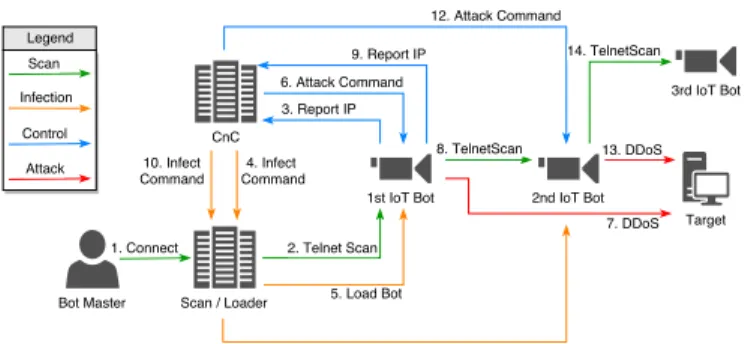
Fig. 1.Botnet Infection and Proliferation
One of the most prominent examples of a DDoS attack emanating from the IoT during this period was the Mirai botnet. Mirai is a piece of malware that attempts to find and infect IoT devices to establish and propagate a network of robots (botnet) consisting of the infected IoT devices (bots). An attacker (botmaster) then uses a command and control (C&C) server to remotely control the bots, forcing them to participate in DDoS attacks against targets on the Internet. On September 20 2016 the Mirai botnet was used to perform an unprecedented 620 Gbps DDoS attack on security journalist Brian Krebs website krebsonsecurity.com [8]. Shortly after it
was also responsible for a series of additional DDoS attacks peaking at over 1.2 Tbps against French hosting company OVH and DNS provider DYN, who estimated that up to 100 000 infected IoT devices (bots) were involved in the attack. The severity of the DYN attack was sufficient to cause major disruption on the Internet, and render several high profile websites such as GitHub, Twitter, Reddit, Netflix, inaccessible [9].
Fig. 1 shows the process of infection and propagation method employed by Mirai. The Mirai infrastructure consists of a command and control (C&C) server, a Scan/Loader server and infected IoT devices known as bots.
Infection and propagation occurs by exploiting weak default
security credentials found on many IoT devices running
busy-box, an embedded version of Linux. An attacker (botmaster)
starts the process by connecting to the Scan/Loader server (step 1) and initiating./loaderto execute thescanner.cmodule, and scan the Internet for vulnerable IoT devices with Telnet
services and ports 23 or 2323 open (step 2). Upon detecting
a vulnerable device, the malware attempts to brute force a successful login using a list of 62 known default usernames and passwords. If successful, login credentials and device information are sent back to the C&C server, and will be used later by the Scan/Loader server to login and deliver
the malware to the vulnerable device (step 3). An infect
command is sent from the C&C server to the Scan/Loader server containing all necessary information such as login details, IP address, hardware architecture. Mirai supports
mul-tiple hardware architectures, including arm, mips, sparc and
powerpc (step 4).
The Scan/Loader server uses this information to login
and instruct the vulnerable device to tftp or wget to the
Scan/Loader server, download and execute the corresponding payload binary. Once executed, the first infected IoT device becomes part of the Mirai botnet and can communicate with the C&C server. The malware binary is removed and runs
only in memory, to avoid detection (step 5). The botmaster
can now issue attack commands, specifying parameters such
as attack duration and target (step 6). The malware includes
10 DDoS attack types, including UDP flood (udp), Recursive
DNS (dns), SYN packet flood (syn), ACK packet flood (ack),
GRE flood (gre ip), which can be used to attack a target on
the Internet (step 7). The first bot now attempts to repeat
the infection process and propagate the botnet by scanning the Internet for additional vulnerable IoT devices with Telnet
services and ports 23 or 2323 open (step 8). New vulnerable
IoT device information is returned to the C&C server (step
9). A new infect command is issued to the Scan/Loader server
(step 10). The appropriate hardware binary is loaded onto the
newly discover vulnerable IoT device (step 11). The relevant
attack command is issued from the C&C server (step 12).
The attack is executed by the newly infected second bot, in
conjunction with the first bot (step 13). Scanning for additional
vulnerable IoT devices is repeated to further expand the botnet. (step 14).
B. Deep Learning for Attack Detection
The increasing presence of IoT systems in a broad range of applications, as well as their increasing computing and processing capabilities make them a valuable attack target, such as network packets and malware designed to compromise specific IoT devices. Attack detections in IoT systems is notably different from the existing mechanisms because of the special service requirements, such as low latency, resource specificity, distributed nature, mobility, to mention a few [10]. This means that conventional network attack detection has limited application in addressing IoT security problems. According to Kaspersky Lab, in 2016 the majority of IoT devices examined were insecure, using default passwords or unpatched vulnerabilities, and easily compromised by Mirai and Hajime malware [11].A considerable number of zero-day attacks are continuously emerging because of the addition of various IoT protocols. Most of these attacks are small variants of previously known cyber-attacks that present a difficulty in their detection even for advanced computational intelligence mechanisms such as traditional machine learning systems.
Previous literature have suggested the potential of lever-aging machine learning to enhance security threat hunting, but it is not practical to simply integrate machine learning in static and dynamic cyber security analysis due to the wide variety and distribution of IoT devices, particularly for (inexpensive) IoT devices with limited processing power [12]. On the other hand, the success of deep learning (DL) in various big data fields has attracted noticeable interest in cybersecurity fields. The application of DL has become practical because of the advances in computer architecture (e.g. NVIDIA DGX platforms) and in development of new neural network libraries (such as Theano and Tensorflow for instance); also, the availability of large and diverse training datasets made a contribution to the effectiveness of deep learning algorithms.
Deep learning (DL) enables several breakthroughs of con-ventional AI tasks in the fields of image processing, pattern recognition and computer vision. Deep networks are capable of achieving significant improvement in accuracy of classification and predictions in these complex tasks. The main benefit of deep learning is the absence of manual feature engineering, unsupervised pre-training and compression capabilities which enable the application of deep learning feasible even in re-source constraint networks. It means that the capability of DL to self-learning results in higher accuracy and faster process-ing, which can be effectively utilised for a novel distributed attack detection in IoT systems [13]. This is very important in the context of IoT security because such systems face a plethora of security problems, including jamming, spoofing, replaying and eavesdropping, but also prone to issues related to resource constraints e.g. out-of-memory accesses, unsafe programming languages, etc. [14].
This research is aimed at adopting a deep learning approach to cybersecurity to enable the detection of botnet attacks. Other machine learning and evolutionary computing techniques have
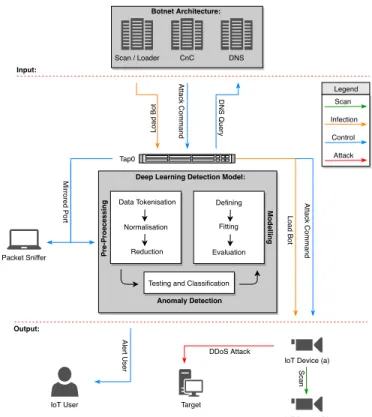
IoT Device (b) IoT Device (a)
Target Scan / Loader CnC DNS Packet Sniffer Scan Infection Control Attack Legend Tap0 DNS Query DDoS Attack Load Bot Attack Command Mirrored Port Input: Output: Botnet Architecture:
Deep Learning Detection Model:
Load Bot Scan Attack Command Pre-Proecessing Modelling Anomaly Detection Data Tokenisation Normalisation Reduction Defining Fitting Evaluation
Testing and Classification
IoT User
Alert User
Fig. 2.Botnet Architecture and Deep Learning Detection Model
been successfully applied in mitigating against botnet attacks. One example is the use of swarm intelligence for destroying any rigid master-slave relationship between bots and for auton-omizing the bot operating roles [15]. The evolving behaviour of botnets often enables them to circumvent the traditional de-tection approaches. The development of behavioural dede-tection approaches, however, have helped in dealing with the constant change in the botnet activities by finding the common patterns that botnets follow across their life cycle. For instance, all the bots need connect to the C&C server to receive new orders, and this kind of behaviour observed only after a long period of time can guide the detection methods.
One implication of observing the network traffic over a long period is the necessity to successfully deal with large data sequences. Recurrent neural networks (RNN) in general, and one of its variants the Long Short Term Memory (LSTM) network have been proven effective in recognizing the different sequences of states that change over time, bridging thereby long time lags between relevant input and target output [16]. This type of structure is theoretically well suited and has been proven a powerful model for tagging tasks with appli-cations in natural language processing, machine translation, Image recognition, and the like [17]. A bidirectional LSTM (BLSTM), furthermore, introduces two independent layers to accumulate contextual information both from the past and the future [12]. The main contribution of this paper is the applica-tion of the variants of LSTM networks for implementing deep learning in network traffic analysis aimed at detecting botnet attacks.
III. METHODOLOGY
To promote reproducibility of this paper, a detailed descrip-tion of botnet environment and algorithm implementadescrip-tion is presented.
A. Experimental Setup
A secure sandboxed environment was created as shown in Fig. 2. This consisted of a command and control C&C server, a Scan/Loader server and an additional utilities server to handle DNS queries and reporting. A soft tap (Tap0) SPAN port was created to mirror all relevant traffic to a packet sniffing device, to capture for later analysis. Two Sricam AP009 IP Cameras
running busybox utilities were used as bots to attack a target
Raspberry Pi.
The Mirai source code was downloaded from GitHub. To ensure a true representation of a Mirai infection and attack, amendments to the source code were kept to a minimum however, some configuration changes were required to comply with ethical and legal regulations.
1) C&C Server Configuration:
Essential packages were installed usingapt-get install unzip
gcc golang electric-fence screen y
Domains were created for report.McDPhD.org and
cnc.McDPhD.org, and added to table.candmain.go.
MySQL was installed using apt-get install mysql-server
mysql-client y and a user created using INSERT INTO users VALUES (NULL, ’miraiuser’, ’miraipassword’, 0, 0, 0, 0, -1, 1, 30, ”); Once configuredmain.gowas edited to include the MySQL credentials.
Cross compilers for the required binary architectures
(e.g. arm, mips) were installed and appropriate export
paths added to /etc/profile using export PATH= $PATH:
/etc/xcompile/mips/bin. To allow information regarding C&C connections, compiler issues and flood status to be sent the
C&C server ./build.sh debug telnet was run. The required
binary files for each architecture were created and stored in the releasedirectory using./build.sh release
2) Scan Loader Server Configuration:
Apache was installed using apt-get install apache2 y and
binary architecture files created earlier, were moved to the
loader/bins directory. The Scan/Loader IP address was added tomain.c and full permission granted usingchmod777*. The
loader file was compiled and added to the loader directory
using ./build.sh
To reduce the number of IP ranges available for scanning and ensure the range used in our environment was allowed,
excluded IP ranges were amended in scanner.c to reflect our
topology.
The Scan/Loader IP address was added to scanListen.go
and port 48101specified as the default port to listen for brute
force results. Within the tools directory the scanListen file
was compiled using go build scanListen.goand moved to the
loader directory.
The Sricam AP009 IP camera used in the lab setup did not
includewget, therefore tftp was installed usingapt-get install
tftpd tftp.
Algorithm 1 Botnet Detection Algorithm
1: dataProcessing (dataset)
2: unitToDrop←25%
3: Parse data to predefined format
4: Define token dictionary
5: repeat
6: /*Parse data to format*/
7: forrow←1, rowsdo
8: Convert text to tokenised integer format
9: Index tokenised text
10: Create dictionary of tokenised text indices
11: Pad data arrays with 0s to max 25
12: Inject additional tokenised features into array
13: end for 14: until return dataset
15: Split Training and Test based on unitToDrop
16: TrainAndValidate (trainingData, testData)
17: model←sequential() 18: cell←0 19: activation←sigmoid 20: loss←mae 21: optimiser←Adam 22: epochs←100
23: Create new BLSTM/LSTM unit
24: Add LSTM unit to model
25: Create new Dense Layer
26: Add Dense Layer to model
27: Set activation for Dense Layer
28: Compile model using Optimiser and Loss
29: repeat
30: /*Fit Model*/
31: forepoch←1, epochs do
32: Evaluate Loss, Validation Loss
33: Evaluate Accuracy and Validation Accuracy
34: end for
35: until All epochs completed
36: Return Loss, ValLoss, Acc, ValAcc
A tftp configuration was created using touch
/etc/xinetd.d/tftp and /tftpboot specified as the directory where the architecture binary files will be copied to for delivering later delivering the payload.
3) DNS Server Configuration:
The Mirai malware requires access to a DNS server
to discover the C&C servers IP address. Bind9 software
was installed and used to create two required domains
re-port.McDPhD.organdcnc.McDPhD.orginnamed.conf.local. These will be used by the bots to report IoT device information and communicate with the C&C server.
B. Pre-Processing using Word Embedding
The developed model uses a novel application of Deep Bidirectional Long Short Term Memory based Recurrent Neural Network (BLSTM-RNN), in conjunction with Word
Embedding, to convert string data found in captured packets, into a format usable by the BLSTM-RNN.
The dataset used in our experiments was generated from the experimental set-up described in Section III-A. It consists of
Mirai botnet traffic such as Scan, Infect,Control and Attack
traffic as described in Section II-A and normal IoT IP Cam-era traffic genCam-erated in our experimental set-up. The dataset
included features No., Time, Source, Destination, Protocol,
Length, and overall payload information in the Info feature.
Some features such as No. and Time did not provide much
scope for data analysis so were removed.
Majority of the captured information resided in the Info
feature, as shown in Table III therefore a model was required which could read and understand the text presented in this feature. As discussed in Section III-C an Artificial Neural Net-work(ANN) and more complex versions of Recurrent Neural Networks(RNN) such as Long Short Term Memory (LSTM) only work with numerical values. However [18] demonstrated that a Deep Bidirectional Long Short Term Memory based RNN (BLSTM-RNN) can be used which provides promising results for text recognition. This potential was further demon-strated in [17] where a BLSTM-RNN was used in conjunction with Word Embedding, in such a way phrases and vocabulary were mapped to vectors or real numbers, and proved to be an effective method for modelling and predicting sequential text. Motivated by this potential, this paper presents a detection algorithm and model, which is applied to botnet detection in
the IoT. Since the information provided in the Infofeature of
the dataset follows a sequence, we implemented our approach by first converting each letter into a tokenized and integer encoded format. A dictionary of all tokenized words and their
index within theInfofeature was created and text replaced with
its corresponding index number. In order to understand each attack type, it was important to maintain the sequence order of the indices, therefore an array of the indices was created. Since attacks are often closely coupled to the protocol used and the
length of the captured packet, theProtocolandLengthfeatures
also required to be included in the array. Word Embedding was again used to convert and create a dictionary of all tokenized protocols and their index. These were then added,
along with the Lengthfeature, which was already an integer,
to the array. Labels identifying each type of captured packets were mapped from string to integer (’norm’: 0,’mirai’:1,’udp’: 2, ’dns’:3, ’ack’:4,’normal’:5), and also injected into the array.
To simplify this process, we used the Keras library with
a wrapper API around Theano and Tensorflow. The Keras
one hot function was used to convert strings into indices, form a 2-dimension list and create a dictionary at the same time. Finally, since deep neural networks require arrays to be of equal length, we needed to find the maximum length of a
sentence within the Infofeature and pad all the arrays with 0
to be equal to the maximum length of 25.
After processing the dataset it was split intotrainingandtest
datasets and reshaped into 3 dimensions, the format required for LSTM layer (see algorithm 1.)
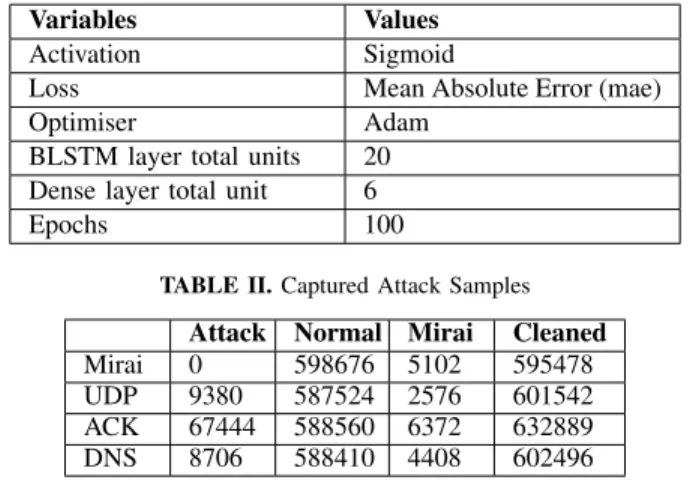
TABLE I.Model Parameters
Variables Values
Activation Sigmoid
Loss Mean Absolute Error (mae) Optimiser Adam
BLSTM layer total units 20 Dense layer total unit 6
Epochs 100
TABLE II.Captured Attack Samples
Attack Normal Mirai Cleaned
Mirai 0 598676 5102 595478 UDP 9380 587524 2576 601542 ACK 67444 588560 6372 632889 DNS 8706 588410 4408 602496
C. Modelling using Long Short Term Memory Recurrent Neu-ral Network
As previously stated the main contribution of this paper is the application of deep learning to botnet detection in the IoT. Word embedding was used in Section III-B to convert text into tokenised integer format, for use with a deep neural network. To test the effectiveness of this approach the detection model is evaluated using LSTM-RNN and BLSTM-RNN and tested
against a series of attacks associated with theMiraibotnet. As
shown in algorithm 1 to develop the detection models, unit and Output layer with sigmoid activation are added to the model. The model is then compiled with the MAE loss function and the Adam optimiser over total of 100 iterations, as shown in Table I.
The proposed detection model shown in Fig. 2 transitions acquired botnet data through three distinct phases. The Pre-processing phase adjusts features to ensure data representation is suitable for the used algorithms. The Word Embedding method described in Section III-B tokenises the data, before normalisation and removal of packets with missing data.
In the Modelling phase the LSTMN-RNN and BLSTM-RNN algorithms are applied to the training data to define, fit and evaluate the detection model.
Finally in the Anomaly Detection phase the generated dataset is tested to determine the effectiveness of the model in terms of accuracy and loss.
IV. DATASOURCES
To evaluate our detection models we required a dataset which contained a mixture of IoT botnet communication, multiple attack vectors and normal IoT device traffic. There are currently no public datasets that fulfilled all three cri-teria, therefore an experimental set-up was implemented as
described in Section III-A. Themiraibotnet malware contains
ten available attack vectors, which infected IoT devices can utilise to engage in DDoS attacks against targets. For the purpose of our experiments, four attack vectors were chosen,
including User Datagram Protocol (UDP) flood,
Acknowl-edgement (ACK) flood, Domain Name System (DNS) flood,
TABLE III.Attack Packet Structure
Packet Time Source Destination Protocol Size Info
Normal 0.000226 192.168.252.40 192.168.252.60 TCP 66 81 - 50451 [SYN, ACK] Seq=0 Ack=1 Win=5840 Len=0 MSS=1460 SACK PERM=1 WS=2
Mirai 0.268276 192.168.252.40 106.65.144.6 TCP 64 62002 - 23 [SYN] Seq=0 Win=57378 Len=0 [ETHERNET FRAME CHECK SEQUENCE INCORRECT]
UDP 0.268276 192.168.252.40 192.168.252.50 UDP 554 55741 - 65170 Len=512
DNS 4.513663 192.168.252.40 192.168.252.22 DNS 90 Standard query 0x0c9 A nnt1heibflkk.report.McDPhD.org TABLE IV.ACK Packet Structure and Sequencing
Packet Time Source Destination Protocol Size Info
ACK 1.940214 192.168.252.40 192.168.252.50 TCP 566 59693 - 41058 [ACK] Seq=1 Ack=1 Win=29597 Len=512 ACK 1.940431 192.168.252.50 192.168.252.40 TCP 60 41058 - 59693 [ACK] Seq=1 Ack=1 Win=29597 Len=0 ACK 1.959063 192.168.252.40 192.168.252.50 TCP 566 28029 - 45060 [ACK] Seq=1 Ack=1 Win=29597 Len=512 ACK 1.959074 192.168.252.40 192.168.252.50 TCP 566 56493 - 64047 [ACK] Seq=1 Ack=1 Win=29597 Len=512
and control messages between the C&C server and the infected
IoT IP camera(bot)were also captured, as was normal traffic
generated by the camera.
To capture packets and generate the necessary dataset the
tcpdump command tcpdump W 5 C 500 w datacapture was
issued, where -W stipulates to split the capture into a
maxi-mum of five files and-Cstipulates that the maximum capture
file size should be 500mb.
The necessary data was captured in a series of five separate captures, which would later be concatenated into a single
dataset. The first capture (normal.pcap) consisted of normal
IoT device traffic, for a duration of 2 hours and included normal device communication on the network, and also two remote connections to the camera to view the video feed, each of which lasted 5 minutes.
Mobaxterm was used to create a secure shell (ssh) into
the C&C server, before executing command screen ./cnc
from within the mirai/release directory, to start the MYSQL
database. A second remote session was used to telnet and log into the C&C server, ready to issue attack commands to the infected IoT IP camera. A third remote session was used to
ssh into the Scan/Loader server, before executing the./loader
command from within the mirai/releasedirectory, to scan the
network for available IoT devices to infect.
The initial scanning process and device infection was
cap-tured in the second capture (mirai.pcap)which also included
the infected camera scanning on ports 23 and 2323 for new
devices to infect. The third capture(udp.pcap) consisted of a
single(udp) flood attack, whereby the C&C server issued the
attack command, and the infected IoT device flooded its target
with bursts of (udp)packets for a total period of 60 seconds.
The fourth capture(dns.pcap)consisted of a single(dns)flood
attack, whereby the C&C server issued the attack command, and the infected IoT device flooded its target with bursts of
(dns)packets for a total period of 60 seconds. The fifth capture
(ack.pcap)consisted of a single(ack)flood attack, whereby the C&C server issued the attack command, and the infected IoT
device flooded its target with bursts of(ack)packets for a total
period of 60 seconds.
After capturing all five attack scenarios using the .pcap
format, the capture files were converted to .csvfiles. In order
to train and validate our detection model, ground-truth labels
norm,mirai,udp,dns,ackwere assigned to the captured data, ready to be ingested into the detection model. The total number of samples captured by each attack type can be seen in Table II. The cleaned column represents the total number of samples once packets with missing data have been removed.
V. MODELCOMPARISON ANDDISCUSSION
To compare our deep learning detection models a series of four experiments were performed for each. Since uni-directional LSTM-RNN only preserve information from the past, the aim of the comparison was to ascertain if the use of a bidirectional LSTM-RNN, which is able to accumulate contextual information from both past and future, could return better accuracy or loss metrics for our captured dataset. For
Experiment 1 each attack type was split between train and
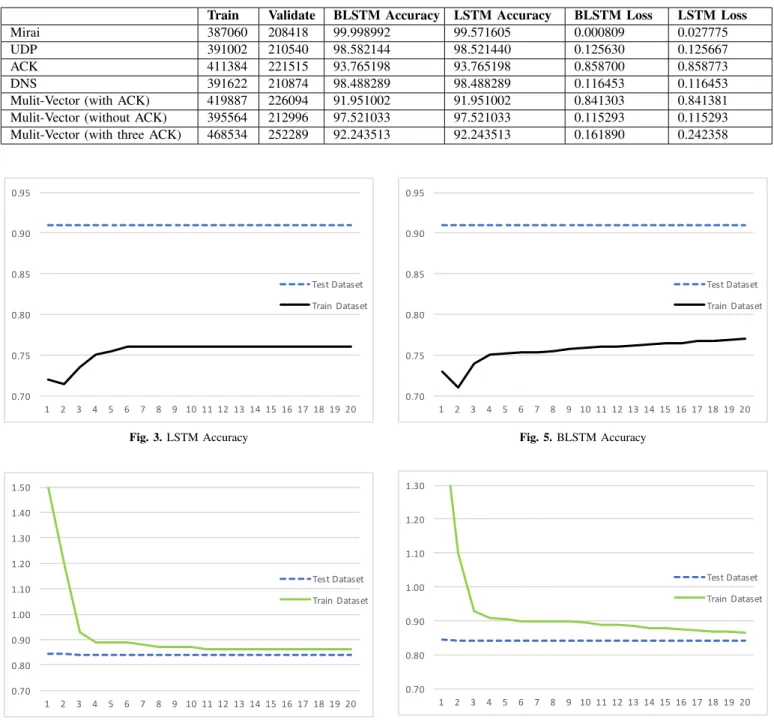
validate, presented to each model and trained over a total of 20 iterations. The mean accuracy and loss metrics for each attack were measured, and are presented in Table V. As can be seen from the results, both models returned high accuracy and
pre-diction formirai,udp, anddnsattack types. However, returned
less favourable results for ack attacks, despite this attack
having the highest number of samples. This was possibly due
to the nature and complexity of information in theinfofeature,
as seen in Table IV, where the sequence numbers in eachack
packet changed. Despite this, a pattern can however be seen
on rows one and two, where sequence numbers(59693-41058,
41058-59693)of contiguous packets were clearly linked, and packet size and Length were consistent. Unfortunately some packets appeared out of sync as can been in rows three and four, and possibly resulted in the detection model not recognising this pattern, contributing to the lower detection rate, and significantly higher loss metric. By contrast, although the mirai captured packets in Table III appear to be equally
complex, the information in theinfofeature, remained largely
the same, possibly aiding better detection.
Since multi-vector DDoS attacks were highlighted as being
TABLE V.Detection Accuracy and Loss
Train Validate BLSTM Accuracy LSTM Accuracy BLSTM Loss LSTM Loss
Mirai 387060 208418 99.998992 99.571605 0.000809 0.027775 UDP 391002 210540 98.582144 98.521440 0.125630 0.125667 ACK 411384 221515 93.765198 93.765198 0.858700 0.858773 DNS 391622 210874 98.488289 98.488289 0.116453 0.116453 Mulit-Vector (with ACK) 419887 226094 91.951002 91.951002 0.841303 0.841381 Mulit-Vector (without ACK) 395564 212996 97.521033 97.521033 0.115293 0.115293 Mulit-Vector (with three ACK) 468534 252289 92.243513 92.243513 0.161890 0.242358
0.70 0.75 0.80 0.85 0.90 0.95 1 2 3 4 5 6 7 8 9 10 11 12 13 14 15 16 17 18 19 20 Test Dataset Train Dataset Fig. 3.LSTM Accuracy 0.70 0.80 0.90 1.00 1.10 1.20 1.30 1.40 1.50 1 2 3 4 5 6 7 8 9 10 11 12 13 14 15 16 17 18 19 20 Test Dataset Train Dataset Fig. 4.LSTM Loss
mirai,udp,dns, andackcaptures being concatenated to form a multi-vector attack scenario. Results on row 5 of Table V show
the impact of the ackattack on the overall detection accuracy
and particularly loss metrics. To validate this observation,
Experiment 3consisted ofnorm,mirai,udp, anddnscaptures being concatenated to form a multi-vector attack scenario,
minus the ack attack. Results on row 6 of Table V show that
once theackattack is removed, overall detection accuracy and
prediction of the model are very good. A final validation of this
observation was conducted inExperiment 4which consisted of
threeackattacks were performed during the same time frame,
increasing the total sample size of ack attacks, in order to
0.70 0.75 0.80 0.85 0.90 0.95 1 2 3 4 5 6 7 8 9 10 11 12 13 14 15 16 17 18 19 20 Test Dataset Train Dataset Fig. 5.BLSTM Accuracy 0.70 0.80 0.90 1.00 1.10 1.20 1.30 1 2 3 4 5 6 7 8 9 10 11 12 13 14 15 16 17 18 19 20 Test Dataset Train Dataset Fig. 6.BLSTM Loss
observe the variation in accuracy and prediction.
Row 7 of Table V shows an increase in sample size, im-proves the overall validation accuracy to 92%, with BLSTM-RNN returning the better loss metric, meaning this model was able to better predict attack traffic, when presented with a larger sample size.
Fig. 3 through to Fig. 6 show accuracy and loss metrics for the detection models. Although metric results are comparable, and the bidirectional approach adds overhead to each epoch, increases processing time, the trajectory shows a better pro-gressive model over time. A larger dataset with more samples, could further demonstrate the benefit of BLSTM-RNN.
VI. CONCLUSIONS ANDFUTUREWORK
This paper presents the implementation of deep learning using a Bidirectional Long Short Term Memory Recurrent Neural Network (BLSTM-RNN), in conjunction with Word Embedding for botnet detection. The model was compared to a unidirectional LSTM-RNN to ascertain if the accumulation of contextual information from both past and future used by the BLSTM-RNN, could return better accuracy or loss metrics for our captured dataset. Both models returned high accuracy and low loss metrics for the four attack vectors used by the
mirai botnet malware. Results for mirai, udp, and dns were very encouraging with 99%, 98%, 98% validation accuracy and 0.000809, 0.125630, 0.116453 validation loss metrics
respectively. The ack attack vector metrics were shown to be
less favourable, but the paper showed that a larger sample size could improve accuracy and reduce loss. The positive results demonstrate the effectiveness of our novel application of deep learning for botnet detection in the IoT. By focusing detection at the packet level, and using text recognition on features normally discarded, we have demonstrated that the limitations of existing specification or flow based detection methods, can be overcome. Furthermore, although the bidirectional approach adds overhead to each epoch, and increases processing time, it appears to be a better progressive model over time
Several avenues for future research have been identified. Firstly a second more comprehensive dataset will be generated,
incorporating all ten attack vectors used by the mirai botnet
malware. To demonstrate the ability of our developed model to detect new variations of botnets, a mutated version of the
miraisource code will be used to generate a third dataset, and will be compared against existing signature and flow based anomaly detection methods. Having successfully demonstrated a solution to the detection problem presented in Section I, we will also further investigate ways to improve situational aware-ness of botnet activity within the IoT. By helping consumers become aware when their device is infected, we hope to raise awareness of the inherent vulnerabilities, and aid them to make better choices in the future, with regard to procurement, and operation of such devices.
The generated mirai botnet dataset has been made public
and is available upon request. REFERENCES
[1] M. Aazam, M. St-Hilaire, C.-H. Lung, I. Lambadaris,
and E.-N. Huh,IoT Resource Estimation Challenges and
Modeling in Fog. Springer International Publishing, 2018, pp. 17–31.
[2] L. Atzori, A. Iera, and G. Morabito, “The Internet of
Things: A survey,”Computer Networks, vol. 54, no. 15,
pp. 2787 – 2805, 2010.
[3] A. Mosenia and N. K. Jha, “A comprehensive study
of security of internet-of-things,”IEEE Transactions on
Emerging Topics in Computing, vol. 5, no. 4, pp. 586– 602, Oct 2017.
[4] C. D. McDermott and A. V. Petrovski, “Investigation of computational intelligence techniques for intrusion
detec-tion in wireless sensor networks,” International Journal
of Computer Networks and Communications (IJCNC), vol. 9, no. 4, pp. 45–56, 2017.
[5] S. Moganedi and J. Mtsweni, “Beyond the convenience of the internet of things: Security and privacy concerns,” in 2017 IST-Africa Week Conference (IST-Africa), May 2017, pp. 1–10.
[6] Akami. (2017) Threat Advisory Internet of Things and the Rise of 300 Gbps DDoS Attacks. [Online]. Available: https://www.akamai.com
[7] Verisign, “Verisign distributed denial of service trends
report,” Computer Networks, vol. 4, 2017.
[8] B. Krebs. (2016) KrebsOnSecurity Hit
With Record DDoS. [Online]. Available:
https://krebsonsecurity.com/2016/09/krebsonsecurity-hit-with-record-ddos/
[9] S. Hilton. (2016) The DDoS that didn’t break the camel’s
VAC. [Online]. Available:
https://dyn.com/blog/dyn-analysis-summary-of-friday-october-21-attack/
[10] J. A. Jerkins, “Motivating a market or regulatory solution
to iot insecurity with the mirai botnet code,” in 2017
IEEE 7th Annual Computing and Communication Work-shop and Conference (CCWC), Jan 2017, pp. 1–5. [11] C. Kolias, G. Kambourakis, A. Stavrou, and J. Voas,
“Ddos in the iot: Mirai and other botnets,” Computer,
vol. 50, no. 7, pp. 80–84, 2017.
[12] H. HaddadPajouh, A. Dehghantanha, R. Khayami, and K.-K. R. Choo, “A deep recurrent neural network based approach for internet of things malware threat hunting,”
Future Generation Computer Systems, vol. 85, pp. 88 – 96, 2018.
[13] A. A. Diro and N. Chilamkurti, “Distributed attack detec-tion scheme using deep learning approach for Internet of
Things,”Future Generation Computer Systems, pp. 1–5,
2017.
[14] F. A. Teixeira, F. M. Pereira, H.-C. Wong, J. M. Nogueira, and L. B. Oliveira, “SIoT: Securing Internet of Things
through distributed systems analysis,”Future Generation
Computer Systems, 2017.
[15] A. Castiglione, R. D. Prisco, A. D. Santis, U. Fiore, and F. Palmieri, “A botnet-based command and control
approach relying on swarm intelligence,” Journal of
Network and Computer Applications, vol. 38, pp. 22 – 33, 2014.
[16] P. Torres, C. Catania, S. Garcia, and C. G. Garino, “An analysis of Recurrent Neural Networks for Botnet
detection behavior,” in2016 IEEE Biennial Congress of
Argentina (ARGENCON), June 2016, pp. 1–6.
[17] P. Wang, Y. Qian, F. Soong, L. He, and H. Zhao, “A unified tagging solution: Bidirectional lstm recurrent
neural network with word embedding,” ArXiv e-prints,
Nov 2015.
[18] A. Ray, S. Rajeswar, and S. Chaudhury, “Text recognition
using deep blstm networks,” in 2015 Eighth
Interna-tional Conference on Advances in Pattern Recognition (ICAPR), Jan 2015, pp. 1–6.