Exact Learning of Lightweight Description Logic Ontologies
Boris Konev [email protected]
Department of Computer Science University of Liverpool, United Kingdom
Carsten Lutz [email protected]
Department of Computer Science University of Bremen, Germany
Ana Ozaki [email protected]
Department of Computer Science University of Liverpool, United Kingdom
Frank Wolter [email protected]
Department of Computer Science University of Liverpool, United Kingdom
Editor:
Abstract
We study the problem of learning description logic (DL) ontologies in Angluin et al.’s frame-work of exact learning via queries. We admit membership queries (“is a given subsumption entailed by the target ontology?”) and equivalence queries (“is a given ontology equivalent to the target ontology?”). We present three main results: (1) ontologies formulated in (two relevant versions of) the description logic DL-Lite can be learned with polynomially many queries of polynomial size; (2) this is not the case for ontologies formulated in the description logic EL, even when only acyclic ontologies are admitted; and (3) ontologies formulated in a fragment of ELrelated to the web ontology language OWL 2 RL can be learned in polynomial time. We also show that neither membership nor equivalence queries alone are sufficient in cases (1) and (3).
Keywords: Exact Learning, Description Logic, Complexity
1. Introduction
In many subfields of artificial intelligence, ontologies are used to provide a common vo-cabulary for the application domain of interest and to give a meaning to the terms in the vocabulary, and to describe the relations between them. Description logics (DLs) are a prominent family of ontology languages with a long history that goes back to Brach-man’s famous knowledge representation system KL-ONE in the early 1980s (Brachman and Schmolze, 1985). Today, there are several widely used families of DLs that differ in expres-sive power, computational complexity, and intended application. The most important ones are the ALC family which aims at high expressive power, the EL family (Baader et al., 2005) which aims to provide scalable reasoning, and the DL-Lite family (Calvanese et al., 2007; Artale et al., 2009) which is tailored specifically towards applications in data access. In 2004, the World Wide Web Committee (W3C) has standardised a DL of theALCfamily
as an ontology language for the web, called OWL. The standard was updated to OWL 2 in 2009, and since then comprises a family of five languages including the OWL 2 profiles OWL 2 EL, OWL 2 QL, and OWL 2 RL. While OWL 2 EL is based on EL and OWL 2 QL on DL-Lite, OWL 2 RL is closely related to the fragment of EL that is obtained by allowing only concept names on the right-hand side of concept inclusions. In this paper we study DLs from the ELand DL-Lite families.
Designing an ontology for an application domain is a subtle, error-prone, and time consuming task. From its beginnings, DL research was driven by the aim to provide var-ious forms of support for ontology engineers, assisting them in the design of high-quality ontologies; examples include the ubiquitous task of ontology classification (Baader et al., 2017), reasoning support for debugging ontologies (Wang et al., 2005; Schlobach et al., 2007), support for modular ontology design (Stuckenschmidt et al., 2009), and checking the completeness of the modelling in a systematic way (Baader et al., 2007). The same aim is pursued by the field of ontology learning, where the goal is to use machine learning tech-niques for various ontology engineering tasks such as to identify the relevant vocabulary of the application domain (Cimiano et al., 2010; Wong et al., 2012), to learn an initial version of the ontology that is then refined manually (Borchmann and Distel, 2011; Ma and Distel, 2013; Jim´enez-Ruiz et al., 2015), and to learn concept expressions as building blocks of an ontology (Lehmann and Hitzler, 2010); see the recent collection (Lehmann and V¨olker, 2014) and the related work section at the end of the paper for details.
In this paper we concentrate on learning the full logical structure of a description logic ontology. Our starting point is the observation that building a high-quality ontology relies on the successful communication between an ontology engineer and a domain expert because the former is typically not sufficiently familiar with the domain and the latter is rarely an expert in ontology engineering. We study the foundations of this communication process in terms of a simple communication model and analyse, within this model, the complexity of constructing a correct and complete domain ontology. Our model rests on the following assumptions:
1. The domain expert has perfect knowledge of the domain, but is not able to formalise or communicate the target ontologyO to be constructed.
2. The domain expert is able to communicate the vocabulary (predicate symbols, which in the case of DLs take the form of concept and role names) of O and shares it with the ontology engineer. The ontology engineer knows nothing else about the domain. 3. The ontology engineer can pose queries to the domain expert which the domain expert
answers truthfully. The main queries posed by the ontology engineer are of the form “Is the concept inclusionC vD entailed byO?”
4. In addition, the ontology engineer needs a way to find out whether the ontology H that has been constructed so far, called the hypothesis ontology, is complete. If not, he requests an example illustrating the incompleteness. The engineer can thus ask:
“Is the ontologyHcomplete? If not, then return a concept inclusionC vD entailed byO but not by H.”
We are then interested in whether the target ontologyOcan be constructed with only poly-nomially many queries of polynomial size (polynomial query learnability) or, even better, with overall polynomial time (polynomial time learnability). In both cases, the polynomial is in the size of the ontology to be constructed plus the size of the counterexamples returned by the domain expert. Without taking into account the latter, one can never expect to achieve polynomial time learnability because the domain expert could provide unnecessar-ily large counterexamples. Note that polynomial time learnability implies polynomial query learnability, but that the converse is false because polynomial query learnability allows the ontology engineer to run computationally costly procedures between posing queries.
The above model is an instance of Angluin et al.’s framework of exact learning via queries (Angluin, 1987b). In this context, the queries mentioned in Point 3 above are called membership queries. The queries in Point 4 are a form ofequivalence queries. In Angluin’s framework, however, such queries are slightly more general:
“Is the hypothesis ontology H equivalent to the target ontology O? If not, then return a concept inclusion C vD entailed by O but not by H (apositive counterexample) or vice versa (anegative counterexample).”
In our upper bounds (that is, polynomial learnability results), we admit only queries of the more restricted form in Point 4 above: the learning algorithm is designed in a way so that the hypothesis ontology His a consequence of the target ontology Oat all times, and thus the only meaningful equivalence query is a query of the form “Is H already complete?”. Our lower bounds (results saying that polynomial learnability is impossible), in contrast, apply to unrestricted equivalence queries, that is, they do not assume that the hypothesis is implied by the target. In this way, we achieve maximum generality.
Within the setup outlined above, we study the following description logics:
(a) DL-Lite∃R, which is a member of the DL-Lite family that admits role inclusions and allows nested existential quantification on the right-hand side of concept inclusions; (b) the extension DL-Lite∃R,horn of DL-Lite∃R with conjunction on the left-hand side of
concept inclusions;
(c) the basic memberEL of the ELfamily;
(d) the fragment ELlhs of EL where only concept names (but no compound concept ex-pressions) are admitted on the right-hand side of concept inclusions.
We remark that DL-Lite∃Ris closely related to OWL 2 QL, which is based on the fragment of DL-Lite∃R that does not allow nested existential quantification on the right-hand side of concept inclusions. In this more restricted case, though, polynomial learnability is uninter-esting. In fact, the number of concept inclusions formulated in a fixed finite vocabulary Σ is bounded polynomially in the size of Σ instead of being infinite as in the description logics studied in this paper; consequently, TBoxes are trivially learnable in polynomial time, even when only membership queries (but no equivalence queries) are available or vice versa. The extension DL-Lite∃R,horn of DL-Lite∃R is not part of the OWL 2 QL standard, but admitting conjunctions on the left-hand side of concept inclusions is a useful and widely considered
ELrhs ELlhs DL-Lite∃R,horn DL-Lite∃R
EL
Polynomial query learnable Polynomial time learnable Not polynomial query learnable
Figure 1: Summary of main results
extension of basic DL-Lite dialects, see for example (Artale et al., 2009). ELlhs is a
signifi-cant part of the OWL 2 RL language and can be viewed as a natural fragment of Datalog. An even better approximation of OWL 2 RL would be the extension ofELlhs with inverse roles, but polynomial learnability in that language remains an open problem. And finally, unrestrictedEL can be viewed as a logical core of the OWL 2 EL language.
After introducing preliminaries in Section 2, we study exact learning of DL-Lite∃R on-tologies in Section 3, establishing polynomial query learnability. We strengthen this result to DL-Lite∃R,horn in Section 4, using a significantly more subtle algorithm. It remains open whether DL-Lite∃R and DL-Lite∃R,horn admit polynomial time learnability. Our algorithms do not yield such a stronger result since they use subsumption checks to analyse counterex-amples provided by the oracle and to integrate them into the current hypothesis ontology, and subsumption isNP-complete in these DLs (Kikot et al., 2011). In Section 5, we show
that ELlhs ontologies are learnable in polynomial time, a result that extends the known polynomial time learnability of propositional Horn formulas (Angluin et al., 1992), which correspond to EL ontologies without existential restrictions. In fact, our algorithms take inspiration from learning algorithms for propositional Horn formulas and combine the un-derlying ideas with modern concepts from DL such as canonical models, simulations, and products. The algorithm forELlhs also uses subsumption checks, which in this case does not get in the way of polynomial time learnability since subsumption in ELlhs can be decided
in polynomial time.
In Section 6, we then establish that EL ontologies are not polynomial query learnable. Note that the fragment ELrhs of EL, which is symmetric to ELlhs and only admits concept names on the left-hand side of concept inclusions is a fragment of DL-Lite∃R. Together, our upper bounds for DL-Lite∃R and ELlhs thus establish that failure of polynomial query learnability of EL ontologies is caused by the interaction between existential restrictions on the left- and right-hand sides of concept inclusions. Interestingly, our result already applies to acyclic EL TBoxes, which disallow recursive definitions of concepts and are of a rather restricted syntactic form. However, the result does rely on concept inclusions as counterexamples that are of a form not allowed in acyclic TBoxes. We also show that ontologies formulated in DL-Lite∃R,horn and in ELlhs are neither polynomial query learnable with membership queries alone nor with equivalence queries alone; corresponding results for propositional Horn formulas can be found in (Frazier and Pitt, 1993; Angluin et al., 1992; Angluin, 1987a), see also (Arias and Balc´azar, 2011). Figure 1 summarises the main results obtained in this paper.
In Section 7 we provide an extensive discussion of related work on the exact learning of logical formulas and theories, and we close the paper with a discussion of open problems. A small number of proofs are deferred to an appendix.
2. Preliminaries
We introduce the description logics studied in this paper, then consider a representation of concept expressions in terms of labelled trees and show how important semantic notions such as subsumption between concept expressions can be characterised by homomorphisms between the corresponding trees. This also involves introducing canonical models, which are an important tool throughout the paper. Finally, we formally introduce the framework of exact learning.
2.1 Description Logics
LetNCbe a countably infinite set ofconcept names(denoted by upper case lettersA,B, etc)
and letNR be a countably infinite set ofrole names disjoint fromNC (denoted by lower case
lettersr,s, etc). Concept and role names can be regarded as unary and binary predicates, respectively. In description logic, constructors are used to define compound concept and role expressions from concept and role names. In this paper, the only role constructor is the inverse role constructor: forr∈NR, the expressionr−is theinverse roleofr. Semantically,
r− represents the converse of the binary relation r. Arole expression is a role name or an inverse role. We set r− := s if r = s− for a role name s. For brevity, we will typically speak ofroles rather than of role expressions. The concept constructors used in this paper are >(everything), u(conjunction), and ∃r.C (qualified existential restriction). Formally, concept expressions C are defined according to the following syntactic rule:
C, D := > | A | CuD | ∃r.C
whereAis a concept name andris a role. For example,∃hasChild.> u ∃gender.Maledenotes the class of individuals who have a child and whose gender is male.
Terminological knowledge is captured by finite sets of inclusions between concept ex-pressions or roles. Specifically,
• a concept inclusion (CI) takes the form C vD, where C and Dare concept expres-sions, and
• a role inclusion (RI) takes the form rvs, wherer and sare roles.
An ontology or TBox is a finite set of CIs and RIs.1 We use C ≡ D as an abbreviations for the two CIsC vDand DvC and likewise forr ≡s; we speak ofconcept equivalences (CEs) and role equivalences (REs), respectively.
1. In the description logic literature, CIs of the form introduced here are often calledELICIs to distinguish them from CIs that use concept expressions formulated in other description logics. The TBoxes are called
Example 1 Consider the following TBox:
Prof v ∃supervisor of.Studentu ∃conduct research.> (1)
Graduate ≡ ∃has degree.> (2)
GraduateStudent ≡ StudentuGraduate (3)
GraduateStudent v ∃supervisor of−.Prof (4)
supervisor of v advisor of (5)
CS Graduate ≡ ∃has degree.CS Degree (6)
The CI in Line 1 states that every professor supervises students and conducts research. Notice that we do not specify the specific area of research, hence we use an unqualified existential restriction of the form ∃r.>. The CE in Line 2 defines a graduate as anyone who has a degree. The CE in Line 3 defines a graduate student as a student who is a graduate. The CI in Line 4 states that graduate students are supervised by professors. Notice that we use the inverse role of supervisor of here. Line 5 shows an RI which states that every supervisor is an advisor. The CE in the last line defines a computer science graduate as someone with a degree in computer science.
A signature is a set of concept and role names and we use ΣT to denote the signature of the TBox T, that is, the set of concept and role names that occur in it. The size |C| of a concept expression C is the length of the string that represents C, where concept names and role names are considered to be of length one. Thesize |T | of a TBox T is defined as
P
CvD∈T |C|+|D|.
The semantics of concept expressions and TBoxes is defined as follows (Baader et al., 2017). An interpretation I = (∆I,·I) is given by a non-empty set ∆I (the domain of I) and a mapping ·I that maps every concept name A to a subset AI of ∆I and every role name r to a subset rI of ∆I ×∆I. The interpretation rI of an inverse role r = s− is given byrI ={(d, d0)|(d0, d)∈sI}and the interpretation CI of a concept expression C is defined inductively by
>I = ∆I (C1uC2)I = C1I ∩C
I
2
(∃r.C)I = {d∈∆I |there existsd0∈CI with (d, d0)∈rI}.
An interpretationI satisfies a concept expression C ifCI is not empty. It satisfies the CI C v D if CI ⊆ DI, written as I |= C v D. Similarly, I satisfies RI r v s if rI ⊆ sI, written as I |= r v s. I is a model of a TBox T if it satisfies all CIs and RIs in T. A TBox T entails a CI or RI α, in symbols T |= α, if α is satisfied in every model of T. Concept expressionsC and Dare equivalent w.r.t.T, writtenT |=C≡D, ifT |=CvD and T |=DvC; equivalence of roles r and s is defined accordingly, written T |= s ≡ r. TBoxes T and T0 are logically equivalent, in symbolsT ≡ T0, if T |=α for allα ∈ T0 and vice versa.
Prof Stud Grad Grad Stud Grad CS Grad CS Deg has deg sup of adv of has deg con res d3 d2 d5 d1 d0 d4
Figure 2: Illustration to Example 2.
Example 2 Consider the TBox T from Example 1 and the interpretation I that is illus-trated in Figure 2 and defined by setting ∆I ={d0, . . . , d5} and
ProfI = {d2}, conduct researchI = {(d2, d3)}
StudentI = {d4}, supervisor ofI = {(d2, d4)},
Graduate StudentI = {d4}, advisor ofI = {(d2, d4)},
GraduateI = {d4, d0}, has degreeI = {(d4, d5),(d0, d1)},
CS GraduateI = {d0}, CS DegreeI = {d1}.
It is easy to see that I is a model of T. Moreover, I 6|= Graduate v CS Graduate as GraduateI ={d4, d0} but CS GraduateI ={d0}, thus T 6|=GraduatevCS Graduate. It can
be shown that T |=CS GraduatevGraduate.
It isExpTime-complete to decide, given a TBoxT and a concept inclusionCvD, whether
T |=CvD(Baader et al., 2008); this reasoning problem is known assubsumption. Because of this high complexity, the profiles of OWL 2 are based on syntactically more restricted description logics in which subsumption is less complex. We next introduce a few relevant such logics. A basic concept is a concept name or a concept expression of the form ∃r.>, wherer is a role. For example,∃hasChild−.>is a basic concept, but∃hasChild−.Graduateis not.
DL-Lite∃R. ADL-Lite∃R CI takes the form
B vC
where B is a basic concept and C is a concept expression. A DL-Lite∃R inclusion is a DL-Lite∃R CI or an RI. ADL-Lite∃R TBox is a finite set of DL-Lite∃R inclusions.
Example 3 Lines (1), (4), and (5) of Example 1 are DL-Lite∃R inclusions and Line (2) abbreviates the two DL-Lite∃R CIs Graduate v has degree.> and has degree.> v Graduate. Lines (3)and (6) do not fall within DL-Lite∃R.
DL-Lite∃R,horn. In the extension DL-Lite∃R,horn of DL-Lite∃R, CIs take the form B1u · · · uBnvC
whereB1, . . . , Bn are basic concepts andC is a concept expression. ADL-Lite∃R,horn TBox
T is a finite set of DL-Lite∃R,horn CIs and RIs. Both DL-Lite∃R and DL-Lite∃R,horn have been
Example 4 As Lines (1), (2), (4) and (5) from Example 1 fall within DL-Lite∃R, they also fall within DL-Lite∃R,horn. Line (3) falls within DL-Lite∃R,horn. Line (6) is not in DL-Lite∃R,horn.
EL. An EL concept expression is a concept expression that does not use inverse roles. An EL concept inclusion is a CI of the form
CvD
whereCandDareELconcept expressions. AnELTBox is a finite set ofELCIs. Thus,EL does neither admit role inclusions nor inverse roles. In contrast to DL-Lite∃R,horn, however, it allows existential restrictions∃r.C withC 6=>on the left-hand side of CIs.
Example 5 Inclusions (1), (2), (3) and (6) from Example 1 are EL inclusions. Inclusion (5) is not an EL inclusion.
Subsumption is NP-complete in DL-Lite∃R and in DL-Lite∃R,horn, see (Kikot et al., 2011)
for the lower bound and (Calvanese et al., 2007; Artale et al., 2009) for the upper bound. Subsumption in EL is in PTime (Baader et al., 2005) and this is still true if RIs that do
not use inverse roles are admitted in the TBox. Given a TBoxT and an RIrvs, deciding whether T |=r vs is possible in PTime in all description logics considered in this paper.
In fact,T |=r vsif, and only if, there exists a sequencer0, . . . , rnof roles such thatr =r0,
s=rn, and for everyi < neitherrivri+1 ∈ T orri−vr
−
i+1 ∈ T. Our learning algorithms
will carry out various subsumption checks as a subprocedure, as detailed later on.
2.2 Tree representation of concept expressions
To achieve an elegant and succinct exposition of our learning algorithms, it will be con-venient to represent concept expressions C as a finite directed tree TC whose nodes are labelled with sets of concept names and whose edges are labelled with roles, and to describe manipulations of concept expressions in terms of manipulations of the corresponding tree such as merging nodes, replacing subgraphs, modifying node and edge labels, etc. We gen-erally useρC to denote the root node of the treeTC. In detail,TC is defined as follows. For C=>, the tree TC has a single node dwith label l(d) =∅; if C =A, whereA is a concept name, thenTC has a single nodedwithl(d) ={A}; if C=∃r.D, thenTC is obtained from TD by adding a new rootd0 and an edge fromd0 to the rootdofTD with labell(d0, d) =r
(we then call dan r-successor of d0); if C = D1uD2, then TC is obtained by identifying
the roots ofTD1 and TD2.
Example 6 For C = Studentu ∃has degree.∃has degree−.Graduate Student, TC has three
nodes, e0, e1, e2, wheree0 is the rootρC of TC, e1 is a successor of e0 ande2 is a successor
of e1, the labelling of the nodes is given by l(e0) = {Student}, l(e1) = ∅, and l(e2) =
{Graduate Student}, and the labelling of the edges is given by l(e0, e1) = has degree and
has deg−
has deg con res sup of
Stud Grad Stud Prof Grad e0 e1 e2 e3 e4 e5
Figure 3: Illustration to Examples 6 (left) and 7 (right).
Conversely, every labelled finite directed treeT of the described form gives rise to a concept expressionCT in the following way: ifT has a single node dlabelled by {A1, . . . , An}, then CT =A1u · · · uAn (we treat>as the empty conjunction here, so ifl(d) =∅thenCT =>).
Inductively, let d be the root of T labelled with l(d) = {A1, . . . , An}, let d1, . . . , dm be the successors of d, and let l(d, d1) = r1, . . . , l(d, dm) =rm. Assume Cd1, . . . , Cdm are the
concept expressions corresponding to the subtrees of T with roots d1, . . . , dm, respectively.
Then CT =A1u · · · uAnu ∃r1.Cd1 u · · · u ∃rm.Cdm.
Example 7 LetT be the tree with roote3 labelled by{Prof}and successorse4, e5 labelled by
∅ and {Graduate}, respectively, and with edge labelling given by l(e3, e4) =conduct research
andl(e3, e5) =supervisor of. ThenCT =Profu∃conduct research.>u∃supervisor of.Graduate;
see Figure 3 (right).
In what follows, we will not always distinguish explicitly between C and its tree rep-resentation TC which allows us to speak, for example, about the nodes and subtrees of a concept expression.
One important use of the tree representation of concept expressions is that both the truth relation ‘d∈ CI’ and the entailment ‘T |=C vD’ can be characterised in terms of homomorphisms between labelled trees and interpretations. A mapping h from a tree TC corresponding to a concept expression C to an interpretation I is ahomomorphism ifA∈
l(d) implies h(d)∈AI for every concept name A and r=l(d, d0) implies (h(d), h(d0))∈rI for all role names r. The following characterisation of the truth relationd∈CI by means of homomorphisms is well-known.
Lemma 8 Let I be an interpretation, d∈∆I, and C a concept expression. Then d∈CI
if, and only if, there is a homomorphism from TC to I mapping ρC to d.
The proof is by a straightforward induction on the structure ofC, see for example Baader et al. (1999) for details.
Example 9 Consider the interpretation I from Example 2 and the tree representations of the concept expressions given in Figure 3. It can be seen that functions g and h defined as
g(e0) = d4, g(e1) = d5, g(e2) = d4 and h(e3) = d2, h(e4) = d3, h(e5) = d4 are
homomor-phisms and so, by Lemma 8, d4 ∈(Studentu ∃has degree.∃has degree−.Graduate Student)I
It is also standard to characterise the subsumption relation∅ |=C vD (that is, subsump-tion relative to the empty TBox) by means of homomorphisms between the tree representa-tionsTD andTC. Ahomomorphism hfrom labelled treeT1 to labelled treeT2 is a mapping
from the nodes of T1 to the nodes of T2 such that A ∈ l(d) implies A ∈ l(h(d)) for every
concept name Aand r =l(d, d0) impliesr =l(h(d), h(d0)) for every roler.
Lemma 10 Let C and D be concept expressions. Then ∅ |= C vD if, and only if, there is a homomorphism from TD to TC that maps ρD to ρC.
The ‘if’ direction is essentially a consequence of Lemma 8 and the fact that the composition of two homomorphisms is again a homomorphism. For the ‘only if’ direction, one can consider TC as an interpretation I and apply Lemma 8. We again refer to Baader et al. (1999) for details.
Next, we characterise subsumption in the presence of TBoxes in terms of homomor-phisms. To achieve this, we make use of the canonical model IC0,T of a concept expres-sion C0 and a TBox T. If T =∅, then we want IC0,T to beTC0 viewed as a tree-shaped interpretation which we denote byIC0 rather than byIC0,T. More precisely, the domain of IC0 is the set of nodes of TC0 and
d∈AIC0 iff A∈l(d), for all d∈∆IC0 and concept names A
(d, d0)∈rIC0 iff r=l(d, d0), for alld, d0∈∆IC0 and roles namesr
We call the root ρC0 of TC0 theroot of IC0. IfT 6=∅, thenIC0,T is obtained by extending IC0 so that the CIs in T are satisfied. For example, if T = {A v ∃r.B} and C0 = A,
then IC0 is a single node ρC0 with A
IC0 = {ρ
C0} and X
IC0 = ∅ for all concept and role
namesX distinct fromA. To define IC0,T we add a node dto ∆
IC0 and set BIC0,T ={d}
and rIC0,T ={(ρ
C0, d)}. In general,IC0,T is defined as the limit of a sequence I0,I1, . . . of interpretations, where I0 =IC0. For the inductive definition of the sequence, assume that In has been defined. Then obtainIn+1 by applying one of the following rules once:
1. if C vD∈ T and d∈CIn butd6∈DIn, then take the interpretation I
D and add it toIn by identifying its rootρC withd. In more detail, assume that ∆In∩∆IC ={d} and d=ρC and defineIn+1 by setting, for all concept names Aand role names r:
∆In+1 = ∆In∪∆IC, AIn+1 =AIn∪AIC, rIn+1=rIn∪rIC;
2. if r vs ∈ T and (d, d0) ∈ rIn but (d, d0) 6∈ sIn, then define I
n+1 as In except that sIn+1 := sIn ∪ {(d, d0)} if s is a role name; otherwise there is a role name s
0 with
s=s−0 and we defineIn+1 asIn except that s
In+1
0 =s
In
0 ∪ {(d0, d)}.
We assume that rule application is fair, that is, if a rule is applicable in a certain place, then it will indeed eventually be applied there. If for some n >0 no rule is applicable then we set In+1 =In. We obtain IC0,T by setting for all concept names Aand role names r:
∆IC0,T = [ n≥0 ∆In, AIC0,T = [ n≥0 AIn, rIC0,T = [ n≥0 rIn.
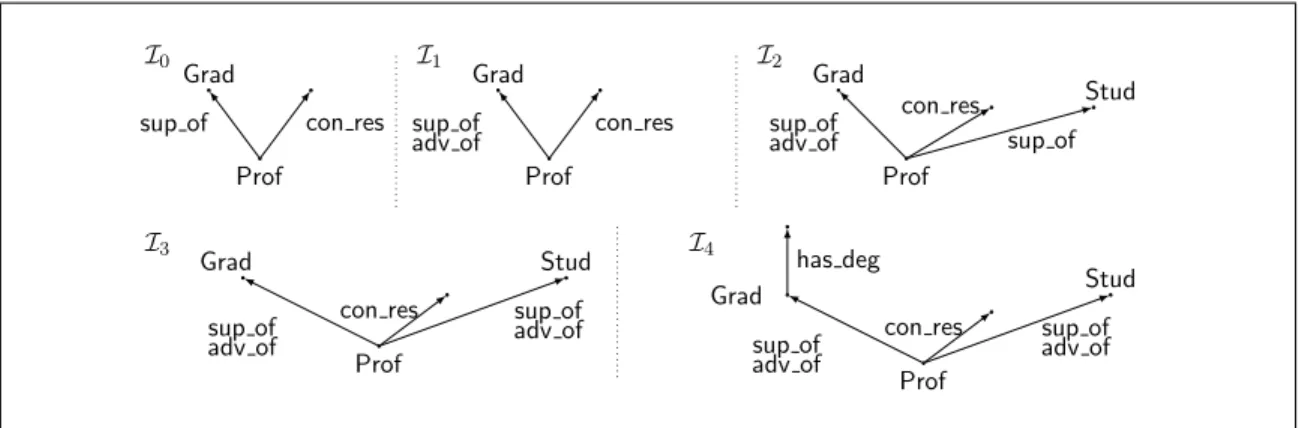
sup of con res Prof I0 Prof I1 con res sup of adv of Prof con res sup of I2 adv of sup of Stud I3 Stud sup of sup of Prof adv of con res adv of Grad Grad Grad Grad I4 adv of Grad sup of con res adv of Prof Stud sup of has deg
Figure 4: Canonical model construction for Example 11.
Note that the interpretationIC0,T obtained in the limit is tree-shaped and might be infinite.2 The following example illustrates the definition ofIC0,T.
Example 11 Consider the following TBox T:
Prof v ∃supervisor of.Student (7)
Prof v ∃conduct research.> (8)
Graduate v ∃has degree.> (9)
∃has degree.> v Graduate (10)
supervisor of v advisor of (11)
and the concept expression
C0 =Profu ∃conduct research.> u ∃supervisor of.Graduate.
Figure 4 illustrates the steps of the canonical model construction with I0 being IC0 and I4 being the canonical model IC0,T.
The following lemma provides the announced characterisation of subsumption in the pres-ence of TBoxes.
Lemma 12 Let T be a TBox and C a concept expression. Then IC,T is a model ofT and the following conditions are equivalent, for every concept expression D:
1. T |=CvD; 2. ρC ∈DIC,T;
3. there is a homomorphism from TD to IC,T that maps ρD toρC.
2. The exact shape of IC0,T depends on the order of rule applications. However, all possible resulting interpretationsIC0,T are homomorphically equivalent and, as a consequence, the order of rule application is not important for our purposes.
The proof is completely standard (see, for example, (Kr¨otzsch, 2012)), we only give a high-level overview. Using the construction of IC,T, it is not hard to show that IC,T is a model ofT and thatρC ∈CIC,T. This implies ‘1 ⇒2’ and ‘2 ⇒ 3’ follows from Lemma 8. For ‘3
⇒ 1’, one can show that for any modelI of T and anyd∈CI, there is a homomorphism fromIC,T toI that maps ρC tod. In fact, one constructs a homomorphism toI from each of the interpretations I0,I1, . . . built during the construction of IC,T, which is not hard by analysing the rules applied during that construction. The homomorphism built for each In+1 extends that forIn and thus we can take the unions of all those homomorphisms to obtain a homomorphism fromIC,T toI. It remains to compose homomorphisms and apply Lemma 8.
We are only going to use canonical models and Lemma 12 in the context of DL-Lite∃Rand DL-Lite∃R,horn. Next, we identify a more subtle property of canonical models of DL-Lite
∃ R and DL-Lite∃R,horn TBoxes that we need later on. Very roughly speaking, it states a form
of locality which is due to the fact that existential restrictions on the left-hand side of CIs in DL-Lite∃R,horn are unqualified. Assume that d∈(∃r.D)IC,T for the canonical model I
C,T of a concept expression C and TBox T. Assume d ∈ ∆IC. We know that there exists
a homomorphism h from T∃r.D to IC,T mapping ρ∃r.D to d. Then either h maps some elements ofTD into ∆IC or it maps the whole treeTD into ∆IC,T \∆IC. We are interested in the latter case. The following lemma states that if T is a DL-Lite∃R TBox, then there is a basic concept B withd∈BIC such that T |=B v ∃r.D. Thus, the question whether
d∈ (∃r.D)IC,T only depends on the concept names A with d∈ AIC and the roles r with
d ∈ (∃r.>)IC. If T is a DL-Lite∃
R,horn TBox, it might not be sufficient to take a single
basic concept but at least a set of basic concepts suffices (corresponding to the fact that DL-Lite∃R,horn admits conjunctions on the left-hand side of CIs). This observation does not hold forEL TBoxes and is ultimately the reason for the fact that one cannot polynomially learnEL TBoxes. The following example illustrates this observation.
Example 13 Consider the EL TBox T = {∃r.A v A, A v ∃r.B} and let C = ∃r.∃r.A. Then ρC ∈ (∃r.B)IC,T since T |= C v ∃r.B. We therefore find a homomorphism h from T∃r.B to IC,T mapping ρ∃r.B to ρC. This homomorphism maps TB (which has a single
node only) into ∆IC \∆IC,T. The only basic concept B with ρ
C ∈BIC is ∃r.>but clearly
T 6|=∃r.> v ∃r.B and so the observation we sketched above does not hold for EL.
We present this result in a more formal way. LetT1 andT2be trees with labelling functions
l1 and l2, respectively. We callT1 a subtree of T2 if the following conditions hold: T1 ⊆T2,
l1 is the restriction of l2 to T1, and if d ∈ T1 and d0 is a successor of d in T2, then d0
is a successor of d in T1 as well. The one-neigbourhood NIC(d) of d ∈ ∆
IC is the set of
concept names A with d ∈ AIC and basic concepts ∃r.> such that there exists d0 ∈ ∆IC
with (d, d0)∈rIC.
Lemma 14 Let T be a DL-Lite∃R,horn TBox, D = ∃r.D0 and assume h : TD → IC,T is such that h(ρD) =d∈∆IC and the image of the subtree TD0 of TD under h is included in
∆IC,T \∆IC. Then there exists I ⊆N
IC(d) such thatT |=
d
E∈IEvD. Moreover, if T is
Proof (sketch) This property of canonical models for DL-Lite∃R,horn has been proved im-plicitly in many papers, for example (Artale et al., 2009). We give a sketch. LetN be the conjunction of all E ∈ NIC(d) and assume T 6|= N v D. Consider the canonical model
IN,T. By definition, the one-neighbourhoods of ρN in IN,T and d in IC,T coincide. Now observe that the canonical model of any concept expression C0 and TBox T is obtained
from IC0 by hooking tree-shaped interpretations Id with root d to every d in IC0. As in DL-Lite∃R,horn the concept expressions on the left-hand side of CIs are basic concepts, the interpretations Id only depend on the one-neighbourhood NIC0(d) of d in IC0. Thus, the tree-shaped interpretations hooked to ρN in IN,T and to d in IC,T coincide and the homomorphism h given in Lemma 14 provides a homomorphism h :TD → IN such that h(ρD) =ρN. By Lemma 12,T |=N vD. We have derived a contradiction. For DL-Lite∃R one only requires a single member of NIC(d) since the left-hand side of CIs in DL-Lite
∃ R
consists of a single basic concept only. o
We close the introduction of description logics with some comments about the choice of our languages. In the DL literature it is not uncommon to consider the weaker variant DL-LiteR of DL-Lite∃R in which only basic concepts are admitted on the right-hand side of CIs, but compound concepts are not. This is often without loss of generality since every DL-Lite∃R TBox can be expressed in DL-LiteR by using additional role names; in this way, standard DL-Lite∃R reasoning tasks such as subsumption and conjunctive query answering can be reduced in polynomial time to the corresponding tasks for DL-LiteR. Such a reduction is not possible in the framework of exact learning that we are concerned with in this paper. In fact, in contrast to DL-Lite∃R TBoxes, TBoxes in DL-LiteR are trivially polynomial time learnable using either membership queries only or equivalence queries only as there are only polynomially many CIs and RIs over a given signature.
2.3 Exact Learning
We introduce the relevant notation for exact learning. A learning framework F is a triple (X,L, µ), whereX is a set ofexamples (also calleddomain orinstance space),Lis a set of concepts,3 and µ is a mapping from L to 2X. We say thatx∈X is apositive example for l∈ Lifx∈µ(l) and anegative example forlifx6∈µ(l).
We give a formal definition of polynomial query and time learnability within a learning framework. Let F = (X,L, µ) be a learning framework. We are interested in the exact identification of a target concept representation l ∈ L by posing queries to oracles. Let MEMF,l be the oracle that takes as input some x ∈ X and returns ‘yes’ if x ∈ µ(l) and ‘no’ otherwise. A membership query is a call to the oracle MEMF,l. Similarly, for every l∈ L, we denote byEQF,l the oracle that takes as input ahypothesis concept representation h ∈ L and returns ‘yes’ if µ(h) = µ(l) and a counterexample x ∈ µ(h)⊕µ(l) otherwise, where ⊕ denotes the symmetric set difference. There is no assumption regarding which counterexample inµ(h)⊕µ(l) is chosen by the oracle. An equivalence query is a call to the oracleEQF,l.
A learning algorithm forF is a deterministic algorithm that takes no input, is allowed to make queries to MEMF,l andEQF,l (without knowing what the targetlto be learned is), 3. The similarity of this name to ‘concept expression’ is accidental and should not be taken to mean that
and that eventually halts and outputs someh∈ Lwithµ(h) =µ(l). We say that Fisexact learnable if there is a learning algorithm for F and that F is polynomial query learnable if it is exact learnable by an algorithm A such that at every step the sum of the sizes of the inputs to membership and equivalence queries made by A up to that step is bounded by a polynomial p(|l|,|x|), where l is the target and x ∈ X is the largest counterexample seen so far (Arias, 2004). Finally, F is polynomial time learnable if it is exact learnable by an algorithm A such that at every step (we count each call to an oracle as one step of computation) of computation the time used byAup to that step is bounded by a polynomial p(|l|,|x|), where l ∈ L is the target and x ∈ X is the largest counterexample seen so far. Clearly, a learning frameworkF that is polynomial time learnable is also polynomial query learnable.
The aim of this paper is to study learnability of description logic TBoxes. In this context, each DLLgives rise to a learning framework (X,L, µ), as follows: Lis the set of all TBoxes formulated in L, X is the set of all CIs and RIs formulated in L, and µ(T) = {α ∈ X | T |= α} for every T ∈ L. Observe that µ(T) = µ(T0) iff T ≡ T0, for all TBoxes T and T0. We say thatLTBoxes are polynomial query learnable if the learning framework defined by L is polynomial query learnable, and likewise for polynomial time learnability. What does not show up directly in this representation is our assumption that the signature of the target TBox is known to the learner. Note that this is a standard assumption. For example, when learning propositional Horn formulas, it is common to assume that the variables in the target formula are known to the learner.
3. Learning DL-Lite∃R TBoxes
We prove that DL-Lite∃R TBoxes are polynomial query learnable. If inverse roles are disal-lowed in CIs and RIs of the target TBox then our algorithm runs in polynomial time and thus shows that TBoxes in this restricted language are polynomial time learnable. Without this restriction, polynomial time learnability remains open.
To simplify the presentation, we make two minor assumptions about the target TBoxT. We will show later how these assumptions can be overcomed. First, we assume thatT does not entail non-trivial role equivalences, that is, there do not exist distinct rolesrandssuch thatT |=r≡s. This allows us to avoid dealing with classes of equivalent roles, simplifying notation. The second requirement is a bit more subtle. A concept inclusion is in reduced form if it is between basic concepts or its left-hand side is a concept name. A TBoxT is in named form if all CIs in it are in reduced form and it contains a concept nameAr such that Ar ≡ ∃r.> ∈ T, for each role r. We assume that the target TBox is in named form and that all CIs considered by the learner are in reduced form. In particular, counterexamples returned by the oracle are immediately converted into this form.
Example 15 Although the TBox T from Example 11 does not entail role equivalences and all its CIs are in reduced form, it is not in named form. To fix this, we introduce concept names Asupervisor of, Aconduct research and Aadvisor of and extend T with the following
equiva-lences:
Asupervisor of ≡ ∃supervisor of.> (12)
Algorithm 1 Na¨ıve learning algorithm for DL-Lite∃R
Input: A DL-Lite∃R TBoxT in named form given to the oracle; ΣT given to the learner.
Output: TBoxH, computed by the learner, such that T ≡ H.
1: Compute Hbasic={r vs| T |=rvs} ∪ {B1 vB2 | T |=B1 vB2, B1, B2 basic}
2: SetHadd=∅
3: whileHbasic∪ Hadd6≡ T do
4: Let AvC be the returned positive counterexample for T relative to Hbasic∪ Hadd
5: if there isAvC0 ∈ Hadd then
6: ReplaceAvC0 byAvCuC0 inHadd
7: else
8: Add AvC toHadd 9: end if
10: end while
11: return H=Hbasic∪ Hadd
Aadvisor of ≡ ∃advisor of.>. (14)
Notice that Graduate acts as a name for ∃has degree.> so no new definition is needed for the role has degree. The TBox T0 =T ∪ {(12),(13),(14)} is in named form.
To develop the learning algorithm it is instructive to start with a na¨ıve version that does not always terminate but which can be refined to obtain the desired algorithm. This version is presented as Algorithm 1. Given the signature ΣT of the target TBox T, the learner starts with computing the setHbasic by posing to the oracle the membership query ‘T |=r vs?’ for all r, s∈ΣT and ‘T |=B1 vB2?’ for all basic concept B1, B2 over ΣT. Observe that T |= Hbasic. Then it enters the main while loop. Note that the condition ‘Hbasic∪ Hadd 6≡ T?’ in Line 3 is implemented using an equivalence query to the oracle, and that A vC in Line 4 refers to the counterexample returned by the oracle in the case that equivalence does not hold. The counterexample must be positive since we maintain the invariant T |=Hbasic∪ Hadd throughout the run of the algorithm. If there is no CI of the form AvC0 in Hadd then A vC is added to Hadd, otherwise AvCuC0 is (Lines 6 and 8). The algorithm terminates when Hbasic∪ Hadd≡ T, implying that the target TBox has been learned.
Example 16 For the TBoxT0 from Example 15, Algorithm 1 first computesHbasic which coincides withT0except thatProf v ∃supervisor of.Studentis not included since the concept ∃supervisor of.Studentis not basic. In the main loop the only counterexamples to Hbasic∪
Hadd≡ T0 are (up to logical equivalence moduloHbasic) the CIs
Prof v ∃supervisor of.Student, Prof v ∃advisor of.Student.
If the oracle returns the first CI in the first iteration, the algorithm terminates immediately having learned T0. Otherwise the oracle first returns the second CI and then returns the first CI in the second iteration. The algorithm terminates with
which is equivalent toT0.
We now consider five examples on which this na¨ıve algorithm fails to terminate after poly-nomially many steps (or at all), each example motivating a different modification step that is added to Algorithm 1 after Lines 4 and 5. The final, corrected algorithm is given as Algorithm 2 below. Each modification step takes as input a counterexampleAvC against the equivalence Hbasic∪ Hadd ≡ T and modifies it by posing membership queries to the oracle to obtain a CI A0 v C0 which is still a counterexample and has additional desired properties. CIs satisfying all five additional properties will be called T-essential. The five modification steps are of three different types:
1. two saturations steps: the underlying tree ofTC is left unchanged but the labelling is modified by adding concept names to node labels or replacing roles in edge labels; 2. two merging steps: nodes in the tree TC are merged, resulting in a tree with fewer
nodes;
3. a decomposition step: TC is replaced by a subtree or a subtree is removed from TC, and the concept name Aon the left-hand side might be replaced.
The saturation and merging steps do not change the left-hand sideA of the CIAvC and result in a logically stronger CI A v C0 in the sense that ∅ |= C0 v C. In contrast, the decomposition step can be regarded as a reset operation in which also the left-hand side can change and which is logically not related to A vC. We start with an example which motivates the first saturation step.
Example 17 Let
T ={Av ∃r.A} ∪ Tnf,
where Tnf ={Ar ≡ ∃r.>} ensures that T is in named form. First, Algorithm 1 computes Hbasic. Afterwards the oracle can provide for then-th equivalence query in the while loop the positive counterexample A v ∃rn+1.>, for any n ≥1 (here we set inductively ∃rm+1.>= ∃r.∃rm.> and∃r1.>=∃r.>). Thus, the algorithm does not terminate.
Informally, the problem for the learner in Example 17 is that the concepts ∃rn.> used in the counterexamplesAv ∃rn.>get larger and larger, but still none of the counterexamples implies Av ∃r.A. We address this problem by saturatingTC with implied concept names. For the following discussion, recall that we do not distinguish between the concept expression C and its tree representation TC. For example, if we say that C0 is obtained from C by adding a concept nameB to the label of nodedinC, then this stands for: C0 is the concept expression corresponding to the tree obtained fromTC by addingB to the label ofdinTC. Definition 18 (Concept saturation for T) Let A v C be a CI with T |= A v C. A CI A v C0 is obtained from A v C by concept saturation for T if T |= A vC0 and C0
is obtained from C by adding a concept name to the label of some node of C. We say that
AvC is concept saturated for T if there is no AvC0 with C 6=C0 that can be obtained from AvC by concept saturation.
Observe that the learner can compute a concept saturated AvC0 from a counterexample A v C by posing polynomially many membership queries to the oracle: it simply asks for any node d in TC and concept name E ∈ ΣT whether T |= A v CE,d, where CE,d is obtained from C by adding E to the label of d. If the answer is positive, it replaces C by CE,d and proceeds.
Example 19 (Example 17 continued) The CIs A v ∃rn.> are not concept saturated for T. For example, for n = 2, the concept saturation of A v ∃r2.> is A v AuAru ∃r.(AuAru ∃r.(AruA)). Now observe that if the CI A v C returned by the oracle to the first equivalence query is transformed by the learner into a concept saturated CI (after Line 4), then the TBox T = {A v ∃r.A} ∪ Tnf is learned in one step: the only possible counterexamples returned by the oracle to the equivalence query Hbasic ≡ T are of the form
A v C1u ∃r.C2 for some concepts C1 and C2. Concept saturation results in a concept of
the form C10 u ∃r.(AuC20) and {AvC10 u ∃r.(AuC20)} |=Av ∃r.A.
The following example motivates the second saturation step. Here and in the subsequent examples we do not transform the TBoxes into named form as this does not effect the argument and simplifies presentation.
Example 20 Consider forn≥1 the TBoxes
Tn = {Av ∃e1.∃e2. . . .∃en.>} ∪ {ei vri, eivsi |1≤i≤n}.
For M ⊆ {1, . . . , n}, set CM = ∃t1.∃t2. . . .∃tn.>, where ti = ri if i ∈ M and ti = si if
i /∈M. Then for the first 2n equivalence queries in the while loop the oracle can provide a positive counterexample AvCM by always choosing a fresh set M ⊆ {1, . . . , n}.
Intuitively, the problem for the learner in Example 20 is that there are exponentially many logically incomparable CIs that are entailed byTn but do not entailAv ∃e1.∃e2. . . .∃en.>.
A step towards resolving this problem is to replace the rolesri andsi by the roles ei in the counterexamples AvCM.
Definition 21 (Role saturation for T) Let A v C be a CI with T |= A v C. A CI
AvC0 is obtained from AvC by role saturation forT ifT |=AvC0 andC0 is obtained from C by replacing in some edge label a role r by a role s with T |=sv r. We say that
AvC is role saturated forT if there is noAvC0 with C6=C0 that can be obtained from
AvC by role saturation.
Similarly to concept saturation, the learner can compute a role saturated A v C0 from a counterexample A v C by posing polynomially many membership queries. Observe that in Example 20 the role saturation of any A vCM is A v ∃e1.∃e2. . . .∃en.>. Thus, if the
counterexampleAvCM returned by the first equivalence query is transformed into a role saturated CI, then the algorithm terminates after one step. We now introduce and motivate our two merging rules.
Example 22 Consider the TBox
r r− s s− r r− e r s e .. . h B
Figure 5: Tree representation of C{1,3} and homomorphism to ∃r.> u ∃s.> u ∃e.B.
and fix an n≥ 1. For M ⊆ {1, . . . , n}, set CM =∃t1.∃t−1.∃t2.∃t−2. . . .∃tn.∃t−n.∃e.>, where ti =r ifi∈M andti =sifi /∈M. Figure 5 (left) illustrates the concept expressionC{1,3}, assumingn= 3. By Lemma 10, T |=AvCM since there is a homomorphism h from TCM
to the labelled tree that corresponds to∃r.> u ∃s.> u ∃e.B, as shown in Figure 5. Thus, the oracle can provide for the first 2n equivalence queries a positive counterexample A vCM by always choosing a fresh setM ⊆ {1, . . . , n}.
The problem for the learner in Example 22 is similar to that in Example 20: there are exponentially many logically incomparable CIs that are entailed by T but do not entail Av ∃r.> u ∃s.> u ∃e.B. A step towards solving this problem is to merge the predecessor and successor nodes of a node if the edge labels are inverse to each other and the resulting CI is still implied by the TBox.
Definition 23 (Parent/Child Merging for T) A concept C0 is obtained from a con-cept C by parent/child merging if C0 is obtained from C by choosing nodes d, d0, d00 such that d is an r-successor of d0, and d00 is an r−-successor of d, for some role r, and then removing d00, setting l(d0) = l(d0)∪l(d00), and making every s-successor e of d00 in C an
s-successor of d0, for any role s.
Let A v C be a CI with T |= A v C. A CI A v C0 is obtained from A v C by parent/child merging if T |= A vC0 and C0 is obtained from C by parent/child merging. We say that Av C is parent/child merged for T if there is no A vC0 with C 6=C0 that can be obtained from AvC by parent/child merging.
Note that when C0 is obtained from C by parent/child merging with d0 and d00 as in Def-inition 23, then ∅ |= C0 v C. To show this, one can use Lemma 10 and the natural homomorphism hfrom TC toTC0, that is, the identity except that h(d00) =d0.
Similarly to the saturation operations, the learner can compute a parent/child merged AvC0 by posing polynomially many membership queries. In Example 22 the parent/child merging of any AvCM with∅ 6=M 6={1, . . . , n}is Av ∃r.> u ∃s.> u ∃e.>, as illustrated in Figure 6: in the first step the nodesd0 and d2 are merged, two additional merging steps
give ∃r.> u ∃s.> u ∃e.>. The following example motivates the second merging operation.
Example 24 Define concept expressionsCi by induction as follows: C1=∃r.> u ∃s.>, Ci+1 =C1u ∃e.Ci
r r− s s− r r− e d0 r r s− s r− e · · · r s e d2 d1 d0=d2 d1
Figure 6: Parent/Child Merging of C{1,3} forT
C3 e s r C3{1,2} e s r r r C3{1,3} e e r r e s s e r s
Figure 7: Tree representation of the concept expressions C3,C3{1,3} and C3{1,2}.
and let
Tn={Av ∃e.Cn}.
For M ⊆ {1, . . . , n}, set C1M = ∃r.> if 1 ∈ M and C1M = ∃s.> if 1 ∈/ M. Also, let
CiM+1 = ∃r.> u ∃e.CiM if i+ 1 ∈ M and CiM+1 = ∃s.> u ∃e.CiM if i+ 1 ∈/ M, 1 ≤ i < n. Figure 7 illustrates concept expressions of the formCn and CnM.
As an answer to the first 2n equivalence queries the oracle can compute a positive coun-terexample Av ∃e.CnM by always choosing a fresh set M ⊆ {1, . . . , n}.
To deal with this example we introduce a modification step that identifies siblings in C rather than a parent and a child.
Definition 25 (Sibling Merging for T) A concept C0 is obtained from a concept C by sibling merging if C0 is obtained from C by choosing nodes d, d0, d00 such that d0 and d00 are
r-successors of d, for some role r, and then removing d00, setting l(d0) = l(d0)∪l(d00), and making every s-successor eof d00 in TC an s-successor ofd0, for any role s.
Let AvC be a CI with T |=AvC. A CI AvC0 is obtained fromA vC by sibling merging if T |=AvC0 and C0 is obtained from C by sibling merging. We say that AvC
is sibling merged forT if there is no AvC0 withC 6=C0 that can be obtained fromAvC
by sibling merging.
It can be verified that whenC0 is obtained fromC by sibling merging, then∅ |=C0vC. In Example 24 the counterexamples AvCnM are actually sibling merged for Tn. Thus, producing a sibling merged A v C0 directly from the counterexamples returned by the oracle does not overcome the problem illustrated by the example. Instead, we apply sibling
merging after Line 5 of the algorithm: instead of adding A vCuC0 toHadd, the learner computes a sibling mergedAvDfrom this CI and adds it toHadd. For Example 24, this is illustrated in Figure 8. Clearly, after at mostn+ 1 counterexamples, the learner has added Av ∃e.Cn, as required. C5{1,2} r e e r C5{1,3} s e s r r e e r e s e r s r
Figure 8: Sibling MergingC3{1,3} and C3{1,2} forT.
Finally, we need a decomposition rule. The following variant of Example 17 illustrates that the four modification steps introduced so far do not yet lead to a polynomial learning algorithm even if they are applied both after Line 4 and after Line 5 in Algorithm 1.
Example 26 Let
T ={AvB, Bv ∃r.B}.
The oracle can provide for then-th equivalence query the positive counterexampleAvCB,n, where CB,n = AuDB,n and, inductively, DB,0 =B and DB,n+1 = Bu ∃r.DB,n, for any
n≥0. The algorithm does not terminate even with the four modification steps introduced above applied after Lines 4 and 5: the CIs A v CB,n are concept and role saturated and they are parent/child and sibling merged.
The problem illustrated in Example 26 is that so far the learning algorithm attempts to learnT without ever considering to add toHadda CI whose left-hand side isB (rather than A). To deal with this problem we introduce a ‘reset step’ that, in contrast to the previous modification steps, can lead to a different left-hand side and also to a CI that does not imply the original CI givenT, as in all previous modification steps.
Definition 27 (Decomposed CI for T) Let A vC be a CI with T |=A vC. We say that A v C is decomposed for T if for every non-root node d in C, every concept name
A0 ∈l(d), and everyr-successord0 of dinC, we haveT 6|=A0 v ∃r.C0 where C0 corresponds to the subtree of C rooted at d0.
In contrast to the previous four modification steps, the membership queries used by the learner to obtain a decomposed CI do not only depend on T but also on the hypothesis Hadd∪ Hbasic computed up to that point: starting from CI A v C, the learner takes a non-root noded inC, a concept nameA0 ∈l(d), and anr-successord0 ofdinC, and then checks using a membership query whetherT |=A0 v ∃r.C0, whereC0 is the subtree rooted atd0 inC. If the check succeeds, AvC is replaced by
(a) A0 v ∃r.C0 ifHbasic∪ Hadd6|=A0 v ∃r.C0; and otherwise by
(b) A v C|−d0↓, where C|−d0↓ is obtained from C by removing the subtree rooted in d0
r B A, B B d0 d d r B d A, B B d0 r r
Figure 9: Illustration of decomposition of CIs. Here C|−d0↓ =AuBu ∃r.B and C0=B.
Algorithm 2 The learning algorithm for DL-Lite∃R
Input: A DL-Lite∃R TBoxT in named form given to the oracle; ΣT given to the learner.
Output: TBoxH, computed by the learner, such that T ≡ H.
1: Compute Hbasic={r vs| T |=rvs} ∪ {B1 vB2 | T |=B1 vB2, B1, B2 basic}
2: SetHadd=∅
3: whileHbasic∪ Hadd6≡ T do
4: Let AvC be the returned positive counterexample for T relative to Hbasic∪ Hadd 5: Find a T-essential CI A0 vC0 such thatHbasic∪ Hadd6|=A0 vC0
6: if there isA0 vC00∈ Hadd then
7: Find T-essential CI A0 vC∗ such that ∅ |=C∗ vC00uC0 8: ReplaceA0 vC00 by A0 vC∗ inHadd
9: else
10: Add A0 vC0 toHadd 11: end if
12: end while
13: return H=Hbasic∪ Hadd
Note that{AvC|−d0↓, A0 v ∃r.C0} |=AvC.Thus, one of the CIsAvC|d−0↓andA0 v ∃r.C0
is not entailed by Hbasic∪ Hadd, and this is the CI that replaces the original CI.
In Example 26, assume that the oracle returns AvC withC =AuBu ∃r.(Bu ∃r.B) as the first counterexample. The treeTC corresponding toC is shown on the left-hand side of Figure 9. This CI is not decomposed forT: the label of node dcontainsB, the concept C0 rooted ind0 inC isB and T |=B v ∃r.B. SinceH ∪ Hadd6|=B v ∃r.B, Case (a) applies and AvB is replaced byB v ∃r.B.
This finishes the description of the modification steps. It turns out that they cure all problems with the initial version of the algorithm and enable polynomial query learnability.
Definition 28 A DL-Lite∃R CI is T-essential if it is concept saturated, role saturated, par-ent/child merged, sibling merged, and decomposed for T.
After Lines 4 and 5 of Algorithm 1, we need to make the CI currently consideredT-essential, by exhaustively applying the modification steps described above in all possible orders. The resulting refined version of the learning algorithm is shown as Algorithm 2. We next analyse the properties of this algorithm.
Polynomial Query Bound on the Algorithm
If Algorithm 2 terminates, then it obviously has found a TBoxHbasic∪ Haddthat is logically equivalent to T. It thus remains to show that the algorithm terminates after polynomially many polynomial size queries. Observe that Hadd contains at most one CI AvC for each concept nameA. At each step in the while loop, either someA0 vC0 is added toHadd such that no CI withA0 on the left-hand side existed inHadd before (Line 10) or an existing CI A0 vC00 inHadd is replaced by a fresh CIA0vC∗ with∅ |=C∗ vC00.
We start with showing that Lines 5 and 7 can be implemented with polynomially many membership queries. The next lemma addresses Line 5.
Lemma 29 Given a positive counterexampleAvC forT relative toHbasic∪Hadd, one can construct a T-essential counterexample A0 vC0 using only polynomially many polynomial size membership queries in|C|+|T |.
Proof LetAvC be a positive counterexample forT relative toHbasic∪ Hadd and assume the five modification steps introduced above are applied exhaustively by posing membership queries to the oracle. Observe that the number of applications of modifications steps is bounded polynomially in |C| × |T |. To show this, let nC be the number of nodes in TC. Then nC00=nC0 ifA00vC00 is obtained from A0 vC0 by a concept or role saturation step
and nC00 < nC0 ifA00 vC00 is obtained fromA0 vC0 by a merging or decomposition step.
Thus, the number of applications of merging and decomposition steps is bounded by nC and the number of applications of concept and role saturated steps is bounded by|ΣT| ×nC and |ΣT| ×n2C, respectively. Thus, after at most nC +|ΣT| ×nC +|ΣT| ×n2C steps no modification step is applicable and the final CI is T-essential. We verify that it is also a positive counterexample for T relative to Hbasic∪ Hadd. It suffices to show that the CI resulting from each single modification step is entailed byT, but not byHbasic∪ Hadd. The former has been shown when we introduced the modification steps. Regarding the latter, in the first four modification steps we haveHbasic |=C0 vC ifAvC is replaced by AvC0. Hence Hbasic∪ Hadd 6|=AvC0. For the decomposition step, we have already argued, after Definition 27, that the added CI is not entailed byHbasic∪ Hadd. o
The following lemma addresses Line 7.
Lemma 30 Assume that A vC1 and AvC2 are T-essential. Then one can construct a
T-essential A v C such that ∅ |= C v C1uC2 using polynomially many polynomial size
membership queries in |C1|+|C2|.
Proof We start with A vC1uC2. Using the fact that C1 and C2 are both T-essential,
one can show that this CI is (i) concept saturated for T, (ii) role saturated for T, (iii) parent/child merged for T, and (iv) decomposed for T. Assume, for example, that A v
C1uC2 is not concept saturated. Then one can add a new concept name A0 to the label
l(d) for some noded inTC1uC2 and T |=AvC
0 for the resulting concept C0. Clearly dis a node inTC1 or in TC2. Assume without loss of generality that dis in TC1 and let C
0
1 be
the concept obtained from C1 by adding A0 tol(d). Then T |=AvC10 sinceT |=AvC0
which contradicts the assumption that A vC1 is concept saturated. The remaining three
step ‘Sibling merging forT’ and use the resulting CI as the desiredAvC. Similarly to the argument above one can show that a CI with properties (i)–(iv) still has those properties after applying sibling merging. Thus,AvCisT-essential. We have argued in the proof of Lemma 29 already that the number of applications of a sibling merging step to a CI of the form AvDis bounded by the number of nodes in TD. Thus, the number of modification
steps is bounded polynomially in|C1|+|C2|. o
To analyse the algorithm further we first prove a polynomial upper bound on the size of T-essential CIs. To this end, we require the notion of an isomorphic embedding and an auxiliary lemma. A homomorphism h : TC → I is an isomorphic embedding for T if it is injective, A ∈ l(d) if h(d) ∈ AI for all concept names A, and for r = l(d, d0) it holds that T |=r vs for all (h(d), h(d0))∈ sI. The following lemma shows that for T-essential CIs A v C and any D that interpolates between A and C (meaning that T |= A v D and T |=D vC) the homomorphism h from TC to ID,T that witnesses ρD ∈ CID,T (see Lemma 12) is an isomorphic embedding.
Lemma 31 Assume the A vC is T-essential, T |= Av D and T |=D vC. Then any homomorphism h:TC → ID,T that maps ρC toρD is an isomorphic embedding.
Proof Assume first thath is not injective. Then there is a parent/child or sibling merging C0 of C and a homomorphism f :TC0 → ID,T such that h =f ◦g for the natural
homo-morphism g :TC → TC0. By Lemma 12, T |= D vC0. Thus, T |= A v C0 and we have
derived a contradiction to the assumption that C is parent/child and sibling merged. Now letT0be the following labelled tree: the nodes inT0 are the same as inT,A∈l0(d) iff h(d) ∈ AID,T, and for any two nodes d, d0 with d0 a successor of d: l0(d, d0) = r for the
unique roler withT |=rvsfor allswith (d, d0)∈sID,T. LetC0 be the concept expression
that corresponds to T0. Then ρD ∈ C0ID,T and so, by Lemma 12, T |= D v C0. Thus
T |=AvC0. But thenAvC0 can be obtained fromAvCby concept and role saturation steps. As A vC is concept and role saturated already, C =C0 and soh is an isomorphic
embedding. o
We are now able to prove that T-essential CIs are of polynomial size in T. Let nC denote the number of nodes in the tree representationTC of C and let
AT ={A} ∪ {B |AvB ∈ Hbasic} ∪ {D| T |=AvB, BvD∈ T }.
Lemma 32 If AvC isT-essential, then nC ≤ X
D∈AT nD.
Proof Assume A v C is T-essential. Let D0 := dD∈AT D and ID0,T be the canonical model ofD0 and T. By Lemma 12, there is a homomorphism h:TC → ID0,T mappingρC toρD0. By Lemma 31,his an isomorphic embedding. Using thatAvC is decomposed for T we now show that h maps TC into the restriction ofID0 to ∆
ID0 from which the lemma follows since h is injective.
For a proof by contradiction, assume that there exists d0 in TC with h(d0) 6∈∆ID0. As
In particular, the parentdof d0 inTC is mapped into ∆ID0. Letl(d, d0) =r. Observe that the whole subtree rooted ind0 must be mapped into ∆ID0,T \∆ID0 since otherwiseh would
not be injective.
Let C0 =∃r.C00, where C00 corresponds to the subtree rooted ind0 inC. By Lemma 14 there exists a basic concept B such that h(d) ∈ BID0,T and T |= B v C0. As T is in
named form there exists a concept name E with T |= E ≡ B. Thus h(d) ∈ EID0,T and
T |=EvC0. Ashis an isomorphic embedding, E∈l(d). We make a case distinction: • h(d) 6= ρD0. Then A vC is not decomposed for T since C contains an edge (d, d
0) such that E is in the node label of d, l(d, d0) = r, and T |= E v ∃r.C00. We have derived a contradiction.
• h(d) = ρD0. As h(d
0) ∈ ∆ID0,T \∆ID0, by construction of I
D0,T, there exists a CI
B0 vD∈ T withB0 a basic concept such thatρD0 ∈B ID0,T
0 and h(d0) is in the copy
of the tree-shaped interpretationID which was attached toρD0 in the construction of ID0,T. But sinceT |=AvB0 we haveD∈A
T and soρD 0 ∈D
ID0. But then, by the
construction ofID0,T, no freshID was attached toρD0 becauseDis already satisfied inID0 and we have derived a contradiction.
o We are now in the position to prove that the learning algorithm terminates after posing a polynomial number of queries.
Lemma 33 For every concept nameA, the number of replacements of a CIAvC in Hadd by a CI of the formAvC0 is bounded polynomially in |T |.
Proof All CIs AvC ever added to Hadd areT-essential. We show that when AvC is replaced with AvC0, then the number of nodes in the tree representation ofC0 is strictly larger than the number of nodes in the tree representation ofC. By Lemma 32, the number of replacements is thus bounded by P
D∈AT nD, which is polynomial in |T |.
Note that when AvC is replaced with AvC0, then ∅ |=C0 vC and ∅ 6|=C vC0. It thus suffices to establish the following.
Claim. If A v C and A v C0 are T-essential, ∅ |= C0 vC and ∅ 6|=C v C0, then TC is obtained from TC0 by removing at least one subtree.
We prove the claim. Since∅ |=C0 vC, by Lemma 12 there is a homomorphismhfrom TC to the canonical model IC0 that mapsρC toρC0. Then his also a homomorphism into the
canonical model IC0,T and thus, by Lemma 31, h is an isomorphic embedding into IC0,T.
Then, trivially,his also an isomorphic embedding intoIC0 which means thatTC is obtained
from TC0 by removing subtrees. Since ∅ 6|=C vC0, at least one subtree must in fact have
been removed. o
We have obtained the following main result of this section.
Theorem 34 DL-Lite∃RTBoxes are polynomial query learnable using membership and equiv-alence queries. Moreover, DL-Lite∃R TBoxes without inverse roles can be learned in polyno-mial time using membership and equivalence queries.
Proof Recall that our algorithm requires the target TBox to be in named form. We first show Theorem 34 under that assumption and then argue that the assumption can be dropped.
In each iteration of Algorithm 2, either a CI is added to Hadd or a CI is replaced in Hadd. Since the number of times the former happens is bounded by|ΣT|and (by Lemma 33) the number of times the latter happens is polynomial in |T |, the number of iterations of Algorithm 2 is polynomial in|T |. For polynomial query learnability of DL-Lite∃R TBoxes, it remains to show that in each iteration Algorithm 2 makes only polynomially many poly-nomial size queries in |T | and the size of the largest counterexample seen so far. We start with equivalence queries, made only in Line 3. We have already argued that the number of iterations is polynomial in |T | and thus so is the number of equivalence queries made. Regarding their size, we observe that there are at most |ΣT|2 CIs in Hbasic and at most
|ΣT|CIs inHadd, that the size of CIs inHbasic is constant and by Lemma 32 the size of CIs inHadd is polynomial in|T |. Membership queries are made only in Lines 5 and 7 for which it suffices to invoke Lemmas 29 and 30.
Now for the “moreover” part of Theorem 34. Observe that since each (membership or equivalence) query counts as one step of computation, the only potentially costly step of Al-gorithm 2 is the implementation of the decomposition step in Line 5, which relies on making subsumption checks of the formHbasic∪ Hadd|=AvC. As discussed in Section 2, deciding subsumption in DL-Lite∃R isNP-complete while in EL with role inclusions subsumption is inPTime. As DL-Lite∃R without inverse roles is a fragment ofEL with role inclusions, we obtain polynomial time learnability for TBoxes in this case.
To drop the requirement that the target TBox is in named form, we show that any polynomial (query or time) learning algorithm for TBoxes in named form can be transformed into the same kind of algorithm for unrestricted target TBoxes. In fact, the learner can use at most O(|ΣT|2) membership queries “Does T entail r v s?” to compute for every role r the class [r]T of roles s with T |= s ≡ r and choose a representative rT for this class. Then whenever some s∈[r]T is used in any counterexample returned by the oracle, it gets replaced with rT. Likewise, whenever T does not have a name for some ∃r.>, the algorithm still uses the concept name Ar in its internal representations (although they are no longer included in the signature ΣT of the target TBox) and replaces∃r.>withArin the counterexamples returned by the oracle. It also replaces each Ar with∃r.>in membership queries to the oracle and in the hypothesis used for posing equivalence queries. o
4. Learning DL-Lite∃R,horn TBoxes
We study exact learnability of TBoxes in DL-Lite∃R,horn, the extension of DL-Lite∃R that admits conjunctions of basic concepts on the left-hand side of CIs. This language is a gen-eralisation of both DL-Lite∃Rand propositional Horn logic. In fact, the algorithm we present combines the classical algorithms for propositional Horn logic (Angluin et al., 1992; Frazier and Pitt, 1993) with the algorithm for DL-Lite∃R presented in Section 3. The resulting algorithm is quite subtle and indeed this is the reason why we treated the DL-Lite∃R case separately in Section 3.
To simplify the presentation, we make the same assumptions as in Section 3 about the target TBoxT with signature ΣT. In particular, we assume that T is in named form,